A History of the County of Stafford: Volume 14, Lichfield. Originally published by Victoria County History, London, 1990.
This free content was digitised by double rekeying. All rights reserved.
'Lichfield: History to c.1500', in A History of the County of Stafford: Volume 14, Lichfield, ed. M W Greenslade (London, 1990), British History Online https://www.british-history.ac.uk/vch/staffs/vol14/pp4-14 [accessed 30 April 2025].
'Lichfield: History to c.1500', in A History of the County of Stafford: Volume 14, Lichfield. Edited by M W Greenslade (London, 1990), British History Online, accessed April 30, 2025, https://www.british-history.ac.uk/vch/staffs/vol14/pp4-14.
"Lichfield: History to c.1500". A History of the County of Stafford: Volume 14, Lichfield. Ed. M W Greenslade (London, 1990), British History Online. Web. 30 April 2025. https://www.british-history.ac.uk/vch/staffs/vol14/pp4-14.
In this section
GENERAL HISTORY
EARLY SETTLEMENT
Fragments of Mesolithic flints have been found on the high ground occupied by St. Michael's churchyard, and they may indicate the site of a flint industry. (fn. 1) Traces of Neolithic settlement have been discovered on the south side of the sandstone terrace occupied by the cathedral. (fn. 2) St. Michael's on its hill-top site may possibly have replaced a pagan sanctuary. (fn. 3) There have been scattered Romano-British finds in the city, (fn. 4) and it is possible that a burial discovered beneath the cathedral in 1751 was Romano-British. (fn. 5) The line of the Roman Ryknild Street runs through the south-east of the city, and the fact that it was built across existing fields suggests settlement in that area by the time of its construction. (fn. 6) The tradition of a massacre of Christians at Lichfield in the reign of Diocletian, 284–305, developed from a medieval fabrication and can no longer be accepted. (fn. 7)
Near the point south of the city where Ryknild Street crosses Watling Street is the site of Letocetum, the modern Wall, which originated as a 1st-century A.D. fort and developed in the 2nd century as a civilian settlement. (fn. 8) The name Letocetum represents the Celtic toponym lătocaiton, from which evolved the form luitcoit. Both words mean 'grey wood' and reflect the wooded character of the area. The name Lichfield is a compound of the Celtic luitcoit and the Anglo-Saxon feld, meaning 'common pasture'. It may simply be descriptive of the area at the time of the Anglian settlement c. 600 and mean 'common pasture in (or beside) the grey wood'. On the other hand it may indicate a Celtic settlement called Luitcoit and mean 'common pasture near (or belonging to) Luitcoit'. (fn. 9)
In the earlier or mid 7th century there was a settlement called Caer Lwytgoed ('town of the grey wood') in the area, and a battle was fought there involving the Welsh of Powys, who took extensive booty. (fn. 10) Its site is problematic. There is no evidence that Wall was inhabited later than the 5th century. It is possible that the fort and settlement of Letocetum took its name from a pre-Roman estate or administrative centre some distance away and that for local Celtic-speaking people Luitcoit remained the estate or centre. (fn. 11) There is no archaeological evidence that it was the later cathedral site. The earliest accounts of the establishment of the bishopric in 669 speak of Lichfield simply as a place (locus). (fn. 12) It may well be that in the 7th century the name Lichfield was used for an extensive area and only later came to be restricted to the cathedral and its environs.
THE ANGLO-SAXON ECCLESIASTICAL CENTRE
There is some evidence of Romano-British Christianity in the area. A bronze bowl found at Wall bears the Christian Chi-Rho monogram. (fn. 13) A stone there, also bearing the monogram, could be 4th-century; another stone is carved with a cross. (fn. 14) Bishops and monks suffered as a result of the Welsh victory at Caer Lwytgoed in the earlier or mid 7th century, (fn. 15) and there may thus have been a church or monastery in the area.
In 653 Peada, the under-king of the Middle Angles and a son of Penda, king of Mercia, became a Christian on his marriage to the daughter of Oswiu, king of Northumbria. He brought back four missionaries from Northumbria, who probably worked among the Mercians as well as the Middle Angles. In 655 Oswiu took control of Mercia, establishing Peada as king of the Southern Mercians. Diuma, one of the four missionaries, was consecrated the first bishop of the Mercians, the Lindisfaras, and the Middle Angles. (fn. 16)
In 658 Wulfhere, another son of Penda, gained control of Mercia. Bishops continued to be appointed, and Wulfhere also brought Wilfrid, bishop of York, into Mercia several times between 666 and 669 to perform episcopal functions. He gave Wilfrid land in various places, and Wilfrid established monasteria (monasteries or minsters) there. Lichfield was one of the estates so granted. Meanwhile York was held by a rival bishop, Chad, but in 669 Archbishop Theodore deposed him in favour of Wilfrid. Impressed, however, by Chad's humility, Theodore the same year gave him the vacant Mercian bishopric. Chad's predecessors had probably been peripatetic, but Lichfield, considered by Wilfrid as suitable to become an episcopal see, was duly made Chad's see. He was received with honour by Wulfhere and was installed by Theodore and Wilfrid. (fn. 17)
Several suggestions have been put forward to explain why Lichfield commended itself to Wilfrid. If there was already a church in the area, its existence could have been one reason. There may have been a Mercian royal centre in the region, perhaps at Tamworth as there was later, (fn. 18) more probably at Bury Bank (in Stone) which was known as 'Wulfecestre' in the Middle Ages. (fn. 19) Lichfield was close to Ryknild Street and Watling Street; Ryknild Street in particular was a link with the north-east and Wilfrid's diocese. Lichfield may also have been a good base for missionary work. Woden worship in the area is attested by the place names Wednesbury and Wednesfield, while Weeford, the name of a parish south-east of Lichfield, indicates the existence there of a pagan shrine. The shrine could have been associated with the tumulus called Offlow, which lay in Weeford parish to the north of Watling Street. It may have been the burial mound of the Mercian royal family when it was still pagan and thus the focus of pagan feeling to be counterbalanced by Lichfield. (fn. 20) The tumulus was important enough to give its name to the hundred of Offlow.
Chad's church probably stood on the site of the present cathedral. Stowe c. ½ mile to the north-east is traditionally the place where he preached to the people. It is probably also the site of the 'more retired dwelling place' to which he used to withdraw with a small group of companions and where he died in 672. Stowe has remained a sacred spot with its medieval church dedicated to St. Chad and its holy well bearing his name. (fn. 21) Chad was buried near the church of St. Mary, presumably the cathedral, and a considerable cult developed. In 700 a funerary church was built, probably close to the cathedral, and Chad's remains were transferred to it. (fn. 22)
Although the diocese lost its outlying parts c. 679, it remained extensive, (fn. 23) and with the growth of Mercia's power in the 8th century, culminating in the reign of Offa 757–96, Lichfield, as the ecclesiastical centre of the kingdom, grew in importance. The cathedral was the burial place probably of King Wulfhere (d. 674) and certainly of King Ceolred (d. 716). (fn. 24) In 787 at the council of Chelsea Offa removed part of the province of Canterbury from its archbishop and gave Bishop Hygeberht of Lichfield metropolitan authority over it. Pope Hadrian I confirmed the transfer in 788, and Lichfield thus became the centre of an archbishopric extending apparently from the Thames to the Humber. The new archbishop of Canterbury appointed in 793 was consecrated by Archbishop Hygeberht. (fn. 25) When Offa had Ethelbert, king of the East Angles, executed in 794, Hygeberht, with Offa's permission, buried the body in Lichfield cathedral in the presence of his clerks and deacons. (fn. 26) The province of Lichfield did not long survive Offa's death in 796. Although Hygeberht witnessed charters as archbishop at least until 799, in 802 Pope Leo III restored Canterbury's rights, and the council of Clovesho in 803 abolished the archbishopric of Lichfield. (fn. 27) In 822 Bishop Aethelwald organized the community at the cathedral as a body of 20 canons including a provost. (fn. 28)
It is possible that Lichfield cathedral was a literary centre in the 8th and 9th centuries, when Mercia appears to have been important in the world of culture. Offa in particular was praised as a patron of learning, and there were Mercians among the scholars who helped Alfred revive education in southern England in the late 9th century. (fn. 29) On the other hand no pre-Conquest text or manuscript, teacher or scholar can be linked without question to Lichfield. Even a 9th-century Old English homily on the life of St. Chad written in the Mercian dialect may have come from elsewhere. (fn. 30) A Mercian collection of pedigrees of English kings and lists of popes and English bishops, compiled c. 812, may perhaps have originated at Lichfield and may later have been kept there. (fn. 31) Ascriptions of other pre-Conquest texts to Lichfield have not been generally accepted. (fn. 32) The cathedral's sole preConquest manuscript, the illuminated 8th-century gospel book known as the Lichfield Gospels or St. Chad's Gospels, did not originate at Lichfield. It was probably produced in Ireland, Iona, or Northumbria, possibly as a gift for a Mercian church or a Mercian king. It was in Wales by the early 9th century and came to Lichfield only in the 10th century. (fn. 33)
Lichfield must have suffered like the rest of Mercia at the hands of the Danish invaders in the late 9th century. It lay on the Danish side of Watling Street when that road was fixed as the boundary by Alfred and Guthrum between 886 and 890. There may have been some break in the episcopal succession, details of which are incomplete for the later 9th century. (fn. 34) The cathedral was presumably despoiled, and the disruption probably led to a break-up of the communal life of the canons. By 1086 its establishment had dropped from 20 canons to 5. (fn. 35)
By then it had also ceased to be the seat of a bishop and had been demoted to the status of a minster church. In 1075 the council of London gave permission for the see to be moved to Chester, in accordance with the decrees of early popes and councils banning the location of sees in small places. (fn. 36) William of Malmesbury, commenting half a century later on the transfer to Chester, described Lichfield as a mean place (villa exigua), isolated by the wooded nature of the district. (fn. 37) It has, however, been suggested that the real motive for the move to Chester was a desire on the part of the Norman Bishop Peter to add to his bishopric the part of Wales then being claimed by the Normans. Furthermore he had considerable property in Chester and may have had designs on the wealth of Chester abbey. If those were the intentions behind the move, they were not fulfilled, and Peter's successor Robert de Limesey transferred the see to Coventry, receiving papal approval in 1102. (fn. 38)
In fact William of Malmesbury may have exaggerated the meanness of Lichfield. It still had St. Chad's shrine, which presumably continued to attract pilgrim traffic. In 1086 Lichfield was also the name of an episcopal manor which covered much of south-east Staffordshire and may have had its origins in the estate given to the see by King Wulfhere and Wilfrid. It is, however, doubtful whether there was yet a single settlement called Lichfield. The name seems rather to have been used to describe an area in the neighbourhood of the cathedral containing several settlements. Likely places, all mentioned in documents of the 12th or 13th centuries, are Gaia north of the cathedral, probably including Beacon Street; the north end of Dam Street near a gate into the Close and a mill on the outflow of Minster Pool; Stowe, extending from the area of St. Chad's church and a nearby mill along Stowe Street and Lombard Street; 'Bech' south-east of Stowe; the high ground at Greenhill near St. Michael's church; and Sandford at a crossing of Trunkfield brook. (fn. 39) There also appears to have been an Anglo-Saxon fortification on Borrowcop Hill south of the later town centre. Before the 17th century the hill was called Burghwaycop, the Old English burh element suggesting a fortified place. The same element is found in Oxbury, the name of an area north of the hill by the town ditch. (fn. 40) That stretch of the ditch was known as Castle ditch, (fn. 41) presumably another reference to the hill-top fortification.
The cathedral was the focus of several roads. The route from Chester probably ran along Beacon Street and then turned east along Gaia Lane to join a road from the north running east of the cathedral. The joint route seems then to have followed Dam Street and Tamworth Street to Greenhill, although earlier the line may have run further east. At Greenhill it forked, one branch running to Burton upon Trent via Ryknild Street and the other to Tamworth along Rotten Row, so named by 1379. It has also been suggested that there was a continuation south from Dam Street along the line of Bakers Lane and Levetts Fields. (fn. 42) The approach from the south-west evidently ran through Leamonsley and along Shaw Lane to Gaia Lane, which continued east to Stowe. (fn. 43) There may have been another route from the south-west running well south of the cathedral along the line of Friars Alley and Bore Street. Friars Alley was described in the mid 14th century as the street leading to Shrewsbury and probably continued to Wall along Chesterfield Road and Claypit Lane. (fn. 44) Another early south-west route was along the later Birmingham Road; it was described in the 13th century as the way to Aldershawe, to which it continues along Fosseway, known as the Falseway in the late 15th century. (fn. 45)
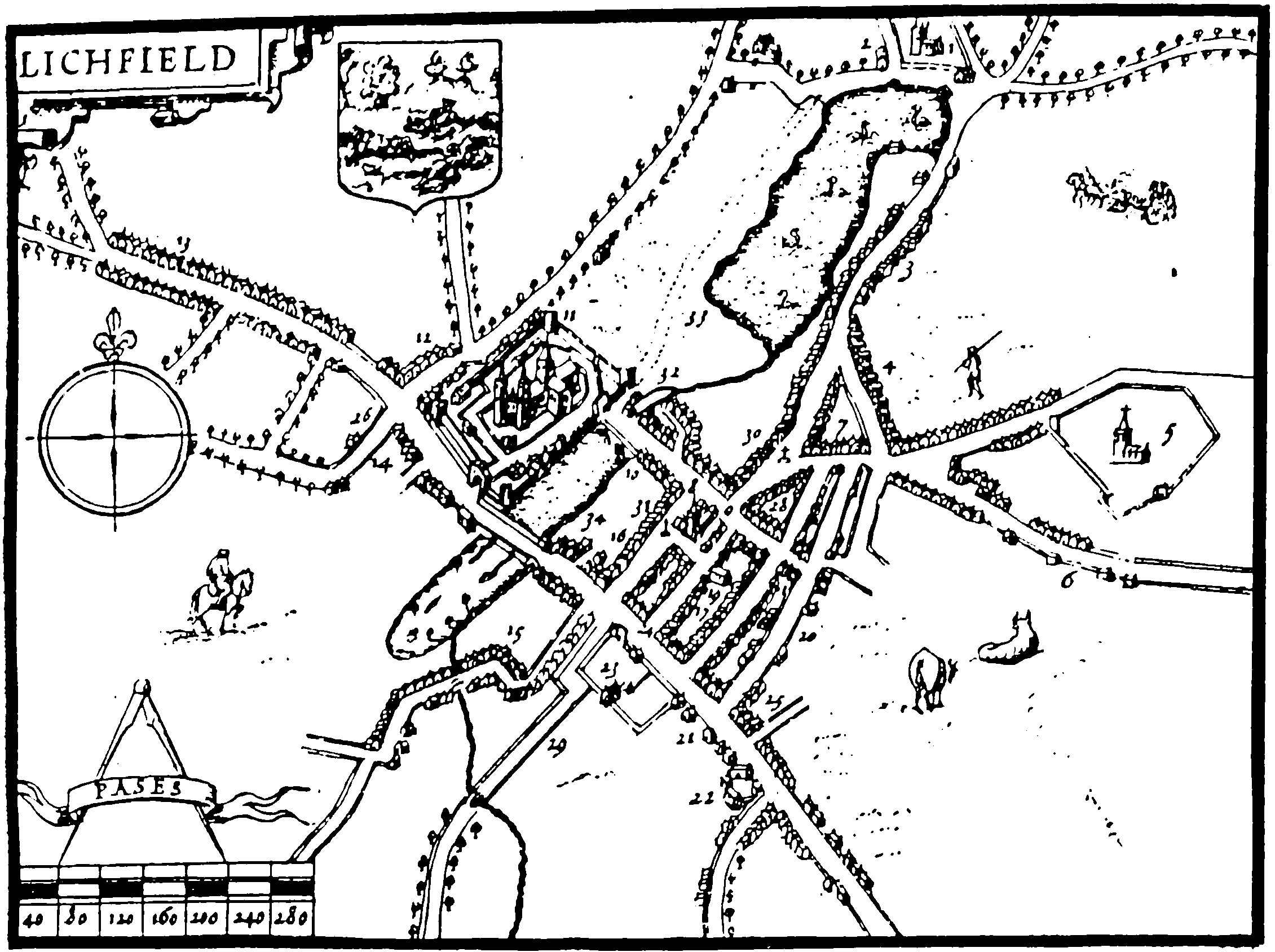
Lichfield 1610
1 Stowe Church. 2 Stowe Mill. 3 Stowe Street. 4 Ioyles lane. 5 St. Michaels chur. 6 Rotten Rowe.
7 Tamworth stret. 8 The Chappell. 9 The Conduit. 10 Dams street. 11 St. Chads minst. 12 Iayes lane.
13 Bacon stret. 14 The Almeshouse. 15 Samford stret. 16 Sadlers street. 17 Bore street. 18 Wade street.
19 Towne Hall. 20 Frogge lane. 21 St. Iohns street. 22 St. Iohns Hospitall. 23 The Friery. 24 The
Conduit. 25 The Freeschole. 26 Grey Marger lane. 27 Greenehill street. 28 Bakers lane. 29 Friers lane.
30 High Crosse. 31 Stowe Crosse. 32 Damm Mill. 33 Stowe Mere. 34 Damm Mere.
THE 12TH CENTURY
In the 12th century Lichfield was re-established as an ecclesiastical centre. Despite the removal of the see the Norman bishops rebuilt their church. Bishop Limesey, 1085–1117, allegedly used the wealth of the Coventry monks for extensive building at Lichfield. Bishop Peche, 1121–6, began further work which was probably completed by Bishop Clinton, 1129–48. Clinton also appears to have fortified the Close. (fn. 46) In the 1130s he established a chapter at Lichfield on Norman lines. It probably did not participate with the Coventry monks in the election of Clinton's successor in 1149, but it evidently took part in elections from 1161. (fn. 47) In 1176 Bishop Richard Peche re-endowed the deanery, which had been 'ruined during the time of war', presumably a reference to the rebellion of Henry II's son Henry. (fn. 48) The Close was given a piped water supply in the mid or later part of the century. (fn. 49) The first known statutes for the cathedral date from the time of Bishop Nonant, 1185–98, and are the earliest to survive for any English cathedral. (fn. 50)
Clinton held a synod at Lichfield in 1139 and another in the later 1140s. (fn. 51) The see may have returned there temporarily when Coventry priory was converted into a castle by Robert Marmion in 1143. (fn. 52) In 1157 the newly elected abbot of Chester was blessed at Lichfield, and Bishop Pucelle died there in 1184. (fn. 53) The first bishop to be buried at Lichfield after the Norman Conquest was Bishop Muschamp, who was buried there in 1208 by his own wish. (fn. 54)
Meanwhile a new town was laid out south of Minster Pool by Bishop Clinton, although Bishop Durdent may have completed it. (fn. 55) The town had a ladder plan with four rungs, the present Market Street, Bore Street, Wade Street, and Frog Lane, which linked Dam Street, Conduit Street, and Bakers Lane on one side with Bird Street and St. John Street on the other. Bore Street appears to have been the principal street, being wider than the others. At the north-east corner of the town Market Street and Bore Street were linked by a market place; a Sunday market was granted to Bishop Durdent by King Stephen in 1153. On that side the Tamworth Street and Lombard Street portion of an older settlement was grafted on to the plan, with Wade Street and Frog Lane extending across Bakers Lane. On the west side Sandford Street continued the line of Market Street beyond Bird Street. The area between Market Street and Minster Pool remained an open space. St. Mary's chapel in the market place was probably built when the town was laid out, although the earliest known mention of it was not until the late 13th century. Originally the market place surrounded the chapel on all sides, but encroachment took place on the south side. Bishop Clinton enclosed the town with a bank and ditch, and gates were set up where roads into the town crossed the ditch.
The town was described as a borough in a deed of Bishop Durdent, and it was governed as a separate manor probably from its creation. No charter has survived, but when the abbot of Burton established a borough at Abbots Bromley in 1222, he took the liberties of the Lichfield burgesses as a model. The standard rent for a burgage in Lichfield was 12d. in 1298. (fn. 56)
In addition to the market King Stephen granted Bishop Durdent a mint at Lichfield. The grant was confirmed by Duke Henry (later Henry II) in 1154 and by Richard I in 1189. (fn. 57) The mint closed down in 1198. (fn. 58) The only known surviving coin was struck during Richard's reign. (fn. 59)
Bishop Clinton may have been the founder of St. John's hospital, situated just outside the gate in St. John Street by 1208. (fn. 60) Whether that road was extended south in the mid 12th century to form a southern approach to the new town or whether such a route already existed is not clear. (fn. 61) Two crosses stood outside the gate and were known as Bishop Durdent's and Bishop Pucelle's. (fn. 62)
THE 13TH CENTURY
Lichfield finally recovered its position as a see in 1228 when Gregory IX recognized the chapter's claim to share in episcopal elections with the Coventry monks. He decreed that both chapters were to elect, meeting alternately at Coventry and Lichfield. Bishop Stavensby, 1224–38, duly abandoned the title bishop of Coventry, which had been substituted for bishop of Chester by Bishop Durdent, and he styled himself instead bishop of Coventry and Lichfield. That remained the bishops' title until Bishop Hacket, 1661–70, reversed it to Lichfield and Coventry. (fn. 63)
The chapter also increased in wealth, and the prebendal system reached, in essentials, its final form in 1255. Bishop Cornhill, 1214–23, granted the chapter the right to elect its own dean, and it did so for the first time in 1222. The authority of the dean increased, notably in the exercise of archidiaconal jurisdiction, to the exclusion of the bishop, over the cathedral and the city churches as well as over the prebendal churches and those belonging to the chapter's common fund. The cathedral dominated the religious life of the city, whose churches were simply chapels of ease in the cathedral parish. The chapter's victory in the matter of episcopal elections was symbolized in the building of a new chapter house in the 1240s. The vicars choral, first mentioned in Bishop Nonant's statutes of c. 1190, were organized by statutes drawn up in 1241, which stipulated continuous residence in Lichfield. They had their own property from the earlier 13th century and their own house from the 1240s. (fn. 64) Throughout the century the cathedral was the scene of building operations, which were completed in the 14th century and produced the plan as it is today. (fn. 65) In the town a Franciscan friary was built in the later 1230s on burgage plots on the west side of Bird Street and St. John Street. (fn. 66) By the 13th century there were burgages outside the boundary of the new town, perhaps an indication of suburban development. Property granted to the dean and chapter by Bishop Muschamp, 1198–1208, included a burgage beyond Sandford gate. (fn. 67) In the later 13th century Beacon Street, described as a suburb, contained a burgage outside the town gate. (fn. 68) There were then two half burgages nearby at Gaia and a burgage between Gaia Lane and Stowe Pool. (fn. 69) In the same period there were burgages outside Tamworth gate. (fn. 70)
The main economic activity was retailing, and by the end of the century a threeday Whitsun fair had been added to the weekly market. The needs of the cathedral probably account for the presence of goldsmiths, glaziers, and a bellfounder. Leather working appears to have been of some importance: there was a shoemakers' quarter in the later part of the century, and tanning was in progress by 1300. There was also cloth working.
The town was important because it was on the road between London and Chester and near Ryknild Street. Henry II was at Lichfield in 1175 and 1181, and John and Henry III visited the town many times. (fn. 71) By the 1190s it was the normal stopping place in Staffordshire for the justices in eyre, (fn. 72) and forest pleas were held there in the later 13th century. (fn. 73) There was a field for judicial combat (campum duelli) outside the St. John Street gate in 1208; in 1203 the vill paid a fine 'pro habendo duello'. (fn. 74)
Although governed through the bishop's manorial courts, the burgesses early on developed a sense of community. In 1221 they sent two men to plead their cause over toll against the burgesses of Stafford. In 1254 'the community' nominated its bailiffs and six other citizens to represent it before the royal treasurer, using the community's seal. The seal was again in use in 1301 in a grant of land made by six men acting on behalf of the community. By the early 13th century tenants of the dean and of the prebendaries enjoyed various immunities from the bishop's manorial jurisdiction. (fn. 75)
THE LATE MIDDLE AGES
In 1291 a fire destroyed most of the town, including the churches and the friary, but the Close escaped. (fn. 76) The general rebuilding of the town may be reflected in the many grants of pavage between 1299 and 1345, although there had been earlier grants in 1285 and 1290. (fn. 77) Bishop Langton, 1296–1321, built a bridge or causeway at the west end of Minster Pool c. 1312, evidently replacing an earlier one; his intention may have been to ease the flow of traffic along Beacon Street and Bird Street following his closure of a right of way through the Close. (fn. 78) Work on St. Mary's continued in the 14th century when the tower was built, possibly in 1356. (fn. 79) The friary was soon rebuilt after the fire, and in 1301 it was granted a water supply from springs near Aldershawe to the south-west. The supply was later made available to the townspeople, with a conduit at the gate of the friary in Bird Street connected with others in the town. (fn. 80)
Langton carried out extensive work on the cathedral, notably the addition of the Lady Chapel, and in the Close, where he greatly strengthened the fortifications and built a new palace. The completion of a new choir at the cathedral, begun by the 1330s, was evidently delayed by the Black Death. All major medieval work on the cathedral was finished by the beginning of the 15th century, although the enrichment of the interior continued, notably under Dean Heywood, 1457–92. (fn. 81)
Lichfield remained an important centre for both ecclesiastical and secular purposes. Pilgrim traffic presumably increased as a result of Langton's provision of a magnificent shrine for St. Chad's relics. By 1335 some of the saint's relics were kept in a portable shrine and his head in a painted box; there was another reliquary by 1445 containing his right arm. Pilgrims received encouragement from Dean Heywood, who secured indulgences from Canterbury in 1473 and Rome in 1482 for those attending services in the chapel of the chantry founded by him in the cathedral. Numbers of people were also brought into the town by meetings of the bishop's consistory court and by the celebration of orders in the cathedral; both were notably more frequent under Bishop Blythe, 1503–32. (fn. 82)
Assizes continued to be held at Lichfield until the 16th century. (fn. 83) In 1414, as part of an attempt to deal with a general breakdown of order, the King's Bench sat there for over three weeks as a superior eyre, with Henry V himself staying at Burton abbey and remaining in close touch with the court's proceedings. (fn. 84)
Lichfield was the assembly point for 125 Staffordshire archers in 1345 before their march to Southampton to take part in the earl of Derby's campaign in Gascony. (fn. 85) In 1402 Henry IV ordered knights, squires, and yeomen from various parts of the country to meet him at Lichfield for his campaign against Owain Glyn Dŵr. (fn. 86) During the Wars of the Roses Lancastrian troops attacked the gaol in 1459, possibly in an attempt to release prisoners taken at the battle of Blore Heath that year. (fn. 87) Richard, earl of Warwick, passed through Lichfield in 1460 on his way to meet the duke of York at Shrewsbury. (fn. 88) Before the battle of Bosworth in 1485 Lord Stanley was at Lichfield, and his younger brother Sir William Stanley received Henry Tudor there with military honours. (fn. 89)
Lichfield's importance as a trading centre was enhanced in 1307 when the threeday Whitsun fair was extended to 15 days and an eight-day fair in November was added. A four-day September fair was granted in 1337, and by 1409 there was an Ash Wednesday fair with a court of pie powder. A wide range of goods was brought into the city, and in the early 14th century there was also a flourishing wool trade.
Among the city's own products leather goods remained important. In the 17th century the saddlers' company claimed to have been in existence by the reign of Edward I and the shoemakers' since the late 1430s. Two other companies, the vintners' and the mercers', claimed to have been established in the 14th century. Quarrying was in progress in the 14th and 15th centuries, and the masons claimed to have been incorporated in the early 15th century. The carpenters, the cooks, and the barbers and surgeons traced their incorporation to Edward IV's reign. Specialist tradesmen, such as goldsmiths, bellfounders, and parchment makers, continued to work in the city. (fn. 90) Inns mentioned were the Swan in Bird Street (1362), (fn. 91) the Lion in Market Street (1440), (fn. 92) the Antelope and the Unicorn adjoining each other in Bird Street (1495), (fn. 93) the George in Bird Street, the Talbot in Beacon Street on the site of the later Angel Croft hotel, the Angel on an adjoining site to the south, the Cock also in Beacon Street, and the Star in Bore Street (all 1498), (fn. 94) the Cardinal's Hat in Tamworth Street (1498, mentioned as a burgage 1350), (fn. 95) and the Eagle in Market Street (1529). (fn. 96)
The number of people visiting and passing through the city appears to have encouraged prostitution. A woman in Conduit Street was stated in 1466 to have earned 6 rials (£3) by being available day and night to members of the household of the duke of Clarence during his recent visit to Lichfield. (fn. 97) Beacon Street, probably because it was a thoroughfare on a major route, seems to have been the main area of brothels. In 1414 four brothel keepers there were presented at the manor court. (fn. 98) In 1466 a woman of Beacon Street was accused of having had with her two women recently arrived from a London brothel. (fn. 99) Probably because it was near the cathedral, the area provided the vicars choral with opportunities for fornication in the early 15th century. (fn. 100) In 1485 three brothels were recorded in Wade Street, Conduit Street, and Greenhill. (fn. 101)
The cathedral maintained its control of the three city churches, which by the 14th century were served by five chaplains appointed by five of the prebendaries. The system was modified in 1491 when a vicarage was ordained at St. Mary's, with the dean and chapter as patrons. The vicar had overall responsibility for the cathedral's parishioners in the city and had to provide a chaplain at each of the three churches, but there were still no individual parishes attached to them. St. Mary's, however, had already achieved a special prominence as the church of the guild of St. Mary and St. John the Baptist, founded in 1387 by the amalgamation of two existing guilds at St. Mary's. Admissions to the guild rose to an average of 105 a year in the later 15th century, and both men and women were eligible. The members were mainly people from Lichfield and the surrounding region, including gentry and heads of religious houses, but there were also notable people from further afield, including royalty. There was a guildhall in Bore Street by 1421. The guild had its own chaplains, who lived in a house in Breadmarket Street and helped with the services at St. Mary's; there were four of them in 1466.
The almshouse in Beacon Street later known as Dr. Milley's hospital appears to have been founded by Bishop Heyworth in or shortly after 1424. It was re-endowed for 15 almswomen in 1504 by Thomas Milley, a canon of the cathedral, and was probably rebuilt at the same time. (fn. 102) St. John's hospital was refounded and reendowed for 13 almsmen by Bishop Smith in 1495, and as part of the refoundation he also endowed a grammar school. (fn. 103)
The guild of St. Mary and St. John the Baptist came to participate in the government of the town, and by the late 15th century it was working in association with a body called the Forty-eight, which may have represented the burgesses and commoners. The jurisdiction of the bishop, however, remained paramount, and by the early 15th century he was holding three great courts a year. There were then ten wards in the town, each with two tithingmen. Two of the wards, Stowe Street and Greenhill, were outside the gates, and by the end of the century there was also a tithingman for the part of Sandford Street beyond Sandford gate. The courts met in a moot hall, mentioned in 1308–9 and probably in Lombard Street. The bishop had a gaol in Lichfield, possibly as early as 1164 and certainly by 1306. (fn. 104) In the later 15th century the receiver general of the bishop's temporalities used Lichfield as a centre for auditing; in 1459 he was there for three weeks and in 1463 for nineteen days. (fn. 105) In 1441 the Crown granted the dean and chapter extensive powers of selfgovernment in the Close. (fn. 106) The city was represented at most parliaments between 1305 and 1327 and again in 1353, but it then ceased to be represented until the mid 16th century. (fn. 107)
Lichfield's position on important roads continued to attract royal visitors. Edward II was there as Prince of Wales probably in 1296 and as king in 1309, 1323, and 1326. (fn. 108) Edward III was there in 1328, (fn. 109) and in 1348 Lichfield was the scene of one of the splendid tournaments which he held after his victories at Crécy and Calais. (fn. 110) Richard II attended the enthronement of Bishop Scrope in 1386 and spent Christmas 1397 at Lichfield. In 1398 he concluded a treaty with the duke of Brittany there in May, was present at the enthronement of Bishop Burghill in September, and celebrated Christmas there with a papal nuncio and an envoy of the Eastern Emperor among his guests. He returned in 1399 on his way to London as a prisoner. (fn. 111) Henry IV was at Lichfield before and after the battle of Shrewsbury in 1403, and in 1404 he held a council there. (fn. 112) Edward IV dined with Bishop Hales at Lichfield in 1461 and made an agreement with the earl of Warwick there in 1462; in 1473 he spent over two weeks at Lichfield. (fn. 113)