A History of the County of Stafford: Volume 14, Lichfield. Originally published by Victoria County History, London, 1990.
This free content was digitised by double rekeying. All rights reserved.
'Lichfield: From the Reformation to c.1800', in A History of the County of Stafford: Volume 14, Lichfield, ed. M W Greenslade (London, 1990), British History Online https://www.british-history.ac.uk/vch/staffs/vol14/pp14-24 [accessed 30 April 2025].
'Lichfield: From the Reformation to c.1800', in A History of the County of Stafford: Volume 14, Lichfield. Edited by M W Greenslade (London, 1990), British History Online, accessed April 30, 2025, https://www.british-history.ac.uk/vch/staffs/vol14/pp14-24.
"Lichfield: From the Reformation to c.1800". A History of the County of Stafford: Volume 14, Lichfield. Ed. M W Greenslade (London, 1990), British History Online. Web. 30 April 2025. https://www.british-history.ac.uk/vch/staffs/vol14/pp14-24.
In this section
FROM THE REFORMATION TO THE CIVIL WAR
The Reformation brought loss and gain to Lichfield. The status of the chapter was enhanced as a result of the dissolution of Coventry priory, despite Bishop Lee's protest that Coventry was his 'principal see and head church'. An Act of 1541 recognized Lichfield as 'the full, sole, and entire see and chapter' of the diocese. (fn. 1) Another Act of the same year reduced the size of the diocese by assigning the archdeaconry of Chester to the new diocese of Chester. The archdeaconry, however, had long enjoyed extensive administrative autonomy, and the change may not have greatly reduced the number of people coming to Lichfield on ecclesiastical business. (fn. 2) A major loss was the disappearance of pilgrim traffic following the destruction of St. Chad's shrine in 1538. (fn. 3) That year too the Franciscan friary was dissolved, the site becoming a private estate. (fn. 4) Both hospitals survived, although St. John's was threatened. Its chaplain was evidently regarded as a stipendiary priest under the Chantries Act of 1547, and his salary was appropriated by the Crown; it was, however, restored in 1550. Later attempts by the Crown to suppress the hospital were also unsuccessful. (fn. 5) The guild of St. Mary and St. John was dissolved under the Act of 1547. Chantry and guild property in the city came into the possession of the Crown; in 1567 some of it was in decay, with the rents increasingly in arrears, and the Crown admitted that the city was thereby impoverished. (fn. 6)
The main development of the period was the city's achievement of selfgovernment. It was incorporated by royal charter in 1548, the corporation consisting of two bailiffs and 24 brethren. In the same year Bishop Sampson conveyed his manorial rights in Lichfield to the new corporation. As a reward for the support given to Mary I by the bailiffs and citizens during the duke of Northumberland's attempt to prevent her accession, the queen issued a new charter in 1553, confirming the 1548 charter and in addition granting county status to the city with its own sheriff. The bishop had suffered another loss in 1546, when he was forced to surrender many of his estates to the Crown. They included the nearby manors of Longdon, Cannock, and Rugeley and the bishop's house at Beaudesert in London, all of which passed to Sir William Paget (later Lord Paget), one of the principal secretaries of state. It is likely that Paget was instrumental in securing the charters for Lichfield. The incorporation was probably linked with the dissolution of the guild and the consequent gap in the city's government. There was extensive continuity of personnel: the first senior bailiff and half the brethren had been masters of the guild, and another six of the brethren had been guild wardens. The corporation also took over the guildhall. The city's new importance was enhanced by its once more being represented in parliament. (fn. 7)
Also linked with the guild was the new Conduit Lands Trust. In 1545 the master of the guild, Hector Beane, acting with the guild's consent and evidently sensing the coming dissolution, conveyed the guild's lands lying outside the city to eight feoffees for the maintenance of the town's water supply; any residue of income was to be used for the common good of the city. As a result Lichfield has for several centuries had both a well maintained water supply and a range of other public services. (fn. 8)
Lichfield seems to have shown little opposition to the earlier stages of the Reformation. Indeed the new corporation, despite its support of Mary in 1553, showed protestant sympathies. It sold goods belonging to the three city churches and spent part of the proceeds on taking down altars, removing 'idols and images', and providing books, including the Bible in English. In 1556 or 1557 the sheriff of the new county of Lichfield and the wives of two prominent members of the corporation gave comfort to a woman condemned to be burnt as a heretic. By contrast a large number of the cathedral clergy were deprived in 1559 or soon afterwards, and in the late 16th and early 17th century there seem to have been many Roman Catholics in the city. (fn. 9)
Despite the reduction in the size of the diocese Lichfield retained importance as a centre of ecclesiastical administration. The high proportion of lawyers among the bailiffs between 1548 and 1588 (fn. 10) was presumably a reflection of the amount of business to be done. The dean and chapter wrote in 1635 of the 'multitudes of persons' coming daily to the bishop's consistory court and of the officers of the court living in the city. (fn. 11) It was as the seat of the bishop's court that the city witnessed the burning of three persons for heresy under Mary I. (fn. 12) In 1611 it was the scene of the last such burning in England, of Edward Wightman of Burton upon Trent. (fn. 13)
The number of recorded trade companies greatly increased in the later 16th and earlier 17th century. (fn. 14) Leather working continued to be important, and the tanners' company had been added to those of the shoemakers and the saddlers by 1625. Textiles too were important. The clothworkers' and weavers' company was recorded in 1552, the cappers' in 1575, and the tailors' in 1576. Capping declined in Lichfield as elsewhere in the later 16th century, but the city had over 70 tailors in 1634. Metal working was extensive. The smiths' company was recorded in 1601, with a wide range of craftsmen. The range increased in the 17th century, and in 1648 the company had 95 members. Retailers, including providers of food and drink, probably made up the largest single group of tradesmen. In the late 16th century there was even a complaint that the number of alehouses was excessive and was causing 'much decay in the place'. (fn. 15) Agriculture continued as part of the city's economy, and sheepfarming was important by the late 16th century.
In 1582 Bishop Overton stated that Lichfield 'is not the city that it hath been'. He attributed such economic decline to the city's bad government, the result of its removal from episcopal control. (fn. 16) The effects of the Reformation were more probably to blame, coupled with the decline of capping and apparently the loss of all but one of the fairs. Further economic decline probably followed the outbreak of plague in 1593, when there were over 1,100 deaths. (fn. 17) In 1622, however, three new fairs were established by royal charter. The city was also developing as a centre of communications. It was a post town on the route between London and Ireland by the later 1570s, and by the 1650s coaches between London and Chester called there, with the George and the Swan probably already the main coaching inns. (fn. 18) In the 1630s Lichfield was by far the wealthiest of Staffordshire's towns. It was assessed for ship money in 1635 at £100; Walsall came next at £25 and then Stafford at £20. (fn. 19) In 1637 Lichfield was assessed at £150, with another £10 for the Close; Stafford was assessed at £30. (fn. 20)
Edward VI was in Lichfield on 23 September 1547, when he evidently visited the cathedral. (fn. 21) Elizabeth I was at Lichfield in 1575, arriving from Kenilworth on 27 July. She appears to have stayed elsewhere and to have returned to Lichfield on 30 July; she left for Chartley, in Stowe, on 3 August. She was evidently received in the market place and entertained in the guildhall. In preparation for her visit the bailiffs had the market cross painted and the area round it paved, and the guildhall was painted and repaired. In addition work was carried out on the road leading into the city from the south. The bailiffs also paid 5s. to a William Holcroft 'for keeping Mad Richard when her Majesty was here'. (fn. 22)
THE CIVIL WAR
Lichfield, with its strongly defended Close and its position as a focus of communications, had a strategic importance during the Civil War which resulted in three sieges of the Close, and its cathedral suffered more damage than any other. (fn. 23) The Close was garrisoned by the royalists early in 1643; the garrison, some 300 strong under the earl of Chesterfield, consisted mostly of local gentry and their retainers. A parliamentary force of 1,200 under Lord Brooke camped outside Lichfield on 1 March. On 2 March Brooke entered Lichfield and set up his headquarters in Market Street in the house of the parliamentarian Michael Biddulph of Elmhurst. The royalist troops, after fierce resistance, fell back on the Close, and an attack at once began on the south gate in Dam Street. Brooke, directing the attack from a nearby house, was shot dead, traditionally by the deaf and dumb John Dyott firing from the central tower of the cathedral. Sir John Gell came from Derby the same day to take command of the siege. He brought more troops with him, and on 3 March further reinforcements arrived under Sir William Brereton. Attacks on the west gate and on the north side of the Close were repulsed, but on 4 March a mortar was set up in the garden of Sir Richard Dyott's house in Market Street. It caused panic in the Close, and allegedly there was also a shortage of food and ammunition. Chesterfield surrendered on 5 March, and the royalist garrison was replaced by one under Colonel Russell.
Sir John Gell turned his attention to Stafford but was defeated on Hopton Heath by a royalist force on its way to relieve Lichfield. The parliamentarians then consolidated their position at Lichfield, strengthening the defences of the Close. An attempt by the royalist Col. Henry Hastings to retake the Close on 21 March was unsuccessful, but on 7 April Prince Rupert entered the city. He surrounded the Close, setting up his artillery on high ground to the north still known as Prince Rupert's Mound. Russell surrendered on 21 April, and a garrison with Col. Richard Bagot as governor took over.
Lichfield remained a royalist stronghold for the rest of the war, supported by financial levies, (fn. 24) donations, and money taken from the enemy. Bagot later claimed to have advanced money of his own as well. In July 1643 Queen Henrietta Maria passed through Lichfield on her way south from Bridlington (Yorks. E.R.). Prince Rupert passed through in March 1644 on his way to relieve Newark and again on his way back. Col. Bagot left with part of the garrison in May 1645 to reinforce the king, leaving the city defended by 100 horse and 200 foot under Major Harsnett. Defeated at Naseby in June, Charles I and the remains of his army spent the night of the 15th in and around Lichfield, Charles himself staying in the palace. Bagot, having been wounded at Naseby, returned to the Close. He died there in July and was buried in the cathedral. His replacement as governor of the garrison was his brother Hervey. Charles returned in August for two nights and again in October for one night. (fn. 25) An outbreak of plague began in July and continued into 1646. Few died in the Close, but 821 deaths were recorded in the city.
In January 1646 Sir Thomas Tyldesley was appointed governor; taken prisoner by the parliamentarians in 1644, he had escaped from Stafford to Lichfield towards the end of 1645. On 9 March Sir William Brereton captured the city and began a siege of the Close which lasted four months. He cut a trench from Stowe Pool to Upper Pool, building a raised defensive position or mount at each end. A third mount was built north of the Close and a fourth in Dam Street in front of the south gate. He set up his headquarters on the high ground north of the Close, defending it with more earthworks. The central spire of the cathedral was used by the royalists as a vantage point, and when they also flaunted regimental colours and officers' sashes from it on May Day, it became a symbol of resistance in the eyes of the parliamentarians. Brereton also believed that it not only contained the powder magazine but also housed 'their ladies and grandees'. He subjected it to five days' bombardment, and on 12 May it collapsed, damaging the choir and nave. One of a dwindling number of royalist garrisons, the Close continued to resist even after the fall of Oxford on 26 June and the end of royalist hopes. It finally surrendered on 10 July, and the garrison, mustering 84 officers and 700 other ranks, marched out on the 16th.
The main damage caused during the war was to the cathedral and the Close. The cathedral had been desecrated by the parliamentarians in 1643, when its glass, statuary, and organs were destroyed. The final siege left it in ruins along with the palace and many of the houses in the Close. Subsequent looting of fabric caused further destruction. (fn. 26) Beacon Street was burnt by the royalists during the final siege to deprive the attackers of cover; 52 houses there belonging to the vicars choral were destroyed, although some had been rebuilt by 1649. (fn. 27) A house in Dam Street near Minster Pool was burnt down in 1646, but it too had been rebuilt by 1649. Stowe church was occupied by the parliamentarians during the siege of 1643, and during that of 1646 the tower of St. Mary's was damaged by royalist bombardment. The market cross, with its statuary and crucifixes, was destroyed by the parliamentarians in 1643. The contents of the cathedral library were dispersed after the surrender of 1646, (fn. 28) and the Civil War has been blamed for the disappearance of the early records of the corporation. In 1658, however, Elias Ashmole (1617–92), a native of Lichfield, was pursuing his antiquarian interests by transcribing deeds in the custody of the bailiffs which have since disappeared. (fn. 29)
FROM THE RESTORATION TO THE END OF THE 18TH CENTURY
Services were again being held in the cathedral by mid June 1660, and the chapter was reconstituted in September. (fn. 30) An early problem which confronted the returning clergy was access to their houses in the Close: those not destroyed during the Civil War had been occupied by squatters, who had to be removed. (fn. 31) Work on rebuilding the ruined cathedral began in earnest with the arrival of Bishop Hacket in August 1662, and it was rededicated on Christmas Eve 1669. A new bishop's palace was built in 1687 and a new deanery in 1707. (fn. 32)
Although Presbyterians were removed from the corporation, they remained influential in the town and were active in the parliamentary election of 1667. Thomas Minors, a Presbyterian, established an English school in Bore Street in 1670. It may have continued to have Dissenting masters in the early 18th century, but it later came under the control of Anglicans. Support for James II, who touched for the King's Evil in the cathedral in 1687, seems to have been limited, but later the corporation and townspeople showed Jacobite sympathies. (fn. 33) A mob supporting the Pretender attacked the Whigs at a byelection in 1718, and when the Whigs captured both parliamentary seats in 1747 there were riots at the September race meeting, including an assault on the duke of Bedford. (fn. 34)
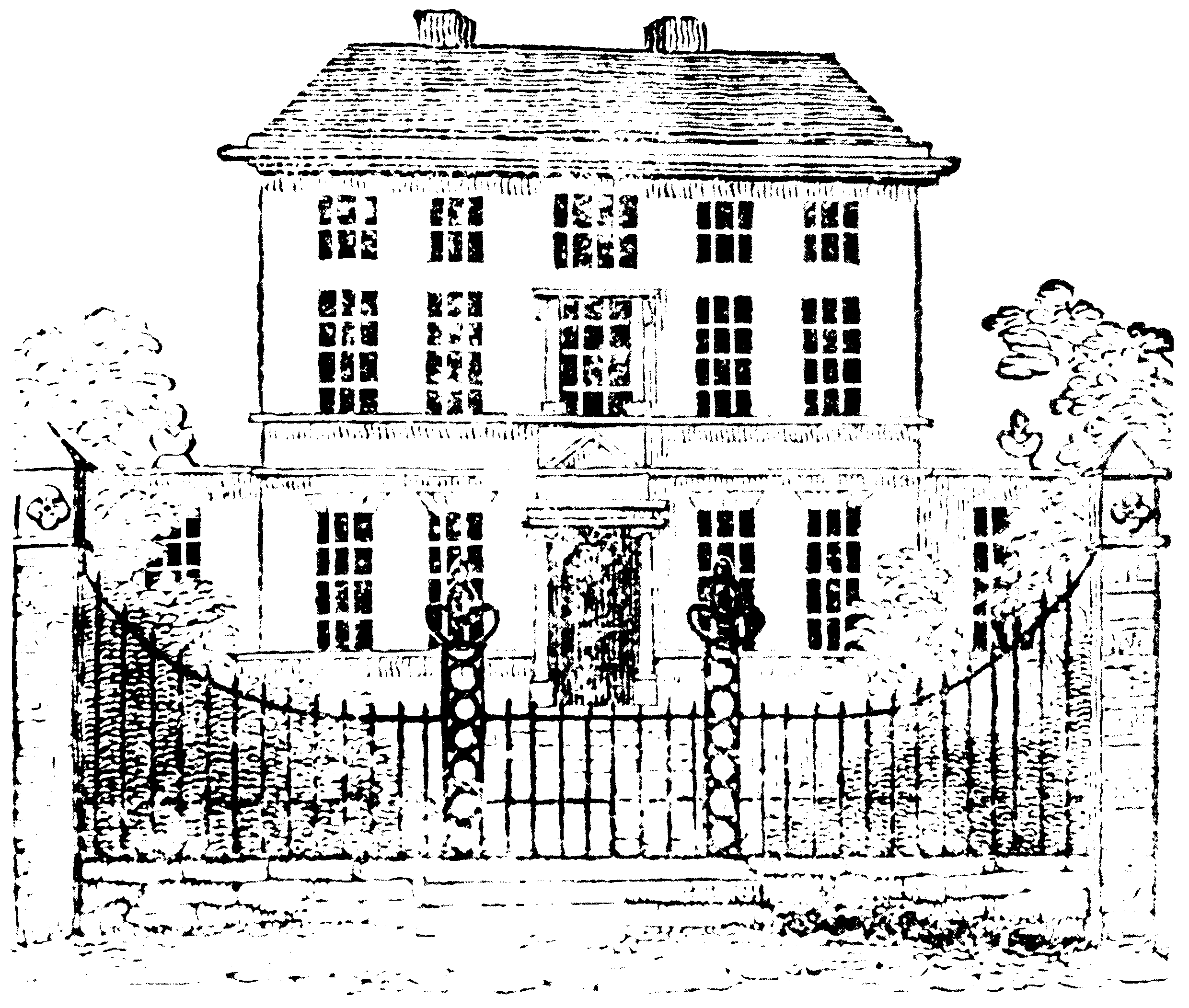
Redcourt House in 1819
Visiting Lichfield in 1697, Celia Fiennes thought that the town had good houses and that its streets were neat and handsome. (fn. 35) For Daniel Defoe in the earlier 1720s it was 'a fine, neat, well-built, and indifferent large city', the principal town in the region after Chester. He considered that those two towns, with Coventry, were the only places of importance on the road from London to Carlisle. (fn. 36) Less enthusiastic was John Loveday, a visitor in 1732, for whom the town was 'large, but by no means compact, nor the streets wide'; the brick buildings were 'not very handsome'. (fn. 37) The use of brick as building material in preference to timber became normal from the late 17th century and was presumably in part prompted by concern over the risk of fire. A fire had occurred in late 1681 or early 1682, and another evidently in 1697; in July 1697 the corporation ordered that all thatched buildings should be tiled. (fn. 38) Several town houses built in brick in the 18th century survive. (fn. 39) Two have been demolished. St. John's House (later Yeomanry House) opposite St. John's hospital was built before 1732 for Theophilus Levett, town clerk 1721–46. It replaced a house known in 1577 as Culstubbe Hall, the home of the physician Sir John Floyer in the late 17th century. It was demolished in 1925. (fn. 40) Redcourt House on the south side of Tamworth Street was built in 1766 for Lucy Porter, Dr. Johnson's step-daughter. It was demolished in 1929 or 1930. (fn. 41) Stone was used for the guildhall and St. Mary's church when they were rebuilt in the earlier 18th century.
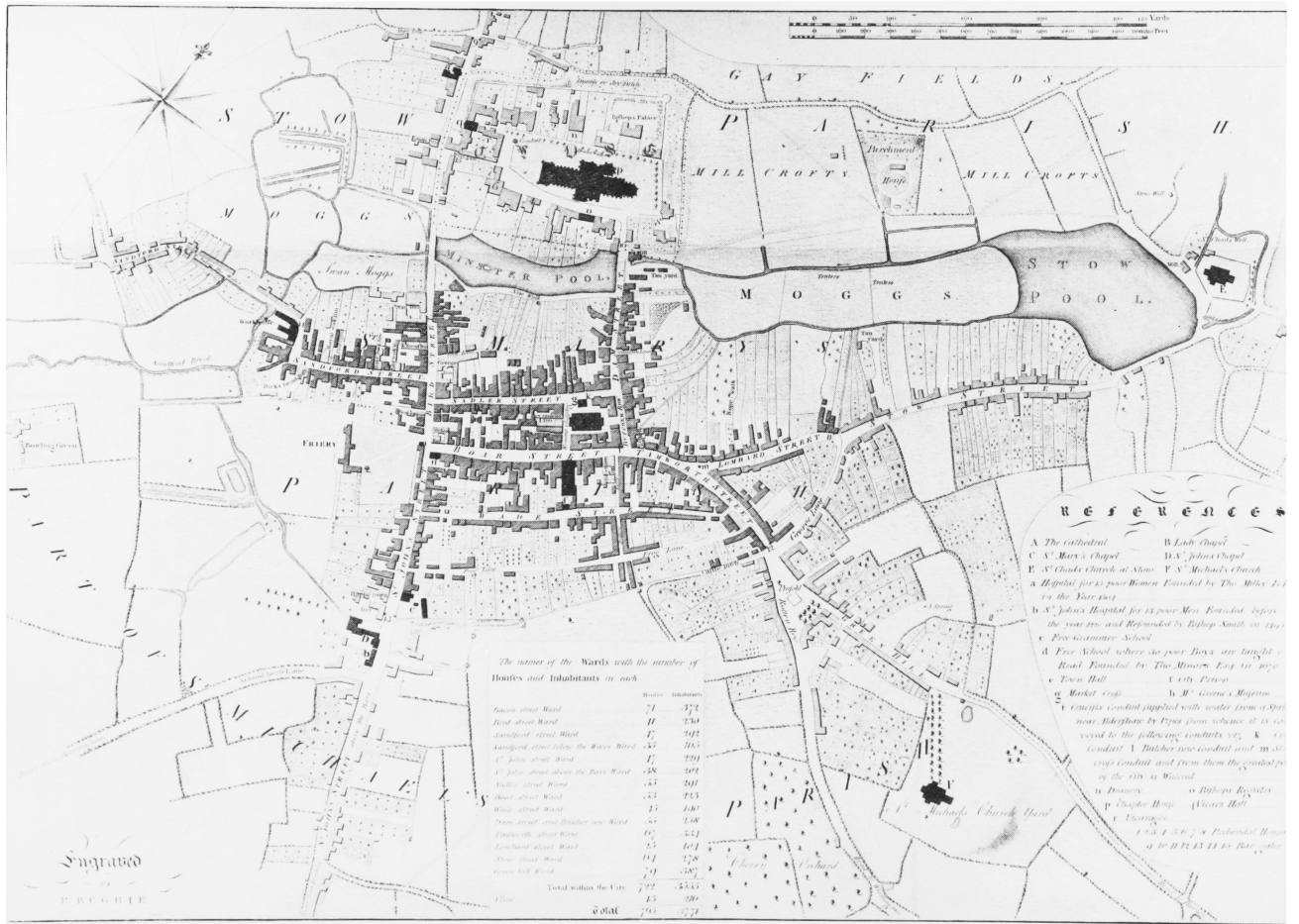
Lichfield 1781
The built-up area of the city did not expand greatly until the 19th century. Stowe House and Stowe Hill were built in the 1750s and Beacon Place in Beacon Street towards the end of the century. (fn. 42) There was also scattered settlement on or near the city boundary. Farmhouses at Knowle and Berry Hill on Ryknild Street existed by the later 18th century, the former taking its name from a nearby knoll and the latter an inhabited location in the later 14th century. (fn. 43) The Shoulder of Mutton inn at the junction of Ryknild Street and the London road had been built by 1770. (fn. 44) Sandyway on the Walsall road, already inhabited in the late 16th century, had an alehouse c. 1700. (fn. 45) The Three Tuns inn existed there by 1777. (fn. 46) There was another inn on the road in the early 19th century, the Royal Oak (later Sandyway Farm). (fn. 47) There was a hamlet called Cross o' th' Hand on the boundary with Burntwood by the later 17th century. (fn. 48) Lyncroft House on the Stafford road was built probably in the late 18th century.
Lichfield's economic activity, centred chiefly on retailing, was of only local importance. (fn. 49) Two markets were held each week, and there were four fairs, although only two were important in the 18th century. The range of goods offered for sale by Lichfield shops was limited. In 1788 Anna Seward complained that the city furnished 'nothing but clumsy necessaries' and remarked that Bath was the place to buy luxury goods, not 'plain, uninventive Lichfield'. In 1806 she claimed that a visitor would find the food at her table plain because Lichfield was 'the worst market imaginable'. (fn. 50) The manufacturing trades were confined mainly to coachmaking and cloth and leather working. Tanning was the only noxious trade, and the corporation's opposition in 1761 to the establishment of a canvas manufactory by John Tunstall may have been because it was opposed to any kind of industry in the town. By 1776, however, Tunstall was making sailcloth in premises in Sandford Street. The absence of industry gave the town an air of sleepiness. Horace Walpole, comparing Wolverhampton with Lichfield in 1743, thought that the latter was 'as indolent as the former was busy', (fn. 51) and a visitor in 1782, noting the absence of industry, commented that 'the silence of the streets is interrupted only by the passage of public carriages'. (fn. 52)
Lichfield became a centre for polite society in the region. It surprised Celia Fiennes that the bishop, cathedral clergy, and an 'abundance of gentry' lived at or near Lichfield with its low-lying and watery position, rather than at Coventry with its pleasanter situation and better buildings. She wrongly thought, however, that Coventry was still, with Lichfield, the bishop's see. (fn. 53) Circumstances obliged some of the cathedral clergy to live at Lichfield, and the gentry presumably followed their lead. The city evidently lost some of its popularity in the 18th century after the bishops had abandoned their palace in the Close for their house at Eccleshall. Nevertheless Defoe thought that Lichfield was the best town in Staffordshire and the neighbouring counties for 'good conversation and good company'. (fn. 54) In the 1730s or 1740s Richard Wilkes, a physician and antiquary of Willenhall, described it as 'the most genteel place in the county'. Because there was little manufacture or commerce the inhabitants had 'more time to dress and visit', and the cathedral and 'the variety of travelling company' passing through the town were further attractions. (fn. 55) A music club promoted public concerts by the mid 1740s. Professional acting companies came to Lichfield at least from the later 1760s, and a theatre was opened in Bore Street in 1790. In addition there was a bowling green west of the town, in existence since the later 17th century, and archery was evidently a favourite pastime in the later 18th century. (fn. 56)
Although Frances, countess of Huntingdon, lived in Lichfield after she was widowed in 1701 until 1705 or later (fn. 57) and Lord Stanhope lived in the bishop's palace in 1706, (fn. 58) the nobility appear to have confined their visits largely to the race meetings which became an important feature of Lichfield's social life. First recorded when held at Alrewas in the early 1680s, the meetings were moved nearer Lichfield to Whittington heath in 1702. By the early 1740s they were held in September and lasted two days, extended to three in 1744. (fn. 59) They were accompanied by dinners, concerts, and balls. In 1733 the countess of Strafford reported that she 'never saw so much good company together in any place before'. (fn. 60) It is uncertain whether it was the wives and daughters of the visiting nobility, or those of residents, who were alluded to as 'the fair ladies of Lichfield' by Walter Chetwynd of Ingestre in 1689. (fn. 61) For the poet Isaac Hawkins Browne, Lichfield in the early 1720s was 'the Paphos of England' on account of its pretty women. (fn. 62)
The leading members of polite society lived in the Close, either being associated with the cathedral or renting houses there. (fn. 63) Gilbert Walmisley, a native of Lichfield and diocesan registrar from 1707, lived in the bishop's palace from the late 1720s until his death in 1751. He gathered a group of literati around him and gave encouragement to both Samuel Johnson and the actor David Garrick in their youth. Two resident prebendaries were authors: Sneyd Davies, resident from c. 1751 to 1769, was a poet, and Thomas Seward, resident 1754–90, edited the plays of Beaumont and Fletcher. Seward's daughter Anna (1747–1809) was a celebrated poet and was known as 'the Swan of Lichfield'. (fn. 64) The physician and scientist Erasmus Darwin lived in Lichfield between 1758 and 1780. He established a botanic society in 1778 and laid out a botanic garden at Abnalls in Burntwood. (fn. 65) Richard Greene (d. 1793), an apothecary who lived in Market Street, created a museum there which attracted many visitors. (fn. 66) The fame of the Lichfield 'lions' spread. (fn. 67) Anna Seward was visited by the poet William Hayley in 1782, (fn. 68) the violinist Wilhelm Cramer in 1796, (fn. 69) the landscape gardener Humphry Repton, (fn. 70) the writer Walter Scott in 1807, (fn. 71) and the poet Robert Southey in 1808. (fn. 72) The resident literary circle, however, was small, and Anna Seward felt culturally isolated. She lamented the 'insensibility' of the town's leading inhabitants, and in particular the unimaginative choice of books ordered by the reading society. (fn. 73) That society was presumably the one which in 1781 ordered a copy of Fanny Burney's novel Evelina, published in 1778; despite the book's fame, it had not been heard of locally until Samuel Johnson brought a copy to Lichfield. (fn. 74)
As the birthplace of Samuel Johnson Lichfield was attracting visitors as early as 1801. (fn. 75) He was born in Lichfield in 1709, the son of Michael Johnson, a bookseller living in Market Street. (fn. 76) He attended schools in the city and then one in Stourbridge (Worcs.); in 1728–9 he was a student at Pembroke College, Oxford. After his father's death in 1731 he sought employment away from Lichfield. He returned after his marriage in 1735 and opened a school at Edial, in Burntwood, in 1735–6. The school failed, and in 1737 he went to London. His Dictionary was published in 1755. The grant of a royal pension in 1762 enabled him to travel, and he periodically visited Lichfield; his last visit was in 1784, the year of his death. In 1838 a stone statue of him, presented by the diocesan chancellor, the Revd. J. T. Law, was set up in the market square. The sculptor was R. C. Lucas. (fn. 77) A bronze statue of Johnson's biographer James Boswell, given by its sculptor Percy Fitzgerald, was set up in the square in 1908. It stands on a pedestal which is decorated with five medallions of Boswell's friends and panels depicting Boswell and Johnson together. (fn. 78)
Lichfield had some of the characteristics of a leisure town of the 18th century. Its economy supported the luxury trade of bookselling, already important in the late 17th century; (fn. 79) street lights were set up in the later 1730s; (fn. 80) and the landscape was improved by public walks and gardens. (fn. 81) It was, however, slow to develop the refinement which would have attracted more residents. Animals continued to be sold in the market square, and the popular Whitsuntide festivity of the Greenhill Bower invaded the town centre despite middle class disapproval. (fn. 82) A further distraction was the large number of public houses, 80 innkeepers being recorded in 1732. (fn. 83) Besides serving the needs of travellers and denizens, the inns accommodated troops who were frequently quartered in Lichfield. (fn. 84) In 1779 there were 70 men quartered on the George, 65 on the Swan, 34 on the Hartshorn, 30 each on the King's Head and on the Crown, and proportionate numbers on the poorer inns, so that the poorest had at least 10 each. (fn. 85) Gregory King in 1711 noted that the inhabitants were 'addicted to drinking', (fn. 86) and drunkenness was a special problem at the contested parliamentary elections in 1747 and 1755. (fn. 87) The demise of the Cecilian Society, a music club, c. 1790 was in part because its concerts had been turned into drinking sessions. (fn. 88)
Lichfield's position on the main road to the north-west of England and to Ireland made it a convenient stopping place for travellers. In 1729 the town became the centre of a turnpike network. (fn. 89) On his visit to Lichfield in 1687 James II stayed at the Deanery; he praised the workmanship of the bishop's palace, then nearing completion. (fn. 90) William III passed through Lichfield in 1690 on his way to Ireland. (fn. 91) Lichfield's position on a main road was probably the reason for its being chosen as a place to quarter French prisoners-of-war. Two Frenchmen were guarded over night at the George in 1667, before being taken to Coventry. (fn. 92) Several French officers were brought to Lichfield in 1704. (fn. 93) One on parole in 1779 gave private French lessons. (fn. 94) Large numbers of them were at Lichfield on parole during the Napoleonic Wars. Eighty arrived in January 1797, but they were taken to a gaol in Liverpool in November. Their 'graceful manners and enlightened minds' were much appreciated by Anna Seward and her friends, but other residents kept their distance. (fn. 95) In 1809, when c. 40 officers were quartered, the senior ones were allowed to attend the September race meeting. (fn. 96) In 1810 a party of 17, comprising three prisoners (one with a family) and black servants, who had been taken at Guadeloupe, was brought to Lichfield. (fn. 97) A French prisoner was last recorded in Lichfield in 1812. (fn. 98)
An infantry regiment was formed in 1705 by Col. Luke Lillingston at the King's Head in Bird Street. In 1751 it became the 38th regiment of foot and in 1783 the 1st Staffordshire Regiment; after reorganization in 1881 it became the 1st battalion of the South Staffordshire Regiment. (fn. 99) There was a volunteer company in Lichfield in 1745, commanded by Peter Garrick, the brother of the actor David Garrick. (fn. 100)