A History of the County of Stafford: Volume 14, Lichfield. Originally published by Victoria County History, London, 1990.
This free content was digitised by double rekeying. All rights reserved.
'Townships: Freeford', in A History of the County of Stafford: Volume 14, Lichfield, ed. M W Greenslade (London, 1990), British History Online https://www.british-history.ac.uk/vch/staffs/vol14/pp253-258 [accessed 30 April 2025].
'Townships: Freeford', in A History of the County of Stafford: Volume 14, Lichfield. Edited by M W Greenslade (London, 1990), British History Online, accessed April 30, 2025, https://www.british-history.ac.uk/vch/staffs/vol14/pp253-258.
"Townships: Freeford". A History of the County of Stafford: Volume 14, Lichfield. Ed. M W Greenslade (London, 1990), British History Online. Web. 30 April 2025. https://www.british-history.ac.uk/vch/staffs/vol14/pp253-258.
In this section
FREEFORD
Freeford, south-east of Lichfield, was formerly a township of 378 a. in St. Michael's parish, Lichfield. (fn. 1) Most of it was an estate centred on Freeford Manor, the home of the Dyott family; the rest was centred on Freeford House. In 1934 Freeford became part of the new civil parish of Swinfen and Packington. A boundary change in 1980 transferred 5½ a. around Freeford House to Lichfield, from which 172 a. east of Lichfield Eastern Bypass was added to Swinfen and Packington. (fn. 2)
Part of Freeford's north-western boundary follows the upper reaches of Darnford brook; on the east the boundary with Whittington runs along the Tamworth road. The subsoil is Bunter Sandstone and Pebble Beds, except for an area of Keuper Sandstone north of Freeford Manor. (fn. 3) The soil is loam. (fn. 4) The ground lies at 226 ft. (69 m.) on the boundary with Lichfield by Freeford House; to the south it rises to 259 ft. (79 m.) at Freeford Manor and 328 ft. (100 m.) on the boundary east of Home Farm.
Six people were assessed for tax in 1327 and 13 in 1332–3. (fn. 5) Two householders were assessed for hearth tax in 1666. (fn. 6) Freeford's population was 27 in 1841, 23 in 1851, 12 in 1861, 15 in 1871, and 54 in 1881. (fn. 7) By 1901 it was 100, falling to 75 in 1911 and 59 in 1921. In 1931, when it was last recorded separately, the population was 64. (fn. 8)
Freeford derives its name from a ford on the Lichfield-Tamworth road over Darnford brook. The ford was 'free' in the sense that it was open or accessible, presumably in contrast to Darnford, the hidden or secret ford, further downstream in Streethay. A medieval leper hospital stood south of the junction of two roads from Lichfield, on the site later occupied by Freeford House; (fn. 9) there was a house next to the hospital's chapel in 1466. (fn. 10) A green, mentioned in 1327, (fn. 11) may have lain around the road junction. Freeford Manor to the south may stand on or near the site of a medieval house. The site of Freeford Farm to the west, in Lichfield, was settled in the earlier 18th century. (fn. 12) In 1837 a cottage was built south of Freeford Manor on the site of Home Farm, itself dating from the later 19th century, and between 1861 and 1871 two cottages were built in Barkers Lane. (fn. 13) Several houses were built along the Tamworth road and south of Freeford Farm in the 1930s. (fn. 14) East of Home Farm the club house for Whittington golf club was built in the early 20th century. A new club house was opened on the Whittington side of the boundary c. 1960 and the old one became a private house, called Lochranza, where commercial dog kennels were later built. (fn. 15)
The Lichfield-Tamworth road was turnpiked in 1770 and disturnpiked in 1882. A tollgate east of Darnford brook was removed in 1882, and North Lodge was built on its site. (fn. 16) A new stretch of the road was constructed over Lichfield Eastern Bypass, which was opened in 1971. (fn. 17) Part of the former road was converted into a compound for lorries using the bypass; two houses were later built near by.
When Lichfield council took an electricity supply from Walsall in 1926, it supplied Freeford free of charge because poles carrying the cable to the city ran across the Dyott estate. (fn. 18)
Edward II stopped at Freeford in 1326 before entering Lichfield city. (fn. 19)
MANOR AND OTHER ESTATES.
In 1086 FREEFORD was a member of the bishop of Chester's manor of Lichfield (later Longdon). (fn. 20) It was assessed at 3 hides c. 1255. (fn. 21) It remained a member of the bishop's (later the Paget family's) manor of Longdon until at least the later 18th century. (fn. 22)
Ranulf held the manor of the bishop in 1086. He also held Timmor in Fisherwick, and by 1135 Freeford formed a knight's fee with Timmor and with Fradswell in Colwich. (fn. 23) By 1242–3 the lords of Timmor held Freeford as mesne lords, and in the 1260s William of Timmor and his son Hugh granted the terre tenant, Robert of Freeford, freedom of marriage for himself and his heirs. (fn. 24) The mesne lordship survived in 1298. (fn. 25)
In 1242–3 William of Freeford held the manor as ½ knight's fee. (fn. 26) By the 1260s it was held by his son Robert, who was still alive in 1289. (fn. 27) William of Freeford held it by 1294 and was still alive in 1332. (fn. 28) In 1323 he settled Freeford on his younger son John, who was M.P. for Staffordshire in 1337 and had been knighted by 1338. (fn. 29) John died in 1366, leaving three daughters as his heirs. (fn. 30) The manor remained divided until it was re-united by John Dyott of Lichfield and his son Anthony between 1563 and 1616.
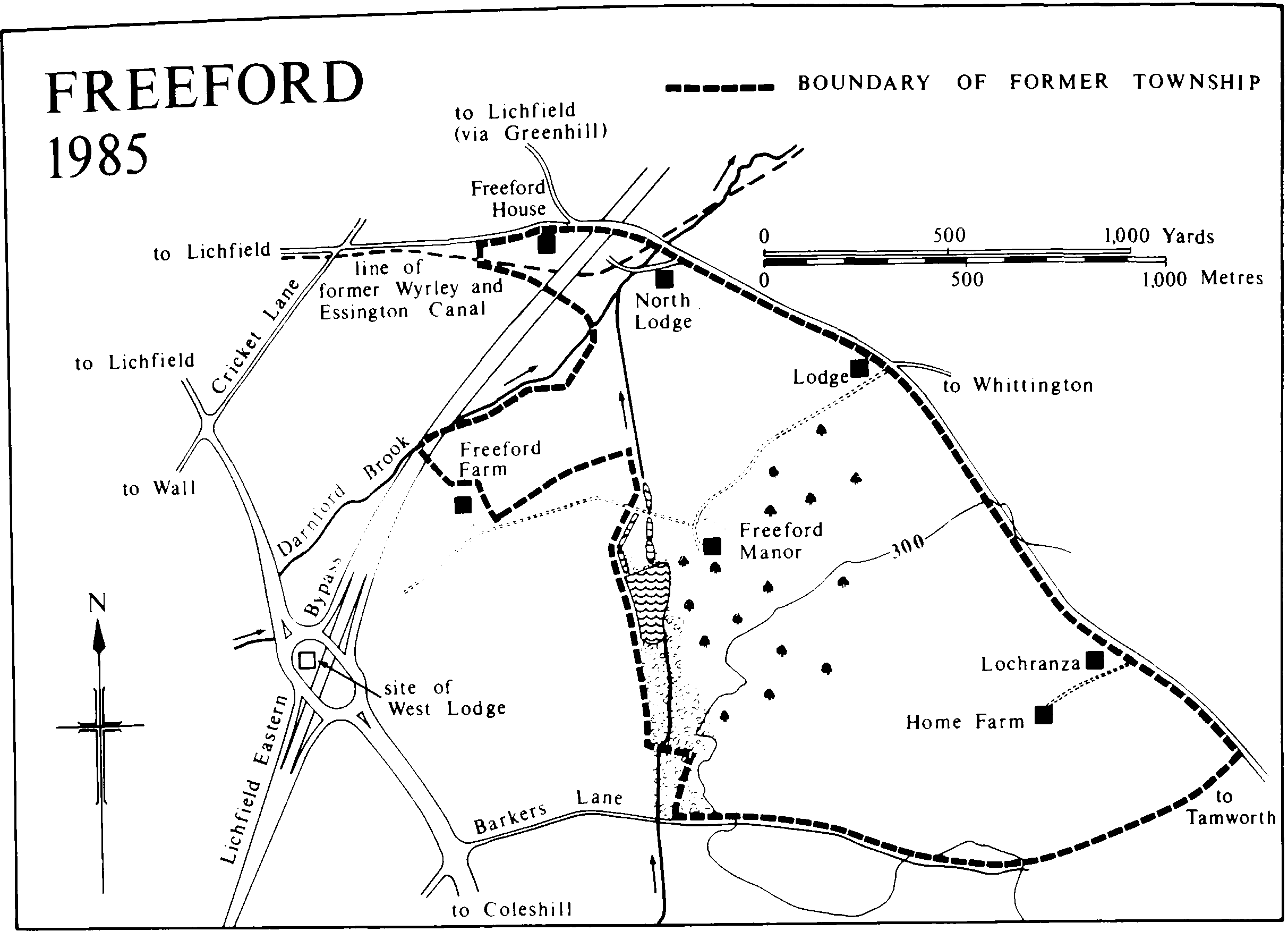
FREEFORD 1985
By the late 14th century a third share of the manor had passed from Margaret, one of Sir John Freeford's daughters, to her daughter Alice and Alice's husband Henry Brown of Lichfield (d. c. 1403). Afterwards it passed to their son John, who was still alive in 1440. (fn. 31) His heirs were two daughters, of whom Elizabeth inherited the interest in Freeford. Her daughter Margaret, who was recorded as holding a share of Freeford through her husband John Harcourt of Ranton in 1512 and in her own name in 1514, died in 1522. (fn. 32) Her interest passed to her grandson John Harcourt, who let a house and barn at Freeford to John Dyott of Lichfield in 1549. Harcourt died soon after, and his interest in Freeford passed to his son Robert (d. 1558), who left his estate to his mistress Cassandra Cooke and their four sons. In 1584 she and two of the sons conveyed their rights in Freeford to John Dyott's son Anthony. (fn. 33)
By 1421 another third of Freeford was held by Sir William Lichfield, evidently as heir of Elizabeth, one of Sir John Freeford's daughters and wife of John Bachecote. (fn. 34) William was succeeded in 1446 by his daughter Margaret, wife of Humphrey Stafford of Bishop's Frome (Herefs.). (fn. 35) The share evidently passed to Sir William Stafford of Bishop's Frome, whose daughter Margaret married Sir George de Vere. In 1537 Margaret assigned her share to her daughter Elizabeth and Elizabeth's husband Sir Anthony Wingfield. (fn. 36) By c. 1600 the share had passed to Jane Kniveton. In 1603 Jane's son William Kniveton conveyed it to Ralph Jarman, a Lichfield innkeeper (d. 1612). In 1616 Jarman's widow Margaret relinquished her rights to Anthony Dyott. (fn. 37)
The remaining third share was further divided. One part was held by Thomas Andrews in 1512 and by William Andrews in 1514. In 1563 Humphrey Andrews conveyed it to John Dyott. (fn. 38) The other part was held in 1512 by Thomas Swinfen of Swinfen in Weeford and in the later 16th century by William Swinfen. In 1606 John Swinfen sold it to Anthony Dyott's wife Dorothy and their son Richard. (fn. 39)
John Dyott, a barrister and three times bailiff of Lichfield, was probably the original of the 'little John Doit of Staffordshire', the boon companion of Shakespeare's Justice Shallow in their youth. (fn. 40) He was granted a crest in 1560 and a coat of arms in 1563. (fn. 41) He was succeeded in 1578 (fn. 42) by his son Anthony Dyott, a barrister and M.P. for Lichfield in 1601 and 1603, who died in 1622. (fn. 43) He was succeeded by his son Richard, a barrister, who in 1610 had married Dorothy, daughter and heir of Richard Dorrington of Stafford. Knighted in 1635, he was M.P. for Lichfield in the 1620s and in 1640 and a prominent royalist. (fn. 44) He was succeeded in 1660 by his son Anthony (d. 1662), another barrister, whose heir was his brother Richard. (fn. 45) Richard, who had accompanied Charles II into exile, was elected M.P. for Lichfield in 1667. (fn. 46)
On Richard's death in 1677 his son, another Richard, succeeded. He was M.P. for Lichfield in most parliaments 1690–1715 and died in 1719. (fn. 47) His heir was his son Richard, the first of the family to live at Freeford rather than Lichfield. He died in 1769 and was succeeded by his son Richard. In 1776 Richard was living at Ashbourne (Derb.) and in 1784 at Leicester, where he died in 1787. (fn. 48) He was succeeded by his son Richard, who lived at Freeford from 1784 and was recorder of Lichfield from 1808. He was succeeded in 1813 by his brother Lt.-Gen. William Dyott, a regular soldier who was promoted to full general in 1830. An edition of the diary which William kept from 1781 to 1845 was published in 1907. (fn. 49) William was succeeded in 1847 by his son Richard (d. 1891), M.P. for Lichfield 1865–74. Richard was succeeded by Lt.-Col. Richard Burnaby, grandson of William Dyott's sister Lucy. Burnaby, who changed his name to Dyott, was succeeded in 1903 by his grandson Richard (d. 1965). He was followed by his grandson Richard Burnaby Dyott, formerly Shaw, who remained the owner in 1985. (fn. 50)
Freeford Manor, known as Freeford Hall until the 1930s, (fn. 51) may stand on or near the site of a medieval house. In 1366 Sir John Freeford's widow was granted a licence for an oratory in her house, possibly at Freeford. (fn. 52) In the 17th century the Dyott family preferred to live in Lichfield, and in 1719 there was only 'a little house' at Freeford. It was probably incorporated in the brick house which Richard Dyott built there in the early 1730s, (fn. 53) improving the site by planting apple, cherry, nectarine, peach, pear, and plum trees next to the house. (fn. 54) The house itself was small and had a west front of three bays. A drawing room, later the library, was added on the south in the mid 18th century, and by the late 18th century another large room had been added to it on the east. A two-storey service range on the north side of the house had also been built by the late 18th century. Over the main doorway there was by then an inscription 'Nil nisi bonum, portus amicis', still in place in 1985. (fn. 55) The house was approached on the north through a courtyard, whose entrance was flanked by a pair of square buildings.
On gaining possession of the house in 1826 on the death of his brother's widow, William Dyott engaged the architect Joseph Potter the elder of Lichfield to make alterations. The work included resetting the 18th-century main staircase in the south-west corner of the original house and adding bedrooms over the drawing room. (fn. 56) The house was further extended and remodelled in 1848–9. The first bay of the 18th-century service wing was rebuilt to restore the symmetry of the west front, and the south front was also made symmetrical. The east wing was given an upper storey and was extended north and east. A shallow stone porch of two storeys was built to emphasize the main west entrance, probably in 1851–2. (fn. 57) A bay window was later added on the south side of the library, and in the 20th century various changes were made to the service buildings on the north. The stables north of the house were built in the late 18th or early 19th century, when a kitchen garden nearby was also laid out. The icehouse in the wood south of the house was built in 1842. (fn. 58)
There was an enclosed park by the earlier 17th century: in 1646 the estate could not be let because 'the fence is so down and carried away'. (fn. 59) The parkland was used for grazing sheep and cattle in the early 18th century, (fn. 60) and in the later 1790s it united 'the utility and profits of farming with the pleasurable beauties of the ornamental landscape'. (fn. 61) Small plantations of trees were established by William Dyott in the early 19th century. (fn. 62) The pool west of the house may have originated as a mill pond in the Middle Ages. In the early 20th century it covered nearly 4 a. (fn. 63)
By the later 18th century the main approach to the house was along an avenue from the east, and a lodge on the Tamworth road was renovated in 1839. (fn. 64) In the mid 18th century an avenue ran west of the house towards London Road across the recently inclosed part of Old Field. (fn. 65) It was replaced as the main approach to the house, probably in the early 1840s, by a road slightly to the north passing near Freeford Farm. A double lodge was built on London Road in 1843. The northern part was demolished before 1900 and the southern in 1958 when London Road was widened. (fn. 66) The eastern avenue then became the main approach once more; the lodge there had been rebuilt apparently in the late 19th century. A service road laid out in 1845 joined the Tamworth road at the tollgate replaced in 1882 by North Lodge. (fn. 67)
FREEFORD HOUSE
FREEFORD HOUSE occupies the site of the leper hospital of St. Leonard, established by the mid 13th century. The hospital appears to have ceased to function by the later 14th century, and in 1496 its estate was added to that of the almshouse of St. John the Baptist in Lichfield. (fn. 68) In 1508 the master of St. John's let a house at Freeford, reserving the former chapel of St. Leonard; that house was presumably part of the St. John's estate in Freeford worth 30s. in 1535. (fn. 69) In the early 1720s the estate comprised 18 a. (fn. 70) In 1813 the house and land were sold to Jonathan Mallet, evidently the tenant. (fn. 71) He died in 1835 leaving his estate to his sisters Harriet (d. 1853) (fn. 72) and Mary Ann (d. 1854). Subject to two life interests the estate passed to Mary Ann's great-nephew Thomas Mallet. Thomas was farming at Freeford in 1861 (fn. 73) and died in 1906 leaving the estate in trust for his wife Lucy (d. 1949). In 1950 her heir or executor, Mrs. Fanny Lear, sold the house to W. G. McKie. He in turn sold it in 1967 to Mr. M. H. L. Farrant, the owner in 1985.
Freeford House is a brick building of the earlier 18th century, joined at right angles to a range which runs east-west along the Tamworth road. That range, of the 16th or 17th century, was timber-framed on a sandstone plinth; most of the timber was replaced by brick at various dates in the 18th and 19th centuries. In the 19th century the range was divided near its west end, presumably to give access to the back of the house. The gap was filled with a small house, Princes Villa, in 1892. (fn. 74)
The great and small tithes of Freeford belonged to the prebendary of Freeford in Lichfield cathedral. From 1660 or earlier a modus of 11s. 2d. was paid for both sorts, although in the late 1770s the lessee of the prebend made an unsuccessful attempt to have the great tithes paid in kind. (fn. 75)
ECONOMIC HISTORY.
Agriculture.
In 1086 Freeford had land for six ploughteams. (fn. 76) About 1330 two open fields were mentioned, Mere field and Nether field. (fn. 77) There was evidently some sheepfarming in the late 15th century: a flock of over 100 sheep was mentioned in 1480. (fn. 78)
About 1610 the lordship of Freeford consisted of 240 a. of meadow, pasture, and woodland, with Freeford marshes, evidently along Darnford brook, and heathland in Lichfield called Old Field. Crops then grown included oats, rye, white wheat, red wheat, barley, and peas, and there were 14 cows, 10 young beasts, 6 calves, and a bull. Sheepfarming was evidently important: there were 149 wethers 'fat enough for the shambles', and 80 ewes and 60 lambs kept in Town field in Lichfield. The estate was thought to be worth £120 a year, improvable by inclosure, liming, and a good stock of animals. (fn. 79)
The inclosure of Old Field in Lichfield in the late 17th and early 18th century added c. 175 a. of arable land to the Dyott estate. It provided land for Old Field (later Freeford) farm, which included 166 a. in Lichfield in the mid 18th century, when there was a farmhouse on the present site. The home farm, which was worked from Freeford Hall and covered 165 a. at the same date, probably included the Bispells estate in Lichfield held by the Dyotts as lessees. A third mid 18th-century farm, Upper (later Home) farm south of Freeford Hall, covered 171 a. (fn. 80) On the home farm in 1725 there were 34 cows (10 of them milkers), 4 calves, a bull and 202 sheep. In the 1730s there were c. 400 sheep; by 1750 the flock had increased to nearly 490, and there were then regular sales of sheep and wool. (fn. 81) In the 1760s over 300 sheep were sheared each year. (fn. 82)
Richard Dyott (d. 1813), who farmed the home farm from 1784 and also farmed at Tamhorn in Fisherwick, was an agricultural improver and was elected president of the Staffordshire Agricultural Society on its establishment in 1800. (fn. 83) At Freeford he drained much of the land to create firm pasture. By 1792 he had a flock of 940 sheep and lambs. Nearly 600 sheep were sheared that year, 463 of them at Tamhorn but the rest at Freeford; the breeding ewes numbered 260 and produced 300 lambs a year. In the 1790s sales of fattened sheep and of wool at Freeford averaged £650 a year. Fattened bullocks and heifers were included in the annual sales, and the stock had been improved by the purchase of heifers from the experimental breeder John Princep of Croxall (Derb.) and of Scotch steers. Only c. 30 a. of wheat were grown at Freeford and 70 a. of turnips as winter food for the sheep; the turnips were followed by barley and then grass for one or two years. (fn. 84) The Freeford sales continued in the early 19th century; that of 1810, which took place the day after a meeting of the Staffordshire Agricultural Society at Lichfield, included 100 fat ewes, 50 theaves, and several rams, all apparently of the Leicester breed, and 10 blackfaced wethers, 10 Scotch bullocks, 6 cows, and a bull. Some sales also included racehorses. (fn. 85)
William Dyott improved the farm buildings and in 1829 bought a haymaking machine, having had trouble with his labourers. (fn. 86) In the later 1830s and early 1840s he was growing turnips, swedes, carrots, and mangolds as feed for his cattle and sheep; he also grew some wheat, barley, and potatoes. (fn. 87) Freeford farm and Upper farm were let. They were worked together until 1838, when Upper farm was let separately to Joseph Booth, who also farmed as the tenant at Fulfen in Streethay. Because there was no living accommodation at Upper farm, a cottage was built there in 1837 for Booth's use. (fn. 88) Richard Dyott (d. 1891) replaced the cottage with a farmhouse for the amalgamated home farm and Upper farm, known as Home farm by 1872. (fn. 89) Richard was a pioneer breeder of Shropshire sheep and won prizes with rams at the 1863 and 1865 Royal Shows. The flock was still kept in the late 1920s. (fn. 90)
Thomas Baxter, knighted in 1943 for services to agriculture, was lessee of Freeford farm from 1903 to 1927 and of Home farm from 1909 to 1921. In 1917 he farmed 612 a., of which 65 a. were devoted to barley (chiefly for brewing in Lichfield), 55 a. to wheat, 54 a. to swedes, and 15 a. to mangolds. There was four-course rotation of barley (with clover), clover, wheat (or early potatoes), and roots. The potatoes were sold locally, while much of the root crop was used to feed 550 Shropshire sheep, 50 dairy cows, and other cattle. The yearly sale of milk in 1917 was 26,000 gallons. In 1923 Baxter was one of the first farmers in the county to sow sugar beet. (fn. 91)
In 1985 the Dyott estate in Freeford and Lichfield comprised some 625 a. with a further 145 a. in Whittington. Farming was chiefly dairying and cattle rearing. (fn. 92)
Fishery and warren.
The fishery of a pool at Freeford was reserved when Richard Dyott let the estate in 1632. (fn. 93) Carp were turned into ponds there in 1759, and in 1763 ponds were stocked with carp and trout; tench were introduced in 1765. (fn. 94) When the pool was drained in 1784 it yielded 80 carp, 3 perch, and 3 pike. In 1785 it was restocked with 200 carp, 200 perch, 100 trout, and 6 pike, and further stockings of trout were made in 1786 and 1787. The pool was enlarged in 1793 and continued to be fished. (fn. 95) Soon after 1827 regular fishing seems to have been abandoned, as the pool became increasingly choked. (fn. 96)
In 1585 a lessee of Freeford manor was liccensed to kill rabbits. (fn. 97) Pasture called 'cunney-greays' in the 18th century was presumably the site of a former warren. (fn. 98)
Mill.
In the early 13th century Roger Gray, son of Simon Gray, granted Thomas Brown a mill at Freeford. (fn. 99) A share in a mill there was acquired by Henry son of Walter of Lichfield in the later 13th century. (fn. 100) Henry's son Richard later conveyed four parts of the mill, possibly its entirety, to Robert of Freeford. (fn. 101) The mill may have stood below the pool west of Freeford Manor.
LOCAL GOVERNMENT.
In 1293 Freeford township made presentments at the great court of Longdon manor. (fn. 102) In 1327 it sent two frank-pledges but only one by 1370. One was still chosen at the Longdon court in 1642. (fn. 103) Freeford remained a constituent township of Longdon manor in 1760, when a headborough for Freeford was recorded among the manorial officials. (fn. 104) The Dyott family evidently resented the dependency: in the early 1740s Richard Dyott claimed that he had the right to hunt his own land, but he was forced to admit that Freeford was a township only and not a manor and that all rights to game belonged to the earl of Uxbridge as lord of Longdon. (fn. 105) About the same time Dyott alleged that courts baron had formerly been held at Freeford but that no court rolls survived, having been 'lost during the Civil Wars'. (fn. 106) There was a constable by 1377, (fn. 107) and election to the office at the Longdon great court was recorded by the late 16th century. (fn. 108) In the late 1790s it was the practice that the constable was chosen by the head of the Dyott family from among his household. (fn. 109)
Parochially Freeford was in St. Michael's parish, Lichfield, and in 1820 it had a sidesman at that church. (fn. 110) Freeford, however, had no organization for administering the poor and was regarded as extra-parochial by the late 1790s. It became a civil parish in 1858, and in the same year was placed in Lichfield poor-law union. (fn. 111) In 1934 it was joined with the Swinfen and Packington portion of Weeford to form the civil parish of Swinfen and Packington. (fn. 112)
Freeford subscribed to the Whittington Association for the Prosecution of Felons, formed by 1780 and surviving in 1828. (fn. 113)
CHURCH.
Once St. Leonard's hospital was no longer a leper-house, its chapel was evidently used for services by local people. Dean Buckingham included Freeford chapel as part of his intended visitation of Freeford prebend in 1356, giving no indication that it was other than a chapel of ease. (fn. 114) At some date in the 15th century the chapel possessed vestments, books, a cross, a censer, a pyx, and two candlesticks. (fn. 115)
Anthony Dyott (d. 1662) and later members of his family were buried in St. Mary's, Lichfield, the church which earlier members had attended as Lichfield residents. (fn. 116) It was a tradition by the early 19th century that the burials took place at night, (fn. 117) a practice which elsewhere in the country originated in the 17th century. (fn. 118) The last burial at St. Mary's was that of Richard Dyott in 1891, after which the Dyotts were buried at Whittington. (fn. 119) From at least the later 18th century the inhabitants of Freeford went to Whittington church. (fn. 120) In 1983 Freeford was added to the ecclesiastical parish of Whittington, except for the area around Freeford House west of Lichfield Eastern Bypass which was added to St. Michael's, Lichfield. (fn. 121)
NONCONFORMITY.
None known.
EDUCATION.
No evidence.
CHARITIES FOR THE POOR.
None known.