A History of the County of Bedford: Volume 3. Originally published by Victoria County History, London, 1912.
This free content was digitised by double rekeying. All rights reserved.
'Parishes: Risely or Riseley', in A History of the County of Bedford: Volume 3, ed. William Page (London, 1912), British History Online https://www.british-history.ac.uk/vch/beds/vol3/pp157-161 [accessed 1 May 2025].
'Parishes: Risely or Riseley', in A History of the County of Bedford: Volume 3. Edited by William Page (London, 1912), British History Online, accessed May 1, 2025, https://www.british-history.ac.uk/vch/beds/vol3/pp157-161.
"Parishes: Risely or Riseley". A History of the County of Bedford: Volume 3. Ed. William Page (London, 1912), British History Online. Web. 1 May 2025. https://www.british-history.ac.uk/vch/beds/vol3/pp157-161.
In this section
RISLEY OR RISELEY
Riselai (xi cent.).
Riseley is a parish of 3,102 acres, of which 1,447½ are arable land, 1,042 permanent grass and 81¼ woods and plantations. (fn. 1) The soil is clay and the chief crops grown are wheat, barley, oats, beans and peas. The parish is watered by a small tributary of the Ouse, but water for domestic purposes is supplied by pumps or wells. The village, which is one of the largest in this part of the county, extends for about a mile along the main road coming from Bedford in the south and passing north to Kimbolton. The church and vicarage stand back from this main street, which consists chiefly of picturesque cottages and a few small shops. The buildings are either brick or halftimbered, occasionally covered with distempered plaster. In the north of the village is Riseley Lodge, now a farm-house, a Georgian house of brick and tiles with a wooden cornice. The village lies low, but west of the main street the ground rises and a windmill, which is still in use, has been built. Until recent years a water-mill also stood by the river. Two moats, one in the north and one in the south of the parish, probably mark the sites of ancient manors. Brick and tile manufactures were formerly carried on in this parish; pillow lace is still made to a considerable extent, and of recent years an attempt has been made to introduce the shoe trade from Rushden.
This parish was inclosed in 1793. (fn. 2)
There are Wesleyan, Moravian and Baptist chapels in Riseley.
The following place-names have been found: la Rihale, Turbereyfield, Heronslond, Machinggeslond, Juddes Close, Paleffreman, Gaunts, Werendwyke and Townsend (xiv cent.), Le Estende (xv cent.), Coldham and Hallsted. (fn. 3)
MANORS
In 1086 the Bishop of Coutances owned 6 hides in Riseley worth 72s. The land was held of the bishop by two Frenchmen and six Englishmen. (fn. 4) On the death of the bishop his estates reverted to the Crown. It became later the property of Alice de Clermont, who granted it to the Knights of St. John of Jerusalem. (fn. 5) In 1279 the Hospitallers held the property as one and a-half knights' fees in free alms of the honour of Gloucester. (fn. 6)
The Knights Hospitallers had rights of free warren in Riseley (fn. 7) and a view of frankpledge. An interesting entry in a Court Roll of 1534 states that William Weston, the last prior, held no court in Riseley that year owing to a pestilence. (fn. 8)
The manor of LAWRENCE was held of the Knights Hospitallers apparently by a family bearing this name. In 1279 William Lawrence held 2½ virgates of land here, (fn. 9) and in 1364 (fn. 10) Sir William Croyser received a grant of free warren probably in this manor. It is not, however, till 1489 that the manor can be definitely identified, at which date Robert Broughton died seised of it. (fn. 11) He was succeeded by his grandson Robert, whose son John Broughton sold the manor to Richard Fox, Bishop of Winchester, and others in 1514. (fn. 12) Within the next sixteen years the manor had come into the possession of William Holgyll, clerk, who quitclaimed it to Sir Anthony Oughtred in 1530. (fn. 13) Two years later Sir Edward Seymour, afterwards the Protector Somerset, a brother-in-law of Sir Anthony, (fn. 14) alienated the manor to Sir John St. John and others. (fn. 15) Sir John died seised of the property in 1559 (fn. 16); his heir was his son Oliver first Baron St. John. (fn. 17) This manor has remained in the possession of the St. John family down to the present day, (fn. 18) the present lord of the manor being Lord St. John of Bletsoe.
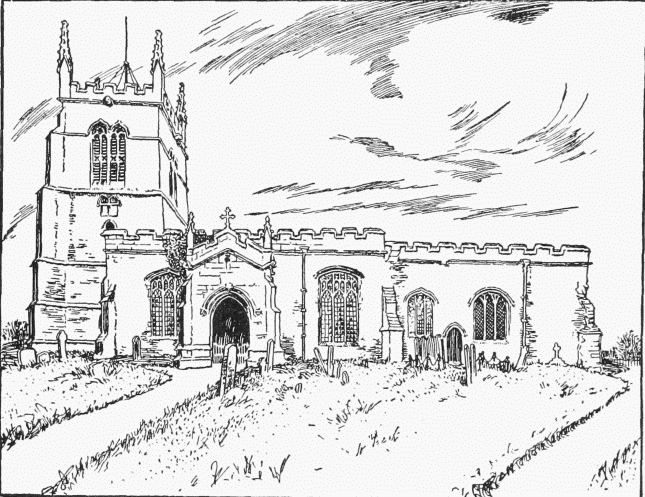
Riseley Church from the South
The property that afterwards became known as HARVIES MANOR was parcel of the Knights Hospitallers' Riseley possessions. It can first be separately identified in 1279, when Walter son of Geoffrey de Riseley held 4 hides of land in Riseley of the Knights Templars. (fn. 19) This land later came into the possession of William son of Lawrence de Riseley, who in 1320–1 quitclaimed it to John son of Geoffrey de Riseley. (fn. 20) It is possible that this family of Riseley is the same as the Harvey family of Riseley. In 1351 John Harvey died seised of this property. (fn. 21) An interesting instance of the ravages of the Black Death in this neighbourhood is shown in the inquisition taken after his death, in which it is stated that the 300 acres of arable land which he owned are of no value, as 'they are uncultivated and no one wants to occupy them.' (fn. 22) This property remained in the hands of the Harvey family for the next 120 years. In 1473 John Harvey enfeoffed trustees of it to the use of his wife Agnes. (fn. 23) The latter, who afterwards married a Paston, died in 1510. (fn. 24) Her heir was her son George Harvey. (fn. 25) About this time it would appear that the manor was alienated (fn. 26) to Thomas Sackville, a member of the royal household, who, owing money to the king, granted the manor to him for a term of years. (fn. 27) The king made over this lease to Lady Radcliffe, (fn. 28) who with her husband made conveyances of the property in 1555 and 1562. (fn. 29) This latter transaction, however, must have been purely nominal, as by 1557 the Sackville family had resumed possession, and in the same year John Sackville alienated the manor to Edmund Elmes. (fn. 30) The latter held it until his death in 1602, (fn. 31) when his son Thomas succeeded him, and died in 1632, leaving a son William as his heir. (fn. 32) This manor, however, apparently passed to his second son Thomas, who married Ann Clarke, (fn. 33) and through him to the Clarke family, from whom it went to Sir Creswell Levinz before 1680. (fn. 34) The manor remained in the hands of the Levinz family until 1759, when it was bought from them by the Duke of Bedford, (fn. 35) whose descendant the present duke is now lord of the manor.
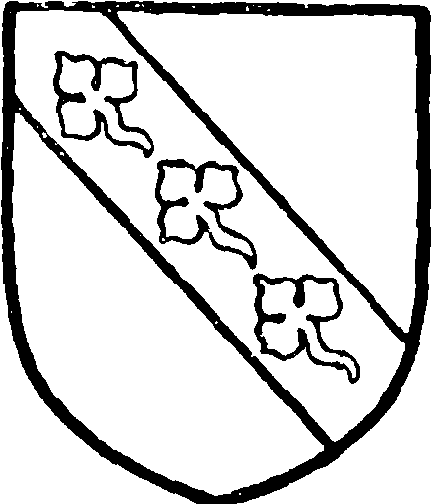
Harvey. Gules a bend argent with three trefoils vert thereon.
The manor of PERTSOILLS or PERTESOYLES can be traced back to the hide of land in Riseley held by Hugh de Beauchamp at the time of the Domesday Survey. (fn. 36) This land is described as being a berewick of Keysoe. (fn. 37) The overlordship of this manor follows the same descent as that of the Monchesney-Latimer portion of the barony of Bedford (fn. 38) (q.v.). The family of Pertesoil, who gave their name to this manor, first find mention in Riseley in 1202–3 when William son of Azon quitclaimed some 65 acres of land to William Pertesoil and Robert Rufus. (fn. 39) About this date the Pertesoils were enfeoffed of land in Riseley by Simon de Beauchamp to be held by knight's service. (fn. 40) Possibly William Pertesoil above mentioned was the father of Roger Pertesoil, whose son Simon (fn. 41) held the manor in the latter half of the 13th century. (fn. 42) Simon Pertesoil had a view of frankpledge in Pertenhall in 1279, for which right he paid 2s. annually to William de Monchesney, his overlord. (fn. 43) He leased a messuage and 2 hides of land in Riseley for eight years at a rent of 18 marks in 1278 to Philip Burnell, (fn. 44) who died seised of it in 1282. (fn. 45) Simon Pertesoil was still lord of the manor in 1288, (fn. 46) but by 1302 he had been succeeded by John Pertesoil, who held by service of a tenth part of a knight's fee. (fn. 47) John was succeeded by Roger Pertesoil, who was holding in 1316. (fn. 48) Thirty years later one of this family named William met with a violent end in the parish, being murdered of set design and purpose, (fn. 49) while the same year (1346) John Pertesoil was lord of the manor. (fn. 50) The manor continued in the hands of this family, two members of which, William and John, were in 1439 pardoned for having with others appeared in arms at Bedford sessions and insulted the justices. (fn. 51) John Pertesoil was an illegitimate son of William Pertesoil, and on William's death in 1439 his sisters Elizabeth Rous and Athelina Sackville claimed the property (here first called a manor) from the trustees William had appointed. (fn. 52) It would appear, however, that they were unsuccessful in their claim, (fn. 53) and that John Pertesoil obtained seisin. The last member of this family of whose tenure of the manor there is documentary proof is Robert Pertesoil, who died seised in 1518, leaving as heir his grandson John. (fn. 54) Nothing is known of the history of this manor for the next 113 years, but in 1631 Richard Talbot conveyed it by fine to Thomas Talbot, (fn. 55) who three years later transferred it to Adam Hill. (fn. 56) This appears to have been by way of settlement, for in 1656 Robert Talbot, probably a son of Thomas, conveyed the manor by fine to the same Adam Hill and one John May. (fn. 57) In 1685 John Hale owned this manor (fn. 58); the same year he alienated it to James Smalman and Eyre Walcot. (fn. 59) No later reference to this manor has been found.
At the time of the Domesday Survey the Bishop of Lincoln owned 1 hide in Riseley and Godfrey held it of him. (fn. 60) This is doubtless the property held of the Bishop of Lincoln by John son of Geoffrey de Risley as a tenth part of a knight's fee in 1302–3. (fn. 61) John appears to have been succeeded by a brother named Richard, (fn. 62) but by 1346 this property was held by Walter le Daie, John le Graunt, Margery le Daie and Simon le Daie. (fn. 63) No further mention has been found of it.
In 1086 David de Argentine held 1 hide in Riseley of the king, (fn. 64) the only land in Bedfordshire held by this illustrious family. A half-hide in Riseley was held at this date by Hugh Hubald of Osbern son of Richard. (fn. 65) No further mention has been found of either of these Domesday holdings.
Alvric the priest held half a hide in Riseley in 1086 of Hugh de Beauchamp. (fn. 66) This is probably the same land that John son of Geoffrey de Riseley held of the Patishull portion of the barony of Bedford in 1302. (fn. 67) He was still holding in 1316, (fn. 68) but by 1346 John Harvey held the property. (fn. 69) No further mention of this property has been found, but it probably became absorbed in Harvey's larger holding in Riseley (q.v.).
In the Testa de Nevill there appears an entry recording that 'in Riseleg in parte' William Parentin held a tenth part of a knight's fee, and Henry 'de Risleg' an eighth part of a fee of the honour of Wahull. (fn. 70) This appears to have reference to this parish, but no further mention of land there held of the Wahull honour has been found.
CHURCH
The church of ALL SAINTS consists of a chancel 32 ft. 6 in. by 17 ft. 6 in., nave 45 ft. 3 in. by 17 ft., south chapel 31 ft. by 16 ft., south aisle 47 ft. 9 in. by 16 ft. 4 in., and a west tower 13 ft. 9 in. by 13 ft. The earliest masonry is that of the south wall of the south aisle, which is the original nave of 12th-century date, to which a north aisle was added late in the same century. The chancel was rebuilt in the 13th century, being widened to equal the nave, and early in the 14th century a north chapel was added to the chancel. In the 15th century the north aisle was rebuilt and widened and became the nave, the north chapel becoming the chancel, and the west tower was built at the end of the new nave. The south walls of the old nave and chancel were heightened, the old and new chancels being included under one low-pitched gable, and the south porch was added.
The east windows of the new and old chancels are alike, of three trefoiled lights, with quatrefoiled net tracery of 14th-century date, but the mullions, and in the chapel the tracery also, are new. In the north wall of the chancel is a 15th-century window of two cinquefoiled lights, with tracery under a fourcentred head, and over it is an arched tablet dated 1678, and at the north-west of the chancel is a modern organ chamber.
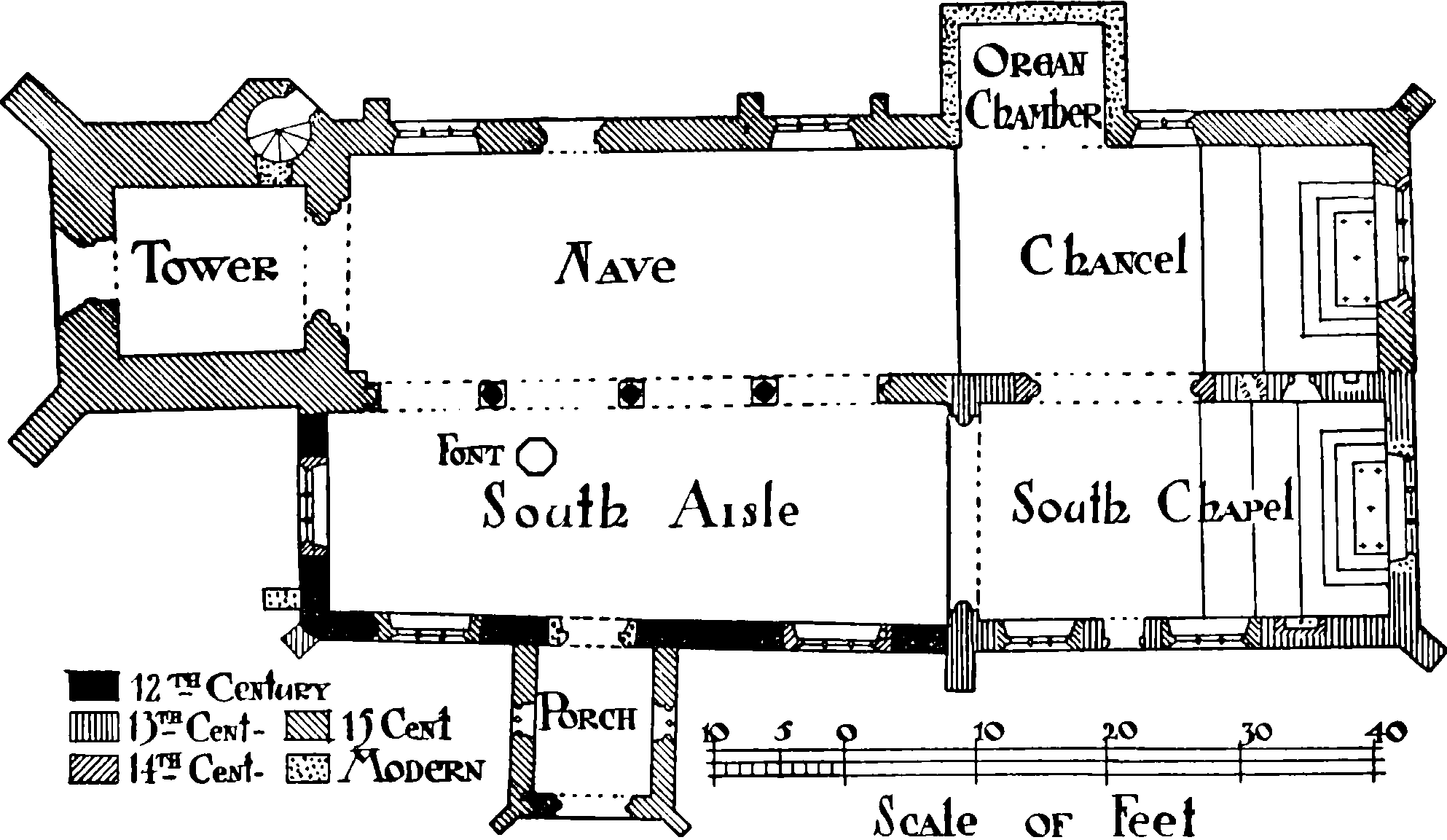
Plan of Riseley Church
In the south wall are a restored trefoiled piscina and a 13th-century lancet with an external rebate for a frame, formerly an external window to the old chancel. To the west of it are a rectangular squint from the chancel to the chapel and a wide pointed arch, opening originally to the 14th-century north chapel which preceded the present chancel. The chancel and south chapel have coved plaster ceilings of comparatively modern date.
In the south wall of the chapel are two late 15th-century windows of three cinquefoiled lights under low four-centred heads, the mullions being carried up to the heads. There are also a 13th-century priest's doorway on the south side and a 14th-century piscina under two arches, the eastern arch being cinquefoiled and the western trefoiled, with a drain in the eastern arch only. The labels and mouldings have been cut back flush with the wall face.
The old chancel arch, now opening to the south aisle, is of early 13th-century date, with half-round responds and moulded capitals, and an arch of two chamfered orders.
There is no arch between the chancel and nave, its position having been occupied by the rood screen and loft, now unfortunately destroyed; but the embattled rood beam still remains, carrying a plastered partition filling in the triangle of the roof.
In the north wall of the nave are two three-light 15th-century windows with modern mullions, and between them a simple doorway of the same date, while above them are three two-light clearstory windows, also of the 15th century.
On the east side of the north door is a stone bracket in the wall.
The nave arcade, which has been restored, is in four bays with pointed arches of two chamfered orders, and a plain label springing from circular columns with square capitals. When the arcade was rebuilt in the 15th century the columns, which, with the capitals, are of late 12th-century date, were heightened and the arches renewed, their inner order being in large stones of 15th-century date, while the outer order is mainly composed of the smaller 12th-century arch stones re-used; the label is also 12th-century work altered at the re-building, but the responds are entirely of the 15th century. The bases, which are 12th-century work, have angle spurs, and in the east respond is the door to the rood stair.
Over the arcade are blocked 15th-century windows like those in the north wall.
There is a 15th-century south porch to the aisle with an embattled parapet, having crocketed pinnacles and projecting gargoyles over the diagonal angle buttresses. In the east and west walls are twolight windows. The inner doorway is new, the exterior doorway has continuous jamb and arch mouldings, and a label stopped upon large grotesque heads, with a winged angel holding a book at the apex, over which is a small cinquefoiled niche with a crocketed canopy. On either side of this porch is a tall three-light window with 15th-century tracery; the jambs of that to the east are probably of 14th-century date, and there is a small trefoiled niche cut in the eastern splay.
The west window of the aisle is of late 14th-century date, of three trefoiled lights with two quatrefoils in a pointed head; the mullions and jambs have been restored.
The tower arch is in three chamfered orders, the inner of which has a moulded capital, while the others are continuous. The tower, which has been largely rebuilt, is in four stages, with diagonal buttresses at the western angles and an embattled parapet with angle pinnacles. In each face of the belfry stage are pairs of two-light windows with transoms, the labels being carried round the tower as strings. The tower stair is in a projection at the north-east; its original internal doorway is now blocked, and an external one has been cut through the wall.
The west doorway has a two-centred head with a continuous arch, and over it is a window of two cinquefoiled lights with tracery. In the south side of the tower is a single trefoiled light, and over it a sundial and the heads of two small 14th-century trefoiled openings with labels.
The roofs of the nave and aisle are of low pitch, dating from the 15th century, and are in four bays. In the south aisle is a 15th-century octagonal font, and some of the seating at the west end of the church dates from the end of the 15th-century, and there is a mediaeval oak chest in the north-east corner of the aisle. There are no monuments of interest.
There are five bells: the treble, by Hugh Watts, inscribed 'God save the King, 1639'; the second of 1816; the third an alphabet bell by Watts, of 1639; the fourth of 1852; and the tenor of 1814.
The plate consists of a chalice, paten, flagon and two plates, presented by Emma Maria Elizabeth Lady St. John in 1788.
The registers previous to 1813 are in four books, the earliest containing all entries from 1626 to 1672; the second the same, from 1683 to 1743; the third is the printed marriage register, 1754 to 1812; and the fourth contains baptisms and burials 1790 to 1812.
ADVOWSON
The advowson of the church of Riseley formed a part of Alice de Clermont's grant to the Knights of St. John of Jerusalem, (fn. 71) and remained their property until the Dissolution. Queen Elizabeth in 1585–6 granted the advowson to Sir Christopher Hatton. (fn. 72) By 1618 it had become the property of Oliver St. John of Bletsoe, (fn. 73) and henceforward followed the same descent as that of Lawrence Manor (q.v.). The present patron is Lord St. John of Bletsoe.
In 1291 the value of the church was £4 5s. 8d., (fn. 74) and at the Dissolution £8 17s. 10d. (fn. 75)
The commissioners of Edward VI found that a tenement and 11 selions of land, worth 8s. per annum, had been given for the maintenance of a sepulchre light; out of this a rent of 3d. to the Crown and another of 4d. to Lord St. John had to be paid. (fn. 76)
CHARITIES
The official trustees hold a sum of £10 2s. 7d. consols, representing a gift for poor widows by a person named Bourne at a date unknown. In 1909 the dividends were distributed on St. Thomas's Day among sixteen widows.
The same trustees also hold a sum of £109 17s. 9d. consols, arising from a legacy under the will of Samuel Richards, dated in 1824, for the Sunday school.
A further sum of £109 17s. 9d. like stock is held by the same trustees, bequeathed by the same testator, for the distribution of bread on St. Thomas's Day among the industrious poor frequenting the Established Church.
In 1909 the dividends, amounting to £2 14s. 8d., were applied in bread to 119 recipients.
The Cake Bread Close consists of a piece of old inclosure, containing 2 r. 13 p., adjoining the vicarage lands, referred to in an award dated 27 April 1793, in respect of which small cakes of bread are distributable among the housekeepers in the parish.