
A History of the County of Bedford: Volume 3. Originally published by Victoria County History, London, 1912.
This free content was digitised by double rekeying. All rights reserved.
'The hundred of Wixamtree: Introduction', in A History of the County of Bedford: Volume 3, (London, 1912) pp. 227. British History Online https://www.british-history.ac.uk/vch/beds/vol3/p227 [accessed 19 April 2024]
THE HUNDRED OF WIXAMTREE
CONTAINING THE PARISHES OF
| BLUNHAM with MOGGERHANGER and CHALTON | NORTHILL | |
| OLD WARDEN | ||
| CARDINGTON with EASTCOTTS | SOUTHILL with ROWNEY | |
| COPLE | WILLINGTON (fn. 1) | |
At the time of the Domesday Survey Wixamtree Hundred contained about the same area as it does at the present day. Several of the hamlets are not mentioned in Domesday. Thus Moggerhanger was part of the old hamlet of Chalton; Eastcotts, Cotton End and Fenlake of Harrowden; while Rowney and Shefford Hardwick were included under Southill, Stanford and Broom and the hamlets of Northill under Northill and Beeston. (fn. 2)
Wixamtree was a royal hundred which appears to have remained in the possession of the Crown, with the exception of a lease for forty years granted by Charles I in 1630 to Onslow Winch for a yearly payment of £11 1s. 5d. (fn. 3) and a grant for life in 1665 by Charles II to Queen Catherine. (fn. 4)
Wixamtree held a court leet half-yearly and also a three weeks court at which the tenants performed their suit and service to the lord of the hundred, the profits of these courts being averaged in 1651 at £2 10s. yearly. (fn. 5)
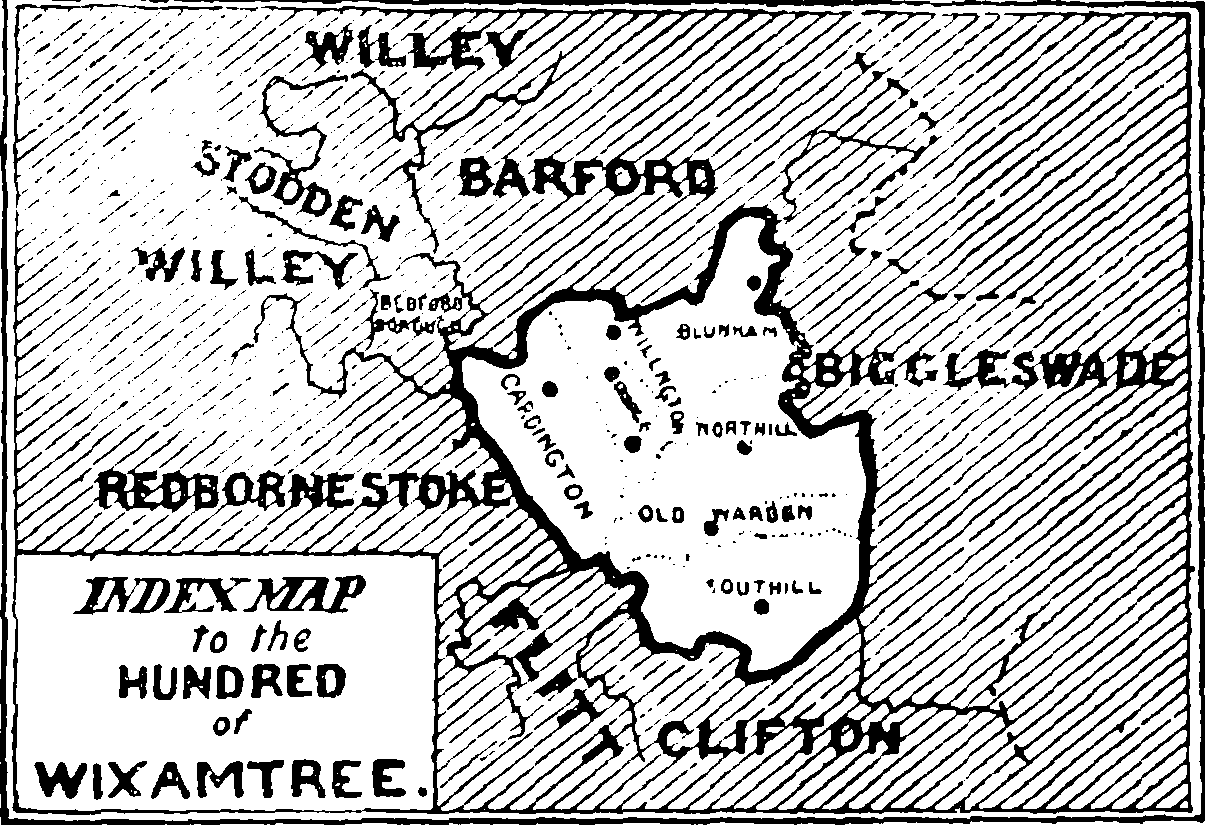
INDEX MAP to the HUNDRED of WIXAMTREE.
Varying sums have been contributed by this hundred from time to time towards national aids and subsidies. In 1346, when an aid was levied for knighting the king's son, Wixamtree was assessed at 9 fees and a fraction and paid a sum of £19 10s. (fn. 6) The hundred raised £48 12s. 7d. in 1517, £83 14s. 8d. in 1598, £137 1s. 4d. in 1628–9 towards royal subsidies. (fn. 7) In 1570 Thomas Pigott and George Fish were responsible for charges for supplying armour and weapons within the hundred. (fn. 8) Thirty inhabitants were assessed at £15 for ship-money in 1638, (fn. 9) while £170 18s. 8d. represented a two months' tax levied during the Interregnum for the maintenance of the forces under Sir Thomas Fairfax. (fn. 10) In 1660 the assessment was raised to the sum of £369 3s. 10d. (fn. 11)
A Parliamentary Survey in 1651 stated that Sir Samuel Luke (who was then owner of the lease granted to Onslow Winch) received £17 9s. 8d. yearly in quit-rents and royalties. The waifs, strays, deodands and felons' goods in the hundred were named as belonging to the lord if the bailiffs seized them first, but if any bailiff belonging to a lord of a manor, who had a leet within the hundred, seized them first they became the property of the latter. (fn. 12)