A History of the County of Bedford: Volume 3. Originally published by Victoria County History, London, 1912.
This free content was digitised by double rekeying. All rights reserved.
'Parishes: Cranfield', in A History of the County of Bedford: Volume 3, ed. William Page (London, 1912), British History Online https://www.british-history.ac.uk/vch/beds/vol3/pp275-279 [accessed 9 May 2025].
'Parishes: Cranfield', in A History of the County of Bedford: Volume 3. Edited by William Page (London, 1912), British History Online, accessed May 9, 2025, https://www.british-history.ac.uk/vch/beds/vol3/pp275-279.
"Parishes: Cranfield". A History of the County of Bedford: Volume 3. Ed. William Page (London, 1912), British History Online. Web. 9 May 2025. https://www.british-history.ac.uk/vch/beds/vol3/pp275-279.
In this section
CRANFIELD
Crangfeld (x cent.); Cranfelde (xi cent.).
Cranfield is a large parish of 3,998 acres, situated on a range of hills on the Buckinghamshire border. The soil is heavy, with a subsoil of cold clay. There are 1,757 acres of arable land, the crops being wheat, oats and barley, 1,654 acres of permanent pasture and 37½ of woods and plantations. (fn. 1)
The village of Cranfield stands on high ground over 360 ft. above the ordnance datum and extends some distance along roads radiating from the church, which is surrounded by a shady churchyard. Some years ago, when the church was undergoing restoration, Roman coins were discovered in the churchyard. (fn. 2) At the junction of the roads is the village pump and hard by are the schools. The street boasts several good shops, due probably to the fact that the nearest railway stations, Millbrook and Woburn Sands, are only 4 miles distant. The most conspicuous object, however, is the group of almshouses, two separate portions of which were erected by the late Mr. James Goodman and the third by the Society of Friends. In this part of the village, which extends into the hamlets of West End and Tartlett End, are the Wesleyan chapel and two Baptist chapels.
Along the road leading north from the village lie some of the hamlets contained in the parish. At Broad Green there is a windmill still in use, whilst another one recently stood north of Gossard's Green. A third at Bourne End was burnt down a few years ago. Bourne End, which is served by a mission room, consists of scattered farms, of which Troy Hall and Hillgreen Farm are moated. The site of another moat is visible to the north-east of Boxhedge Farm.
The north-east end of Cranfield, known as East End, contains a Baptist chapel. From here a field path leads to Moat Farm, a small modern brick building almost entirely surrounded by a moat still holding plenty of water.
In the extreme west of the parish is the small group of houses called Wharley End. The remaining hamlet of Wood End is about three-quarters of a mile south of the village and contains little of interest beyond a moated inclosure. The road connecting it with the village borders the park surrounding Cranfield Court, a large modern red-brick building with Bath stone dressings, in the French Gothic style. It is the seat of the widow of Mr. J. F. Hatfeild Harter, and from its elevated position can be plainly seen from all sides.
MANORS
The earliest mention of Cranfield is found in 969, when among the boundaries of Aspley mention is made of 'Cranfeldinga dic.' (fn. 3) The Chartulary of Ramsey Abbey records that Alwyn the Black, who died in 998, gave the manor to the Abbot and convent of Ramsey. (fn. 4)
This grant was confirmed by Edward the Confessor in 1060, (fn. 5) by William I in 1078, (fn. 6) and by Pope Alexander III (fn. 7) in 1178. The latter grant speaks of the church, which is not mentioned in the two earlier.
Abbot Alfwin, the last Saxon abbot, granted a life estate in Cranfield to Ralph Earl of Hereford. (fn. 8)
The Domesday Survey states that the Abbot of Ramsey held the manor; that it was assessed at 10 hides worth £9. (fn. 9)
In the 11th century two of the abbots are mentioned as having alienated land here belonging to the abbey, giving it to their relations. (fn. 10)
On the retirement of Abbot Robert de Redinges in 1206 King John, with the assent of the abbey, granted the manor to him for life. He seems to have been involved in a quarrrel with this monarch, and no doubt the manor was given him, as a pension, to compensate him for having to retire. (fn. 11) In the same king's reign the abbot was granted a view of frankpledge in his manor of Cranfield, and in 1251 Henry III gave the abbot and convent a grant of free warren in all their demesne lands at Cranfield, (fn. 12) and there seems to have been some doubt as to the validity of these grants, for the abbot was summoned to the Bedford Assizes in 1330 to show by what right he enjoyed these liberties. After hearing the case the court decided to take them back into the king's hands and the abbot had to pay 40s. to have them regranted to him. (fn. 13) In 1328 the manor was granted by the abbot to Sir William de Herle, Robert de Sachynton and Robert de Burgh, rector of Houghton, for the yearly rent of £100 of silver, the abbot on behalf of the monastery reserving the right of re-entry should the rent not be paid. This grant also expressly states that the right of presentation to the church was to remain with the abbey. (fn. 14) During the 14th century various grants of land at Cranfield were made to the abbot. Thus Thomas de Newby gave 60 acres. (fn. 15) The abbots continued to hold the manor till the Dissolution, at which time its value was £68 9s. 4d. (fn. 16) It then became Crown property, and in 1542 was attached to the honour of Ampthill. (fn. 17) In 1545 William Hutton was appointed to be the bailiff and collector of the manor. (fn. 18)
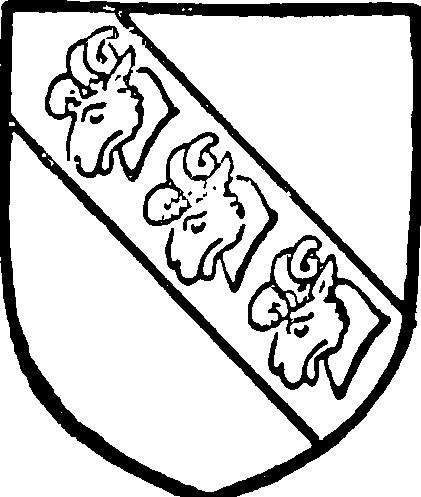
Ramsey Abbey. Or a bend azure with three rams' heads argent cut off at the neck and having golden horns.
In 1550 Edward VI granted the manor to his half-sister the Princess Elizabeth, (fn. 19) who ten years later leased it for twenty-one years to one Fysher. (fn. 20) Later in 1603 James I granted it as part of her dowry (fn. 21) to his consort Queen Anne, who died in 1617–18. In 1621 the manor was granted to Sir Lionel Cranfield (fn. 22) on being raised to the peerage as first Baron Cranfield of Cranfield. The following year he was created Earl of Middlesex. (fn. 23) He died in 1645, and was succeeded by his son James, on whose decease in 1651 his brother Lionel succeeded to the title and estates as heir male. (fn. 24) He made a settlement of Cranfield Manor in 1653, (fn. 25) in 1655, (fn. 26) in 1660–1, (fn. 27) and again in 1663. (fn. 28) In 1672 it became the property of the Monoux family, by whom it was retained till 1729, when it was purchased by the Duke of Bedford, (fn. 29) by whose family it was retained till 1837, (fn. 30) about which date it was alienated to Joseph Ashby Partridge, who held it in 1847. A further alienation took place before 1864 to Captain Drake, whose widow devised it by will to her husband's kinsman, Mr. Alfred Henry Tarleton, (fn. 31) the present owner.

Cranfield, Earl of Middlesex. Argent a pale azure with three fleurs de lis argent there on.
A second manor existed here called WASHINGLEY MANOR, which no doubt is called after the family of Wassingle, whose names appear as witnesses to deeds granting land in Cranfield (fn. 32) to Ramsey Abbey in the 13th century, and who seem to have been in the employment of the abbot, for William de Wassingle, as steward of the abbot, presided over the court of King's Repton in 1288, and he is mentioned as holding the position of steward of the fair of St. Ives in 1293. (fn. 33) The first mention of this family as landowners in Cranfield is in 1295, when William de Craunfeld (fn. 34) granted for 20 marks and for the yearly payment of 6 marks of silver during his life all his lands, tenements and appurtenances, with the homage and service of free tenants, to William the son of William de Wassingle of Cranfield. A little later William de Wassingle the elder obtained a licence to alienate in mortmain to the Abbot and convent of Ramsey a messuage and a moiety of 1 virgate of land at Cranfield. (fn. 35) In 1353 John de Wassingle obtained a messuage and land from Gilbert de Warwick and Nicholas of York. (fn. 36) The first mention of Washingley as a manor is in 1515, when Thomas Stafford sold it to Richard Langley for £140. (fn. 37) By 1548 the manor had come into the possession of Thomas Leigh, who seems to have mortgaged it to John Dormer, a citizen and merchant of London. (fn. 38) At his death in 1572 (fn. 39) Thomas Leigh left a son John, who was a minor, aged nine years. In 1584 John Leigh recovered the estate, (fn. 40) but in 1589 he transferred it to John Stampe and his wife, who was the daughter and heir of the above-mentioned John Dormer. (fn. 41) By 1599 John Leigh had again obtained the manor, (fn. 42) and died in 1620, being succeeded by his son Lewis, (fn. 43) who with his wife Lucy conveyed the manor in 1624 to Nicholas Hampson. (fn. 44) Again in 1649 the Leighs were in possession of the property, (fn. 45) but the following year Thomas Lord Leigh and his son Charles parted with it to William Feilde, (fn. 46) who settled it on Miles Whitworth and Thomas Ringe. From the Feildes the manor passed through female heirs to the families of Baker and Coleman, (fn. 47) and then to Mr. Pearse of Bedford, who inherited it from the latter family, and transferred it to Robert Denis in 1802. (fn. 48) After this date no further mention has been found of this manor.
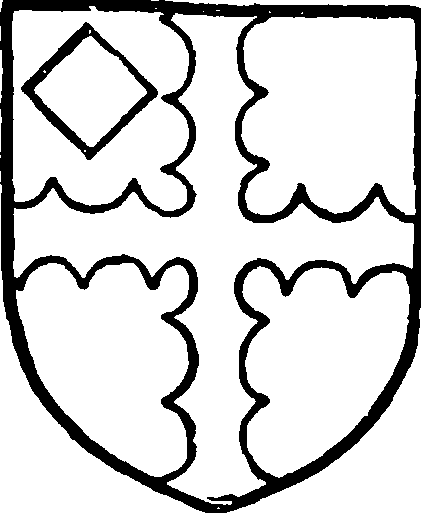
Leigh, Lord Leigh. Gules a cross engrailed argent with a lozenge argent in the quarter.
There was also a third manor in this parish, which was known as RUDLONDS or RUDLANDESFELDE, the first mention of which yet discovered occurs in 1563, when Sir William Paulet appears as the owner. (fn. 49) In 1575 he conveyed it to Jeremy Weston, (fn. 50) whose son Richard was created Lord Weston in 1628 and Earl of Portland in 1633. (fn. 51) The earl at the time of his death (March 1634–5) was in possession of the manor (fn. 52); but in 1640 his widow and her son Jerome second Earl of Portland parted with the property to Mr. Dray Chamberlain, (fn. 53) when all mention of it disappears.

Weston, Earl of Portland. Or an eagle sable looking backwards.
CHURCH
The church of ST. PETER AND ST. PAUL consists of a chancel 36ft. 4 in. by 20 ft. 8 in., with a north vestry, nave 57 ft. 6 in. by 16 ft. 6 in., north aisle 11 ft. wide, south aisle 12 ft. 9 in. wide, and west tower about 10 ft. square.
The chancel arch, nave arcades and lower part of the tower date from about the middle of the 13th century, and the chancel, though now entirely modernized, must have reached its present plan early in the 14th century at least. Part of the two-story northeast vestry is of that date. The aisle walls are perhaps also of late 13th-century date, though remodelled in the 15th century, when the clearstory was added and the tower heightened and much altered. It is possible that at the same time the nave arcades were rebuilt and heightened.
The chancel is plastered and overgrown with ivy, and the windows, which have perpendicular tracery in four-centred heads, are modern; on each side of the east window is a modern canopied niche, and the piscina and sedilia, in 15th-century style, are also modern.
The vestry, which has modern doors and windows, is 14th-century work, and has a priest's chamber above it, approached by a staircase in the south-west angle; it has an embattled parapet, chamfered plinth and diagonal angle buttresses of little projection. The upper room is lighted by two narrow square-headed lights, but shows no traces of arrangements like those at Marston Moretaine.
The chancel arch is of two chamfered orders with a deeply undercut label; there are half-round shafts in the jambs, having well-moulded capitals, of which that on the south is ornamented with nail-head. The arcades of the nave, each in four bays, are of the same character as the chancel arch, with similar arches resting on shafts, a quatrefoil on plan, and with moulded capitals varying slightly in section; the chamfers of the arches in the south arcade are stopped over the capitals by a scroll. The clearstory windows, of which there are four on each side, are of three cinquefoiled lights under a four-centred head. The nave roof is good 15th-century work in four bays; the secondary rafters have angels supporting them, with wings outspread and holding shields bearing emblems of the Passion, the angels and carved bosses being disfigured by modern colouring. The tower arch is 13th-century work, and consists of chamfered orders springing from the jambs, and having a restored label and mask stops.
The north aisle has a late 13th-century piscina in the north wall with a trefoiled head, over which is a label; above it is an image corbel. The east window is also of the end of the 13th century, consisting of three uncusped pointed lights under a pointed head and a label with modern stops. In the north wall, which is plastered and has an embattled parapet, are three restored 15th-century windows, each of three cinquefoiled lights under a four-centred head; between these windows are 13th-century buttresses in two stages. The round-headed north doorway, now blocked, is re-used work of the latter part of the 12th century, but almost entirely made up in Roman cement; it is in two orders, the outer moulded with a pointed bowtel between two hollows, and the inner slightly chamfered; it rests on jambs in which are shafts having scallop and simple leaf capitals. The west end of the aisle is not plastered, and the walling is of roughly coursed rubble, the window being like those in the north wall. The roof is of the 15th century, with painted bosses and half-figures of angels carrying shields.
The south aisle has a squint in the north-east angle looking into the chancel; there is a 13th-century square piscina in the south wall, moulded like that of the north aisle, and adjoining it is an unmoulded aumbry. The windows are like those of the north aisle, but much more restored, and the doorway and the inclosing stonework are quite modern; over the arch of the doorway is an early carving of a seated saint holding a book (?); the sides of the stone taper and have a roll moulding, and it seems probable that it is part of a cross shaft. To the east of the doorway, inside the aisle, is a trefoiled stoup fitted with a modern piscina basin. The roof is 15th-century work and like that of the north aisle. The porch is modern.
The tower is built of wide-jointed coursed rubble, with an embattled parapet and diagonal buttresses; about half-way up it widens on all sides, the projection being carried on three-centred arches. The west door is modern, in 15th-century style, and the window above it, of two cinquefoiled lights under a four-centred head, is also modern. On each side of the top stage are two 15th-century windows consisting of two cinquefoiled lights under a four-centred head, and there is a stair in the south-west angle, entered from the ground floor by internal and external doorways.
The font and pulpit are both modern, but in the churchyard is a 15th-century font in a ruinous condition.
There are few monuments of interest, but in the south wall of the chancel is a marble quarry inscribed to the memory of Thomas Frank, a former rector, who died in 1690, and was buried at Campton in the same county.
There are five bells: the first by John Hodson, 1663; the second and third by Newcombe of Leicester, 1611; the fourth by Mears of London, 1833; and the fifth by Taylor of St. Neots, 1805. There is also a small bell with no inscription or marks.
The communion plate consists of a foot-paten of 1710 and a cup, flat paten and flagon of 1848.
The registers previous to 1812 are in six books:— (1) all entries 1600 to 1652; (2) the same, 1653 to 1670; (3) 1690 to 1734; (4) printed marriages 1754 to 1770; (5) baptisms and burials 1763 to 1787; and (6) printed marriages 1802 to 1812.
ADVOWSON
The advowson of the church belonged to the Abbots of Ramsey, (fn. 54) who were the lords of the manor of Cranfield, and after the Reformation the right of patronage still continued to belong to the manor till the 18th century. (fn. 55) The present patron is the widow of the late Mr. J. H. Harter, whose grandfather obtained it by purchase before 1854. (fn. 56) The earliest mention of the church is in the time of Abbot Walter (1133–60), when he granted it to Godfrey the priest, (fn. 57) who paid 20s. yearly to the abbey for the repair of the service books at Ramsey. The next mention of the church is in 1178, (fn. 58) when Pope Alexander III confirmed it to the abbey, Pope Gregory IX doing the same in 1229. (fn. 59) According to the Taxatio (fn. 60) the value of the living was £20. The Valor shows the living to be worth £33 2s. (fn. 61)
In pre-Reformation times a brotherhood or gild existed in the parish. This gild, according to the chantry certificates, (fn. 62) had a house and 6 acres of land. The brotherhood also owned a herd of cattle which were let to various people, the money paid being £8 10s. In addition to the brotherhood 5 acres of land were devoted to the upkeep of a light, and a rood and a half of land was given to a drinking.
CHARITIES
In 1601 George Bury by will devised 40s. a year for the repair of causeways and common churchways to be paid out of the rents of the lands called Coles. By a scheme of the Charity Commissioners, 22 December 1897, the rent-charge is vested in the official trustee of charity lands, and is made applicable in the repair of any footpaths under the control of the parish council, or in placing and maintaining seats in places of public resort, or for other public purposes in the parish. In 1908 there was a balance in hand of £15 14s. 6d.
The St. Thomas' Day charities consist of a rentcharge of £2 5s. charged on Broad Green Farm by Mr. H. Lovell, the owner, supposed to represent the gifts of Thomas Butler, 1645, Thomas King, 1658, and Elizabeth Field, 1694; also a rentcharge of £1 charged on Perry Hill Farm, representing the gift of William Fruit in 1649. The annuities are duly received and applied.
In 1683 Richard Grange bequeathed £200 for purchasing freehold land, the rent thereof to be applied in apprenticing the sons of poor householders. The endowment consists of 3 a. in this parish and 6 a. in Wootton of the rental value of £20 or thereabouts. The charity is regulated by schemes of the Charity Commissioners of 4 October 1862 and 4 December 1885.
The school. (fn. 63)
The endowments are derived from settlements by Mrs. Alice Girton and her son-in-law Peter Caynhoo, 1703, Mrs. Ann Baker, 1716, and will of Thomas Turney, 29 December 1712, consisting of two fields containing 12 a. 2 r. 11 p. let at £7 a year, and a rent-charge of £10 on a farm at Bourne End, the property of Mr. F. G. Taylor.
The Hartwell Almshouses, founded by will of Richard Hartwell, 2 December 1734, are regulated by scheme, 22 July 1898. The trust property consists of three buildings used as almshouses and 40 a. let at £65 a year. By the scheme the net income is applicable in pensions to not more than six persons, of whom one-half to be members of the Society of Friends and the other half persons who have been five years resident in the parish. In 1908–9 three widows, inmates of the almshouses, received 2s. 6d. a week and three annuitants received £8 6s. per annum.
The Goodman Almshouses.
In 1888 James Goodman, formerly of Cranfield, by deed, dated 24 September in that year, founded and endowed almshouses for aged and infirm widows.
The same donor by deed, dated 13 October 1892, also built and endowed five additional almshouses for aged or infirm married couples or widowers. The endowment consists of house property at Tooting, Herne Hill, Brixton and Clapham, and 3 a. 2 r. at Cranfield, producing in 1909 £170 or thereabouts; 5s. a week is paid to each of the inmates, the surplus income being applied for the benefit of deserving poor.
In 1883 Stephen John Hatfeild Harter, by will proved at London on 7 March in that year, bequeathed £1,000, the interest to be applied in donations to the poor or other charitable purposes for the good of the parish at the discretion of the rector and churchwardens. The legacy is represented by £896 London and North Western 4 per cent. stock with the official trustees, producing £35 16s. 10d., which in 1909 was applied in tickets for clothing of the value of 5s. each; also gifts were made to families to encourage the children's school attendance.
The Church Estate consists of 4 a. or thereabouts, the rental value of £5 being applied for church expenses.
The trustees of the Baptist chapel, comprised in a deed of 8 November 1849, hold certain cottage property now producing about £21 a year upon trust as to £5 for the use of the Sunday school of the Meeting House and the residue towards the support of the minister.