A History of the County of Bedford: Volume 3. Originally published by Victoria County History, London, 1912.
This free content was digitised by double rekeying. All rights reserved.
'Parishes: Houghton Conquest', in A History of the County of Bedford: Volume 3, ed. William Page (London, 1912), British History Online https://www.british-history.ac.uk/vch/beds/vol3/pp288-296 [accessed 30 April 2025].
'Parishes: Houghton Conquest', in A History of the County of Bedford: Volume 3. Edited by William Page (London, 1912), British History Online, accessed April 30, 2025, https://www.british-history.ac.uk/vch/beds/vol3/pp288-296.
"Parishes: Houghton Conquest". A History of the County of Bedford: Volume 3. Ed. William Page (London, 1912), British History Online. Web. 30 April 2025. https://www.british-history.ac.uk/vch/beds/vol3/pp288-296.
In this section
HOUGHTON CONQUEST
Oustone, Houstone (xi cent.); Hoctona (xii cent.); Octona, Hocton (xiii cent.).
The parish of Houghton Conquest lies some 6 miles south of Bedford. It comprises 3,431 acres, of which 80 are woodland, while the remainder are divided in almost equal proportions between arable land and permanent grass. (fn. 1) The soil is clay and the subsoil Oxford clay. The principal crops grown are wheat, barley, oats, beans and peas. The ground rises from the north of the parish, where it is little more than 160 ft. above ordnance datum, and reaches 100 ft. in the centre, where the village is placed. Beyond this the rise is more rapid and terminates in a range of low hills on the southern boundary. From this hilly ridge, the height of which varies from 300 ft. to 369 ft., a magnificent view over the vale of Bedford can be obtained.
The village stands at the crossing of two byroads and is dominated by the fine church of All
Saints. To the east of it is an 18th-century brick
farm-house, while further along the road, standing
opposite a pasture, is a row of 17th-century brick
almshouses, to which additions to the back and renovations were made during the last century. The front
was then rebuilt, but an original stone was reset in
the central gable on which is the following inscription:—
ANNO DÑI: 1632 ANNOQ
RRs CAROLI OCTAVO
HAEC DOMUS de novo erecta et constructa
fuit Sumptibus propriis Francisci Clerk de
Houghton Conquest in Com['] Bed['] Militis
In perpetuam Elemosynam pro sex pauperibus
Ibid['] Relevand['] necnon pro libero Paedagogio ad
Liberos ejusdem Villae & Alibi dicti Com['] edocendos
et voluit q[uod] dict['] Pauperes habeant octo Libras
In eas añuatim dividend['] cum sex Cubiculis
Inferioribus, et [quo]d Paedagogus habeat sex decim
Libras a[nn]uatim, ac resid['] dictae domus cum
Pitello Columbario pro suo Salario in perpetuum.'
In the garden in front of and belonging to the almshouses is a pump, from which many of the inhabitants
draw their water.
The remains of the manor-house of Houghton Grange, now part of a small shop, may still be seen in the village street. There are also a few picturesque timbered cottages, whilst the rectory—an early 18th-century building approached by a fine avenue of limes—is worthy of mention. The Bury Farm, a little to the south of the village, occupies the site of the manor-house of Conquest Bury, the seat of the Conquest family. (fn. 2) Here James I stayed for two nights in 1605 and attended service at the parish church. The queen meanwhile was the guest of Sir Richard Newdigate in the neighbouring parish of Haynes, where the king afterwards joined her. (fn. 3)
In the outlying portion of the village known as Chapel End is the Hill Farm, a modern building, which has still standing at its end a 17th-century brick chimney-stack built on a sandstone base, while in one of the rooms on the ground floor is some panelling of the same date or possibly earlier, said to have been taken from the pews of Haynes Church during a restoration. In the yard are some old barns, one being built of brick and half-timber on a sandstone base and evidently of the same date as the chimney-stack, while traces of a moat are still to be seen.
On a hill to the north-west is a windmill which is still worked.
To the south-west of Houghton Conquest is the hamlet of Haw End, which consists of one or two farms and a Methodist chapel. The Manor Farm marks the site of the manor which formerly belonged to Reading Abbey.
Beautifully situated on the top of a hill in the south of the parish stand the ruins of Houghton House, once one of the finest houses in the county. The principal approach was from the south, and there is still to be seen some 150 yds. from the building part of an avenue of lime trees stretching away towards Ampthill. From the north a magnificent view over the vale of Bedford is obtained, a broad avenue of elms on the slope of the hill forming a delightful vista in the foreground. The house was erected early in the 17th century, and is built of red brick with stone quoins and dressings, though in some of the internal and basement walls local sandstone has been used in conjunction with the brick. A strict regard to symmetry has been observed in the design of both the plan and elevations. It is in plan a rectangle with projecting end wings on the south, the side walls of which are carried right through the building, while a division wall runs across the house east and west parallel with the front wall. In the centre of the south front is a projecting bay that was carried up the front of the building, serving on the ground floor as the principal entrance. This led into a large hall which was bounded on the north by the main cross wall of the building and extended eastwards as far as the east wing. Between the west wing and the hall was a smaller room. In the centre of the building behind the hall was a vestibule entered from a central open portico on the north. On either side of the portico and vestibule were staircases lighted from the north, while to the east and west of these respectively were two large rooms the full width of the south projecting wings and extending from the north front to the central division wall. These rooms were lighted from the north by large three-sided mullioned and transomed bay windows, the front having four lights, the sides one light each, the windows being divided horizontally into three parts. The east wing of the building evidently accommodated the offices and servants' quarters, and had a basement or cellars, while the external wall was quite plain, but of this part of the house nothing remains but parts of the outside walls. In the front part of the projecting west block was a small room lighted on the south and east, and entered from a large room extending back as far as the main division wall. On the north-west this led into an open portico in the centre of the west front, on either side of which were narrow rooms entered from the chambers on the east, the northern one having been used as a small staircase. There were no corridors on the ground floor, through communication being obtained from room to room. In the central projecting bay on the south front was the square entrance doorway surrounded by a stone architrave with large keystones in the head carrying a curved pediment over. Above this on the first floor was a two-light mullioned and transomed window divided horizontally into three, over the head of which was a semi-octagonal stone panel having a stone bracket in the centre carrying a projecting panel crowned with a broken pediment. On either side of the central bay were two twolight windows divided horizontally into three ranges, while the two windows in each of the projecting wings were of a similar description.
The portico in the centre of the west front was of five bays formed by stone Doric columns supporting an entablature which carried another order, but of this nothing remains save the pedestals. In the metopes of the Doric frieze were the following heraldic devices: a bear and ragged staff, interlacing pheons with an H, and a collared and chained porcupine.
On either side of the portico was a two-light window, while at the ends of the front were slightly projecting bays in the walls of which were small elliptical stone panels.
An arcade of three bays, behind which was an open portico, emphasized the centre of the south front, while between the arches were detached Doric columns carrying an entablature enriched in a similar manner to that on the west front. Above this was a row of Ionic columns standing on pedestals, but of this only one column is now remaining. At the ends of this front were slightly projecting bays, in the centre of which were the three-sided bay windows already referred to, while between these and the portico were two two-light windows like those on the other fronts. Marking the first-floor level was a flat stone band, while the fenestration on this floor repeated that of the floor under.
To the west of the house now belonging to a modern farm are several half-timber and brick barns with tile roofs.
The surrounding estate known as Houghton Park or Dame Ellensbury Park was granted by James I to Mary Countess of Pembroke—'Sidney's sister, Pembroke's mother'—to hold for her life. (fn. 4) She built there the mansion just described, (fn. 5) and employed Inigo Jones as her architect. The tradition long current that her brother, Sir Philip Sidney, wrote his Arcadia in the grounds of this house must regretfully be rejected, as he died before the property came into her possession. James I visited Lady Pembroke here in 1621, the year of her death. (fn. 6) Her younger son, Philip Earl of Montgomery, who had a reversionary interest in the estate, surrendered it two years later to the king, who granted it the same year to Thomas Lord Bruce, (fn. 7) whose son Robert in 1665 became lord of the manor of Dame Ellensbury. (fn. 8) The Bruce family, afterwards Earls of Elgin (fn. 9) and Earls of Ailesbury, (fn. 10) and hereditary seneschals of the honour of Ampthill, made Houghton House their chief residence. Here after the battle of Worcester came that ardent Royalist Christian Countess of Devon (sister of Thomas Bruce Earl of Elgin) to 'compose her distracted thoughts' (fn. 11) after the great disaster. She remained here three years, 'lightening her griefs and expenses.' (fn. 12) Houghton House was bought from the Bruce family in 1738 by John Duke of Bedford, (fn. 13) whose son Francis Marquess of Tavistock was killed whilst hunting near Dunstable in 1767. (fn. 14) The house was subsequently dismantled and unroofed by the duke. The shell is still standing, but is so far decayed as to be beyond hope of repair. The ruins, now overgrown with ivy and trees, are railed off from the public. It has been suggested by a present-day writer that Bunyan, who must have frequently seen the house in the days of its full splendour, had it in his mind when he wrote of the 'House Beautiful' which stood on the summit of the hill 'Difficulty.' (fn. 15)
The parish registers of Houghton Conquest (fn. 16) are unusually full and interesting, largely owing to the industry of Thomas Archer, rector of the parish from 1589 to 1631, who enriched them with numerous memoranda concerning events of both general and local importance. Not the least interesting entry is that which records how one Bunyan of Elstow (the father of John Bunyan) when bird's nesting in the Bury wood discovered a nest containing three young rooks whose feathers were as white as snow. (fn. 17)
The following place-names have been found in this parish:—Calewellehill (xiii cent.), Garnacles (xv cent.), Swathesland, Ballond Hill, Dane Cross, Palsie, Chilmead and le Peak (xvi cent.).
The parish has been inclosed under an Act passed in 1806. (fn. 18)
MANORS
At the time of the Domesday Survey the Countess Judith held half a hide in Houghton. (fn. 19) She held 10 hides in the neighbouring parish of Kempston, and it would appear from the subsequent history of the property that a considerable portion of her land which in 1086 was adjudged to be in Kempston was later considered to be part of the vill of Houghton. (fn. 20) The origin of HOUGHTON CONQUEST MANOR alias CONQUEST BURY must be looked for in this property. The fief of the Countess Judith afterwards became known as the honour of Huntingdon, and the overlordship of this manor follows the same descent as that honour (fn. 21) (q.v.), the last mention of it in connexion with this parish occurring in 1571. (fn. 22) The Conquest family, whose long tenure in the parish was to give it so distinctive a name, are first mentioned in a document of 1223–4, when Geoffrey Conquest was concerned in a suit about land in Houghton with Isabel de Hotot, his mother-in-law, who had made waste and sale in a wood in the parish contrary to the interest of Geoffrey. (fn. 23) This same Geoffrey, or more probably a son of the same name, is recorded in the Testa de Nevill c. 1240 as holding the manor by service of a knight's fee, (fn. 24) and is mentioned again in 1247. (fn. 25) John Conquest, possibly a son of the latter, died seised of the property in 1297–8. (fn. 26) His son and heir John succeeded him. (fn. 27) This John Conquest appears to have been a man of considerable importance in the county; in 1306 he was one of those appointed to collect in Bedfordshire the subsidies granted by Parliament to the king, (fn. 28) while in 1314 he with two others was appointed conservator of the peace in the county during the king's absence with the army in Scotland. (fn. 29) He also filled the office of coroner, but in 1319, having been smitten with paralysis, was obliged to resign. (fn. 30) Three years before he had settled the manor (fn. 31) on himself and his wife Alice. (fn. 32) After his death his wife married Thomas Morris, and with him claimed rights of free warren, a view of frankpledge and other manorial rights in Houghton in 1330–1. (fn. 33) Thomas Conquest, presumably a son of John and Alice, died seised of the manor thirty years later, and was succeeded by his son Roger, (fn. 34) who in turn was followed by John Conquest. (fn. 35) In 1384 Henry Conquest died seised; previous to his death he had enfeoffed John Conquest, rector of the parish, and others as trustees for John his infant son. (fn. 36) In 1400 the king granted William Wetaway custody of the Houghton lands during the minority of the heir. (fn. 37) John Conquest, on attaining his majority, took seisin of the property in 1402. (fn. 38) He was succeeded by his son John, and he by his son Richard, who in his turn was followed by a son Richard, who died seised of the manor in 1503. (fn. 39) His son and heir Richard died without issue in 1541, and the manor passed to his brother Edmund. (fn. 40) The latter died in 1549 and was succeeded by his son Edmund, (fn. 41) and he dying without issue in 1570, the manor passed to his brother Richard. (fn. 42) Sir Richard died in 1607 (fn. 43); his son and successor Sir Edmund Conquest died in 1634, (fn. 44) having settled the manor eight years before his death on his son Richard on the occasion of his marriage with Elizabeth Thimelby. (fn. 45)
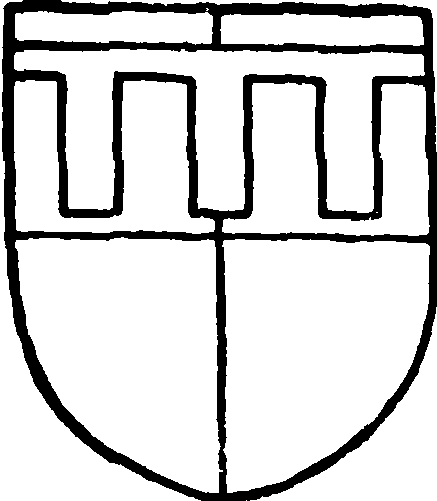
Conquest. Quarterly argent and sable a label gules.
In the Civil War Sir Richard Conquest fought on the king's side, taking rank as colonel in the Royalist army. (fn. 46) In 1644 his estate was sequestered. (fn. 47) Four years later composition was made and the estate discharged. (fn. 48) In 1650, however, the minister of Houghton Conquest with others petitioned against him as a dangerous malignant and Papist, stating that his property was worth over £800 a year and that he had a great sum of money concealed. (fn. 49) On the plea that his estate on composition had been undervalued it was once more sequestered, (fn. 50) but he pleaded that it had so suffered during the previous sequestration that there was not subsistence for 'himself, wife, eight sons and five servants,' and for the maintenance of two brothers and two sisters to which he was bound. (fn. 51) The next year the case was heard at Haberdashers' Hall and the Houghton property was released. (fn. 52) Richard Conquest, however, was himself arrested as he left the court on a charge of having beaten and wounded an officer and his men sent to take him into custody some eighteen months before. (fn. 53) He was soon released, and the next year (1652) is found petitioning against Francis Theobald, his son-in-law, (fn. 54) who had taken possession of the Houghton estate. (fn. 55) He was successful in his suit, and was in enjoyment of the property in 1654 (fn. 56) and continued to hold it till his death, which took place shortly afterwards, though the exact date is uncertain. His son John Thimelby Conquest succeeded him, (fn. 57) and was in turn succeeded before 1703 by his son Benedict Conquest. (fn. 58) The latter was the last of the family to hold the lordship of Conquest Bury, and in 1741 he sold the manor to Lord Gowran, afterwards Earl of Upper Ossory, (fn. 59) who sat as member for Bedfordshire from December 1753 to 1758. (fn. 60) His son and successor the second earl sat for the county from 1767 until he became an English peer in 1794. (fn. 61) On his death in 1818 (fn. 62) his Houghton property passed to his nephew Lord Holland, from whose heirs the Duke of Bedford purchased it in 1849. (fn. 63) It has remained the property of the Dukes of Bedford down to the present day.
In the year 1086 Hugh de Beauchamp held 5 hides of land in Houghton. (fn. 64) This property later became broken into smaller holdings, and in these must be sought the origins of the manors of Dame Ellensbury, Brittons alias Groves, Flamwells and Houghton Grange. The overlordship of all these properties follows the same descent as the barony of Bedford (q.v.).
The precise date at which the Malherbe family became seised of the manor afterwards known as DAME ELLENSBURY MANOR is uncertain, but from comparison with the history of Hockliffe Manor (q.v.), which for some time followed a similar descent, they would appear to have obtained the property early in the 13th century. At the time of the Testa de Nevill, the heir of the Malherbes being under age, the property, then assessed at 2 hides, was in the custody of Roger of the Treasury. (fn. 65) This heir would appear to have been Robert Malherbe, who, being in financial difficulties, had before 1255 made over his estates to the Jews, and in that year Richard Earl of Cornwall, represented by Abraham, a Jew of Norwich, distrained upon them. (fn. 66) The estate was shortly afterwards freed, and continued in the Malherbe family. In 1284–6 it was held by John Malherbe, (fn. 67) on whose death it passed to his daughter Joan, the wife of Richard de Kersey, who held it in the right of his wife. (fn. 68) By 1346 he had been succeeded by John de Lymbotseye and Eleanor Adingrave. (fn. 69) It seems possible that Eleanor Adingrave married Almaric de St. Amand, for by 1372 the manor had passed into the latter's possession. (fn. 70) His son Almaric held it jointly with (Eleanor) his wife until his death in 1402. (fn. 71) It is doubtful whether it is from this Eleanor or from Eleanor Adingrave that the manor acquired its name of Dame Ellensbury. In her widowhood Eleanor St. Amand suffered from the persecution of Reginald de Grey, who from his neighbouring manor of Silsoe made raids on her property, destroyed her rabbits and hares, cut and carried off her crops and maltreated her servants. (fn. 72) After her death the manor came into the hands of Sir John Cornwall, who was seised of it before 1428. (fn. 73) The descent of this manor for the next hundred years is the same as that of the manor of Ampthill (q.v.). Henry VIII granted the manor to Sir William Gascoigne of Cardington, who in 1534, (fn. 74) and again in 1537, (fn. 75) is found complaining that the king had caused a portion of the woodland of the manor, valued at £17 11s. 8d., to be taken from him and inclosed in the new royal park at Ampthill. (fn. 76) His grievances were respected, and on his yielding up the remainder of the manor he received a grant of the priory of Bushmead in exchange. (fn. 77) The king in 1542 attached the manor to the honour of Ampthill, and it remained royal property until Charles I granted it to Edward Ditchfield, John Highlord and others, trustees for the Corporation of London, in 1628. (fn. 78) The latter in 1630 alienated it to Sir Francis Clerke, (fn. 79) whose brother-in-law Lewis Conquest was in possession of it nine years later. (fn. 80)
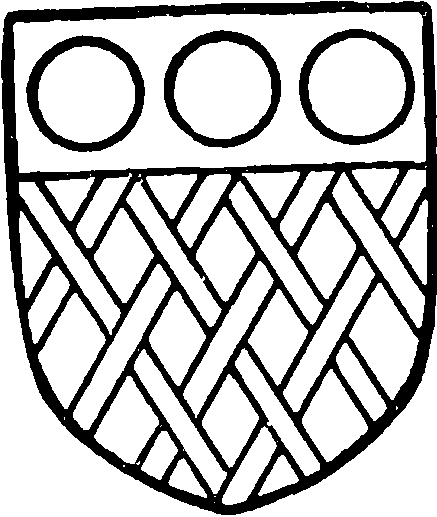
St. Amand. Or fretty sable and a chief sable with three bezants therein.
Lewis Conquest alienated it in 1640 to Henry Pigott. (fn. 81) The latter had his recently purchased estates sequestered in 1646 on a charge of delinquency, (fn. 82) but on his proving that they were bought before the outbreak of the Civil War they were discharged. (fn. 83) About this time Goddard Leigh (fn. 84) laid claim to the manor, and the ensuing dispute with Henry Pigott was decided by the Master of the Rolls in favour of the latter. (fn. 85) Goddard Leigh in 1661 is found petitioning for a re-hearing of the case; he was then a prisoner in the Fleet Prison, having been committed there for four years. (fn. 86) Three years later he gave up his real or supposed right in the manor to Henry Pigott, (fn. 87) who the next year alienated the property to Robert Bruce Earl of Ailesbury. (fn. 88) It remained in the hands of the Bruces until 1738, when it was purchased from them by the Duke of Bedford. (fn. 89) Its further history is the same as that of the manor of Ampthill (q.v.). The present lord of the manor is Herbrand Arthur, eleventh Duke of Bedford.
The manor of BRITENS alias GROVE MANOR, as stated above, has its origin in a portion of the 5 hides in Houghton held by Hugh de Beauchamp in 1086. (fn. 90) By the time of the Testa de Nevill this portion had come into the hands of William Briton and was then assessed at 1½ hides. (fn. 91) William Briton was still in possession of the property in 1284–6, (fn. 92) and a successor and namesake held it in 1346 by service of one-fifth of a knight's fee. (fn. 93) A member of the same family, John Briton, died in 1390 seised of the manor, which was at this date stated to be in the custody of the king owing to the said John being non compos mentis. (fn. 94) John Briton's heir was his sister Margaret, the wife of William Wenlock. (fn. 95) Her son and heir Sir John Wenlock was returned to Parliament for Bedfordshire in 1433, 1436, 1445, 1447 and 1449. (fn. 96) At first a partisan of the house of Lancaster, he became a Yorkist after the battle of Northampton, and six years later was created Baron Wenlock by Edward IV. Afterwards, however, having once more attached himself to the Lancastrian cause, he was slain at the battle of Tewkesbury, (fn. 97) and his property passed into the king's hands. This manor, with other property, was six years later granted by Edward IV to Thomas Rotherham, Archbishop of York. (fn. 98) Sir Thomas Rotherham, nephew of the above, died seised of the manor in 1504. (fn. 99) His son Sir Thomas Rotherham settled it on his son Thomas on the occasion of his marriage with Alice Wellesford in 1535–6. (fn. 100) Thomas the younger predeceased his father, and left a widow and two sons, Thomas—who was non compos mentis—and George. (fn. 101) His widow took for her second husband Ralf Astry, and enjoyed the profits of the manor until her death in 1561. (fn. 102) She was succeeded by her second son George, who suffered a recovery of the manor in 1568, (fn. 103) preparatory to alienating it to Thomas Clarke of Stevenage. The latter granted it to his second son Edward in 1570. (fn. 104) He was succeeded by his younger brother Christopher, who died in 1580 while still a minor and in ward to the queen. (fn. 105) Another brother Francis then succeeded, who rose to considerable importance in the county, being high sheriff in 1623, (fn. 106) in which year also he was knighted by the king on the high road between Bletsoe and Castle Ashby. (fn. 107) His heir was his daughter Dorothy, the wife of Sir Edmund Wylde. (fn. 108) This manor remained in the hands of the Wylde family for the next hundred years, (fn. 109) but between the years 1729 and 1742 it had become the property of Thomas Hurley, who by his will dated 16 July 1742 left it to his brother-in-law Isaac Hughes. (fn. 110) From the latter it was purchased by John Potter, Archbishop of Canterbury, who left it by will to his second son Thomas Potter, (fn. 111) wit, politician and associate of Wilkes. (fn. 112)
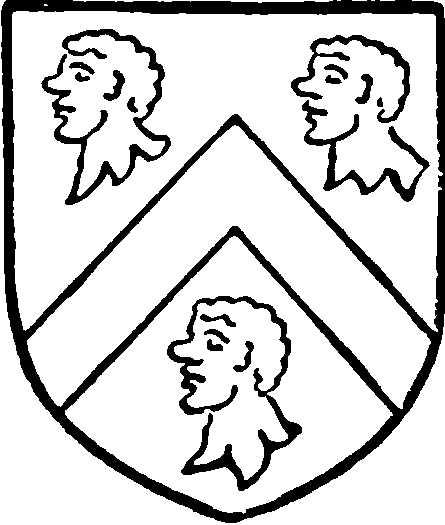
Wenlock. Argent a cheveron between three blackamoors' heads razed sable.
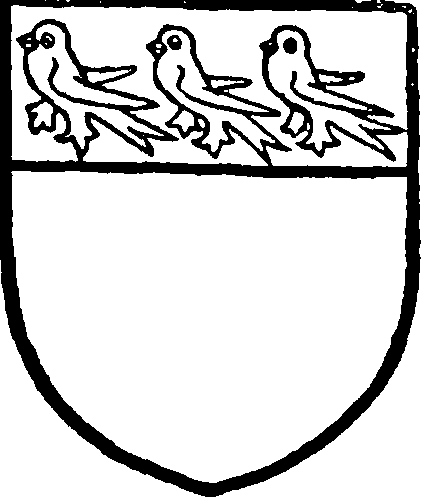
Wylde. Argent a chief sable with three martlets or therein.
Thomas Potter died in 1759, (fn. 113) and was succeeded by his son Thomas, who was lord of the manor in 1761. (fn. 114) The latter died without issue, and his property passed to his half-sister, whose husband, Dr. Malcolm MacQueen, was in enjoyment of it in 1810. (fn. 115) In 1820 Dr. MacQueen alienated the manor to Thomas Mills and Robert Campbell. (fn. 116) The land, which formerly was parcel of this manor, is now in the possession of Mr. F. J. Thynne.
Another tenant in Houghton Conquest who at the time of the Testa was holding of the barony of Bedford was John Flamvill, whose property, then assessed at 1 hide, (fn. 117) was the origin of the 'manor' of FLAMWELLS. In 1284–6 Henry Flamvill (fn. 118) held this estate, and was succeeded before 1346 by Matilda Flamvill, who held the property in that year by service of one-tenth of a knight's fee. (fn. 119) Robert Flamvill, a member of the same family, was appointed commissioner of the peace for Bedfordshire in 1377. (fn. 120) In 1461 Flamwells Manor was held by John Byrling and his wife Alice, who may have been a Flamvill before her marriage. At this date they levied a fine of the manor, (fn. 121) which by 1528 had passed to their son Alexander Byrling. (fn. 122) Six years later Alexander settled the reversion of the estate on Robert Smyth, (fn. 123) who became duly seised of Flamwells on the death of Alexander Byrling in 1535. (fn. 124) William Smyth, heir of Robert Smyth, alienated the manor in 1560 to Robert Taylor, (fn. 125) who the same year transferred it to John Barber. (fn. 126) By 1620 it had come into the possession of Sir Edmund Wylde, who died seised of it in that year. (fn. 127) The further history of this manor is the same as that of the manor of Britens in this parish (q.v.).
The manor of HOUGHTON GRANGE has its origin in the land in Houghton granted to Chicksands Priory by Pain Malherbe, and confirmed (in the early years of the 13th century) by William de Beauchamp. (fn. 128) Another of the Malherbe family, one Geoffrey, later increased the priory's possessions in Houghton by 1 virgate of land and 6s. rent, receiving in return 10 marks of silver. (fn. 129) In 1285 Edward I granted the monks right of free warren in their demesne lands in Houghton, (fn. 130) which right they claimed (fn. 131) in 1330. They held their property of the barony of Bedford by service of one-tenth of a knight's fee. (fn. 132) At the Dissolution the value of the temporalities of the priory in Houghton was £13 10s. 6½d. (fn. 133) Some time before the dissolution of the priory the monks leased the property to James Done, (fn. 134) who before his death (circa 1546) (fn. 135) appointed William Wilbon as his executor and as guardian of his children, entrusting him with the custody of the manor, (fn. 136) whose lease had not yet expired. William Wilbon did not enjoy peaceful seisin of the manor, however, and both he and his son, who succeeded him, were troubled by vexatious suits concerning it. (fn. 137) On the expiration of the original lease the property, as monastic lands, reverted to the Crown, and was granted by Elizabeth in 1559 to Sir Humphrey Ratclyffe and Edward his son for their lives, (fn. 138) with reversion to Richard Conquest in 1595. (fn. 139) A further temporary grant of it was made in 1624 to Henry Hobart, who two years later sold it to Thomas Foscall, (fn. 140) while the same year the reversion was granted yet again by the Crown to Henry and Thomas Garway. (fn. 141) In 1764 it was in the hands of Robert Lord Granville, (fn. 142) but it cannot be traced further.
The manor of HOW END or REDDINGS MANOR has its origin in a portion of the 4½ hides held in 1086 by the wife of Hugh Grantmesnil, and then valued at £4. (fn. 143) Parnel, the heiress of the Grantmesnil family, in 1168 married Robert de Beaumont Earl of Leicester, (fn. 144) and their son Robert the fourth earl granted 1½ hides in Houghton to Reading Abbey. (fn. 145) The Abbots of Reading held this property in free alms of the honour of Leicester. (fn. 146) In 1286 the abbot claimed to have a view of frankpledge in Houghton and to have a gallows there, but, as he did not appear at the inquiry, his rights were taken into the king's hands. (fn. 147) In 1330 he successfully claimed rights of free warren there. (fn. 148)
In 1291 the yearly value of the manor was £12, (fn. 149) while the value at the Dissolution was £10 15s. 11d. (fn. 150) Elizabeth made a temporary grant of rent from this manor to Sir Francis Walsingham and others, (fn. 151) which rent (£9 13s. 7d.) was granted by James I in 1609–10 to Christopher Hatton and Francis Needham. (fn. 152) The same year James I appointed Edward Lord Bruce steward of the manor. (fn. 153) By 1657 How End Manor had been leased to the Blofield family, and in that year Elizabeth Blofield, widow, Giles Blofield and Mary his wife put it into the hands of trustees. (fn. 154) Possibly Mary survived her husband and married Nicholas Harkett, who with his wife Mary alienated the manor in 1674 to Nicholas and Nathaniel Lawson. (fn. 155) By the beginning of the 18th century the manor was held by the steward of the Ampthill honour, Charles Bruce, (fn. 156) and its further descent is the same as that of the manor of Dame Ellensbury (q.v.).
CHURCH
The church of ALL SAINTS consists of a chancel 40 ft. 2 in. by 18 ft. 10 in. with a north vestry, a nave 63 ft. 9 in. by 16 ft. 8 in., north and south aisles 12½ ft. wide, a south porch and west tower 14 ft. by 13 ft. 3 in.
The church was restored in 1870, the walling being rebuilt in parts and the stonework of the windows for the most part renewed. The nave dates from c. 1340, the tower was begun in 1393, (fn. 157) and the chancel with it; the north vestry and the south porch are of the 15th century. In the same century the nave clearstory was added and the aisle walls heightened, flat-pitched roofs being put over nave and aisles.
The chancel has an embattled parapet and chamfered plinth, with a 14th-century string re-used in both; the east window, all modern except a few stones in the jambs, is of five cinquefoiled lights with a transom and tracery under a low four-centred head; in the north and south walls are two similar windows of three lights, and a door at the north-east leads into the vestry, which was formerly of two stories, and is lighted by square-headed windows. On the south is a priest's doorway, of which the rear arch and jambs only are old. On each side of the east window is a canopied niche with fluted crockets and cusping of a peculiar kind, probably the result of a late repair; at the south-east is a double piscina with cinquefoiled arches under a square head divided by an octagonal shaft. A moulded string runs round the chancel at the window-sill level, breaking up over the piscina and doorways. The chancel arch with the nave arcades is fine and wellproportioned 14th-century work, on engaged round shafts with rolls in the angles and good moulded capitals. The arch has spread and the eastern pillars of the arcade have gone over to north and south, the eastern responds have been strengthened by replacing the outer shafts with solid masonry. The height of the nave and aisles is considerable and the effect most dignified; all the ashlar work is in Totternhoe stone, but the walling is of ironstone. The arcades are of four tall bays, and over each arcade is a range of four clearstory windows of three trefoiled lights under a four-centred head. The tower arch is of two continuous chamfered orders with a moulded string at the springing of the inner order. The north aisle has five three-light windows of mid-14th-century style, the tracery for the most part modern, three in the north wall and one at each end; the south aisle has a west but no east window, and of its three south windows the two eastern have 15th-century tracery, though the head and jambs are original. The north doorway is in two moulded orders with engaged shafts in the jambs having two 14th-century capitals very much decayed in the west side, the rest of the stonework being mostly new. The south doorway is like it, but much better preserved, being under a porch. There is an ogee-headed piscina, and the door and roof are like those of the north aisle; the porch, which is rebuilt, has an embattled parapet and a niche over the doorway, which has a sundial in the wall to the east of it. On each side of the porch are two windows of three cinquefoiled lights under a four-centred head, with old moulded inside reveals.
The tower is in three stages with angle buttresses, an embattled parapet and a moulded plinth. The belfry windows are of two cinquefoiled lights with tracery under a pointed head, and there is a pointed west door consisting of a double ogee order and a wave-moulded order separated by a casement moulding; the west window is of three trefoiled lights with perpendicular tracery. The staircase is in the southwest angle and terminates in a turret.
The font is late 14th-century work, each side of the octagonal bowl having a crocketed canopy and each angle a pinnacle rising from the head of an angel carrying a shield; the shaft is of much smaller diameter. The font now stands at the west end of the nave, but was originally set against one of the pillars, as the roughness of one side shows. The east bays of the roof of the nave and south aisle show remains of painting, and there are lead stars, once gilded, on the nave roof. Several patches of 15th-century wall painting have been uncovered over the chancel arch: Our Lord seated in judgement between angels holding the cross and scourging pillar, with the Crucifixion emblems below; over the north door is a large St. Christopher, and at the east end of the south aisle a great deal of painting, mostly defaced; and there are later texts in black letter in the north and south aisles. There is a good deal of 15th-century traceried panelling in the pewing, and the chancel stalls have ends of the same date with somewhat unusual poppy heads. The rood screen contains some old tracery in the head, but owing to its being extensively repaired the old work is hard to distinguish. It has four openings on either side of the middle doorway, and below the rail is plain boarding. In the vestry is a chest dated 1691 and also part of the old chancel wall plate, with an inscription stating that Thomas Archer paved the chancel in 1625; the lock of the vestry door also bears his initials.
In the various windows of the church are fragments of old glass; those in the chancel are mostly of 15th-century date, and a black bull's head occurs several times, also a shield argent with a dolphin sable; in the nave the glass is of 14th-century date, a good deal of it heraldic. The following shields occur: 1, Gules a lion rampant argent; 2, Or fretty gules and on a chief gules three bezants; 3, Party fessewise indented gules and ermine a ring or for difference; in the next window are: Barry of six argent and azure a label gules.
On the north side of the chancel is the effigy, shown in a pulpit, of Thomas Archer, rector, who died 1629. On a brick altar tomb with a Purbeck marble top are the brasses of John Conquest and his wife Isabel and son Richard. Isabel died in 1493, the dates of death of her husband and son not being filled in. Beneath them are smaller brasses of nine sons and five daughters. The corners of the slab had the evangelistic symbols in a circle of clouds, but only Matthew and Luke remain. Above Richard is a shield of his arms impaling 1 and 4, three lozenges bendwise and in chief three scallops; 2 and 3, checky a fesse for his wife, who was a Malet. Another brass in the chancel floor is to Richard Conquest 1500 and Elizabeth his wife, with their effigies and a scroll bearing the words, 'Orate p. mortuis quia moriemur'; below is the inscription plate.
There is a stone in the chancel floor to Thomas Awdley 1599 and Anna his wife, and outside against the south wall of the chancel is a canopied tomb to his father of the same name who died in 1531; there is also one to Dame Anne Clerke, wife of Sir Francis Clerke 1644, and on the wall of the south aisle a tablet to Edmond Woodward 1659, arms: A cheveron between three trefoils. Below the sill of the south-east window of the south aisle on the outer face of the wall is a stone inscribed to Urian Stocwell, 1605.
The six bells were all recast in 1841 by Mears.
The plate consists of a cup and paten cover, date mark 1618, inscribed, 'Thomas Archer Rector dedit hunc calicem coopertum ecclesiae de Houghton Conquest, qui alienaverit anathema sit año 1620,' maker H. On the cup are the coats (1) A hound running between three leopards' heads caboshed; and (2) Three winged arrows, whilst on the lid the two are impaled, the sinister, however, being in an engrailed border. There is also a modern set of a foot paten, 1842, a flagon of 1846 and a large salver 1846 given by Archdeacon Rose, rector, and an oval paten on three clawed feet with ornamental rim, date 1827.
The first book of registers, 1539 to 1594, is in the Bodleian Library, Oxford. The second book, 1595 to 1653, contains extracts relating to the Conquest family between 1567 and 1601, and some notes of the times in the handwriting of Thomas Archer, including his payments for the communion cup still used. From this it appears the cup weighed 16¼ oz. and 12 grains at 7s. 2d. per oz.; he paid for the cup £5 16s. 6d., for 'graving of words' 22d., for the box 2s. 8d., and for the Corporas cloth working 2d., total £6 1s. 2d. The third book runs from 1653 to 1695, the fourth 1695 to 1733, the fifth 1733 to 1797 (marriages ending in 1754), the sixth 1797 to 1812; the seventh has marriages only 1754 to 1792, and the eighth marriages 1794 to 1812. The marriages for 1793 are on a loose sheet. There is in the chest a great deal of miscellaneous MS. relating to the village by Thomas Archer and successive rectors.
ADVOWSON
The first mention that has been found of Houghton Conquest Church occurs in the latter half of the 13th century, by which time the advowson had been divided into moieties, and unlike most cases of the sort, when some arrangement as to alternate presentations was usually made, the moieties became definitely separated, the patrons of each making their own independent nominations. The rectory was divided into two portions known as Houghton Gildable and Houghton Franchise respectively, (fn. 158) and until 1641, (fn. 159) when the rectories were amalgamated, a most extraordinary and inconvenient state of affairs existed in Houghton Conquest, there being two parish priests and two parsonages, while there was but one church. To treat first of that half of the advowson which went with the rectory of Houghton Gildable; it was early attached to the barony of Bedford, but William de Beauchamp is the first who is known to have exercised his patronage of this moiety of the advowson. (fn. 160) On the death of John de Beauchamp (brother and heir of William) at the battle of Evesham the Beauchamp property was divided among the female heirs of William de Beauchamp, (fn. 161) and this moiety of the advowson fell to the share of his daughter Ela. (fn. 162) Her heirs were her three daughters Ida wife of John Steingrave, (fn. 163) Joan wife of Michael Pigot (fn. 164) and Elizabeth, each of whom received a third of this moiety. Ida's third followed a distinct descent until 1383–4, (fn. 165) after which date it appears to have lapsed; the other two-thirds became amalgamated and descended in the Pigot family until 1430, (fn. 166) when Baldwin Pigot alienated them to John Cornwall for life, with reversion to others. (fn. 167) For over one hundred years no reference to this moiety has been found, but by 1539 it had come into the hands of Sir Edward Bedingfield (the custodian of Catherine of Aragon's honour of Kimbolton), (fn. 168) who that year, together with his son Henry, alienated it to John Gostwick and Joan his wife. (fn. 169) Later this moiety came into the hands of the Conquest family (see below).
The moiety of the advowson to which belonged the right of appointing the rector of Houghton Franchise was by 1383 in the hands of the Conquests, lords of the manor of Conquest Bury. (fn. 170) They long retained it and in 1637 Richard Conquest, having obtained possession of the other moiety, petitioned for the amalgamation of the two rectories. (fn. 171) The petition was granted and the rectories amalgamated in 1641. (fn. 172) The last occasion on which a Conquest presented was in 1662. (fn. 173) After this date a succession of patrons are found in the Institution Books: Edward Atkins in 1674, the Crown in 1675, Maurice Thompson and the Crown in 1676, while from 1703 to 1720 the Earl of Ailesbury presented. (fn. 174) About this latter year the advowson was purchased by Dr. Zachery Grey (he was patron in 1722), (fn. 175) who in 1725 sold it to his old college of St. John's, Cambridge. (fn. 176) The college has retained the advowson to the present day.
CHARITIES
For the school and almshouse founded by Sir Francis Clerke, kt., by deed 5 June 1632, see article on 'Schools.' (fn. 177)
By an order of the Charity Commissioners of 4 September 1903, made under the Board of Education Act 1899, it was determined that the portion of the endowment applicable for educational purposes consisted of the sum of £16, being part of the yearly rent-charge of £24 granted by the founder.
The endowments now consist of the said rentcharge of £24 received from the Duke of Bedford, six almshouses, a rent-charge of £10 received from Sidney Sussex College, Cambridge, the school close containing 1 acre let at £2 10s. a year, and 10 acres of land at Apsley Green let at £19 7s. a year, arising under the will of Edmund Wylde, dated 20 October 1621, and £81 10s. 7d. 2½ per cent. annuities, producing £2 0s. 8d. a year. In 1909 the inmates received £16 from Clerke's charity and £6 from Wylde's charity, with an allowance for firewood.
In 1630 the Rev. Thomas Archer, rector, by will proved at Bedford 2 March in that year declared the trusts of 6 acres of land situated at the How End of the parish comprised in a deed of grant 1 October 1619 to be that the rents thereof should be distributed on certain days named amongst 'poor people,' defined by the testator to be the poor by impotency, the poor by casualty, but not the thriftless poor. The land now known as Poor's Pightle is let at £10 a year, which is distributed in doles and clothing.
In 1708 Mrs. Villiers Fowler by her will charged her estate in the parish of Hawnes with the sum of £100 to be eventually laid out in the purchase of land for the use and benefit of the poor. The legacy was never raised or paid, but the sum of £5 a year as the interest thereof is paid as a rent-charge by Mr. F. G. Thynne, the owner of the land charged, and is distributed in money on the Saturday before Houghton Feast Day.
This parish is entitled to participate in the charity of John Bryan, founded by will 4 August 1655, in respect of which the official trustees hold a sum of £125 5s. 2d. consols, producing £3 2s. 8d. in yearly dividends. The charity is regulated by schemes of the Charity Commissioners of 5 January 1877 and 5 January 1906. The income is applied in the distribution of bread every week throughout the year.
The Wesleyan Methodist chapel is regulated by a scheme of the Charity Commissioners 1880. The trustees are possessed of a cottage and 5 acres let at £15 a year, and 1 a. 2 r. let at £2 10s. a year, the rents being applicable towards the support of the Wesleyan ministry in Ampthill circuit.