A History of the County of Bedford: Volume 3. Originally published by Victoria County History, London, 1912.
This free content was digitised by double rekeying. All rights reserved.
'Parishes: Toddington', in A History of the County of Bedford: Volume 3, ed. William Page (London, 1912), British History Online https://www.british-history.ac.uk/vch/beds/vol3/pp438-447 [accessed 1 May 2025].
'Parishes: Toddington', in A History of the County of Bedford: Volume 3. Edited by William Page (London, 1912), British History Online, accessed May 1, 2025, https://www.british-history.ac.uk/vch/beds/vol3/pp438-447.
"Parishes: Toddington". A History of the County of Bedford: Volume 3. Ed. William Page (London, 1912), British History Online. Web. 1 May 2025. https://www.british-history.ac.uk/vch/beds/vol3/pp438-447.
In this section
TODDINGTON
Dodingtone (xi cent.); Dedintone, Dodingethone (xii cent.); Tudingetone (xiii cent.).
Toddington is a large, irregular shaped parish of 5,535½ acres, of which 1,195¼ are arable land, producing wheat, barley, oats, beans and peas, 2,524½ are permanent grass and 113 woods and plantations. (fn. 1)
The ground is undulating and averages from 350 ft. to 450 ft. above the ordnance datum, though west of Toddington at Herne Grange and at Herne Farm the ground rises to 500 ft. The village is slightly lower, and the land falls sharply away from it to the north and east.
The soil is marl and clay, with a subsoil of gravel which has been worked in the east and south. The parish is watered by the Flitt, a branch of the Ivel, which enters Toddington in the south and flows due north past Mill Farm. The adjoining mill has not been worked for the last six years. On another branch of the stream, a little to the north-east, stand the old brick and tile buildings of Old Park Farm, built into the front wall of which are stones bearing respectively the following dates: 1655, 1749, 1866, 1851. The house is possibly of the 17th century, and at the back are some old thatched barns.
Toddington in the 18th century was a thriving market town, and though by 1800 its importance was already on the wane (fn. 2) it still retains an air of its ancient dignity. The houses, many of which are brick Georgian buildings, have been erected round the open Green called the Church Square, upon which five roads converge. The houses also continue along the roads for a considerable distance. A large pond, partly inclosed by a brick wall, stands south of the Square, and beyond it, on the Green itself, is the smithy forge, and the public pump is at the north end, beneath the brick and stone wall of the churchyard.
Facing the Green, and overlooking the churchyard at the back, is a brick-fronted building, the back of which is of half-timber, and has an overhanging upper story. On the east side of the Green stands an interesting 18th-century house, built of brick and having a tile roof and enriched wooden cornice. At either end is a slightly projecting wing, while in the centre is a doorway flanked by wooden Corinthian pilasters carrying a pediment. The windows are double-bay sashed. On the other side of the Green, on the road to Tebworth, is a two-storied brick house of a similar character but slightly earlier. It has a tile roof and wooden cornice. Wooden pilasters of the Doric order carry a pediment over a central doorway, while the windows are divided by wooden transoms and mullions.
The market-house formerly stood in the Square, but was pulled down in 1799 and the materials sold. At the back of the church is an artificial mound, encircled by a moat, known as Gayer's Hill, (fn. 3) and another mound of similar character, though rather more irregular in shape, is in a field north of the village.
Toddington Park, to the north of the village, covered nearly 400 acres in the 17th century, and contained some magnificent old oak trees. It is now less than half that size, and part of it is included in the grounds surrounding the modern building called Toddington Park, the residence of Colonel Mercer. The manor-house of Toddington, the greater part of which is modern, on the site of the mansion built by Lord Cheney in the 16th century, is the property of Mrs. Warren Vernon and now unoccupied. Lysons, writing in the beginning of the 19th century, states that nothing remained of the former structure except a few rooms and the spacious kitchen, in which were two fireplaces, each 12 ft. wide. An ancient plan was preserved at this time which showed that it formerly occupied four sides of a quadrangle, having a turret at each corner, with a frontage on the north and south of 210 ft. The chapel was 30 ft. by 24 ft., the tennis court 65 ft. long, and there was also a marble gallery 58 ft. long. (fn. 4) Remains of a gateway in the park are thought to mark the site of the mansion which Paulinus Pever built in Toddington in the middle of the 13th century. (fn. 5) Matthew Paris describes this dwelling as 'like a palace, with state rooms, chapel, bed chambers and other apartments of stone covered with lead, and environed with orchards and parks in a manner which astonished all beholders.' (fn. 6)
Herne Grange lies a mile westward of Toddington. It is an 18th-century brick building with a tile roof. Mr. Scrivener resides at Herne Farm, a comparatively modern building.
The hamlet of Fancott lies nearly a mile south-east of Toddington, and contains Feoffee Farm, the rent of which goes to the support of the Feoffee almshouses, a small block of buildings opposite the church.
About a mile farther south, lying in a hollow, is the small hamlet of Chalton. There are several examples of half-timber and brickwork here, while in the centre of the settlement is an old farm-house surrounded by a moat. Chalton Cross Farm is an 18th-century brick building standing on high ground to the south-east of the hamlet.
The parish was inclosed in 1797, (fn. 7) the lord of the manor receiving an allotment for one moiety of the great tithes and the rector 100 acres and a corn rent for the other moiety.
The inhabitants are employed in straw-plaiting and the breeding of poultry.
Miscellaneous articles dating from the Bronze Age and Anglo-Saxon times have been found here. (fn. 8)
The following place-names occur in documents relating to Toddington:—Longspert, Chemcirs, Hitonway, Deppyttys, Hewmorserse (xv cent.), Biote Wood (xvi cent.). The Griffin Inn in Herne is also mentioned in a document of 1653, (fn. 9) and a house of the same name exists in the parish at the present day. Thomas Rufford, 'belmaker,' living in 1390 (fn. 10) in Toddington, is doubtless the origin of the name 'Belmakers' applied to a property in the parish in the 15th century. (fn. 11)
MANORS
TODDINGTON, comprising 15½ hides, was held by Wulfweard 'Levet' before the Conquest, and was afterwards granted to William Spec, who before 1086 exchanged this manor for two others held by Ernulf de Hesding. (fn. 12) Two of Ernulf de Hesding's daughters are afterwards found connected with this parish. (fn. 13) Of these Matilda, with her husband Patrick de Chaworth, made a grant of the church of Toddington, which was attached to the manor, to the Abbey of La Couture, 1100–22. (fn. 14) This grant was made especially for the soul of 'Ernulf de Hisden who held before us the land which we now hold' and was confirmed by Matilda's grandson Payn de Chaworth in 1167. (fn. 15) Between this date and 1180 Toddington passed to Geoffrey Count of Perche, (fn. 16) who represented Sibel another daughter of Ernulf de Hesding, being her great-grandson. (fn. 17) He died in 1203, (fn. 18) and Toddington was still held by his widow, the Countess of Perche, in 1205. At this date, on the severance of English and Norman fealties, the English lands of the Count of Perche escheated to the Crown, and Toddington was granted to Peter des Roches. (fn. 19) This grant was temporary, and before 1229 the manor was again in the possession of the Crown, and was at that date conferred on William Marshal Earl of Pembroke on the occasion of his marriage with Eleanor sister of Henry III, who was to retain a life interest in Toddington. (fn. 20) William died in 1231, and Eleanor afterwards married Simon de Montfort Earl of Leicester, (fn. 21) who is returned as lord of Toddington in right of his wife in the Testa de Nevill. (fn. 22) The manor next passed to Roger Bigod Earl of Norfolk in right of his wife Maud sister and co-heir of William Marshal. (fn. 23) Some time before 1250 (in which year Paul Pever obtained a grant of a market in this manor) (fn. 24) Roger Bigod subinfeudated Toddington to Paul Pever, (fn. 25) who had previously inherited property in Toddington, where his family was settled certainly as early as 1198. (fn. 26) He was one of the king's seneschals in 1249, and died in London in 1252, directing that his body should be buried there, but his heart taken to Toddington and buried there. (fn. 27) The manor passed to his grandson John, who was lord in 1276, (fn. 28) and who in 1314 made a settlement of Toddington and Chalton on himself and Mary his wife. (fn. 29) He died the following year, and his widow married Almaric de St. Amand before 1316. (fn. 30) She held Toddington for her lifetime, (fn. 31) and in 1329 probably entertained the king there, for letters patent for that year are dated from Toddington. (fn. 32) She died circa 1333, and the manor then passed to her grandson Nicholas son of Paulinus Pever, a minor then aged fourteen and a half years, (fn. 33) who held Toddington in 1346. (fn. 34) On his death in 1362 the manor was valued at only £12 12s. 8d., 'not more because the tenants are dead' (fn. 35) —showing that Toddington had suffered heavily from the plague of that year.
Thomas son and heir of Nicholas Pever (fn. 36) married Margaret daughter and heir of Sir Nigel Loring, by whom he had a daughter Mary. (fn. 37) He died in 1429, when John Broughton son of Mary succeeded to Toddington. (fn. 38) He was sheriff for Bedfordshire in 1436, 1460 and 1466, (fn. 39) and dying in 1490 left the manor to his grandson John, (fn. 40) who died under age and was succeeded by his brother Robert, lord of the manor in 1502–3. (fn. 41) John son and heir of Robert left Toddington on his death in 1517 to an infant son John, (fn. 42) who died in 1530 before attaining his majority, (fn. 43) when the whole of the Pever and Broughton estates passed to his two sisters Catherine and Anne. Toddington passed to the latter, who married Sir Thomas Cheney. (fn. 44) She survived her husband and on her death in 1562 was succeeded by her son Henry, (fn. 45) who was knighted at Toddington two years later. He was summoned to Parliament as a baron of the realm from 1572 to 1586, and was one of the peers appointed to sit on the trial of Mary Queen of Scots. (fn. 46) He died shortly afterwards without issue, and by a settlement made before his death Toddington and his other Bedfordshire estates inherited from his mother were left to his widow Lady Jane Cheney absolutely. (fn. 47) Her nephew Henry Lord Wentworth resided with her at Toddington during the early 17th century, and in 1608 they received a visit there from James I. (fn. 48) Thomas son of Lord Wentworth inherited the property on the death of Lady Cheney in 1614, (fn. 49) though the Cheney family disputed her right to alienate the property at will, but without success. (fn. 50)
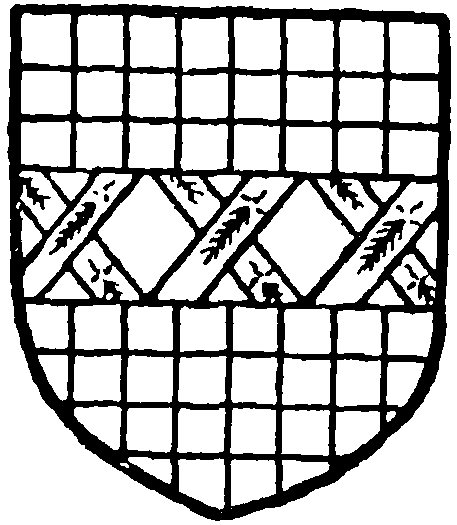
Cheney of Toddington. Checky or and azure a fesse gules fretty ermine.
Thomas Lord Wentworth was created Earl of Cleveland in 1626, (fn. 51) and his popularity at court led him and his son into great extravagance. The Bedfordshire estates were already heavily encumbered by debt in 1636, when an order for a settlement to effect a payment of their debts was made. (fn. 52) Toddington Manor and Toddington Place were included in the settlement drawn up on the proposed marriage of Thomas Lord Wentworth son of the Earl of Cleveland and Barbara daughter of Sir John Lambe, which marriage never took place. (fn. 53) The earl and Lord Wentworth were on the Royalist side in the Civil War, but the former was taken prisoner at Newbury in 1642 and remained in the Tower until 1648. It is not known how his imprisonment terminated, but in 1650 both father and son were in exile with Charles II. (fn. 54)
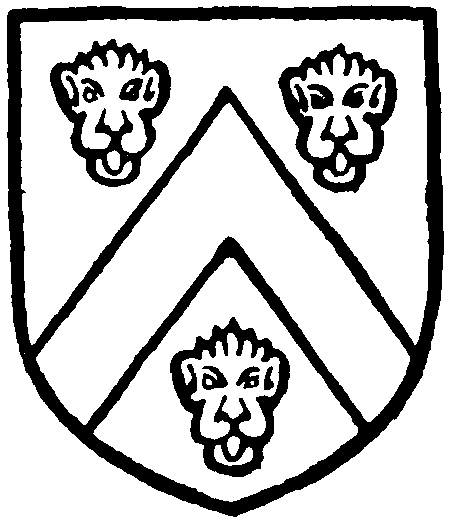
Wentworth. Sable a cheveron between three leopards' heads or.
An Act of Parliament had been passed in 1641 authorizing the sale of the earl's estates for the satisfaction of his creditors. The sale of Toddington Manor, however, was objected to by Tristram Woodward, who held a mortgage on that property. (fn. 55) In 1650, when the whole of his lands were sequestered and his debts were found to amount to £100,000, (fn. 56) Lady Frances Weld also put forward a heavy mortgage claim on Toddington. (fn. 57)
The Earl of Cleveland returned to England at the Restoration, and died and was buried at Toddington in 1667, his son Lord Wentworth having predeceased him in 1665. (fn. 58) Philadelphia Lady Wentworth, (fn. 59) his daughter-in-law, assumed the management of the estates during the minority of her daughter Henrietta Maria, (fn. 60) and the whole of the issues were devoted to the discharge of the debts of the Earl of Cleveland and his son. Henrietta Maria Baroness Wentworth in her own right appeared at court in 1674 and became the mistress of the Duke of Monmouth. A marriage was subsequently proposed between her and the Earl of Thanet, but she refused the alliance and retired to Toddington, where she was visited by the duke, and a room in the old house and Monmouth's Oak in the park long bore witness to his visits there. (fn. 61) Monmouth fled to Toddington after the discovery of the Rye House Plot, and it is thought that the Baroness Wentworth raised considerable funds for his subsequent rebellion. (fn. 62) She died unmarried in 1686, and Toddington then passed to her great-aunt Anne Lady Lovelace, only surviving sister of the Earl of Cleveland, who made a settlement of the property in 1687 (fn. 63) and released it to her son John in 1692. (fn. 64) The latter, who bore the title of Lord Hurley, died in the following year, and in 1697, on the death of his mother, the manor passed to his only daughter and heir Martha, who became Baroness Wentworth in her own right. (fn. 65) She afterwards married Sir Henry Johnson, a rich shipbuilder of Blackwall, (fn. 66) and they held Toddington jointly in 1704. (fn. 67) On her death without issue the property became the absolute right of her husband, who left it to his daughter Anne by a former wife. She had married Thomas Wentworth first Earl of Strafford, (fn. 68) and so brought Toddington back into that family. Their only son William died in 1791, when his property was divided among his three sisters the Ladies Anne Conolly, Lucy Howard and Harriet Vernon. (fn. 69)
Anne (fn. 70) acquired Toddington Manor as her share, and at her death it descended to her son Thomas Conolly, who in 1806 (fn. 71) sold the whole manor to John Cooper. (fn. 72)
Elizabeth daughter and heir of John married her second cousin William, who changed his name to Cooper. She died in 1855. Her husband died five years later, and Toddington then passed successively to their son William and their grandson William Cooper. The latter died in 1905, and his eldest daughter Mrs. Elizabeth Georgina Warren-Vernon is owner of Toddington Manor at the present day. (fn. 73)
The market and fair at Toddington, the tolls of which were held by the lords of the foregoing manor, were granted by Henry III in 1218 to William Marshal Earl of Pembroke, the market being held on Thursday and the fair on the vigil, feast and morrow of St. George (April 23). (fn. 74) The market day was changed to Saturday by a special grant in 1315, and the fair which appears to have been held at that time at the feast of the Holy Trinity was confirmed for the festival of St. George. (fn. 75) In 1386 another confirmatory charter was granted to the lord of the manor, Thomas Pever, and the days on which the fair was to be held were changed back again to the feast of the Holy Trinity. (fn. 76)
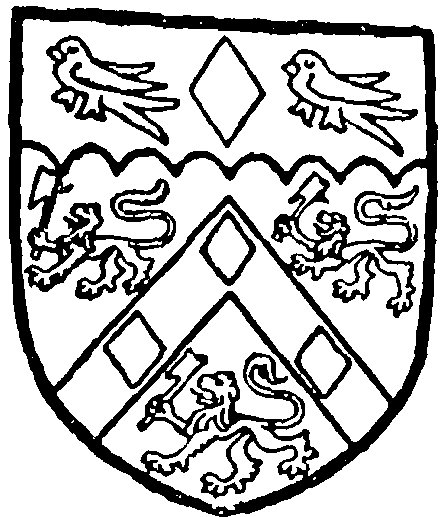
Cooper of Toddington. Gules a cheveron between three lions passant argent each holding a battle-axe or with three lozenges sable on the cheveron and a chief engrailed or with a lozenge gules between two martlets sable therein.
In 1531 the lords of Toddington had a renewal of licence for their weekly market and two annual fairs of two days each at Bartholomewtide, 24 August, and St. Katherine's Day, 25 November, and the following days. (fn. 77) Toddington is not included by Leland in his list of Bedfordshire market towns, but if the market had been discontinued at that period it was revived before 1681, for in that year it was in so flourishing a condition that sixteen butchers rented stalls in the market-place. (fn. 78)
In 1803 a writer in the Gentleman's Magazine states that the market had been discontinued for some years. (fn. 79) It was revived during the 19th century, but in 1891 the place of the former prosperous market was taken by a few stalls in the church square on Saturday for the sale of meat and other articles, and the tolls were leased by the lord of the manor to Mr. W. Pilgrim for 10s. yearly. (fn. 80) In 1693 the fairs were confirmed to Philadelphia Lady Wentworth, and their dates fixed as 14 April, the first Monday in June and 22 October. (fn. 81) At the beginning of the 19th century the fairs, in a more prosperous condition than the market, were held on 25 April, first Monday in June, 4 September, 2 November and 16 December. (fn. 82) At the present day the fair days are the same, except that one formerly on 4 September is held on the Wednesday before 15th September.
Among the prescriptive rights claimed by John Pever in his manor of Toddington at the close of the 13th century (fn. 83) were view of frankpledge, waifs and strays, escheats and gallows; free warren in his demesne in Toddington, Herne, Wadlowe and Chalton he claimed by charter of Henry III in 1250. (fn. 84) Similar rights were claimed by Maria widow of John Pever in the middle of the 14th century, (fn. 85) and the free warren was confirmed to Thomas Pever later in the same century, (fn. 86) together with licence to inclose a 'foreign' wood of Eppeho.
During the early 13th century there is record of lands later known as CHALTON MANOR from which service was due to the lords of Toddington Manor. (fn. 87) In 1297 John Pever and Beatrice his wife, then holding the manor of Toddington, also held a considerable estate in Chalton, comprising a messuage, 100 acres of land and 10s. rent. This was then held of them by a lease for life by William Swift, and is doubtless that estate which under the name of the 'manor' of Chalton formed the subject of a settlement by John Pever and Mary his wife in 1314. (fn. 88) Chalton follows the same descent as Toddington, in which it apparently became absorbed, no mention of it being found after the death of Nicholas Pever in 1362. (fn. 89)
The priory of Dunstable acquired a considerable estate in the parish of Toddington during the 13th century, and possibly earlier, for among the grants enumerated in the cartulary of that monastery are those of Geoffrey Count of Perche, (fn. 90) whose connexion with this parish extended from 1180 to 1203. He confirmed to the monks of Dunstable 5 virgates of land in Chalton and 34 acres of land in Herne, and confirmation of this grant was afterwards made by William Marshal Earl of Pembroke. (fn. 91) Other smaller properties were also alienated to them in mortmain by William Swift, Edmund Marshall, Hugh and John de Wadelowe and William de Tingre and Cecilia his wife, (fn. 92) and later in the same century they received a royal grant of a hide of land in Chalton. (fn. 93) In 1291 their estate in Toddington, which formed the nucleus of the estate known later as WADLOWES MANOR, was valued in lands, meadow and rent at £1 6s. (fn. 94) and in fruits and flocks at 13s. 4d. The priory received a grant of free warren in 1323, (fn. 95) and in the reign of Edward III claimed a view of frankpledge extending over their property at Toddington. (fn. 96)
At the Dissolution the lands of Dunstable were valued at £4 13s. 4d., from which 14s. 6d. was paid as an annual rent to the lord of Toddington. (fn. 97) The property was subsequently annexed to the honour of Ampthill, and was granted to Nicholas West and his heirs in 1553. (fn. 98) The following year it was purchased from him by John Burgess, (fn. 99) who was called upon to prove his title to the estate in 1555 (fn. 100) and who died before 1559, when Wadlowes Manor was released to his son Thomas. (fn. 101) He alienated it by licence in 1564 to William Repyngton, (fn. 102) from whom it passed before 1597, being then held in two moieties by the Johnson and Astrey families. (fn. 103) Richard Johnson, who died in 1597, left as heir a son Richard, (fn. 104) who in 1599 released his moiety to Henry Astrey, son and heir of Ralph, (fn. 105) holder of the other moiety. (fn. 106) He had probably disposed of the reversion, (fn. 107) for he appears to have died seised of half the manor of Wadlowes, to which his son and heir Richard then claimed entry, though unsuccessfully. (fn. 108)
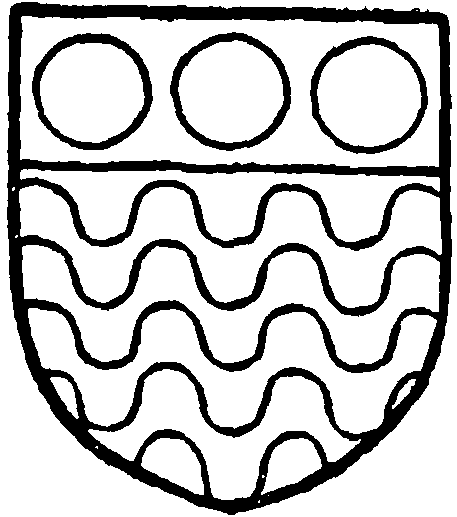
Astrey. Barry wavy argent and azure a chief gules with three bezants therein.
Henry Astrey of Woodend in Harlington was knighted in 1627 (fn. 109) and died in 1630, leaving a son and heir William, then aged fifteen. (fn. 110) William died during his minority while at Oxford, and the Astrey estates then passed to his younger brother Francis, (fn. 111) who dealt with the manor of Wadlowes by fine in 1640. (fn. 112) He was succeeded on his death in 1659 by a son James, (fn. 113) who was in possession in 1675, (fn. 114) and who was knighted at Harlington in 1683. (fn. 115) He and James his son suffered a recovery of the manor in 1701, (fn. 116) but the former died in 1709 and the latter in 1716 without issue. (fn. 117)
Wadlowes Manor then passed to a younger son Francis Astrey, D.D., (fn. 118) who left it by will to a kinsman of his mother's, Francis Penyston, who held it in 1801. (fn. 119) In 1808 there only remained a few traces of buildings to mark the site of the former manor-house, and these had lately been purchased by John Jennings. (fn. 120) His descendants are still large farmers in Toddington.
Early in the reign of Henry III Simon son of Hugh de Stanbridge granted to the monks of Woburn a small property in Herne inherited from his maternal grandfather Simon Franchevaler, (fn. 121) but 3 carucates of land in Herne granted to Roger Abbot of Woburn in 1235 by Humphrey de Herne (fn. 122) doubtless formed the origin of the abbey's Toddington property, known later as HERNE GRANGE or HERNE MANOR. In 1276 the Abbot of Woburn paid half a mark to the barony of Chaworth for his estate in Herne, (fn. 123) which in 1291 was valued in land, rent and profits of their courts at £6 0s. 10d., and in movable property at £1 18s. 4d. yearly. (fn. 124)
In 1302–3 Woburn Abbey held in the vill of Herne two parts of half a knight's fee, (fn. 125) and a similar return was made in 1346 and 1428. (fn. 126) The property was increased in 1368 by a small grant from Richard Carleton, (fn. 127) and by a royal charter of 1392 the abbot and monks obtained a right of free warren in all their lands in Herne. (fn. 128)
At the Dissolution the revenues of Woburn Abbey derived from Herne Grange amounted to £9 19s. 2d., with 10s. rent from Walter Morres for the capital messuage and certain land there. (fn. 129) In 1539 a lease of Herne Grange was granted to Roger Lee for twenty-one years at a rent of £6 13s. 4d., (fn. 130) the bailiffs of the Crown holding the annual court baron of the honour of Ampthill at Herne during the ensuing eight years. (fn. 131) In 1547 the reversion of this property was granted to Sir William Paget, together with the free warren and pasture called 'Harclease,' and right of holding court leet and view of frankpledge at Herne. (fn. 132)
Within the next ten years, however, Herne Grange passed to Richard Bury, having been purchased by him from Peter Grey. (fn. 133) He died in 1557, (fn. 134) when the estate passed to his son and heir Humphrey. (fn. 135) The latter married Jane daughter of Thomas Rotheram, kt., and in 1560 made a settlement of Herne upon her and their issue. (fn. 136) Humphrey died in 1592, leaving a son Henry, (fn. 137) who in 1600 obtained livery of his father's lands in Toddington. (fn. 138)
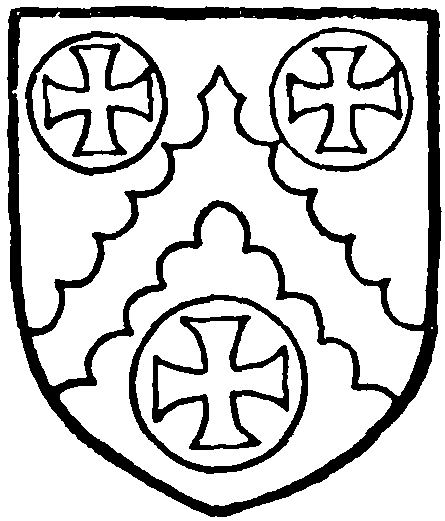
Bury. Sable a cheveron engrailed or between three roundels argent each charged with a cross formy gules.
The continuity of the descent of the manor of Herne during the 17th century is broken, no documents having been found to show how it passed to its successive owners. In 1625 William Brett died seised of it, leaving as heir a son William, (fn. 139) who obtained livery of a third part of Herne Manor in 1628. (fn. 140) He shortly afterwards was attainted for felony, and in 1629 a grant of the lands confiscated for that reason was made to his brother Robert. (fn. 141)
In 1635 the capital messuage of Herne is enumerated among the properties held by John Wainright at the time of his death, though no mention is made of the manor. (fn. 142) Trace of the latter is lost until 1690, when it was the property of Arthur Mawditt, who suffered a recovery of the estate in that year. (fn. 143) He apparently left three daughters as co-heirs, for in 1715 Elizabeth Cley, widow, Maria Mawditt and Sarah Mawditt, spinsters, were jointly seised of Herne Manor. (fn. 144)
In 1813 Charlotte Georgina Bettesworth and Frances Herne, wife of John Quantock, appear as holding equal rights in the property, which was then conveyed to Richard Gutteridge. (fn. 145) Before 1822 it had passed to Richard Thomas Gilpin. (fn. 146) At the present day Mrs. Warren-Vernon is lady of the manor.
In the 14th century another property, known as CHALTON MANOR, appears in the parish. It was held in 1366 of Sir Walter Massey and Elizabeth his wife as of the Earl Marshal, (fn. 147) and in 1417 was said to be attached to the manor of Weston, near Baldock. (fn. 148) Sir Henry Grene was lord of the manor, which included a chapel, till his death in 1369, when his son Thomas was declared to be his heir. (fn. 149) Thomas died in 1418, (fn. 150) but prior to his death he and his brother John appear to have remitted their right in Chalton to their brother Ralph. (fn. 151) He had died shortly before, when his brother John became his heir. (fn. 152)
It is impossible to state with any certainty that this manor is identical with one of the same name which appears in 1562 as the property of George and Humphrey Browneand of John Lord Mordaunt, who then made a settlement of it. (fn. 153) Humphrey Browne settled his third on his son George, and in default of his issue on his three daughters Mary, Christiana and Katherine. (fn. 154) Before 1570 this share had passed to the three daughters of Humphrey, from whom two third parts were purchased in 1576 by Robert Bell, (fn. 155) on behalf of the third sister Katherine. (fn. 156) She, who married William Roper, sold her part of Chalton Manor to Francis Bigg in 1589. (fn. 157) John Lord Mordaunt acquired the reversion of the moiety of George Browne in 1561, (fn. 158) and his son and heir Lewis so inherited from his father two-thirds of Chalton Manor, which he sold in 1590 to Francis Bigg, above mentioned. (fn. 159) Francis died in 1618, leaving as heir to his Chalton property a son Abraham, (fn. 160) who was in turn succeeded by a son Abraham. (fn. 161) The latter obtained seisin of the manor on reaching his majority in 1628, (fn. 162) but apparently died without issue before 1639, leaving Chalton to his sisters and co-heirs Mary Goldsmith, widow, Abigail wife of George Wainright, Sarah wife of Richard Shepherd and Agnes wife of William Burr. (fn. 163) Mary Goldsmith acquired the share of Agnes in 1643, (fn. 164) and her son and heir Thomas that of Abigail in 1650. (fn. 165) He also acquired the share from Sarah before his death, and by his will dated 1674 left the manor to his eldest son Thomas, with various legacies chargeable on the estate to his other children. (fn. 166) The manor of Chalton remained in the Goldsmith family until 1754, (fn. 167) when it was purchased from William Goldsmith and Elizabeth his wife by David William. (fn. 168) In 1761 it was the property of Charles Dymoke William, (fn. 169) from whom it passed to Rev. Dr. Hibbins, (fn. 170) and in 1797 it was in the hands of Maria Lepine. (fn. 171) Lysons, writing at the beginning of the 19th century, states that Viscount Howe was then lord of the manor. (fn. 172) Chalton was sold before 1804 to a brewer of London called Cox, (fn. 173) and before 1832 it was acquired by William Dodge Cooper of Toddington Manor, (fn. 174) whose subsequent history (q.v.) this manor of Chalton shares.
The church of Toddington was early endowed with land in the parish, to which certain manorial rights are found attached in the 14th century. This land, estimated at half a hide, was held in 1198 on a life lease by Roger Pever at an annual rent of 7s. and 4 'altilia.' (fn. 175) In 1220, possibly on the death of the incumbent, Roger sought a confirmation of his lease from the Abbot of La Couture, who failed to appear in court to answer the plea, (fn. 176) and in 1230 his son Paul sought also to obtain a release of the half hide from the new parson William le Cauf. (fn. 177) By an agreement in 1238 Paul quitclaimed all right in that property to the Abbot of La Couture in return for 30 marks. (fn. 178) In 1291 Toddington Church was valued at £10, (fn. 179) and the endowment in the middle of the 14th century is returned as a messuage and carucate of land in Toddington, over which the incumbent claimed the prescriptive rights of a view of frankpledge held twice a year, and all waifs and strays, (fn. 180) but no further trace has been found of a manor connected with the church.
The hospital of St. John the Baptist in this parish was founded in 1433 by John Broughton. (fn. 181) After the Dissolution the lands forming the endowment were seised by the owners of Toddington Manor without the king's licence. (fn. 182) In 1572 the site and endowment were granted to William, James and John Grey, (fn. 183) but the latter apparently continued with the lords of Toddington, who probably compounded with the Greys for them, and is coincident with the glebe lands and tithes in the parish known as the Portionaries, held with the manor in 1593 and 1615. (fn. 184) Lysons states that the hospital building was pulled down in the 16th century and the materials used in the erection of the market hall. (fn. 185)
CHURCH
The church of ST. GEORGE is cruciform, consisting of a chancel 36 ft. 2 in. by 18 ft. 2 in. with north vestry, central tower 14 ft. 8 in. square, nave 52 ft. 4 in. by 21 ft. 2 in., north transept 21 ft. 2 in. by 23 ft. 9 in., north aisle 8 ft. 3 in. wide, south transept 20 ft. 2 in. by 22 ft., and south aisle 8 ft. wide.
The cruciform plan and general dimensions date from early in the 13th century, but only the central tower, south transept and south aisle preserve masonry of that date. The nave arcades belong to c. 1310; the chancel and vestry, north transept and north aisle were rebuilt in the 15th century, the clearstory added and the south aisle walls heightened. A remarkable detail is the parapet, which has on the bed mould a series of animals carved, now unfortunately much weathered, owing to the softness of the Totternhoe stone, but worked with great spirit and effect.
Much of the church walling is rendered in cement and the walls terminate with parapets, some embattled and some plain. The chancel is entirely rendered in cement inside and out, including the masonry of the windows, and the walls are topped by a plain parapet. The east window is of four cinquefoiled lights, with tracery beneath a four-centred head; in the north wall are two windows like the east window, but of three cinquefoiled lights, and one like them in the south wall near the east end; at the opposite end of this wall is a window of three cinquefoiled lights, with geometrical tracery, and between these windows is a flat-headed doorway, the jambs moulded with a double ogee. Between the windows on the opposite side is a three-story 15th-century vestry. On the east side are three rectangular windows one above another. In the north wall are two circular staircases leading to the rooms above, one of which is entered from the outside and one from the inside, and at the top is a rectangular window; in the interior there are two square lockers, in the west wall of the vestry, and a fireplace in the north wall The lower of the two upper rooms is used as a library and the upper one as a store-room. The tower arches are in three square orders springing from chamfered responds, with moulded capitals and bases; the rood loft was in the east arch, entered by steps on the north. Externally the walls have been repaired with brick, and are partly covered with cement; the staircase turret is at the south-east angle, and at the other three angles are clasping buttresses. Over the roof of each transept is a pointed door, and in each face of the belfry stage are two windows, side by side, each of two trefoiled lights, with a quatrefoil over. On the west wall of the tower, considerably below the present roof of the nave, is the line of an older roof, below which is a blocked doorway, and above on a level with the present roof is another doorway. In the interior of the ringing chamber on each side are two blocked 13th-century windows of two lancet lights, with pointed heads springing from shafts with moulded capitals.
The north end of the north transept is built in rubble walling, crowned, like the vestry, by an embattled parapet with figures of animals, all very much worn, and containing a modern window of three cinquefoiled lights in two chamfered orders separated by a hollow, with perpendicular tracery beneath a four-centred head and label. The side walls are blank, the east being built in brick and stone, with a plain parapet, and the west is in squared stone with round flints. The floor of this transept is raised five steps, the arch into the north aisle is in two moulded orders, the outer continuing down the jamb and the inner springing from shafts with moulded capitals and bases.
The walling of the south transept is covered with cement; in the south end is a window of three cinquefoiled lights, and on the east side is a door to the stair turret at the south-east angle of the tower. In the south wall is a double piscina of the 13th century with moulded arches and shafts to the jambs, but the middle shaft is lost. At the north-east angle are a door and a blocked-up light to the stair turret. The arch from the south transept into the south aisle springs from moulded corbels, that on the north side being new and the other restored. The south transept probably formed the chapel of St. Mary the Virgin referred to later.
The nave arcades are in four bays springing from octagonal shafts with moulded capitals and bases; the capital of the middle pillar of the south arcade is decorated with a band of nail-heads. The arches are in two chamfered orders, with moulded labels in the south arcade and plain labels in the north. There are four three-light clearstory windows on both sides, those on the north being modern copies. The west doorway of the nave dates from the 15th century, and is in two moulded orders, of which the inner has a four-centred head and the outer a square head; in the spandrels are the remains of quatrefoiled panels. Above it is a restored 15th-century window of five cinquefoiled lights; three of the mullions are of wood up to the tracery, and the head has a moulded rear arch springing from shafts with moulded capitals and bases. On either side of the door in the interior are traces of late windows that have been blocked up. The north doorway of the nave has been rebuilt. Above it is a 15th-century cinquefoiled niche. The north porch was rebuilt in 1898 in ashlar masonry with a plain parapet; in each side is a square-headed window of two cinquefoiled lights, and on the east side is a stoup with a crocketed canopy formed in cement. The outer doorway is in two chamfered orders, with a pointed head and label and a cinquefoiled niche above it. There are two three-light windows in the north aisle to the east of the doorway and a modern window to the west of it. The south doorway is of the 13th century, with jamb-shafts and defaced foliate capitals. West of this door in the south porch is the moulded base of a pedestal for a 15th-century stoup. The porch is also of this date, and has in each side wall a square-headed window of three cinquefoiled lights, the mullions of which are in brick covered in cement. The outer doorway is much defaced; it is in two moulded orders, of which the inner has a pointed head and the outer a square head with a label over, and above that is a modern sundial. West of the porch is a new window like that opposite it in the north aisle, and between the porch and the south transept are two similar windows.
The chancel roof, which dates from the 15th century, has been restored, and those of both transepts are modern, but in the north transept are old carved stone corbels to support the roof. The roof of the nave, which has been restored, is in four bays, and between the main trusses, which have cinquefoiled tracery between the tie-beams and principal rafters, are secondary rafters, supported by figures of angels carrying emblems of the Crucifixion; the purlins and ridge are moulded with finely carved bosses at the intersection of the roof members, and attached to the eastern tie-beam is a pulley-block for suspension of a light before the rood; there are also remains of colour and the ceiling over the rood. The aisles have plain 15th-century roofs of low pitch.
The font is modern, in Romanesque style, and stands between the north and south doors.
There are several monuments in the church, especially in the south transept.
In the south wall of the chancel, near the east end, is a small mural monument in alabaster to Gylis Bruse, son of Sir John Bruse of Wenham, who died in 1595 while on a visit to his sister Alice, who was in attendance upon Lady Cheney. There is a memorial slab in the floor beneath the east arch of the tower to the same man. In the chancel floor is a slab to Barbara Lambe, who died in 1683, and her daughter Elizabeth Marshall, who died in 1689.
On the east wall of the north transept is a large marble monument, with pillars and a pediment, under which is a shell-headed niche, and a base carved with skulls and bones. It is in memory of Henrietta Maria Baroness Wentworth, daughter of Thomas fifth Lord Wentworth and granddaughter of Thomas Earl of Cleveland; she died 1686. On the opposite wall is a tomb, unfortunately damaged but of very good style, with the seated figure of Maria Wentworth, daughter of Thomas Earl of Cleveland, who died in 1632, aged eighteen.
On the east side of the south transept, near the entrance to the tower, is a raised tomb with the effigy of Jane wife of Sir Henry Cheney and daughter of Sir Thomas Wentworth, Lord Chamberlain to King Edward VI, who died in 1614. South of this tomb is another with half of an effigy of a man in armour of the 16th century, and next to it one with the effigy of Dame Anne Cheney, 1560; and at the west end is a coat, quarterly of fifteen: (1) A cheveron between three molets, (2) three Saracens' heads, (3) a cheveron between three bird-bolts, (4) on a cheveron three fleurs de lis, (5) quarterly over all a bend, (6) quarterly fessewise dancetty, (7) a bend vair between three escallops, (8) a saltire engrailed, (9) on a cross four escallops, (10) paly of six, (11) a pair of pincers (?), (12) a fesse dancetty between six crosslets, (13) a cross engrailed, (14) two leopards passant, (15) on a cheveron a fleur de lis.
Let into the south wall of the transept are two tombs beneath four-centred arches, with quatrefoiled panels, bearing shields on the tombs and in the spandrels above the arches. The tomb to the east bears the figure of a woman, whose feet are resting on a griffin; on the other is the figure of a knight in plate armour, and on his breast is a cheveron charged with three fleurs de lis, arms which suggest that he is a Pever; his feet are resting on a lion.
By the west wall is the broken figure of a knight carrying a shield charged with a cheveron as the last, and beneath is a fragment of quatrefoiled panelling, also broken. On this wall are three fragments of brasses of the time of Edward IV and Richard III. They probably belong to a brass of the first of the Broughton family.
In the floor of this transept are two stones with the matrices of brasses and a brass shield quarterly of six: (1) a cheveron between three roundels, (2) a lion rampant, (3) three boars (?), (4) a bend, (5) a fesse between two cheverons, (6) a fret.
On the floor there are also several fragments of a stone coffin.
There are eight bells and a sanctus, which is by Chandler, 1665. Of the others the treble is by Mears, 1850, the second to the sixth by Warner, 1906, and the seventh and tenor by Mears, 1792.
The plate is modern, consisting of two communion cups, a paten and a flagon given in 1846 by Elizabeth Cooper Cooper and a silver-gilt paten.
The register books are: (1) 1540 to 1559 and 1639 to 1772; (2) 1558 to 1591; (3) 1624 to 1637; (4) 1640 to 1667; (5) 1773 to 1812; (6) marriages 1754 to 1785.
ADVOWSON
The church of Toddington was granted to the abbey of La Couture, Le Mans, between 1100 and 1122, and confirmed to the Benedictine monks there by Henry I between the same dates, by Payn de Chaworth in 1167, (fn. 186) by Henry II 1180 to 1186, and by Geoffrey Count of Perche 1192 to 1202. (fn. 187)
The advowson may have remained with the abbey (fn. 188) during the 13th century, but from the cartulary of the abbey it would seem more probable that the monks lost it following on the quarrels with the incumbent Hugh of Gloucester in 1218 (fn. 189); certainly the right of presentation had passed before 1314 to the lords of Toddington Manor. (fn. 190) From that date up to the beginning of the 19th century the lords of Toddington Manor (q.v.) have also been patrons of the living. (fn. 191)
It was purchased from the heirs of Lady Louisa Conolly, widow of Thomas Conolly, lord of the manor in 1806, by James Lewis in 1822, (fn. 192) and before 1850 was acquired by William Cooper, then lord of the manor also. By several subsequent conveyances (fn. 193) it has passed to Mrs. Pipon of Chester, and Mrs. Hicks is the present patroness.
CHAPELS
The earliest mention of the chapel of St. Mary the Virgin in the church of Toddington occurs in 1298, and the last record of it is found in 1506. (fn. 194) The priest of the chapel was appointed by the lord of Toddington Manor, to whom also belonged the right of appointing a priest in the chapel of St. Bartholomew. There is a record of a presentation to the latter by Paul Pever in 1244, the last mention occurring in 1361. (fn. 195)
The advowson of a third chapel, that of St. John the Baptist, which was founded some time before 1244 and was in existence in 1562, (fn. 196) in the church of Toddington, belonged to the lord of Toddington, and after the foundation of the Hospital of St. John the Baptist by John Broughton in 1433 (fn. 197) the offices of warden of the hospital and chaplain in the chapel of St. John the Baptist were combined, (fn. 198) and the histories of both are identical (q.v.).
The chantry of St. James, also called the chapel of Chalton, was founded before 1392, (fn. 199) and belonged to the lords of Chalton Manor (q.v.). After the dissolution of chantries and chapels by Edward VI this chapel was granted to William, James and John Grey with the hospital at Toddington in 1572. (fn. 200) No further mention of it has been found.
At the dissolution of chantries in 1549 certain lands in Toddington of the yearly value of 6s. 9d. went to support a light in the church. (fn. 201) These lands are doubtless identical with those described in 1572 as lands for the maintenance of lights called St. Katherine's Lights, which were granted to William, James and John Grey, with the hospital and chapel of St. James. (fn. 202)
CHARITIES
In 1611 Richard Sheriff, by his will, charged a house and pightle in the village with 40s. a year for six poor widows, and in 1730 Dorothy Astrey by deed charged a small close of about an acre with 14s. yearly for twelve poor widows. The land now produces £5 a year. The two charities are administered together, and in 1906 £7 was distributed amongst fifty-nine widows.
The Town Lands.
It appears that certain property was held by feoffees for the use of the town as early as Henry VI. The trust estate now consists of a house and 36 acres of land at Fancott in this parish let at £60 a year, a house and garden let at £10 a year, 3 roods of garden ground let at £4, and a garden known as Cloister Garden let at 10s.
The trust is administered under the provisions of a scheme of the Charity Commissioners of 29 January 1897, whereby the legal estate is vested in the official trustee of charity lands, and provision is made for the appointment of successive trustees, the income to be applied in accordance with the existing trusts, but not in the relief of the rates directly or indirectly. Gifts of 18s. a week for limited periods are made to poor persons, chiefly widows.
The Cheney almshouses for three poor widows, founded by will of Lady Jane Cheney, bearing date 1 March 1612, are endowed with 1 a. 2 r. of garden ground let at £5 a year, and an annuity of £20 charged on an estate called Herne Farm, now the property of Mr. John W. Patersen. The income is equally divided among the three inmates.