
A History of the County of Huntingdon: Volume 2. Originally published by Victoria County History, London, 1932.
This free content was digitised by double rekeying. All rights reserved.
'Parishes: Warboys', in A History of the County of Huntingdon: Volume 2, (London, 1932) pp. 242-246. British History Online https://www.british-history.ac.uk/vch/hunts/vol2/pp242-246 [accessed 26 April 2024]
In this section
WARBOYS
Wardebusc (xi cent.), Wardebusche (xii cent.), Wardeboys (xiii–xvii cent.).
Warboys is a large parish on the eastern side of the county bordering on Cambridgeshire. It covers 8,435½ acres, of which a considerable part in the north-east is fen-land, the higher land in the south being of stiff clay. The land falls from about 114 ft. above the ordnance datum in the south to 2 ft. in the fen-land (fn. 1) in the north and north-east. Nearly threequarters of the area is arable, upon which potatoes are largely grown and also corn, beans, etc. Warboys Wood and Pingle Wood are the only remaining pieces of woodland and cover about 110 acres.
The fairly large village lies on high ground in the south-west part of the parish overlooking the fen to the north-east. It has grown up at the fork formed by the junction of the main road from St. Ives to Ramsey with the branch road leading eastward over Warboys Heath and to Fenton. The main road as it passes through the village is called Church Street and the branch road is the High Street. The church is at the south end of the village and adjoining it to the north-west is the Manor House, now the residence of Mr. G. L. Ekins, J.P. It is an early 17th-century two-storied brick house with attics, probably built by Sir John Leman, who bought the manor in 1622 and died in 1632. The front has rounded and shaped gables and within is an original staircase. To the north of it is a contemporary brick barn. On the opposite side of the road is the rectory, an early 18th-century house. A good door with a hood over it formerly formed the main entrance, but has now been moved to the back of the house. Some architectural fragments in the garden are said to have come from Ramsey Abbey. There are three or four old cottages in the village, including the White Hart Inn on the north side of the High Street, a 17th-century brick house with a thatched roof. The eastern part of the village, where the railway station now stands, is called Mill End from the windmill which is situated in the fork of the road here. Near by are brickworks and a little west is the Baptist Chapel.
A memorial clock was erected in the village in 1887. In 1774 an Act was passed for draining certain lands in Warboys, including 300 acres called High Fen and 60 acres, part of New Pasture. (fn. 2) Again, in 1795, an Act was passed for dividing, inclosing and draining the open common fields in Warboys. (fn. 3) A further Act was passed in 1798 to amend the last Act as regards the lands allotted in lieu of tithes. (fn. 4)
Warboys became conspicuous in 1593 by the trial and execution of three persons of the village for bewitching the five daughters of Robert Throckmorton, lessee of the manor, and Susan Lady Cromwell, Sir Henry Cromwell's wife.
MANOR
Warboys was the gift of Archbishop Dunstan to the Abbey of St. Benedict of Ramsey, and was confirmed by King Edgar in 974, (fn. 5) by Edward the Confessor, (fn. 6) by William the Conqueror in 1077, (fn. 7) and by Edward III in 1334; (fn. 8) and further by Pope Alexander in 1178, (fn. 9) and by Pope Gregory in 1229. (fn. 10)
Warboys was returned in the Domesday Survey among the lands of St. Benedict of Ramsey; and it was stated then that the abbot had 10 hides in the manor which paid geld. There were a priest and a church and 3 acres of meadow. There was wood for pannage 1 mile long and 1 mile broad. (fn. 11) The same hidage was given in the 13th century survey for 'Wardebois cum Caldecote,' (fn. 12) 30 acres being reckoned to the virgate and 4 virgates to the hide. (fn. 13) An inquisition concerning customs and rents in 1251 again returns Warboys and Caldecote as of 10 hides. (fn. 14)
There was a wood belonging to the manor extending from Middelgrave to Mareweye, from Mareweye to Wolfheye, from Wulfheye to Newedyche, and from Newedyche to Middelgrave. (fn. 15) The marsh of Warboys belonging to the manor was a subject of dispute during the abbacy of Abbot Rainulf (1231–53) with the Abbey of Thorney. The dispute resulted in Abbot Rainulf granting to Thorney half the herbage, between the weirs of Tyllingwere and Wulveywere from the river to the next 'merefen' in Warboys marsh, for a rent of one penny. Thereupon the Abbot of Thorney acknowledged that all the soil of the marsh was the property of the Abbot of Ramsey as belonging to his manor of Warboys. (fn. 16) The Abbot of Ramsey's tenants at Broughton had rights of pasturage, etc., in this marsh, but had to pay to the manor of Warboys for licence to enter. (fn. 17) The tenants of Warboys with those of Broughton had rights of common in Wystow Marsh, but not beyond the "Drauht" without licence of the abbot. (fn. 18)
In 1279 the Abbot of Ramsey held the manor of Warboys cum Caldecote of the king, including a windmill, and a messuage with a garden of 2½ acres, and gallows, tumbrel, view of frankpledge and all appurtenances. (fn. 19) In 1535 the site of the manor was leased by the abbot to John Mayhue or Mayhew of Warboys, husbandman, for 40 years at a rent of £8. (fn. 20) Two days before, a close in Warboys called Caldecotts had been leased for 40 years with the site of the manor of Broughton to John Lawrence of Ramsey, bailiff of Warboys. (fn. 21)
After the Dissolution the manor of Warboys with grange or farm, wood, fisheries and marsh, was granted in 1540 to Richard Williams alias Cromwell, (fn. 22) and followed the descent of Ramsey (fn. 23) until 1622, when Sir Oliver Williams alias Cromwell, jointly with his wife Anne, Henry his son and Dame Anne Carr, Henry's wife, and Henry Williams alias Cromwell his brother, sold the manor to Sir John Leman, kt., citizen and alderman of London, to Robert Leman, and William Leman, son of Sir John's deceased brother William. (fn. 24) In the following September, Sir Oliver Williams alias Cromwell of Hinchingbrooke, kt., with Henry Williams alias Cromwell of Ramsey, esq., his son and heir, leased to Henry Williams certain land in Upwood, in consideration of the latter conveying his interest in the pasture or warren of Woolvey (Wolvey) in Warboys to Sir John Leman. (fn. 25) Robert granted his interest in the manor to Sir John and his nephew William in 1628. (fn. 26)
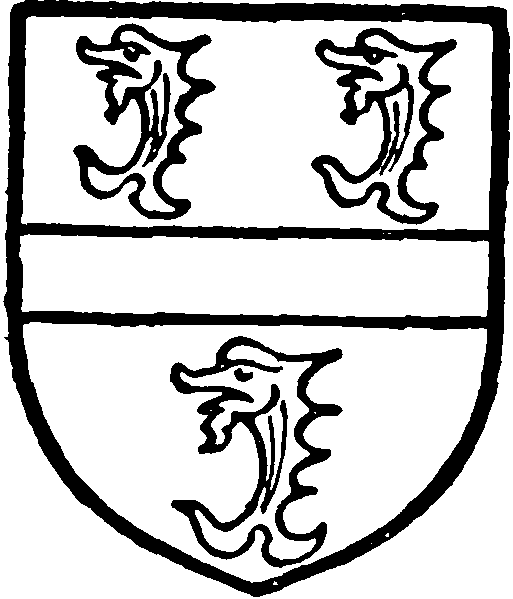
Leman of Warboys and of Northaw, Baronet. Azure a fesse between three dolphins rising argent.
Sir John Leman was a member of the Fishmongers' Company, and Lord Mayor of London, 1616–17. He was the son of John Leman of Beccles in Suffolk and died unmarried in 1632. (fn. 27) His elder brother William had four sons, John, Robert, William and Philip. John the eldest predeceased his uncle, leaving a son William, who was his grand-uncle's heir. Sir John Leman, however, bequeathed Warboys to his nephew William, third son of William his brother. (fn. 28) William married in 1628 Rebecca, daughter and co-heir of Edward Prescott, of London, (fn. 29) and they together in 1655 settled the manor and advowson, with view of frankpledge, etc., (fn. 30) on their son William's marriage with Mary, daughter of Sir Lewis Mansel by his third wife Elizabeth, and granddaughter of Henry Montagu, first Earl of Manchester. (fn. 31) This son William was created a baronet in 1665; (fn. 32) he succeeded his father in 1667, became sheriff of Hertfordshire in 1676, and M.P. for Hertford in 1690. In 1670 an Act was passed for settling the boundary between Warboys and Ramsey manors. The Bedford Level Commissioners had placed Warboys Fen within the manor of Warboys, and Sir Henry Williams attempted unsuccessfully to have it included in Ramsey. (fn. 33)
In 1682 and 1683 Sir William Leman, bart., with his wife Mary and his son Mansel Leman, settled the manor and advowson, (fn. 34) evidently at the marriage of Mansel with Lucy, daughter of Richard Alie, alderman of London. Mansel died in 1687, (fn. 35) and his father Sir William in 1701. (fn. 36) Mansel's son Sir William Leman, bart., of Northaw, co. Herts, in 1708 settled the manor of Warboys. (fn. 37) He married Anna Margareta, daughter of Colonel Brett, and mistress of George I, and with her settled the manor in 1738. (fn. 38) Sir William Leman died childless in 1741. His widow died on 24 December 1745, her sister-inlaw, Lucy Leman, the heiress of her brother, having predeceased her on 3 October 1745. (fn. 39) Mansel Leman's sister Elizabeth had married Henry, son of Richard Alie, brother of Mansel's wife. Their son Richard Alie was adopted by Sir William Leman, and inherited Northaw, and presumably Warboys, but died childless in 1749, after having assumed the surname Leman. (fn. 40) His sister and heir Lucy died childless in 1753. She gave Northaw to John Granger, who took the name of Leman, and dying childless as John Leman was buried at Warboys in 1781, leaving his estates to his wife with a reversionary interest to William Strode, whom she afterwards married. (fn. 41) William Strode of Loseby, co. Surrey, was holding the advowson of Warboys in 1795, (fn. 42) but not the manor, which appears to have passed to the family of Mansel Leman's sister, Theodosia, who had married Lewis Newnham, of London and Sussex. In 1769 it was held by John Newnham, (fn. 43) apparently of Maresfield Park, Sussex, whose daughter Wilhelmina married Sir John Shelley, bart., (fn. 44) by whom the manor was held in 1794, when he conveyed it to William Palmer. (fn. 45) The inclosure Acts of 1793 (fn. 46) and 1798 (fn. 47) return John Richards of Brampton and John Kirton of Gray's Inn as lords of the manor. In 1813 John Carstairs, of Stratford Green, Essex, appears as lord, (fn. 48) and in 1815 one-fourth part of the manor was conveyed to him by George Farcy (sen.) and Frances his wife. (fn. 49) John Carstairs left two daughters and co-heirs, Cecil, who married Wilson Jones of Hartsheath, co. Flint, in 1822, (fn. 50) and Johanna, who in 1840 married Sir John Henry Pelly, bart. (fn. 51) The Rev. Hugh Chambers Jones seems to have held the manor for a time and afterwards it passed to Henry Carstairs Pelly, son of Sir John Henry Pelly. After his death, in 1877, it was held by his trustees. His daughters, Annie Evelyn, widow of Capt. Thomas Rivers Bulkeley (killed in 1914) and Constance Lilian, wife of David, 27th Earl of Crawford, in 1918 joined in selling the manor to W. L. Raynes, of Cambridge, who conveyed it to Mrs. Fanny Elizabeth Spearing and Mrs. Mary Florence Raynes, the present owners. (fn. 52)
A field called Wolfheye was mentioned in 1251 (fn. 53) and as Wolveye in 1291, (fn. 54) later as belonging to the infirmarer of Ramsey, (fn. 55) seems to have been the origin of a property referred to as the manor of WOLVEY. In 1535 John Warboys, Abbot of Ramsey, leased it pertaining to the infirmarer's office, to John Somerbye of Ramsey for 40 years at a rent of 53s. 4d. (fn. 56) In 1540 the manor or farm of Wolvye was leased with the site of Warboys manor to Gabriel Throckmorton 'in like manner as William Pope lately held it.' (fn. 57) The separate conveyance of Wolvey pasture or warren was made to Sir John Leman, since which date it has followed the descent of the principal manor.
CHURCH
The Church of ST. MARY MAGDALENE, formerly of the BLESSED MARY THE VIRGIN, (fn. 58) consists of a chancel (34 ft. by 17 ft.), nave (49 ft. by 20 ft.), north aisle (8½ ft. wide), south aisle (8 ft. wide), west tower (12 ft. by 11½ ft.), north and south porches. The walls are of rubble and the roofs covered with lead. Nothing remains of the church which existed here at the time of the Domesday Survey (1086). The earliest church of which there is now evidence was built in the middle of the 12th century, probably when the church and its possessions were granted by Abbot Walter to the almonry of Ramsey Abbey about 1155. (fn. 59) This church consisted of a chancel and the present nave and a north aisle. (fn. 60) The chancel arch, the responds at each end of the north arcade and a small piece of walling at the south-west corner of the nave of this church still survive. Early in the 13th century, the Norman north aisle with the arcade was rebuilt, and immediately afterwards the south aisle with its arcade was added. (fn. 61) In the middle of the 13th century the west tower with its broach spire of ashlar was built, and it was evidently intended at this date to extend the aisles westward to the line of the west wall of the tower. If this intention was then carried out, the south extension was rebuilt in the latter part of the 14th century when the south porch was added, and the north extension was also rebuilt in the early part of the 15th century when the north porch was added. The chancel was rebuilt and shortened before the beginning of the 19th century, and in 1832 it was extended eastward apparently to its original length and considerably altered. At this date large galleries were erected in both aisles and the tower, the floor being lowered a foot to give head room under them; the east wall above the chancel arch and the west wall of the tower were cased in lath and plaster, a vestry was formed at the west end of the north aisle, all the walls were coated with thick plaster and wooden mouldings fixed below the clearstory windows and in other places. The spire was restored in 1898, and in 1926 the tower and south aisle were underpinned, the additions of 1832 (except those to the chancel) were removed and the floor restored to its former level.
The chancel has a three-light east window, two windows on the north side and three on the south. On the modern north door has been fixed a fine 12thcentury knocker consisting of a lion's face holding in its mouth a ring formed of two winged dragons fighting. The 12th-century arch is semicircular and of two orders, the lower consisting of two large rolls and the outer having the cheveron ornament; the responds have attached shafts with simple Norman capitals and bases.
The nave arcades are of four bays, the arches on the north side are moulded on the side next the nave, while those on the south are simply chamfered. The piers are cylindrical, except the middle pier on the north, which is octagonal, with moulded capitals and bases. The responds at each end of the north arcade are of the 12th century. They are square with moulded imposts, and a 13th-century corbel has been inserted in each to carry the lower order of the later arches. A locker was formed in the east respond of the north arcade; only the rebated stone frame, however, with the holes for the hinge hooks, now remain, the back having been destroyed when steps to a modern pulpit were inserted. The nave walls were heightened and a new roof made in the 15th century, when the present clearstory windows of two lights were inserted. Previously the walls were only carried a little above the sills of the present windows, and the line of the old roof, which was of steeper pitch, can still be seen on the wall of the tower. Between this roof and that of the aisles there was just sufficient room for three circular or quatrefoil windows in the spandrels of the arches (not over the arches as usual). The inner jambs of these windows may still be seen inside the church. At the northeast angle of the nave was the stair to the rood loft, and the entrance to the staircase was probably in the nave. Parts of the upper doorways may be seen both in the nave and the north aisle. Apparently in 1832 the lower part of the staircase, which was much worn, was destroyed and an entry to the modern pulpit formed from the aisle, leaving a large cavity in the wall which endangered its safety; it was therefore found necessary in the recent repairs to fill up the cavity to the springing of the chancel arch above which it is left empty. A small piece of a moulded beam of the rood screen with coloured decorations was found used up in one of the plaster casings.
The north aisle has an east window of the early part of the 15th century, and three windows in the north wall of the same date, all of three lights. The north doorway is of the 13th century. In the east wall is a 15th century bracket carved with a lion's face, probably for an image. The beautiful arch across the north aisle in a line with the east wall of the tower is of the 15th century, and the west window of this aisle, which has a ram's head as a label stop in reference to the arms of Ramsey Abbey, is of the same date. In the extension of this aisle there is an ancient chest.
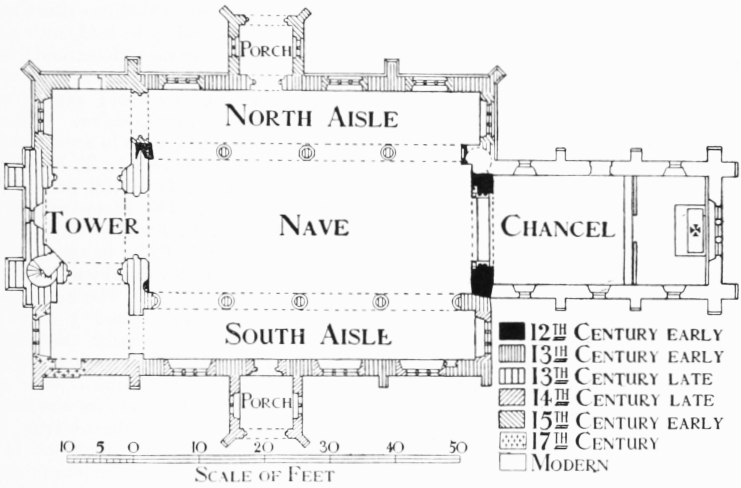
Plan of Warboys Church
The south aisle has an east and three south windows of the late 14th century, all of three lights. The south door and porch are of the same date. At the eastern end of the south wall is a mutilated fragment of a 13th-century piscina indicating the position of an altar. (fn. 62) At the west end of the south wall are the remains of an ancient fireplace, the flue of which, some few feet up, has been filled in. One jamb of the fireplace has been restored and the lintel is broken. The present square-headed three-light west window of the aisle was probably inserted in the 17th century, the date 1695 on the jack-leg above the window, or T.M. 1676 cut on the south-east pier of the tower, may give the date of it. This window, which was partially destroyed by the addition of a modern doorway now removed, has lately been restored. The roofs of the north and south aisles are of the 15th century, but are much restored and renewed.
The 13th-century tower is of three stages with a moulded plinth and a corbel-table at the base of the spire. The tower is carried on three arches of two chamfered orders resting on moulded imposts with attached shafts. The arch in the east wall of the tower is lofty and imposing, the arches on the north and south walls are lower, although the outer order inside the tower is carried up to the same height as the eastern arch. The west wall has a wall-arch enclosing a tall and elegant lancet window with the unusual feature of a trefoiled transom at about half its height. Down the southern jamb of the window are four quatrefoils now only visible from outside, which were inserted in 1832 to give light to a sham window in the lath and plaster casing inside, which is now removed. The arches and windows in the south and west walls are forced out of their proper place by the stair turret in the south-west angle of the tower. In the second stage there is a lancet in the north, south and west walls. The third stage has in each of the four sides two coupled lancet windows with shafted jambs and mullions. The broach spire has three tiers of lights on the cardinal faces, the lowest of two lights and the others of single lights.
The font is an interesting specimen of early 13th-century date; it has a square bowl carved with rather crude foliage, standing on a large central and four angle shafts having moulded capitals and bases— the capitals of the angle shafts being carved on the corners of the bowl.
Various stones, chiefly of 13th-century date, found in the course of the recent works, have been built into the walls for preservation.
On the floor of the chancel are stones in memory of the Rev. Allen Cowper, M.A., rector for 40 years, died 1772 aged 77, and the Rev. Thomas Stona, M.A., rector, died 1792 aged 64. On the nave floor are stones to Edward Smith, died 1733 aged 70, and Mary his wife, died 1747 aged 80; Christopher Wood, died 1797 aged 92, and Elizabeth his wife, died 1775 aged 75; the Rev. John Warburton, rector, died 1721, and Margaret his wife, died 1715 aged 88.
On the north wall of the chancel is a monument to John Leman, Esq., died 1781, and another to Elizabeth relict of the said John Leman, and wife of William Strode, died 1790. In the churchyard, on the north side of the chancel, is a coped stone of 14th-century date with a cross and large rosettes; of the inscription in Lombardic capitals all that can be read are the words "… Dieu de sa alme eyt merci, Amen."
There are five bells, inscribed: 1, Cum voco uenite. Joseph Eayre fecit, 1765; 2, Omnia fiant ad gloriam Dei. Joseph Eayre, St. Neots, fecit 1765; 3, Edward Dring and Oliver Hills, Churchwardens, Joseph Eayre, St. Neots, fecit 1765; 4, (name erased) Churchwarden, Joseph Eayre fecit 1765; 5, Allen Cowper, Rector, Edward Dring and Oliver Hills, Churchwardens, 1765 (and on the rim) Ego sum vox clamantis. These bells have lately been rehung in a new oak frame.
The registers are as follows: (i) Baptisms, 31 Aug. 1551 to 4 Feb. 1653–4, marriages, 8 Feb. 1565 to 15 June 1662, burials, 31 March 1565 to 22 Jan. 1653–4, and one entry 27 Dec. 1662; (ii) baptisms, marriages and burials, 11 Feb. 1663 to 23 July 1769, marriages end 5 Feb. 1754; (iii) baptisms and burials, 30 Sep. 1771 to 29 Feb. 1812; (iv) the official marriage book, 2 July 1754 to 6 Oct. 1812. Book III is bound in at the end of Book IV.
The church plate consists of a silver gilt cup, standing paten and flagon, each inscribed 'Dedicated to the Service of the Altar and presented for the use of the Parishioners of Warboys by the Rector, the Revd. William Finch, M.A., A.D. 1842,' all hall-marked for 1841–2; two plated plates, inscribed 'Presented by the Revd. Wm. Finch, A.D. 1842.'
ADVOWSON
A church and a priest at Warboys were recorded in 1086, and the church was confirmed to Ramsey Abbey with the manor by Popes Alexander and Gregory. Alfred, the priest of Warboys, witnessed numerous deeds between 1114 and 1130. (fn. 63) Between 1148–60 the church with all its appendants, and with free lands and tithes, was assigned to the almonry of Ramsey by Abbot Walter for the sustenance of pilgrims and the poor, the almoner to have the parsonage. This grant was to take effect after the death or removal of Nicholas de Sigillo and Richard the clerk of Warboys. It was confirmed by Robert Bishop of Lincoln, and Theobald Archbishop of Canterbury, and at various later dates. It continued to be held by Ramsey Abbey until the Dissolution. (fn. 64)
The advowson was granted with the manor in 1540 to Sir Richard Williams alias Cromwell, (fn. 65) with which it continued to be held, with occasional exceptions, until late in the 18th century. In 1722, Lucy Leman, widow of Mansel Leman, whose son Sir William Leman was lord, presented; and in 1772, for that turn, Margaret Stona, widow. William Strode of Losely held the advowson in 1792, and in 1828 his trustees. It was then held by T. Daniel, Esq. In 1871 the Rev. Chas. Grey Hill presented, and in 1894 his executors. The advowson was next held by the Rev. W. H. Bromley Way. The presentation was made by A. Fuller in 1900, and the advowson now belongs to Richard Flowers Sergeant, esq. (fn. 66)
CHARITIES
The Rev. Robert Fowler, by will dated 3 Aug. 1824, gave to the rector and churchwardens £200 for investment, the interest to be distributed amongst the poor of the parish in meat and bread. The endowment of the charity now consists of £192 5s. 5d. Consols with the Official Trustees producing £4 16s. annually in dividends, which is distributed by the rector and churchwardens to about 30 recipients in meat, in accordance with the directions of the donor.
Poor's Estate and Church Estate. This property, as to which there are no writings to be found, comprises two cottages at Fenton End and several closes of land, containing in all about 26 acres. The land and cottages are let to various tenants, and the rents, which in 1923 amounted to £78 9s., are carried to the general church expenses account. The charity is administered by the rector and churchwardens.