
A History of the County of Huntingdon: Volume 2. Originally published by Victoria County History, London, 1932.
This free content was digitised by double rekeying. All rights reserved.
'Parishes: Offord Cluny', in A History of the County of Huntingdon: Volume 2, (London, 1932) pp. 319-322. British History Online https://www.british-history.ac.uk/vch/hunts/vol2/pp319-322 [accessed 24 April 2024]
In this section
OFFORD CLUNY
Upeford, Opeforde (xi cent.), Upford (xii cent.), Offord Cluny (xiii cent.).
Offord Cluny lies to the east of the River Ouse and south of Godmanchester. The parish is lowlying and near the river is liable to floods; it rises, however, to 150 ft. on its eastern boundary. It has an area of 1,046 acres of land and 16 acres of land covered by water. The soil is clay and gravel and the subsoil clay growing wheat, barley, turnips and beans. The Offord and Buckden Station on the London and North-Eastern Railway is in the parish and serves the three parishes.
The village lies on the road from St. Neots to Godmanchester, a little to the north of the boundary between the two Offords, where this line joins the Ouse (the western boundary of the parish), just below Offord Common and the weirs and boat house south of Buckden Mills. It is here that the two villages are situated adjacent to each other, each with its ancient church and manor house grouped near the river. A road branches westward from the village to Buckden, passing over the river by a bridge of three arches.
Offord Cluny church stands in the village, east of the main road and south of the station. To the east of it is the Manor House, an early 18th-century building, and the Old Swan public house, with various buildings of the same date in the vicinity. Whitwell Farm, to the west of the road, further north. was probably rebuilt in the early 18th century, Bottom Farm, which lies to the north, is a picturesque timber and plaster house of two stories and an attic, now three cottages. It was built probably in 1632, the date carved over the main doorway, the north wing and porch being added in 1668, the date shown on the porch gable. About 80 yards south of the church, where New Road branches east from the Huntingdon road, is Manor Farm, where a late 16th-century projecting wing with overhanging upper story survives in a building otherwise partly rebuilt in the 18th century. Here, again, are interesting old houses and cottages.
A broken pillar of granite was erected as a memorial to the men who fell in the Great War.
MANOR
The manor of OFFORD CLUNY was held in the time of Edward the Confessor by Bului, but after the Conquest it had passed to Arnulf de Hesding, who, before 1086, had granted it to the monks of Cluny. (fn. 1) At this date the manor was assessed at 10 hides, and there were then a church, a priest and two mills. (fn. 2) It was confirmed to the monks of Cluny by Henry I, Henry II and Richard I. Before 1276 it had been subinfeudated and was held of the monks by Imbert de Montferraud, (fn. 3) who was succeeded before 1286 by John de Crokeslee, tenant for life under the abbey of Cluny. A claim was set up by the crown that the manor was ancient demesne of the crown, but this was not upheld. Richard I granted the monks view of frankpledge, freedom from shire and hundred and other liberties. (fn. 4) The abbey had acquired, in addition, before 2 February 1305, two mills and the site of a mill in Offord Cluny, from John de Offord and his wife Isabel. (fn. 5)
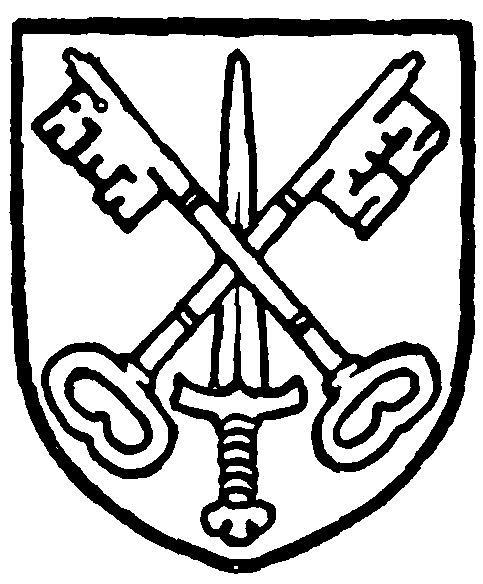
Cluny Abbey. Gules the keys of St. Peter crossed saltirewise in front of the sword of St. Paul.
Walter de Langton, Bishop of Coventry and Lichfield, obtained from the abbey of Cluny a grant for life of the manor, vill and advowson of Offord, which were confirmed to him by Edward I with the manors of Tiksover and Manton in 1307, (fn. 6) free warren being granted to the bishop in his demesnes there and in Offord Darcy and Everton. (fn. 7) The vill was returned in 1316 as held by the bishop, (fn. 8) after whose death the advowson was returned as in the king's gift by reason of his custody of the bishop's heir. (fn. 9) In 1327 the manor was committed to the keeping of John de Waldeshef, (fn. 10) who in 1328 was ordered to deliver the issues to Abbot Peter, the latter having rendered fealty for the manor and other lands in England taken into the king's hands by reason of the death of the last abbot. (fn. 11) Before 1337 the manor was in the keeping of John de Offord, King's clerk, who was proctor of the abbot and fermor of the manors of Offord Cluny, Tiksore and Maxton. (fn. 12) In 1342 the lands of the abbey of Cluny were in the king's hands by reason of the war with France. (fn. 13) For the same reason the manor was in the king's hands when John de Offord died in 1349, and was granted on 20 June to the king's yeoman, Roland Daneys, to hold on the same terms as the late chancellor and archbishop elect. (fn. 14)
In 1355 the abbot of Cluny received restitution of the manor, (fn. 15) and a grant of it made by the abbey to Nicholas de Tamworth and his wife Joan, for life, was confirmed by Henry, Duke of Lancaster, in 1361. (fn. 16) After the death of Nicholas, Joan married Sir Gilbert Talbot, kt., with whom she was holding the manor for life in 1389, (fn. 17) and who after her death received a grant in 1392 to hold for life during the war with France. (fn. 18) In 1397 he received licence to purchase it with the advowson from the abbey for his life and a year beyond. (fn. 19) Sir Gilbert died in 1399, (fn. 20) leaving by his wife Margaret an infant son Richard. A grant of the manor was made in the same year to Sir Simon Felbrigg, kt., and inspected and confirmed in 1399, 1400, and 1401. (fn. 21) Sir Simon was apparently dead in 1412, when the King's Esquire, William Porter, received licence to cross the seas with 4 persons and 5 horses to bargain with the abbey of Cluny for purchase of this and other manors. (fn. 22) Licence to hold these manors was granted to him and his wife Agnes at a rose rent in 1413, 1415 and 1425. (fn. 23) Agnes Porter was holding the manor alone in 1441–2. (fn. 24)
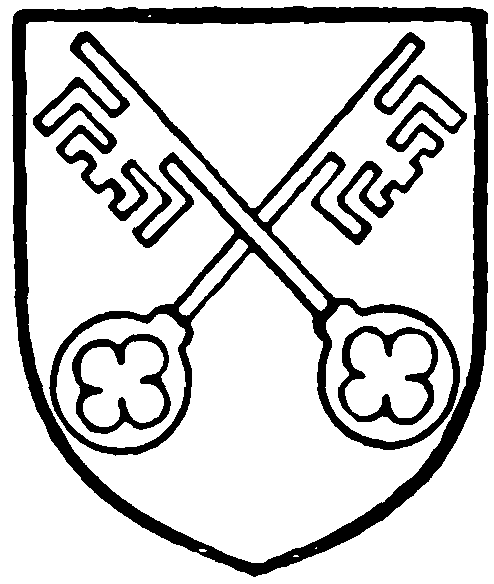
Westminster Abbey. Gules the crossed keys of St. Peter or.
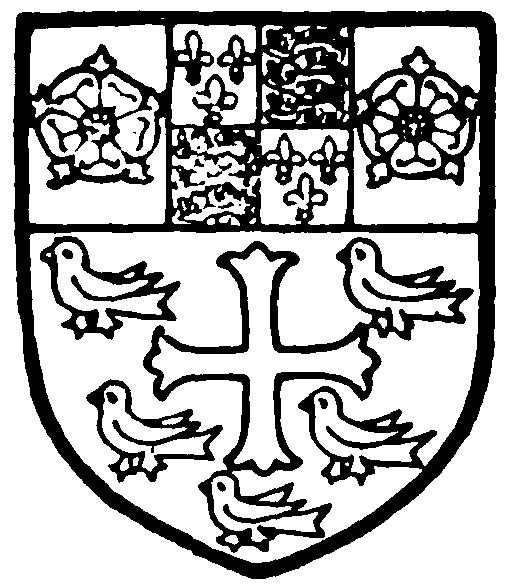
Dean and Chapter of Westminster. The arms of Edward the Confessor with a chief or and therein a pale of France and England between two Tudor roses.
After the property of alien priories in England had come finally into the hands of the crown, the manor and advowson were by the will of Henry V bequeathed to the abbey of Westminster, (fn. 25) and by Henry VI, on 9 July 1445, conveyed to the abbey in execution of his father's will, (fn. 26) to hold as fully as William Porter had done, all the conditions laid down by both kings being confirmed by Edward IV, with additional instructions for masses for Richard Duke of York (the King's father), his mother, and others. Grants of the manor were made to the dean and chapter by Henry VIII and Elizabeth. (fn. 27)
A lease of the manor made by the dean and chapter in 1641 to Henry Iles, his wife Sara, and their son William shows that it was charged with several yearly rents under the Act for the continuance and maintenance of the school and almshouses of Westminster. (fn. 28) These tenants appear to have succeeded as lessees Sir James Evington and his wife Jane, whose predecessor had been one Cropley. (fn. 29) The manor was sold by the Trustees for the Sale of the Lands of Deans and Chapters in 1650 to William Wright, with view of frankpledge, courts leet and baron, etc. A detailed account of the property conveyed by this sale shows that the site covered about an acre, and gives clear indications of the positions of mills, closes, the pound, ford, etc. (fn. 30) Courts baron for this manor were recorded as having been kept for William Wright in 1652, 1654, 1656, and 1658. (fn. 31) After the Restoration the manor was returned to the Dean of Westminster, who held courts there in 1665. (fn. 32) At the inclosure of the parish in 1800 the lessee of the dean and chapter of Westminster, the lords of the manor, was Thomas Sismey. (fn. 33) The dean and chapter are still lords of the manor.
The property which later became known as PAPWORTH FEE was possibly represented in 1301 by a holding of William de Papworth in Graffham, Offord and elsewhere. (fn. 34) William de Papworth was returned in 1314 as having held at his death, when he was succeeded by his son John, a messuage and 40 acres of land held of the abbot of Cluny in Offord Cluny by service of 30s. yearly, and a messuage and 20 acres of arable land held of Walter de Langton by service of 1 lb. of pepper in Offord Darcy. (fn. 35) At the death of Walter de Langton 6s. 8d. was returned as payable out of the manor of Offord Daneys to the heirs of William de Papworth in 1321. (fn. 36) Papworth Fee in Offord Cluny was in 1523 conveyed by Edmund Haselwood to Thomas Wolfe of London, subject to an annuity of 10 marks to Edmund, son of William Wolfe, who with Edmund Haselwood was to make surrender according to the custom of the manor. (fn. 37) From this it would appear that Papworth Fee was only a customary holding, and we lose sight of it from this date. Thomas Wolfe and his wife Dorothy were dealing with 3 messuages, 40 acres of land, 12 acres of meadow, 6 acres of pasture and 47s. rent in Offord Cluny and Darcy and Great Paxton in 1532. (fn. 38)
The Bishop of Lincoln was returned in 1279 as having wrongfully occupied a free fishery belonging to the manor of Offord Cluny. (fn. 39)
CHURCH
The Church of ALL SAINTS consists of a chancel (22½ ft. by 14 ft.), nave (38½ ft. by 14½ ft.), north aisle (44 ft. by 8½ ft.), south aisle (38½ ft. by 8½ ft.), west tower (10¾ ft. by 10¾ ft.), and modern south porch. The walls are of pebble and stone rubble, with stone dressings, except the chancel, which is of brick. The roofs are covered with tiles and lead.
The church is mentioned in the Domesday Survey (1086), but the earliest parts now standing are the nave arcades, that on the south c. 1260 and on the north c. 1280; and the aisle walls built at the same time probably remain, although much altered. Early in the 15th century the tower was built, and new windows and doorway formed in the north aisle; about 1500 the south aisle was similarly modified, and slightly later the arcade was rebuilt and the clearstory added. The staircase turret of the tower was repaired in 1687, and the chancel is dated 1726. The porch was built in 1851, in which year several repairs were done, and other restorations took place in 1853 and 1860.
The chancel, built in 1726, (fn. 40) is of brick and has a two-light window in the east wall and a similar window in each of the side walls. In the east gable is a stone inscribed 'L. B. 1726.' (fn. 41) The late 13thcentury chancel arch is of two hollow chamfered orders, resting on chamfered responds with semioctagonal shafts having moulded capitals and bases.
The 13th-century nave has an arcade of three bays on each side, that on the north, c. 1280, has two centred arches of two hollow-chamfered orders resting on circular columns with moulded capitals and bases and similar responds; that on the south, originally of c. 1260, has two centred arches of one chamfered order, the inner order having been lost, resting on octagonal columns with moulded capitals (their abaci lost), and simple bases and similar responds—but the whole has been clumsily rebuilt, probably early in the 16th century. The early 16th-century clearstory has three three-light windows on each side. The contemporary roof is of low pitch and has moulded tiebeams with jack-leg and curved braces, and carved figures at the feet of the intermediate beams. The south wall plate is carved with running foliage, and the north plate is inscribed 'A C · W S · 1683 · I B · R G'
The weathering of the former steep-pitched roof can be seen on the east wall of the tower.
The 13th-century north aisle has a 15th-century two-light east window, flanked by two early 16thcentury rectangular brackets; in the north wall are two similar windows and a doorway of the same date. The west wall has no window. The early 16thcentury roof is of simple form.
The 13th-century south aisle has a three-light window of c. 1500 in the east wall; two similar windows, a plain doorway, and a 14th-century piscina in the south wall, and another similar window in the west wall. The early 16th-century roof has moulded beams and curved braces, and the date '1776' has been cut on one of the wall plates. The early 15thcentury tower has a two-centred tower-arch of three orders, the lowest resting on attached shafts with moulded capitals and bases. The west doorway has moulded jambs, a two-centred arch under a square head with tracery panels in the spandrels; above it is a three-light window with four-centred head. The second stage has a quatrefoiled light in the north, south and west walls. The belfry windows are of two lights. The tower has clasping buttresses at the angles, becoming diagonal at the second stage, and is finished with an embattled parapet; formerly there was a timber spire covered with lead, removed in 1851. (fn. 42) The stair turret at the south-west corner is inscribed 'John Barns William Silke, Churchwardens, 1687,' probably the date when some repairs, largely of brick, were done.
The octagonal font is modern (1853), but in the churchyard is a much-broken ancient octagonal bowl.
There are four bells, inscribed (1) I.K. Jevs be our sped 1630; (2) I.K. Praise the Lord 1630; (3) I.K. ✠ God save our King 1630; (4) Thomas Mears Founder London 1842. (fn. 43) The first three by James Keene, of Woodstock.
The early 17th-century communion table has heavy turned legs.
The hexagonal oak pulpit is made up of 17thcentury panelling, probably from a former pulpit, but is largely modern; and the reading desk is also made up of panelling of similar date.
There are the following monuments: In the chancel, to the Rev. Edward Edwards, rector, d. 1834, and Sarah his wife, d. 1832; floor slab to George Walker, d. 1694–5, and George his son; and glass windows to the Rev. George Price, rector, d. 1850; and Emily Frances Turner, d. 1863, and Amelia Isabel Turner, d. 1864. In the south aisle, to Thomas Sismey, d. 1820; John Sismey, d. 1831; Elizabeth, widow of Thomas Sismey, d. 1880; and South African War Memorial.
The registers are as follows: (i) Baptisms, 14 Nov. 1578 to 13 Oct. 1772; marriages, 8 Feb. 1666–7 to 6 Feb. 1721; burials, 2 Oct. 1574 to 2 Feb. 1722–3; (ii) baptisms, marriages and burials, 29 March 1723 to 30 Dec. 1812; marriages end 4 Aug. 1755; (iii) the official marriage book, 4 Aug. 1755 to 20 May 1806; (iv) the same, 28 June 1808 to 27 Dec. 1811.
The church plate consists of a silver cup inscribed 'John Newcome D.D. Rector of Offord Cluny. 1757,' hall-marked for 1756–7; a modern paten, perfectly plain (? silver); a plated paten, inscribed 'Offord Cluny Parish Church. Presented by the Rev. E. B. Turner, Rector, Easter 1868.'
ADVOWSON
The church was granted to the Abbey of Cluny with the manor, and the presentation was made by its proctor or lessee, or by the king when the temporalities of alien abbeys were in his hands, until the manor and church were granted to the Abbey of Westminster. At the Dissolution it was granted to the Bishop of Westminster by Henry VIII in 1541, (fn. 44) and to the Bishop of London by Edward VI in 1551. (fn. 45) It remained with the Bishops of London until the latter part of the 19th century, when it passed to the Bishop of Peterborough, and from him in 1874 by exchange to the Lord Chancellor. (fn. 46)
The incumbent seems to have been endowed with a rectory manor from an early date. He was holding courts from 1651 to 1741, (fn. 47) and was returned as lord of the rectory manor in 1800. (fn. 48) The rectory was annexed to that of Offord Darcy by Order in Council in 1923, taking effect in 1927, when the rectory house of Offord Cluny was sold. The rector resides at Offord Darcy.
CHARITIES
The Poor's Estate, founded before the year 1830, is now regulated by a scheme of the Charity Commissioners dated 1 October 1915. The endowment of the charity consists of about 5 a. 2 r. of land in Offord Cluny, £58 14s. 10d. 2½ per cent. Consols and £238 2s. 5d. 5 per cent. War Stock with the Official Trustees, the whole producing about £26 per annum, which, after deducting a sum of £3 7s. 6d. and expenses, is distributed to about 150 recipients in money.
Under the provisions of the above-mentioned scheme the charity is administered by a body of trustees consisting of two co-optative trustees and three representative trustees appointed from time to time by the Parish Council of Offord Cluny.
The sum of £3 7s. 6d. referred to above constitutes the endowment of the Church Estate, and is paid to the churchwardens and applied towards church expenses.