
A History of the County of Huntingdon: Volume 2. Originally published by Victoria County History, London, 1932.
This free content was digitised by double rekeying. All rights reserved.
'Parishes: St Neots', in A History of the County of Huntingdon: Volume 2, (London, 1932) pp. 337-346. British History Online https://www.british-history.ac.uk/vch/hunts/vol2/pp337-346 [accessed 24 April 2024]
In this section
ST. NEOTS
S. Neod (xii cent.); Villa Sancti Neoti (xiii cent. and later).
The parish of St. Neots originally formed part of Eynesbury, but when in 1113 the Priory of St. Neots was given the whole manor in which the priory was situated, (fn. 1) the monks formed their lands and tenants into a separate township and the name of St. Neots was given to it. The first recorded use of the new name is in 1156–7 (fn. 2) and the men of St. Neots are mentioned in a Pipe Roll of 1188, (fn. 3) but the final severance was probably not made until 1204, when the ecclesiastical division of the parishes took place. (fn. 4) Geographically, the new parish practically cut that of Eynesbury into two portions. The sub-soil of St. Neots parish is mainly Oxford Clay. The river Ouse forms the western boundary and its tributaries the Hen Brook and Gallow Brook form parts of the southern and northern boundaries.
The Priory stood on the river a little way north of the Market Square. Only a few stones of the building remain, and the site is now occupied by a brewery.
The town of St. Neots no doubt originally grew up round the Priory, to which Henry I and Henry II granted very important privileges, but the chief cause conducive to the prosperity of the town was at first apparently a ford or ferry (fn. 5) and later the bridge across the Ouse. Main roads from Huntingdon, Kimbolton and Bedford converge at this point on the west side of the river, and like roads from Godmanchester, Cambridge and Sandy on the east side; they are fed by secondary roads from the neighbouring villages. The bridge known formerly as High Bridge is referred to in 1180 (fn. 6) and William de Ferrers, Earl of Derby (d. 1254), it is recorded, was thrown from his litter on the bridge. (fn. 7) It is composed of three spans of round arches over the river and eight smaller arches, and a causeway over the low-lying land in the parish of Eaton Socon. The bridge is partly of stone and partly of brick and has cut-waters on both sides except the three westernmost of the smaller arches which have flat buttresses on the north side. The middle of these buttresses has the date 1647 carved on it, probably indicating the date of the completion of the work here. An indulgence was granted for the repair of the bridge in 1293, and it was in a very ruinous state in 1388, when Richard II granted to the bailiff and men of St. Neots pontage for two years in aid of its repair. (fn. 8) According to Leland the bridge was still of timber in 1538. Legacies were left for its repair in 1517, (fn. 9) 1526 and 1548. (fn. 10) In 1588 an Inquisition was held as to the state of the bridge, which it appears had lately been newly built by Edward Payne, bailiff of the manor, at a cost of £583 1s. This bridge was chiefly of timber, but had stone piers up to the water-line; it was desired to raise part of the cost by way of tolls. In 1606 an Order was given to fell 200 tons of timber in Bedfordshire for its repair. (fn. 11) In 1616 and 1617 between £1,000 and £2,000 was collected for repairing it, (fn. 12) and possibly it was at this date that the stone arches were built. Whenever it was done, they probably used stone from the Priory, as the stones of the third arch from the south side and a portion of the second arch appear to be of 14th-century origin. In 1645, to impede the king's progress south-ward, drawbridges were made (by order of Parliament) at the bridge of St. Ives, Huntingdon and St. Neots (fn. 13) for which purpose probably the middle of the three river arches was destroyed. The arch nearest St. Neots and the arches on the Bedfordshire bank apparently belong to this period. The bridge has been repaired and altered at various times, and in 1885 it was widened by corbelling out on cantilevers on both sides.
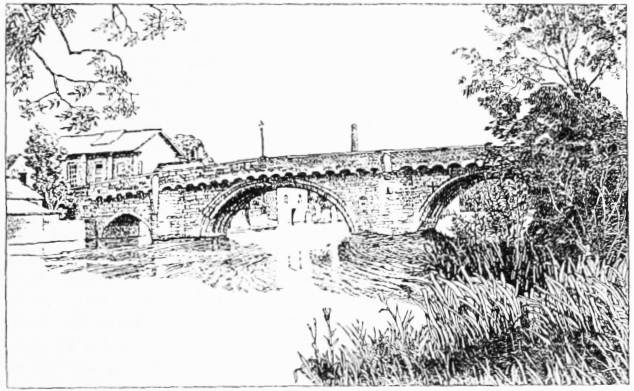
St. Neots: The Bridge
It may be noticed that the greater part of the bridge and the majority of the older houses in the town belong to the 17th century, when St. Neots was at the height of its prosperity in consequence of making the Ouse navigable here.
Immediately to the east of the bridge is the Market Square in the position originally set out in the 12th century, which was paved and fenced in the 16th century. (fn. 14) Around it on the north side are several 17th-century timber-framed houses, inns, and shops, now considerably altered. The Bridge Hotel, built in this century but enlarged at a later date, has a reset plaster panel in the south wall and some earlier plaster work inside. A little to the east is the Cross Keys Hotel, a 17th-century house, refronted in brick in the 18th century. It has two wings extending towards the north and inside is an interesting 18th-century fireplace. The next house on the east side has some stone work in the cellar built with material thought to have come from St. Neots Priory, near by. The Angel Inn contains inside some good plaster work and the Fox and Hounds Inn a good 17th-century staircase. At the east end of the south side are two 17th-century houses, much altered in the next century, and now converted into shops. On the island site at the west end of the Market Place is, at the south-east corner, a house dating back possibly to the 15th century, but much altered in modern times. At another island site, at the east end of the Market Place, is a 17th-century shop, now much altered.
Going south from the east end of the Market Place is South Street, (fn. 15) where on the east side are two early 17th-century houses, now shops, with projecting upper stories. Opposite South Street the modern New Street gives a short cut to Little Paxton and the Huntingdon Road. Eastward from the Market Place is High Street, referred to in 1530. (fn. 16) Here, towards the east end of the south side, are some 17th-century gabled houses, much altered, the easternmost of which is the Dewdrop Inn. At the east end of the High Street four roads meet. Church Street, going south, is apparently called St. Mary's Street in the 13th century and later, (fn. 17) and leads to St. Mary's Church. Huntingdon Street, which bore that name in the 13th century, (fn. 18) was in the 17th century the principal residential quarter of the town. (fn. 19) At the junction of the four streets here probably stood the High Cross referred to in 1540. (fn. 20) Church Street contains one or two 17th-century houses, particularly one on the east side at the corner of East Street, now two shops which must have been an important house when first built. The continuation of Huntingdon Street becomes the road to Great Paxton and Godmanchester. Cambridge Street continues eastward from High Street and becomes the road to Cambridge. It is referred to in the 15th century and has some 17th-century houses on its north side.
Although burgages are mentioned in the 13th and 14th centuries, (fn. 21) the Priory rentals do not show that such tenures were permanently introduced, and no form of self-government was attained by the townsmen. (fn. 22) The officials of the Priory carried on the town government, the chief being the bailiff of the town of St. Neots and the bailiff of the market. (fn. 23) The same officials were appointed by the lay lords of the manor, who succeeded the monks, but the steward, who had been the chief officer of the Priory, seems to have become the steward of the town or manor of St. Neots, rather than the steward of all their lands. (fn. 24) In 1876, the town and parish and part of the parish of Eynesbury were placed under a Local Board, but in 1895 the parish was divided into the urban and rural districts. The urban district, under an Urban District Council, consists of the civil parish of St. Neots, containing 971 acres of land and 25 acres of land covered by water, and the parish of Eynesbury. The rural district contains 2,697 acres and consists of the manor of Monk's Hardwick (q.v.), Wintringham (q.v.) and the Tithe farm, which was awarded to the impropriator, Sir George Smith, bart., at the inclosure of the parish by Act of Parliament in 1770. (fn. 25)
By Letters Patent of 1629 the river Ouse was made navigable by Arnold Spencer, from St. Ives to St. Neots, and thence to four miles from the town of Bedford. (fn. 26) The prosperity of St. Neots was greatly increased, a considerable trade in coal and corn and other commodities being river-borne. (fn. 27) Charles I in 1638 granted Spencer and his heirs the sole right of a ferry and passage in this part of the Ouse. (fn. 28) In 1677 the rights in the ferry had passed to Nathaniel Jemmat and Elizabeth his wife and John Jemmat and Anne his wife, as the right of Elizabeth and Anne, (fn. 29) daughters of Robert son of Arnold Spencer. The Spencers had long settled at St. Neots, where they had by intermarriage inherited the tenements of the Arnolds before the dissolution of the Priory. (fn. 30) In 1680 Nathaniel Jemmat and Elizabeth sold their moiety of the ferry to Henry Ashley, (fn. 31) and in 1694 the other moiety was sold to Charles Perkins. (fn. 32) In 1869 Thomas Nesham Kirkham acquired the whole of the rights from the heirs of the Jemmats and sold them in 1891–2 to Mr. Frank Manley Benddall. In 1893 Benddall conveyed them to Mr. Leonard Taylor Simpson, the present owner.
About 1183, Pope Lucius III granted certain privileges to the Priory on condition that they maintained a hospice for the poor, (fn. 33) and it seems possible that the Alms House mentioned in a rental of 1486 and again in a will of 1540 (fn. 34) had originally been established for this purpose, although it was at the earlier date in the hands of a tenant. (fn. 35) Beside the brewery already mentioned, (fn. 36) there are engineering works, and in 1735 a bell foundry was established on the site of the Priory by Joseph Eyre, who cast the St. Neots bells. (fn. 37) The town-house of St. Neots is mentioned in 1604. (fn. 38)
In 1556, Faucet, priest and schoolmaster of St. Neots, is mentioned (fn. 39) and Francis White, Bishop of Ely, and his brother John (1570–1615), sons of the vicar of St. Neots and Eaton Socon, are said to have been educated at the grammar school at St. Neots. (fn. 40) The school does not seem to have been endowed, and in 1658, the Trustees for the Maintenance of Ministers made a grant of £20 a year for a schoolmaster at St. Neots to be appointed by Lord Montagu. (fn. 41) There is no grammar school at the present day, but in 1760 a boys' school, now a Church of England elementary school, was founded. It has a small endowment.
The Victoria Museum was founded in 1887 and contains natural history collections. A neolithic flint celt and a British bronze axe have been found in the parish. (fn. 42)
At Wintringham Hall, now a farmhouse, there is a fine moat. A smaller inclosure lies to the west which is said to be the site of a chapel. There is still another moat in a field called the Birches to the south of Wintringham Hall. (fn. 43) In 1648 during the Civil War, St. Neots was the scene of a skirmish, in which the royalists under the Duke of Buckingham were defeated. The duke escaped, but several important prisoners, including the Earl of Holland, were taken by the parliamentarians. (fn. 44) The prisoners, to the number of about 120, were put in the church, where it is said the parliamentary soldiers amused themselves by shooting into the roof of the nave. (fn. 45)
Three historians of some note have been connected with St. Neots. The Rev. William Gordon, D.D. (1728–1807) was pastor of an independent congregation there from 1789–1802. Earlier he had been in America and is said to have acted as private secretary to George Washington. In 1788, he published The History of the Rise . . . and . . . Independence of the United States. (fn. 46) The Rev. George Cornelius Gorham (1787–1857) was born at St. Neots and wrote the history of his native place, publishing many documents relating to St. Neots and Eynesbury. More generally he was famous for his connection with the 'Gorham Judgment.' (fn. 47) The Rev. Robert Halley, D.D. (1796–1876) had charge of an independent congregation at St. Neots from 1822–1826. In 1869 he published Lancashire: its Puritanism and Nonconformity. (fn. 48)
The May-day festival still (1931) survives at St. Neots. Two girls go from door to door early in the morning carrying a doll hanging on a hoop decorated with flowers and covered with lace. They sing a song of three verses beginning, 'Remember us poor mayen all | For here we do begin | To lead a life of righteousness | Lest we should die in sin.'
MANORS
In the latter half of the 10th century two hides of land in Eynesbury, which must have been included in the manor of Eynesbury, later called the manor of ST. NEOTS, were granted to the first monastery of St. Neot by the founders, Earl Ælric and his wife Ælfleda. (fn. 50) In the reign of Edward the Confessor the manor was held by Robert son of Wimarc, but after 1066 it came into the hands of Gilbert, the ancestor of the Clares. (fn. 51) In 1086 Rothais, wife of Richard son of Gilbert, held the manor, where the monastery, which she and her husband had refounded as a cell of the Abbey of Bec Harlouin, still had land for three ploughs on her demesne. (fn. 52) In 1113, with the consent of her son, she granted the whole manor to the Priory of St. Neots, (fn. 53) which held it in frankalmoin and in demesne until the Dissolution of the Monasteries. (fn. 54) Her descendants, the Earls of Gloucester and later the Earls of Stafford, retained no rights in the manor but only in the advowson of the priory. (fn. 55) The manor after the Dissolution, with the exception of the site of the priory, (fn. 56) remained in the possession of the crown or of members of the royal family, (fn. 57) until 1620, when James I granted it to Sir Richard Lucy, bart., with free warren and all privileges previously held by the priory. (fn. 58) Sir Richard sold it in 1631 to Sir Sidney Montagu, (fn. 59) whose descendants, the Earls of Sandwich, held until 1902, (fn. 60) when Lord Sandwich sold it to Mr. George Fydell Rowley, D.L., J.P., the present owner.
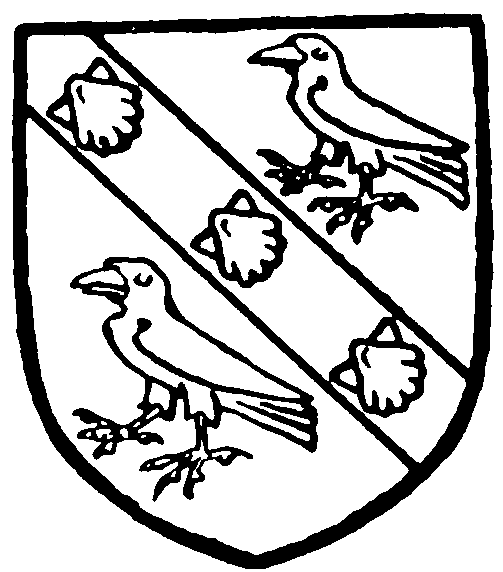
Rowley. Argent a bend sable between two choughs, with three scallops argent on the bend.
The date at which the manor of MONKS HARDWICK was acquired by St. Neots Priory is uncertain. The family of Bret (Brito or le Breton) had lands at Hardwick of which Richard Bret made an exchange with the prior that was confirmed in 1218 by William his son as lands at Monks Hardwick. (fn. 61) We have a reference to the house of Richard Bret on his lands here, and the importance of the existing homestead moat at Monks Hardwick (fn. 62) suggests that it may originally have been the site of this house. We know that William Bret his son lived at Wintringham from the fact that he had his chapel there. (fn. 63) It is possible therefore that the lands exchanged by Richard may have included the site of the original Bret house and that William about 1218 made his residence at Wintringham where, at Wintringham Hall, is another homestead moat. The Prior of St. Neots also acquired lands at Hardwick from the father of William de Augo, who was called upon to warrant his father's gift in 1209. (fn. 64) Monks Hardwick is mentioned as a separate manor early in the 13th century, (fn. 65) and in 1324 the prior had a grange there and held the manor in demesne. (fn. 66) After the dissolution of the priory, the manor and the site of the priory were granted in exchange in 1542 to Sir Richard Williams alias Cromwell. (fn. 67) His younger son Francis (fn. 68) and grandson Henry Cromwell succeeded him, but the latter sold the reversion of the manor and site of the priory in 1600 to Sir Edmund Anderson, kt., Chief Justice of the Common Pleas, (fn. 69) who probably built the house, one wing of which still survives, within the large moat. This house was of half timber plastered, with a tiled roof. The surviving wing has had some modern additions and contains two original fireplaces. Sir Edmund was succeeded in 1605 by his son Sir Francis Anderson (fn. 70) who settled the manor on himself, his second wife Audrey, afterwards Lady Dunsmore, and their heirs male, with reversion to his own heirs male. (fn. 71) She survived both Sir Francis (fn. 72) and their son, Sir John Anderson, bart., who died unmarried in 1630. (fn. 73) The reversion of Monks Hardwick passed to his eldest half-brother Edmund, (fn. 74) who, however, only left a daughter, and on the death of Lady Dunsmore in 1652, it passed to Edmund's younger brother Stephen. (fn. 75) Stephen's son of the same name was created a baronet in 1664 (fn. 76) and his descendants held the manor until 1773 (fn. 77) when a fourth Stephen died without heirs male. (fn. 78) It then passed to Charles Anderson Pelham afterwards Earl of Yarborough, great-grandson of Francis Anderson, a brother of the first Sir Stephen Anderson. (fn. 79) He sold it in 1790 to Owsley Rowley, who built the house called Priory Hill on the estate in 1796. (fn. 80) In 1812, however, he sold the manor of Monks Hardwick to the devisees of Dr. Moss, Bishop of Oxford, whose sister, Harriott, the wife of John King, a commissioner of army accounts, obtained the manor. (fn. 81) She sold it in 1838 to John Holland, from whom it was bought in 1859 by George William Rowley, the son of Owsley Rowley. (fn. 82) The Priory Farm, representing the ancient demesne of the priory, had been retained by Ousley Rowley, (fn. 83) but the site of the priory was transferred, probably in 1812, to the Earl of Sandwich, the lord of St. Neots manor (q.v.). (fn. 84) George Fydell Rowley, D.L., J.P., is now owner of Monks Hardwick manor and of the Priory Farm.
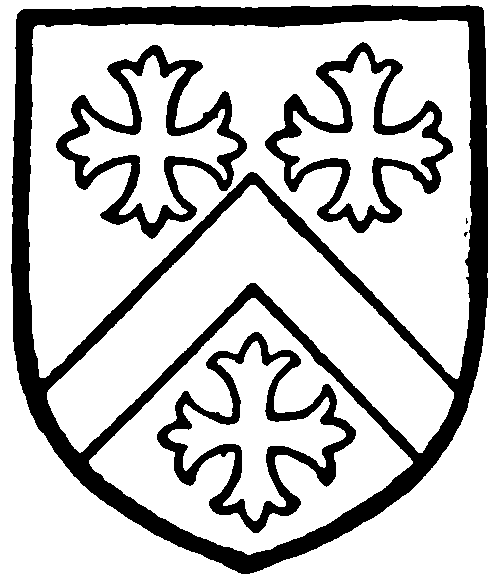
Anderson. Argent a cheveron between three crosses paty sable.
WINTRINGHAM
WINTRINGHAM is a hamlet in the parish of St. Neots. In 1086 William Brito or Bret held two hides and one virgate of land, belonging to the manor of Eynesbury, later granted to the Priory of St. Neots. (fn. 85) In the following century, a Reginald Bret, with his son John's consent, surrendered one hide of land in Wintringham to the Priory, (fn. 86) but before 1154 the rest of the family lands seem to have passed to William, son of Richard Bret, and probably nephew of Reginald. (fn. 87)
We have only disconnected references to the Bret family at Wintringham, which was probably only a large freehold in the manor of St. Neots. William Bret had a chapel there for the use of his family about 1218. (fn. 88) Richard le Bret of Wintringham was holding in 1279 (fn. 89) and was a juror for the perambulation of the county boundary in 1286. (fn. 90) William le Bret of Wintringham occurs in 1295. (fn. 91) Walter le Bret was assessed for subsidy in the parish of St. Neots in 1328, and again in 1332. (fn. 92) In 1375 William son of Walter Bret granted to the priory all the lands and tenements at Wintringham which had been his father's. (fn. 93) It seems possible to identify his holding with a tenement called 'Bryttes-Place,' which was granted for 40 years in 1385 by the priory to Simon Bret and his son John in survivorship. (fn. 94) John Bret was living in 1418, (fn. 95) but the family disappeared from Wintringham before 1486, (fn. 96) though possibly the smaller moated site near Wintringham Hall marks the site of 'Bryttes-Place.' It cannot be traced by name among the farms mentioned in grants of the 16th century. (fn. 97)
A considerable estate in Wintringham, which probably represented the holding of the priory here, was obtained on lease by Robert Payne before 1566. (fn. 98) He and his family played an important part in the history of St. Neots town during the following hundred years. (fn. 99) They seem to have acquired the fee of the whole or part of the estate, and Robert Payne obtained a grant of free warren in his lands in Wintringham in 1616. (fn. 100) The family appears to have lived at Upper Wintringham till about 1672. (fn. 101) It passed later to the Rowley family, and was for some years the residence of Charles Percival Rowley, third son of George William Rowley. Charles P. Rowley died unmarried in 1904, and was succeeded by his nephew, Mr. George Fydell Rowley.
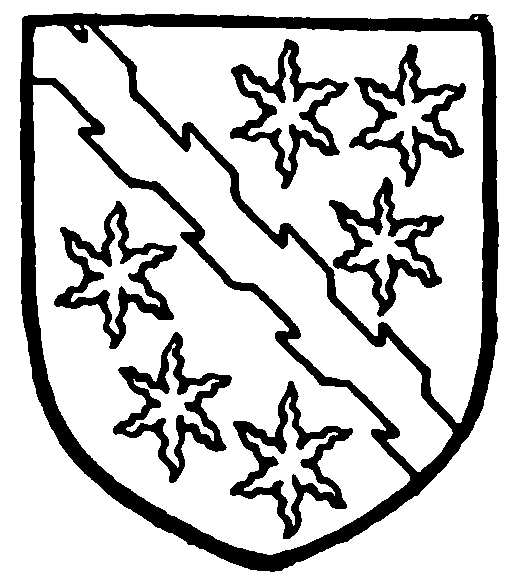
Payne. Azure a ragged bend between six stars or.
The Priory of St. Neots held a view of frankpledge in St. Neots, where the prior had a gallows, tumbrel and pillory. In 1285 he claimed these rights by long seisin and also in virtue of a charter of privileges granted by Henry II to the Abbey of Bec. (fn. 102) After the Dissolution, the view of frankpledge was held by the lords of the manor. (fn. 103)
In 1086, a mill, valued at 23s. a year, was attached to Rothais' manor of Eynesbury. (fn. 104) In 1324, there were three water mills belonging to the priory at St. Neots, (fn. 105) but in 1370 they had been destroyed in a great flood and were of no value. (fn. 106) A horse-mill, however, had been newly repaired. (fn. 107) Before 1439 Prior John Turvey repaired the water-mills of St. Neots, using, it is said, the timber which the contractor for building a new roof in the Lady Chapel of the priory had collected. (fn. 108) The St. Neots mills were let on lease at the time of the Dissolution, but were granted in 1547 to Robert Payne. (fn. 109) In 1604, the water-mills and a malt mill were in the hands of the Paynes. Later the mills passed with the chief manor of St. Neots and were sold by Lord Sandwich about 1803 to Owsley Rowley. They were rebuilt in 1799. In 1804 they were taken by William Fourdrinier, who was the first man to set up machinery for making paper in a continuous web. The firm failed in 1810. Shortly afterwards they were let to the Towgood family for paper mills, who held them till 1888, when they were taken by the St. Neots Paper Mill Co., the present tenants. (fn. 110)
A fishery was attached to the manor of St. Neots or Eynesbury in 1086, (fn. 111) and a several fishery belonged to the priory in 1370. (fn. 112) In 1620, a fishery was granted with the manor of St. Neots to Sir Richard Lucy. (fn. 113)
The Priory of St. Neots claimed to hold a weekly market under a charter of Henry I. (fn. 114) Confirmations of the grant were made by Stephen and Henry II and the Thursday market (fn. 115) was held uninterruptedly by the priory until its dissolution. (fn. 116) The prior appointed a bailiff of the market, and let out the profits and tolls of the market at farm. (fn. 117) The same system was carried out by the later lords of the manor. In 1558 the tolls of the markets were leased to Robert Payne, (fn. 118) and his descendants held the market as lessees of the Earl of Sandwich as late as 1672. (fn. 119) The market is still held on Thursday.
The priory held a fair on the vigil, the feast of St. Neot and the morrow of the feast, under a charter of Henry II. (fn. 120) In 1285 two other fairs were held, for three days at the feast of the Ascension, and for three days at the feast of St. Peter ad Vincula. (fn. 121) The original charters were lost about 1265, when the belfry of the priory church fell down, and in answer to the Quo Warranto inquiry of 1285, the priory could only produce a charter of Henry I, granting the same rights of toll and stallage in the market and fair of St. Neots, as the king held in the markets of his demesnes. (fn. 122)
The fairs passed with the manor after the dissolution of the priory and the tolls and profits were leased with the market (q.v.). (fn. 123) In the 17th century four yearly fairs were held; (fn. 124) in 1792 (fn. 125) and 1822 (fn. 126) there were five fairs, but in 1847 only four. (fn. 127) At the present day there are fairs on Ascension Day, on that day three weeks and a statute fair on a Thursday in September, the exact date being fixed annually.
CHURCH
The Church of ST. MARY consists of a chancel (42½ ft. by 17 ft.), with north chapel (25 ft. by 18 ft.), modern north vestry, south chapel (26 ft. by 17¾ ft.), nave (80 ft. by 21¼ ft.), north aisle (16¼ ft. wide), south aisle (16 ft. wide), west tower (18 ft. by 18 ft.) and north and south porches. The walls are of rubble with stone dressings, but those of the tower and north chapel are of ashlar. The roofs are covered with lead.
The church is not mentioned in the Domesday Survey (1086), but a church appears to have existed about 1183, (fn. 128) although nothing of this early date survives. Parts of the chancel walls are of 13th-century date, and the north vestry is of the 14th century. The rest of the church seems to have been wholly rebuilt in the 15th century, commencing with the south chapel, then the nave with its aisles, clearstory, porches and north chapel, and ending up the west tower, completed about 1535. (fn. 129) The north wall of the north aisle and the west end of the south aisle were restored in the 17th century. In 1843 the north porch, formerly of brick, was rebuilt in stone; in 1846–8, the church was generally restored, the floors lowered and new seats and pulpit put in; in 1855–6 the east wall of the chancel was faced with ashlar and the window renewed; and in 1860 the chancel seats were made. (fn. 130) In 1880 the pinnacles of the tower were renewed. In 1883–5 the sanctus bell-cote was restored and the vestry enlarged. In 1901 the chancel roof was completely restored.
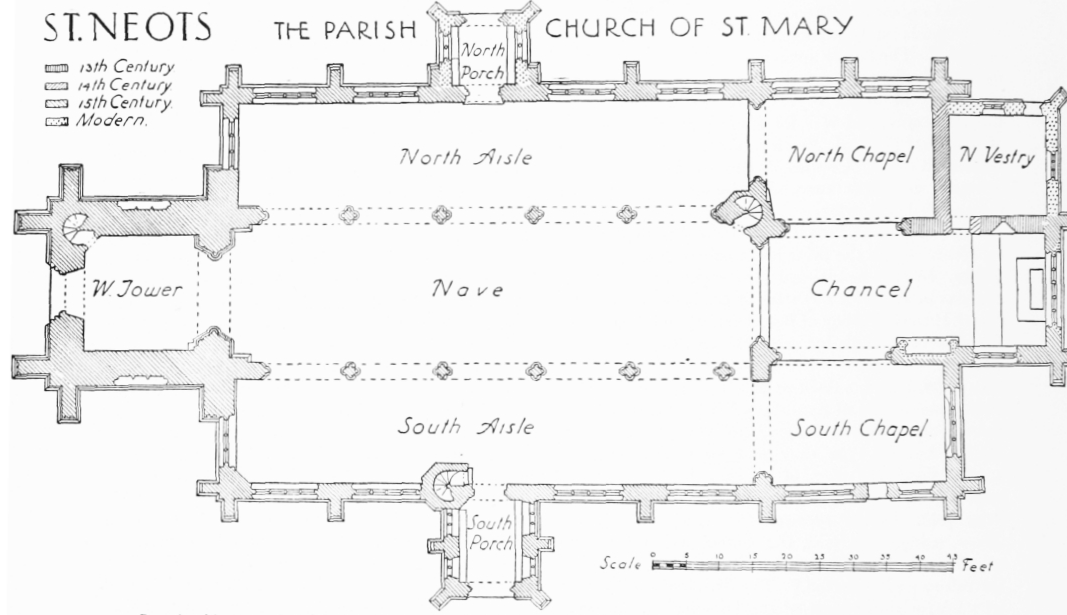
ST. NEOTS THE PARISH CHURCH OF ST. MARY
Reproduced by permission of the Controller of H.M. Stationery Office from the Royal Commission on Historical Monuments, Hunts.
Except where otherwise stated, all the features are of the 15th century.
The chancel has a modern five-light east window. In the north wall is a blocked 13th-century lancet window with traces of colour on the inner jambs, a reset 14th-century doorway to the vestry and a 15th-century arch to the chapel. In the south wall is a three-light window and an arch to the chapel; between them is a large modern monument with effigies, elaborate canopy and wrought-iron grille to George William Rowley, d. 1878, and Jane Catherine (Mein) his wife, d. 1886. High up, at the western end of this wall, is a square opening into the roof of the chapel. The chancel arch is of two moulded orders resting on attached shafts with moulded capitals and bases. Under the two side arches are late 15th-century oak parclose screens, much restored and with modern metal crestings. The 15th-century roof, much restored, is of low pitch with heavy tie-beams having curved braces and carved figures on the jacklegs; the oak ceiling is panelled and has carved bosses.
The north chapel or Jesus Chapel (fn. 131) has a three-light east window above the vestry roof, and in the north wall are two four-light windows. The buttresses have crocketed gablets and shields with I.H.C. The arch to the aisle is of two moulded orders resting on engaged shafts, and below it is an oak screen, c. 1500, with considerable Renaissance feeling in the tracery. The roof has moulded timbers and carved braces, demi-angels on the cornices holding shields with I.H.C. and crowned angels at the feet of the intermediate principals. Built into the east wall is a fragment of an early 16th-century monument having a shield bearing a crown and part of an inscription 'FOR: THE: SOV---.'
The south chapel or chapel of Our Lady (fn. 132) has a four-light window in the east wall. In the south wall is a similar four-light window, a two-light window and a small doorway. The arch to the aisle is similar to that of the north chapel, but rests on the south on a semi-octagonal respond, and on the north it dies into the wall; under it is a late 15th-century oak screen. The roof is generally similar to that on the north, but the carving includes an angel with a fleur-de-lis, the emblem of Our Lady, and the cornice has an elephant, camel, unicorn, etc.
The nave has an arcade of five bays on each side, having arches of two moulded orders resting on columns composed of four engaged shafts with hollows between them, and with moulded capitals and bases; they have moulded labels terminating in carved bosses, from each of which a triple shaft is carried up to support the jacklegs of the roof. At the east end of the north arcade is the rood staircase with lower and upper doorways intact. (fn. 133) At the corresponding end of the south arcade is a small portion of a sixth arch dying into the east wall, and above it is a doorway on to the aisle roof. The clearstory has five three-light windows on each side; and on the east gable is a much-restored sanctus bell-cote. The low-pitched oak roof has moulded beams carved with angels holding shields, books, etc., and curved braces with tracery in the spandrels and angels with outstretched wings at the feet of the intermediate principals. There is a deep cornice carved with lions, griffins, camels, dogs, harts, etc.
The north aisle has four four-light windows in the north wall and a three-light in the west. The north wall has also a doorway with four-centred arch in a square head with traceried spandrels and a small niche with projecting head. The pent-roof is generally similar to that of the nave, but was repaired in the 17th century.
The south aisle is similar to the north, but there is no niche. On the west side of the doorway is a small turret-staircase to the room over the porch. The western window on the south has a little contemporary glass including a shield of the See of Canterbury.
The west tower is of three stages, divided by bands of panelling. The tower arch is of three orders, the lowest resting on attached shafts with moulded capitals and bases, below which is a modern oak screen (1918). The west doorway has a four-centred arch under a square head with traceried spandrels; above it is a four-light window with panelled central mullion and a transom. The side walls have each a blind window of three lights. In the next stage there is a two-light window in each face. The belfry windows are coupled two-lights with transoms and crocketed ogee labels. Above these windows is a band of panelling, and the tower is finished with an embattled parapet, the central merlon on each side being finished with three small pinnacles. The buttresses stand square at the angles, are panelled on the face and are continued up as square pinnacles finished with a group of one large and four small crocketed pinnacles.
Within the church, at the springing of the tower arch, is a nearly erased inscription '. . . Wm. Corbit . . . . Church [wardens] A [nno] Dom. 1691.'
The modern north porch has a four-centred archway under a square head with traceried spandrels. There is a two-light window in each of the side walls. Although rebuilt in 1844 much of the material is ancient.
The south porch has a similar outer archway to that on the north; but the side walls have each two windows. Above this porch is a room known as Dove's Chamber; it has a three-light window in the south wall which contains two panels of 15th-century glass with figures of St. Stephen and St. Lawrence, tabernacle work, etc. The roof has moulded tie-beams and curved braces and is painted in black and white. There is a small collection of theological books.
The 13th-century font has a heavy irregular octagonal bowl standing on a short circular stem.
There are eight bells, inscribed: (1) Grata sit arguta resonans campanula voce. Recast 1919. (2) On the old second, Johannes est nomen meum. Recast 1919. (3) I. H. S Nazarenus Rex Judaeorum fili Dei miserere mei. Recast 1919. (4) Cum ego vocem, mortales mentem attolant Deo. Recast 1919. (5) Ut nos sic homines inter se conveniant. Recast 1919. (6) Omnia fiant ad gloriam Dei. Bells nos. 1 to no. 7 were cast by J. Eayre, 1753, and recast by John and Denison Taylor 1919. Thomas Hodgson, Vicar, and Archdeacon of Huntingdon. Alfred Jordan, Fred. H. Fisher, Churchwardens. (7) Stephen Scarbrow, Churchwarden. In memory of Richard Corker Meade, D.D., Vicar of this Parish 1875–1902. Jesu, Mercy. Recast 1919. (8) William Day and William Peppercorn, Churchwardens. William Dobson, Founder, Downham, Norfolk, 1832. Pacem mortuis lente — Laetius pransuris pacem solus sono — Pacem universis omnes sonamus — In piam memoriam Emily Anne Day Haec campana restaurata est. A.S. MCMXIX, Sumptibus Frank Day. Recast 1919. The seven smaller bells, recast by J. Eayre, mostly bore his name and the date August 28th, 1753; the eighth bell was also recast by him in 1764, but was again recast by Dobson with the date July 23rd, 1832. They were all rehung in 1896. (fn. 134) In 1919 they were again recast and rehung in a steel frame by Taylor and Sons of Loughborough.
In the chancel are two groups of three 15th-century oak stalls; three of the stalls have shields bearing a cross flory, and the inscription 'Jesu merci.' They were brought from Milton Ernest in 1848.
There are two matrices of brasses: (1) in the north chapel, with floriated cross and marginal inscription, ' ✠ Johane. la. Gousle. gist. ici. prie. pur. le. alme. de. luy. Ky. pur. lalme. de. luy. priera. cent. jours. de. pardoun. avera.' (fn. 135) (2) Under tower arch, three figures with inscription plate and four roundels. (fn. 136)
There is a very fine early 17th-century Communion Table, with bulbous turned legs and arabesque ornament and masks on the rails; and a 16th-century chest in Dove's Chamber. (fn. 137)
On the lead roof of the nave is a cast inscription, '1633. R.P. R.R. G.H. W.A.' and a scratched inscription '1674. Scroope & Tyrwitt.'
There are the following monuments: In the chancel, to Owsley Rowley, d. 1824, and Anne his wife, d. 1835; Francis Day, d. 1863; Emily Anne, his widow; Ross, his son, d. 1865; and Frank Day, d. 1919; George William Rowley, d. 1878; and Jane Catherine (Mein), his wife, d. 1886; the Rev. Richard Corker Meade, Vicar, d. 1902; and the Ven. Thomas Hodgson, Vicar, and Archdeacon of Huntingdon, d. 1921; and glass windows to David Rowley, d. 1855. In the north chapel, to Stephen Gorham, d. 1789; Martha, his wife, d. 1766; and four children of George James and Mary Gorham; George James Gorham, d. 1840, and Mary (Greame) his wife, d. 1837, and Elizabeth, his daughter, d. 1824; floor slab to Stephen Scarbrow, d. 1781, and . . . his wife, d. 1789; and a defaced slab with a shield of arms; (fn. 138) and windows to George Dawson Rowley, d. 1878; and Caroline Frances (Lindsay), his widow, d. 1900. In the south chapel, to William Alexander Peppercorn, d. 1833, and Sarah his wife, d. 1824, and George Alexander Peppercorn, d. 1853; Nevile Day, d. 1839, and two infants; John Burder, d. 1841, and Susannah his relict, d. 1848; Robert Day, d. 1844, and infant son; William Day, d. 1854, and Elizabeth his wife, d. 1855; Captain Rudolph Meade Smythe, d. 1915; floor slab to Loftus Hatley, d. 1757, and Susannah his wife, d. 1769; Richard Hatley, d. 1789, and Frances his relict, wife of John Bonus Child, d. 1825; and window to the Rev. Charles Hale Collier, Vicar, d. 1886. In the nave, War Memorial to First Highland Brigade, R.F.A., 1914–18; floor slabs to Laurence Thompson, d. 1724, and Elizabeth (Dorman) his first wife, d. 1705; William Fowler, d. . . .; William Fowler, d. 1802; Sarah, wife of William Fowler, d. 1795; George Fowler, d. 1811; and Sarah Fowler, d. 1810. In the north aisle, windows to Dr. Joseph Rix and Helena Percy his wife, 1879; and to the Rev. George Bowes Watson, Vicar 1866–1875, d. 1890. In the south aisle, War Memorials to South African War and the Great War; and windows to William Day and Elizabeth his wife, 1870; and Samuel Alvey, M.D., and Sarah his wife (n.d.). In the tower, to Thomas Cotton, d. 1793; Ann wife of Adam Love, d. 1806; and Adam Love, d. 1825; Catherine Chapman, d. 1802; Elizabeth (Russell), relict of Richard Chapman, d. 1822; Henrietta Bewsher, d. 1846, and Harriet Augusta Bewsher, d. 1869; William Noble Bewsher, d. 1883; and floor slab to John Bailey, d. 1745. In south porch, to John Smith, junior, d. 1745, and Letitia his infant, d. 1744; Jane relict of Robert Pattison, d. 1803. On a buttress of the south aisle, west of the porch, is an incised inscription to William Heath, 1676. (fn. 139)
The registers are as follows: (i) Baptisms, marriages and burials, April 1691 to 23 March 1720–1, in very bad condition; (fn. 140) (ii) Ditto, 29 March 1721 to 26 Dec. 1761; marriages end 7 Jan. 1754; (iii) baptisms and burials, 1 Jan. 1762 to 26 Dec. 1812; (iv) the official marriage book, 16 April 1754 to 17 May 1780; (v) Ditto, 6 June 1780, to 22 Dec. 1812.
The church plate consists of: A silver chalice engraved 'My blood is drink indeed,' inscribed on base, 'St. Neots Church, 1884, R. C. Meade, B.D., Vicar,' with Sheffield hall-mark for 1883–4; a silver chalice with gilt panels on stem of the Crucifixion, the Ascension, and the Blessed Virgin and Child, inscribed on base, 'St. Neots Church. In Memoriam. June 10, 1896,' hall-marked for 1894–5; a silver standing paten, inscribed '✠ The Gift of Mrs. Sarah Vaughan by I.W. gent. her Executor, for ye use of ye Church of St. Neots in ye County of Huntingdon, 1754.' hall-marked for 1754–5; silver salver, similarly inscribed and hall-marked; a silver flagon, similarly inscribed and hall-marked; a silver standing paten, inscribed 'Ex Dono Laurentij Thompson, nuper de Drayton Agro Salopiensi gen: ecclesiae Sti. Neoti Com. Hunt,' with Sheffield hall-mark for 1883–4; (fn. 141) a silver pocket set: chalice engraved 'My blood is drink indeed,' and paten engraved 'My flesh is meat indeed,' and two cruets; hall-marked for 1869–7; on the box, 'To the Glory of God and as a memorial of the St. Neots Lent Mission, 1868. This Service for the Communion of the sick is offered for the use of the Parish of St. Neots by the Clergy of fifteen parishes in which the services of the mission were held'; a small plated box, inscribed 'St. Neots Church, 8th October, 1902. S. St. A. Baylee, M.A., Vicar'; a small plated spoon.
ADVOWSON
In 1086, both portions of Eynesbury and its dependency at Caldecote were served by one church, which was attached to the manor of Countess Judith. (fn. 142) Her son-in-law, Simon de St. Liz, Earl of Huntingdon, with his wife's consent, gave the church of Eynesbury to the refounded Priory of St. Neots before 1111. (fn. 143) Two years later, as has been recorded, one of the Eynesbury manors was given to the Priory, and the town grew in importance, but no parochial division seems to have taken place till the close of the century. Pope Lucius III (1181–85) granted to the monks the right of appropriating the churches in their lands to the use of the Priory and appointing vicars, and in consequence, about 1183, the 'church of St. Mary of St. Neots' was appropriated, (fn. 144) but it is not certain whether a second church had actually been built as yet. The name, St. Neots, might possibly have been applied to a parochial altar in the nave of St. Neots Priory, and in a bull of confirmation by Pope Celestine III in 1194 only the church of Eynesbury is mentioned. (fn. 145) In any case the church had been built by the time of Prior Roger (1218–23). (fn. 146) The grant of appropriation in 1183 probably brought the monks into conflict with the de Quincys, lords of the manor of Eynesbury, the rectors of Eynesbury and the Priory of Newenham, who held a pension from the rectory. (fn. 147) Saher de Quincy, Earl of Winchester, inherited the manor soon after 1200, (fn. 148) and in 1204 an agreement was reached, by which the two parts of the parish were finally separated. The Earl of Winchester recovered the right of presentation to the church of Eynesbury, to which was assigned half the tithes of corn in the parish. To the new parish of St. Neots was assigned the other half of the tithes, while the monks were to retain the tithes of corn from the third part of the earl's demesne lands at Eynesbury, which they had had by an earlier donation. (fn. 149) The priory held the rectory till the Dissolution. (fn. 150) In 1566, Elizabeth granted the reversion of the rectory then held by Thomas Tonney to Edward, Lord Clinton and Saye, (fn. 151) but the grant seems to have been surrendered, since in 1601 she granted it to John Tonney. (fn. 152) In 1608 John Shotbolt and his wife Jane, probably the heir of John Tonney, sold it to Sir John Boteler, kt. (fn. 153) but before 1627 it had come into the possession of Sir Richard Grubham, kt., (fn. 154) who died seised of the rectory in 1629. (fn. 155) His heir was his brother John, whose son George, on whom the reversion had been settled, seems to have died without male heirs. (fn. 156) The rectory passed to the descendants of Sir Richard Grubham's sister Jane, the wife of John Howe. (fn. 157) Mary, daughter and heiress of William Howe, married George Smith of East Stoke, Notts, who was created a baronet in 1757. (fn. 158) Her son took the name of Bromley, and her grandson, Admiral Sir Robert Howe Bromley, was the impropriator in 1824. (fn. 159) The rectory passed into the hands of the Rowley family before 1885, and Mr. George Fydell Rowley is now the impropriator.
The church of St. Neots was first served by chaplains, whose names frequently appear as witnesses to charters in favour of the priory. (fn. 160) The vicarage, however, was instituted by 1238 or 1239, when Alan, one of these chaplains, was presented to it. (fn. 161) The priory held the advowson of the vicarage till the Dissolution; (fn. 162) Edward VI granted it with the manor of St. Neots (q.v.) to Elizabeth, (fn. 163) but from her accession it remained in the Crown (fn. 164) until it was bought by George William Rowley about 1850. Mr. George Fydell Rowley is the present patron of the living. In 1566 and 1587 a yearly pension of £7, payable to the vicar out of the rectory, was mentioned when the latter was alienated from the Crown. (fn. 165) The small tithes were also assigned to the vicar. (fn. 166)
The Guild or Fraternity of Jesus existed at St. Neots during the 15th and early 16th centuries. It consisted of a president, wardens and brethren, who probably built and used the Jesus chapel on the north side of the chancel of the parish church. Various townspeople left property to the Guild by will. (fn. 167) At the Dissolution of the Chantries the lands of the Guild were concealed, until 1552, when the matter was reported by Robert Payne. The rents from tenements in St. Neots and Great Paxton amounted to 51s. 6d. a year, less a rent of 12s. 3½d. due to Princess Elizabeth as lady of the manor. They were leased to George Cotton and Thomas Reve. (fn. 168)
A chapel at Wintringham on the land of the Brito family existed in the 13th century. About 1218 William Brito, by permission of Prior Roger, established a chantry in the chapel to be served by the chaplains of the parish church of St. Neots for the benefit of his family. (fn. 169) It seems to have stood in an enclosure on Wintringham Green, but had probably fallen into decay before the Dissolution of the Monasteries. (fn. 170) Queen Elizabeth leased various lands in Wintringham in 1566 to Robert Payne, including the Chapel yard. (fn. 171) He also obtained the 'Churches' farm (fn. 172) there, and it is possible that this originally formed the endowment of the Chapel.
There are in the town a Wesleyan chapel, established about 1794, as well as two Baptist chapels and a Congregationalist chapel built in 1831, and apparently rebuilt in 1888.
CHARITIES
William Luff Anderson, by will proved in the Principal Registry, 17 March 1875, gave to the churchwardens a sum of £100, the interest to be distributed in coals to old widows of the parish. The endowment now consists of £105 19s. 2d. 2½ per cent. Consols, held by the Official Trustees, producing £2 13s. yearly in dividends, which are distributed by the vicar and churchwardens in coals to old widows.
Chatteris' Charity.
The origin of this charity is unknown. The endowment consists of £100 2½ per cent. Consols, held by the Official Trustees, producing £2 10s. yearly in dividends, which are applied in augmenting the salary of the organist of the parish church.
The Emily Anne Day Trust was founded by a Declaration of Trust dated 8 July, 1912, and consisted of a gift of £500 to the vicar and churchwardens of St. Neots, the interest to be applied towards the repair of the fabric of the parish church or, if not required for this purpose, to accumulate so as to form an extraordinary repair fund. The endowment now consists of £669 19s. 2½ per cent. Consols, held by the Official Trustees, and £79 4s. 7d. 5 per cent. War Stock, the whole producing £20 14s. 2d. annually in dividends, which are being accumulated.
John Dryden, by will dated in 1707, bequeathed £100, which was laid out in the purchase of lands in Eaton Socon. The lands have since been sold, and the endowment now consists of £195 7s. 6d. 2½ per cent. Consols and £457 5s. 4d. 5 per cent. War Stock with the Official Trustees, producing £27 15s. annually in dividends, which are distributed by the vicar and churchwardens to the poor in bread.
Joseph Eayre, by will dated 26 May, 1772, gave the minister and churchwardens £100, the interest to be applied for the benefit of the poor. The endowment now consists of £107 15s. 6d. India 3 per cent. Stock, held by the Official Trustees, producing £3 4s. 8d. yearly in dividends, which are distributed by the vicar and churchwardens among the poor of the parish.
The Rev. John Green Trust was founded by a Declaration of Trust dated 24 July, 1911, and consisted of a gift to the vicar for the upkeep of the graveyard of the parish church, with special attention to that part in which is situate the tomb of the Rev. John Green. The endowment now consists of £25 2½ per cent. Consols, held by the Official Trustees, producing 12s. 4d. annually in dividends, which are applied by the vicar and churchwardens in accordance with the directions contained in the Declaration of Trust.
John Holland, by will proved in the Principal Registry 24 September, 1891, gave the sum of £500, the interest to be distributed in coals and bread to the poor. The endowment now consists of £524 18s. 8d. 2½ per cent. Consols, held by the Official Trustees, producing £13 2s. 4d. yearly in dividends, which are applied by the vicar and churchwardens for the benefit of the poor.
Hugh Wye, by will dated 14 March, 1648, bequeathed £40, which was laid out in the purchase of land in St. Neots, in lieu of which an allotment of 2 a. and 26 pls. was set out on an enclosure award. The land was sold in 1919 under the authority of the Charity Commissioners, and the proceeds invested in the purchase of £342 13s. 9d. 5 per cent. War Stock in the name of the Official Trustees. The income, amounting to £17 2s. 8d. yearly in dividends, is distributed by the vicar and churchwardens among the poor and poor widows in coals and bread.
The Workhouse Charity. The endowment of this charity consists of £329 2s. 2d. 2½ per cent. Consols, held by the Official Trustees, representing the investment of the proceeds of the sale of the Old Workhouse. The income, amounting to £8 4s. 4d. annually in dividends, is distributed by the vicar and churchwardens in doles to widows and widowers.
William Medland, by will proved 2 January, 1873, gave to the vicar and churchwardens a sum now represented by £900 Consols, held by the Official Trustees for the benefit of the poor of the parish. The income, amounting to £22 10s. annually in dividends, is distributed by the vicar and churchwardens in coals to the poor.
Mary Musgrave, by will proved in the Prerogative Court of Canterbury 12 October, 1854, bequeathed £100 for investment, the interest to be distributed in coals to the poor. The endowment now consists of £109 17s. 10d. 2½ per cent. Consols, held by the Official Trustees, producing £2 14s. 8d. annually in dividends, which are distributed by the vicar and churchwardens in money and coals to the poor of the parish.
Elizabeth Smith, by will proved in the Prerogative Court of Canterbury 3 July, 1835, gave £100 for investment, the interest to be applied in paying £1 1s. to the resident minister who should perform the morning service in the parish church on New Year's Day, and the residue distributed in bread to the poor. The endowment now consists of £99 11s. 9d. 2½ per cent. Consols, held by the Official Trustees, producing £2 9s. 8d. yearly in dividends, which are applied by the vicar and churchwardens in accordance with the directions contained in the will of the donor.
Bell Rope Charity. An account of this charity is given under the parish of Eynesbury.
Joan Cromwell, by will dated in July, 1620, gave £2 yearly to the poor, payable out of her close in the parish called the Whinnel. The rent charge issuing out of the Whinnels, now in the occupation of Mr. G. F. Rowley, is regularly paid and distributed by the vicar and churchwardens to the poor of the parish.
Charles Percival Rowley, by will proved in the Principal Registry 16 November 1904, bequeathed to the vicar and the owner of Priory Estate the sum of £1,000 for investment, the interest to be applied as to £5 for the annual insurance against fire and tempest of the stained glass windows of St. Neots Church, and the remainder towards the stipend of a curate to assist in the services and other duties of the said church.
The same donor, by will as above, gave to the same trustees a further sum of £1,000 to invest and distribute the income among the deserving poor of the parish. The total sum of £2,000 was invested in the purchase of £1,951 3s. 6d. Brighton Corporation 3½ per cent. Stock and forms the endowment of the charities. The total income, amounting to £68 5s. 8d. annually in dividends, is applied by the vicar and churchwardens in accordance with the directions contained in the will.