A History of the County of Buckingham: Volume 3. Originally published by Victoria County History, London, 1925.
This free content was digitised by double rekeying. All rights reserved.
'Parishes: Hughenden', in A History of the County of Buckingham: Volume 3, ed. William Page (London, 1925), British History Online https://www.british-history.ac.uk/vch/bucks/vol3/pp57-62 [accessed 30 April 2025].
'Parishes: Hughenden', in A History of the County of Buckingham: Volume 3. Edited by William Page (London, 1925), British History Online, accessed April 30, 2025, https://www.british-history.ac.uk/vch/bucks/vol3/pp57-62.
"Parishes: Hughenden". A History of the County of Buckingham: Volume 3. Ed. William Page (London, 1925), British History Online. Web. 30 April 2025. https://www.british-history.ac.uk/vch/bucks/vol3/pp57-62.
In this section
HUGHENDEN
Huchedene (xi cent.); Hugendene (xiv cent.); Hitchenden (xvii, xviii cent.).
Hughenden, formerly often called Hitchenden, (fn. 1) is a hilly parish 5 miles in length and 3½ miles in width lying in the hundred of Desborough except that part of it called the Liberty of Brand's Fee, which is in Aylesbury Hundred. It covers an area of nearly 5,828 acres, including 3,336 acres of arable land, 1,532 acres of permanent grass and 611 acres of woods and plantations. (fn. 2) The slope of the land is very irregular. The chalk hills are often between 500 ft. and 600 ft. above ordnance datum and reach their maximum height (644 ft.) at Denner Hill near the northern boundary separating this parish from that of Great Hampden. Deep valleys wind round these hills, but the surface of the land is never lower than 265 ft. above ordnance datum in the extreme south of the parish. The soil is chiefly gravel, the subsoil chalk. Wheat and barley form the principal crops. There is no village in Hughenden, but scattered along a winding road leading from High Wycombe to Great Missenden are the hamlets of Four Ashes, Great Kingshill and the village and ecclesiastical parish of Prestwood formed 9 April 1852 out of Hughenden, Great Missenden and a detached portion of Stoke Mandeville. Naphill hamlet is in the west of the parish, and Widmer End in the east is now comprised in Hazlemere parish.
Hatches Farm, in Great Kingshill, Great Moseley Farm at Naphill, and Coombs Farm, on the north side of the road leading east from Naphill, are all 17th-century houses, with later additions and alterations, but retaining much of the original work. The church stands on the north side of the grounds of Hughenden Manor, in the southern part of the parish, and to the south-west of it there is a range of early 17th-century almshouses given to the parish by the Dormers. An inscription on the building records that Ellen Countess Conyngham (d. 1816) left a legacy for repairing the houses. They have been a good deal restored and altered in modern times.
The manor-house stands on a hill in the south of the parish. It is a square building with two wings, of which only a small part is ancient, and commands from its south front a fine view of the town of High Wycombe, 2 miles distant. The carriage drive to the north front winds through a well-timbered and undulating park watered by a trout-stream. A mill at one time stood on this stream by Old Ford Lane, and the head-water surrounding a small island fills up when there is sufficient water in it. (fn. 3) Hughenden Manor, which was formerly the seat of Benjamin Disraeli Earl of Beaconsfield, is now the property and residence of his nephew Mr. Coningsby Ralph Disraeli. The path down-hill to the northeast of the manor-house leads past the vicarage to the churchyard and church. Church Farm lies to the north-east of the church, and threequarters of a mile further on is Brands House, the seat of Mr. Samuel Newman, who is also the owner of Rockhalls Farm to the east of Brands House. At the end of the 18th century the old moated mansion locally known as Rockhalls still retained traces of former grandeur. (fn. 4) It was replaced by the present farm-house in the early 19th century, (fn. 5) when five stone shields from the old house bearing the arms of Montfort and Wellesbourne inaccurately charged were rebuilt into the walls.
The name of Widmer, a family who lived at Rockhalls in the 17th and 18th centuries, survives in the small hamlet of Widmer End with Widmer End and Widmer Farms, half a mile to the north-east. In this part of Hughenden are also Hazlemere Lodge, the seat of Mrs. Leadbetter, and Uplands, the property and residence of Mr. T. Somers Cocks. About the centre of the parish is the hamlet of Cryer's Hill with its farm and plantation. Here are also a school and Methodist chapel. Half a mile north-east of Cryer's Hill is the hamlet of Great Kingshill, which before the middle of the 19th century was an open common. (fn. 6) Part of it in 1852 was included in the ecclesiastical parish of Prestwood. (fn. 7) The hamlet of Naphill, 2½ miles to the north-west of Hughenden Church, has a mission hall and school and a Primitive Methodist chapel built in 1851. A reference to Moseley Farm occurs in 1616, when it was the property of Richard Clarke, (fn. 8) a name found in Hughenden in the 15th century. (fn. 9) Naphill Common extends into the neighbouring parish of West Wycombe. Bricks are made at Walter's Ash in the extreme west of the parish. A finely-grained building stone has been quarried here for some time (fn. 10) and is extensively used for channelling. Large quantities were used in refacing the Round Tower at Windsor. To the north-east of Walter's Ash beyond Courn's Wood is the hamlet of North Dean, once the property of Sir William Lawrence Young, bart., and formerly the residence of the Young family. Half a mile further in the same direction are Piggott's Farm and Wood belonging to the Earl of Buckinghamshire.
Hughenden is inseparably connected with the memory of the great Victorian statesman, Benjamin Disraeli Earl of Beaconsfield, who made the manor his home during the greater part of his Parliamentary career, and on his death in 1881 was buried in the church by the side of his wife at his express desire. (fn. 11) In 1826 an urn containing silver and copper coins, a flint arch supported by side walls and other Roman remains and a battle-axe of later origin were found in this parish near Hazlemere turnpike gate. (fn. 12) A vase, probably Roman, was also discovered during excavations at Hughenden Vicarage in 1883. (fn. 13) Some portions of Hughenden parish were inclosed in 1856. (fn. 14)
The following place-names have been found: Bossemede, Colverhouse, Cornewalestondes, Prioreslymore and an osiery called Hallebushes (fn. 15) (xv cent.); Curtismede and Hugynersfield (fn. 16) (early xvi cent.); Knife's Lane, which still survives at Great Kingshill (fn. 17) (xvii cent.); Deadman-Danes Bottom, (fn. 18) Upper and Lower Mill Field and Mill Field Grove (fn. 19) (xix cent.); Theeds Wood (xx cent.).
MANORS
In 1086 HUGHENDEN MANOR, formerly part of Queen Edith's lands, was held by William son of Oger of the Bishop of Bayeux and was assessed at 10 hides. (fn. 20) After his forfeiture it was held of the Crown, (fn. 21) presumably of the honour of Wallingford. (fn. 22)
Henry I bestowed Hughenden Manor on his lord chamberlain and treasurer, Geoffrey de Clinton. (fn. 23) He in the third of his extant charters granted it with the consent and at the request of his tenant Geoffrey de Sancto Roerio to the priory which he had founded at Kenilworth (fn. 24) in 1122. (fn. 25) The gift was confirmed by Henry I (fn. 26) and Henry II, (fn. 27) and in 1250 by Henry III. (fn. 28) The Hughendens, descendants of Geoffrey de Sancto Roerio, held the manor of the priory. Geoffrey's grandson Nicholas de Hughenden (fn. 29) early in the reign of Henry II gave the church to Kenilworth Priory (see advowson). Ralph de Hughenden dealt with lands here in 1194 (fn. 30) and 1202, (fn. 31) and later mortgaged the manor to the Jews. (fn. 32) By arrangement with Ralph the Prior of Kenilworth in 1206 redeemed the mortgage, receiving in return a quitclaim from Ralph of the reversion of land which his mother Denise held in dower and an increase in the yearly rent. (fn. 33) Simon son of Ralph de Hughenden succeeded in 1216. (fn. 34) In 1223 Simon son of Robert Blund successfully sued Simon de Hughenden for reinstatement under a lease for twenty-one years made to his father in 1213, (fn. 35) and set aside on the ground of disloyalty during the war. Simon son of Simon de Hughenden is named in connexion with Hughenden in 1250. (fn. 36) Geoffrey de Hughenden was holding in 1308 (fn. 37) and Nicholas de Hughenden in 1341, after which date no further reference to this family has been found. (fn. 38) At the surrender of the priory in 1538 (fn. 39) the manor escheated to the Crown and was granted in the following year to Sir Robert Dormer, (fn. 40) whose father William Dormer owned some property in Hughenden before his death in 1506. (fn. 41) Hughenden Manor follows the same descent in his family as that of Wing (q.v.) until 1737, (fn. 42) when it was sold by Philip Earl of Chesterfield (fn. 43) to Charles Savage. (fn. 44) He died in 1763, (fn. 45) and his brother and successor Samuel Savage (fn. 46) in 1771. (fn. 47) Hughenden Manor passed to their nephew John Norris, (fn. 48) sheriff for the county in 1775, (fn. 49) and on his death in 1786 (fn. 50) to his cousin Ellen Countess Conyngham, (fn. 51) in accordance with the will of their uncle Charles Savage. (fn. 52) She was succeeded in 1816 (fn. 53) by a relative, John Norris, distinguished in his day as an antiquary and scholar. (fn. 54) He died in 1845, (fn. 55) and Hughenden Manor was purchased from his executors by Isaac D'Israeli of Bradenham Manor about a year before his death in 1848. (fn. 56) He was succeeded by his son Benjamin, who in 1876 was created Viscount Hughenden of Hughenden and Earl of Beaconsfield. (fn. 57) On his death in 1881 (fn. 58) the manor passed to his nephew Mr. Coningsby Disraeli, who is the present owner.
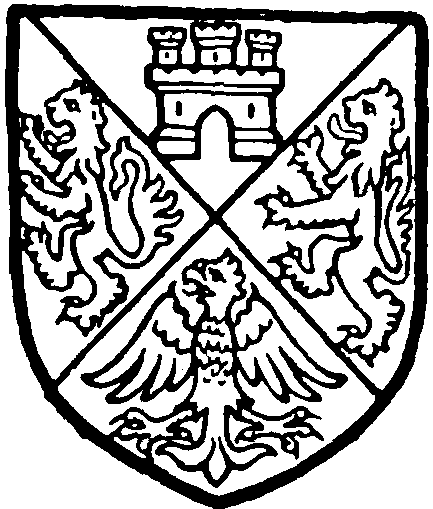
Disraeli, Earl of Beaconsfield. Party saltirewise gules and argent with a castle argent in the chief an eagle or in the foot and two lions sable in the flanks.
The Priors of Kenilworth had the right of holding the view of frankpledge in Hughenden before 1254. (fn. 59) The right of free warren was also granted them in 1388. (fn. 60) All rights which they had formerly held in Hughenden were included in the grant of the manor in 1539 to Sir Robert Dormer. (fn. 61) The last enumeration of them that has been found occurs in 1794. (fn. 62)
A water-mill in Hughenden is named in 1279. (fn. 63) It was then held by Adam de la Penne, previously by Walter Bluet, (fn. 64) son of Simon Bluet of Hughenden. (fn. 65) No later reference to it has been found.
The so-called manor of OVERHALL or EVERHALL appears in Hughenden in the early 16th century as the property of John Colet (fn. 66) and his wife Cicely, who conveyed it in 1505 to Robert Belson and his heirs. (fn. 67) His nephew Augustine Belson (fn. 68) conveyed Overhall in 1575–6 to John Lane. (fn. 69) This manor appears to have remained in his family, (fn. 70) one of whom, his grandson Thomas Lane, (fn. 71) was Recorder of High Wycombe in 1634. (fn. 72) In 1708 William Lane, Martha wife of Henry Noy, and Martha wife of William Chilton surrendered their rights in the manor to John Gibbons. (fn. 73) Before 1755 Overhall had passed to Richard Warre, who in that year warranted it to John Upton. (fn. 74) It was evidently purchased by one of the owners of Hughenden Manor, (fn. 75) and appears to correspond to the North Dean estate which passed to the Young family through the marriage in 1832 of Sir William Lawrence Young, bart., with Caroline daughter and co-heir of John Norris of Hughenden Manor. (fn. 76) It now belongs to their grandson (fn. 77) Sir William Lawrence Young, bart.
Another estate in Hughenden called HUGHENDEN MANOR in the 16th century and more usually known as ROCKHOS alias DEROQUILLE, later ROCKHALLS, was apparently held by Richard Wellesbourne at the end of the 14th century. (fn. 78) His descendants lived at Rockhalls. (fn. 79) Sir John Wellesbourne of Hitchenden and of Finmere, Oxfordshire, (fn. 80) was M.P. for High Wycombe in 1429, (fn. 81) 1446 (fn. 82) and 1448 (fn. 83) and Thomas Wellesbourne in 1477. (fn. 84) John Wellesbourne is the last member of the family found in connexion with Hughenden. His name occurs in 1552 in conjunction with that of Thomas Widmer, (fn. 85) who in 1566–7 on the occasion of the marriage of his son Thomas to Anne Grant made a settlement of this estate on them and their heirs. (fn. 86) The younger Thomas Widmer died seised in 1586, leaving a son Richard, (fn. 87) who succeeded his mother Anne some time before 1598. (fn. 88) He was still living in 1624. (fn. 89) His family lived at Rockhalls during the 17th (fn. 90) and 18th centuries, but had ceased to do so before 1797. (fn. 91) They still owned a right to tithes in Hughenden between the years 1776 and 1791. (fn. 92) Rockhalls Farm, on the site of the former mansion, came into the possession of the Newman family of Brands House (see Brand's Fee) before 1862. (fn. 93)
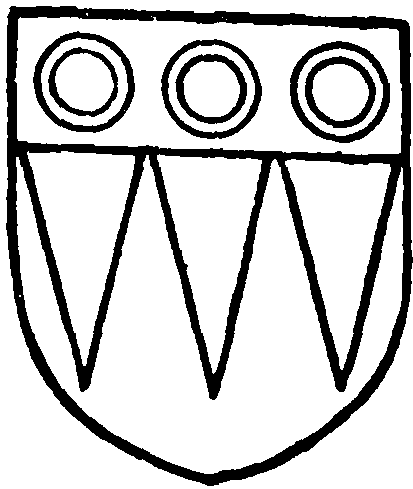
Young of North Dean, baronet. Or three piles sable and a chief or with three rings sable therein.
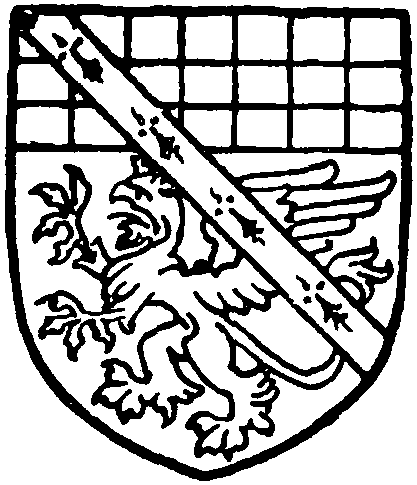
Wellesbourne. Gules a griffon or and a checkered chief of azure and or with a bend ermine over all.
The property in Hughenden known as PIGGOTTS (fn. 94) was owned by Thomas Hampden of Great Hampden at his death in 1486. (fn. 95) It follows the same descent in his family (fn. 96) as the manor of Great Hampden, passing in 1824 to the Hobart family, Earls of Buckinghamshire. (fn. 97) Sidney, the seventh earl, is the present owner.
Eton College owns some land in this parish (fn. 98) granted by Henry VI in 1444 as land which John Coleshull of Hughenden (fn. 99) had given him. (fn. 100)
The liberty of BRAND'S FEE forms that division of the parish of Hughenden which lies in Aylesbury Hundred. No rights seem to have been attached to the liberty, which apparently owes its separation from the rest of Hughenden parish solely to its being in a different hundred. The liberty did not exist till the 15th century or later (fn. 101) and seems to have been formed from land in Kingshill, which itself extended into two parishes, the hamlet of Great Kingshill being in Hughenden and that of Little Kingshill in Little Missenden parish. Kingshill, however, was connected manorially with Wendover, and hence Brand's Fee is sometimes returned under that town. (fn. 102) The name of Brand's Fee was derived from Sir Robert Brand, (fn. 103) who in 1252 received a knight's fee in Kingshill from Ingram de Fiennes. (fn. 104) His son John Brand (fn. 105) held the manor of Kingshill in the 13th century of Isabella de Fiennes as of her manor of Wendover. (fn. 106)
The lands of Missenden Abbey in Brand's Fee were known as the manor of RAVENSMERE. (fn. 107) Ingram de Bethun, who granted lands to the abbey of Missenden, (fn. 108) occurs in connexion with Kingshill in 1237 (fn. 109) and was succeeded by Sir Robert Brand, (fn. 110) who with his son John confirmed such grants. (fn. 111) John Brand made further gifts, all of which were confirmed by Stephen de Chenduit. (fn. 112) These lands were called 'le Brondes,' (fn. 113) and in the 14th century the manor of 'Brondes' is mentioned. The possessions of the abbey in Brand's Fee were held in 1541 (fn. 114) by Sir William Windsor at the yearly rent of £20 19s. 4d. Before 1546 the manor of Ravensmere in Hughenden and Little Missenden had been granted to Sir Thomas Darcy, and in that year he obtained leave (fn. 115) to alienate it to Sir Robert Dormer. Sir Robert Dormer died seised of the manor in 1553, (fn. 116) and it passed to his son and heir Sir William Dormer, who left it under the name of the manor of Brand's Fee to his wife Dorothy for the performance of his will. (fn. 117)
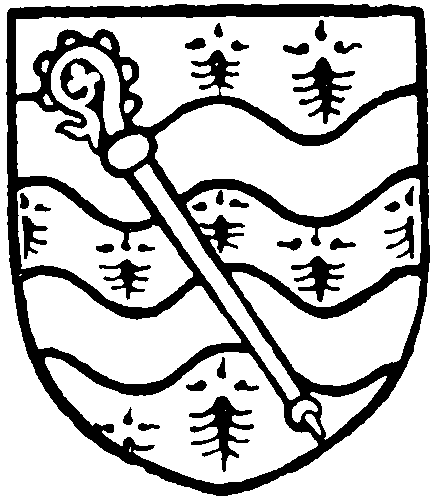
Missenden Abbey. Barry wavy ermine and sable with a crozier or set bendwise.
The Dormers' title to Ravensmere was disputed by Queen Elizabeth, (fn. 118) and Sir Robert Dormer, son and heir of Sir William, obtained a new grant of the manor from her. (fn. 119) The manor has remained with his family, (fn. 120) but after the death of Charles second Earl of Carnarvon in 1709 (fn. 121) it did not descend to his daughters, but passed to his cousin Rowland Dormer, who succeeded him as fourth Lord Dormer of Wing (fn. 122); it has since descended with the title to the present Lord Dormer.
Lysons appears to have confused the manor of Brand's Fee with Brands House, which has been held by the family of Newman for a considerable time. (fn. 123) The late Mr. John Newman inherited the house and estate from his father and came to live there about 1840. On his death in 1888 it passed to Mr. Samuel Newman, the present owner.
CHURCHES
The church of ST. MICHAEL AND ALL ANGELS consists of chancel measuring internally 33 ft. by 20 ft., north chapel 17 ft. wide, nave, north aisle, south porch and north-west tower.
The chancel and north chapel are of mediaeval date, but were very considerably restored between 1874 and 1890, when the rest of the church was completely rebuilt. The walls are of flint with stone dressings and the roofs are tiled.
The chancel has a modern window in the east wall, and in the south wall are two modern windows, and a 14th-century piscina with a trefoiled ogee head, having a round basin and a shelf at the back; internally the outline of an early pointed doorway can be traced. In the north wall is an arcade of two bays, dating probably from the late 15th century, with four-centred arches supported on an octagonal pillar and semi-octagonal responds with capitals bearing shields. There is a small trefoiled niche on the east respond and a square niche on the north side of the pillar. The chancel arch is modern, with the exception, perhaps, of a few jamb stones.
The north chapel has a restored east window of three trefoiled lights with tracery under a pointed head, dating probably from about 1350; in the north wall are modern windows and a 14th-century tomb recess with a moulded two-centred drop arch, while in the south wall, west of the arcade, is a small fourcentred tomb recess of about 1500, with two glazed rectangular openings to the chancel. On the sill of the east window are three head corbels, comprising a grotesque of the 12th century, a mailed head of the 13th, and a crowned head of the 14th century.
The nave is of three bays and is built in the style of the 14th century, as are the tower, aisles and porch. The roofs throughout have been renewed. The font, dating from the early 13th century, is of cylindrical form enriched by continuous trefoiled panels with a foliated band at the top. The altar dates from the 17th century and has carved rails and turned legs. Two high-backed oak chairs, one in the chancel and the other in the nave, are probably of the 17th century.
On the east wall of the north chapel is a small brass figure of a priest in mass vestments, with an inscription to Robert Thursbe, 'Capellanus,' who died 15 January 1493, and in the recess in the north wall of the chapel is a marble slab with indents for a head, a scroll and two shields. In the north chapel are six very interesting effigies, of which the oldest, a recumbent effigy of a cross-legged knight, dating from about 1285, but slightly altered probably in the 16th century, lies in the south-east corner. This is supposed to be a de Montfort, ancestor of the Wellesbournes of this parish. He wears chain mail and a long surcoat charged with a griffon grasping a child in his left paw and a chief checky, possibly for Wellesbourne; with his left hand he grasps his long sword, on the scabbard of which are seven shields, and holds a dagger in his right, while a long shield over his left arm bears a lion with forked tail in an orle of crosslets and holding a child in its mouth, possibly for Montfort, though it differs somewhat from the Montfort shield, as do the arms on the surcoat from the shield of Wellesbourne. Both the head and feet rest upon cushions ; that at the head has a shield on either side, of which the dexter is bendy of ten a chief and the sinister seems to be bendy, but is much defaced. On the sill of the east window is a knight in chain and plate armour of the time of Edward III and wearing a bascinet with camail. The forearms having been broken off, they have been rudely carved in the body of the figure. The head rests upon two griffons, each holding a child in its claws, and at the elbows, feet, and on the jupon are arms similar to those on the older effigy. On either side near the knee is a peculiar crescent inclosing a face. This effigy has also been altered at a later date, probably in the 16th century. On either side of the window is a slab with the figure of a man in armour carved in low relief ; both are probably 16th-century imitations of earlier work. The figure on the north, which is somewhat defaced, wears a quilted gambeson and a large shield covering the breast and all but the lower part of the sword; the legs are in profile and the arms on the shield are similar to the above. The figure on the south side wears a vizored helm with orle and holds a mace in his right hand, while suspended from his shoulder is a shield bearing a griffon and chief checky, as on the surcoat of the first effigy, and over all a bend. This is the nearest approach to the arms of Wellesbourne. In the recess in the north wall is another effigy of a man in armour carved in low relief, wearing a short gambeson, a coif and collar of roundels, a sword and a large shield on the breast which covers the right hand and both arms. The left hand grasps a staff with a cross end and another sword pierces the head of a beast at his feet. The arms on the large shield are incorrect versions of Wellesbourne and Montfort and those on the small shields are meaningless. In the recess on the south side of the chapel is an effigy, probably of the 16th century, of a corpse lying on a shroud which partly envelops the body; in a cavity formed in the breast bone is a little figure with arms out stretched, symbolizing the departing spirit. On the south wall of the chancel is a monument, with the kneeling figure of a boy, to Thomas Lane, who died in 1621, and south of the church, in the churchyard, is a slab to William Russell, 1694. In a case in the nave is a key dating probably from the 15th century.
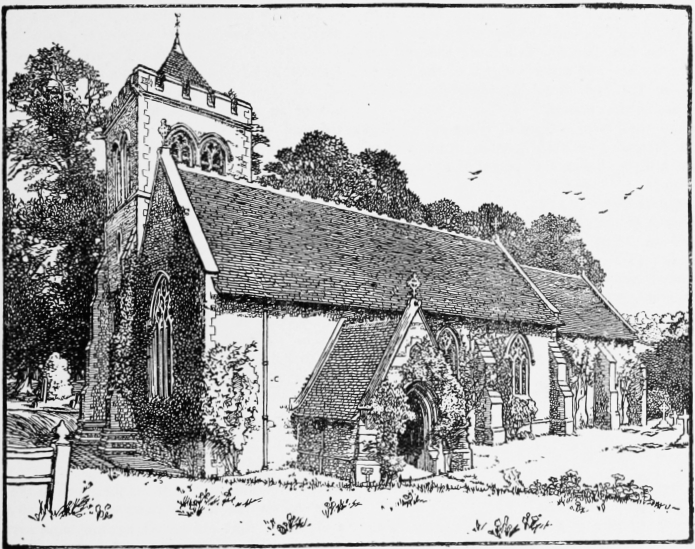
Hughenden Church from the South-west
The tower contains a ring of eight bells: the treble and second are by J. Warner & Sons, 1881, and the third and fourth by Mears & Stainbank, 1875; the fifth and sixth are by Henry and Ellis Knight, 1663; the seventh is inscribed 'Sancta Maria Ora Pro [N]obis' in black lettering with crowned initials, and the tenor 'Criste Baptista Campana Gaudeat Ista,' with lettering as the last. These two are of 15th-century date.
Near the seat which he used is the monument to Lord Beaconsfield erected by Queen Victoria. It is of white marble and contains a portrait in relief of the earl by R. C. Belt. Below is the following inscription: 'To the dear and honoured memory of Benjamin Earl of Beaconsfield, this memorial is placed by his grateful sovereign and friend Victoria R.I. Kings love him that speaketh right. Proverbs xvi, 13. February 27, 1882.' On the outside of the church are memorials to Mary Ann Disraeli, 1872, and to Sarah widow of James Bridges Williams, who died in 1863 and made the earl her heir. The banner and other insignia of the Garter belonging to the earl, from St. George's Chapel, Windsor, are in the chancel.
The plate consists of a Spanish silver-gilt chalice and paten, presented by Mrs. Blagden in memory of her father, a silver chalice and paten of 1714 and a silver flagon.
The registers begin in 1559.
The church of the HOLY TRINITY, Prestwood, consecrated in 1849, is built of flint with stone dressings in 14th-century style and consists of chancel, nave, aisles, vestry, south porch and open western turret containing one bell. The living is a vicarage in the gift of Mr. Coningsby Ralph Disraeli.
ADVOWSON
Hughenden Church was given by Nicholas de Hughenden to Kenilworth Priory (fn. 124) apparently early in the reign of Henry II. (fn. 125) In 1258 Simon Bluet of Hughenden claimed the church against the prior, (fn. 126) and about three years later his sons joined with others in burning the porch and breaking the windows. (fn. 127) The advowson follows the descent of Hughenden Manor (fn. 128) (q.v.), the present owner being Mr. Coningsby Disraeli.
Hughenden rectory does not appear to have been appropriated by Kenilworth Priory before 1291, when the church was valued at £20, (fn. 129) its valuation in 1535 being £9 1s. 4d., (fn. 130) when the rectory was worth £11 2s. 10d. yearly. (fn. 131) The latter remained under the same ownership as the advowson until 1641, when according to Langley it was sold by the Earl of Carnarvon to William Mayne and others. (fn. 132) It seems to have been dispersed on its sale by Edward Harvey in 1703. (fn. 133) In 1862 the great tithes belonged to the landowners and the small tithes had been commuted. (fn. 134)
In 1548 land and rent which had been left for an obit in Hughenden were worth 11s. yearly. (fn. 135)
CHARITIES
In 1690 Thomas Gregory, by will proved 29 March, devised an annuity of £2 for poor housekeepers, issuing out of an estate called Knife's Farm, which is distributed in bread.
The almshouses consist of four cottages in the churchyard, given to the parish by the Dormer family. (fn. 136)
In 1816 Ellen Countess Conyngham, by her will proved 24 July, bequeathed £500 4 per cent. bank annuities, now represented with accumulations of income by £635 8s. 8d. consols, the income to be distributed half-yearly to the inmates of the almshouses above referred to. The stock is held by the official trustees, producing £15 17s. 8d. yearly.
The charity of Katherine Pye. (fn. 137)
The sum of £7 to £8 a year is received as the share of the net residue applicable for educational purposes in this parish. (fn. 138)