A History of the County of Buckingham: Volume 3. Originally published by Victoria County History, London, 1925.
This free content was digitised by double rekeying. All rights reserved.
'Parishes: Saunderton', in A History of the County of Buckingham: Volume 3, ed. William Page (London, 1925), British History Online https://www.british-history.ac.uk/vch/bucks/vol3/pp92-95 [accessed 3 May 2025].
'Parishes: Saunderton', in A History of the County of Buckingham: Volume 3. Edited by William Page (London, 1925), British History Online, accessed May 3, 2025, https://www.british-history.ac.uk/vch/bucks/vol3/pp92-95.
"Parishes: Saunderton". A History of the County of Buckingham: Volume 3. Ed. William Page (London, 1925), British History Online. Web. 3 May 2025. https://www.british-history.ac.uk/vch/bucks/vol3/pp92-95.
In this section
SAUNDERTON
Santesdone, Santesdune (xi cent.); Santerdon (xiii cent.); Sauntdresdone (xiv cent.).
Saunderton is a long, narrow parish, 5¾ miles from end to end and with its greatest width of less than a mile in the centre. Its area covers nearly 1,725 acres, including 1,111 acres of arable land and 178 of permanent grass. (fn. 1) There are no woods or plantations. The slope of the land varies between 348 ft. above the ordnance datum on the road near the church and 687 ft. at Lodge Hill on the western boundary. The soil is light and shallow, the subsoil rubble and chalk. There is a chalk-pit to the south-east of Lodge Hill. The chief crops are wheat, barley, peas, beans and oats. Both the Watlington and Wycombe branches of the joint line of the Great Western and Great Central railways cross the north of the parish, and the latter branch traverses two of its eastern sections and has a station in the extreme south-east. Between them runs the Lower Icknield Way; the Upper Icknield Way lies 1½ miles further south. Close to the station is the Wycombe union workhouse. The small village of Saunderton lies 3½ miles to the north-west of the station and halfway between them is a small hamlet called Saunderton Lee, which includes the Grange. The reason for the decline of a once flourishing community is lost. There were originally two churches in Saunderton, with the ascriptions to St. Mary and St. Nicholas respectively, but the latter appears to have been allowed to fall into decay from the middle of the 15th century (see advowson), and its site is not ascertainable. It is supposed, from the human remains which have been dug up there, (fn. 2) to have stood to the westward of the present church at a place called Great Saunderton. After its decline the remaining church of St. Mary was henceforward known as St. Mary and St. Nicholas.
The rectory, formerly a farm-house, about half a mile to the south-east of the church, is an 18th-century building with a 17th-century wing and a stable and barn of the latter date. Some fragments of 14th and 15th-century window tracery from the church are now in the garden.
There is no manor-house. The last mention of one that could be found at the end of the 18th century was in a will dated 1610. (fn. 3)
Frogmore Farm, about a quarter of a mile west of the church, is an interesting example of a mid-15th-century house, which, though altered about 1600 and subsequently added to, retains much of the original massive timber construction, including the roof to the hall.
To the north-east of the church is Saunderton Mill, which is both a steam and water-mill. The Bledlow paper-mill stands in the north of the parish.
Near Slough Farm, in the south, are two tumuli, which were opened in 1858, but nothing was discovered, and at Lodge Hill, about 1½ miles northwest, are two more and a line of entrenchment. Near the church is an almost effaced mount and bailey castle which has one bailey on the south-east, since converted into a moated site, and vestiges of another at the north-west of the mount. On the borders of Horsenden parish is a homestead moat in Roundabout Wood. Saunderton was inclosed in 1806. (fn. 4)
The following place-names have been found in this parish: Chawley Farm (fn. 5) (xvii cent.); Budnam and Great Wyldy (fn. 6) (xviii cent.).
MANORS
In 1086 the Bishop of Bayeux held a manor in Saunderton assessed at 5 hides, (fn. 7) which was later known as SAUNDERTON or SAUNDERTON ST. MARY. Before 1235 it appertained to the honour of Leicester, (fn. 8) and so passed to the duchy of Lancaster, (fn. 9) the last reference to this overlordship that has been found occurring in 1650. (fn. 10) In 1086 the Bishop of Bayeux had subinfeudated his land in Saunderton to Roger, (fn. 11) who was also his tenant in Weston Turville, (fn. 12) to which manor Saunderton become appurtenant. (fn. 13) This intermediary lordship is last mentioned in 1361. (fn. 14)
Robert son of Osbert de Saunderton was holding in Saunderton in the middle of the 12th century. (fn. 15) Before 1215 (fn. 16) Osbert de Saunderton was tenant of the manor of Saunderton St. Mary, (fn. 17) and was still alive in 1247. (fn. 18) William de Saunderton, probably his son, was holding before 1289, (fn. 19) and was incapacitated by age for the office of coroner for the county in 1308. (fn. 20) Alexander de Saunderton had succeeded before 1329. (fn. 21) Another Alexander de Saunderton was holding in 1346, (fn. 22) and was returned to Parliament for the county in that year. (fn. 23) By licence two years later (fn. 24) he made a settlement of this manor on his sons William, John and Alexander in tail-male. (fn. 25) It remained in his family (fn. 26) until 1452, when William Saunderton and his wife Agnes conveyed it to John Brecknock, Edmund Brudenell and others. (fn. 27) They demised it in 1459 to John Stocker and others, (fn. 28) who transferred it in 1462 to William Tybert and John Wild. (fn. 29) They granted this manor before 1474 to Sir John Leynham alias Plomer and his wife Margaret. (fn. 30) He died in 1479, (fn. 31) and Margaret sold the manor to Sir John Donne. (fn. 32) He bequeathed it to his wife Elizabeth for life, with reversion to their son Edward, (fn. 33) who had succeded in 1506. (fn. 34) He was knighted in 1513, (fn. 35) and on his death in 1551 (fn. 36) Sir Thomas Jones, who had married Elizabeth only daughter and heir of Sir Edward Donne, held the manor for his life. (fn. 37) He died in 1559, (fn. 38) leaving two co-heirs, Anne wife of John Cotton and Frances wife of Ralph Lee. (fn. 39) By mutual agreement Saunderton Manor passed to the Lees. (fn. 40) Frances died in 1572 (fn. 41) and her husband in 1578. (fn. 42) Their son and heir Edward Donne Lee (fn. 43) conveyed this manor in 1593 to Sir Robert Dormer, (fn. 44) afterwards first Lord Dormer. (fn. 45) Robert Dormer, third son of Lord Dormer, (fn. 46) was in possession in 1625, (fn. 47) and the manor has descended in his family, (fn. 48) his grandson Charles succeeding his cousin Rowland as Lord Dormer in 1712. (fn. 49) Rowland thirteenth Lord Dormer is the present owner.
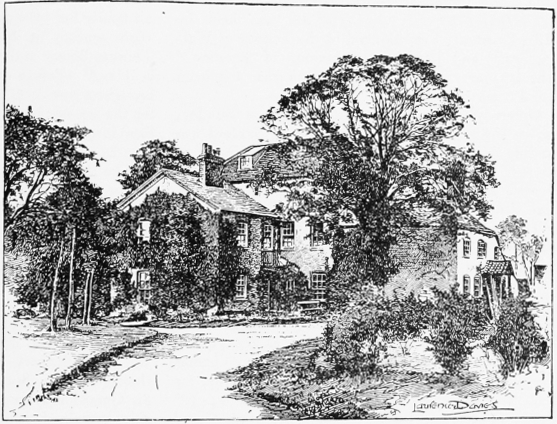
The Rectory, Saunderton

Dormer, Lord Dormer. Azure ten billets or and a chief or with a demi-lion sable therein.
The profits of the courts leet and baron of the manor of Saunderton St. Mary were 13s. 4d. in 1650, and the 'certainty money' formerly paid to the steward for the use of the lord was 2s. 6d. (fn. 50)
In 1086 a second manor assessed at 5 hides in Saunderton, afterwards distinguished as that of SAUNDERTON ST. NICHOLAS, was held by Miles Crispin. (fn. 51) It belonged to the honour of Wallingford, (fn. 52) and later to the honour of Ewelme. (fn. 53) The last mention in this connexion that has been found occurs in 1673. (fn. 54)
Osbert was tenant under Miles Crispin in Saunderton in 1086. (fn. 55) Before 1215 Roger de Sanford was holding Saunderton St. Nicholas, (fn. 56) and continued to do so (fn. 57) until his death about 1235, when it was divided among his heirs. (fn. 58) They appear to have been Emma wife of William Beauchamp, Joan wife of Henry Dayrell and Maud wife of John, 'medicus,' who were plaintiffs in a suit in 1236. (fn. 59) That part assigned to Emma and her husband William Beauchamp was sometimes called SAUNDERTON MANOR and afterwards CHEYNES MANOR, and descended with Drayton Beauchamp (q.v.), of which William Beauchamp was lord, for over 200 years. (fn. 60) It was granted with Drayton Beauchamp to Thomas Cheyne in 1364, (fn. 61) and descended in his family, Sir John Cheyne being mentioned as lord in 1445. (fn. 62) Before 1459 it had passed to John Breckneck, (fn. 63) and from this date descended with Saunderton St. Mary (q.v.), being last mentioned by name in 1723. (fn. 64) The Crown seems to have retained rights in the manor, which was leased in 1601 (fn. 65) and 1602, (fn. 66) the grants evidently proving ineffective. It seems to have renounced these rights in 1603 to Sir Robert Dormer. (fn. 67)
The second share in the manor of Saunderton St. Nicholas was presumably held by Henry and Joan Dayrell in 1236. He was Sheriff of Middlesex in 1246, (fn. 68) and died soon afterwards. (fn. 69) His son Henry (fn. 70) was holding in 1302, (fn. 71) and in 1308 obtained a licence to alienate to John de Foxley, his wife Constance, and to John's heirs. (fn. 72) A grant of free warren in this estate was made to John de Foxley (fn. 73) in 1317. (fn. 74) He died about 1323, (fn. 75) when his lands were taken into the king's hands, but restored to Constance in 1325 for her life. (fn. 76) Thomas son and heir of John de Foxley (fn. 77) was holding in 1346. (fn. 78) His lands in Saunderton presumably escheated to the Crown and were included in the grant of land to the value of 100 marks made from the honour of Wallingford to Sir John de la Hay in 1377, (fn. 79) and inspected and confirmed in the following year. (fn. 80) He was holding in Saunderton in 1379, (fn. 81) and the estate remained in his family for over a hundred years, for early in the 16th century it had descended to John wife of Thomas Botery and daughter and heir of Edward de la Hay. (fn. 82) Before 1515 Thomas and Joan Botery brought a suit in Chancery against Sir Ralph Verney for the recovery of deeds relative to their lands in Saunderton, (fn. 83) but no later mention of them has been found.
The third share resulting from the division of the manor of Saunderton St. Nicholas in 1235 came to be known as BROMES, BROMYS or BROWN'S MANOR. Maud wife of John, 'medicus,' in 1236 (fn. 84) was presumably third co-heir of Roger de Sanford. She is called Maud Mire in 1247–8. (fn. 85) Ralph Brown, probably her son by a former marriage, was holding before 1300. (fn. 86) John Brown, mentioned in 1356, (fn. 87) who married Maud widow of Alexander de Saunderton (see Hedgerley), sold this manor in 1374–5 to Robert Braybrook and others. (fn. 88) One of these, William Borstall, released his right in it to Sir Gerard Braybrook the elder in 1389. (fn. 89) It probably remained in the Braybrook family until the death of Sir Gerard Braybrook without heirs male in 1432, (fn. 90) and by 1459 was in the possession of John Brecknock and others. (fn. 91) It thus came under the same ownership as Saunderton St. Mary and follows the same descent. It is last mentioned as a distinct manor in 1749. (fn. 92)
In 1086 there were three mills in Saunderton, one on the manor of Saunderton St. Mary, (fn. 93) the other two on that of Saunderton St. Nicholas. (fn. 94)
Thame Abbey held lands in Saunderton, afterwards called SAUNDERTON GRANGE, (fn. 95) granted to it in free alms late in the 12th century by Robert de Saunderton for 2 silver marks and a horse-load (summa) of oats and for 40d. Paid to his wife. (fn. 96) At the Dissolution this estate was in the tenure of Thomas Winter. (fn. 97) It was granted in 1542 to the Dean and Canons of Christ Church, Oxford, (fn. 98) a grant which was confirmed in 1546. (fn. 99) They have since retained it, their lessee in 1806 being Richard Brigginshaw. (fn. 100) Mrs. Schobell, who purchased the lease from John Brigginshaw in 1830, (fn. 101) was holding it in 1862 (fn. 102) for £2 4s. 4½d. yearly and the price (regulated by the Oxford market) of 1 quarter 5 bushels of wheat, 1 peck of malt and two capons, amounting in all from £25 to £30. (fn. 103)
CHURCH
The parish church of ST. MARY AND ST. NICHOLAS consists of a chancel, nave with a western bellcote of wood, and south porch. The present structure is modern, having been completely rebuilt in 1888–91, many of the windows and doorways and much of the material of the walling of the former church, which was of flint with stone dressings, being re-used.
Two early 14th-century windows are reset near the east end of the chancel in the north and south walls, each of two lights in a pointed head with an external label, and at the north-west there is a single trefoiled light of 15th-century date. The window at the south-west of the chancel, of two pointed lights, has been much restored. The heads of the lights probably date from the 16th century, while the label, which seems to have been originally made for a pointed opening and is of typical 14th-century section, has been adapted to its present segmental form. The remaining features in this wall are an early 14th-century doorway, which is now blocked, and a piscina with a moulded trefoiled head and a stone shelf, probably of a later date in the same century.
The easternmost window in the north wall and the lower window in the west wall of the nave contain a few old stones in the jambs and mullions. The north and south doorways are both of the early 14th century.
The framework of the bellcote is of mediaeval date.
The early 13th-century font has a fluted and moulded bowl, around which is a band of stiff-leaved foliage, and stands on a circular base. The chancel rails are made up of the remains of two screens, and on each side of the central opening have trefoiled heads of four bays with pierced spandrels cut from a single plank. The north bays date from the late 14th century and the south from the early 15th century; over the latter is some woodwork with early 17th-century carving. On the altar platform and in the organ chamber are a number of yellow and red mediaeval tiles of a variety of designs. The only early monument remaining is a 15th-century brass of the half-length figure of a woman on the south wall of the nave with inscription to Isabella Saunderton, daughter of William Saunderton and sister of Bernard Saunderton.
There are three bells, all by Alexander Rigby, 1699.
The plate includes a small cup of 1691 and a cover; both have the same maker's mark, but the cover has no date letter.
The registers begin in 1728.
ADVOWSON
Before 1215 there were two churches in Saunderton, (fn. 104) which gave their names to the manors of St. Mary and St. Nicholas. The advowson of each church appertained to the manor in which it was situated (fn. 105) and followed the same descent. (fn. 106) Both churches were valued at £5 6s. 8d. yearly in 1291. (fn. 107) On the partition of the manor of St. Nicholas, about 1235, the advowson of that church appears to have been divided between the holders of the Dayrells' and Bromes portions, who presented in turn. (fn. 108) With Bromes it had come under the same ownership as Saunderton St. Mary before 1459, (fn. 109) and the last mention of it that has been found occurs in 1528. (fn. 110) The rectories were united to form the present rectory of St. Mary and St. Nicholas, valued at £14 0s. 0¼ d. in 1535. (fn. 111) The advowson of Saunderton Church was sold by Charles Lord Dormer in 1726 to the President and Fellows of Magdalen College, Oxford, (fn. 112) who are the present owners.
In 1806 the rector was awarded a fifth of the arable land in Saunderton and a ninth of the remainder, exclusive of the woodlands, in lieu of the great and small tithes. (fn. 113)
In 1548 the site of the Church House in Saunderton, which had been given for an obit, was worth yearly 4d. (fn. 114) It was granted in free socage in 1554 to William Walton and Jeremiah Hally. (fn. 115)
There are apparently no endowed charities in this parish.