A History of the County of Buckingham: Volume 3. Originally published by Victoria County History, London, 1925.
This free content was digitised by double rekeying. All rights reserved.
'Parishes: High Wycombe', in A History of the County of Buckingham: Volume 3, ed. William Page (London, 1925), British History Online https://www.british-history.ac.uk/vch/bucks/vol3/pp112-134 [accessed 30 April 2025].
'Parishes: High Wycombe', in A History of the County of Buckingham: Volume 3. Edited by William Page (London, 1925), British History Online, accessed April 30, 2025, https://www.british-history.ac.uk/vch/bucks/vol3/pp112-134.
"Parishes: High Wycombe". A History of the County of Buckingham: Volume 3. Ed. William Page (London, 1925), British History Online. Web. 30 April 2025. https://www.british-history.ac.uk/vch/bucks/vol3/pp112-134.
In this section
HIGH WYCOMBE
Wicumbe (xi cent.); Wicumba, Wycumbe (xii–xiii cent.); Chepyng, Chepping Wycombe (xiv–xx cent.); East Wycumbe (xiii–xiv cent.); Great Wycombe, Temple Wycombe (xvi cent.).
High Wycombe is the first town in Buckinghamshire in point of size, and perhaps the most important from the point of antiquity and historic importance. Its situation in a well-watered valley protected by higher ground would be favourable to early prehistoric settlements of which traces have been found at Wycombe Marsh dating from the Bronze Age. (fn. 1) There are two hill-top camps in the parish, one at Keep Hill and the other at Castle Hill. (fn. 2) Under the Romans Wycombe, though not situated on one of the great Roman high roads, was yet on an important cross-road connecting the Thames and the Icknield Way, (fn. 3) and excavations at Penn Mead, at the western extremity of the Rye, have unearthed remains of a Roman settlement of some importance. (fn. 4) The Anglo-Saxons, too, have left traces of their presence here, (fn. 5) but it is not till the great Survey of 1086 that the written history of this parish really begins. The picture there presented of Wycombe is entirely rural; the woodland later to become such a valuable asset then fed 500 swine. There were six mills and thirty ploughs. (fn. 6)
The development of Wycombe was certainly quickened by the Conquest. It lay in a favourable position half-way between Oxford and London, and commanded the important road to Marlow. According to one tradition (fn. 7) Wigod of Wallingford removed to Wycombe after the building of the Norman fortifications at Wallingford, and it is at least possible that he possessed a house here; but the most illustrious name connected with the early history of the town is that of St. Wulfstan. One story in his Life (fn. 8) shows us the bishop lodging here on his way to London with a retinue of servants and pack-horses and escaping from the wreck of an old house falling to ruin. Later he was again at Wycombe by licence from Bishop Remigius (fn. 9) to consecrate a church built by a wealthy townsman (fn. 10) at his own charges. On this occasion, having preached to the people and confirmed their children, he is said to have healed of grievous sickness a maid-servant of his hostess with water hallowed by a bezant which the Holy Lance had touched. Although Christianity had long been the creed of the Chilterns, pagan customs still lingered, and nearly a century after Wulfstan's death St. Hugh of Avalon, Bishop of Lincoln, (fn. 11) put a stop to wellworship (fn. 12) at High Wycombe.
Owing to its important strategical position Wycombe itself, or perhaps a castle (fn. 13) commanding the town, stood a siege (fn. 14) during the anarchy of Stephen's reign. Damage was doubtless done to the town, and the mills (fn. 15) probably suffered.
From the 13th until the 16th century the parish was, roughly speaking, divided into two large manorial estates farmed by absentee owners, and the borough, which unhampered from outside interference was free to develop along its own lines. From contemporary documents it is possible to reconstruct in part the appearance of Wycombe as it was in the 13th century. The broad High Street running east and west was then as now the main thoroughfare, and opening out on it were the burgage tenements already sufficiently numerous, for twenty-six burgesses came forward in 1226 as witnesses for their fellow-burgesses. (fn. 16) At the west end of the High Street was the market-place with the ancient moot hall, the 'Cnavenethorn' of 1226. North of the market-place stood the parish church, a building which gave place in 1273 to the present edifice. The prison also probably stood in the High Street. (fn. 17) At the east end of the borough and marking its boundary was St. John's Hospital, whose lands ran down to the River Wye. On the opposite bank stretched the green meadow land of the Rye with a steep beech-clad ridge rising at the back. Here the cattle belonging to the burgesses were pastured in common, and here in the open air the 'law days' were often held. South-west of the Rye, where Wycombe Abbey now stands, was the leper hospital, whose master in 1233 received ten oaks towards the repair of the chapel there. (fn. 18) The fairs, held by the burgesses in Alan Basset's fields, (fn. 19) and by the masters of St. John's and St. Giles's Hospitals in their own grounds, doubtless brought many visitors to the borough, which had to provide hostelries for their entertainment. The name of le Vinetur, or the Taverner, is found among the 13th-century inhabitants, and, though mention is not found of it till later, the peculiar historical significance of the sign of the 'Saracen's Head' denotes that it already stood in the High Street. The Abbess of Godstow at this time claimed tithe of nine mills working in this parish, one of which was in Loudwater, (fn. 20) whilst mention is also found of Crendon, another hamlet long since depopulated. Edward I appears to have visited Wycombe in 1284, for a patent of that year acknowledging loans of £8,000 from the Ricardi is dated from Wycombe. (fn. 21) In 1290 a case of treasure trove is found at Wycombe, William atte Lyche, whose innocence was later proved, being accused of maliciously hiding £20 which he found between the town and 'Le one-handed Cruche.' (fn. 22)
Scanty reference has been found to Wycombe in the 14th century; the Black Death, which visited the adjacent parish of West Wycombe very severely, probably made itself felt here, though no record has been preserved. In 1389 mention is found of Andrew Kelsey, a 'table-maker' of Wycombe, who was in Newgate for felony. (fn. 23) In 1399 a by-law was passed forbidding the inhabitants to be out after ten o'clock at night on pain of imprisonment unless good cause could be shown. (fn. 24) Besides the High Street mention is found at this time of 'Croyndones Lane,' Frogmore Street and Newland Street, all of which can be identified at the present day. In 1419 an extent is found of Bassets Bury Manor; the site of 1½ acres included a small hall (aula) with two small rooms annexed, a large tiled grange, a small grange, a cowshed with a stable and one 'domo' above the door. (fn. 25) About this date 'the tenement called the Newynne and the Saresenehede' in the High Street extended to the rectory close called Bourehays. (fn. 26) In 1467 St. Margaret's Hospital is described as ad finem ville, (fn. 27) whilst St. Mary's Street was without the borough. (fn. 28)
The reformation of religion in the 16th century, as was inevitable, brought with it many changes in the town life of Wycombe. The leper hospital, it is true, had long been diverted from its original purpose, but the hospital of St. John Baptist was now converted into a royal grammar school. The influence of two other important religious bodies, Godstow Abbey, who owned the church, and the Knights Hospitallers, lords of half of Wycombe, also disappeared from the parish. The inhabitants of Wycombe appear to have favoured the reformed religion, for in 1539 twenty-four of them complained to the Lord Privy Seal that the Bishop of Lincoln (probably on the occasion of his visit to the town in the preceding year to try one Cowbridge convicted of heresy) (fn. 29) 'prayed not for the king nor spoke against the bishop of Rome.' (fn. 30) Loyalty to the reigning sovereign was, however, the guiding policy of Wycombe, and in 1558 procured the borough its charter of incorporation from Queen Mary.
In 1604 the aspect of the town was improved by the building of a new Gildhall, which stood on 'twenty-two large posts and pillars of heavy oak.' (fn. 31) The old building was not destroyed, for it was rented in 1657 by Jerome Grey, (fn. 32) so that a different site (probably that occupied by the present Gildhall) must have been chosen. The town book about this time contains an interesting entry showing that many of the inhabitants of Wycombe took shares, ranging from 40s. to 5s. a share, in the lottery made on the settlement of the merchant adventurers in New Virginia. Many lots were taken in the names of children, and the serjeant and parish clerk were each accredited with a lot worth 5s. in return for their trouble in collecting the subscriptions. (fn. 33)
Chepping Wycombe was assessed at £50 for ship money in 1638, (fn. 34) and in the following year had as justice of the peace no less a person than John Hampden. (fn. 35) During the Civil War the town was at various times the head quarters of Parliamentary troops, (fn. 36) and was on one occasion, in 1643, the scene of a slight skirmish which took place on the Rye with Prince Rupert. In 1647 Charles I passed through the town on his way from Caversham to Woburn. (fn. 37) In 1663 it was the scene of another royal visit, when Charles II and his queen lodged at the 'Katherine Wheel' in the High Street on their way from Oxford to London. (fn. 38)
The plague, best known as the Great Plague of London, visited Wycombe with some severity, as may be gathered from the parish register, for in 1665–96 deaths out of 149 recorded were from plague, whilst in 1666 101 out of 144 were due to the same disease. (fn. 39)
After the Restoration the Dissenters of Wycombe suffered under the various Acts passed against Nonconformity. In 1664 seven labourers, Quakers, were committed to the house of correction for three months for assembling in the house of John Raunce for worship. (fn. 40) Dr. Martin Lluelyn, the famous mayor in 1671, 'behaved himself severe against fanatics.' (fn. 41) Samuel Clarke, the annotator of the Bible, however, ejected from his living of Grendon Underwood by the Act of Uniformity, contrived by his 'peaceable prudence' to dwell in safety at Wycombe. (fn. 42)
In 1681 the mayor and corporation are found presenting a most extraordinary address of congratulation to Charles II on the occasion of the political overthrow of Lord Shaftesbury, (fn. 43) who had visited their town in the early part of the year. (fn. 44) True to the general policy of the borough, a denunciation of the Pretender, signed by the mayor and bailiffs, is entered in the town records for 1714. (fn. 45) A later entry concerns the distribution of militia arms—muskets, swords and bandoliers—to the mayor and corporation. (fn. 46)
During this century much was done to beautify the town. In 1757 the present Gildhall was built at the expense of the Earl of Shelburne, and four years later the octagonal market-house was erected. Several of the fine houses still adorning the High Street were also built during this period. Loakes, the seat of Lord Shelburne, was visited in 1775 by John Wesley, who eulogized its beauty, (fn. 47) and by Dr. Johnson, who stayed there for two days in 1783 during the absence of its owner. (fn. 48) Loakes was replaced in 1795 by the fine buildings of the present Wycombe Abbey. In 1799 the Royal Military College was established here, but was removed to Sandhurst in 1812.
The history of Wycombe during the 19th century has been one of continuous development mainly along industrial lines; but the educational advantages offered, the healthy climate, and the excellent service of trains are doing much to popularize the town, especially on its northern slopes, as a good residential neighbourhood. At the present day the parish includes some 5,000 acres, of which 2,286 are arable, 1,609 permanent grass and 807 woods and plantations. (fn. 49) It varies in level from about 200 ft. above the ordnance datum in the east to more than 500 ft. in the north and west. The River Wye flows down the centre of the parish, and its course is followed approximately by the main road from Oxford to London and by the Great Western and Great Central joint railway.
The north and south of the parish are in the main agricultural; the urban part, which is rapidly extending, occupies the centre of the parish stretching from east to west. Though the borough has much increased in size of late years, its nucleus is still the High Street, whose broad thoroughfare has changed comparatively little in character since the 18th century. At its eastern extremity the High Street narrows into Easton Street. Here is the grammar school with its interesting ruins of the hospital of St. John Baptist, consisting principally of the late 12th-century aisled hall. South-east of the hall, a detached wall, built in the 13th century, is probably part of the chapel. In 1550 the building was converted into a grammar school, and when the new school was built in the 19th century the original remains were carefully preserved. The remains of the two arcades of the hall are of special interest, the 12th-century details being very well preserved. South of Easton Street and its continuations, the London Road, is the Rye Meadow, which is here separated from the road by the Wye. Easton Street also contains a number of interesting buildings. One house, now divided into two (Nos. 16 and 17), is of L shape and of 16th-century date. In the hall, which still remains, is a handsome 16th-century fireplace, and a somewhat similar fireplace is to be found on the first floor. The original iron casements lead water pipes and brick chimneys are also of great interest. The Goat Inn, which dates from the late 16th or early 17th century, is of two stories, with a plastered front and projecting upper floor. The Two Brewers Inn and some houses on the south side of Easton Street are of early 17th-century date, but have been much altered in the last century.
At the junction of High Street and Easton Street, Crendon Lane, a narrow and ancient street, runs northward up the hill. On its west side is an old Congregational chapel, dating from 1714, but enlarged in the middle of the last century. Lane's Almshouses, founded in 1674, are also in this street. At the top of the lane, on the east, is the joint station of the Great Western and Great Central railways. The road running north from the station up Amersham Hill has good modern houses and leads to the cemetery, which is also approached from Priory Avenue on the south side. North of Easton Street and London Road and in proximity to the railway there has sprung up recently a network of roads with small houses, of which an occasional name, such as Saffron Road (reminiscent of the 17th-century Saffron Plat), recalls the fact that they mark the site of the ancient demesne of Bassets Bury Manor.
Returning to the High Street, Queen Victoria Road, opposite to Crendon Lane, runs south. On its western side is the fine town hall, built in 1904. The Wye is here crossed by a bridge, built by Earl Carrington (now Marquess of Lincolnshire) as a memorial of Queen Victoria's Diamond Jubilee. Beyond the bridge, on the east of St. Mary's Street, are the grounds of Wycombe Abbey, which stands on the site of the old manor of Loakes. It was built in 1795, in the Gothic style, from the designs of James Wyatt. (fn. 50) Part of the more ancient building is said to be incorporated in the present house, which was at one time the seat of Earl Carrington. It was purchased from him by the Girls' Education Company, Ltd., and opened in 1896 as a school, in connexion with which four boarding-houses have been erected on the Marlow Hill, the school accommodating in all some 240 scholars. South of Wycombe Abbey is Daws Hill Lodge, the seat of the Marquess of Lincolnshire.

The Gildhall, High Wycombe
The house and water-mill No. 1 St. Mary's Street, although of the late 16th or early 17th century, contain many timbers of a much earlier date, which probably belonged to the mediaeval mill and were later used again. (fn. 51) Several other houses and cottages in this street are of late 16th or early 17th-century date.
On the north side of the High Street is the old Wheatsheaf Inn, now a shop, a three-storied brick and timber house of about 1600, partly refaced. The 'White House,' on the same side of this street, also a shop at present, is a brick 16th-century house plastered in front. Two fine stone fireplaces have been moved from here to the Capital and Counties Bank.
The oldest part of the town is the west end about the market-place, which lay to the south-west of the church. Possibly the island block of buildings between Church Street and White Hart Street may be an encroachment on the market-place. If so, the encroachment must have been early, as the houses at the west side of Church Street and the south side of White Hart Street are nearly all of the 16th century, refronted in brick. The White Hart Hotel, from which the latter street takes its name, contains remains of 17th-century work. In Paul's Row are many old houses. One of these, though mainly of about 1600, retains a moulded oak doorway of the late 15th century. The Royal Oak Inn, the Angel Inn and the house next to it, formerly the Five Bells Inn, are late 16th-century brick and timber houses, much altered in the modern period and refronted with brick.

High Street, High Wycombe
Some old houses in the neighbourhood of the church are worth notice, particularly the Priory, situated at the junction of Priory Avenue and Castle Street, a three-storied building probably of the 16th century, with a 19th-century brick front. The vicarage, north of the church, is apparently of the 16th century, but has been much altered at a later date. West of the vicarage is a late 16th-century house called the Chantry, refaced with 18th-century brick, and next to it is the Town House, the front portion of which also dates from the 18th century. (fn. 52) West of the Gildhall there is little beyond such names as Frogmore and Newlands, both of 14th-century origin, to recall the past. In Oxford Street, however, a house of two stories and an attic, dated 1684, now five shops, is said to represent the King's Head Inn. South of the Wyk or Wye, which runs to a great extent parallel with the Oxford Road, the main road leading out of Wycombe on the north-west side, the place is being increasingly built over to supply the needs of a large manufacturing and industrial population. The circumstances under which Wycombe has become the centre of a vast chair-making industry have been described elsewhere. (fn. 53) This industry has undoubtedly added to the material prosperity of the town, whilst detracting from its picturesqueness.
Wycombe Marsh, a hamlet further east, contains the 16th-century manor-house of Bassets Bury, much altered in later times. Beyond Wycombe Marsh is Loudwater. Both these hamlets are engaged in the manufacture of paper and are in a prosperous condition.
Among outlying districts in the parish should be noted Totteridge, a picturesque hamlet standing on high ground in the north of the parish; Hazlemere, formed in 1847 into a civil parish from the adjoining parishes of High Wycombe, Penn and Hughenden; and Tylers Green, 2½ miles north from Loudwater. At the last-named hamlet is Rayners, the seat of Sir Philip Rose, bart.
In 1854 the first Wycombe paper, known as the Wycombe and South Bucks Monthly Advertiser, was started. It only lasted for a year, but since then various journals have been published in the town, the South Bucks Free Press, started in 1856, and the South Bucks Standard, started in 1890, both weekly papers, being issued at the present day.
In 1672 the house of Alice Westoll was licensed for Presbyterian worship. (fn. 54) There are at present in Wycombe one Roman Catholic, two Congregational, two Wesleyan, three General Baptist, two United Methodist and three Primitive Methodist chapels. At Flackwell Heath is a Baptist chapel and at Loudwater a Wesleyan. Hazlemere has a Primitive Methodist, whilst at Wycombe Marsh are a Baptist and a Congregational church.
The following place-names have been found in connexion with documents relating to this parish: in the 13th century, Bulleswell, Crendons Hatch, Eltres, Heselmere, Over and Nether Milne Crofts and Russemere; in the 14th century, la Cressche or le Creys, (fn. 55) Okerigge, Pouke Lane; in the 15th century, Boncewell, Bourehays, Flexeleye, Hellefeld, Downelesmed, Ryschmerewod, Spralinges, Walissilis; in the 16th century, Aylewins, Bulstrode Close, Crowchefeld, Culverhous, Deancroft, Lokys Lane, St. Margaret's Mead, Templars Mead alias Fishersmead; in the 17th century, Dawes Hill, Durham, Dean Garden and Wood, Flackwell Heath, Little Rainers, Nunnewell, Pagans Mead, Saffron Plat and Windsor Lane.
BOROUGH
In 1086 the whole of Wycombe was attached to the fief of Robert Doyley, which, united to that of Miles Crispin, became later known as the honour of Wallingford. (fn. 56) To this honour are subsequently found attached Bassets Bury Manor, Temple Wycombe Manor and the various minor estates in this parish, whose history is traced below. (fn. 57) In addition to general rights of overlordship the honour also claimed rights in the borough, notably that of return of writs. (fn. 58) Local courts of the honour, too, were held at Wycombe, and court rolls from the year 1422 to 1546 have been preserved, from which it appears that the bailiffs of the borough at these dates paid a 'certain' rent of 6s. 8d. to the honour. (fn. 59)
There is no mention of Wycombe as a borough in Domesday, but, as in the case of its neighbour Marlow, a borough certainly existed here in the reign of Henry II, and an old tradition refers its formation to the reign of his grandfather. It is, however, perhaps significant that the 'men of Wycombe' were farming the manor (fn. 60) in the early years of Henry II and that between 1181 and 1183 the 'vill' of Wycombe was obliged (fn. 61) to pay £4 for a falsum dictum in respect to its 'liberties.' Burgage tenure certainly existed here before 1185, (fn. 62) and traders (fn. 63) were settled in the town in the 12th century. King John gave a moiety of the foreign vill or 'suburb' to Robert de Vipont (fn. 64) and the other moiety with the whole of the borough to Aian Basset, and the conditions in the ordination of the vicarage by Bishop Hugh of Wells before 1221 (fn. 65) show that the cloth industry was then firmly established in Wycombe, the mention of the tithe of teasels (used for finishing cloth) being of particular interest.

Borough of High Wycombe. Party gules and sable a swan argent collared with a crown and chained or.
The earliest known boundaries of the borough are given in the charter of 1558 as follows: 'from a certain bridge called Wynkles Bridge in Frogmore situated at the west end of the same borough or town unto a certain meadow called Hallywell Mead, situate at the end of a certain common pasture called the Rye Mead . . . and from thence to a certain ditch situate on the north part of a certain curtilage called Bourhayes and from the same ditch unto a certain bridge in the street called Saint Mary Street near to a certain house or farm called Lokes, which same bridge leads to the town of Marlowe on the south part.' (fn. 66) The borough was extended from the township to the whole parish in 1831. (fn. 67) A perambulation made on 13 August 1846 has been printed by Parker. (fn. 68)

High Wycombe: Corner of Church Street and White Hart Street
The farm of the borough in the early 13th century was £20, (fn. 69) and by his final agreement with the burgesses of Wycombe in 1226 Alan Basset acquitted them of this rent, they in return paying him £30 and 1 mark yearly. In default of payment Alan was to have power of distraint upon the goods of the burgess in the borough or without on the lands of his fee. (fn. 70) The fee-farm rent for the borough was henceforward paid by the lords of Bassets Bury Manor until in 1399 as part of the duchy of Lancaster it became merged in the Crown. Meanwhile the rent of £30 13s. 4d. continued to be paid by the burgesses and is mentioned in various extents of the manor (q.v.). When the canons of Windsor acquired Bassets Bury in 1483 the burgesses continued to pay them this rent, which in 1508 was reduced to £26, (fn. 71) and was held with the manor by the Raunce family late in the 16th century. (fn. 72) In 1835 the fee-farm rent was £20 16s. (fn. 73) Early in the 13th century the burgesses alluded to the charters of liberties which they asserted they obtained from the king's ancestors. (fn. 74) They received, however, no charter of incorporation before the 16th century, though a fine levied in 1226 between Alan Basset and the burgesses (fn. 75) was confirmed by Henry III and successive kings and took to some extent the place of a royal charter. This fine confirmed to the burgesses the borough of Wycombe with the rents, markets and fines and all else pertaining to a free borough, and in return they quitclaimed to Alan and his heirs all damages alleged to have been done to them. This fine, which was witnessed on behalf of the borough by twenty-six burgesses, was enrolled among royal charters in 1239, (fn. 76) and was confirmed to the burgesses by Edward I in 1285, (fn. 77) by Henry IV in 1400 (fn. 78) and by Philip and Mary in 1553. (fn. 79)
In 1558 the borough was granted a charter of incorporation, though, as is expressly stated, it had long enjoyed the rights of a corporate body. In addition to the previous liberties of markets, fairs, gild merchant, freedom from toll throughout England, and right to devise by will here enumerated, Wycombe was constituted a free borough by the name of mayor, bailiff and burgesses of Wycombe, with a common seal, and power to purchase lands, hold courts and elect officers. Its constitution (discussed elsewhere) is set forth at length and its boundaries defined. (fn. 80) This charter was confirmed by Elizabeth in 1598, (fn. 81) and, whilst confirming former privileges, gave the corporation a court of record for all manners of pleas concerning debts, contracts or personal actions arising within the borough not exceeding the value of £40. The charter of James I dated 17 June 1609 is confirmatory in character, but also granted the borough the right to appoint a recorder. (fn. 82)
Under the Commonwealth various abuses practised by the mayor in admitting unfit persons into the corporation and misusing the funds for the relief of the poor led to an inquiry by the authorities in London. (fn. 83) Colonel Tobias Bridge was sent down, and the result of his investigations was issued in an award dated 31 January 1656, in which he advised the mayor and corporation 'to surrender their charter and renew the same from the Lord Protector with such alterations as he should think fit.' (fn. 84) Accordingly in November 1656 the Protector's council considered the draft of a further charter for Wycombe. (fn. 85) The alterations included a scheme by which the jurisdiction of the court of record held every three weeks should be extended to the inhabitants of Great and Little Missenden and adjacent parishes. (fn. 86) It was also enacted that the mayor was to be elected from the aldermen only, that an additional eight burgesses were to be added to the common council and that there was to be a prison within the borough. (fn. 87) The charter never came into operation, and at the Restoration, under the mayoralty of William Lucas, there appears an entry, dated 2 June 1660, stating that 'the foure leaves of this booke were now cutt out and defased wherein were entried the corrupt and uniust orders of Collonell Tobias Bridges against divers members of this comon Counsell and Burgesses of this borough.' (fn. 88)
Charles II granted a charter to Wycombe in 1663 which confirmed former privileges and also had additional clauses dealing with the taking of the oath of supremacy by those holding office within the borough. It also enacted that the royal assent was to be obtained to the election of recorder and common clerk. (fn. 89) The Municipal Corporations Act of 1835 deprived the borough of its original right under its charters of holding quarter sessions and of appointing a recorder and coroner. (fn. 90)
The burgesses of Wycombe were an hereditary class of whom mention has first been found in 1185 when Robert son of Angod held 3½ acres of land here by burgage tenure of the inheritance of his father. (fn. 91) It would appear that tenure in the High Street originally constituted one of the essentials of burgess-ship, for in the quarrel between the Abbess of Godstow and Alan Basset, lord of the borough in 1222–3, it was decided that those of the abbess's men who owned a house with the door opening on the street were to pay 4d. to the lord of the borough. (fn. 92) This is corroborated by later entries in the town Ledger Book; thus in 1612 a yearly rent of 1d. was paid to the mayor for a cellar door 'leading out from the George into the street.' (fn. 93) In 1367 it was declared that 'every child of a burgess who at the time appears to be the oldest after the decease of his father' on claiming freedom should have the same on paying 10½d., viz., to the mayor 1d., to the clerk ½d., to the gildsmen 8d., to the under-bailiff ½d. and to the master of St. John's ½d. (fn. 94) By the charter of 1598 it was enacted that burgesses might be disfranchised for bad behaviour, (fn. 95) and instances of such disfranchisement occasionally occur in the town records; thus in 1659 Richard Dyer, a person of disorderly behaviour, was convicted of stealing a 'Shurt' and was in consequence removed from the burgess roll. (fn. 96) During the 17th and 18th centuries various admissions of 'foreign burgesses,' as well from political as from industrial motives, are found. John Earl of Bridgewater and Sir William Egerton his son in 1672, Edmund Waller, son of the poet, and Thomas Lewes, lord of West Wycombe Manor, in 1688, Lord Shelburne in 1715 are amongst those admitted. (fn. 97) All burgesses, hereditary and foreign, took an oath on election to uphold the franchises of the borough, Timothy Child, Quaker, being allowed to take an 'affirmation' on grounds of religious scruple in 1734. (fn. 98) The fees for admission varied from 10½d. in 1367 to £4 15s. in 1835. (fn. 99) It was enacted by the charter of 1558 that residence in the borough was an essential of burgess-ship. (fn. 100)
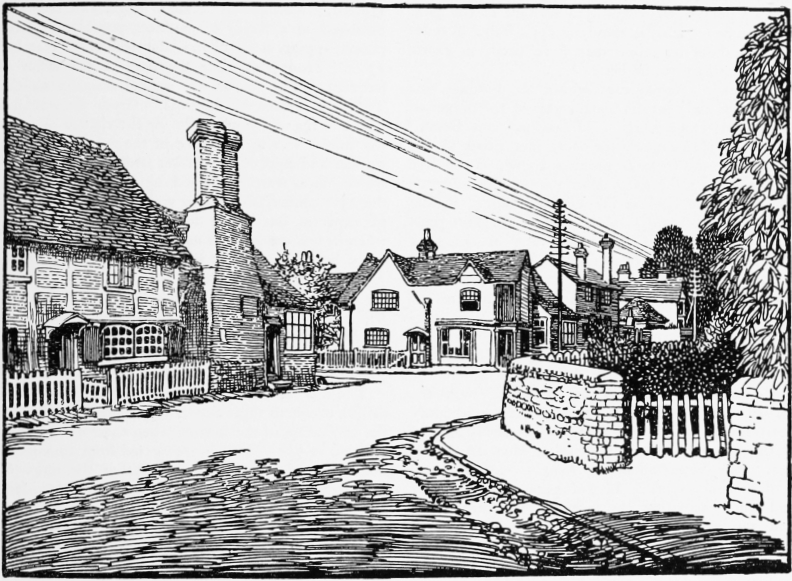
Loudwater Village, High Wycombe, showing Old Chimney
In addition to the advantages entailed by freedom from external jurisdiction and freedom of trade the burgesses enjoyed other special privileges. A case which was brought before the king's court in 1275 furnishes an example. In that year Agnes Godfrey complained that she was unjustly disseised of her free tenement in Wycombe by Nicholas le Vinetur and Maud his wife (fn. 101) and Thomas atte Lude. Nicholas and his wife said that Agnes never was in seisin, but that Thomas son of Richard died seised of it and left it by will to his mother Maud wife of Nicholas le Vinetur, who remained there with her husband after Thomas's death. Agnes on her side said that Thomas died under age and that, therefore, he was not able to make a will, and that she herself entered the said messuage on the death of Thomas as his brother (sic) and heir and was unjustly disseised by Thomas atte Lude. Jurors thereupon are summoned and declare on oath that as Thomas son of Richard Godfrey lay on his death-bed his friends came and made a will, leaving the messuage aforesaid to his mother Maud, and being asked if he consented to such disposition of his property he answered yes. Immediately (aliquantulum) on his death Agnes entered the messuage and remained with Maud for nearly a day and a night until Thomas atte Lude and others ejected her. Being asked the age of Thomas son of Richard Godfrey, they say he was thirteen at the time of his death, but that it is the custom of the vill of Wycombe that anyone aged twelve might bequeath lands by will and also be placed on any assize and jury before any justice or bailiff. (fn. 102) Agnes thereupon withdrew, and she and her pledges (of whom she was unable to find any quia perfidam quia pauper) were in mercy. (fn. 103)
In 1559 an order was made by the common council regarding wills and testaments to the effect that if any burgess dying left his estate to children or kinsmen under fourteen years of age, the executors of his will must find sureties to the mayor and corporation that they would faithfully administer. In default of such surety, the mayor and corporation were to undertake the administration of the estate. (fn. 104)
Perhaps the most ancient privilege of all those enjoyed by the burgesses was right to common pasture in the Rye, (fn. 105) which privilege is exercised by them at the present day.
In 1505 a curious ordinance was made by the mayor and 'whole commonalty' to the effect that when a burgess was committed to ward in the gildhall the door 'schalbe stondyng opyn frely,' in order that the other burgesses 'may have licens to exorte and advise hym to the beste.' (fn. 106)
A view of frankpledge within the borough was among the early jurisdictional rights of the burgesses. It was held twice yearly at Michaelmas and Easter. (fn. 107) Until the 16th century the court met either in the open air in the common meadow known as the Rye or else at the Gildhall. (fn. 108) After the 16th century the meetings were held at the Gildhall only. Besides the solemn half-yearly courts a more frequent portmanmote (fn. 109) was held at least as early as the 13th century. As the gild merchant was co-extensive with the borough, the courts are sometimes called gilds, and are said to be held in the name of the mayor, the bailiff, the gild keepers and the commonalty of Wycombe. It seems likely that the 'buildings of Cnavenethorn' (A.-S. cnihtenthorn = burgess tourn ?) which Alan Basset confirmed to the burgesses in 1226 (fn. 110) may be identified with the earliest mote or gildhall. Save in the confirmatory charters only one further mention has been found of 'Cnavenethorn,' that is in 1361–2, when an annual rent 'in le Newelond of the fee Cnaventhorn' was paid to the mayor. (fn. 111) In connexion with the view and court leet within the borough, the corporation had the assize of bread, wine and ale, and of measures and weights, chattels of felons, waifs, estrays, deodands, treasure trove, &c. (fn. 112)
The mayor, bailiffs and burgesses had also the right to hold a court of pie-powder during the period when any market or fair was being held within the borough. (fn. 113)
The borough had also a court of record, held every three weeks in the 16th century, whose jurisdiction was confined to cases where the value involved did not exceed £40. (fn. 114) This court was discontinued after the 17th century. (fn. 115) A court of quarter sessions was also held within the borough, but did not extend to felonies. (fn. 116) By the charter of incorporation of 1558 and succeeding charters the common council was composed of the mayor, bailiffs and twelve 'capital burgesses' (or aldermen) residing in the borough, in whom was vested power to make laws, dispose of lands, award penalties and otherwise act for the good government and general well-being of the borough. (fn. 117)
The mayor, who is the principal officer of the borough, first appears in the reign of Edward I, and two documents existing among the corporation records enable the date to be fixed approximately. A deed of Ralf Gervis of Wycombe, (fn. 118) which may be dated in the early years of Edward I, is witnessed by Roger Hutred, mayor, and the name of Roger Ouctred, who belonged to a family of clothiers, possibly the same person, appears as mayor in a later deed of 9 December 1302. From this time mention of the office is frequent. The mayor was elected annually on the Thursday before Michaelmas (fn. 119) 'from the counsell howse of the said borghe.' (fn. 120) By the charter of 1558 the mayor was to be justice of the peace, escheator, coroner and clerk of the market within the borough, (fn. 121) which offices were confirmed by later charters. In the 15th century the mayor was allowed nothing for his expenses, but during the 17th and 18th centuries, when he was expected to make a feast on going out of office, he was granted a salary varying from £20 to £50. (fn. 122) At the beginning of the 19th century his costs were defrayed by the town chamberlain, (fn. 123) whilst the Municipal Act of 1836 made no provision for his expenses. By the working of the same Act the election of the mayor is made at present from among the burgesses of the borough.
The most ancient officers in the borough were the bailiffs, of whom there appear to have been three until the institution of the mayor, when their number was reduced to two. They were elected from among the burgesses and shared with the mayor the rights of jurisdiction within the borough. After the Municipal Reform Act of 1835 this officer was abolished.
The aldermen of the borough are not mentioned before the 15th century. (fn. 124) They were elected from among the burgesses (fn. 125) and were by the charter of 1609 limited in number to twelve. (fn. 126) They were also obliged to reside within the borough. The aldermen paid a small fee for admission, which in 1835 was £3 11s. 6d. (fn. 127)
The office of town clerk dates from the 17th century, (fn. 128) when he was elected by the common council, subject to the approbation of the Crown. (fn. 129)
Under the charter of 1558 (fn. 130) a steward was appointed for the borough, whose office was abolished in 1609 (fn. 131) and a recorder appointed in his stead. Thomas Waller was appointed first recorder, (fn. 132) and one of the same family held office in 1695. (fn. 133) Another recorder of High Wycombe was Sir William Lee, the judge, in 1718. (fn. 134) The present recorder is Mr. F. W. Raffety.
The office of serjeant-at-mace was probably as old as that of the bailiff, whose subordinate he was. In the 14th century he received ½d. on the election of a burgess or a gildsman. (fn. 135) He was elected by the common council, and among his duties were to execute processes, summon juries and attend the mayor on state occasions bearing the mace.
Among the lesser officers connected with the corporation prior to its remodelling in 1835 may be mentioned the beadle and town crier, the hayward, whose office—chiefly connected with the common pasture of the Rye—is now in the appointment of the Wycombe Grammar School and Almshouse Foundation, the town chamberlain, the hospital chamberlain, and the toll collectors. (fn. 136) At the present day the borough is governed by a mayor, eight aldermen and twenty-four councillors, and the officers include a town clerk, treasurer, head constable (who is also inspector of weights and measures), surveyor, inspector of nuisances, collector of market tolls, and a town crier and beadle.
In response to the summons to the Parliament of 1300–1 Wycombe sent two members, John de la Lude and Thomas le Taillur. (fn. 137) The borough continued to send two representatives until it was deprived of one by the Reform Act of 1832. (fn. 138) Under the working of the Redistribution of Seats Act of 1885 the representation was merged in that of the county.
The honour of Wallingford claimed the return of writs within the borough, (fn. 139) and in the beginning of the 14th century the Parliamentary returns were made by the bailiff of the honour. (fn. 140) No mention of the honour is made in the returns of the last part of the 14th century, (fn. 141) and from the beginning of the 15th century the Parliamentary returns are made by the mayor and burgesses, (fn. 142) the right being confirmed to them in their charter of incorporation. (fn. 143)
During the 17th and 18th centuries various cases of contested elections occur. In 1660 a double return of Thomas Scot and Richard Brown was made. On inquiry made, the House agreed that the return of Thomas Scot was illegal. The Mayor of Wycombe was brought to the bar of the House to amend the return and insert the name of Mr. Brown in the indenture and was afterwards committed to the serjeant-at-arms for making a false return. (fn. 144) In 1672 another case occurs arising from a by-election caused by the death of Sir John Borlase, bart. (fn. 145) The seat was contested by Sir John Borlase, bart., his son, (fn. 146) and Sir William Egerton. The former was returned and his election was declared by the House to be valid, though Sir William Egerton complained of undue practice, stating that one Mr. Lucas, calling himself mayor, had raised a disturbance and caused a double return to be made. (fn. 147) In 1698 John Archdale, a Quaker, was elected member for the borough, but on his refusal, on grounds of religious scruple, to take the oaths a new writ was issued and Thomas Archdale elected in his stead. (fn. 148)
In 1702 Lord Shelburne complained before the House that the election of Fleetwood Dormer had been secured by the admission of unqualified electors. The right of election was agreed to be in the mayor, bailiffs, aldermen and burgesses not receiving alms, so that the controversy turned upon the manner of making burgesses. Mr. Dormer's counsel admitted the creation of twenty-four burgesses in his favour by the mayor, but the case was nevertheless decided in his favour. (fn. 149) In 1722 Harry Waller, an unsuccessful candidate, presented a petition against the election of Lord Shelburne, which he was subsequently allowed to withdraw. (fn. 150) He stood in a by-election of 1725 and again, and this time successfully, presented a petition against his non-election. On this occasion it was stated that the mayor never came to the place of election, but 'privately retired to a little room in the George Inn kept by an agent of the honourable Charles Collyear, esquire,' the other candidate, and signed an indenture declaring him to be duly elected. The burgesses also presented a petition to the House against this flagrant breach of their privileges, and the election was declared void. (fn. 151) In the by-election which followed both Harry Waller and Charles Collyear stood. The mayor was again found guilty of malpractice in forcing the return of the latter, whose election was once more rendered void and Harry Waller declared to be duly elected to serve in Parliament. (fn. 152)
Wycombe appears to have shared in the general corruption of small boroughs in the 18th century, at the close of which Lord Shelburne is found writing, 'What can you say to a blacksmith who has seven children or to a common labouring man who is offered £700 for a vote, or to two misers who are offered £2,000, which are instances distinctly upon record at Wycombe since Mr. Dashwood's election?' (fn. 153)
Among the names of illustrious persons who have represented Wycombe in Parliament may be mentioned Armagil Wade, 'the English Columbus,' who sat in 1547, Sir Edmund Verney, the standard bearer of Charles I, member in 1640, and Sir Richard Browne, the Parliamentary general in 1641. (fn. 154) Benjamin Disraeli contested the borough twice unsuccessfully in 1832 and 1834. (fn. 155)
Wycombe had a gild merchant, to which all burgesses were eligible to belong, membership passing to the son and heir of a burgess on his father's death on payment of his burgess fees. (fn. 156) There were gild keepers whose office was to regulate trade generally, and there was also a gildhall which, the membership of the gild and the burgess-ship being co-extensive, was used as a general court-house for the borough. (fn. 157) By the charter of 1558 none not of the gild were able to sell or buy flax, wool, thread, skins or hide within the borough. (fn. 158) The claim of Wycombe borough to bear arms was ratified by Harvey Clarenceux at the visitation of Buckingham in 1566. (fn. 159) The number of fullingmills in this parish would alone point to the weaving of cloth as a special industry, but other references have been found to the wool trade in Wycombe. Like members of other mysteries and crafts practised within the borough, the weavers were members of the gild merchant, of which the 'gildani' or gild keepers regulated their trade. (fn. 160) They were accustomed to pay a certain sum for every loom (argoys) working in the borough, which sum early in the 14th century was reduced to 12d. on every loom, probably with the idea of encouraging the trade. (fn. 161) In 1306 sixty pieces of rough web for covering tents were ordered to be bought and purveyed in Wycombe and the neighbourhood. (fn. 162) Flemish weavers appear to have settled here in the 15th century, for in 1425 'John Weizter in Brabayn' was bound apprentice for eight years to 'William Brabayn of Wycombe' to learn the art of weaving. (fn. 163) In 1436 James de Clyff and Joyce de Clyff from Braban and John Caller of Liége were licensed 'to dwell peaceably and enjoy their goods' at Wycombe. (fn. 164)
The rule of apprenticeship was strictly enforced during this and ensuing centuries. In 1510 it was enacted by the mayor with the aldermen and burgesses that no weavers or fullers should practise their craft in the borough unless they had been duly apprenticed 'or brought up in their youth with craftsmen of the same occupation.' (fn. 165) At the same court a fine of £3 6s. 8d. was imposed on any putting out dyeing, fulling or weaving to others than craftsmen of the borough. (fn. 166) This order was repeated in 1560. (fn. 167) In pursuance of this policy of restricting 'foreign' trade within the borough a special tax of 6d. was levied on every foreign loom in 1606, (fn. 168) whilst in 1630 George Bradshaw, a burgess and dyer of Wycombe, paid 20s. yearly to exclude foreign dyers. (fn. 169) In 1660 Charles Elliott and Thomas Dymans, drapers, paid £3 each to be appointed tradesmen with liberty to trade. (fn. 170)
During the 16th and 17th centuries the ordinances for enforcing apprenticeship and for preventing outsiders from trading in the borough save on special terms were numerous and affected all trades. (fn. 171) In 1564 the shoemakers undertook to pay 20s. yearly to the bailiff, it being enacted in return that no foreign shoemaker should sell shoes in Wycombe except on the two fair days. (fn. 172) In 1599 it was ordained that no shoemaker was to keep a stall or sell in the market. (fn. 173) The butcher's trade was also much supervised by the borough authorities (fn. 174); and in 1599 a by-law was passed that no butcher was to have more than one stall in the market or to kill any beast 'unless unchased and undriven for twenty-four hours on pain of 20s.' (fn. 175) In 1577–8 all foreign maltsters were ordered to pay ½d. on every quarter of malt they made, (fn. 176) and this order was repeated in 1606. (fn. 177) The tailors of the borough complained that their trade was interfered with by outsiders in 1610 and agreed to pay 10s. yearly for the privilege of trading. (fn. 178) About the same date the hatmakers and sellers agreed to pay 6s. 8d. yearly to the bailiff, stipulating that henceforward no foreign hatmakers should trade in Wycombe save on fair days. (fn. 179) Richard Saunders, a tanner, paid £3 in 1646 to be admitted a tanner and trade within the borough. (fn. 180) A clause of the Cromwellian charter of 1657 was framed to abolish the seven years' apprenticeship system and to establish freedom of trade without licence, (fn. 181) but it never took effect and entries continue to occur of outsiders paying heavily for the privilege of trading within the borough.
Besides those fairs acquired by the religious houses in Wycombe, others were also held belonging to the borough. First mention is found of such fairs in 1226, when the annual cattle fair was said to be held on the land of Alan Basset, lord of the borough. (fn. 182) In 1558 two fairs of long standing are mentioned. One was held in Easton Street on St. Thomas's Day (7 July) (fn. 183) and the other on the feast of the Exaltation of the Holy Cross (14 September). (fn. 184) In 1663 four fairs were held, on the feast of St. John Baptist (24 June), on 14 September, on 28 October and on the Saturday before Lent. (fn. 185) Horse and cattle fairs were held in April and in October until the latter half of the last century, (fn. 186) but have since fallen into disuse, but a pleasure fair is still held in the town at Michaelmas.
Chepping Wycombe, as its name implies, has always been a market town, (fn. 187) and since the 16th century, if not earlier, the market day has been Friday. The mayor was clerk of the market (fn. 188) and the profits were employed in defraying various expenses; thus in the 17th century a charge of £10 on the tolls went to support the house of correction. (fn. 189)
Like most old market towns Chepping Wycombe has always been well supplied with inns, and several of the signs exhibited in the town to-day are of very ancient origin. Notable among these is the 'Red Lion,' which, itself an ancient building, marks the site of one even earlier. It was originally held by a family of Cok alias Goldfot, of whom mention is found in the adjacent parish of West Wycombe as early as 1312. (fn. 190) In 1482 Robert Cok alias Goldfot died seised of the inn and in 1518 John Cokkes or Cox gave the 'Red Lion' in Wycombe and £120 to Brasenose College, Oxford, to provide two priests, fellows of the college, to preach an annual sermon at Kirtlington, co. Oxford. (fn. 191) That part of the hotel which formed the ancient inn belonged till recently to Brasenose College. (fn. 192)
Another ancient inn called the 'Antelope' was erected about 1480 and stood on the site of two others even more ancient, the New Inn and the 'Saracen's Head.' (fn. 193) In 1587 it belonged to Robert Ranner. (fn. 194) The 'Green Dragon,' which has disappeared, was held in 1605 by Christopher Wase (fn. 195) and in 1643 by his son Christopher. (fn. 196) In 1623 the 'ale houses' in Wycombe were reduced from twenty-one to nine (fn. 197) and in 1636 the taverns in the town are given as the 'Lyon,' the 'Nagshead' and the 'Katherine Wheel.' (fn. 198) The last-named, which stood opposite the 'Red Lion,' was burnt down in 1780 and the porch of the Haywards House is said to have originally formed the entrance to this inn. (fn. 199) The 'Falcon' (mention of which is found in the 17th century), (fn. 200) the 'Crosskeys,' the 'White Hart,' and the 'Wheatsheaf' are other ancient inns.
MANORS
At the Survey Robert de Oilgi held WYCOMBE MANOR, assessed at 10 hides, in right of his wife, (fn. 201) who according to later documents (fn. 202) was the daughter of Wigod de Wallingford. Brihtric had held it under the Confessor. (fn. 203) Maud daughter of Robert Doyley, to whom the manor next passed, married twice, first Miles Crispin, (fn. 204) and secondly Brian Fitz Count, with whom she held the manor under King Stephen. (fn. 205) They had no children and both embraced the religious life, whereupon their lands came into the hands of Duke Henry, afterwards Henry II. After his coronation Wycombe was held by Wigan of Wallingford, (fn. 206) apparently nephew of Brian Fitz Count, (fn. 207) until Wigan's death about 1156, when it was seized by the king and retained in his hands for the remainder of his life. (fn. 208) In 1171 Thomas Basset appears to have obtained a life grant of the manor, (fn. 209) which he held until 1179, (fn. 210) when he was succeeded by Gilbert Basset, (fn. 211) whose kinsman Alan Basset in 1203 received a permanent grant of Wycombe (except the part held by Robert Vipont treated of later under Temple Wycombe Manor). (fn. 212) This grant represents the manor of BASSETS BURY, which was held of the honour of Wallingford by one knight's fee. (fn. 213) Alan Basset received a confirmation of this grant in 1229 (fn. 214) and died in 1231, in which year his son Gilbert Basset paid a fine for entering into possession of his father's lands. (fn. 215) Gilbert married Isabella daughter of William de Ferrers, who survived her husband twenty years. (fn. 216) He died c. 1241 without issue, and Wycombe passed to his brother and heir Fulk Basset, at this time Dean of York. (fn. 217) Philip Basset, a younger brother, appears to have acquired an interest in Wycombe at the same time, for during Fulk's tenure of the manor his name appears in various suits concerning small portions of land in the parish. (fn. 218) In his lifetime Fulk granted 6 marks of annual rent in Wycombe called 'Eltres' to Alina his granddaughter in marriage with Robert Butevileyne. (fn. 219) Fulk, who became Bishop of London in 1241, (fn. 220) died in 1259 and was succeeded by Philip Basset, his brother and heir. (fn. 221) Philip Basset died in 1271, (fn. 222) when his heir was his daughter Alina, widow of Hugh le Despenser and wife of Roger Bigod Earl of Norfolk. (fn. 223) Ten years later, at her death, Hugh le Despenser, her son, entered into possession of her Wycombe property. (fn. 224) Hugh le Despenser held the manor until 1326, (fn. 225) in which year he was executed for high treason and Wycombe reverted to the Crown by attainder. In 1327 Queen Isabella received a grant of the manor (fn. 226) and in 1331 John de Shobenhanger paid £62 to the Crown for its custody. (fn. 227) In the latter year it was granted to Thomas Earl of Norfolk, (fn. 228) who in 1332 surrendered the manor and town to William de Bohun Earl of Northampton, (fn. 229) his nephew, to whom he made a further quitclaim in 1336. (fn. 230) William de Bohun enfeoffed the Archbishop of Canterbury and others of Wycombe Manor and lands elsewhere in 1346 in order to secure a settlement on himself and his heirs with reversion to the king. (fn. 231) He died in 1360 (fn. 232) and was succeeded by his son Humphrey de Bohun, on whose death in 1373 two daughters, co-heirs, Eleanor and Mary, succeeded to his estates. (fn. 233) Wycombe, which was held for life by Humphrey's widow Joan, (fn. 234) came to Mary wife of Henry later Duke of Lancaster, of whose duchy it henceforward formed part. (fn. 235) On 30 September 1399 he became King of England under the title of Henry IV and his honours were thus merged in the Crown. Wycombe Manor was assigned as part of the dower of Katherine mother of Henry VI in 1422. (fn. 236) William Earl of Suffolk was appointed steward of the manor, which begins to be called Bassets Bury in 1437. (fn. 237) It remained in the duchy of Lancaster until 1483, in which year it was granted to the Dean and canons of St. George's, Windsor, (fn. 238) by whom it was retained until the latter part of the 19th century, when it became vested in the Ecclesiastical Commissioners.

Basset. Barry wavy argent and azure.

Despenser. Argent quartered with gules fretty or with a bend sable over all.

Duchy of Lancaster. ENGLAND with a label of FRANCE.

St. George's, Windsor. Argent a cross gules.
From the 16th century onwards the dean and chapter were accustomed to lease the manor, and among the lessees may be mentioned Lord Windsor in 1574 (fn. 239) and Robert Raunce, followed by his sons John and Robert, holding in the latter part of the 16th and the beginning of the 17th century. (fn. 240) John Logan was lessee in 1679 (fn. 241) and the names of Althea, Mary and Elizabeth Logan occur in 1682. (fn. 242) Sir Orlando Gee rented the manor between 1691 and 1717, (fn. 243) in which year Sir Francis Dashwood acquired the lease, (fn. 244) which remained in the Dashwood family until the close of the last century, when, the lease falling in, the manor reverted to the Ecclesiastical Commissioners.
The next manor in importance in this parish is that of TEMPLE WYCOMBE, which was held of the honour of Wallingford, (fn. 245) and originally formed part of the manor held by Robert Doyley at Domesday. This manor appears to have been divided at the time of King John's grant to Alan Basset in 1203, when one-half of the manor, to be known later as Temple Wycombe, was reserved to Robert Vipont. (fn. 246) It remained in his possession until 1227, shortly before his death, when he granted all his lands in Wycombe 'with his body' to the Knights Templars, (fn. 247) and the following year the constable of Wallingford was ordered to allow the Templars to hold in peace. (fn. 248) In 1246 Reginald de Alneto acknowledged the right of Robert de Sandford, then master of the Templars, to suit of court from himself and his tenants in Wycombe. (fn. 249) At this time the manor was held by the service of one knight's fee. (fn. 250) In 1307 the order of the Templars was suppressed in England, (fn. 251) and Temple Wycombe Manor, as did most of their possessions, passed to the Knights Hospitallers, after remaining for a short time in the possession of the Crown. (fn. 252) In 1310 Michael atte Grene is found complaining that he had enfeoffed the late master and brethren of 60 acres of land and 8 of meadow in Wycombe to provide for his maintenance, and that when their possessions were seized by the sheriff not only was this land taken, but 20 acres of land and 5 of wood belonging to him which had never formed part of the grant to the Templars. (fn. 253) This land was accordingly restored to him. In 1324 Michael was still receiving from the Exchequer for his maintenance 3d. daily for his food, 10s. yearly for his robe and 5s. yearly for his summer tunic. (fn. 254) In 1345 the Hospitallers petitioned for and obtained a recognition of their right to land which Michael atte Grene had granted to the Templars. (fn. 255) The manor was held of the honour of Wallingford in 1346, (fn. 256) and was then worth 18 marks. (fn. 257) The Hospitallers continued to hold Temple Wycombe until the Dissolution, when it was valued at £38 14s. 5d. (fn. 258) It was retained by the Crown until 1553, when it was granted to John Cock and John Thurgood. (fn. 259) Between this date and 1585 it was transferred to Robert Raunce. (fn. 260) He died seised in 1585, when by the provisions of his will Temple Wycombe was settled in trust for his wife Anne and his second son Robert with remainder to his eldest son John. (fn. 261) It appears in the tenure of John Raunce in 1610, who then made a settlement in conjunction with his wife Judith and his son Robert. (fn. 262) John Raunce died in 1621 and Temple Wycombe then passed to Robert. (fn. 263) He made a settlement of the manor in 1624, (fn. 264) probably preparatory to an alienation which took place about this date (fn. 265) to Richard Archdale, whose name with that of his son Thomas occurs in a further settlement in 1634. (fn. 266) He died in 1638 (fn. 267) and fifty years later John Archdale, his grandson (fn. 268) and son of Thomas, held the manor. (fn. 269) John Archdale, who was a Quaker, was for some time Governor of North Carolina. (fn. 270) He made a settlement of his Wycombe property in 1678 (fn. 271) and again in 1688. (fn. 272) In 1700 together with Thomas Archdale, possibly his son, (fn. 273) he finally alienated his estate in this parish to Henry Petty Lord Shelburne. (fn. 274) He died in 1751 and was buried at Wycombe. (fn. 275) His estates passed to his nephew John Fitzmaurice, (fn. 276) who assumed the name of Petty and was raised to the peerage as Earl of Shelburne (in Ireland) in 1753 and created Lord Wycombe, Baron of Chepping Wycombe, in 1760. (fn. 277) He died in the following year, and the manor then passed to his eldest son William, (fn. 278) who in 1784 was created Viscount Calne and Calston, Earl Wycombe of Chepping Wycombe and Marquess of Lansdowne. (fn. 279) His son John Henry Petty, who between 1784 and 1805 is styled the Earl of Wycombe, (fn. 280) suffered a recovery of Temple Wycombe Manor in 1788. (fn. 281) In 1799 and again in 1802 he made a conveyance of the manor by fine to John Wilmot and Sir Francis Baring, bart. (fn. 282) A further settlement is found in 1805, (fn. 283) when John Henry Petty succeeded to the title and estates of his father, (fn. 284) who died and was buried at Wycombe. (fn. 285) Soon after the manor was purchased by Lord Carrington, whose grandson the Marquess of Lincolnshire, K.G., is at present lord of the manor.

Petty. Ermine a bend azure with a magnetic needle pointing to a polar star thereon.

Fitzmaurice. Argent a saltire gules and a chief ermine.

Carrington, Marquess of Lincolnshire. Or a cheveron cotised between three demi-griffons sable with a molet gules for difference.
There was also a manor in this parish known as ANGOTES FEE alias CHAPEL or WINDSOR FEE. It was attached to the honour of Wallingford, (fn. 286) and appears to have formed part of the original endowment of the college or free chapel of St. Nicholas in the castle of Wallingford founded by Miles Crispin, who died in 1107. (fn. 287) Earliest mention is found of the college holding in Wycombe by name in 1225, when Ralph de Norwich, Dean of Wallingford chapel, claimed in free alms land held here by Hugh Faber and others, amounting in all to 5 virgates. (fn. 288) Three years later he was convicted of having made false oaths before the justices itinerant in this case and 2 virgates were restored to their original owners. (fn. 289) An undoubted early tenant of the college was one Angod, from whom the manor derived its distinctive name. In 1185 Robert son of Angod, who was son of Anketel, was thirteen years of age and in the custody of his mother Maud daughter of Robert de Havechford, who paid 40 marks for his guardianship. (fn. 290) He had three brothers and four sisters, of whom the eldest was sixteen. His property, which he held by service of half a knight's fee, was worth 100s. and included a mill and 3½ acres of burgage land for which he paid 6½d. (fn. 291) The family reappears in 1237, when Alan Basset granted in his charter to the borough the rent of 4s. which Geoffrey son of Angod used to pay him, (fn. 292) and about the same date the 'heirs of Godfrey Ansgod' paid 1 mark for half a fee of the honour of Wallingford. (fn. 293) Alice daughter of Geoffrey held land here in 1248, (fn. 294) and granted fish-ponds outside the borough which had descended to her by inheritance to Sir Philip Basset. (fn. 295) In 1291 the dean of the college was assessed at 4s. In Wycombe. (fn. 296) Angot's Fee is mentioned by name in 1299 and again in 1378 as attached to the honour of Wallingford, (fn. 297) whose Court Rolls, preserved for Wycombe between 1422 and 1546, also contain references to this property. (fn. 298) In 1530 a steward was appointed for the manor, here so called for the first time. (fn. 299) The college of Wallingford was suppressed in 1548, (fn. 300) and the Wycombe endowment appears to have been shortly after granted by the Crown to Lord Grey and John Bannister, who in 1550 obtained royal licence to alienate the manor to George Wright and Eustace Moon. (fn. 301) In the same year the last-named were again licensed to alienate to John and Robert Raunce. (fn. 302) The latter also acquired Temple Wycombe Manor (q.v.), with which the history of this property is henceforward identical.
A further estate known as GYNAUNTS FEE was attached to the honour of Wallingford, and appears to have included one of the six mills attached to Wycombe in 1086. First mention is found of it in 1171–2, when Thomas de Wycombe paid 13s. 4d. into the Exchequer for marrying the widow of 'Gynan' and having custody of his children. (fn. 303) In 1185 Ginant's son and heir Ellis was seventeen years of age, and was still a ward of the king, Alexander Medar having acted as guardian for eight years. (fn. 304) Ellis had two sisters, aged eighteen and fourteen respectively, and his property in Wycombe was worth 3 marks, without counting the stock, and was held by service of one-fifth of a knight's fee. (fn. 305) Maud widow of Ginant of Wycombe and wife of Thomas 'Ginant' was still alive in 1199, in which year she conveyed her life interest in one-third of a mill in Wycombe to Walter de Penn. (fn. 306) About the same date, or a little previously, (fn. 307) Ellis 'Gynaunt' made a grant to Missenden Abbey of his mill at Wycombe called 'Gwynauntes mulne' with the appurtenances 'as the water divides Frieneth from the corner of the Upper Mill Croft down to the bridge below the said mill.' He also gave to the abbey the meadow of Bulleswell and other lands. (fn. 308) He does not appear to have relinquished all his lands in Wycombe, for the name of William D[G]inant is returned for one-fifth fee held of the honour of Wallingford in Wycombe about the year 1235. (fn. 309) Edmund Earl of Cornwall, as holder of the honour, received rent from 'Fee Genant' previous to his death in 1291, (fn. 310) and it is mentioned in the courts of the honour held between 1422 and 1458. (fn. 311) The mill may be identified with that formerly belonging to Mr. Henry Wheeler at Wycombe Marsh, (fn. 312) and now the property of Messrs. Reid & Co., (fn. 313) whilst Ginions Field Farm, with house, cottages and gardens, amounting in all to some 90 acres, represents the remainder of the estate. It is also in Wycombe Marsh, and was acquired some time previous to 1878 by the Wycombe Municipal Charity Trustees. (fn. 314)
Besides the mill mentioned above, Missenden Abbey received various small grants in Wycombe during the 12th and 13th centuries; among its benefactors may be named Mabel daughter of Siward, William son of Hervey, Robert of Rouen and Walter his son (fn. 315) and Simon Hochede. (fn. 316) In 1273 the Abbot of Missenden and Nicholas le Taverner made a settlement by which Nicholas was to retain two messuages in Wycombe for life at a rent of a clove gillyflower paid to the abbot at Easter. (fn. 317) On his death the messuages reverted to the abbot. (fn. 318) The true story of this settlement appears some years later in the Quo Warranto rolls of 1286. In that year the king's attorney, Gilbert, claimed a messuage formerly belonging to Nicholas 'de Vynetur' against the abbot. Gilbert said that Nicholas was a Norman and that on his death his lands escheated to the Crown. The abbot quoted the above settlement and said Nicholas was only a life tenant, but Gilbert declared that the abbot had intruded and that he could prove that Nicholas had continued his possession by himself, his wife and his servants. The sheriff was enjoined to form a jury to try the cause composed of twelve men of the neighbourhood and twelve from Wycombe itself, none of whom were to be connected with the abbot. At this stage the mayor and bailiffs protested that this was an infringement of their liberty and that inquiries concerning land in Wycombe ought to be made before a jury composed of burgesses only. Ultimately the jury was formed, composed of seven burgesses and five foreigners, 'thus saving to them their liberty.' The result of the inquiry showed that Nicholas was a Norman and that he purchased the messuage of Alice la Peynture. Afterwards he had a corrody in Missenden Abbey and was detained there by sickness. While sick he made the grant, apparently under compulsion, quoted by the abbot, who thereupon sent Reginald de Chovel, one of the canons, to Nicholas's tavern to enter into possession. On arrival Reginald found the wife and family there, and in order to get rid of them sent the wife out to buy fish. On her return she found herself shut out, but forced an entry by means of a ladder placed against a window, and remained in the house till Nicholas, recovered from his illness, returned and repudiated the charter. In view of this evidence the messuage was declared to be Crown property. (fn. 319) In 1291 the Abbot of Missenden's lands were assessed at £3 5s. 6d. (fn. 320) They were confirmed to him in 1401, (fn. 321) and in 1426 his free warren was said to extend into Newlands, Wycombe. (fn. 322) At the Dissolution the Missenden property in Wycombe had sunk in value to 27s. 4d. (fn. 323) Nothing further has been found concerning the abbey's property, which was possibly included in the post-dissolution grant of Temple Wycombe Manor.
In addition to the church the Abbess of Godstow appears to have claimed a RECTORY MANOR here which was held of the honour of Wallingford. (fn. 324) In 1222 Alan Basset, lord of Wycombe Manor, acknowledged the right of the abbess to meadows in Wycombe, she in return promising to remember him in all future orisons at Godstow. (fn. 325) In the same year (1222–3) a more serious suit was instituted between the same parties concerning the feudal obligations of Godstow tenants in Wycombe. Alan Basset had sought to force them to pay market dues, to contribute towards the fee-farm rent of the town, to serve as ale-tasters and to forfeit their manure if left in the street. (fn. 326) By this settlement they were to continue to serve as ale-tasters and to pay fines for breach of market rules, but were to be allowed to leave their manure in the street for one night, after which it became the property of the lord of Wycombe. They were to take their share of any tallage levied by the king, but were not to be responsible for the fee-farm rent. (fn. 327) By his charter of 1237 Alan Basset transferred to the burgesses the rents and customs due to him from the abbess's men. (fn. 328) During the 13th century numerous grants of lands and rents in Wycombe are recorded in the cartulary of the abbey. (fn. 329) In 1255 the abbess claimed to hold a view of frankpledge in Wycombe, by what warrant was not known. (fn. 330) In 1291 her lands were valued at a little under £4. (fn. 331) In 1331 she leased the rectory and manor (here expressly so called) to John Coleman and Robert atte Wall for a term of ten years. The rent was to be 4 marks and four shillingsworth of cakes presented to the abbess at the feast of St. James. (fn. 332) The abbess's temporalities in Wycombe appear to have decreased during the next century, being assessed at 13s. 4d. only in 1439. (fn. 333) At the Dissolution William Green, farmer of the rectory, valued it, together with all lands and rents belonging to the abbess, at £16, from which sum 6s. 8d. was due to the bailiff of the honour of Wallingford and 15s. 8d. to the bailiffs of the town. (fn. 334) No further trace has been found of the manor.
In 1482 Robert Bardsey died seised of LOAKES MANOR, of which no previous mention has been found. (fn. 335) It was attached to the honour of Wallingford, and passed to Robert's son and heir Edward Bardsey. (fn. 336) He married Aubrey daughter of Sir William Fielding, (fn. 337) and their son Thomas, dying young, appears to have been succeeded by his uncle Peter, son of Robert Bardsey. (fn. 338) In 1516 Thomas Clerk, who had recently purchased from Peter Bardsey, sold Loakes Manor to Robert Astbrook. (fn. 339) His will, proved in 1534, does not mention Loakes by name, though he leaves to his wife Clement the house and appurtenances 'late purchased of Thomas Clerk.' (fn. 340) Among those benefiting under his will were Henry and Roger Bennett, sons of his daughter Jane, Clement Buknill wife of Robert Bennett, and William Astbrook and Joan his wife. (fn. 341) For more than fifty years no trace has been found of the manor, which reappears in 1604–5 as the property of William Jackson and Martha his wife. (fn. 342) At that date they conveyed it to Robert Bromley and Edward Bold, who in 1605, together with John Raunce and Robert Raunce, sen. and jun., alienated it to Richard Archdale. (fn. 343) In 1638 Richard Archdale died seised of 'a manor or farm and capital messuage called Loakes and a close lately surrounded with a stone wall.' (fn. 344) This property has since followed the descent of Temple Wycombe Manor (q.v.), and Wycombe Abbey, built in 1795, stands on the site of the ancient manor-house. (fn. 345)
In 1502 one Abraham Sybell died seised of an estate held of the honour of Wallingford and called Wycombe Manor. (fn. 346) He left as heir his son Isaac Sybell, who appears to have sold this property to Robert Astbrook, owner of Loakes Manor (q.v.), in which it became merged. (fn. 347)
Certain lands and woods in the parish were known as FENNELS, and their situation can be identified by Fennells Wood in the south of the parish. The name is derived from the family of Fitz Nigel or Fitz Neel, by whom they were held in the 13th century. In 1283 Roger Taylor of Little Marlow conveyed lands in Wycombe to Robert Fitz Neel, (fn. 348) who in 1299 received a grant of free warren, which extended into this parish. (fn. 349) In 1331–2 Robert Fitz Neel, probably a son of the above, died seised of this property, which was then held of the Prior of St. John of Jerusalem. (fn. 350) It then passed to his daughter Grace wife of John de Nowers, (fn. 351) after whose death in or about 1349 it passed to William de Irtlingburgh in trust for her son Robert, who was said to have 'lost his memory.' (fn. 352) In 1369 John, another of her sons, transferred this land to the king, Ingram de Coucy Earl of Bedford and Isabella his wife, the king's daughter. (fn. 353) It was in the royal possession in 1392, when John Hoggedish was commanded to fell the queen's underwood in 'Fenelgrove by Wycombe.' (fn. 354) Ten years later it formed part of a grant confirmed in 1416 to John afterwards Duke of Bedford. (fn. 355) It appears to have afterwards been acquired by the Hospitallers, (fn. 356) who had claimed rights of overlordship earlier. It is included in an extent of their possessions made about 1548, and was then leased at a rent of 20s. for twenty-nine years to John Bracebridge. (fn. 357) After the 16th century the descent of this property becomes obscure.
An estate in Wycombe known as ASHWELLS dates from the 13th century, and still gives its name to a farm in the north of the parish. Like the rest of the parish it was attached to the honour of Wallingford, (fn. 358) the last mention of the overlordship being found in 1645. (fn. 359)
In 1234–5 Stephen de Eswelle or Ashwell paid 5s. 4d. for a fee in Wycombe, (fn. 360) and the following year Basilia de la Penne acknowledged his right and that of his wife Aubrey to the reversion of 30 acres in Wycombe on her death. (fn. 361) In 1250 Stephen entered into an arrangement with his son John and Alice his wife by which Stephen and Aubrey held a carucate of land and 56s. rent here for life, with reversion to John and Alice, who in return gave a sore sparhawk. (fn. 362) Stephen de Ashwell was still living in 1261–2, (fn. 363) but before 1302 had been succeeded by John de Ashwell. (fn. 364) William his son (fn. 365) leased his lands in Wycombe for a term of years in 1319, (fn. 366) and in 1332 some of his lands appear to have passed to Adam son of Thomas Wace. (fn. 367) William de Ashwell had a daughter Margery, who married John Leche of Beaconsfield, who in 1354 is found disputing the right of Richard Drew to this land, (fn. 368) which Drew had held certainly since 1346. (fn. 369) Nothing more has been found concerning this estate until the early 16th century, when a Chancery suit took place between Christopher son and heir of Elizabeth, formerly wife of William Wollaston, and John Wase (who cannot be considered in any way connected with the Adam Wace of 1322) and Roger Brampton. (fn. 370) Christopher here claimed that John Wase had acquired possession of the messuage which should have descended to him through his mother and also of the title deeds, and so he was unable to prove his rights. (fn. 371) John Wase may, however, be connected with Christopher Wase, who in 1580–1 made a settlement of his 'capital messuage' and land called Ashwells on the occasion of his marriage with Ann daughter of William Prettiman of Bacton, co. Suffolk. (fn. 372) She retained Ashwells for life according to the terms of this settlement, and in 1620–1 their son Christopher Wase entered into possession. (fn. 373) He married Judith daughter of John Clerkenwell, who survived him. (fn. 374) He died in 1643, when his co-heirs were his daughters Hester wife of William Mainwaring, aged seventeen, and Judith Wase, aged ten years.
One of the most considerable woods in this parish, known as St. John's Wood, was, as its name implies, formerly part of Temple Wycombe Manor. When the manor was granted to Robert Raunce the wood was not included, and he is found complaining about its exclusion. (fn. 375) He petitioned the queen to have 'tender pythy to a maymed soldior now uppon greate extreme and utter undoinge' who had been 'servisable in warrfare' both to herself and to Edward VI. In spite of his clear right, according to the recorder, the verdict, owing to the 'frowerd Dealings of some of the Jurye,' went against him and the wood remained Crown property. (fn. 376) In a survey of 1655 it was said to contain 275 acres and to lie in common to seven townships—Great and Little Missenden, Wendover, Amersham, Hughenden, Wycombe and Penn—all of which had the right of cutting wood there. (fn. 377) It was at this time leased for £45 yearly to Sir Robert Johnson, who had held it since 1620 on a sixty-year lease. (fn. 378) At the close of the 18th century it appears among Crown lands, and was then rented by Sara Floyd for £60. (fn. 379)
In 1258 the Prioress of Marlow owned three shops in Wycombe, (fn. 380) and at the Dissolution the priory lands here were worth 25s. 1d. (fn. 381) They were granted in 1540 to John Tytley and Elizabeth Restwold. (fn. 382)
In 1511 Eton College received a grant of land here, (fn. 383) said to be worth 107s. at the Dissolution. (fn. 384) In 1291 Nutley owned lands assessed at 5s. 8d., and at the same date Merton Priory was assessed at £1. (fn. 385)
The mills in Wycombe have always been numerous and important. At Domesday there were six water corn-mills attached to the manor, which were worth 75s. yearly. (fn. 386) Of these six one was subsequently attached to Angotes Fee (q.v.), and was known as the Bridge Mill. (fn. 387) Its site is to be identified with that of the mill now No. 1 St. Mary's Street. A second mill formed part of Gynaunts Fee (q.v.), and its position at Wycombe Marsh can also be identified. (fn. 388) A third of the Domesday mills was known as Pannells or Pann Mill, which name is still borne by a mill on the north-west of the Rye. It probably belonged to a family in this parish called Pinel, mentioned in 1185, when the widows of Roger and David Pinel held half a hide in dower in Wycombe. (fn. 389) In 1235 Richard of Croyedene held this mill, (fn. 390) and in 1344 Adam de Martham granted 'two water-mills under one roof called la Pennell in Wycombe' to Sir Hugh de Neweton. (fn. 391) It appears to have been attached to Temple Wycombe Manor, for it is given among the possessions of the Hospitallers at the Dissolution. (fn. 392) In 1558 it was decreed by the common council that the miller of Pan Mill was not to be allowed to pasture any horse in the Rye unless such horse was used in the service of the town, (fn. 393) for, like the Bridge mill, Pann Mill was outside the borough and was assessed parochially. (fn. 394) Christopher Wase, who held lands late of the Hospitallers elsewhere, died seised of this mill in 1605 (fn. 395) and his son Christopher in 1643. (fn. 396) Of the remaining water-mills one was granted by Mabel daughter of Siward, c. 1200, to the Abbess of 'Godstow, (fn. 397) who five years later alienated it to William son of Hervey, (fn. 398) who held the 'Burne Mills' here in 1235. (fn. 399) A fifth water-mill was attached to the demesne of Bassets Bury Manor and is mentioned in various extents of the manor. (fn. 400) It was held of the lords of the manor by Richard de Sobinton and Thomas his son in the 13th century. (fn. 401) The sixth and last mill mentioned in 1086 appears to have been attached to Temple Wycombe Manor. (fn. 402) At the Dissolution it was granted to Thomas Keate, from whom it passed to his son Sebastian, with a life charge of £6 13s. 4d. annually to his widow Joan. (fn. 403) In 1588 they alienated it to Michael Barker, (fn. 404) and by 1637–8 this mill had passed to William Martin, who then died seised. (fn. 405)
As would be expected from the connexion of Wycombe with the woollen trade, fulling-mills (which like the corn-mills were driven by water power) are found here quite early. The principal, which was held of Bassets Bury Manor, is sometimes called 'Robyn Mill,' (fn. 406) from a very early 13th-century holder, for Henry Chesemonger already held it in 1235. (fn. 407) In 1250 Sebricht the Carpenter and Joanna his wife with Walter le Fuller and Parnel his wife acknowledged the right of Philip Basset, their overlord, to a rent of 3 marks for two parts of this mill. (fn. 408) In 1254 William de Pudregge released to Sir Philip Basset the mill 'formerly William Robyns,' which came to him as the dower of Albrea his wife. (fn. 409) A year later Philip transferred 'the moiety of the mill that was William Robyn's in Wycumbe with all the water course in the pool thereto belonging' to Richard son of John Fuller, (fn. 410) and a family of Fullers continued to hold in Wycombe during the 14th century. (fn. 411) In 1420 the fulling-mill is called 'Hochedes Mille,' (fn. 412) which implies that the family of Hochede, who were settled in Wycombe from the earliest years of the 13th century, (fn. 413) had at some time farmed the mill.
Another fulling-mill, at Loudwater, belonged later to the Templars. (fn. 414) It belonged to a family of La Lude, of whom first mention has been found in 1250, when William de la Lude conveyed a messuage in Wycombe to Andrew Crok, who gave him a sore sparhawk. (fn. 415) In 1253 the same William demised lands to Philip Basset for a term of twenty-one years. (fn. 416) A little later Philip Basset granted to Thomas de la Lude permission to build a fulling-mill. Thomas was to pay 1 mark yearly rent, and at no time were cloths made in Wycombe (that is to say, in the borough) or delivered to be fulled there to be received into the said mill. (fn. 417) Thomas de la Lude is later said to hold two water-mills (probably under one roof), (fn. 418) which in 1337 were leased by John de la Lude to Richard de Wegenholt for life. (fn. 419) They were temporarily confiscated for felony between 1336 and 1340. (fn. 420) Further alienation must have taken place, for in the 16th century this mill reappears in the possession of the Hospitallers, who held a manor adjacent. It was held of them by Edward Case, clothier, and is described as 'Ludewater Mylne at West Wicombe,' with all walls, banks and waterworks belonging to it, with free fishing from the king's highway on the east to the Over King's Mead. (fn. 421) It was subsequently attached to Temple Wycombe Manor (q.v.).
The Hospitallers had also a second fulling-mill called Gosham or Goscnham attached to their manor, of which mention is first found in 1403. (fn. 422) At the Dissolution it was held by John Carter on a sixty-one years' lease, (fn. 423) and follows the descent of the manor (q.v.).
In the 17th century the paper-making industry was started in Buckinghamshire, and various paper-mills were begun in this parish at Loudwater, and the neighbourhood, as is related elsewhere. (fn. 424) In 1638 mention is made of 'a paper-mill called Loudwater Mill, newe built, let for £50,' and attached to Bassets Bury. (fn. 425)
CHURCH
The church of ALL SAINTS consists of a chancel measuring internally 50 ft. by 20 ft. with east extension 7 ft. deep by 16 ft., north chapel 50 ft. 6 in. by 24 ft., south chapel 46 ft. 6 in. by 24 ft., nave 113 ft. by 24 ft., north aisle 111 ft. by 21 ft., east bay 23 ft., south aisle 112 ft by 21 ft., south porch 11 ft. 6 in. square, and west tower 17 ft. 6 in. by 16 ft. 6 in.
The present plan has probably been developed from that of a 12th-century cruciform church with a central tower. The chancel and nave of this earlier building appear to have been lengthened late in the 13th century, when the north chapel was added to the chancel and the transepts were embodied in the aisles which were added to the nave; the south porch is also of this date. (fn. 426) A further enlargement was made late in the 14th or early in the 15th century by the addition of a chapel on the south side of the chancel, and about 1450 a considerable alteration was effected in the nave by rebuilding both arcades with the addition of a clearstory and by heightening the walls of the aisles in order that they might be reroofed at a flatter pitch than formerly. (fn. 427) The present western tower was begun about the same time, but it probably remained unfinished for a considerable period. About 1500 new arcades were inserted in the walls between the chancel and the north and south chapels, the latter of which was practically rebuilt. The demolition of the old tower took place in 1509–10, (fn. 428) necessitating the insertion of another bay at the east end of each arcade of the nave and the rebuilding of the chancel arch. The eastern extension of the chancel probably dates from a few years later. The church was restored internally by G. E. Street in 1873–5, and the exterior was extensively repaired, much of the old masonry being renewed, in 1887–9 under the supervision of Mr. A. M. Mowbray and Mr. J. Oldrid Scott. The walling of the body of the building is of flint and stone with stone dressings and the tower of ashlar; the roofs generally are covered with lead, but the chancel roof is tiled.
In the east wall of the chancel there was formerly a window which is reported to have been of similar design to the windows of the south chapel, but which was replaced in 1873–5 by the present window. The north and south arcades are each of four bays, and have four-centred arches springing from piers with engaged shafts having moulded capitals and bases. The chancel arch is pointed and of two orders; its responds appear to be mainly composed of stones of an earlier date which have been re-used.
In the east wall of the north chapel there is a five-light window of c. 1500. The external masonry of the four 13th-century windows in the north wall has been renewed; the windows are each of two lights beneath a pointed head containing a cinquefoiled circular light, and the attached shafts to the jambs and mullions have moulded bases and capitals except those of the westernmost, which have carved capitals. The second window from the east is covered internally by a large monument. The late 13th-century archway to the north aisle has clustered responds with moulded capitals and bases and is of three orders with a label on either side. Externally the south or 'Bower' chapel has an original embattled parapet; the window in the east wall is of the same character as the corresponding window of the north chapel. The four windows in the south wall, the second of which is also closed by a monument, are each of four lights. In the west wall is an arch similar in detail to the chancel arcades, but with responds of simpler design and with no capitals.
The arcades of the nave are each of seven bays, the easternmost of which are of greater width than the remainder and have pointed arches of two orders springing from responds which have attached shafts with moulded bases and capitals. The remaining arches are four-centred and of the same number of orders springing from pillars which vary but slightly in detail from those of the chancel arcades; all the arches have moulded labels on each side, and the line of junction between the building of the two periods can be clearly seen in the walling. There are eight clearstory windows in each wall, each of two lights beneath a pointed traceried head; the external masonry of all of these has been much restored. There was formerly a two-storied building at the north-west of the north aisle, a loop to which and an upper and a lower doorway, probably of 13th-century date, still remain, but are now blocked; the small recess on the external face of the wall was formerly in this adjunct. At the east end of the north wall is the original window of the former transept; it is of three lights, modern externally, and has modern tracery. The shafted jambs and mullions have moulded bases and carved capitals. The wall contains in addition four windows of similar detail to the windows in the north wall of the north chapel, two doorways of the same period, all of which are entirely modern externally, and two recesses, also of the 13th century, one of which has a moulded head and a label and the other part of a similar head. The string-courses on this wall at the level of the sill and springing of the windows are continued on the west wall at a higher level. The three-light west window is modern externally, but has shafted jambs of 13th-century date.
The former south window of the transept, beneath which is a modern doorway, remains in the south aisle and resembles the corresponding window in the north aisle. In addition there are in the south wall five windows of similar detail to those in the north wall of the north chapel, two are entirely modern and the rest modern externally. The south doorway is original and has a pointed arch of two moulded orders and jambs with attached shafts having carved capitals; to the west of it at a higher level is the door which formerly gave access to the parvise, and to the east of it some remains of a stoup, probably of 16th-century date. The west window is of three lights, like the corresponding window of the north aisle. To the west of the easternmost window in the south wall and some distance from the floor there is an original trefoiled lancet which was formerly blocked. It probably gave light to a former roodloft, and is said to have been closed with a shutter or casement, the hinges of which remained in 1827. (fn. 429)
The exterior of the south porch has been restored and the detail of the parvise is modern; internally the east and west walls of the porch have the original arcades of three bays with trefoiled heads from which spring the ribs of the 13th-century quadripartite stone vault; the shafts of the arcades are modern.
The west tower is of three stages with an octagonal turret at each angle; it has a panelled plinth course enriched on the southern face with quatrefoils in which are shields. The tower was built outside, but adjoining the west wall of the nave, the opening to which is in consequence in two parts, the former west window of the nave being adapted to form the eastern arch, while the western arch, which is narrow and less lofty, is of two moulded orders and has jambs with attached shafts having moulded bases and capitals. The doorway in the west wall has a square outer head in which is a two-centred arch, the spandrels being traceried and containing shields; the three-light window above it is entirely modern excepting the inner jambs. The second stage has in each face except the east a small original window of two lights under a traceried pointed head, and the bell-chamber is lighted in each wall by a three-light traceried window. This stage is finished at the top with a string-course carved with quatrefoils and an 18th-century pierced parapet with pinnacles.
The roofs, which are now with the exception of the chancel all of flat pitch, were formerly much steeper, as can be seen by the marks remaining externally on the walls; those of the north chapel, the south chapel and the nave, the latter of eight bays, date probably from the late 15th or early 16th century, and have moulded tie-beams and principal rafters with traceried panels both above and below the tie-beams; the roofs of the aisles are of similar date and character. In the nave and aisles the corbels are variously carved with heads, shields, and angels holding shields, which bear traces of colouring.

Plan of High Wycombe Church
On the south wall of the south chapel there are three brass inscriptions, one in black letter to Margaret Trone, who died in 1588, another to Robert Kempe, 1621, and the third undated, but of the 17th century, to Margaret and Mary, the wives of John Lane. On the same wall there are monuments to Jacob Wheeler, shoemaker, 1621, and to Elizabeth the wife of Richard Roberts, 1689, both with arms. In the floor of the south aisle there is a slab to Edmund Petty, 1661, and Ann O'Kelley his daughter, 1691, and in the tower another dated 1689, with the name obliterated.
In the chancel there is a credence table, the standard of which is composed of two pieces of window tracery of 13th-century date. The recess in the north aisle contains two 12th-century stones which show traces of having been twice re-used, and the blocked north doorway contains a stone which is apparently part of a 17th-century monument and is carved with the head of a man.
Fragments of a 15th-century screen, including part of a modern inscription to Rychard Redehode and members of his family, are incorporated in the modern screen across the west end of the south chapel. Eight traceried oak bench ends of the late 15th or early 16th century with poppy heads, and some octagonal columns with carved capitals, which were possibly part of a former rood screen, have been utilized in the modern seating of the quire.
In the north chapel there is a large oak chest, the lid of which is bound with iron and is in two sections, each having three locks; it is possibly of 16th-century date. There is also a smaller chest dated 1687.
There are twelve bells, ten rehung in 1909.
The plate includes a cup of 1671, a cover paten of 1686, and a larger paten of 1684.
The registers begin in 1613.
The parish of CHRIST CHURCH was formed in 1897. The church in Crendon Street is a building of red brick in the 13th-century style, consisting of chancel, nave, aisles, western porch and tower. The living is a vicarage in the gift of local trustees.
ST. ANDREW'S CHURCH, Gordon Road, built in 1898, is of red brick with stone dressings and is worked as a mission.
ST. JOHN'S, West End Road, consecrated in 1903, is built of red brick with stone facings; it is designed in the 14th-century style and consists at present of chancel and nave only. It is a chapel of ease to the parish church.
ST. ANNE'S, Wycombe Marsh, was built 1858–61. It is of flint with stone dressings in early Gothic style and consists of chancel and nave. It is a chapel of ease to the parish church.
The parish of ST. PETER, Loudwater, was formed in 1866. The church was built in 1788 by Mr. William Davis and consecrated in 1791. (fn. 430) It is a building of brick, consisting of nave, chancel added in 1903 and small bell-turret. The living is a vicarage in the gift of trustees.
The parish of HOLY TRINITY, Hazlemere, was formed in 1847 from parts of High Wycombe, Penn and Hughenden. The church, built in 1845, is of brick in the Romanesque style and consists of eastern apse, nave and bellcote over the western entrance. The living is a vicarage in the gift of trustees.
The parish of ST. MARGARET, Tyler's Green, was formed in 1863. The church, built in 1854, is of flint and stone in the Gothic style and consists of chancel, nave, south porch and north-east tower. The living is a vicarage in the gift of Earl Howe.
ADVOWSON
It has been suggested that the church of Wycombe was that erected by a wealthy townsman and consecrated by Bishop Wulfstan between 1072 and 1092. (fn. 431) The advowson must have come into the hands of the Crown, and was granted to Godstow Abbey by Henry II, (fn. 432) the gift being confirmed by Richard I in 1189 (fn. 433) and Henry III in 1254. (fn. 434) The church was appropriated to Godstow before 1220 (fn. 435) and continued to be held by the abbey till the Dissolution. (fn. 436) After becoming Crown property the history of the vicarage and rectory diverges. The advowson of the vicarage appears to have been granted almost immediately to the Raunce family, of whom Jane Raunce presented in 1555 (fn. 437) and John Raunce in 1557, (fn. 438) whilst Robert died seised in 1587. (fn. 439) Before his death Robert Raunce settled the advowson by will on his second son Robert, (fn. 440) who held it in 1619. (fn. 441) Henry son of Robert Raunce, who acquired the advowson in May 1629, (fn. 442) alienated it very shortly after, for in November of the same year the citizens of London presented to Wycombe. (fn. 443) Between that date and 1660 it was acquired by Matthew Archdale, (fn. 444) lord of Temple Wycombe Manor, with which it has henceforth descended, (fn. 445) the right of presentation belonging at present to the Marquess of Lincolnshire. (fn. 446)
In 1574 Thomas Bostocke acquired the lease of Chepping Wycombe rectory by Letters Patent. (fn. 447) He never entered into possession, for in the same year William Pynchbeck was granted a twenty-one years' lease (fn. 448) (confirmed in 1576) (fn. 449) of the same property. On the expiration of this lease in 1597 Richard Coningsby received a grant for a similar period, (fn. 450) but before it had elapsed Francis Philipps and Richard Moore acquired the rectory from the Crown in perpetuity. (fn. 451) They shortly after alienated it to Robert Bennett, Bishop of Hereford, who died seised in 1617. (fn. 452) He bequeathed it by will to his cousin Robert Bennett, (fn. 453) who together with Ethelreda his wife made a settlement of the rectory in 1635. (fn. 454) Leonard Bennett, their descendant, held in 1666, (fn. 455) and from him the rectory appears to have passed to a family of Doble, of whom Henry Doble appears in 1679 (fn. 456) and 1682 (fn. 457) in a suit concerning a rent-charge on the rectory. In 1709 John Doble and Katherine his wife with Daniel Chapman and Hannah his wife alienated Wycombe rectory to Samuel Welles. (fn. 458) He died in 1712, (fn. 459) and the rectory was subsequently held by his son Samuel, who died in 1750, (fn. 460) and his grandson Samuel Welles, who died in 1807. (fn. 461)
In 1291 the church was worth £20 and the vicarage £6 13s. 4d. (fn. 462) and at the Dissolution £30 10s. (fn. 463) There is in existence a long and detailed list of the church goods of Wycombe in the 16th century, which has been printed by the Historical Manuscripts Commission in the report on the documents of this borough. (fn. 464)
The tithes of his demesne in Wycombe, except the tithe of the 30th acre which should go to the church of Wycombe, were granted by Miles Crispin to the Abbot of Bec. (fn. 465) At the same time he granted 18s. which he was wont to take at the exchequer of the rent of Wycombe, (fn. 466) which sum duly appears as paid to Bec in the Pipe Rolls of Henry II. (fn. 467) In 1234, when Godstow was holding the church, a suit was instituted between Bec and Godstow by which it was decided that Bec should take all the tithes of the ancient demesne, save the above-named 30th acre, but of assarts only two-thirds. Of other tithes Godstow was to have two-thirds. (fn. 468) In 1254 Godstow obtained a perpetual lease of the tithes for £8. (fn. 469) In 1357 the Abbot of Bec received licence from Edward III to sell this rent-charge, (fn. 470) which was purchased in that year by John de Talworth, burgess of Wycombe, (fn. 471) probably acting for the abbess.
Of the chantries at Wycombe one of the most important was that of the charnel-house of the Holy Trinity and our Lady. This may possibly have originated in the chapel of the B. V. Mary referred to in an indulgence (fn. 472) of 1273. It is there described as situate in the churchyard (cimiterio) of Wycombe. Three years after another indulgence (fn. 473) was granted to the chapel of the B. V. Mary at Wycombe, but its exact position is not defined. Presumably this was the same building still in course of repair or restoration. It lay apparently at the north (fn. 474) of the church. This chapel is supposed to be identical with the chapel of the Holy Trinity, the B. V. Mary and All Souls mentioned in the ordinance of a chantry there in 1358. (fn. 475) It is described as built over the charnelhouse. The chantry was founded or refounded by John Talworth, a burgess of Wycombe who later in 1392 alienated in mortmain a messuage, six shops, two tofts, a curtilage, 2 acres of meadow and 6s. 8d. rent in Wycombe to support the chaplains of this chantry. (fn. 476) Stephen Darell and Alice Batyn each bequeathed a messuage at the same date. (fn. 477) In 1415 John Benet and John Domain, here called the two rectors of the chapel in the cemetery of the parish church of Wycombe, received a special indulgence to them and their successors, in the event of Wycombe being placed under an interdict, to celebrate in a low voice and with closed doors masses and other divine offices in the said chapel. (fn. 478) In 1459 Margaret daughter of Laurence Hammond and married successively to Roger Draicote and John Hilles left money to provide a priest in the chantry of the Holy Trinity to pray for her soul at certain seasons, namely, the first, third and seventh year after her decease. (fn. 479) Presentations of chaplains occur in 1463, 1477 and 1485. (fn. 480) At the Dissolution these chantries were worth £14 16s. 4d. and their goods included a chalice of silver parcel gilt, weighing 8½ oz., vestments of blue damask and green satin, seven old stoles, eleven mass books, a pair of pewter cruets, two sacring bells, and two chests. (fn. 481) They were said to have been founded to provide two daily masses for people of the town and 'laborers by the way.' (fn. 482) In 1549 Sir Edward Warner and John Gosnold received a perpetual grant of the house and chantry, (fn. 483) and in 1632 William Collins acquired a garden in St. Mary's Street formerly belonging to the chantry called 'Charnells.' (fn. 484) It appears to have followed the same descent as the rectory (q.v.) in the 18th century.
Another chantry in Wycombe within the parish church was dedicated in honour of the B. V. Mary, and was founded c. 1220 by Adam son of Walder under the patronage of the Abbess of Godstow, (fn. 485) probably some time in the 13th century. It is called the Bower chantry to distinguish it from that moiety of the charnel-house with a similar dedication, taking the name in all probability from that John le Bowyer who in the reign of Edward I left land to provide three wax candles, each 4lb. in weight, to burn in the church of Wycombe, two on the feast of the Assumption (when they would probably be burnt at the chantry altar) and one at Christmas. (fn. 486) In 1291 Thomas Walder by his will left to the Abbess and convent of [Godstow] 4s. for the support of a chaplain celebrating in Wycombe Church for the souls of himself and his ancestors. (fn. 487) Matthew son of Matthew le Fuller also left a tenement in the High Street and 10d. rent in 1348–9 to provide a lamp to burn continually before the altar of the B. V. Mary. (fn. 488) In 1474 a further grant made by Henry Colleshille is quoted at a meeting of the mayor and burgesses in the Gildhall. (fn. 489) Throughout this period frequent mention is found of collectors of rents for and wardens of the chapel of our Lady. (fn. 490) At the Dissolution the chantry was worth £5 6s. 8d. and the church goods included a chalice of silver parcel gilt, weighing 8 oz., a paper mass book, vestments of blue damask, 'Dorwyk' and fustian, pewter cruets, and a little 'Sackering Bell.' (fn. 491) The endowments of the chantry formed part of the royal grant to found a grammar school in 1562. (fn. 492)
Mr. Parker in his History of High Wycombe (fn. 493) mentions a chapel of St. Mary called the Corporation Chapel situated in 'Bynethe Brigge' Street, afterwards St. Mary's Street, and belonging to the gild of St. Mary. He believed it to have been largely rebuilt between 1338 and 1378. Later writers, however, consider that this chapel (fn. 494) was in the parish church. In fact, there has been much confusion as to the chapels of the B. V. Mary at High Wycombe. A chapel of St. Nicholas and St. Katherine and altars of Jesus, of the Resurrection, of St. Clement and of St. Erasmus besides the Lady altar certainly existed in the parish church. (fn. 495)
In addition to the chantries there were certain lands and rents in Wycombe, valued at 19s. for yearly obits. (fn. 496)
CHARITIES
The Royal Grammar School and Almshouse Foundation (fn. 497) is regulated by a scheme dated 29 June 1878, made under the Endowed Schools Acts, as altered by schemes in 1882, 1900 and 1904. By further schemes bearing the same date as the principal scheme the following charities, formerly administered by the corporation, were placed under the management of the governors of the grammar school, namely, William Littleboy's charity, founded by will in or about 1633, Mary Bowden's charity by will 1790, also the charities of Dame Dorothy Pelham by will 1613, Ambrose Conway by will proved 1608, Robert Lord Dormer, Thomas Church by will proved 1616, — Wainwright, the Saw Pit House, Richard Freer by deed 1655, and the King's Hill Farm charity.
The almshouses consisted originally of four almshouses adjoining the schoolhouse, seven in Newland Street, two in St. Mary's Street and five in Easton Street. In 1900 the houses in Newland Street were sold and a new block of houses was erected at a cost of £1,300 in the Lower Gordon Road.
Under the provisions of the principal scheme the governors were authorized to pay out of the income of the foundation an annual sum of £187 4s. 8d. to the almspeople, who were to receive a maximum allowance of 8s. a week. £20 a year is allowed for repairs and a yearly sum of £12 14s., if required, for expenses of Rye Mead, otherwise for the use of the almshouse foundation, together with all fees and payments received in respect of the exercise of any rights over the said Rye Mead. The yearly sum of £8 10s. is applicable in the distribution of bread in respect of Littleboy's charity above mentioned.
Lane's Almshouses, founded and endowed by will of John Lane, proved 18 November 1675, consist of two cottages in Crendon Street for habitation of two poor widows or two other poor old people. The endowment fund now consists of £1,353 3s. 7d. consols with the official trustees, arising from the sales in 1869 and 1870 of property in Amersham and Great Missenden, devised by the testator. The yearly dividends, amounting to £33 16s. 4d., are applied in weekly payments to the almspeople, £2 in Christmas gifts, and £2 2s. for clerk's salary.
In 1885 William Vincent Baines by will, proved at Oxford 6 March, bequeathed fifty shares of £2 each in the High Wycombe Waterworks Co., the interest to be applied in the distribution of coals among twenty poor families within the borough of Wycombe on 11 October annually. Upon the winding-up of the company in 1901 the capital was invested in £433 Midland Railway 2½ per cent. stock with the official trustees, producing £10 16s. 6d. yearly.
In 1887 Joseph Cole by will, proved 29 October, bequeathed £105 for the benefit of the Sunday school. The legacy was invested in £109 7s. 6d. consols with the official trustees.
Lord Wharton's charity.
This parish participates in the distribution of Bibles and other religious books under the trusts of this charity.
Nonconformist charities.
In 1799 John Murlin by a codicil to his will bequeathed £300, now represented by £307 5s. 7d. consols with the official trustees, the income to be applied in support of the Methodist chapel and the poor thereof. The dividends, amounting to £7 13s. 8d. yearly, are applied as to one-third to the minister, one-third to the poor, and one-third to the treasurer of the Wesley Trust.
In 1875 John Barton by deed settled a sum of £1,200 for the use of the minister of the congregation called Presbyterians, which is now represented by £1,199 18s. 11d. local loans 3 per cent. stock with the official trustees, producing £36 a year.
For the Wycombe Abbey School and the County High School for Girls see article on 'Schools.' (fn. 498)
Hazlemere, Holy Trinity.
In 1881 Miss Mary Elizabeth Carter by will, proved at London 11 November, bequeathed £900 consols and directed that out of the income £5 should be applied annually between the day and Sunday schools connected with the church, £10 for charitable purposes and the residue for repairs of the church. By an order of the Charity Commissioners of 3 February 1905, £200 consols, part thereof, was apportioned as Carter's educational foundation, and £700 consols, other part thereof, as Carter's charity for church and poor. The sums of stock are held by the official trustees, who also hold a sum of £1,500 consols as an endowment for the minister and £75 as a repair fund for the church, which sums arose from subscriptions in 1845.
St. Margaret's, Tyler's Green.
In 1882 Sir Philip Rose, bart., by his will bequeathed £200, now represented by £200 10s. consols with the official trustees, the interest to be distributed in bread, meat, clothing or money to three poor people usual attendants at the church.