
A History of the County of Buckingham: Volume 3. Originally published by Victoria County History, London, 1925.
This free content was digitised by double rekeying. All rights reserved.
'Parishes: Chalfont St. Peter', in A History of the County of Buckingham: Volume 3, (London, 1925) pp. 193-198. British History Online https://www.british-history.ac.uk/vch/bucks/vol3/pp193-198 [accessed 12 May 2024].
"Parishes: Chalfont St. Peter", in A History of the County of Buckingham: Volume 3, (London, 1925) 193-198. British History Online, accessed May 12, 2024, https://www.british-history.ac.uk/vch/bucks/vol3/pp193-198.
"Parishes: Chalfont St. Peter", A History of the County of Buckingham: Volume 3, (London, 1925). 193-198. British History Online. Web. 12 May 2024, https://www.british-history.ac.uk/vch/bucks/vol3/pp193-198.
In this section
CHALFONT ST. PETER
Celfunde (xi cent.); Chaufunte St. Peter (xiii cent.).
The parish of Chalfont St. Peter covers an area of 4,363 acres, of which 1,787 acres are arable land, 1,165 are permanent grass and 736 consist of woods and plantations. (fn. 1) There is a detached portion of the parish to the north-west of Chalfont St. Giles. The soil is mixed gravelly loam with a subsoil of chalk, and the chief crops are oats, wheat and barley.
The land is undulating, the highest ground, 313 ft. above ordnance datum, being in the north, which is wooded. The village about the centre of the parish lies 195 ft. above the ordnance datum, and from here the ground rises to Chalfont St. Giles in the north. In the south is Chalfont Park, the property of Mr. Edward Mackay Edgar, through which the Misbourne flows. The house stands on a lawn sloping down to the water. The park, of 400 acres, extends into Denham, and includes some fine trees, notably the Great Ash, stated to be the oldest tree of that species in England. Chalfont Park is often mentioned by Horace Walpole, for Lady Maria Walpole was the wife of Charles Churchill, the owner in the second half of the 18th century.
The main road from Uxbridge to Amersham skirts the park on the west, passing by the almshouses north of the park and immediately afterwards entering the village of Chalfont St. Peter. At the entrance to the village, standing in a small park and hidden among trees, is the Grange, once the home of the Peningtons. The present house, the seat of Mr. J. Leeming, has been almost entirely rebuilt since Penington's time. The estate was purchased before 1635 by Sir Isaac Penington, fishmonger, and afterwards Lord Mayor of London. (fn. 2) During his residence at the Grange he quarrelled with Mr. Bradshaw, the vicar of Chalfont St. Peter, 'who was wonderful timorous,' whom he importuned to give an afternoon lecture on Sundays. His speeches were described as scandalum magnatum, and his gardener, who refused to bow at the name of Jesus, was censured. (fn. 3) The Grange was settled by the alderman on his son Isaac on his marriage with Lady Springett in 1654, but they did not reside there until 1658, soon after their conversion to Quaker beliefs. (fn. 4) Their house at once became a centre for the Friends around, and in 1660 and 1661 the meetings were broken up by soldiers and Penington with several others taken to Aylesbury Gaol. (fn. 5) Thomas Ellwood, the well-known Quaker, a constant visitor to the Grange, was made tutor to the Peningtons' children in 1662, (fn. 6) and he and Penington suffered many imprisonments between this date and 1665, when they were finally turned out of the Grange. (fn. 7) There is a local tradition to the effect that Judge Jeffreys lived at the Grange while the house at Bulstrode was being built, but there is no history attached to it after the ejection of the Peningtons. (fn. 8)
The small old-world village of Chalfont St. Peter clusters round the church and what was a small piece of water now bridged over. Most of the houses lie along the London road. The older buildings are mostly of timber and brick with tiled roofs; the oldest is probably a cottage, with overhanging upper story, to the south of the church on the west side of the road, which may date back to the 16th century, but has been repointed in brick. A little further south on the opposite side of the road is a 17th-century cottage, also refronted. The Greyhound Inn, under which flows the Misbourne, is a 17th-century brick house of two stories. It is said to have been built by Judge Jeffreys, and was the property of the Whitchurch family, lords of Chalfont St. Peter Manor in the 17th and 18th centuries. (fn. 9) The George Inn, also a 17th-century house modernized, is opposite the church. Lower down are the 'Bakers' Arms,' a 17th-century house refronted, and an early 17th-century house opposite the White Hart Inn which contains some original panelling.
The road runs north from the village past Mill House to Gravel Hill, following the course of the Misbourne and passing Hill House, Deanacre and Pleasant Place. Further on are Wheatley's Cottage, Water Hall and the Pheasant Inn before Chalfont St. Giles is reached. A branch road leads from Gravel Hill past Mount Pleasant to a colony for epileptics founded in 1894, consisting of twelve houses. The National Society for Epileptics now own what used to be Skipping's, Robert's and Tubbs's Farms near by. In the grounds is the obelisk called Gott's Monument, after Sir Henry T. Gott, who erected it in 1785 to commemorate the death of a stag at which George III was present. It was restored as a landmark in 1879 by William Brown. The Gotts lived at Newlands, now Newlands Park, a well-wooded estate comprising 550 acres in the north-east of this parish, now the seat of Mr. Henry Devenish Harben and owned in the 17th and 18th centuries by the Saunders. (fn. 10) It was sold by Sir John Saunders to Mr. Hopkins, of whom it was purchased by Mr. Croke. Sir H. T. Gott acquired it about 1770, and after his death in 1809 it was sold to Thomas Allen, later of the Vache, (fn. 11) with which this estate passed to Mrs. Stevens. In 1903 it was purchased from Mrs. Stevens by Mr. Henry Andrade Harben, at whose death in 1910 the property went to his son Mr. Henry Devenish Harben, the present owner. The house is built of stone in the Georgian style, and was added to by the late Mr. H. A. Harben. (fn. 12) At Horn Hill there is a village recreation hall built by the late Mr. H. A. Harben. Opposite to it is St. Paul's chapel of ease.
To the west of and rising above the village is Goldhill Common. The Baptist chapel here was founded in 1774. A lane leads south to Austen Wood Common.
A short distance west of Goldhill is Layter's Green, from where Mumfords Lane leads past Mumfords to the main road from London to Oxford. Mumfords consists partly of the Manor House, the residence of Mr. Charles E. Moore, the present lord of the manor, and partly of Mumfords Farm, which was probably held in 1645 by Christopher Mumford. (fn. 13) It is a brick house with tiled roof begun at the beginning of the 17th century, and has additions of the middle and end of that century. This south-west corner is well wooded, the chief spinnies being Putams Wood, Great Leys and Malms Woods, Giblets Wood and Chantry Wood near Maltman's Green.
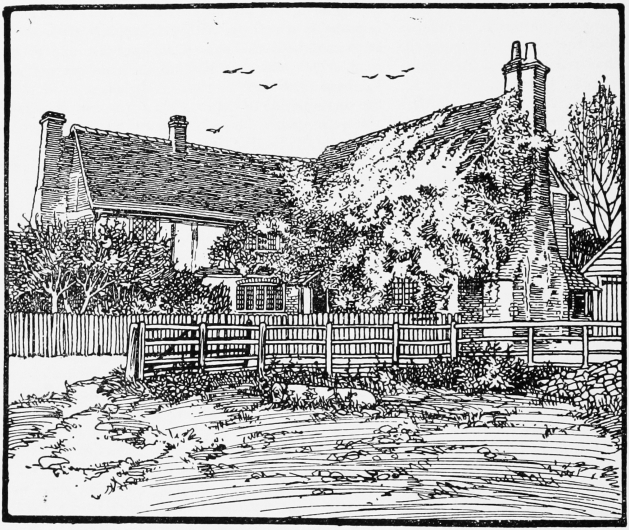
Ashwell's Farm, Chalfont St. Peter
The road running south from the Vache, Chalfont St. Giles, to Denham and eventually skirting Chalfont Park on the east passes Gorelands, Ashwell's Farm (a 17th-century timber and brick house with tiled roof), Ninning's, Warren Farm, and finally Mopes Farm. The Baldwin family, whose name occurs in connexion with Chalfont in 1510, (fn. 14) held Mopes, of which Thomas Baldwin died seised in 1641, leaving a son and heir George. (fn. 15)
There is a large plateau camp in Bulstrode Park and a homestead moat north-west of Chalfont Lodge.
The following place-names have been found in Chalfont St. Peter: Edred's Croft (xvi cent.); Snapes and Great and Little Cockshott (fn. 16) (xvii cent.). Land called Didsworth in the 15th and 17th centuries (fn. 17) probably derived its name from William Diddesworth, who bestowed lands here in the 13th century upon Missenden Abbey. (fn. 18)
Latchmore Field, in this parish, was inclosed under an Act of 1836; the award, dated 13 April 1847, is in the custody of the clerk of the peace. (fn. 19)
By a Local Government Board Order (fn. 20) part of Chalfont St. Peter, together with parts of Fulmer, Iver, Langley Marish and Upton-cum-Chalvey, was taken to form the civil parish of Gerrard's Cross, the ecclesiastical parish having been formed in 1861. (fn. 21) The area is 2,116 acres, of which 1,268 are permanent grass, 250 arable land and 309 woods and plantations. The soil is gravel with a subsoil of chalk, and the chief crops are oats, wheat and barley.
The station on the main line of the Great Western and Great Central joint railway, which passes through this parish, was opened in 1906, and the quick service to London has contributed to make this district increasingly popular. Within the last few years many estates have been sold for residential purposes, and the type of house erected is that of the country cottage with plastered or half-timber front, tiled gabled roof and small lattice window. The common lies to the south of the station about 280 ft. above ordnance datum. Houses have been built all round it. On the south side of the main road from Uxbridge to Beaconsfield, which skirts the common, stand the church of St. James by Fulmer Common. Behind the church lies Duke's Wood stretching away into Fulmer. Another large spinny is Oakend Wood, bordering Chalfont Park on the east; on its southern outskirts is the Isle of Wight Farm, and from here the land falls away to 162 ft. where the Misbourne stream flows. St. Laurence's Convalescent Home for chill dren stands south of the Uxbridge Road on lands belonging to Colonel Trench. The Pilgrims' Home, endowed by Sir J. W. Alexander, bart., who died in 1888, is situated on the north side of the common.
MANORS
In 1086 the whole of Chalfont St. Peter, assessed as a manor of 4 hides and 3 virgates, was held of Odo Bishop of Bayeux. (fn. 22) The overlordship passed as in Weston Turville (fn. 23) (q.v.) to the Counts of Meulan, Earls of Leicester, (fn. 24) and afterwards to the duchy of Lancaster, (fn. 25) and is last mentioned in 1618. (fn. 26)
The under-tenant at the time of the Survey was Roger, (fn. 27) who, as in Weston Turville, was succeeded by the Bolbecs and Turvilles. The Turvilles, however, did not retain Chalfont St. Peter in their own keeping, for Arnald son of Richard Turville in 1229 subinfeudated Ralph Brito in CHALFONT MANOR with free warren and all appurtenances in return for a yearly pension of 6 marks and the remittance of all debts. (fn. 28) Henry III confirmed the grant in the same year and gave Ralph licence to hold a market on Wednesday and a fair on the eve and day of St. Peter and St. Paul. (fn. 29) While lord of the manor Ralph sued the Abbot of Missenden (fn. 30) and disseised him of land called 'la Denelande' and of the services of seven villeins bestowed on the abbey by Richard son of Geoffrey Turville. (fn. 31) The abbey recovered possession of its property in 1231, (fn. 32) and appears shortly afterwards to have obtained the manor. (fn. 33) A grant of free warren was obtained by the abbot in 1302 (fn. 34) and confirmed in 1426. (fn. 35) After the Dissolution it was granted in 1540, with the rest of the Missenden estates in Chalfont and elsewhere, to Robert Drury for £594. (fn. 36) The property included Hedgerley Manor (q.v.), with which Chalfont St. Peter was held by the Drurys (fn. 37) until the dispersal of the family estates by William Drury in 1626, when it was acquired by Henry Bulstrode. (fn. 38) His son Thomas in 1645 alienated Chalfont St. Peter to Thomas Gower, (fn. 39) by whom it was conveyed in 1650 to Richard Whitchurch. (fn. 40) Richard was succeeded at his death in 1672 (fn. 41) by his son Thomas, who died in 1691, (fn. 42) leaving a son Richard. The latter on his death in 1709 (fn. 43) was succeeded by his son Richard, who died in 1741. (fn. 44) His son, another Richard, succeeded to the property and died without issue in 1800, when the estate passed to his sister Anne Whitchurch, the last survivor of the family, who died in 1809. (fn. 45) The manor passed into the possession of William Jones, who was holding in 1847, and was later acquired by the Rev. Edward Moore, lord of the manor between 1864 and 1877. It is now the property of Mr. Charles E. Moore.
A second manor in this parish known later as BULSTRODES or BRUDENELLS MANOR was held of the Turvilles as of the honour of Leicester. The first tenant, mentioned towards the end of the 13th century, was Andrew Goys, (fn. 46) from whom it passed to William Goys, holding in 1302. (fn. 47) John Goys, in possession in 1316, (fn. 48) united with his brother Simon in 1320 to convey the manor to Geoffrey Bulstrode, his wife Agnes and Adam Bulstrode, probably their son. (fn. 49) This family held Bulstrodes Manor for the next hundred years, Adam having succeeded to the property before 1346 (fn. 50) and Geoffrey holding in 1361. (fn. 51) Very little is known of them in the following years, but in the early 15th century Agnes daughter and heir of Robert or Richard Bulstrode brought the property in marriage to William Brudenell of Amersham, (fn. 52) from whom the manor acquired its alternative name. Their son Edmund enfeoffed trustees of the manor in 1452 (fn. 53) and in the same year obtained a renunciation of the claim of the Virleys, descendants of Joan the daughter and heir of Geoffrey Bulstrode. (fn. 54) Edmund died in 1469, when his son Drew, aged twenty-five, succeeded him. Drew Brudenell died in 1490, leaving a son and heir Edmund, (fn. 55) whose lands in Chalfont St. Peter were valued at 100 marks in 1523. (fn. 56) On the occasion of the marriage of his daughter and heir Elizabeth with Drew son and heir of Sir William Barrington, Edmund Brudenell settled the manor on himself and wife Joan for life, with reversion to Elizabeth and Drew and their issue, but he was afterwards sued by Sir William Barrington for failing to deposit the title deeds with the Abbot of Nutley and for debt, though he had contributed to the maintenance of Elizabeth from the date of the marriage until she was eighteen. (fn. 57) Elizabeth, then the wife of Robert Drury, succeeded to the property on her father's death in 1538, his wife Joan having predeceased him. (fn. 58) In 1540 Robert Drury obtained the principal manor of Chalfont St. Peter (q.v.), with which Brudenells was held until 1645. (fn. 59) Although not mentioned in the transfer of the other Chalfont St. Peter property by Thomas Bulstrode to Sir Thomas Allen in 1645, it may have been alienated at that time, as in 1651 Frances Allen, widow, was in possession. (fn. 60) By 1657 it had passed to Dudley Rowse and his wife Frances, (fn. 61) who were taxed at £5 in 1661. (fn. 62) Dudley Rowse, who was appointed receiver-general for Oxfordshire in 1667, owed the Crown large sums of money at his death in 1678, and Brudenells Manor with the capital messuage called Chalfont Place or House was therefore seized by the king and by him bestowed in 1688 on Judge Jeffreys. (fn. 63) It is possible that this grant never took effect, for in the same year Edward Penn and Margaret his wife are stated to have held the manor. (fn. 64) For the next fifty years the history of this manor is obscure. In 1707 a fine was levied of it between Thomas Duke of Leeds and Elizabeth Herbert, (fn. 65) but by 1728 it was the property of John Wilkins, (fn. 66) of whom it was purchased before 1750 by Lister Selman. (fn. 67) In 1755 the trustees of Charles Churchill, sen., acting under the instructions in his will, acquired Brudenells Manor from Lister Selman, to the use of Charles Churchill, jun., (fn. 68) but in 1792 the surviving trustees obtained powers from Parliament to sell the manor, (fn. 69) which accordingly passed in 1794 to Thomas Hibbert. (fn. 70) Thomas died in 1819, leaving Brudenells to his brother Robert, on whose death in 1835 it descended to his third son John Nembhard Hibbert, (fn. 71) Sheriff of Buckinghamshire in 1837, who died in 1886, aged ninety. (fn. 72) The estate and house known as Chalfont Park were sold by Mr. Hibbert's executors to Captain Berton, and by him in 1899 to Mr. John Bathurst Akroyd, and were purchased from the latter by Mr. Edward Mackay Edgar, the present owner.
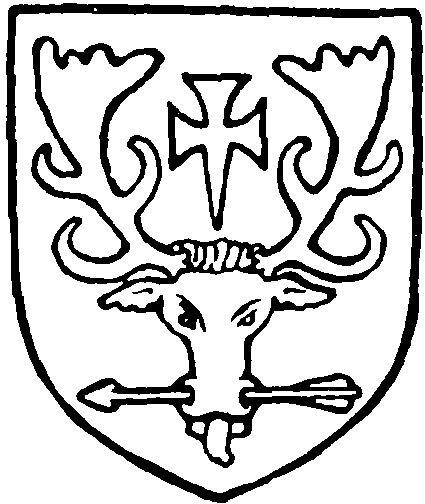
Bulstrode. Sable a hart's head caboshed argent having horns or with a cross formy fitchy between them and an arrow or through his nostrils.
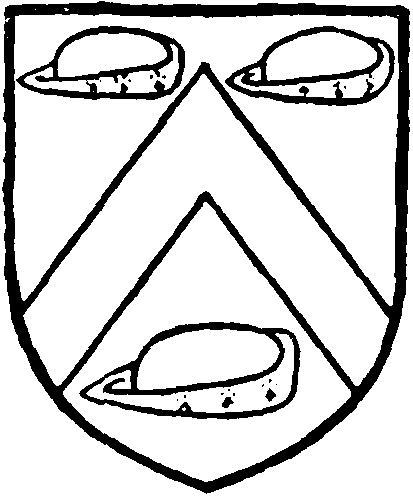
Brudenell. Argent a cheveron azure between three hats gules turned up with ermine.
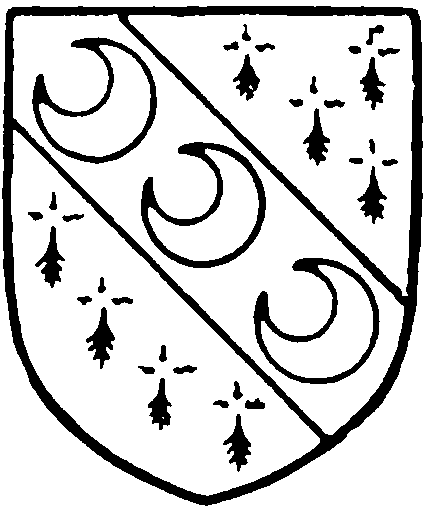
Hibbert. Ermine a bend sable with three crescents argent thereon.
A small estate in Chalfont St. Peter was held by the Templars as parcel of their manor of Temple Bulstrode in Hedgerley (q.v.) and is mentioned first in 1232, when Ralph Brito seized the hay from this land. (fn. 73) The Hospitallers, who in 1286 claimed to hold view of frankpledge from their four or five tenants in Chalfont, (fn. 74) succeeded to the Templars' property at the dissolution of this order by Edward II, but Nicholas Turville took possession of the property, which he alienated to Geoffrey Bulstrode. (fn. 75) Geoffrey disputed the ownership of the land, first with the Hospitallers and afterwards with Burnham Abbey from 1328 to 1346, but was finally obliged to relinquish the estate. (fn. 76) When Temple Bulstrode was bestowed on Robert Drury in 1541 this property was known as Turville's Land, (fn. 77) and is mentioned in 1618 as Turville's Lane. (fn. 78) It may be identical with the small manor comprising Back Lane (the lane running to the vicarage garden gate), of which the vicar is lord, and from which he receives a few shillings a year and occasional sums of 5s. as heriots.
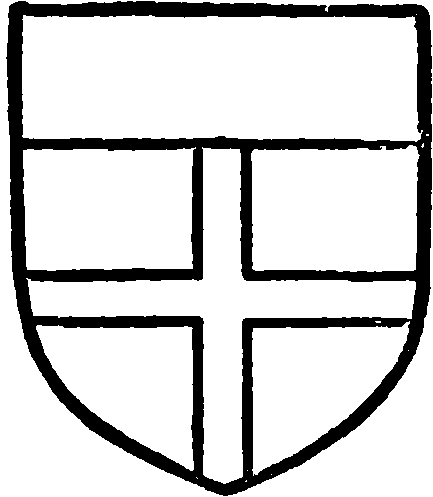
The Knights Templars. Argent a cross gules and a chief sable.
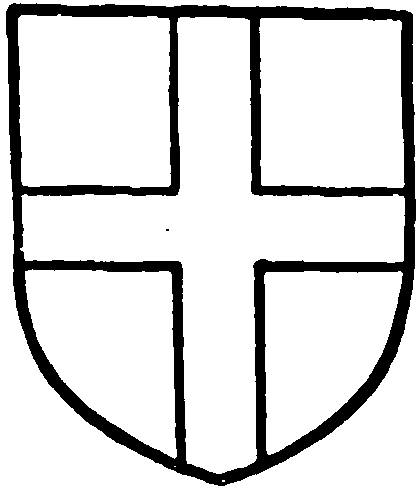
The Knights Hospitallers. Gules a cross argent.
In 1086 there was a mill worth 6s. on Chalfont St. Peter Manor, (fn. 79) which passed with it to Missenden Abbey, being last mentioned in 1291. (fn. 80) There was also a water-mill on the estate claimed by Geoffrey Bulstrode in the early 14th century against the Prior of St. John of Jerusalem. (fn. 81)
CHURCHES
The old church of ST. PETER collapsed in 1708, and was re-erected in brick in 1714. As rebuilt it consisted of a short chancel, nave and west tower. About 1860 the chancel was again rebuilt, a south chapel added and the whole church Gothicized. The south porch was built in 1887. The communion table, which is of oak and dates from the 17th century, is now in the south chapel. On the north wall of the chancel there are seven brasses. One group with the figures of a man in plate armour and a woman in horned head-dress and veil is to William Whaplode, steward to Henry [Beaufort] Cardinal of England and Bishop of Winchester, who died in 1446, and Margery his wife; another, to William Whaplode, sen., who died in 1398, and Elizabeth his wife, formerly wife of William Restwold, was apparently engraved at the same period as the above; the brass of a priest in mass vestments of about 1500 is placed above an inscription to Robert Hanson, vicar of this parish and of Little Missenden, who died in 1545. There are inscriptions to William Wheytte and Alice his wife, in which only the date of the latter's death, 1525, is given; to George Brudenell, LL.B., son of Drew Brudenell, who died in 1522; to Rose Edgeworth, mother of Roger and John Edgeworth, both vicars of Chalfont, who died in 1529; and to Robert Drury, who died in 1592. An old rubbing at the Society of Antiquaries shows the figure of Robert Drury and a shield of Drury impaling three stars on a cheveron between three blackamoors' heads. In the south chapel are floor slabs to Henry Gould, who died in 1671; Deborah his wife, who died in 1695, and their son Thomas, who died in 1699; Thomas Whitchurch, who died in 1691, and Richard his son, who died in 1709. In the vestry are two chests, probably of the 17th century, one of which is panelled.
There is a ring of six bells, the treble, third, fourth, fifth and tenor by T. Mears of London, 1798, the second by Henry Bond & Sons, Burford, Oxon., 1884.
The communion plate includes the following, which are all of pewter: two flagons and patens of 1693, two patens of 1661 and a bowl and a flagon which are probably of the same century.
The registers begin in 1538.
The church of ST. JAMES, Gerrard's Cross, near Fulmer Common, was built by the Misses Reid in memory of their brother, Major Gen. Reid. It is a cruciform building in the Romanesque style of various coloured bricks and stone and consists of chancel, nave, transepts, octagonal dome flanked by four turrets and campanile containing five bells. The living is a vicarage in the gift of the Simeon trustees.
St. Paul's chapel of ease, built in 1866, serves Horn Hill, part of which is in Rickmansworth, Hertfordshire.
ADVOWSON
The church of Chalfont St. Peter was held by the Turvilles and is mentioned first in 1195, when Geoffrey Turville, in return for a four years' grant of half the vill except the capital messuage and wood, transferred his right in it to his son Richard, (fn. 82) by whom it was bestowed on the abbey of Missenden in the same year. (fn. 83) Shortly afterwards Geoffrey, brother of Richard, claimed the church as the gift of his father, (fn. 84) and in 1229 the abbot had further trouble with Ralph Brito, (fn. 85) who had obtained a grant of the church from Arnald Turville. (fn. 86) Bishop Hugh of Lincoln in 1224 ordained a vicarage in the church, which was to consist in all altar offerings, a messuage, lands and the tithes of sheaves arising therefrom, (fn. 87) and in 1253 Pope Innocent IV confirmed the abbey in its possession, his example beingfollowed by Boniface IX in 1401. (fn. 88)
The vicarage was assessed at £5 6s. 8d. in 1291, (fn. 89) and at £5 in 1535. (fn. 90) It was included in the grant of the abbey's property made to Robert Drury in 1540, (fn. 91) and descended with the manor (q.v.) until 1645, when it was acquired of Thomas Bulstrode by Sir Thomas Allen of Finchley. (fn. 92) In 1661 Sir Thomas received licence to bestow the advowson on St. John's College, Oxford, (fn. 93) of which he was a fellow commoner, and from that date onwards the right of presentation has been exercised by the college.
At the visitation of the church in 1612 (fn. 94) it was found that one side was 'so broken that a hog may creep through,' but later in the century the only complaint was to the effect that the church needed whitewashing. (fn. 95) Mr. Bradshaw, the vicar at this time, was the first minister to be ejected in the county, being turned out 12 November 1640. (fn. 96) The living was a poor one and was ordered to be augmented by the committee to the extent of £33 in 1657. (fn. 97)
At the institution of the vicarage in 1224 there was reserved to the abbey, in addition to the rectorial tithes, a messuage with the 'grove' held formerly by Ralph, priest and late parson of the church, and a messuage with a croft held formerly by Richard, priest. (fn. 98) The whole estate, valued at £12 in 1291, (fn. 99) was called the rectory or grange and was leased by the abbot in 1484 to William Wythe and Helen his wife for twenty-one years at a rent of £10 5s. (fn. 100) After the death of William, Helen in 1498 conveyed her interest to Edmund Brudenell, lord of Bulstrode Manor, who was £40 in arrears with the rent in 1502. (fn. 101) Robert Brudenell, his brother, arranged to pay the abbot an annuity of £6 until £35 was paid, but the abbot received £26 only of this sum. (fn. 102) The rectory, which was still on lease in 1535, at £11 rent, (fn. 103) passed with the advowson through the Drurys and Bulstrodes and was bestowed in 1661 on St. John's College, Oxford.
That part of the rectorial estate which comprised the messuages, grove and toft may be identical with the estate attached to the house called the Grange, in which Isaac Penington lived in the 17th century.
A chantry was founded at the altar of St. Mary in the church of Chalfont St. Peter by William Whaplode, lord of Vache Manor, Chalfont St. Giles (q.v.), who by his will dated 14 November 1447 empowered his trustees to devote certain lands to that purpose. (fn. 104) In 1449 the executors obtained licence to acquire lands worth £8 a year, (fn. 105) which they alienated in mortmain to Thomas Mere, the chaplain in 1452. (fn. 106) The chaplain was appointed in the 16th century by the Brudenells, lords of Brudenells Manor (fn. 107) (q.v.), and had to sing mass daily for the founder's soul, to help the curate and pay certain moneys to the curate, clerk and sexton. (fn. 108) His salary, including 5s. for an obit, was £9 19s. 0½d. (fn. 109) When dissolved in 1547 the chantry's possessions were assessed at £11 9s. 8d., whereof 16s. 10d. for the lands was paid to Sir Robert Drury, lord of Brudenells Manor, (fn. 110) and the rest, after payment of tithes, to Thomas Longshawe, the chantry priest (fn. 111); a vestment of white damask was valued at 13s. 4d. (fn. 112) Whaplode's chantry was granted to Sir Robert Drury in the same year, (fn. 113) and his grandson Sir Henry Drury died seised of it in 1618. (fn. 114)
CHARITIES
In 1770 William Courtney by will bequeathed a sum of stock, the income to be distributed in bread every Sunday to poor unmarried women. In 1867 the stock was apportioned by the Charity Commissioners between this parish and Gerrard's Cross. The trust fund for Chalfont St. Peter is now represented by £284 9s. 7d. London County 3 per cent. stock, producing £8 10s. 8d. yearly. (See also under Gerrard's Cross.)
In 1824 Maria Taylor, by will proved in October, bequeathed £300, the income to be applied in money, bread, coals and blankets. In 1867 a sum of £247 14s. consols, producing £6 3s. 8d. yearly, was apportioned to this parish and £82 11s. 6d. like stock for Gerrard's Cross. (See under Gerrard's Cross.) The charity is regulated by a scheme of 27 October 1899.
In 1861 the Rev. George Gleed by will bequeathed £1,000 towards the erection or endowment of any new church at or near Horn Hill. The trust fund consists of £1,072 6s. 3d. London County 3 per cent. stock, producing £32 3s. 4d. a year, forming part of the endowment of the parish.
The same testator likewise bequeathed £500 for poor communicants. The trust fund is represented by £536 2s. 6d. like stock, producing £16 1s. 8d., which, in pursuance of a scheme 21 March 1902, is applicable in donations to a parish nurses' fund or to a hospital or in supply of tickets for necessaries for poor people being members of the Church of England.
In 1861 Mrs. Isabella Evans, by will proved at London 28 March, bequeathed £200 consols, the dividends on £100 consols to be applied in keeping in repair the tomb of her late husband, the surplus, if any, to be applied with the dividends of the other £100 consols in provisions or other necessaries for the poor. In 1867 the sum of £25 consols, part thereof, was apportioned to Gerrard's Cross. The share for Chalfont St. Peter is now represented by £165 19s. 5d. London County 3 per cent. stock, producing £4 19s. 8d. a year.
In 1891 Mrs. Jane Anne Hibbert, by will proved at London 17 December, bequeathed £300 for the benefit of the almshouses erected by her. The legacy was invested in £219 North British Railway Company 4½ per cent. preference stock, the income of which, amounting to £9 17s., is distributed in doles to the inmates.
The Cottage Hospital for the parishes of Chalfont St. Peter, Chalfont St. Giles and Gerrard's Cross was established by members of the Hibbert family and is maintained mainly by voluntary contributions. It is endowed, however, with a sum of £292 North British Railway 4½ per cent. preference stock, producing £13 2s. 10d. a year, arising from a legacy of £400 by will of Mrs. Jane Anne Hibbert, proved 17 December 1891, and with £554 9s. 10d. New South Wales 3½ per cent. stock, producing £19 8s. a year, representing a legacy of £500 by will of Miss Mary Eliza Moore, proved 16 June 1894, a donation of £5 5s. entitled Memoria in æterna, 1891, and a gift in 1894 of £50 by Mrs. E. M. Sandars.
The National schools, comprised in deeds of 1846 and 1892, are endowed with a sum of £219 North British Railway 4½ per cent. preference stock arising from a legacy of £300 by will of Mrs. Jane Anne Hibbert above mentioned, producing £9 17s. 2d. yearly, which, under a scheme of the Charity Commissioners of 5 December 1893, is made applicable for the benefit of the infants' department.
The sums of stock belonging to the several charities are held by the official trustees.
Gerrard's Cross.
The endowments of the three charities following were, under an order of the Charity Commissioners 26 March 1867, apportioned between this parish and Chalfont St. Peter. The share of Gerrard's Cross consists of £100 consols in respect of William Courtney's charity, by will 1770; £82 11s. 6d. consols, Maria Taylor's charity, by will 1824, and £25 consols, Isabella Evans's charity, by will 1861.
The income of these charities is administered with that of the next mentioned charity. The charity of Miss Louisa Reid, or the Gerrard's Cross district charity, was founded by deed 24 March 1873, whereby the trusts of a sum of £1,333 6s. 8d. consols were declared to be for giving bonuses to provident clubs, for rendering aid at confinements, in medical comforts, pecuniary aid and in assisting girls and boys to start in service.
In 1909 the income of the foregoing charities, amounting to £38 10s., was applied as to £28 in bonuses, £7 in medical aid and the remainder in cash to cottagers.
Miss Louisa Reid likewise, by her will proved in 1881, bequeathed £100 a year in augmentation of the benefice. The principal sum has been transferred to the Ecclesiastical Commissioners.
The church repair fund.
Miss Louisa Reid likewise, by deed 24 March 1873, settled a sum of £1,666 13s. 4d. consols upon trust that the annual dividends thereof, now amounting to £41 13s. 4d., should be applied towards internal and external repair and maintenance of the fabric of the church of St. James, including the chancel.
In 1886 Mrs. Bramley Moores, by will proved at London 20 December, founded a coal fund charity, consisting of £495 1s. consols, the annual dividends whereof, amounting to £12 7s. 4d., are applied under the provisions of a scheme of the Charity Commissioners of 27 October 1908.
The several sums of stock are held by the official trustees.