A History of the County of Buckingham: Volume 3. Originally published by Victoria County History, London, 1925.
This free content was digitised by double rekeying. All rights reserved.
'Parishes: Chesham', in A History of the County of Buckingham: Volume 3, ed. William Page (London, 1925), British History Online https://www.british-history.ac.uk/vch/bucks/vol3/pp203-218 [accessed 30 April 2025].
'Parishes: Chesham', in A History of the County of Buckingham: Volume 3. Edited by William Page (London, 1925), British History Online, accessed April 30, 2025, https://www.british-history.ac.uk/vch/bucks/vol3/pp203-218.
"Parishes: Chesham". A History of the County of Buckingham: Volume 3. Ed. William Page (London, 1925), British History Online. Web. 30 April 2025. https://www.british-history.ac.uk/vch/bucks/vol3/pp203-218.
In this section
CHESHAM
Cestreham (xi–xiii cent.).
The parish of Chesham, which formerly comprised Ashley Green, Chartridge and Latimer, now constituted separate parishes, contains the town of Chesham with its hamlet of Waterside. The existing parish covers an area of 1,386 acres, of which 736 acres are arable land, 621 permanent grass, and 16 woods and plantations. (fn. 1) The town lies in a picturesque situation about 340 ft. above the ordnance datum on the southern slope of the chalky range of the Chiltern Hills. The Metropolitan railway throws out from Chalfont Road a branch line which terminates here in a station erected behind the High Street. Chesham had formerly a local board of nine members, but under the Local Government Act, 1894, an urban district council of eighteen members was established. It is a thriving town, owing its prosperity mainly to the boot and shoe trade, the chief factories being those of Messrs. Reynolds and Mr. John Hayes. The brewing industry is carried on to a certain extent, and the beech woods on the surrounding hills provide timber for the saw-mills, where it is turned into coarse wooden-ware chairs, spades, hoops, &c. There are two brush factories, which employ a good many hands, but the straw-plait trade, which was formerly important, is now nearly extinct.
The increase in population brought about by the establishment of large factories has caused the town to extend northwards along the hill on the Berkhampstead road, and this colony of artisans' dwellings and business works is known as the New Town, a straggling and rather uninteresting quarter. The waterworks and reservoir and the cemetery with its two mortuary chapels, opened in 1858, are placed here. The new quarter is also served by a mission room. The houses have encroached on and inclosed Higham Mead, mentioned in documents of the 17th century, in which there rises a spring head of the River Chess, which flows through the town.
The older part of the town is situated lower down in the valley and stretches along the Berkhampstead road, which is here known as High Street. Where it is joined by Blucher Street on the west it widens into the Broadway, where there is an old house, 'High House,' which dates probably from the beginning of the 17th century. The cage, pound and stocks used formerly to be kept here, but were removed in 1833. (fn. 2) Further down the High Street, passing the George and Crown Hotels, the town hall is reached. It was partly rebuilt by Lord Chesham in 1856, the period when many of the public buildings in Chesham were erected, and is the property of the present holder of the title. The open part below is used for the market held on Wednesday ever since the grant to the Earl of Oxford in 1257. (fn. 3) The busiest times, however, are on 21 April, 22 July, and 28 September, when the fairs are held.
Church Street, which branches off the High Street where the town hall stands, runs west and then south past the vicarage and church. Nos. 54 and 56 Church Street (originally one house) represent a 14th-century domestic building with much original detail remaining; it was added to in the 17th century and has modern alterations. The most striking external feature is the original moulded wooden tracery in the window of the gabled upper story of the solar wing. There are also many houses of 17th-century origin situated not only in Church Street, but in Germain Street, Blucher Street and King Street, the majority of which have been considerably altered and added to in later times.
A striking feature of one approach to the church is a fine avenue of Dutch elms commencing at the west end of Blucher Street and running parallel with Skottowes Pond through Chesham Park. In the churchyard there are three yew trees, proved by the registers to have been planted in 1720, (fn. 4) and an Ionic Cross erected in 1908 to the memory of Thomas Harding, said to have been burned on 30 May 1532, 'in the Dell going to Botley at the north end of the towne of Chesham.' (fn. 5)
The vicarage-house dates from the 18th century and took the place of Chesham Woburn or the 'lower' parsonage, the foundations of which have been traced near the Germain Street council school (1912), and which was destroyed about the same period. (fn. 6) Chesham Leicester, or 'upper parsonage,' stood in the park about 100 yards north of the church. (fn. 7) The house, which was probably built in the 16th century, was the residence successively of the Ashfields, Whichcotes and Skottowes (whose name has been given to the pond hard by), but was pulled down in the early 19th century. (fn. 8)
To the south-west of the church is the Bury, the residence of Mr. Lowndes Frith. It was built in the reign of Queen Anne by his ancestor, William Lowndes, secretary to the Treasury, and faces a large sheet of water, Bury Pond, which feeds the River Chess. The Grove and Warren with the Park, part of which is open to the public, stretch away behind the house to the west and north. On the south the Bury looks past Moor Farm and Drydell Barn to the open country beyond, but to the south-east are some houses known as Pednormead End. A brick and timber house of the 17th century with gables is now represented by Nos. 2, 4, 6 and 10 Pednormead End.
Below the town hall High Street divides into two, the western branch becoming Germain Street (fn. 9) and leading past Weylands, the new council school and Great Germains to Little Germains on the slope of Fuller's Hill. The eastern branch is called Red Lion Street from the name of an inn, the property of the Skottowes in the 18th century. (fn. 10) It leads past the almshouses erected in the reign of James I by Thomas son of Richard Wedon of Pednor, (fn. 11) and past the Prospect Works, under the railway bridge through the picturesque hamlet of Waterside, constituted an ecclesiastical parish in 1867, (fn. 12) and served by Christ Church, which stands with the vicarage overlooking the Chess. In the northern part of this district are the gasworks established in 1847 and the cottage hospital founded in 1869. The Chess, which flows along the valley, past Chesham Moor, affords occupation to breeders of ducks and cultivators of watercress. It also turns the wheels of three corn-mills, the first of which, Lord's, is a 17th-century building with broad gables, and the mill-house adjoining has a fine stack of chimneys. The three mills were in the possession of the Cheynes in the 17th century, together with land called Cannon Mead, (fn. 13) which gave its name to the second mill. The third mill, Weirhouse Mill, lies above Milk Hall and the Chesham sewage works. The river at Chesham particularly impressed Thomas Baskerville, who in 1671 stayed at the 'Crown,' which dated back at least to the century before, (fn. 14) and may have occupied the site on which the present 'Crown' stands. He says: 'Here also runs a nimble stream with mills on it to grind meal for London, and in a room over the market house people are much employed to hoult, cleanse, or sort the flour from the bran.' (fn. 15) The River Chess passes on to Broadwater Bridge, where the land lies only 295 ft. above ordnance datum, and here leaves Chesham for Latimer parish.
The Roman Catholic church of St. Joseph in Eskdale formerly Khartoum Avenue, served by Carmelite Fathers, was built in 1909.
Chesham is a stronghold of Nonconformity, and the 6 acres covered by its cemetery is equally shared between the Church and Nonconformists. The earliest chapel was the Hinton Baptist Chapel founded in 1701 and rebuilt in 1898. The Baptist chapel in Broadway was founded in 1706, that in Townfield in 1820, and the Zion Baptist Chapel in Red Lion Street in 1868. In the High Street opposite the Broadway the Congregational chapel was first built in 1724 and rebuilt in 1886, and the Wesleyan chapel erected in 1897 was rebuilt in 1902. There is also a Friends' meeting-house in the Bellingdon Road.
In the 17th century there lived at Chesham an eccentric character, Roger Crab, who from his occupation and mode of living had earned for himself the name of the 'Mad Hatter.' He served on the Parliamentarian side during the war 1642–9 and had his skull cloven in action. He retired to Chesham, where he acquired a small fortune by selling hats, and became a vegetarian and water-drinker. In 1651 he shut up shop, sold part of his estate to give the proceeds to the poor, and retired to Ickenham, where he boasted that he could live on three farthings a week and wrote an account of his own life. He died at Bethnal Green in 1680, and was buried at St. Dunstan's, Stepney. (fn. 16)
Latimer (Iselhampstead, xiii–xiv cent.; Iselhampstead Latimers, xiv–xix cent.; Latimer, xix cent.present day) was constituted an ecclesiastical parish in 1868, and the civil parish was formed out of Chesham by order of the county council on 11 August 1898, confirmed by Local Government Board Order, (fn. 17) 1 April 1899. It contains 3,079 acres, of which rather more than half is arable land, while the amount of permanent grass is about double that of woodland. (fn. 18) The soil is loam over chalk.
The parish is watered by the Chess, which forms its southern boundary, and lies about 300 ft. above the ordnance datum. From its banks narrow lanes, called Trapps, Pump, Bottom, Bunns and Blackwell Hall, ascend to the higher ground in the north, where 523 ft. is the highest level reached.
Latimer village is prettily situated in a hollow near the River Chess, about 275 ft. above ordnance datum. It formerly consisted of two parts, but the upper one, on the top of the hill, was destroyed about the middle of the last century and merged into the grounds of Latimer House. (fn. 19)
A few half-timber whitewashed cottages, with small gardens before the doors, stand back from the green, where tall elms cluster round the pump. There is a post office, but no public-house. A steep path leads to the church and rectory-house, near which stands Latimer House, the seat of Lord Chesham. The house, a red brick mansion, was almost entirely rebuilt, in the Elizabethan style, in the middle of the last century. It stands high above the village in a park of about 800 acres containing good pasture land and some fine timber. The Chess runs through the grounds and widens into a small lake.
Latimer is historically interesting for its association with Charles I, who on 3 June 1647 was removed from Woburn to 'Latimers … a little but neat house of the Lord Cavendish Earl of Devonshire.' (fn. 20) He is said to have slept in the room now the drawing room, and the bed used by him is still shown. (fn. 21)
Further west of the village is Blackwell Hall, facing the Chess and marking the site of the ancient manor of that name. It is a much altered halftimber and plaster house of the 15th century. In the original plan there was a central hall with probably a solar at one end and a similar chamber at the other. An upper floor was set in the open hall in the following century and still later the plaster was largely replaced by brick. Inside the house are several original details. Blackwell Hall Lane runs due north behind the hall and parallel for some distance with the road from Latimer to the hamlet of Leyhill. On the south edge of the common are the school and Ashridge Farm, and on the western side the road ascends past the cottages with the smithy, publichouses, Baptist and Methodist chapels to Jasenhill Farm.
Roads lead west from Leyhill to Botley, another hamlet consisting of several farms and cottages. St. George's, a chapel of ease to Christ Church, Waterside, is situated on Tylers Hill, north of Cowcroft Farm and its surrounding woods.
In the north-west of the parish are Codmore (fn. 22) and Brockhurst Farms with Bayman Manor, the residence of Colonel T. Trueman. Of these Codmore Farm is a brick and timber two-storied house of the 15th century, considerably altered in the 17th century, when an upper floor was inserted in the hall and the present chimney stack built. The original roof trusses in the hall are richly moulded. Brockhurst Farm is a half-timber house of later date, and in all probability dates from about 1600.
The ecclesiastical parish of Ashley Green was formed in 1875, and the civil parish was constituted by a county council order, confirmed by a Local Government Board Order, (fn. 23) in 1897. By a second Order, (fn. 24) which came into operation 1 October 1900, part of this parish was transferred to the parish of Chesham.
It covers an area of 3,291 acres, of which 1,557 acres are arable land, 884 permanent grass and 379 woods and plantations. (fn. 25) It lies on high ground, for the most part over 500 ft. above the ordnance datum, rising to 550 ft. south of the village. The inhabitants are chiefly engaged in agricultural pursuits, but the breeding of pheasants is also carried on to a large extent.
Ashley Green village occupies the centre of the parish, and is reached from Chesham by the Berkhampstead Road, which passes over Nashleigh Hill, past Nashleigh, Sloughlands and Pressmore Farms, to Ashley Green, leaving on the west Thorns Barton, a large house standing in its own grounds and the residence of the Hon. Amyas S. Northcote. The orchards on the east side belong to Ashley Green Farm, and beyond the road widens into the green, on the edge of which stands the church with the vicarage to the east. A road leads west off the green, past the post office, to the Baptist chapel. The school, which is beyond the vicarage, was erected in 1853 by Colonel Dorrien of Haresfoot. West of the village are Oak and Hog Lane Farms, and to the north Snow Hill and Johns Lane Farms, with Hockeridge and Pancake Woods behind.
Lye Green is a hamlet 1½ miles south of Ashley Green, and consists of a few cottages and Lye Green Farm. The other hamlet, Whelpley Hill, lies 2 miles east of Ashley Green. Here are a few cottages with the school and a Baptist chapel, and the outlying farms of Whelpley Hill, Sales, Spencers, Hemings and Moors. Berries (or Whelpley Hill) Farm dates from the 16th century, but has been much altered and added to in later times. One original chimney stack and some of the original timber framing remain.
The farm-houses at Sales Farm, Nashleigh Farm, Oak Farm and Hog Lane Farm all date from the late 16th or early 17th century and retain a good deal of the original work, though they have all been more or less altered and added to in the 18th and 19th centuries.
Lying a little to the south of Whelpley Hill there is a roughly circular camp 4½ acres in extent. The single rampart and a ditch are gradually disappearing under the plough.
Lye Green and Whelpley Hill are connected by Grove Lane, off which stand Torrington and Little Grove Farms. To the north of the latter is Grove Farm, which marks the site of the old manor-house of the Cheynes, the great hall of which was said to have been in existence as late as 1750. (fn. 26)
Here there is a moated site, with a mediaeval building now used as a barn, and other remains, all probably of the 15th century. The moat, in a portion of which water still remains, is contained by strong ramparts. The barn and two tower-bases with a fragment of a north and south curtain wall are situated in the north-western portion of the inclosed area, divided by an inner moat from the remainder. The barn, built of flint with stone and brick dressings and a half-timbered gable, has been generally styled 'the Chapel,' but there seems no particular reason for giving it this name. In the first half of the 17th century an upper floor, since removed, was inserted and the walls consequently heightened. The building, which is L-shaped in plan, retains a good deal of 15th-century detail, but most of the windows and one doorway are now blocked. The open timber-work roof of the chief block appears to be in the main original, but its position has been raised.
Chartridge was constituted a civil parish in 1899. (fn. 27) It covers an area of 4,992 acres, and is chiefly agricultural, 2,910 acres consisting of arable land, 1,056 of permanent grass and 344 of woods and plantations. (fn. 28) The homesteads are numerous and important, and between them farm many miles of country. The situation is high and open, as the parish stretches across spurs of the Chiltern Hills, which maintain a level well over 500 ft. above the ordnance datum. The ridges, separated by valleys, run in a north-westerly direction and attain a height of over 600 ft. in the north. Chartridge and its several hamlets lie on the brow of these ridges and are reached from Chesham by long green lanes, from which, when not bordered by tall hedgerows, an extensive view of the surrounding country can be obtained. The surface of the soil is clay with a subsoil of chalk, which has been worked in pits, now mostly disused, scattered over the parish.
Chartridge lies about the middle of the parish, with Chartridge House or Lodge, the residence of Mr. A. E. Franklin, on the outskirts of the village. On the same side, near Chesham, is Raymonds, and lower still is Chartridge Grange, occupied by Mr. H. J. Montefiore. In the village is a small Baptist chapel, built in 1844 and rebuilt in 1885. A succession of farms leads upwards past Newlands to Chartridge End Farm, standing in an elevated position 595 ft. above ordnance datum.
About 1¼ miles north of Chartridge a school, a small Congregational chapel dating from 1891 and Widmore Farm, with a public-house and a few cottages, form the nucleus of Ashridge hamlet with Ashridge and Wood Farms at its northern end and Tiles Farm on the south. Ashridge Farm itself seems to be a late 16th-century house much altered in the 18th and 19th centuries. The original half-timber work with brick nogging may be observed in the gables.
The large hamlet of Bellingdon (Belenden, xv cent.) extends along a hill 1 mile north of Ashridge. On the outskirts, on Hivings Hill, is Mount Nugent Farm, a two-storied house of the early 17th century with later additions. An original three-light window with diamond panes is to be found in the eastern end of the south wall. The date 1622 on an adjacent barn may also be that of the building of the main house. On land formerly part of this farm a vicaragehouse belonging to the rectorial manor of Chesham Woburn is said to have stood. (fn. 29)
Bellingdon consists of half a dozen scattered farms with a nursery house, brickworks and a church mission room. It extends past Bank and Peppetts Greens, with farms of the same names, to the Cross Cottages, beyond which are more brickworks and Bellingdon End Farm. Bellingdon Farm, Bellingdon End Farm, Bloomfield Farm, Huge Farm and Hazeldean Farm are all 17th-century houses, but much restored and altered. Vale Farm may belong to the late 16th or early 17th century, but has been much added to and altered.
A long, straight lane running parallel with the southern boundary of Chesham Park leads northwest between two ridges, where it is called Pednor Bottom, to Cogdells Farm. On the north Great and Little Friars Hills separate it from the Hollow Way, off which stands the moated farm of Little Pednor, (fn. 30) where the Wedons lived in the 17th century. Great Pednor Farm lies about a quarter of a mile to the north-west.
Hundridge (Hunderugge, xiv cent.; Hundrige, xv–xvi cent.) is another hamlet, about 2½ miles south of Chartridge. It can be reached on foot from Chesham by Blind Lane, an old pack-horse road, which terminates in Little Hundridge Lane, Little Hundridge Farm lying at the junction. Shortly before its termination a footpath leads off southward past Willow Coppice to Great Hundridge Farm, once the manor-house of the Brocs and afterwards of the Dormers. This is a half-H-shaped house, probably built in 1696. To the east of it is a rectangular 13thcentury chapel. The north and west walls have, however, been rebuilt with modern brickwork. The west part is now a dwelling and the east part has been used as a brew-house. There are two 13th-century lancets, both blocked, in the south wall, and another has been reset in the north wall, while in the east is a late 15th-century three-light window. In the garden adjoining human remains are said to have been found. (fn. 31)
Halfway House Lane leads from Chesham to the southernmost hamlet of Chartridge, Hyde Heath, which extends into Missenden parish. The open range of country on the Chilterns changes here to wood and common. The cottages, with the Baptist chapel, mission room and Hyde Heath Farm, overlook Hyde Heath Common. To the east is Wedon Hill Farm, and woodland paths lead west past Rose Cottage to Hyde House, the property and residence of Miss Fuller.
Among the place-names in Chesham occurs that of Harfrays, so-called after the Harfray family in the 13th century. (fn. 32) In the 16th century as Harfrays Farm it was in the possession of the Wood family. (fn. 33)
In the 14th century there is Cobmeregrove, (fn. 34) in the 15th lands called Pippards, in Bellingdon, (fn. 35) in the 16th Maynewodd, in Hundridge. (fn. 36) In the 17th century occur Mounsell Mead, Adam's Hill, Shudcroft, Folletredding (fn. 37) and Stebbings, Dods, Keenes and Okehams Closes. (fn. 38)
British coins have been picked up at Chesham. (fn. 39)
MANORS
The manor of Chesham, afterwards called CHESHAM HIGHAM, which had been held by Brictric, a man of Queen Edith, was assessed at 8½ hides in 1086, and was held of the king in chief by Hugh de Bolbec. (fn. 40) His possessions, including Chesham, became known as the barony of Bolbec, (fn. 41) which was held of the king until some time after 1452. (fn. 42)
The chief seat of the Bolbecs in this county was at Whitchurch, where the remains of their castle still exist, and with which Chesham passed to the Earls of Oxford by the marriage of Isabella daughter and heir of Walter de Bolbec to Robert de Vere, third Earl of Oxford, whose father Aubrey de Vere had obtained her wardship. (fn. 43) The descent of Chesham in the Earls of Oxford has been described under Whitchurch (q.v.), with which it was held until c. 1581.
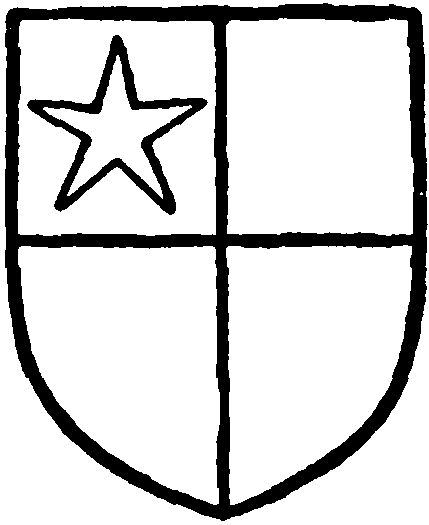
Vere. Quarterly gules and or with a molet argent in the quarter.
In 1257 Hugh de Vere, the fourth earl, received a grant of a weekly market on Wednesday and of a fair on the vigil, day and morrow of the Assumption, (fn. 44) which grant was confirmed to John, the twelfth earl, in 1441. (fn. 45) In 1276 the earl claimed free warren in Chesham, (fn. 46) but his title was probably insecure, as in 1330 a royal grant of the same was made to him. (fn. 47) In 1329 he obtained a grant of view of frankpledge in Chesham and Calverton, not only from his own tenants but from those of others, and all other perquisites that the sheriff was accustomed to take, in part recompense of the 20 marks he was wont to receive for the third penny in Oxfordshire. (fn. 48) In 1336 this view was decided to be separate and not pertaining to the manor. (fn. 49) A pension of £10 from the manor was granted by Robert Earl of Oxford and Alice his wife as a marriage settlement to their daughter Joan wife of William de Warenne. (fn. 50) On the death of Joan in 1293 it reverted to Alice Countess of Oxford, (fn. 51) but passed at her death in 1312 to John son of Joan de Warenne and Earl of Surrey. (fn. 52) In 1330 a settlement of the manor was made by Robert, the sixth earl, on himself for life, with remainder to his nephew John, (fn. 53) who inherited on his uncle's death in the next year. (fn. 54) In 1350 Chesham formed part of the marriage portion of Thomas son and heir of John de Vere, the seventh earl. (fn. 55) The latter complained in 1351 that Roger Sifrewast, kt., had broken his pillory, felled his trees and carried away the timber and assaulted his servants at Chesham. (fn. 56) Robert, the ninth earl, afterwards Duke of Ireland, made a settlement in 1385 of Chesham, (fn. 57) held by his mother Maud in 1404, (fn. 58) and the reversion of which was granted in 1406 to his widow Philippa and his nephew Richard de Vere, son of the tenth earl. (fn. 59) On Maud's death in 1412 Richard as eleventh earl entered into possession, (fn. 60) but mortgaged the manor in the same year for £400. (fn. 61) On the execution of John, the twelfth earl, and his eldest son in 1462 (fn. 62) Chesham was granted to John Scott, controller of the king's household, (fn. 63) but by 1466 John, the thirteenth earl, had recovered his father's possessions, (fn. 64) only, however, to forfeit them in 1475. (fn. 65) Later, returned to favour, he regained Chesham, and was pardoned in 1490 for alienating it without licence. (fn. 66) Edward, the seventeenth earl, who succeeded to Chesham in 1562, (fn. 67) demised the manor for a term of years to Luke Atslow, whose brother Dr. Edward Atslow brought an action against the copyholders in 1574 to prevent the cutting down of timber. (fn. 68) In 1580 Edward Earl of Oxford obtained the royal licence to alienate Chesham to Nicholas and Joan West and their son and heir William, (fn. 69) with whom he united in the following year to convey it to Thomas Farmer. (fn. 70) By 1588 Chesham Higham had come into the possession of Miles Sandys, lord of Latimer (fn. 71) (q.v.), with which Chesham has since been held.
The manor which at the beginning of the 14th century was known as ISENHAMPSTEAD CHEYNDUIT (fn. 72) or CHEINDUYT, and towards the end of the same century as ISENHAMPSTEAD LATIMER, is mentioned as part of the honour of Wallingford in 1194, (fn. 73) to which it remained attached until some time after 1563. (fn. 74) A fresh grant of the manor was made in 1566 by the queen, to hold of her as of her honour of Ewelme. (fn. 75) Though this Isenhampstead was contiguous to the Isenhampstead which afterwards became known as Chenies, it appears to have an entirely separate descent, at any rate from Domesday onwards. A 15th-century chartulary of the abbey of St. Mary Pré, Leicester, states that Latimer was at one time called Foliots. (fn. 76) A Walter Foliot was Sheriff of Oxfordshire in 1225, (fn. 77) and had a daughter and heir who was the wife of Ralph Chenduit by 1242. (fn. 78) She was probably the Joan who with her husband Ralph Chenduit had lands in Whelpley in 1233. (fn. 79) He was in possession of Isenhampstead in 1237, when he paid a mark for it. (fn. 80) He died in 1243, (fn. 81) and his successor Stephen joined the suite of Prince Henry son of Richard, King of Germany, with whom he returned to England in 1257. (fn. 82) In 1276 he subinfeudated Sir Hugh Fitz Otho in the manor to hold of the Chenduits for 1d. per annum. (fn. 83)
Until as late as 1346 Latimer was known as Isenhampstead Chenduit, (fn. 84) though called Isenhampstead Botetourt for a short period during the Botetourts' tenure, (fn. 85) and it was not until 1379 that it became uniformly known as Isenhampstead Latimer, (fn. 86) the original name, as in the case of Chenies, being dropped during the 19th century.
In 1277 Sir Hugh Fitz Otho obtained from Edward I a grant of protection against the Jews relative to any debts contracted by Stephen Chenduit in respect to Isenhampstead Manor. (fn. 87) In the following year the grant in fee simple was ratified by Stephen Chenduit for £500, (fn. 88) and in 1279 Hugh received a grant of free warren. (fn. 89)
Hugh died in 1283, and was succeeded by his daughter and heir Joan, then a year old, his son Edward having predeceased him. (fn. 90) Edmund Earl of Cornwall, who then held the honour of Wallingford, (fn. 91) thereupon demanded the custody of the manor, (fn. 92) but was obliged to relinquish it in the following year to Stephen Chenduit, who said that Hugh Fitz Otho held Isenhampstead of him by knight service. (fn. 93) Stephen Chenduit, however, recovered it only to alienate it to the queen for an annual rent of £20. (fn. 94) The manor-house appears to have been used as a royal residence during the next few years, and again later in the century, when it was once more in the Crown. In 1286 the queen received £4 19s. 6½d. from the issues of Isenhampstead, (fn. 95) and in the same year the Sheriffs of London had orders to send 2 tons of wine to the cellars there. (fn. 96) In 1290 the carriage of the pantry, a cask of ale and one of wine from Langley to Isenhampstead cost 2s. 8d. (fn. 97) In 1291 the queen transferred the custody of the manor to Robert Tibbotot, (fn. 98) but Joan daughter of Hugh Fitz Otho appears to have died while still a minor, and the manor passed to Maud daughter and heir of Thomas Fitz Otho and probably a cousin of Joan. (fn. 99) Her husband, John de Botetourt, was holding Isenhampstead in her right in 1302, (fn. 100) and in 1323 they conveyed the manor to Hugh le Despenser, jun., (fn. 101) by whom it was at once alienated to the king for a period of six months. (fn. 102) In 1324 Hugh le Despenser obtained a confirmation of the transfer from the Botetourts, (fn. 103) but on his execution and attainder in 1326 Isenhampstead escheated to the Crown, by whom the custody was granted to Maud Botetourt. (fn. 104) Within a few months it was bestowed for life on Simon de Bereford, (fn. 105) who shortly afterwards obtained a grant in fee simple, (fn. 106) but when he was attainted as a rebel the estate again escheated to the Crown in 1330. (fn. 107) In the same year it was demised in fee to William Latimer, third Lord Latimer, and Elizabeth his wife, a daughter of John and Maud Botetourt, (fn. 108) who found the estate impoverished by the pilferings of the servants of Simon de Bereford and others. (fn. 109) In 1335 William Latimer complained that Thomas de la Grove had broken his park, hunted and carried away his deer and committed other trespasses. (fn. 110) On his death in the same year (fn. 111) his widow Elizabeth received the issues of the manor, (fn. 112) which she held until her death in 1384. (fn. 113) Their son William Latimer having died in 1381 his daughter and heir Elizabeth, second wife of John Nevill, Lord Nevill de Raby, succeeded to the estates. (fn. 114) Lord Nevill dying in 1388, (fn. 115) Elizabeth married as his third wife Robert Lord Willoughby de Eresby, who died in 1396, (fn. 116) a year after his wife. (fn. 117) Latimer then descended to John Nevill Lord Latimer, Elizabeth's son by her first husband, during whose minority Edmund Brudenell held the custody. (fn. 118) John Nevill proved his age in 1403, (fn. 119) and in 1407 settled the manor on himself, his wife Maud and their issue. (fn. 120) In 1418, however, he granted the reversion to Ralph Nevill Earl of Westmorland, his half-brother on the father's side, to the exclusion of Elizabeth his sister of the whole blood and heir. (fn. 121) John Nevill died without issue in 1430, (fn. 122) and on the death of his widow Maud in 1446 (fn. 123) Latimer passed, according to the settlement of 1418, to George Nevill, fifth son of the Earl of Westmorland, who was summoned to Parliament as Lord Latimer. (fn. 124) On his death in 1469 he was succeeded by his grandson Richard, then aged one year, his son Henry having predeceased him. (fn. 125) Richard Nevill's tenure of Latimer was disputed from 1494 onwards by Sir Robert Lord Willoughby de Broke, the great-grandson and heir of Elizabeth sister and heir of the John Nevill who alienated his estates. (fn. 126) Lord Willoughby de Broke received a regrant of Latimer Manor, (fn. 127) and his son Robert settled it in 1517 to the use of John Newdigate, (fn. 128) but is said to have sold it in 1520 to Sir David Owen. (fn. 129) In 1530 Sir David Owen brought an action against Fulke Greville and Francis Dawtrey, the husbands respectively of Elizabeth and Blanche, granddaughters and heirs of Robert Willoughby, who had entered the manor 'with Bucklers, Daggers, Bowes and Arrowes' and turned out Robert Durrant, Owen's tenant. (fn. 130) David Owen died c. 1542 seised of the manor, which he left by will to his second son John, (fn. 131) who in 1548 quitclaimed his interest to Sir Fulke and Elizabeth Greville. (fn. 132) Sir Fulke died in 1559 (fn. 133) and his widow in 1563, (fn. 134) when the manor was retained by trustees in order to pay off all debts. (fn. 135) The elder son and heir Fulke apparently did not enter into possession until 1566, (fn. 136) but his brother Robert Greville was sued in 1563 by Christian Fairfield, widow, for dispossessing her of the manor-house leased to her in 1554 at a rent of £40 and left to Robert by the will of his mother. (fn. 137) The Grevilles had reserved to themselves the use of 'all the howsinge adjoining to the neyther ende of the hall and housing called the Newe Lodginge and the stable … containing 3 baye,' and closes called Beddells, Rounde and one near the Lord of Privy Seal's Pond; but Robert Greville desired the remainder of the site, and being 'a man of muche welth and substance and greatlye frended and allyed in the countie' was likely to have his way. (fn. 138)
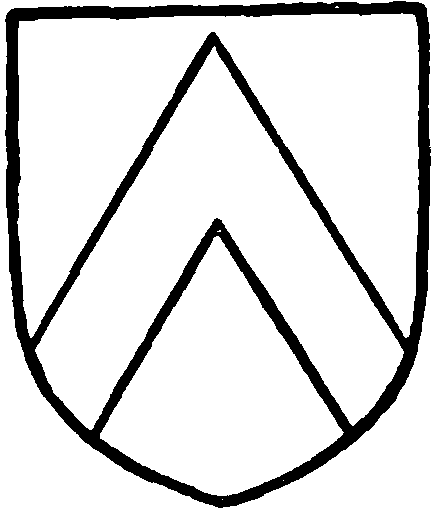
Chenduit. Azure a cheveron or.
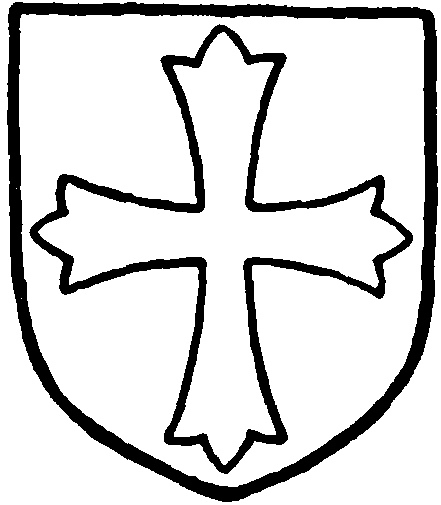
Latimer. Gules a cross paty or.
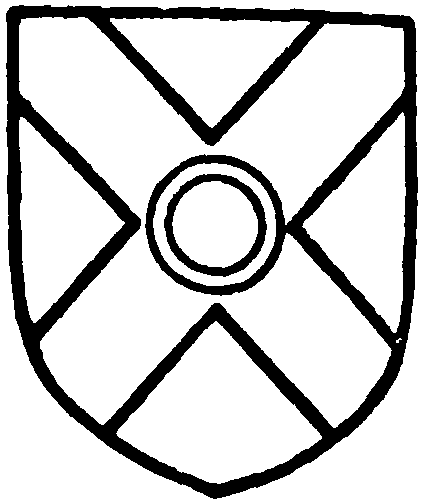
Nevill, Lord Latimer. Gules a saltire argent charged with a ring sable.
In 1567 Fulke Greville received licence to alienate the manor to Miles Sandys, (fn. 139) who proceeded to curtail the copyholders' privileges. In 1590 the executors of the will of Thomas Axtell brought an action against Sandys on behalf of Axtell's infant son and heir. They accused Sandys of endeavouring to charge the lands with the tenure of knight service in order to have the wardship of the heir, and of procuring the deeds held by the plaintiffs wherein socage tenure was clearly affirmed. They were also refused access to the court rolls and rentals of the manor. (fn. 140) Miles Sandys was further charged with contravening the custom by which all copyholders paid upon alienation or death four years' quit-rent and had the right to cut down trees. He had taken the Customary Book, formerly always kept by a tenant, with the object of enforcing heriots upon surrender and of forbidding the cutting down of timber. (fn. 141) On his death in 1601 Miles was succeeded by his son Edwin, (fn. 142) who held Latimer until his death in 1607, (fn. 143) when it passed to his son William, by whom it was alienated in 1615 to William Lord Cavendish, (fn. 144) afterwards Earl of Devonshire. His grandson William Earl of Devonshire (fn. 145) suffered as a Royalist in the Civil War, and paid £400 as a compounding fee for Latimer and Chesham. (fn. 146) On 13 October 1645 he and his mother, Christian Dowager Countess of Devonshire, entertained Charles I at Latimer while in the custody of the Parliamentary army. (fn. 147) His son William, created Duke of Devonshire in 1694, left Latimer to his youngest son Lord James Cavendish, (fn. 148) who leased the manor to the Yales and to Benjamin Hynmers, relatives of his wife Anne Yale, daughter of the governor of Fort St. George in the East Indies. (fn. 149) In 1732 Lord James Cavendish settled Latimer on himself for life, with remainder to William his son in tail-male, and in default to the right heirs of himself. (fn. 150) Father and son dying within a few months of each other in 1751, (fn. 151) the manor passed to Elizabeth daughter and heir of Lord James and wife of Richard Chandler, who assumed the name and arms of Cavendish on coming into the property. (fn. 152) Richard died some time after 1776 (fn. 153) and his widow in 1779, (fn. 154) without issue, when Latimer passed, in accordance with the terms of her will, to Lord George Augustus Cavendish, afterwards Earl of Burlington, third son of the fourth Duke of Devonshire. (fn. 155) Lord Burlington's eldest son William held Latimer in 1804, (fn. 156) but as he died without issue in 1812 it passed to his brother Charles Compton Cavendish, created Lord Chesham of Chesham in 1858. (fn. 157) His great-grandson Lord Chesham is the present owner of Latimer. (fn. 158)
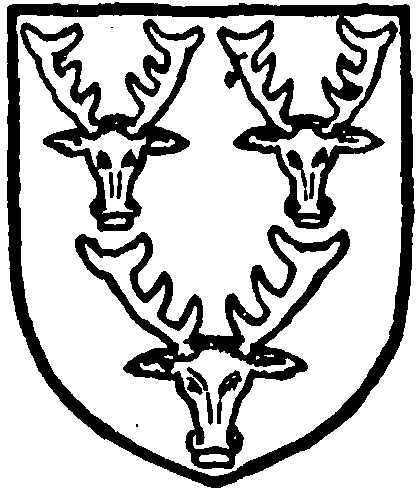
Cavendish, Lord Chesham. Sable three harts' heads caboshed argent.
The manor which by 1416 had acquired the name of CHESHAM BURY was held during the 12th and 13th centuries of the king in chief, (fn. 159) but in 1252 it was subinfeudated to a younger branch of the Sifrewast family by the elder line, (fn. 160) of whom it was afterwards held as of their manor of Clewer, Berks., until some time in the 15th century, (fn. 161) after which it was held of the king as of Clewer Tower within the castle of Windsor for 2s. 2d. (fn. 162)
The Sifrewast family are first mentioned in connexion with Chesham in the early 12th century, when Richard Sifrewast, with the consent of Emma his wife, William and Robert his heirs, and Peter and Alexander his other sons, gave a mill here to Missenden Abbey. (fn. 163) Richard was succeeded about 1166 by his son Robert, who gave 100 marks as a fine for his father's lands in Chesham. (fn. 164) He died in 1199, leaving a son and heir Richard, (fn. 165) from whom his sisters, Isabella wife of Robert de Pinkeny, Rose wife of William Broughton, and Emma wife of Osbert de la Mare, had some trouble in procuring their dower. (fn. 166) Osbert de la Mare and his son Robert in 1199 quitclaimed their rights in Emma's portion to Richard Sifrewast, (fn. 167) and though Robert in 1223 tried to regain possession on the pretext that he was a minor at the time of the alienation, he was unsuccessful in enforcing his claim. (fn. 168) In 1236 Richard settled 4 virgates of land on a younger son Thomas, who was to pay 60s. per annum to Richard during his lifetime, the land to revert to Roger, another son of Richard, (fn. 169) to whom he granted the manor in 1244. (fn. 170) Richard's son and heir appears to have been another Richard Sifrewast, who subinfeudated the manor to his brother Roger, in Chesham, in 1252, (fn. 171) his heirs retaining the mesne lordship thus created till some time after 1438. (fn. 172) Roger Sifrewast was dead by 1274, (fn. 173) and was succeeded by John Sifrewast (fn. 174) and his wife Elizabeth. (fn. 175) John represented the county in the Parliament of 1331 (fn. 176) and settled Chesham on his son Roger, (fn. 177) who was in possession in 1346 (fn. 178) and was coroner for Bucks. in 1349. (fn. 179) It was against him that John Earl of Oxford brought an action for breaking his manor of Chesham Higham (q.v.) in 1351. (fn. 180) Roger Sifrewast was dead in 1369, in which year Godfrey Sifrewast held the manor. (fn. 181) The last male Sifrewast appears to have left a widow Maud, who married John Wolseley, (fn. 182) and a daughter and heiress Amice, who married c. 1371 John de Beverley. In 1378 Maud Wolseley, for 100 silver marks, renounced her rights in the third of Chesham to John de Beverley, (fn. 183) after whose death Amice married Robert Bardolf, knight, with whom she held Chesham in 1394. (fn. 184) Amice was again a widow at her death in 1416, when Chesham passed, according to settlement, to William Lynde and his heirs, to the exclusion of Amice's grandsons and heirs, Robert Langford and Walter Daudessey. (fn. 185) William Lynde died seised of the manor in 1438, leaving a son and heir Thomas, aged thirteen, (fn. 186) who enfeoffed William Wedon of the manor and a field called Buryfield, to the use of Thomas and his heirs, (fn. 187) and sued Thomas Langford, a relative of Amice Bardolf's heir, for £600 which the latter owed him. (fn. 188) In 1477 Thomas Lynde purchased a pardon for all previous offences, (fn. 189) and died in 1486, leaving a son and heir John, aged twenty-two. (fn. 190) For some reason unknown Chesham Bury escheated to the Crown, by whom it was granted a month after Thomas Lynde's death to John Earl of Oxford. (fn. 191) In 1490 the earl obtained a pardon for all past alienations, (fn. 192) and seems to have acquired it in fee, as its descent is henceforth identical with that of Chesham Higham (q.v.), already held by the Earls of Oxford. (fn. 193)
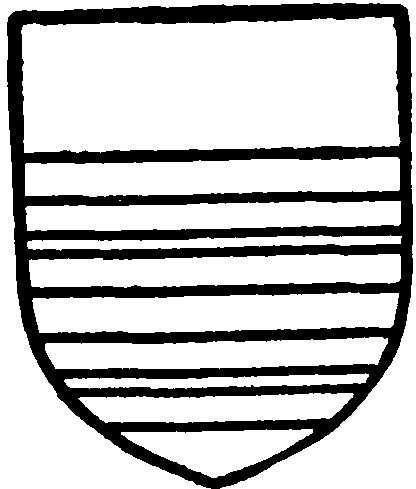
Sifrewast. Azure two gimel bars and a chief or.
The site of the manor of Chesham Bury, including woods and solums called Wuckeridge Wood, Higham Park and Cowcroft, was alienated in 1579 by the Earl of Oxford to Thomas Ashfield and his heirs, to hold of the queen in chief, reserving a rent of £7 to the earl and his successors. (fn. 194) Thomas Ashfield, who had formerly been bailiff to the Earl of Oxford, (fn. 195) had received a grant of Chesham advowson (q.v.) in 1571, with which the site of Chesham Bury then descended. (fn. 196) When his great-nephew Thomas Ashfield was sequestered for delinquency under the Commonwealth (fn. 197) it was found that Cowcroft had been sold to Samuel Latch in trust for Francis Mannay and Higham Mead to Robert Goodwin, M.P. (fn. 198) The Earl of Devonshire in 1653, as lord of the manor of Chesham Bury, put in a claim to the rent reserved. (fn. 199)
The descent of the site of the manor cannot be further traced, but a capital messuage called Cowcroft was leased to Jeremy Whichcote by Thomas Ashfield in 1656, (fn. 200) and was afterwards held by the Whichcote family with the rest of the Ashfield property in Chesham. (fn. 201)
GROVE MANOR
GROVE MANOR in Chesham was represented by 2 virgates of land in the 13th century which were held of the Earl of Oxford for one-eighth fee, 13s. 4d., and suit of court at his manor of Chesham Higham. (fn. 202) The overlordship remained in the Earls of Oxford and is last mentioned in 1535. (fn. 203)
There is mention about the middle 12th century of Walter de Broc, Maud his wife and Robert his son and heir, (fn. 204) probably ancestor of the Laurence de Broc, tenant under the Earl of Oxford, who greatly added to his possessions in Chesham from 1241 onwards. (fn. 205) On his death in 1275 he was succeeded by his son Hugh, (fn. 206) who at first subinfeudated the manor to Edmund Earl of Cornwall, but in 1286 alienated the ownership in fee of Grove Manor to Roger de Drayton and Robert de Hemel Hempstead and the heirs of the longer liver, the Earl of Cornwall retaining the intermediary lordship. (fn. 207) Hugh de Broc failed to keep the agreement and forfeited the manor in 1290 to the king, (fn. 208) by whom it was apparently bestowed on Walter de Langton, Bishop of Coventry and Lichfield. In 1300 Walter de Langton obtained a grant of free warren in his demesne lands of Grove, (fn. 209) but they were again seized by the Crown in 1307 for some misdemeanour, (fn. 210) though restored before Langton's death in 1322. (fn. 211) His heir was Edmund, the son of Robert Peveril, then under age, whose mother Alice received the custody of the lands as his nearest friend. (fn. 212) 'The easement of houses' in the manor was granted at the same time to Ida, the widow of John de Clinton, as the king wished to show her especial favour. (fn. 213)
By 1362 Grove Manor had come to Thomas Cheyne, who in that year received a grant of free warren. (fn. 214) He afterwards obtained Drayton Beauchamp Manor, with which Grove was held until the death of Sir John Cheyne in 1468, (fn. 215) when both manors passed to John Cheyne of Chesham Bois (fn. 216) (q.v.). His son Robert in 1544 made a settlement of Grove Manor on his second son Thomas, (fn. 217) who was in possession in 1572, (fn. 218) and in 1578, in which latter year he alienated it and the site with the park to Thomas Southen. (fn. 219)
No further mention of the manor has been found until 1692, when Henry Dunn, son of John Dunn, with Elizabeth his wife, Josiah and John Dunn, and John Lee and Anne his wife alienated it to William Lowndes, (fn. 220) secretary of the Treasury in the reign of Anne. After the death of Henry Dunn, his widow Elizabeth in 1704 confirmed the alienation to William Lowndes, (fn. 221) after whose death in 1724 Grove Manor passed to his son Charles, also secretary of the Treasury. (fn. 222) His son William was a commissioner of Excise, and left a son William, who died in 1831, when he was succeeded by his son another William. (fn. 223) The latter, who was twice married, left by his first wife a son William, who succeeded to the property in 1864, (fn. 224) but died unmarried in 1905, when Grove Manor passed to his half-sister's son William Frederick Lowndes Frith, who now owns the estate at Chesham.
Another manor in Chesham, afterwards known as BLACKWELL HALL MANOR, derived its name from the Blackwell family. William Blackwell held land in Chesham in 1227, (fn. 225) and his name occurs again in 1236–42. (fn. 226) By 1321, however, the manor of Blackwell, so called for the first time, had come into the possession of Edmund Earl of Arundel, who settled it on himself for life with reversion to Richard his son. (fn. 227) On the forfeiture of Edmund Earl of Arundel in 1326 (fn. 228) the lands escheated to the Crown and were bestowed by Edward III in 1328 on John de Warenne Earl of Surrey in fee simple. (fn. 229) The Earls of Surrey afterwards subinfeudated the manor and are mentioned last as overlords in 1430. (fn. 230)
In 1393 the ownership in fee of Blackwell Hall was vested in William Esenden and Alice his wife, who in that year renounced their interest and that of Alice's heirs to Sir Robert Bardolf and Amice his wife, lords of Chesham Bury. (fn. 231) On the death of Amice in 1416 Blackwell Hall was inherited by her grandsons Robert Langford and Walter Daudessey, kt., (fn. 232) but Langford appears to have acquired his cousin's interest, as he died seised of the whole manor in 1429, leaving a son and heir Edward, aged three. (fn. 233) Robert Langford's widow Elizabeth married John Boyville and settled Blackwell Hall in 1432 on herself for life with remainder to her issue by her first husband. (fn. 234) Within the next few years the manor had come into the possession of Sir Thomas Cheyne of Chesham Bois, (fn. 235) with which it descended (fn. 236) until 1576, when John Cheyne alienated it to William Doodes. (fn. 237) In 1613 it was held by John Pott and Barbara his wife and Thomas Sawes and Mary his wife, who conveyed it to James Birch. (fn. 238) Ten years later it passed, on James Birch's death, to his son William, (fn. 239) who with Susan his wife quitclaimed his interest in the same in 1636 to Thomas Style, attorney of the King's Bench, (fn. 240) already lord of Cholesbury, with which Blackwell Hall was afterwards held till about the end of the 17th century. (fn. 241) In 1738 threequarters of the manor was claimed by Christopher Griffith and Mary his wife and her sisters Susannah and Elizabeth Brightwell, daughters and co-heirs of Samuel Brightwell, (fn. 242) while the remaining quarter was held by Anne wife of Richard Chicheley and probably another daughter. (fn. 243) That part held by the three sisters appears to have been settled on Mary Griffith's son Christopher Griffith, whose greatnephew and heir Christopher Darby-Griffith held Blackwell Hall in 1828 (fn. 244) and owned 470 acres in Chesham in 1873, (fn. 245) though the manor is not again mentioned.
The remaining portion held by the Chicheleys in 1738 passed to Richard Robbins and Elizabeth his wife, who held it in 1756. (fn. 246) In 1774 it is mentioned for the last time as the property of Richard and Mary Robbins. (fn. 247)
Among the names of landholders in Chesham occurs that of the Mordaunts. Edmund Mordaunt and Eleanor his wife complained in 1355 of having been unjustly disseised of common of pasture. (fn. 248) Edmund died in 1373 seised of rents in Chesham, which descended to his son Robert. (fn. 249) Another Robert Mordaunt appears to have married an heiress Elizabeth, who brought her husband the manor afterwards called MORDAUNTS FEE, which they alienated in 1434 to Edmund Brudenell. (fn. 250) It was afterwards acquired by Sir Thomas Cheyne together with the manor of Blackwell Hall (fn. 251) (q.v.), with which it descended and in which it appears to have merged. It is mentioned last as a distinct manor in 1613, (fn. 252) and in the 18th century is comprised in that of Blackwell Hall as the manor of Blackwell Hall cum Mordants. (fn. 253) The name disappears after 1774.
THORNE MANOR in Chesham, which was held of Miles Sandys in 1586, (fn. 254) acquired its name from the Thorne family, the earliest of whom there is mention being Sir John Thorne, who held lands here in 1279. (fn. 255) By 1302 he was succeeded by Geoffrey de Spina or Thorne, (fn. 256) whose name last occurs in 1328. (fn. 257) Thomas Thorne is mentioned in 1346 (fn. 258) and was still alive in 1370. (fn. 259) His son John and Alice his wife conveyed Thorne Manor to Edmund Brudenell in 1398, (fn. 260) but the transaction does not appear to have been completed until 1405. (fn. 261) The manor was retained by the Stoke Mandeville branch of the Brudenells, Maud widow of Robert Brudenel claiming dower here in 1473 against their son and heir John. (fn. 262) On the death of John's son Edmund Brudenell in 1583 (fn. 263) Thorne Manor passed to his son Francis, aged fifty, (fn. 264) who died in 1602 (fn. 265) before he was able to carry out his intention of settling it on his wife and younger children. (fn. 266) The eldest son Edmund, who was otherwise provided for, refused to carry out his father's wishes and entered into the manor, (fn. 267) which he settled in 1610 on himself and heirs. At the same time he settled land on John Turnor and James Benning, (fn. 268) and in 1611 united with his brother William Brudenell to convey Thorne Manor to James Mayne, (fn. 269) by whom it was alienated in 1615 to John Turnor, son of John Turnor aforesaid. (fn. 270) John Turnor died in 1638, when the manor passed to his son John, (fn. 271) from whom it doubtless descended to a female heir, for in 1671 it was held by Thomas Nicholl in right of his wife Susan and by them was alienated to Thomas Kentish. (fn. 272) In 1768 it reappears in the possession of Thomas Brand, (fn. 273) who was still holding in 1795, (fn. 274) but there is no further mention of this manor.
Lands in Chesham, afterwards known as HUNDRIDGE MANOR, were held of Hugh de Bolbec in the 13th century, (fn. 275) and afterwards of the Earls of Oxford, (fn. 276) the overlordship being last mentioned in 1575. (fn. 277)
Walter de Broc, the first tenant of whom there is record, (fn. 278) died before 1203, in which year his widow Emma claimed 50 acres of land in Chesham (fn. 279) and his son and heir Robert did homage for his father's lands. (fn. 280) By 1286 they had passed to Robert's son John, (fn. 281) who in 1303 received a grant of free warren in Hundridge. (fn. 282) John or a son of the same name was holding in 1329 (fn. 283) and 1342, (fn. 284) and by 1464 the manor had passed to Thomas de Broc. (fn. 285) Thomas was succeeded by William de Broc, who sued Thomas Cheyne for breaking into his house and killing his dog. (fn. 286) William died in 1476, leaving a son and heir Leonard, (fn. 287) who appears to have died about 1530, in which year his sister and co-heir Joan Fyllins alias Reynolds, widow, claimed Hundridge. (fn. 288) She appears to have united with her sisters to convey the manor to Sir Robert Dormer, who died seised of it in 1552. (fn. 289) From this date until 1632 the descent of Hundridge coincides with that of Wing, (fn. 290) but it was then alienated with other manors by Robert Earl of Carnarvon to Richard Lord Lovelace in trust to sell them to pay the earl's debts and raise portions for his younger children. (fn. 291) By 1679 it had become the property of Charles West and Elizabeth his wife, (fn. 292) who appear to have conveyed it before 1705 to Garnham Edwards and Elizabeth his wife. (fn. 293) They were still in possession in 1741, (fn. 294) but nothing further is heard of Hundridge until 1830, when it reappears in the hands of William Lowndes, jun., (fn. 295) lord of Grove Manor, with which Hundridge apparently became amalgamated, as it is not mentioned separately after 1862. (fn. 296)
In addition to the advowson and great tithes of Chesham Leicester the abbey of St. Mary Pré owned other rights in Chesham. In 1276 the chaplain of Bradenham took 32 quarters of corn from the abbot's estate at Chesham to supply the castle of Windsor, (fn. 297) and in 1291 the abbot had £1 10s. 5½d. in rents. (fn. 298) This property was the rectorial manor of CHESHAM LEICESTER, mentioned as such for the first time in 1719, then in the possession of Sir Paul Whichcote. (fn. 299) His family had made the old rectory-house or 'upper parsonage' of Chesham Leicester, near the church, one of their residences, and it was looked upon as the capital messuage of this manor. (fn. 300) Sir Francis Whichcote sold the property c. 1730 to Coulson Skottowe, (fn. 301) who died in 1784, leaving it by will to his wife Anne Skottowe for life with reversion to his half-brother John Skottowe, governor of St. Helena. (fn. 302) Anne Skottowe died the same year as her husband, (fn. 303) and John Skottowe was succeeded in 1786 by his son John, (fn. 304) who on the death of his uncle Nicholas Skottowe, East India merchant, in 1798 inherited a freehold messuage at the gate at Chesham called Berry Hill Gate, with the hay in the fields and wines in the cellars. (fn. 305) John Skottowe held the manor until 1802, (fn. 306) when he sold the Chesham property. (fn. 307) The manorial rights appear to have been dispersed on the buying up of the tithe by small owners, and the rectory-house with the park adjoining was sold to Charles Lowndes and shortly afterwards demolished. (fn. 308)
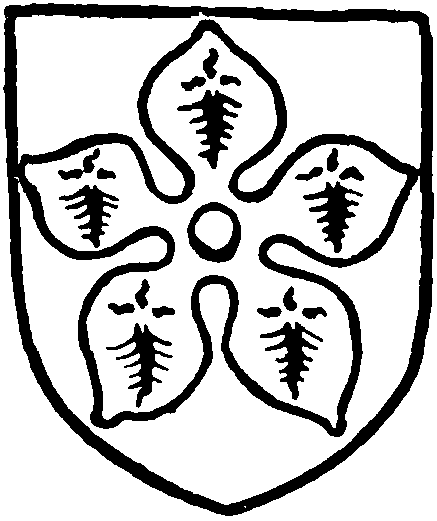
Leicester Abbey. Gules a cinqfoil ermine.
The Abbot of Woburn acquired lands in Chesham from various people in the 13th century, (fn. 309) and from Isabel de Bolbec, Countess of Oxford, in 1223 and 1241. (fn. 310) In 1291 his temporal possessions in Chesham were assessed at £2 12s. 2d., (fn. 311) and £1 was received in rents from Isenhampstead. (fn. 312) This estate, however, in 1586, as the rectorial manor of CHESHAM WOBURN, (fn. 313) passed with the rest of the Woburn property to the Earls of Bedford, (fn. 314) by whom it was retained until the end of the 18th century, when the eighth duke sold the manor to the Rev. — Hubbard. (fn. 315) By 1862 it had come into the hands of Mr. B. Fuller of Hyde House, (fn. 316) and at the present day the trustees of the late Mr. J. S. Fuller own manorial rights in Chesham.
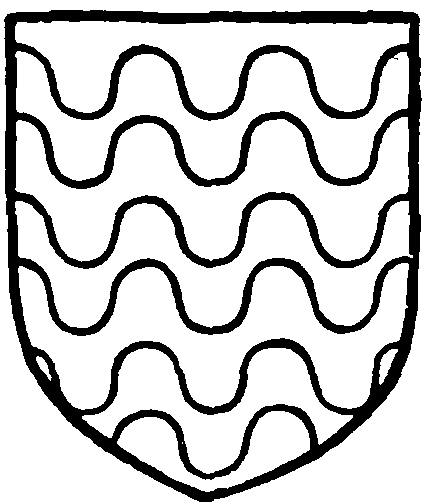
Woburn Abbey. Azure three bars wavy argent.
Missenden Abbey acquired an estate in Chesham in the 12th and 13th centuries by gifts of the Sifrewast family, (fn. 317) confirmed by the Bolbecs (fn. 318) and Earls of Oxford (fn. 319) and augmented by the Bulstrodes and others. (fn. 320) This estate, assessed at £3 16s. 4d. in 1291, (fn. 321) was confirmed to the abbey in 1401 by the pope, (fn. 322) and was said to be worth £9 10s. 6d. in 1535. (fn. 323) After the Dissolution it was granted, as lands called Pednor and Sextens Croft, to John Lord Russell in 1541, and was then in the tenure of Thomas Wedon. (fn. 324) His son Richard Wedon was sued in 1560 by Edmund Brudenell, lord of Thorne Manor, concerning a lease of land in Hartridge. (fn. 325) This Richard Wedon in 1563 purchased the freehold of Pednor Farm, or Grange as it was then called, from Francis Lord Russell and died seised of it in 1593, leaving a son and heir William (fn. 326) and another son Thomas, who inherited a house called the Maynwoods and founded an almshouse in Chesham. (fn. 327) William Wedon died in 1636, leaving five daughters and co-heirs, (fn. 328) the eldest of whom, Mary Beale, died in 1677. (fn. 329) The descent of Pednor has not been traced further.
Lands in Chesham, held of the Earl of Oxford (fn. 330) and at one time known as the manor of Chesham, (fn. 331) were held by John Wedon, who claimed to have free warren here in 1276. (fn. 332) In 1302 Ralph Wedon died seised of lands and rents in Chesham which descended to his son Ralph, (fn. 333) who complained in 1331 that John Sifrewast and others had carried away cattle from his estates at Chesham and Amersham and goods worth £1,000. (fn. 334) These complaints were repeated in 1334 and 1335 (fn. 335) and in 1345 Ralph Wedon recovered the manor from John Sifrewast, who appears to have taken unlawful possession. (fn. 336) William Wedon acquired lands in Chesham in 1370 (fn. 337) and in 1484 John son of William Wedon was made bailiff of the Crown lands in Chesham in succession to his father. (fn. 338) In 1517 Robert Wedon, gentleman, was accused of having destroyed in 1491 and 1497 messuages called Spencers and Nuettes, thus turning out fourteen people. (fn. 339)
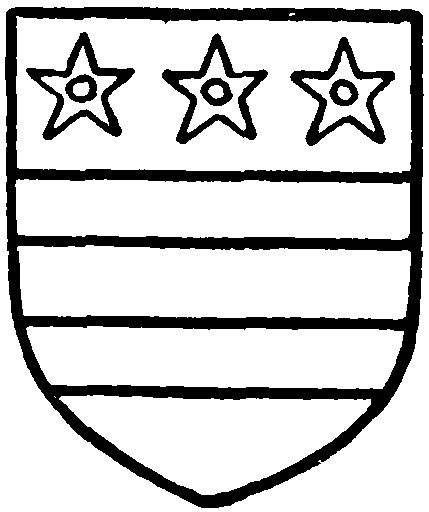
Wedon. Argent two bars gules with three pierced molets sable in the chief.
Four hides in Chesham which Queen Edith had held as a manor had been given by her after the Conquest to Alsi, who held the same of the king in 1086. (fn. 340)
Another half-hide in Chesham held by Epy, a man of Brictric, had passed by 1086 to Turstin. (fn. 341) Neither of these holdings has been traced afterwards.
There was a mill on Chesham Higham Manor worth 10s. in 1086 (fn. 342) and described as a water-mill in 1312 leased at fee farm. (fn. 343) It descended with the manor (fn. 344) and was called two water-mills in 1481, (fn. 345) said to be under one roof in 1580. (fn. 346) Two watermills are mentioned as appurtenant to the manor during the 17th and 18th centuries, (fn. 347) and may be identical with two of the present flour-mills, Lord's Mill, Cannon Mill (fn. 348) and Weirhouse Mill situated on the Chess.
A mill on Chesham Bury Manor was bestowed on Missenden Abbey in the early 12th century by Richard Sifrewast. (fn. 349)
There were also two mills on Latimer Manor, one a corn and the other a fulling-mill, leased at 60s. and 26s. 8d. respectively in 1323. (fn. 350) There is no mention of them after 1335. (fn. 351)
Laurence de Broc died in 1275 seised of Paynes Mill in Chesham leased to Missenden Abbey for 15s. (fn. 352) In 1286 the Brocs' estate comprised a fulling and a corn-mill (fn. 353) and in 1322 half a water-mill. (fn. 354) The mill at Blackwell is mentioned first in the 13th century (fn. 355) and again in the 15th century. (fn. 356)
CHURCHES
The church of ST. MARY consists of a chancel measuring internally 35 ft. 6 in. by 16 ft. 6 in., central tower 14 ft. square, north transept 19 ft. by 15 ft., south transept 19 ft. 6 in. by 15 ft., nave 64 ft. 6 in. by 22 ft., north aisle 14 ft. wide, south aisle 12 ft. wide and south porch.
It is built of flint and stone, some of the buttresses resting on unhewn pudding-stone; the roof of the chancel is slated and the other roofs are covered with lead.
A large cruciform church existed here in the 12th century, and though a mutilated window in the north transept is the only remaining detail, both transepts are probably of this period. In the 13th century the nave was rebuilt, the north and south aisles were added, and the chancel arch was widened. The chancel, central tower and south aisles were rebuilt, and windows were inserted in the transepts about 1350. At this date the tower was of two stages only, and was probably open to the church to its full height, the upper stage forming a lantern. During the 15th century the nave-clearstory and the south porch were built and the bell-chamber added to the tower. About 1606 the church was reseated and a gallery erected in the south aisle, while in 1693 the chancel was reroofed. By the early 18th century the tower piers showed signs of weakness, particularly the southwest pier containing the stairway to the rood-loft; the stairway was therefore filled in and a stronger abutment obtained by partially blocking the arch between the south aisle and transept. Fissures still developed, and late in the 18th century an unsuccessful attempt was made to secure the tower with iron bands. About 1797 the nave was reroofed and provided with a plastered ceiling and the walls of the north aisle were heightened and a gallery inserted. There was also a gallery at the west of the nave on which the organ was built. The whole fabric was restored in 1868–9 by G. G. Scott, when the galleries were removed, the north aisle was considerably widened and the tower strengthened by iron rods and glands.
The chancel is lighted by two traceried windows on the north, two on the south, all of two lights, and a three-light window on the east. The east window is practically modern, and the others, though dating from the 14th century, have been considerably restored. Below the western light of each of the windows at the west end of the lateral walls is a square low-side window with original stanchions and saddle bars, which was closed by a wooden shutter secured by an iron bar and catches, the catches still remaining in the south window. On the south are a priest's doorway and a piscina, both restored, and a sedile formed by the lowering of the sill of the southeast window.
The lower stage of the tower opens to the chancel, nave and transepts by pointed arches of three orders springing from responds with attached shafts and moulded imposts. The arch to the chancel dates from the 13th century, but the others, which have mouldings of a different character, are of the 14th century. The north transept is lighted on the east by a repaired 14th-century window of two lights with foliated tracery, and on the north by a large window, the jambs of which are of the 14th century, but the head and tracery were inserted in the 15th century, when the transept was heightened and reroofed. In the west is a 13th-century pointed arch of two orders with wide chamfered responds and moulded imposts, and above it can be seen the 12thcentury window above referred to, half of which has been cut away and the other half blocked. The south transept was also heightened and reroofed in the 15th century, and the three-light perpendicular window in the south wall is entirely of that period. On the east is a two-light traceried window of the 14th century, and on the west the partially blocked arch to the aisle. The blocked doorway to the roodloft stairs is on the north-west, and there is a buttresslike projection at the south-east corner of the nave strengthening the tower at this point. On the southwest corner of the transept externally are some scratched designs, including two circles, fragments of two others and the inscription 'W.A. 1676.'
The nave is of five bays with north and south arcades of pointed arches supported on octagonal pillars and responds dating from the 13th century. The arches are of two hollow-chamfered orders and the pillars have moulded imposts and plain chamfered bases. On the west is a large 15th-century window of five lights which replaced a triple lancet, traces of which have been discovered, and below the window is a contemporary doorway with a four-centred head, square label and traceried spandrels. It retains its original double oak doors with traceried panels. The clearstory has on either side five windows of three cinquefoiled lights. Three of the windows on the north contain some original glass, including two shields, Cheyne, and an indecipherable coat impaling Chenduit. In the west wall of the north aisle there is a restored 13th-century lancet, and on the north are a blocked pointed doorway and four square-headed windows of two lights, in most of which some 15thcentury work has been re-used.
The south aisle is lighted by four windows on the south and one on the west, all originally of the 14th century, but altered in the 15th century and since restored. They are of three trefoiled lights with tracery in pointed heads. The south doorway, dating from the 14th century, has a pointed head of three continuously moulded orders enriched with ball-flower ornament.
The porch is entered by a pointed arch with continuous mouldings, and has a quadripartite stone vault with hollow-chamfered ribs springing from shafts at the corners. In the middle of the east wall are the remains of a fine stoup with crocketed label, flanking pinnacles, foliated finial, and a crucifix above the finial. This is now much defaced, the front part of the bowl is broken away, and the crucifix has been cut back almost flush with the wall. There is a parvise above the porch, which has a 15th-century traceried window of two lights on the south and small rectangular windows on the east and west. It is approached by a turret stairway on the north-west, which is entered by a four-centred doorway in the aisle and leads also to the aisle roof.
The tower rises two stages above the roof of the church, and is surmounted by an embattled parapet and an octagonal lead spire. The first stage has on the west a 15th-century doorway leading to the roof of the nave, and on each of the other sides a single trefoiled light of the 14th century. On the north wall are traces of a former high-pitched roof of the north transept. The bell-chamber has on each side a 15th-century traceried window of two cinquefoiled lights.
The font is modern. In the south aisle there is a brass inscription to John Gawdry (d. 1670). On the north wall of the chancel is a monument with bust to Richard Woodcoke, vicar of the parish (d. 1623), and a tablet with three shields of arms to Richard Bowle (d. 1626). Against the east window of the south transept there is a large monument to John Cavendish, son of the Earl of Devonshire (d. 1617), consisting of a sarcophagus under a canopy flanked by twin Corinthian columns and surmounted by an achievement of arms. Partly blocking the south window of this transept is a monument with arms to Mary (Banks) wife of Francis Whichcote, bart., of Aswardby, Lincolnshire (d. 1726); it consists of a large sarcophagus standing on a plinth and surmounted by an obelisk and urn. On the south wall of the south aisle is a large indistinct painting representing St. Christopher, and there are traces of colouring on the piers of the tower and on the jambs of the south transept windows. A painting on the north wall representing the Blessed Virgin and an angel weighing souls was destroyed when the wall was moved out in 1869.
There is a ring of six bells, all by Thomas Mears of London, 1812, and a 15th-century sanctus bell by John Sturdy of London, which bears the initials I.S.
The communion plate consists of two chalices, two patens, one flagon and an almsdish all of silver and dated 1870.
The registers begin in 1538. The earlier part of the first volume is a copy of 1598, with no entries during Mary's reign.
There is also a book written by Richard Bowle, commemorated above, concerning 'repayring of the seates and of the Bells of the parish Church and Building of a Newe Gallery, 1606,' with the names of the churchwardens, an account of the work and a list of the seats, &c.
The church of ST. MARY MAGDALENE, Latimer, was built in 1841 and partially rebuilt in 1867 from the designs of Sir Gilbert Scott. It is a building in the Gothic style, consisting of apsidal chancel, transepts, vestry and organ chamber, and south porch with bell-turret over. There are some early registers, baptisms dating from 1782, marriages from 1755 and burials from 1784. The previous registers are all preserved at the parish church of Chesham.
The ecclesiastical parish of CHRIST CHURCH, Waterside, was formed in 1867, and the church was built in the same year. It is of flint and Bath stone in the 13th and 14th-century styles and consists of chancel, nave, south aisle, south porch and western bell-turret. The presentation to the vicarage is vested in Lord Chesham, the owner of the Bury mansion, and the vicar of Chesham for the time being. St. George's, Tylers Hill, is a chapel of ease to this church.
The ecclesiastical parish of ST. JOHN THE EVANGELIST, Ashley Green, was formed in 1875, and the church was consecrated in the same year. It is of flint with stone dressings in the 13th-century style and consists of chancel, nave of four bays, south aisle, south porch, and a bell-turret over the chancel arch. The living is a vicarage in the gift of Mr. T. A. Smith-Dorrien-Smith of Tresco, Scilly Islands.
ADVOWSON
The church of Chesham seems from early times to have been attached in separate moieties to the manors of Chesham Bury and Chesham Higham. That part appurtenant to Chesham Bury was granted by Robert Sifrewast some time before 1199 to the abbey of St. Mary de Pré, Leicester, (fn. 357) from which it acquired the name of Chesham Leicester, and by which it was retained until the Dissolution, though Richard Sifrewast, the son of Robert, sued the abbot for the right of presentation in 1213. (fn. 358) The abbey obtained a confirmation of Robert's charter in 1318, (fn. 359) but the Sifrewasts again put forward a claim in 1329. (fn. 360) A vicarage was instituted some time before 1209, and consisted in the half of all altar offerings and in the lesser tithes. (fn. 361) The abbots presented their own vicars to the church, who served concurrently with those presented by the patrons of the other moiety. (fn. 362) Richard Monk, the incumbent in 1428, was obliged to abjure Lollardy, and promised on the Holy Gospels to preach no more heresy. (fn. 363) In 1535 the church was assessed at £13 6s. 8¾d., (fn. 364) and was leased after the Dissolution to Thomas Ashfield in 1571 for twenty-one years to commence from 1586. (fn. 365) In 1602, however, Ashfield obtained a grant in fee to hold of the manor of East Greenwich in socage. (fn. 366) Thomas Ashfield died in 1609, when the advowson passed to his nephew and heir Edmund afterwards Sir Edmund Ashfield. (fn. 367) Sir Edmund held the advowson until his death c. 1620, (fn. 368) and left a widow Clara and son and heir Thomas. (fn. 369) The church was sequestered owing to Thomas's delinquency, and the issues handed over to the incumbent of Little Marlow to make up his income. (fn. 370) The Ashfields are said to have sold the patronage of Chesham Leicester about 1650 to Jeremy Whichcote, (fn. 371) created a baronet in 1660, (fn. 372) who presented to the church in 1676. (fn. 373) On his death in the following year his son Paul inherited the title and estates (fn. 374) and presented to the church in 1711. (fn. 375) His son and heir Sir Francis sold the advowson c. 1730 to Coulson Skottowe, who presented to the church in 1750. (fn. 376) The patronage was afterwards acquired by the Duke of Bedford, who owned the advowson of Chesham Woburn, with which Chesham Leicester was united to form one benefice by an Act of Parliament in 1767. (fn. 377) Since that date the descent of the advowson is identical with that of Chesham Bois (q.v.) and is now in the gift of the Peache trustees.
The rectory of Chesham Leicester, appropriated to Leicester Abbey, was assessed at £13 6s. 8d. in 1535, (fn. 378) and was leased in the following year to Christopher Ashfield for fifty years at a rent of like value. (fn. 379) It was included in the reversionary lease obtained by Thomas Ashfield in 1571. (fn. 380) Under the Commonwealth it was mortgaged by the Ashfields to Sir John Trevor, (fn. 381) but was sequestered by the commissioners. (fn. 382) It descended with the advowson until c. 1767, when it was retained with the manor of Chesham Leicester (q.v.) by the Skottowes until the beginning of the 19th century, when the tithes were for the most part bought by the owners of the several estates. (fn. 383)
The other moiety of Chesham Church was bestowed on Woburn Abbey, doubtless by one of the Bolbecs, lords of Chesham Higham, for in 1194. Aubrey de Vere Earl of Oxford, acting as guardian of Isabella de Bolbec, attempted to regain the church. (fn. 384) The action was brought against Dunstable Priory, to whom rights in the vicarage had been granted by Woburn Abbey. The prior pleaded that the matter did not appertain to the lay court. (fn. 385) The vicarage consisted in half of the altar offerings, and the Prior of Dunstable claimed in addition to the right of presentation a pension of 3 marks, which had not been paid by the abbey in 1218 and was left to be decided by the Bishop of Lincoln. (fn. 386) The dispute was finally settled in 1221 by the priory renouncing all claims in the vicarage for a perpetual pension of 3 marks, (fn. 387) which continued to be paid until the Dissolution. (fn. 388) The church was assessed at £17 5s. in 1291 (fn. 389) and at £13 6s. 8¾d. in 1535. (fn. 390) After the Dissolution the advowson of Chesham Woburn was granted in 1552 to Anne Countess of Bedford and Lord Francis Russell to hold of the honour of Ampthill in free socage, (fn. 391) and descended in the Earls of Bedford together with Chenies Manor, (fn. 392) being united in 1767 with Chesham Leicester (fn. 393) (q.v.).
The rectory of Chesham Woburn was assessed at £23 in 1535 and was leased to John Cheyne. (fn. 394) It was confirmed in the grant to the Russells in 1552 and remained in that family until 1795, when the tithes were purchased by the respective landlords. (fn. 395)
On account of the distance from Lincoln the parishioners of Chesham were allowed to hold the Whitsuntide processions in the parish church of Amersham, but owing to discords which arose between the parishioners of the two places and encounters under arms the men of Chesham begged to be allowed to celebrate these sinodalia pentecostalia elsewhere than at Amersham. In 1454 licence was therefore granted to them, together with the inhabitants of the hamlets of the chapels of Chesham Bois and Chesham Latimer, dependent on that church, to proceed on Whit Monday with cross and banners round their own church and town, offering 16d. in token of subjection to the fabric of Lincoln. (fn. 396)
There was a chapel of St. James in Latimer, mentioned first in 1304 as in the patronage of John Botetourt. (fn. 397) The right of presentation has always been held by the lords of Latimer and is now vested in the present Lord Chesham. (fn. 398)
The chapel was dependent on Chesham Church, but was endowed with tithes from the demesne lands by some early lord of Latimer. (fn. 399) In 1730 the chalpain sued Sir Francis Whichcote, bart., as impropriator of Chesham Leicester, for £8 in lieu of 4 quarters of wheat which had been stopped by Mr. Gainsford, former lessee of the tithes, 'only out of ill humour or some maggott.' (fn. 400)
The chapel was exempt from episcopal visitation until the Act of 1838, (fn. 401) when, however, no district was assigned or church or chapel wardens appointed. In 1867 the chapel was enlarged and consecrated in the name of St. Mary Magdalene. (fn. 402) The ecclesiastical parish was constituted by an Order in Council dated 14 May 1868, (fn. 403) and by an order dated 24 March 1876 the benefice, a rectory, was united with Flaunden Vicarage. (fn. 404)
There was a chantry or free chapel of St. Edward King and Martyr in Hundridge claimed in 1199 by the Abbot of Woburn as pertaining to his half of Chesham Church. (fn. 405) The defendant Elias de Wimberville, represented by Richard de Broc, acknowledged the abbot's title in 1200, (fn. 406) and the duties of the abbot were then defined.
The Brocs, within whose manor the chapel was situated, endowed it with lands and tithes and appear to have acquired a certain interest in the presentation.
In 1472 William Broc agreed that the abbot should cease to provide the priest for the next four years in return for an annual rent of £4. (fn. 407) As the rent was not always paid, Anne widow of William Broc sued the abbot in 1494 for the sum owing. (fn. 408) In 1504 there was further trouble with the abbot, whom the trustees of Leonard Broc sued for refusal to provide a chaplain during the last two years, and the necessary books, chalice, bread, wine, wax and vestments. The abbot denied his obligation to celebrate mass or find a chaplain for other services, and alleged that the chapel was so ruined that no chaplain would dare to celebrate mass because of the danger of death. (fn. 409) At the dissolution of Woburn Abbey the Brocs acquired full control over the chapel, which is mentioned in their possession in 1535. (fn. 410) In 1546 the salary of the chaplain of 'Brokes' chapel, as it was then called, was 60s., and had been paid by Robert Cheyne for thirty-seven years. (fn. 411)
CHARITIES
In 1624 Thomas Wedon by will founded and endowed almshouses for four poor people. The trust estate consists of 99 acres of land in the parish of Chartridge let at £60 a year. Each of the inmates receives 4s. a week, the net residue being applied in the upkeep of the almshouses.
In 1578 John Cheyne by deed charged a farm called the Mose with an annuity of £2 for the poor, which is distributed in small sums.
In 1630 land in Chartridge containing 39 acres or thereabouts was purchased with a sum of £200 given to the poor by the Earl of Devonshire. The land is let on a lease for 300 years, from 5 August 1630, for £12 per annum, which is distributed, according to the trusts, equally among seven poor persons.
In 1670 John Gawdrey by will gave an annuity of £3 out of land in Chesham, now known as Milk Hall Farm, for distribution among twelve poor widows or widowers.
Margaret Butterfield, who died in 1674, gave £100 stock, now £100 consols, the dividends to be paid to the minister for preaching two sermons, one on the first Wednesday after 6 September (her birthday) and the other on the first Wednesday after 28 October (day of her burial).
In 1875 Mrs. Rachel Johnson, by will proved at London 14 December, bequeathed £2,000 for educational purposes (see educational charities below). The same testatrix bequeathed four legacies of £400 each for eleemosynary purposes, which are represented by a sum of £1,660 3s. 8d. consols with the official trustees, producing an income of £41 10s. a year. The dividends are applied in the following proportions, namely, one-eighth to the town coal fund, one-eighth to the Waterside coal fund, one-quarter to the soup fund, one-quarter to the Infant Society and one-quarter to the Dorcas Society.
In 1885 Thomas Curtis, by a codicil to his will proved at London 18 March, bequeathed a legacy, now represented by £2,400 consols, for providing the yearly stipend of £60 to the clergyman of Whelpley Hill chapel of ease. The stock is standing in the names of trustees. See also under educational charities below.
Educational charities, comprising the educational foundations of:—
— Prior, founded by deed 2 July 1856, trust fund, £667 7s. 7d. consols with the official trustees, annual dividends £16 13s. 4d., regulated by scheme of Charity Commissioners 19 February 1895, whereby the income is made applicable in prizes for elementary scholars and exhibitions for secondary scholars.
Mrs. Rachel Johnson, will 1875, trust fund, £2,075 4s. 6d. consols with the official trustees, set aside by order of Charity Commissioners 30 November 1906. The annual dividends of £51 17s. 8d. are at present accumulating. See also eleemosynary charity of same testatrix above.
Thomas Curtis, founded by codicil to will proved at London 18 March 1885, trust fund, £2,400 consols, set aside by order of Charity Commissioners 11 October 1904, for providing £60 a year for a schoolmistress of the school at Whelpley Hill founded by him. The dividends on a sum of £583 4s. 1d. consols, amounting to £14 11s. 6d. a year, derived under the will of the same testator, are also applicable for educational purposes. The sums of stock are standing in the names of trustees.
Lord Wharton's Charity.
This parish participates in the distribution of Bibles and Prayer-books under the charity of Philip Lord Wharton. (See under Amersham.)
Nonconformist Charities.
The endowments in connexion with the Congregational church consisted of the following sums of stock for the benefit of the minister, namely, £107 16s. 4d. consols arising under the will of Mary Bass, 1833, £112 consols by will of Ann Clark, 1809, and £356 6s. consols by will of John Graveney, 1817.
In 1904 the several sums of stock were realized and the proceeds applied towards the purchase of Hillside Villa for the minister's residence, with the sanction of the Charity Commissioners, subject to repayment with interest at 3 per cent.
In 1886 Eli Birch, by a codicil to his will proved at London 28 September, also bequeathed for the minister the sum of £200, which was invested in £198 14s. 8d. consols standing in the names of trustees of the church.
The endowments in connexion with the Broadway Baptist Chapel.
Joanna Neale's charity, founded by deed 16 June 1714, is regulated by scheme of the Charity Commissioners 14 August 1877. The trust property consists of a villa called 'Arden,' used as a manse for the minister, and a sum of £2,859 5s. 7d. consols with the official trustees, producing £71 9s. 8d. a year.
The minister of the Baptist chapel also receives the rents of 5 acres and two cottages known as Little Pipetts, let at £20 a year, which was purchased with moneys arising under the will of John Timms, proved 12 May 1750, and other moneys raised for the purpose.
Mrs. Mary Ann Beckley's gift consists of £225 6s. consols arising under will proved at London 24 September 1898 and standing in the names of George Freeman and three others. The annual income of £5 12s. 4d. is distributed by the sick visiting society.
Chapelry of Latimer.
In 1743 Benjamin Hynmers by his will devised £5 yearly for the poor of this chapelry issuing out of a farm at Latimer.