A History of the County of Buckingham: Volume 3. Originally published by Victoria County History, London, 1925.
This free content was digitised by double rekeying. All rights reserved.
'Parishes: Wyrardisbury or Wraysbury', in A History of the County of Buckingham: Volume 3, ed. William Page (London, 1925), British History Online https://www.british-history.ac.uk/vch/bucks/vol3/pp320-325 [accessed 30 April 2025].
'Parishes: Wyrardisbury or Wraysbury', in A History of the County of Buckingham: Volume 3. Edited by William Page (London, 1925), British History Online, accessed April 30, 2025, https://www.british-history.ac.uk/vch/bucks/vol3/pp320-325.
"Parishes: Wyrardisbury or Wraysbury". A History of the County of Buckingham: Volume 3. Ed. William Page (London, 1925), British History Online. Web. 30 April 2025. https://www.british-history.ac.uk/vch/bucks/vol3/pp320-325.
In this section
WYRARDISBURY or WRAYSBURY
Wirecesberie (xi cent.); Wyredesburi (xiii cent.); Wreysbury (xvii cent.).
The parish of Wyrardisbury covers an area of 1,678 acres, and of these 640 are arable and 666 permanent grass. (fn. 1) The soil is loam and the subsoil gravel. The chief crops are wheat, barley and oats and potatoes. Wyrardisbury lies on the north bank of the Thames, (fn. 2) which encircles it on the west and south, and the River Colne and its tributaries water it on the east. The land is low, rising nowhere higher than 59 ft. above the ordnance datum. The periodical overflow of the rivers formerly caused great inconvenience to the inhabitants. This was to a great extent counteracted by the erection of a suspension bridge in 1842 by George Simon Harcourt, and by raising the roads where necessary above high-water mark. (fn. 3) This bridge was replaced about 1874 by one on iron girders supported by brick pillars. The village lies in the centre of the parish. The houses, amongst which are a few 17th-century buildings much altered, are scattered on either side of a small tributary of the Thames, which is crossed by the bridge above mentioned. (fn. 4) The church stands to the west of the bridge, the school, Baptist chapel and vicarage to the east. The George Inn, to the north of the church, is mentioned in 1731 as the place of meeting for 'staking day'; there was 1s. forfeit for non-attendance. (fn. 5) It is a two-storied brick house coated with cement, built early in the 17th century and subsequently enlarged. Wyrardisbury station, (fn. 6) on the Windsor branch of the London and South Western railway, is situated at the east end of the village. Near it is Wyrardisbury House, formerly the rectory, and Bowry Farm, which derives its name from a yeoman family who lived there in the 17th and 18th centuries. (fn. 7) By the Thames in the west of Wyrardisbury stands Remenham House, the property and residence of Capt. Charles Hargreaves; near it are the old Ferry House and Place Farm (popularly known as King John's Hunting Lodge). This is probably an early 16th-century house, refaced at a later date. It is timber-framed, and the southern half appears to have formed the hall, extending the whole height of the house. The entrance archway to the porch is original, and an arched roof truss shows the position of the hall; some old doors remain, and in the windows of two rooms on the first floor is some heraldic glass comprising a shield charged with the royal arms and another with the Stonor arms. The building is in a dilapidated condition and much overgrown with ivy.
The Ankerwycke estate, the property of Mr. Guy Harcourt, lies in the south of the parish. The ruins of Ankerwycke Priory, a house of Benedictine Nuns, are apparently of the 13th century with 15th-century additions, and consist of a length of wall, 10 ft. high, running east and west with two shorter fragments at the east and north-west. In the longer wall are three windows, all facing the south. There is a 15th-century opening in the fragment of wall at the northwest, and the east wall is strengthened by diagonal buttresses. All are now in a ruinous condition and overgrown with ivy. Near the ruins of the old nunnery is a large yew tree, connected traditionally with a meeting between Henry VIII and Anne Boleyn. In 1813 its girth 3 ft. from the ground was 27 ft. 8 in. and this in 1906 had increased to 30 ft. (fn. 8) Ankerwycke House, the residence of Mr. A. H. Benson, was built by John Blagrove in the early 19th century (fn. 9) on the site of the 16th-century residence of Sir Thomas Smith, statesman and scholar under Edward VI and Elizabeth. (fn. 10) The latter sovereign visited Sir Thomas Smith there in 1565. (fn. 11) The grounds overlook the Thames with the Surrey hills in the background. Near Ankerwycke is Magna Charta Island, where is preserved the stone framed in oak on which King John is said to have affixed his seal to Magna Charta.
There were two mills in Wyrardisbury in 1086. (fn. 12) In 1547 George Bulstrode of Horton (q.v.) held Coltnett water-mill as free tenant of Wyrardisbury Manor. (fn. 13) It remained in his family for about a century. (fn. 14) A complaint was made in 1755 that the dammingup of the water in the mill-stream had flooded Wyrardisbury Common and made the ford over the Colne dangerous. (fn. 15) Thomas Williams is named in 1799 as one of the smaller proprietors in Wyrardisbury (fn. 16) and Coltnett, now known as Wyrardisbury Mill, belonged during the 19th century to his family. (fn. 17) Copper Mill Road denotes the industry connected with this mill in the early years of that century. It was afterwards adapted for the manufacture of paper, for which purpose it had previously been used in 1605. (fn. 18) The second mill in Wyrardisbury stands near the junction of the Colne with the Thames at Hythe End. (fn. 19) It was noted during the last century for the manufacture of mill-boards. (fn. 20)
Mention is made of four fisheries in Wyrardisbury in 1086. (fn. 21)
This parish was inclosed in 1799, when allotments were made for the gravel-pits belonging to it. (fn. 22) Its right to hold a wake or fair on Friday in Whitsunweek on specified waste land was also recognized, (fn. 23) but by 1862 the declining fair had been transferred to the road in front of the George Inn. (fn. 24)
Among place-names in Wyrardisbury may be mentioned: Watebrech (fn. 25) (xiii cent.); Queen's Mead, (fn. 26) Rewyke Grove (fn. 27) (xvi cent.); Caresbushott, Rotten Row Green, (fn. 28) Eton Green, (fn. 29) Flinsted's, (fn. 30) Gospits, (fn. 31) Barton's, Fisher's, Rieside Shot, Staines Shot, Warbridge, High Warple (fn. 32) (xvii cent.); Kitchin Eight, and in osier-lands Ferry Eight, Gravill Eight, Rushbed, Vineyard Slip, and Welly Eight (fn. 33) (xviii cent.).
MANORS
The manor of WYRARDISBURY, the only estate in Buckinghamshire held by Robert Gernon in 1086, (fn. 34) was afterwards held of the Crown as parcel of the barony of Stansted Mountfitchet, the caput of which was at Stansted Mountfitchet in Essex. (fn. 35) In 1540 it was annexed to the honour of Windsor. (fn. 36)
Before the Conquest this manor was held by Edmund, one of King Edward's thegns. (fn. 37) Gernon, the Domesday tenant, died without heirs, and his lands were given by Henry I to William de Muntfichet. (fn. 38) Gilbert, his son, a minor at the time of his father's death sometime after 1135, (fn. 39) was succeeded by his son Richard before 1186. (fn. 40) He was Sheriff of Essex and Hertfordshire in 1200, (fn. 41) and died three years later, when the custody of his heir Richard was given to Roger de Lacy. (fn. 42) Richard de Muntfichet was one of the twenty-five barons who called in the aid of France against John, and was taken prisoner at the battle of Lincoln. (fn. 43) He died without issue shortly after in 1268, leaving as heirs the descendants of his three sisters, Margery, Aveline and Philippa. (fn. 44) The second sister, Aveline, had married William de Fortz Earl of Albemarle, and Wyrardisbury Manor with Langley Marish (q.v.) was allotted to her granddaughter Aveline. (fn. 45) During Aveline's minority her lands remained in the hands of the king, who gave her in marriage in 1269 to his second son Edmund Earl of Lancaster. (fn. 46) He and his wife obtained seisin of her lands in 1273. (fn. 47) She died in the same year (fn. 48) without issue, and Wyrardisbury became the right of Ralph de Plaiz, grandson and heir of Philippa de Muntfichet. (fn. 49) Since Ralph was only nine years old, the Crown had his wardship. (fn. 50) Ralph de Plaiz died while still a minor sometime before 1284, (fn. 51) and the claim of the descendants of his brother Giles was afterwards ignored by the Crown. (fn. 52) Wyrardisbury Manor was leased in 1282 to Christine de Marisco (Mariscis or Marreys), second wife of William de Marisco, (fn. 53) for her life, (fn. 54) and to her executors for three years after her death. (fn. 55) She died in 1311, and six months later her executors surrendered the remainder of their claim on Wyrardisbury to the king in exchange for a tenancy of Overstone Manor, Northamptonshire, for seven and a half years. (fn. 56) Wyrardisbury was afterwards administered as a royal manor. (fn. 57) In 1313 part of the issues of this manor was assigned to the chaplain and clerks of the chapel in Windsor Park, (fn. 58) predecessors of the Dean and Canons of Windsor. The arrears for fourteen years amounted to £140 in 1327. (fn. 59) In that year Wyrardisbury was given to Queen Isabella for life. (fn. 60) It was afterwards assigned in dower to the queens of Edward III, (fn. 61) Richard II (fn. 62) and Henry IV. (fn. 63) Sir John Fray was holding Wyrardisbury Manor for life in 1447, when the reversion was granted to Eton College. (fn. 64) This grant, however, proved abortive, although Wyrardisbury was excepted from an act of resumption in 1455 (fn. 65) and a fresh grant was made in favour of Eton College in 1457 during the lifetime of Sir John Fray. (fn. 66) In 1465 this manor was settled on Elizabeth, queen of Edward IV, for her life. (fn. 67) It formed part of the dower lands of Elizabeth, queen of Henry VII, (fn. 68) also of Katherine of Arragon, (fn. 69) of Anne Boleyn, (fn. 70) and of Jane Seymour. (fn. 71) In 1627 a grant of Wyrardisbury Manor was made to John Sharrow, (fn. 72) who conveyed it in the same year to trustees. (fn. 73) In 1649 they conveyed a moiety of the manor (including the right of holding courts) (fn. 74) to Thomas Ling and Humphrey Carter in trust for Andrew King, to whom it was transferred in 1656. (fn. 75) Lipscomb, who appears to have had access to the manorial Court Roll of that date, says that Andrew King died in 1659, and was succeeded by his son Andrew, (fn. 76) who was knighted on the accession of Charles II. (fn. 77) Sir Andrew King died in 1678, (fn. 78) and his executors, following the instructions contained in his will, (fn. 79) sold Wyrardisbury Manor in 1685 to John Lee, (fn. 80) who died in 1704. (fn. 81) His widow Mary owned Wyrardisbury until her death in 1725, (fn. 82) when it passed to Philip Harcourt, grandson of Elizabeth, John Lee's sister. (fn. 83) He died in 1759, and was buried at Wyrardisbury. (fn. 84) His brother and heir John died in 1785, (fn. 85) leaving a son and heir John Simon. (fn. 86) He alienated the manor to John Blagrove of Cardiff Hall, Jamaica, who held his first court in 1807. (fn. 87) The trustees for Blagrove's daughters and co-heirs held a court in June 1828, (fn. 88) but within the year the manor had been purchased by George Simon Harcourt, (fn. 89) son of the former owner. (fn. 90) His grandson Mr. Guy Elliot Harcourt is now lord of the manor of Wyrardisbury.
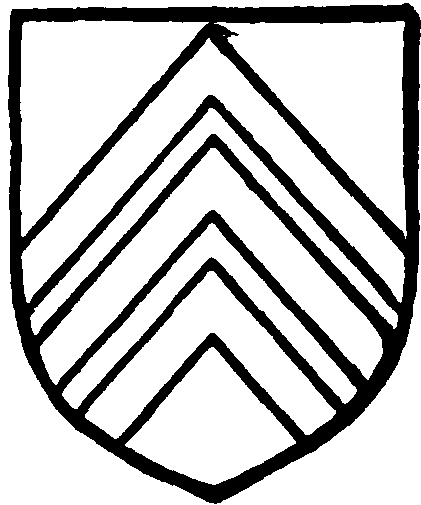
Muntfichet. Gules three cheverons or.
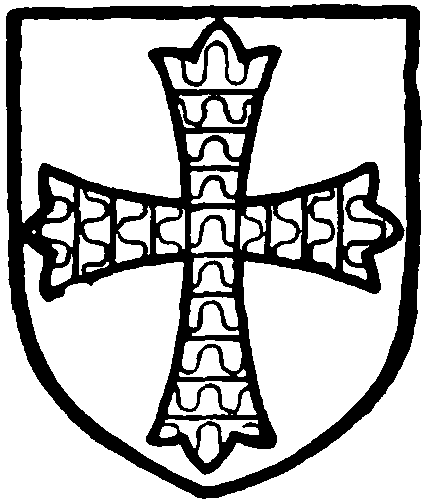
Fortz. Gules a cross paly vair.
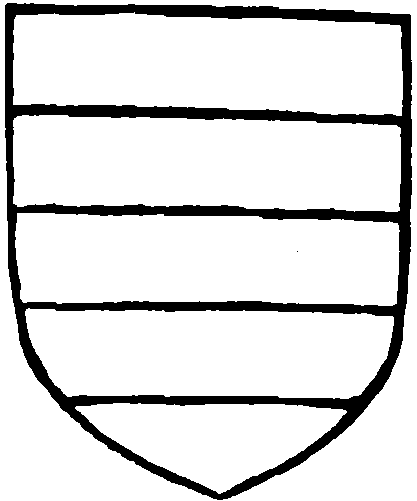
Harcourt. Gules two bars or.
In 1369 the manor-house of Wyrardisbury, an old hall and some 277 acres of land were leased for thirty years to John Jourdelay and Thomas Remenham. (fn. 91) This estate, known as the site and demesne of the manor, was leased in 1543 for twenty-one years to Sir Walter Stonor. (fn. 92) Five years earlier he had obtained a settlement in his favour of Remenham Manor (q.v.), and this lease follows the same descent in the Stonor family. The reversion was granted in 1555 to Sir Thomas Smith, and the lease renewed in 1574. (fn. 93) It was held in 1605 by Sir William Smith, (fn. 94) nephew and heir of Sir Thomas, (fn. 95) who obtained an extension in that year. (fn. 96) The estate was granted in 1628 to trustees for the City of London, a clause relative to the lease being introduced into the grant. (fn. 97) It was sold at the expiration of the lease, and, under the name of Place Farm, followed the same descent as Remenham Manor (fn. 98) (q.v.).
The right of view of frankpledge in Wyrardisbury is named in the 13th century. (fn. 99) References to the court leet occur in the 17th century. (fn. 100) The court baron is still held annually. In some cases it was customary on the death of a copyholder to pay as heriot the second best beast to the lord of the manor. (fn. 101) In 1725 from 38 acres of heriotable land two heriots were due, namely, 'the best living or dead goods.' (fn. 102) In 1799 willow plantations for copyholders were to be held in severalty. (fn. 103)
Silvester, rector of Wyrardisbury, owned land there in 1231. (fn. 104) In 1350 Edward III transferred to the collegiate church of Windsor, then in possession of the advowson (q.v.), a small estate granted to him by Richard of Gloucester. (fn. 105) These lands remained as the RECTORY MANOR with the college, which was exempted from suppression at the Dissolution. (fn. 106) In 1651 it was dispossessed and the manor, valued at £3 8s. 6d., was sold nominally to John Bland (fn. 107) for Sir Andrew King, then lessee of the estate. (fn. 108) After the Restoration the Dean and Canons of Windsor recovered the manor, (fn. 109) which they retained (fn. 110) and still own.
The lease of Wyrardisbury House and grounds, parcel of this manor, was owned consecutively by members of the Hassel and Gyll families during the 18th and 19th centuries, (fn. 111) and the owner was lay rector. (fn. 112)
A second manor in this parish, called WYRARDISBURY or REMENHAM MANOR, owes its name to the Remenham family, who were living here in the 13th and 14th centuries. In 1289 John de Remenham and his wife Alice held land and a mill in Wyrardisbury. (fn. 113) His descendant Thomas in 1343 settled land here with a weir and fishery in the Thames on himself, with remainder to his sons John, William and Richard. (fn. 114) Reference has already been made to the joint lease held by Thomas de Remenham in 1369 of the principal manor in Wyrardisbury (q.v.).
In 1463 Edward IV granted Wyrardisbury Manor to John Brecknock to hold by fealty and rent of a pair of spurs, or 3s. 4d. yearly. (fn. 115) He died in 1476, (fn. 116) and his widow Elizabeth held the manor until her death in 1489. (fn. 117) She was succeeded by Sybil granddaughter of John Brecknock and wife of Thomas Stonor. (fn. 118) In 1538 this estate, under the name of Remenham Manor, was secured to their son Sir Walter Stonor, kt., (fn. 119) and his wife Margaret with reversion to Walter's daughter Elizabeth (fn. 120) and her heirs. Sir Walter Stonor died in 1551, (fn. 121) and was succeeded by Elizabeth, then wife of Sir Philip Hoby. (fn. 122) She was buried at Wyrardisbury in 1560, (fn. 123) as was also her son and successor Walter Walshe (fn. 124) in the following year. (fn. 125) His son William (fn. 126) afterwards Sir William Walshe owned Remenham Manor in 1611, (fn. 127) but before 1626 it had been purchased by Sir William Smith, kt., who died in that year. (fn. 128) The manor passed to his son Sir William, kt., (fn. 129) who, dying in 1631, left as heir an infant son Edward. (fn. 130) He died unmarried, and soon afterwards his uncle Thomas later Sir Thomas Smith, bart., (fn. 131) in 1651 sold Remenham to Richard Hale. (fn. 132) His son (fn. 133) Dr. Richard Hale, dying in 1728, (fn. 134) bequeathed it to his nephew Thomas Tower, with remainder to Christopher, brother of Thomas, and his sons. (fn. 135) Christopher Tower, son of the above Christopher, (fn. 136) was the owner in 1778. (fn. 137) In 1785 he sold the manor to William Gyll, (fn. 138) who died in 1798. (fn. 139) His son and heir William died in 1806, (fn. 140) and was succeeded by Brooke Hamilton Gyll, his son, who was in possession in 1862. (fn. 141) The Remenham estate passed to his brother Gordon and afterwards to Gordon's son Major Fleming Gyll, (fn. 142) from whom it was purchased about 1886 by the present owner, Captain Charles Hargreaves.
In 1611 Remenham Manor owed suit at the courts leet and baron of Wyrardisbury Manor. (fn. 143) It owned a ferry across the Thames, (fn. 144) and the fishing rights in 1785 extended about half a mile. (fn. 145)
The so-called manor of COW or COKKE in Wyrardisbury appearing in the early 17th century (fn. 146) follows the same descent as Remenham. It is last mentioned in 1825. (fn. 147)
Ankerwycke Priory owned an estate in Wyrardisbury, (fn. 148) with which it was endowed by its founder, Gilbert de Muntfichet, about 1160. (fn. 149) This was increased by further gifts from him and his family, all of which are enumerated in 1251. (fn. 150) This property was owned by the priory at the Dissolution, when the demesne lands at Ankerwycke were valued at £4 13s. 4d. and the rents and farms in Wyrardisbury at £5 6s. 8d. yearly. (fn. 151) In 1536 Ankerwycke was leased to John Norris for twenty-one years, and the reversion of this lease was included in the foundation grant to Bisham Abbey in 1537. (fn. 152) It was transferred to Andrew Lord Windsor in 1539, (fn. 153) but exchanged with the Crown for other property in 1542. (fn. 154) In 1550 Sir Thomas Smith received a grant of the manor, (fn. 155) which was settled, shortly before his death in 1577, (fn. 156) on his brother George and George's son William in tail-male. (fn. 157) William succeeded his father in 1584 (fn. 158) and was knighted in 1603. (fn. 159) He acquired Remenham Manor (q.v.), and Ankerwycke follows the same descent until 1652, when it was conveyed by Thomas Smith (fn. 160) to John Lee of London. (fn. 161) He died in 1682, (fn. 162) and since 1685, when his son John (fn. 163) acquired Wyrardisbury Manor, the descent of Ankerwycke has corresponded with that of the manor. (fn. 164)
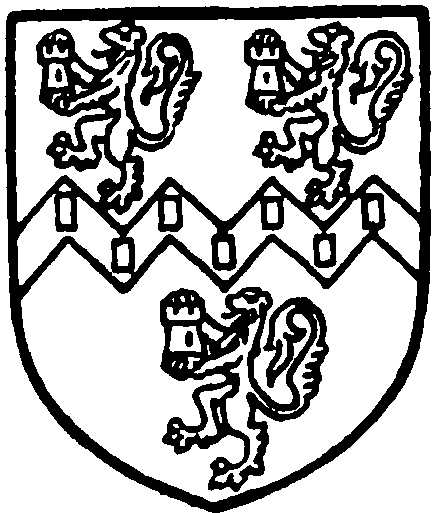
Smith. Sable a fesse dancetty argent billety sable between three lions each holding a castle all argent.
Ankerwycke Priory owned all weirs and fisheries in the Thames from Ankerwycke Ferry to Old Windsor. These were included in the grant of 1539 to Lord Windsor, and were held at that time by Thomas Edwards and William Danby. (fn. 165)
CHURCH
The church of ST. ANDREW consists of a chancel measuring internally 20 ft. 6 in. by 14 ft. 6 in., north chapel, nave 38 ft. 6 in. by 17 ft. 6 in., north and south aisles and west tower. The walls are of stone with a modern Kentish rag facing, and the roofs are tiled.
The building dates from the early part of the 13th century, and then consisted of the present chancel, nave and north aisle, and a south aisle which was afterwards destroyed. The north chapel was built in the 15th century, forming an eastern extension of the north aisle, and in 1862 the church was extensively restored and refaced, the tower, replacing a western bell turret, added, and the south aisle rebuilt.
The chancel is lighted from the east by a threelight traceried window and from the south by a twolight window, both of which have modern tracery but old inner jambs. In the north wall are traces of a blocked 13th-century lancet and three blocked doorways; the central doorway, below the lancet, is of 15th-century date, and has a four-centred head and moulded jambs on the chapel side. In the south wall is a modern niche containing a restored 13th-century piscina bowl. The chancel arch is of the early 13th century, it is pointed and of two orders with keeled edge-rolls, recessed only on the nave side, and springs from similarly moulded jambs with small capitals and bases, the abaci and plinths of which are continued along the nave walls. The north chapel, which has no structural division from the north aisle and is now used as a vestry, has a modern window in the east wall, on either side of which is a trefoiled niche, probably of early 15th-century date, while in the north wall is a modern doorway. On either side of the nave is an arcade of three pointed arches with square piers having keeled edge-rolls. The details are of the same character as those of the chancel arch, but the arches are of one order only. The south arcade has been restored on the south side, and all the details of the north and south aisles and of the west tower are modern. The nave seems to have had at one time a flat ceiling, as appears by indications on the walls above the chancel arch and nave arcades, but the present roofs, with the exception of two 15th-century moulded trusses in the north chapel, appear to be modern.
The font has a cylindrical bowl, the upper part of which is probably a fragment of a 13th-century column with the base moulding inverted and cemented upon it; the lower part of the bowl and the base are of a subsequent period. The oak pulpit dates from the late 17th century. The sounding-board is now at the vicarage, having been adapted as a table. Some carved panelling and an oak chest in the chapel are of the same period.
In the chancel is an early 16th-century brass with the figure of a knight in armour, and the indent of the figure of a lady in butterfly head-dress. Above the figures are the remains of an elaborate double canopy, with two shields in white metal, a fragment of a third shield, and the indent of a fourth. One shield is charged with a cheveron between three eagles' legs razed, and the other two remaining shields bear the same charges impaling a cheveron. There is also a brass commemorating John son of Walter Stonor, who died in 1512. From the diminutive size of the figure it has been supposed to represent a student of Eton College, but the costume, a long gown with a furred border and a close-fitting hood with streamers surmounted by a round cap bound with fur, is probably that of a doctor of laws. A third brass with an inscription and three shields of arms and the matrix for another commemorates Dame Elizabeth Hoby, daughter of Sir Walter Stonor, who died in 1560, and her son Walter Walshe, who died in 1561. There is a floor slab in the chancel to Edward Gould, servant of Charles II, who died in 1680, and another in the nave to Mary wife of Henry Gibbons and their son Henry, both of whom died in 1687, also monuments to the Gyll, Paxton, Fleming and Pitches families.
There are eight bells, of which the first, second, third and fourth are by John Warner & Sons, London, and were cast between 1871 and 1890, the fifth and sixth by Bryan Eldridge, 1657, the seventh by William Eldridge, 1664, and the tenor by Henry Knight, 1591.
The communion plate includes a cup and cover paten of 1634, a modern chalice given by the Rev. Seymour Neville, vicar 1856–69, a flagon presented by John Wilder in 1861 and a modern paten.
The registers begin: baptisms and burials in 1734, marriages in 1754.
ADVOWSON
Robert Gernon, the Domesday tenant of Wyrardisbury, granted the church, which with Langley Marish (q.v.) was valued in 1291 at £33 6s. 8d. yearly, (fn. 166) to Gloucester Abbey. (fn. 167) The latter exchanged it with the Crown in 1345 for property in Gloucestershire. (fn. 168) In 1348 it was granted in free alms to the Dean and canons of Windsor with licence of appropriation, (fn. 169) and in the following year a vicarage was ordained. (fn. 170) The advowson, valued with Langley at £15 0s. 10½d. yearly in 1535, (fn. 171) has, with the rectory, continued under the same ownership. (fn. 172)
CHARITIES
The parochial charities are regulated by a scheme of the Charity Commissioners of 19 April 1898. They comprise the charities of:
Philip Harcourt, founded by will proved in the P.C.C. 10 April 1759, and consisting of a yearly payment of £3 9s. 4d. by the owner of Hythe End Farm.
The Bridge Land, consisting of 10 a. 2 r. 23 p., producing £15 19s. yearly, and four cottages and gardens producing £20 13s. yearly.
William Gyll (alderman of London), who died in 1798, and by his will bequeathed £300 stock.
Thomas Wright, who by will 1794 left a legacy of £100 stock.
These legacies are now represented by £448 0s. 11d. consols with the official trustees, producing £11 4s. yearly.
John Lee, by will in or about 1807, bequeathed to the Corporation of the Sons of the Clergy £26 yearly for providing an afternoon service every Sunday, a further sum of £1 for the parish clerk, and of £2 12s. for distribution of bread.
Charlotte Holmes, by will proved at London 21 August 1862, left a trust fund of £500 consols, producing £12 10s. yearly.
It is directed by the scheme that the income of the Bridge Land should be applied towards the repair of those public bridges for which the county is not liable, any residue to be applied to any other public purpose approved by the Charity Commissioners; that the yearly income of Charlotte Holmes's charity —subject to keeping in repair two tablets and vault in church—should be divided into two equal parts, one part to be applied towards the maintenance of the Church Sunday school and the other part for the general benefit of the poor; that the yearly income of the remaining charities should also be applied for the general benefit of the poor.
In 1908–9 £7 10s. 6d. was applied in the distribution of coals to twenty-eight poor families, £7 2s. 6d. in fares of patients to hospitals, &c., and £2 2s. in a subscription to the Surgical Aid Society.
The church land consists of 5 a. 2 r. 19 p. known as Queen's Mead, producing £8 2s. 6d. yearly, and cottages and land let at £40 yearly. The net rents are carried to the churchwardens' account.