A History of the County of Buckingham: Volume 3. Originally published by Victoria County History, London, 1925.
This free content was digitised by double rekeying. All rights reserved.
'Parishes: Cholesbury', in A History of the County of Buckingham: Volume 3, ed. William Page (London, 1925), British History Online https://www.british-history.ac.uk/vch/bucks/vol3/pp334-335 [accessed 30 April 2025].
'Parishes: Cholesbury', in A History of the County of Buckingham: Volume 3. Edited by William Page (London, 1925), British History Online, accessed April 30, 2025, https://www.british-history.ac.uk/vch/bucks/vol3/pp334-335.
"Parishes: Cholesbury". A History of the County of Buckingham: Volume 3. Ed. William Page (London, 1925), British History Online. Web. 30 April 2025. https://www.british-history.ac.uk/vch/bucks/vol3/pp334-335.
In this section
CHOLESBURY
Chelwardisbyry (xiii cent.); Chelwoldesbery (xiv cent.); Chollesbury (xvi cent.); Cholsbury (xvii cent.).
Cholesbury is a small parish, covering an area of 178 acres, of which about 75 acres are arable land, 85 permanent grass, and 16 woods and plantations. (fn. 1) The soil is clay, with a subsoil of chalk, which has been worked in pits on Ray's Hill. The chief crops are wheat and barley.
The village, consisting of a few cottages with one or two outlying farms, stands near the centre of the parish on high ground, rising to 613 ft. at the vicarage. The manor-house is near the vicarage, and hard by is a spring called Holy Well. (fn. 2) To the north-west of the village is a large prehistoric plateau camp, on a spur of the Chiltern Hills. Within the inclosure, to the south-west, stand the church and churchyard, near which are Berry Pond and Holly Pond. (fn. 3)
In 1833 the poor rates of Cholesbury are said to have exceeded 30s. in the pound, so that all the land was forced out of cultivation and parochial bankruptcy was caused.
MANOR
Cholesbury is not mentioned by name in the Survey of 1086, but it is assumed to be included under 'Draitone' (Drayton Beauchamp), assessed at 6 hides, 3 virgates, and held of Manno le Breton. (fn. 4) Like Drayton Beauchamp (q.v.), it remained attached to the honour of Wolverton. (fn. 5)
The sub-tenant in 1086 was Helgot, (fn. 6) and in 1248 the manor of CHOLESBURY, first so-called in that year, was conveyed by William le Breton to Hugh le Breton and his heirs for 1d. rent. (fn. 7) Hugh le Breton, who in 1251 acquired further lands in Cholesbury from Thomas le Breton, (fn. 8) may have been a member of a younger branch of the Wolverton house. There is no mention of the manor during the next hundred years, but in 1362 it reappears, in conjunction with Drayton Beauchamp, as the property of Mary the Dowager Countess of Norfolk. (fn. 9) From this date until 1541 its descent is identical with that of Drayton Beauchamp (q.v.), as a hamlet of which it is sometimes described. (fn. 10) In this year Robert Cheyne is said to have sold the manor to Chief Justice Baldwin. In 1618 John Baldwin conveyed it to Thomas Stile, one of the attorneys of the Court of King's Bench. (fn. 11) Thomas Stile afterwards acquired Holmer Manor in Little Missenden, (fn. 12) with which Cholesbury passed to the Hobys and Sayers, who were holding in common in 1666. (fn. 13) The Hobys appear to have renounced their right, (fn. 14) and Mary Sayer probably married as her second husband Loftus Brightwell, with whom she was holding Cholesbury in 1689. (fn. 15) By 1712 the manor had passed to Richard Seare of Great Missenden, (fn. 16) who died in 1714, (fn. 17) and whose eldest surviving son John alienated it in 1748 to Robert Darell. (fn. 18) In 1813 it was the property of Edward Darell, who bequeathed it to his nephew the Rev. John Jeffreys, rector of Barnes, Surrey. (fn. 19) In 1862 the manor had passed to the son of the latter, the Rev. H. A. Jeffreys, (fn. 20) rector of Hawkhurst, Kent. (fn. 21) Upon his death in 1899 the lordship was bought by Mr. Henry J. Turner, J.P., of Braziers End House. (fn. 22)
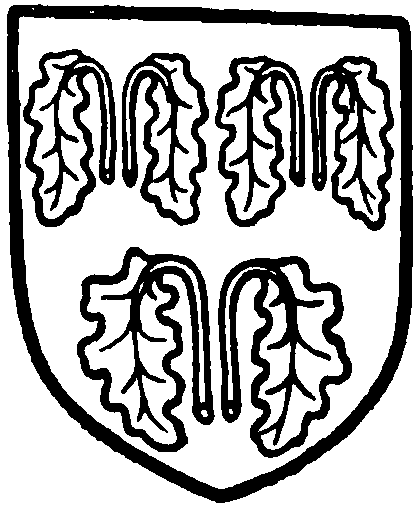
Baldwin. Argent three pairs of oak leaves vert with their stalks sable.
CHURCH
The church of ST. LAWRENCE consists of a chancel measuring internally 23 ft. by 14 ft., south vestry, nave 33 ft. by 14 ft., west bell turret and south porch. It is built of flint, with stone dressings, and roofed with tiles.
The former nave and chancel dated respectively from the 13th and 14th centuries, but, with the exception of parts of the walls on the south side, the whole building was rebuilt in 1872–3, largely of re-used material. The porch, vestry and bell turret are modern additions.
The east window of the chancel is of three lights, the inner jambs with their angle shafts being of 14th-century stones. The doorway into the vestry and the two-light window on the south side have each some re-used material of the same date. Towards the east on this side is a 14th-century piscina with a square bowl. The other details, including the chancel arch, are modern.
The two windows in the north and one on the south side of the nave are of two lights and contain some re-used 14th-century stones. The eastern window in the north wall has inner angle shafts with moulded capitals and bases. The similar window in the south wall appears to have been brought from the chancel, as its sill is carried down to form a sedile. The window in the west wall is modern. The south doorway, which dates from the 13th century, has a pointed arch of two moulded orders, supported by detached shafts with moulded capitals and bases. The dog-tooth label above is modern.
In the churchyard are the remains of the circular bowl of a 13th-century font. The present font is modern and the design has been based on this fragment.
There is one 17th-century bell by an unknown founder, inscribed 'Com and praye.'
With the plate is a cup of 1577.
The registers begin in 1583.
ADVOWSON
The advowson of the church at Cholesbury belonged in 1230 to Geoffrey le Breton. (fn. 23) In 1259 it seems to have passed to the prior of the Hospital of St. John of Jerusalem, (fn. 24) who possibly ordained a vicarage. The prior probably possessed the advowson until the hospital was dissolved, when it doubtless passed to the Crown. In 1598 John Baldwin was the patron, (fn. 25) and for many years the descent of the advowson was the same as that of the manor. (fn. 26) By 1704 the advowson had passed to Richard Seare, who in this year sold it to Joseph Neale of Gray's Inn. (fn. 27) In 1705 the latter formed a trust of nine members, to whom he conveyed it, at the same time establishing a lectureship in the church. (fn. 28) This trust still possesses the advowson.
It is a curious fact that no presentations were made to the church after 1416 for more than a hundred years. (fn. 29) The cure may have been served from Hawridge or, more probably, from Drayton Beauchamp, as a report was current in later years that Cholesbury had formerly been a chapel to Drayton. (fn. 30) The rectory and vicarage are said to have been consolidated after the Dissolution, and only a small stipend and a few acres of glebe were allotted to the minister. (fn. 31) According to a survey of 1650 there was 'no minister, for want of maintenance. Cholesbury is about one mile distant from Hawridge, … and fit to be united with it.' (fn. 32) The recommendation does not seem to have been acted upon. Nevertheless, the living has been known as a perpetual curacy since the early 18th century. (fn. 33)
CHARITIES
The Neale Lectureship Trust, founded by deeds of lease and release, dated respectively 12 and 13 July 1705, is regulated by a scheme of the Charity Commissioners of 22 June 1906. The endowments consist of £3,247 17s. 1d. consols with the official trustees, arising from the sale of a farm in Cublington, and producing £81 3s. 8d. a year; also the advowson of the parish church. The income—subject to 20s. yearly being distributed in Bibles, Prayer-books and gifts among the poor of Cholesbury—is applicable as to one-fourth to a lecturer or preacher for reading afternoon service and catechizing children in the parish church of Wigginton, Hertfordshire, and as to threefourths for the same purpose in the parish church of Cholesbury.
An unknown donor's charity consists of £175 6s. consols with the official trustees, arising from the sale of land in 1877. The annual dividends, amounting to £4 7s. 8d., are applied as a bonus for members of a clothing club.
John Cheyne's Charity.
The annual sum of £1 is distributable among the poor in respect of this charity. (See under Chesham Bois.)