
A History of the County of Buckingham: Volume 3. Originally published by Victoria County History, London, 1925.
This free content was digitised by double rekeying. All rights reserved.
'Parishes: Marsworth', in A History of the County of Buckingham: Volume 3, (London, 1925) pp. 391-397. British History Online https://www.british-history.ac.uk/vch/bucks/vol3/pp391-397 [accessed 19 April 2024]
In this section
MARSWORTH (fn. 1)
Maessanworth (x cent.); Missevorde (xi cent.); Massewrth (xii cent.); Messeworthe (xiii cent.); Masworth (xvi cent.).
The parish of Marsworth contains 1,212 acres, of which 728 acres are arable land and 291 acres are permanent grass. (fn. 2) The soil is marl and gault with a subsoil of chalk and marl. The ground rises gradually from about 300 ft. above the ordnance datum in the north to 400 ft. in the south. Marsworth is traversed by the Lower Icknield Way. The Grand Junction Canal crosses the parish, throwing off the Aylesbury branch towards the west. The main line of the London and North Western railway cuts the eastern boundary of Marsworth. The village, which lies towards the south of the parish, consists of a few houses north of the church, and of the vicarage on the south, and contains a small Baptist chapel, which was formerly worked as a mission in connexion with New Mill in Hertfordshire, but has been closed since 1907.
There are two hamlets, Startop's End on the southwest, and Cooks Wharf (otherwise Cheddington Wharf). Along the canal are a few solitary houses, and one or two farms lie away from the village. Manor Farm in the village is part of the old building of the De la Hay Manor House, and Church Farm to its north marks the consolidation of two old farms, the original Church Farm near the church having disappeared over 100 years ago. Further west is Marsworth Great Farm, which has moated remains, all that is left of the manor-house of Goldingtons, pulled down in the 18th century. In the south of the parish are College and Hospital Farms, the latter reminiscent of St. Thomas's Hospital, whose original farm-house was between the church and Startop's End.
Duncombe's Farm, once known as Greening's and for a short time as Russell's, on the south-west of the church, is a timber-framed house with brick filling and tiled roof. It is of the early part of the 16th century, but is now much altered. It contains a hall, now divided into two floors with probably the original fireplaces. Near to it is an ancient timber-framed barn with thatched roof.
The Inclosure Award for Marsworth, dated 7 November 1811, under the Inclosure Act of 1809, (fn. 3) is now in the custody of the parish council.
MANORS
MARSWORTH is first mentioned in the will of Aelfgyfu, by which she left it to the king. (fn. 4) Thorpe dates this will at 1012, but it must have been before the death of Edgar in 975, as by the Liber Eliensis Aelfgyfu, when she died, gave Marsworth to Edgar, who with Alftruda gave it to St. Etheldreda of Ely. (fn. 5) It had passed from the monastery before the Conquest to Brictric, a thegn of King Edward, (fn. 6) and by 1086 was assessed at 20 hides among the possessions of Robert Doyley. (fn. 7) His lands afterwards became part of the honour of Wallingford, (fn. 8) to which Marsworth was attached as late as the 17th century. (fn. 9)
The sub-tenant in 1086 was Ralph Basset, (fn. 10) in whose family Marsworth remained for the next 130 years. William Basset was holding in 1194–9, (fn. 11) and he was succeeded by Thurstan, on whose death, c. 1223, the property was divided into equal shares among his six daughters and co-heirs: Isabel widow of Robert Mauduit, Joan wife of Robert de Burnebu, Egeline wife of Richard Burdun, Alice wife of John le Brun, Maud, and Laurencia. (fn. 12) The two latter shortly afterwards married without royal licence Bartholomew de Rakinton and Ralph de Wedon respectively, for which offence their portions were temporarily confiscated to the Crown. (fn. 13) The part allotted to Laurencia and Ralph de Wedon was in the latter's possession in 1236. (fn. 14) By 1284 it had passed to another Ralph de Wedon, probably a son or grandson, (fn. 15) on whose death about 1301 it passed to his son and heir Ralph. (fn. 16) The latter, by his marriage with Elizabeth daughter and eventually sole heir of William de Beauchamp, acquired the manor of Drayton Beauchamp (q.v.), with which this portion of Marsworth, first called a manor in 1328, was held until 1446. In that year Sir John Cheyne and Joan his wife conveyed Marsworth Manor to Thomas Charleton, (fn. 17) by whom it was alienated in 1460 to John Barlow. (fn. 18) Within the next hundred years this estate appears to have become united with the manor of Marsworth or Goldingtons (fn. 19) (q.v.), and to have descended with it as one manor.

Basset. Barry wavy argent and sable.

Wedon. Argent two bars gules with three martlets sable in the chief.
The origin of the manor of Marsworth called Goldingtons, later MARSWORTH with GOLDINGTONS, is somewhat obscure. It does not appear to correspond to one of the portions assigned to Basset's six daughters, but was a composite holding subinfeudated by them or their descendants to the Goldington family, from whom it took its name. Ralph de Monchesney, who may have represented one of the heiresses, was said in 1292 to have as his tenant William Goldington, (fn. 20) and in 1319 the overlords were given as Ralph de Wedon, Nicholas Burdun, the lord of Hawridge (John Beauchamp) and Sir Philip Aylesbury. (fn. 21) The first three were all descended from three of the Basset heiresses, and Aylesbury's rights were probably based upon similar grounds, the greater part of his inheritance apparently lying in Tiscot, in Hertfordshire. (fn. 22) The Aylesburys, however, retained rights in this manor as late as the early 15th century. (fn. 23) The William Goldington who held this estate under Ralf de Monchesney in 1292 (fn. 24) is probably identical with the William Goldington who died about 1319, leaving a son John, aged twenty-one. (fn. 25) His manor of Marsworth was surveyed in 1324, and comprised a capital messuage, a garden, a fishery with fish-pond worth 6s. 8d. yearly, and various lands in Hertfordshire. (fn. 26) John Goldington received a grant of free warren here in 1328, (fn. 27) and died c. 1338, when his widow Katherine entered into the manor, (fn. 28) his son and heir John, then aged ten, (fn. 29) later entering into the rest of the property. (fn. 30) John was still alive in 1375, (fn. 31) but doubtless alienated Marsworth to the Venours, of whom William and Elizabeth were in possession in 1401. (fn. 32) Richard Venour, mentioned in connexion with Marsworth in 1409, (fn. 33) was probably the next holder. The history of Marsworth is obscure for the next eighty years, but by 1489 it was the property of Sir Thomas Bryan, chief justice, who made a settlement of it in that year, (fn. 34) and left it by his will, proved December 1500, to his son and heir Thomas and the latter's wife Margaret. (fn. 35) The son, Sir Thomas Bryan, by his will proved 31 January 1517–18, left the manor for life to his wife Margaret and then to his son Sir Francis. (fn. 36) In 1527 Marsworth was settled on Margaret and her second husband David de la Zouche for the life of Margaret, then on Francis, failing whose issue it was to go to his sister Elizabeth, wife of Nicholas Carewe. (fn. 37) Further arrangements were made in 1532, by which the Carewes obtained the first reversion, (fn. 38) and in 1546, after the death of the Carewes, Sir Francis quitclaimed his rights in the reversion to their son Francis Carewe, (fn. 39) who accordingly entered into the manor after the death of Margaret de la Zouche, c. 1554. (fn. 40) In 1561 Francis Carewe conveyed it to John Gresham, citizen and goldsmith of London, (fn. 41) by whom it was alienated in the following year to John Seare and others, (fn. 42) a preliminary to its transfer to Nicholas or Richard and Joan West and William their son and heir. (fn. 43) In 1565 Nicholas West had to prove his title to the manor, (fn. 44) and received a confirmation of the alienation from Francis Carewe in 1575. (fn. 45) Nicholas West died in 1586, and was succeeded by his son Edmund, (fn. 46) William having died in 1583. (fn. 47) In 1610 Edmund settled the manor on his second wife Theodosia and their issue, (fn. 48) and died in 1618, when his rights descended to his son Edmund, then aged ten. (fn. 49) Edmund attained his majority in 1629, his mother in the meanwhile having married Gregory Pratt. (fn. 50) By his will, dated 23 January 1677–8, Edmund West left all his lands to his son Edmund, serjeant-at-law, (fn. 51) who, however, died on 27 February 1681–2, about a year before his father. (fn. 52) Roger, the second son, therefore inherited Marsworth, (fn. 53) which in accordance with his will, made 23 March 1697 and proved 7 July 1700, passed to Samuel Poynter, son of John Poynter and Sarah, Roger West's niece. (fn. 54) Samuel Poynter held the manor until 1720, when he alienated it to William Gore of Tring Park, Hertfordshire. (fn. 55) William Gore's grandson, Charles, made a settlement of the manor in 1767, (fn. 56) and was succeeded by his son Charles Orlando Gore, who conveyed Marsworth at the end of the 18th century to Drummond, afterwards Sir Drummond Smith, bart., (fn. 57) who was holding in 1814. (fn. 58) The trustees of Sir Drummond Smith sold the estate after his death to William Kay, in whose family it remained until 1872, (fn. 59) when it was purchased by Baron Lionel Nathan de Rothschild, (fn. 60) whose son Lord Rothschild of Tring is the present lord of the manor.
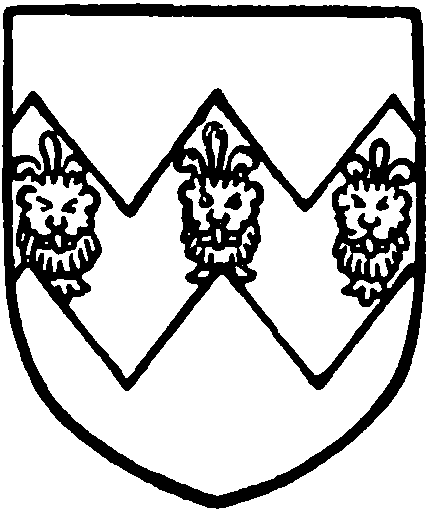
West of Goldington. Argent a fesse dancetty sable charged with three fleurs de lis coming out of leopards' heads or.

Rothschild. Quarterly, (1) Or an eagle sable, (2 and 3) Azure a naked arm issuing from the edge of the shield and holding in the hand a sheaf of arrows all proper, (4) Or a lion gules; and over all a scutcheon gules charged with an ancient shield proper.
Maud de Rakinton, who received another portion of Marsworth as her inheritance, apparently married as her second husband a man surnamed 'of Esserughe (Ashridge),' as she is called Maud of Esserughe in 1236. (fn. 61) Her share may possibly be identical with the half-fee held in 1284 and 1302 by Walter de Rudham, (fn. 62) who died without issue c. 1306, when MARSWORTH MANOR passed to his nephew William Bygod. (fn. 63) The following year William Bygod alienated the manor to Ralph de Monchesney, (fn. 64) on whose death about four years later it descended to John his son. (fn. 65) Disputes seem to have arisen between Thomas son of William Bygod, (fn. 66) who apparently retained some land in Marsworth, and John de Monchesney, for in 1312 Thomas complained that John with several others had broken his houses at Marsworth and carried away his goods. (fn. 67) In 1315 John in his turn complained that several men, possibly incited by Thomas, 'forcibly entered his manor of Masseworthe, broke the houses, and fished in his stews.' (fn. 68) In 1318 a certain Peter Doyvel, great-nephew of Walter de Rudham, (fn. 69) sued John de Monchesney for half the manor on behalf of himself and Thomas Bygod. (fn. 70) By 1346 the manor appears to have passed to John Was or Wace (fn. 71) in right of his wife Isabel, with reversion to Alice, the wife of Richard atte Ponde. (fn. 72) However, in 1350 the two latter granted the reversion to Walter Wace of Amersham and his heirs. (fn. 73)
Here the descent of this manor is uncertain, but it may have passed to John de la Hay, who in 1379 held land in Marsworth of the honour of Wallingford, (fn. 74) afterwards known as the manor of DE LA HAY. Before 1443 this had passed to Richard de la Hay, who in that year settled Marsworth on himself and Margaret his wife, with reversion to Matthew, William and Robert his sons. (fn. 75) Matthew died without issue some time after 1455, (fn. 76) for his brother William died seised of the manor in 1507, leaving a son and heir Edward. (fn. 77)
The manor is next heard of in the tenure of Richard Goodere and Mary his wife, (fn. 78) who gave it in November 1534 to their daughter Alice (fn. 79) and her husband William Rood. Richard Goodere soon afterwards died, and his widow Mary, with Nicholas Feld and Elizabeth his wife, another daughter of Richard and Mary Goodere, disputed the gift of the manor to the Roods. (fn. 80) It was finally agreed that William and Alice Rood should keep the manor of Marsworth, other lands being allotted to the Felds. (fn. 81) Alice appears to have married as her second husband Edward Capell, with whom in 1546 she conveyed the manor then called Hayes to John Seare, (fn. 82) whose relative Edward Seare had been lessee under the Roods. (fn. 83) In 1575 John settled this manor under the name of De la Hay Manor on his younger son Michael, Edward his son and heir renouncing all right in the same. (fn. 84) On John's death in 1575 Michael entered into the premises, (fn. 85) and settled them in 1591 on himself with reversion to his son and heir John, (fn. 86) to whom the manor descended on his father's death in 1602. (fn. 87) The connexion between the various members of this family who held Marsworth during the 17th and 18th centuries has not been established, (fn. 88) but in 1755 the manor was in the possession of John Seare, (fn. 89) who died in 1792, leaving all his property to his wife Mary. (fn. 90) He desired his wife, in case she should die childless, to leave part of the estate to his nieces Maria and Caroline Lockman. (fn. 91) Mary Seare survived until 1798, (fn. 92) and in 1808 Maria, then wife of Edward Barker, and Caroline Lockman were in possession, (fn. 93) but the Barkers appear to have obtained sole rights in the manor, (fn. 94) which they alienated in 1819 to Viscount Lake. (fn. 95) It was afterwards purchased by Earl Brownlow, holding in 1862, (fn. 96) who sold it to Baron Mayer de Rothschild. After his death in 1874 it passed to his daughter, who brought it in marriage to Lord Rosebery, the present proprietor. (fn. 97)
There is mention of courts leet and baron attached to the manor from the 16th to the 19th century. (fn. 98) Free fishing and view of frankpledge were included in the sale of 1819. (fn. 99)
Alice Basset's share of Marsworth was still in the possession of her husband John le Brun in 1235. (fn. 100) It may be identical with the land held here in 1284 (fn. 101) by Nicholas Durival, who died between 1288 (fn. 102) and 1302, at which latter date his widow Hawise held the estate, (fn. 103) their son Robert being seised of the reversion. (fn. 104) In 1305 Robert granted the reversion to John Pever, Beatrice his wife, and Aumary their son, (fn. 105) and later married Margaret, John's daughter, to whom Great Woolstone was given for life. (fn. 106) John was succeeded at his death in 1315 by his son Paul Pever, (fn. 107) who let Marsworth, now called a manor, to Ralph Marshall and his wife Clarice for their lives at 10 marks yearly, with reversion to Paul and his heirs. (fn. 108) Paul died about 1323, leaving a son and heir Nicholas, (fn. 109) who held Marsworth (fn. 110) till his death in 1361. (fn. 111) His son and heir Thomas (fn. 112) obtained in 1366 a renunciation of her right in the manor from Avice, probably his mother, then wife of William de Clopton. (fn. 113) Thomas Pever, mentioned in connexion with Marsworth in 1379, (fn. 114) married Margaret daughter and heir of Sir Niel Loring, by whom he had a daughter Mary, (fn. 115) mother of John Broughton, who succeeded to Marsworth on his grandfather's death in 1429. (fn. 116) At his death in 1489 his grandson Sir Robert Broughton, son of his son John, inherited the property, (fn. 117) which passed at his death in 1506 to his son John. (fn. 118) John Broughton and his wife Anne conveyed the manor in 1514 to the trustees of the Savoy Hospital, (fn. 119) among whose possessions it was assessed in 1535 at 107s. 6½d. (fn. 120) Upon the suppression of the Savoy in 1553 (fn. 121) it was granted by the king to the Mayor and citizens of London for the endowment of St. Thomas's Hospital. (fn. 122) The hospital continued to hold this manor until c. 1876, (fn. 123) when it was exchanged for land in Essex with Mr. William Brown of Tring. (fn. 124) In 1888 the estate was sold in two parts to Miss Margaret Chapman and Lord Rothschild, and on Miss Chapman's death in 1908 Lord Rothschild acquired the remainder, and is the present owner. (fn. 125)
The part of Marsworth assigned to Egeline Burdun was held by her as a widow in 1235. (fn. 126) The next of this family mentioned is Nicholas Burdun in 1252, (fn. 127) who died in 1272, leaving a son and heir Robert, (fn. 128) on whose death in 1280 his possessions descended to his son and heir Nicholas, then aged eleven. (fn. 129) Nicholas attained his majority in 1291, (fn. 130) and died about 1300, (fn. 131) when dower was assigned to his widow Agnes. (fn. 132) His son, another Nicholas, was under age and did not enter into possession of the estate until he reached his majority in 1310. (fn. 133) This Nicholas was still holding in Marsworth in 1316, (fn. 134) but after this date the family appears to have disappeared from the place, leaving no trace.
Isabel Basset's portion of Marsworth was brought by her to her husband Robert Mauduit in 1223, (fn. 135) and passed to their son William Mauduit, mentioned in 1222. (fn. 136) The greater part of this property appears to have been situated in Hawridge (q.v.), with which it was held by the Mauduits and the Beauchamps, their descendants. (fn. 137) John de Beauchamp was holding Marsworth and Hawridge in 1346, (fn. 138) but the lands in Marsworth are not referred to after this date.
Robert and Joan de Burnebu were succeeded by 1284–6 by John de Burnebu, who held a fee in Marsworth. (fn. 139) This land may be identical with that held by Sir Robert Swynerton in 1379, but nothing further is known of it. (fn. 140)
Land in Marsworth was probably amongst the endowments of the church of St. George in Oxford, founded by Robert Doyley. (fn. 141)
Of the three mills worth 15s. on Marsworth Manor in 1086, (fn. 142) one was probably situated in Tiscot in Tring, Hertfordshire, which had the same Domesday over and underlords. As such it would be attached to the Aylesbury portion of the Basset inheritance, which included Tiscot, and is probably identical with the water-mill in Marsworth called Athelynemulne, leased in 1313 by Philip Aylesbury to Walter de Gobelcote for six years at 60s. rent. (fn. 143) The charter given at Tiscot reserves to the grantor the rights and easement of the fishery, the tenant being bound to take care of the fish, and of any swans placed in the mill-pond. (fn. 144) A hundred years later the Aylesbury family were receiving 10s. rent from this mill. (fn. 145) The lessee of the mill at this date was Richard Venour, (fn. 146) who was probably also lord of Goldingtons Manor, to which another water-mill was appurtenant. This mill is mentioned in 1292 as worth 57s. 4d. (fn. 147) yearly, but in 1324 only 30s. (fn. 148) It descended with the manor, (fn. 149) and was in Edmund West's possession at his death in 1618. (fn. 150) It stood south-west of the village, on the site marked cornmill in the Ordnance Survey, and was turned into a windmill, called Dyers Mill. (fn. 151)
The mill attached to the De la Hay Manor was in 1571 the subject of a dispute between Michael Seare, heir to the manor, and John Gery. (fn. 152) It is said to have stood on Nottimore Brook, near the Lower Icknield Way. (fn. 153) A fourth mill in Marsworth belonged to the Savoy Manor and stood near Startop's End, on a spot now included in the reservoir bank or just outside it. It was later used as a paper-mill, and had passed from the possession of the hospital by 1790. (fn. 154)
CHURCH
The church of ALL SAINTS consists of a chancel 23 ft. 4 in. by 14 ft. 3 in., south chapel 16 ft. 6 in. wide, nave 38 ft. 9 in. by 14 ft. 6 in., north-east stair turret, north vestry, south aisle 16 ft. 6 in. wide, west tower 12 ft. 6 in. by 12 ft., and a south porch.
There was a church here probably at the end of the 12th century, (fn. 155) consisting of a chancel and nave, to which a south chapel and aisle were added in the 14th century. In the 15th century the present nave was partly rebuilt, the south arcades being preserved, and the west tower was added or rebuilt, the tower arch being constructed of re-used 13th-century material.
The church was restored in 1828; in 1854 the north and east walls of the chancel were rebuilt, the pitch of the roof being made steeper. In 1860 the south chapel was repaired and new north and south porches were erected. In 1880 the Rev. F. W. Ragg was instituted vicar, and finding the church in a deplorable condition, and being unable to raise the necessary funds to repair it, he undertook the work with his own hands, assisted by some of the villagers. He stripped off the old plaster, repaired and pointed the walls, underpinned the tower and raised the nave ceiling some 4 ft. by means of screw jacks. He built a chancel arch, the mouldings of which he worked, and the capitals he himself carved. He cut the wallarcades on the north side of the chancel and added a window there and inserted the east window. The repairs occupied some twenty-five years and form a marvellous memorial to the industry and loving care of the workers. (fn. 156) The south chapel was further restored in 1913.
The walls of the chancel and chapel are of small squared rubble with ashlar dressings. The north wall of the nave has a lower part of ashlar; at a higher level are chequerings of flintwork, and above is modern flintwork with some old stones re-used. The roofs of the chancel, porch and vestry are covered with tiles and the remainder with lead.
The modern east window of the chancel is of elaborate design and richly carved. The eastern window in the north wall was inserted in 1854, and the western of two lights with tracery was found built into the east wall and inserted by Mr. Ragg. In the south wall is a 14th-century arcade of two bays with two-centred arches of two hollow-chamfered orders, having broached stops, springing from an octagonal column and semi-octagonal responds. It was possibly rebuilt at a later period.
The south chapel has a large modern east window. In the south wall there are two large windows almost completely restored externally; the eastern is 15thcentury work, of three cinquefoiled lights with tracery in a two-centred head, the soffit of the arch having sunk panels with trefoiled ends. The 14th-century western window is of three lancet lights in a twocentred head. Partly beneath the eastern window is a 14th-century double piscina with a traceried head carried on small shafts with moulded capitals and bases, the easternmost shaft and the bowls being modern. Near the piscina is a corbel of the 14th century, and carved with foliage, built into the wall. The arch to the south aisle is modern.
At the east end of the north wall of the nave are the upper and lower doorways of the stair to the former rood-loft. The stair, which is in a turret, is lighted by one small loop. West of these are a large window of three cinquefoiled lights with tracery in a four-centred head, a doorway now leading to the vestry, with a four-centred arch and sunk spandrels in a square head, and a window of two cinquefoiled lights with tracery in a two-centred head, all of 15thcentury date, but considerably restored externally. The south wall has an arcade of three bays of the same detail as that in the south wall of the chancel. To the east of the arcade high up is an opening through the wall near the chancel through which the nave rood-loft was perhaps continued across the east end of the south aisle.
In the south wall of the south aisle is a window similar to that at the east end of the south wall of the chapel; below it is a 13th-century recess much restored. The south doorway has a rear arch and inner jambs of 13th-century date. Between the window and doorway high up is a small 15th-century niche with a four-centred head and a moulded bracket at the base. In the back are traces of original colouring depicting apparently the figure of a saint, across which an inscription of the 17th century, 'Judge and revenge my cause, O Lord, from them that evill be, From wicked and deceitfull men, O Lord, deliver me. psa xliii.,' has been painted. The west window is similar to that at the west end of the north wall of the nave.
The tower is of two stages with a moulded plinth, an embattled parapet, and a stair in the south-west angle carried above the level of the roof. There are diagonal buttresses to the eastern angles, and at the western angles pairs of square buttresses to the top of the lower stage, whence diagonal buttresses springing from between them are carried to the top of the upper stage. The early 13th-century tower arch, which was reconstructed in the 15th century, is two-centred and of three chamfered orders. The two inner orders spring from 15th-century semioctagonal responds with 13th-century moulded capitals carved with stiff-leaved foliage, the outer order being continuous on the east side and dying into the walls on the west. The bases of the responds have been recut. The west doorway, of late 15th or early 16th-century, date is considerably restored; it has a two-centred arch with sunk spandrels in an almost flat two-centred head. The window above, of three cinquefoiled lights in a four-centred head, is probably modern. The north and south faces of the ringing chamber have a single cinquefoiled light, and the east and west faces of the bell-chamber a window of two cinquefoiled lights in a two-centred head, the north and south faces having pairs of similar windows. The stair is lighted on the west face by a loop and a modern quatrefoil, and on the south face by a loop and two modern quatrefoils. The west face of the tower north of the doorway and the south buttress to the west side are pierced by small rectangular openings, and the north and south faces of the tower have a number of similar piercings, now blocked. They appear to be putlog holes.
In a broken Purbeck marble slab in the south chapel is a brass, parts of which are missing. It comprises the lower part of a figure of a man in armour, the figures of two daughters, the lower parts of the figures of four sons, with an inscription beneath the man's figure commemorating Nicholas West, kt., and Joan his wife, who died in 1586 and 1585 respectively, and an achievement of his arms, and another shield with West impaling a coat of many quarterings, most of which are indecipherable. Several parts of this brass are said to be engraved on the back of a brass of foreign workmanship. Near this is another slab containing the figure of a woman in an embroidered gown and ruff, beneath which is the figure of a chrisom child with an inscription to Mary Clare, wife of Edmund West, the date 1606 and part of the name being hidden now by the organ. The south chapel also contains a brass with an inscription to William West, who died in 1583, and another with a request in Latin for prayers for the souls of John Scelk and Cristine his wife.
At the east end of the chapel is the tomb of Edmund West, who died in 1618, the front, back and ends of which are panelled and enriched with allegorical figures, carvings of skulls, &c., and the arms of West. The panel on the north has a brass tablet depicting the death-bed of a knight in armour. The tomb was reset in 1860, but not on its original site. There are floor slabs to Edmund West, 1681; to Sarah wife of Edmund West, 1691; to Bridget Wilford, daughter of Edmund West, 1692; to Theodosia West, daughter of Edmund West, 1701; to Roger West, 1700; to Bridget West, daughter of Edmund West (the date hidden by a fixed bench), and to Edmund West and Ann his wife with no dates, but an inscription recording that the stone was laid by their daughter, Ann Hassell, in 1701.
On the north wall of the chancel is a tablet to Nathaniel Cole, a former vicar, 1612, and on the south wall of the south aisle are others, to Elizabeth wife of John Lockman, 1773; to John Seare, 1792, and Mary his wife, 1798; and to Henrietta Seare, spinster, 1807.
The south chapel contains a few mediaeval tiles and two coffin slabs, on one of which is a cross.
The base of the modern pulpit is of 14th-century date and was found in the south porch in Mr. Ragg's restoration, and adapted by him to its present purpose. It is carved with the figures of angels and with foliage.
The font (fn. 157) has an octagonal bowl of Purbeck marble with sunk quatrefoil panels variously carved with faces and conventional flowers. It is of late 14th-century workmanship. The stem and base are modern.
In the recess in the south aisle there are several fragments, including some 16th-century tracery, and in the tower there are more, of the 12th, 13th, 14th, 15th, and 16th centuries, including part of a label and an arch-stone enriched with ball- and fourleaved flowers.
There are screens in the chancel, south aisle and chapel designed and carved by the Rev. F. W. Ragg and Mrs. Ragg.
There are five bells and a sanctus, of which the treble is by Henry Knight, 1662, the second by Chandler, 1694, the third by George Chandler, 1702, the fourth also by George Chandler, 1682; the tenor, originally by Anthony Chandler, 1679, was recast by Warner & Sons, 1887, and the sanctus is by Lester & Pack, dated 1767.
The plate includes a large paten presented in 1685, a flagon of 1698, and a large cup of 1712.
The registers before 1812 are as follows: (i) baptisms and burials from 1720 to 1783, marriages from 1720 to 1762; (ii) baptisms and burials from 1783 to 1811; (iii) marriages from 1754 to 1813; (iv) baptisms and burials of 1811 and 1812.
ADVOWSON
Marsworth Church appears to have been granted by Thurstan Basset to Caldwell Priory, Bedfordshire, before 1218, in which year Hugh of Wells, Bishop of Lincoln, made arrangements for a vicarage which was to be ordained after the death or resignation of Richard de Tingehurst, the then rector. (fn. 158) After his death about 1253 the canons of Caldwell appear to have made an attempt to regain the whole revenues, but their right to present to the vicarage alone was admitted. (fn. 159) The church, which was assessed at £9 6s. 8d. in 1291 (fn. 160) and at £10 0s. 0¾d. in 1535, (fn. 161) was bestowed in 1546 after the Dissolution upon Trinity College, Cambridge, (fn. 162) the present rector and patron. (fn. 163)
A portion of Marsworth tithes was granted to Oseney Abbey at its foundation, (fn. 164) and when the Prior of Caldwell, in the reign of Edward IV, granted the parsonage to William Parkyns of Aylesbury for about three months, the payment of 6 marks 6s. 8d. to Oseney was stipulated. (fn. 165) The indentures proving faulty, Parkyns refused to pay this sum. (fn. 166) In 1585 John Cheyne died seised of a lease of the parsonage, which he bequeathed to his second son Francis. (fn. 167)
Land rent in Marsworth worth 8d. a year was given to maintain a light within the church. (fn. 168)
CHARITIES
Charity of William Hill, founded by will 3 June 1723. This parish receives from the trustees of the charity at Wendover a great coat worth about 20s. for a poor old man and 20s. in money for distribution among poor communicants.
In 1750 John Sawell, by his will, devised an acre of land for the poor. Upon the inclosure of the parish about 3 roods of land were allotted in lieu of the land devised. The land allotted was taken by the Grand Junction Canal Company in connexion with the reservoir, in respect of which a sum of 20s. a year is received and distributed in doles.
The church houses consist of three tenements and about half an acre of land adjoining the churchyard, of the annual rental value of £15, which is carried to the churchwardens' account.
Countess of Bridgewater's Educational Trust.
This parish receives £5 a year from the trustees, which is applied towards the support of the school. (See under Edlesborough.)