
A History of the County of Buckingham: Volume 3. Originally published by Victoria County History, London, 1925.
This free content was digitised by double rekeying. All rights reserved.
'Parishes: Swanbourne', in A History of the County of Buckingham: Volume 3, (London, 1925) pp. 427-432. British History Online https://www.british-history.ac.uk/vch/bucks/vol3/pp427-432 [accessed 19 April 2024]
In this section
SWANBOURNE
Suanaburna (viii cent.). Sueneborne, Soeneberno (xi cent.).
Swanbourne is a parish of 2,551 acres, of which 304 acres are arable land, 2,078 acres permanent grass and 14 acres woods. (fn. 1) The ground rises in the middle and north-east of the parish to 420ft. above the ordnance datum and falls in the west to about 300 ft. The soil is loam and gravel, the subsoil clay. A stream on the southern boundary and two others on the north and south of the village, respectively, water the parish. The London and North Western railway crosses it in the north, where there is a station. The village, which is small, lies in the centre of the parish along the main road. The church is situated to the east of the village, and near it is the manor-house. This is of two stories, built of stone, and dating probably from the latter half of the 16th century. It was originally rectangular, with a porch in the middle of the principal front; but the north side was pulled down and a new wing added on the south side. The original building retains, for the most part, its stone-mullioned windows and dormers, and internally the original features include two fireplaces. It is said to have been built by the Fortescues of Salden, who, tradition asserts, used it principally as a nursery or hospital for the children when ill. (fn. 2)
North of the Manor House is a late 16th-century timber-framed building, part of which is now used as the post office. The brick filling of the front is set in herring-bone pattern, and three original mullioned windows remain in each story.
Hollow Lane, the road leading westward to Winslow, has on the north Charlton Hill Farm, an early 17th-century house, which has been a good deal altered, but retains among its original features a fine central chimney stack and a room lined with oak panelling. On the south side of the road is Grange Hill Farm, built, probably, late in the 16th century and added to in the 17th century; the house has been considerably altered, but its chimney stacks, a fireplace on the upper floor and several old doors are interesting features. On the same side of the road, farther west, is Ivy Farm, probably a late 16th-century house, added to in 1626 and again in 1718, according to dates on the walls; the house has been restored, but still retains some interesting features, including chimney stacks, fireplaces and some old doors.
East of the church, on the north side of the road leading eastward to Mursley, is Deverell's Farm, a stone building, apparently of early 17th-century date; the greater number of its original stone mullioned windows remain, and in the gable of the west porch wing is the date 1632. On the south side of the road, further to the east, is 'The Old House,' the residence of the Hon. T. F. Fremantle, a late 16th-century building, timber-framed with a filling of herringbone brickwork, partially visible internally. Externally the walls are covered with modern plaster, and considerable modern additions have been made. Internally there are several original stone fireplaces.
Brise's Farm, at Nearton End, on the south side of a lane running east from the Hoggeston road, is probably a late 16th-century house, and has walls of closely spaced timber-framing with a filling of herringbone brick-work. This still remains on the north and south fronts, but the original very small window openings have been blocked. The central chimney stack and two fireplaces are other interesting features.
Swanbourne House
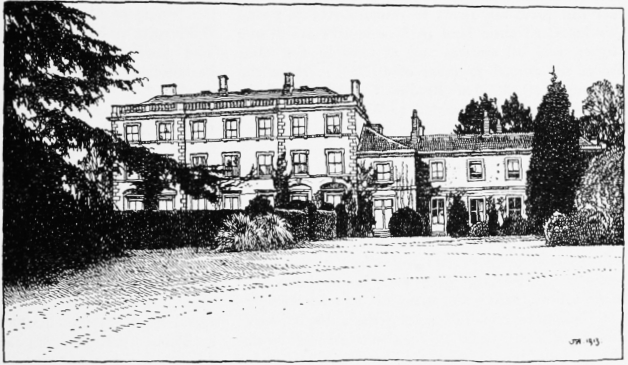
Swanbourne House is a large 19th-century building of brick, now the residence of Lord Cottesloe. The village contains a number of 17th-century houses, most of which are of timber-framing with brick filling, and all of which have been considerably restored, altered or added to during subsequent years.
Early in the Civil War Swanbourne suffered misfortune at the hands of the Royalists. By a report of the occurrence afterwards made in Parliament in June 1643 it appeared that 'a number of armed men calling themselves the King's Forces, under the command of the Earls of Cleveland and Carnarvon, invaded the county of Buckingham, robbed and pillaged there, and in particular burnt the village of Swanbourne and murdered a poor woman there and, seeming to take delight in the desolation they caused, set guards to prevent anyone from attempting to quench the flames.' (fn. 3)
To the east of the village is the hamlet of Nearton End, which has both Methodist and Baptist chapels.
An Inclosure Act for this parish was passed in 1762. (fn. 4)
MANORS
Before the Conquest two thegns, Alward and Alwi, held two manors in SWANBOURNE. The former's land amounted to 5 hides all but one virgate, and that of Alwi, his man, to 2 hides and 3 virgates. (fn. 5) By the time of the Survey these two manors had been united and were held as one by William, tenant of Walter Giffard. (fn. 6) The land was afterwards attached to the honour of Giffard and was held of the Earls of Gloucester as of their chief manor of Crendon in the 13th century. (fn. 7) The direct overlordship was in the Crown in the 16th and 17th centuries, when the manor was attached to the royal honour of Ampthill. (fn. 8) The last mention of the overlordship occurs in 1627. (fn. 9)
In the late 12th century this part of Swanbourne was held by Hugh Malet and Margaret Passelewe his wife (fn. 10) who, in 1202–3, confirmed a charter which they had previously made to Woburn Abbey, giving this house all their land in Swanbourne except one virgate, and all services and customs in free alms except the annual payment of a silver mark to the sick nuns of Maiden Bradley. (fn. 11) Other land in Swanbourne was also granted to Woburn (vide infra) and in 1255 the possessions of the abbey here amounted to 13 hides of land. (fn. 12)
In 1326 the abbot leased lands here to John, son of Philip Walewayn, for thirteen years, which lease John afterwards transferred to Richard de Aythrop. In 1331 Aythrop was sued by the abbot for damages for having dug in 2 acres of the manor and sold the soil (arsillum) thereof; and for selling a hall (aula) worth £10, two large gates with houses built over them, value 5 marks, and many oak and ash trees. (fn. 13)
Swanbourne remained among the abbey's possessions until the Dissolution, (fn. 14) and was granted by the Crown in 1544 to Ambrose Gilbert and Grace his wife. (fn. 15) Ambrose died in 1558 and his widow afterwards married Richard Smith, with whom she held the manor. (fn. 16) In 1577 George Gilbert, son and heir of Ambrose, was lord of Swanbourne. (fn. 17) The manor was afterwards sold by him to Philip Bassett, who, after some years, sold it in his turn to Sir James Dyer, kt., at whose death Richard Dyer, his greatnephew and heir, inherited. (fn. 18) An attempt to disinherit the latter was made before 1587 by Edward Smith, son of Richard Smith and Grace, acting on behalf of his step-sister, Anne Gilbert, and her nephew, John Harp. (fn. 19) These parties claimed that, under the terms of a settlement made by Ambrose Gilbert, the remainder, on the death without issue of George Gilbert, should have been to his next heirs, and that the sale to Philip Bassett was therefore illegal. (fn. 20)
By 1614 the manor had come into the hands of the Fortescues of Salden, (fn. 21) who in 1624 conveyed it to John Adams and his brother Thomas. (fn. 22) It seems probable that the manor was forthwith divided between the two Adamses in separate moieties. In 1626 Thomas Adams died seised of half the manor, leaving a son and heir Robert, aged five. (fn. 23) It was probably the son of the latter, another Robert, who held a moiety in 1683, (fn. 24) and died in 1716. (fn. 25) John Adams was lord in the first half of the 18th century. (fn. 26) By 1762 this moiety was held by James Adams, (fn. 27) son of Roger Adams and Susanna, of Little Horwood. (fn. 28) At his death in 1775 James Adams bequeathed his land here to trustees to be sold after the death of his wife for the benefit of his nieces Alice Stonell and Elizabeth Williamson and his great-nephew James Williamson. (fn. 29) The purchaser was Joseph Farborough, (fn. 30) who still held in 1813. (fn. 31)
The property came before 1873 into the Fremantle family, (fn. 32) afterwards Lords Cottesloe. The present Lord Cottesloe is now lord of the manor, the manorial rights of which, however, appear to have long since lapsed.
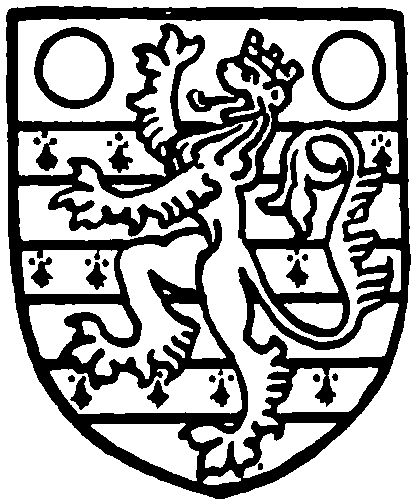
Fremantle, Lord Cottesloe. Vert three bars ermine with a lion gules having a mural crown or over all and two roundels argent in the chief.
The other moiety, which was the share presumably of John Adams in 1624, was apparently that settled in 1683 by Thomas Adams on his son Thomas. (fn. 33) In 1684 John Walker and Elizabeth, William Grove and Mary and Robert Boulter and Katherine, holding in the right of the three wives, conveyed this moiety to Josiah or Jonas Askew. (fn. 34) The latter died in 1750, (fn. 35) and his land was afterwards sold by the Askew family to the Deverells. (fn. 36) John Deverell was lord of this moiety in 1762 (fn. 37) and at his death in 1784. (fn. 38) Subsequently it seems to have been reunited to the rest of the manor, as in 1873 the Fremantles owned practically the entire parish.
In the time of the Confessor Earl Harold had held 4½ hides in SWANBOURNE, which in 1086 were in possession of William I. (fn. 39) The land was attached to the royal manor of Brill in the 13th century. (fn. 40) In the 14th century the Crown appears to have granted certain of its privileges as overlord to the Moleyns family. (fn. 41) In the 16th century the manor was again held in chief (vide supra).
This land was held under the Crown in the 12th century by Robert de Tenerchebrai, who died before 1191, in which year the sheriff rendered account of 58s. 7d. from the issues of his land at Swanbourne. (fn. 42) During the next five years an annual sum of 41s. or 42s. was paid to the Exchequer for the farm of the land, (fn. 43) the inheritance of which gave rise to a dispute about this time between Hugh son of William Peverell and Lucy de Kokefeld. Hugh Peverell, whose father appears to have been cousin and male heir of Robert de Tenerchebrai, claimed the land against Robert's daughter and heir Lucy, asserting that she had been born out of wedlock. (fn. 44) Another claimant, though on what grounds is not evident, was Henry son of Geoffrey de Clinton, and to him in 1195 Hugh Peverell and Lucy de Kokefeld finally quitclaimed all their right. (fn. 45) Before 1208 Henry de Clinton subinfeudated the manor to Robert de Braybrook, the Clintons retaining the position of intermediary lords until some time after 1278. (fn. 46) After this date their interest appears to have lapsed, and the Braybrooks held directly of the chief lord of the fee, the last reference in this connexion occurring in 1346. (fn. 47)
The tenants and holders in fee under the Clintons, and afterwards under the Braybrooks also, were the Abbots of Woburn, to whom Henry de Clinton gave 4½ or 5 hides here in the early 13th century. (fn. 48) The subsequent descent of this estate is identical with that of the rest of the Swanbourne lands which were held by Woburn Abbey, and which, with this addition, formed the main manor (q.v.). The abbot claimed view of frankpledge in his land here in 1255, (fn. 49) and was said to hold by a charter of Stephen, afterwards confirmed by Edward IV in 1461. (fn. 50) In 1275–6 he also claimed assize of bread and ale. (fn. 51) In 1291 his authority to hold the view was called in question, and he finally offered to compound with the Crown by paying 2s. yearly for the privilege. (fn. 52)
Part of the land given by Henry de Clinton was held by the abbot by payment to the manor of Brill of a bowl of honey containing 9½ gallons, but this rent was withdrawn by the abbot from the reign of Henry III onwards, although by what authority was not known. (fn. 53) In 1285–6 the abbot claimed that John de Braybrook, his immediate overlord, ought to acquit him of the bowl of honey to the king and this claim was evidently allowed, this rent being afterwards paid by the Braybrooks. (fn. 54)
There is mention of the mills at Swanbourne in the 13th and 14th centuries, (fn. 55) and a windmill was later the property of the Deverell family, being left by William Deverell by his will, proved 5 July 1559, to his youngest son Augustine. (fn. 56) At the close of this century John Deverell of Swanbourne bequeathed 'the old windmill standing upon church hill,' to his son John, and the 'new windmill' to his son William. (fn. 57)
The manor which became known in the 16th century as CLIFFORD'S MANOR probably had its origin in the 2 hides of land which Geoffrey de Mandeville held in 1086, (fn. 58) succeeding Ansgar the staller here as elsewhere in the county. (fn. 59) Suen, a man of Ansgar, had held before the Conquest, but could not sell without leave. (fn. 60) The overlordship remained in the Earls of Essex, afterwards Earls of Hereford, (fn. 61) for some time, (fn. 62) but seems to have passed to the Earls of Gloucester before 1278, (fn. 63) and by 1462 was held in chief. (fn. 64)
Richard Godard held half a fee of the Earl o Gloucester in the 13th century. (fn. 65)
In 1238 Robert Passelewe was a life tenant of the land, but, by agreement between Humphrey de Bohun, Earl of Hereford, and the Prior of Newnham, gave it up to the priory at about this date. (fn. 66) Robert had previously enfeoffed John de Swanbourne, son of Ralph de Lesseberge and brother of the prior, (fn. 67) of this land, or of part of it, and this tenant now quitclaimed to the prior his right in a virgate and a capital messuage which he held of Robert Passelewe, and in half a virgate and a messuage which he held of Henry Godard. (fn. 68) The Abbot of Woburn was mesne lord between the Prior of Newnham and the Earl of Gloucester, but it was stated in 1278–9 that the earl had dispossessed the prior and granted the land to Robert le Veel, (fn. 69) together with view of frankpledge. (fn. 70) Robert was succeeded by his son Bogo le Veel, and by his grandson Peter. (fn. 71) The latter in 1337 alienated his estate here to Sir John de Moleyns, (fn. 72) the transaction being completed in 1339. (fn. 73) Sir John de Moleyns retained view of frankpledge and the manorial rights from the king in 1338 (fn. 74) and 1339. (fn. 75) After his first disgrace (fn. 76) Swanbourne was restored to him in 1345, (fn. 77) but Peter le Veel finally gained possession, and in 1352 Peter le Veel, probably son of the above Peter, (fn. 78) granted his lands in Swanbourne, then first called a manor and named LE VEEL after its owner, to Robert atte Brome, clerk. (fn. 79) It was probably alienated with Littlecote in Stewkley (q.v.) by John Colewell and his wife Isabel in 1364 to Thomas de Missenden, (fn. 80) as Sir Edmund de Missenden, at his death in 1394, held a messuage and lands in this parish. (fn. 81) It descended with the Missendens' manor of Overbury in Great Missenden (q.v.) (fn. 82) until the death of John Iwardby in 1485, when Swanbourne was allotted to his youngest daughter and co-heir, Helen. (fn. 83) She married firstly William Cutlard or Cutland, and secondly Thomas Clifford, (fn. 84) and held the land as the latter's widow in 1544. (fn. 85) In 1566 Thomas Clifford, her younger son, alienated his manor of Swanbourne to William Shillingford alias Isodd, (fn. 86) who sold it three years later to John Watts and Elizabeth. (fn. 87) They in turn sold it in 1577, by the name of 'the manor of Swanbourne called Clyfford's Manor,' to Henry Sheppard. (fn. 88) In 1584 the latter, with Mary his wife, conveyed it to Andrew Watts, (fn. 89) who, by agreement, and in exchange apparently for some other lands, seems to have given up his right, in 1600, to Robert Adams, on whose heirs a settlement was made in the same year. (fn. 90) Robert Adams died in April 1616, when Clifford's Manor descended to John, his son and heir, (fn. 91) who afterwards, with his brother Thomas, acquired the principal manor of Swanbourne, into which Clifford's doubtless became merged, as it is not mentioned separately afterwards. The name Veel survived in the parish, for in 1597 John Deverell bequeathed 'Vealles' Close' to his son Matthew. (fn. 92)
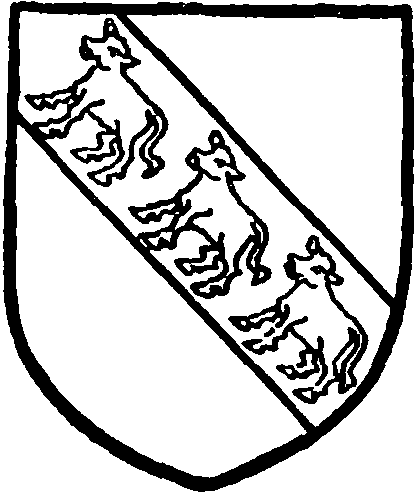
Veel. Argent a bend sable with three calves argent thereon.
A manor which existed here as WELDES Manor had its origin doubtless in part of a knight's fee held by Thomas de Walda (de la Welde) in this parish in 1284. (fn. 93) The land was parcel of the fee of Mortain in Swanbourne held of the lord of Langley. (fn. 94) A Thomas de la Welde still held in 1302. (fn. 95) In 1306 a messuage, about 150 acres of land and 40s. rent were settled on Thomas de la Welde and Alice his wife by Walter de la Welde, (fn. 96) and Thomas, or his son, still held in 1316 and 1342. (fn. 97) By 1462 'Weldes Manor' was held by the Iwardbys, (fn. 98) who also had the Veels Manor in this parish. The two probably became united in Clifford's Manor (q.v.) afterwards held by the descendants of the Iwardbys.
Before the Conquest Brixtuin, a thegn of King Edward, and Almar, a man of Earl Harold, held 4½ hides and 1 hide respectively. (fn. 99) In 1086 Ralf and Almar held 5 hides of this as one manor of the Count of Mortain. (fn. 100) These lands were attached, with the count's other possessions, to his fief, known as the small fief of Mortain or honour of Berkhampstead, (fn. 101) in which the overlordship remained vested (fn. 102) as late as 1762. In this year the Inclosure Act for the parish referred to the right, title and interest of the king in certain lands here in the right of his duchy of Cornwall and honour of Berkhampstead. (fn. 103) His jurisdiction, however, was over but a small extent. (fn. 104)
Holding under this honour, and probably descended from Ralf, the Domesday tenant, was the family of Chenduit, who held the manor of that name in King's Langley in Hertfordshire to which this fee in Swanbourne was attached. (fn. 105) The last mention of the Chenduit fief occurs in 1353, (fn. 106) but the name seems to have attached itself to the land here, as a tithing man from 'Swanbourne Cheynys' regularly attended the courts of the honour of Berkhampstead in the 15th and 16th centuries. (fn. 107) Holding under the Chenduits in the 13th and 14th centuries were the Passelewe family, who held land also in Drayton Parslow (q.v.). John Passelewe held in Swanbourne in 1278–9 and in 1284, (fn. 108) but it was probably his son, another John, who was holding in 1304. (fn. 109) In 1353 there was a dispute between Nicholas Passelewe and the Abbot of Woburn as to the right overlordship of the lands; it was found, however, that the half fee of Mortain in Swanbourne was held of the lord of Langley, formerly William Chenduit, now the king. (fn. 110) The tenants of the Chenduits and holders in fee were the Godards. In 1255 Walter Godard held 2½ hides, (fn. 111) but the estate had passed to his heir by 1278–9. (fn. 112) She married William de Winslow, who held in her right in 1284–6 and in 1302. (fn. 113) A Walter de Winslow held the same fief in 1346, (fn. 114) but by 1352 the tenant was Thomas Williams. (fn. 115)
In 1086 a virgate of land sufficient for two oxen to plough was held by Payn of William Fitz Ansculf. (fn. 116)
BELEWS FEE
BELEWS FEE in Swanbourne was also attached to the honour of Berkhampstead. John de Belew held 1½ hides in 1255, (fn. 117) and in 1278–9 the guardian of Edmund, son of John Godard, held a messuage and 6 virgates of the heir of Belew. (fn. 118) The last mention of this fief by this name occurs in 1632. (fn. 119)
Hugh Malet and Margaret Passelewe his wife granted a virgate of land in Swanbourne to the leprous nuns and brethren of St. Mary de Pré near St. Albans before the year 1202. (fn. 120) The accounts of this house from 1486 to 1489 record the receipt of 20s. during that time from Robert Ryot for farm of lands in Swanbourne. (fn. 121) After the suppression of this house in 1528 the Swanbourne lands were granted as a manor to Cardinal Wolsey. (fn. 122) With it were also granted the other possessions of the nunnery, including the manor of Wing (q.v.) in this county. The Swanbourne lands followed the same descent as the latter manor, being granted with it in 1530 to John Penn (fn. 123) and passing to Sir Robert Dormer in 1547. (fn. 124) 'Pray' house and 'Pray' close were left by William Deverell in 1559 to his son Augustine (fn. 125) and in 1585 Queen Elizabeth granted to Theophilus Adams and his heirs all her lands in Swanbourne which had formerly belonged to the said nunnery. (fn. 126)
A manor called DUDLEYS existed in the parish in the reign of Henry VIII. In 1542 William Dudley and Elizabeth his wife and Thomas his son conveyed it to Thomas Palmer, (fn. 127) and two years later it passed from the latter to John Saunders and Sibyl his wife. (fn. 128) There appears to be no other record of this manor; the appurtenances included one horse mill. (fn. 129)
CHURCH
The church of ST. SWITHUN consists of a chancel 32 ft. by 21 ft., nave 48 ft. by 25 ft., north aisle 34 ft. by 8 ft. 6 in., west tower 10 ft. by 9 ft. 6 in., and a south porch.
The building dates from the first half of the 13th century, and then consisted of the present nave, a chancel and a west tower. The north aisle belongs to the second half of the 15th century. Within fifty years the tower was entirely rebuilt, and at the same period the western bay of the north aisle was demolished, and a large window, apparently from another part of the church, was reset in the north wall of the nave. The south wall of the nave bears the date 1632, at which time it was rebuilt, possibly on account of the demolition of a former south aisle, of which, however, no evidence remains. In 1863 the chancel was rebuilt, though it retains some of its original features and walling stones, and modern windows were inserted in the nave clearstory. The walls are of stone and the roofs are all modern and slated.
The east window of the chancel is of three lancets, which internally form the middle portion of a 13th-century arcade of five bays. Its exterior stonework is new. The arches of the arcade spring from circular shafts, of which the two outer are detached; all have moulded capitals and bases. The north wall contains three lancets, which are modern externally, and the south wall three similar lancets and a doorway, almost wholly renewed. The double piscina, which is original but restored, has two-centred trefoiled heads. The chancel arch, which is also original, was restored and heightened in 1863. It is pointed and of two moulded orders on the chancel side and three on the nave side, the innermost springing from moulded and carved corbels and the remainder being continuous.
The nave has a north arcade of three bays of late 15th-century date, with pointed arches of two chamfered orders springing from octagonal columns with moulded capitals and chamfered bases. The square eastern respond has chamfered edges; an original column built into the intersection of the west wall of the aisle with the north wall of the nave acts as the western respond. To the west of the arcade is a large late 15th-century pointed window of four cinquefoiled lights in a traceried head with an external label, one of the shield stops of which is charged with a cross and the other with a molet. At the east end of the arcade is the restored upper doorway to the former rood-loft stair.
All the detail of the north aisle is of the 15th century. The north doorway has a pointed arch in a square head with moulded spandrels. Above the doorway is a blocked niche, and eastward of it is a square-headed window of three trefoiled lights. Further east on the north wall is a painting of late 15th-century date, divided into three stages, each containing three subjects. The first stage represents (1) the reception of the perfect man into heaven; (2) a soul pleading for admission and our Lord placing a crown upon his head; (3) probably denotes the souls of the righteous. The second stage shows (1) death, as a skeleton, presenting a priest's stole, emblematic of a yoke on man's sins, to a woman; (2) the struggle between an angel drawing a woman forward by the hands and a demon pulling her back by a stole round her neck; (3) three souls in purgatory. The bottom stage depicts (1) a woman coming out of a door, and death, accompanied by a demon, taking the stole from her neck; (2) a demon leading off the woman; (3) is obliterated, but is supposed to have represented souls in torment. A painting to the west cannot be deciphered, but a shield with the arms Argent three crosslets sable can be made out. (fn. 130) The east window of the north aisle is of three trefoiled lights in a four-centred head. The west window of this aisle is similar to that in the north wall; below it, visible externally, is a small blocked window or niche with a trefoiled head, not in its original position.
The south wall contains two windows, probably of the date 1632, already referred to; the first has four and the other three trefoiled lights, and each has a traceried pointed head. In the middle of the wall is a 13th-century doorway, moved from a position further west in 1863, and much restored. The inner order has a septfoiled pointed arch with a plain tympanum above, and the outer order is moulded. The arch springs from moulded jambs having attached shafts with moulded bases and capitals. The door is probably of 15th-century date and retains its original strap-hinges. At the east end of the south wall is the 15th-century lower doorway to the former rood-loft stair, with a four-centred arch in a square head, carved spandrels and one head-stop. There is also a piscina recess of the same period with a trefoiled segmental head. The basin has now gone.
The tower is of three stages, with an embattled parapet and a moulded plinth. It has shallow buttresses at the eastern, and diagonal buttresses at the western, angles. The 13th-century tower arch is pointed and of three orders, which are moulded on the east side; the inner orders spring from carved corbels. The 15th-century west window has three trefoiled lights in a depressed head, and the doorway below it has continuously moulded jambs and pointed arch. The second stage contains on the west side a stone clock dial, apparently original. In each face of the topmost stage is a pointed window of two cinquefoiled lights.
On the south side of the chancel is a brass
to Robert Adams (d. 1616) and his wife, with
inscription and two small indents, and on the north
side is a brass to Thomas Adams, 1626, and Elizabeth
his wife, with the figures of a man, a woman, two
sons and two daughters, a shield of the arms of the
Butchers' Company, and an inscription to the said
Thomas,
'Who in prime of youth by bloudy theves was slain,
In Liscombe ground his bloud ye grass did staine.'
The chancel also contains several modern wall tablets to members of the Fremantle family, and a floor slab to Robert Adams, 1716, and his son Robert, 1718, with a shield of arms. On the north wall of the north aisle are tablets to Thomas Deverell, 1699, and Ann his wife, to Robert Adams and Elizabeth his wife, to Mary daughter of Robert Adams, 1725, to James Adams, 1775, and to Jonas Askew, 1750. On the south wall of the nave is a tablet to Anna Maria, relict of William Penn, 1799.
The font has a circular tapering bowl which has been re-tooled, but is probably of the 13th century. The communion table and the lectern are both of 17th-century date.
There are six bells and a sanctus, all modern, by John Warner & Sons, with the exception of the second and sixth, which are by Anthony Chandler, 1654.
The communion plate includes a paten of 1724, a cup of 1809, a large unmarked plated flagon and two pewter plates, probably of late 17th-century date.
The registers before 1812 are as follows: (i) all entries 1565 to 1688, with a list of vicars from 1536 to 1740 and some accounts of 1606; (ii) all entries 1695 to 1747; (iii) baptisms and burials 1748 to 1785 and marriages 1748 to 1753; (iv) marriages 1754 to 1780; (v) marriages 1781 to 1785 and baptisms and burials 1786 to 1812; (vi) marriages 1785 to 1812. There is also a book of churchwardens' accounts from 1649 to 1841.
ADVOWSON
The church of Swanbournc formed part of the fee granted to Woburn Abbey by Hugh Malet, (fn. 131) and it remained in the possession of this monastery until the Dissolution. A vicarage was ordained before 1279, in which year the vicar, appointed by the abbey, held 1½ virgates of land in its fee there. (fn. 132) After the Dissolution the right of presentation remained vested in the Crown (fn. 133) until the 19th century when the first Lord Cottesloe obtained it with the manor. The present lord of the manor is patron of the living.
The rectory was granted to Sir John Fortescue of Salden in 1583 for a term of forty years, being at that time in the tenure of Thomas Gifford. (fn. 134) A grant in fee was made to Sir John in 1606, (fn. 135) and in 1624 John Fortescue his grandson conveyed the rectory to John and Thomas Adams. (fn. 136) Its subsequent history is that of the main manor, being divided into separate moieties like the manor, in the 17th century.
In 1762 the sole impropriator of the great tithes was James Adams, (fn. 137) and the present lay rector is Lord Cottesloe.
CHARITIES
For the school founded by will of Nicholas Godwin, 1712, see article on schools. (fn. 138)
The poor's land, acquired in 1762 on the inclosure of the parish, consists of 9 a. o r. 37 p., of the annual letting value of £12, which is distributed among the poor in sums of about 4s. each.
The church land, also acquired on the inclosure, consists of 3 a. 3 r. 33 p., let at £7 a year, which is carried to the churchwardens' account.
The parish clerk also receives 10s. a year, the rent of a rood of land at Hoggeston.