A History of the County of Durham: Volume 3. Originally published by Victoria County History, London, 1928.
This free content was digitised by double rekeying. All rights reserved.
'Parishes: Bishop Middleham', in A History of the County of Durham: Volume 3, ed. William Page (London, 1928), British History Online https://www.british-history.ac.uk/vch/durham/vol3/pp204-212 [accessed 30 April 2025].
'Parishes: Bishop Middleham', in A History of the County of Durham: Volume 3. Edited by William Page (London, 1928), British History Online, accessed April 30, 2025, https://www.british-history.ac.uk/vch/durham/vol3/pp204-212.
"Parishes: Bishop Middleham". A History of the County of Durham: Volume 3. Ed. William Page (London, 1928), British History Online. Web. 30 April 2025. https://www.british-history.ac.uk/vch/durham/vol3/pp204-212.
In this section
BISHOP MIDDLEHAM
The parish of Bishop Middleham included in 1831 the townships of Bishop Middleham, Cornforth, Garmondsway Moor, Mainsforth, and Thrislington, and had an area of 5,940 acres. These townships constituted the ancient parish, (fn. 1) but for some reason Garmondsway Moor was regarded in 1865 as an extra-parochial place, and has since been treated separately.
The old parish area occupies the north-west corner of Stockton Ward, and, except for part of Garmondsway Moor, lies on the west of the main high road from Stockton to Durham. It is bounded by Croxdale, Ferry Hill, and Aycliffe on the west, Sedgefield on the south, Trimdon on the east, and Kelloe on the north. It lies almost entirely on magnesian limestone, and the surface of the parish is widely diversified by limestone hills and marshes. There are numerous quarries, some disused, in all the townships. In the 16th and 17th centuries lime-working was apparently confined to Cornforth. A payment for '4 futher of lyme' was made to the tenants of that vill by an official of Durham Priory between 1541 and 1548, (fn. 2) and in 1649 the limestone quarry of Cornforth is mentioned. (fn. 3) A coal-mine in Cornforth is mentioned in 1401 and 1454. (fn. 4) At the present day there is a colliery in Thrislington township on the borders of Cornforth and another in Bishop Middleham. Of the whole area, 2,297 acres are arable land, 2,906 acres permanent grass, and 213 acres are woodland. (fn. 5)
The south-east part of the parish is occupied by the large township of Bishop Middleham. The village, in the centre of the township, has two streets at right angles. The first runs east and west along a limestone hill. The second runs south from the west end of the first into the valley and up a second hill, on the highest point of which stands the church of St. Michael. South of the church the hill forms a triangular promontory, from which there is a sharp fall to the marsh below. On this height stood the manor-house of the bishops of Durham. Surtees has pointed out (fn. 6) that for purposes of defence the whole hill on which it stood could have been cut off by water. The building was probably used as the bishops' residence from the 12th century to the 14th. Bishop Pudsey may have had a house there about 1183, when the demesne of the manor was in his own hands (fn. 7); Bishop Philip de Poitou (1197–1208) certainly stayed at Middleham, (fn. 8) and charters and letters were frequently dated here from 1241 onwards. (fn. 9) Two bishops died at their manor-house of Middleham— Robert of Holy Island in 1283, (fn. 10) and Richard Kellaw in 1316. (fn. 11) Bishop Louis Beaumont, successor of Kellaw, built a kitchen here and began a new and fine hall and chapel, (fn. 12) and from an account roll of 1349–50 it seems that Bishop Hatfield was at that date executing extensive repairs. (fn. 13) In 1384 the manor-house was worth nothing beyond reprises, (fn. 14) and after that date the references to the bishops' occupation of it cease. It seems probable that they gave up using it as a residence at the end of this century. 'The manor-house or site of the manor' was sold by the Trustees for Church Lands in 1649. (fn. 15) Probably the house was then in ruins. The remains now consist of the grass-grown lines of the walls and a few fragments of masonry showing here and there above the turf. (fn. 16) Surtees, writing about 1820, says, 'the last remaining portion of the building, a low, oblong, arched room, was removed several years ago.' (fn. 17) The house stood within the park. (fn. 18)
The bishops had a fish-pond at Middleham, probably on the marshy ground immediately below the house to the south. In 1313 Bishop Kellaw ordered his bailiff to deliver to Robert de Hilton two cygnets from his vivary here. (fn. 19) The 'Viver banks' are mentioned in 1349–50. (fn. 20) The park, which existed at least as early as 1349, (fn. 21) lies to the south of the village. Its extent in 1649 was about 70 acres, (fn. 22) and it was still a walled inclosure in Surtees' day. (fn. 23) There are still some fragments of walls and an entrancegate. (fn. 24)
Bishop Middleham Hall, a manor-house attached to the rectory, is on the east side of the churchyard. The freehold successively held by the Freville and Surtees families had a capital messuage attached to it (fn. 25) which was known in the 18th century as the Old Hall. It was taken down in about 1761, when George Surtees lost the lease of the park and demesnes. A new house was built on the site, and within its inclosure there still stood about 1820 an old stone dovecot. (fn. 26) It is now occupied by Mr. Thomas F. Smith. Among the field names of the demesne of Bishop Middleham mentioned in 1384 are 'Grewhondes place,' (fn. 27) 'Edmundesmedow,' 'Spornlawosmedow,' 'Redkar,' 'Horseker,' and 'Wylowker.' (fn. 28) Several of these are mentioned again in the 15th and 16th-century leases, (fn. 29) and there are frequent references to a meadow called 'Eland,' (fn. 30) perhaps the farm called the 'Island' in Surtees' time. (fn. 31)
From Bishop Middleham a road runs west for three-quarters of a mile to the little village of Mainsforth. Mainsforth Hall, the seat of the Surtees family, is at its west end. Here Robert Surtees spent the years between 1802 and 1834 on his History of Durham, (fn. 32) to which all later accounts of the county are so much indebted. Robert Surtees was a brilliant conversationalist, and at Mainsforth Hall he collected round him the members of that famous school of northern antiquaries which he himself had founded and which, after his death, established in his memory the society which bears his name. He was a friend and correspondent of Sir Walter Scott. (fn. 33)
The older portions of Mainsforth Hall probably date from the time of Ralph Hutton, about 1625, but the house was almost entirely rebuilt shortly after 1720 by Edward Surtees, who added a large square block of three stories at the south-east end. Internal alterations were afterwards made, chiefly by Robert Surtees in 1772, and quite recently by Gen. H. Conyers Surtees, the present owner. The entrance gate-piers were brought from Embleton Hall, and some heraldic glass in the house shows amongst others the arms of Claxton and a coat with three scythe blades (for Kempley ?) brought from an old house at Chilton, and some more modern glass from Hardwick Hall, Sedgefield, about the middle of the 18th century. Over the main entrance to the garden is a shield of arms, formerly in Robert Surtees' (d. 1617) house in Durham market place. (fn. 34) To the west of it is Narbal Hill, a curious sand-hill with a hollow summit. The name is more correctly Nab Hill. (fn. 35) A Wesleyan chapel was built at Mainsforth in 1913.
Thrislington is immediately north of Mainsforth, and to the west of both these townships the ground slopes steeply down to the marshy ground called the Carrs. The paved pathway leading across the marsh from Thrislington Hall to Ferry Hill is mentioned in an agreement of 1262, by which the owners of Thrislington agreed to grant to the Prior of Durham, in return for pasture on Ferry Hill Moor, all their marsh 'from the causeway which leads from Fery to Thurstanton as far as the causeway to Mainsworth.' (fn. 36) There is no village of Thrislington.
Cornforth, the township to the north and east of Thrislington, has an old village built round a green roughly square in shape, with the church of Holy Trinity on its west side, and a new settlement called West Cornforth, which has sprung up since 1857 and is occupied chiefly by colliery workers and railway men. West Cornforth has a station on the Hartlepool and Ferry Hill branch of the North Eastern railway, which here leaves the Newcastle line and runs east. The Ferryhill and Coxhoe branch also cuts across the township. West Cornforth has a Roman Catholic church dating from 1875, (fn. 37) and dedicated to SS. Joseph, Patrick, and Cuthbert.
The mill of Cornforth is north-east of the village, on a little stream called Cornforth Beck. The mill of Thinford (Thynford, Thynforth, in the 15th century, when the Forcer family had meadow land here) (fn. 38) is worked by the same stream. It stands near the western boundary, and is not mentioned before 1857. (fn. 39) Brandon House, a large farm, (fn. 40) is near Thinford Mill. A messuage called 'le Peile,' in Cornforth, perhaps a fortified tower, is frequently mentioned in 15th-century leases, (fn. 41) and 'Colynson meadow' occurs several times. (fn. 42)
The tract of land called Garmondsway Moor, east of Cornforth, is the highest ground in the parish; in places it rises to 500 ft. above the ordnance datum. There is no village. On Raisby Hill, in the north of the township, are quarries and limekilns.
The common fields of Middleham were inclosed in 1693. (fn. 43)
MANORS, &c.
In the purchase of Sedgefield and its appurtenances for St. Cuthbert by Bishop Cutheard (fn. 44) (900– 15) MIDDLEHAM was probably included. Nevertheless Bishop Ranulf Flambard (1099–1128), treating it as his personal possession, made a grant of it to his nephew Osbert the Sheriff, who was still in possession in 1146. (fn. 45) From him it seems to have passed to Jordan de Escoland of Seaham, of whom land here (fn. 46) was held in the second half of the 12th century by Ralph Basset. Bishop Pudsey restored it to the see before 1180 by granting Ralph land in Painshaw (q.v.) in exchange. (fn. 47) He also recovered 2 oxgangs from Ralph the clerk, who received in return land in Newton, near Durham. (fn. 48) The vill remained a part of the endowment of the bishopric, except from 1649 to 1660, (fn. 49) down to 1856, when it was vested in the Ecclesiastical Commissioners. (fn. 50) The land is held for the most part by leasehold or copyhold. (fn. 51)
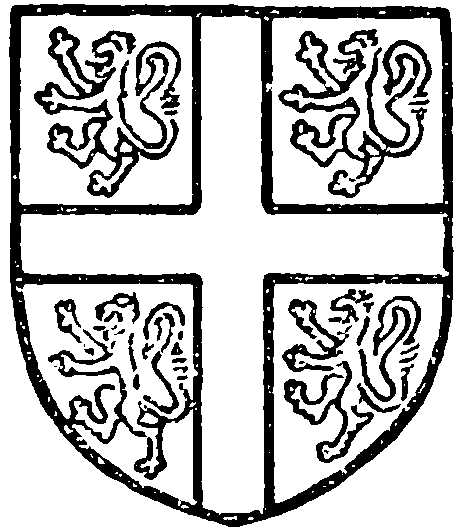
Bishopric of Durham. Azure a cross or between four lions argent.
In 1183 there were in Middleham and Cornforth, which were surveyed together, twenty-six villeins, whose tenure was similar to that of the villeins of Boldon. (fn. 52) Seven cottiers held 6 acres each. Four bordars had four tofts and crofts. (fn. 53) The demesne, which was common to both vills, and perhaps to Sedgefield also, was in the bishop's hands. (fn. 54) In 1349 it was farmed by the bishop's bailiff; the services of the bondmen were commuted for a money payment. The grass of 'Sprowes lawe,' a meadow in Middleham, was sold for 12s. to the bondmen of Middleham, that of 'Corneforth medowe' was sold similarly to the men of Cornforth, and that of 'Seggefel medowe' to the men of Sedgefield. (fn. 55) Both Cornforth and Sedgefield were part of Middleham Manor, and did suit at the halmotes held at Middleham or Sedgefield. (fn. 56)
The survey of about 1384 gives the extent of the arable land attached to the manor-house of Middleham as 3 carucates or 270 acres. (fn. 57) There were also 90 acres of meadow. (fn. 58) A messuage called 'Grewhondes place,' on the demesne, was held in 1384 by Robert Reginald, who also held 10 acres of demesne land. John Atthegate had 41 acres and half a rood of demesne. (fn. 59) There were only six bondage or villeinage tenements in Middleham, (fn. 60) each consisting of a messuage and 2 oxgangs of 15 acres, the tenants paying 6s. for cornage. The vicar had two of these villeinage holdings. (fn. 61) Thirty-two tenants held 'exchequer land' generally in small holdings of 6 or 7 acres, some of which are described as newly-inclosed from the waste. (fn. 62) Under this heading is placed the common bakehouse, which was held by John Atthegate at a rent of 4s. 6d. (fn. 63)
In 1406 the whole of the demesne, with the customary works, was leased to Thomas Randson for six years at a rent of £10. (fn. 64) A similar lease, with the exception of certain meadows retained by the bishop, was made to William Wright in 1413. (fn. 65) The vicar had a lease of the demesne in 1478. (fn. 66) In the late 15th and early 16th century the demesne was leased to the bishop's bailiff, (fn. 67) and from the end of the 16th century till the later part of the 18th century the leasehold tenure was continuous. In 1564 Henry Eure was in possession of the park and demesnes, (fn. 68) and in 1594 his son William released certain demesne meadows to George Freville. (fn. 69) He must also have released the rest to him, for the leasehold of the park passed with the freehold land of George Freville through the hands of the Bradshaws and the Halls to George Surtees. (fn. 70) About 1761, however, one of the lives on which the lease depended expired, and before George Surtees had renewed it the other two expired also, so terminating the lease. It was not renewed to the Surtees family, but was granted to Nicholas Halhead, their steward, (fn. 71) whose daughters, Katherine wife of Francis Burton and Elizabeth Halhead, held it in 1823. (fn. 72) It was subsequently held by the Russell family. (fn. 73)
There were two free tenants in Middleham in 1183, Arkell, who held 4 oxgangs and paid 14s., and Ralph, who held 2 oxgangs for 10s. and five cartloads of wood. (fn. 74) There is no evidence as to the descent of their holdings between that date and 1359, when Thomas de Coxside and Alice his wife received licence to grant a messuage and 100 acres here (fn. 75) to Richard de Hett. (fn. 76) Richard died in or before 1373 (fn. 77) seised of this estate, which was held in chief for oneeighth of a knight's fee and a rent of 24s. at the exchequer. (fn. 78) His son John, who succeeded him, (fn. 79) was said about 1384 to hold 89 acres in Middleham and to pay 26s. (fn. 80) John's daughter and heir Elifot married John Webster, and had a daughter and heir Alice, wife of Hugh Chambre. (fn. 81) John Chambre son of Hugh (fn. 82) died in possession of this holding (100 acres) in 1462, leaving daughters and co-heirs Agnes, Maud, and Isabella. (fn. 83) His lands were evidently divided among them, and cannot be certainly traced. Between 1588 and 1619, however, George Freville united by purchase several freeholds in the vill. Richard Heighington conveyed to him in 1588 his capital messuage in Middleham. (fn. 84) John Shawe of Thrislington released to him in 1599 a messuage here, evidently that messuage with 22 acres attached which belonged about 1384 and 1420 to Roger Washington or Usher, and was acquired by the Shawes with land in Thrislington (fn. 85) and Cornforth. Another messuage, called 'le front in the feilde,' with a dovecote and garden, was purchased by Sir George Freville of Old Park from William Jackson in 1609, (fn. 86) and a fourth from Thomas Lawson at a date unspecified. (fn. 87) He bequeathed all the premises to Elizabeth his wife for life, with remainder to his nephew Nicholas Freville, and died in 1619. (fn. 88) In 1668 Nicholas conveyed his estate in Bishop Middleham to William Bradshaw, (fn. 89) who with Troth his wife and Troth and Mary his daughters sold it in 1704 to Nicholas Hall. (fn. 90) Guise Hall son of Nicholas and Annabella widow of Nicholas sold it in 1734 to George Surtees, who settled it in 1761 on the marriage of his nephew Robert Surtees of Mainsforth (q.v.). (fn. 91) General Surtees of Mainsforth holds a freehold in Middleham at the present day.
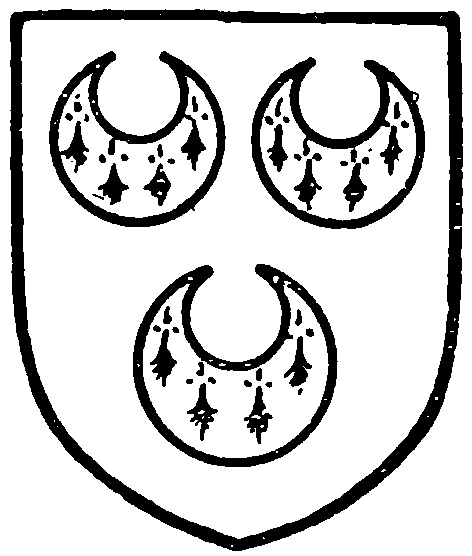
Freville. Gules three crescents ermine.
CORNFORTH
CORNFORTH (Cornford, xii cent.), which may have been included in the grant of the manor of Middleham to the Sheriff Osbert, (fn. 92) was claimed in the late 12th century by Alan de Chilton. (fn. 93) Before 1180, however, he surrendered all right in it to Bishop Hugh Pudsey in return for the vill of Healey. (fn. 94) In 1183 Cornforth was surveyed with Middleham, and the reeve of the manor of Middleham held 2 oxgangs here for his service. (fn. 95) Except for a few freeholds the vill remained part of the episcopal estate. Here was the manorial water corn-mill, to which the tenants of Mainsforth and Middleham owed suit. At the beginning of the 14th century the mill was worth £20 a year. (fn. 96) About 1384, when it was held by the tenants in common, the rent was only £13 6s. 8d. The extent of a villein tenement in Cornforth— namely, 2 oxgangs—was the same as that in Middleham. There were twenty such tenements, according to the 14th-century survey. (fn. 97) Most of the villein tenants then held two tenements or one and a half. In addition to the obligations of the Middleham bond-tenants they were bound to do carriage for the bishop and his steward. They paid a sum of 20s. in cornage. The kiln and bake-house of the vill were held in common, like the corn-mill. (fn. 98) The fulling-mill of Cornforth, which is mentioned in 1358 and 1361, (fn. 99) was ruinous about 1384. (fn. 100) References to Cornforth in the bishop's halmote rolls are concerned chiefly with leases of the mill or grants of copyhold land. (fn. 101) The whole vill was leased to Robert Crounde and others in February 1459–60. (fn. 102) The Ecclesiastical Commissioners, in whom the episcopal lands are vested, are the chief landowners at the present day.
There were several freeholds in Cornforth in the 14th century. (fn. 103) A free tenement of a messuage and 60 acres, held at a rent of 22s., belonged to Roger de Washington, who was succeeded in or before 1370 by his son William. (fn. 104) Roger son of William Usher, who held this freehold about 1384, was apparently identical with Roger son of William de Washington, who had land in Middleham at the same date. (fn. 105) Roger Usher died seised of both the Cornforth and Middleham land in 1420. (fn. 106) His son and heir John died two years later, his heir being his sister Alice. (fn. 107) The freehold is not mentioned again till it appears in the possession of William Shawe, who did homage for land in Cornforth in 1577 or 1578. (fn. 108)
William Shawe died in 1587 (fn. 109) seised of this and another small freehold. (fn. 110) His son and heir Thomas, who died in 1590, was succeeded by his brother John, (fn. 111) tenant at his death in or before 1631 (fn. 112) of a capital messuage, three other messuages, and 160 acres of arable land, meadow and pasture. (fn. 113) John left three daughters and co-heirs, Elizabeth, Alice, and Anne, who married respectively William Eden, George Guye, and William Emerson. (fn. 114) William Emerson and Anne made a grant of 120 acres of arable land here with meadow and pasture to Thomas Richardson in 1632. (fn. 115) To Alice and her husband George Guye livery was granted in 1633, (fn. 116) and in the same year they had licence to alienate land in Cornforth to Richard Slinger and William Stoddart. (fn. 117) The estate was found split up into thirds about ten years later, and was never reunited. The tenants in 1644 were William Eden of Whitton, husband of Elizabeth Shawe, Mrs. Howard, and Matthew Smith. (fn. 118) Brandon House, which seems to have been the capital messuage of the Shawes, (fn. 119) came into the hands of the Woodhouse family, (fn. 120) and was subsequently purchased first by the Whites and then by the Haswells. (fn. 121) In 1684 the freeholders were Robert Cooper, Robert Haswell, William Hutchinson, Thomas Waugh, Robert Hutchinson, William Woodhouse, William Wilkinson, Thomas Garthorne, and Thomas Hutchinson. (fn. 122) The Haswells and Garthornes held land here till the middle of the 19th century. (fn. 123)
The township of GARMONDSW AYMOOR must be identified with the 'place called via Garmundi,' from which King Cnut walked barefoot to the shrine of St. Cuthbert. (fn. 124) About 1183 the bishop held 4 oxgangs here by purchase and 5 by escheat of Ralph Haget. (fn. 125) The first holding was lying waste. (fn. 126) Very shortly after the survey of 1183 Bishop Pudsey granted the whole vill as part of the endowment of his hospital for lepers at Sherburn. (fn. 127) The brethren and sisters were to pay to Ralph son of Paul of York and his heirs 4 marks a year as an equivalent of service from a third part of the vill. (fn. 128) Ralph son of Paul also granted them a charter. (fn. 129) In 1204 the master of the hospital released to the rector of Middleham all claims on the tithe of Garmondsway. (fn. 130) Free warren in the demesne lands of the hospital here and elsewhere was granted by Bishop Fordham in 1384. (fn. 131) In 1580 Ralph Lever, then master, protested against the assessment of Garmondsway as temporal land of the hospital. He described it as ancient demesne of the house, 'always employed with a stocke of cattell for the maintenance thereof,' (fn. 132) and was successful in having the assessment altered. The township still forms part of the endowment of the hospital.
A carucate of land in RAISBY (Raceby, xii cent.) was granted with Garmondsway to the hospital by Bishop Pudsey, who had purchased it from Baro, its first cultivator. (fn. 133) This land was burdened with a rent-charge of 15s. to the lord of Great Kelloe, 5s. of which were released to the hospital by Alexander de Kellaw in the 13th century. (fn. 134)
About 1183 the bishop had 17 oxgangs in MAINSFORTH (Maynesford, xii cent.) which had come into his hands by escheat or purchase. Eight of these were arable and held for rent and for customary works, rendered doubtless on Middleham demesne. The other 9 lay in pasture with the moor. (fn. 135) With the exception of these 17 oxgangs the whole vill was the freehold of Robert de Mainsforth. (fn. 136)
During the 14th century there is evidence of the existence of bondage tenements in Mainsforth, (fn. 137) but before the survey of 1384 the villeinage land seems to have been for the most part converted into freehold. At that date two tenements were in the bishop's hands for lack of tenants. The whole of the rest of the vill was held by freeholders. (fn. 138) It was stated that the ancient 'free rent' of the vill was 36s. 8d., but that in 1384 the tenants, 'by the collection of John de Hardwick and his fellows,' rendered 34s. 10d. (fn. 139) The latter sum appears in later accounts as a free rent due from land 'formerly of John de Hardwick and his fellows.' (fn. 140) It seems probable that this holding represented most of the 17 oxgangs originally held by the bishop's bondmen, and that the other free tenants mentioned about 1384 (fn. 141) derived their interest from Robert de Mainsforth.
There is no evidence as to the heirs of Robert de Mainsforth, and freeholds held in the 14th century (fn. 142) by persons bearing the local name were not important. The chief part of his holding seems to have been acquired by Peter Dautry. In 1349 John de Parys had licence to enter on a carucate of land in Mainsforth of the gift of Peter Dautry, and immediately afterwards he granted it to Nicholas de Kellaw and his daughter. (fn. 143) About 1360 Peter himself died seised of two tofts, two crofts, 85½ acres of arable land, and an acre of meadow which he held for a rent of 8s. 4d. His heir was Ralph son of Rowland Bart, a minor, (fn. 144) whose lands here as in Middleton St. George (q.v.) passed to William de Walworth. Walworth was the famous mayor of London who in 1381 killed the rebel leader Wat Tyler. Thomas de Walworth, William's brother, paid 8s. 6d. rent about 1384. (fn. 145) He seems to have sold his holding to John Lord Nevill of Raby, who died in 1388 seised of two messuages in Mainsforth and 100 acres of land. (fn. 146) About 1414 Ralph Earl of Westmorland paid 8s. 6d. rent for the lands late of Thomas de Walworth. (fn. 147) He sold them with the manors of Edmondsley and Hunwick (q.v.) to John de Hoton, (fn. 148) and this part of Mainsforth descended with Hunwick till 1575, (fn. 149) when Anthony Hoton sold it to Henry Heighington. (fn. 150)
The estate of John de Hardwick, one of the other free tenants of 1384, was found at his death in or before 1396 to include a capital messuage with a garden, toft and croft, and 24 acres called 'Boxhous,' a toft and 6 acres called 'Kellawhous' (possibly part of the holding granted by John de Parys to the Kellaws), a messuage and 18 acres called 'Waytesplace,' a messuage and an oxgang called 'Wattesplace,' a messuage and an oxgang called 'Castelhous,' and finally 16 acres of the estate of Peter Dautry. (fn. 151) This holding descended with John de Hardwick's part of the manor of Hardwick (q.v.) till the forfeiture of Anthony Hebborne in 1569. (fn. 152)
Thirty acres (fn. 153) of Hebborne's land were granted by the Crown to George Walters and John Williams, who about 1609 sold them to Sir William Hewet and John Hewet (fn. 154); they in 1611 conveyed this holding to Henry Warde, who sold it to George Warde and Felix Wilson in the next year. (fn. 155) George and Mary his wife and Henry Warde conveyed a messuage and 30 acres of arable land with 40 of meadow, moor and pasture, apparently the same estate, to George Wardell and George his son and heir in 1614. (fn. 156) George Wardell sold it ten years later to Francis son and heir of John Bainbridge, who in 1625 conveyed it to Ralph Hutton and William Chaytor. (fn. 157) Ralph Hutton also bought up several other freeholds in Mainsforth, including that formerly held by the Hotons of Hunwick. In 1577 a messuage, with 44 acres of arable land, 3 acres of meadow, and 20 acres of pasture, was granted by Henry Heighington of Fishburn to William Heighley of Woodham and his son Thomas. (fn. 158) They in 1581 conveyed this holding to Ninian Heighley of Whorlton, (fn. 159) who sold it in 1598 to Robert Robson of Little Chilton. (fn. 160) From Robson it was purchased by Ralph Hutton in 1628. (fn. 161) Two oxgangs of land in Mainsforth which in the 13th century had been granted to the chantry of St. Mary, in the church of St. Oswald, by its founder Ralph, were sold in 1606 by John Halsey and Robert Morgan to Robert Robson. (fn. 162) These also were purchased by Ralph Hutton in 1628. (fn. 163)
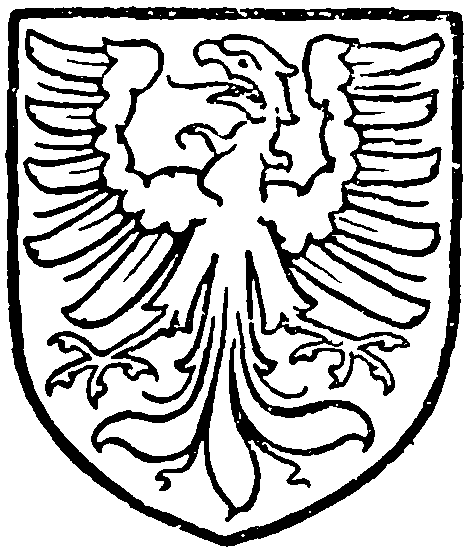
Hutton. Vert an eagle or.
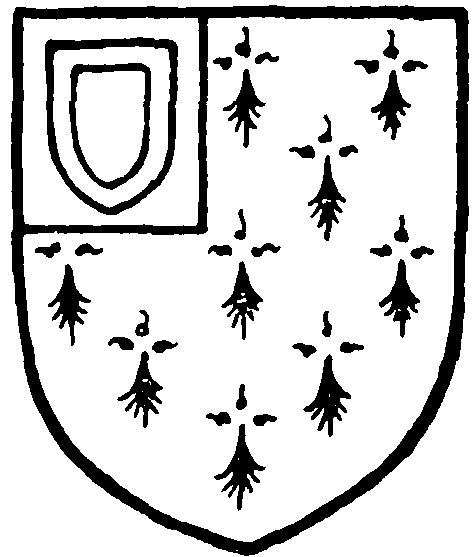
Surtees. Ermine a quarter gules with a voided scutcheon or therein.
The Huttons held an estate in Mainsforth for three generations, Ralph Hutton being succeeded by a son and grandson of the same name. (fn. 164) The last Ralph sold it in 1708 to Robert Surtees of Ryton and his son Edward of Crawcrook. (fn. 165) Edward Surtees gave Mainsforth to his second son George, who died unmarried in 1769, leaving it to his nephew Robert, son of his brother Hauxley. (fn. 166) Robert was the father of the historian Robert Surtees, who held the estate till his death in 1834, after which his widow Anne held a life interest till 1868. (fn. 167) On her death it reverted to Charles Freville Surtees, great-grandson of Robert eldest son of Edward Surtees, (fn. 168) who held the reversion by devise of his elder brother Robert Lambton. General Herbert Conyers Surtees, C.B., C.M.G., D.S.O., M.V.O., D.L., J.P., son and heir of Charles Freville, is the present owner.
A smaller freehold belonged in the 16th century to the Farrer family. John Farrer died in 1569–70 seised of four tofts and 36 acres of arable land in Mainsforth. (fn. 169) His son and heir John Farrer did homage for land here in 1578–9, (fn. 170) and died in 1586 seised of two messuages with 32 acres, one toft with 12 acres, and another toft with 26 acres, leaving a son John. (fn. 171) The latter was probably the John Farrer the elder who in 1627 purchased land here formerly of Robert Robson from Ralph Hutton and Sir William Chaytor, and in 1641 granted his Mainsforth lands to his son John. They were settled in the next year on the marriage of John, jun., with Mary Smith, and were sold by the same John in 1653 to Samuel Disbrowe. In 1673 Disbrowe joined with Richard Saltonstall, John Farrer, and others in a conveyance to Robert Lynn of Shotton. Robert Lynn, son of Robert, died in 1744. His son and heir, also called Robert, left three daughters and co-heirs: Mary, who died unmarried, Jane wife of Christopher Mawer, and Dorothy wife of John Smart. (fn. 172)
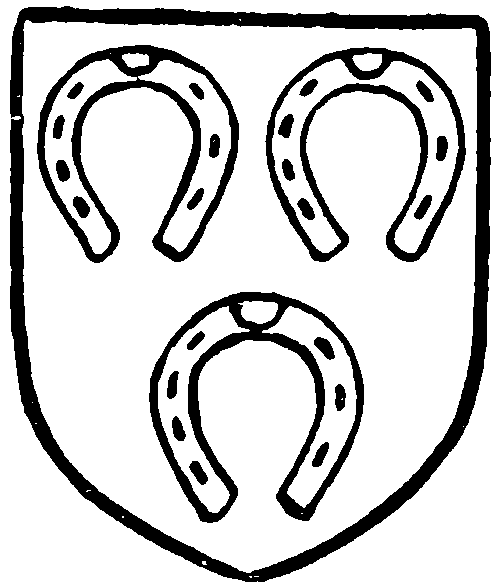
Farrer. Argent three horse-shoes sable.
The Prior and convent of Durham had an estate in Mainsforth, probably acquired under the grant of marsh land by the freeholders of Thrislington in 1261. (fn. 173) In 1539 it was held, apparently by a copyhold tenant, for a rent of 20s. 4d. It passed with the other possessions of the priory to the dean and chapter. (fn. 174)
The vill of THRISLINGTON (Thurstanton, xiii–xv cent.; Thorstanton, xv cent.; Thrustanton, Thrustyngton, Thruslington, Thrislington, xvi–xvii cent.) is first mentioned in 1262, when the Prior and convent of Durham made an agreement with Adam son of Roger de Fulthorpe, Nicholas son of Thomas de Thurstanton, Roger son of William de Thurstanton, Thomas the Drenge, John de Skyrburne and Alice his wife, and Adam Paris and Beatrix his wife, as its owners and tenants. (fn. 175) The family of Fulthorpe of Fulthorpe (q.v.) was probably already in possession of the greater part of the vill, the 'lordship' of which in 1336 belonged to Roger Fulthorpe. (fn. 176) It was granted, probably by his grandson Alan, to the younger branch of the family, (fn. 177) who also acquired Tunstall (q.v.), and the manor followed the descent of Tunstall down to the 17th century. (fn. 178)
The family bearing the local name had, however, an independent holding. Bernard de Thurstanton, probably the heir of Nicholas, made an agreement with the Prior of Durham in 1309, (fn. 179) and died in or before 1340 seised of a messuage, 70 acres of land, and 3 acres of meadow in Thrislington, held in chief for a twentieth part of a knight's fee. (fn. 180) He left a son and heir Bernard, (fn. 181) whose holding was evidently acquired by the Fulthorpe family before 1430. (fn. 182)
Two important freeholds were held under the Fulthorpes by sub-tenants till 1614, when the subtenants became lords of the manor. In or before 1344 Richard de Kelloe died seised of a rent of 20s. from a messuage and 3 oxgangs in Thrislington, then held by John Mareschal. (fn. 183) Agnes, widow of his heir William, had this messuage and 3 oxgangs in her own hands, (fn. 184) and her descendants, the Forcer family, continued to hold them (fn. 185) of the lords of Thrislington till 1531, when John Forcer died seised. (fn. 186) The holding must have been purchased from his heirs by William Shawe, who was seised of it at his death in 1587. (fn. 187) He then also held the second freehold, a messuage and land which in 1421 had been held of the Fulthorpes by Roger Usher and Joan his wife. (fn. 188) William Shawe's son Thomas died in 1590, and was succeeded by his brother John Shawe, sen. (fn. 189) A younger brother William purchased from John his whole estate in Thrislington, and with his son John Shawe, jun., acquired the manor of Thrislington in 1614 from Nicholas and Christopher Fulthorpe. (fn. 190) He made a settlement of half of it in 1632 on his third son Thomas, and died in the same year. (fn. 191) Both John Shawe, jun., and Thomas appear to have died without issue, and Robert, a fourth son of William, inherited the manor. (fn. 192) Robert's three elder sons Robert, Thomas, and John (fn. 193) died without issue. (fn. 194) His fourth son William (fn. 195) died in 1709, leaving daughters and co-heirs. (fn. 196) Thrislington was alienated between 1731 and 1750 by the heirs of the Shawe family to Sir Thomas Robinson of Rokeby, bart., (fn. 197) who sold it to Hendry Hopper of Durham. (fn. 198) Hendry Hopper died in 1750. (fn. 199) His grand-nephew Robert Hopper Williamson was lord of the manor in 1823. (fn. 200) William Hopper Williamson of Whickham, Robert's great-grandson, is the present owner.
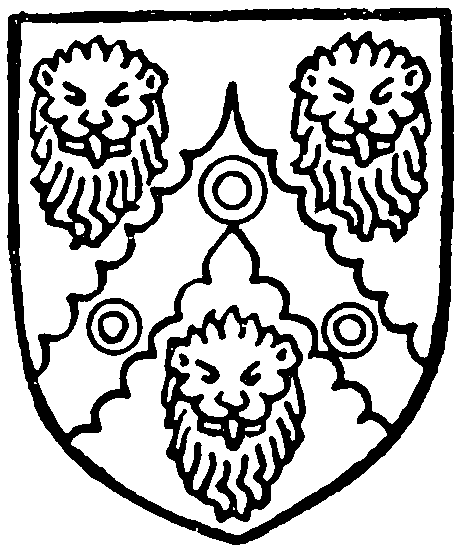
Forcer. Sable a cheveron engrailed or between three leopards' heads argent with three rings sable on the cheveron.
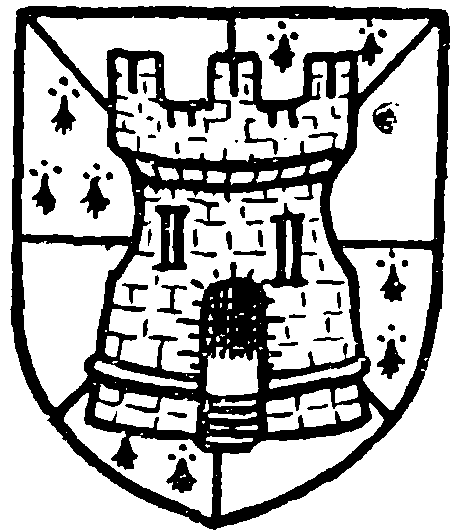
Hopper. Gyronny sable and ermine a castle argent.
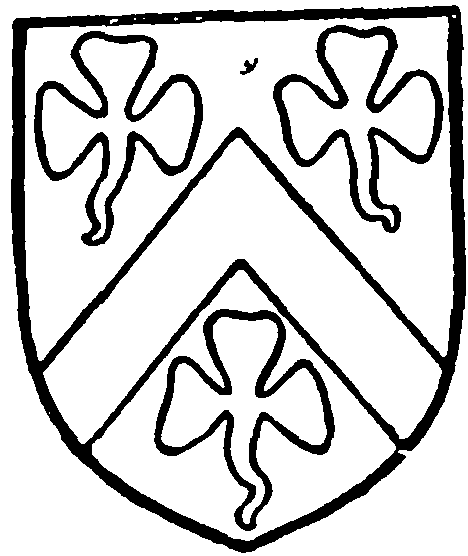
Williamson. Or a cheveron gules between three trefoils sable.
CHURCHES
The church of ST. MICHAEL stands on high ground on the southwest side of the village and consists of a chancel 42 ft. by 17 ft. with small north vestry, clearstoried nave 57 ft. by 22 ft. with north and south aisles each 9 ft. wide, and north porch 9 ft. 4 in. by 8 ft. 6 in., all these measurements being internal. There is a bellcote over the west gable containing two bells.
With the exception of the vestry, which is a modern addition, the whole of the building is of early 13th-century date, and though successive alterations and restorations have destroyed many of its ancient features it still retains intact its original plan and in the main its mediaeval aspect. Externally the building is of very plain character, the walls being of rubble masonry and the roofs covered with modern blue slates. The original windows were all lancet openings, but they only remain in the north and south sides of the chancel and at the ends of the aisles. All the rest of the windows are modern. The outer wall of the north aisle was taken down in 1802 (fn. 201) and rebuilt without buttresses, and to this date probably belonged the sash windows on both sides of the nave which existed in Surtees's time. At a later period the three lancet lights of the east window were replaced by a large pointed opening. (fn. 202) In 1843–6 the church was restored by Mrs. Surtees in memory of her husband, when the original lancet lights, many of which had been built up, (fn. 203) were opened out, the sash windows of the aisles replaced by the existing double lancets, new roofs erected, and the building generally put in a state of repair. (fn. 204) There was a further restoration in 1905–6. (fn. 205)
The chancel is externally of two bays, having a flat double buttress at each of its outer angles. The intermediate buttresses of the north and south walls are of similar type, and the roof is considerably lower than that of the nave. The east window is a modern one of three lancet lights, replacing the former insertion. On the north side are two original lancets and on the south three, with a smaller round-headed opening towards the west end. The heads of the lancets are all cut from single stones and are without hood moulds, two on the south side and one on the north having shouldered inner heads. The sills are 6 ft. above the ground outside, but the westernmost of the three lancets on the south side has been lengthened by 2 ft. at the bottom, forming a low-side window. The round-headed window is shouldered on the inside, but its sill is considerably higher than those of the lancets. Internally the chancel walls are plastered, but no ancient ritual arrangements remain except a recess at the east end of the north wall. The chancel arch is pointed and of two chamfered orders the full width of the chancel, with a hood-mould towards the nave. The outer order is square on the east side and dies into the wall, but on the west it runs down to the ground. The inner order springs from moulded corbels and the chamfered hood mould terminates in carved heads. All the chancel fittings are modern. In the floor in front of the altar rails is a grave slab with cross and chalice, now very much worn.
The nave consists of four bays with north and south arcades composed of pointed arches of two chamfered orders springing from circular piers and keel-shaped responds, all with moulded capitals and bases. Towards the aisles the outer order is square, and there is a hood mould on the nave side only. On the south the capitals are simply moulded, but on the north side those of the two responds have a small nail-head ornament. The stops of the hood moulds on both sides are all carved, some with plain masks, others with grotesque heads and ornamental bosses. The old lancet windows at the ends of the aisles have all shouldered inner heads except that at the east of the south aisle, and there is a modern lancet at the west end of the nave. The clearstory has three square-headed two-light windows with segmental rear arches on the south side, but is blank on the north. The windows are apparently modern restorations of comparatively late work, a clearstory being in all probability no part of the 13th-century building. Above the windows outside is a hollowed string-course the full length of the nave.
The north and south doorways are in the second bay from the west, the porch being on the north side owing to the position of the church in relation to the village. The porch, though restored, is interesting as retaining nearly all its 13th-century detail, although the side walls have been heightened about 3 ft. 6 in. and the original pitch of the gable has thus been reduced. The roof is covered with modern slates. The outer arch is of two orders, the chamfer of the inner being continued down the jambs. The outer order is moulded and springs from angle shafts with moulded capitals and bases. The arch itself is a restoration, together with the capital of the west shaft in which the nail-head ornament occurs; the hood mould terminates in two original heads, one of which is mitred. There is a window on each side of the porch, moulded round the head, jambs, and sill, and fragments of several mediaeval grave slabs are built into the walls and gable or are preserved inside the porch. The inner doorway is quite plain, with a chamfered pointed arch. The south doorway is similar in character to that of the porch, but is smaller and less restored. The shafts are very much worn away in the lower part and the bases are gone or are covered up. The nail-head ornament occurs in the capital of the east shaft and the mitred head is on the opposite side to that in the porch doorway. In the wall above is a stone sundial with the motto 'Memento mori' and the date 1741. The bell-turret has been rebuilt, but with the old stones. It has a pointed gable and stands on a rectangular base.
At the west end of the nave are two flat buttresses of three stages at the ends of the arcade walls and a dwarf buttress below the window, and the wall is set back slightly at a height of 10 ft. above the ground. Built into the wall above the window is a circular moulded stone carved with a cross moline. (fn. 206) The south wall is divided externally into four bays by flat buttresses, three of which have been rebuilt. Internally all the walls are plastered and the nave has a modern boarded roof of eight bays, the aisles being under lean-to plastered roofs. At the east end of the south aisle in the usual position is a piscina with pointed head and a square aumbry.
The font consists of a circular bowl of Frosterley marble 29 in. in diameter on a circular shaft and is probably of the same date as the building. The bowl of a smaller font lies on the floor at the west end of the north aisle.
The pulpit (fn. 207) and seating are modern, and a choir vestry, inclosed by a modern wooden screen, has been formed at the west end of the south aisle. The organ, which formerly stood within the chancel, blocking the view of the altar, is now at the east end of the north aisle. There are memorials in the chancel to Robert Surtees, the historian of the county, who died in 1834, (fn. 208) his wife Anne (d. 1868), Colonel Charles Freville Surtees (d. 1906), and others. (fn. 209)
Over the north doorway is a hatchment with the arms of Thomas Bedford, vicar (d. 1660), and a long inscription recording his death and that of his wife in 1686: 'She was mother, grandmother, and great-grandmother to 74 children.' Over the south doorway is the hatchment of 'Ralph Hutton of Mensforth Batchr of Lawes Advocate of Durham.'
In 1553 there were two bells in the steeple, (fn. 210) one of which probably remains. It bears the inscription 'Ave Maria g[rati]a Plena Dñs tec[um] H.F.' and may be of 14th-century date. The second bell is by Samuel Smith of York and is inscribed 'Voco veni precare 1723.' (fn. 211)
The plate consists of a chalice, two patens, and a flagon, all made by Butler & Whitwell of York in 1818–19. (fn. 212)
The registers begin in 1559. They have been printed down to 1812. (fn. 213)
The church of the HOLY TRINITY, CORNFORTH, was built in 1868 from the designs of J. P. Pritchett. It is a building in the Gothic style, consisting of chancel, nave, south porch, and belfry at the east end of the nave. The district was formed in 1865 from Cornforth and Thrislington. (fn. 214) The living is a vicarage in the gift of the Crown and the Bishop of Durham alternately.
ADVOWSON
The church of Middleham was given to the priory of Durham in 1146 by Osbert the sheriff, then in possession of the manor by gift of Ranulf Flambard. (fn. 215) Bishop William de Ste. Barbe consented to the gift and confirmed it by his own charter, and Ralph son of Ranulf Flambard, then parson, surrendered his rectorial rights. (fn. 216) The church is mentioned in the confirmatory charters to the priory of Henry II, Richard I, and John. (fn. 217) In spite of the grants of the bishop and rector about 1146, no formal appropriation seems to have been made, and the priors continued to present rectors to the church for more than a century. At the end of the 12th and beginning of the 13th century its custody during a vacancy was the subject of dispute between the Bishop of Durham and the prior. Both sent representatives to take possession, and two monks of Durham and two of the bishop's men occupied the church for a week. The struggle ended with the presentation of Philip de Balliol to the living by the prior and convent. (fn. 218) In 1278 Bishop Robert of Holy Island appropriated the church to Finchale Priory, a cell of Durham, for the support of five (fn. 219) monks. (fn. 220) A vicarage was ordained at the same time, the vicar receiving 5 marks annually from the tithe corn of Garmondsway. The Prior and convent of Durham retained the right of presentation, and a pension of 40s. was paid to the sacrist. (fn. 221) From 1423 the tithe of Garmondsway was assigned entirely to the vicar. (fn. 222)
On the surrender of the priory of Durham the advowson came into the king's hands, and has since remained in the Crown. (fn. 223) The Lord Chancellor presents at the present day. The rectory was leased in 1541 for twenty-one years to Avery Burnett, who assigned his interest to Christopher Lascelles. (fn. 224) After an intervening lease it was granted by Elizabeth in 1576 to John Ward for twenty-one years. (fn. 225) He surrendered his lease nine years later in exchange for another to his wife Winifred and his sons John and Samuel for their lives. (fn. 226) John Ward bequeathed his interest in 1596 to his younger sons Peter and Henry for four years with remainder to his son John. (fn. 227) In 1611 a grant in fee of the rectory was made to Francis Morice and Francis Philips at the petition of various persons, including William Cockayne. (fn. 228) Morice and Philips conveyed it eight years later to William Cockayne, then a knight, and James Price. (fn. 229) Sir William's son Charles with James Price leased it in 1640 with a considerable estate to Humphrey Morton, whose possession was disputed by the Ward family. (fn. 230) Charles was created Viscount Cullen in 1642 (fn. 231) and was in sole possession of the rectory in 1644, when his farmer was John Ward. (fn. 232) His son Brian, second viscount, (fn. 233) settled it in 1679 on the marriage of Mary, his daughter or sister, with Robert Peirson. (fn. 234) Mary's daughter and heir Margaret married Gilbert Spearman (fn. 235) and died in 1731 (fn. 236); Gilbert died in 1738, (fn. 237) leaving a son George. (fn. 238) The daughters and heirs of George, Elizabeth Honoria and Anna Susanna, (fn. 239) conveyed the rectory in 1769 to Ralph Hopper, (fn. 240) younger nephew of Hendry Hopper of Thrislington. (fn. 241) At the death of Ralph Hopper in 1780 (fn. 242) it passed to his son John Thomas Hendry Hopper, who sold it in parcels. (fn. 243) The greater part was purchased by William Russell of Brancepeth Castle, (fn. 244) and has followed the descent of Brancepeth into the hands of the present Viscount Boyne. The tithes of Mainsforth and Thrislington were respectively bought by Robert Surtees and Robert Hopper Williamson. (fn. 245)
A chapel was confirmed with the church of Middleham to the Prior and convent of Durham by Henry II. (fn. 246) It was perhaps in Thrislington. Roger the clerk of Thrislington is mentioned twice in the 13th century. (fn. 247)
The light of the Blessed Mary in the church of Bishop Middleham is mentioned in 1341. (fn. 248)
CHARITIES
For the parochial school see article on schools. (fn. 249)
For the charity of Dame Elizabeth Freville see under parish of Sedgefield. About £35 is received yearly, of which two thirds is distributed in Cornforth and one third in money to about 15 recipients in Bishop Middleham.
The Pellaw's Leazes charity was founded by an indenture of 27 and 28 September 1742, whereby 1 acre in a field called Pellaw's Leazes was conveyed in trust for the poor. The land was sold in 1856 and the proceeds invested in £397 13s. 8d. consols with the official trustees. The dividends, amounting to £9 18s. 8d. yearly, are distributed in money doles, half to the poor of Middleham and half to the poor of Cornforth.
The Hope and Clerk's Acre.
At a court held for the manor of Middleham on 26 January 1724 certain persons were admitted tenants of an acre of land called the Hope, adjoining the Clerk's Acre, in trust for the poor of the townships of Bishop Middleham, Cornforth, Mainsforth and Thrislington. Both pieces of land were sold in 1911 in consideration of the transfer of £302 13s. 4d. consols to the official trustees, of which £121 1s. 4d. stock, producing £3 0s. 4d. yearly, was apportioned in respect of the Hope charity and £181 12s. stock, producing £4 10s. 8d. yearly, in respect of the Clerk's Acre. The income of the Hope charity is distributed in money doles and that of the Clerk's Acre is applied towards church expenses.
Quit-rents.
The poor also receive the sums of 20s. and 10s. 6d. from the owner of Brancepeth Castle in respect of a piece of waste land called Brick Dyke and a piece of land near Pinfold, together with the sum of 12s. 8d., being the dividends on £25 7s. 1d. consols with the official trustees, representing the investment in 1882 of arrears of the said quit-rents.
Cornforth.
For Old Cornforth National school see article on schools. (fn. 250)