A History of the County of Durham: Volume 3. Originally published by Victoria County History, London, 1928.
This free content was digitised by double rekeying. All rights reserved.
'Parishes: Hartlepool', in A History of the County of Durham: Volume 3, ed. William Page (London, 1928), British History Online https://www.british-history.ac.uk/vch/durham/vol3/pp263-285 [accessed 2 May 2025].
'Parishes: Hartlepool', in A History of the County of Durham: Volume 3. Edited by William Page (London, 1928), British History Online, accessed May 2, 2025, https://www.british-history.ac.uk/vch/durham/vol3/pp263-285.
"Parishes: Hartlepool". A History of the County of Durham: Volume 3. Ed. William Page (London, 1928), British History Online. Web. 2 May 2025. https://www.british-history.ac.uk/vch/durham/vol3/pp263-285.
In this section
HARTLEPOOL
Hiartapoll, Hertlepole (xii cent.); Herterpol (xiii cent.); Hertilpol (xiv cent.); Hertylpull (xv cent.); Hartinpooell (xv cent.).
Hartlepool stands upon a rocky peninsula on the coast of Durham. The peninsula forms the east side of a large but shallow bay, the Slake, which extends inland in a north-westerly direction. A neck of land only 500 yards across at its narrowest point, formed of blown sand, connects with the shore the headland of magnesian limestone on which the town is built. It has often been asserted that Hartlepool was once a tidal island, but there is no proof of this. (fn. 1) The east and south coasts of the peninsula are defended by cliffs between 30 ft. and 40 ft. high, and by rocks which extend out to sea for a considerable distance, but the harbour has a sandy shore, and from the earliest times must have been a refuge for ships, although its depth at high water, before the 19th century, was not more than 8 ft. or 10 ft. There was also a smaller but deeper natural bay, the inner harbour, formed by a promontory jutting out westwards from the end of the peninsula. The outer harbour, on the south of the promontory, was formed in the 15th century by means of a pier.
When the draining of the Slake and the rebuilding of the town were begun early in the 19th century the trunks of trees and the antlers and teeth of deer were discovered in large quantities embedded in the clay, showing that the land had once been covered with forest (fn. 2); even at the beginning of the 13th century the 'wood of Hartlepool' still existed. (fn. 3)
The founder of Hartlepool was Hieu, a religious woman, who, under the direction of St. Aidan, established a monastery for men and women on the promontory about 640. (fn. 4) The cemetery probably of this house was discovered in 1833; it lay on the south-east end of the promontory close by the shore, about 150 yards south-east of the present church of St. Hilda. (fn. 5) Although there was no tradition of the monastery's site, the field where the remains were found was called Cross Close. Hieu was succeeded as abbess by Hilda, who left Hartlepool for Whitby in 657 or 658. After this nothing more is known about the monastery, and it is said to have been destroyed during the Danish invasions. (fn. 6)
In all probability when the monastery was founded the peninsula of Hartlepool was uninhabited and covered with thick forest, but here as elsewhere the presence of the religious house would cause a settlement to be made, and the advantages of the bay for fishing would soon be used. Hartlepool is not mentioned by name again for the next 500 years. The few references are to the district name only of Hartness, which at the beginning of the 12th century came into the hands of the Brus family. (fn. 7) By this time, however, the town was in existence, as in 1153 some Norwegian pirates under King Eystein carried off ships and goods from Hartlepool. (fn. 8)
Bishop Pudsey took part in the rebellion of the young Prince Henry against his father, Henry II, and on 13 July 1174 forty knights and 500 Flemings landed at Hartlepool to support the rebels, under the command of Hugh Count of Bar, the bishop's nephew. On the same day the King of Scotland, the rebels' ally, was defeated and captured at Alnwick, and the bishop hastily sent the Flemings home again and made his peace with the king. (fn. 9)
It seems to have been about this time that the chapel of St. Hilda was built by the Brus family at Hartlepool on the highest point of the peninsula at its southern angle. (fn. 10) Some of the charters relating to the chapel give the first outlines of the arrangement of the town. Robert de Brus (c. 1141–94) confirmed the grant made by Gerard de Seton to the church of St. Hilda of a toft which lay on the east of the cemetery in exchange for that part of the cemetery which lay between the toft and the old ditch, saving the great road between the toft and the cemetery. (fn. 11) This highway was probably the main street of the town, afterwards called Southgate (fn. 12) and now High Street. It runs across the end of the peninsula east and west, from the sea to the sea.
William de Brus (c. 1194–1215) confirmed the grant of half the wood of Hartlepool made to the monastery of Guisborough by Simon of Billingham, (fn. 13) and the same William granted to the church all the land towards the south which extended from the cemetery of St. Hilda's chapel to the sea in one direction, and to the ditch extending from the chaplain's toft to the sea in the other, saving the common road. (fn. 14)
The Franciscan Friars established a house in Hartlepool before 1240. The friarage, as it was always called, lay to the north-east of St. Hilda's and had a chapel, a cemetery, and a well. (fn. 15) In 1538 the house was leased to Richard Threlkeld, (fn. 16) and in 1541 the lease was renewed for twenty-one years. (fn. 17) Before the end of the lease the house was granted in fee to John Doilye and John Scudamore on 16 June 1545. (fn. 18) They seem to have sold it to Cuthbert Conyers of Layton (q.v.), who by his will dated 28 September 1558 left 'the Freers and mill and lands in Hartlepool' for life to his two sons, Matthew and Cuthbert, and the survivor of them, but settled the whole of his lands in entail on his sons Ralph, John, and others in succession. (fn. 19) Ralph Conyers was attainted for his share in the rising in the North in 1569. (fn. 20) His lands were forfeited to the Crown during his life, but after his death in 1605 they reverted to Ralph son of his brother John, (fn. 21) who seems to have sold the friarage to Robert Porrett. On 10 January 1634 the trustees of Smith's charity purchased the friarage from Porrett. (fn. 22)
The ruined building, which was standing in the early part of the last century, was a large rectangular gabled mansion with mullioned and transomed windows, erected probably in the latter part of the 16th or beginning of the 17th century. The walls were tolerably perfect in 1825, but the roof and some of the gables had disappeared. (fn. 23) Very little or nothing of this building now remains in the Hartlepool hospital, which occupies its site and has developed from it. Used at one time as a workhouse, the building was converted into a hospital in 1867 and rebuilt with the exception of a small portion at the east end in 1889. The grounds are inclosed by an old stone wall.
The friars preachers of Hartlepool are mentioned in 1259, but nothing more is known of them. (fn. 24)
A rental of Guisborough Priory, dating probably from 1299, gives some idea of the town at that date. The 'Great Streat' there mentioned was probably Southgate Street. On the north side of it the monks owned a well-built toft and garden and four cellars. In St. Mary's Street 3½ crofts, 3 tofts and gardens on one side and 13 tofts on the other, belonged to the priory. In the street by the sea from the north to the south the monks owned a croft, four tofts, a garden and an archa domus on the east side of the street. They also owned a croft 'on the Island of St. Helen where the little street of St. Epigewina (?) branches off.' Between Northgate Street and Southgate Street there used to be an open space called Messam Green with several detached buildings in it, and one or two narrow alleys leading into the main streets from it. One of these alleys was called Pudding Street (Puidingel Street, (fn. 25) xvi cent.). A place called Eland, where the fishermen used to dry their nets, is mentioned in 1398–9, (fn. 26) and was possibly the same as St. Helen's Island. The street of St. Helen is also mentioned in the Guisborough Rental; the monks held a toft and croft there which had been given to maintain a light in the dormitory of the lay brothers. The chapel of St. Helen lay without the walls, and the situation of the street is unknown. The east part of St. Helen's Street was 'next to the merchant's street,' that is probably the east part of Southgate, where the market cross stood. (fn. 27)
The booths in Southgate are mentioned in the first half of the 13th century. About 1230 the Prior and convent of Durham granted a house and a booth in Southgate at Neshend to William son of Lambert, whose heirs held the house, which had been divided into three booths and a booth that was waste, in 1430. At this date there were a 'Northrawe' and 'Suthrawe' in South Street, and a 'Westrawe' in Northgate; a number of burgages and booths were then waste. (fn. 28)
The mayors' accounts mention the 'town's house' which the burgesses of Hartlepool began to build in 1600 (fn. 29); the richer citizens contributed 10s. a year for several years to the work. This hall probably stood on the site of the later town hall, by the market cross, on the south side of Southgate. (fn. 30)
The Prior and convent of Durham had in the 15th century a great herring-house in Northrow in South Street, described as formerly belonging to Robert de Brus. (fn. 31) This was a shed where the herrings were cleaned and cured.
The builder of the haven and town walls is said to have been Robert de Brus I, (fn. 32) but no references to the walls have been found earlier than the grants of murage in the reign of Edward II, and the evidence seems to show that they were built by the townsmen as a protection against Robert de Brus VII in the Scotch wars. In 1315, when the latter invaded England, James Douglas plundered the town and wasted all the east coast. (fn. 33) The manor had been forfeited by Brus in 1306 for the murder of Comyn and had been granted to Robert de Clifford (fn. 34); Brus therefore had a grievance against the place, and the inhabitants were panic-stricken: there was a tradition that they fled to their ships and left the town to the Scots. (fn. 35) A quantity of coins of Bishop Bek and Edward I, discovered at Hartlepool about 1841, were probably hidden in the face of this danger. (fn. 36) Soon afterwards, however, the townsmen began to take active measures for defence. A petition from the mayor and commonalty in 1328 stated that Robert de Brus had granted a truce to all the bishopric except the town of Hartlepool, which he proposed to burn and destroy in revenge for the capture of a ship laden with arms and victuals, and that the community had inclosed a great part of the town and were building a wall to the best of their power. They asked the king to grant them for the purpose 100 marks due for food bought from the late king by Robert de Musgrave. (fn. 37) The request was granted, and the king ordered that the work should be hastened. (fn. 38)
Only that portion of the wall on the west side of the town now remains, and of this a great deal near the north end has been rebuilt and most of its original features lost. The existing wall is about 450 yards in length and runs in a north-westerly direction from the rocks near the pier to the modern ferry, at which point there was formerly a round tower. From here the original wall ran in a north-easterly direction across the inner harbour to the opposite shore, where it was continued over the isthmus. Large portions of this north wall were standing in Hutchinson's day, (fn. 39) and his description of it, together with Sir Cuthbert Sharp's illustrations and notes of the changes wrought before 1816, is the only trustworthy record remaining of the ancient defences of the town. (fn. 40)
The length of the wall across the isthmus was over 300 yards, and it is stated by Hutchinson to have been strengthened at intervals by demi-bastions, some rounded, others square. From the edge of the cliff where the wall began the ground gradually fell towards the harbour, and at about half its length the wall formed an obtuse angle 'guarded with a turret or bastion from whence is a kind of horn work projecting into the field for a considerable distance, of an angular figure, having two terraces one above the other, with the remains of a glacis.' To the east of this were three bastions, the middle one rectangular and the two outer rounded. To the west were the remains of a sally-port and a third round bastion. The wall terminated next the harbour in the great land gate, or chief entrance to the town, which was 34 ft. in width and projected 16 in. in front of the main wall. The opening was 11 ft. 3 in. wide with a segmental arch of two rings, 13 ft. in height. The gate-house probably formed originally a strong tower, but the upper part had gone in Hutchinson's day. 'The whole wall, tower and gateway,' he says, 'are of excellent masonry, built of limestone which is won in the sea banks,' but before 1816 two of the bastions had disappeared. (fn. 41)
From the land gate the wall was continued in a direct line across the haven, the water at high tides coming up to the gate. This wall was over 8 ft. thick, faced on each side with dressed stones 'with a parapet guarded by a breast wall and embrasures,' and was pierced by a low pointed water gate for small craft. In Sharp's time the water gate was blocked in the lower part, and the superstructure, the remains of which suggested to Hutchinson a watch-tower, had disappeared. Further west the wall was broken in its length by two rectangular bastions, the entrance to the harbour being further west again, between two round towers 36 ft. apart. In Hutchinson's time one of these towers was 'very perfect save the parapet and embrasures,' but only the 'facia and foundations' of the other remained. Sharp (1816) states that 'the most perfect of the two towers was a few years ago 32 ft. high,' and that at various parts the remains of quays had been traced, showing that in all probability they extended entirely round the harbour. The harbour was nearly 12 acres in extent, but was inclosed for agricultural purposes in 1808 and the tower at the entrance destroyed. The entrance was then blocked and 'every vestige of antiquity which could be converted to profit' was removed. (fn. 42) Five years later, however, the harbour was restored to its original use, but was silted up in 1832. It now forms part of the Victoria Dock.
The existing western wall faces the outer harbour, and formerly had bastions at intervals and a sally-port at about half its length, but these have disappeared. (fn. 43) Near its south-east end, at rather less than 150 ft. from where the wall abuts upon the rock, is the old gateway known as Sandwell Gate. It stands at the end of Sandwell Chare, a narrow thoroughfare running from Southgate Street to the beach. The wall here is 8 ft. 3 in. thick and about 18 ft. high, and is pierced by a wider modern opening immediately to the south of the gateway. The top of the wall with plain parapet and chamfered plinth its whole length now forms a promenade. Towards the beach the gateway opening is 8 ft. in width with a pointed arch of two continuous chamfered orders, flanked on either side by angular buttresses carried up the full height of the parapet. On the town side the entrance has a segmental barrel vault carried by two chamfered ribs, the outer one forming the arch. The gateway is of plain and massive character and appears to be part of the original early 14th-century work.
Beyond the wall, across the isthmus, lay one of the town fields, Farwell Field; on the north-west boundary of the field were St. Helen's Chapel and St. Helen's Well, (fn. 44) which thus lay outside the borough boundaries. In 1802 it was decided by arbitration between the Mayor of Hartlepool and George Pocock, the lord of the manor, that the boundary of Hartlepool was the white or north wall. (fn. 45) The boundary between Farwell Field and Hart Warren was marked by a low wall in 1816. (fn. 46) Corporation Road at the present day follows the line of this wall.
The ferry with boats over a certain creek into the sea is mentioned in 1436. (fn. 47) It plied between the headland at the end of Southgate and the tower at the end of the sea-wall defending the harbour, and belonged to the Cliffords as lords of Hartlepool.
On 24 March 1473–4 Bishop Booth issued letters addressed to all abbots, priors, &c., entreating their charitable aid for the men of Hartlepool, who proposed to build a pier 'near the walls on the south part of the town, for the safeguard of all ships and vessels arriving at the port.' (fn. 48) The pier was built due west from the headland called Crofton Heugh, which projects into the sea beyond the south end of the town wall. By the building of this pier the outer harbour was made. When the pier needed repairs, the mayor issued orders for the inhabitants to bring loose stones for the work, (fn. 49) but this method of maintaining the pier does not seem to have been very effective, as in 1565 it was already ruinous.
The excellence of the harbour of Hartlepool made it a centre for most of the fighting on the northern coasts from the Scotch wars onwards. Its history was in consequence a turbulent one down to the 17th century. In the 14th century the seamen of the port were hampered by pirates. Richard de la More, in 1316, was sailing from Hartlepool to Berwick with a cargo of flour, corn and salt for the English garrison there. Pirates forced him to take refuge in Warkworth Harbour, where the inhabitants seized his ship, carried away its cargo, and refused to give the ship up. (fn. 50) In 1345 Nicholas and William Nesbit obtained licence to sail from Hartlepool with two ships, La Nicholas and La Catelyn, to destroy the numerous pirates then at sea in ships of war, and convoy the king's subjects safely across. Afterwards they were to repair on the king's service to Portsmouth. (fn. 51) Possibly these were two out of the five ships from Hartlepool, with crews amounting to 145 men, which formed part of Edward the Third's great fleet at Calais in 1346–7. (fn. 52)
Towards the end of the 14th century a feud broke out between the Cliffords, who were the lords of Hartlepool, and the Lumleys, who held Stranton (q.v.). The origin of the quarrel is unknown, but the men of Hartlepool supported the cause of their lady, Maud widow of Roger de Clifford. (fn. 53) In 1391 Sir Ralph de Lumley, kt., brought an action against Robert de Mapilton and 117 others, chiefly inhabitants of Hartlepool, for carrying off from Stranton one of Lumley's boats, destroying his property, ejecting his tenants and assaulting his servants. (fn. 54) The affair became so serious that the king interfered and ordered the Bishop of Durham to bring the dissensions to an end. (fn. 55) In 1394 the mayor, bailiffs and principal burgesses of the town gave a recognizance to the bishop of 1,000 marks to do no hurt or wrong to Sir Ralph de Lumley, his men, or his tenants. Ralph de Lumley gave a similar recognizance. (fn. 56) In 1403 it was found that Ralph Lumley had destroyed Maud de Clifford's market and fair at Hartlepool. (fn. 57) In 1410 the Mayor and commonalty of Hartlepool again gave a recognizance to preserve the peace with certain persons, but it does not appear whether these were adherents of the Lumleys. (fn. 58)
At least one Hartlepool man took part in Hotspur's rebellion of 1403, (fn. 59) and in 1405 the mayor and bailiffs were ordered to send victuals and ships to Berwick for Henry IV and his army, who was coming to punish the rebellion of the Earl of Northumberland. (fn. 60)
At the time of the Reformation the people of Hartlepool long remained faithful to the old religion. In October 1536, on the outbreak of the Pilgrimage of Grace in Yorkshire, Sir Francis Bigod, who had made himself obnoxious as one of Cromwell's agents, attempted to escape to London by sea, but his ship was driven by contrary winds to Hartlepool, where Sir Francis took refuge in the late mayor's house. As soon as his presence was known the townsfolk rose to capture him, and he was obliged to flee again. (fn. 61)
During the religious conflicts of the 16th century Hartlepool was noted by both parties as a suitable place for the secret landing of foreign troops. (fn. 62) At the siege of Dunbar in 1560 it was said that the French had a 'platt' or map of Hartlepool, 'where they mind to set men a land, and to fortify the place; which being done they hoped to make York the bounds of England. This came out by an Italian who is the fortifier of Dunbar.' (fn. 63) In 1565 Hartlepool was entered as one of the three ports of the bishopric in a government list of ports and harbours drawn up with a view to the suppression of piracy. (fn. 64)
In August 1561, when the English Government was very much excited by the departure of Mary Queen of Scots from France to Scotland, orders were sent to Hartlepool to keep a watch on the shipping, and to search foreign craft coming into the port. (fn. 65)
At the Rising of the North in 1569 the Spanish ambassador advised the earls to seize Hartlepool, in order that Alva might land troops from the Netherlands there to support the rebels. (fn. 66) On the outbreak of the rebellion the Earl of Sussex gave orders that Hartlepool should be garrisoned by 200 men, (fn. 67) but the order was not obeyed in time, and Christopher Nevill, at the head of 300 rebels, seized the town. (fn. 68) All the ordnance which the rebels possessed, a falcon and two slings, was taken from Brancepeth to Hartlepool. (fn. 69) Both Sir George Bowes and Sir William Cecil were very uneasy over the loss of Hartlepool. A royal ship which was sailing from Scarborough to Tynemouth fired on the town about 17 December. The rebels returned the fire, but the ship captured a fishing coble with three poor and half-naked men in it. The prisoners declared that there were 200 footmen in the town under the command of one Stafford, and that Christopher Nevill made it the headquarters of his 100 horsemen, 'and as for shipping there is none there, nor was not a great while, but 4 five-men cobles and 16 small cobles.' (fn. 70) By 18 December the rebels had fled from the town, (fn. 71) and the Earl of Sussex sent Sir Henry Gates to garrison it with 300 men. (fn. 72) This garrison was maintained somewhat longer than those in the other northern towns, but on 27 December Sussex had decided that it was a superfluous charge, as the town was very ruinous and the walls down in many places. (fn. 73) On 17 January 1569–70 he went to view the town himself, although 'platts' of it had been prepared for him, as the government considered it a matter of importance. (fn. 74)
It does not appear that the government took any steps to repair the walls of the town. In 1588 a Bill was passed in the House of Lords for repairing the pier of Hartlepool, but its provisions are unknown. (fn. 75)
An incident in the perpetual quarrel between the Bishop of Durham and the lord of the manor, as to whether Hartlepool lay within the bishopric, (fn. 76) occurred in 1581, when a ship carrying Thomas Brown and about thirty men was driven by stress of weather to take refuge in the harbour. Brown was believed to be a pirate; he and his men were arrested, and the bishop claimed that they ought to be confined in his gaol at Durham, but instead of this they were sent to Newcastle. The bishop produced evidence that in the time of Bishop Pilkington (1561–77) the men of Hartlepool had been assessed for service to the queen as being in Stockton Ward, and that when they refused to pay, a distress was taken, namely, 'two kye,' which were put in the poundfold at Durham. (fn. 77) The dispute with the bishop was adjusted in 1598, when two arbitrators decided that Hartlepool was within the liberties of the bishopric. (fn. 78)
In January 1638–9 it was proposed to establish a magazine of arms at Hartlepool, as being a more defensible place than Durham. (fn. 79) Early in February Sir Thomas Morton viewed the town, and reported that 'the town and walls are very ruinous, and will require a great charge, and a great time to repair, both of which I suppose, will not be agreeable to the present service; yet the cutting of 60 yards of ground makes it a perfect island, and no access to it but at low water. In the town are sufficient granaries for corn, and now, for the most part, well stored. The country adjacent is fruitful in corn and grass, and fit for quartering an army, if not too far remote. Those of the corporation affirm, that with six weeks warning they can provide corn for an army, and the like for butter and cheese, if there be an inhibition for carrying them out.' A plan of Hartlepool and an estimate for the proposed fortifications were drawn up, (fn. 80) but the scheme was not carried out. In 1640, when the Scots seized Newcastle, the king was warned to make Hartlepool secure. (fn. 81)
Lord Lumley and his family were Royalists, and on the outbreak of the Civil War Hartlepool was garrisoned for the king, under the command of Sir Edmund Carey. In April 1644, when Leven invaded England, it was reported that Hartlepool had fallen to him, (fn. 82) but the town lay out of the Scots' line of march, and it was not surrendered until Callendar advanced to Leven's support, when on 25 July 1644 its defenders were allowed to march out. (fn. 83)
A Scotch garrison was placed in the town under the command of Lieut.-Colonel Richard Douglas, (fn. 84) who repaired the walls and apparently caused earthworks to be thrown up across the peninsula. (fn. 85) The Scots' occupation of this and other northern towns was very disagreeable to the English Parliament, but they could not rid themselves of their allies until the treaty at the end of 1646–7. (fn. 86) On 26 February 1646–7 the House of Commons ordered that the new works at Hartlepool should be thrown down and the town disgarrisoned. (fn. 87) The first part of these orders may have been carried out, but the second certainly was not, as references to the garrison at Hartlepool occur in 1648, 1650, 1652, and 1658, while from 1647–9 'cesses' were imposed upon the inhabitants 'by reason of a garrison here.' (fn. 88)
In 1657 the mayor and burgesses petitioned for 'a brief for a collection towards building up their pier,' (fn. 89) and in 1662 a similar petition was referred to the Lord Chancellor. (fn. 90)
During the Dutch war of 1664–7 the attention of the government was attracted to Hartlepool. A report and map of the place was drawn up in 1664. It was said to possess a competent harbour which would receive a ship of 100 tons. The port provided a place of safety for passing colliers in bad weather and in war time. (fn. 91) Vessels pursued by the Dutch frequently took refuge in the harbour, (fn. 92) and the government continued the garrison there until the end of the century. (fn. 93)
In 1665 an attempt was made to obtain Parliamentary aid for the repair and maintenance of the pier, but the Bill was defeated. (fn. 94) In 1719 a small duty for the maintenance of the pier was imposed on exported grain. (fn. 95) Every inhabitant of the town was liable to be called upon to furnish work on the pier, but repairs of this kind were, of course, haphazard and unsatisfactory. (fn. 96) Between 1721 and 1732, however, the greater part of the pier was repaired by the generosity of the successive mayors. (fn. 97)
The price of corn in 1741 suddenly rose from 6s. to 15s. per boll, causing serious riots in Hartlepool. These were stopped only by the public-spirited action of William Romaine, a member of a Huguenot refugee family who had settled in the town as a corn merchant and become a capital burgess. He sold his stock to all comers at the old price, and in this way relieved the immediate discontent. (fn. 98)
In the course of the 18th century the trade of Hartlepool diminished and the harbour was allowed to fall into disrepair. Hutchinson in 1794 suggested improvements which might be made in it to the great advantage of the town. (fn. 99) In 1795 R. Dodd, an engineer, issued a Report on the various Improvements, Civil and Military, that might be made in the Haven or Harbour of Hartlepool, (fn. 100) but nothing was done and the town continued to deteriorate. By the beginning of the 19th century it was known only as a health resort, and even in this capacity it was not very successful, as the accommodation was poor, and the streets were dirty and insanitary. (fn. 101) The inhabitants lived in such complete isolation that they preserved many ancient customs, forgotten elsewhere. The fishermen and fishwives wore a distinctive costume, and by constant intermarriage practically everyone in the town was related. (fn. 102) There is a local tradition that during the Napoleonic wars a foreign ship was driven into the port with a monkey on board, and that the people of Hartlepool, never having heard of such a creature, at once hanged it as a French spy.
In 1804 the corporation made another attempt to obtain Parliamentary aid for the repair of the pier, as the town was evidently in no position to undertake the work, but again they were unsuccessful. (fn. 103)
In 1808 'a grant of the harbour was unfortunately made to an individual . . . who immediately enclosed it for the purposes of agriculture.' (fn. 104) A crop of corn was grown upon the dry Slake, but in 1813 William Vollum, one of the capital burgesses, indicted the inclosure as a nuisance. The case was tried at Durham, and a verdict was given in favour of the town, thus saving not merely the Slake but also probably the harbour, which would have silted up without the scouring action produced by the sweep of the backwater in the Slake. (fn. 105)
Meanwhile the severe storms of 1810 carried away a great part of the ruined pier. Again petitions were presented to the House of Commons, pointing out that Hartlepool was the only safe harbour between Sunderland and Bridlington, a distance of 90 miles on a stormy coast, but still nothing was done. A committee was therefore formed to collect subscriptions for the purpose, and in 1813, largely through the activity of Cuthbert Sharp, the town's historian, an Act for improving the port and pier of Hartlepool was passed, which provided that a toll of 2d. per ton on every ship entering the port, a rate of 5s. a year on every coble belonging to the port, and a part of the poor rate, should be devoted to the maintenance of the pier. (fn. 106)
Unfortunately, the sum raised by subscription was not large enough to rebuild the pier properly, while the income from the tolls was very trifling. (fn. 107) The affair was allowed to drift on without any real improvement for many years. In 1823 it was first proposed that, in consequence of the rapid development of railways and the coal trade, the port of Hartlepool might once more be utilized with advantage, but the scheme fell through. It was taken up again in a more practicable form in 1830. (fn. 108)
The Hartlepool Dock and Railway Company was formed in 1831, and obtained in 1832 an Act for the building of a railway line and docks. (fn. 109) By a further Act the promoters of the new company took over the work of the committee for the maintenance of the pier, which had been almost entirely neglected in recent years. (fn. 110)
The company was authorized to take 'the whole of the inner harbour and lands adjoining thereto, and so much of the Slake covered at high water, contiguous to the inner harbour on the west side thereof, and also so much of the lands adjoining the Slake on the north side thereof as shall not exceed in the whole 60 acres.' After many difficulties the tide basin was opened on 9 July 1835, when coal was shipped from Thornley Colliery. In order to improve the feeble credit of the company, the opening took place before either the dock or the railway line was ready, and, though the experiment was for the moment successful, it was followed by much damage owing to the imperfect state of the work. (fn. 111)
In 1837 the dock company obtained a further Act of Parliament for 'The Great North of England, Clarence and Hartlepool Junction Railway Company.' In the following year, 1838, the Stockton and Hartlepool Railway Company obtained powers to construct a line from Billingham to Hartlepool. (fn. 112) There was considerable rivalry between the two companies, but they finally came to an agreement that the Stockton and Hartlepool Railway should ship its coals in the Hartlepool docks instead of building a dock of its own at the Slake. The Victoria Dock was completed in 1840 for the accommodation of the new line. (fn. 113) The profits of the new railway and dock were less than had been expected; the old dock company and the railway company quarrelled, and the latter in 1844 obtained powers to build docks for themselves on the west or Stranton shore. (fn. 114) This was the origin of West Hartlepool (q.v.).
The influence of Trinity House and of the shipowners whose vessels used the port forced the commissioners to replace the small light on the old pier by a new lighthouse on Crofton Heugh, which was opened on 1 October 1847, and was the first in which gas was used for the light. (fn. 115)
In 1846 the Hartlepool dock and railway, the Hartlepool Junction Railway, were taken over by the York, Newcastle and Berwick Railway Company, now the London and North Eastern Railway. (fn. 116)
In 1845 the commissioners for the port and pier, to whom further powers were given in 1837, were reconstituted. The Hartlepool Pier and Port Act of 1851 made further changes in its constitution. By the same act the commissioners were empowered to make a pier or breakwater south-eastward from the Heugh, and to establish and control the ferry between Hartlepool and the new town of West Hartlepool, the profits to be devoted to protecting the Heugh from the inroads of the sea. The Hartlepool Port and Harbour Act of 1855 incorporated the commissioners and provided for an outer harbour of refuge in the bay, two piers from the shore and a sea wall to be built south from Throston to protect the Headland. Under the Port and Harbour Act of 1869 the commissioners were authorized to abandon the piers and to build a sea wall from the northern pier of West Hartlepool to the stone jetty of the commissioners' harbour. (fn. 117)
In 1870 a breakwater was built to protect the north of the harbour, and the channel was dredged to give a depth of 20 ft. at the lowest tide, and has now been deepened to 25 ft. By 1885 the commissioners had built a part of the sea wall authorized in 1855; the corporation was then empowered by Act of Parliament to finish it and make a promenade along it, also to acquire Galley's Field for purposes of recreation. (fn. 118)
The development of the port necessarily led to a great increase in population and to an extensive rebuilding of the town. Of all the antiquities which it once possessed, only St. Hilda's Church remains; the rest were swept away as rapidly as possible, and a few vain attempts to save the most interesting were treated with contempt. (fn. 119) The original Hartlepool still showed the lines of the mediaeval town, huddled together in the narrow space of the peninsula, dirty, insanitary and picturesque. If it had been rebuilt in the interests of the public health no reasonable person could have objected, but, unfortunately, while its picturesque features were destroyed, the dirt and lack of sanitation were worse than ever. (fn. 120) The immediate result was severe outbreaks of cholera in 1832 and 1849, (fn. 121) and the evil effects are experienced to this day, while on the score of beauty it may be said that with the exception of the church there is not a single building or street in Hartlepool which possesses the slightest architectural dignity. Some improvements, however, there were; the Hartlepool Gas and Water Company was formed in 1846, and the citizens were no longer dependent for their water upon two wells and the rainfall.
The whole area of the borough is built over except the Town Moor (fn. 122) and the cemetery on Hart Warren. In 1889 the promenade along the sea front to the lighthouse, forming the chief open-air recreation place for the town, was finished.
The old town hall in Southgate Street had been rebuilt about 1750. (fn. 123) A borough hall and market buildings in Middlegate Street were erected in 1866, and the corporation acquired a large hall, now used as a town hall, in Lumley Street in 1902. A new borough hall was built in 1926. The Hartlepools Port Sanitary Hospital was opened at Throston in 1877.
One of the most stirring experiences in the history of Hartlepool occurred on 16 December 1914, when the town, together with West Hartlepool, was bombarded by three German cruisers for slightly over half an hour. The first shell, fired at 8.15 a.m., missed the lighthouse, but wrecked part of the house on its left, killing two women. The most serious damage was done in Old Hartlepool, especially beyond and behind the land batteries, which replied effectively as far as their guns of medium calibre allowed. One shell fell in the Royal Engineer lines and others in those of the 18th (Service) Battalion of the Durham Light Infantry. The roof of St. Hilda's Church was partly wrecked, the gasometer was set on fire, and many houses were hit at the farther end of West Hartlepool. Including 9 soldiers, 128 persons were killed, many being women and children, and over 400 were injured.
John Wesley frequently visited Hartlepool, which is mentioned in his Journal in 1757, 1759, 1761, 1766, 1784, 1786 and 1790; he was always well received, but his labours did not have much permanent effect, and in 1786 he wrote: 'Surely the seed will spring up at last even here, where we seemed so long to be ploughing on the sand.' (fn. 124) A small congregation was gathered by the means of a wealthy Wesleyan, Mr. Middleton, who gave his name to the district of Middleton between the two Hartlepools. After meeting in private rooms for some time, the congregation built a chapel on the Town Wall about 1793. A new and larger chapel was built in Northgate in 1839. (fn. 125)
There are two United Methodist chapels, built in 1860 and 1876, and a Primitive Methodist chapel, built in 1851. (fn. 126) St. John's Presbyterian Church of England, in Brougham Street, was built in 1882–3 to take the place of an earlier chapel built in 1839. (fn. 127) A Congregational chapel was built in 1843–4. (fn. 128) The Baptist chapel was built in 1851–2. (fn. 129)
It has been mentioned above that the Roman Catholic element in Hartlepool continued strong from the 16th century, but the first Roman Catholic chapel was not opened until 1834, when a very small one was built and given to the congregation by John Wells. (fn. 130) The present Roman Catholic church of St. Mary was built in 1850–1. (fn. 131)
BOROUGH
Hartlepool being within the manor of Hart (q.v.) belonged in the 12th century to the Brus family. Richard II confirmed in 1397 a charter of Adam de Brus granting to his burgesses of Hartlepool the customs, laws and statutes of the burgesses of Newcastle. (fn. 132) This is the earliest known charter of the borough. The names of the witnesses (fn. 133) indicate that the grantor was the Adam de Brus, lord of Skelton, who succeeded his father in 1143. (fn. 134) In February 1200–1 a charter to the same effect, granting also that the men of Hartlepool should be free burgesses, was obtained from King John, the burgesses paying for it a fine of 30 marks. (fn. 135) Hartlepool was the only Durham borough to receive a royal charter. It belonged to the wapentake of Sadberge, which the bishop had acquired in 1190, but as it was part of the fee of the powerful Brus family it maintained an uncertain independence of the episcopal jurisdiction. (fn. 136) A market on Wednesday and a three days' fair were granted by the king to William de Brus in the year of the charter to the town, (fn. 137) and were confirmed to his son Robert in 1215, when the date of the fair was given as the feast of St. Laurence and the two days following. (fn. 138) Nevertheless this grant had apparently not come into force in 1218, possibly as a result of some protest from the bishop. In that year Robert de Brus agreed that his mother should have a third of the market and fair in dower, provided that either of them could get possession of these liberties. (fn. 139)
In 1230 the burgesses obtained a new charter from Bishop Richard le Poor by which the fair on St. Laurence's Day (and a fortnight afterwards) was granted to them. They also had a grant of a market, the day being changed to Tuesday. The charter added other important privileges to those granted by King John and Adam de Brus. It allowed the burgesses to have a mayor as their chief officer, and to establish a gild merchant; and it definitely stated that they held their tenements by rents and no other services. The bishop reserved to himself and his successors all due customs, including the prisage of wine, and 'reasonable emption of goods such as the king has in the boroughs of his barons.' Another saving clause was that the bishop's men and the men of the Prior and convent of Durham were to be free from toll in Hartlepool. (fn. 140) This charter was confirmed by the Prior and convent of Durham, as was a similar charter granted by the bishop to Peter de Brus of Skelton, who was holding Hartlepool during the minority of the heirs of the immediate lord, Robert de Brus. In both charters the prior and convent reserved their right to buy food in Hartlepool and the liberties granted them by William and Robert de Brus. In the confirmation to Peter de Brus they reserved the right of the heir when he should be of full age. (fn. 141) Finally the king himself inspected and confirmed the bishop's charter in 1234. (fn. 142)
In spite of the grant of market and fair to the burgesses it was found by quo warranto in 1293 that both belonged to Robert de Brus, then lord of the manor. (fn. 143) Documents of the 14th and 15th centuries make it clear that the lords of the manor retained possession of the tolls and stallage. (fn. 144) They had besides control of the port with keelage and prisage of fish, perquisites of court, and the rents from the burgage tenements, the mills, bake-house and common oven. (fn. 145) Sometimes the profits of the borough were let to farm.
In 1314, on the death of Robert de Clifford at the battle of Bannockburn, Bishop Kellaw seized Hartlepool (fn. 146) and at once farmed it to Richard Mason, who paid £84 yearly for the vill with the ovens, water-mills and the mill of Hart. (fn. 147) In 1389 the borough was let to various tenants, who possibly represented the burgesses, for £10. (fn. 148)
When John in 1201 granted to Hartlepool the liberties of Newcastle-upon-Tyne, the latter town was governed by bailiffs. (fn. 149) The first civic officers of Hartlepool were, therefore, probably bailiffs, but by Bishop le Poor's charter the burgesses were empowered to have a mayor.
The earliest reference to a mayor of Hartlepool is in 1306, when he appealed to Edward I about damage done to one of the ships of the port by Norwegians. (fn. 150) From 1315 a mayor regularly appears as chief officer of the town. (fn. 151) There were still town bailiffs, who were apparently elected officers subordinate to the mayor, and should be distinguished from the bailiffs and collectors of customs appointed by the lord of the manor, the bishop and the king. In 1393 the mayor, bailiffs and some of the burgesses were bound over as representatives of the community to keep the peace with Ralph de Lumley. (fn. 152) Grants of murage were made during the 14th and early 15th century to the mayor and bailiffs on behalf of the burgesses. These grants illustrate one feature of the history of the borough—the continual rivalry between king and bishop for the supreme influence there. The burgesses took advantage of this rivalry to obtain charters first from one authority and then from the other, so that their right to take murage was almost continuous for nearly a century. (fn. 153) In 1410, however, the king revoked his most recent grant, declaring that it was to the prejudice of the bishop. (fn. 154)
During the 15th and 16th centuries the municipal organization seems to have merged in that of the gild merchant authorized by Bishop le Poor in 1230. No records exist of the early history of the gild, but it is probable that the gild officials, who controlled the trade of the town, must have had more power than the municipal officers. An undated petition to the Crown, probably of the 14th century, asking that the burgesses of Hartlepool might be quit of toll throughout the realm as were the burgesses of Newcastle-upon-Tyne, was perhaps presented by the gild. (fn. 155) By 1544 the bailiffs had given place to aldermen, who were perhaps originally gild officials, (fn. 156) and the mayor, who was elected by the aldermen, (fn. 157) was probably, also, the chief officer of the gild. It seems clear, also, that the terms 'free burgess' and 'free merchant' were interchangeable at the end of the 16th century. (fn. 158) The original qualification for a burgess had been the possession of a burgage tenement. Of these there were 120 in 1437, (fn. 159) but a large number were then in the possession of religious bodies, (fn. 160) and some were waste. (fn. 161) In 1565 there were 66 householders, many of the houses being in decay. The greater number belonged to the queen, as successor of the ecclesiastical lords. (fn. 162)
In 1587 Lord Lumley bought the manor of Hart (q.v.), including the town of Hartlepool, from the Earl of Cumberland. He was anxious to promote the welfare of his new tenants, and by his assistance on 3 February 1592–3 the burgesses of Hartlepool obtained a new charter from the Crown. By this charter Hartlepool was constituted a free borough, and the mayor and burgesses were formed into a body corporate with a common seal. Edmund Bell was appointed the first mayor, but from henceforward the mayor was to be chosen on the Monday after Michaelmas Day every year by the common council from one of themselves. He was to have two serjeants at mace. The council was to be composed of twelve capital burgesses, the first twelve being appointed in the charter, but hereafter on any vacancy occurring the remaining councillors and the mayor were empowered to choose the new member from among the common burgesses. The unity of the organizations of town and gild was recognized. The mayor and burgesses were to have a court-house or gildhall, and to hold a court or assembly there, where they should draw up statutes for the government of the town and the regulation of its trade and enforce them by penalties. These meetings were called 'gilds.' (fn. 163) The weekly market on Tuesday, the fair at the feast of St. Lawrence, and a court of pie-powder were granted to the corporation. (fn. 164) In securing this charter for the borough, Lord Lumley surrendered most of his own privileges. It may be that the market and fair, destroyed by his ancestor at the beginning of the 15th century, had never since been of importance. Leland places Hartlepool among the market towns, however, and it must have been to some extent a source of revenue to its lords. It seems most probable that Lord Lumley before securing the charter made a bargain with the burgesses. In 1593 the new corporation granted to him and his heirs in return for his aid half the fines of the court, and half the fines for creating free burgesses or free merchants; they also acknowledged his right to keelage, and granted to him stallage on market days from every shop or booth ¼d., and for the passage of every horse on fair and market days ½d. The descendants of Lord Lumley sometimes leased these dues for terms of years to the corporation. (fn. 165)
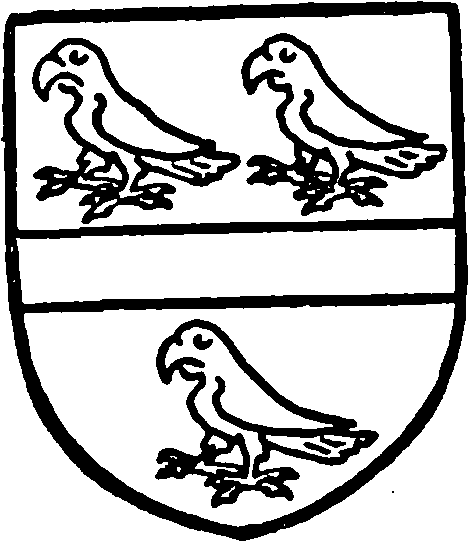
Lumley. Argent a fesse gules between three parrots.
The town records begin in the 16th century, at first in a few disconnected entries, but regularly from 1566. On 19 October 1599 Robert Porrett, the mayor and the common council, drew up a series of orders for the town. Earlier books of records are referred to from time to time, but they are now lost. (fn. 166)
The list of statutes drawn up by the common council in 1599 was divided into sections headed Orders for the Church, Orders for the Town, Orders for the Shipping, Orders for Innholders, Orders for Hiring and Retaining Servants, Orders for Butchers, Orders for the Sands and Fishermen, Orders for the Pasture. (fn. 167) The most interesting of these orders show that the ancient custom of parting a purchase among the burgesses was still in force in 1599, as it had been in 1230:—
Ytt ys ordeyned, yt whatsoever inhabytante of this towne goeth aborde of any shippe or hoye w'thin this wycke or harborough, and buyeth anie maner of corne, victualls, beare, or anie other goods, or comodyties whatsoever, bee it but portage of anie value, w'thout the lycens of the maior, and before there bee a pryce thereof sett down by the sayd maior of the sayde corne, goodes, or other merchandyse or victuals, that then hee or they soe offendinge shall not onely paye for everye tyme soe offendinge to the use of this town ten shillings, but alsoe the sayd goods or comodities soe by hyme or theme boughte to be taken from the partyes soe buyinge and the same to be sequestred att the discressyon of the maior, twelve chiefe burgesses, comon counsell of this town, or the greater parte of theme. (fn. 168)
Ytt ys ordeyned, for the avoydinge of all contraversyes which hereafter may growe betwixte the freemen of this town and the forryners for the buying of fyshe and askinge part thereof, that evrye freeman of this town buyinge a cobble of fyshe shall enjoy the same, without partinge with anie forryner. But if the forryner be the fyrst buyer of anie suche cobble of fyshe, and a freman being presente att the buyinge therof and askinge parte of the same, the sayd freman or fremen soe askinge parte, shall enjoy [it]; if the freman bee not the fyrst yt askethe parte of such fysche, butt the seconde or the thirde, then ytt ys ordeyned yt the freman shall have butt parte with the others that before hyme asked parte thereof.
Ytt ys ordeyned yt the maister or some other of evrye cobble of this town shall make twoo pennye worth of fyshe to any of their neighbors askinge the same for there own p'vysyon, yf they have nott made foure pennye worthe foorth before, upon payne to paye for evrye tyme nott soe doeing . . . vid. (fn. 169)
No mention was made in the charter of 1593 of the court leet, which was apparently the court of the lord of the manor. Twelve years after the charter, however, a recorder appears in the town records, (fn. 170) and it appears that he and his successors held courts leet and baron for the borough, the former dealing with debts under 40s. (fn. 171) These courts were said in the 19th century to be held by prescription, and the recorder was called the steward of the manor court. (fn. 172)
Two 'gilds' were held yearly, one in April, when the grand jury or jury of presentment, called the gild jury, was chosen, the other in October for the election of the mayor. The duty of the gild jury was to present offences against the town by-laws before the courts leet and baron. In 1624 the oath of the gild juryman was entered in the corporation books. (fn. 173) The gild jury received an allowance from the corporation, and also had a gild dinner once a year, which was distinct from the corporation dinner. The corporation received 'gild essoign pence,' which were fines from jurors who were absent from the gilds. (fn. 174) In 1716 the gild jury, on behalf of the inhabitants, petitioned the council that the cess regularly levied by the mayor for a yearly feast should be devoted to the repair of the church and walls. (fn. 175)
Orders for the regulation of trade were made sometimes by the common council, sometimes by the general gild. In 1626 the mayor and twelve burgesses ordered that no one should give work to any foreigner or stranger in any shop or chamber under penalty of 3s. 4d. (fn. 176) On 15 April 1673 it was ordered at a general gild:
That whosoever he be, of any merchant trade, or house-carpenter, joyner, ship-carpenter, draper, taylors, plumers, glaisers, cordiners, butchers, glovers and skinners, whitesmiths, blacksmiths, wallers, wine coopers, tallow chandlers, et alias, that shall presume to come in, and within the liberty of this corporation, to trade or occupye any such trade, without the liberty or consent off any such who are injoyned to the prejudice of the free trades, and companyes within the corporation, as now is ordered for the good off the free burgesses and inhabitants theiroff, and for the better preservation off all the companijes and incouragement of them, to them and their successors for ever hereafter, we doe hereby order and have fully agreed upon, that whatsoever he be that shall com within the corporation aforesaid, shall pay to the use off the major and burgesses of this towne for every such time soe offending as he or they shall trade, complent being made by one or two more of the companys aforesaid to the major and burgesses, for every such offence . . . . . xs.
The companys of tradesmen shall from time to time and at all times hereafter within their hall or com'on hall and meetings, order and with the consent of their warden and major partt of them at theire quarterly meetings, make such lawes and orders, for the better incouragement of their trades and callings hereafter, for the better suppressing of all those yt shall hereafter make any brash within the corporation to the damage of all or any of the said companyes aforesaid, shall upon every such offence pay to the warden of the said company, over and above the fine above mentioned, for every time soe offending the sum of . . . . . xs. (fn. 177)
On 3 October 1681 the mayor and burgesses ordered that Nicholas Corner and George Patteson, tailors and freemen of the town, should at all times be ready to work at any of the chief burgesses' houses, under penalty of 3s. 4d. (fn. 178) In 1722 Robert Wheat was fined first 10s., and then £1 for working as a weaver in Hartlepool, though no freeman. (fn. 179) From the order of 1673 it appears that the tradesmen were still in the habit of holding gild meetings for the regulation of the separate trades. There do not seem to have been any chartered trade companies in Hartlepool, as there were in Durham and Gateshead. As the population of the town was small, and the principal trade was fishing, there were probably not more than half a dozen masters in any one trade, and the expense of forming so small a company was not worth while. Probably all the masters of all the trades met in their common hall, and kept records of their meetings apart from the corporation records. (fn. 180) By the beginning of the 19th century no trace was left of the trade companies or the gild meetings. (fn. 181)
A list of the town officers appointed by the mayor was drawn up in 1656 as follows:—
One town clerk, one serjeant, two chamberlains, three auditors, four constables, four bread weighers, four pier masters, two ale tasters, two grassmen, one herd, two sand cleaners, two viewers of weights, one measurer of cloth. (fn. 182) From this it seems that the two serjeants at mace granted by the charter had been reduced to one. The mayor's stipend was at first 44s., but in 1606 it was entered as £10; this rise, however, was not formally confirmed by the common council until 1631. (fn. 183) The first town clerk occurs in 1604.
On 3 December 1675 the mayor and corporation resolved that by Queen Elizabeth's charter they had the same power as the corporation of Newcastle-upon-Tyne to levy a toll on grain brought into the town, and that they would levy the toll accordingly. (fn. 184) The town revenues, independent of the cesses levied by the common council, arose from tolls on corn, ale, fish, timber, and agricultural produce, harbour dues, stallage at the markets and fairs, and hawkers' licences. (fn. 185) As the trade of the town declined the amount realized from these dues diminished until, at the beginning of the 19th century, it was only about £22 a year. This, however, would have been sufficient for the very small expenses of the town government if it had not been for the law-suit over the town boundaries, which was brought by the corporation against the lord of the manor in 1802. (fn. 186) The cost of the suit saddled the corporation with an annuity of £24 a year. After this there was an annual deficit of some £12 or £13, which had to be met out of the mayor's pocket, while he was also expected to provide salaries for the constables. (fn. 187) The result of this was that it became more and more difficult to find men willing to carry on the corporation.
In 1835 the Municipal Corporation Commissioners visited the town and found the corporation greatly decayed. There were only twenty-six resident freemen and about twelve who were non-resident. The freemen had exemption from the tolls, which were reported to be burdensome, and rights of pasture on the Town Moor. (fn. 188) Freedom was attained by birth, apprenticeship, complimentary presentation, or sometimes by purchase. As there had not been more than four instances in the preceding twenty years of a person taking up his freedom by purchase, it is evident that the privilege was no longer regarded highly. The largest number of capital burgesses at the mayor-choosing in recent years had been six, while there were usually only three or four. The mayor was chosen from the capital burgesses in rotation; he was frequently non-resident, and sometimes never attended to take the oath, but in that case he appointed a deputy mayor. The number of capital burgesses was then nine, and only three were resident. The town officers were the recorder, town clerk, and serjeant at mace, chosen by the common council. There were two constables, who were insufficient to keep order while the new docks were being built, and the town was neither watched nor lighted. The report ends in a note that after the inquiry at Hartlepool the commissioners received a letter stating that a quo warranto had been issued against the mayor for exercising that office, and that he, being aware his election was invalid, had disclaimed. (fn. 189) In consequence of this report, Hartlepool was not included in the Municipal Corporations Act of 1835.
After the mayor's disclaimer the corporation fell into abeyance. In the words of a contemporary, 'Now commenced a period of disorganisation and misrule unequalled in any town in the kingdom of similar pretensions—no resident magistrate, no control, no police, the township constables incompetent and inefficient and literally objects of ridicule. The whole town lay at the mercy of the lawless labourers employed in excavating the docks.' In spite of all these inconveniences the inhabitants were slow to move, and it was not until 16 January 1839, after an interregnum of nearly five years, that a public meeting of the inhabitants and freemen was held, and a committee appointed to take measures to restore corporate government. (fn. 190)
The committee consulted Sir William Follett, who advised that the corporation should be revived by a new charter, to be obtained from the Crown by petition of the freemen, and, if necessary, of the other inhabitants. He considered this course would be preferable to an application for the creation of an entirely new corporation under section 141 of the Municipal Corporations Act, (fn. 191) as it was doubtful in the latter case whether the new corporation would be entitled to the possession of the corporate property of the old, while, by obtaining a new charter to revive the old corporation, its continuity would be assured. (fn. 192) There seems to have been a good deal of trickery in connexion with the new charter, but it is difficult to follow the intrigue, as the author of the Supplement to Sharp's History, writing so near the time, was naturally cautious. It appears that the committee drew up a draft of a charter, applying the principles of the Municipal Corporations Act to the new corporation of Hartlepool. On 22 June 1841 this draft was approved by the Attorney and Solicitor-General, who directed that it should be laid before a public meeting of the inhabitants of Hartlepool in order that they might be able to object to any of its provisions. On 13 August 1841 the Lord Chancellor declared that he was satisfied that the charter had been laid before the people of Hartlepool, and that they had accepted it without protest; but it is significant that the date and place of the alleged meeting are not mentioned in the Supplement, and the author goes on to state that much disappointment was felt, when the new charter, dated 24 September 1841, appeared, that it was a simple renewal of the old charter of Elizabeth.
From this it appears that the committee either engineered the public meeting so that only their own friends were present, or else submitted to a genuine public meeting the draft charter which was in accordance with the Municipal Act, and afterwards substituted for it the provisions of the Elizabethan charter. The government of the town was now in the hands of the twelve men who had found means to have their names inserted in the charter as aldermen. The opponents of the charter said that its only redeeming feature was the fact that the mayor for the time being was also to be a justice of the peace in virtue of his office; thus order was restored in the borough. (fn. 193)
The new aldermen may have acted for their own advantage, but they found themselves involved in a great deal of labour and trouble. They came into office 'hampered with a debt of £1,200, without a shilling of revenue, with the corporate property in a state of unequivocal confusion: and in numerous instances the occupants thereof hurled defiance at the corporation, disputing their rights and despising their authority.' (fn. 194) The feeling in the town in favour of reform was so strong that the aldermen soon abandoned their former policy and declared themselves enthusiastic municipal reformers. In the year 1850 a petition for a new charter was presented, and on 5 December 1850 the present governing charter was granted, embodying the principles of the Municipal Corporations Act. The town council consisted of a mayor, four aldermen, and twelve councillors. (fn. 195) Under the Hartlepool Borough Extension Act of 1883 there are six aldermen and eighteen councillors. In the same year the Local Board Districts of Throston and Middleton were added to the borough and in 1897 parts of Throston Rural and Hart. (fn. 196)
A bill was introduced into the House of Commons in 1614 and again in 1620 to give Parliamentary representation to the county of Durham. It was proposed that, in addition to members for the county and city of Durham, either the borough of Hartlepool or the borough of Barnard Castle should be represented. The arguments in favour of Hartlepool were that it was the only haven in the bishopric, for Sunderland was as yet but a hamlet, and that it was a place of ancient strength. In the end, however, it was omitted from the bill, on the grounds that it belonged to a private person, not to the king, that it was so poor a town there was no person in it of sufficient wealth to sit in Parliament, and that it was much given to popery. (fn. 197) In 1867 Hartlepool was constituted a parliamentary borough returning one member. (fn. 198)
The common lands of Hartlepool consisted of the Town Moor, the Farwell Field, and certain ways to these two places, which were called chares or stripes. The Town Moor lies on high ground to the north-east of the old town, between the town and the sea, its eastern boundary being the cliffs of the coast. The Farwell Field, as already stated, lay on the isthmus to the north of the town, beyond the town wall, but within the borough boundary. The chares were the ways from the town to the fields used by the burgesses. The early history of the town fields is unknown, as the common pasture is first mentioned in the Orders of 1599, when it was ordained that the mayor and common council must view every horse or mare before it was allowed to graze there, and must be satisfied that the animal was worth at least 4 marks. It was also ordained that no horse should be allowed to graze there between St. Martin's Day (11 November) and St. Helen's Day (21 May). (fn. 199)
Presentments relating to the town fields were made at the borough court, where two grassmen were appointed to manage the business of the pasture. (fn. 200) In 1720 an order for viewing cattle stinted (i.e. allowed to graze) upon the moor, similar to that for horses, was made by the common council. Every common burgess and burgess' widow had a right to stint one horse and one cow on the common pasture. (fn. 201)
In 1834 the Municipal Commissioners found that 'each freeman being a resident householder has a right of pasturage on the town moor for one cow throughout the whole year and for one horse from May Day to Martinmas.' The cattle depastured must be their own property. The privilege is estimated as being worth about £10 a year. (fn. 202) While the corporation was in abeyance from 1834 to 1841 many encroachments were made upon the common fields. The aldermen nominated in the charter of 1841 were declared to have the privileges of freemen, a discovery which caused much indignation among the older freemen, but it had the good result that the new corporation was directly interested in the settlement of the problem of the town fields and therefore accomplished it. (fn. 203)
By an action brought in 1841 against one of the encroachers on common land they established their right, and on 21 May 1846 a committee was appointed by the corporation to deal with the question of the freemen's lands. (fn. 204) On 28 July 1847 the committee presented a report, which, after stating the privileges of the freemen, continued:—
This privilege of pasture has been much curtailed—the pasturage of large tracts of lands called chares (being narrow strips of land leading to the Moor and Farwell Field) and formerly containing the richest and most luxuriant herbage, has been destroyed by persons owning the adjacent property throwing down the fence walls, and opening out and fronting their houses thereon; thus improving their own property at the expence of the corporation, the freemen, and indirectly of the inhabitants at large. The parties thus offending are a very numerous body, and excuse their encroachments by saying that they were made during the abeyance of the corporation between the years 1833 and 1841.
The committee recommended:—
That the Town Moor and the Farwell Field with all their appurtenances should, for ever hereafter, be put under the control of the municipal body, by whatever name it is to be designated for the use of the town; and held in common with all other corporate property, to be appropriated in the best manner for realising a revenue for the town, with a due regard to the health, comfort and convenience of the inhabitants. That every freeman and widow of a freeman whilst resident in the borough of Hartlepool shall receive from the revenues of the corporation an annuity of £12 10s. secured by forgoing every claim and privilege. . . . That all persons having inchoate rights of freedom, as apprentices and the eldest sons of freemen, shall be entitled to the same annuity as freemen . . . . on their attaining the age of 21, all annuities to last only during residence and to cease with the death of freemen and their widows. (fn. 205)
The committee also recommended that an application should be made for an Act of Parliament to put these resolutions into force, but owing to mutual jealousy the governing body had much difficulty in acting with the freemen, who were apt to raise their demands for compensation. In consequence of these difficulties the Act was not obtained until 1851. It provided that the freemen should appoint a Pastures Committee to manage the common lands while still in the hands of the freemen, and to negotiate with the corporation for the extinction of the freemen's privileges. When the freemen had received full compensation and the land had passed into the hands of the corporation, the latter were authorized to build on the Farwell Field and to turn the chares into streets. The Town Moor was to be kept as a public recreation ground, and not more than 3 acres of it might be used for building sites. (fn. 206) Accordingly it is the public recreation ground at the present day.
The town possesses the matrices of three ancient seals—the obverse and reverse of the common seal and the mayor's seal. The first bears a hart at bay in a pool with a hound on its back, a rebus upon the name of Hartlepool; the inscription is 'S. Communitatis de Herterpol.' The second bears in the centre St. Hilda with a priest on each side of her standing at an altar; on each altar is a chalice, and over each descends a pelican holding a nimbed host in its beak; over these a sun and a moon; the whole under a canopy like a church with central tower and low spire. The inscription is 'Subveniat Famul. nobil. Hilda suis.' These designs are probably of the early 13th century. The third seal is rather later. It bears St. Hilda with a bishop on each side of her, all standing on a lodged hart and under a canopy of three gables. The inscription is 'Sigillium Officii Maioris de Hertilpol.' All three are of brass. (fn. 207)
The corporation also owns two maces and a loving cup, presented by Henry Earl of Darlington, mayor in 1818, and a chain presented by Alderman Grooves in 1879.
Markets were held in the 15th century on both Tuesday and Friday. (fn. 208) The charter of Elizabeth fixed Tuesday as the market day. (fn. 209) It was changed before 1720 to Monday and again between 1808 and 1816 to Saturday. (fn. 210) A corn market on Saturdays was established in 1851. In 1866 a market was provided by the corporation, but in 1883 it was discontinued under the Hartlepool Borough Extension Act as it had been carried on at a loss. The single yearly fair, lasting for a fortnight, established in 1593 (fn. 211) became in course of time four fairs of one day each on 14 May, 21 August, 9 October and 27 November. These fairs were much frequented by clothiers in the 18th century, but were little attended at the beginning of the next century. (fn. 212)
In a fishing town and trading centre like Hartlepool shipbuilding must have been one of the industries from early times. In 1299 the master of the 'Navis Dei' of Hartlepool was employed by the king to carry victuals in his ships to the garrisons of Stirling and Edinburgh. (fn. 213) Merchant ships were often requisitioned from Hartlepool for the Scotch and French wars of the 13th and 14th centuries. (fn. 214) The town's contribution to the northern section of the grand fleet which Edward III brought before Calais in 1346 was five ships and 145 sailors. (fn. 215) About the middle of the 14th century the family of Nesbit seem to have been the principal shipowners in the town. (fn. 216) A ship called 'La Marie' of Hartlepool belonged in 1395 to Robert Houdene, who was authorized to embark 50 pilgrims in it for Santiago. (fn. 217) In 1565 there was one ship, the 'Peter,' belonging to the town; in 1672 there were two small vessels. (fn. 218) A shipbuilding yard was opened at Hartlepool in 1836 by Mr. Denton, who was afterwards joined in partnership by William Gray. In 1864 the firm of Denton, Gray & Co. launched their first iron ship. The firm moved to West Hartlepool in 1871. (fn. 219) At the present day the principal firms are the Hartlepool engine-works of the amalgamated company of Richardsons, Westgarth & Co., Sir William Allan & Sons and Sir Christopher Furness, Westgarth & Co., marine engine builders, and the Irvines Shipbuilding and Dry Dock Co., shipbuilders.
The fisheries of Hartlepool are its oldest industry. In 1360 it was said that the livelihood of the men of Hartlepool 'depends entirely on their fishing on the sea.' (fn. 220) The mayor and aldermen of Newcastle-upon-Tyne in 1560 declared that 'Hartlepool hath been time out of mind a fisher town, and so long as the inhabitants of the same framed and applied themselves to their occupation of fishing, their town prospered.' (fn. 221) The commissioners of 1565 reported that there were three 5-men boats and seventeen small cobbles belonging to Hartlepool, all occupied in fishing, which employed fifty-one persons, all fishermen and not mariners. (fn. 222) A suit in 1560–1 gives some trade terms then in use. The case concerned the delivery at Hartlepool to two London fishmongers of 1,000 codfish, 'good swete and mercandizable, of 27 inches by besome and upward, skynne and blewberde owtcaste, and no sayntes ffyshe taken owt.' (fn. 223) Sharp gives an interesting account of the fisheries at the beginning of the 19th century. (fn. 224)
In 1650 Lord Lumley, as impropriator of the rectory of Hart, which included tithes of fish at Hartlepool, brought an action against the fishers of Hartlepool 'touching a duty of a 20th part or rent of all fish brought to the port,' and obtained a decree to receive it until the fishermen should try the right at law. (fn. 225) In 1718 the lord of the manor brought another suit against the owners of fishing vessels, when it was proved that there had long been a customary payment, but its amount was uncertain. The court fixed the sum at 12d. in the £ on all fish caught by fishermen of the parish, all reasonable charges being first deducted. (fn. 226) By the beginning of the 19th century this had been commuted for a fixed annual payment of 8s. per cobble. (fn. 227)
The foreign trade of Hartlepool fluctuated as the political importance of the place varied. In 1275 the king ordered the bailiffs of Hartlepool to arrest the goods of any Zealand merchants in the town for robberies committed upon London merchants in Zealand. (fn. 228) In 1305 similar orders were sent concerning merchants of Amiens, St. Omer, and other French towns, (fn. 229) but these were merely general orders, and did not necessarily mean that there were such merchants in the town. In 1279 the goods of Bremen merchants in England were to be arrested in satisfaction for the losses of four Hartlepool merchants while trading in Bremen. (fn. 230) In 1339 there was a complaint relating to the 'Cuthbert' of Hartlepool, a ship belonging to John de Nesbyt, a Hartlepool merchant, which was seized off the coast of Denmark and detained by the men of 'Hardenwyk, Swoll, Staver Camp, Lubye, Strelsond and Rostok,' while trading in 'Estland.' The merchant petitioned Edward III, who wrote to the Emperor to demand that justice should be done. (fn. 231) Edward the First's war with Scotland probably gave an impetus to the trade of Hartlepool, as the town was used as a depot from which stores were transported to the troops. (fn. 232)
The articles of trade at Hartlepool were corn, (fn. 233) the neighbourhood being very fertile, herrings and other fish, (fn. 234) wine, wools (fn. 235) and hides. Bishop Bury's charter of murage in 1339 enumerated the articles coming to the town on which toll might be levied, including corn, hides of horses and cattle, meat, fat hogs, salmon, lampreys, fleeces, sheep skins, skins of small animals, cloth, linen web, canvas, Irish cloth, 'galeward,' worsted, turf, silk, cypress, wine, ashes, honey, wool, hay, reeds, fodder, nets, tallow, woad, alum, copperas, argol, verdigris, onions, garlic, herrings, boards, hand-mills, faggots, salt, cheese, butter, wood, lime, coal, figs, raisins, oil, nails, iron, tin, brass, copper, dried fish, candles, pitch, tar. (fn. 236) To these the charter of 1384 added leather, wax, pepper, almonds, cummin seed, teazles, spices, fine linen, fruit and live animals. (fn. 237)
The first recorded appointment of a collector of customs at Hartlepool is on 14 June 1305, when the king appointed Andrew de Bruntoft, afterwards mayor, and Peter du Mareys to collect the new customs (payable by foreign merchants under the Carta Mercatoria of 1303) at the port of Hartlepool, and to keep one part of the coket seal (fn. 238); in 1307 Andrew de Brumpton was appointed to collect the custom on wine. (fn. 239) In the same year, 1307, Bishop Anthony Bek was ordered to restore to the king the custom on wool, hides, and woolfells, which he had been collecting for his own use as part of his royal rights in the bishopric. (fn. 240) In 1334 the energetic Bishop Richard de Bury made a vigorous effort to assert his prerogative in collecting the customs on wine. He was so far successful that he obtained an acknowledgment of his right from the king, and appointed John de Nesbyt chief butler for the town of Hartlepool in 1334, but although the office was maintained until the beginning of the 15th century the bishop very soon ceased to obtain any profit by it, (fn. 241) as the king began again to appoint his own collectors of customs both on wine and wool almost immediately after his recognition of the bishop's right. (fn. 242)
Meanwhile the relations between Newcastle-upon-Tyne and Hartlepool with regard to the customs were becoming involved. The earlier appointments to the office of collector of customs cover only Hartlepool, (fn. 243) and down to 1347 the butler or his deputy who collected the customs on wine acted generally for Newcastle, Hartlepool and Yarm. (fn. 244) After 1341 no separate collectors of customs seem to have been appointed for Hartlepool. (fn. 245) Probably from this date the Newcastle collectors included Hartlepool in their jurisdiction. (fn. 246) There were a troner and a weighing beam at Hartlepool in the 14th century, (fn. 247) and a place called 'le Weyhouse,' which once stood on the east side of Northgate Street, is mentioned in 1545. (fn. 248)
The wool trade of Hartlepool was temporarily
destroyed by the statute of the staple of 1353, which
made Newcastle the staple town, from whence alone
might be shipped the wools of Northumberland,
Durham, Cumberland, Westmorland, Richmond and
Allerton. (fn. 249) The mayor and burgesses of Newcastle
watched Hartlepool with a jealous eye, and in 1560,
on the first symptom of its recovery from this
blow, they sent a petition to the government declaring that Hartlepool was a member of the port of
Newcastle, and that hitherto the trade of Hartlepool
had been confined to the fisheries, but
within the space of seven years or thereabouts there be certain
persons come from London for such debts as they be there
owing, to inhabit at Hartlepool because it is a town of privilege—who not only practice with strangers repairing to Hartlepool
to employ the money of the same strangers in wool . . . but
also they . . . do ship wools, fells, lead and other merchandise,
sometimes paying custom, and many times depart without any
custom paying, for that there is neither searcher, customer,
controller, or weigh-master there, saving only one of themselves
as deputy to the customers of the port of Newcastle, by whose
oversight they may use what liberty they list; so that without
speedy reformation our young men of Newcastle . . . perceiving the liberty there, the small charges, and the transporting of
the wool shipped there to Amsterdam, to Haarlem and other
towns in Holland, where we are compelled by our ancient grants
to ship the wools of Newcastle only to Barro in Brabant, that the
same our young men will leave the town and inhabit Hartlepool.
Moreover, the merchants of Hartlepool were shipping
wool from parts of Yorkshire, such as Pickering Lythe,
which were not appropriated to Newcastle, and as
this wool was much better and finer than that which
was shipped at Newcastle, the Newcastle wools were
falling in price and estimation. (fn. 250) The Newcastle
merchants were crying out long before they were
hurt, according to the report of the harbour commissioners in 1565, who represented Hartlepool as
being a very small place, with only one ship belonging to the port; 'the town has been a good haven
and is strongly walled, and many ships of 200 tons
burden may lie within the town and pier; but the
latter is in decay and many houses also, whereof
the greater number are the Queen's and belonged
to abbeys, friaries, chantries and gilds.' (fn. 251)
In spite of the opposition from Newcastle the shipping of lead from Hartlepool continued, as appears from the will of John Featherstone of Hartlepool, 6 March 1567; he exported lead from Stanhope, the seat of his family, and the inventory of his goods shows the value and quantities of what he sold. (fn. 252)
Although it does not appear upon what Newcastle's claim that Hartlepool was a member of the port of Newcastle was based, it was generally acknowledged in the 17th century. There is a silver seal of that period belonging to the custom-house which bears the inscription, 'S. Hartlepoole Mem. de P. N. Castri s Tyne.' (fn. 253) Several cases relating to the prisage of wines took place in the 17th century. (fn. 254) In 1664 a report on the town mentions the poverty of the corporation, due to the coal trade of Newcastle, as Hartlepool had no manufactures of its own. It was stated that there were 'Norway merchants' settled in the town for purposes of trade and they, with the fishermen and tradesmen, formed its chief inhabitants. (fn. 255) In 1680 the port had declined so much that the principal custom establishment was removed to Stockton, leaving only inferior officials at Hartlepool. (fn. 256)
In consequence of the great increase of trade after the building of the railway and docks, Hartlepool was constituted a separate port, extending for three miles from the south side of Seaton to the promontory on the north of Castle Eden, with a customs house of its own on 6 January 1845. (fn. 257)
The principal export at the present day is coal.
The right of wreck at Hartlepool belonged to the Bishop of Durham. His claim was disputed between 1232 and 1240 by Peter de Brus, who seized a ship which had been wrecked on the coast of Hartness; for this he was fined 50s. at the bishop's court of Sadberge. Indignant at this judgement, Peter sent his servants to Hartlepool to carry off Gerard de Seton, a burgess, who had given evidence in favour of the bishop's right. Gerard was imprisoned in Skelton Castle, until the bishop solemnly excommunicated all those who had taken and held him prisoner. This forced the captors to let their prisoner go, and Peter de Brus was fined £20. In the end the Earls of Albemarle and Lincoln negotiated a compromise between the bishop and Peter de Brus. The bishop forgave Peter the fines, and Peter acknowledged the bishop's right of wreck. (fn. 258) When the power of the bishops waned, however, the lord of the manor claimed the right of wreck unopposed. On 1 December 1631 Lord Lumley leased certain dues to the mayor and burgesses of Hartlepool, but reserved 'wrecks of all kinds,' (fn. 259) and in 1802 arbitrators determined that 'all wrecks of the sea cast on shore in any part of the manor of Hart, including the township of Hartlepool, belong to G. Pocock (the lord of the manor), and all wrecks of the sea floating within the liberties of the port of Hartlepool, belong to the mayor.' (fn. 260)
CHURCHES
The church of ST. HILDA stands in a fine position near the head of the crescent-shaped limestone promontory on which the town of Hartlepool was originally built. Nothing now remains above ground of the buildings of Hilda's monastery, but there can be little doubt that they stood in close proximity to the ancient cemetery before alluded to and thus at some little distance from the existing church.
The church (fn. 261) consists of a clearstoried chancel (37 ft. by 22 ft.) and nave (83 ft. 6 in. by 21 ft. 6 in.) with north and south aisles overlapping the chancel (about 8 ft. 6 in. wide), south porch, and engaged west tower (18 ft. by 20 ft.), with transeptal chambers (20 ft. 6 in. by 10 ft. on the north and 19 ft. 6 in. by 8 ft. 6 in. on the south). With the exception of an earlier south doorway, the church was erected about 1189 to 1215, and completed probably in 1237. (fn. 262) The earlier building, to which the south doorway belonged, was probably the first church on the present site, and may have been erected during the lifetime of Robert Brus I, the founder of Guisborough Priory, who died in 1141. However that may be, it is evident that when Robert Brus II gave the church of Hart and the chapel of Hartlepool to Guisborough Priory some sort of building was then standing. Its complete rebuilding at the end of about half a century may perhaps be attributed to the desire of the Brus family for a place of sepulture worthy of their importance. A ruined tomb standing in the churchyard to the east of the quire, but within the lines of the destroyed chancel, (fn. 263) is probably that of Robert III, or his brother William, who died about 1215. (fn. 264) The idea of the new building may have originated with Robert II, and its erection was perhaps begun by his son Robert III; but the latter's short tenure of the property makes anything more than a beginning out of the question, and the evidence of the fabric would seem to show that it is substantially the work of William de Brus, lord of Hartlepool about 1194–1215. Beginning with the east end and proceeding westwards the nave arcade was probably begun by 1200, the aisles (including the south doorway) having been first set out and perhaps built up to a certain height. There then seems to have been an interval of some years before the arcade was proceeded with, the clearstory and tower not being built till about 1230–40. The interdict of 1215 may account for this suspension, and thus for the discrepancies of detail in what is otherwise a complete and uniform design. In the interior, while there is a general harmony between the details of the nave arcade and the ground stage of the tower, the soffit mouldings and shafts of the eastern arch of the tower are more delicate in design than those of the nave piers, and while the nave piers have large disk-shaped abaci, the abaci of the tower piers are divided in keeping with the shafts and capitals. As completed before the middle of the 13th century the church consisted of a clearstoried chancel and nave of equal width and height and nearly equal in length, both with north and south aisles, and western tower. This is so abnormal a plan for the date, that it is probable that it was at first set out with a tower between nave and chancel, which was shortly abandoned and its area thrown into the chancel. Nearly the whole of the eastern half of the building has, however, now perished, one bay of the original chancel, which was 70 ft. 6 in. long, alone remaining, so that the evidence of its suggested development is not complete.
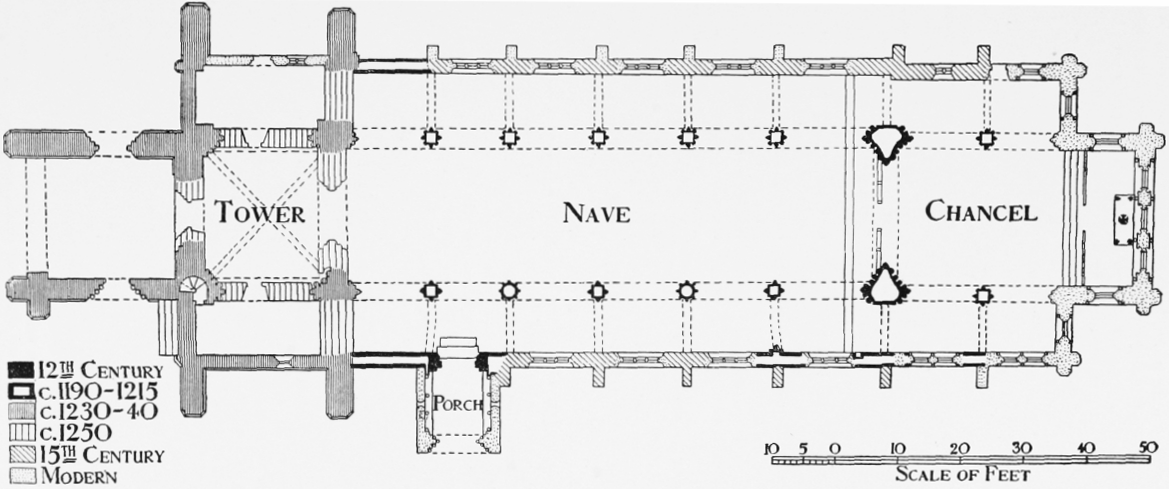
Plan of Hartlepool Church
The west tower, with its built-up arches, offers many points of difficulty. There seems to be little doubt that the heavy buttresses were planned from the beginning to take the thrust of the tower vault, those on the west side being further designed to form the north and south walls of a western porch. The original design was doubtless like that still existing at Kelso, where the west tower of the abbey church is flanked by short north and south transepts and a western building of equal size and height with the transepts. There is no indication in the style of the buttresses that they are later than other parts of the tower, and their base-mouldings show that their lower portion, at any rate, is part of one design carrying out that of the aisles. The west buttresses with their doorways bear general signs of belonging to the second quarter of the 13th century and may be ascribed to the date given above for the tower. The 'porch,' or western building, was intended to be of two stories, the lower one vaulted, as is shown by the corbels or capitals remaining in the angles, and by the smaller angle buttresses built on to the greater ones, and its importance is indicated by its independent entrances, the southern of which is of a somewhat elaborate character. (fn. 265)
There is no doubt that the tower began to fail either in the course of its erection or shortly after. The failure was probably due not so much to the vault as to the vertical pressure of the upper walls upon the masonry of the ground stage, which stood on a foundation which has only recently been discovered to have been utterly inadequate. When the ground was opened up during some late repairs (previous to 1894) it was found that the foundations of the piers went down only 4 ft., or about 3 ft. short of the solid rock, and in some cases there were 'no foundations at all,' the north-east angle having been built on the surface of what appears to have been puddled clay with a few large boulders thrown in amongst it. (fn. 266) The foundations of the buttresses, however, went down to the rock but were composed of loose rubble, and under the south-east buttress was a split, or fissure in the rock about 1½ in. wide 'with a current of air blowing out.' (fn. 267) A streak or pocket of clay also crossed the centre of the site of the tower from north to south. The settlement, or disruption of the tower resulting from these causes was remedied, or attempted to be remedied, mainly by building up the tower arches and a number of the window openings in the upper stages. As the fillings in of some of these windows contain small lancet lights the work must have been done very shortly after the tower was completed, if not actually before the upper stages were finished. Seeing that these 'remedies' added considerably to the weight to be borne by the foundations, it is not surprising that the tower has ever since been in a more or less insecure state and is still supported internally by timber shoring. The south-west pier, containing the newel staircase, was strengthened by a mass of masonry built against it on the outside. Whether the tower was ever crowned by a spire it is now impossible to say, but it seems clearly to have been so intended; the settlement occurring at so early a period, however, probably caused the spire to be abandoned, the tower being completed with parapet and pinnacles.
No change in the plan took place during the middle ages, and practically the only alterations made seem to have been in the 15th century, when the north aisle wall and a good deal of the south were pulled down and new windows inserted. Most of these have since been replaced by modern copies.
At the beginning of the 18th century the church was in a state of disrepair; but a petition to Quarter Sessions in 1714 recommending the queen to grant Letters Patent for its repair produced no result, (fn. 268) and two years later the building is described as 'ruinous.' In 1719 the quire was stated to be 'almost entirely unroofed, and the steeple, pillars and walls . . . so much decayed by length of time that the whole fabrick will inevitably fall to the ground unless speedily prevented by taking down and rebuilding some and repairing the decayed parts thereof.' A sum of about £1,700 was collected by brief, and the work of repair put in hand in 1721; but a scheme for rebuilding agreed to in September of that year (fn. 269) was evidently not carried out, for in May 1724 Bishop Talbot gave leave to take down the roof and to cover the church with a flat one, and for the chancel to be reduced to 15 ft. within the walls. This was done, the old chancel being practically swept away, leaving but a single bay at its west end. A straight end wall was erected immediately to the east of the remaining piers, and the arches themselves, together with those between the nave and chancel aisles, were built up. There is nothing to show that the decay and ruin of the chancel was so complete as to necessitate its demolition, and it seems, therefore, probable that its destruction was due to poverty and indifference. No drawings of it in its perfect condition are known to exist, but the remaining bay indicates that it was contemporary with the nave and almost exactly similar in all its details. Foundations of eastern parts which have from time to time been dug up show the length to have been as stated in the bishop's licence to take down. In spite of the decision that the windows should be wrought 'after the same model as they now are' this does not appear to have been done, the drawing in Surtees (fn. 270) showing the aisle windows of three plain square-headed lights under semicircular hood moulds, and there was at that time 'a clumsy south porch,' (fn. 271) probably an 18th-century addition. Surtees describes the interior as 'neatly pewed with oak' with a gallery at the west end. In 1838 the tower buttresses, one of which had fallen, were restored and the interior of the building renovated. A further internal restoration took place in 1851–2, in which latter year the present south porch was built. (fn. 272) In 1866–7 the nave was restored again, the floor being lowered so as to show the bases of the piers, a new roof was erected, and the whole of the interior reseated. In 1869 the chancel was rebuilt in its present form. (fn. 273) The tower was restored in 1893. Subscriptions are now (1927) being raised to restore the church to its ancient grandeur. Plans have been prepared by Mr. W. D. Caröe, M.A., F.S.A., for carrying out the work at a cost of £33,000, towards which £26,500 has been raised, including £12,000 from Sir William Gray, bart. The proposed work includes the extension of the chancel to its original length, opening out of the tower, rebuilding the south porch, restoration of the Galilee Chapel, repairs to the nave and new heating apparatus.
The church throughout is built of stone and the roofs are covered with modern green slates. The new chancel consists of three bays with aisles. Externally the chancel stands 12 ft. in front of the east walls of the aisles with windows north and south, and all the modern work follows the design of the older parts. The east end is lighted by two triplets of tall lancets, one above the other, with a smaller single light in the gable, as at Darlington; but here it is, of course, a purely modern arrangement, no evidence existing of the original eastern termination of the destroyed quire. Externally the whole of the quire, with the exception of the aisle walls in the western bay, is modern, the outside faces of the western clearstory windows having been rebuilt, but internally the responds, arches and piers of the original western bay remain, forming the only evidence of the original plan of the chancel. It may have consisted of five equal bays with aisles its full length, or of two compound bays and a sacrarium projecting beyond as at Tynemouth Priory. The existing evidence, however, is insufficient to make a definite conclusion possible. The remaining western arches of the arcade exhibit certain peculiarities which have given rise to some conjecture as to the design and arrangement of the destroyed portion. The capitals of the western responds, which are attached to the chancel arch piers, are considerably higher than those of the nave arcade, but the capitals of the piers range with those in the nave, the result being that the arch springs from different levels and is consequently distorted. The probable deduction is that this is the remains of an original scheme for a central tower, abandoned during the course of building.
The piers consist of eight clustered shafts, alternately round and keel-shaped, with moulded capitals and bases, and the arches are of three moulded orders. The west responds are similar in character to the piers, and the modern eastern arches carry out the same design. The clearstory, though similar in character to that of the nave, was of slightly smaller dimensions; the windows, judging from the two remaining in the west bay (which internally are entirely original), were not placed immediately above the centres of the arches, the east jamb, instead of the centre line, coming immediately above the centre of the arch, the window thus lying to the west. (fn. 274) The wall arcading is composed of richly moulded triplets, both internally and externally, those outside having rich floreated capitals to the shafts. Inside, the mouldings and shafts are doubled between the window openings, the outer shafts being carried on projecting corbels, the whole producing, even in its present fragmentary condition, an effect of great beauty. The walls were 34 ft. in height, and the arches of the clearstory arcade were acutely pointed, and the clearstory windows themselves were about 6 ft. 3 in. in height by 2 ft. wide. Internally, 'in order to gain sufficient depth for the outer order of the arcades the usual . . . method of construction was reversed, the thicker part of the walling being placed . . . at the top. That is to say that although the inner mouldings of the clearstory arcades and their shafts are set back, the whole of the outer mouldings together with the shafts that carry them, their hood moulds and superincumbent masonry are set forward and completely overhang the pier arches and wall surfaces below.' (fn. 275) The chancel arch is of three moulded orders springing from groups of five clustered shafts and rising to almost the full height of the clearstories. The shafts have richly carved capitals with transitional volutes and square abaci. The arch, which springs at a height of 20 ft. above the nave floor and has a clear width of 15 ft. 6 in., has a hood mould on each side, and the orders consist of roll and fillet and hollow mouldings set square, equally rich on both sides. On the east side there is an additional shaft carried up to the height of the west respond of the chancel, with a smaller shaft above rising from the capital. Towards the nave the middle shaft has a corbel or lower capital similar in design to the others, about 3 ft. below the main capital, the use of which was probably to carry the ends of a rood-beam. The whole of the eastern end of the old chancel having perished, no ancient ritual arrangements remain. The floor is tiled and raised two steps above that of the nave, and there are three steps to the sanctuary. The oak chancel screen was erected in 1894, in memory of Francis Green Morris (d. 1893). The western bay of the north aisle is occupied by the organ. The 18th-century fillings of the arches between the nave and quire aisles were removed when the new chancel was erected.
The nave internally consists of six bays with north and south aisles, the total width of the church at the west end being 44 ft. (fn. 276) Like the quire, the nave is faced internally with wrought stone, but, though retaining its beauty of detail, has suffered in appearance at the west end by the filling in of the tower arch and the arches on either side. The arcades differ in detail in many respects, and the dimensions of the bays vary, but the general effect is one of complete unity and harmony. The two arcades, though corresponding exactly in their dimensions, are not identical either in planning or decoration, the piers and the arch mouldings differing completely in detail. On the north side the piers are all alike, but on the south they differ from each other and from those opposite, while the arches have hood moulds on the south side only. At the east end of the south aisle was a chapel, the piscina of which remains in the south wall, and perhaps for this reason the east bay is wider than the others. The two western bays are much contracted, but the average width between the piers is about 10 ft. 6 in. (fn. 277) The first, third and fifth piers are square on plan with a keel-shaped shaft on each face. The second pier from the east is circular, with eight small circular shafts ranged around it, and the fourth is of similar type, but octagonal in plan. The shafts in each case have separate capitals and base, the former surmounted by a single large circular moulded abacus, from which the arches spring at a height of 12 ft. 3 in. above the floor. The arches are pointed and of two moulded orders with indented hood moulds similar to those in the quire, apparently indicating that the south arcade was built from east to west immediately after the chancel. A horizontal moulding runs the full length of the nave immediately above the arches, forming the sill of the clearstory windows, and over each pier, springing from a moulded corbel which rests on the abacus, rises a small circular shaft, with moulded capital, the full height of the wall. These shafts carried the ends of the principals of the old roof, which was of the same pitch as the existing modern one, and 'must have been of some trussed or arched form without tie-beams,' which would 'have cut across and disfigured the lofty arch in the tower.' (fn. 278)
The piers of the north arcade consist of eight clustered shafts, of circular and keel-shaped section alternately, all with separate moulded capitals and bases with large inclosing circular abaci. The arches are of two moulded orders. The bases of the piers of the south arcade stand on separate circular chamfered plinths, but on the north side the circumscribing line is octagonal and the bases were connected by a low plinth a few inches above the nave floor, which may represent the original height of the floor of the aisle.
From each of the nave piers an arch of a single moulded order with hood mould on each side is thrown across the aisle. On the south side the arches spring from the capitals of the columns and from corbels opposite, but on the north the inner springing is from independent capitals applied to the shafts of the piers at a lower level, their abaci being lower than the neck moulds of the main capitals. In the south aisle, more particularly, many of the arches are curiously misshapen, as though from settlement or pressure, but the walls show no signs of either. There is no sign of the corbels having been raised, and the roofs always cleared the arches, some of which are quite symmetrical. (fn. 279) In the south aisle the easternmost transverse arch springs on the wall side from a respond similar in section to the pier opposite, thus further emphasizing the special treatment of the eastern bay. On the north side there is no trace of an altar having existed. The old lean-to roofs of the aisles were removed in the 18th century, and the original windows are all gone, the only evidence of their appearance being the single light remaining in the engaged bay south of the tower. They were probably plain lancets in groups of two or three, most of the light in the nave having come originally from the clearstory. The existing aisle windows are of three cinquefoiled lights with tracery in the heads, and have all been renewed on the north side. (fn. 280) Externally the bays are divided by buttresses, and the wall finishes with a straight parapet.
The clearstory is lighted by a single lancet to each bay, with the hood mould continued along the internal face of the wall as a string-course, but externally there is an arcade of three moulded lancets to each bay filling the whole of the space between the buttresses, the middle one only being pierced. The arches are of two orders, the outer moulded, springing both internally and externally from angle shafts with capitals and moulded bases. On the south side all the capitals are carved, but on the north they are plainly moulded, except in the eastern bay. The easternmost window on each side is 9 in. taller than the others, perhaps to throw additional light on to the rood, but the inequality is skilfully masked on the south side by the hood mould being carried along the wall at the same level throughout, taking the arch of the taller light at the springing and those of the other windows 9 in. above. The difference, scarcely marked inside, is more noticeable on the exterior. On the north side the arrangement of the hood mould is all but reversed, the wall having apparently been built from the west eastward. Beginning at the springing line of the arches of the western clearstory windows it continues at that level to just beyond the easternmost wall shafts where it is stepped up 9 in. to the taller end window. The roofs of the nave and chancel have overhanging eaves.
The 12th-century south doorway evidently under-went some alteration when it was re-used in the present structure. It originally consisted of two orders, both richly moulded with zigzag ornament, which was continued down the jambs under a chamfered hood mould carved on the underside with six-leaved flowers. When the stonework was refixed the jamb mouldings of the outer order were moved outwards along the face of the wall, and in the nooks thus left were inserted circular shafts with moulded capitals and bases, the square order of the arch sitting rather awkwardly on the circular capitals, and the hood mould resting on the outer zigzags.
The tower consists internally of three stages, the lower one being the full height of the church with a vault which springs from capitals level with the string-course under the clearstory window, and is 35 ft. in height to the crown. Over this are the ringing chamber and the belfry, and the tower terminates in an embattled parapet and angle pinnacles. Externally the lower stage is again divided into two, corresponding in height with the aisle and clearstory, the aisles being carried along the north and south sides of the tower with lean-to roofs between the great buttresses. The tower measures internally about 18 ft. by 20 ft., the greater length being from north to south, and there is a vice, carried up as a turret, in the south-west corner. The ringing chamber is lighted on the north, south and west by pairs of moulded lancets, and the belfry stage has an external arcade on the same three sides of four moulded arches, of which two on each face were pierced. On the east side above the roof are two wider pointed windows. There is also a blank arcade on the north and south sides, ranging roughly with the clearstory immediately above the aisle roofs, that on the north side being more or less perfect, but only one arch remaining on the south. Internally a great deal of the original detail is now covered up by the fillings of the arches, and the whole is encumbered with timber shoring. The great east arch to the nave occupies the whole space from the piers of the arcades up to the full height of the clearstory, and, like the arches north and south to the aisles, was richly moulded, but with the exception of the hood mould and part of the outer order all its detail is now buried. Of the original western opening all that can be said is that it was considerably wider than the existing and slightly later doorway, and that it had nook shafts separated by rows of dog-tooth. (fn. 281) The vault has deeply moulded ribs meeting in a floreated central boss, but is now in a greatly shattered state. In the filling of the western arch is a window of three lancet lights within a single arch, which now alone lights the tower space. The west wall of the 'galilee' has gone, but sufficient masonary remains at either end to mark its position. The north and south doorways, which are pierced through the buttresses, though much decayed, still remain as when erected. That on the south side consists of three moulded orders springing from angle shafts with moulded capitals and bases, inclosed within a hood mould and with an inner trefoiled arch—a beautiful piece of 13th-century work. That on the north is much plainer, consisting of four chamfered orders on the outside and two facing south, the wall itself being considerably thicker than those on the west and south.
The font was 'the gift of Geo. Bowes, Esq., 1728,' and consists of a circular scalloped marble basin and shaft, with contemporary wooden cover.
The pulpit and all the fittings are modern.
There is a brass in the floor of the nave immediately in front of the chancel arch, with a figure of Jane Bell, who died in 1593. (fn. 282)
In the engaged portion of the aisle south of the tower are preserved a number of fragments of old masonry, consisting of capitals, gable crosses, &c., together with three stone coffins (fn. 283) and a mutilated female effigy. An ancient key, found in a putlog hole in the tower in 1893, is now in the vestry.
The tower contains three bells cast by T. Mears of London in 1819. The clock dates from 1895.
The plate consists of an egg-shaped chalice of 1813 and a paten and flagon of 1818, all made by Thomas Watson of Newcastle-upon-Tyne. The chalice and flagon are inscribed, 'Presented by the Corporation of Hartlepool,' and the paten (which stands on three feet) '1818 Hartlepool. This Communion Plate was presented by William Harry, Earl of Darlington, Mayor, George Pocock, Esq., M.P., Robert Wilson, Esq., William Vollum, Esq., Sir Cuthbert Sharp, John Cooke, Esq., Rev. Willm Wilson, William Sedgewick, Esq., Aldermen, and Mr. Robert Richardson, aided by the liberal subscriptions of the hon. & right rev. Shute Bishop of Durham, and the Revd Dr. Prosser, Archdeacon.' (fn. 284)
The registers begin in 1566.
The church of the HOLY TRINITY was built in 1850–1. It is a stone building in the early 14th-century style, and consists of a chancel, nave, north and south aisles, north and south porches, vestry and organ chamber and western bellcote. The parish, which includes the northern part of the town, was formed in 1853. (fn. 285) The living is a vicarage in the gift of the Bishop of Durham.
The church of ST. ANDREW, in Croft Terrace, built in 1886, is a stone building in the 13th-century style, consisting of a chancel with organ chamber, nave, north aisle, south porch and south tower. It serves as a chapel of ease to St. Hilda.
ADVOWSON
The church of 'the Isle of St. Hilda' (apparently an early designation for the present peninsula; cf. the name Heruteu above) was granted to the monastery of Guisborough by Robert de Brus (II) and his wife Eufemia about the middle of the 12th century. (fn. 286) In the confirmation charter of Henry II of 1182 the 'church of Herterpol' was included as well as the church of Hart. (fn. 287) In 1237 William Archdeacon of Durham placed the Prior and convent of Guisborough in corporal possession of the chapel of St. Hilda of Hartlepool, according to their former possession and ancient right, (fn. 288) after the resignation of the chapelry by Lawrence, former Prior of Guisborough, who on his surrender of the priorship at a date before 1219 (fn. 289) was given the chapel of Hartlepool for his support by the papal legate. (fn. 290)
In 1291 the chapel of Hartlepool was worth £26 13s. 4d. per annum. (fn. 291) At the commission of array in 1400 the vicar of Hartlepool appeared with a lance and two arrows, the rector of Hartlepool with three lances and six arrows. (fn. 292)
Hartlepool is included in the rectory of Hart in the Valor Ecclesiasticus of 1535. (fn. 293) On the dissolution of Guisborough Monastery in 1539–40 the rectory of Hart with the chapelry of Hartlepool and tithes of fish there passed to the Crown. (fn. 294) The right of presentation belonged to the vicar of Hart until 1905, when it was transferred to the Bishop of Durham. (fn. 295)
Hart rectory and Hartlepool chapel were leased to Thomas Legh in 1541. (fn. 296) Subsequently the rectory became the property of Lord Lumley. (fn. 297) In 1644 the tithes, including that of fish, were sequestered as part of Lord Lumley's possessions, and let to Richard Malam. (fn. 298) In 1650, when John son of Lord Lumley compounded for his estate, he offered the rectory as half the fine. (fn. 299)
The clergy of Hartlepool seem to have been unsatisfactory in the 16th century, perhaps on account of the strong Roman Catholic feeling in the town. In 1578 the task set for the clergy at the visitation was 'utterly neglected by Robert Toyes, deacon of Hartlepool,' (fn. 300) and in the following year Nicholas Lowes, curate of Hartlepool, was suspended from his ministry. (fn. 301)
After the Reformation the affairs of the church were managed by the corporation. The parish register from 1566 to 1597 was kept in the corporation books. (fn. 302) Orders for the church were drawn up in 1599 among the other orders for the town, and the list was supplemented in 1600, 1640 and 1655. (fn. 303) The mayor and chief burgesses chose the two churchwardens, who presented their accounts at the borough court. (fn. 304)
The chantry of St. Nicholas was founded in St. Hilda's Chapel at Hartlepool before 1396, when the mayor and commonalty received licence from the bishop to refound it for the maintenance of one chaplain, and to endow it with eight messuages in Hartlepool held of Maud de Clifford. (fn. 305) On 1 January 1501–2 Nicholas Pert, chaplain, was presented to this chantry by the mayor and corporation on the death of John Crevison. (fn. 306) This chantry is not mentioned in the Valor Ecclesiasticus or in the report of the Chantry Commissioners in 1548.
The third part of a tenement in Hartlepool, which had belonged to a chantry, was granted to Anthony Collins and James Mayland on 17 March 1585, and was sold by them on 29 March of the same year to John Aubrey and Gerard Pudsey, who resold it on 20 November 1599 to John Richardson. (fn. 307) In 1615 William Clopton, a collector of the rents of suppressed religious houses, was charged with concealing, among other money, rents from the possessions of a chantry in Hartlepool, (fn. 308) and in 1609–10 land belonging to a chantry in Hartlepool was granted to Horatio Earl of Lennox. In none of these cases is the name of the chantry mentioned, and it is only conjecture that it was the chantry of St. Nicholas.
In 1393 the mayor and commonalty also had licence to found anew the chantry in the chapel of St. Helen and endow it with ten messuages and rent in Hartlepool and Nelston. (fn. 309)
The chantry of the Annunciation of the Blessed Virgin Mary was founded by Bishop Kellaw. In 1311 he proclaimed that, as the rents of the altar of the Blessed Mary in Hartlepool Chapel were now sufficient for the maintenance of a chantry, he would ordain such a chantry unless cause to the contrary should be shown before a certain day. (fn. 310) In 1314 the bishop pronounced sentence of excommunication against any person who should detain legacies from the altar of St. Mary in the church of St. Hilda. (fn. 311)
In 1396 the mayor and commonalty of Hartlepool received licence from the bishop to refound the chantry of St. Mary. The endowment was for two chaplains, and included thirty-two messuages, twenty-seven tofts and crofts, 2½ roods of land and 84s. 5d. rent, most of it held of Maud de Clifford. (fn. 312) The presentation of chaplains to the chantry by the mayor and commonalty occurs in 1413 and 1435. (fn. 313) On 15 February 1501–2 the mayor and corporation presented William Wright in place of John Graveson, deceased. (fn. 314) The chantry is then called the chantry of the Annunciation of the Blessed Mary the Virgin. In 1535 there was only one chaplain, John Holme; the clear value was 65s. 11d. rent received from thirteen burgages. (fn. 315)
In 1548 the Chantry Commissioners valued the chantry of our Lady in the parish church of Hartlepool at £6 9s. 5d. There was no stock, and the goods and ornaments were not apprised. (fn. 316)
On 6 April 1605 the king granted to Sir Henry Lindley and John Starkey a wasted messuage in Micklegate, lately belonging to the chantry of St. Mary, and in July 1607 they sold it to Henry Dethick. (fn. 317)
In 1395–6 the mayor and commonalty of Hartlepool obtained licence from the bishop to give seven messuages in Hartlepool held of Maud de Clifford to William Bakster and William Howe, keepers of the fabric of the church of St. Hilda, for the purpose of supplying a light at the altar of the Blessed Mary, and for sustaining the quire of the church. (fn. 318)
CHARITIES
Educational Charities.
Henry Smith's secondary school was founded on 26 June 1884. (fn. 319)
The several elementary schools have been already dealt with. (fn. 320)
Eleemosynary Charities.
In 1679 Sir William Blackett, by his will, devised for the poor a rent-charge of £2 issuing out of property at Newcastle-upon-Tyne. The rent-charge was redeemed in 1873 by the transfer of £67 consols to the official trustees. The annual dividends, now amounting to £1 13s. 4d., are distributed in small money doles, generally of 2s. 6d. each, to poor widows.
John Farmer, by will proved at Durham, 3 January 1879, bequeathed £100, the income to be divided among the widows and orphans of fishermen. The legacy, less duty, was invested in £70 North Eastern Railway 4 per cent. stock, producing £2 16s. yearly.
The same testator bequeathed four sums of £100 each for investment at a rate of interest not less than 5 per cent., such interest to be applied in aid of the funds connected with the lifeboats at Seaton, Hartlepool and West Hartlepool, and at Redcar in the North Riding of the county of York. The sum of £360, being the amount of the legacies, less duty, was paid by the executors to the Royal Lifeboat Institution, in respect of which a remittance of £4 10s. is remitted yearly to each of the four branches for the benefit of their lifeboat establishments.
James Groves, by a codicil to his will proved at Durham in 1882, bequeathed £150, the income to be distributed at Christmas among all the fishermen who might at the time be natives of and residents in Hartlepool, and not less than fifty years of age. The charity came into operation on the death of the testator's widow in 1900, but owing to an insufficiency of assets a sum of £127 3s. 9d. only was paid, which was invested in £138 8s. 8d. consols, producing £3 9s. yearly.
The sums of stock are held by the official trustees.
The Seamen's Pension Fund, founded by Sir Christopher Furness by deed 3 July 1895, is endowed with £13,000 5 per cent. War Stock in the name of Viscount Furness and £11,000 4 per cent. Funding Stock in the names of Walter Furness and John Thomas Furness, bringing in an income of £1,090 a year. Pensions of £10 a year are payable to seamen resident in Hartlepool or West Hartlepool, of the age of fifty years and upwards, who have served as seamen for twenty-five years at least, and who at some time during such period have served in vessels trading or registered as belonging to those ports.
Church Estate.
The endowments known as the Church property have from time immemorial been leased for the benefit of the church of St. Hilda, the earliest lease extant being dated 25 September 1706. The trust property consists of a dwelling-house and three houses in the High Street, a house and shop on Church Bank, two houses in St. Mary Street, and three cottages known as Fisher Row, and £61 3s. 11d. consols, the whole producing yearly £128 or thereabouts, which is applied to the repair of the fabric of the church.
The Independent chapel, schoolroom and trust property at Brougham Street are comprised in an indenture of lease of 25 January 1844, declaration of trust 15 February 1844 and indenture of conveyance 13 November 1885. Trustees were appointed by order of Charity Commissioners of 16 February 1923.
St. John's Presbyterian Church of England trust property is comprised in an indenture dated 6 November 1880.
Matthew Henry Horsley, by his will proved 27 May 1925, gave £1,000 to the trustees of the Northgate Wesleyan Chapel, the income to be applied towards the maintenance of the Horsley Memorial Institute at Hartlepool. The bequest was invested in £1,684 0s. 9d. India 3 per cent. stock, now with the official trustees, producing £50 10s. 4d. yearly.