A History of the County of Durham: Volume 3. Originally published by Victoria County History, London, 1928.
This free content was digitised by double rekeying. All rights reserved.
'Parishes: Norton', in A History of the County of Durham: Volume 3, ed. William Page (London, 1928), British History Online https://www.british-history.ac.uk/vch/durham/vol3/pp304-315 [accessed 30 April 2025].
'Parishes: Norton', in A History of the County of Durham: Volume 3. Edited by William Page (London, 1928), British History Online, accessed April 30, 2025, https://www.british-history.ac.uk/vch/durham/vol3/pp304-315.
"Parishes: Norton". A History of the County of Durham: Volume 3. Ed. William Page (London, 1928), British History Online. Web. 30 April 2025. https://www.british-history.ac.uk/vch/durham/vol3/pp304-315.
In this section
NORTON
Northtune (xi cent.); Norton, 1212.
The parish consists of a single township. The northern boundary is formed by Billingham Beck, flowing south-east to join the Tees. Blakiston is in the north-west of the parish and Hardwick in the west; between them lie Middlefield and Howden. Ouston Moor is in the south-west corner, Newham and Ragworth lie near the southern border, and Holme House in the south-east. The area is 4,663½ acres. In the south-east the surface is low and flat, but it rises to the west and north, over 170 ft. above the ordnance datum being attained near Howden. The soil round the village is rich and loamy; to the west it is a red clay on sand and gravel. The agricultural land is thus employed: arable, 1,607 acres; permanent grass, 2,410; woods and plantations, 24. (fn. 1) The chief plantations are in the west and north. There are numerous market gardens, for which the place has long been famous; wheat, oats and barley, potatoes and turnips are grown. Brick and tile making is an old industry; there are a brewery and a pottery on the border of Stockton; formerly a glue factory and tannery existed. (fn. 2) The ironworks are disused. The butts of the Stockton Territorials are in this parish.
In 1913 a large portion of the parish of Norton, including the village, was incorporated in the borough of Stockton.
The main part of the village or ancient markettown of Norton stands on rising ground to the west of the Billingham Beck, and has grown up along the old road from Stockton to Durham, going zigzag north and west through the parish with a branch north-east to Billingham. At the north end of the village is a large green with duck pond, formerly called the Cross Dyke, in the centre. The parish church stands on its west side, and there is a reading room on the green.
The Victoria Jubilee Memorial Cross is built on the site of one of the ancient common ovens or bakehouses. The Fox almshouses were founded in 1897, at the south end of the High Street, in accordance with the bequest of John Henry Fox.
The Grammar school at Norton is supposed to have been founded about 1600, but the circumstances are unknown. The bishops were accustomed to demise certain trust lands on lease to the vicar, (fn. 3) who was to pay the proceeds to a schoolmaster for the free education of six boys nominated by the vicar. The demise included two ovens or bake-houses, one of which had fallen into decay by 1828, the toft where the Lady Kiln had stood, the Kiln Close or Lady Close in Portrack Lane with an acre appurtenant thereto, and the Hermitage garth. At an inclosure in 1673 more land was given to the school. (fn. 4) A scheme for the use of the endowment was made in 1898; scholarships are provided by it for boys of the parish tenable at a secondary or technical school approved by the governors. A school board was formed in 1872. (fn. 5)
The old winding road from Stockton to Durham was superseded about 1830 by a new and straight road, passing over a mile to the west of the village. There is another road leading from the Green south-west through Hardwick to Darlington, with a branch connecting it with the old Durham road. The London and North Eastern Railway Company has several lines running through the parish; across the north goes the Hartlepool branch with a station named Norton-on-Tees, about a mile beyond the village; this line has a branch running south-east into Stockton; through the west side of the parish goes the Stockton and Sunderland line, having a junction with the first-mentioned one. The village is connected with Stockton and Middlesbrough by electric tramways. Water is supplied by the Tees Valley Board. There is a parish council for the administration of local affairs.
Norton has had a comparatively peaceful history. That it had special importance is shown by its ancient and well-endowed church and by the grant of a market by Henry I. The Bishop of Durham in 1314 granted an indulgence to benefactors to the making of a bridge and causeway between Norton and Billingham. (fn. 6) Cecily Underwood in 1343 left 3s. for the bridges between Norton and Hardwick. (fn. 7) The Black Death is alluded to in a court roll of 1358, when it was found that John Spurnhare and Richard Kirkman had been cultivating a 'malland' of Gilbert Spurnhare's 'from the time of the pestilence till now' without licence. (fn. 8) In 1414 Alan Megson and Robert Stokesley had a dispute concerning the value of a horse won by them from the Scots at Homildon. (fn. 9) The collegiate church was the principal institution in the place, but the destruction of the college at the Reformation reduced it to an ordinary vicarage.
The rising of 1569 does not seem to have drawn many adherents from the parish except Marmaduke Blakiston, who was attainted (fn. 10) but afterwards pardoned. The Protestation of 1641 was signed in Norton, (fn. 11) and the political troubles of the time brought forth a petition from William Holliman of this place, setting forth that the Scots had taken his corn and had billeted men and horses upon him, and praying that he might have respite from his creditors till he could sell part of his land. (fn. 12)
After the Restoration Nonconformists were numerous, Bishop Cosin lamenting 'that Mr. Davison, vicar of Norton, hath so many obstinate men and women in his parish that will not yet let down their conventicles.' (fn. 13) The Quakers of Norton are mentioned in 1676, when John Whiting and his sister visited them; she died there and was buried in the Friends' burial ground. (fn. 14) Their meeting-house dates from 1671, and was restored in 1902. About 1850 it was used by the Primitive Methodists. (fn. 15) John Wesley preached at Norton in 1770, (fn. 16) and a Wesleyan Methodist chapel was built in 1824 in succession to an earlier one. (fn. 17) More recently (1886) a Congregational chapel has been built at Norton.
The growth of Stockton in recent times has had an important influence on Norton, which has become practically a suburb of that town.
It was formerly the custom at Eastertide for the men to take off the women's shoes on Easter Day, the women retaliating on the Monday by taking off the men's hats; shoes and hats were redeemed by presents to the captors. (fn. 18)
Among the natives of Norton is reckoned a surgeon of distinction, Anthony White; born here in 1782, he was educated at Cambridge, and became surgeon at Westminster Hospital. He died in 1849, and has a memorial in Norton Church. (fn. 19) Christopher Middleton, of the Hudson Bay Company, who was employed on one of the attempts to find a northwest passage round America in 1741–2, spent the end of his life here. (fn. 20) So did Jeremiah Moore, who, according to the story, had by the devices of an elder brother been made a slave in Turkey and on his escape was pressed for the navy; he at last succeeded to the family estate and died in 1753. (fn. 21)
Thomas Baker, a farmer and Quaker preacher, lived at Holme House, on the road to Portrack, and acquired the nickname of 'Potato Tom' because he introduced the potato into the county about 1736, and was very successful in cultivating that and other garden produce. (fn. 22)
Another celebrity of the place was Thomas Jefferson Hogg, a lawyer and literary man, born at Norton in 1792, being the eldest son of John Hogg of Norton House. He was educated at Oxford, and there made the acquaintance of Shelley, becoming his friend and biographer. He died in 1862. (fn. 23)
MANORS
The earliest record of NORTON is in the Liber Vitae of Durham, which records the grant of it to St. Cuthbert by Ulfcytel son of Osulf, who included all its appurtenances with sac and with soc. (fn. 24) The benefactor is not otherwise known, but an Osulf was Earl of Northumberland in the middle of the 10th century. (fn. 25) The grant probably included the whole of the ancient parish—i.e., Norton with Stockton. From that time it appears to have been part of the possessions of the bishopric. Between 1109 and 1114 Henry I granted a market on Sundays at Norton at the request of Bishop Ranulph; its customs were to be the same as those of the king's demesne manors elsewhere in England. (fn. 26) From Bishop Hugh's survey made in 1183 it appears that there were in the vill thirty villeinage tenements of the usual type, the extent of each being 2 oxgangs. The villeins were exempt from the payment of cornage on account of the lack of pasture. There were also twenty farmers with tenements of the same extent held by a rent of half a mark, certain carrying services and four boondays in the autumn. Twelve cottiers had tofts and crofts and 13 acres in the fields, for which they paid 16s. and helped in haymaking and stacking the corn. There were one free tenant and one drengage tenant. The whole vill rendered two milch cows and the toll of beer 5s.; the pinder had 8 acres and thraves of corn and rendered 80 hens and 500 eggs; the mills had 8 acres and the meadows near the mill and rendered 20 marks a year. The meadow of Northmeadow was in the bishop's hands. (fn. 27)
In 1348 it was reported that Roger de Wighton had made an encroachment on the Carrside (Kersyde). (fn. 28) In 1350 the mills were in the hands of the husbandmen. (fn. 29) William Hunter had a forge in 1353. (fn. 30) The bishop's park is mentioned in 1354 in a complaint that the villagers of Billingham had encroached on it by a watercourse at the West bridge for six years past. (fn. 31) The court rolls here cited are fairly complete from 1348.
The survey of about 1384 shows that money payments were accepted in place of all or most of the services of bondage tenants, the total payment from a normal holding being 14s. 2d. Only twenty-nine such holding are mentioned; seven of the tenants had two 'bondages' each, twelve had one each, and the other three were held by groups of two or four tenants. Each servant of a bond tenant of the age of sixteen or upwards paid 1s. a year in lieu of autumn boon-works. Each 'selffode' of whatever position, dwelling in the vill, paid 3d. a year. There were now only eleven cottiers, the remaining tenement being held by them in common. Each paid 6d. rent for a cottage and an acre of land and 11½d. as the equivalent of his services. The great forge rendered 8d., two others paid 4d. each, and another 2d. The dovecote was rented at 6d. The tenants held the common oven, rendering 66s. 8d., and the toll of ale, rendering 10s.; in place of two milch cows or 'metrich' they paid 10s. The mills of Norton, Stockton and Hartburn, with 'crooks' of meadow near them and Longacre, rendered in all £26 13s. 4d. Sixteen parcels of Exchequer land which had been approved from the waste since 1184 were mostly demised at small rents. An exceptional holding was that of Gilbert Spurnhare; he had fifteen cottages and 60 acres in the field of Virthouk, paying 32s. The other rents amounted to 13s. 8d. in all. Eight oxgangs of the 40 recorded in the Boldon Book as held by the farmers had come into the hands of free tenants or malmen. The remainder was held in twenty-one tenements, in many cases of I oxgang each. Some tenants had the normal holding of 2 oxgangs, for which the rent was now 10s. 5½d., the increases being accounted for by the commutation of their services. (fn. 32)
The account of the receiver for 1385–6 records £84 5s. 4½d. from Norton, with £7 10s. 8d. from the court; other receipts amounted to 37s. 6d. (fn. 33)
In the 15th century most of the manorial sources of profit were leased to the tenants. The tollbooth mentioned in 1401 probably stood in the middle of the village. (fn. 34) The common bake-house in 1405 and 1407 stood at the end of the building containing the common forge. (fn. 35) In 1457 the mill was demised half to John Halyman and Thomas Wedow and half to Thomas Bowbark for three years at a rent of 26 marks. (fn. 36) John Garry had a lease of the water-mill in 1460; in the first year he was to pay £17 13s. 4d. and in the second and third years £18 a year. (fn. 37) Anthony Tunstall of Stockton obtained in 1548 a lease of the water corn-mill for thirty years at the rent of £16 13s. 4d. a year. (fn. 38) In 1595 the receipts from Norton were £53 8s. 7½d.; Thomas Howitson paid £8 6s. 8d. for the mill, (fn. 39) i.e., half a year's rent. The forges are mentioned several times (fn. 40) and part of the furniture—a stithy of iron with a pair of bellows, two pairs of tongs and two 'nailcolez'—was taken in Stockton by violence from John Smith of Norton in 1415. (fn. 41) The watercourse on the west of the road called Stabstongate is mentioned in 1406. (fn. 42)
The Parliamentary survey of the bishop's lands made in 1647 states that the water corn-mill at Norton was the only one in the lordship of Stockton, and all tenants were bound to grind there except those of Carlton. The copyholders were bound to repair the mill, scour the millrace and dam, bring timber and millstones for it, but for this carrying they had 4d. a mile pay and dinner. The mill had 6 acres of meadow attached to it; the miller had the hay, but after it had been gathered the people generally had pasturage thereon. The tenants of 60 oxgangs of land used to help in the lord's haymaking or pay 40s. The copyholders' fines were certain, but varied in each tenement. (fn. 43) The watermill, to the east of the village, is mentioned in 1857 as paying rates to Stockton. (fn. 44)
The manor of Norton is now held by the Ecclesiastical Commissioners in right of the see of Durham.
There is a small copyhold MANOR OF THE VICARAGE which was mentioned in the survey of 1647: 'The Vicarage has glebe lands worth £60 a year, and the same is a manor and keepith its courts two times a year.' (fn. 45) In 1795 the vicar was accustomed to hold a court. (fn. 46) A terrier of 1734 thus describes the manor: 'A copyhold manor belongs to the vicar, the tenants whereof pay a yearly rent of £4 19s. 10d., the one half on Great Monday after Pentecost, the other half at Great Monday after Martinmas, besides 29 hens at Martinmas and several days' labour in hay and corn harvest. But the particulars of what each tenant is to pay are expressed in their respective fines.' (fn. 47)
The drengage tenant of 1184 was Alan de Normanton (? Norton), who held a carucate of land by a rent of 10s. His services resembled those of the farmers, except that he was exempt from personal labour. (fn. 48) His holding belonged in the 14th century to the family of Lucas. Robert Lucas of Norton is mentioned in 1343, (fn. 49) and in 1349 Thomas his son paid relief for his freehold and himself had tenants; land here was held in 1349 by Thomas son of Robert Lucas, who paid relief in the same year. (fn. 50) It may have been this estate which was called the 'manor of Norton' about 1350, when Robert de Bowes granted it to Richard de Boulton. (fn. 51) In 1384 the drengage holding of a messuage and I carucate of land called LUCASLAND was in the possession of Sir Roger Fulthorpe; he paid a rent of 19s. 10d. and was free of all services. (fn. 52) Another drengage tenement, created after 1184, was in the hands of Sir Roger at this date. It consisted of 29 acres called 'Trumperland,' and had belonged to Master John de Norton, clerk, who died in or before 1349, leaving as heir his nephew John, the son of Gilbert. (fn. 53) This Sir Roger Fulthorpe seems to have been the lord of Tunstall (q.v.). Lands in Norton and Blakiston were among those forfeited with Tunstall and repurchased by William Fulthorpe, son of Sir Roger, in 1389. (fn. 54) In 1432 seven messuages and 10 oxgangs in Norton were granted by the trustees of William Fulthorpe to Robert Thorn for life. (fn. 55) This accounts for the fact that Thomas Fulthorpe of Tunstall had only one messuage and 30 acres in Norton at his death in March 1467–8, when his young daughters Isabel and Philippa were his heirs. (fn. 56) The estate of 10 oxgangs in the common fields came into the possession of the Radcliffe family, (fn. 57) and was forfeited by Bryan Palmes in 1569. (fn. 58) Roger Radcliffe of Mulgrave, Yorks, in 1590 (fn. 59) settled it and other lands, including a moiety of the manor of Tunstall, for the use of William Radcliffe and his issue, with successive remainders to Ralph and Charles Radcliffe. A further settlement on William and Ralph, with remainder to Charles in default, was made in 1595, (fn. 60) while five years later it was settled on Charles for 52 years, with reversion to William and remainder in default to Ralph and his issue. (fn. 61) William and Charles Radcliffe sold their land to Ralph Davison in 1607. (fn. 62) Its later history is uncertain. It may have come into the hands of Robert Brandling, who conveyed a garden, four messuages, four cottages and 220 acres in Norton in 1610 to Francis Kitchen. (fn. 63) A messuage and 4 oxgangs in Norton belonged to John Lakenby, who died in 1607, leaving a son Simon. (fn. 64)
About 1384 a freehold of 3 oxgangs late of Adam son of John was held by Richard Stanlawman for a rent of 11s. (fn. 65) This came into the possession of Roger de Fulthorpe of Norton, perhaps a younger son of the house of Tunstall. He died about 1414 seised of it and leaving a daughter and heir Isabel. (fn. 66) She married John Sayer, and the holding followed the descent of the manor of Preston upon Tees till 1635 at least. (fn. 67)
William son of John de Norton died about 1376 holding 3 oxgangs here by a rent of 18s. 6d. and leaving a son William. (fn. 68) This freehold belonged to Robert Spurner about 1384, to William Highfield of Aislaby on his death in 1488, and to his son Thomas Highfield in 1500. (fn. 69)
In 1426 Thomas de Tange granted two messuages and lands in Norton and Stockton to Thomas Holden. (fn. 70) In 1504 John Soule sold his lands here to John Preston, Robert Robson and William Blakiston of Blakiston. (fn. 71) John Johnson, as nephew of Thomas Simpson, sold his lands in Norton to John Bates in 1485, (fn. 72) and James Bates of Bedlington, who was the brother and heir of John, in 1491 granted the reversion of 2 oxgangs to John Michelson then held by Joan widow of John Bates and her husband John Graves. (fn. 73) Percival Michelson, son of John, in 1522 had a lease of 2 oxgangs of land called Kentland, and the reversion of 3 oxgangs after the death of Joan widow of John. (fn. 74) Anthony Michelson in 1553–4 granted a messuage and land in Norton to his son John, and John, as son and heir of Anthony, surrendered to Henry Huton. (fn. 75) In 1517 Avice widow of John Pepper surrendered 4 oxgangs of land, &c., to the use of William the son of John, and he gave his capital messuage and 3 oxgangs to his brother Edward. (fn. 76) In 1522 Joan widow of Edward Pepper had the capital messuage in which he had dwelt, with 2 oxgangs of serviceland and I oxgang of 'maleland'; afterwards she and her second husband, John Thomson, demised to William Pepper for life an oxgang of land occupied by Avice Pepper. (fn. 77)
HARDWICK
HARDWICK (Herdewyk, xiii cent.) was evidently included in the 12th century in the bishop's vill of Norton. About 1384 16 oxgangs, by far the greater part of the vill, were demesne land, farmed by three tenants for £8 18s. 4d. There were a few acres of exchequer land and 8 oxgangs and some closes held by free tenants. (fn. 78)
In 1408 the herbage of the vill was let for a year at 13s. rent; that of Hykkesflat was included in the grant. (fn. 79) The vill of Hardwick itself, together with Holstanmore (Ouston), was in 1417 demised to Adam Barne for two years at a rent of 23 marks (fn. 80); in 1450 the vill was demised to John Halyman and John Hartburn for six years at rents increasing from £17 to £18 and £20 in the last two years, (fn. 81) and again in 1456 at the rent of £18 6s. for the first five years and £20 for the sixth year (fn. 82); and in 1509 to John Michelson, William Milner, Thomas Halyman and John Weddowe to the use of all the tenants of the vill of Norton. (fn. 83)
In 1341 it was found that Richard de Hardwick had held two-thirds of a messuage and 40 acres of the bishop by a rent of 3s. 9d. and that his mother Isabel held in dower the other part of the messuage and 60 acres by a rent of 8s. 7d. (fn. 84); John his son and heir was an infant eighteen months old. The principal free tenant of about 1382 was Roger son of Alan Fulthorpe, probably Roger Fulthorpe of Norton (q.v.). He had acquired various parcels of land, including 6 oxgangs of arable, which had formerly belonged to Richard de Stanlaw (? Stanlawman), clerk. (fn. 85) This estate is not again mentioned, but may have descended in the Sayer family with part of Norton.
A freehold of 2 messuages and 2 oxgangs, originally in the possession of Thomas Porter, was held for 4s. 5d. rent in 1349 by William son of John. It belonged about 1384 to his son John, who died in or before 1392, leaving a son William. (fn. 86)
Two tofts and 2 oxgangs of land in Hardwick by Norton lately belonging to William son of John and a rent of 6 marks from a messuage, 6 tofts and 6 oxgangs lately belonging to Roger son of Alan Fulthorpe were in 1414 given to endow the chantry of St. Mary and St. Cuthbert in Durham Cathedral. (fn. 87)
Hardwick Farm was the property of John Peacock, who died in 1851; it was soon afterwards bought by John Grey. (fn. 88) It was later acquired by Mr. Robert Richmond, whose widow now holds it.
BLAKISTON
BLAKISTON (Blecestun, Bleicheston, Blecheston, xii cent.; Blekestone, 1203; Blackstone, xvii cent.) is said to have been given to the monks of Durham by Bishop William of St. Carileph, but the charter is regarded as a forgery. (fn. 89) Bishop Ranulf took the vill away from the monks and gave it to his nephew Richard together with other estates, the alienation being confirmed by Henry I (fn. 90); but the bishop restored it to the monks at some date between 1125 and his death in 1128, after which the monks obtained a further confirmation from the king. (fn. 91) Blakiston was in the monks' confirmation charters obtained from Henry II before 1168, (fn. 92) from Richard I in 1195, (fn. 93) and from John in 1204. (fn. 94) Richard, the bishop's nephew did not readily acquiesce in the restitution, and Henry I thereupon ordered Walter Espec and others to see that Blakiston was effectually possessed by the monks and to adjudge on Richard's claim. (fn. 95) The result was that Richard held it of the monks. It seems to have been his son who as Robert son of Richard de Ravensworth released all his right in Blakiston and other places to Geoffrey son of his nephew Geoffrey son of Richard at the end of the 12th century. (fn. 96) Afterwards Geoffrey son of Geoffrey promised Thomas Prior of Durham (1233–44) and the monks to do suit of court for his tenement of Blakiston whenever there should be any pleading in the prior's court by writ of the bishop or (during vacancy) of the king. (fn. 97) Sir Marmaduke son of Geoffrey in the time of Prior Hugh (1258–73) released to the monks all his claim in the 'manor' of Blakiston, which was of the prior and convent's fee and which he had formerly held of them by right of inheritance. (fn. 98)
After the surrender by Marmaduke son of Geoffrey the monks apparently bestowed the manor on a member of the family of Park. The vill was subsequently held of the prior and convent by a rent of 26s. 8d. and services at the manor of Bewley. (fn. 99) Sir Geoffrey de Park of Blakiston was one of the bishop's knights in 1264. (fn. 100) Richard de Park was in 1314 absolved of his offence in assaulting the vicar of Billingham. (fn. 101) Richard de Park was lord of Blakiston in 1335, (fn. 102) and was probably identical with the Richard son of Richard de Park mentioned in 1339. (fn. 103) In 1341 this Richard released to Roger de Blakiston and his heirs all right in a messuage and 5 oxgangs in Blakiston which Roger held for life by the grant of the older Richard; besides this he gave a release of a messuage to Hugh de Blakiston. (fn. 104) The final sale of the estate to the Blakiston family probably took place in 1349, when Roger de Blakiston and John son of Roger de Hardwick obtained from Richard de Park and Christiana his wife six messuages, 200 acres of land, a mill, &c., (fn. 105) for in 1341 the lord of Blakiston was distinguished from Roger de Blakiston who had land there, (fn. 106) but in 1349 Roger was certainly lord of the place. (fn. 107) In the time of Edward IV Edward Park made an attempt to recover the manor. (fn. 108)
The origin of the family of Blakiston is not clear. One Ralph de Rounton (Rungeton) was in 1339 found to have held three messuages and 40 acres of land in Blakiston of Richard son of Richard de Park by fealty, a rent of 2s. 4d., a pair of gloves and half a pound of cummin; he also had lands in Redmarshall and Carlton. His heir was his son William de Blakiston, aged thirty. (fn. 109) William died in or before 1349 holding the same estate in Blakiston of Roger de Blakiston; his heir was his nephew John Roland of Butterwick, in Sedgefield parish, son of a sister, and thirty years old. (fn. 110) It seems possible that this was the William who was appointed sheriff and escheator of Durham and Sadberge in 1344, (fn. 111) and continued in the office in 1345, (fn. 112) but then disappears from the records.
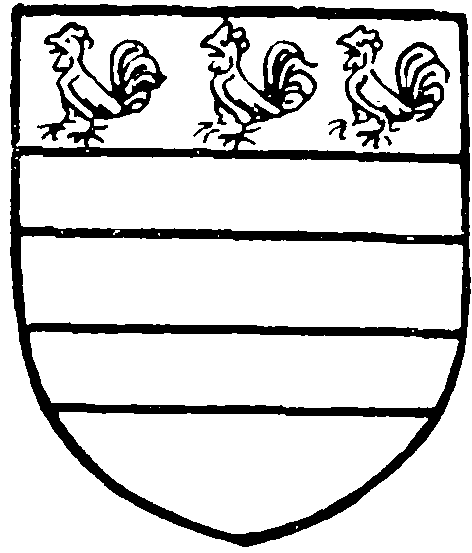
Blakiston of Blakiston. Argent two bars with three cocks in the chief all gules.
Roger de Blakiston appears from 1329 (fn. 113) to about 1359 (fn. 114); he was appointed a justice in 1344. (fn. 115) His successor, perhaps his son, was probably the William de Blakiston who occurs in the rolls from 1367 onwards. (fn. 116) He was a knight in 1409. (fn. 117) He died in or before 1418, when the writ of diem clausit extrcmum was issued. (fn. 118) At the subsequent inquisition it was found that he held the manor and vill of Blakiston of the Prior of Durham by 2 marks rent; also land called Chamberland, to which he had no claim. In 1396 he had made a settlement of the estate, the remainder being to his son William the younger and Katherine his wife. The son died before his father, so that the heir was a grandson, Nicholas, son of the younger William, who was twenty years of age. (fn. 119) Nicholas, on coming of age, received his grandfather's lands. (fn. 120) A little later he was one of the commissioners of array for Stockton Ward, (fn. 121) as he was again in 1447. (fn. 122) He died in 1460, having made various feoffments of his lands to provide for younger children, including a conveyance made in 1457 to John Nevill and others of the manor and vill of Blakiston. (fn. 123) His heir was a son William, aged forty, who had already acted as commissioner of array for Stockton Ward. (fn. 124)
William Blakiston died in 1468 (fn. 125); his heir was a son Thomas, aged thirty, who after doing homage was allowed to have seisin of his inheritance. (fn. 126) Thomas Blakiston died in 1483, having made various dispositions of his lands; he had conveyed one parcel of land in Blakiston to trustees in 1470, and in 1482 had granted a rent from it; in 1483 he had conveyed certain land there to his brother, Robert Killinghall His heir was a son William, aged eighteen. (fn. 127) Jane the widow of Thomas had assignment of dower. (fn. 128) William Blakiston died in or about 1533 holding the manors of Blakiston and Coxhoe, with other lands; his heir was his son Thomas. (fn. 129) Agnes, the widow, received her dower. (fn. 130) Thomas Blakiston in 1559 was succeeded by his son John, aged twenty-two. (fn. 131) In January 1562–3 John succeeded his uncle, William Blakiston, in the manor of Coxhoe. (fn. 132) John Blakiston recorded a pedigree in 1575, but this, as printed, confuses his father Thomas with his great-grandfather of the same name. (fn. 133) He did homage for the manor of Blakiston in 1578 and took the oath of supremacy. (fn. 134) He died in 1587. The inquisition after his death shows that in 1581, when his son William married Alice daughter and eventual co-heir of William Claxton of Wynyard in Grindon parish, he made a settlement of Blakiston and other estates. (fn. 135) His will has been printed. (fn. 136) William Blakiston had licence to enter on his father's lands in 1589. (fn. 137) He appears to have been reconciled to the Roman Church before 1598, and in 1600 bond was given for his appearance before the Ecclesiastical Commissioners. (fn. 138) Hence two-thirds of the manor of Blakiston and other estates were sequestered by the Crown and given in February 1598–9 to Henry Sanderson, and, after revocation of this grant, in March 1600–1 to Marmaduke Blakiston, (fn. 139) perhaps his brother, rector of Redmarshall and prebendary of Durham. The consequent fines may account for various sales of their estates made by William Blakiston and his wife, (fn. 140) as well as for a seizure of nearly a hundred of his stock—horses, cows, &c.—made by bailiffs in 1607, when Sir William himself vainly attempted a rescue by force. (fn. 141) His confinement to his manor-house in 1608 was also, no doubt, due to his religion. (fn. 142) James I, however, had at the beginning of his reign made him a knight. (fn. 143) He was living in 1612, (fn. 144) but probably died soon afterwards. His son Thomas was in May 1615 made a baronet (fn. 145) and in June was knighted. (fn. 146) Soon afterwards a spy reported that 'meetings of papists are held at Sir Thomas Blakiston's house.' (fn. 147) In the same year he conveyed the manor of Blakiston to Alexander Davison, a merchant of Newcastle-upon-Tyne, the sale being completed in 1630. (fn. 148)
The new lord of the manor was made a knight in 1639, (fn. 149) and showed himself a zealous Royalist during the Civil War, taking part in the defence of Newcastle in 1644, in spite of his great age of nearly eighty years, and losing his life on 11 November when that town was stormed by the Scots. (fn. 150) His eldest son and heir Thomas was also a Royalist, being a lieutenant-colonel under the Earl of Newcastle from April 1643 to October 1644 when he surrendered; he took the oath and covenant in Gray's Inn Chapel, being a member of the inn. The family estates had been sequestered by the Parliament, and Blakiston was said to be worth £250 a year. The fine was fixed at £1,116, to which £312 18s. was added later, but these sums appear to have been reduced. (fn. 151) Thomas Davison had a licence to travel to London in 1658, to consummate his marriage, (fn. 152) and on the Restoration in 1660 was made a knight. (fn. 153) He recorded a pedigree in 1666, when his eldest son Alexander was thirty years of age and had a son John, aged two years. (fn. 154) Sir Thomas made his will in February 1666–7, and died shortly afterwards (fn. 155); his son Alexander died in 1669. (fn. 156) After the Revolution, in 1689, John Davison required a pass to go to Blakiston. (fn. 157) He died the year following, (fn. 158) and was succeeded by his son Thomas, who married Anne daughter of Sir John Bland of Kippax (co. York). Thomas Davison died in 1748, his son Thomas in 1756, (fn. 159) and his son, another Thomas, in 1794. To this last Thomas his father's cousin, Elizabeth Bland, left her moiety of the Bland estates, and he took the surname of Bland. He left a son Thomas, who about 1800 sold Blakiston to William Russell of Brancepeth (q.v.), and from him it descended to Viscount Boyne, who sold it to Mr. Wanless. Mr. William Potter, who married Miss Wanless, now owns it.
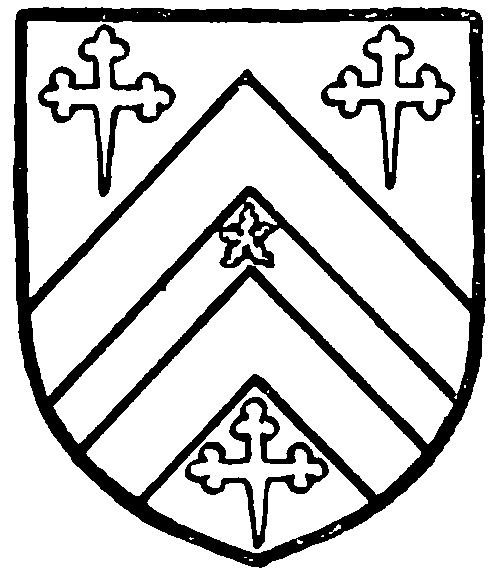
Russell. Argent two cheverons between three crosslets fitchy with a cinqfoil between the cheverons all sable.
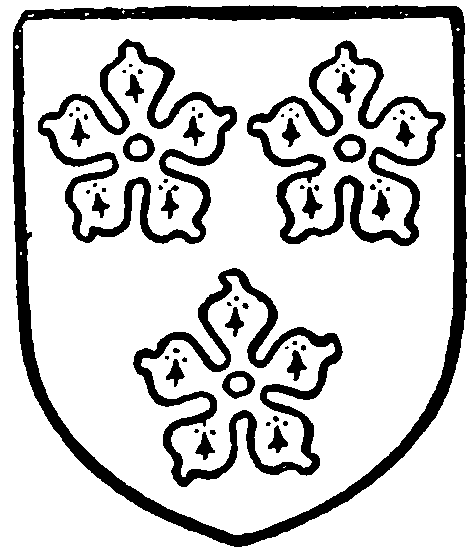
Hamilton. Gules three cinqfoils ermine.
CHAMBERLAND
CHAMBERLAND, once the estate of Simon Chamber, was after the death of Sir William Blakiston in 1418 made the subject of inquiry on behalf of Thomas Langton of Wynyard. The claimant said he had held a messuage, two cottages and a ploughland called Chamberland in Blakiston by feoffment of William de Hoton, but had been expelled by the statement in the inquisition postmortem that Sir William held it. (fn. 160) The return in the Feodary of 1430, quoted above, shows that the Langtons established their right.
Another estate noticed in the inquisitions is that of Richard de Hardwick, who in or before 1341 had a messuage and 60 acres in Blakiston, held of the lord of Blakiston by a rent of 3s.; 24 acres of it rendered 23s. 6d. to Roger de Blakiston. (fn. 161)
Sir Richard Smith in 1717 as a 'Papist' registered an estate in Blakiston of £10 yearly value. (fn. 162)
In recent times the chief resident families have been those of Hogg, still seated there, Page and Grey. (fn. 163)
CHURCH
The church of ST. MARY THE VIRGIN is a cruciform structure consisting of chancel 33 ft. by 17 ft., with north vestry and organ chamber, north transept 15 ft. by 14 ft. 9 in., south transept 15 ft. 9 in. by 15 ft., central tower 15 ft. square, clearstoried nave 43 ft. 6 in. by 14 ft. 10 in. with north and south aisles each 10 ft. wide, and south porch 8 ft. 6 in. square, all these measurements being internal. The width across the transepts is 51 ft. 8 in. and at the west end across nave and aisles 40 ft.
The building is of exceptional interest as affording the only example in Northumbria of a pre-Conquest church on the cross plan. Of this early structure— dating probably from the first half of the 11th century —the tower, transepts, and part of the nave walls remain. The aisles were added at the end of the 12th century, the nave walls being pierced for the arcades, and the chancel was rebuilt on a larger scale in the 13th century. At the time of the reconstruction of the nave by the addition of the aisles the original east and west arches of the tower were rebuilt, but the openings to the transepts were retained, though they were enlarged by the removal of the inner order of voussoirs and of the portions of the jambs which supported them. (fn. 164) The tower is the largest of all those of pre-Conquest date in the northern counties, being 20 ft. 9 in. on each face externally, (fn. 165) and stands quite distinct from the rest of the building, the four limbs of which are built against it, as at Stow in Lincolnshire, the four angles rising clear from the ground, as may still be seen from the aisles where they are not hidden by later work. Before being rebuilt in the 13th century the chancel, like the transepts and nave, originally abutted against the tower. The north transept, which retains its original walling intact, clearly shows the ancient construction, its outside width being contained within the limits of the tower. The south transept has been a good deal altered and its southern end entirely rebuilt, but it otherwise retains its original form. Built into the wall near the tower is part of a pre-Conquest cross on which an interlaced design is worked. (fn. 166)
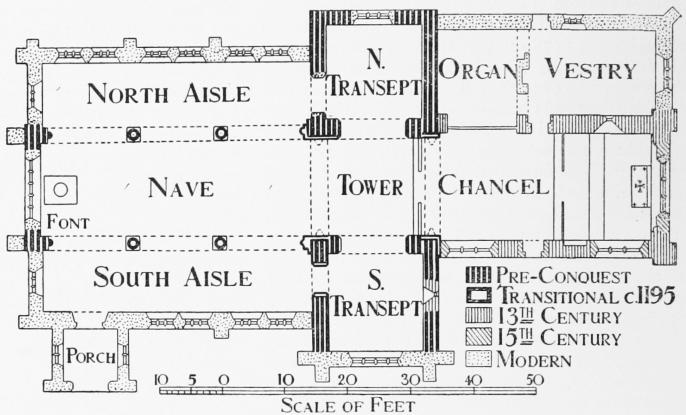
Plan of Norton Church
In 1340 Richard de Bury complained that the canons neglected to keep the chancel in order, (fn. 167) and in 1410 Bishop Langley ordered them to repair it, (fn. 168) but by the end of the century it had 'fallen into ruin and desolation, as well in the roof, the stone walls and windows as in various other parts.' Bishop Fox, therefore, in 1496 sequestered the incomes of the canons for the necessary repairs and did the work himself, (fn. 169) the existing roof, the priest's doorway, and all the windows with the exception of a window on the north side being probably of this date, or restorations of work then done. The upper stage of the tower is also a rebuilding or addition of the 15th century. In 1579 the chancel was again reported to be in decay. (fn. 170)
In 1823 'the side walls of the west part of the church were entirely taken down and rebuilt so as to enclose a larger area,' (fn. 171) which seems to imply a widening of the aisles at that time, two new galleries were erected, the end of the south transept rebuilt, a new west window inserted, and the old east window renewed. (fn. 172) The galleries occupied the aisles, the roofs of which were raised, (fn. 173) and in 1829 the building was described as 'well pewed and in excellent order.' (fn. 174) Sir Stephen Glynne, who visited the church in 1843, describes it as 'much altered and modernised especially within,' the exterior being stuccoed. ' The side aisles of the nave,' he proceeds, 'have been widened and the windows in the modern walls have pseudoperpendicular tracery. (fn. 175) The clearstory has been closed. … There are ugly galleries erected along every side of the nave, which is encumbered also with high though regular pues.' (fn. 176)
The building was completely restored in 1876, when the aisles and the end of the south transept were again rebuilt, a new west window inserted, the galleries removed, the nave reseated, and the organ chamber and vestry added on the north side of the chancel. There were further, but slighter, restorations in 1879 and 1889. The roof of the north aisle was renewed in 1911.
The chancel is constructed of rubble masonry, and the roof is a leaded one of very flat pitch behind an embattled ashlar parapet, which is continued along the east wall. The side walls were raised when the new roof was erected at the end of the 15th century. At the eastern angles are original flat double buttresses of two stages, and on each side of the east window just above the sill level are portions of a 13th-century chamfered string-course. The original east window appears to have consisted of four lancets, the angle shafts of which, with moulded capitals, bands, and bases, still remain inside below the spring of the two outer lights. Externally a portion of the hood mould remains at each end, and is carried along the wall as a string above the buttresses. The east window is of three cinquefoiled lights with perpendicular tracery and four-centred head with hollow-chamfered jambs and hood mould. The restoration seems to have been confined to the mullions and tracery, the jambs and head being apparently old, and there are two four-centred windows, each of three cinquefoiled lights without tracery, on the south side, one at each end of the wall. Both are to some extent restorations, the mullions in all cases being new, and the detail is similar to that of the east window. The priest's doorway has a four-centred head without hood mould, and is midway between the windows. The north side of the chancel is now hidden externally by the vestry and organ chamber, the lancet window, which is near the east end, now opening into the former. The west end of the north wall is open to the organ chamber by a modern arch, but the doorway to the vestry is apparently of 15th-century date and has a four-centred head. In the south wall, in the usual position, is the westernmost and part of the second seat of the 13th-century sedilia, the easternmost seat having been destroyed in the 15th century, when the new windows were inserted. The remaining arch of the sedilia arcade is moulded and has the dog-tooth ornament, and springs from angle shafts with moulded capitals and bases, the whole design before mutilation having been one of much beauty. The piscina is below the easternmost window, but is either new or a restoration, consisting of a projecting bowl under a pointed recess, in the arch of which the nail-head ornament occurs. The fluted bowl of a large piscina, dug up when the present vestry was built, is preserved in the chancel. The fittings are all modern, and the roof is of four bays and boarded. The width of the former chancel is distinctly shown on the east side of the chancel arch, where the ancient masonry has been cut away. The chancel arch, like that between the tower and the nave, is semicircular in form and of two orders, each with a pointed bowtel moulding on the angles springing from chamfered imposts and with a hood mould on each side. The inner order has a halfround member on the soffit, and springs from keelshaped responds, which have been cut away on either side immediately below the capitals. The latter have plain necks and square abaci.
The tower, to which the chancel arch really belongs, is the most interesting part of the church, and is built of rubble masonry with angle quoins. The total height of the pre-Conquest portion now standing is level with the ridge of the ancient roofs, the lines of which are preserved on each face. The original transept arches, as already stated, have been tampered with and the inner order of voussoirs removed, the result being a clumsy semicircular arch of a single square order springing directly from square jambs slightly chamfered on the angles. The tower walls are 3 ft. thick, and the width of the two arches differs slightly, that on the north being 10 ft. 3 in. and the other 10 ft. 6 in. across the existing opening. Above the arches of the crossing are four triangular-headed openings in the walls communicating originally with the roof spaces. The openings are 7 ft. high by 2 ft. in width, and the headstones rest on chamfered impost stones which go through the walls, being flush externally, but having a projection inside, below which the jambs are splayed. Over these windows, which are now above the later flat-leaded roofs, was a floor, and a little above this again are two smaller openings on each face of the tower, one on each side of the original high-pitched roof. They were originally only 6 in. wide, but splayed inside, and have semicircular heads cut from one stone. A little higher up are indications of a second floor, above which the tower is of 15th-century date. The grooves of the old roof lines, which are of exceedingly steep pitch, are filled on all four faces with small square stones flush with the face of the wall. (fn. 177) The tower may originally have risen no higher than the ridge of the four abutting roofs, and the first floor was entered through a doorway high up in the south wall near the south-west angle above the arch, reached by a ladder or stairway from the south transept. The floor, which was immediately above the crown of the arches, has been removed, but the doorway still remains. The later belfry story has a square-headed window of two trefoiled lights on each side and finishes with a plain embattled parapet, the whole being of rubble masonry different in character from that below.
The north transept, known later as the Blakiston porch, has a modern north window of three lights, but is otherwise little altered except as regards the roof, which, like those of the chancel and south transept, is a leaded one of very flat pitch. The north 'gable,' which follows the line of the roof, has a modern apex cross, but the roof overhangs the side walls. On the west side the line of the 1823 aisle roof, higher than the present one, shows against the wall. The transept is built of rubble masonry with large and massive angle quoins, some of which measure 2 ft. 6 in. to 3 ft. in length and 16 in. to 24 in. in height, but no original openings or any architectural features remain. Internally there is a mutilated piscina at the south end of the east wall with a roughly-shaped pointed head, the bowl of which is cut away. It may be a 13th-century insertion. The arch between the transept and the aisle is modern.
The south transept, which is known as the Pity Porch, (fn. 178) probably from its having contained a chantry dedicated to Our Lady of Pity, is very much modernized externally, the whole of the south wall being new. The walls terminate in an embattled parapet continuous with that of the chancel, and the south window is of four cinquefoiled lights with perpendicular tracery. There is a doorway below the window in the south-west corner, and the angles have modern double buttresses. In the east wall is an original lancet window with head in one stone, an insertion probably when the chancel was rebuilt, but there are no other ancient features. The roofs of both transepts are boarded internally, and the walls, like those of the rest of the building, are of bare stone. The pointed arch between the transept and the south aisle is of the same date as the nave arcade, and consists of a single chamfered order springing from imposts.
The nave is of three bays, the arcades consisting of pointed arches of two moulded orders similar to those of the east and west tower arches, but with the hood mould on the nave side only, springing at a height of 9 ft. 6 in. from circular piers with moulded capitals and bases. The responds are of similar type, except that at the east end on the south side, which is keel-shaped. The piers are 25 in. in diameter, and the capitals have circular necks and octagonal abaci. Those on the north side are quite plain, but on the south the capital of the easternmost pier has an indented moulding along the underside of the abacus, and that of the adjoining pier has the neck carved with early leaf ornament. The capitals of the responds are carved with the early volute. A torus string runs the whole length of the wall on each side immediately above the crown of the arches, stopping against the east and west walls. The clearstory walls are of wrought masonry in courses, and are divided externally into three bays by flat pilaster buttresses. There are three original transitional round-headed windows on the north side, and the same disposition was followed on the south, but the middle window was altered in the 15th century, and now consists of a square-headed opening of two trefoiled lights, the head of which internally is formed of a 13th-century grave cover. (fn. 179) The original openings are chamfered all round externally, and the heads are cut from one stone. The walls finish with an embattled parapet, behind which the flat-pitched leaded roof is not seen. The west window is of five lights with perpendicular tracery, and the wall above on each side has been rebuilt. The modern aisles are under lean-to red tiled roofs behind embattled parapets, and the porch is also embattled and has a red tiled hipped roof running back into that of the aisle. In the east and west walls of the porch are a number of 12th and 13th-century fragments, the former (apparently voussoirs of an arch with cheveron ornament) serving as part of a corbel table supporting the roof. In the east wall is a stone female effigy, the head of which has gone.
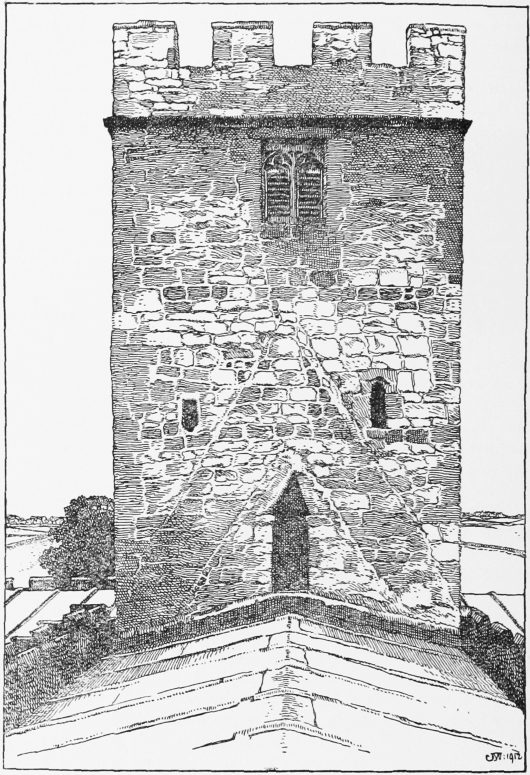
Norton Church Tower
At the east end of the nave on the south side, below the tower arch, is an exceedingly fine recumbent effigy of an unknown knight in chain armour and surcoat, apparently of late 13th or early 14th-century date. Above the head is a crocketed canopy, and the feet rest on two animals in combat. The head is bare, and on the right side is a small kneeling figure with open book. The sword, in a jewelled sheath, hangs from a belt, and on the left arm is a shield of six quarterings cut at a later date. Behind the canopy, over the head, are two original shields of arms, one a cross moline and the other a voided scutcheon with a bend over all. The first may be the arms of Bek of Redmarshall or Fulthorpe of Grindon. The other is that assigned to John Lithegraynes. If the figure represents a member of the family of Park, as is generally stated, the shields can only refer to allied families; but it is possible that it is the effigy of some other person more intimately connected with the family of Bek. Both Hutchinson and Surtees speak of this figure as being somewhere in the Blakiston porch, whence it was removed to its present position. It was probably appropriated by one of the Blakistons in the 16th century under the impression that it was one of his ancestors. The quarterings on the shield are of this period. (fn. 180) On the chamfer of the slab on which the figure rests is an artificer's mark consisting of the letter I and three interlaced rings.
The font dates from 1851, and is of stone elaborately carved. (fn. 181) The pulpit is also of stone and modern, and there is a modern oak chancel screen. An old oak chest, 3 ft. long, said to be a groat chest or money box, is preserved in the chancel, and on the north wall is a painting of the 'Supper at Emmaus,' which was presented by the Rev. Christopher Anstey (vicar 1786–1827) and stood over the altar table till 1875, when it was removed and sold. It was restored to the church by the purchaser in 1894. (fn. 182)
The tower contains three 17th-century bells, the oldest bearing the date 1607 and the initials R.D. The second is inscribed 'Anno Domini: 1613 I.C.' The third, by Samuel Smith of York, 1664, bore the motto 'Venite exultemus Domino. R.D. I.C.' The third bell was recast with an inscription: 'Recast 1893 Deus canticum novum cantebo tibi. T.E.S. vicar, T.H.F., H.S.C. ch.was.' (fn. 183)
The silver plate consists of a chalice with domed cover, paten (the gift of the Rev. Christopher Anstey, vicar in 1808), two flagons, all of 1807, (fn. 184) London make, and two plates (presented by the Rev. C. J. Plumer, vicar 1843).
The registers begin in 1574. The first volume contains entries down to 1713; the second volume begins in 1700, and contains baptisms and burials till 1798 and marriages till 1733. (fn. 185)
A grey stone crucifix has been erected near the entrance to the churchyard as a memorial of those men of the parish who fell in the Great War.
The church of ST. MICHAEL AND ALL ANGELS was built in 1913. It consists of a chancel, nave, north aisle and western tower.
ADVOWSON
Norton parish formerly included Stockton (q.v.), which, with the hamlets of Preston and East Hartburn, was made a chapelry with right of burial in 1237 and was created a parish in 1713. From the earliest record of its existence Norton Church was, like the manor, in the hands of the Bishops of Durham. It was given about 1083 by William of St. Carileph to the secular canons he had removed from Durham Cathedral when he placed monks there. This is said to have been done by order of Pope Gregory VII. (fn. 186) A vicarage was evidently ordained, while the rectorial tithes were assigned to eight canons, whose shares were called prebends. The bishop apparently retained the right of presenting to the vicarage as well as to the prebends. (fn. 187)
The Pipe Roll of 1197 records £53 6s. 8d. as due from the parsons of the church of Norton; but, though the word is plural here, William son of Henry is then named as if he were alone in the rectory. (fn. 188) In 1213 (fn. 189) and in 1215 (fn. 190) King John presented clerks to portions in the church, the bishopric being vacant. Similar grants to the portions or prebends occur in the time of Henry III, (fn. 191) and in 1238 the king presented to the vicarage also (fn. 192); the vacancy of the bishopric was in each case the reason assigned for the king's right. The prebends and vicarage were often or usually held with other benefices, and frequently by the king's clerks. (fn. 193) In 1291 the eight prebends were taxed as worth £6 a year each, and the vicarage as worth £20, giving £68 in all (fn. 194); but owing to the Scottish raids in the time of Edward II the prebends were in 1318 taxed at £4 each and the vicarage at £13, or a total of £45. (fn. 195) In the bishop's accounts of the plague year 1349 is entered the sum of 66s. 8d. from Reginald de Hillington, vicar of Norton, for sixteen oxen and four cows sold to him, viz., from the mortuaries received during the vacancy of the church there. (fn. 196) In 1535 the value of the rectory, appropriated as formerly to eight portionaries, was recorded as £34 13s. 4d. in all; the vicarage was worth £31 13s. 4d., of which 2s. was paid to the archdeacon. (fn. 197) The college or rectory was confiscated by the Crown in 1548, when it was stated that the incumbents of the rectory had the tithes divided among them to help them to study at the university. (fn. 198) About 1580 they were called 'lay portioners'; at that time the dissolved college was still in the queen's hands. (fn. 199) A grant of it was made to William Tipper and Robert Dawe in 1590, (fn. 200) and a further grant was made in 1612 to Francis Phelipps and Francis Morrice. (fn. 201) Sir Edmund Duncan, a Royalist, was the owner in 1644, at which time it was sequestered by the Parliament and demised to Rowland and Robert Burdon at £160 a year. (fn. 202) Part of the rectory—viz., the greater tithes of Norton and East Hartburn—was in 1910 given up by the owner, the Right Hon. John Lloyd Wharton, as an additional endowment of the vicarage. (fn. 203)
The vicarage of Norton continued in the gift of the Bishops of Durham until 1859, when it was transferred to the Bishop of Chester, whose successor is the present patron. (fn. 204) The foundation stone of a new church of St. Michael and All Angels was laid in 1912.
At the visitation of 1501 it was found that the vicar did not reside; the parish chaplain and the chantry priest did not appear, and were therefore suspended. (fn. 205) The vicar at that time (1498–1518) was a man of note, Dr. John Claymond, who was then fellow of Magdalen College, Oxford, and was elected president in 1504; he had various other ecclesiastical benefices, and in 1516 was made the first president of Corpus Christi College, Oxford, and from his devotion to the Blessed Sacrament was known as 'Eucharistiae servus.' He founded six scholarships at Brasenose College, one of them to be filled by a candidate from the parish of Norton, including Stockton. He died in 1537. (fn. 206)
Although a chantry priest is mentioned in the visitation of 1501 cited above, it does not appear that an endowed chantry existed in the church, and the priest referred to may have been at Blakiston. William Blakiston, who died in 1533, left money for a cantarist for twenty years, and this stipend was paid in 1548. (fn. 207) There is nothing to show what became of the chapel of the Holy Trinity at Blakiston or of the chantry founded there in 1323 by Richard de Park and Alice his wife. They gave 4 oxgangs of land for the maintenance of the chaplain, who was to be assisted by a sufficient clerk, and to say the canonical hours regularly, celebrate a requiem mass thrice a week and mass of Our Lady at other times. The Prior of Durham was to appoint the chaplain after the founder's decease. (fn. 208)
The ecclesiastical parish of St. Michael and All Angels was formed in 1918 by Order in Council. It comprises lands taken from the parishes of Norton, St. John Baptist and St. Thomas, Stockton-on-Tees. The living is in the gift of the vicar of Norton.
A Hermitage garth is mentioned in the endowment of the grammar school.
CHARITIES
In 1714—as stated in the Parliamentary returns of 1786—John Thompson by deed conveyed to trustees certain lands (a) for upholding and maintaining the church, and (b) for the poor. The ecclesiastical branch consisted of the church field containing about 4a., which was sold in 1920 and the proceeds invested in £1,172 7s. 6d. 5 per cent. War Stock, and a further sum of £300 of same stock, presumably accumulations. The endowment of the poor's branch now consists of £869 9s. 6d. India 3 per cent, stock, representing the proceeds of a sale of land in 1875 with accumulations. The annual dividends, amounting to £26 1s. 8d., are applied in the distribution of tickets for food, fuel, and clothing.
In 1781 John Snowdon by his will bequeathed £100 stock, now £100 consols, the annual dividends of £2 10s. being distributed in tickets for goods from 2s. 6d. to 5s. each in value.
In 1820 Thomas Newton by his will bequeathed £100, now represented by £108 2s. 5d. consols, producing £2 14s. yearly. The parish of Norton is entitled to one-fifth of the income, Newton Bewley two-fifths, Wolviston one-fifth, and Billingham one-fifth. The charity is regulated by a scheme of the Charity Commissioners of 1867, and the income applied in the distribution of tickets for food and other articles in kind.
The above charities are administered in accordance with a scheme of the Charity Commissioners of 20 January 1920 under the title of the United Charities.
The sums of stock are held by the official trustees.
The Fox Almshouses were founded and endowed by the will of John Henry Fox proved at London 7 October 1893. By a deed poll, dated 20 November 1895, the trusts of a sum of £20,000 were declared, to which a scheme was annexed for the management of the charity. The almshouses, consisting of twelve tenements of three rooms each and a caretaker's house, were erected at a cost of about £4,000 on a site conveyed in 1893 to trustees for the purpose by Mr. Timothy Crosby, to whom the same had been devised absolutely by the founder. There is also a detached building containing a reading room for the inmates and a clerk's office. The balance of the trust fund has been invested in railway securities and mortgages producing an income of about £450 a year. A stipend of 10s. a week is paid to each of the inmates.
The Chilton Endowment Fund was founded by Mrs. Mary Ovington Trotter by deed dated 17 December 1920. She gave £3,000, the income arising therefrom to be applied by the trustees to or for the benefit of any of the inmates of Fox's Almshouses. The money was invested in £5,783 2s. 8d. Local Loans 3 per cent. stock with the official trustees, producing £173 10s. yearly.
The charity of Elizabeth Clifton for organist in the ecclesiastical parish of St. Michael and All Angels, Norton, founded by will proved at Durham 16 April 1901, is regulated by a scheme of the Charity Commissioners of 29 November 1921, under the terms of which the vicar is appointed sole trustee. The endowment consists of £108 7s. 11d. India 3½ per cent. stock with the official trustees, producing £3 15s. 8d. yearly, which is applied towards the salary of the organist.
Educational Charities.
The Grammar School Educational Endowment has already been dealt with. (fn. 209)
The official trustees now (1926) hold a sum of £441 14s. 5d. India 3 per cent. stock arising from the proceeds of sales of real estate, and £26 10s. 11d. 2½ per cent. consols representing £20 paid by the Rural District Council for the right to lay a sewer through land belonging to the charity, producing £13 18s. yearly.
An account has been already given of the elementary school and the charity of Ann Hogg, founded by will, dated in 1796. (fn. 210) The official trustees hold a sum of £152 19s. 8d. India 3 per cent. stock, producing £4 11s. 8d. yearly, which, in accordance with the scheme of 9 June 1891 regulating the charity, is applied in the payment of rewards to girls at the school who have attained standards higher than Standard IV.