A History of the County of Durham: Volume 3. Originally published by Victoria County History, London, 1928.
This free content was digitised by double rekeying. All rights reserved.
'Parishes: Stockton on Tees', in A History of the County of Durham: Volume 3, ed. William Page (London, 1928), British History Online https://www.british-history.ac.uk/vch/durham/vol3/pp348-365 [accessed 30 April 2025].
'Parishes: Stockton on Tees', in A History of the County of Durham: Volume 3. Edited by William Page (London, 1928), British History Online, accessed April 30, 2025, https://www.british-history.ac.uk/vch/durham/vol3/pp348-365.
"Parishes: Stockton on Tees". A History of the County of Durham: Volume 3. Ed. William Page (London, 1928), British History Online. Web. 30 April 2025. https://www.british-history.ac.uk/vch/durham/vol3/pp348-365.
In this section
STOCKTON ON TEES
Stocton, Stoketon, c. 1200.
The parish of Stockton on Tees, formed in 1713 out of what had long been a parochial chapelry in Norton, comprises the three townships of Stockton, East Hartburn and Preston upon Tees, which are found closely associated in the earliest notices of the district. Norton forms the northern boundary, the eastern touches Billingham, and the western Elton and Long Newton. Egglescliffe lies to the south-west, and along the south the River Tees divides the parish and county from Yorkshire. The township of Stockton occupies the eastern half of its parish, with Hartburn to the west and Preston to the south-west. Between these latter townships flows Hartburn Beck, which gives a name to East Hartburn here and also to West Hartburn some miles off in Middleton St. George. This stream has a number of titles, being called Lustring or Lustram Beck after passing into Stockton township; here it winds round the town on the west and north, receiving some other streams, and joins the Tees at Portrack. The areas of the townships are respectively 3,031, 1,045 and 1,136 acres, 5,212 acres in all, including 4 acres of inland water, 79 of tidal water and 36 of foreshore. (fn. 1)
The surface generally lies at an elevation of 50 ft. to 100 ft. above the ordnance datum, but with a belt of low-lying ground along the Tees and depressions through which run the streams mentioned above.
Stockton is now mainly urban, but it was formerly a rich agricultural district. (fn. 2) According to Sir George Bowes in 1569 'the best country for corn' lay around Stockton. (fn. 3) The district was in 1647 described as a 'champion country, very fruitful, though a stiff clay'; there was no wood growing on the castle demesne or elsewhere in that part of the country. (fn. 4) In an official report of the end of the 18th century the soil was described as loamy or rich clay; the flat grounds near the Tees, which were of considerable extent, were drained by means of wide ditches commonly called 'Stells.' (fn. 5) Wheat and other cereals are grown. A chamber of agriculture was formed in 1888.
The main part of the town of Stockton, centrally placed in its township, stands well up above the river, here flowing north, whereas on the opposite Yorkshire bank the land is low and flat; but to the east of the town is a large low-lying tract of marsh land, and on the north and west is the valley of the Lustring Beck. The winding course of the Tees to the east of the town caused serious inconvenience to shipping even when sea-going vessels were very small compared with their modern successors, and in 1791 a 'cut' or canal across one large bend called Mandale was proposed. A Bill was passed through Parliament after some years' effort in 1808, (fn. 6) and the new channel was opened on 18 September 1810. Though only 220 yards in length, it saved a circuit of about 2¼ miles. (fn. 7) A second and longer cut to the east made under an Act passed in 1828 (fn. 8) was opened in 1831. (fn. 9) More recently the county and parish boundaries have been adjusted to the new course of the river, Mandale being taken from Stockton and added to Thornaby in 1887, (fn. 10) and the part of Linthorpe north of the second 'cut' being added to Stockton in 1895. (fn. 11) 'Portrack Lake' is the old Tees bed cut off from the newer channel. At Portrack vessels used to be moored during the winter. (fn. 12)
The town of Stockton grew up on the elevated tongue of land between the Tees and Lustring Beck, along the road going north from the Bishop of Durham's manor-house or castle, long ago destroyed, to the old parish church at Norton. This road begins as a wide and handsome street called High Street, said to be the widest in England and nearly half a mile long, in the centre of which stands the picturesque town-hall or town-house, built in 1735 on the site of the smithy and enlarged in 1744, when the old tollbooth was taken down. (fn. 13) This tollbooth was of the usual type, an upper chamber supported on pillars and approached by steps; it had been used as a school in its latter days. (fn. 14) A piazza was added on the north side of the town-hall in 1768, while on the south side the Doric column, still standing, was built on the site of the older covered cross in the marketplace. (fn. 15) In the same year the shambles were built further south in the centre of High Street; they were rebuilt in 1825. (fn. 16) The town-hall, the lower part of which is occupied as a shop, was used as assembly rooms as well as for civic business. North of it, on the east side of the street, is the parish church adjoining the site of the ancient chapel. Thus from the modern centre of the town some notion of ancient Stockton may be obtained: the long wide 'place' suitable for a market or meeting place with the manor-house closing its southern end, the cross, tollbooth and smithy in the centre, and the chapel and bake-house at the north; the houses on each side the High Street formed the borough. The ancient staith or landing-place on the river side near the castle has expanded into a long line of quays, of which the principal one is owned by the Corporation.
Finkle Street leads east from the town-hall to the river and Duckett (Dovecot) Street west, marking the northern end of the mediaeval borough. The lord's dovecot stood at the corner of the street named from it; its site was marked by Dovecot House standing in the roadway (fn. 17) until it was taken down in 1839 to widen the street. (fn. 18) At the south end of High Street Yarm Lane or Road goes west and then south through Preston to Yarm, Hartburn Lane turning off westward. The latter passes through East Hartburn village to Elton and Darlington. At its northern end, as stated above, High Street is prolonged as Norton Road, eastward there is a lane to Portrack, and westward Bishopton Lane leads to Darlington with a wide straight road, formed in 1830, branching from it towards Durham. The districts called Mount Pleasant and St. Ann's Hill lie to the east of the Norton road, Smithfield was by the river where it turns east, Newham Grange and White House are between Bishopton Lane and the Durham road, Bowesfield stands in the extreme south of the township, and a rifle range, now disused, was made for the volunteers beyond it, near the Tees.
The ancient roads and lanes continue in use and have determined the direction of the modern streets, but some of the older names have changed in course of time. In the former days most of the minor streets or lanes of the town went east down to the riverside. One of them, called Boathouse Lane, Ferry Lane or Cook's Wynd, opposite Yarm Lane, was the passage to the ancient ferry across the Tees, the boat being somewhat to the south of it, near the later bridge. Each of the inhabitants of Stockton and Thornaby on Easter Monday and St. Stephen's Day paid a cake valued at 4d. for passing freely over the river all the year except when the river was frozen; at such times they paid ½d. each way. (fn. 19) After the adjoining castle had been quite destroyed High Street was prolonged to the south and then, curving eastward, crossed the river by a stone bridge of five arches built in 1764–9. (fn. 20) After that the ferry was discontinued, (fn. 21) but tolls were paid by those who used the bridge until its cost had been repaid. It was declared free in 1820. (fn. 22) After having been enlarged for increasing traffic it was in 1887 superseded by the present Victoria Bridge on an adjacent site. This bridge is of stone and iron, crossing the river by three wide arches. At the south end of the town, on the Bridge road, was St. John's Well; it yielded the best water in the town, and there was a bath near it. (fn. 23) Over the bridge, on the Yorkshire side, has grown up the modern borough of Thornaby, formerly known as South Stockton. Ferry boats still ply across the river and are largely used by workmen crossing to the dockyards and other works.
There are many buildings and institutions worthy of notice. Borough Hall, in High Street, was built in 1851 on the site of an old dwelling-house; it contains some public offices, a Corn Exchange and a hall for meetings. (fn. 24) The Free Library, in Wellington Street, off the north end of High Street, was opened in 1877. A literary society or book club was formed in 1776, and a subscription library in 1792. (fn. 25) The first Mechanics' Institutie was established in 1825, and revived or joined with the Reading Association in 1836–7; in 1852 it obtained Corporation Building, which had been erected at the corner of Dovecot Street for public uses in 1839, (fn. 26) and was given up when Borough Hall was opened. The name was changed to Stockton Institute of Literature and Science in 1846, (fn. 27) and since then to the Literary Institute. It contains reading and chess rooms and a public hall. The Exchange Hall, in High Street, built in 1874, has a large concert room, now a cinema theatre.
There are numerous chapels. Protestant Nonconformity took shape here after the Restoration, but nothing very definite can be related until the Toleration Act of 1689. John Rogers of Barnard Castle (d. 1680), an ejected minister, is said to have founded a congregation here. (fn. 28) At the Indulgence of 1672 Joseph Gill of Stockton took a general licence as a Congregationalist. (fn. 29) Presbyterian and Quaker congregations appear after the Revolution, as is shown below, and in 1748 John Wesley paid his first visit to Stockton, preaching near the market-place to 'a very large and very rude congregation,' who grew 'quiet and serious.' (fn. 30) He preached again in 1751, finding that 'the society was more than doubled since he was there before.' (fn. 31) The first meeting-place is said to have been in Bolton House Yard, (fn. 32) Thistle Green. Wesley preached, usually in the High Street, on many later visits down to 1790; in 1770 he 'preached in the new house, strangely raised, when the case appeared quite desperate, by God's touching the heart of a man of substance, who bought the ground and built it without delay.' (fn. 33) This was probably the Smithfield chapel of the Methodists marked on the plan of 1796 in Brewster's History of Stockton to the east of the parish church. It was rebuilt in 1813, and the congregation removed in 1823 to Dovecot Street to a new chapel called Brunswick. It had a library connected with it. This building remains in use, and there are more recent chapels in North Terrace, 1867, Oxbridge Lane, Yarm Road, 1904, and mission stations. The Welsh Wesleyans have a chapel in Villiers Street dating about 1878. The Primitive Methodists held their first 'camp meeting' in 1821 and had a room in Playhouse Yard; they opened a chapel in Maritime Street in 1825, (fn. 34) and now have three—Paradise Row, 1866, Norton Road, 1876, and Bowesfield Lane, 1887— besides some mission rooms. The Wesleyan Associa tion, afterwards (1856) the United Methodists and now the Free Methodists, built a chapel in Regent Street in 1838, and the Wesleyan Reformers, who united with them, opened a meeting-place in Mill Lane in 1851. The New Connexion, now also Free Methodists, held their first services in 1862, and opened Zion Chapel, in Norton Road, in 1864.
The Independents formed a congregation about 1799, meeting in Green Dragon Yard, Finkle Street, and built a chapel in West Row in 1818. From this there was a secession in 1842. The seceders, styling themselves Congregationalists, had a meeting-place in Tennant Street, and in 1845 built a chapel in Norton Road. (fn. 35) A second, Christ Church, Yarm Road, was built in 1878. The Welsh Congregationalists have a chapel in Barrett Street dating from 1866. The older congregation at West Row called themselves Scotch Presbyterians and became part of the United Presbyterians. (fn. 36) There are now two congregations of the Presbyterian Church of England in Stockton: St. Andrew's, Tower Street, built in 1861 in succession to West Row, and St. George's, Yarm Road, 1876. The Welsh Methodist or Welsh Presbyterian church in Barrett Street goes back to 1870.
The Particular Baptists had a meeting-place in the middle of the 18th century, and in 1809 converted a warehouse in West Row into a chapel. (fn. 37) The Baptists have now three places of worship: the Tabernacle, Wellington Street, which represents the original congregation (1869); Northcote Street (1885); and Lightfoot Grove (1904); and there is a Welsh Baptist chapel called Bethesda in Portrack Lane, established in 1870.
The English Presbyterians of the post-Restoration time, now Unitarians, had a minister in 1688, and met in a room in Bolton House Yard afterwards occupied by the Methodists. In 1699 they built a meeting-house on Mill Garth, opposite the parish church. This was registered in 1706, and a trust deed was agreed upon in 1709. The chapel, which was rebuilt in 1756, was closed from 1817 to 1820 on the dismissal of Samuel Kennedy. There was a library in it. The Unitarians removed to a new chapel in Wellington Street in 1873. (fn. 38)
The Society of Friends, established in Norton as early as 1671, (fn. 39) had a meeting-place in Stockton before 1724, when it is found marked on a plan of the town. (fn. 40) This was in Dovecot Street until 1814, when a new one was built further up the street in Mill Lane, now Dovecot Street.
The Salvation Army, the Plymouth Brethren and various religious bodies have meeting-places in the town.
After the Reformation Catholicism appears to have died out completely with the exception of the families of Sayer and Witham in Preston. A new beginning is said to have been made in 1783, and a chapel in Playhouse Yard is noted on Brewster's plan of 1796. This remained in use until St. Mary's, in Norton Road, a building designed by Pugin, was opened in 1842. (fn. 41) A chapel of ease at Portrack, the Sacred Heart, is served from it. At the south end of the town a school chapel, St. Cuthbert's, was opened in 1884.
A Jewish synagogue was opened in Skinner Street about 1885; it was rebuilt in 1906 in Hartington Road. The Latter Day Saints, or Mormons, had a meeting-place in Brunswick Street in 1857. (fn. 42)
The public baths at the north end of the town were first opened in 1859 (fn. 43) and rebuilt in 1892. The union workhouse, in Portrack Lane, was built in 1851 in place of an older one in Bishop Street. (fn. 44) The fire engines were in old times kept in the church porch, and later in Brunswick Street. (fn. 45) Now the fire brigade station is in West Row, (fn. 46) and the county police station, where the courts are held, was about 1870 removed from West Row (Borough Hall) (fn. 47) to Church Row.
The electric telegraph, then in the hands of private companies, was introduced in 1853, a line from Leeds to Hartlepool passing through the town; another line crossed Stockton in 1864. (fn. 48) The Corporation now owns the gas and electric lighting works, which are at the north end of the town, and the water supply is under the control of the Tees Valley Water Board, on which the borough has five representatives. Gas was first supplied under an Act obtained in 1822 (fn. 49); the works were in the hands of a private company until 1857, when they were purchased by the Corporation. (fn. 50) The electric lighting works date from 1890. (fn. 51) The first Act for a good supply of water was obtained in 1851, (fn. 52) and reservoirs were established at Carlton and elsewhere, more recently in Dinsdale. A water board for Stockton and Middlesbrough on purchasing the undertaking was established in 1876, (fn. 53) and this became the Tees Valley Water Board in 1899. (fn. 54) The Corporation has a fever hospital, parks, library and cemeteries. In 1718 the first order for paving the town was made, and two public pumps were provided. (fn. 55)
In Dovecot Street are the Temperance Hall, opened in 1865, (fn. 56) the rooms of the Young Men's Christian Association, founded here in 1861, (fn. 57) and the almshouses. The Temperance Society was founded in 1830 at the Friends' meeting-house. (fn. 58) The first almshouses were built near the old parochial chapel about 1682 and rebuilt in 1816 (fn. 59); they were sold in 1896, and the present houses built in 1902.
The Grammar school, founded without any endowment in 1785 in West Row, (fn. 60) was removed to Skinner Street in 1848, and is now in Norton Road. There is also a secondary and technical school maintained by the Durham County Council. A Blue Coat school founded by public subscription in 1721, at first for boys, but later for boys and girls, became a public elementary school in 1870 and later was incorporated in the Boys' High School. The county court, opened here in 1847, is in Bridge Road, where also is now the custom-house. The sessions of the county court were formerly held in the town-hall. The first custom-house, in 1680, was in the yard of an inn, the 'Red Lion.' In 1696 it was removed to the river side at the end of Finkle Street, where a new building was made for it in 1730, (fn. 61) replaced by another in Housewife Lane, Smithfield, in 1828. (fn. 62) Afterwards the custom-house was removed to Borough Hall, High Street.
A cottage hospital was maintained on Thistle Green from about 1865 (fn. 63) until the Stockton and Thornaby hospital was built in 1876 on a site off Yarm Lane. The Corporation fever hospital, built in 1893, is placed on the Durham road, and there is a smallpox hospital at Somerville.
Ropner Park, in Hartburn Lane, was presented to the town by Sir Robert Ropner, bart., and was opened in 1893 by the Duke of York, now King George V. There are also recreation grounds at the north end of the town which were opened in 1892 in Portrack Lane and Durham Road. A customary bowling green on the Saltholme is mentioned in the partition of the common lands in 1659. (fn. 64) Regattas have been held from time to time since 1825. (fn. 65) Cockfighting used to be a favourite sport.
In the 18th century the 'Stockton races' were held on the low ground on the Yorkshire side of the Tees. (fn. 66) They were discontinued, but revived in 1839, and are held on Mandale Marshes, formerly in Stockton and now in Thornaby. (fn. 67) There used to be a pack of otter hounds; otters infested the river according to the rhyme:—
An otter in the Tees
You may find at your ease,
and they did much damage to the fisheries. (fn. 68) Seals
also at one time were numerous and preyed on the
salmon, so that a century ago it was the custom for the
fishermen to devote a day or two occasionally to
hunting the seals. (fn. 69)
Stockton has a prominent place in the history of railways, for the first line on which locomotive engines were used is that from Stockton to Darlington. This was begun in 1822 and formally opened on 27 September 1825. (fn. 70) The station was at the south end of the town and is now a goods station. The line was continued along the line of quays. In 1830 a suspension bridge was thrown across the Tees to carry a line to Middlesbrough; this had to be supported by timber struts, and in 1844 was replaced by an iron bridge. (fn. 71) Coals were delivered at Stockton by the Port Clarence railway in 1833. A railway to Hartlepool was opened in 1841, (fn. 72) the station being in Bishopton Lane; the company was incorporated in 1842. In 1852 it was amalgamated with the Hartlepool West Harbour and Dock Company as the West Hart!epool Harbour and Railway Company, and took over the Port Clarence line. (fn. 73) In 1846 the Leeds and Northern railway, now the North Eastern, obtained powers to make a branch to Stockton by way of Yarm and Egglescliffe, and the station in Bishopton Lane was opened on 15 May 1852. (fn. 74) By amalgamation in 1854 and later all the lines have been united in the North Eastern system, and the Bishopton Lane station has been enlarged and made the only passenger station in the parish, that called Eaglescliffe Station being just outside on the south. There is a branch goods line with a station in Norton Road, at the north end, running to the river side; near this point there is a ferry across to Thornaby. The Stockton and Castle Eden branch passes on the west through Stockton and East Hartburn. The tramways through Stockton connect the town with Thornaby, Middlesbrough and North Ormesby in one direction and with Norton in another; they were first formed in 1882, (fn. 75) and are owned by a private company. Before that time there was an omnibus service to Norton.
A weekly newspaper, the Stockton and Thornaby Herald, is published at Stockton on Saturdays. It was founded in 1858. The earliest newspaper published here was the Advertiser, begun in 1858, but lasting only a year. A local magazine called the Stockton Bee began in 1793 and continued until 1795; it contained essays, poems, puzzles and other miscellaneous articles. (fn. 76) The Gazette was founded in 1859 by the efforts of Robert Spears, (fn. 77) a Unitarian minister then stationed at Stockton. It continues as the North-eastern Gazette, published at Middlesbrough. The News and Advertiser, begun in 1864, (fn. 78) and the Examiner, later, did not succeed.
East Hartburn contains the village so named on its eastern border, adjoining Stockton, and the hamlet of Fairfield has sprung up in the northern corner. Preston has part of the hamlet of Eaglescliffe Junction in the south-west; north of it lies Cowley Moor. The Whinstone dyke, here 75 ft. wide, enters the country in Preston, where it is being quarried. (fn. 79) Each of these townships has a Parish Council for administering its local affairs.
The early history of Stockton is bound up with that of Norton. From the names it may be surmised that Stockton was the original Anglian settlement formed upon a defensible site beside the river, and that Norton afterwards grew up to the north either as pleasanter to dwell in or more secure from attack. Later, while the church was built at Norton, which thus gave a name to the parish, the bishops preferred to establish their manor-house at Stockton, (fn. 80) which provided a name for the ward or administrative division of the county.
King John paid three visits to Stockton: in February 1200–1 on his way from Scarborough to Durham and Newcastle, again in April 1210 and in February 1212–13, this time on his way south. (fn. 81) That the Bishops of Durham frequently resided there is evident from grants dated at Stockton, (fn. 82) and when Bishop Nicholas de Farnham resigned the bishopric in 1249 in order to devote his last days to a life of contemplation, Stockton was one of the manors reserved for his maintenance, (fn. 83) and there he died in 1257. (fn. 84)
The Reformation period seems to have passed quietly by, but in 1569 nine men from this place joined the Northern Rising, of whom two were executed. (fn. 85) In the exaction of ship money by Charles I Stockton was joined with some other towns to provide a ship, (fn. 86) and in 1637 John Burdon, a townsman and constable of the ward, was summoned to answer for his neglect in not collecting the ship money or in not accounting for it. (fn. 87) In 1640 there is mention of butter for the king's forces ready to be shipped from Stockton. (fn. 88) Later in that year the Scots invaded England and defeated the king's troops at Newburn on 28 August. (fn. 89) Dr. Morton the bishop at first took refuge in his castle at Stockton and then crossed over into Yorkshire. (fn. 90) At the beginning of October the Scottish horse approached the town. (fn. 91) By the treaty of 26 October the Tees was to be the division between the king's forces and the Scots, with the exception that the town and castle of Stockton and the village of Eaglescliffe were to remain the king's. (fn. 92) Stockton was regarded as a place of military importance, (fn. 93) but no adequate provision was made for defending it. (fn. 94) At the beginning of January the troops were in disorder and there were no provisions for them (fn. 95); in February they were clamouring for their pay. (fn. 96) The registers record the deaths of several soldiers between 20 December 1640 and 6 May 1641. (fn. 97) When the Civil War broke out the castle was garrisoned, but the Scots again invaded Durham, and on 24 July 1644 the castle surrendered to Lord Calendar without resistance, (fn. 98) and was garrisoned by them until, by the treaty of 1646, they withdrew to Scotland early in 1647, having received their £200,000. (fn. 99) During the occupation serious complaints had been made by the people of the district concerning the oppressive conduct of James Levingstone, the governor. (fn. 100) Some meetings of the Parliamentary Commissioners were held in Stockton, (fn. 101) but the 'delinquents' in the parish were few, Col. Sir Edmund Duncan, Richard Grubham, Lawrence Sayer of Preston and Leonard Stott being the only persons named. (fn. 102) In view of war with the Dutch the defence of Stockton was considered in 1664; it was one of the 'naked' places of the coast. (fn. 103) In 1672 the Dutch war ships and privateers were very active, and vessels often put into the Tees to avoid them or to wait for a convoy. (fn. 104)
In 1740 there was a great disturbance here; wheat was scarce, and in May and June the populace refused to allow any to be exported from the town. Soldiers were brought in to overawe them, some prisoners were made and sent to Durham, but there the mob released them. (fn. 105) Troops, this time Germans, (fn. 106) were again brought to Stockton in 1745–6 during the alarm caused by the early successes of the Scottish Jacobites under Charles Edward the Young Pretender, and their advance to Carlisle and Derby. Their final defeat at Culloden was celebrated in festive manner; among other illuminations was that provided by a raft laden with combustibles on fire and sent floating down the Tees. (fn. 107) Wesley, who visited the town many times, gives the following account of a press-gang raid in July 1759 (fn. 108) :—
I began near Stockton market-place as usual. I had hardly finished the hymn when I observed the people in great confusion, which was occasioned by a lieutenant of a man-of-war who had chosen that time to bring his press-gang and ordered them to take Joseph Jones and William Allwood. Joseph Jones telling him, 'Sir, I belong to Mr. Wesley,' after a few words he let him go; as he did likewise William Allwood, after a few hours, understanding he was a licensed preacher. He likewise seized upon a young man of the town, but the women rescued him by main strength. They also broke the lieutenant's head, and so stoned both him and his men that they ran away with all speed.
The wars with the French in the latter part of the 18th century contributed in certain ways, as in shipbuilding, to the material prosperity of the town, but alarm was caused in 1779 by the appearance of Paul Jones, the American privateer, off the mouth of the Tees, where he captured a sloop. (fn. 109) A small band of volunteers was raised about that time for the defence of the town, (fn. 110) and another corps in 1798 called the Loyal Stockton Volunteers or 'Blue Coats.' (fn. 111) These were disbanded in 1802, but again enrolled in 1803, and finally disembodied in 1813. (fn. 112) In 1788 the centenary of the Revolution was celebrated by bonfires. (fn. 113) In 1783 there were four post-days weekly. (fn. 114) In the same year the Darlington and Seaton coach passed through Stockton twice a week. (fn. 115) A mail coach from Sunderland via Stockton to Boroughbridge, where it joined the London mail, was established in 1806 and ran till 1832. (fn. 116) The Tees Bank was established in 1785 by Henry Hutchinson and continued until 1825 (fn. 117); another, the Stockton and Cleveland, failed in 1815, when the Commercial Bank appeared. (fn. 118) A savings bank was formed in 1816. (fn. 119)
Of minor events may be mentioned a visit of the Duke of Wellington in 1827, when he was entertained by the Corporation. (fn. 120) Wordsworth wrote part of the White Doe of Rylstone while on a visit to the Hutchinsons at Stockton in 1807. (fn. 121) A less important visitor was Joanna Southcott in 1803; she made few converts. (fn. 122) In 1832 there were great rejoicings over the passing of the Reform Bill. (fn. 123) The Rev. John Brewster, the first historian of Stockton, who was assistant curate and lecturer from 1776 to 1799 and then vicar until 1805, was held in great esteem, and no doubt aided or stimulated the various charitable and intellectual efforts of the time. (fn. 124) His history was first published in 1796. (fn. 125)
In the 18th century Ralph Bradley, a barrister of Gray's Inn, practised at Stockton, and was said to have managed the concerns of almost the whole county of Durham; he died in 1788. (fn. 126) Joseph Reed, a dramatist, was born at Stockton in 1723, and for a time followed his father's business as a ropemaker; in 1757 he removed to London, where he died in 1787. (fn. 127) Brass Crosbie, born at Stockton in 1725, went to London, where he practised as an attorney. He became City Remembrancer in 1760 and Lord Mayor in 1770; during his term of office he refused pressgangs permission to work in the city and defied the House of Commons by allowing reports of its proceedings to be printed. He was in consequence imprisoned in the Tower, becoming a popular hero. He died in 1793. (fn. 128) Christopher Allison was a local seaman whose story attracted much attention. He took part—by his own statement a leading part—in the capture of a French privateer in 1758. He died in 1808. (fn. 129) Nathan Brunton, born at Stockton in 1744, entered the navy as a seaman, obtained a commission and rose to be a vice-admiral. He died at Stockton in 1814. (fn. 130) Thomas Sheraton, the famous cabinet-maker and designer of furniture, was born at Stockton in 1751. He removed to Soho about 1790 and published books of designs and taught drawing. He was also a zealous Baptist preacher. He died in 1806. (fn. 131) Margaret Nicholson, who attacked King George III in 1786, was also a native of Stockton. She was insane at the time, and died in Bedlam in 1828. (fn. 132) Joseph Ritson, the celebrated antiquary, was born at Stockton in 1752 in humble circumstances. He became a solicitor, and in 1775 settled in London. He studied English literature and history, and was an authority on ballad poetry. In 1781 he published the Stockton Jubilee, a satire on the inhabitants of his native place. On the other hand he assisted Hutchinson and Brewster in their histories of the county and the town, and made a collection of Durham ballads, some relating to Stockton. He died in 1803. (fn. 133) Admiral Sir Thomas Bertie was a son of George Hoar, and was born at Stockton in 1758. He entered the navy in 1773 and took part in a great number of actions, particularly distinguishing himself at the battle of Copenhagen, retiring from the service in 1810. In 1788 he married Catharine Dorothy daughter of Peregrine Bertie, and took her name. He died in 1825 at Twyford, in Hampshire. (fn. 134) Lieut.-Col. William Sleigh, born at Stockton about the same time as Sir Thomas Bertie, joined the 19th Regiment and served in the American war. He died in 1825 at his native place. (fn. 135) A contemporary, Grace Horsfall, the wife of George Sutton of Stockton and Elton, whom she married in 1780, founded the Stockton School of Industry for girls in 1803, and deserves remembrance for a life of charitable effort. She died in 1814, and has a monument in the church. (fn. 136) The school is continued as Holy Trinity Girls' School. John Walker, born at Stockton about 1781, became a chemist there in 1818, and about 1827 invented friction matches. He died in 1859, and a tablet commemorating him has been placed on the wall of 59 High Street. (fn. 137)
CASTLE
The Bishops of Durham had a manorhouse at Stockton from the late 12th century at least. The 'hall' of Bishop Pudsey stood near the banks of the Tees, probably on the site of the later castle. (fn. 138) The date when the castle was built or the manor-house fortified is not known.
Bishop Kellaw, who died in 1316, built a 'beautiful chamber' at Stockton, (fn. 139) and this was perhaps the scene of the bishop's assertion of his palatine rights in 1312, (fn. 140) though at other times the chapel seems to have been used as the official room. (fn. 141) A deed of 1428 was dated in the 'chapter-house' of the manor. (fn. 142) The house is called a castle in 1376 in an inquiry concerning the abduction from it of one of the bishop's wards. (fn. 143) Leland also mentions the castle about 1535, (fn. 144) and in 1577 inquiry was made as to the condition of the manor-house of Stockton commonly called Stockton Castle. It was then stated that the place went to decay under Bishop Pilkington's rule, and that nearly £1,600 would be required to put it in good repair. The report names the tower north of the chapel, the west tower, the tower over the stairs; of the hall, measuring 63 ft. by 33 ft. with walls 36 ft. high and 4 ft. thick, nothing remained but the walls; the chapel, measuring 63 ft. by 18 ft., with its four turrets needed repairs. There was a staith of timber in front of the house for its protection from the Tees; it was 'sore decayed,' and if not repaired the water would undermine the house. (fn. 145) Probably nothing substantial was done, for in 1647 the castle was 'ruinous and in great decay,' the moat was partly filled up, the orchards and gardens within the moat destroyed and the park had been disparked. The castle demesnes included a 'meadow or park' and Smithy Hill and orchard, both 'under the castle wall,' and other fields and inclosures, about 370 acres in all, including the Great Summer Field and the Winter Field. (fn. 146) The castle is said to have been destroyed in 1652 in accordance with an order of the House of Commons, and the site is now known by the names of certain streets—Castlegate, Tower Street and Moat Street. A small portion called a barn remained till the middle of last century, (fn. 147) and portions of the old wall may still be seen in Castlegate. A theatre has been built on part of the site.
BOROUGH
The date of the formation of the borough of STOCKTON is not known, and no charter exists. Its sharply defined limits, originally it would seem including only the houses on both sides of the High Street and the tofts of land on which they stood, (fn. 148) indicate a comparatively late formation. The borough did not exist at the time of Bishop Pudsey's survey of 1184, Stockton being then apparently an agricultural manor. In 1197 it was tallaged as a 'villata,' (fn. 149) but in 1283 when the bishopric, during a vacancy, was in the king's hands, the tallage of the borough of Stockton as well as of the bondmen was accounted for at the royal exchequer. (fn. 150) In 1307 the borough was again in the king's hands, (fn. 151) also in 1311. (fn. 152) On the former occasion the rent of the borough for three terms was 23s. and for two terms 11s. 3d. (fn. 153) In 1310 Bishop Bek granted a market and fair to the town, without, however, mentioning the burgesses. (fn. 154)
The earliest indication of the constitution of the borough is obtained from an account of the customs of Newcastle sent to the Mayor, bailiff and burgesses of Stockton for their guidance by the Mayor and bailiffs of Newcastle in 1344. This may be taken to show that Stockton, like Hartlepool, claimed the same customs as Newcastle. Briefly the customs mentioned were these (fn. 155) :—
1. Merchandise arriving at Newcastle was to be sold by the merchants between sunrise and sunset. 2. A burgess if a 'host' was not to buy of his guest if a stranger. 3. No burgess was to buy before the goods were technically 'in port,' i.e., until after a plank had been laid to the ship. 4. A merchant who was not a burgess could buy only of a burgess. 5. The mayor and sounder part of the commonalty could make orders for the good of the town. 6. A burgess, and a burgess's son, might have mill and oven and measure. 8. A burgess might grind corn where he pleased. 10. A burgess might bequeath purchased lands freely. The other rules concerned the sale of fish and herring and of bad provisions, prohibited forestalling, and asserted the usual freedom for a serf who had resided in the borough for a year without being claimed.
The second of these clauses suggests the existence in Stockton of a company of host men corresponding to that of Newcastle, but no other evidence on the subject has been found. The next document which throws light on the history of the borough is Bishop Hatfield's survey made about 1382. (fn. 156) From this it appears that there were two classes of burgesses, both paying a rent to the bishop and owing suit at the borough court held every three weeks. The first class consisted of the burgesses actually living in the borough, the other of burgesses outside the borough with an interest in a burgage tenement. There were forty-six such tenements, the normal rent being 6d. or 8d. Most of the out-tenants had only a quarter of a burgage each, while several of the in-tenants had one or two. The burgesses were free of toll throughout the bishopric except in the wapentake of Sadberge. All the profits of the borough, including tolls, perquisites of court, fines for alienations, forfeitures, the toll called 'towirst' and the burgage rents, were let for £5 6s. 8d. to Richard Maunce 'and his fellows.' Richard Maunce was a burgess, but it does not appear that he was acting on behalf of his fellow-burgesses, who never, so far as is known, farmed the borough in common. Several leases to individuals occur in the 14th and early 15th century, the earliest on record being that of 1358, when Walter Denand and Henry Het leased the borough for a rent of £5. (fn. 157) The rent in 1419 was £4 6s. 8d. (fn. 158) Later the normal practice was for the borough to be held by an officer of the bishop called 'bailiff of the borough.' He was also 'keeper of the manor,' and received a fee of £6 13s. 4d. (fn. 159) In the time of Bishop Shirwode (1484–94) a detailed account was given of the receipts from the borough. They amounted nominally to £6 0s. 6d., but there were 'decayed rents' of 6s. 8d., the farm was 113s. 4d., perquisites of court came to 5s. 4d., and fines of various burgesses to 103s. 7d. (fn. 160) The bailiff of the borough paid 60s. in 1493–4. (fn. 161) To judge from the practice of the 19th century it was the custom for the bishop's bailiff to attend at the borough court already mentioned, in which the mayor presided and the burgesses were 'the jurors.' (fn. 162)
In 1602 the Mayor and burgesses of Stockton petitioned Bishop Matthew for a renewal of the grant of market and fair, and received in return a charter recognizing them as the municipal body under that style. (fn. 163) There is no charter of incorporation from the Crown.
About 1620 the Corporation put forward a claim to the dues paid by ships coming into port. The bishop, however, proved his right to these dues called anchorage and plankage; they had been paid to him in the time of Henry VI, and the staith at which ships discharged, then in decay, was in the outer court of the bishop's castle. (fn. 164) The bishop then gave a lease of the dues to Rowland Wetherilt, but afterwards the Corporation held the lease, (fn. 165) and this system has continued to the present time. At some time before 1796 the market tolls, which had been reserved to the bishop in the latest charter (1666), passed to the Corporation, which seems also to have leased the burgage rents. (fn. 166) The town officials were at that date the mayor, aldermen and recorder, the recorder being steward also of the bishop's court leet and court baron. 'Alderman' was merely a name given to the exmayors. There was no limit to their number, but there were only five in 1795; they remained aldermen as long as they held burgage property. There was no select borough council; the mayor and the whole body of burgesses managed the affairs of the town. The mayor was elected annually by the burgesses (fn. 167) on the Tuesday after Michaelmas (29 September); an allowance of £30 a year was made to him, and he was a justice of the peace and a justice in the Durham court of pleas ex officio. The borough court was held at the town-hall or town-house; two courts were held each year for the trial of petty causes within the borough. The town's serjeant was the constable of the borough. (fn. 168) There were 122 holders of burgage tenements, the number of tenements being probably seventy-two, as in the reign of Elizabeth. (fn. 169)
An Improvement Act for Stockton was passed in 1820, under which a board of ninety-four commissioners were appointed, the mayor and aldermen being included ex officio. (fn. 170) This seems to have given the aldermen for the first time a definite function.
The report of 1835 shows little change from 1796. The title of the corporation was 'Mayor, Aldermen, Burgesses and Commonalty.' There were fifty-three burgesses and seventy-one burgage tenements, comprising about one-fourth of the town. The number of aldermen was now said to be limited to eight. Courts baron, over which the mayor presided, were held eight times in the year for the recovery of debts under 40s. All the officers of the town, including collectors of river dues, testers of weights and measures, &c., were appointed by the mayor, except the recorder, who, as already stated, was the bishop's nominee, and three auditors, who were elected by the burgesses. (fn. 171) Freedom of the corporation was conferred by ownership of the burgage tenements.
Under the Municipal Corporations Act of 1835 the borough area remained unchanged, but was divided into two wards with nine councillors to each, and the first election took place on 26 December 1835. (fn. 172) At the same time a Commission of the Peace was granted for the borough, the recordership being abolished. In 1852 the borough boundaries were extended to cover a larger part of the township, Lustram Beck being the boundary, and the area was divided into four wards (fn. 173) —North-East, North-West, South-East and South-West—by High Street and the cross streets at the town-hall (Dovecot Street and Bishop Street). Each ward had two aldermen and six councillors. Part of the township outside the borough was in the South Stockton local government district. In 1889 a further extension was made. The borough is now conterminous with the township, (fn. 174) and is divided into ten wards, each with an alderman and three councillors, named Central, Exchange, South-East, South-West, North-West, West End, Parkfield, Victoria, Tilery and Portrack. In 1913 parts of East Hartburn and Norton were brought within the township and borough. Two wards, Hartburn and Norton, were added and Portrack and Tilery wards amalgamated. The number of aldermen and councillors was correspondingly increased. (fn. 175)
The borough police was in 1851 merged in the county force. (fn. 176) Petty sessions for the borough are held daily at the police-court; the county magistrates meet fortnightly. A school board was formed in 1870. (fn. 177) Stockton is also the seat of a rural district council and poor law union.
By the Act of 1867 Stockton, in conjunction with Thornaby and part of Norton, became a Parliamentary borough, returning one member.
The market day under the charter of 1310 was Wednesday, while the fair was held on the feast of the Translation of St. Thomas of Canterbury (7 July) and the week following. The same days were appointed in the charters reviving the market and fair which were granted by Bishop Matthew in 1602 and Bishop Cosin in 1666. (fn. 178) In 1720 the market day was said to be Saturday, (fn. 179) in 1808 it was Wednesday, and fairs were held on 27 January, 18 July and the Monday after 13 October. (fn. 180) In 1849, as at the present day, there were both Wednesday and Saturday markets. Fairs were then held on the Wednesday before 13 May and on 23 November. (fn. 181) These still remain as hiring fairs. There are besides cattle fairs in April and October. Cattle markets were established in 1811 monthly at first and weekly later. (fn. 182) By the Stockton Improvement and Extension Act of 1869 the corporation was empowered to regulate the markets and fairs and take the profits. In 1876 they obtained an Act enabling them to purchase The Green on the east side of the churchyard for a new market-place. (fn. 183)
Stockton as a port first comes into notice in 1228, when a certain ship which had been arrested at Billingham was loaded at Stockton and the bishop's men took 6d. 'by custom.' (fn. 184) It is mentioned as a port in 1543. (fn. 185) In 1565, however, Tees mouth was not considered a convenient haven because Stockton, the nearest landing-place, was 10 miles inland. (fn. 186) In the 17th century Stockton was a member of the port of Newcastle. (fn. 187) At that time it was 'a very intelligible port and one of more trade than any between Hull and Newcastle. It had a great trade with Holland for butter and lead, and now will have one with Denmark.' (fn. 188) The Baltic trade was so important that the Eastland merchants thought it desirable to appoint a surveyor there in 1671. (fn. 189) In 1677 a junk of between 200 and 300 tons was launched, the largest vessel till then known there, and another of the same size was building. (fn. 190) At the same time exports of corn are recorded. (fn. 191) The growing importance of the place is shown by the transference to it of the Customs officers in 1680; till then they had been stationed at Hartlepool. (fn. 192) Free quays were set out under a royal commission in 1683, and there were also the private quays of James Cooke, Robert Jackson, Matthew Wigginer, —Atkinson and Thomas Crow. (fn. 193) In 1795 the vessels belonging to the port numbered forty-seven, with a tonnage of 5,730, an average of 125 tons each. (fn. 194) During the 19th century the town and port made great progress, the chief causes being the opening of the railway in 1825 and the discovery of ironstone in Cleveland about 1850. Various shipping companies were formed from 1803 onward (fn. 195); the improvement in the river navigation assisted trade and Stockton began to be a bonding port in 1815. (fn. 196) The first steamboat appeared in 1822, and in 1824 there was one belonging to the port, (fn. 197) yet in 1831 the eighty ships of Stockton had only 7,970 tons burthen in all, (fn. 198) showing a diminution in average size since 1795. In 1866, after Hartlepool and Middlesbrough had been made separate ports, there were thirty-one Stockton vessels with a tonnage of 6,109; in 1901 there were also thirty-one with 22,179 tons. The Tees Navigation Company, which controlled the river from the making of the 'old cut' in 1808–10, was in 1852 superseded by the Tees Conservancy Commission, (fn. 199) which has its headquarters at Middlesbrough.
The port of Stockton now begins at Newport, halfway between Thornaby and Middlesbrough. The following bodies had power to levy dues in 1855: The Tees Conservancy Commission, for light dues, &c.; Stockton Corporation, lessees of the Bishop of Durham, for anchorage and plankage on ships and town dues on cargo; Trinity House, Newcastle, for primage on cargo; the Trustees of Ramsgate Harbour, the Warden and Assistants of Dover, the Bridlington Harbour Trustees and the Russia Company. (fn. 200)
The industries of Stockton are numerous and varied. There is a considerable shipping trade, both foreign and coastwise, from the quays along the river. The foreign trade is chiefly with Holland and the Baltic ports. The exports at present are chiefly iron and coal from the mines of the surrounding district, the imports are iron ore, timber, wheat, hemp and flax, hides and tallow. Formerly wheat was exported, but the local demand almost overtook the growth before 1800. (fn. 201) Lead was at one time the chief export, but the trade was diverted to other ports. (fn. 202) Coal was imported until the opening of the railway reversed the case. (fn. 203) The fisheries of the Tees have always been important; salmon are the chief fish taken. (fn. 204) There was a dispute between the fishermen with draw nets and those with 'haling' nets in 1530 (fn. 205); an order was made that none should fish with 'kydyll' nets for smelts, &c., from Salthow (? Saltholme) upwards between 25 April and 1 August. (fn. 206)
The town contains large iron and steel works. Shipbuilding and steam engine making are extensively carried on, and ropes are made. The ropemaking and shipbuilding industries date from the 18th century at least. (fn. 207) In 1779 a frigate named Bellona was built here for the navy, but was wrecked on its first voyage. (fn. 208) At that time, on account of the war, three shipbuilding yards had constant employment and another was tried at Portrack. (fn. 209) The plan in Brewster's History of a few years later date shows yards at Smithfield, on the site of the North Shore yard, and a rope walk west of the church; there was another rope walk at Portrack. Iron and brass founding is carried on, bricks and tiles are made, and cement. In addition there are sawmills, corn-mills, sweet factories and breweries as well as minor industries.
There were in the early 19th century factories for sail-cloths, damask and worsted. Damask weaving had died out by 1830, but linen, sail-cloth and worsted were still made, and lead was rolled and smelted. A steam corn-mill was erected in 1821, and there were other mills, besides foundries, breweries, shipbuilding yards, roperies and brickworks. (fn. 210) A soap manufactory was given up in 1814. (fn. 211) The Chamber of Commerce was established in 1850, (fn. 212) and similar societies had been formed in 1823 and 1832.
Two Stockton tradesmen issued 'farthing' tokens in or about 1666—John Wells two and Robert Jackson one. (fn. 213) The former of these became the leading Nonconformist of the town and died in 1709. (fn. 214)
MANORS
It seems probable that STOCKTON was included in the grant of Norton (q.v.) to St. Cuthbert made by Ulfcytel son of Osulf. Since the earliest references to it the manor has belonged to the see of Durham.
In 1184 the demesne of the vill was at farm and the remaining land was held in tenures similar to those of Norton. There were eleven bondmen besides one who held half in Stockton and half in Hartburn, six farmers, three cottiers, one free and one semifree tenant. The smith and the pinder held respectively one toft and 6 acres. The ferry over the Tees brought in a rent of 20d. One oxgang belonging to the vill was on the Yorkshire side of the river. (fn. 215)

Bishopric of Durham. Azure a cross or between four lions argent.
In the Pipe Roll of 1197, under the tallage of the vills, Stockton is mentioned as contributing £7 0s. 4d. (fn. 216) The old wool of the town was sold for £173 6s. 8d. (fn. 217)
During the 13th century the borough area was separated from the agricultural manor. (fn. 218) A roll of receipts of 1307 gives 2s. 6d. as the farm of Stockton ferry boat (fn. 219); Alan was then reeve of Stockton, and the issues of the manor amounted to £42. (fn. 220) Woodlade amounting to 21s. 10½d. was paid to the reeve. (fn. 221) The accounts of part of 1311 show receipts of 42s. 9d. from pinders and from the ferry. (fn. 222)
The survey of about 1384 shows that 9 carucates of land containing 810 acres belonged to the demesne. Attached to the castle or manor-house were the park, which was let for a rent of £8, and 140 acres of meadow worth 3s. an acre lying in Northmede, Haygate, Sundrenes, Westhalburn, Lusthorne, Lynehalgh, Lyttelnes, Elvetmore, Campsyke, Cotegrene, Coldsyke, Cotacredene, Esthalburn, Grenesmedow, Pykesike, Hawbankes, Haybrigate, Halburnhevde, Knapdale, Bernerdmyre, Cronnerpole, Sandlandheved, Mirehead and Pighill. The bondage tenants were now ten in number, each with a normal tenement of 2 oxgangs. The remaining 3 oxgangs had become 'exchequer land,' but were still liable to certain bondage services. There were besides five other parcels of exchequer lands of various extents. Two farmers are mentioned holding three tenements, each of 1 oxgang. There were two cottier tenements, one called 'Castleman.' The 6 acres which in 1184 were held by the pinder were now held in common by the tenants, who also held the common oven. They paid 12d. a year for castle ward. The new holding of the pinder consisted of meadow in Miresheved, Wybbysgar, Porkside, Beligate and Jarmegate. The rent from the ferry had risen to 53s. 4d. (fn. 223)
Court rolls are preserved from 1348. The members of the halmote district of Stockton were Hartburn, Preston, Norton, Hardwick and Carlton. (fn. 224)
The court rolls record various demises of demesne lands, herbage, &c. In 1394 John Joyfull and others took the Turfpits in the Bishopholme with the 'foggage' in Lustorn (Lustring) meadow and Elmetmire for twelve years; also 8 acres of meadow called Lusterend, which was not leased with the demesne. (fn. 225) The herbage of the park was in 1398 demised for three years at a rent of 13 marks (fn. 226); in 1402 the rent of the herbage of the demesne lands was £21. (fn. 227) The park and demesne lands were leased to Adam Barne in 1410 at a rent of £25 3s. 4d. (fn. 228) Place-names which occur in these rolls are Brigplace, Saltamleys, Kelesike, Overcourtfield. William Storird was in 1465 fined for not doing his part of Burnsbrig. (fn. 229) A demise of the mill 'at the ancient farm as before' was made in 1351. (fn. 230) The ferry, with its boat, was demised to Ralph de Hardwick in 1349 at 6s. 8d. a year for three years, (fn. 231) and in 1416 John del Row had the boat for two years, with all suits of the same, entry and exit and passages over the water. (fn. 232) The grant was renewed to him in 1417 at a rent of 73s. 4d. unless someone else would pay £4 or more. (fn. 233) The anchor belonging to the boat was valued at half a mark in 1420. (fn. 234) There were numerous leases of fisheries or fishgarths in the Tees. One at Tiningholmend was in 1413 demised at 5s. a year instead of the old rent of 40d., (fn. 235) and William Culy had leave to make a new one at Outsandgole, 40 ft. long, at 2s. rent. (fn. 236) Fisheries called Tillingholme and Saltholmside, each with four nets, in 1438 and later paid rents of 6s. 8d. (fn. 237) In 1472 the fishery for sparling at Tillingholmeside was demised at 3s. 4d. and not more, because it had been completely destroyed by the water, and had therefore remained in the lord's hands for twelve years past. (fn. 238) A year later the rent of Tillingholme weir was 6s. 8d., (fn. 239) but about 1490 Tillingholmeside was untenanted for several years. (fn. 240)
In 1518 the bishop's stock at this manor comprised 20 great fat oxen, 20 smaller ones, 30 fat cows and 200 fat wethers, valued at about £77. (fn. 241) The survey of the manor made in 1647 states that the bishop had royalties of the Tees, whales, sturgeon and porpoises, within the manor of Stockton, and all wrecks of the sea. The copyholders were bound to do suit and service at the courts, carry the lord's provisions and household stuff from the castle to Durham or Bishop Auckland at the rate of 1d. a bushel for corn and 4d. a mile, meat and drink also being allowed; but these and other services were of little value. The fines on death were certain in each holding. There were no cottages. The tenants in Stockton township paid 8s. 'service silver,' and those in Hartburn the same. There were no warrens or forests. The castle, manor, &c., were sold to Col. William Underwood and James Nelthorpe for £6,165 10s. 2½d. in March 1647–8. The sale included the rents, &c., of freehold and customary lands in Stockton, Norton, Hartburn and Carlton, the meadow called the Park and other closes, the common bake-house in Stockton, the ferry boat, shops under the tollbooth, anchorage and plankage from vessels in the port or creek of Stockton and dues on goods, the mill and two common ovens of Norton with Ladykiln and Hermitage garth, the profits of the courts, royalties for hunting, fishes royal and other rights. The port dues had been granted by the bishop to the Mayor and burgesses of Stockton in 1635 for twenty-one years at 20s. a year. (fn. 242) The manor was regained by the see on the Restoration.
About 1790 the copyhold court was held at the 'Star and Garter.' (fn. 243) The manor is now in the hands of the Ecclesiastical Commissioners in right of the see.
The most important free tenant in Stockton about 1184 was Adam son of Walter, who held a carucate and an oxgang for half a mark. (fn. 244) By 1384 4 oxgangs of this were held by John de Ursall (Worsall), two by William Osberne and two by Robert Culy. (fn. 245) John de Worsall, who was still the tenant in 1400, (fn. 246) perhaps held in right of his wife Joan, who died a widow in 1429 holding a ploughland (120 acres) in Stockton, 15 acres in the moor, meadow in 'Helveton,' of which part had been made arable, and another oxgang of land and some meadow by charter of Bishop Philip (1197–1208); her heir was her niece Agnes wife of John Selby and daughter of Joan's sister Agnes, aged sixty. (fn. 247) The rent was 1 mark, and a like estate was recorded on the death of Agnes Selby in 1439. Her heirs were her daughters, Cecily wife of Robert Lawson of Fishburn and Alice wife of Thomas Hunt. (fn. 248)
William Osberne was in 1400 stated to have held 30 acres by knight's service and suit of court in conjunction with John Worsall and John Culy, paying 3s. rent. (fn. 249) His son Richard held the same at his death in 1421, when William Osberne, chaplain, was found to be his son and heir. (fn. 250) In 1451 the heirs of William were Emma widow of William Elstob, Alice widow of Robert Rand, Cecily wife of Adam Rungthwaite, Alice wife of Thomas Ashby, John Fowler, son and heir of Joan sister of William Osberne, and Robert Monk, son and heir of Agnes, another sister. (fn. 251) The history of their respective shares cannot be traced.
The holding of the Culys belonged to John Culy in 1400. In 1422 Robert Culy died in possession, leaving a son and heir John, who died seised in 1426. (fn. 252) William the son of John was succeeded by his brother Thomas. (fn. 253). In 1478 Thomas had been succeeded by his son Thomas. (fn. 254) Ten years later Alice widow of William Fowler, John Rushden and Agnes his wife, John Thomson and Emma his wife, sisters and heirs of William Culy, son and heir of Thomas Culy, held a messuage and 2 oxgangs of land in Stockton of the bishop by knight's service and a rent of 4s. 4d. (fn. 255)
Part of the estate apparently descended in the Fowler family. In 1486 William Fowler released to his son John Fowler, chaplain, all his claim to 2 oxgangs in Stockton. (fn. 256) Roger Fowler of Stockton in 1633 had a third part of the 2 oxgangs by a rent to the bishop of 17d. He left a son and heir Roger. (fn. 257)
What appears to be another third part of the Culy estate was held in the 17th century by Percival, Robert and William Bainbridge. (fn. 258)
The land of the second free tenant mentioned in 1184, Robert de Cambois, became the endowment of the chapel. (fn. 259)
John de Elvet or Elwick held freely about 1384 by a rent of 20s. 4 oxgangs which were perhaps formerly land of the farmers. His wife Denise held jointly with him. Their heir was a son Gilbert, (fn. 260) who settled the estate on his daughter Maud with remainder to Alice wife of John de Aislaby. (fn. 261) John de Aislaby, son of Alice, had livery in 1429. It descended, like part of Aislaby (q.v.), to the Highfields (fn. 262) and Brandlings. (fn. 263)
In 1608–9 Robert Brandling sold to Thomas Lambert a messuage and 4½ oxgangs in Stockton, with a fishery in the Tees. (fn. 264) In 1615 Thomas Lambert was summoned to the heralds' visitation, but disclaimed, (fn. 265) yet his arms were confirmed. (fn. 266) He died in 1619 or earlier holding his land partly of the king and partly of the bishop. He had other lands in Thornaby and Preston. His heir was his son Ralph, aged fourteen. (fn. 267) Ralph married Eleanor Hicks in 1625, and, dying a year or two later, left the same estate to his infant son Thomas. (fn. 268)
Another messuage with 1½ oxgangs in Stockton was sold by Robert Brandling to Thomas Burdon, (fn. 269) apparently the son of William Burdon, who about 1552 held land here formerly belonging to the Hospitallers, and in his will of 1587 mentions his sons William, Henry, Roger and Thomas. (fn. 270) In 1620 Thomas Burdon had licence to alienate to Rowland Wetherell 1 oxgang of land in Stockton. (fn. 271) Rowland Burdon was prominent in the Commonwealth time. (fn. 272) The family house on the west side of High Street was known as the 'Blue Posts' from two Frosterley marble piliars supporting an overhanging story; they were said to have been taken from the ruins of the castle. The house was pulled down in 1811 (fn. 273) and the pillars were removed to the entrance hall of Col. Rowland Burdon's house at Castle Eden.
The Hospitallers' tenement has been mentioned above; nothing is known of its origin. From a Crown rental of 1552 it appears that Mount Grace Priory held the third part of 2 oxgangs of land; William Bainbridge was tenant, paying 20s. rent. (fn. 274) This was sold to George Ward and others in 1607. (fn. 275) Ralph Hart, who held 2 oxgangs in 1611, left a brother and heir William, (fn. 276) and Nicholas Fletham was in 1624 succeeded in 1 oxgang by a grandson Anthony, son of his son Anthony. (fn. 277)
The Sayers of Preston also had land in Stockton. (fn. 278) Elizabeth Bossell, widow, in 1567 granted three messuages, &c., to Christopher Wilson. (fn. 279)
In 1658 a division of the town fields was made by arbitrators, the award being published in 1659 and confirmed by Bishop Cosin after the Restoration. (fn. 280) The liberty of drying fishing nets in the accustomed places was reserved, also the bowling-place on Saltholme. Cowholme, Meadowholme and Saltholme bridge are named. The landowners who obtained 90 acres or more were: John Jesson and Roger Fewler, 365; John Jenkins, 343; Thomas Harperley, 173; Mark Wapp, 152; Robert Wright, 107; Elizabeth Burdon and George her son, 102; John Bunting, 99; Alice Burdon and James her son, 95. (fn. 281)
In HARTBURN there were in 1184 (fn. 282) twelve and a half villeinage tenements each consisting of 2 oxgangs of land and rendering like those of Stockton and Norton. One farmer held 1 oxgang for the same services as in Norton. There were two cotters with tofts and crofts and 24 acres in the fields also rendering like the Norton crofters. The whole vill rendered one milch cow. The demesne was at farm with that of Stockton.
About 1384 (fn. 283) there was only one farmer, William Baron, who held two tenements, one of which, called Osbernsland, had been occupied by William Bosse. Each tenement contained 1 oxgang of land: for one the holder paid 7s. 4d. rent and worked like the bondmen, excepting the weekly works, woodlades and carts, for which he compounded by 15d. a year; for the other he paid 3s. 4d. rent and worked as did the Norton farmers.
William Baron and his companions held a piece of the Stockton demesne lands called Northdeynside, next the sheepfold, paying 21s. 8d.
There were four cottages, each paying 6d., held by three tenants. The tenants of the vill held the oven, paying 2s. a year, and the forge, paying 2d.
There were eleven bondage tenements of 2 oxgangs each; the other tenement and a half recorded in Boldon Book had become a free tenement and one of the farm holdings already recorded. Each selfod rendered 3d. and each bondman's servant 12d. for works.
There were eight parcels of exchequer land, mostly tofts and crofts, paying 4d. to 14d. a year. One parcel, however, held jointly by six tenants, contained 24 acres and rendered 11s.
In 1461 the whole vill was demised to Thomas Clerk and others for three years at a rent of 24 marks. (fn. 284)
The only free tenant at the time of Hatfield's Survey was John Laykan, who held 2 oxgangs, formerly villeinage land. He died in or before 1392, holding a messuage and 30 acres of the bishop in socage by a rent of 13s. 4d. His heir was a sister, thirty years of age, the wife of Thomas Copyn. (fn. 285) Joan relict of Richard Goldsmith in 1467 obtained licence to enter a toft and croft and 2 oxgangs of free land held of the bishop by knight's service (fn. 286); her husband had held the same. (fn. 287)
As early as 1184 PRESTON was chiefly in the hands of tenants of a class above the villeins, who are called drengs in 1380. The Boldon Book states that there were (fn. 288) seven villeins each holding 2 oxgangs and five free tenants. Waldwin held 1 carucate, Adam son of Walter de Stockton held 1 carucate for 10s., Orm son of Cocket and William son of Utting held 1 carucate and Richard Rund half a carucate. They worked in all ways like the drengage tenants of Norton and Stockton, i.e., they were quit of personal services, but obliged to find men to do a certain number of days' work at hay-time and harvest. The whole vill rendered one milch cow.
Thus of the 5¼ carucates in the vill 3½ were held by the tenants in drengage, and in course of time all the tenements seem to have been raised to the same status. In 1353–4 Thomas de Seton had licence to enter upon a carucate in Preston, (fn. 289) and dying a few years later Sir Thomas was in 1359 found to have held ten messuages and 8 oxgangs of land in Preston by 10s. rent, another 8 oxgangs by 18s. rent, 4 oxgangs by 1d. rent, and 23 acres in drengage. His heir was a daughter Alice, wife of Thomas de Carew [Carrow] the younger. (fn. 290) In 1361–2 Isabel widow of Thomas de Seton had a third part of the 'manor' of Preston and other lands assigned to her as dower. (fn. 291) In 1376 a commission was appointed to inquire into the conduct of John de Carew and others who had entered the castle of Stockton and carried away John [de Carew] son and heir of Alice the daughter and heir of Thomas de Seton, while he was the bishop's ward. (fn. 292)
About 1380 John de Carew, who held Thomas de Seton's lands, was the chief drengage tenant. He rendered 38s. 0¾d., doing foreign service and suit of court. (fn. 293)
The Seton estate, which was the dominant one, was called the manor. John son of Sir Thomas de Carew was in 1387 found to have held the same estate in Preston as his grandfather, Sir Thomas de Seton, by the same rents. His heirs were William Sayer, aged six years, and Joan wife of John son of Lawrence 'Jumbys' de Seton, aged thirty. (fn. 294) Joan being of age seisin of a moiety was at once given to her, (fn. 295) and the wardship and marriage of William Sayer were granted to John de Wyke, the bishop's chamberlain. (fn. 296) William Sayer died in or before 1400 holding a messuage and 5½ oxgangs of land in Preston by a rent of 8s. 5¾d.; the heir was his son John, aged half a year. (fn. 297) The wardship and marriage were granted to Roger de Fulthorp. (fn. 298) John Sayer proved his age in 1421; he had been born at Norton on 7 January 1399–1400, and baptized next day by William Laton, vicar of Norton. (fn. 299) His mother Isabel, daughter and heir of Roger de Fulthorp, died in 1439 holding 9 acres in Preston by fealty; her son John was then said to be thirty years of age. (fn. 300) John Sayer lived till 1473, when he was found to have held 'a manor' of 11 oxgangs in Preston upon Tees by a rent of 19s. 0¼d. His heir was a son John, aged fifty; to him and his wife Joan the father had in 1449 conveyed parts of his estate. (fn. 301) The younger John, who was in 1458 appointed to accompany Lord Fauconberg, then in command of a fleet, but evaded the enterprise, (fn. 302) died in or before 1496 holding the manor of Preston by the fortieth part of a knight's fee and a rent of 38s. 0¾d.— the whole rent payable in 1384—and two messuages 20 oxgangs of land and 9 acres called Websterland, two cottages and a fishery. He left as heir a son William, aged forty; Joan the widow survived him. (fn. 303) William Sayer of Worsall (Yorks.) was in 1515 found to have held the manor of Preston upon Tees with a fishery there, with lands and rents in various other places in the county. John aged thirty, was his son and heir. (fn. 304) John Sayer afterwards made a settlement of this manor, (fn. 305) and in 1525 gave certain lands to his son William and Margaret his wife. William died in 1531 holding the manor of Preston, (fn. 306) and his widow Margaret married John Maunsell. (fn. 307) William's son and heir John Sayer, aged ten at his father's death, died in 1584, leaving a son and heir John, then aged thirty-nine, who had married Frances Conyers. (fn. 308) John Sayer made a feoffment of this manor in 1597, (fn. 309) and after his death in 1635 the manor went to his nephew Lawrence Sayer, son of a brother Richard, by virtue of a settlement made in 1610. The next heir, however, was Dorothy wife of William Bulmer, daughter of another brother, George Sayer. (fn. 310) Under the Commonwealth the estates of Lawrence Sayer of Worsall and Yarm were seized as those of a 'Papist delinquent,' (fn. 311) but at that time Preston upon Tees appears to have been mortgaged to Thomas Metham. (fn. 312) Nevertheless the manor was declared forfeit and sold by the Treason trustees in 1653 to Gilbert Crouch and Martin Lister. (fn. 313) Lawrence Sayer, son and heir of Lawrence, appears to have surrendered his right in it to Crouch, and about 1673 the estate was purchased by trustees for George Witham of Cliffe (Yorks.). (fn. 314) The manor appears to have come into the hands of Sir William Wyvill, who in 1683 conveyed it to the same George Witham, and Sir Marmaduke Wyvill, who acquired a further estate from Robert Sayer, conveyed it in 1688 to the same George. The new owner in 1702 devised his estate in Preston to his grandson William Witham. (fn. 315) In 1717 Catherine Witham of Preston upon Tees, widow of Dr. Marmaduke Witham, and Bishop Witham, a vicar apostolic, as 'George Witham of Cliffe, gent.,' registered their annuities from Preston. (fn. 316) In 1722 William Witham sold the estate to Sir John Eden, bart., of Windleston. (fn. 317)
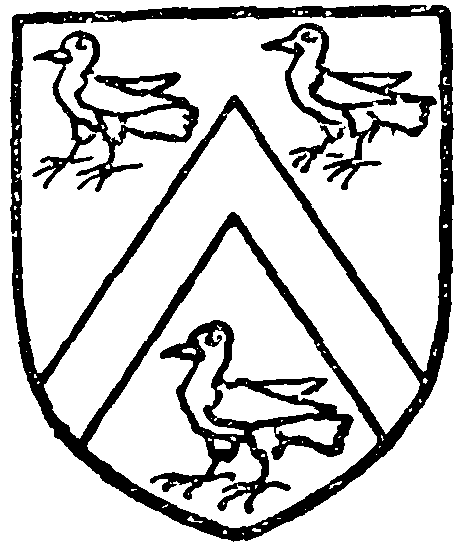
Sayer of Preston. Gules a cheveron between three sea-pies argent.
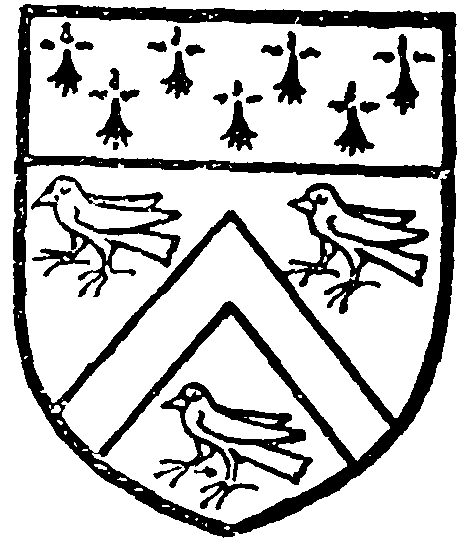
Sayer of Worsall. Gules a cheveron between three sea-pies argent with a chief ermine.
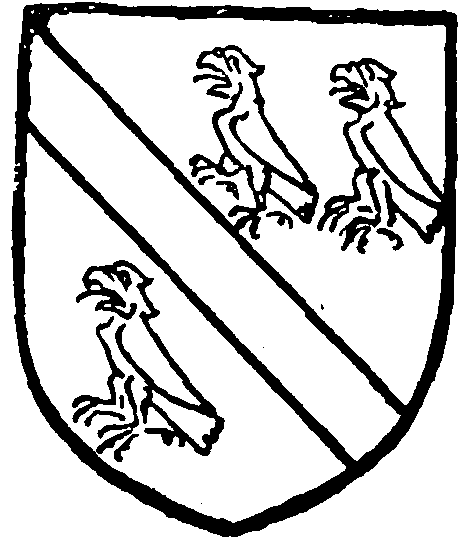
Witham of Cliffe. Or a bend between three eagles close gules.
Sir John Eden died in 1728, and his great-grandson Sir Robert Johnson-Eden, (fn. 318) who succeeded in 1812 and died in 1844, about 1820 conveyed his Preston estate to David Burton Fowler, who had previously acquired Witham Hall, another part of the Witham family's former possessions. (fn. 319) Mr. Fowler built Preston Hall in 1825 and died in 1828, having bequeathed the estate to a grand-nephew Marshall Robinson, who took the name of Fowler. (fn. 320) His son Marshall Fowler sold Preston Hall to Sir Robert Ropner, but continued to reside there till his death. It is now the residence of Mr. Leonard Ropner, youngest son of the late Sir Robert Ropner.
In 1403 it was found that John son of Lawrence de Seton had held, in right of Joan his wife, a messuage, 4 oxgangs of land and 10 acres in Preston, or rather less than William Sayer; the services were unknown. The heir was a son Thomas, aged twenty-two. (fn. 321) About the same time the grandfather's widow, Isabel de Seton, died in possession of her third part; the heirs were the above-named John Sayer and Thomas de Seton. (fn. 322)
In 1426–7 Thomas made a number of feoffments of his lands in Preston upon Tees and elsewhere, by which they came into the hands of William Hutton of Hardwick. (fn. 323) After an inquisition made in 1435 William son of Gilbert Hutton of Hardwick was allowed to grant certain lands in Sedgefield to the altar of St. Katherine in the parish church there, because he would still continue to hold two messuages and 11 oxgangs of land in Preston upon Tees; these were held of the bishop by a rent of 19s. and suit of court. (fn. 324) In 1459–60 the feoffees of William Hutton deceased confirmed to his daughter Isabel his lands in Preston and elsewhere, with various remainders. (fn. 325) This estate was acquired by the Sayer family, as appears from the inquisition of John Sayer in 1496.
John Randolph was in 1361 recorded to have held nine messuages and 9 oxgangs of land in Preston by homage and suit of court; also another oxgang, which had come into the bishop's hands by virtue of an inquisition made in the time of Bishop Lewis (d. 1333), and for which he paid 6s. 8d. rent. The heirs were daughters: Margaret wife of William de Hett, Joan wife of William de Elmeden, Agnes wife of John Fossour, and Alice, all over sixteen years old. (fn. 326)
The inheritance of John Randolph can be traced for some time, though it appears to be omitted in Hatfield's Survey. (fn. 327) William de Hett died in or before 1388 holding a messuage and 30 acres in Preston by knights' service and suit of court. His son Thomas, aged thirty, succeeded, (fn. 328) and in 1390 was found to have held 1 oxgang of land in Preston upon Tees, as of the manor of Hett, by knight's service. Thomas had had two sisters: Elizabeth, who had been wife of Nicholas de Hawkeswell and had left a son and heir Robert, aged fourteen, and Alice wife of William de Blakiston. (fn. 329) Robert de Hawkeswell died on 10 August 1404 holding two messuages and 2¼ oxgangs of land by knight's service. (fn. 330) He left a son John, who died 1 March 1419–20 holding the same estate; his heir was Joan widow of Nicholas Gower, aged forty, she being daughter of Alice sister of John's grandmother Elizabeth. (fn. 331) Some other Gowers occur in the records in addition to the lords of Elton, (fn. 332) but the Preston lands descended, like Hett in Merrington parish and Haliwell, to Nicholas Gower, who died in 1496 or 1497 holding 2¼ oxgangs of land by knight's service and suit of court, (fn. 333) and to Thomas Gower (1561). (fn. 334)
The Elmeden part of the Hett lands in Preston descended in a succession of William Elmedens until the 16th century, when an heiress Elizabeth married William Bulmer. (fn. 335) Thomas Elmeden before 1403 sold 6 oxgangs in Preston to William Hutton. (fn. 336)
In 1360 Ranulf de Preston held a messuage and 10 oxgangs of land of the bishop by the eighth part of a knight's fee; his heir was a daughter Alice, aged fifteen. (fn. 337) Cecily the widow of Ranulf held a third part in dower down to 1381, when Alice was wife of Robert de Eden. (fn. 338) Robert Eden died in or before 1413 holding by knight's service three messuages and 10 oxgangs of land in Preston; his son and heir Thomas was of full age. (fn. 339) Thomas Eden, who died in 1437, held the same estate by the twentieth part of a knight's fee; his son William, aged thirty, succeeded. (fn. 340) He in turn was in February 1475–6 succeeded by a son Thomas, aged thirty. (fn. 341) Thomas died about 1479–80, (fn. 342) and his widow Isabel had dower. (fn. 343) The next step is not clear, for about the same time the wardship and marriage of Thomas son and heir of William Eden, who had held land in Preston, were granted to John Halyman (fn. 344); but another William Eden succeeded, who, at his death in 1509, left a son and heir William, under age. (fn. 345) This may be the William Eden of Durham who stands at the head of the recorded pedigree of the family. (fn. 346) The inquisitions do not show that he had any land in Preston. (fn. 347) It seems probable, however, that this estate descended in his family, and was finally inherited by Sir John Eden, purchaser of the manor in 1722.
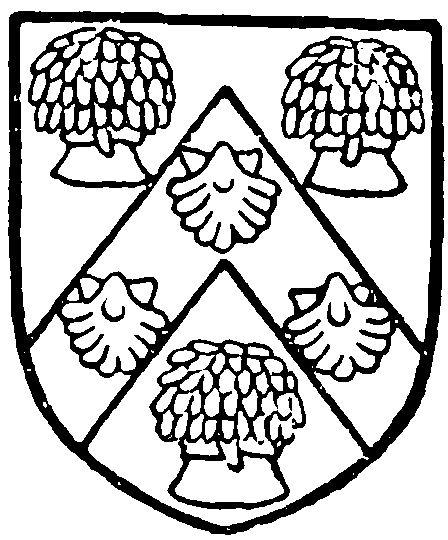
Eden. Gules a cheveron argent between three sheaves or with three scallops sable on the cheveron.
Lands in Preston upon Tees were granted to Thomas de Claxton in or before 1384, when John de Nevill, lord of Raby, confirmed the same. (fn. 348)
The court rolls show demises of part of the episcopal demesne to Richard Osberne in 1416 and 1421 and to William Osberne, chaplain, in 1444. Littleness, Sunderness and other parcels in the field of Preston were included. The rent declined from £26 a year to £21. (fn. 349)
In the 17th century families named Lambert (fn. 350) of Stockton and Wilde (fn. 351) of Ketton had land in the township.
CHURCHES
The church of ST. THOMAS is a building of red brick with stone dressings erected in 1710–12 (fn. 352) in the plain classic style of the day. It consists of a chancel 45 ft. by 22 ft., nave of six bays 105 ft. 6 in. by 22 ft., with north and south aisles each 17 ft. wide, and west tower 80 ft. high, and stands slightly to the north of the old chapel which was pulled down at the time of its erection. No record of the appearance of the old chapel has been preserved, but it was pronounced 'ruinous and too little' in 1705. (fn. 353) The nave and aisles of the present building are under one flat-pitched roof originally covered with lead, for which slates were substituted in 1793. A vestry was erected at the east end of the north aisle in 1719, together with a west gallery in which an organ was placed in 1759. (fn. 354) A second gallery was erected on the north side in 1748 and another on the south in 1827, but during the remaining years of the 19th century no alterations were made in the fabric. In 1906 the old chancel, which was very short and little more than a recess at the east end, was rebuilt on a larger scale, the floor of the nave relaid, and the old pews replaced by modern oak seating. A side chapel and clergy vestry from designs by Mr. W. D. Caröe were added in 1925 and paid for out of a bequest by Mr. T. L. Kirk of Norton. A quire vestry was at the same time built from subscriptions of the congregation.
Externally the building is of little architectural interest, the detail being very plain. The nave has six large round-headed windows on each side and two well-designed doorways on the south below the end windows. The walls terminate in a cornice and plain brick parapet.
The new chancel (fn. 355) and its fittings form a very fine piece of modern Renaissance work. As seen from the west end of the church in contrast with the long plain nave it has an appearance of much dignity and beauty. It contains very fine pavements of Sicilian, Frosterley and Egyptian marbles. The old altar rails have been retained. They are said to have been made by Capt. Christopher out of drift oak picked up by Capt. Cook, with whom he sailed on his last voyage.
The nave arcades consist of six semicircular arches springing from square pillars, and there is a semicircular chancel arch. The piers and arches are all plastered, and there are flat plaster ceilings to the nave and aisles. The side galleries extend as far as the fourth bay from the west and are contained within the aisles. The organ retains its old position in the west gallery.
The tower, which forms the west porch, is of three stages with large round-headed belfry windows and a straight brick parapet and angle pinnacles. The west doorway is of some architectural merit, and there is a large west window with a rounded head and pediment above. The angles are emphasized by stone quoins. A clock and chimes were placed in the tower in 1736.
The vestry is panelled in oak all round, and the pulpit is the original 18th-century one of oak of good design. The font also is original, with an octagonal fluted bowl of Frosterley marble. The organ built in 1759 was replaced by a new instrument in 1900.
There is a ring of ten bells, two of which are by Christopher Hodgson, 1696, and four by Samuel Smith of York, 1714. The other four, cast by Llewellins & James of Bristol, were added in 1898 as a memorial of the sixty years of Queen Victoria's reign. (fn. 356)
The plate consists of a chalice and cover made at York in 1688 by John Oliver, inscribed 'Capel de Stockton 89 ex dono Willmi Lee'; another chalice and cover of the same date and make inscribed 'Capel de Stockton 89 Tho. Rudd Curat Stephan Whidwright guard'; a paten of 1702 inscribed 'Tho. Rudd Curate, Tho. Sutton and Robt Thursby Chapple Wardens of Stockton March ye 26th 1703'; a paten of 1711 with the mark of Seth Lofthouse, London; two flagons of 1728 made by Thomas Farrer, London, one inscribed 'The Gift of Nicholas Swainston Esqr Anno Domini 1727,' and the other 'Mrs. Ann Stainsby widow of Mr. Robert Stainsby gave ten guineas towards this piece of plate'; a flagon of 1730, Newcastle make, inscribed 'The Gift of Mr. Robt Bishoprick 1730'; two plates of 1743 made by Humphrey Payne of London inscribed 'Stockton Church 1743'; a large almsdish of 1743 made by John Gilpin, London, inscribed 'The Gift of Catharine Jackson'; a small cylindrical cup and paten, 1821; a small chalice and paten of 1824, both inscribed with the names of the vicar, curate and churchwardens, 1825; and two chalices of 1863 by Barnard & Sons of London. (fn. 357)
The registers begin in 1621.
In the south-west corner of the churchyard is a handsome war memorial erected by public subscription from a design by Mr. H. V. Lanchester, F.R.I.B.A., and at a cost of £7,500. It was unveiled by the Earl of Durham and dedicated by the Bishop of Durham on 31 May 1923.
The church of the HOLY TRINITY, in the High Street, was completed in 1837. It is a building in the Gothic style consisting of a chancel, nave with north and south aisles, north and south transepts and west tower with spire. The parish was formed in 1837. (fn. 358) The living is a vicarage in the gift of the Bishop of Durham.
The church of ST. JAMES, in Portrack Lane, was completed in 1868. It is a stone building in the style of the early 14th century, consisting of a chancel, nave with aisles, north and south transepts, organ chamber, south porch, and west tower with spire. The parish was formed in 1864 (fn. 359) from that of St. Thomas. The living is a vicarage in the gift of the Crown and the Bishop of Durham alternately.
The church of ST. JOHN BAPTIST, in Alma Street, was completed in 1874. It is a brick building in the Basilican style, and consists of an apsidal chancel, nave with north and south aisles, and south porch. The parish was formed from that of St. Thomas in 1871. (fn. 360) The living is a vicarage in the gift of the Bishop of Durham.
The church of ST. PETER, in Yarm Road, was completed in 1881. It is a brick building with stone dressings, in the Gothic style, and consists of a chancel, nave with north and south aisles, south porch and west tower. The parish was formed from the parishes of St. Thomas and Holy Trinity in 1875. (fn. 361) The living is a vicarage in the gift of the Crown and the Bishop of Durham alternately.
The church of ST. PAUL, in Wellington Street, was built in 1885. It is a brick building with stone facings in the 13th-century style, and consists of a chancel, nave, vestry, organ chamber, south-west porch and bell gable. The parish was formed in 1875 out of St. Thomas and Holy Trinity parishes. (fn. 362) The living is a vicarage in the same gift.
The church of ALL SAINTS, Preston upon Tees, is a small building attached as a mission church to Holy Trinity. Other mission churches in the parish are that in Bowesfield Lane and another at Fairfield served by the clergy of St. Paul's. St. James' Hall in Tilery is licensed for public worship and served by St. James'.
ADVOWSON
In the ordination of the chapel of Stockton made before 1237 it was agreed that the vicar of Norton should find the chaplain and that his parishioners in Stockton, Preston and Hartburn should have right of baptism and burial at Stockton, visiting the mother church and making their offerings there on the feast of the Assumption (15 August). They were to pay the vicar of Norton 50s. a year and to offer 1d. with the blessed bread every Sunday at Stockton except on the days when they gave blessed bread to Norton. (fn. 363) Stockton chapel, which may have been of much earlier origin, thus became a parochial chapelry practically independent of the parish church. Later it was described as the free chapel of St. Thomas the Martyr. The payment of 50s. appears to have been augmented afterwards, for in an account made about 1705 it was recorded that the inhabitants of the chapelry paid £3 a year to the vicar of Norton towards a curate to be maintained at Stockton. This payment was called the 'Priest's own,' and was collected at the rate of 12d. from each 2 oxgangs of land, widows paying 8d. and others who had no land 6d. For tithes of fish each cobble paid 4s. and gave a salmon cock or scurf worth 6d. (fn. 364)
The parochial chapel obtained an endowment of land by gift from Bishop Nicholas de Farnham (1241–9). This was described as 4 oxgangs late of Maud de Combe, and was evidently the land held about 1184 by Robert de Cambois (Combe). (fn. 365) On the confiscation of such chapels by Henry VIII and Edward VI it was returned that the chaplain's house was worth 6s. 8d. a year; four burgages, with barn and 4 oxgangs of land, paid £4 14s. 10d.; another piece of land, the third part of an oxgang, for the maintenance of two candles burning before the Blessed Sacrament, paid 5s.; rents of 1s. 6d. and 6d. were due to the bishop for the lands; and the net income was £5 3s. (fn. 366) The lead and bells of the chapel were also noticed, (fn. 367) but the fabric was spared on the ground that it stood a mile from the parish church and was used by the people of various parishes 'in the winter time, when for rainy floods they could come none whither else to hear divine service.' (fn. 368) During the Northern rising of 1569 the altar was rebuilt in Stockton Church, (fn. 369) and probably mass was said there, but nothing more is stated. About ten years later the curate was unlicensed (fn. 370) and the roof of the chapel was in decay. (fn. 371)
The old endowment was sold by the Crown in 1613 to Francis Morrice and Francis Philipps with many other like parcels, being described as the mansionhouse of the chaplain and 4⅓ oxgangs of land belonging to the chapel. (fn. 372) In 1618 the grantees sold it to Richard Grubham, (fn. 373) and it was in 1644 sequestered by the Parliament for his adherence to the king's party, (fn. 374) but about 1648 it was acquired by John Jenkins, a Welshman and a major in Cromwell's army, who lived in Stockton at the corner of Bishopton Lane. (fn. 375) The estate was known as the 'queen's land,' and a moiety was in 1653 claimed by Rowland Burdon, whose sister had married Jenkins, (fn. 376) but their claim seems to have failed. Jenkins died in 1661, having made a gift to the poor of the place, and in his will mentions his burgages and 4⅓ oxgangs of land, obviously the chapel endowment; the Grange field and Miln eye were perhaps portions of it. (fn. 377) The land was probably that marked 'freehold' on the plan of 1724, just north of the old borough boundary. (fn. 378)
It is not clear how the curate or chaplain was maintained after the Reformation. In the Survey of 1647 the benefice is called 'a poor pension, not worth above £30 or £35.' (fn. 379) A note by Thomas Rudd states that 'Rowland Salkeld was left curate at Stockton by Mr. Mallory (vicar of Norton), who was forced from his vicarage and went to the West Indies, and should have a fifth of the vicarage. But Mr. Salkeld got the chapel turned into a vicarage, which he secured to himself.' (fn. 380)
Thomas Rudd became curate of Stockton in 1663, and revived Salkeld's plan for making an independent parish. He first caused the chapel to be replaced by a new church on a fresh site given by the bishop in 1710–12, and then procured an Act of Parliament by which from 24 June 1713 Stockton became a parish with the same bounds as the ancient chapelry. (fn. 381) The incumbent was to be styled vicar of Stockton, and to answer for a third part of the firstfruits and other charges hitherto levied upon Norton. To compensate for loss of rates £100 was paid to Norton. (fn. 382) The Bishop of Durham was made patron of the new benefice, and this arrangement continues.
At the formation of the parish the Bishop of Durham was empowered to grant some land for an endowment. He gave a piece close to the church as a site for a vicarage and another piece, between Silver Street and Bishop Street, the older South and North Streets, with Thistle Green. Soon afterwards the vicar and vestry granted this land out on lease for 1,000 years. As the town grew it became obvious that this policy had been erroneous, but an attempt to upset the lease in 1817 was defeated on trial. (fn. 383)
The 'chapel of the manor' was within the bishop's manor-house or castle, and is often mentioned in connexion with charters granted there, (fn. 384) ordinations held, (fn. 385) and other episcopal rites performed. (fn. 386)
CHARITIES
The educational charities have already been dealt with. (fn. 387)
The official trustees hold a sum of £3,946 14s. 4d. 5 per cent. War Stock, producing £197 6s. 8d. a year, in trust for the Grammar school, which includes a sum of £900 consols derived under the will of George Sutton, proved in the P.C.C. on 24 April 1817. The official trustees also hold £2,231 8s. 10d. consols, the annual dividends, amounting to £55 15s. 8d., being applicable as an exhibition endowment.
Elizabeth Whitley's Foundation, created by a codicil to her will proved at Durham 15 December 1772, consists of a sum of £321 10s. 1d. consols, the annual dividends of which, amounting to £8 0s. 8d., are applicable, under an order of the court of Chancery of 7 August 1867, in keeping in repair Elizabeth Whitley's monument in Stockton churchyard; so much of the income not required for this purpose is applied for the benefit of St. Thomas's School.
St. Thomas's School also receives the sum of £1 5s., the dividends on £41 17s. 9d. India 3 per cent. stock derived under the will of William Clarke Vincent, proved at Wakefield on 2 December 1896, the original trusts of these charities for the repair of monuments in the churchyard being void. The sums of stock are held by the official trustees.
Charitable Institutions.
The Almshouses and Stockton Dispensary. The old almshouses, which appear to have been founded in 1862, were in 1895 sold for £5,000, a portion of which was applied in the purchase of a new site and the erection of new almshouses with accommodation for a dispensary, the residue being invested in £1,561 17s. 7d. India 3 per cent. stock with the official trustees, producing £46 17s. yearly. The new almshouses consist of a two-storied building, two rooms on the ground floor of which are used as a dispensary. The almshouses are occupied by eighteen aged women.
In addition to the sum of £300 consols derived under the will of George Sutton above referred to, the almshouses were endowed with £100 consols by the will of Mary Raisbeck, proved on 25 November 1853; with £150 consols by the will of Mary Lambert, proved at Durham on 26 February 1875; with £285 6s. 8d. consols by the will of Lydia Wilson, proved at Durham on 16 March 1876; and with £1,787 12s. 1d. consols forming the endowment of the Dinsdale Memorial Charity Fund by declaration of trust of 24 Oct. 1923. The sums of stock are held by the official trustees. The dispensary above referred to is conducted by a committee of subscribers, and is supported by voluntary contributions, and with the interest of certain invested funds. The charity is regulated by schemes of the Charity Commissioners of 1870 and 1898.
The Stockton and Thornaby Hospital, comprised in a deed of 3 August 1875, is supported mainly by voluntary contributions. The official trustees, however, hold in trust for the hospital a sum of £219 11s. 2d. London County 3 per cent. stock, derived under the will of Edward D'Oyley Bailey, proved at London on 26 August 1896. A sum of £525 3½ per cent. stock of the Stockton Corporation is also held by the trustees of the hospital, arising from a legacy of £250 by the will of James Brown, 1901, and a gift of £250 by Frank Brown, and a legacy of £25 by the will of Miss Elizabeth Clifton. Joseph Richardson, by his will proved at London on 5 December 1902, bequeathed £1,000 to the Free Surgical Hospital, of which £500 was appropriated to the hospital building fund and £500 invested in £565 14s. 3d. London County 3 per cent. stock with the official trustees, the dividends of which are being accumulated to replace £250, part of the £500 expended in buildings. The official trustees also hold £5,031 12s. 5d. 5 per cent. War Stock, made up from various bequests, producing £251 11s. 6d.; £350 3s. 10d. India 3 per cent. stock, being a legacy from Alderman A. G. Rudd; £146 13s. 8d. Port of London 4 per cent. B stock, being legacies from H. Tossall and Jane Heslop; £524 6s. Port of London 3 per cent. A stock, being legacies from T. E. Atterby and Kate Walker; £1,000 5 per cent. War Stock, being the Madge Free Cot Fund founded by declaration of trust 24 July 1919; and £1,700 5 per cent. War Stock, being the Littleboy Free Bed Fund founded by declaration of trust 14 Sept. 1925. Special investments for the Extension Fund Account, not held by the official trustees, are £10,000 5 per cent. National War Bonds, 1928, being the donation of Sir Robert Ropner, and £5,746 15s. 8d. 4 per cent. Funding Stock, being a bequest from the estate of the late Wilfrid Evelyn Littleboy.
The Ropner Convalescent Home, comprised in a deed of 9 August 1897, consists of a house and about 3½ acres of land situate in Middleton-One-Row, purchased with £2,000 given by Robert Ropner in commemoration of the sixtieth anniversary of the reign of Queen Victoria for the benefit of workmen, their wives and families, and the poor of Stockton and Thornaby on Tees.
Distributive Charities.
In 1661 Major John Jenkins, by his will, gave 52s. yearly out of lands in Stockton to pay every Sabbath Day 12d. in white bread. The charity was distributed every Sunday before the altar of the parish church. Part of the rent charge was redeemed in 1920 by the transfer of £28 13s. 4d. consols to the official trustees. The income is now £1 17s. 11d. from the rent charge and 14s. 4d. from dividends.
The charity of Elizabeth Bunting, founded by a deed of 1 May 1777, is endowed with £378 13s. 6d. consols, with the official trustees. The annual dividends, amounting to £9 9s. 4d., are, under a scheme of 23 January 1872, distributed by the vicars of Stockton-on-Tees, Holy Trinity, St. James, and St. John the Baptist in their respective parishes, generally in money doles of 10s.
In 1781 John Snowden, by his will, gave £100 stock to the vicar and churchwardens of Norton and Stockton, the interest to be distributed to decayed housekeepers, preference to be shown to any in the shoemaking business. The legacy is now represented by £81 7s. 10d. consols, producing £2 0s. 8d. yearly. The income is distributed among poor shoemakers chosen from the whole of the ancient parish.
George Sutton, by his will proved at London on 24 April 1817, bequeathed certain stocks upon trust for charitable purposes. These legacies are now represented by a sum of £1,309 0s. 9d. consols, with the official trustees, producing yearly £32 14s. 4d.; the interest on £333 6s. 8d. consols to be applied in providing blankets for the poor; the interest on £675 14s. 1d. towards the stipend of the organist of the parish church, and on £300 consols for the dispensary of Stockton.
The official trustees also hold, under a declaration of trust of 25 July 1894, a sum of £209 19s. 10d. consols, purchased with money subscribed some years previously by private individuals to supplement the Blanket Club branch of George Sutton's charities known as Mrs. Sutton's Blanket Club. The annual dividends, amounting to £5 5s., are applied in the distribution of blankets.
George King, by his will proved at York on 17 October 1826, bequeathed his residuary estate, the interest to be applied, irrespective of and in addition to the amount received (if any) for poor law relief, for the relief of the poor. The endowment consists of £1,626 7s. 4d. consols, with the official trustees, producing £40 13s. yearly. The charity is regulated by a scheme of the Charity Commissioners of 11 September 1891.
Anne Barker, by a codicil to her will proved at London in 1860, gave £50, the income to be distributed among poor not in receipt of parochial relief. The legacy is represented by £53 5s. 2d. consols, with the official trustees, and the income, amounting to £1 6s. 4d. yearly, is distributed in small sums.
John Farmer, by his will proved at Durham in 1879, gave £100, the interest to be distributed at Christmas among the old people residing in the workhouse of Stockton-on-Tees. The legacy, less duty, is represented by £105 5s. 3d. 5 per cent. War Stock with the official trustees, producing £5 5s. 4d. yearly.
The same testator left £100, the interest to be divided equally among the Scripture readers engaged in connexion with the churches of St. Thomas, Holy Trinity, St. James and St. John, in Stockton. The legacy, less duty, was invested in £83 16s. 4d. India 3 per cent. stock, with the official trustees. The income, amounting to £2 10s., is divided among the readers in the ecclesiastical parishes of Stockton and Stockton St. James.
Ecclesiastical District of Holy Trinity.
The Holy Trinity National School, (fn. 388) founded by deed poll 1 March 1847, is endowed with a sum of £470 13s. 2d. consols, arising under the will of George Sutton above mentioned.
George Robinson, by his will proved at London in 1866, directed his trustees, on the termination of certain life interests, to transfer twenty Preference Shares in the North Eastern Railway Company to the official trustees, half the income therefrom to be distributed among the poor of Holy Trinity and the remaining moiety among the poor of St. John in Darlington. The last of the life interests determined on 8 September 1899, and in 1900 £675 London and North Eastern Railway first guaranteed 4 per cent. stock, representing the twenty Preference Shares, was transferred to the official trustees. The stock produces £27 yearly, one-half of which is applicable to Holy Trinity.
Ecclesiastical District of St. John Baptist.
Edward D'Oyley Bayley, by his will proved at London on 26 August 1896, bequeathed, subject to certain life interests, since determined, £200 for the benefit of the organist of St. John's Church. The endowment consists of a sum of £219 11s. 2d. London County 3 per cent. Consolidated Stock, with the official trustees, producing £6 11s. 8d. yearly.