A History of the County of Warwick: Volume 4, Hemlingford Hundred. Originally published by Victoria County History, London, 1947.
This free content was digitised by double rekeying. All rights reserved.
'Parishes: Berkswell', in A History of the County of Warwick: Volume 4, Hemlingford Hundred, ed. L F Salzman (London, 1947), British History Online https://www.british-history.ac.uk/vch/warks/vol4/pp27-34 [accessed 30 April 2025].
'Parishes: Berkswell', in A History of the County of Warwick: Volume 4, Hemlingford Hundred. Edited by L F Salzman (London, 1947), British History Online, accessed April 30, 2025, https://www.british-history.ac.uk/vch/warks/vol4/pp27-34.
"Parishes: Berkswell". A History of the County of Warwick: Volume 4, Hemlingford Hundred. Ed. L F Salzman (London, 1947), British History Online. Web. 30 April 2025. https://www.british-history.ac.uk/vch/warks/vol4/pp27-34.
In this section
BERKSWELL
Acreage: 6,169.
Population: 1911, 1,577; 1921, 1,857; 1931, 1,729.
The parish of Berkswell is divided from Meriden on the north by a small stream, called in 1550 the Hornbrook, (fn. 1) which formerly ran into the River Blythe at the point where the latter is now canalized. The Blythe forms the western boundary of the parish as far south as Bradnocks (fn. 2) Marsh Mill; the boundary then runs east along a stream to the Coleshill-Warwick road, the course of which it follows approximately, running south-east, to Blackhales Farm; (fn. 3) then northeast to Burton Green, and north up the road by Tile Hill and Banner Lane to Hockley, and so to the northeast angle of the parish.
The village lies north of the centre of the parish where the road running south from Meriden is crossed by one from Hockley to the Coleshill-Warwick road, and is surrounded by a belt of trees forming the bounds of the Berkswell Hall grounds. Farther north the Meriden road is crossed by another road from Hockley which turns north-west by Cornets End, (fn. 4) with a branch lane south-west to Mercote.
Berkswell Station, about a mile south of the village, on the L.M.S. line from Rugby to Birmingham, is the junction for a branch line to Kenilworth, opened in 1884. Truggist Lane runs east from the station past Carol Green, (fn. 5) where it crosses the Meriden road, and Nailcote Hall (fn. 6) to Tile Hill. From Burton Green Hob Lane runs north-west past Beanitt Farm. (fn. 7)
The subsoil is clay, formerly dug for marl and apparently for bricks, as the names of 3 brickmakers occur in the parish registers between 1698 and 1706. (fn. 8) At that time flax seems to have been an important crop, as 7 flaxdressers and a 'hatcheler' are mentioned, and some of the 17 weavers who also occur may have woven linen. Most of the land, which lies mainly at a height of c. 400 ft. but falls to 280 ft. at the northwest angle of the parish, is now pasture. There is little woodland, beyond scattered copses, but several small streams and a large number of ponds.
The Rectory, south of the church, is an early-18th-century house, red brick with stone angle-dressings, and has a main block between two wings that have curvilinear gables. A staircase has thin twisted balusters and ramped handrails.
In a small triangular green, south-east of the church, are the ancient stocks with five sockets. About it are fine elm-trees, recently pollarded, and near by is the well, or spring, from which the place presumably derives its name.
The small village lies about 200 yards to the east of the church and contains three or four ancient buildings. The Bear and Ragged Staff Inn, south-east of the cross-roads, is a late-16th-century house of T-shaped plan, with some original timber-framing, chamfered ceiling-beams, and a wide fire-place. Opposite is a mid-16th-century timber-framed building with large curved braces in the external walls. The ceilings are open-timbered. It is now a café. South of it is a 17th-century house of square framing.
There are about thirty-six other ancient buildings scattered about the parish, the majority in the southern half, with remains of timber-framing and usually old chimney-stacks. Unless otherwise described they are of the 17th century. The most important are Blind Hall, Ram Hall, Nailcote Hall, Moat House Farm, and Moat Farm.
Blind Hall, about ½ mile north-north-east of the church, is a timber-framed house of c. 1600. The original plan is L-shaped, the main body facing south and the east wing projecting southwards. Most of the original rectangular framing remains, on ashlar stone foundations. The west wall is of 18th-century brickwork, and two lower wings of the same period project north and south of it. The lower rooms have chamfered ceiling-beams, but the roof timbers are probably of later repair. A central chimney-stack at the junction of the two parts has a 10-ft. fire-place towards the east wing. Above the roof are four diagonal shafts of thin bricks: a middle double shaft between them may be later. The forecourt is entered by a gateway having brick posts with moulded and ball heads of red sandstone. A barn, chiefly of red brickwork dated 1735 with the initials E and D P, has a few older timbers in the roof and gable-heads.
Holloway Farm, ¾ mile to the north-west, is a small late-16th-century house of two bays, facing nearly south, with an early-17th-century cross wing at its west end. The older part retains most of its original framing and has a heavy roof-truss with curved braces to the cambered tie-beam. The purlins have curved wind-braces. A central chimney-stack has a wide fire-place.
Hornbrook Farm is a rectangular house of mid-17th-century square framing. The square central chimney-stack has a square pilaster on each face.
Ram Hall, about ½ mile south of the village, is an interesting Elizabethan house of two stories, cellars, and attics, with walls of red sandstone partly repaired with later brickwork. The plan is square and is formed by two parallel blocks with gabled north and south ends. The west front has a chamfered plinth containing cellar-windows, and a moulded string-course at the first-floor level, but the eaves-course is of 18th-century brick. The middle entrance has chamfered jambs and lintel and contains a nail-studded door, and there is a similar door in the original doorway on the north side. The windows, of three lights, have original moulded stone mullions. The north side has two gables with moulded copings and finials.
The rooms on both floors have stop-moulded ceiling beams and the roof, partly restored, has straight windbraces to the purlins. The central chimney-stack has a wide fire-place of stone and on the first floor are moulded stone square fire-places. The southern is flanked by Ionic fluted shafts and has a frieze and moulded shelf; over it is an embossed oval panel in a wreath surround. The staircase is set east of the wide fire-place, and in the upper story is a reputed hidinghole with a trapdoor. Another large space next the stack on and below the second floor is said to have been used for drying malt. There are several internal doors of battens and V-shaped fillets, hung with fleurde-lis strap hinges. A barn and other farm buildings are of old framing, and the remains of a wet moat survive west and south of the house.
Lavender Hall, a farm-house ¾ mile south-west of the church, is of late-16th-century origin but was encased, and probably enlarged, in brickwork late in the 17th century. The plan was then half-H-shaped, the wings projecting to the south. The space between the wings was filled in flush in the 18th century to make the plan rectangular. The certain evidence of the first period is the west wing, which has an original chimney-stack of three square shafts with square pilasters to each. Windows in the east wing, now bricked up, had late-17th-century wood mullions and transoms. The north front has the ancient plinth of red sandstone. In the older middle block is a fine late16th-century staircase reaching to the second floor. It has square newels with moulded shoulders and ball heads and moulded flat balusters. A large timberframed barn of five bays stands on the road-side south-west of the house.
Moat House Farm, ½ mile east of Ram Hall setting back north of the Coventry main road, dates from c. 1600. The original part is of L-shaped plan, the wings extending north and west. Most of its framing is displaced or faced with later brickwork, but the angle-posts and gable-head remain on the west and a little framing in the lower story of the east side, on the ancient stone foundations. Later in the 17th century another gabled wing of square framing was added in the north-west angle, use being made of the original angle-post in its construction. The central chimney-stack at the junction of the two original wings has reduced fire-places, but above the roof is a massive brick shaft of X-shaped plan. Around the house is the greater part of a square moat, dry on the north side, wet on the other three. Outside this, to the north-east, is a timber-framed barn.
Nailcote Hall, 1¾ miles south-east of the church, is a much restored house of late-16th-century origin. The west front has a main block between two gabled wings, all in one plane, the middle part having two smaller gables and a modern porch-wing. The lower story has close-set studding, all painted but apparently ancient, the upper story has painted mostly modern timbers. The windows are modern but the entrance has a nail-studded door. The rooms have chamfered ceiling beams, and a central chimney-stack with reduced fire-places has a heavy square shaft, above the roof, with a square pilaster on each face. To the east and south are modern additions.
The Bricklayers' Arms, an inn 11/8 miles south of the church on the west side of Station Road, is mostly of timber-framing, and a farm-house ¼ mile farther south has a timber-framed barn. At Catchems Corner, ½ mile to the south-east, are two cottages with framing: one is thatched. A former windmill ¼ mile to the south has a tapering round body of 18th-century brickwork with a wood capping: no sails are left. Green Meadow Farm, 5/8 mile east-south-east of the last, is an 18th-century brick house of two parallel ranges with a panelled chimney-stack. It has a barn of square framing.
Moat Farm, about 3/8 mile south-east of Green Meadow Farm, is a late-15th-century house almost complete. The plan is of modified T shape. The main block (the head of the T) about 50 ft. long faces east, and the back wing (or stem of the T) about 33 ft. long extends westwards. The former has a 15 ft. middle bay and south double bay of 18 ft. divided by original roof-trusses. These bays were probably a hall open from ground floor to roof. The two main trusses flanking the middle bay have chamfered and cambered tie-beams supported by heavy curved braces (one brace removed in the southern truss). The 18 ft. double bay is divided by a secondary truss with arched braces under a collar-beam. The side-purlins are supported by curved wind-braces forming pointed arches. A floor with chamfered beams and joists was inserted in the 16th century and a central chimney-stack built in south of the middle truss. The whole block has a single ridged roof from end to end but there is not visible evidence, at present, whether the 15 ft. northernmost bay was part of the hall or was always a two-storied wing. The walls are mostly of original close-set studding with curved braces and struts at the angles. The north gable-head is of square framing, the southern is plastered. Projecting windows in both stories of the front are of Elizabethan origin. The central chimney-stack had a wide fire-place with stone jambs and oak lintel. The southern fire-place on the upper floor has a four-centred stone arch. Above the roof are three diagonal shafts of thin bricks. The slightly lower west wing was the original kitchen and buttery and has walls of similar framing. The endmost chamber shows the original wide flat ceiling joists. The central chimney-stack of stone has a large fire-place. Above the roof it is modern. Around the house are the remains of a square moat, now nearly dry but said to have washed against the north side formerly. East of it is the byre with a timber-framed barn, &c.
MANORS
In 1086 BERKSWELL was held by the Count of Meulan. For some obscure reason the main entry of this estate was recorded under Northamptonshire, where the Count is said to hold 4 hides here, of which 3 were in his own hands. (fn. 9) Under Warwickshire he is said to have I hide, held by Leuenot under the Confessor, which Walter held of him (fn. 10) —this being presumably the fourth hide of the Northants entry. The count's lands passed to his brother Henry de New burgh, Earl of Warwick, and the overlordship of the manor continued with the earls. (fn. 11)
According to Dugdale (fn. 12) Earl Henry (1090–1123) gave Berkswell to Ranulf de Mundeville, or Amundeville. Niel de Amundeville held 1 knight's fee (presumably here and in Lighthorne) of the Earl of Warwick in 1166 (fn. 13) and was still connected with Warwickshire about 1200; (fn. 14) and in 1221 Richard de Mundeville is mentioned as lord of Berkswell. (fn. 15) This Richard's eldest son Richard married Isabel sister of John FitzAlan in 1249, when his father endowed her with ⅓ of all his lands. (fn. 16) One of the two Richards, probably the father, had a charter of free warren for his lands at Berkswell and Lighthorne, provided they were not in the king's forest, in 1252. (fn. 17) Ten years later Richard son of Richard de Amundeville was said to hold lands in Warwickshire worth not more than £12. (fn. 18) He took part with Simon de Montfort against the king, but under constraint. (fn. 19) In 1268 he was holding Berkswell as ½ fee of the Earl of Warwick, (fn. 20) and in 1277 Richard de Amundeville and his wife Maud (widow of John FitzAlan of Arundel) (fn. 21) sold the manors of Berkswell and Lighthorne to William de Beauchamp, Earl of Warwick, for £100 and a life-tenancy of these manors and of Brailes. (fn. 22) In 1285 Richard proved his right to free warren, but failed in his claim to hold view of frankpledge and the assize of bread and ale. (fn. 23) In 1297 a fresh arrangement was made by which Richard, in return for a grant of £100 a year for life, surrendered the manor to the Earl of Warwick, (fn. 24) whose widow died seised of it in 1301, when it passed to her son Earl Guy. (fn. 25) Berkswell then descended with the other estates of the earldom, coming to the Crown at the end of the 15th century. (fn. 26) It was among the manors granted in 1553 to John Dudley, Earl of Warwick and Duke of Northumberland, (fn. 27) but on his attainder reverted to the Crown, when the demesne lands were leased for 21 years to John Mann at a rent of £7 10s., (fn. 28) and certain pastures there to other persons. (fn. 29) In April 1557 the manor was granted to Thomas Marrow and Alice his wife, with remainder to their son Samuel and his heirs. (fn. 30) Samuel died in 1610, (fn. 31) and the manor descended in the male line for four generations to Sir Samuel Marrow, created a baronet in 1679, (fn. 32) who died at some date between 1683 (fn. 33) and 1686. (fn. 34) Under a settlement made in 1674 the five daughters and coheiresses of Sir Samuel were to hold the manor jointly; (fn. 35) accordingly we find courts held in 1705 and 1706 by Arthur Kay and Anne, Robert Wilmot and Ursula, John Knightley and Mary, Elizabeth Marrow, and Arabella Marrow. Some arrangement must then have been made, as from 1707 to 1750 Elizabeth Marrow held the courts, (fn. 36) and she was succeeded by John Knightley alias Wightwick (son of the above-mentioned John and Mary Knightley), whose widow Catherine held the manor from 1764 to 1812. John Eardley Wilmot (grandson of Robert Wilmot and Ursula Marrow) inherited the manor, but died in 1815. His son John Eardley Eardley-Wilmot, (fn. 37) who was created a baronet in 1821, was for twenty years chairman of the Warwickshire Sessions and advocated many penal reforms, especially in relation to the juvenile offender. He was M.P. for North Warwickshire from 1833 to 1843, in which year he was appointed governor of Van Diemen's Land; he was superseded in 1846, died early in the next year and was buried at Hobart, but is commemorated by a monument in Berkswell Church. The estates and lordship of Berkswell were sold by his son Sir John in 1862 to Thomas Walker, (fn. 38) who died in 1887, being succeeded by Frederick James Walker, (fn. 39) who sold in 1888 or 1889 to Joshua Hirst Wheatley, and his son Col. C. J. H. Wheatley, the present lord of the manor, inherited the property in 1925.
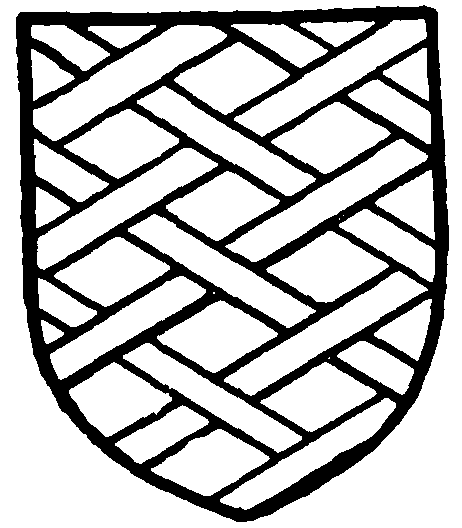
Amundeville. Azure fretty or.

Marrow. Azure a fesse engrailed between three maidens' heads cut off at the shoulders argent with their locks or.
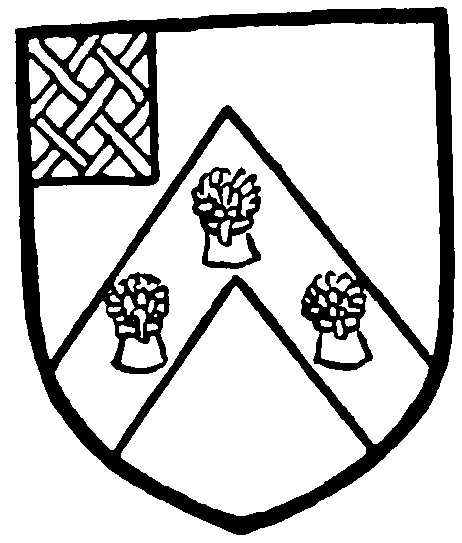
Eardley. Argent a cheveron azure charged with three sheaves or and a quarter gules fretty or.

Wilmot. Sable a fesse or between three eagles' heads argent with three scallops gules on the fesse.
The Domesday Survey shows that there was then in Berkswell woodland 1 league long and 1 league broad, (fn. 40) and in the second half of the 12th century Niel de Mundeville with Olive his wife granted to Kenilworth Priory the right to take fuel from his woods here. (fn. 41) A park is definitely mentioned as appurtenant to the manor in 1325, (fn. 42) and complaints of poaching in Berkswell Park were made in 1322 and 1366. (fn. 43) While Berkswell was in the hands of Richard II after the attainder of Thomas, Earl of Warwick, grants of the keepership of the park were made in 1397 and 1398. (fn. 44) Similarly during the reign of Henry VIII there were numerous appointments to the office of bailiff or keeper of the park, sometimes coupled with the posts of woodward and master of the hunt. (fn. 45) The park was included in the grant of the manor to Thomas Marrow in 1557. (fn. 46) Its original extent is not known, but the present park round Berkswell Hal lpresumably represents what remains of it.
A family who derived their name from Mercote existed in this district from the end of the 12th century, when Hamon de Morcote occurs. (fn. 47) Alan de Morcote, who occurs in 1220, (fn. 48) is mentioned in 1248 as holding 7 virgates in Morcote from Hugh de Loges as part of Hugh's serjeanty of Chesterton, (fn. 49) which is a long way from Berkswell but, as it happens, adjoins Lighthorne, which was held with Berkswell. Alan left a son John, (fn. 50) and other members of the family occur from time to time, (fn. 51) but there is no mention of the manor of MERCOTE until 1384, when William Warde of Charwelton and Margaret his wife, in whose right he evidently held, as warranty was given against her heirs, sold it to Thomas del Botrye. (fn. 52) In this family it apparently descended for about a century, passing by marriage to John Mathewe, a skinner of Coventry. (fn. 53) He died at the end of 1497, leaving a young son George (fn. 54) and a widow Agnes, presumably the 'daughter of Butterise'. (fn. 55) George had a son George, (fn. 56) who made various settlements of the manor of 'Morcote Hall' with its estates, including two water-mills, which led to disputes with his son Henry in 1624. (fn. 57) Henry was living here in 1640, (fn. 58) and the estate was still in the same family in 1730, (fn. 59) but seems to have been broken up soon after this. (fn. 60) By 1774 Sir John Eardley Wilmot had acquired a moiety of the manor, (fn. 61) and Mercote was no doubt absorbed into the Berkswell estate.
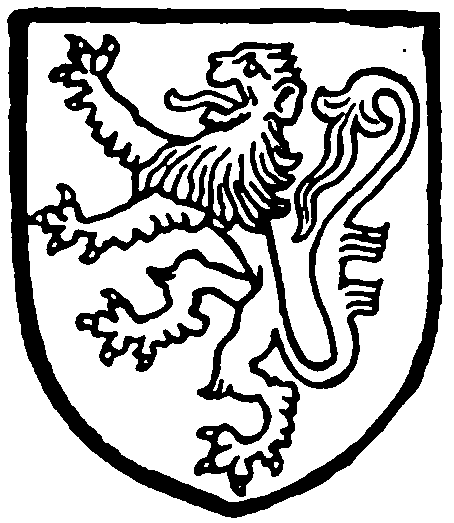
Mathew. Sable a lion argent.
CHURCH
The parish church of ST. JOHN THE BAPTIST consists of a chancel, nave, north and south aisles, south porch, west tower, and vaulted crypts below the chancel and part of the nave.
The earliest remains of the existing fabric indicate a chancel as now with the crypt below it and an aisle-less nave, dating from c. 1150. Later in the same century an octagonal crypt was added west of the other, under the east part of the nave, and a north aisle of two bays built, west of it, to avoid obstructing its window. This crypt probably replaced an earlier structure, as the 12th-century builders would be unlikely to excavate below an already standing nave, whereas an earlier vault in this position would promote the idea of continuing the crypt below the new chancel. Further enlargements began early in the 14th century with the addition of a north chapel to the chancel and the continuation of the north aisle eastwards to meet it, with perhaps a widening of the 12th-century aisle. About the same time the south aisle and arcade were built, material, including the doorway, being re-used from the 12th-century south wall of the nave. In the 15th century, probably the first half, the north aisle and chapel were rebuilt in one range, possibly because of weakness, as the work included a kind of reinforcing archway against the north side of the earlier north archway of the chancel. The west tower was added late in the 15th century, and the south porch with the chamber above it early in the 16th century. The clearstory of the nave was probably not earlier than the 17th century and perhaps as late as the 18th, for lighting the galleries inserted in the aisles. The south aisle walls were also heightened a little in the 18th century, also for the gallery, for which small windows (now abolished) were provided. Except for the roofs the repairs and restorations in modern times have not been on a large scale.
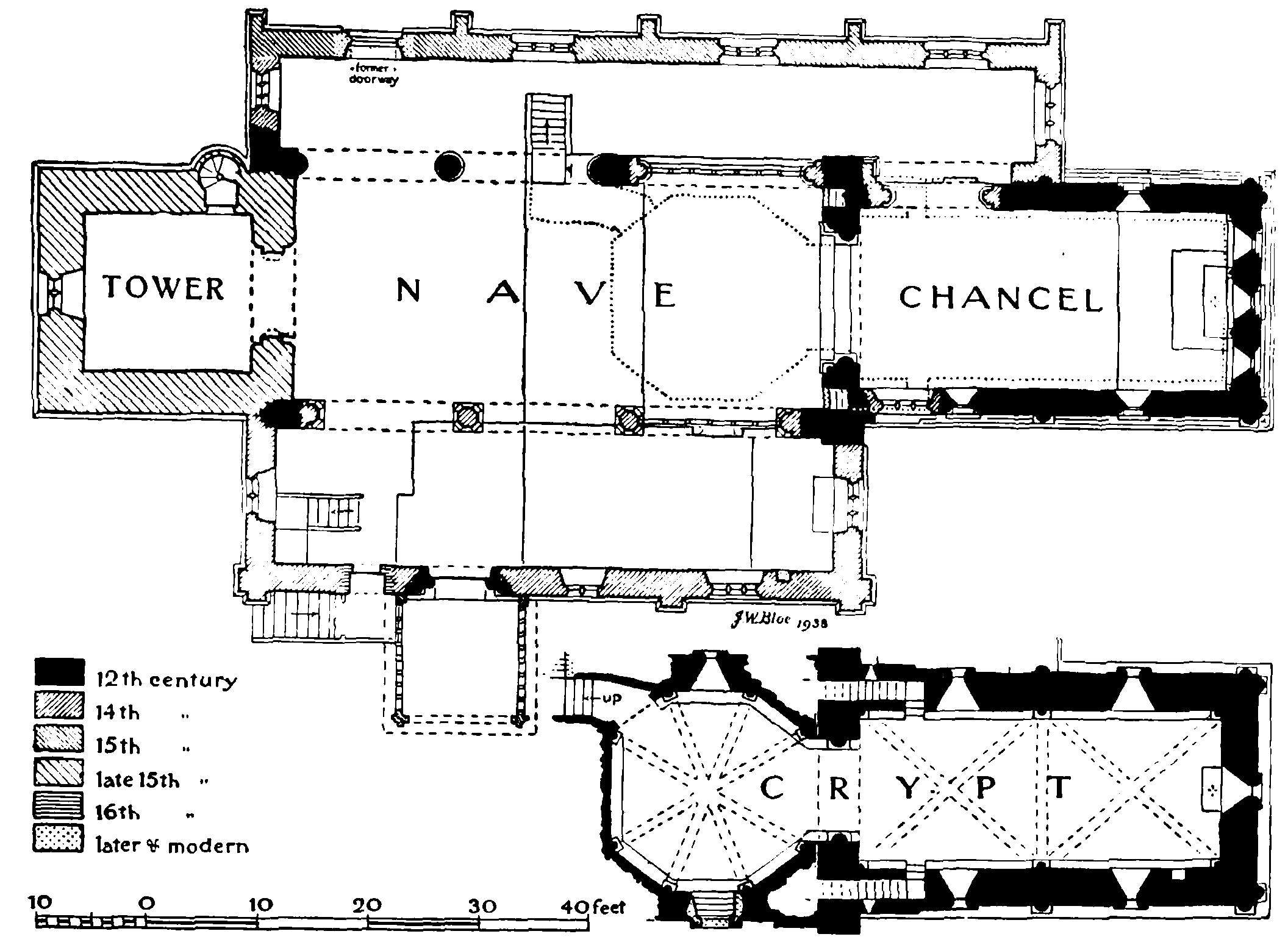
Plan of Berkswell Church.
The chancel (about 33½ ft. by 16½ ft.) has three 12th-century windows in the east wall, of two orders outside and a plain chamfered hood, with round nookshafts having scalloped or foliage capitals and moulded bases. Inside, the jambs and heads are splayed and have an outer square order, the arches being carried on half-round shafts between the windows and full-round shafts in the angles with moulded bases and foliage or scalloped capitals. The chamfered hood-moulds meet between the windows on carved stops, one a human head, the other a mask, almost a beak-head. Below the sills outside and ledge inside are moulded stringcourses. The side walls have similar windows, two in the south and one in the east half of the north wall, but of only one splayed order inside. West of the two on the south is an early-14th-century window of three trefoiled lights, the middle tallest, and plain tracery in a two-centred head with a plain external hood-mould. Opposite is a 14th-century archway, opening into the east end of the aisle; it has semi-octagonal responds with impost-moulds and a high segmental-pointed arch with hood-moulds on both faces with carved stops— foliage towards the chancel and heads (defaced) towards the aisle.
The chancel arch has jambs of two square orders towards the nave (one only towards the chancel), the inner with half-round shafts on the reveals, and with modern nook-shafts, all with moulded bases and scalloped square capitals, and grooved and hollowed impost-moulds that are carried to the side walls. The head, of two plain square orders, was semicircular but is depressed from settlement: it has a plain chamfered hood-mould. On either side of the archway, towards the nave, is a low doorway with a shouldered lintel at the top of the stairway from the crypt.
All the 12th-century work is of red sandstone; the walls are ashlar-faced inside and out. The plinth is of two chamfered courses. At the east angles are pairs of half-round pilaster-shafts with moulded bases, resting on the plinth, and scalloped capitals at the level of the eaves. Those to the side walls carry the projecting kneelers of the gable, but the two to the east wall now have nothing to support and above the capitals they are sloped back to the wall-face. The gable-head is modern.
The south wall has a similar shaft in the middle.
Below the middle east window and each of the original side-windows is a shallow buttress, also standing on the plinth, where it is about a yard wide; it is gathered in above to about half the width. In each is a plain round-headed window to the crypt. The lower part of the south wall at the west end is thickened for the side of the crypt-stair and contains a small loop light for it; at the extreme west end is another pilaster up to the eaves. The projecting eaves-courses on both sides are square and carried on corbels carved as human masks.
The pavement of polished stone slopes down about 6 in. from the sanctuary to the chancel arch, where there are three steps down into the nave.
The roof is barrel-vaulted with open timbers, divided into five bays by main arched beams that are treated with cable-ornament on the soffits. The central purlin is similar. These may be ancient; the other timbers are modern.
The crypt (about 33 ft. by 14½ ft.) is divided into two bays by the semicircular groined vaulting, which has plain chamfered diagonal ribs. These are carried on short round shafts with capitals like those above, and moulded bases raised on stone wall-benches. In the east wall and both side-walls each bay has a roundheaded window with splayed reveals and heads, and stepped ledges. The exterior of the north-western is covered by the north aisle. Next to the western windows are the original L-shaped flights of steps rising to the doorways flanking the chancel arch, which now have their lower halves walled up: the lower entrances have similar shouldered lintels. Above the stairs are rubble rounded vaults. The west arch has half-round shafts in the reveals with scalloped capitals and a semicircular head of one square order. It opens into an octagonal chamber (about 18 ft. by 18 ft.) under the nave. In each angle, raised on a 12 in. stone bench, is an 8 in. round shaft with a moulded base and a fluted or scalloped capital. They carry the plain chamfered radiating ribs of the vault, between which are the plastered cells, forming round arches to east and west and pointed arches to the other faces. The reveals and head of the east arch meet the west arch of the other crypt with straight joints. In the north bay is an original window like the others. The external head, now glazed, is exposed above the floor of the north aisle. A similar window in the south wall was widened by the cutting back of the east splay to form a segmentalpointed doorway with steps leading up through it. It is now blocked except for the head, which appears in a 2½ ft. parapet towards the south aisle. To bridge the rear of the doorway two 13th-century coffin-lids with incised long crosses were used. In the north-west side is an ancient segmental-headed entrance 4 ft. wide opening from a vaulted passage with steps down. This is now the entrance in use and has a modern flight of steps down to it from the north aisle.
The nave (about 48 ft. by 20 ft.) has a 12th-century north arcade of two bays, and east of it a wide archway. The last, except for the width, is similar in detail and date to the north archway of the chancel, but its hood-moulds stop on the impost moulds and the responds show the original moulded bases.
The 12th-century work has a round pillar and halfround responds with scalloped capitals and chamfered abaci. The semicircular arches are of two square orders with chamfered hood-moulds.
On the south side is an arcade of three bays of the 14th century with octagonal pillars and responds to match: the pillars have moulded bell capitals and small moulded bases on chamfered and square subbases. The heads and hood-moulds (on both faces) are like the north arches. The walling over the arches is of rubble—all red sandstone—but the clearstory above is of ashlar, with grey or cream stone mixed with the red, and has four plain square-headed windows on each side, probably of the 17th or 18th century, with chamfered jambs, mostly of the lighter stone. The east wall of the clearstory sets back about a foot from the 12th-century face below.
The low-pitched roof is covered with lead. The roof is divided into four bays by moulded tie-beams supported by moulded curved braces. The middle and two side purlins are also moulded and carry wide flat rafters. It appears to be of the early 16th century and older than the clearstory windows. If so, it may have been raised for the clearstory, or the latter windows have been altered.
The north aisle (about 8¼ ft. wide at the nave) overlaps the chancel at the east end to form a north chapel, probably replacing an earlier one. The east window is of three cinquefoiled ogee-headed lights and tracery (including two octofoiled lights) of the 15th century below a four-centred head. It has double-chamfered jambs and mullions of red stone of the 14th century, the head of old cream-coloured stone. In the north wall are three windows of similar elevation, but all of the lighter-coloured stone and with wide shallow hollows in the splays and heads on both faces. West of them was the north doorway, now only indicated by the lines of its jambs below a plain window with a segmental-pointed head and without mullions, of the 18th or 19th century. The west window has three very narrow pointed lights under a two-centred main head.
The north archway of the chancel is enframed towards the aisle by another deep archway in line with the nave arcade. It is of grey stone with square jambs and segmental-pointed arch with a moulding like those of the contemporary north windows.
The aisle walls are chiefly of cream-coloured or grey ashlar, except for the east plinth and some of the north plinth, which are of red sandstone. The north wall has five buttresses dividing it into four nearly equal bays each with a window, the westernmost replacing a doorway. The west wall has some original 12th-century rubble of a light red or yellow stone up to about 4 ft. from the tower wall; north of that is about 4 ft. of roughly coursed red sandstone rubble of the 14th century, both marked by broken seams. North of that it is of the 15th-century masonry of the north wall. The tops of the walls are of modern repair. The roof is a modern lean-to with a middle purlin and plain rafters.
The south aisle (about 12 ft. wide) has a 14th-century east window of three trefoiled lights and modern tracery in a two-centred head. In the south wall are two windows. The eastern has three narrow pointed lights and intersecting tracery in a twocentred head; the second is of two trefoiled lights and a plain spandrel in a two-centred head; both have external hood-moulds with head-stops.
A third window was put out of use by the outside staircase to the porch-chamber. The south doorway is of the 12th century, re-set. It has jambs of two orders, the inner chamfered, the outer square, with nookshafts having moulded bases and carved capitals, the eastern scalloped, the western with foliage. They have plain imposts, the eastern of red stone, the western of grey. The head, which is segmental instead of semicircular, is also of two orders. In the reveals are sockets for a drawbar. West of it is a four-centred doorway, probably for the original stair to the porch-chamber; it now opens into the space below the existing outside staircase. The west window is of two lights and modern tracery in a two-centred head. The walls are of red sandstone. Much of the ashlar in the south wall is 12th-century masonry re-used; it has a shallow buttress at each end and one between the two windows. Above the windows is a chamfered string-course, perhaps for a parapet: above it the wall has been heightened for the gallery and had small square windows to light it, now abolished. The east wall is of rougher ashlar and it meets the original south-east buttress of the nave with a straight joint. It also has a shallow buttress at the angle and shows the heightening to a shallower slope at the top. The west wall is similar. The flat lean-to roof is of the 18th century or later, but the trusses rest on ancient stone corbels carved as angels. In the south doorway is an ancient oak door of five long panels divided by nail-studded ribs; on it is an old key-hole scutcheon and a plate for a handle. There was originally a middle wicket-door, but it is now altered so that the three eastern panels open as the door. In the south wall is a 14th-century piscina with a trefoiled pointed head and a damaged round basin. Outside near the porch is a scratched mass-dial. The gallery, approached by a stair at the west end, has an 18th-century panelled front between the arches of the arcade.
The eastern 27 ft. of the tile-paved floor of the nave is higher than those of the aisles, the side risers or parapets under the arcades showing the heads of the lights to the octagonal vault below. The floor has two steps, 11 ft. apart, and also slopes down considerably from the chancel arch to the second step (some 27 in. in all) at the gangway across the nave. The slope continues down about 10 in. to the south entrance, but westwards the paving, of brick, is practically level up to the tower. This must have been a later alteration, as the moulded base of the 12th-century west respond is now buried below it. There are also steps and minor differences in the levels in the aisles.
The west tower (about 15 ft. by 14 ft.) is of two stages, the upper setting back on all four faces above a chamfered string-course, and is built of cream-coloured ashlar (Arden sandstone). The plinth is chamfered, the parapet embattled. It has no buttresses, but on the north side, near the aisle-wall, is a half-round projecting stair-turret with a semi-conical stone roof below the string-course. The vice has a lower four-centred doorway inside. The archway from the nave has continuous jambs and a two-centred head of two chamfered orders, the inner with a moulded impost. The reveals of the inner order have been cut back in the lower part to widen the opening. The west window is of two plain lights and plain spandrel under a fourcentred head, and the four windows to the bellchamber are similar. There are no windows to the middle story.
The south porch, of the 16th century, is of timber framing and of two stories, the upper jettied on its three faces. The entrance, 9 ft. wide, has moulded posts and a lintel, with quadrant brackets to form a flat arch springing from plain impost blocks: in the soffit is a rose carving. The sides are cemented in the lower half and open in the upper half with trefoiled pointed lights, eight in the east and five in the west side. The walls of the upper story are of close-set studding, the south front, and the north end above the aisle-roof, being gabled. Some of the timbers have been renewed and the windows have modern frames. The stairturret, in the angle of the west wall with the aisle, is plastered in the lower half and of similar framing in the upper, the west face having a half-gable. In place of the original spiral steps a straight stair of red sandstone leads up from the west, against the aisle wall, through a doorway at the half landing. This stair has an open pent-roof. The entrance to the upper chamber has an ancient battened door with an oak stock-lock. The ancient framing of the walls is seen inside and the roof has curved wind-braces to the purlins.
The round font with carvings is modern.
The two east arches of the nave-arcades have screens of c. 1500 on the raised parapets. The northern is of seven lights with moulded posts, and ogee heads with quatrefoiled spandrels, some retaining rosette centres, below the moulded top-rail carved with a running vine-pattern. The lower rail is plain, with masons' joints, and below it is a closed frieze panel and sill. This screen has been partly restored. The southern has six lights with segmental-pointed heads and trefoiled spandrels with rosette centres: otherwise it is similar to the northern.
In the tracery of the south-east window of the south aisle are two pieces of 15th-century glass. One a diamond quarry of brown with a quatrefoil flower in black line, the other a quatrefoil of blue surrounding a diamond quarry of brown containing a four-lobed black leaf. (fn. 62)
In the chancel are two mid-17th-century chairs with carved backs and elbows.
There are seventeen funeral monuments in the chancel and nave: none is very ancient. (fn. 63)
On the south face of the tower is a large 18th-century sun-dial.
In the churchyard is a modern standing cross on an ancient octagonal base with five steps up to it.
The memorial of the great war of 1914–18 in the churchyard is a red sandstone building forming an open shrine with an altar shelf, a crucifix, and figures of St. Nicholas and St. George. It has an arched west entrance, open side windows, and a vaulted roof.
There are six bells: the first and second of 1898, the third by Geoffrey Giles 1584; the fourth is inscribed in Lombardic capitals 'Ave Maria Gra: Plena' and was probably cast by John de Stafford 1338–54. (fn. 64) The fifth inscribed 'Nomen Magdalene Geret Melodie' is probably by Watts and Newcombe of Leicester c. 1600.
The tenor is dated 1869.
The registers date from 1653.
ADVOWSON
The advowson of the rectory of Berkswell has descended with the manor and is now in the possession of Col. C. J. H. Wheatley. Until 1894 the chapel of Barston was attached to Berkswell, except for a short period after 1662, but since 1894 Barston has been a separate parish. (fn. 65)
In 1291 the church was valued at £13 6s. 8d., (fn. 66) and in 1535 at £14 12s. 4d. (fn. 67) Early in the 17th century the rectory was stated to be worth £200 a year. (fn. 68)
CHARITIES
The School, Church, and Poor Lands Charity. It appears that certain lands and premises (containing in 1834 90 acres approx.) within the manor of Berkswell had been from time to time immemorial held by the churchwardens of the parish to the use of the church and to the maintenance of a school in the town. An Order of the Court of Chancery dated 26 Nov. 1589 directed that the rents should be applied for the use of the church, the school, and the relief of the poor. By a Decree dated 19 July 1754 it was ordered inter alia that the cottages which had hitherto been enjoyed by poor persons without payment of rent should so continue. Part of the property has been sold and the proceeds invested.
Good Friday Grove Charity. The endowment of this charity consists of three pieces of land called Good Friday Grove, but it is not known how they were acquired. The rents were received by the churchwardens and distributed amongst the poor on Good Friday.
Freckleton's Gift. The share of this charity applicable for the parish of Berkswell originally consisted of a rent-charge of 6s. 8d. issuing out of Springfield Hall Estate. The rent-charge was redeemed in 1916.
Marsh's Gift. This parish also receives as its share of Marsh's Charity a rent-charge of 10s. issuing out of Springfield Hall Estate. The charge was redeemed in 1916.
Thomas Miles gave 10s. to be distributed amongst the poor on St. Thomas's Day, to be paid out of Stonepit Field.
Job Potter gave £1 10s. a year to be distributed amongst the poor in bread upon St. Thomas's Day, to be paid out of Kendall Field.
Thomas Docker gave by will 5s. a year to be distributed amongst the poor in bread upon St. Thomas's Day, to be paid out of Hither Waste Field.
Gilbert Docker gave by will 5s. a year, to be paid out of the house and shop in Docker's Lane.
John Whitehead by will dated 8 March 1693 gave to the churchwardens a messuage and lands in Oldnall End and Berkswell, in trust to lay out the issues to the amount of £4 10s. towards the setting forth of one poor child an apprentice, the residue to be distributed to the most needy inhabitants. The property consisting of a house and some 15 acres of land in Berkswell is let at a fair rent.
Catherine Whitehead by will gave to the poor of Berkswell 30s. a year, to be paid out of a farm called Nailcot Hall to the churchwardens and overseers of the poor to be distributed with John Whitehead's gift to the poor.
William Sleath by will dated 30 Dec. 1729 gave to the poor of Berkswell 10s. per annum, to be paid out of his coppice wood called Round Reading's to the churchwardens and distributed by them in bread.
The Rev. Thomas Cattell by will dated 7 August 1833 gave to the Archdeacon of Coventry and the Rector of Berkswell £200, the interest to be applied in repairing the gallery of the parish church. The endowment now produces £7 12s. 4d. annually in dividends.
The above-mentioned charities are now regulated by a Scheme of the Charity Commissioners dated 4 June 1869. The Scheme appoints a body of trustees and provides for the application of the income as follows:
The whole of the income of Cattell's Charity and the yearly sum of £16 out of the income of the School, Church, and Poor Lands Charity shall be applied towards the maintenance of the parish church; the remaining income of the latter Charity shall be applied for the maintenance of the school in Berkswell under the provisions of the scheme; one moiety of the income of John Whitehead's Charity shall be applied in sums of not more than £4 10s. each for the benefit of poor children of not less than 14 years of age. The annual income of the remaining charities shall be applied to the benefit of the most deserving and necessitous inhabitants, as set out in the scheme. The income of the Charities amounts to £460 per annum (approx.).
Elizabeth Huddesford by codicil to her will dated 21 Aug. 1822 gave to the rector and churchwardens £200, the interest to be distributed to the poor inhabitants of the parish. The endowment now produces £5 13s. 8d. annually.
Thomas Reynolds by will proved 28 Jan. 1905 bequeathed to the parish council of Berkswell £50, the income thereof to provide groceries for the poor in the the almshouses at Berkswell. The legacy produces £1 17s. 10d. annually.