A History of the County of Warwick: Volume 4, Hemlingford Hundred. Originally published by Victoria County History, London, 1947.
This free content was digitised by double rekeying. All rights reserved.
'Parishes: Bickenhill', in A History of the County of Warwick: Volume 4, Hemlingford Hundred, ed. L F Salzman (London, 1947), British History Online https://www.british-history.ac.uk/vch/warks/vol4/pp34-39 [accessed 2 May 2025].
'Parishes: Bickenhill', in A History of the County of Warwick: Volume 4, Hemlingford Hundred. Edited by L F Salzman (London, 1947), British History Online, accessed May 2, 2025, https://www.british-history.ac.uk/vch/warks/vol4/pp34-39.
"Parishes: Bickenhill". A History of the County of Warwick: Volume 4, Hemlingford Hundred. Ed. L F Salzman (London, 1947), British History Online. Web. 2 May 2025. https://www.british-history.ac.uk/vch/warks/vol4/pp34-39.
In this section
BICKENHILL
Acreage: 3,224.
Population: 1911, 589; 1921, 630; 1931, 1,517.
The parish lies between Coleshill on the north and Hampton-in-Arden on the south. The Old Chester Road from Warwick to Birmingham forms its eastern boundary, and from it a road runs westwards along the northern edge of the parish to Marston Green. This, which is now a separate parish, lying between Low Brook and Hatchford Brook, has in recent years developed into a populous residential suburb of Birmingham. There is a station at Marston Green on the L.M.S. Railway, opened on 9 April 1838 as part of the London and Birmingham Railway. Besides this main line the Whitacre and Hampton branch line passes through the south-east corner of the parish by Middle Bickenhill. A road running west from Coventry to Birmingham passes slightly to the north of the village, which stands on the highest point, about 380 ft., most of the parish lying between 300 ft. and 320 ft.
A detached portion of the parish known as Lyndon Quarter, including part of Kingsford manor, was added to Solihull (q.v.) for civil purposes in 1874 and, under the name of Olton, is now practically a suburb of Birmingham. Under the Warwickshire Review Order of 1932 a portion of Elmdon parish was added to Bickenhill.
The parish, excepting the detached portion, was inclosed under an Act of 1818, and the Award is preserved at the Shire Hall, Warwick.
A few of the houses in the parish are of some interest. The Croft, south-west of the church, retains a little of its 17th-century timber-framing, but most of the walls are of later red brick. Pasture Farm, 1¼ miles east of the church, near Diddington Hill, bears a date 1666, but the main part of the house is probably earlier. The plan is T-shaped, with the stem to the north. In the middle of the south front is a two-storied porch-wing: the upper story is jettied on its three sides on moulded brackets. The gabled head also projects on similar brackets; on the bressummer is a sheet of lead bearing the date 1666, perhaps applied to this position from elsewhere. The main front is of square timber-framing and of two stories and attics: above the eaves two large gabled dormers project from the main wall-face with moulded bressummers on brackets, having small lights in the gable-heads. The windows are modernized, except one to the lower story (east of the porch) which is blocked. The inner doorway has an ancient plain frame. The central chimney-stack retains unaltered one of the two wide fire-places; and above the roof it has a shaft of X-shaped plan with a small square pilaster on the outer face of each arm. The back wing also has square framing.
Castle Hills Farm, nearly ¾ mile west of the church, is an L-shaped house of 17th-century origin. The gabled wing projecting at the south end of the east front retains much of its original timber-framing, but the remainder is mostly of later red brickwork. A central chimney-stack has two diagonal shafts. Two ponds east and south of the house are remains of a moat. A large pit or depression some way north of the house, roughly 40 yards broad and 20 ft. deep, with trees growing in it, may be an old marl pit.
Marston Hall, 1¼ miles north of the church, is of early-16th-century origin but considerably altered (perhaps in 1616) and again late in the 17th century, when it was refaced with brick and re-fenestrated and furnished with the main staircase. The walls are now covered entirely with cement. The plan is rectangular: the east front and the back have three gables, and there are two on the south side. The upper story of the front has six late-17th-century tall windows with casements and transoms; similar windows to the lower story now have sash frames. In each gable-head is a blocked window. The south-east front room has a wide fireplace with an oak lintel, and a good moulded early16th-century ceiling-beam; the beam in the room above, now encased, is said to be similar. The middle room has a Tudor stone fire-place: the mantel has a frieze panel with honeysuckle ornament. The staircase at the back has late-17th-century turned balusters, &c. A long forecourt is entered by a gateway with brick posts having heavy stone ball-heads. A sun-dial dated 1616 is said to be indigenous.
The Old Moat Farm near Marston Green, now tenements, facing south, is a 17th-century house encased with 18th-century brick. At the west end is a chimney-stack with two diagonal shafts. The site is surrounded on three sides by a moat fed by a running streamlet at the north end of the east arm. The present Moat Farm house is modern.
Chapel House Farm, about ½ mile west of Moat Farm, is a long low building of late-16th-century date, facing south. The walls, probably of timber-framing, are partly plastered and partly refaced with brick. It has a central chimney-stack with wide fire-places and two star-shaped shafts. At the west end a gabled crosswing projects to the north, where it has on its east side a projecting chimney-stack of red sandstone with two diagonal shafts of red brick. The lower room east of the central chimney-stack has stop-moulded ceiling beams, and that west of it original cross-beams with large chamfers. The old dairy at the east end, formerly a separate building, is now connected with the house, its west wall being replaced by a beam supported by moulded and carved brackets, probably of the late 17th or 18th century. South-west of the house is a timberframed barn of three bays.
A cottage at Marston Green, ¼ mile north of the last, preserves much of its 17th-century timber-framing with whitened brick infilling. The roof, once thatched, is now tiled. The central chimney-stack is plastered.
About 1835 Ebenezer Congregational Church, Birmingham, founded a preaching station and Sundayschool at Marston Green, and a chapel was erected two years later; but in 1855 its condition was described as 'rather discouraging', (fn. 1) and it appears subsequently to have become defunct. There is now a small Free Church in that hamlet, where there is also a village hall, erected as a memorial to those fallen in the war of 1914–18, and recently transferred to the Charity Commissioners. A village hall for Church Bickenhill is projected.
MANORS
BICKENHILL
BICKENHILL was held under Edward the Confessor by Alward and in 1086 by Turchil as 2 hides; there was woodland 4 furlongs in length and breadth. (fn. 2) Turchil's grandson Henry de Arden endowed his wife with the service due from Eustace de Arden of Bickenhill. (fn. 3) The branch of the Arden family settled here as subtenants of the Ardens of Hampton evidently adopted the surname de Bickenhill. Eustace's brother Alexander had a son Thomas de Bikehull (fn. 4) who sued Richard de Kaines in 1220 for 2 hides of land in Bickenhill. (fn. 5) In 1203 he, as Thomas de Bikenhull, acquired ½ virgate here from William Haregrave and immediately, as Thomas de Arden, acknowledged the right of Ralph de Trump to hold it of him by rent of a pound of cummin. (fn. 6) Thomas was probably father of Alexander de Bickenhill who undertook not to pledge or sell any part of his lands without the permission of Sir Hugh de Arden; (fn. 7) he also in 1240 admitted the right of Sir Hugh to assart and inclose land in Haregrave. (fn. 8) In 1295 Alice de Langley is said to have called herself 'lady of Bickenhill', and in the same year another Thomas was lord. (fn. 9) In 1326 Walter Parles held the manor; (fn. 10) he was grandson of William Parles, who had married Joan, one of the four daughters and co-heirs of Eustace de Watford, (fn. 11) who was grandson of Eustace de Arden. (fn. 12) Walter seems to have transferred it in 1327 to Sir John Pecche of Hampton, (fn. 13) whose grandson Sir John had a grant of free warren in his demesnes in 1354. (fn. 14) The subsequent history of the manor is obscure, but Sir John's son left two daughters, of whom Margaret married Sir William Mountfort of Coleshill, (fn. 15) and their grandson Robert, when accused of treason in 1465, was styled 'of Church Bickenhill'. (fn. 16) Moreover, Edward Grey, Lord de Lisle, at his death in 1492 held ½ virgate in Bickenhill of Sir Simon de Mountfort. (fn. 17) On the attainder of Sir Simon in 1495 this estate presumably fell into the hands of the Crown, but although there are occasional references to a manor of CHURCH BICKENHILL in the 18th and 19th centuries, (fn. 18) it seems probable that already by 1495 any manorial rights had become attached to some other manor. Any shadowy survivals thereof seem to have gone, from the 16th century onwards, with the other two Bickenhill manors.
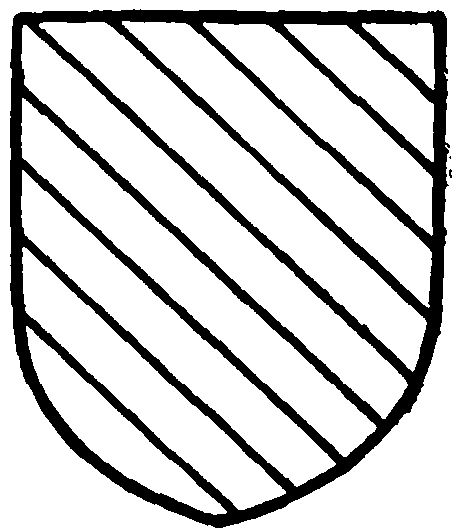
Mountfort. Bendy of ten pieces or and azure.
HILL BICKENHILL
HILL BICKENHILL, on the north-east of the parish, adjacent to Little Packington, and MIDDLE BICKENHILL, between Hill Bickenhill and Church Bickenhill, are often mentioned as distinct manors, but their history is mutually inseparable. They apparently originated in the 'other Bickenhill' mentioned in Domesday, held as 2 hides by Aluric in the time of Edward the Confessor, and by Turchil in 1086. (fn. 19) About 1200 Richard de Kaines (fn. 20) granted land in the parish, under the name of Parva Bikehill, to his three sisters Rose, Ala, and Margaret: William their brother confirmed the grant, and Henry de Bickenhill released to them all his right therein. (fn. 21) Part of the lands passed to the priory of Henwood, (fn. 22) and this priory in 1535 possessed lands and tenements worth £2 10s. 8d. in Hill Bickenhill and £2 2s. in Middle Bickenhill: also rents assessed at 16s. in those two manors and at 5s. 6d. in Bickenhill, presumably Church Bickenhill. (fn. 23) On 26 May 1553 the possessions formerly monastic were granted, as the manor of Middle Bickenhill, to Edward Aglionby of Balsall and Henry Higford of Solihull. (fn. 24) They apparently sold the manor shortly afterwards to John Fisher (fn. 25) of Great Packington (q.v.), with which it has since been held. A grant of free warren, dated 9 July 1617, covered the Fisher lands here and at Great Packington. (fn. 26) The Earl of Aylesford was lord of the manors of Hill, Middle, and Church Bickenhill in 1818, (fn. 27) and the present earl is now lord of the manor of Bickenhill.
The manor of MARSTON CULY, in the extreme north of the parish adjacent to Coleshill, was held freely in the reign of Edward the Confessor by Edwin the Sheriff, and in 1086 Roger held it of Turchil. (fn. 28) The family of de Culy first appear here with Hugh de Culy in about 1248: (fn. 29) Ralph de Culy held land in Marston (fn. 30) and is mentioned with his brother Walter in 1287; (fn. 31) and in 1328 Katharine, late wife of Ralph de Culy, held land here. (fn. 32) On the extinction of the de Culys the manor passed to Sir Fouk de Bermingham, (fn. 33) perhaps as guardian of Isabel granddaughter of Richard de Whitacre who married Joan daughter of Hugh de Culy; (fn. 34) for Isabel married Thomas son of Fouk, and subsequently the latter's daughter Elizabeth wife of Thomas Roche sold it to Hugh Freeman and Robert Leecrofte in 1399. (fn. 35) In 1490 William Leecrofte died seised of the manor, and was succeeded by his daughter Agnes wife of John Lisle of Moxhull. (fn. 36) Their son and heir, Nicholas Lisle, sold it to Reynold Digby of Coleshill. (fn. 37) It has since been held with Coleshill (q.v.) by the Digby family. (fn. 38)

Finch, Earl of Aylesford. Argent a cheveron between three griffons passant sable

Culy. Argent a cheveron between three roundels sable.
MARSTON WAVER
MARSTON WAVER, north-west of Church Bickenhill, is not mentioned in Domesday Book, and Dugdale suggests that Anketill de Crafte was enfeoffed in the reign of Stephen or that of Henry II. (fn. 39) The manor passed to his nephew Sir Roger de Crafte, who early in the reign of Richard I sold it to William de Waver for £40, to be held of him by one-sixth of a knight's fee. (fn. 40) The mesne lordship seems to have passed from Roger de Crafte to Hugh de Herdebergh. When William Maudit, Earl of Warwick, the overlord of this fee, died in 1267 Marston Waver was returned as a sixth of a fee, but no tenant was named. (fn. 41) On the death of Earl Guy in 1315 the sixth was held by 'the heirs of Hugh de Herdeberowe', (fn. 42) and they were again returned as holding a fifth (sic) of a fee here of the earl in 1400. (fn. 43) These heirs were the descendants of Hugh's granddaughters, (fn. 44) but there is no further trace of this mesne lordship.
William de Waver, who died about 1230, (fn. 45) was succeeded by Robert, and the latter's son William, in 1257, obtained a charter of free warren in his demesne lands here and at Whitacre. (fn. 46) He died in 1271, leaving a son Robert, (fn. 47) and Marston presumably continued in the family, as in 1427 John Waver held the manor, and conveyed it to John Catesby of Lapworth, (fn. 48) probably on mortgage, for in 1474 Sir Harry Waver held it, having inherited it from his father of the same name, (fn. 49) and in 1476 he released all his right in the manor to John Catesby of Stowell, grandson of the earlier John Catesby. (fn. 50) Later a descendant, Sir William Catesby, held the manor: it descended to his son Thomas, and next to Thomas's son Simon, who held it in the reign of Edward VI. (fn. 51) Simon in 1570 settled the manor to his own use. (fn. 52) Chancery proceedings followed between him and his eldest son Randall. (fn. 53) Simon died soon afterwards, and Randall in 1573 sold the manor to his brother John for £200. (fn. 54) John, a year later, sold it to Henry Maine, with the reversion of one-third held for life by Midwina Catesby widow of Simon. (fn. 55) John Maine, second son of Henry, succeeded his father, (fn. 56) and in 1640 was succeeded by his son, also named John. The manor was then held of Sir William Turville as of his manor of Crofte, the last mention of any overlordship. (fn. 57) By his will, the elder John left the manor to his widow for life, with reversion to his daughter Blanche. (fn. 58) The husband of the last, John Wollaston, held it in 1668. (fn. 59) It subsequently underwent several changes of ownership. Between 1764 and 1775 Fettiplace Nott was lord of the manor, (fn. 60) and in 1792 it was conveyed by Sarah Nott, spinster, to Hugh Baily, (fn. 61) probably for a settlement, as in 1818, two years after her death, it was held by her husband (fn. 62) Henry Godfrey Faussett. (fn. 63) The land is now in process of development as building sites, and all manorial rights appear to have lapsed.
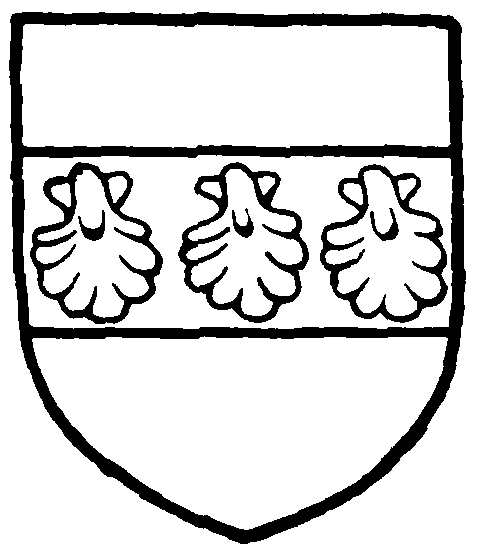
Waver. Argent on a fesse sable three scallops or.
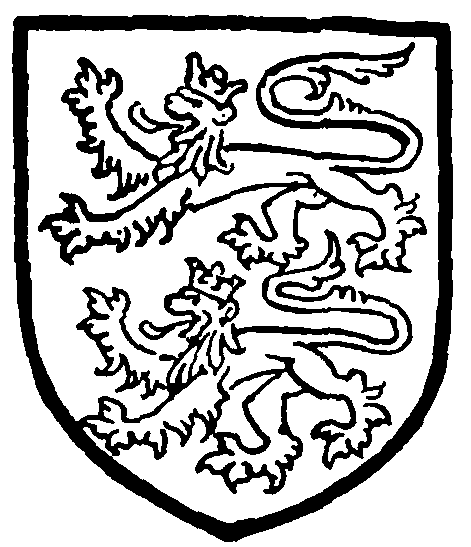
Catesby. Argent two lions passant sable crowned or.
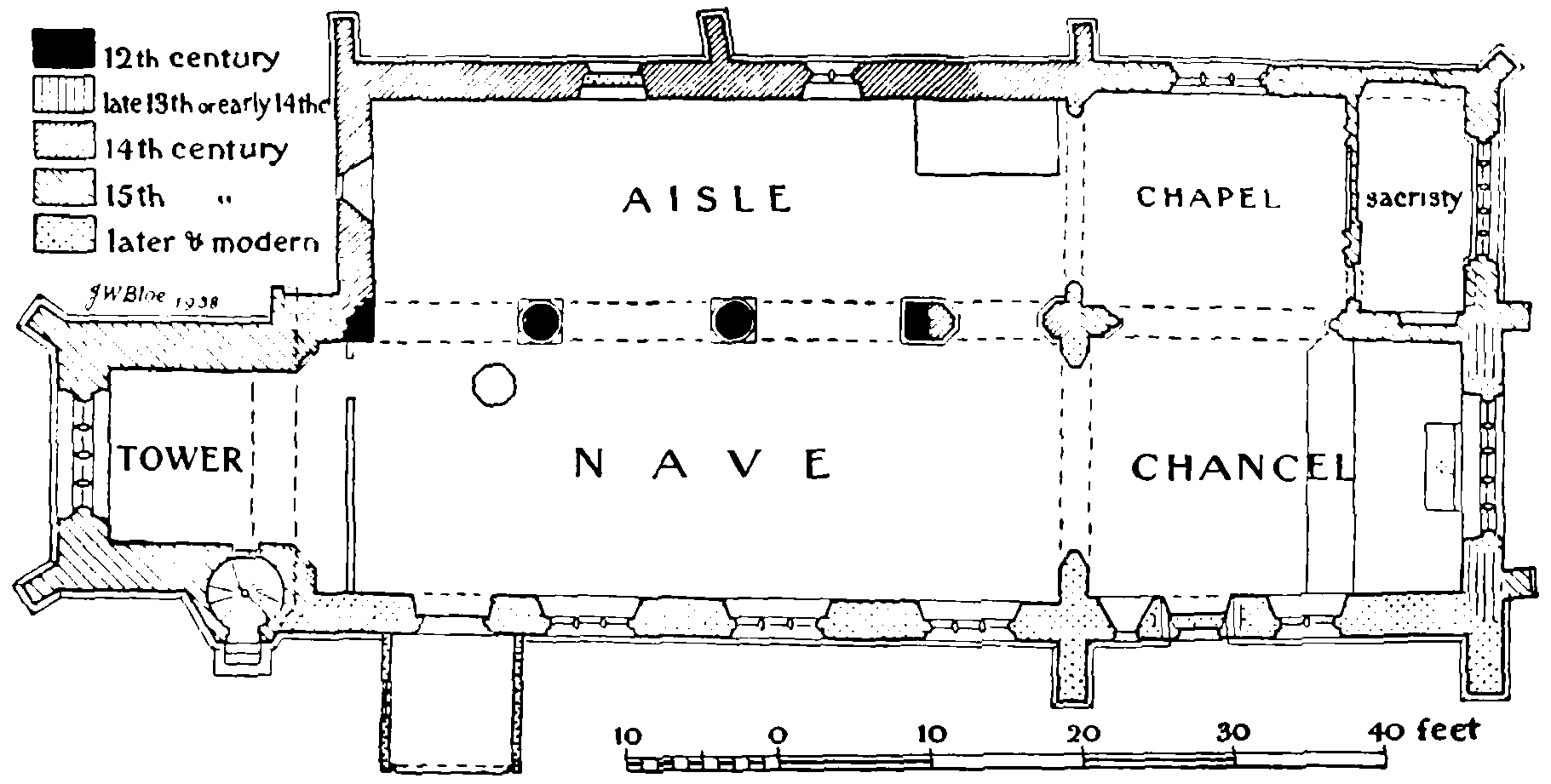
Plan of Bickenhill Church.
CHURCH
The parish church of S. PETER consists of a chancel, north chapel, nave, north aisle, west tower, and south porch.
The church had a 12th-century nave, with a north aisle of which the arcade of c. 1140 remains in place. The chancel was added or rebuilt about 1300; it had lancet windows, now destroyed, and a priests' doorway, reset in the modern wall. The north aisle was widened about 1330 and another archway inserted east of the 12th-century arcade. Late in the 15th century the north chapel was added, equal in length with the chancel and in breadth with the aisle. The stone reredosscreen with the sacristy behind it is an unusual feature. The west tower was built about the same time; whether the stone spire was coeval is not certain. The 17thcentury dates carved on the tower imply important alterations or repairs, especially that of 1632, which may have amounted to a complete rebuilding of the tower or the addition of the spire. In 1887 a very drastic restoration was carried out, the whole of the south walls of the chancel and nave being rebuilt; the only structural features that were re-used were the priests' doorway and the inner archway of the 12thcentury south doorway. (fn. 64)
The chancel (about 24½ ft. by 17 ft.) has an east window of five cinquefoiled lights and net tracery in a two-centred head, modern or completely restored. On the north side is a late-15th-century archway to the north chapel; it has ogee-moulded shafts in the hollowchamfered responds with moulded capitals and plain bases, and a four-centred head with crocketed hoodmoulds on both faces, having carved stops; on the chancel side they are a harpy with a woman's head with a horned head-dress and wings, and a griffon, on the chapel side a bat-like monster, the other replaced by a plain block. In the south wall are two modern windows, the eastern of two lights, the second a single trefoiled light. The blocked doorway between the windows is probably of late-13th-century date. It has chamfered jambs and pointed head with an external hood-mould with mask-stops. The chancel arch is also modern; it has splayed jambs and a two-centred head of two chamfered orders. The modern roof of two bays has queen-post trusses. The east wall, which has no plinth, is of squared rubble of pink and red sandstone: the north and south buttresses are old, but probably not original. The south wall, rebuilt with similar rubble, has a chamfered plinth.
The north chapel (about 25 ft. by 14 ft.) has the easternmost 5 ft. of space inside cut off by a late-15thcentury reredos-screen of stone about 7½ ft. high to form a sacristy. The east window is of five cinquefoiled lights and vertical tracery in a four-centred head with crocketed hood-moulds on both faces; the weatherworn stops outside seem to have been monsters, and there is a foliage finial: inside, the lower ends have been shortened. The wall is recessed below the sill inside, but the jambs do not coincide with those of the window. North of it is a four-centred fire-place, partly walled up. South of it is a four-centred recess that looks like a blocked doorway, but there is no sign of it outside. Above these and about 3 in. above the silllevel is a hollow-chamfered string-course or 5-in. shelf that passes also along the south wall up to the stone screen. Below it in this wall is another recess, 3 ft. 9 in. wide, with its sill 11 in. above the floor. In the north wall is another four-centred recess, 6 ft. 8 in. wide, down to the floor; the western part of it is 2 in. deeper than the eastern and appears to have been a pointed doorway, not now visible outside. South of the window above the shelf is a plain image-bracket. The north window, farther west, is of three trefoiled ogee-headed lights and half-quatrefoils under a square head: this is a 14th-century window that had a pointed head, the lower curves of which are still visible at the sides, fitted with a late-15th-century lintel. It was probably the east window of the aisle. The west archway to the aisle is modern. The walls are of red sandstone ashlar in large courses up to the eaves-level, above which the gabled east wall is of later rubble and has a chimneystack above the apex. The plinths are moulded and the north wall has a moulded eaves-course. At the angle is a diagonal buttress, altered in the upper stage to a V-shaped face and having a perished gargoyle and the stump of a former pinnacle. There is also a moulded cornice or eaves-course in the south wall above the archway. The roof is probably original and is divided into five bays by trusses with segmental arches below the collar-beams. The side-purlins have curved windbraces, some forming pointed arches in the bays and others half-arches.
The screen has a shallow recess for the reredos, with remains of brattishing over it. It is flanked by small niches with canopied heads enriched with crockets and pinnacles and with pilasters on either side. The imagebrackets, carved as demi-angels, are carried on shafts from the floor. South of it is a four-centred doorway to the sacristy, the hood-mould of which has king and queen head-stops, crockets, and a finial rising above the screen.
The nave (about 48½ ft. by 17¼ ft.) has three modern south windows, each of three trefoiled lights under a square head. The pointed doorway west of them is also modern, but has a reset 12th-century chamfered reararch and hood-mould carved with double billetornament, and impost-stops with cheveron ornament. On the north side are four arches. The easternmost, of the 14th century, has plain splayed responds with moulded capitals and bases, and a two-centred arch of two chamfered orders. The remainder is a 12th-century arcade of three bays. The two pillars are cylindrical with moulded bases and capitals changing from round to square: the eastern is decorated with zigzag lines and a kind of primitive leaf ornament consisting of four groups of beaded lines, rising to a common point at each angle. The western capital has simpler zigzag ornament: the abaci are chamfered. The responds are square with plain chamfered abaci. The semicircular arches, of one square order, have plastered soffits between the voussoirs. The roof of four bays is modern.
The north aisle (about 13 ft. wide) has only one north window, of two trefoiled ogee-headed lights and foiled spandrel in a square head; it is of the 14th century with modern repairs. The contemporary north doorway, farther west, is now blocked. In the west wall is a 14th-century single light with a trefoiled ogee head, and plastered splays and a flat lintel inside. Below it is a late-15th-century doorway with continuous moulded jambs and four-centred head inside, with a hoodmould carved with crockets and finial and having king and queen head-stops. It is blocked and was set rear-arch outwards. The aisle walls are of coursed, rough, red sandstone ashlar with a chamfered plinth and eaves-course. The north wall has an intermediate and two end buttresses, narrow and deep and of two stages. The west wall has some repair in large ashlar courses similar to the blocking of the doorway; and above the window a sloping chase may mark the lean-to roof of the 15th-century vestry or other chamber into which the doorway opened. Other repairs above the slope may indicate a former window.
The roof is gabled and has trusses dividing it into four bays of early-17th-century form of construction with tie-beams and sloping posts under the collarbeams; the side-purlins have straight wind-braces.
The west tower (about 9 ft. by 11 ft. inside) is of cream-coloured Arden sandstone ashlar in one stage unbroken by string-courses and has a chamfered plinth and embattled parapet with pinnacles at the angles. At the west angles are skew-buttresses, against the west wall, of three stages; they change at the top to V-shaped faces, projecting on the west but flush with the side walls, and carry the pinnacles. At the north-east angle is a square north buttress flush with the east wall, also changing at the top. The bottom of this buttress is half cut away for what appears to have been an 18thcentury round-headed doorway (half the arch remaining in the buttress) or skewed passage through the short length of nave-wall west of the arcade. This wall is of red rubble, perhaps 12th century, but the blocking of the doorway, which perhaps led to a former gallery, is of ashlar. At the south-east angle is a stair-vice of halfhexagonal projection reaching to the bell-chamber. The south outer entrance, approached by four steps, has old jambs, perhaps 17th century, and a modern head. Above it is a loop-light and over that are two panels carved with the date 1632 and letters EBRA. The inscription seems to be too pretentious to refer merely to the doorway below and suggests some more extensive repair or rebuilding of the tower walls. The ashlar of the turret courses mostly with that of the main wall. On the masonry of the latter are two other inscriptions in incised letters: one reads: JAMES DOWELL PHILLIP ORTON CHVR: WAR: 1692 and the other, about 2 ft. higher, SAMVELL SMITH THOMAS BROOKES CHVR: WAR: 1667.
The mouth of the tower towards the nave is peculiar and suggestive of alterations to the original design. The two angles projecting into the nave are splayed at 45° and the ashlar splays are treated with panelling in two tiers: the lower have cinquefoiled two-centred heads with rosette cusp-points, the upper have trefoiled heads with voluted pear-shaped cusp-points. At the base of the north upper panel is a tiny human-head corbel. These projections may have been intended to be the responds of a 15th-century archway, but the twocentred arch proper is built 18 in. farther west and dies on the side walls of the tower; it is about 3 ft. thick and of two chamfered orders with large voussoirs. The original inner doorway to the south stair-vice, with twocentred head, is blocked. The west window is of four lights and vertical tracery under a two-centred head; the tracery is a little out of the ordinary: the heads of the lights are well below the springing line; the side lights are trefoiled, but the two middle lights are treated as the two halves of one broad middle light with a subcusped trefoiled ogee-head: the mullion dividing it is cemented, apparently a repair, but an old stump in the sill indicates an original mullion: the foiled tracery above the middle lights includes an embattled transom. The side mullions have on their outer faces square pilasters with moulded bases, gabled heads, and crocketed finials. The symmetrical jambs and arch have hollowed splays and the head has an external hoodmould with crowned head-stops. The bottoms of the main lights are walled up with three courses of masonry above the original sill. The second story has a south loop-light, half covered by a modern clock-face. The bell-chamber is lighted by four-centred windows of two cinquefoiled lights with foiled spandrels; the jambs are like those of the west window. Above it is an octagonal spire of ashlar with three tiers of spire-lights (in four sides) with hood-moulds.
In the third nave-window are reset some fragments of a 15th-century coloured border, a black and yellow wavy pattern with pieces of ruby at intervals in peculiar trefoiled heads from a window that is now non-existent; also some quarries with tendril foliage.
The font, late-15th-century, is octagonal, the bowl being panelled with quatrefoiled circles in squares, the tapering lower part carved with demi-angels holding shields. The stem has trefoiled panels and panelled buttresses at the angles.
A dug-out chest 8 ft. long has a coped lid in two lengths with plain strap-hinges and other iron strapwork with curved arms. There are two locks to one lid and one to the other lid.
An alabaster slab in the floor of the north aisle, 6½ ft. long, has an incised border with an illegible inscription in black letter. Another farther east, also of alabaster, is plain.
There are six bells, the second and third of 1703 by Joseph Smith of Edgbaston, the fourth of 1636 by Thomas Hancox of Walsall, the tenor of 1707 also by Smith. The treble is modern in memory of Rev. Charles Baines, vicar, died 1928.
The registers begin in 1558, but several leaves of the first volume are missing.
ADVOWSON
The church is alleged to have been part of the original endowment of Henwood Priory, (fn. 65) and a bull of Pope Innocent VII (fn. 66) issued in 1404 implies that it was at that date still in the hands of the nuns; but this was certainly not so, as the church of Bickenhill is definitely said to be appropriated to the priory of Markyate (Beds.) in 1291, when it was valued at £6. (fn. 67) The nuns of Markyate proved their right to the church, with its dependant chapels of Kington and Lyndon, in 1329, (fn. 68) and it still belonged to them in 1535, when it was worth £7 17s. 2d. (fn. 69) After the Dissolution the advowson of the vicarage remained in the hands of the Crown until at least 1582, (fn. 70) but by 1605 it had been acquired by Sir Clement Fisher, (fn. 71) and it descended with the manor (fn. 72) until September 1919, when the Earl of Aylesford conveyed it to the Birmingham Diocesan Trustees, (fn. 73) the present owners.
The rectory was leased in 1553 to William Clark for 21 years, (fn. 74) and sold in 1589 to Richard Thakeston and Henry West. (fn. 75) In 1608 Dabridgecourt Belcher held it, apparently in right of his wife Elizabeth (daughter and co-heir of Richard Fisher of Warwick), (fn. 76) and sold it to John Huggeford, (fn. 77) who conveyed it in 1626 to Thomas Waring, (fn. 78) possibly acting for Richard Alcocke. (fn. 79) A later Richard Alcocke was dealing with it in 1662, (fn. 80) but by the middle of the 18th century the rectorial tithes seem to have been acquired by the lord of the manor. (fn. 81)
In 1347 Nicholas de Leecroft and Henry de Aumberlee, priest, proposed to give lands in Marston Culy to endow a chantry in the chapel of that hamlet; (fn. 82) but no licence in mortmain seems to have been issued and no more is heard of the chantry. Nor is there any other reference to such a chapel, but its site is supposed to have been near the present Chapel Farm at Marston Green. A new chapel of St. Leonard, Marston Green, was built in the 19th century and was acquired by the Birmingham Diocesan Trustees in 1923. In 1928 Marston Green was separated for ecclesiastical purposes from Bickenhill and united to Sheldon, (fn. 83) and the chapel has been replaced by a large structure of red brick, consecrated in 1938. Provision has also been made for the union of Bickenhill and Elmdon when next a vacancy occurs in either parish. (fn. 84)
CHARITIES
Blanche Wollaston by will dated 30 Jan. 1676 directed her personal estate to be laid out in the purchase of lands for certain charitable uses, one of which was that £5 of the yearly rents should be distributed amongst the poor of Bickenhill. Certain lands in Aldridge were purchased and the endowment is now represented by £200 Consols, and the £5 per annum is distributed to the poor in coal. By a scheme of the Charity Commissioners of 3 Oct. 1933 a body of five trustees was appointed to administer the charity.
Walter Thornley by will proved 31 May 1897 gave £100, the interest to be laid out in the purchase of coal to be distributed to the poor of Bickenhill. The legacy was invested, producing £2 4s. 1d. annually. By a Scheme of the said Commissioners dated 20 Sept. 1938 a body of three trustees was appointed to administer the charity.