A History of the County of Warwick: Volume 4, Hemlingford Hundred. Originally published by Victoria County History, London, 1947.
This free content was digitised by double rekeying. All rights reserved.
'Parishes: Corley', in A History of the County of Warwick: Volume 4, Hemlingford Hundred, ed. L F Salzman (London, 1947), British History Online https://www.british-history.ac.uk/vch/warks/vol4/pp57-60 [accessed 2 May 2025].
'Parishes: Corley', in A History of the County of Warwick: Volume 4, Hemlingford Hundred. Edited by L F Salzman (London, 1947), British History Online, accessed May 2, 2025, https://www.british-history.ac.uk/vch/warks/vol4/pp57-60.
"Parishes: Corley". A History of the County of Warwick: Volume 4, Hemlingford Hundred. Ed. L F Salzman (London, 1947), British History Online. Web. 2 May 2025. https://www.british-history.ac.uk/vch/warks/vol4/pp57-60.
In this section
CORLEY
Acreage: 1,394.
Population: 1911, 333; 1921, 405; 1931, 560.
This small parish is roughly diamond-shaped, being 2 miles from east to west and 1½ miles from north to south. A survey of the bounds made early in the 15th century (fn. 1) begins at the eastern point at 'the gallows of Corley' and runs by Woddcokkgrove (now Woodcock Hill Wood) and Moserddswod (Muzzards Wood) to Dudleyfeld (Daddleys Wood) and so to Corley Moor, where they follow the road to Little Packington. The 40 acres of the Moor in this parish were inclosed in 1847 (fn. 2) and the road has been straightened, diverging slightly from the boundary. The bounds then turned north-eastwards past Falkwood to 'the highway called le End' (apparently Savage's Lane), past 'John Catesby's wood called Tackeley' (fn. 3) to a stream (Breach Brook), including in the parish 'le Hayle (perhaps part of Holly Farm) belonging to the Hospital of St. John of Coventry', (fn. 4) and so by Heynelane (now a field footpath) to the Coventry road where the said gallows stood.
The village stands high, the church being at an elevation of 590 ft., on the road between Coventry and Tamworth. Northwards the ground falls to 480 ft. at the hamlet of Corley Ash, where there are brickfields, and to 380 ft. along the Breach Brook. The soil, though sandy, is good corn land, and on Corley Moor is a disused windmill, probably standing in the Wyndemulnefeld mentioned in the 15th century. (fn. 5)
Corley Hall, about ½ mile north-east of the church, dates probably from the first half of the 16th century but it has been very much transformed by later alterations. The plan is H-shaped facing south-east, with a 17th-century back extension to the north-east wing and other modern enlargements. The front is roughcasted and betrays little sign of age, but in the northeast side is an early-16th-century four-centred and square oak door-head, and in the internal wall of the same wing is another ancient door-frame and a door hung with strap-hinges having fleur-de-lis ends. The middle block and south-west wing have Elizabethan moulded ceiling beams to the lower story and the latter has a late-16th-century overmantel. This is of three round-headed bays inclosing grotesque heads and divided by foliage-carved pilasters. Over them is a carved frieze of serpentine monsters. The fire-place has foliage-carved side pilasters. In the upper room of this wing is reset a remarkable series of early-16th-century carved panels, said to be indigenous. There are 8 moulded panels containing carved heads, almost portraits, one very like Francis I and another a lady in a flat head-dress. Six others have smaller heads in medallions and three others conventional heads and scrolls and a cherub holding a shield; seventeen in all. There is other panelling of c. 1630 and an overmantel of c. 1680 with a bolection-moulded panel. The upper ceiling beams are chamfered. The front courtyard to the house has a pair of gate-posts with moulded stone heads on which are pedestals with griffons' or wolves' heads.
There is little else of age in the parish. Two thatched cottages opposite the church show some 17th-century timber-framing, and timber-framed outbuildings and a barn ¾ mile north-west of the church indicate ancient sites.
MANOR
At the time of the Domesday Survey Godwin held 1 hide in CORLEY of the king, and he held it before the Conquest. (fn. 6) By 1315 the Earls of Warwick had acquired the overlordship. (fn. 7) Under them the manor was held by the Hastings, lords of Fillongley, (fn. 8) who at an early date subinfeudated it to the family of Ringesdon. The advowson of the church, and presumably the manor also, belonged about 1190 to Adam de Ringesdon, whose son Hugh disputed the patronage in 1220 with the Prior of Coventry. (fn. 9) The manor belonged in 1268–9 to Ralph de Ringesdon, (fn. 10) who seems to have been dead by 1284 when three sisters, probably his coheiresses, claimed the church of Corley. They were Felice wife of Roger le Thatcher and her sisters Christiane and Felicente. (fn. 11) In 1313 the manor was said to be held by the heirs of Ralph de Ringesdon. (fn. 12) From this time the descent of the manor becomes obscure. In 1437 it was stated that Corley manor was held of Joan widow of William de Beauchamp, to whom the Hastings estate had come, by Guy heir of John de Mancetter by the service of half a knight's fee. (fn. 13)
Before 1458 the manor had passed to Roger Champernoun. (fn. 14) Roger Champernoun died without issue and his brother John (fn. 15) died seised of the manor in 1475. His heirs were his daughters Blanche wife of Sir Robert Willoughby, kt., and Joan Champernoun (fn. 16) who afterwards married Sir Humphrey Talbot. (fn. 17) Joan Talbot died in 1506, when her nephew and heir Robert, 2nd Lord Willoughby de Broke, obtained the whole manor. (fn. 18) Sir Robert died in 1521 leaving as his co-heiresses the three daughters of his son Edward, Elizabeth, Anne, and Blanche. (fn. 19) Elizabeth, who eventually became sole heir, married Sir Fulke Greville, and Corley manor passed on her death in 1560 to her son Fulke. (fn. 20) Fulke was succeeded in 1606 by a son Fulke Greville, created Baron Brooke of Beauchamps Court in 1621. (fn. 21) He died unmarried in 1628, and his cousin Robert Greville succeeded to the manor which descended with the title till at least 1745. (fn. 22)
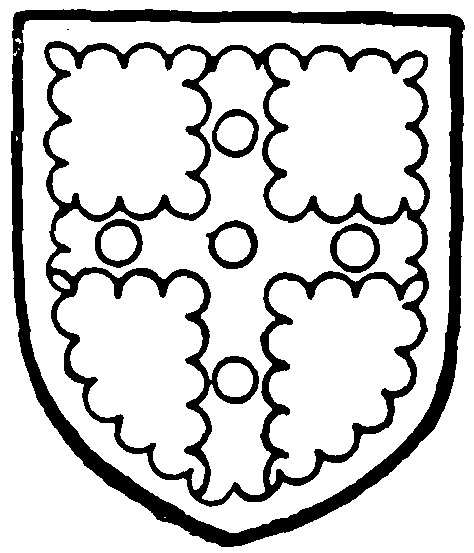
Greville. Sable a cross engrailed in a border engrailed or with five roundels sable on the cross.
By 1754 Dr. John Smyth had acquired the manor. (fn. 23) He was a son of Joseph Smith of Corley (fn. 24) and died at the age of 82 at Chipping Norton in 1792, (fn. 25) when he was succeeded by John Bohun Smyth, who was still lord in 1797. (fn. 26) The history of the manor during the 19th century appears to be a blank, except for the occurrence of Viscount Lifford as lord in 1850. (fn. 27) Joseph Cooper held it in 1900, (fn. 28) and Thomas Knowles in 1932. (fn. 29)
CHURCH
The parish church (of St. Mary? dedication uncertain) consists of a chancel, nave, and north aisle.
The nave is of early-12th-century origin and was very small, not more than about 28 ft. long. Later in the same century a north aisle was added, with an arcade of two bays. The chancel was rebuilt, and obviously enlarged, c. 1300, and about thirty or forty years later the aisle was rebuilt and widened. About six or seven years ago the fabric was restored and the nave lengthened about 9 ft. at the west end.
The chancel (about 21½ ft. by 14½ ft.) has an east window of three pointed lights and intersecting tracery in a two-centred head; the external hood-mould has perished head-stops; it has a lancet rear-arch.
In each side wall are two similar windows of two lights with sharply pointed heads. Between the two southern is a coeval priests' doorway of one chamfered order with a hood-mould and defaced headstops. The walls are of roughly coursed rubble inside and of ashlar outside, with plinths of two chamfered courses. Below the kneelers of the east gable are grotesque-face corbels. At the angles are square buttresses of one stage with foiled acute gable-heads and fleur de lis ridges.
In the north wall is a plain locker and in the south a contemporary piscina with a trefoiled head and a foiled square basin.
The gabled roof is modern, of trussed rafter type.
The chancel arch is of the early 12th century with square reveals, having chamfered plinth-bases and plain grooved and chamfered imposts, and a round head of two plain square orders. The wall above the arch is of early rubble work but contains one reset voussoir of an arch showing diaper ornament. The gable above has carved corbels to the kneelers as the chancel.
The nave (about 37 ft. by 15 ft.) has a late-12th-century north arcade of two 11-ft. bays with a cylindrical pillar and half-round responds. The pillar, 31 in. diameter, has a capital carved with a series of spiky leaves, and a chamfered abacus, also round in plan but cut back flush with the wall-face on the aisle side. The east respond capital is treated with nearly similar foliage, but in its south-west face is also carved a man's head with what may be intended for a wing and to his left a monster. The half-round of the west respond has been cut back in the reveal to a flat surface; its capital to the north of the flattening is treated with the usual scallop ornament and to the south of it with vertical fluting and three rows of horizontal zigzag ornament. The bases have a chamfered and grooved top member and stand on square sub-bases with chamfered plinths. The semicircular heads are of one square order with wide-jointed voussoirs and have on the nave side grooved and chamfered hood-moulds. Owing to the circular plan of the capitals the reveals set back about 10 in. from the east and west edges. Above and between the arches, but not centrally, is an early-12th-century small light looking into the aisle and not glazed. The splays, towards the nave, have dressings with beadmoulded and filleted edges; the cheeks are of rubble. East of the east respond the wall is pierced by a later square-headed opening for a rood stair; it has two oak steps in the threshold and one lower, cemented, about 4 ft. above the floor.
In the south wall are two 12th-century windows near the east end. The eastern, 15 in. wide, of the later period, has been restored externally but the inner splays are original and have a small roll-moulded edge. The outside is of two square orders. Below it are traces of a former 19th-century window. The second is a plain 8-in. light of the earlier period, also restored outside. The south doorway, west of them, is also of the later period. It has jambs of two square orders with restored nook-shafts with voluted capitals and modern bases: the grooved and chamfered abaci have diaper ornament. The half-round head is moulded and has a chamfered hood-mould and diapered tympanum. It is all of wellpreserved or perhaps retooled sandstone. The two windows west of the doorway, three in the west wall, and one in the north, are all modern copies of the south-eastern. The ancient walling is of red sandstone rubble, roughly in courses and with wide jointing repointed in cement. There are original ashlar quoins to the east angle. The nave-roof has a flat wooden ceiling with moulded cross-beams; two over the 12th-century windows may be of the 16th or 17th century, the other three are modern. Over the east end of the roof is a bell-cote rising only about 2 ft. above the tiling. It is of timber-framing and has a pyramidal roof with a post and weather-vane.
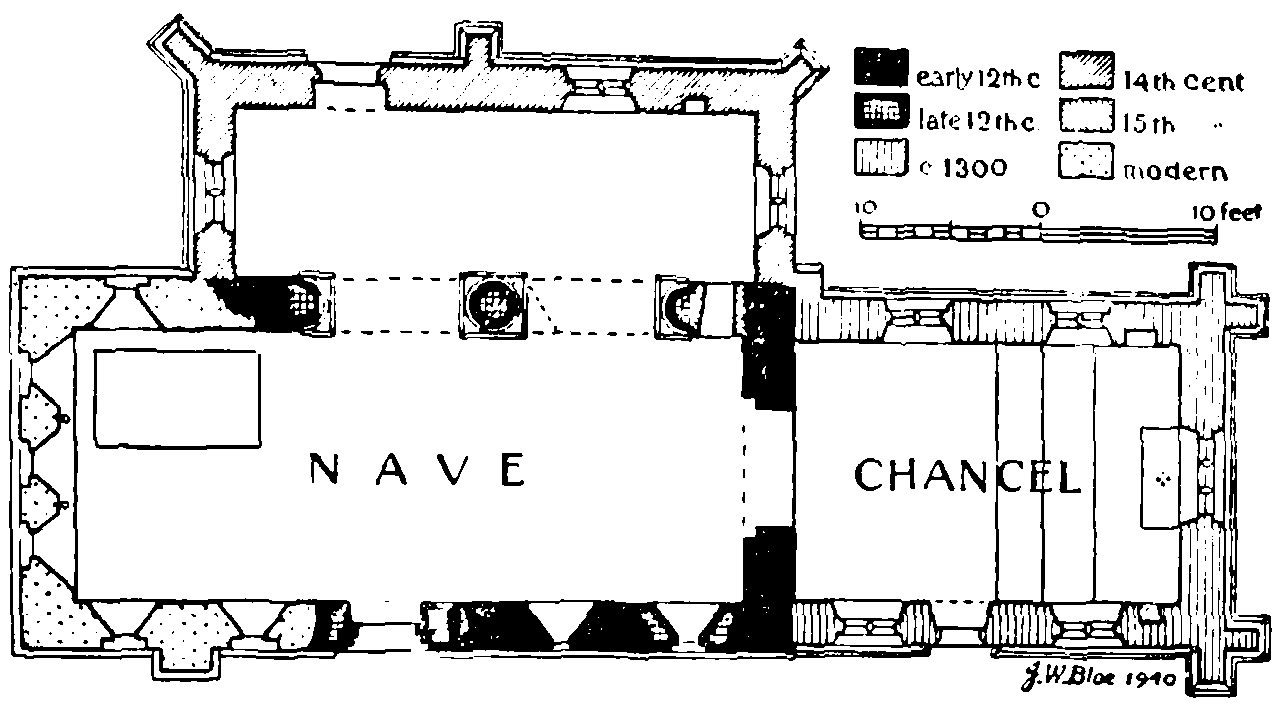
Plan of Corley Church
The aisle (29 ft. long by 9¼ ft.) has an east window of two cinquefoiled pointed lights and a trefoil spandrel in a round head with an external hood-mould and segmental rear-arch. It has been mostly restored. In the east half of the north wall is a similar window with a rough brick round rear-arch, and in the west half a doorway of two chamfered orders with a two-centred head and hood-mould. The west window is like the others but all modern outside; the north internal splay is of old stonework, the south splay of 18th- or 19th-century bricks. Reset at the east end of the north wall is a 14th-century piscina with a trefoiled head and square basin. The aisle walls are of red sandstone squared rubble with a plinth like that of the chancel to the north and west walls. The north wall has a middle buttress and at the angles are diagonal buttresses with the same plinth. The east wall has a different lower plinth. The top of the north wall is of seven or eight courses of 18th-century brick. Several put-log holes inside were probably for a former gallery. The gabled roof is modern.
The font has a round bowl with a moulded top edge and chamfered lower. A panel in its side is inscribed RR 1661 RI cw. The stem is plain, the base moulded.
Over the north doorway is a patch of plaster with remains of a medieval painting of St. Christopher dressed in blue or black. There are only faint traces of the head and the Christ Child, on a yellow background.
There are five bells: 1st, of 1641 by Hugh Watts; 2nd, probably of c. 1410 by Johannes de Colsale of Leicester or Nottingham and inscribed 'Gloria tibi domine'; 3rd, recast in 1937 by Taylor & Co.; 4th, uninscribed; and the 5th, of 1631 by Thomas Hancox of Walsall. The plate is modern. The registers date from 1540.
A carved stone lying loose in the churchyard, with four gabled faces, was evidently the base of a gablecross.
ADVOWSON
The advowson of the church of Corley was evidently granted with the manor to the Ringesdons, for Adam de Ringesdon presented a clerk called Robert about 1190. When Hugh de Nonant, Bishop of Coventry, expelled the monks of Coventry in 1191 he came to Corley and took the church away from Robert, the parson appointed by Adam, and afterwards consecrated the church. Adam came to the dedication and presented to the bishop a certain Ralph Shanke, whom the bishop refused to admit because he was not worthy to have a benefice. Eventually a certain John de Offaton became parson, and Ralph Shanke was made vicar; and when they both were dead Adam once more presented the original Robert. On his death about 1220 Adam's son Hugh claimed the advowson, but the Prior of Coventry produced a charter showing that Adam had granted the advowson to the priory, and that Corley church was a chapel belonging to the church of Coventry. (fn. 30) The Prior presented to the church in 1250 (fn. 31) and the rectory was appropriated in 1259, (fn. 32) but in 1284 the advowson was claimed by Felice, wife of Roger le Thatcher, one of the co-heirs of Ralph de Ringesdon. (fn. 33) Felice lost her case as her sisters did not join in the suit, and the prior remained in possession until the Dissolution. A controversy which broke out between the Priors of Coventry and Maxstoke as to the tithes from a wood in Fillongley and Corley called Le Falkwoode was settled by assigning to the Prior of Maxstoke the tithe of the wood as far as Falkwood gate opposite le Cowpercroft and to the Prior of Coventry the tithes of the part of the wood from that gate to the park of Fillongley and the croft of John of Fillongley. (fn. 34) In a rental of the glebe land made in 1410 it appears that the chaplain of Corley had two crofts lying round the church called le Gillecroft and le Churchfield, lying next Wyndemylnefeld. (fn. 35)
The advowson was granted in 1542 to Richard Andrews and Leonard Chamberlain of Woodstock, (fn. 36) who probably sold it to Henry Over of Coventry. (fn. 37) He presented in 1543, (fn. 38) and in 1554 sold the advowson to Michael Camsewell, who presented in that year and 1557. (fn. 39) Michael complained in 1559 that Henry had made a conveyance of the advowson to Richard Stansfield; but according to Henry this was part of a general settlement of Michael's debts, and he had permitted Michael to make the two presentations, though the purchase-money, £20, was still unpaid. (fn. 40) The next presentation was made in 1571 by Nicholas Harding, and in the following year the executors of Thomas Saunders made a presentation, (fn. 41) possibly for that term only, as Nicholas Harding was holding the advowson when he died about 1574. (fn. 42) The king presented Basil Smith in 1620, but it was subsequently found that John Gregory of Styvechale was the patron, and he presented Basil in 1621. (fn. 43) John Gregory was succeeded by his grandson Loveisgod, who was a minor in 1681 when a presentation was made by his mother Mary, then wife of John Downes. (fn. 44) Arthur Gregory son of Loveisgod presented in 1704. (fn. 45) He died about 1743, and his son Arthur was patron in 1760. (fn. 46) Francis son of Arthur, who succeeded in 1791, presented in 1794, (fn. 47) and dying in 1833 was followed by his son Arthur Francis Gregory. Arthur Francis married the Hon. Caroline Hood, and dying in 1853 was followed successively by his sons Arthur Hood Morgan Grosvenor Gregory and Major Francis Hood Gregory. The latter died unmarried in 1909, and was succeeded by his cousin the Hon. Alexander Frederick Hood, who assumed the name Gregory in lieu of Hood. He died in 1927 and the advowson passed to his son Major Charles Hugh Hood of Loxley Hall and Styvechale, who was patron in 1929. (fn. 48) Soon after the patronage passed to the Church Association Trust.
CHARITIES
Church land. The endowment of this charity consists of a close of land called Divetts Close, a cottage and garden and a plot of land, all at Corley. The property is let at an annual rent of £12 approx. which is paid to the churchwardens towards church expenses.
Henry Davy by will proved 15 January 1665 gave an annuity of 5s. issuing out of property known as Hatton's Cottage for the use of the godly poor people of Corley. The charge is distributed by the vicar and churchwardens to the poor of the parish.
Henry Davy the younger gave £20, the interest to be given to poor widows or fatherless children; and William Green gave £40, the interest to be applied to best use of the poor for ever. These two charities now produce £1 12s. 8d. per annum, distributed to the poor in bread.
Mary Tallis by will dated 27 June 1637 gave 5s. for ever to be paid out of property at Corley Moor to the poor of Corley. The charge is distributed by the vicar and churchwardens to poor widows.
Susannah Moggs by will proved 12 August 1881 bequeathed to the vicar and churchwardens £100, the interest to be applied to the poor and infirm of Corley. The interest amounting to £2 4s. 8d. annually is distributed as directed.