
A History of the County of Warwick: Volume 4, Hemlingford Hundred. Originally published by Victoria County History, London, 1947.
This free content was digitised by double rekeying. All rights reserved.
'Parishes: Balsall', in A History of the County of Warwick: Volume 4, Hemlingford Hundred, (London, 1947) pp. 86-91. British History Online https://www.british-history.ac.uk/vch/warks/vol4/pp86-91 [accessed 12 April 2024]
In this section
BALSALL
Acreage: 5,875.
Population: 1911, 1,353; 1921, 1,545; 1931, 1,992.
Balsall, originally part of Hampton-in-Arden, was made a separate ecclesiastical parish in 1863 and was enlarged by the inclusion of part of Knowle in 1932. It is roughly an equilateral triangle, some 3½ miles from its base to its northern apex, with Berkswell on the east and Knowle and Barston on the west. The country is open, with very little woodland and many small streams and ponds, rising from 300 ft. in the north to about 400 ft. in the south. The village lies close to the River Blythe at the junction of Knowle and Barston parishes. The older roads are mostly lanes, but in the south-east on what was Balsall Heath a number of straight roads have been laid out since the inclosure in 1802, and here in the modern settlement of Meer End is the half-timbered mission church of St. Richard, opened in 1929. There is also a small modern church of St. Peter, Balsall Common, built of red brick.
The remains of the Preceptory or Commandery stand west of the church. The building consists of three bays of the aisled hall of timber, probably as old as the 13th century, and a 15th-century west wing containing the parlour and chamber over. The whole is encased with modern brickwork and the hall is divided into tenements. The three bays are of about 14-ft. span and are indicated by oak posts that divided the nave from the aisles. The original roof construction is said to exist, but it is now hidden from view. (fn. 1)
The 'lodgings' west of the hall—about 25 ft. long by 18½ ft.—are built at right angles to the hall, being flush with its north wall but stopping short 5 ft. from its south wall, probably owing to the removal of the buttery mentioned in the survey of 1541. (fn. 2) The upper chamber is open to the roof: this is of one and a half bays and has a main southern truss and a subsidiary northern truss. The former has a cambered tie-beam supported by curved braces from the story-posts and carrying king- and queen-posts under a collar-beam: above the last are curved struts to the principal rafters. The intermediate (northern) truss has an arch springing from the wall-plates to support a collar-beam which also carries curved struts. The side-purlins are supported by curved wind-braces forming pointed arches. The lower chamber has an open-timbered ceiling: the beams are plain, but on the east wall is a 15th-century moulded beam.
A number of bosses are painted with coats of arms, &c., including several with a rebus of a tun, on an anchor, inscribed LIKES for Likeston.
In the west wall is a projecting chimney-stack of stone, probably of c. 1500, with a later brick shaft above. In it the lower chamber has a fire-place with a late-17th-century moulded stone surround and a 25-in. lintel. It is flanked by oak fluted pilasters and has a moulded shelf, above which is a late-16th-century overmantel of three bays, inlaid with vase and flower ornament. The upper chamber has an original moulded stone fire-place and shelf.
In 1541 the house and church formed the north side of an inclosed court containing about 3 acres, of which the south side contained a great barn of 9 bays with 2 porches; this still stood c. 1730 and was 140 ft. long, by 40 ft. wide, and 38 ft. high.
The Hospital or almshouses for old women founded by Lady Katherine Leveson in 1677 stands east of the church. It is a plain structure of sandstone and consists of two long ranges flanking a long narrow courtyard running north and south, with cross-wings at their south ends. A wall between these wings contains the gateway to the courtyard. The north end is closed by the residence of the Master, which is also the vicarage: this was rebuilt in 1836.
Temple House, north of the church, is an early18th-century house of red brick with tall narrow sashwindows.
There are about 32 other ancient buildings in the parish; they are situated roughly in groups, and are of the 17th century unless otherwise specified.
One group of eight is in or near the village of Balsall. They include a house on the north side of Balsall Street, much restored but with a gabled west wing of square framing. A thatched cottage farther east shows some framing. In Balsall Street East is a small house with a framed wing at the back, and opposite it an 18th-century farm-house with timber-framed farm buildings; and another farther east has a framed barn. Holly Lane Farm, ¼ mile to the south, said to have been formerly Church Farm, has been refaced with brickwork dated 1743 but retains an early-17th-century central chimney-stack and a timber-framed stable.
North of Balsall Street and west of Station Road are two detached cottages with framed walls and tiled roofs.
Another group is about ½ mile west of the village on the main road and in a loop-road south of it. The Saracen's Head Inn, facing north-west, is of two bays of square framing and has an end chimney. Two detached houses, both divided into tenements, to the north-west are of similar framing. Balsall Farm, on the west side of the loop road, is of c. 1690 and is built of red brick with rusticated stone angle-dressings and moulded cornice. It has rectangular windows with stone key blocks and wood casements and transoms: the middle entrance has a stone architrave and key block. There is also a timber-framed barn. Farther south at the bend of the loop-road is Magpie Farm (formerly Churchfields Farm), which has a two-storied north wing dating from c. 1560. This is of rectangular plan, about 42 ft. by 18 ft., with a central chimney-stack. The walls are of close-set studding to both stories except in the upper story of the gabled west front where there is rather more elaboration. Below the windows are rectangular panels with herring-bone struts, except the central which have quadrant struts. The gable-head projects on a moulded bressummer supported on shaped brackets, and is of square framing in small panels. The upper story has a restored oriel window on the original shaped brackets and with dwarf wing-lights with moulded mullions. The lower oriel window has been abolished, but the original winglights remain. The east end, except for the more simple post-work, is similar, the oriel and its wing-lights being ancient: the gable-head also projects on brackets. The story-posts in the north side divide it into seven alternate narrow and wide bays (in the proportion of 3 to 5). The middle wide bay has an original three-light window in each story with moulded mullions, lighting the cupboards next the central chimney-stack. The other wide bays had originally oriel windows, but they have been altered to flat windows. The rooms have plastered ceilings with stop-chamfered beams. The lower fire-places have heavy four-centred stone arches, but the jambs are of brick, with chimney-corners. The upper fire-places are later. A modern wing extends southwards, but some of the original close studding of the south wall is exposed inside. The lobby on the first floor south of the chimney-stack has three ancient doors hung with strap-hinges with flowered ends.
'The Old Farm', a little farther north on the east side of the loop, has a north wall of framing and a central chimney-stack of 17th-century bricks with two diagonal shafts. There is also a timber-framed barn.
The third group of five cottages showing 17th-century framing lies chiefly at Fen End, south-east of the church on the road to Honiley. A house on the west side of the road, built of red and black bricks and dated 1699, has tall narrow windows and a gabled entrance with a nail-studded door. Fen End farmstead has a labourer's cottage and a barn of timber-framing. There was a moat around the buildings, now reduced to four ponds at the former angles.
A fourth group of eight buildings is in Oldwich Lane and near Chadwick End. The most important is Oldwich House, 1¼ miles south-east of the church, a reputed ancestral home of the Shakespeares. (fn. 3) It is probably of early-16th-century origin, but altered later. The plan is T-shaped, and the cross-wing at the west end is encased with 18th-century brickwork but has a late-16th-century projecting chimney-stack of brick with stone quoins and two diagonal shafts. It contains a room with an early-16th-century open-timbered ceiling with moulded beams and joists. The fireplace has an early-18th-century moulded surround. The room is lined with Elizabethan panelling with a top-frieze richly carved with flowers and grape-vine ornament, said to have been brought from Kenilworth Castle. (fn. 4) The main block is brick-fronted on old stone foundations on the south, but the gabled east end and the back have square timber-framing. One room has a 16th-century moulded beam. The central chimney-stack has a wide fire-place, and above the roof is a panelled rectangular shaft with a base mould and cornice of the late 17th century. The entrance has an ancient nail-studded door. There are also two timberframed barns and remains of a moat.
Balsall Cottage Farm, 3/8 mile west, is a small late16th-century house of L-shaped plan showing some framing in its east gable. The east room has an opentimbered ceiling and a wide fire-place. There is also a timber-framed barn. Chadwick End Farm, ¾ mile south-west of Oldwich House, is an L-shaped house with the main block of 18th-century brickwork and a staircase of c. 1730, and a back wing of earlier framing. A large barn of five bays is of timber-framing.
Hill Farm, at Chadwick End, ¼ mile west on the main Warwick road, is a gabled house covered with rough-cast cement, and having a late-16th-century central chimney-stack with V-shaped pilasters. A little to the south is a reconditioned house, formerly an inn, of square framing. Two cottages to the west also have framing. At Netherwood Farm are remains of a wet moat.
At the north end of the parish on the west side of the Kenilworth main road is the George in the Tree Hotel, which has a timber-framed back wing; and northwest of it on the Barston road is a thatched cottage of framing.
MANOR
BALSALL
BALSALL was given by Roger de Mowbray, probably during the reign of Stephen, to the Knights Templars (fn. 5) and became the site of a preceptory of the order. A survey of 1185 shows the bond tenants holding some 650 acres, in addition to 'the land of the mill' and portions of the demesne, for which they paid £10 14s. 10d. (fn. 6) In 1248 the Templars were granted free warren here, (fn. 7) and in 1268 a weekly market on Thursday and fairs, of 3 days each, at the feast of St. George and St. Matthew. (fn. 8) On the suppression of the Templars in 1308 Balsall reverted to John Mowbray and was held by him until his attainder and death in 1322, (fn. 9) after which it was made over to the Knights Hospitallers. (fn. 10) When the order was dissolved the manor and park of Balsall were granted in 1544 to Queen Katherine Parr, (fn. 11) and in 1547 the reversion thereof was granted to Edward, Duke of Somerset. (fn. 12) On the attainder of Protector Somerset the manor, then in the tenure of Giles Foster and his wife Isabel widow of Martin Docwra, (fn. 13) was acquired in July 1553 by John Dudley, Earl of Warwick. (fn. 14) On his attainder it was granted in 1554 to Edward Sutton, Lord Dudley, (fn. 15) but when Queen Mary purposed to refound the Hospital of St. John of Jerusalem she granted the reversion of Balsall manor to the order in 1558. (fn. 16) With the accession of Elizabeth this scheme came to nothing, and in 1572 Lord Dudley conveyed the manor to Robert, Earl of Leicester, (fn. 17) to whom the Hospitallers' rights had been granted in 1565. (fn. 18) He settled the reversion of the manor after the death of himself and his wife on his brother Ambrose Dudley, Earl of Warwick, for life, with remainder to his own illegitimate son Robert Dudley. (fn. 19) Robert, having failed to establish his legitimacy, (fn. 20) left England and his wife Alice (later created Duchess Dudley) and their four daughters. The manor of Balsall was divided between the four, one of whom, Anne widow of Sir Robert Holbourne, acquired three shares, which on her death were bought by her surviving sister Lady Katherine Leveson. (fn. 21) She by her will in 1671 devised the manor and estate of Balsall for the founding of a hospital, oralmshouse, for 20 poor women, widows or unmarried, who should each have yearly £8 and a grey gown with the letters K. L. in blue cloth thereon. A chaplain was to be provided at a salary of £20 to read prayers for them twice daily, and he should also freely teach 20 of the poorest boys of the parish. The Hospital of the Lady Katherine Leveson was incorporated in 1704, with a body of 11 governors, and by 1721 there were 27 old women in residence and further enlargement was projected. (fn. 22)
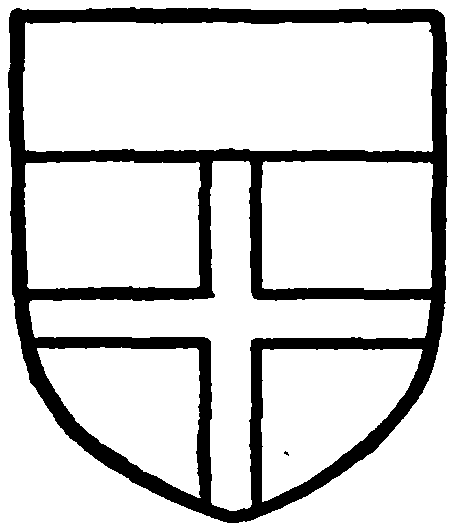
Knights Templars. Argent a cross gules and a chief sable.
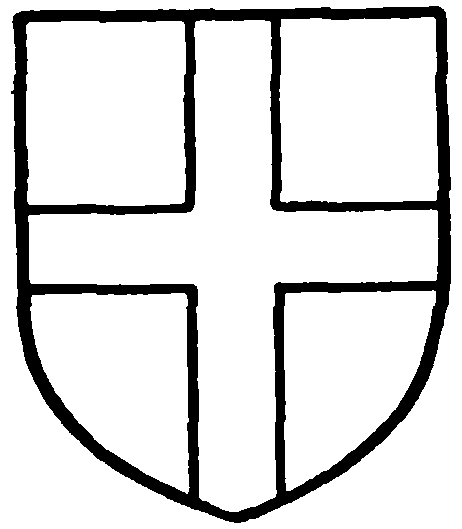
Knights Hospitallers. Gules a cross argent.
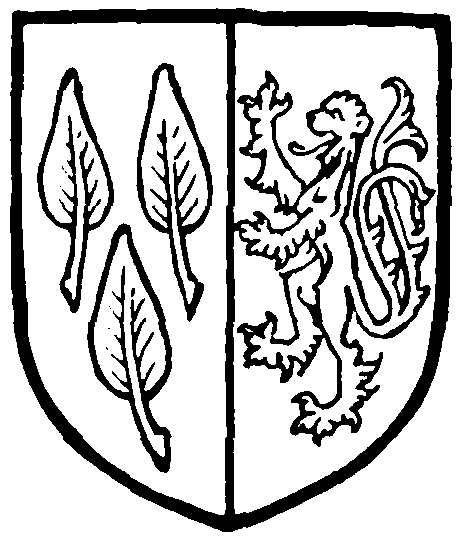
Lady Katherine Leveson. Azure three leaves or — Leveson of Trentham impaling Or a lion azure with a forked tail vert —Dudley.
Roger de Mowbray is said to have confirmed to Peter de Arden the estate of CHADWICK which his father Ralph (de Hampton) had held. (fn. 23) Peter's nephew William de Arden in about 1200 settled the vill on his wife Amice for life. (fn. 24) In 1242 Peter de Montfort was holding 1/8 knight's fee here, (fn. 25) probably as mesne lord, John Peche (representative of this branch of the Ardens) holding ½ fee in Chadwick of Roger Mowbray in 1298. (fn. 26) Thomas Mowbray, Duke of Norfolk, was overlord in 1400, (fn. 27) after which time it seems to have been absorbed into the manor of Hampton-in-Arden.
CHURCH
The church of ST. MARY (fn. 28) was built by the Knights Templars c. 1290. After the Suppression in 1540 it fell into decay and became roofless. In 1662 it was reroofed and restored to use by Lady Katherine Leveson and Lady Anne Holbourne, and it served as a chapel for the adjacent almshouses founded by the former in 1677. It became a parish church in 1863.
The church was restored in 1849 by Sir Gilbert Scott, who raised the walls to their original levels, provided them with pinnacles and parapets, and con structed a new roof. (fn. 29) The square south-west bellturret of 1662 was replaced by the present structure. Some of the masonry and carvings in these works are said to have been actual fragments found lying loose on the site.
South of the church, by the south doorway, the foundations have been traced of a former porch of two stories, and of two 13-ft. bays from north to south. Fragments of its vaulting still survive about the doorway and some of the many loose stones lying in the vicarage garden probably also belonged to it.
The church is of a simple rectangular plan, (fn. 30) about 90½ ft. by 30 ft.
The east window is of five cinquefoiled pointed lights and geometrical tracery including circles treated with trefoils, in a moulded two-centred head with an external hood-mould. The jambs are of square orders with hollow-chamfered edges: the exterior has one and the interior two round nook-shafts with moulded bases and bell-capitals carrying two rear-arches with undercut mouldings and a hood-mould with head-stops. The mullions are also moulded and have attached hexagonal shafts with caps and bases. In each side wall are three windows, varying in elevation and details. The easternmost north window is of three trefoiled lights and tracery that includes three sexfoiled circles. The mullions are hollow-chamfered. The jambs outside have an outer moulded order and the hood-mould to the pointed head has man and woman head-stops. Internally the jambs are splayed and have an edge-moulding including an attached round shaft with a moulded base and a capital carved with foliage; they carry a pointed moulded rear-arch that has a hood-mould with headstops. The second window is of four plain pointed lights and tracery including two sexfoiled triangles and three cinquefoiled circles. The mullions are chamfered and have attached round shafts or rolls with foliage capitals, and in the east jamb inside next the capital is a small man's cowled head projecting southwards as a corbel. The roll is also continued in the tracery-bars. The jambs outside have a hollow-chamfered outer order. Internally the reveals are square, each with an attached round shaft to the inner edge, with a foliage capital (also a small human head corbel in the reveal) carrying the rear-arch, moulded differently to the others: next the jamb on the wall-face is also a half-round shaft with a foliage capital carrying the hood-mould. The external hood-mould has stops carved as curling monsters. The third window is like the first but has taller lights, the sill being lower. The easternmost south window is of four cinquefoiled lights and tracery, including two circular lights filled with four trefoiled smaller circles and two others filled with five trefoiled circles, all in the two-centred head. The jambs outside resemble those of the great east window and have foliage capitals; inside the reveals are square and have moulded angles with shafts with plain capitals: the rear-arch is moulded as in the east window and the hood-mould has head-stops. The mullions have attached round shafts with foliage capitals. The second window is of three trefoiled lights and tracery including three circular lights filled with six trefoils of two forms. The jambs inside are like the first, but externally have no shafts. The window is a long one and has a transom, the lights having plain heads below it. The sill although low is not low enough for a seat. The third window is of four cinquefoiled lights and tracery, including two trefoiled circles and a large middle circle filled with a wheel pattern of twelve trefoiled piercings: the other details are as in the first window.
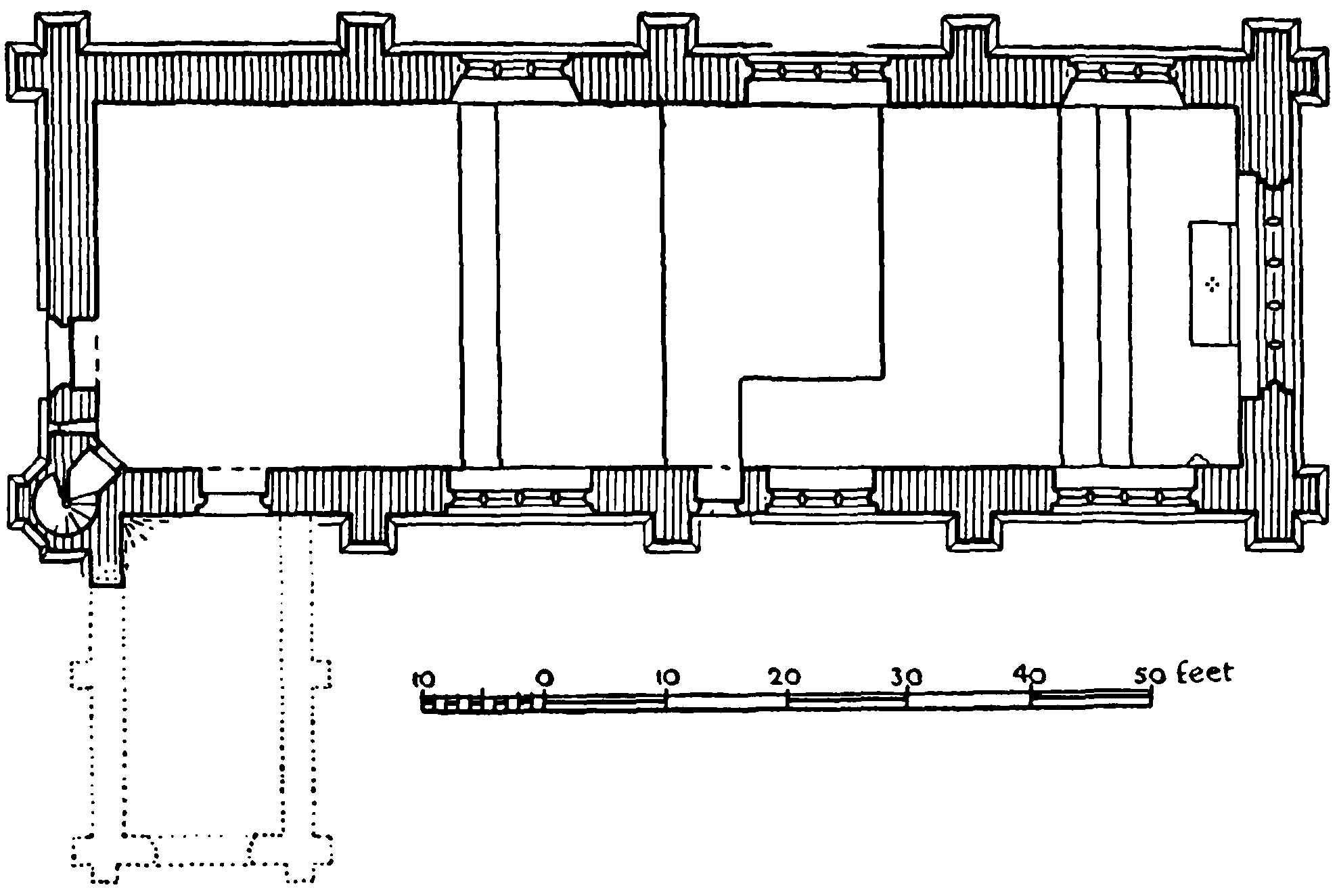
Plan of Balsall Church.
Below the windows and forming the edges of their ledges inside are moulded string-courses.
Under the middle north window is a pointed doorway, set with the rear-arch outwards. The head has a series of mouldings with undercut hollows and the hood-mould has knotted corbels for stops: the rear-arch has a segmental-pointed moulded label. The doorway is of modern stonework, but if it is only a restoration it must have opened into a former chamber here. West of the middle south window is another more simply moulded doorway with a trefoiled open-cusped head in a twocentred main arch: the age of this doorway is doubtful.
The fourth bay of the north wall is unpierced. The same bay contains the main south doorway, now disused: the jambs are chamfered and moulded and each has one nook-shaft with a foliage capital and moulded base. The head, of two main orders, is elaborately moulded with filleted rolls and deep hollows like the windows; the hood-mould has head-stops. The segmental-pointed rear-arch is moulded; the hood-mould is of the same section as the string-course with which it joins at the apex.
The west doorway resembles closely the south doorway. The great west window is plainer than the others; it is of five plain pointed lights and tracery including two cinquefoiled circles, in a pointed head with an external hood-mould. The jambs outside are of two hollow-chamfered orders: the internal reveals are square and have edge-rolls with moulded capitals and bases; the moulded rear-arch has a hood-mould with corbelstops. Above it inside is a moulded string-course at the level of the wall-plates, and outside the face sets back for a ledge furnished with a parapet. In the thinner wall of the gable-head, which is of modern stonework, is a large wheel-window of twelve trefoiled lights.
In the south-west angle is a stair-vice treated octagonally outside and lighted by loops in the south-west side. A splay across the angle inside contains the moulded segmental-pointed entrance to it and another blocked doorway above, which was entered presumably from a gallery. A corresponding splay outside, above the remains of the vaulting of the former south porch, had a square-headed doorway, now blocked, that admitted to its upper chamber. There are also traces of another former doorway in its west side that opened into a building west of the church. This was probably timber-framed and a row of five corbels on the main wall just above the west doorway supported a floor or roof belonging to it. From this building a view into the church was obtained by a squint (now blocked) just north of the turret. It was round-headed outside (in the chamber) and, on the church side, it has a trefoiled head: the string-course drops to pass under it and rise again to sill-level north of it. Outside the squint has a round arch and is blocked.
The walls are of red sandstone and have plinths of two chamfered courses and a moulded top member. The ground slopes down from east to west and the plinth, as well as the pavement inside, steps down with it. At the east angles and north-west angle are pairs of square buttresses, and similar buttresses divide the side walls into four bays. They are of two stages, the lower and wider being weathered back to the walls above the string-courses that pass round them. The upper have modern gabled heads and pinnacles.
Flanking the east window are corbels for images, carved as angels.
The side parapets are modern and have stringcourses carved with human heads and other subjects.
The south-west stair-vice is surmounted by a modern octagonal turret with a stone spirelet.
The westernmost bay of the south side retains some remains of the vaulting of the former porch or two-bay chamber. This includes a moulded wall-rib carried on the east by a corbel, close to the door-head, carved as a woman's head with a wimple. The west angle has the springing stones of three filleted and undercut round ribs rising fanwise and carried on a corbel-capital carved with fighting beasts. On the broken masonry over the ribs is the splay of the stair-vice with a blocked squareheaded doorway that gave entrance to the upper chamber.
The roof, of four double bays, is modern. The trusses are carried on a series of stone corbels carved as kings, bishops, and knights or Templars. Whether any of these are ancient is uncertain.
The pavement rises in seven steps from the west end to the altar.
The piscina in the south wall of the sanctuary has a recess of triangular plan; the jambs have shafts with moulded bases and foliage capitals carrying a moulded pointed head with a hood-mould having head-stops. A similar shaft in the angle at the back of the recess carries half-arch vault ribs to the soffit. The basin is modern.
The three sedilia next west have triple shafts between them and double shafts in the outer jambs, with moulded bases and foliage capitals: they carry twocentred arches filled in with open mask-tracery, and have hood-moulds meeting the string-course with their apices. Vertical mouldings above the jambs, and circular mouldings on the spandrels adjoin them and are of the same projection: the circles enclose shallow trefoils. The seats are stepped down westwards. Both piscina and sedilia are said to be ancient, (fn. 31) but if so have been almost entirely renovated or re-tooled.
In the north wall is a locker with a shouldered head and surrounded by a projecting moulded frame: the edges are rebated for a shutter and the reveals are grooved for a wooden shelf: a projecting course at the same level as the grooves is carved with a small serpent.
The font is modern. (fn. 32) At the west end is a late-17thcentury chest: the front has three panels with enriched mouldings and raised jewel-ornament. The lid is of four panels with plain muntins, &c.
On the south wall outside are scratched two small mass-dials and a circular one.
The registers begin in 1736.
ADVOWSON
Although the chapel of Balsall was in 1541 listed as one of the 'superfluous buildings' and was allowed to fall into gradual decay, 'the advowson of the church and vicarage of Balsall' was included in 1572 in the conveyance of the manor to the Earl of Leicester (fn. 33) and is again referred to in 1663. (fn. 34) It was, however, a donative attached to the manor and without any regular endowment until, shortly after the Restoration, Lady Anne Holbourne repaired the church and by her will left an endowment of £50 a year for the minister. (fn. 35) When Lady Anne's sister Lady Katherine Leveson gave the manor to her Hospital the patronage of the curacy was vested in the governors and the post has usually been held with the mastership. (fn. 36)
In 1306 in return for benefits conferred upon them by Sir Philip de Gayton the Templars agreed to maintain a resident secular chaplain to celebrate for his soul and those of his relatives. (fn. 37)
CHARITIES
The Amalgamated Charities: Saracen's Head Charity. The origin of this charity is unknown. It appears from a court roll of the manor of Balsall dated 24 October 1780 that the surviving trustee was admitted tenant to the messuage and croft called the Saracen's Head, in Balsall Street, to hold the same in trust for the use of the inhabitants of Balsall. The premises are now let on lease for 21 years at a rent of £50 per annum.
Ludford's Charity. The endowment of this charity formerly consisted of 1¼ acres of meadow land called Ludford's Meadow lying in Balsall Street quarter, and 1 r. 38 p. of land, part of Balsall Heath. The land was copyhold of the manor of Balsall and the rents and profits were distributed to the poor of Balsall. The property was sold and the proceeds invested in stock in trust for the charity.
Coventry Dole. An annual sum of 15s. was formerly received by the overseer of Balsall in respect of a warehouse at the corner of Wells St., Coventry. It is unknown who was the donor of this annuity, but it is understood to have been appropriated to the poor of Balsall. The annuity was redeemed in 1928 in consideration of £30 Consols, producing an income of 15s.
Huddesford's Charity. In the Returns under Gilbert's Act an annual sum of 10s. is mentioned as the gift of Huddesford to the poor of Balsall derived from land at Wooton Green.
William Knight by will dated 18 February 1716 gave to the poor of Chadwick End in Balsall an annual sum of 10s., secured on two closes called House Place.
Henry Marsh in 1617 gave 10s. per annum for ever out of his estate at Pearsall End to be distributed among the poor of Balsall; and Leonard Freckleton in 1592 gave an annual sum of 6s. 8d. issuing out of a close called 'The Field Next Browns' to be distributed among the poorest men of Balsall. These two yearly payments were redeemed in 1915 in consideration of £33 6s. 8d. Consols producing 16s. 8d. annually in dividends.
The above-mentioned charities are now regulated by Schemes of the said Commissioners of 10 July 1888 and 25 March 1891 under the title of the Temple Balsall Amalgamated Charities. The schemes appoint a body of eight trustees and direct the income of the Charities, amounting to £84 1s. 4d. per annum, to be applied for the benefit of deserving and necessitous persons resident in Temple Balsall as set out under various heads.
The William Henry Smith Charity. W. H. Smith by indenture dated 5 March 1925 conveyed to trustees land containing 9 a. 2 r. 34 p. at Alder Lane, Balsall, for the benefit of persons residing in Temple Balsall and for any of the purposes set out in clause 19 of the abovementioned scheme of 10 July 1888. The land is let at an annual rent of £15.
Hospital of Lady Katherine Leveson. As stated above, Lady Katherine Leveson devised the manor of Balsall to trustees to erect and endow a Hospital or Almshouse for 20 poor women. The donor directed that should there not be sufficient poor women in Balsall, then the almswomen should be chosen out of the poor inhabitants of Lady Leveson's part of Itchington, Trentham, and Lilleshall. By a Scheme of the Charity Commissioners confirmed by Act of Parliament 28 June 1861 by which the charity is regulated, the number of almswomen was increased to 35 and provision made for the following payments, &c., out of the income of the charity: 6s. per week to each almswoman, who shall be provided with reasonable quantities of bread, milk, and fuel, together with a grey cloth gown and a suitable bonnet every year; 8s. a week to four pensioners in each of the parishes of Long Itchington, Trentham, and Lilleshall in lieu of the contingent benefits given by the founder. The cost of the maintenance and repair of the church of St. Mary, Balsall, and an annual stipend of £100 to the minister of the church (in addition to the annuity of £50 received under the will of Lady Anne Holbourne), and £10 yearly to the sexton, £200 a year to the Master of the Hospital, and £100 a year to the bailiff.
The income of the charity, amounting to about £2,300 annually, is derived from 1,078 acres or thereabouts of real property and from various Stocks.