
A History of the County of Warwick: Volume 4, Hemlingford Hundred. Originally published by Victoria County History, London, 1947.
This free content was digitised by double rekeying. All rights reserved.
'Parishes: Meriden', in A History of the County of Warwick: Volume 4, Hemlingford Hundred, (London, 1947) pp. 147-155. British History Online https://www.british-history.ac.uk/vch/warks/vol4/pp147-155 [accessed 26 April 2024]
In this section
MERIDEN
Acreage: 3,099.
Population: 1911, 832; 1921, 848; 1931, 911.
The parish of Meriden is situated in typical Arden country between Coventry and Birmingham. The village lines the London, Coventry, and Birmingham main road from which, 2 miles farther on, there branches off another, in early times even more important, to Coleshill, Lichfield, and Chester. This central position has conditioned the development of the place. The church, standing apart on a hill overlooking the eastern end of the village, marks the centre of the original settlement, which was known as Alspath. The attraction of an important thoroughfare caused, as at Broadway, a shift of population; and the present village, to which properly belongs the name of Meriden, (fn. 1) grew up, as Dugdale says, 'from some Inns and Alehouses built for the receipt of passengers'. (fn. 2) Dugdale, it will be noted, speaks of the change as a comparatively recent one. Ogilby describes Meriden as 'a scattering village', 'consisting chiefly of Inns'. (fn. 3) Two of these, the 'Red Lion' and the 'Bell', both now disappeared, were of sufficient importance to be named in the Hearth Tax Returns of 1662. But the most famous of the Meriden inns in the 18th century was the 'Bull's Head', 'called by the country People The Handsomest Inn in England'. (fn. 4) Guide-book writers of the period frequently remark on its magnificence, (fn. 5) though that captious traveller, the Hon. John Byng, found it in 1789 'a most blackguard stop'. (fn. 6) Queen, then Princess, Victoria stayed there in 1832. (fn. 7) The original Bull's Head was the large Georgian mansion now called Darlaston Hall, which is said previously to have been a seat of the Earl of Aylesford. (fn. 8) It ceased to be an inn about the middle of last century, (fn. 9) though another inn in the village continues the name.
The London road, turnpiked in 1821, enters the parish down a steep hill from the east. Its original course, which was still steeper, can be traced in the fields to the right and comes out at the beginning of the village, by the Queen's Head Inn. (fn. 10) It was probably abandoned soon after 1785 when the Inclosure Act empowered the Earl of Aylesford to divert the road. (fn. 11) From the same Act dates the straight line of road from the west end of the village towards Hamptonin-Arden and the present course of the road to Berkswell as far as Four Oaks.
By 1785 the greater part of the parish was already inclosed and the Act referred only to 102 acres of open field (in Great Field, Little Field, Church Field, and Well Furlong) and 286 acres of waste. Most of the latter was comprised in Meriden Heath, which lay on the western side of the parish, extending into Packington. The inclosure was actually made by an agreement which was concluded at a meeting of the proprietors on 8 November 1783. Commissioners were then appointed and the text of their award is embodied in the Act. The agreement also effected numerous exchanges of old inclosures and provided for the exoneration of old inclosures from tithe. In all 47 proprietors were concerned, of whom 20 appear to have enjoyed common rights on the heath. The lord of the manor received 1/16 of the heath in lieu of his right of soil. Cottages and encroachments on the heath of more than 20 years' standing and for which no payment had been made to the lord were to be regarded as freeholds. If payment had been made the occupiers were entitled to 99-year leases at present rents. Encroachments within the past 20 years were to be considered as open common and allotted to the lord as part of his 1/16 share; but the occupants were to be entitled to leases for three lives at present rents. The effect of these provisions can be seen in the greatly increased proportion of small holdings shown by the Land Tax Assessments of the next few years. (fn. 12) One-seventh of the open fields and appurtenant heath and waste and 1/9 of the residue of the heath and waste were to be allotted in lieu of tithe. In the Award more than three-quarters of the whole was allotted to the Earl of Aylesford, and the Land Tax Returns indicate, in the early 19th century, a still greater concentration of ownership in his hands.
In December 1745 during the Young Pretender's invasion of England, Meriden Heath was for a short time the headquarters of the Duke of Cumberland's army which was attempting to block his advance on London. The main body of the troops was encamped on the heath from the 6th to the 8th, while the duke stayed with Lord Guernsey at Packington Hall. From here on the morning of the 8th, having learned of the Pretender's retreat from Derby, Cumberland turned northwards in pursuit. (fn. 13)
The Woodmen of Arden, a famous Archery Club, was established at a meeting at the 'Bull's Head' in 1785. (fn. 14) Its headquarters, Forest Hall, on the Birmingham road, was built by Bonomi in 1788 and subsequently enlarged. (fn. 15)
The workhouse, at the west end of the village, dates from 1793, (fn. 16) and was one of those established under Gilbert's Act of 1782.
A few of the buildings in the village are of the 17th century. The roofs are mostly tiled.
In the triangular green at the crossings stands the medieval village-cross, reputed by some to mark the centre of England. The original octagonal tapering shaft, on an octagonal base-stone which has broachstops to make it square at the bottom, stands on a platform of three badly worn steps.
Facing the green, north-east of it, are two small buildings, both with modern shops. One has brick walls, but on the south-east side is a stone chimneystack, and inside are chamfered beams. The other has timber-framing in the side-walls and old beams inside. Adjoining behind it is a former barn of two 16-ft. bays and with curved wind-braces to the purlins to the original roof.
North-west of these, north of the Maxstoke road, is a low thatched cottage with square framing; and a short way west, on the main road, is another with walls of red sandstone.
A former farm-house about 300 yards east of the green on the south side of the road has framed walls covered with rough-cast cement and a central chimneystack of four conjoined diagonal shafts of thin bricks. A cottage of several tenements a little east of it on the other side is of square framing. Another near it on the east side of a loop road is of late-17th-century framing in three bays. A house next east, now several tenements, was probably a farm-house. It has a main block, now faced with 19th-century brickwork, between two gabled cross-wings. The west wing is of square framing in the upper story of the front and has a central chimney-stack of three diagonal shafts. The east wing has a jettied upper story, but the facing is modern. It is used now as the Methodist Chapel.
Darlaston Hall, farther east, is a large 18th-century house of red brick with rusticated angle dressings and a moulded wooden cornice. It has a main block between two projecting wings. The middle entrance has a portico with Doric columns. The front windows are modern, but in the side walls are original windows with flush sash frames. East of it is a bell-tower of the same period with low wings north and south of it.
The Georgian house next east of Darlaston Hall was occupied in the early part of last century by a celebrated private school known as Meriden Academy. Its proprietor, John Allbut, also made it a centre of Wesleyanism in the neighbourhood. After his death and the removal of the family services continued to be held in a room in the village. (fn. 17)
Malt House, now 'Village Farm', opposite the western loop road to the church, is of 18th-century brickwork, but the internal beams, one of which is moulded, are earlier. The former malt-house adjoining west of it is of three stories, also of brick, and had a range of seven windows, with keystones, on each floor, as well as three in the west side. Most of them are now blocked. Their number and size suggest some other use originally. Inside are heavy timbers.
The Queen's Head Inn, at the corner of the road to Walsh Hall, has some old framing but has been mostly restored.
Meriden Hall, ½ mile west of the church, is a large three-storied stone house of the early 18th century, mainly refitted late in the same century. The north front is divided into three bays, the middle slightly project ing with a pediment; each has rusticated pilasters; a moulded cornice at the top of the second story passes round them as capitals. The south was the original main front; it has no pediment. The middle south room, formerly the entrance hall, contains an early18th-century staircase. The middle north room has early-17th-century panelling and overmantel, both from elsewhere. There are several good fire-places and ceilings of the Adam period (c. 1780). A lower long wing extends westwards from the south side. The lower story, containing the old kitchen and other offices, has stone mullioned windows and wide fireplaces of the 17th-century; the upper story is of modern rebuilding.
Moat House, east of the church, is a farm-house of half-H plan, facing west. The west end of the south wing, of old framing covered with rough-cast cement, is dated 1609 in the gable-head, but the house is probably of 16th-century or earlier origin. The whole west and north sides were rough-casted, but it is now partly stripped in the main block and inner faces of the wings, revealing ancient close-set studding to both stories, on stone foundations. The middle entrance has an ancient door hung with ornamental strap-hinges. The north side and the upper story of the east front are of similar framing: the lower story of the last is partly of red sandstone and partly brick, the south side all of brick. The lower rooms have chamfered beams. Story-posts show in the walls inside, but there is no visible evidence to date the roof trusses. A central chimney-stack has wide fire-places back to back; the shaft above is square with a square pilaster on each face. Another stack in the south wing has three diagonal shafts. Around the house and farm-buildings is a moat, mostly dry.
Church Farm, west of the church, is of irregular plan and different periods. The main block contains a wide fire-place of stone, and ceiling beams, one moulded, of the mid 16th century, but the external walls are of later brickwork. A south gabled wing has 17th-century timber-framing and a chimney-stack with three diagonal shafts. Other parts are modern.
Walsh Hall, 5/8 mile north of the church, is part of an early-to mid-15th-century house with 16th-century and modern additions. The original building had a great hall facing north, a west solar wing projecting north, and a buttery wing which afterwards disappeared. About the middle of the 16th century the solar wing was lengthened to the south, and a new wing added west of the solar wing. About the same time the usual upper floor was inserted in the hall-block, with a great chimney-stack. The house has recently been carefully renovated and a new kitchen wing added on the site of the former buttery wing. A new north porch was also added.
The great hall was probably longer, towards the east, than the present main block. One 16-ft. bay remains intact, with an original roof truss. This has a heavy cambered tie-beam supported by shaped story-posts and curved braces, and carrying a post and struts under a collar-beam. (fn. 18) The purlins are supported by steeply curved wind-braces. The inserted ceiling to the ground floor has a 16th-century moulded beam and stopchamfered rafters. That of the original west wing has chamfered beams and some long heavy rafters. The middle cross partition has an ancient moulded doorway. The roof trusses of the wing are not visible. The west extension has a plaster ceiling to the lower story with a border rib of conventional running grape-vine pattern, probably of the 17th century. The roof is Elizabethan. The 16th-century main staircase occupies part of the original west wing; it has newels with moulded and ball heads, turned balusters, and plain chamfered hand-rail.
The external walls of the main block (hall) have all been restored on the north side and fitted with a porch and entrance doorway with a carved door from elsewhere. On the south side it is of square framing above the brick lower story and furnished with a large, flush, gabled dormer of close-set studding of the 16th century, partly restored. The north end of the original west wing is of close-set studding with a flush gable-head of square framing. The south end has square framing to the lower story, but the upper part is of close timbers; the gable-head projects on a moulded bressummer and shaped brackets. The farther west wing is mostly of close timbers and has similar projecting gable-heads on the west and south sides. The first floor of the west side also projects on similar brackets, but the moulded bressummer is modern. Most of the window-frames are modern; two or three of the upper windows with moulded mullions are of the 16th century. The foundations are of red sandstone.
There are four ancient chimney-stacks. That inserted in the hall has a 9-ft. wide fire-place but is rebuilt above the roof. That added to the east side of the north end of the original west wing is of brick. Its lower fire-place of stone has moulded jambs and a straightsided four-centred arch with shields carved in the spandrels: the mantel over it is carved with a raised mesh or diaper pattern. Another on the west side of the south end of the wing has a lower fire-place with restored stone jambs and an early-16th-century moulded lintel, perhaps reused from elsewhere. The upper room has a moulded stone Tudor fire-place. The fourth, projecting from the north side of the farther west wing, has a similar Tudor stone fire-place on each floor. The upper also has a frieze or mantel from elsewhere, carved with a hunting-scene. Each of the three latter stacks has a pair of diagonal shafts. There is a door and some panelling of c. 1600 in the hall.
There are a few ancient buildings of lesser importance scattered about the north-east part of the parish.
Brailes Farm and another house at Eaves Green, ½ mile east of Walsh Hall, have rough-casted walls and central chimney-stacks of the 17th century. Lodge Green Farm, about ½ mile north of Walsh Hall, shows some old framing in the gable and has a barn partly of 17th-century framing and partly of earlier red sandstone masonry.
Marlbrook Hall, about a mile north-east of the last, seems to have been part of the outbuildings of the original Hall. The plan is irregular. The main part, running east and west, has brickwork of the early 16th century in the east wall, but the upper story and western part are of 18th-century brick. The ceilingbeams and joists in the lower story are also of the early 16th century. A gabled projecting north wing is of 17th-century framing. Another projecting southwards is of 18th-century brickwork but has a chamfered beam which is earlier. Stone foundations have been found of an extension towards the east. A square moat incloses a large area to the north, east, and west of the house, and loose stones found at times indicate the site of a larger house and other buildings that have long since disappeared.
A cottage ¼ mile south of Marlbrook Hall, of red sandstone with a central chimney-stack and a wide fireplace, and several other cottages in Hollyberry End of similar material are probably of the 17th century.
Hillwood Cottage Farm, ¾ mile north-west of Marlbrook Hall, has some old framing although much restored. A central chimney-stack has a wide fire-place.
Hornwood Farm, 11/8 miles west of the church, is a 17th-century house covered with Roman cement. It has chamfered ceiling-beams, one with an emphatic curved camber, and a central chimney-stack with a reduced fire-place; above the tiled roof it has a massive square shaft of brick. The Horn brook passes the north side of the house and has been embanked in part, probably for a former mill-wheel.
Berry Fields Farm, on the east side of the Berkswell road, has an ancient barn. The 'Giant's Den', ¼ mile south-west of it, is a large moat, mostly dry, which must have inclosed an important medieval building. In it is a small cottage of 17th-century framing now roughcasted. The ceilings have chamfered beams, and a chimney-stack at the west end has a wide fire-place.
A rising spring in a pond ¼ mile south-south-west of the church marks the site of the ancient St. Lawrence's well. There is no masonry.
MANORS
In the time of Edward the Confessor the Countess Godiva held ALSPATH as 4 hides; in 1086 Nicholas held it to farm of the King (fn. 19) with her other estates, and with them it passed to the Earl of Chester. (fn. 20) In 1235 the lands were held by his heir, Hugh d'Aubigny, as a quarter of a fee. (fn. 21) He died in 1243 without issue, and his possessions were divided between his four sisters. (fn. 22) One of these sisters, Maud, married first John Fitzalan and secondly, after 1267, Richard d'Amundeville, (fn. 23) who is mentioned as overlord of Alspath in the 13th century. (fn. 24) Richard son of John Fitzalan was her heir, and in 1282 was overlord. (fn. 25) Edmund Fitzalan was executed in 1326, (fn. 26) and the overlordship appears then to have lapsed to the Crown. In 1372 the manor was said to be held of Sir John de Clinton, (fn. 27) but if this was not an error it was probably under some special grant. The de Langley family appears as mesne lords of the ¼ fee in the middle of the 13th century, (fn. 28) and again in 1325. (fn. 29)
The Segraves held lands in Meriden at least as early as 1234, when Gilbert de Segrave held one-quarter knight's fee of John de Langley, who himself held of Hugh d'Aubigny. (fn. 30) Gilbert died in 1255 and was succeeded by his son Nicholas. (fn. 31) The latter's lands, including ½ virgate in Alspath held of Philip de Kynton, (fn. 32) were seized after the Barons' Revolt, but restored under the Dictum de Kenilworth; Nicholas died in 1295. (fn. 33) His son John succeeded, and on 8 November 1318 received, for himself and his heirs, the grant of a weekly market at his manor of Alspath, with an annual fair on the eve and feast of St. Lawrence and the following six days. (fn. 34) John died in 1325, after purchasing more lands from Gerard de Alspath, together with a mill and the fishponds of Horn Pool and Ness Pool, and others which he held of the feoffment of Richard de Kington, all these being held of John de Langley by knight's service. (fn. 35) John's widow Christiane was allotted rents from the manor, (fn. 36) and his grandson John son of Stephen Segrave, aged nine, succeeded. (fn. 37) This younger John died seised of the manor in 1353 leaving a widow Margaret, and an only daughter Elizabeth, aged 15, the wife of John de Mowbray. (fn. 38) John de Mowbray inherited the Barony of Segrave in right of his wife, and that of Mowbray from his father in 1361. He was slain near Constantinople in 1368, and succeeded by his son John, who had previously been created Earl of Nottingham. (fn. 39) On his death in 1382 his brother Thomas succeeded. He became Earl Marshal in 1386 and Duke of Norfolk in 1397, and died in exile in 1400, (fn. 40) when the custody of Alspath was granted to Sir Thomas Rempston, as his son Thomas was a minor: (fn. 41) this grant of custody was renewed in 1402. (fn. 42) The younger Thomas Mowbray, Earl Marshal, was executed for high treason in 1405, and was succeeded by his brother John: the latter in 1424 recovered the dukedom of Norfolk. (fn. 43) Meanwhile Margaret, widow of John de Segrave, after his death in 1353 married Sir Walter Manney, and had a second daughter Anne, who became Countess of Pembroke, (fn. 44) and her possessions eventually passed to Reynold, Lord Grey of Ruthin. His son John Grey in 1413 conveyed his rights in the manor to John de Mowbray, (fn. 45) who became Duke of Norfolk and died in 1432, having granted Alspath manor for her life to his sister Isabel who married James, Lord Berkeley. (fn. 46) Their son William, Lord Berkeley, Earl Marshal and of Nottingham, acquired Alspath as one co-heir of the Mowbrays and in 1488 made a settlement of it and other manors, (fn. 47) under which it passed on his death without issue to Thomas Stanley, Earl of Derby. (fn. 48) In 1501 Isabel Harrison widow, daughter of Alice daughter of James, Lord Berkeley (and niece of the Earl of Nottingham), released her rights in various manors including 'Alspath with Meriden' to Thomas, Earl of Derby. (fn. 49) From this time the main manor seems usually to have been known as MERIDEN. (fn. 50) Until 1783 it remained the possession of the Earls of Derby, but two years later it had passed to the Earl of Aylesford, (fn. 51) whose descendants have since held it with Great Packington.
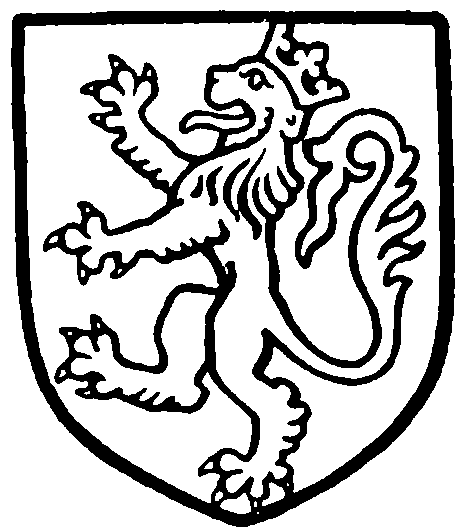
Segrave. Sable a lion argent crowned or.
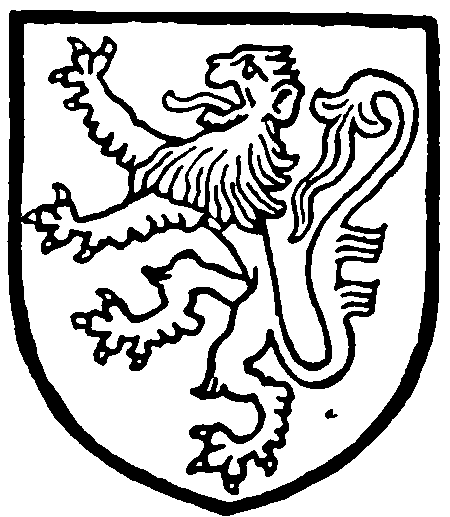
Mowbray. Gules a lion argent.
There was another manor of ALSPATH held by a family deriving their name from the place. Ivo de Ellespathe occurs in about 1155, (fn. 52) and in 1202 his daughter Alice was dealing with land in Alspath. (fn. 53) On 1 June 1257 Gerard (II) son of Gerard (I) de Alspath (or Seintliz, said to have married a coheir of Alspath) (fn. 54) received a grant of free warren in his demesne lands of Alspath. (fn. 55) This Gerard (II) about 1270 did homage to Richard de Amundeville at Berkswell for lands of which the location is not specified: (fn. 56) he married one Milicent, (fn. 57) and died in 1282, when his lands, being held of Richard Fitzalan, then a minor, were taken into the king's hands. (fn. 58) About this time a Walter de Alspath is said to have been styled 'lord of Alspath'; (fn. 59) his son William on 22 July 1304 received a grant of free warren here, (fn. 60) which he exercised in 1308 by seizing a ferret and nets belonging to men who were rabbiting on the edge of his wood. (fn. 61) William is said to have had a daughter Annabel who married, as his first wife, Gerard (III) son of Gerard (II). (fn. 62) The second wife of Gerard (III) was Maud, apparently daughter of Osbert de Clinton, (fn. 63) and by her he had a son John, whose daughter Margery married William Cockes. (fn. 64) She, as a widow, sold the estate to John Chetwynd; (fn. 65) and in 1510 William Chetwynd, owner of Meriden Hall, had laid waste 100 acres of arable land, leaving ten men to wander unemployed. (fn. 66) He died in 1546, having settled 'the manor', held of the Earl of Derby's manor of Meriden, on his son Thomas and his wife Joan. (fn. 67) In 1548 the manor of Alspath alias Meryden was sold by Thomas and Joan to John Hales of Coventry, (fn. 68) who transferred it three years later to his brother Christopher. (fn. 69) In 1554 Christopher sold one moiety to Edward Aglionby, and the other to Elizabeth, wife of John Holbech, and the heirs of her body begotten by John Dabridgecourt her late husband. (fn. 70) Thomas Dabridgecourt, apparently a son of Elizabeth, had inherited this moiety by 1564, and sold it to Edward Aglionby, (fn. 71) who within four years sold it to his son-in-law, William Foster. (fn. 72) Foster, in 1584, sold the whole of this manor to Richard Corbett of Clattercote, Oxon., (fn. 73) whose brother Robert, of Moreton Corbett, Salop, succeeded. The latter's daughter, Elizabeth, wife of Sir Henry Wallop of Farleigh, Hants, was the next possessor; in 1609 Sir Henry sold it to William Andrews and John Halsall. These in 1612 passed it to Thomas Holbech, (fn. 74) whose descendant Matthew Holbech held it in 1706 (fn. 75) and died 1713. (fn. 76) It appears since to have become dispersed.
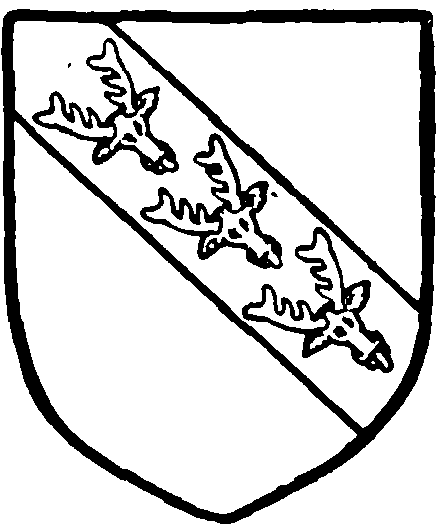
Stanley, Earl of Derby. Argent a bend azure with three harts heads cabossed or.
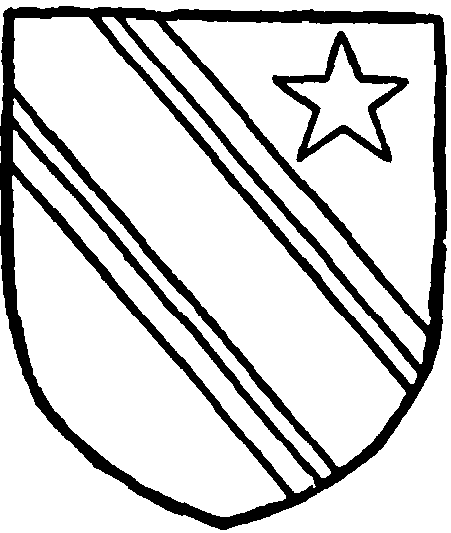
Alspath. Argent a bend sable cotised gules and a molet sable in chief.
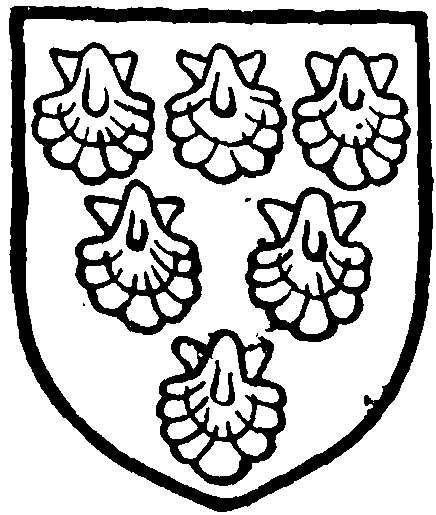
Holbech. Vert six scallops argent.
Reverting to Gerard (III) de Alspath, we find that he had— apparently by his first wife—a son Gerard (IV), who assisted Roger Mortimer to escape from the Tower, for which he received a pardon in 1330. (fn. 77) He left a daughter Annore who married Gilbert de Crosseby, armourer. They recovered from Thomas le Chaloner in 1339 and from John de Segrave and Margaret in 1350 a considerable estate in Alspath, which Gerard (III) had sold, but which was really entailed. (fn. 78) Gilbert and Annore left three daughters, whose representatives in 1424 were suing Sir John Cockayn, John Malory of Newbold, and John Chetwynd for these lands, (fn. 79) but with what result does not appear.
In 1463 the title to the 'manor called GERARD SEYNTLUCE in Alspath' was disputed between Richard Clapham, the nature of whose claim is not stated, and John Shirwode, who claimed that the manor was settled by Osbert de Clynton on Gerard (III) de Alspath and Maud in tail and had descended to him as son of William Shirwode, son of Alice (fn. 80) daughter of William son of Gerard and Maud. Clapham denied that Gerard had any such son William, (fn. 81) but apparently Shirwode made good his claim and about 1470 made the manor over to John Botiler of Alspath, (fn. 82) to whom he was in debt. (fn. 83) About 1495 Thomas son of Robert Botiler sued Wynkyn de Worde of Westminster, bookprinter, for the return of certain deeds concerning the manor of Alspath; (fn. 84) and in 1523 Thomas Butler died seised of a manor of Alspath, held of the Earl of Derby's manor of Meriden, leaving a life interest therein to his wife Margery. His heirs were his daughters, Catherine wife of Richard Hoo; Anne wife of John Walsingham; Elizabeth wife of Ralph Broke; and Joyce, then aged 16, (fn. 85) who afterwards married Robert Crowe. (fn. 86) Eventually the co-heirs sold their respective shares to Roger Wigson, (fn. 87) or Wigston, who died November 1542 seised of this manor of Alspath, leaving a son William. (fn. 88) Possibly, however, he was acting as trustee; for in 1560 Richard Hoo and Catherine were dealing with the whole manor, (fn. 89) and in 1589 William, Humphrey, and Anthony Hoo conveyed it to John Leveson, (fn. 90) after which no more is heard of it.
The Waldieve family anciently held lands in Meriden. Gerald Waldieve bestowed lands on the monks of Coventry, and his successor William left an annual rental of 20d. to the parish church early in the reign of Edward I. (fn. 91) Another William was a coroner and a collector of taxes in the reign of Edward III. (fn. 92) His son Alan, by marriage with Joan daughter and heir of Richard Whitacre, became possessed of Elmdon (q.v.), where he was living in 1394. (fn. 93) Alan Waldieve was dead by October 1406, (fn. 94) and was succeeded by two daughters, of whom the younger, Ellen wife of Richard Walshe, received the possessions in Meriden, (fn. 95) afterwards known as WALSHE HALL. In 1461 Richard was assessed at one-quarter of a knight's fee, held of the Duke of Norfolk. (fn. 96) John Walshe died in 1510, seised of a manor of Alspath held by rent of the Earl of Derby, and was succeeded by his son John. (fn. 97) The latter, on his death in 1541, was succeeded by his son Francis, whose estate was then styled one-fifth of the manor. (fn. 98) Richard Walshe, his son, had a daughter Joyce, wife of Sir Roland Cotton, (fn. 99) but Richard's widow Katherine subsequently married Roger Palmer, (fn. 100) and they in 1620 sold this 'manor of Meriden alias Alspath' to William Andrews of Northfield, Worcs. (fn. 101) The latter sold it three years later to Sir Robert Fisher (fn. 102) of Great Packington, with which it has since been held. The Hall was occupied by Sir Robert's second son Thomas, who died 1687. (fn. 103)

Waldieve. Or three leopards' heads sable.
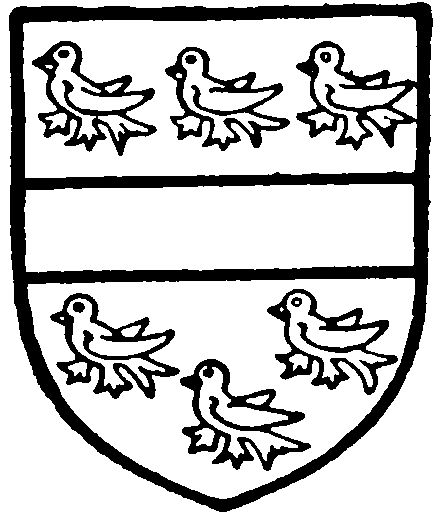
Walshe. Argent a fesse between six martlets sable.
The reputed manor of MARLBROOK first occurs in 1498, when it was said to consist of 60 acres of arable land, 60 of pasture, 20 of meadow, and 120 of wood, together with an annual rental of £3 6s. 8d., held by Thomas Froxmore of Lord Berkeley at a rent of 4s. (fn. 104) Thomas died in that year, and was succeeded by his son Francis, aged 14. (fn. 105) In the reign of Edward VI Marlbrook was held by Anne Cockett, late of Appleton, Norfolk, who was daughter and co-heir of Thomas Froxmore and widow of Edward Cockett. (fn. 106) Her estates passed to her son Anthony, then to his son Arthur, and another Arthur, son of the first, who in 1619 brought an action against Henry West. (fn. 107) But West claimed that his father Thomas West had bought Marbrookes Hall in 1594 from Edward son and heir of Thomas Holberg. This was apparently correct, as Henry West owned the manor in 1627 (fn. 108) and still held it of the Earl of Derby when he died in 1635; he was succeeded by his son Thomas, (fn. 109) who died in 1663, (fn. 110) after which no further trace of this reputed manor has been found.
Several monastic houses held property in this parish. The lands given to Coventry Priory by Gerald Waldieve (see above) were granted in 1553, under the name of the Tithebarn Yard, to Thomas Brown and William Breton, gentlemen, of London. (fn. 111) Ford's Chantry, Coventry, also possessed lands here, which in 1552 were granted to the mayor, bailiffs, and commonalty of that city: (fn. 112) in 1712 they were leased by the Corporation to Samuel Payne at an annual rent of £20. (fn. 113) In 1443 Thomas Boteler of Coventry, girdler, demised all his lands and other possessions in Meriden to William Cotton, prior, and the convent of St. Mary of Arbury; (fn. 114) these were assessed at £1 in 1535. (fn. 115) Lands in this parish were granted to Westminster Abbey by King Edward I in 1292 for the soul of Queen Eleanor; (fn. 116) the grant was confirmed by Edward II in 1316, (fn. 117) and in 1337 by Edward III, who conceded exemption from taxation. (fn. 118) In 1541 the lands were bestowed on the new Diocese of Westminster. (fn. 119)
CHURCH
The parish church of ST. LAWRENCE stands on high ground ¼ mile south of the Birmingham and Coventry main road. It consists of a chancel, nave, north and south aisles, west tower, and modern south porch and vestry.
The chancel and nave are of 12th-century origin; the chancel was lengthened a few feet in the 13th century and the chancel arch widened. Aisles were added to the nave subsequently, the southern first, in the 14th century, and the northern during the 15th century. Later in the 15th century the west tower was built, apparently, judging from the difference of material, in three periods. The clearstory to the nave was raised at about the same time. Minor alterations took place later, such as the insertion of 15th- or early16th-century windows, &c. The west window of the tower was remade in the 17th century. The tower appears to have had a stone spire originally which must have been a conspicuous landmark like those of Solihull and Coleshill.
Various restorations have been carried out in the 19th and 20th centuries.
The chancel (about 23 ft. by 13½ ft.) has an east window of three cinquefoiled lights and vertical tracery in a four-centred head, probably of the 15th century but almost wholly restored. The internal splays are of old rough ashlar. The east wall of red sandstone is thinned above the springing line of the window-head, and there is also a slight set-back inside south of the window. In the north wall are two windows, the eastern a 13th-century lancet with rough internal splays and a later oak lintel. The western is a 12th-century light with a round head in one piece, dressed splays, and a splayed half-round arch inside. Near the west end of the wall is a squint, described below.
In the south wall is a 13th-century lancet like that opposite; it is half covered by the east wall of the modern vestry and is closed at the glass-face by plaster. Farther west is an early-16th-century doorway with chamfered jambs and ogee arch; it now opens into the modern vestry. The reveals, of roughly squared stones, are unequal in thickness, as the wall east of the doorway is 3 ft. thick and west of it about 2¼ ft. It has a stone lintel and above the east reveal are seen traces of a 12thcentury window, as opposite, destroyed by the thinning of the wall. Between the lancet and the doorway is a straight joint in the masonry, with 12th-century dressings west of it, either the remains of a blocked doorway or a recess; it rises to 4 ft. 9 in. above the chancel floor and there has an apparent impost-stone. The remainder above is concealed by a later mural monument. West of the doorway and of the same period was a square-headed window that has had its mullions, &c., removed and the wall cut away below it to form an opening for the organ. Under the lancet windows are small rectangular lockers, and west of the southern, between it and the straight joint, is another recess 3 ft. wide and 15 in. deep with its sill 2 ft. 10 in. above the sanctuary floor: it has a chamfered segmentalpointed arch of the 14th century, but one stone in the west half is a reused 12th-century voussoir with a zigzag moulding.
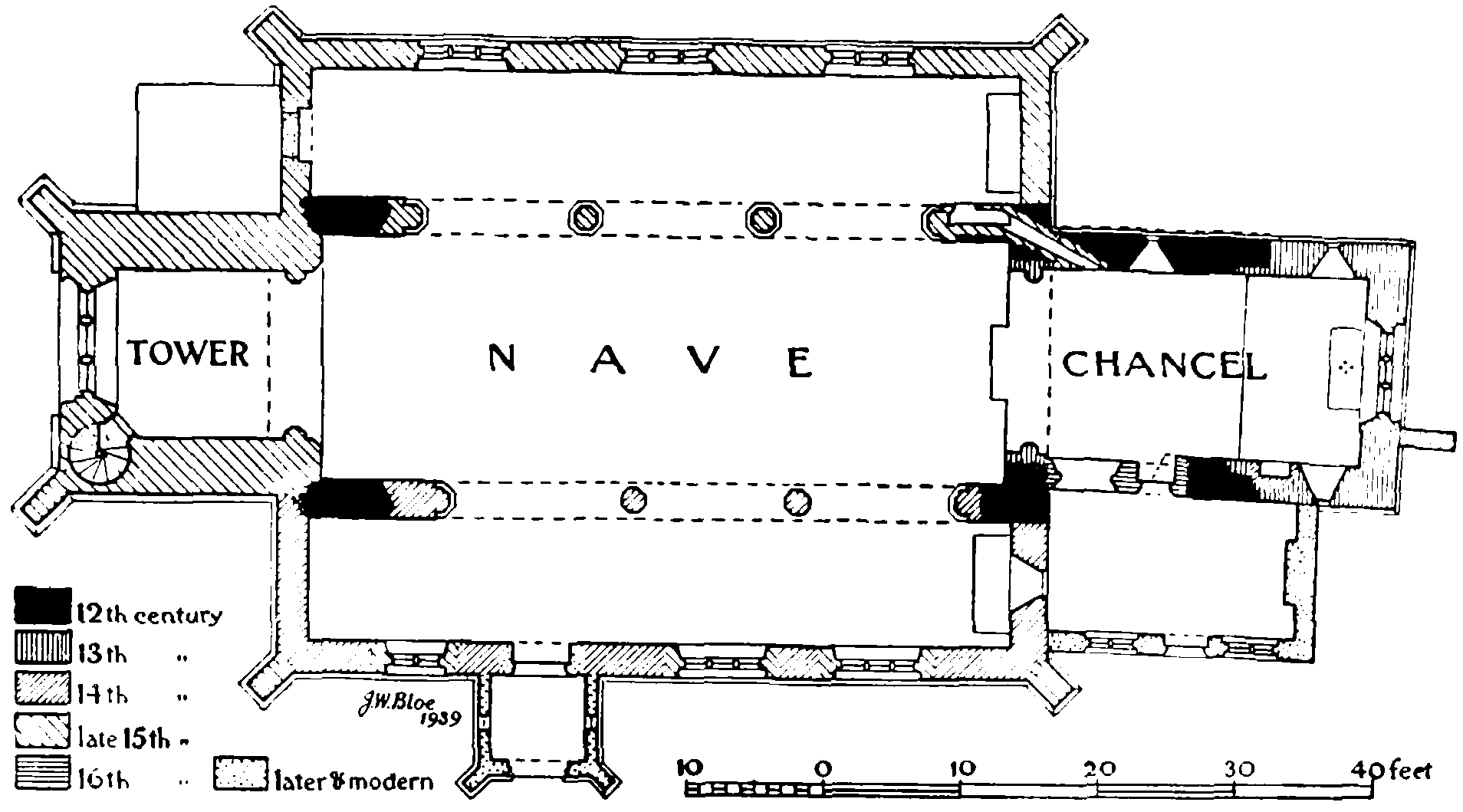
Plan of Meriden Church
In the north wall outside from about 10 ft. from the east end up to within 15 in. of the north aisle is a 12th-century chamfered string-course below the original window. The walling below this is of contemporary coursed rough ashlar and has a chamfered plinth. Above, it is of rough unsquared rubble, but there is a break or seam about 1 ft. from the east end of the string-course and east of that it is similar to that of the east wall. In it is reset upside down a single stone cut with the round head of a small 12th-century window; it shows traces of facial carved ornament. Internally the wall faces are also of large coursed squared rough ashlar: a 12th-century string-course below the north window has been cut right back.
The chancel arch has square and semi-octagonal responds, without bases but with 13th-century foliage capitals. The high segmental-pointed head is of three chamfered orders, the outer two dying on the reveals. The walling above is of coursed ashlar. Above the crown of the arch towards the nave it sets back a few inches and is of rubble like that of the nave clearstory.
The gabled roof is probably of the 15th century; it is of three bays with four trusses. These have collar-beams supported by arched braces. The side purlins have curved wind-braces (four left out of the original twelve). The rafters are modern. The roof is tiled.
The nave (about 50 ft. by 17½ ft.) has a 15thcentury north arcade of three bays with octagonal pillars and responds to match, having high moulded bases and moulded capitals. The two-centred arches are of two chamfered orders. The wall east and west of the arcade is thicker and also above the arches, where it is treated on the aisle side as a chamfered hood-mould. On the east respond are several masons' marks.
The 14th-century south arcade, also of three bays, has octagonal pillars in small courses, with moulded capitals but without visible bases. The responds match but have bases, the western of two chamfers, the eastern either modern or restored. The arches, of two chamfered orders, are segmental-pointed and rather depressed for the period. The westernmost bay is of greater span than the other two and seems to have been widened 2½ ft. at a later date, perhaps to reduce the length of the wall west of it to approximate nearer to that on the north side. Both arcades are of red sandstone. The walls east and west of the arcades are of the original 12th-century thickness, and west of both are remains of 12th-century windows. Their sills were about level with the capitals of the arcades. The masonry west of them is the 12th-century coursed rough ashlar.
The clearstory has two south windows, each of one cinquefoiled light of the 15th century with rough ashlar splays and flat lintels. On the north side the two windows are each of two square-headed lights, probably of the 17th or 18th century. The masonry over the north arcade is of fairly even ashlar, and over the south arcade of roughly squared stones almost in courses. In the clearstory the walling is of rougher rubble work.
The 12th-century north-east angle of the nave forms a straight joint with the east wall of the north aisle and has angle dressings, some of them with diagonal tooling.
The low-pitched roof is probably of c. 1500. It is divided into four bays by trusses carried on stone corbels. These have chamfered main beams supported by wall-posts, moulded curved braces, and stiffeners. Between them are moulded purlins and a ridge-pole and wide flat rafters. The roof is covered with lead bearing several inscriptions with dates 1628, 1694, 1703, and 1752. (fn. 120)
The north aisle (9 ft. wide) has a modern east window high up in the wall. In the north wall are three windows, each of three cinquefoiled four-centred lights and with transoms. They are all restored except the internal splays of rough ashlar. The masonry inside is of roughly tooled coursed ashlar up to the level of the transoms, above which the wall is thinned a few inches. Externally it is all modern ashlar with plinth and parapet. The west wall has a blocked doorway, perhaps the entrance for a former gallery. In the thickness of the wall east of the north arcade is cut a small cavity or chamber of man-height, entered by a 15thcentury doorway. From the east of it a diminishing squint towards the high altar pierces the wall north of the chancel arch.
The south aisle (9 ft. wide) has an east window now opening into the vestry. It is a 2-ft. wide light with a four-centred head and remains of cusping and tracery of the 14th century. For the internal lintel it has a 13th-century coffin-lid carved with a cross with a floriate head and branched shaft. Above is a modern window. In the south wall are three windows like the north windows, the westernmost of two lights, the others of three, all restored except the internal splays. The south doorway, with a four-centred head, is also modern, as is the south porch. The west wall is unpierced. The south wall inside is of coursed rough ashlar with wide jointing: it thins at the transom-level as on the north side. Externally it and the west wall are of modern facing.
The lean-to roofs of both aisles are modern and covered with lead.
The west tower (about 12 ft. square) of three stories is divided externally by a string-course at the base of the bell-chamber. At the angles are diagonal buttresses. It has a 15th-century moulded plinth. The parapet is embattled and has angle gargoyles. The walling is of red sandstone, now detrited, up to the springing-level of the west window-head. Over that is about 10 ft. of cream-yellow ashlar, including the buttresses, and above that it is again of red stone. In the thickness of the south-west angle is a stair-vice lighted by loops, one of which has a crocketed hood-mould. The archway from the nave is two-centred and of two orders, the outer chamfered, the inner ogee-moulded, with moulded imposts of nearly the same section as the north arcade capitals. The doorway to the vice is four-centred and has an ancient battened door.
The west window has 15th-century moulded jambs and two-centred head, and a hood-mould with crockets and finial, and human-head stops. The tracery was altered in the 17th or 18th century to radiating bars from an inner round arch springing from the two mullions. The second story has a four-centred north light and an east doorway leading to the nave roof. The bellchamber has windows of two trefoiled lights and trefoiled spandrel in a four-centred head. There was formerly an octagonal stone spire, of which the squinches and the three bottom courses remain. The roof is now an octagonal pyramid; a beam inside is inscribed W. THOMPSON 1770. The leadwork in the gutters around it bears the date 1750 twice with the names of the vicar and churchwardens and the plumber John Tilley, Coventry. The weather-vane is dated 1933.
The font of the 15th century has an octagonal bowl with a moulded top edge, quatrefoil panelled sides inclosing alternately shield and foliage centres, and a hollowed under-side with trefoiled panels. The stem has similar panels.
Near it is an octagonal trough with a large square hole in the bottom.
A framed chest has a front of four panels with incised early-17th-century ornament. The lid is a gabled one from another chest with three strap-hinges and staples. It is inscribed 'Donum Henrici West Anno Domini 1627'. It was recovered from a local stable.
A chained book of 1609 contains Bishop Jewel's Articles.
A brass in the chancel floor is to Elizabeth, daughter of Thomas Rotton 1638, and has her effigy.
A small tapering coffin-lid of the 13th century stands loose against the south-west respond. It is carved with a floriated cross-head and incised stem and stepped base. Also loose is a headstone to Hannah Westcott, school dame, 1703.
Across the east end of the south aisle is an altar tomb with the alabaster effigy of a knight (fn. 121) of c. 1405 in full plate armour. His feet rest on a lion and at the head are small angels. The base has a top mould and each side has a large panel with three uncarved shields; (fn. 122) at the south end is a similar panel; the north end is rough.
At the east end of the north aisle is another effigy in stone also of a knight in plate armour of mid- to late15th-century date. The feet rest on a lion, and angels support the cushions at the head. The base is of red sandstone and has three square panels with quatrefoiled circles inclosing shields.
On the east side of the wall above the chancel-arch is a scrap of painted black-letter inscription, possibly 16th century or earlier.
There are five bells, three of 1740 and one of 1897. The tenor, uninscribed, has coins incorporated in the shoulder, waist, and sound bow, apparently of the 14th century. (fn. 123)
The communion plate comprises two large chalices with their paten covers, and three alms dishes, all of silver, dating from 1771; and a contemporary small chalice inscribed 'The Gift of Mr. Henry Barnett'.
The register of baptisms and burials begins in 1646 and of marriages in 1647. The earliest register exists in a rough and a (contemporary) fair copy, the latter of which appears to have been taken from a third manuscript, now lost.
ADVOWSON
The church of Alspath was confirmed to the monks of Coventry Priory c. 1160 by Ivo de Allespath, (fn. 124) and again c. 1230 by his grandson James le Bret. (fn. 125) In 1291 it was returned as appropriated to the priory and worth £4 in addition to a pension of £2 then payable to the Dean and Chapter of Lichfield. (fn. 126) In 1535 the rectory of Meriden was farmed for 53s. 4d., which was assigned to the pittancer of the priory; (fn. 127) the vicarage was worth £5 12s.; (fn. 128) and a pension of 20s. was paid to the vicars choral of Lichfield from the church of Alspath (sic). (fn. 129) At the Dissolution the advowson seems to have been retained by the Crown until 1553, when it was granted to Edward Aglionby of Balsall and Henry Higford of Solihull. (fn. 130) Margery Belcher, widow, presented in 1582, (fn. 131) and William Wheate in 1618. (fn. 132) The rectory and advowson then descended in the Wheate family (fn. 133) until at least 1724, when Sir Thomas Wheate, bart., presented. (fn. 134) By 1759 the advowson had been acquired by the Earl of Aylesford, (fn. 135) and it remained with the earls until 24 February 1920, when it was transferred to the Bishop and Chapter of Coventry. (fn. 136)
In 1403 Richard Waldieve granted land to Richard Boteler, vicar of the parish, subject to the annual rent of a rose upon demand, and to the condition to pray daily for the said Richard, Joan his wife, and John his brother. (fn. 137) In 1407 Richard's son John released to the vicar his right to rent. (fn. 138) A chantry was founded in 1404 by John Wyard, (fn. 139) who granted in mortmain £5 rent, for a chaplain to celebrate divine service daily at the altar of St. Mary in the parish church. The value had declined to £4 annually in 1535. The advowson of the chantry was held with their manor by the Walshes in 1510 and 1541. In 1549 the lands were granted to Thomas Fisher and Thomas Dabridgecourt.
CHARITIES
The United Charities: Henry Barnett Bellison by will proved 10 May 1872 gave £500, the interest to be distributed in coal, in quantities of ½ ton each, to the deserving poor of Meriden. The legacy now produces £12 7s. annually.
Charity of Wriothesley and Noel Digby for fuel and clothing. By an indenture dated 22 April 1831, in satisfaction of a request to Noel Digby by his late brother Wriothesley, two shares in the Coventry Canal were transferred to trustees to apply the income therefrom (now £16 approx.) in fuel and clothing to individuals or families of Meriden.
Leightons Land Charity, including Barnett's and Rev. Noel Digby's Charities. Henry Barnett by will dated 6 Nov. 1781 gave £500 in trust to invest the same and from the interest to pay 10s. 6d. a year for a sermon to be preached in Meriden Church, and the sum of 2s. per week for bread to be distributed to the poor of Meriden, and to apply the residue for putting to school boys residing in Meriden. This legacy (together with £163 derived from the sale of timber from 'Rights Lands') was invested on mortgage of an estate of 16 acres in Keresley called Leightons. In 1828 this estate was conveyed by the Rev. Noel Digby upon trust, to apply the profits among the poor inhabitants. The land is now let on a 99 years' lease to the Warwickshire Coal Company at a yearly rent of £30 plus £8 5s. 8d. per annum in respect of coal underlying the land.
Rights Land Charity. In March 1749(–50), in consideration of a sum of £192 representing various gifts, land containing 8 acres known as Rights Land was conveyed to trustees to pay yearly out of the rents 14s. to the vicar of Meriden for preaching two sermons, £4 2s. among poor inhabitants of Meriden, 16s. for teaching poor girls of the parish to read, 15s. in buying bread for poor inhabitants, 5s. to five poor widows, and the residue to poor inhabitants. The land is now let on a 99 years' lease to the Warwickshire Coal Company at a yearly rent of £30 plus £4 4s. in respect of coal underlying the land.
Thomas Rotten gave out of Tyburn Croft, Meriden, 10s. a year to the poor of the parish.
Holbeche's Charity. The share of the charity applicable to this parish consists of a sum of £169 14s. 6d. Consols producing a yearly income of £4 4s. 8d.
Thomas West in 1616 gave a rentcharge of £1 10s. issuing out of Lucas's Grove, Meriden, to the poor of the parish.
Susanna West's Gift. By indenture dated 20 Dec. 1725 Thomas Brown granted an annuity of 10s. payable out of Barley Grove, Meriden, to the Rev. Samuel Jones and others in consideration of £10 paid him by his late sister-in-law, Mrs. Susanna West; 5s. of the annuity to be paid to five poor women of the parish and 5s. to be laid out in repairing and beautifying certain tombs.
Abraham and Susannah Winspear gave a rentcharge of £1 payable out of Douse Field and Lodge Orchard, Meriden; 12s. to be distributed to the poor in bread, and 8s. for a sermon to be preached.
The charities are now regulated by a Scheme of the Charity Commissioners of 15 Dec. 1911 under the title of the United Charities. The Scheme appoints a body of six trustees and provides for the application of the income as follows: yearly sums of 10s. 6d. (Leightons Land Charity), 6s. and 8s. (Rights Land Charity), and 8s. (Charities of Abraham and Susannah Winspear) to be paid to the vicar of Meriden for preaching a sermon on four specified days in the year; and out of the income of the Charity of Susannah West 5s. for the care of certain tombs in the parish church. The remainder of the income to be applied in making payments under various heads set out in the Scheme (including the payment of pensions to poor persons) for the benefit either of the poor of the parish generally, or of deserving and necessitous residents, with a view to the formation of provident habits. The annual income of the Charities amounts to about £120.
Church Lands.
This parish is entitled to two-thirds of the rent of the property called Lapworth Osier Grove, containing 5 acres or thereabouts, for the use of the church. The land is now let at an annual rent of £10 (approx.).