A History of the County of Warwick: Volume 4, Hemlingford Hundred. Originally published by Victoria County History, London, 1947.
This free content was digitised by double rekeying. All rights reserved.
'Parishes: Middleton', in A History of the County of Warwick: Volume 4, Hemlingford Hundred, ed. L F Salzman (London, 1947), British History Online https://www.british-history.ac.uk/vch/warks/vol4/pp156-160 [accessed 9 May 2025].
'Parishes: Middleton', in A History of the County of Warwick: Volume 4, Hemlingford Hundred. Edited by L F Salzman (London, 1947), British History Online, accessed May 9, 2025, https://www.british-history.ac.uk/vch/warks/vol4/pp156-160.
"Parishes: Middleton". A History of the County of Warwick: Volume 4, Hemlingford Hundred. Ed. L F Salzman (London, 1947), British History Online. Web. 9 May 2025. https://www.british-history.ac.uk/vch/warks/vol4/pp156-160.
In this section
MIDDLETON
Acreage: 3,913.
Population: 1911, 418; 1921, 432; 1931, 452.
The parish of Middleton, 3 miles from east to west and 2 miles from north to south, is bounded on the north by the county boundary between Staffordshire and Warwickshire. To its east lies Kingsbury, and on the west it is divided from Sutton Coldfield by Collets Brook and Langley Brook, which unite not far from the south-west angle of the parish to flow through the large Middleton Pool and join the River Tame at the north-east angle. From this point, about 200 ft. above sea-level, the ground rises gently to slightly over 300 ft. on the western boundary, with a steep rise by the wood of New Park to Trickley Coppice where, at the northwest angle of the parish, a height of 480 ft. is reached.
The chief road is that running north from Coleshill to Tamworth. Two branches westward from this road converge to lead into the little village lying round the church.
Middleton Hall, 1 mile east of the church, is built on three sides of a quadrangle open to the north. In the east range are the remains of the original 12thcentury house; there is one small round-headed window surviving in the 3-ft. west wall towards the courtyard but, as the external wall-faces are coated with cement, it is impossible to see how far the original masonry extends. The part identified included a chamber 28 ft. long from north to south by 13 ft. which was subsequently divided up by partitions and furnished with upper floors. Whether it served as a chapel, as has been stated, is doubtful; its position suggests rather that it was a hall. In its south end-wall inside is a tall locker with a shouldered lintel and groove for a shelf at halfheight. North of the present small chamber that has the window and locker is a cross-passage that, as a later insertion, cut the chamber into two. It has a west doorway with chamfered jambs and a three-centred head.
A timber-framed chapel seems to have been added to the north by Sir Baldwin Freville (fn. 1) and was 27 ft. by 15 ft. 8 in. Like the 12th-century work, this was also altered subsequently, its lower framing destroyed and upper floors inserted, and its identity merged in later changes. But a fragment of the roof survives with trefoiled or quatrefoiled framing; it included a small bell-turret at its east end, the upper part of which remains within the present roof.
Presumably the earlier great hall was west of the chapel and was destroyed. The present hall is at the north end of the west range and is of about mid-18thcentury date. North of the east range is a detached plastered building with an overhanging upper story; it may date from the 16th century, but has been much modernized.
The continual alterations and additions of the 18thand 19th-century owners have removed practically all semblance of antiquity from the exterior. Much of the west range is modern.
The north forecourt is surrounded by a dry moat. East of it is a two-storied timber-framed building facing west, of c. 1600. It was once a dwelling-house, but is now mostly used as a farm-building: the south end of it is residential. In the front is a projecting staircase wing with a gabled head and a small bell-turret for an 18th-century clock. The framing is square, with curved braces below the eaves. A cartway with arched stone gateways has been cut through the building. At the back is a red sandstone chimney-stack, now partly ruined. The lower story has a wide fire-place in it: the upper, which has lost its chimney-breast, has a splayed recess with triangular-headed recesses in the splays. The ceilings are open-timbered: the roof has braced tiebeams in the partitions and two purlins, the upper with wind-braces.
MANORS
At the time of the Domesday inquest Hugh de Grentemaisnil held 4 hides in Middleton where there was a priest and a mill, and which had been held, freely, by Pallin in the time of Edward the Confessor. (fn. 2) By the same inquest Adeliz wife of Hugh was also returned as holding 4 hides there, which land had formerly been held freely by Turgot. (fn. 3) Apparently Hugh and Adeliz shared Middleton almost equally between them. (fn. 4)
By 1185 Geoffrey Marmion had already made a grant to the Templars from his land there. (fn. 5) In 1220 Philippa widow of Robert Marmion was claiming dower in Middleton from her son Robert 'senior'. (fn. 6) He had already committed the lands to the Bishop of Winchester, who promised to satisfy her. (fn. 7) This Robert Marmion died in 1241 or 1242 and was succeeded by his son Philip, (fn. 8) who in May 1259 leased what is here first called the manor of MIDDLETON to the Prior and Convent of Studley for two years. (fn. 9) Philip in 1285 successfully claimed a gallows here and view of frankpledge. (fn. 10) He died in 1291, and the chief messuage in the manor, with the suit of the town, 2 water-mills, and other lands and rights there were assigned in dower to his widow Mary, (fn. 11) who died in 1313. (fn. 12)
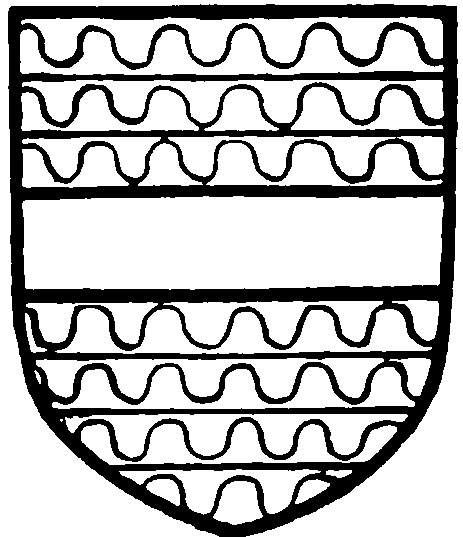
Marmion. Vair a fesse gules
Philip left four co-heiresses, his daughters, Joan widow of William de Morteyn, Maud wife of Ralph le Botiler, and Joan Marmion, and his granddaughter Joan wife of Alexander de Freville and daughter of Mazera Marmion and Ralph de Croumbewell. (fn. 13) At this time the whole manor was held of the church of St. Edith, Tamworth, by service of half a mark. (fn. 14) Joan de Morteyn died in 1295 holding in Middleton three free tenants rendering 4s. 4½d. yearly, and ¼ of two parts of the park and of the foreign wood, all held of the church of Tamworth. She was survived by her niece Joan de Freville, her nephew Ralph le Botiler, and also by her half-sister Joan, who was still a minor in the king's wardship, and concerning whose right to inherit her sister's land there was some doubt. (fn. 15) Ralph le Botiler of Wemme widower of Maud was said to be holding 1/5 of the manor at his death in 1307, his heir being his son Ralph. (fn. 16) Mary widow of Philip Marmion died in 1313, when her third was divided among Joan de Freville, Ralph le Botiler, and the young Joan, then wife of Thomas de Ludlow. (fn. 17) In 1316 the vill of Middleton was said to be in the possession of Ralph le Botiler and Alexander de Freville, (fn. 18) but in 1318 the manor was held in third parts. (fn. 19)
Sir Ralph le Botiler of Northbury died in 1342 seised jointly with Hawise his wife of what was described as a messuage, lands, and rent in Middleton, held of the church of St. Edith in Tamworth by service of ⅓ of 6s. 8d. yearly. (fn. 20) Their heir was Ralph son of their son John, (fn. 21) but Hawise continued to hold a third of 'the manor' until her death in 1360 when it passed to another grandson Edward son of John. (fn. 22) Sir Edward Botiler died in 1412 or 1413 holding part of the manor, (fn. 23) but nothing further is heard of this third of Middleton. (fn. 24)
Meanwhile Philip Marmion's youngest daughter Joan had married first Sir Thomas Ludlow and secondly Henry Hillary, (fn. 25) with whom in 1323 she made a settlement of ⅓ of the manor. (fn. 26) Hillary outlived Joan and at his death in 1349 was succeeded by their son Sir Edward. (fn. 27) This third of the manor was held by payment of a rent of 18d. to the altar of St. Edith in the chapel of Tamworth. (fn. 28) There is no further trace of any Hillary holding a share in the manor, but in 1362 Sir John Dymmok of Scrivelsby, Lincs., a descendant of a daughter of Joan Marmion and Sir Thomas Ludlow, (fn. 29) quitclaimed his right in the manor to Sir Baldwin de Freville. (fn. 30)
In 1318 ⅓ of the manor was held by Joan and Alexander de Freville. (fn. 31) Alexander died in 1328, (fn. 32) Joan surviving him, and their son Baldwin in 1346 entailed this portion of the manor on himself and his first wife Ida. (fn. 33) When Sir Baldwin died in 1375 he bequeathed to his son, another Baldwin, half of ¼ of the manor, in addition to the original ⅓, (fn. 34) but on his death in 1401 this younger Baldwin was found to be holding 2/3 of the manor (see above). (fn. 35) This had formerly been held jointly in fee tail with Joan his wife, with contingent remainder to Joyce, his stepmother, who had married Sir Adam de Peshale. (fn. 36) Joan died without heirs, and Baldwin married Maud, who had issue Baldwin, aged 4 at his father's death; but the lands, or certainly ⅓ of the manor, remained to Joyce and Sir Adam, (fn. 37) on whom they had been settled in 1389, (fn. 38) and in 1401 they made a settlement of ⅓ of the manor for her lifetime. (fn. 39) No record of her death has been found, but in 1418 Sir Baldwin Freville died, holding ⅓ of the manor and leaving as his heirs two sisters and the son of a third. (fn. 40) On one of the sisters, Margaret, and her husband Sir Hugh Willoughby the ⅓ manor was settled in 1435. (fn. 41) In 1454 a settlement was made on Margaret and her second husband Sir Richard Bingham, and her heirs, of what was described as the manor of Middleton. (fn. 42) Margaret was holding two parts of the manor at her death in 1493, when her heir was her grandson Sir Henry Willoughby. (fn. 43)
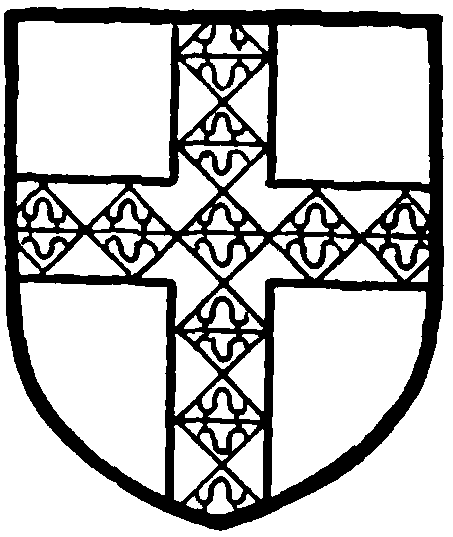
Freville. Or a cross lozengy gules and vair.
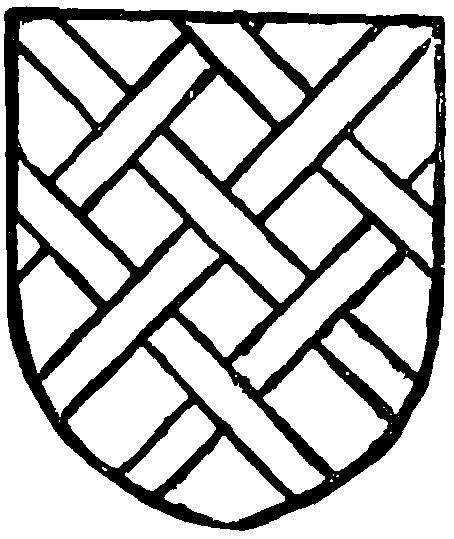
Willoughby. Or fretty azure.
Sir Henry Willoughby died in 1528, leaving the whole manor to his son John, (fn. 44) from whom it passed in 1549 to his nephew Henry. (fn. 45) Sir Henry Willoughby died in 1550 and the manor was in the hands of his executors until his young son Thomas, then aged 8, came of age. (fn. 46) Thomas died without issue in 1558 or 1559 (fn. 47) and was succeeded by his brother Francis. (fn. 48) Sir Francis and Elizabeth his first wife, daughter of Sir John Lyttleton, were dealing with the manor in 1578. (fn. 49) In 1587 Sir Francis settled it, with Kingsbury (q.v.), on his eldest daughter Brigit on her marriage with Percival Willoughby of Park Hall, (fn. 50) and, to help to pay his debts, he made a further settlement on himself and these two, to whom the manors passed, though not without litigation, on the death of Sir Francis in 1597. (fn. 51) One of Brigit's sisters, Winifred, and her husband Edward Willoughby (brother of Percival) (fn. 52) conveyed ⅓ of these manors in 1598 to Percival Willoughby. (fn. 53) In 1611 Sir Percival and Brigit were dealing with the manors (fn. 54) and in 1614 Sir Percival alone. (fn. 55) His son Sir Francis and his wife Cassandra were holding Middleton in 1628. (fn. 56) Sir Francis died in 1665 (fn. 57) and his son Francis settled the manor on his father-in-law, Henry Barnard, in 1668 (fn. 58) and died in 1672. (fn. 59) His eldest son, Sir Francis, died in 1688, (fn. 60) and from him the manor appears to have passed to his brother Thomas, afterwards the first Baron Middleton, (fn. 61) and descended with the title, but all manorial rights appear to have lapsed.
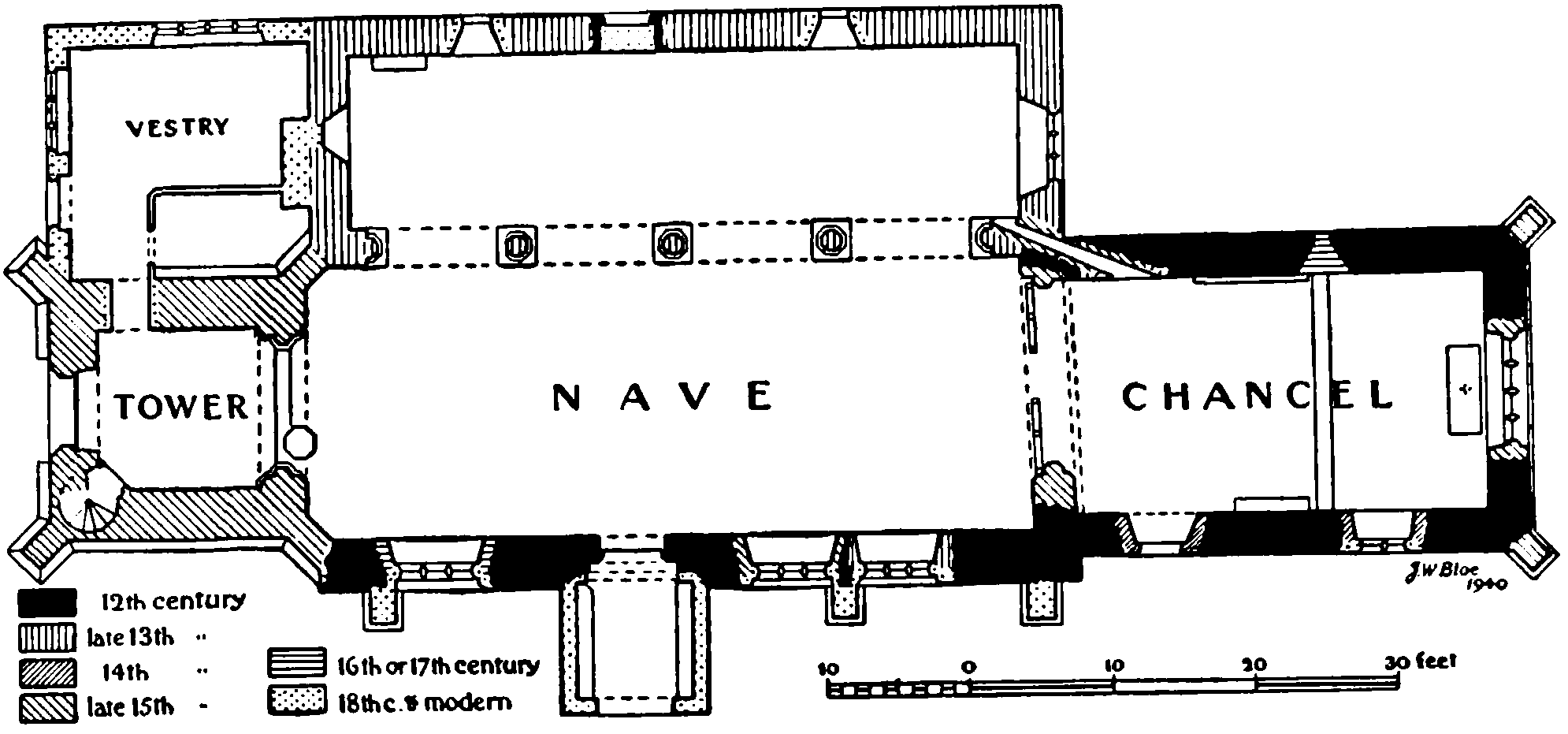
Plan of Middleton Church
A PARK in Middleton is mentioned in 1258 and in 1291, when it was part of the possessions of Philip Marmion. (fn. 62) Henry Hillary had a park there in 1339. (fn. 63) Sir Francis Willoughby is said to have been prevented by his son-in-law, Percival Willoughby, from selling the OLD PARK. (fn. 64) Sir Percival Willoughby and Sir Francis his son with their wives Brigit and Cassandra are said to have devised the NEW PARK, at some time before January 1622 to Sir Rowland Rugeley and Sir Thomas Wolseley for 80 years in trust, to the use of Sir John Hunt and Viscount Wallingford. (fn. 65) Early in 1622 Sir Francis Willoughby and Cassandra conveyed the park and tenements in Middleton to Sir Francis Smith and Sir Thomas Haselbrigge (fn. 66) probably on mortgage, since in 1641 Sir John le Hunt and others conveyed it to Sir Thomas Wendy, K.B., and John and Edward Byrche. (fn. 67) In 1665 William le Hunt appears to have sold the New Park to Sir Francis Willough by and Francis Willoughby, esq. for £4,000. (fn. 68) Thomas, Lord Middleton, owned the park in 1775. (fn. 69)
There were iron-works in Middleton round about the end of the 16th century. (fn. 70)
The lord of the manor was still claiming view of frankpledge in 1668. (fn. 71)
There was a MILL worth 20s. on Hugh de Grentemaisnil's share of Middleton in 1086. (fn. 72) Philip Marmion held two mills at his death in 1291 and these passed to his widow in dower. (fn. 73) Sir Thomas Willoughby had a mill there, and a dovecot, in 1702. (fn. 74)
A free fishery is mentioned in 1291. (fn. 75) In 1549 it was described as being in the Tame and stretching from Kingsbury to Drayton Bassett. (fn. 76) In 1246 Philip Marmion, his heirs, and their wives gained the right to fish in Thomas de Clinton's river at Amington when staying at their manor of Middleton, but with certain kinds of nets only. (fn. 77) The privilege was not extended to their bailiffs or servants in their absence.
CHURCH
The parish church of ST. JOHN THE BAPTIST consists of a chancel, nave, north aisle, south porch, and west tower with a vestry north of it. The chancel and nave are of about mid-12th-century date, the former retaining remains of original windows and the latter those of the south doorway. The north aisle and arcade were added at the end of the 13th century, and late in the 15th century the west tower was built and clearstories were added above both the chancel and nave. The south porch dates from the 18th century. Much restoration appears to have been done in the same century and there was another restoration in 1876. (fn. 78)
The chancel (about 30 ft. by 17 ft.) has a late-15thcentury east window of four trefoiled lights under a four-centred head. In the north wall is a blocked small window of the 12th century, fairly low in the wall; the external head is in one stone. Only half the semicircular rear-arch is exposed inside, the remainder being concealed by the large 17th-century Willoughby monument. Below it is a 7-ft. wide shallow recess with a segmental arch, probably of the early 16th century. Near the west end of the wall is the rectangular mouth (restored) of an oblique squint from the north aisle. In the east half of the south wall is a much restored window of two trefoiled lights and a quatrefoil in a two-centred head with an external hood-mould, probably a 14th-century insertion. In the west half is a priests' doorway of the same period with chamfered jambs and pointed head. Above it in the same internal recess is the splayed rear-arch of a 12th-century window; there is no trace of it outside. The clearstory has one north and two south windows, each of three trefoiled lights under a four-centred head, of the same date as the east window. The northern is blocked for the 17th century monument.
The lower parts of the east and north walls are of 12th-century squared ashlar grey stone; later medieval changes have altered the higher masonry, but many original stones are left. Much of the lower part of the south wall of chancel and nave is faced with 18th- or early-19th-century fine ashlar (a kind of veneer), but original masonry is exposed. The low-pitched east gable-head and the side-walls with the clearstory windows are of red and grey sandstone with plain parapets. At the angles are diagonal buttresses of the 15th century with moulded plinths.
The roof has a flat plastered ceiling divided into four bays by cross-beams.
The chancel arch, of the late 15th century, is of two chamfered orders, the inner with a capital of plain hollow section. The wall is thicker above and is corbelled out on the east face, the oversailing following the crown of the arch.
The nave (about 51 ft. by 19 ft.) has a late-13thcentury north arcade of four bays with octagonal pillars and responds. The pillars have moulded bell capitals, circular in the upper halves, and moulded bases that stand on much broader square sub-bases. The responds have plain capitals, and the western has no base-mould. All is of red sandstone. East of the east respond, in the aisle, is the ancient narrower end of the oblique squint to the chancel. In the south wall are three three-light windows, completely restored. The eastern is of three lancets of 13th-century style, the second of three trefoiled lights of late-15th-century style. The third, west of the south doorway, is of three plain square-headed lights, a 16th- or 17th-century insertion: all is of red sandstone. The south doorway is the original 12th-century entrance. The jambs have been altered and have lost their nook-shafts, but the semicircular head of three orders is intact: the innermost is chamfered, the middle has facial cheveron ornament, and the outermost a plain edge-roll: it is of yellow sandstone. The clearstory has three north and three taller south windows like those in the chancel. The roof has a plastered flat ceiling divided by beams into seven bays. On the east face of the tower are lines indicating the former taller gabled roof, and two corbels within, on the western splays (diagonal buttresses of the tower), were also used for it.
The north aisle (about 12 ft. wide) has a late-13thcentury east window of three lancets, mostly restored. In the north wall are two rectangular windows of the 17th or 18th century. Between them is the blocked north doorway with chamfered jambs and half-round head of the 12th century reset. In the west wall is a blocked lancet window. The roof has a flat plastered ceiling.
The west tower (about 11¼ ft. square) is built of red sandstone ashlar and has a moulded plinth, one moulded string-course, and an embattled parapet with carved water-spouts at the angles. There are diagonal buttresses at the four angles up to the base of the bellchamber, above which they change to shallow clasping buttresses.
The archway towards the nave is of two orders, the outer sunk-chamfered and continued in the twocentred head, the inner of the local late-15th-century form with ogee-moulded sides and a broad fillet; it is interrupted at the springing level by moulded capitals like those of the chancel arch. The bases are hollowchamfered. The west doorway has jambs and fourcentred head of two hollow-chamfered orders, and an external hood-mould with crockets, foliage finial, and large stops carved as monsters. The west window is of three cinquefoiled ogee-headed lights and vertical tracery in a four-centred head with a crocketed hood-mould with carved stops, the southern a man's head, the northern possibly intended for a helmet. In the south-west angle is a stair-vice entered by a four-centred doorway and lighted by south loops with crocketed hoodmoulds. On the south wall is a canopied and crocketed niche for an image.
The second story has a small trefoiled loop in the west wall with a crocketed hood-mould. There are also loops in the north and south walls, the latter covered by a modern clock-dial. The bell-chamber is lighted in each wall by a window of two cinquefoiled ogee-headed lights and vertical tracery in a fourcentred head with a hood-mould having the usual grotesque or monster stops.
The south porch is of 18th-century red brick and has a round-headed entrance. The north-west vestry is modern.
The font is modern. There is also a disused 18thcentury font of baluster type. The chancel arch is closed by a 15th-century oak screen consisting of four bays and a middle doorway. The open side-bays have sub-cusped trefoiled heads and tracery under a fourcentred arch. The posts are moulded and have small attached shafts with capitals that carried the ribs of the former coving of the rood-loft. The middle rail is carved with paterae—foliage, grotesque faces, double rose, &c. The closed panels below have sub-cusped trefoiled heads and rosettes and foliage in the spandrels. The doorway has a cinquefoiled elliptical head with rosette cusp-points and two bays of tracery above. The three south closed panels are pierced with groups of later small peep-holes.
The pulpit is of the 18th century and is of square plan with small splayed angles. On the wider sides are applied cherubs' heads, and the narrower have applied twisted middle shafts.
In the north recess of the chancel is a small brass plate with a Latin inscription in black letter to Dorothy daughter of Henry Willoughby and wife of Anthony Fitzherbert, died 5 November 1507. Above it is a shield of Fitzherbert impaling Willoughby.
In the chancel floor is a slab with the well-preserved brass effigies of a man and woman and a Latin inscription to Sir Richard Bingham, Justice of the King's Bench, who died 22 May 1476, and Margaret (Freville) his wife. The man (3 ft. 2 in. high) wears his justice's robes, and the woman (3 ft. high) a widow's veil and long mantle.
Another slab, north of the altar, has the indents only of four small riband scrolls, one at each corner.
On the south side of the chancel is a mural monument to Edward Ridgway, second son of Thomas, Earl of Londonderry, died 19 September 1638. It has his kneeling effigy dressed in armour and wearing a helmet with a panache and a red cloak; his sword is on his left side. The effigy is set in a round-headed recess flanked by Ionic shafts of black marble that support an entablature and cresting with repainted shields of arms. (fn. 79) On hooks east of it are his funeral helm and gauntlets. Below them is a carved wood cartouche with the painted arms of Willoughby and the remains of a coronet.
On the north side is a large marble monument, standing on the floor, to Francis Willoughby, died 7 December 1665, and his wife Cassandra (Ridgway), died 15 July 1675. The north windows were walled up for this monument.
There is also a floor slab to Lettice daughter of Percival Willoughby and wife of John Byrch of Lecroft, Staffs., died 1 January 1651–2.
The three bells are by T. Mears, 1826.
The communion plate consists of a chalice, paten, and flagon of silver, all of the date 1707.
The registers begin in 1675.
In the churchyard is a medieval square base-stone with a socket for a 13-in. cross-shaft.
The south churchyard wall bordering the road is of ancient masonry and has a chamfered plinth. A former gateway opposite the tower has been walled up, the present modern gateway being opposite the porch.
ADVOWSON
There was a priest in Middleton in 1086. (fn. 80) In 1257 Philip Marmion sold the advowson of the church to the dean and chapter of Tamworth, subject to an annuity of 10 marks paid to William de Farnham in the abbey of Merevale. (fn. 81) It was appropriated to the collegiate church as a prebend and served by a stipendiary priest. (fn. 82) After the Suppression the advowson remained for a time with the Crown. (fn. 83) Francis Willoughby held it in 1668 (fn. 84) and Thomas, Lord Middleton, in 1775 held what was described as the nomination of the curacy of Middleton. (fn. 85) It was still held with the manor in 1850, (fn. 86) and Lord Middleton was patron in 1920. (fn. 87) The church was in the patronage of the Bishop of Birmingham by 1926. (fn. 88)
The RECTORY of Middleton was let at farm by the Dean of Tamworth and subsequently by Queen Elizabeth. (fn. 89) It was leased to George Willoughby in 1569 for 21 years, but in 1577 the queen made another lease, to Nicholas Arrington. (fn. 90) In 1601 she leased it to Richard Cartwright and Thomas Hutton of London. (fn. 91) In 1606 the rectory was bequeathed by Urias Babington to his widow Ann for life, with remainder to his daughter Elizabeth and her issue: in default to Urias Babington his son, and his heir. (fn. 92) In 1636 Henry Coningesby the younger conveyed it to Roland Fryth and his heirs, (fn. 93) from whom it passed to Edward Willoughby and William Booth. (fn. 94) Thomas, Lord Middleton, held it in 1775. (fn. 95)
CHARITIES
Francis Willoughby by will dated 24 June 1672 gave £4 a year to a schoolmaster or mistress to teach the poor children of Middleton, and 20s. to buy Bibles for the said poor children.
Robert Gorton by will dated 6 December 1693 left £100, or £5 a year, to buy a dozen penny bread to be given at church every Sunday to such poor persons as should come to church and 48s. to a schoolmaster or mistress to teach reading to poor children, or for any other uses which Sir Thomas Willoughby or his heirs think fit.
Sir Thomas Willoughby in 1700 added to the above bequest and purchased land called Sherdales in Kingsbury, then let at £15 a year; of this rent £6 8s. was paid to a schoolmaster, £2 12s. for weekly bread, and the residue in bread and money to the poor. Sherdales, containing 26 acres, is now let at an annual rent of £38 10s.
Georgiana, Lady Middleton, by deed dated 17 February 1783 gave to trustees £1,000 Consols, to pay yearly 20s. of the interest thereof in buying pious books, and to apply the residue in providing a schoolmaster and mistress in the parish. The endowment now produces £25 annually.
Samuel White by will dated 11 May 1715 gave to the poor of Middleton 20s. a year, to be disposed of as follows: Ten dozen penny white loaves and 10s. in money; he also gave 10s. to the Minister of Middleton to preach a sermon, to be paid from the rent of Broomhall Close in Over Stonehall. This land, together with the croft adjoining, now forms the endowment of the charity and is let at a yearly rent of £8 6s.
The above-mentioned charities are now regulated by a Scheme of the Charity Commissioners of 5 October 1906, which appoints three trustees and directs the whole of the endowment of the Charity of Georgiana, Lady Middleton (except a yearly sum of 20s.), and a yearly sum of £7 8s. out of the income of the Charity of Francis Willoughby and others to be applied to educational purposes, and the residue of the income as follows: The yearly sum of 20s. in respect of Lady Middleton's Charity to be expended in the purchase of pious books to be given to poor persons resident in Middleton, a yearly sum of 10s. out of the income of White's Charity to be paid to the minister of Middleton for preaching a sermon, and a yearly sum not exceeding 15s. out of the income of the said charity to be distributed in bread to poor children of the parish. The total income of the Charities amounts to about £72 per annum.