A History of the County of Warwick: Volume 4, Hemlingford Hundred. Originally published by Victoria County History, London, 1947.
This free content was digitised by double rekeying. All rights reserved.
'Parishes: Sheldon', in A History of the County of Warwick: Volume 4, Hemlingford Hundred, ed. L F Salzman (London, 1947), British History Online https://www.british-history.ac.uk/vch/warks/vol4/pp200-205 [accessed 2 May 2025].
'Parishes: Sheldon', in A History of the County of Warwick: Volume 4, Hemlingford Hundred. Edited by L F Salzman (London, 1947), British History Online, accessed May 2, 2025, https://www.british-history.ac.uk/vch/warks/vol4/pp200-205.
"Parishes: Sheldon". A History of the County of Warwick: Volume 4, Hemlingford Hundred. Ed. L F Salzman (London, 1947), British History Online. Web. 2 May 2025. https://www.british-history.ac.uk/vch/warks/vol4/pp200-205.
In this section
SHELDON
Acreage: 2,620.
Population: 1911, 451; 1921, 526.
Under the Birmingham and Sutton Coldfield Order, 1931, the greater part of Sheldon was transferred to the City of Birmingham. Subsequently what remained was divided between Coleshill and Solihull, so that the civil parish of Sheldon has ceased to exist.
The old parish is bounded on the north by the River Cole (fn. 1) and on the east for the most part by the Kingshurst and Hatchford brooks. The church and village lie in the south of the parish, connected by several small roads with the road from Coventry to Birmingham, which crosses the parish near its southern edge, entering it by Hatchford Bridge. About a mile north of this bridge the Birmingham and Rugby line of the L.M.S. Railway enters Sheldon, near Eastern Bridge (formerly Easthall) and Mackadown, crossing the parish in a north-westerly direction. On the western boundary, a mile west of Mackadown, is the rectangular earthwork known as Kent's Moat. (fn. 2)
Mackadown Farm has walls of cemented brickwork probably of the 18th century, but it has a 17th-century timber-framed barn by the road-side.
Another farm-house, about ¼ mile north-east of it, has some 17th-century timber-framing in its east front, and a barn mostly of brick also preserves a few earlier timbers.
Sheldon Hall is a long and shallow house about 2 miles north of the church. It consists of a main block of two stories and attics built of red and black bricks with stone dressings, dating from the first half of the 16th century. It contains the original ground-floor hall facing south with a square projecting bay at the east end of its front, and a wide screens-passage and projecting porch-wing west of it, the main wall forming a recess between the two. West of this block is a cross-wing, and east of it a pair of similar crosswings with rough-casted walls, probably all of timber-framing and of c. 1600. The gabled fronts of the three are in the same plane as those of the two earlier and narrower projections.
The original part of the south elevation has moulded string-courses marking the floor-levels, and the heads of the porch-wing and the bay are gabled high up so that their ridges are level with that of the main block. The windows are plain square-headed mullioned openings of stone, with transoms to the ground and first floors. Of the pair of three-lights to each story of the main wall the upper eastern window is blocked. The bay is of four lights on the front and one light in the western return wall on each floor. The porch-wing has a four-light window, now blocked. The stone entrance to the porch has an elliptical arch. In the inner doorway is an original oak nail-studded door; it has a drop ring-handle, with an ornamental plate, which is also a knocker on a lower plate and knob.
The back wall of this block is of red and black brickwork (unplastered inside the hall) and has a projecting chimney-stack with two pairs of diagonal shafts, two with diagonal pilasters (or star-shaped in plan). In this the lower hall has a 9 ft.-wide fire-place with stone jambs and an oak lintel. The fire-place was in the middle of the north side of the hall but a later partition now cuts off a space equal with the east bay. The ceiling is divided by early-16th-century moulded beams. The original timber-framed partition with a moulded top beam remains between the hall and entrance-passage west of it. The upper hall has a late-16th-century stone fire-place with moulded jambs and flat three-centred arch, and there is a second-floor fire-place.
The later rough-casted wings have projecting gable-heads on shaped brackets. The oak mullioned and transomed windows resemble the stone windows. The windows to the east wings are modern, except an upper one at the back. Both east and west walls have brick projecting chimney-stacks of c. 1600. The western of these chimney-stacks is gathered in at the sides with crow-stepping and has two shafts with V-shaped pilasters. The eastern has a group of three and another of two diagonal shafts with pilasters. This stack has, in the lower story, a moulded stone Tudor fire-place, and, in the upper, another differently moulded. There are several moulded oak doorways in the wings, and one from the original entrance passage into the west wing has a 17th-century panelled door. In the wing east of the hall is a 17th-century staircase from the first to the second floor, but the lower part has been replaced by a modern stair.
Around the house are the remains of a moat of irregular four-sided plan; the south side is now filled in.
The White Hart Inn at Tile Cross, a little south of Sheldon Hall, has some 17th-century framing in the south-east front.
Outmoor Farm, ¼ mile west of the Hall, is an early-to mid-17th-century house with walls mostly of timber-framing covered with rough-cast. It is a fairly tall building of two stories and has two gables on each face. The windows have modern frames. On each side is a chimney-stack with two pairs of conjoined octagonal shafts.
MANORS
There is no mention of Sheldon in Domesday Book by that name, but the entry concerning 'Machitona', which has been groundlessly identified with Maxstoke (fn. 3) presumably refers to the later 'Makinton', (fn. 4) now Mackadown. (fn. 5) In 1086 it was held of Turchil of Warwick by Alnod as 5 hides less 1 virgate. (fn. 6) As was the case with most of Turchil's estates, the overlords of Sheldon, at least from 1235 to 1400, were the earls of Warwick. (fn. 7) It has been assumed that the land came, like Coleshill (q.v.), into the tenure of Geoffrey de Clinton in the time of Henry I. (fn. 8) Lescelina, Geoffrey's daughter, married Norman de Verdon (fn. 9) and took with her into this family this ½ knight's fee as part of a group of fees held as of Brandon (fn. 10) in Knightlow Hundred. (fn. 11) Rose de Verdon held ½ knight's fee in Sheldon in 1242 (fn. 12) and Theobald de Verdon in 1315 (fn. 13) and 1316. (fn. 14) After Theobald's death this was assigned in 1344 to his second daughter Elizabeth and her husband Bartholomew de Burghersh. (fn. 15) In 1390 Easthall and Westhall manors in Sheldon were held as of the manor of Brandon of the heirs of John de Arundell (fn. 16), representatives of the second daughter of Theobald de Verdon. (fn. 17)
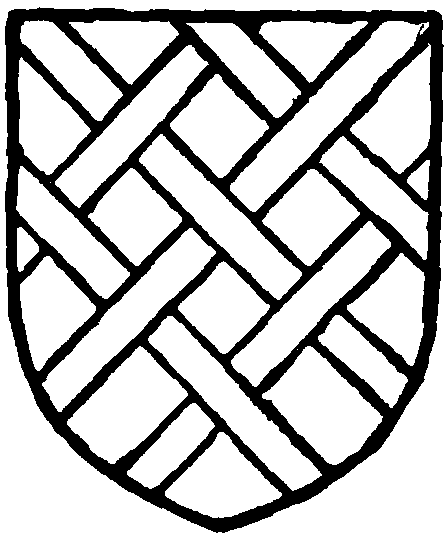
Verdon. Or fretty gules.
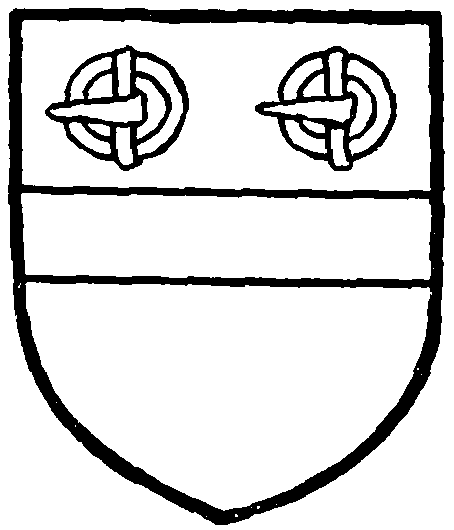
Sheldon. . . . a fesse . . . with two round buckles ... in the chief. (fn. 23)
The first recorded tenant was Ansel de Scheldon, who was lord of 'Makinton' in 1220 (fn. 18) and held the ½ fee in Sheldon at least between 1235 and 1242. (fn. 19) He was succeeded by his son Henry, (fn. 20) who in 1260 conferred a messuage and 2 acres of land here on William, parson of Sheldon. (fn. 21) Henry was lord of Sheldon in 1288, (fn. 22) but Nicholas de Scheldon was the head of the family in 1315 (fn. 24) and 1316. (fn. 25) Nicholas was dead by 1327 when his widow Joan and son Henry (fn. 26) released the manor of SHELDON to John de Hotham, Bishop of Ely, for life, or to his executors for 10 years from October 1327, in return for a pension of £10 a year to Joan. (fn. 27) At the same time the bishop was given the right of free warren in his demesne lands in Sheldon. (fn. 28) He is said to have granted the manor to his nephew John son of Sir John de Hotham, the bishop's eldest brother, (fn. 29) and in 1336 the guardian of the young John released the manor once more to Henry de Sheldon, retaining only certain lands there that Henry had granted to John and Ivette his wife. (fn. 30)
The manor was settled on Henry de Sheldon and Beatrice his wife and their issue (fn. 31) in 1337, and leased by them in 1347 to John de Peyto, junior, and his wife Beatrice, for life, at a rent of £10 a year. (fn. 32) Sir John de Peyto died in June 1373 (fn. 33) and presumably Sheldon was dead also since the manor appears to have been divided between their respective widows. (fn. 34) Beatrice de Peyto (also described as Beatrice de Bishopsdon), held for life a manor in Sheldon called WEST HALL, (fn. 35) while Beatrice de Sheldon in 1385 was still holding EAST HALL. (fn. 36)
Meanwhile, when in 1336 the manor of Sheldon was surrendered to Henry de Sheldon he appears to have had as associate in the transaction Sir John Murdak of Compton Murdak (now Compton Verney), (fn. 37) on whom in 1337 he entailed the manor failing issue to himself and his wife Beatrice. (fn. 38) At the making of the lease to John de Peyto and his wife, Sir John Murdak reserved to himself £10 a year from the manor after the deaths, without heirs, of Henry and Beatrice de Sheldon. (fn. 39) In 1374 his son Sir Thomas Murdak (fn. 40) sold his rights in the manor to Sir Roger de Meres, (fn. 41) who appears to have been succeeded by his son John in 1375. (fn. 42) In 1385 John Meres, senior, sold his rights in the manor of East Hall to Ralph, Lord Basset of Drayton, (fn. 43) who died in 1390 seised of both East Hall and West Hall. (fn. 44) His heirs were his distant cousins Thomas, Earl of Stafford, and Alice, wife of William Chaworth, (fn. 45) but he had devised his Sheldon manors, among others, to his nephew Sir Hugh de Shirley in tail male and enfeoffed the Bishop of Durham and John Brown and others for the purpose of carrying out his bequest. (fn. 46) In June 1403 Edmund, Earl of Stafford, 'cousin and heir of Ralph Basset, lord of Drayton', undertook to deliver these manors, with others, to Sir Hugh Shirley; (fn. 47) and in 1424 one of the feoffees to the uses of Ralph Basset's will released them to Sir Ralph Shirley and his heirs. (fn. 48)
Sir Ralph is said to have held these manors in 1431–2 as ¼ knight's fee. (fn. 49) By 1439–40, however, they were in the possession of Humphrey, Earl of Stafford, (fn. 50) afterwards Duke of Buckingham, passing in 1460 to his grandson, Henry, Duke of Buckingham, (fn. 51) who was beheaded in 1483. (fn. 52) After the attainder of his son Edward in 1521 (fn. 53) the whole Sheldon manor was granted by the Crown to Thomas Grey, Marquess of Dorset, at first for life, and then in 1523 in fee tail. (fn. 54) He died in 1530 (fn. 55) and his son and heir Henry, Duke of Suffolk, was attainted and beheaded in 1554. (fn. 56) In 1559 Queen Elizabeth granted Sheldon to William Gerrard and others, (fn. 57) but in April 1575 she restored it ⃛o Henry Grey to hold in fee tail as 1/20 knight's fee at a yearly rent of £167 4s. 9½d. (fn. 58) Henry Grey sold his rights to Sir George Digby, (fn. 59) who was holding this manor at his death in 1587. (fn. 60) It appears to have been involved in some dispute between the Digby and Mountfort families, as were Coleshill and Kingshurst (q.v.), and is said to have been settled in 1601 by William Mountfort on his son Sir Edward and his wife. (fn. 61) Sir Robert Digby was holding this manor of Sheldon in 1610, (fn. 62) from which time it descended with Coleshill (q.v.) (fn. 63) until recently, when it was sold to a speculative builder.
Sheldon PARK was included in Queen Elizabeth's grant to Henry Grey, (fn. 64) but this is the only mention of a park here that has been found.
When on 29 June 1336 John de Hotham and Ivette his wife (through their guardian) granted the manor to Henry de Sheldon, the grant did not include certain tenements that Henry had given to them and their heirs three days earlier. (fn. 65) John's daughter Alice died in 1379, holding 100s. rent in Sheldon, as of the manor of Brandon. (fn. 66) Hugh le Despenser, her son by her first husband, was similarly holding £8 rent there at his death, without issue, in 1401 (fn. 67) when it passed to his sister Anne, who with her husband Sir Edward Botiller settled it in 1404, as the manor of SHELDON on Sir Hugh's widow, Sybil, for her life. (fn. 68) From this time (fn. 69) this manor of Sheldon descended with Solihull (q.v.), (fn. 70) passing in 1530 to Sir George Throckmorton (fn. 71) and in 1614 from Thomas Throckmorton (fn. 72) to Roger Digby. (fn. 73) After this it descended with the other manor of Sheldon.
CHURCH
The parish church of ST. GILES consists of a chancel with a modern north vestry, nave, north aisle, south porch, and a west tower.
The nave with its fine roof dates from about 1330. The north aisle was added a little later, perhaps early in the second half of the century, but with the chancel, which may have been earlier than the nave, it was rebuilt in 1867. The west tower was added in 1461 and is dated by an inscription; the nave was lengthened westwards by about 10 ft. at the same time, the evidence being provided by the westernmost bay of the roof. The south porch is an early-16th-century structure.
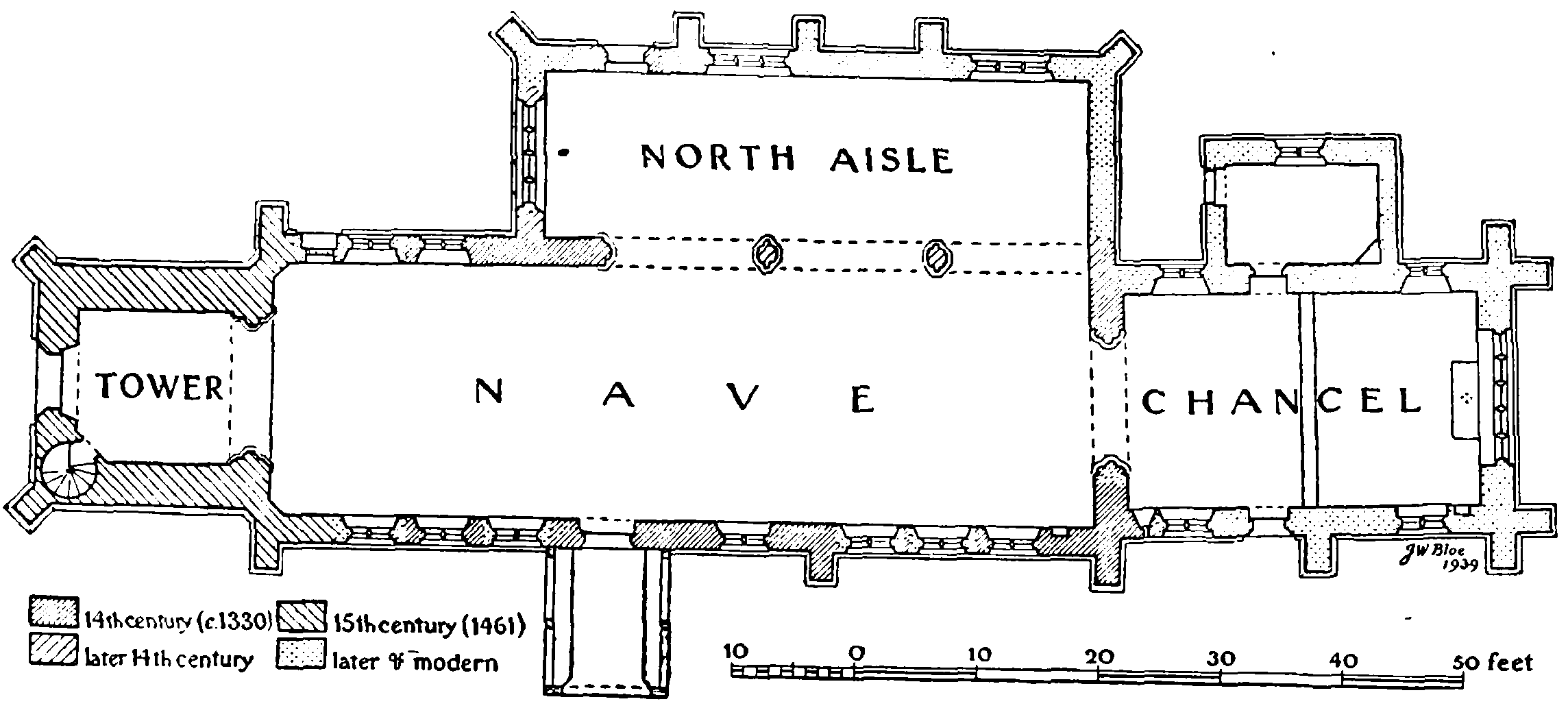
Plan of Sheldon Church.
The chancel (about 29 ft. and 17½ ft.) is entirely modern except for a tiny low-side loop at the west end of the south wall which was reset. The external aperture of this is only 4 in. high by 2½ in. wide. The walls are of red sandstone. The windows are in the style of the 14th century. The east window is of five trefoiled lights, and the two windows in each side wall of two lights, all with tracery in pointed heads. The roof of four bays with foiled wind-braces is covered with tiles. The chancel is deflected to the north of the axial line of the nave, and the chancel arch is square with the chancel, not the nave. The wall has evidently been rebuilt with the chancel. The archway may be of the early 14th century, but has been retooled and largely restored. The responds are of semi-quatrefoil plan and are of modern red sandstone, except for one course of white stone in each respond which may be the original work retooled. The moulded capitals and bases are also of white stone and probably original. The two-centred head of red stone is of two chamfered orders with medium-sized voussoirs.
The nave (about 67 ft. by 20½ ft.) has a north arcade in the eastern part about 40 ft. long, in three bays. The pier and west respond are of two orders, the inner ovolo-moulded, the outer splayed, and have chamfered bases. The mouldings are continued in the two-centred heads without capitals. There is no east respond, the arch dying on the wall. The piers lean outward slightly, but the arches have apparently been rebuilt vertically.
The arcade and the walling above it are of red sandstone. The wall west of the arcade has two windows, the eastern of the 14th century of two cinquefoiled lights and a sexfoil in a two-centred head with an external hood-mould and a chamfered rear-arch. The western is a modern replica, and west of it is a blocked 18th-century doorway (for a former gallery?). The wall is of red sandstone and sets back at the top, with modern masonry above the old moulded eaves-course: the plinth is chamfered.
In the south wall are seven similar windows; only the easternmost, fourth, and sixth are ancient. The south doorway between the fourth and fifth has moulded jambs and pointed head with a hood-mould of the 14th century with defaced head-stops. It is of white stone, except for a few modern courses of red in the jambs. At the east end of the wall is a 14th-century piscina with wave-moulded jambs and a trefoiled head. The sill, formerly projecting, has been cut back flush with the wall and has the remains of a square basin. The back sets back at half height to form a shelf. Higher in the wall is a locker or recess for the former rood-loft. There are said to have been traces of a rood-stair on the north side before the restoration. The wall is of red sandstone ashlar and has restored or modern square buttresses. Those at the west end are probably of the date of the tower.
The nave roof is gabled and divided into five main bays. All but the westernmost are of the 14th century. The four main trusses have moulded cambered tie-beams supported by curved braces and short wall-posts resting on plain stone corbels. On the tie-beams are sloping posts under the collar-beams. The soffits of the principal rafters, above the collar-beams, are cusped to form cinquefoils to the triangular spaces.
Each bay has an intermediate truss, and there is another at the east end. They have moulded collar-beams supported by curved braces from the principal rafters. The rafters are moulded in the lower halves and foiled in the upper parts, like those to the main trusses. The wall-plates are moulded. A purlin on each side is chamfered and supported by straight windbraces, which meet at the point and are foiled to form a cinquefoiled acute arch. There is also a ridge-pole, and below this are curved wind-braces forming two-centred arches.
The westernmost bay has 15th-century moulded wall-plates, a middle principal rafter, and two purlins on each side with curved wind-braces, forming four-centred arches below the lower purlin, and half-arches below the upper from the middle principal.
The north aisle (about 44½ ft. by 13½ ft.) is modern (rebuilt 1867). It has two north windows of three trefoiled lights under a square head, and a large west window of four trefoiled lights and flowing tracery. High in the east wall is a modern pentagonal light. The north doorway near the west end is ancient but partly restored; it is similar in detail to the south doorway. The gabled roof is of four bays with arched collar-beam trusses.
The west tower (about 12¼ ft. square) was built in 1461. It has red sandstone walls and is of two stages divided by a string-course, a tall lower stage, and the bell-chamber. The plinth is moulded and the parapet embattled, with returned copings to the embrasures and carved spouts, now weatherworn. At the angles are diagonal buttresses: the eastern appear inside the nave, forming splays to the west corners. The archway to the nave is of two orders, the outer sunk-chamfered, the inner rounded with a wide fillet to the reveal. They are continued in the two-centred head, but the inner has a moulded impost: towards the nave is a hood-mould.
The west doorway has moulded jambs and a four-centred arch with a crocketed hood-mould and weather-worn beast-stops, and a chamfered segmental-pointed rear-arch. The west window above it is of four cinquefoiled ogee-headed lights and vertical tracery in a two-centred head: the external hood-mould has large mask-stops.
The second story (within the lower stage) has north, west, and south windows, each of two trefoiled lights in a four-centred head with a crocketed hood-mould. The four windows of the bell-chamber are similar, but are taller and have transoms. The south-west stair-vice is entered by a four-centred doorway in the splayed angle and is lighted by five loops, all with crocketed hood-moulds. There was apparently a small niche by the side of the second-floor loop.
Cut on the south wall inside is an inscription in 'black letter': 'In ... yr of our lord M° CCCC lxi ye stepel was begon ye masson had thr[ee] and forti pond vis and viiid for makyng of the st'pel.' Another inscription on the south reveal of the arch reads 'Henry Ulm [ye he?] of [? Horsod] M° CCCC lxi yt to begon'. Other random cuttings include the date 1569.
The south porch is of early-16th-century timber-framing. The front has a pointed entrance flanked by closed side panels with moulded timbers and arched heads; the gable-head has a cambered bressummer treated on the face with interlacing arched panels: the panelled barge-boards are modern. The sides have wall-plates moulded and embattled inside. The middle truss of the roof has a cambered tie-beam, supported on double-chamfered posts and arched braces and carrying sloping struts. The side purlins are treated with quatrefoil panels on the faces, and are supported by arched wind-braces.
Reset on the north wall of the aisle are the remains of a 15th-century reredos. It consists of two large canopied niches separated by a smaller niche with a trefoiled head. The main canopies were three-sided projections with trefoiled gables now nearly all broken away. Above them are tall crocketed pinnacles and flanking them are buttress-pilasters, also with pinnacles and carried on carved foliage corbels at the sill-level; the two middle pilasters are cut away below the head. The subject in the niches was the Annunciation, but the figures are cut away to silhouette only. That in the dexter is the Virgin kneeling, and above her are the remains of a winged figure, probably the Holy Spirit as a dove. The sinister figure, St. Gabriel, is standing. The middle subject, probably the vase of lilies, is much defaced. Some remains of red colouring are visible on the soffits of the canopies.
The font is of the 15th century. It has an octagonal bowl with angle rolls and cinquefoiled triangular-headed panels inclosing blank shields. The chamfered lower edge also has shields and edge-rolls. The stem is plain, the base chamfered.
A cupboard in the aisle has two pieces of 17th-century carved panelling.
There are ten funeral monuments in the tower, of which the earliest is dated 1724 to Joseph Charman.
There are four bells, of which the oldest is of the 16th century, inscribed STA. MARIA, by Newcombe of Leicester; another is dated 1650; the smallest bears the date of its re-casting, March 1723.
The communion plate includes a chalice bearing the date 1717.
The registers begin in 1558.
In the churchyard is a 13th-century tapering coffinlid with a plain long Calvary cross. This was found buried beneath the soil in 1867. (fn. 74)
ADVOWSON
The patronage of the church adhered to the main manor of Sheldon. (fn. 75) In 1327 Henry de Sheldon settled the advowson on John, Bishop of Ely, for life (fn. 76) and it was returned to him with the manor in 1336. (fn. 77) In 1363 the advowson was settled on John de Peyto and Beatrice, (fn. 78) who held it of Beatrice daughter of John de Sheldon. (fn. 79) In the subsequent division of the manor it was attached to Westhall, (fn. 80) coming eventually into the hands of Sir Ralph Basset when Easthall and Westhall were again jointly held. (fn. 81) Presentations were made by the holders of this division of Sheldon, or by their assigns from this date onwards (fn. 82) in spite of the fact that on some occasions the advowson would appear to have been nominally transferred to a holder of the second Sheldon manor. Thus in 1444 it was granted by the king to James Fenys, (fn. 83) in 1521 to Thomas, Duke of Norfolk, (fn. 84) and in 1530 by him to George Throckmorton. (fn. 85)
The church was valued at £5 6s. 8d. in 1291 (fn. 86) and at £8 10s. 10d. in 1535. (fn. 87)
A CHANTRY in honour of Our Lady was founded here by John de Peyto, junior, who built a chapel adjoining the church in 1349 or 1350, with a house for a chantry priest adjoining the churchyard. (fn. 88) The right of presentation was vested in the Prior of Coventry. (fn. 89) John de Peyto had been a great benefactor of the canons of Kenilworth so that they, in return, charged themselves with the annual payment of 8 marks for the maintenance of the priest (fn. 90) and 4 marks 5 shillings annually on the day of the Annunciation for alms given there for the soul of John Peyto, junior. (fn. 91) The last presentation to the chantry appears to have been made in 1538, (fn. 92) and in 1549 the house, orchard, and garden of the chantry priest were granted to Thomas Fyssher and Thomas Dabridgecourt. (fn. 93)
CHARITIES
Henry Rodes gave £9, the interest to be distributed to the poor of Sheldon on Good Friday.
Susanna Dunton gave £3, the interest to be distributed on Whit Tuesday.
Thomas Hall gave £10, the interest to be distributed on St. Thomas's Day.
Sir George Devereux gave £20, the interest to be distributed on Good Friday.
Agnes Bray by will dated 23 August 1729 gave £30, the interest to be distributed by the minister of Sheldon amongst the poor.
Elizabeth Compson bequeathed £5, the interest to be distributed amongst poor widows of the parish.
The endowment of the above-mentioned charities is now represented by a sum of £162 10s. Consols.
Mary Sheldon by will proved in 1826 gave £650, the interest to be distributed in blue coats and cloaks and other warm clothing to the aged poor of Sheldon. The sum was reduced by legacy duty to £585 and is now represented by £656 7s. 7d. Consols.
The Sheldon Bread Charity.
A tablet in the vestry of the parish church records that on 16 December 1858 there was deposited at the Savings Bank, Birmingham, £21 11s. 3d. representing the balance of a subscription entered into to celebrate the marriage of J. W. Digby, and arrangements were made for the interest to be distributed to the necessitous poor by the minister and churchwardens. The endowment is now represented by £28 12s. Consols.
The above-mentioned charities are now regulated by a Scheme of the Charity Commissioners of 24 April 1934. The scheme appoints a body of seven trustees to administer the charities and directs the income to be applied in making payments under one or both of the following heads for the benefit of poor persons resident in Sheldon.
(1) The supply of clothes, boots, linen, bedding, fuel, tools, medical or other aid in sickness, food or other articles in kind.
(2) Temporary assistance in money by way of loan or otherwise in case of sickness, special distress, or unexpected loss.
The total income of the charities amounts to £21 3s. 8d. per annum.