A History of the County of Essex: Volume 5. Originally published by Victoria County History, London, 1966.
This free content was digitised by double rekeying. All rights reserved.
'The ancient parish of Barking: Manors', in A History of the County of Essex: Volume 5, ed. W R Powell (London, 1966), British History Online https://www.british-history.ac.uk/vch/essex/vol5/pp190-214 [accessed 30 April 2025].
'The ancient parish of Barking: Manors', in A History of the County of Essex: Volume 5. Edited by W R Powell (London, 1966), British History Online, accessed April 30, 2025, https://www.british-history.ac.uk/vch/essex/vol5/pp190-214.
"The ancient parish of Barking: Manors". A History of the County of Essex: Volume 5. Ed. W R Powell (London, 1966), British History Online. Web. 30 April 2025. https://www.british-history.ac.uk/vch/essex/vol5/pp190-214.
MANORS.
In or about the year 687 Œthelræd, kinsman of Sebbi, king of the East Saxons, gave to the newly-founded abbey of Barking land comprising 40 hides (manentes) in Ricingaham, Budinham, Deccanham (Dagenham), Angenlabesham, and the field in the wood which was called Widmundes felt. The bounds of the land thus granted were: on the east Writolaburna; on the north Centinces triow (Centing's tree), and then Hanchemstede; on the south flumen Thamisa (the river Thames). (fn. 1) Another charter, dated 687, but of doubtful authenticity, purports to be from Erkenwald, Bishop of London, to Barking Abbey. This mentions Œthelræd's grant, but says it was of 75 hides, at the places named. It also states that the king Swidfrid (son of the king Sebbi of Œthelræd's charter) granted the abbey 40 hides (cassatae) called Berecingas (Barking) and Beddanham. (fn. 2) Widmundes felt was probably at Ilford, though not necessarily in the same area as the later Wyfields. (fn. 3) Writolaburna was probably the river Beam, which later formed the boundary between Dagenham and the royal manor of Havering. (fn. 4) Centinces triow may have been at Becontree Heath, and Hanchemstede was possibly Hampstede croft, near the modern Fulwell Cross. (fn. 5) Ricingaham and Angenlabesham have not been identified. Budinham or Beddanham seems to be a lost place-name identifiable with Barking. Œthelræd's charter does not mention the western boundary of the lands comprised in his grant, perhaps because the land on that side already belonged to the abbey by the gift of Swidfrid. It is reasonable to infer from the above evidence that soon after its foundation the abbey was endowed with land comprising all, or most of, the later parishes of Barking and Dagenham, which had previously been royal territory.
In 1086 the manor of BARKING was held by the abbey as 30 hides, two of which were held by three knights. Since the Conquest 24 a. had been detached from the manor by Goscelin the lorimer, lord of Little Ilford. (fn. 6) Then, as later, the manor undoubtedly included Dagenham (which is not named in Domesday) as well as Barking and Ilford.
Like the abbey's other lands it was held in free alms, though in the 13th and 14th centuries summonses to do military service were repeatedly addressed to the abbess by the Crown. (fn. 7)
The manor of Barking was large (fn. 8) and contained, in addition to the abbey's demesne, the lands of many free tenants. In the earlier 13th century some thirty of these held their tenements by the serjeanty of escorting the abbess or her steward when she or he visited abbey manors. (fn. 9) Such a riding service was still being performed by one Barking tenant in 1475. (fn. 10) The tenure, which resembles those created in the 10th century by St. Oswald, Bishop of Worcester, and the serjeanties of the Domesday radmanni, is probably of pre-Conquest origin. (fn. 11) The claim made by the abbess that it had been converted to its 13th-century form from military tenure is improbable. (fn. 12)
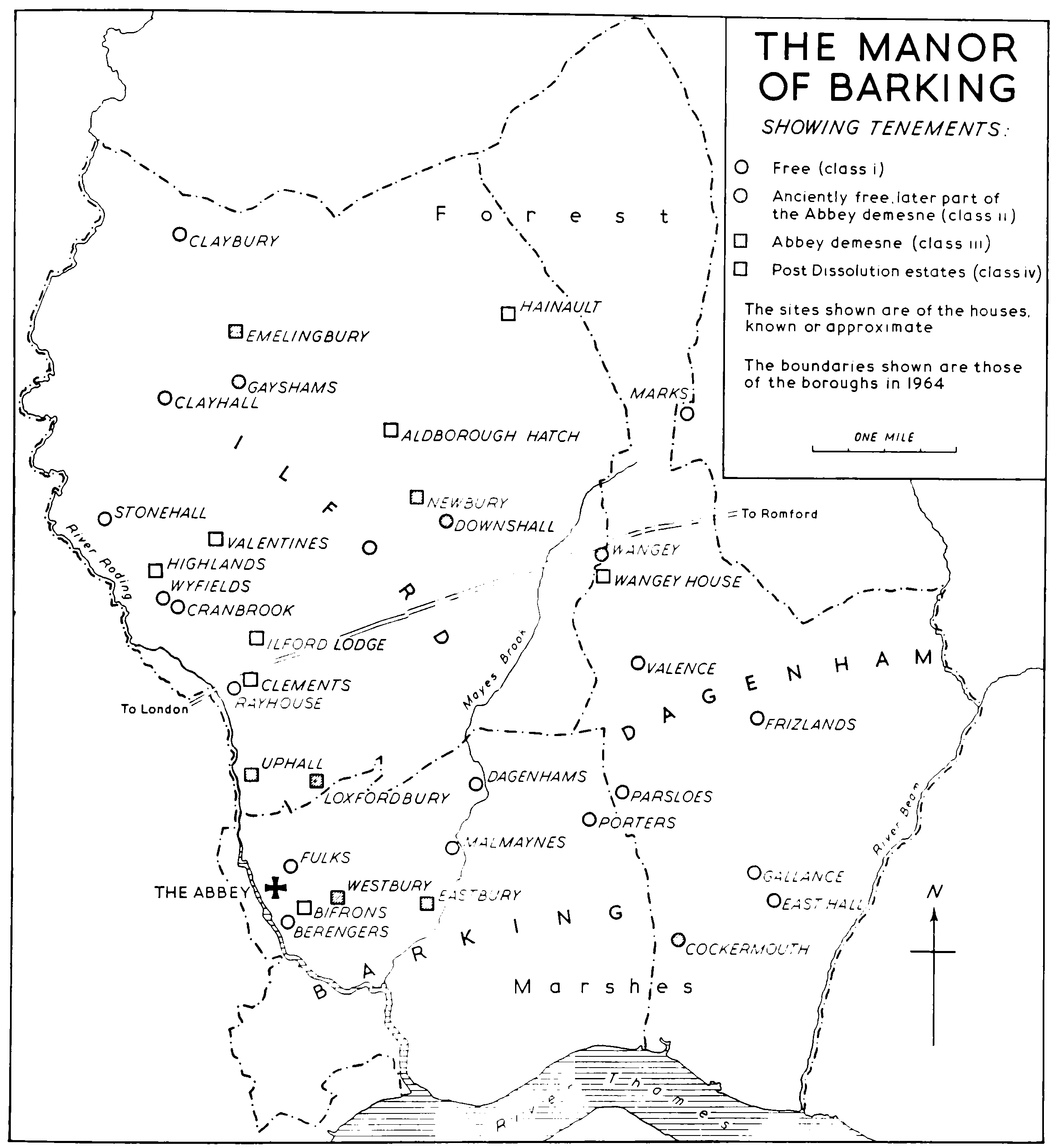
THE MANOR OF BARKING
The estates treated below, in this section, were all subject to the main manor of Barking. They fall into four classes. (i) Ancient free tenements which, in 1539, when the abbey was dissolved, were paying a small quit rent; these were Berengers, Claybury, Clayhall, Cranbrook, Dagenhams, Fulks, Malmaynes, Porters, Rayhouse, Stonehall, and Wyfields. (ii) Tenements which had been free, but which, in 1539, were on lease as part of the abbey's demesne; these were Downshall, Gayshams and possibly Wangey. (iii) Tenements which, in 1539, were on lease as part of the abbey's demesne, and are not known to have been free between the 12th century and the 16th; these were Eastbury, Loxfordbury, Newbury, Uphall, Westbury, and probably also Emelingbury, which appears to have been merged with Gayshams about 1400. (iv) Estates created after the Dissolution; these were Aldborough Hatch, Bifrons, Clements, Hainault, Highlands, Ilford Lodge, and Valentines. It will be noticed that class (iii) includes all the tenements with the element 'bury' in their names except Claybury, whose early history is obscure.
All these estates are treated in alphabetical order after the main manor. Those in the area of the present borough of Barking were Berengers, Bifrons, Dagenhams, Eastbury, Fulks, Malmaynes, Porters, and Westbury. Those in the area of the present borough of Ilford were Aldborough, Claybury, Clayhall, Clements, Cranbrook, Downshall, Emelingbury, Gayshams, Hainault, Highlands, Ilford Lodge, Loxford, Newbury, Rayhouse, Stonehall, Uphall, Valentines, Wangey (part of which was in Dagenham), and Wyfields.
The estates of Dagenham, treated under that parish, were also subject to the manor of Barking. (fn. 13) All were ancient free tenements (class i) except Cockermouth, which was originally free but became part of the abbey's demesne in the 14th century (class ii), and Wangey House, a post-Dissolution estate (class iv).
The abbey's demesne was increased, during the Middle Ages, not only by the grants of the former free tenements, already named, but also by a number which have not been identified with later estates. (fn. 14) The manor of Barking was always much the largest and most valuable of the abbey's properties. In 1086 it produced nearly half the income of the abbey, and in 1291 over a third. (fn. 15) The demesne of the manor was still further enlarged in the 14th century.
At the Dissolution the manor, including the manorial rights, and the tenements forming the demesne (classes ii and iii above), was surrendered to the Crown. (fn. 16) The ownership of the free tenements (class i) was not affected. The Crown sold the demesne tenements, but retained the manorial rights until 1628, when they were conveyed to Sir Thomas Fanshawe, steward of the manor, to whom they had been previously mortgaged. (fn. 17) It was later alleged by the inhabitants of Barking that Fanshawe got the freehold cheap by misrepresenting its value; (fn. 18) but the details of the transaction are not fully known.
Fanshawe (d. 1631) was already owner of Dagenhams, Fulks, and Malmaynes, which thus became, in effect, the new demesne manors of Barking. He was succeeded by his son Thomas (d. 1652), and he by his son, Sir Thomas Fanshawe (d. 1705). (fn. 19) The last named intended to leave the manor to a distant cousin, Thomas Fanshawe (d. 1758) of Parsloes, but his will was found to be defective in law, and the manor passed to Sir Thomas's daughter Susanna (d. 1714) wife of Baptist Noel. (fn. 20) Susanna's daughter and heir, Susan Noel, sold Barking in 1717 to Sir William Humphreys, Bt. (d. 1735). (fn. 21) Sir William's son, Sir Orlando Humphreys, Bt. (d. 1737), left the manor to his daughters: Mary, wife of William Ball Waring, and Ellen, later wife of Charles Gore. (fn. 22) In 1754 Mary, and her third husband Thomas Gore (uncle of Charles), and Ellen and Charles Gore, sold Barking to Smart Lethieullier, who already owned Loxford and Wangey. (fn. 23) Lethieullier (d. 1760) was succeeded by Mary, daughter of his brother Charles. (fn. 24) In 1769 she married Edward, eldest son of Sir Edward Hulse, Bt., (fn. 25) and the manor subsequently descended in the Hulse family. (fn. 26) Wangey was sold in 1805, but in 1847 the Hulse estate in Barking and Ilford still comprised some 1,200 a. (fn. 27)
The manor or capital messuage of ALDBOROUGH HATCH lay on the southern edge of Hainault Forest, at an entrance ('hatch') to that forest, to the east of Barkingside. Its name, which seems originally to have denoted a region rather than a particular estate, was probably derived from the family of Aldburgh, recorded in the 14th and 15th centuries. (fn. 28) The manor, which first appears after the Dissolution, was part of the estate built up by Bartholomew Barnes (d. 1548). That estate included Downshall, and Newbury, former demesne tenements of Barking Abbey, and also lands bought from Henry Gooderick. (fn. 29) Thomas Barnes, son of Bartholomew, sold much of the estate, but retained the section subsequently known as Aldborough Hatch, which included some of Gooderick's land and probably, also, land previously part of Newbury. (fn. 30) Thomas Barnes, who died in 1573, also held Wangey. (fn. 31) He was succeeded by his son, Thomas Barnes II, who sold Wangey, but left Aldborough Hatch, at his death in 1596, to his son Thomas Barnes III (d. 1626). (fn. 32) Thomas III left Aldborough Hatch, for life, to his widow Isabel. (fn. 33) She later married Edward Kighley, of Grays Thurrock, by whom she was the mother of Edward Kighley, minister of Aldborough Hatch chapel. (fn. 34) James Barnes, son of Thomas and Isabel, died in 1642, leaving the reversion of the estate to his sisters Abigail and Hester. (fn. 35) Isabel died in 1668, (fn. 36) and Aldborough Hatch was subsequently divided between the sisters or their heirs, Abigail's family taking the inner section and Hester's the outer. Isabel's son, Edward Kighley, was still living at Aldborough Hatch in 1672. (fn. 37)
Abigail Barnes married John Lockey, of Holmes Hill in Ridge (Herts.), and her half of the estate descended to their son John Lockey (d. 1714). (fn. 38) William Lockey, son of the last-named John, succeeded him, but got into financial difficulties, and in 1729 his estate was put up for sale by order of Chancery. (fn. 39) A copy of the sale catalogue is endorsed with an agreement to purchase by John Harrison, of Grosvenor St., Hanover Square (Mdx.). (fn. 40) The estate probably passed soon after 1729 to Richard Guise, and it descended in his family until 1803–4. (fn. 41) It was then acquired by the Revd. G. Stevens, who was still the owner in 1832. (fn. 42) In 1847 Francis and Samuel Stevens owned Aldborough Hatch Farm (105 a.) and Bunting Bridge Farm (86 a.) adjoining to the west. (fn. 43) Aldborough Hatch Farm descended in their family until 1929, when their trustees sold it, then 66 a., to the Crown. (fn. 44)
Hester Barnes's section of the estate lay north, south, and east of Abigail's section. Hester married John Stephens, of Lippiat Park (Gloucs.), and her estate passed to their daughter Hester, wife of John Neale, of Allesley Park (Warws.) and Dean (Beds.). (fn. 45) Neale died at Aldborough in 1698. (fn. 46) His estate appears to have been acquired by Joseph Jory, who left it on his death in 1725 to his niece Frances, wife of John Foche and later of Col. Martin Bladen. (fn. 47) Frances died in 1747, leaving Aldborough to her cousin Ann, daughter of Sir Nathaniel Hodges, and wife of (Sir) John Lambert Middleton (Bt.). (fn. 48) Ann died in 1762 and Middleton in 1768. Their son, Sir William Middleton, Bt. (d. 1795), succeeded them, and the estate passed on his death to his son, Sir Charles Middleton, Bt., who in 1799 changed his surname to Monck. (fn. 49) In 1800 Monck's estate comprised 247 a.; its southern part was called Aldborough House Farm, and the northern, Tan Yard Farm. (fn. 50) In 1828 he sold the estate to the Crown. (fn. 51)
In 1929, when the Crown bought Aldborough Hatch Farm, most of the Aldborough Hatch estate, divided in 1668, was reunited. In 1938 87 a. of Aldborough House Farm, and the whole of Aldborough Hatch Farm, were included in the sale by the Crown, to the Corporation of the City of London, of land at Fairlop intended for an airport. (fn. 52) The farms, not being needed for the airport, were immediately conveyed by London to Ilford Borough Council, in exchange for other land. (fn. 53)
Aldborough Hatch farmhouse and Aldborough House farmhouse are about 100 yds. apart, the former being the more northerly. Both are about ¼ mile west of St. Peter's church. A map probably based on an original of c. 1666, shows, in the position of Aldborough Hatch farmhouse, an imposing three-story house, probably of brick, since quoins are depicted, and an ornamental stringcourse is suggested between the second and third stories. The central range was flanked on each side by projecting wings, forming a courtyard. (fn. 54) Before c. 1725 this house was probably replaced by another immediately to the south. (fn. 55) This also was later demolished. The present farmhouse is a yellow-brick building, dating from the mid-19th century, which stands on or near the site of the 17th-century house.
The Aldborough House farmhouse, as shown on the map already mentioned, was a building of modest size. (fn. 56) In or about 1728 Col. Martin Bladen built there a large mansion of red brick, costing £14,000. (fn. 57) Drawings made about 1800 show a house of two stories and basements with 10 windows across the front. The three central bays had a pediment at first floor level and were carried up to form a low tower, surmounted by railings. The doorway had a 'Gibbs' surround. At the back of the house was a similar pedimented central block and a doorway with a segmental pediment. Projecting from the back was a wing with dormer windows, perhaps part of an earlier building. At the end of this wing, or in continuation of it, was the chapel. (fn. 58) The house was demolished shortly before 1808. (fn. 59) The red-brick wall which bounds the garden of Aldborough Hatch vicarage along Oaks Lane, and the long pond in the vicarage garden, are thought to have survived from the garden of Bladen's mansion. The present Aldborough House Farm is a yellow-brick house of the mid-19th century.
Aldborough Hatch chapel, the history of which is described in another section (fn. 60) survives as a fowlhouse in the yard of Aldborough House Farm. It probably dates from the late 17th or early 18th century. It is a small building, of red brick except for the east wall, which is of yellow brick: this wall was presumably built when the mansion was demolished about 1808. The parapet on the west, or entrance, front has been lowered, destroying a former pediment. (fn. 61) This front has brick quoins and a round-headed doorway with a 'Gibbs' surround and an original door. Since the mansion of c. 1728 had similar features, the west front of the chapel probably dates from that time. In the 19th century there was a gallery in the chapel. (fn. 62)
The manor of BERENGERS was a free tenement, held of the abbey, in or near Barking town. In the 16th century it became part of the manor of Little Ilford, with which it is reserved for treatment in another volume.
The estate of BIFRONS (in Barking), which adjoined the town to the east, was built up in the early 18th century by John Bamber, M.D. (d. 1753). Bifrons house stood just south of Axe Street near its western end. From there the park stretched southwards in the area between Fisher Street (now Abbey Road South) and Vineyard Lane (now Ripple Road and King Edward's Road). Much of the estate was carved out of Westbury, its nucleus being Upper and Lower Turndown (42 a.), which had been part of the Westbury demesne. (fn. 63)
The will of Samuel Marchant of Westbury (1717) seems to show that he held Lower Turndown but not Upper Turndown. (fn. 64) Perhaps he had already sold the latter to Dr. Bamber. In 1724 Bamber secured a Quarter Sessions order for the diversion of a footpath 'through one of his fields called Turndown . . . for the enlargement and convenience of his house'. (fn. 65) Bifrons descended like Wyfields to Bamber's grandson, Bamber Gascoyne (d. 1791), son and heir of Sir Crisp Gascoyne (d. 1761). (fn. 66) Sir Crisp, who had previously acquired Westbury, was also tenant of Bifrons after Dr. Bamber's death, and a further part of Westbury was thus added to the Bifrons estate. (fn. 67) Bamber Gascoyne retained Bifrons after selling Wyfields, and on his death it passed to his son of the same name. (fn. 68) About 1794 the estate comprised 221 a., including a park of 82 a. (fn. 69) About 1811 the park was being leased to Lord Somerville as sheep pasture. (fn. 70) In 1815–16 Bamber Gascoyne II demolished the house and sold the site and 120 a. land, part of which was bought by William Glenny. (fn. 71) Gascoyne retained the remainder of the estate, which passed through his daughter Frances to her husband James Cecil, Marquess of Salisbury (d. 1868), who took the additional surname of Gascoyne, and to their son Robert Gascoyne-Cecil (d. 1903), the prime minister. (fn. 72) In 1847 Lord Salisbury held some 136 a. in Barking, apart from his Ilford Hospital estate. (fn. 73) This surviving part of the Bifrons estate began to be broken up for building in 1889. (fn. 74)
Bifrons house is said to have been built by Dr. Bamber, and to have been enlarged and improved by Sir Crisp Gascoyne. (fn. 75) A drawing made shortly before its demolition shows a three-story building of the mid-18th century, with a bow-fronted two-story wing at each end, (fn. 76) which suggests that the name, which has not been found before the 18th century, (fn. 77) was taken from the Latin bifrons (two-faced). (fn. 78) In the middle of the 19th century the name was being used for a large house about 100 yds. east of the original Bifrons. (fn. 79)
The capital messuage of CLAYBURY (in Ilford) was near Woodford Bridge. It was a free tenement held of the abbey. In 1401 the tenant was John Malmaynes, whose family was also holding the manor of Malmaynes in Barking at that time. (fn. 80) In 1493 John Stillman was the tenant. (fn. 81) Thomas Burre, who made his will in 1532, left to his wife Margaret a rent from Claybury, and other lands belonging to him. (fn. 82)
Sir Ralph Warren (d. 1553) left Claybury to his wife Joan for life, with reversion to his son Richard. (fn. 83) Joan later married Sir Thomas White, founder of St. John's College, Oxford, who was occupying the estate in 1560. (fn. 84) Richard Warren (d. 1597) left Claybury for life to his widow, Elizabeth, later wife of Thomas Knyvett, with reversion to Oliver Cromwell of Godmanchester (Hunts.), son of Richard's sister Joan, and uncle of the Protector. (fn. 85) Elizabeth I visited Thomas Knyvett at Claybury in 1597. (fn. 86) In 1598 Cromwell conveyed his reversion to Sir Henry Maynard. (fn. 87) Richard Hale had become the owner of Claybury by 1617. (fn. 88) He was dead by 1622, when his son William had livery of the estate. (fn. 89) William Ashwell was owner or occupier in 1630. (fn. 90) In 1652–3 Claybury was held by Alderman Fowke who was no doubt John Fowke (d. 1662), Lord Mayor of London. (fn. 91) His successor of the same name held it in 1686, when he made his will. (fn. 92) He died in 1691, and in 1692 the estate was sold to John Goodere of Wanstead, to raise money for legacies to Christ's, Bridewell, and Bethlehem Hospitals (Lond.). (fn. 93) Goodere left Claybury in his will, dated 1696, to his younger son John, who took possession in 1697. (fn. 94) From 1698 to 1753 Sir Caesar Child, Bt. (d. 1725) and his son and heir of the same name (d. 1753), appear to have been living at Claybury. (fn. 95) Probably they were leasing only the house, since Hester Goodere was farming most of the estate in 1703–9. (fn. 96) John Goodere, grandson of the purchaser, sold the estate in 1767 to Eliab Harvey, whose daughter and heir Elizabeth married Montagu Burgoyne. (fn. 97) In 1786 Burgoyne sold Claybury to James Hatch. (fn. 98) The estate subsequently descended with the manor of Chigwell Hall until 1887, when William J. Rous sold it to the justices of the county of Middlesex, who began to build a lunatic asylum there. (fn. 99) In 1889 ownership passed to the newly-created London County Council, which completed the asylum in 1893 and continued to administer it until 1948, when under the National Health Act of 1946 responsibility was transferred to the N.E. Metropolitan Hospital Board. (fn. 100)
In the 13th century Claybury probably comprised 176 a.: that was the area of the section of it which in 1847 was paying tithes to Ilford Hospital, by virtue of a grant made in 1219. (fn. 101) The estate was still about the same size in the 17th and 18th centuries, (fn. 102) but was greatly extended in the early 19th century: by 1847 it comprised some 440 a., including Tomswood Farm, various woodlands to the north and east, and a property called Tilekiln to the south of Claybury. (fn. 103)
Claybury House, as shown on a map of 1652–3, was a large gabled building. (fn. 104) James Hatch, who bought the estate in 1786, had by 1791 demolished the old house and built a new mansion, designed by (Jesse?) Gibson, on the same site. (fn. 105) This is a two-story building of gault brick, standing near the hilltop about 300 yds. west of the asylum and having a fine view over London and the Kentish uplands. The entrance front is on the north side, where there is a four-columned Doric porch. The main front of five bays is on the south, or garden side. Its principal feature is a central two-story bow having a colonnade with composite capitals to the ground floor. There are later extensions on the eastern side of the house. Many original features survive inside the building. These include a fine stone staircase, near the bottom of which is a bell, dated 1785, suspended from a wooden frame. The stable block, only part of which was still standing in 1964, was similar in style and date to the house. In 1791 Hatch commissioned Humphrey Repton to advise him on replanning the park. Repton's report shows that he only added the finishing touches to work already done, and that he suggested that the entrance, originally on the south, should be changed to the present position. (fn. 106) After the building of the asylum the old house was retained as an annexe. In 1964 it was empty and in poor repair.
The manor of CLAYHALL (in Ilford), which lay a mile south-east of Woodford Bridge, was a free tenement held of the abbey. It is first mentioned in 1203, when 4¾ virgates in 'la Claie' were granted for life by Adam de la Claie to Richard de la Claie. (fn. 107) A Reynold de la Claye occurs in 1227. (fn. 108) This tenement probably remained in the same family until 1313, when Adam, son of Adam de la Cleye, conveyed to Walter, son of William de Basingge, 3 messuages and 215 a. in Barking. Walter was to take possession of two-thirds of the estate immediately, and to have reversion of the other third, which was held in dower by Denise, widow of Adam de la Cleye. (fn. 109) In 1318 William atte Berne of Little Waltham, and Alice his wife, conveyed to William Spark of Writtle a messuage and 231 a. in Barking. Berne had probably held the property jure uxoris for Alice's heirs are mentioned. (fn. 110) In 1330 an estate of similar extent was conveyed, probably by way of settlement, by John de Wydyton to Robert, son of William Spark, and Joan his wife. (fn. 111) In 1392 Robert Archer of Rivenhall conveyed the estate to John Walcote, William Oliver, and John Leycestre of London. Most of the estate was then held for life by Joan, widow of Henry Spark. (fn. 112) Later in 1392 there was another conveyance of the same property, by Robert Newport and Ralph Chamberlain, again to Walcote, Oliver, and Leycestre. John Haroudun and Joan his wife, clearly the Joan Spark of the earlier conveyance, then held the estate for her life. (fn. 113) In 1393 Walcote, Oliver, and Leycestre were licensed to cut down 30 a. of their own wood within the king's forest in Barking. (fn. 114) In 1410 John Tiltesbury of London, skinner, and Margaret his wife, conveyed to William and John de Fynderne and others (named) the manor of Clayhall (thus named for the first time) with 2 messuages and 348 a. in Barking and Chigwell. The grantees and the heirs of John de Fynderne were to hold 1 messuage and 118 a. immediately, and the reversion of the rest of the estate, which was held by Joan, widow of John Haroudun. (fn. 115) In 1435–6 William Creek and Joan his wife quitclaimed Clayhall to Robert Rolleston, clerk, and others (named). (fn. 116) In 1436 John Burgoyne and Robert Crouch granted to John Lowell, Robert Wade, and John Wellis, chaplain, 4 a. of wood in Barkingclay called Newmans, to hold for the life of Agnes, wife of Sir Reynold Lucy. (fn. 117) In 1451 Cicely, widow of John Lacy (or Lucy), citizen and fishmonger of London, and John Hemmyngburgh, released to Thomas Thorp, Sir Thomas Tyrell, Peter Ardern, and Thomas Scargyll, all right in the lands, rents, and services in Great Ilford, sometime of William Lacy and Isabel his wife. (fn. 118) In 1453 Thomas Thorp quitclaimed the manor of Clayhall, whose extent was the same as it had been in 1410, to Thomas Burgoyne and others (named). (fn. 119) The meaning of this series of conveyances is not entirely clear, but it is probable that the Burgoynes were holding Clayhall from 1436 to 1453, subject to the life interests of members of the Lacy family. In 1456 the 'lady of Clayhall' held the estate in Barking 'formerly of Adam de la Clay and afterwards of Henry Spark' as a free tenement of Barking Abbey. (fn. 120) This 'lady' may have been Cicely Lacy.
In 1475 Joan, wife of William Parre and relict of Thomas Colte, died seised of the manor of Clayhall. She was succeeded by John Colte, her son by her first husband. In 1493 Roger, son of Thomas Thorp, released to John Colte all his claims to Clayhall. (fn. 121) Colte was succeeded on his death in 1521 by his son Sir George Colte (d. 1578). (fn. 122) Sir George was succeeded by his grandson George Colte. In 1578 the tenant of the estate was Thomas Fanshawe; in 1568 Henry Fanshawe had held the lease. (fn. 123) In 1588 George Colte leased Clayhall manor house to Thomas Powle of London, one of the Six Clerks of Chancery, for 34 years running from 1596; in 1594 the lease was conveyed by Powle to John Ballett of London, goldsmith. (fn. 124) George Colte (d. 1616) left Clayhall to his son Sir Henry, who in 1627 sold it to (Sir) James Cambell. (fn. 125) For some years, about 1608–19, Sir Christopher Hatton (cousin of Lord Chancellor Hatton) lived at Clayhall, and built a private chapel there. (fn. 126) The manor descended in the Cambell family until the death in 1699 of Sir Harry Cambell, Bt. (fn. 127) He left it to his daughter, Mary, who married Thomas Price. (fn. 128) She died in childbirth in 1713, leaving an only son, Cambell Price, who in 1742 sold Clayhall to Peter Eaton. (fn. 129) Eaton (d. 1769) left the manor to his relative Hannah Markland. (fn. 130) By this time Clayhall was being let to tenant farmers. Miss Markland still held Clayhall in 1777, but by 1780 it had passed under her will to John Monins, who was distantly related to her and to the Eaton family. (fn. 131) In 1777 she had made a 61-year lease of the estate to Thomas Dowson; this was later purchased by James Hatch of Claybury, whose heir J. R. Hatch Abdy, was holding it in 1838. (fn. 132) Clayhall remained in the Monins family until 1918, when J. H. Monins sold it to E. J. Webster. (fn. 133) In 1847 William Ingram occupied Clayhall Farm, then 186 a., as tenant of the Revd. John Monins. Hedgemans Farm (158 a.) and Dunsprings Farm (75 a.), which also formed part of Monins's estate, were separately leased. (fn. 134) After Ingram's death in 1853 Clayhall Farm was occupied successively by William Lamb, his son James, and his grandson Frank Lamb, the last of whom remained tenant until Clayhall was broken up for building. (fn. 135) The name of the estate survives in Clayhall Avenue.
In the 17th century the manor house of Clayhall was probably a building of considerable size, since it was the residence of several of its rich and titled owners as well as of Sir Christopher Hatton. It was improved by Sir Thomas Cambell, Bt. (d. 1665), nephew of Sir James Cambell the purchaser. Two cartouches, containing the arms of Sir Thomas and his wife Hester, daughter of Lucas Corsellis, were placed on the gateposts at the main entrance to the mansion. Above each of them was a stone ball, one with their initials C/TH the other with the date 1648. (fn. 136) Sir Thomas also built a brick granary, placing there a stone tablet recording the date (1664), some details concerning his family, and the arms he used after marrying his second wife Mary, daughter of Thomas, Viscount Fanshawe. (fn. 137) The mansion is thought to have been demolished about the middle of the 18th century, probably by Peter Eaton, and was replaced by a farmhouse. Eaton's initials, and the date 1763, were placed on a tablet in a wall of the granary. (fn. 138) The farmhouse and all its out-buildings were demolished in 1935. The house, which was of brick, contained two stories and attics. (fn. 139) The gateposts and balls of 1648, already described, had been reset in a wall of the building. (fn. 140)
A private chapel, recently built at Clayhall by Sir Christopher Hatton, then tenant of the mansion, was consecrated in 1616 by Thomas Morton, Bishop of Chester, by commission from John King, Bishop of London. It was licensed for preaching, Holy Communion, baptisms, marriages, and for the burial of members of Hatton's household. (fn. 141) This chapel, later used as a barn, was demolished in 1935. It was a small building of red brick. The south-west wall had two round-headed windows with moulded cills inscribed '1659 Hes. Cambell' and '1659 Tho. Cambell'. (fn. 142)
The estate called CLEMENTS (in Ilford) was built up in the earlier 19th century by John Thompson and his son, John Scrafton Thompson, partly from copyholds of the manor of Barking. In 1847 it stretched from Ilford Lane east to Water Lane, and from the High Road south to the Loxford estate. It also included a group of fields south-east of Water Lane, abutting on Longbridge Road. (fn. 143)
The main part of this estate had been consolidated into a single holding as early as the 16th century, and the name Clements had long been in use for a farmhouse (fn. 144) which stood just south of the Thompsons' mansion, on the opposite side of Clements Lane, which until 1814 was the western end of Green Lane. (fn. 145) The name was probably derived from the family of John Clement, who in 1456 was holding a cottage, late of his father John Clement, and other property at Ilford. (fn. 146) In 1485 Alice Bexhill devised 'a tenement called Clementes' to her servant, Agnes Sabright. (fn. 147) In 1540 William Brooke held a house late of John Clement, and a copyhold cottage late of Richard Bexhill, together with other lands, forming a considerable estate, most of which can be identified as part of Clements in the 19th century. (fn. 148) Brooke's estate descended to his daughter Lucretia, wife of William Carewe, and in 1588 Carewe sold it to William Holstock, Comptroller of the Navy (d. 1589). (fn. 149) Henry Holstock, son of William, sold it in 1601 to William Peare, who in 1609 was holding about 191 a., of which some 110 a. were copyhold. (fn. 150) The estate was held in 1740 by Thomas Miller, and in 1782 by his son of the same name. (fn. 151) Their family had been occupying it at least since 1681. (fn. 152) In 1803 Clements was bought from the Millers by John Thompson, who had previously been at Goodmayes Farm. (fn. 153) Among the first additions which Thompson made to the estate was part of Crowchers Yardland, a copyhold tenement immediately to the north, between Green Lane and the High Road. This included a large brick house, which he bought in 1811; the remainder of Crowchers was bought then or later. (fn. 154) The house became his residence, and the name Clements was subsequently given to it. (fn. 155)
The two adjacent properties thus acquired by Thompson were separated by Green Lane, and in 1814 he set about diverting this highway. (fn. 156) Later he enlarged his estate still further by purchasing Cricklewood, which adjoined Crowchers, and several properties along Water Lane: some of these lands had belonged to Westbury, in Barking, which he also acquired. (fn. 157)
John Thompson died in 1829, and his wife Anne in 1830. (fn. 158) Their son, John Scrafton Thompson, was admitted to Clements in 1830, under his mother's will. (fn. 159) In 1847 his estate in Ilford comprised some 430 a. (fn. 160) He died in 1859, having devised it to his nephew, William Thompson, with the proviso that his sister, Eleanor Thompson, should be allowed to remain at Clements. (fn. 161) Eleanor died in 1878, having apparently outlived her nephew. By that time the estate, comprising a total of 560 a. in Ilford and Barking, was heavily mortgaged, owing to William Thompson's extravagance, and in 1879 his executors put it up for sale. As a result, it was completely broken up, and much of it was built upon during the next 20 years. (fn. 162) Among the buildings erected on the former Clements estate was Ilford Town Hall.
Clements, the Thompsons' residence, was demolished soon after the sale of the estate. The house lay on the south side of the High Road, immediately west of the present Clements Road. It faced east upon the garden. (fn. 163) A photograph of 1870 shows it as a substantial building of the 18th or early 19th century, having a three-story central block with single story wings. (fn. 164)
Clements Farm, the original house of that name, was 200 ft. south of the mansion. On the south and east of the farmyard were buildings erected between 1816 and 1826 by John Thompson. (fn. 165) These were demolished soon after 1879. An older building, used as the farmhouse up to the 19th century, was on the west side. It was converted into four cottages, at the end of Clements Lane, after the construction of the new buildings, and survived until 1933. When it was demolished the southern part of this building was found to be framed with oak and hornbeam timber, thought to date from the later 16th century. In the northern part were beams which seemed to be even older, and the remains of a blocked window in the wall between the two central cottages confirmed the impression that Tudor additions were made to an earlier building. (fn. 166) Perhaps the northern part was the 15th-century cottage of the Clement family, and was enlarged by William Brooke or his successors.
The manor of CRANBROOK (in Ilford) which lay about ½ mile north of Ilford village, was a free tenement held of the abbey. It derived its name either from the Cran Brook, a tributary of the Roding, or from a family of Cranbrook which was itself named from the stream. In 1284 Geoffrey, son of Simon of Cranbrook, conveyed land in Barking to John, son of Geoffrey of Cranbrook, and Agnes his wife. (fn. 167) In 1456 John Malmaynes, who was also tenant of the manor of Malmaynes, held lands formerly of Geoffrey of Cranbrook and afterwards of Gilbert de Wygton. (fn. 168) Cranbrook may have been held by the Malmaynes family as early as 1347. (fn. 169) It descended with the manor of Malmaynes to Joan, wife of John Rigby. About 1460 Joan and John Rigby quarrelled with Katherine de la Pole, Abbess of Barking, over the abbey's water supply, which had been supplied from a conduit in Cranbrook. (fn. 170) In 1466 John and Joan Rigby sold Cranbrook to Thomas Rigby. The manor subsequently descended to Thomas's son George, who left it on his death to his wife Elizabeth for life, with reversion to his son William. Elizabeth later married Bartholomew Prouz alias Sproute. Between 1515 and 1529 Elizabeth and Bartholomew defended their right to Cranbrook in Chancery against Richard Page, great-grandson and heir of Thomas Thorpe. (fn. 171) Page alleged that Thorpe had died in possession of the manor, but his claim was unsuccessful. In 1522 Elizabeth and Bartholomew appear to have granted the wardship of William Rigby to Anthony Cavalure. (fn. 172) Rigby was killed in a brawl in 1533. (fn. 173)
In 1540 lands called 'Malmaynes of Cranbrook' were said to be held by the heirs of William Rigby. (fn. 174) 'A manor of Bartholomew Sproute called Cranbroke' is mentioned in the same document, but it is not clear whether Sproute still held this. In 1572 the manor of Cranbrook was conveyed by William Tyffn and James Campion to Israel Amyce, who in 1583 also acquired Rayhouse. (fn. 175) Amyce was the steward of Edward de Vere, Earl of Oxford, to whom he transferred possession of Cranbrook and Rayhouse in 1584. (fn. 176) The earl was in financial difficulties and conveyed the two manors in 1585 to Robert Dudley, Earl of Leicester. Leicester, also, needed money — for his venture to the Low Countries — and in the same year conveyed the manors to Sir Horatio Palavicino, a naturalized Italian who died in 1600 leaving Cranbrook and Rayhouse to his son Henry, the wardship of whom was granted to his mother Anne. (fn. 177) Henry died without issue in 1615. (fn. 178) His brother and heir, Toby Palavicino, squandered his inheritance, and in 1624 sold the estate to Sir Charles Montagu. (fn. 179) Montagu died in 1625 leaving Cranbrook and Rayhouse to his wife, with reversion to his daughters Elizabeth, Anne, and Mary. (fn. 180) They married Sir Christopher Hatton, Sir Dudley (later Lord) North, and Sir Edward Byshe respectively, and in 1633–5 each with her husband made a conveyance of one-third of the two manors. (fn. 181) In 1653 Sir Edward Byshe and Mary conveyed the whole of Cranbrook to Edward Turner and Thomas Wylde, in trust for Thomas Young, who was already occupying it. (fn. 182) Young was the owner of Cranbrook in 1670, when he settled the estate, including Rayhouse, on his wife Margaret, at the time of their marriage. (fn. 183) Under the settlement Margaret, who brought a marriage portion of £4,000, was guaranteed a jointure of £400 a year. Young was to hold Cranbrook for life, to her use, with remainder after her death to her children by him, and by default to his heirs. He died soon after, and Margaret later married Sir William Boreman, whom she also outlived. (fn. 184) She died without issue in 1700, leaving as heirs her nephew, Henry Davis, and his sister Elizabeth, wife of Henry Gibbs, the children of her brother, Richard Davis. (fn. 185) A long period of litigation followed. (fn. 186) Cranbrook was claimed under the settlement of 1670 by Theobald Townson, and his wife Mary, who was the daughter of Thomas Young by a previous marriage. Gibbs and Davis, however, took possession of the manor as Margaret Boreman's heirs, because of a large debt due to her for the £400 jointure. In 1705 it was decreed in Chancery that they should continue to hold it until the debt had been paid. It was further decreed in 1721 that Theobald and Mary Townson might recover the property on payment of a sum that was to include the arrears of jointure and also the cost of repairs made by Gibbs and Davis. This payment was evidently never made. In 1720 Mary Townson had sold her interest in Cranbrook to John Lethieullier of Aldersbrook in Little Ilford, but he and his heirs never held the estate. In 1728, under another Chancery decree, the estate was partitioned between Gibbs, who received Cranbrook, and Davis, who took Rayhouse. Davis, however, appears to have remained at Cranbrook, probably as a tenant, at least until c. 1750. (fn. 187)
Cranbrook is said to have been bought in 1760 by (Sir) Charles Raymond, from Gibbs's devisee Thomas Spencer. (fn. 188) In 1762 Raymond sold the main part of the estate, including the house and the land around and to the south of it, to Samuel Hough. (fn. 189) A smaller section to the north, called Highlands, was retained by Raymond. (fn. 190) In 1763 Hough conveyed Cranbrook to Andrew Moffat, whose daughter took it in marriage to Sir Thomas Mills. (fn. 191) From about 1790 to 1795 the tenant of the estate was a Mr. Phillips. (fn. 192) In 1796 Sir Thomas Mills's son, Andrew Moffat Mills, sold Cranbrook to Robert Raikes. (fn. 193) In 1805–6 the estate was acquired from Raikes by John M. Grafton Dare (d. 1810). (fn. 194) In 1805 Dare, originally surnamed Grafton, and his wife Elizabeth, had inherited the estate of John Hopkins Dare, her son by a previous marriage. Since Cranbrook was said in 1847 (fn. 195) to belong to the trustees of John Hopkins Dare, it was probably bought out of his estate. In 1808 Cranbrook comprised 179 a., including some 60 a., lying west of Cranbrook Road, which had formerly been part of Wyfields, and which had been acquired between 1773 and 1788, from Sir Charles Raymond. (fn. 196) After J. M. Grafton Dare's death the estate passed to his widow, Elizabeth Grafton Dare (d. 1823), and then to her daughter Elizabeth, wife of Robert Westley Hall. (fn. 197) Hall, who then assumed the additional surname of Dare, was the son of Robert Hall, of Ilford Lodge, to which estate he succeeded on his father's death in 1834. Hall-Dare died in 1836, leaving Cranbrook to his second son Henry, who sold it, some time after 1847, to John Davis. (fn. 198) It passed on Davis's death in 1863 to his son John Coope Davis, who sold it to George Beasley. (fn. 199) In 1897 Beasley sold the estate to William P. Griggs, a builder. The last occupier of Cranbrook House, A. S. Walford, gave up his tenancy in 1899, and by 1901 the house had been demolished and the estate cut up for building. (fn. 200) The site is now occupied by De Vere Gardens, Endsleigh Gardens, and adjacent roads. (fn. 201)
Cranbrook House was used to accommodate Spanish prisoners in 1589 but there is no evidence that Sir Horatio Palavicino ever lived there. (fn. 202) In the earlier 18th century the house was a large timber-framed building, surrounded by a moat with drawbridges, the whole site being enclosed by a high brick wall. (fn. 203) It had been rebuilt by 1799: a drawing of the east front made in that year shows three stories, with five windows to the first story. (fn. 204) The central bay had a pediment at second-story level, and the domed porch was supported by two pairs of Ionic columns. The side wings were of one story. A drawing of 1897 shows the same building with a heavy rusticated porch, probably dating from the early 19th century. (fn. 205) The back of the house, shown in a photograph of c. 1900, had a central bow carried up to the second story. (fn. 206) The 18th-century rebuilding probably took place between 1772 and 1798, since the park was replanned within that period. (fn. 207) These operations must have been carried out after the western part of Wyfields (fn. 208) had been merged with Cranbrook, probably at a time when Cranbrook House was about to be lived in by its owner, and when there was no separate tenant at Wyfields. Robert Raikes, who bought the estate in 1796, thus seems a likely builder, and the similarities of style between Claybury House (completed 1791) (fn. 209) and Cranbrook, tend to confirm this.
The manor of DAGENHAM or DAGENHAMS or DAGENHAM PLACE or JENKINS (in Barking) was a free tenement held of the abbey. The manor house was a mile north of Eastbury; the estate extended into Dagenham parish and in the 14th century may have included East Hall. (fn. 210) It was stated in 1540 that the abbey, at a time immemorial, had granted Jenkins alias Dagenhams to Ralph fitz Stephen and his heirs, at a quit-rent of 4s. 4d. (fn. 211) Ralph fitz Stephen figures in several documents relating to Barking, between 1214 and 1235. (fn. 212) He was possibly the son of Stephen of Barking (fl. 1204 and 1209), who was the son of Robert fitz Hugh of Barking by his wife Maud, daughter of Edmund the chamberlain. (fn. 213) Edmund, who also held land in West Ham, occurs in 1166 and 1188–90, but was apparently dead by 1200. (fn. 214) Robert fitz Hugh was the son of Hagenilda of Barking. (fn. 215) He and Maud had two sons in addition to Stephen: Hugh fitz Robert and Richard the chamberlain. (fn. 216)
Emery de Bezill, who died before 23 May 1273, had held 'Dagenham in Barking' consisting of a messuage, 101 a. arable, 19 a. meadow, and 3s. 2d. rent, for which he owed the Abbess of Barking an annual rent of 8s. 8d. and suit of court. (fn. 217) His heir was not then named, but was probably Peter de Besill, to whom John de Northwode and Joan his wife quitclaimed 1 messuage, 80 a. land and 3s. rent in Dagenham in 1276. (fn. 218)
In 1311 Roger de Gildesburgh and John Barnabe conveyed to John de Northtoft and Joyce his wife 2 messuages, 3 carucates of land, 40 a. pasture, 46 a. wood and £6 10s. rent in Dagenham, Barking and Finchingfield. (fn. 219) In 1326 John de Northtoft settled 'the manor of Dagenham' on his son Edmund, and Amy, wife of Edmund. (fn. 220) Edmund de Northtoft (d. 1375) left the manor of Northtofts in Finchingfield, and that of Dagenham, to Emma and Florence, daughters of his son William. (fn. 221) In 1391 Henry Helion, who may have married one of the daughters, died leaving Northtofts to his son John. (fn. 222) Dagenham manor is not mentioned in Henry's inquisition, but he may have held this also, since John Helion was holding East Hall, in Dagenham, in 1442.
In 1446 Margery Humphrey, her son Thomas Humphrey, and Hugh, son of Roger Lightfoot, quitclaimed 'a piece of ground called Dagenham place' in Barking and Dagenham to William de la Pole, Marquess (later Duke) of Suffolk and others. (fn. 223) This was evidently part of a conveyance of the estate by Lightfoot to Robert Osberne; later in 1446 Lightfoot undertook to support Osberne in any legal actions concerning the manor of 'Jenkyns of Dagenham, Dagenham Place or Dagenhams', and in 1447 Osberne was granted free warren in the demesne lands of this manor. (fn. 224) The use of the alternative name Jenkins at this time suggests that at some period before 1446 the manor had been held by a person or family of that name. Simon Jenkyn (fl. 1390) and Richard Jenkyn, who is mentioned in 1456 as having formerly held property near the abbey gate in Barking, may have been tenants of Dagenhams. (fn. 225)
In 1448 Robert Osborne leased Dagenham Place to William of Waynflete, Bishop of Winchester, and others, at an annual rent of £13 6s. 8d. (fn. 226) In 1450 Osborne was involved in a dispute with Katherine de la Pole, Abbess of Barking, concerning access to his tenement in the churchyard of the abbey, in the course of which he was alleged to have assaulted her and her servants. (fn. 227)
In 1456 Thomas Plomer of London, grocer, held Dagenhams of the abbess at an annual rent of 31s. 2d. and a ploughshare. (fn. 228) In 1479–80 Hugh Brown and Henry Wodecock settled Jenkins on (Sir) Hugh Brice, and Elizabeth his wife, who already held Malmaynes. (fn. 229) Brice died in 1496, leaving Jenkins to his grandson Hugh Brice, a minor. The manor then consisted of some 350 a., worth £13 6s. 8d. and held of the abbess at a quit-rent of 4s. 4d. (fn. 230) Hugh Brice the younger died without issue, and was succeeded by his sister Elizabeth, who married Robert Amadas, Master of the Mint to Henry VIII. (fn. 231) Robert and Elizabeth were in possession of Jenkins by 1524. (fn. 232) He died in 1531, and in 1532 she married Sir Thomas Neville, (fn. 233) who was holding the manor jure uxoris in 1540. (fn. 234) By her marriage with Amadas, Elizabeth had had two daughters, Elizabeth and Thomasine. Elizabeth Amadas the younger married Richard Scrope of Castle Combe (Wilts.); she died before her mother, leaving a daughter Frances as her sole heir. (fn. 235) In 1555 Jenkins was settled on Frances and her husband Martin Bowes. (fn. 236) She died in 1556, (fn. 237); in 1567–8 their son Martin sold the manor to Henry Fanshawe. (fn. 238) Fanshawe died in 1568; he appears to have conveyed Jenkins before his death to his nephew Thomas Fanshawe (d. 1601). (fn. 239) Thomas left Jenkins to his second wife Joan (d. 1622) for life, with reversion after her death to their son Sir Thomas Fanshawe (d. 1631) who acquired the manor of Barking from the Crown in 1628. (fn. 240) Jenkins subsequently descended with the capital manor. (fn. 241) In 1847 Jenkins Farm, later called Manor Farm, comprised 345 a., tenanted by James Biggs. (fn. 242) It was broken up for building in 1937. (fn. 243)
Jenkins is depicted on a map of 1652–3 as a large gabled building. (fn. 244) It is said to have included a chapel, in one of the windows of which was the figure of an abbess in stained glass. The house was rebuilt by Sir William Humphreys soon after his purchase of the manor in 1717. (fn. 245) He laid out the gardens 'in Dutch fashion, with fishponds, terraces, vistas and avenues'. (fn. 246) Humphreys's house was itself demolished before 1796 by (Sir) Edward Hulse, who built a farmhouse on the site. (fn. 247) This was a plain two-story house with three windows across the front. (fn. 248) About 1840 a two-story bay was added at one end. (fn. 249) The house was demolished in 1937. (fn. 250)
The manor of DOWNSHALL (in Ilford) was on the west of Seven Kings Water, about ¼ mile south-east of Newbury. It was a free tenement held of the abbey until about 1250, when it became part of the abbey demesne. The name was derived from a family of tenants named Dun.
The Duns appear to have had an interest in at least two tenements in Barking during the earlier 13th century. In 1226 William Dun impleaded John fitz Christopher to warrant to him a carucate of land in Barking which he (Dun) held of him. (fn. 251) John was probably son of Christopher fitz Alexander (fl. 1197) and succeeded his father in or about 1203. (fn. 252) A carucate in Barking had been conveyed to him (perhaps by way of settlement) by Master Adam de Fontibus in 1224. (fn. 253) In 1232–3 Sarah, widow of John fitz Christopher, received acknowledgment from William Dun of her dower in a third part of 100 a. land, 10 a. wood, 1 messuage, and 10s. 11½d. rent in Barking. At the same time the holders of 16 tenements in the parish, totalling 102 a., 1 messuage, and 24s. rent, made similar acknowledgment to her. Sarah then granted to William Dun all the third parts involved, to hold for her life for 24s. a year, and all services to the chief lords. (fn. 254) In 1235 Nichola and Alice, daughters of John fitz Christopher, conveyed to William Dun a messuage and 114 a. land in Barking, to hold of them by the annual rent of ½ mark and all services. Ralph fitz Stephen was present when this conveyance was made and quitclaimed the premises to Dun. (fn. 255) Ralph was tenant of Dagenhams. (fn. 256)
The other tenement in which the Duns had an interest consisted of two virgates, one in the West Marsh and the other in the East Marsh, which Hugh fitz Robert conveyed in 1219 to Martin Dun, for whom William his son was then acting. (fn. 257) Fitz Robert and Martin Dun had been disputing about this land in 1208. (fn. 258) Fitz Robert was brother of Stephen of Barking, who was probably father of Ralph fitz Stephen, and the conveyances quoted above suggest that there was a close relationship at this time between the tenants of Dagenhams and those of Downshall. The marshland conveyed in 1219 may have been sheep pasture attached to the inland tenement of Downshall. (fn. 259)
William Dun occurs in records up to 1244. (fn. 260) He, or a member of his family, probably gave his tenement, or part of it, to Barking Abbey about 1250. A man of his name occurs, presumably as a benefactor, in the list of obits celebrated at the abbey. (fn. 261) None of the Duns seems to have held substantial estates in the parish after the 13th century and no other William has been noticed. (fn. 262)
Downshall occurs, as 'Dunneshall', in 1441 and 1456. (fn. 263) In 1540 it was on lease from the abbey to Edward Harris, whose rent of £4 16s. 8d. was part of the income of the cellaress. (fn. 264) In 1546 it was granted by the Crown, along with Newbury and Aldborough Hatch, to Sir Richard Gresham. (fn. 265) Downshall passed with Newbury to Bartholomew Barnes (d. 1548) and was sold by his son Thomas Barnes (d. 1573) to John Jeffrey, who died holding it in 1590. (fn. 266) Jeffrey left Downshall to his daughter Mary, later wife of Andrew Fuller, and the adjacent estate, called Smiths, to his daughter Alice, wife of Edward Shelton. (fn. 267) In 1601 both Downshall and Smiths were conveyed by these daughters and their husbands to Francis and Margaret Fuller. (fn. 268) Francis Fuller later acquired Wangey and Loxford, and Downshall descended with Loxford until the death of Francis Osbaldeston, in 1648. (fn. 269) It then passed to Henry Osbaldeston, Francis's brother, who in 1661 settled Downshall, alias Smiths, on his daughter Elizabeth, on her marriage with Humphrey Hyde. (fn. 270) In 1690 Humphrey settled the property on his son, John Hyde, who was still alive in 1722. (fn. 271) In 1730 John Hyde, son of the previous John, sold Downshall to John Dagge of Rotherhithe, mariner. (fn. 272) By his will, proved in 1736, Dagge left the manor to Mary Cherriton, daughter of his sister Mary and later wife of Robert More. (fn. 273) Dagge More, son of Mary, sold Downshall in 1776 to a Deptford gardener named Edmonds, who left it to his second son. (fn. 274) In 1847 James Edmonds was the owner of the estate, which consisted of 97 a. (fn. 275) It was later owned successively by James Hunsdon, a Mr. Edwards, and C. H. Hambly, the last of whom sold it for building to A. Cameron Corbett, who developed it in 1898–1901. (fn. 276)
The Porter family were tenant farmers of Downshall continuously at least from 1684 to 1793. (fn. 277) The last two tenants were James Butler (1832–66), and Clement Mead (1866–98). (fn. 278)
Downshall farmhouse stood at the south-eastern corner of what is now Seven Kings Park; its name survives in Downshall Avenue and in the Downshall schools. In 1800 the house was depicted as a plain 18th-century building of three stories, with five windows across the front. The central doorway had a hood-mould supported on brackets. (fn. 279) The house was demolished shortly after 1900. (fn. 280) It is said to have been of red brick. (fn. 281)
The manor of EASTBURY (in Barking), which was situated about a mile east of Barking town, was one of the demesne tenements of the abbey. A reeve of Eastbury is mentioned in 1331–2. (fn. 282) In 1540 it was on lease to Nicholas Stodard. (fn. 283) In 1545 it was granted by the king along with Gayshams, Stonehall, and Westbury to Sir William Denham. (fn. 284) At Denham's death in 1548 Eastbury passed to his daughter Margery, wife of William Abbot. (fn. 285) In 1556 Margery and William sold the manor to John Kele, who appears to have been an agent for Clement Sysley, of East Ham. (fn. 286) Sysley, a rich merchant, built the present Eastbury Hall. He died in 1578 leaving the manor to his wife Anne for life, with reversion to his son Thomas, then a minor. (fn. 287) Anne (d. 1610) married as her second husband Augustine Steward (d. 1597), to whom she conveyed the wardship of Thomas Sysley. (fn. 288) Thomas was a wastrel, continually turning to his step-father for money. (fn. 289) In 1592 he granted a 500-year lease of Eastbury to his step-brother, Augustine Steward, and soon after this converted the lease into an outright sale, subject to Anne Steward's life-interest. (fn. 290) Augustine Steward the younger died in 1628 or 1629. His sons, Edward and Martin, sold Eastbury in 1629 to William Knightley, to whom the property had previously been mortgaged. (fn. 291) In 1649 William Knightley, son of the previous William, sold Eastbury to his mother, Susan Knightley, and in the following year she sold it to Thomas Vyner, citizen and alderman of London. (fn. 292) Vyner, later a baronet, died in 1665. (fn. 293) He was succeeded by his son, Sir George Vyner, Bt. (1673), and his grandson, Sir Thomas Vyner, Bt. (d. 1683). (fn. 294) The last named left no issue, and the manor passed to Edith Lambert and Elizabeth Tombs, daughters of Edith Higgs, one of the sisters of Sir Thomas Vyner (d. 1665), and to Elizabeth Marchant, daughter of Joanna Smythe, the other sister. In 1690 the Vyner estates in Essex and elsewhere were divided between the heirs, Elizabeth Tombs receiving Eastbury. (fn. 295) In 1714 her heirs sold it to William Browne (d. 1724). (fn. 296) Browne's nephew and heir, William Sedgewick, sold Eastbury in 1730 to John Weldale (d. 1731). (fn. 297) Weldale's heirs were his daughters, Elizabeth (d. 1759 or 1760), Mary (d. 1769), and Ann (d. 1773). Ann, who inherited her sisters' shares, left the manor to her cousin Mary, daughter of Samuel Johnson, and wife of the Revd. Wasey Sterry. Mary Sterry died in the same month as Ann Weldale, and after the death of Mary's husband, in 1779, Eastbury passed to their sons Benjamin (d. 1830), Thomas (d. 1817), and Henry (d. 1856). Their shares were small: in 1847 Eastbury comprised only 65 a. altogether. (fn. 298)
Thomas Sterry left his third part of the manor to his wife, Hester (d. 1847), for life, with reversion to his brother Benjamin. Benjamin left his third, and the reversion of Thomas's share, equally to his sons Wasey (d. 1842), and William. The later descent of William's share has not been traced. Wasey left his part of the estate to be divided among his sons Wasey (d. 1858), Francis, and Arthur, and his daughter Frances. The son Wasey Sterry left no issue, and in 1869 Arthur conveyed his share to Francis. In 1873 Henry Sterry, son of Henry Sterry (d. 1856) died leaving his third of Eastbury to his wife Jane (d. 1882) for life, with reversion to the above Francis Sterry. Francis duly succeeded to that part of the property, and in 1883 was engaged in a dispute with G. T. Robinson, son of Jane Sterry by a previous marriage, concerning tithes attached to Henry Sterry's part of Eastbury. In 1888 Francis was holding seven-ninths of the manor, subject to certain perpetual annuities.
Francis Sterry, who was Rector of Poltimore (Devon), continued to hold the estate until 1913–14, when he started to sell it for building development. Some of it, including Eastbury House, was acquired about 1916 by Percy A. Bayman, from whom the house was purchased by the National Trust in 1918. (fn. 299)
Eastbury House (fn. 300) was built by Clement Sysley, who bought the estate in 1556. At his death in 1578 it is mentioned as newly built. (fn. 301) The date 1572 is said to have been carved on brickwork somewhere in it, and 1573 on a rainwater head. (fn. 302) Neither of these dates is now visible. It has been suggested that some of the details are more characteristic of 1550 than 1570, (fn. 303) and it is very likely that the building was started soon after Sysley acquired the estate. The house stands on an open green in the centre of a housing estate completed soon after the First World War. It is a two-storied building of red brick with a third, or attic, story lit by gable-end windows and brick dormers. The plan is H-shaped, the wings on the north or entrance front being much shorter than those at the rear. The latter form two sides of a square courtyard which is closed to the south by a high brick wall. In the north-west angle of the courtyard is an octagonal stair-turret rising above the main roof level; there was originally a corresponding turret in the north-east angle. On its courtyard side the central block has a fine chimney with five diagonal shafts and there are similar two-and three-shafted chimneys, one of which is incomplete, to the flanking wings. The ranges of three-light mullioned and transomed windows form a striking feature of the design. These appear to be of stone, but in reality are of moulded brickwork covered with plaster. A three-storied porch, attached to the inner face of the west wing on the entrance front, has a four-centred arch surmounted by both a hood-mould and a pediment — a curious mixture of Gothic and Renaissance features. This is also executed in plastered brickwork.
During the 18th and early 19th centuries, when the ownership of the estate was divided, the house was occupied by a succession of tenant farmers, and became very dilapidated. (fn. 304) The north-eastern stairturret appears to have been partly demolished shortly before 1814. (fn. 305) About 1833–42 the whole house was on the brink of destruction. The demolition of the stair-turret was completed, several stone chimneypieces were removed, and some of the oak flooring torn up. (fn. 306) Wasey Sterry (d. 1842) was dissuaded from pulling down the building by Edward Sage and others who realized its architectural and historical interest, though according to Sage, Sterry 'spoilt the interior by modernizing, in a cockneyfied manner, the quoins of the west wing on the ground floor, and converting the residue of the house into stables, granaries and coach-houses. This was done in 1841, and in the following year he died a lunatic'. (fn. 307)
In view of the treatment it received in the 19th century, it is not surprising that the interior of the house retains few of its original decorations or fittings; on the other hand, the absence of alterations and extensions by earlier owner-occupiers has meant that the main structure still survives as a good example of a medium-sized manor house of the later 16th century. On the ground floor the main block was originally occupied by the great hall, now subdivided, which had a screens' passage at the west end and a dais at the east. (fn. 308) Above were two rooms, in the eastern of which were wall-paintings, traces of which survive, showing fishing boats at work, and also landscapes; more of these paintings were visible in 1834. (fn. 309) The ground floor of the west wing contained kitchen and other service rooms; a small room at the north end of this wing has oak panelling, possibly dating from the 16th or early 17th century. The surviving turret has a spiral stair with a circular oak newel and solid oak treads. The ground floor of the east wing contained two rooms, probably parlours, separated by a passage. The whole first floor consisted of a long gallery in which an original fireplace has survived. In the room above this there were wall-paintings, of which there were still traces in 1935, showing figures in early-17th-century dress. (fn. 310) The east wing suffered more than the rest of the house from the alterations of 1833–42. The south parlour was turned into a stable, the north parlour became two outhouses, and a cartway was made through the east wall. (fn. 311)
When the estate began to be broken up for building in 1913–14 the house was again in danger of destruction. (fn. 312) It was saved by the energetic action of the Society for the Protection of Ancient Buildings, which raised funds, and that of the London Survey Committee, which published a special monograph on Eastbury House. This made it possible for the house to be bought by the National Trust. For some years after 1918 part of the building was used as an ex-servicemen's club. In 1932–3 it was unoccupied and was suffering damage from hooligans, but in 1934 the National Trust leased it to Barking Borough Council, which restored it, and in 1935 opened it as a museum. (fn. 313) The museum was closed in 1941, and since then Eastbury House has been used as a day nursery, and for other welfare purposes. It was slightly damaged by bombing in 1941. (fn. 314) A thorough restoration of the fabric was being carried out in 1964.
The manor of EMELINGBURY or EMELYN (in Ilford) lay at Barkingside. The name, now lost, first occurs in a collection of extracts from Barking court rolls, 1349–1469, evidently produced in the late 15th or early 16th century in a dispute concerning tithes. (fn. 315) There are references, from other sources, to Emelynes Bery (1441), Emlyngby (1456), Elmbury Grove and Elmesbury (1540), and Elmingbury Hawe (1609). (fn. 316) Abuttals given in these references show that the place was near Mossford Green and Gayshams. 'Browning under Emlyngby', which occurs in 1456, and can be exactly located from later records, was a tenement on the east side of Dunsprings Lane. (fn. 317) In 1540 a tenement clearly identical with Browning lay between Elmbury Grove on the west, and the land of the king, part of Gayshams, and upon the lane [presumably Dunsprings Lane], leading from Motts Grove to Elmesbury towards the west. (fn. 318) Taken together these references indicate that Emelingbury lay north-west of Browning, on the higher ground at the end of Dunsprings Lane.
The 'bury' suffix suggests that Emelingbury was part of the original demesne of Barking Abbey. If so, it must have been merged with one of the other demesne tenements before 1540, since there was then no reference to it in the abbey rental as a separate property. (fn. 319) The tithe extracts of 1349–1469, already mentioned, make it virtually certain that Emelingbury was actually merged with Gayshams. Between 1349 and 1390 tithe-collectors were being chosen for Emelingbury, but there is no mention of Gayshams. From 1399 to 1449, on the other hand, tithe-collectors were being chosen for Gayshams, but there is no mention of Emelingbury. In 1450 there was a dispute over tithes between Emelingbury and Ilford Hospital. Several of the fields named in this case can be identified as paying tithes to Gayshams in later times. There was another dispute, in 1469, between Westbury, the tithes of which then belonged to the hospital, and Gayshams. These extracts imply either that Gayshams was simply another name for Emelingbury, or that Emelingbury was merged with Gayshams, which had no previous right to tithes. The latter must have been the case: up to 1363 at least Gayshams (fn. 320) was a free tenement, and thus had no right to tithes, which belonged to Barking Abbey. But some time between 1363 and 1441 Gayshams became part of the abbey's demesne, and it was during that period, as the tithe extracts show, that this manor was first mentioned in connexion with tithes. (fn. 321) It thus appears that Emelingbury merged with Gayshams about 1400, and eventually lost its identity.
The manor of FULKS (in Barking) which was situated in and near Barking town, was a free tenement held of the abbey. It probably derives its name from the local family of Fulk. Richard fitz Fulk held land in Barking in 1203. (fn. 322) His widow Agnes married Robert le Bret, and in 1218 and 1221–2 was claiming dower in lands formerly belonging to Richard in Dagenham and Barking. (fn. 323) In 1271 Thomas Fulk (Fuk') was engaged in litigation against John Fulk concerning land in Barking. (fn. 324) There are other references to Thomas Fulk in 1283–4, and in an undated deed, of the same period or earlier, (fn. 325) which also mentions his brother Robert: this may have been the Robert Fulk whose daughter Joan, wife of Geoffrey Smith, had by 1314 inherited her father's lands. (fn. 326)
In 1440 Fulks was held by the 'landholder of Samkynes'. (fn. 327) Samkynes (or Sampkynes) took its name from the Sampkyn family, which had also acquired the manor of Wyfields in the 14th century, and Fulks probably descended with Wyfields (fn. 328) from 1440 or earlier. In 1539 both manors, which had belonged to Thomas Sampkyn, who died without heirs, were granted by the king to Thomas Audley, Lord Audley, the Lord Chancellor. (fn. 329) In 1541 Audley conveyed Fulks to William Severne. (fn. 330) In 1542 Severne transferred half the manor to Stephen Close and Ralph Marshall. (fn. 331) Marshall (d. 1556) left his manor of Fulks to his son Nicholas. (fn. 332) The further descent of this moiety has not been traced. It may have been acquired by Henry Fanshawe, to whom William Severne conveyed 'the manor of Fulks' (presumably the other moiety) in 1563. (fn. 333) Fanshawe's manor of Fulks subsequently descended along with Dagenhams. (fn. 334)
Fulks House, which was on the east side of North Street, on the northern corner of the former Nelson Street, now part of London Road, was separated from the manor, and sold by (Sir) Edward Hulse in 1773. It was occupied as the vicarage for a time before the building of the present vicarage in 1794. In the 19th century it became known as Northbury House. About 1860 the owner was James Reed, (fn. 335) and from 1868 to 1906 or later it belonged to the Quash family. (fn. 336) Later it was used as the Northbury Club. It was demolished in 1936 when the London Road extension was made. (fn. 337)
A drawing of Fulks made about 1800 shows the entrance front of a two-story building. The upper story was jettied at each end and above it was a parapet carried across the whole front. The windows had mullions and transomes and the doorway a pediment and a 'Gibbs' surround. (fn. 338) It appears originally to have been a timber-framed late-medieval house of the 'wealden' or 'recessed hall' type. The parapet and doorway were probably added in the early 18th century. Between 1800 and c. 1860 the house was re-fronted. (fn. 339) Another drawing, of 1905, shows the rear, or garden front, which had a small gable on the left and a larger one on the right. (fn. 340)
The manor of GAYSHAMS (in Ilford), which lay half a mile east of Clayhall, was a free tenement held of Barking until about 1400, when it became part of the abbey's demesne. Gaysham was an ancient place name, associated particularly with the forest, but the manor was probably named from the family of Roger de Gaysham, who lived in the late 13th century. (fn. 341)
Thomas de Sandwich, victualler to Edward, Prince of Wales (the Black Prince) died in 1360 holding Gayshams, with 120 a. land, and also Golderstland and Hockeles. (fn. 342) Golderstland, later called Great Golders, was north of Gayshams on the edge of the forest. (fn. 343) Hockeles was later part of Red Bridge Farm. (fn. 344) In May 1361 all these lands were delivered to the Prince of Wales as security for debts owed him by Sandwich. (fn. 345) In the following October they were committed to the Vicar of Barking, and Ellen, Sandwich's widow, on condition that they answered to the prince for the profits. (fn. 346) The estates were apparently still under the prince's control in 1363, when a royal licence was needed to enable John de Hockelee to have an assize of novel disseisin against the Vicar of Barking and others, concerning tenements in Barking. (fn. 347) It was then stated that the justices had previously refused to proceed with the case because the tenements had been taken into the king's hands as the pledge for Thomas de Sandwich's debts.
By 1441 Gayshams was part of the abbey's demesne, being administered, along with Newbury, by a bailiff. (fn. 348) The abbey seems to have acquired it about 1400, and to have merged with it the older demesne manor of Emelingbury. (fn. 349) Gayshams may, however, have been partly dismembered, for in 1456 two small free tenements in the north part of Barking parish were said to have been held formerly by Thomas de Sandwich: one of these was held by John Bolle of London, merchant, the other by William Usdale. (fn. 350)
In 1540 Gayshams was on lease from the abbey to Ralph Tracy. (fn. 351) The manor was granted in 1545 to Sir William Denham, along with Eastbury, Westbury, and Stonehall. (fn. 352) It descended with Westbury to Margery Breame, later Abbot, and after her death passed to her son Arthur Breame, who also held Westbury after the death of his brother Edward. (fn. 353) Arthur leased Gayshams to his sister-in-law, Dorothy Dalton, but in 1571 they both sold their interest in the manor to Vincent Randall of London and his son Edward. (fn. 354) Edward Randall died in 1577, leaving Gayshams to his wife, Alice, in trust for his son, Vincent, then aged 3. (fn. 355) Vincent, who died in 1602, left as heir his sister Dorcas Randall, but he had previously settled Gayshams on (Sir) Edward Randall of Edlesborough (Bucks.). (fn. 356) In 1604 Sir Edward sold the manor to John and Hugh Hare. (fn. 357) In 1609 the Hares sold it to Thomas Wight and his son Gabriel. (fn. 358) Thomas died in the same year, leaving Gayshams to Gabriel. (fn. 359) Gabriel (d. 1621) was succeeded by his son Henry. (fn. 360) Henry died in 1698, leaving Gayshams to his son Henry (d. 1716) who in 1701 bought the manor of Little Ilford. (fn. 361) William Wight, son of the last-named Henry, succeeded and held the manors until his death in 1737. His eldest son William died childless in 1739 and was succeeded by his brother Henry Wight. In 1785 Henry devised all his estates in Essex and Surrey, subject to certain annuities, to his sister Elizabeth, widow of Sir James Harrington, Bt., for life. (fn. 362) After her death half the property was to pass successively to Elizabeth White, widow, of Edward Street, near Cavendish Square (Mdx.), then to John Wight of Guildford (Surr.), for their lives and afterwards to Henry Wight's right heirs. (fn. 363) The other half was to pass after Elizabeth Harrington's death to Henry Wight's cousin, whom he believed to be named William Martin but who was actually James Martin, and afterwards to Martin's issue in equal shares. (fn. 364) Henry Wight believed that Martin had gone abroad several years before 1785 but had not heard of him since. (fn. 365) The will therefore provided that, if he had not been found before Elizabeth Harrington died, an advertisement was to be inserted ten times in the London Gazette, giving information as to the bequest and requiring the Martins to make their claim within a year of the first advertisement. If they failed to do so the second half of the estate was to descend with the first. (fn. 366)
Henry Wight died in 1793, and his sister Elizabeth in 1794, having outlived Elizabeth White. (fn. 367) John Wight then came into possession of half the estate. A Surrey historian, writing about 1808, said that John was not personally known to Henry Wight, but that it was supposed that Henry, having heard John's name and finding that he bore the same arms, believed that he might be of the same family. (fn. 368) John Wight actually appears to have been a descendant of Rice Wight, brother of the Thomas Wight who bought Gayshams in 1609. (fn. 369) The advertisements for the Martin beneficiaries duly appeared in the London Gazette between July and September 1795. (fn. 370) Shortly before the time limit expired a claim was made on behalf of James Martin's daughters: Elizabeth, wife first of J. Rougemont and later of G. Ernst, and Sarah, wife of William Hibbit. (fn. 371) Soon after the division of the estate Sarah and William Hibbit seem to have acquired Elizabeth Ernst's share. (fn. 372) After Sarah's death in 1814 William continued to hold her property on behalf of their son John W. Hibbit, then a minor. When John Wight died in 1817 his half of the estate also passed to the Hibbits, presumably as heirs of Henry Wight under his will of 1785. In 1818 John Hibbit took the surname of Wight. (fn. 373) He held the whole of Gayshams, and Little Ilford, jointly with his father and later alone, until his death in 1867. (fn. 374) In 1847 Gayshams consisted of 247 a. (fn. 375) As the result of a dispute between Wight's heirs his estates, consisting of 645 a., came into Chancery, and in 1873 were put up for sale by order of that court. (fn. 376) Gayshams was bought by J. H. Monins, owner of Clayhall, and descended with Clayhall until 1918, when it was sold to the tenant, Rupert Brown. (fn. 377) Brown still held it in 1927, but soon after this the estate was broken up for building. (fn. 378)
In 1733 Gayshams was on lease to Thomas Meredith, whose son of the same name was tenant until 1781 or later. (fn. 379) From 1790 until 1818 or later the tenants were Thomas Oldaker, father and son. (fn. 380) In 1847 the tenant was Edward Campion. (fn. 381) Soon after that the tenancy passed to George Brown, whose family held it until Rupert Brown bought the farm in 1918. (fn. 382)
The 'old mansion' at Gayshams 'which was of timber and very spacious', is said to have been pulled down by Henry Wight (d. 1716). According to the same writer there was a farmhouse on the site in c. 1796. (fn. 383) These statements do not appear to be entirely correct. Drawings of 1790 show a gabled two-story house, L-shaped in plan, with grouped diagonal chimney stacks. (fn. 384) Between that time and 1905 the building was extended at one end and the exterior was largely altered. (fn. 385) In c. 1920 Gayshams was described as having been built of brick early in the 17th century, with an 18th-century wing on the south-east side. The room at the west end contained original panelling. (fn. 386) In 1944 the house was badly damaged by a flying-bomb and in 1947 it was demolished; the site is now occupied by council flats in Longwood Gardens. (fn. 387)
The Crown estate at HAINAULT (in Ilford and Dagenham), created chiefly by the disafforestation of Hainault Forest in 1851, and enlarged by later purchases, is described elsewhere. (fn. 388)
The estate called HIGHLANDS was built up in the 18th century by (Sir) Charles Raymond, Bt., partly from lands formerly belonging to Cranbrook. (fn. 389) In 1670 Cranbrook included, on its northern side, several fields called Highfields, and a meadow and grove called Watermans, amounting in all to about 50 a. (fn. 390) These were retained by Raymond when he sold the remainder of Cranbrook in 1762, and became the nucleus of Highlands, to which were added, then or later, other lands of about the same area, making up a total, in 1815–16, of 99 a. (fn. 391) After Raymond's death in 1788 Highlands was sold to Sir James Long, Bt., heir to Earl Tylney, (fn. 392) and was thus merged, like Stonehall, (fn. 393) in the Wanstead Park estate, the descent of which is reserved for treatment in a later volume.
The name Highlands was in 1652–3 attached to a house standing on or near the site occupied in the 19th century by Cranbrook farmhouse, which was about 150 yds. north-west of Cranbrook House. (fn. 394) That house, however, remained in the Cranbrook estate, and did not belong to the Highlands estate after 1762. In or about 1765 (Sir) Charles Raymond built a mansion on the Highlands estate, on a site about 300 yds. north-west of the house previously called Highlands. This new house was originally called Highfields, but from the 1770's, Highlands. (fn. 395) In 1771, and for a few subsequent years, it was occupied by William Weber, presumably a tenant of Raymond. (fn. 396) Raymond, who had previously been living at Valentines, had moved to Highlands before his death. (fn. 397) A drawing of Highlands, dated 1798, shows the front of a three-story building. (fn. 398) The projecting central bay was surmounted by a pediment, and the portico had Corinthian columns. The house was demolished early in the 19th century. (fn. 399) Its name was retained for a farmhouse, about 100 yds. south-south-west, which had previously been the laundry of the mansion. This was said to contain a brick dated 1765. (fn. 400)
About 300 yds. north-east of Highlands mansion was a crenellated building, said to have been erected by Sir Charles Raymond as a family mausoleum, but never used as such. (fn. 401) It became known, from its appearance, as 'the Castle'. For many years it was a dwelling house in connexion with Highlands Farm. During the First World War it was an Admiralty observation post. About 1922 the land on which it stood was bought by the Port of London Authority for a sports ground, and in 1923 the building was demolished. (fn. 402)
The 19th-century estate called ILFORD LODGE (in Ilford) was about ½ mile south-east of Cranbrook. It had formed the southern part of the Valentines estate, owned by Donald Cameron (d. 1797). (fn. 403) In 1797–8 Ilford Lodge, including about 35 a. formerly in Wyfields, was detached from Valentines and sold to George Lee, who held it until 1805–6, when it passed to Robert Hall, previously the tenant. (fn. 404) On Hall's death in 1834 Ilford Lodge passed to his son Robert W. Hall-Dare, owner of Cranbrook. (fn. 405) After Hall-Dare's death, in 1836, Ilford Lodge was held for some years by his widow Elizabeth. (fn. 406) When she died it passed to their third surviving son Capt. Francis M. Hall-Dare. (fn. 407) In 1882 the estate, then comprising 173 a., was acquired for building development by the Ilford Land Co. (fn. 408) In 1883 it was bought, with some adjoining land, by James W. Hobbs, a Croydon builder associated with Jabez Balfour. (fn. 409) When the Liberator Building Society, and the other Balfour companies, collapsed at the end of 1892, Hobbs was one of the first to be tried for fraud; he was sentenced in 1893. (fn. 410) Balfour's trial took place in 1895, and in 1895–6 the Ilford Lodge Estate was put up for sale, under the name of Ilford Park Estate. (fn. 411) At that time few houses had been built, but most of the present roads had been laid out, including Balfour Road. In spite of the disadvantages of a forced sale the estate realized a good price. (fn. 412)
Ilford Lodge, from which the estate took its name, was a late-18th-century mansion of yellow brick consisting of a central block and side wings, all of three stories. When the estate was cut up for building the house was preserved, in Wellesley Road, as a club for the new residents. (fn. 413) It was demolished in 1960. (fn. 414)
The manor of LOXFORD or LOXFORDBURY (in Ilford), a mile north of Barking town, was part of the abbey's demesne, and in 1540 was on lease to William Pownsett. (fn. 415) Pownsett, a rich grazier closely associated with Sir William Petre, died in 1554 leaving much property at Loxford, the lease of which still had 43 years to run. (fn. 416) In 1557 the queen granted the reversion of the estate to Thomas Powle. (fn. 417) In 1562 Powle conveyed it to Thomas Pownsett, probably nephew of William. (fn. 418) Thomas Pownsett (d. 1590) left Loxford to his son William. (fn. 419) William (d. 1591) was succeeded by his brother Henry (d. 1627), whose heir was his son William. (fn. 420) The last named William Pownsett sold Loxford in 1629 to Francis Fuller, who already owned Wangey, and Downshall. (fn. 421) Fuller (d. 1636) was succeeded by Francis Osbaldeston or Osbaston, son of his sister Barbara, wife of Henry Osbaldeston. (fn. 422) Francis (d. 1648) left no issue, but Loxford and Wangey remained with his widow Alice, who later married Robert Bertie, and lived until 1677. (fn. 423) They passed on her death to Francis, son of Henry Osbaldeston, nephew of the previous Francis, and already lord of the manor of Aldersbrook in Little Ilford. (fn. 424) Downshall had a different descent after 1648. Francis Osbaldeston (d. 1678), devised all his estates to his brother Henry, and his heirs, on condition that Henry should pay £400 a year to Francis's widow, £200 to his daughter Mary, and £10,000 to Mary when she reached the age of 16 in 1694. (fn. 425) In 1684 Henry directed by his will that when Mary reached the age of 16 all the estates devised by Francis should be sold in order to carry out the terms of the bequest. (fn. 426) Henry was dead by 1693, when, because his niece Mary and his own daughter and heir, Ann Osbaldeston, were still minors, a private Act of Parliament was promoted to dispose of the estate. (fn. 427) Aldersbrook, Loxford, and Wangey were immediately sold to John Lethieullier, a rich London merchant. (fn. 428) They passed to John's son Smart Lethieullier, and Loxford subsequently descended with the main manor of Barking.
From the early 17th century onwards the owners of Loxford did not reside there. The names of 17th-century tenants are not known. During most, if not all, of the 18th century Loxford was leased to the Pittman family. Thomas Pittman was farming there in 1732, (fn. 429) and William Pittman about 1750. (fn. 430) Another Thomas Pittman was there from 1781 or earlier, (fn. 431) and was succeeded before 1803 by a third Thomas. (fn. 432) The last named, whose progressive farming methods won the approval of Arthur Young, (fn. 433) died in 1818. (fn. 434) Anthony Edmonds was the next tenant. (fn. 435) From 1847 or earlier, until the 1880's, the farm was occupied by the Whitbourne family. (fn. 436) About 1896 the northern part was sold, and was rapidly built over. (fn. 437) The southern part was developed more slowly. Much of it, along Loxford Lane, is now (1964) occupied by Loxford Park, the public allotments, and the council's depot.
In 1609 Loxford contained 152 a. freehold land, together with some 97 a. copyhold. (fn. 438) In c. 1750 the total was 242 a., and in 1847, 265 a. (fn. 439) When the estate was broken up for building the tenant, Walter Mills, bought Loxford Hall and some 20 a. land, and his family continued to farm there until the 1920's. (fn. 440)
In 1319 the Abbess of Barking was licensed to fell oaks in Hainault Forest to rebuild her house at Loxford after a fire. (fn. 441) A drawing of the house made about 1800 shows a two-story weather-boarded building with three gables at one end. (fn. 442) In the centre part of the end was a small 18th-century bay window. An early-19th-century ground-floor plan of the house shows that it was T-shaped, and that the bay window belonged to a small parlour at the junction of the main block and the wings. (fn. 443) No views of the interior are known, but it seems probable that the main block was medieval, though much altered. The rooms mentioned in William Pownsett's inventory of 1554, (fn. 444) are not inconsistent with the size and plan of the early-19th-century house, though a direct comparison is not possible. About 1830 Sir Charles Hulse built a new Loxford Hall, enlarged thirty years later, for the use of Anthony Edmonds. (fn. 445) It lay immediately west of the old one, which was rebuilt on a smaller scale as a bailiff's house. (fn. 446) A drawing of 1905 shows the small bay window set in the centre of a rectangular front. (fn. 447) This house was demolished in or before 1945, when pre-fabricated council houses were built on the site. (fn. 448) The 19th-century Loxford Hall, which is on the south side of Loxford Lane, opposite Loxford Park, was used during the Second World War by the War Department, and since 1949 has been an Essex County Council child guidance clinic. (fn. 449) It is built of gault brick with a Greek Doric porch and a hipped slate roof with wide bracketted eaves. There are later 19th-century alterations and additions.
In the 17th century the Fullers and Osbaldestons, owners of Loxford, lived at a mansion called Beehive, about 500 yds. north-west of Valentines. (fn. 450) In c. 1860 it was said that the house had been pulled down many years before. (fn. 451) The name survives in Beehive Lane.
The manor of MALMAYNES (in Barking), which was at Ripple Side, adjoining Jenkins, was a free tenement held of the abbey. It took its name from the Malmaynes family which held the manor from the 13th to the 15th century. It may have been one of the tenements, comprising a total of 2 hides, which in 1086 were held by three knights. (fn. 452) If so, its tenant in 1086 was probably Peter de Valognes, who was tenant-in-chief of the manors of Higham Bensted (in Walthamstow) and Ruckholts (in Leyton). In 1205 6 virgates of land in Barking were held of the abbey by Robert fitz Walter, and Gunnore his wife, one of the heirs to the barony of Valognes. The estate had been subinfeudated to Ralph fitz Solomon, who held of Robert and Gunnore by service of 20s. and a pair of gilt spurs, rendered annually at their court at Higham Bensted. (fn. 453) Ralph fitz Solomon's land passed to Solomon fitz Ralph (fl. 1235), (fn. 454) probably his son, and subsequently to Emma la Base, daughter of Solomon fitz Ralph; she died in 1287, holding a messuage and ½ carucate in Barking as tenant of Sir William Comyn, one of the heirs of the barony of Valognes. A week before her death Emma had granted the estate to Rose, daughter of her son John Deu, and wife of John, son of Henry Malmaynes. (fn. 455) This is the last reference to the intermediate tenancy of Valognes; after 1287 the demesne tenants seem to have held Malmaynes directly of the abbey.
The Malmaynes family already held land in Barking before they acquired the estate of Emma la Base. (fn. 456) John Malmaynes and Rose his wife are mentioned again in 1316. (fn. 457) The manor of Malmaynes remained in their family until about 1460. It was probably held by John Malmaynes (fl. 1373), and by Robert Malmaynes, whose widow Alice was alive in 1396. (fn. 458) Another John Malmaynes held various tenements of the abbey in 1456. (fn. 459) He also held the manor of Cranbrook. (fn. 460) His daughter Joan had by 1462 carried her father's lands to her husband John Rigby. (fn. 461) She outlived Rigby, and in 1474 sold Malmaynes to (Sir) Hugh Brice and Elizabeth his wife, who in 1479–80 also acquired the manor of Dagenhams (or Jenkins). (fn. 462)
Malmaynes apparently descended with Dagenhams until 1555, when it was settled on Martin Bowes and his wife Frances. (fn. 463) In 1565 Joan, widow of Sir William Laxton, bought Malmaynes from Thomas Barker. (fn. 464) She left the manor at her death in 1576 to her daughter Anne, wife of Sir Thomas Lodge. (fn. 465) Lodge died holding Malmaynes in 1583, and was succeeded by his son William. (fn. 466) The manor is said to have been purchased from the Lodge family by the Fanshawes in 1625 and to have descended subsequently along with the capital manor of Barking. (fn. 467) Another writer suggests different 17th-century owners (fn. 468) but it is in any case certain that by 1717 Malmaynes was in the hands of Sir William Humphreys, lord of Barking. (fn. 469) By the middle of the 19th century Malmaynes had been incorporated in Jenkins Farm 'being that portion near Upney'; the farmhouse had been long since demolished. (fn. 470)
The manor of NEWBURY (in Ilford) was about 2 miles north-east of Ilford village, in the area now called Newbury Park. It was part of Barking Abbey's demesne, and its name suggests that it was brought into cultivation later than some of the other demesne estates. A reeve of Newbury is mentioned in 1321–2, and a reeve of Gayshams and Newbury in 1441. (fn. 471) In 1540 the manor was on lease to Laurence Grey. (fn. 472) In 1546 Newbury and Downshall were granted by the Crown to Sir Richard Gresham, who conveyed them in the same year to Bartholomew Barnes. (fn. 473) Barnes (d. 1548) left these two manors to his son Thomas. (fn. 474) Thomas Barnes sold Newbury in 1566 to Thomas Yale, who died holding it in 1577. (fn. 475) In 1578 Joan Lloyd alias Yale, widow of Thomas Yale, sold it to Joseph Haynes (d. 1621) who later bought Wangey. (fn. 476) Simon Haynes, son of Joseph, sold Newbury in 1625 to Thomas Stych (d. 1656) from whom it descended to William Stych (d. 1678) and then to William's son, Sir William Stych, Bt. (fn. 477) Sir William (d. 1697) mortgaged the estate, and suffered foreclosure, and his brother, Sir Richard Stych, Bt., sold it under a Chancery decree of 1698 to (Sir) Thomas Webster (Bt.). (fn. 478) In 1747 Webster sold Newbury to Richard Benyon, governor of Fort St. George (Madras, India). (fn. 479) Benyon was succeeded by his son Richard (d. 1796) and he by his son Richard Benyon, who assumed the surname of Powlett-Wrighte (1814) and later that of Benyon de Beauvoir (1822). In 1847 Newbury comprised 264 a. (fn. 480) On the death of Richard Benyon de Beauvoir, in 1854, Newbury passed to his sister's son Richard Fellowes (d. 1897), who then assumed the name of Benyon. (fn. 481) In 1891 Newbury, then comprising 170 a., was put up for sale by order of the mortgagees. (fn. 482) It appears to have been bought by J. H. Mitchell, and building development had started by 1900. (fn. 483) The farmhouse of the estate, called Great Newbury, was said in 1900 to be modern. (fn. 484) It appears to have been demolished in 1932 or 1933. (fn. 485)
The manor of PORTERS (in Barking), which was at Ripple Side, about 2½ miles east of Barking town, was a free tenement held of the abbey. It probably derived its name from the Porter family, which held land in the parish in 1220, 1258, and later. (fn. 486) A large estate held in 1452 and 1456 by (Sir) John Norton in Barking and Dagenham included Porters. (fn. 487) Norton and his son, also Sir John, granted it to Richard Pygot, who died holding that manor in 1483; Richard's heir was his son John, then a minor. (fn. 488) In 1532 Sir Robert Norwich (d. 1535), Chief Justice of Common Pleas, was living at Porters, and in 1540 the manor was held by his widow Gillian. (fn. 489) She settled the reversion of Porters on her relative Humphrey Tyrell, but in 1553 Robert, son of Humphrey, and Anne his wife, sold their interest in the manor to John Lucas, who thus succeeded Gillian on her death in March 1556. (fn. 490) Lucas himself died in September 1556, leaving (Sir) Thomas (d. 1611) his son and heir. (fn. 491) Thomas Lucas, son of Sir Thomas, died in 1625, leaving John his son and heir. (fn. 492) In 1630 John Lucas and Elizabeth his wife sold Porters to Benjamin Ayloffe and Sir Arthur Herris. (fn. 493) It is said to have belonged to Thomas Fanshawe, lord of the manor of Barking, in 1635. (fn. 494) Porters is mentioned in deeds as appurtenant to the manor of Barking up to 1754, (fn. 495) but it had probably been detached from the main manor before 1701, when Godfrey Woodward is said to have been the owner. (fn. 496) Woodward was succeeded by his daughter Anne, wife of Walter Vane. (fn. 497) Godfrey Woodward Vane, son of Anne and Walter, succeeded them, and his son, William Walter Vane, sold Porters in 1790 to Abraham Newman, who was already tenant of part of the estate and owned other lands in Barking. (fn. 498) In 1798–9 Porters passed from Newman (probably on his death) to William Thoyts, a relative. (fn. 499) Thoyts apparently died in 1817–18, when his widow, Jane Thoyts, became owner. (fn. 500) She was still alive, at the age of 87, in 1849, when her son Mortimer George Thoyts was managing the estate on her behalf. (fn. 501) M. G. Thoyts was himself the owner in 1851, when the estate included Great Porters, Little Porters, Gale Street, Osbornes, Wilds, Maybells, Moggs, and Rippleside farms and other land on the borders of Barking and Dagenham. (fn. 502) In 1872 this estate, comprising 854 a., was put up for sale. (fn. 503) A large part of it was bought by J. G. Fanshawe, of Parsloes in Dagenham, but this subsequently passed to mortgagees, William and John Worthington, who in 1894 offered for sale 371 a., including Great and Little Porters, Gale Street, and Osbornes farms. (fn. 504) The vendors suggested building development, but this did not actually take place until the early 1930's, when that part of the Becontree estate was completed by the London County Council. (fn. 505)
A drawing of Great Porters farmhouse, Gale Street, dated 1903, shows a corner of the building, with a castellated parapet to the roof and a pointed doorway; this was probably a 19th-century façade applied to an earlier building. (fn. 506) The name is preserved in Porters Avenue.
The manor of RAYHOUSE (in Ilford), most of which lay south of the Cranbrook stream, between Cranbrook Road and the Roding, was a free tenement held of Barking Abbey. It derived its name from the Ree family, 14th-century tenants. It must be carefully distinguished from Rayhouse in Woodford. In 1306 an estate of 53 a. in Barking parish was conveyed to Henry de la Ree, to hold of Roger de la Ree. (fn. 507) Henry atte Ree and Isabel his wife occur in 1318. (fn. 508) In 1328 Ralph Aunger and Isabel his wife conveyed to Thomas Weston and Margaret his wife 82 a. in Barking. (fn. 509) Isabel, who was the principal vendor, had probably been previously the wife of Henry atte Ree. The enlargement of the estate since 1306 may be accounted for by the 2 virgates, 'formerly Colman', which Henry had been holding in 1321. (fn. 510) Colemans, which lay immediately north of the Cranbrook, adjoining Rayhouse, later became part of the manor of Cranbrook. (fn. 511) Soon after 1328 Sir Thomas de Weston granted a tenement in Ilford called 'Rehous', and other lands in Barking parish, to Simon de Leythorne, Vicar of West Ham, and John Duk, Vicar of Great Burstead, who in turn granted them to the king. (fn. 512) In 1334 the king himself granted the same properties to the abbey of Stratford Langthorne, in West Ham. (fn. 513) Rayhouse remained in the hands of that abbey until the Dissolution, but continued to be held of Barking Abbey. (fn. 514) In 1456 it was described as a tenement called 'Rehousland', formerly of Robert atte Ree. (fn. 515)
Rayhouse was surrendered to the Crown in 1538, and in 1542 was granted, along with the manors of Little Ilford, and Berengers in Barking, to Morgan Phillips, alias Wolfe, king's goldsmith, who already held Uphall. (fn. 516) By a further grant, of 1550, the estate was to be held rent free. (fn. 517) Phillips died in 1552, leaving as heir his son Julian Morgan alias Wolfe. (fn. 518) Julian died in 1556. His heir to Little Ilford and Berengers was his infant son Henry, but Rayhouse may previously have been settled on Walter Morgan, probably a younger son of Morgan Phillips. (fn. 519) In 1570 Walter Morgan and his wife Jane were certainly holding the manor. (fn. 520) In 1581 Edward Pilkington and his wife Mildred conveyed Rayhouse to Nicholas Fuller, who in 1582 conveyed it to Thomas Pereson. (fn. 521) Pereson and his wife Susan conveyed it in 1583 to Israel Amyce, who was already holding Cranbrook. (fn. 522) Rayhouse subsequently descended as part of Cranbrook until the partition of that estate in 1728, when it was allotted to Henry Davis. In 1738 Davis was holding a house called Rayhouse or Tarratt House in Ilford, together with 57 a. land. (fn. 523) The bulk of this estate consisted of four fields called Rayfields (51 a.). These, which lay immediately south of the Cranbrook, had undoubtedly formed the original manor of Rayhouse. (fn. 524) The house, with 3½ a. land, was ¼ mile south of Rayfields, on the southern corner of Back (now Roden) Street, and Barking (now Ilford) Lane, and was thus detached from the main part of the estate. (fn. 525) The use of the name Rayhouse for a building in this position can be traced back only to the mid-17th century. (fn. 526)
Henry Davis remained owner of the estate until 1749, when it became the property of Henry Lomas, previously the mortgagee. (fn. 527) In 1753 Lomas died, leaving Rayhouse to his brother John, subject to an annual rent to his sister Mary, wife of Peter Howard, and later of William Roson. In 1754 John Lomas and Mary Roson agreed to sell the manor and divide the proceeds, but this had not been done before John died in 1756. He left his interest in Rayhouse to the children of his sister Margaret, wife of James Johnson. Johnson himself apparently remained in control of the manor until his death in 1806, having succeeded in person to Mary Roson's interest in it when she died in 1780. In 1765 he enlarged the estate by purchasing a copyhold tenement of 25 a., which adjoined Rayfields to the south, and included Ilford House, a large building on the north side of the High Road. (fn. 528)
On James Johnson's death Rayhouse passed to his son John Lomas Johnson, and his daughter Mary, wife of the Revd. Benjamin McDowell, who in the same year (1806) put it up for sale. (fn. 529) By this sale (completed, after legal difficulties, in 1809) Rayfields and the copyhold land were broken up in several fragments. (fn. 530) The manor house in Back Street was sold separately and demolished, and the name Rayhouse does not seem to have been used after that time. The largest fragment of the estate was purchased in 1806 by James Graves, and during the next 40 years he reconstituted the estate by buying up the other fragments as opportunity arose, and enlarged it by adding two small properties, one adjoining the copyhold lands to the west, by the Roding, the other adjoining them to the east, along Cranbrook Road. (fn. 531) The last, purchased in 1836, included a large house called Ilford Cottage, which became Graves's residence and gave its name to his estate. (fn. 532) The main line of the Eastern Counties Railway, built in 1838–9, lay across the south-west corner of Graves's estate, and he subsequently sold the small part of it to the south of the line, including Ilford House. (fn. 533) In 1847 his estate thus comprised 74 a., bounded by the Roding, the Cranbrook, Cranbrook Road, and the railway. (fn. 534)
James Graves, who died about 1863, was succeeded by his son Henry (d. 1888). Henry's widow Ann died in 1890, and in 1894 his executors sold most of the estate, comprising 72 a., to A. Cameron Corbett, later Lord Rowallan, for £31,250. (fn. 535) Corbett immediately developed it for building as the Grange estate, lying within the area bounded by Northbrook Road, Mansfield Road, and York Road. (fn. 536)
A drawing of c. 1800 shows Rayhouse as a two-story building with two front gables, possibly dating from about 1600. It was then derelict. (fn. 537) It had been demolished by 1809, (fn. 538) and by 1847 several new houses had been erected on the site. (fn. 539)
When the estate was broken up in 1894 Ilford Cottage, with an acre of garden, was bought by J. T. King. (fn. 540) The house appears to have been demolished in 1924. (fn. 541) The basement was said in 1900 to be about 200 years old. (fn. 542)
In 1894 the estate also included Cranbrook Lodge, a large house in Cranbrook Road previously called Cranbrook Cottage. The site of this had been part of the Rayhouse estate until 1806, when it was bought by Edmund Moore. Moore's nephew G. W. Pretty sold it in 1831 to Henry Graves. (fn. 543) The house had been built by 1835. (fn. 544) It became Cranbrook College, a private High School for boys, founded in 1896. (fn. 545) It was demolished in 1923 when the present college buildings were erected on the neighbouring site facing Mansfield Road. (fn. 546)
The manor of STONEHALL (in Ilford), which lay near the Roding, north-east of Wanstead Park, was a free tenement held of Barking Abbey. Its name may have been derived from the Stonehale family; Roger Stonehale occurs in 1327. (fn. 547) In 1456 Hugh Wyche of London, mercer, had a lease of land in the north part of Barking parish which had formerly belonged to Roger Stonehale. (fn. 548) Stonehall is first mentioned by that name in 1496, when it was among the possessions, at her death, of Elizabeth, widow of Sir Humphrey Starkey. It then comprised 100 a. and was said to have belonged formerly to Thomas Wyndesor. (fn. 549) Members of the Wyndesor family held land in East and West Ham in 1285 and 1290, and in Dagenham in 1381 and 1388. (fn. 550) Elizabeth Starkey's heirs were her daughters by Sir Humphrey: Katherine, wife of William Page, and Elizabeth, wife of Thomas Bledlowe, and her grandsons, Humphrey Torell and John Wrytell, the sons of her daughters Emma and Anne. Katherine Page later married Sir John Rainsford, and Stonehall appears to have passed to her son Sir John Rainsford, who in 1544 conveyed it to Henry VIII. (fn. 551) In 1545 the king sold the manor to Sir William Denham, who in 1546 transferred it to Richard Breame. (fn. 552) Breame died in 1546, leaving Edward his son and heir, a minor. (fn. 553) Edward Breame died in 1558, still under age, and was succeeded by his brother Arthur. (fn. 554) In 1577–9 Stonehall was conveyed by Arthur Breame to John Bales, and later to Robert Dudley, Earl of Leicester, for whom Bales was probably an agent. (fn. 555) Stonehall subsequently descended along with the manor of Wanstead, which is reserved for treatment in another volume. In 1847, when it was held by William Pole-Tylney-Long-Wellesley, Earl of Mornington, it consisted of 134 a. (fn. 556) Stonehall Farm was broken up for building about 1933. (fn. 557) Its name survives in Stonehall Avenue.
The manor of UPHALL (in Ilford), which lay near the Roding about a mile north of Barking town, was part of the abbey's demesne. In 1535–6 it was on lease to Thomas Ewen (fn. 558) and in 1540 to Miles Bowdysshe. (fn. 559) In 1541 the king granted it to Morgan Phillips alias Wolfe, who in the following year also acquired Rayhouse. (fn. 560) Uphall descended with Rayhouse until 1554, when Julian Morgan sold it to Richard Flower, citizen and haberdasher of London. (fn. 561) In 1595 Uphall was sold by John Burre and his son Thomas to Thomas Carewe of Stone (Kent); later in the same year Carewe complained before the Court of Chancery that the estate was encumbered with leases and agreements. (fn. 562) Carewe conveyed Uphall in 1596 to Wessell Weblin, a naturalized German, who died in 1611. (fn. 563) By his will Weblin left the reversion of Uphall, after the death of his wife Elizabeth, to Wessell Weblin, son of his cousin Nicholas. (fn. 564) A third of the manor was seized by the Crown as an escheat, but this was granted in 1611 to Nicholas Weblin. (fn. 565) On Nicholas's death in 1624 this third descended to his eldest son and namesake. (fn. 566) Nicholas Weblin the younger still held it in 1640. (fn. 567) It has not been traced further.
The two-thirds of the estate which came to Wessell Weblin the younger were sold by him in 1633 to John Powell; that part of the estate was subsequently known as the manor of Uphall. (fn. 568) Powell conveyed the manor in 1634 to Bernard Hyde, lord of Little Ilford. (fn. 569) Hyde was succeeded on his death in 1656 by his son (Sir) Bernard. (fn. 570) In 1657 Bernard Hyde the younger conveyed Uphall to Edward Midwinter, whose widow sold it in 1676 to William Billingsley. (fn. 571) After Billingsley's death his heirs sold the manor to Thomas Seabrooke, whose descendant of the same name conveyed it in 1760 to Richard Eastland. (fn. 572) Soon after this Uphall passed into the hands of the Nixons, who were related to the Eastlands. It was held in 1780 by Robert Nixon (fn. 573) and later by John Nixon (d. 1818). (fn. 574) In 1847, when it consisted of 95 a., it was held by Richard Nixon. (fn. 575) After his death in 1851 it passed to his nephews George R. Nixon, and Francis R. Nixon, Bishop of Tasmania, who in 1860 sold it to John Philpot of Ilford, corn dealer. (fn. 576) Philpot (d. 1874) left Uphall to his wife, with reversion to his daughter, Jane Soper. (fn. 577) Mrs. Soper sold the estate in 1898. (fn. 578) Part of it was bought by Harvey Harvey-George, and developed for housing as the Fairfield estate. (fn. 579) Another part, including the farmhouse, was bought by the chemical firm of Howards. (fn. 580)
Uphall farmhouse was badly damaged by bombing during the Second World War and was demolished in 1952. (fn. 581) A photograph of 1900 shows a brick building of two stories and attics, possibly dating from the 18th century. (fn. 582)
The estate called VALENTINES (in Ilford), which in the 18th century became one of the largest in the parish, was built up around two tenements, both bearing that name, which since the mid-17th century had been separate, but which had previously formed a single holding. The name was probably derived from the local family of Valentine. (fn. 583) A substantial part of the estate has been preserved as a public park.
The smaller of the two tenements called Valentines was 8 a. copyhold, including a house on the site of which stands the present Valentines house. The larger, a freehold tenement of 120 a., was Valentines Farm, later called Middlefield Farm, to the east of the copyhold. Early in the 17th century both tenements were held by Toby Palavicino, lord of the manor of Cranbrook, and later by Francis Fuller (d. 1636), lord of Loxford. The larger tenement continued to descend with Loxford until the early 18th century, when it was acquired from the Lethieulliers by Robert Surman. The smaller tenement had a separate descent from the time of Francis Fuller until the early 18th century, when it also was acquired by Surman.
In 1663 the larger, freehold, tenement, described as 'lands parcel of Valentines' was held by Robert Bertie in right of his wife Alice, whose first husband had been Francis Osbaldeston (d. 1648). (fn. 584) In 1680 Francis Osbaldeston, nephew of the previous Francis, who had succeeded to Loxford on Alice Bertie's death in 1677, was said to have held the same tenement, 'late Tobias Pallavicini'. (fn. 585) It passed with Loxford in 1693 to John Lethieullier (d. 1737) who was holding 'lands belonging to Valentines' in 1726. (fn. 586) Soon after this Lethieullier and his son Smart sold Valentines (or Middlefields) Farm to Robert Surman. (fn. 587)
The smaller, copyhold, tenement of Valentines was in 1663 held by Henry Ayscough, one of whose family had been the tenant in 1652–3. (fn. 588) It subsequently passed to Ayscough's daughter Barbara and her husband Edward Beadle, who conveyed it in 1666 to Robert Bertie. This was stated in 1680, when Bertie was holding Valentines, comprising 8 a., 'formerly parcel of a tenement and other lands called Valentines' which had belonged to Francis Fuller and previously to Toby Palavicino. (fn. 589) Bertie held this tenement in his own right, and had thus retained it after the death of his first wife, when Valentines Farm had passed to Francis Osbaldeston. In 1688 Bertie surrendered the smaller tenement to (Sir) Thomas Skipwith (Bt.), who in 1696 surrendered it to Elizabeth Tillotson, widow of John Tillotson (d. 1694), Archbishop of Canterbury. (fn. 590) On Elizabeth's death in 1702 her executors granted it to George Finch. (fn. 591) It has been stated that the archbishop's son-in-law, James Chadwick (d. 1697), bought the copyhold and rebuilt Valentines house. (fn. 592) If so, Chadwick was presumably acting in his mother-in-law's name, or as her sub-tenant. William Finch, who was admitted to the tenement in 1714, under the will of his father George, surrendered it in 1724 to Robert Surman. (fn. 593)
By the 1730's Robert Surman had thus gained possession of both the Valentines tenements. In 1754 he paid £315 to enfranchise the copyhold portion, (fn. 594) and in the same year he sold both tenements to (Sir) Charles Raymond (Bt.) (d. 1788). (fn. 595) Raymond greatly enlarged the estate, adding to it Highlands and Wyfields. (fn. 596) After his death Highlands was sold separately, but the rest of the enlarged Valentines, except for the western part of Wyfields, which appears to have been sold between 1773 and 1788 to the owner of Cranbrook, was bought by Donald Cameron. Cameron's estate also included Ilford Lodge, (fn. 597) so that its total area was over 400 a. After his death in 1797 the estate was split up. The main portion, comprising Valentines house and 174 a. land, was sold to Robert Wilkes, from whom it was purchased in 1808 by Charles Welstead (d. 1832). (fn. 598) Welstead's executors sold it in 1838 to Charles T. Holcombe (d. 1870), who was succeeded by his niece Sarah (d. 1906), wife of Clement M. Ingleby. (fn. 599) Mrs. Ingleby sold 47 a. to the Ilford U.D.C. for a public park, opened in 1899. (fn. 600) After her death her son Holcombe Ingleby gave the council the American Gardens on the north-east of the estate, and in 1907 the council bought the remaining 37 a. of Valentines, including the house, adding these also to Valentines Park, the total area of which is now 136 a. (fn. 601)
Valentines house stands in the north-west corner of the park. After 1907 it was used for various clubs, and, during the First World War, to house Belgian refugees. Since 1925 it has been the Council's public health offices. (fn. 602) It was built in the late 17th century but was largely reconstructed in the 18th. An earlier house there, depicted in 1652–3 as of moderate size, (fn. 603) is said by an 18th-century writer to have been rebuilt by James Chadwick. (fn. 604) If so, the present house presumably dates from 1696–7, since Chadwick's mother-in-law, Elizabeth Tillotson, acquired the copyhold in 1696, and he himself died in the following year. An oak staircase with twisted balusters, an enriched ceiling above it, panelling in the enquiry office (probably re-set), and panelling and doors elsewhere, are of the late 17th century. Robert Surman, who held Valentines from 1724 to 1754, 'enlarged and improved' the house and gardens. (fn. 605) His successor, Sir Charles Raymond, continued the reconstruction, probably completing it in 1769, when he placed his family crest, with the date, on the rainwater heads of the north, east and west fronts. Externally the house is almost entirely of the 18th century. (fn. 606) It is a three-story building of brown stock brick with red dressings, having a small two-story addition, dated 1871, to the north. The entrance front has a late-18th-century portecochère built on a segmental plan and supported on a colonnade of Tuscan columns. The main, or garden elevation, facing south, has 9 windows across the front, the outer pair at each end being in three-storied bowed projections. Further repairs and alterations were carried out in 1811. (fn. 607) These probably included the canopied wrought-iron balcony to the central first-floor window on the garden front. In the yard north of the house is a small octagonal stock brick building, thought to have been a dovecote. The garden retains various 18th-century features, including two rectangular canals, a rock-work grotto, a planned wilderness, and an avenue called the Bishop's Walk. The walk may have been named from Thomas Ken (d. 1711), the nonjuring Bishop of Bath and Wells, who is said to have stayed at Valentines with the Finch family. (fn. 608) The suggestion that it was named from Archbishop Tillotson (fn. 609) seems less likely, since Mrs. Tillotson did not acquire the house till after his death. Elsewhere in the park are large lakes and other landscaping features dating from the 18th century. Valentines was noted for its huge and prolific Black Hamburgh vine, planted by (Sir) Charles Raymond in 1758. (fn. 610) The former position of this is noted by a tablet.
The manor of WANGEY (in Ilford and Dagenham) was at Chadwell Heath, on both sides of the main road. The origin of the name is obscure. (fn. 611) In the 15th century Wangey was part of the demesne of Barking Abbey. Its earlier history has not been certainly traced, but it is not unlikely that this was the estate of 112 a. conveyed to the abbey in or about 1366 by John, son of John de Sutton of Wivenhoe. (fn. 612) Sutton's father, John, son of William de Sutton, had held a slightly smaller estate, in Dagenham and Barking, in 1318. (fn. 613) William de Sutton had married Margery, coheir of Richard Batayle of Wivenhoe, (fn. 614) who held land in Barking in 1289. (fn. 615) This suggests that the descent of Wangey, in the late 13th and the early 14th centuries, was the same as that of Batayles in Stapleford Abbots. (fn. 616)
The abbey retained Wangey until the Dissolution. In 1440 and 1456 the estate was on lease to John Longe. (fn. 617) In 1534–9 it was on lease to John Humfrey, whose rent formed part of the income of the cellaress of the abbey. (fn. 618) Humfrey was holding it in 1540 on a 21-year lease granted in 1536. (fn. 619) In 1551 Wangey was granted by the Crown to Edward Fiennes, Lord Clinton and Saye, Lord High Admiral. (fn. 620) He sold it in the same year to Thomas Baron (or Barnes), (fn. 621) who already owned Aldborough Hatch, Downshall, and Newbury. (fn. 622) Wangey descended with Aldborough Hatch until 1590, when Thomas Barnes, son of the purchaser, conveyed it to Joseph Haynes (d. 1621), who had previously acquired Newbury. (fn. 623) In 1623 Simon Haynes, son of Joseph, sold Wangey to Francis Fuller. (fn. 624) In 1629 Fuller also bought Loxford, and Wangey descended with Loxford, and later with the capital manor of Barking, (fn. 625) until 1805, when Sir Edward Hulse, Bt., sold it to Henry Pedley, (fn. 626) who was still the owner in 1836. (fn. 627) Between 1780 and 1832 it was let to tenants named Burley. (fn. 628) In 1847 Samuel Pedley owned 107 a. at Chadwell Heath, almost entirely in Ilford parish. (fn. 629) Of this, Wangey Hall, with 32 a. land, was occupied by John Bonnett, presumably on a yearly tenancy. The remainder was held by various lessees, who were sub-letting. Most of the Dagenham portion of the estate had by this time been merged, under different ownership, in Chadwell Heath Farm, in Dagenham parish. (fn. 630) The Pedley family retained Wangey until the end of the 19th century or later. (fn. 631) Wangey Hall Farm was broken up for building about 1936. (fn. 632)
The original site of Wangey manor house is not known. A map of 1652–3 shows no house on the Osbaston lands at Chadwell Heath. (fn. 633) By 1777 Wangey Hall farmhouse had been built, to the west of Chitty's Lane, now Station Road. (fn. 634) It was demolished in 1936, and Hemmings Bakery (opened in 1938) was built on the site. (fn. 635) The Wangey House estate, which adjoined the manor of Wangey, is treated under Dagenham. (fn. 636)
The manor of WESTBURY (in Barking), which was about half a mile west of Eastbury, was one of the demesne tenements of the abbey. It was being administered in 1321–2 by John Yacop, the abbey's reeve of 'Westbury and Dagenham'. (fn. 637) At the Dissolution it was on lease to Thomas Fuller. (fn. 638) In 1545 it was granted by the king, along with other lands, to Sir William Denham. (fn. 639) Westbury descended to Denham's daughter Margery, wife of Richard Breame, and later of William Abbot, and on her death to her son Edward Breame, who died in 1560. (fn. 640) In 1571 Arthur Breame, brother and heir of Edward, sold the manor to Thomas Fanshawe (d. 1601) of Dagenhams. (fn. 641) After Thomas's death Westbury passed to his eldest son Sir Henry (d. 1616). (fn. 642) Sir Henry's son Thomas (later Viscount Fanshawe) sold the manor in 1649 to (Sir) Thomas Vyner, who in the following year acquired Eastbury also. (fn. 643) Westbury descended with Eastbury until the end of the 17th century. (fn. 644) Samuel Marchant, who was a descendant of Elizabeth Marchant, one of the heirs to the Vyner estates, died in 1717, leaving Westbury to his son Samuel. (fn. 645) About that time part of the manor was acquired by Dr. John Bamber, and became part of his Bifrons estate. (fn. 646) The remainder of Westbury passed to Blackburn Poulton (d. 1745 or 1746), by whose will it descended to his son of the same name, with a reversionary life interest, after the son's death, to Poulton Allen, grandson of the testator. (fn. 647) Blackburn Poulton the younger sold the estate, subject to Allen's life interest, to (Sir) Crisp Gascoyne. (fn. 648) Gascoyne retained part of the estate, which descended to his son Bamber, and was thus also merged in Bifrons. The small remaining part of Westbury, including the manor house, was bought from Gascoyne in 1747 by Joseph Keeling, who held it until his death in 1792. (fn. 649) Alice Keeling, widow of Joseph, died in 1823, (fn. 650) and about 1826 Westbury was sold by her executors to John Thompson, and was thus merged in the Clements estate. (fn. 651)
In 1843 Westbury House was bought from J. S. Thompson by Dr. John Manley, who lived there until the 1870's. (fn. 652) In 1881–3 the house and 3 a. were put up for sale, and building development began. (fn. 653) Westbury House had been demolished before 1900. (fn. 654) A drawing of about 1800 shows it as an 18th-century building of two stories with attics, having seven windows across the front. The central doorway had Ionic columns and a segmental pediment, and the roof was surmounted by a cupola. (fn. 655)
The manor of WYFIELDS or WITHFIELDS (in Ilford) was a free tenement held of Barking Abbey. Part of it, including the manor house, lay west of Cranbrook Road, adjoining the manor of Cranbrook. The remainder was to the east of the road, and south of the original Valentines estate. Withefield was an ancient place name, possibly derived from the 7th-century Widmundes felt, (fn. 656) but the manor probably took its name from the family of a 13th-century tenant, whose lands were not necessarily in the original Withefield area. In 1219 Barking Abbey granted to Ilford Hospital the tithes of Wyfields; another account of the same grant states that the hospital received the tithes from the demesne of John de Withefield. (fn. 657) From 1219 the tithes of Wyfields were always paid to the hospital, and by comparing the tithe award of 1847 with a map of 1652–3, on which owners' names are recorded, it is possible to distinguish the ancient lands of Wyfields. (fn. 658) Those west of Cranbrook Road comprised about 60 a. in fields intermingled with those of Cranbrook manor. Those east of the road comprised about 140 a., running in a continuous band along the Cranbrook stream to Ley Street. (fn. 659)
Geoffrey de Withefield and his son John, who were benefactors to Ilford Hospital in the earlier 14th century, (fn. 660) may have been tenants of Wyfields, but by the 15th century the manor had been acquired by the Sampkyn family. In 1456 the feoffees of Thomas Sampkyn held lands at Cranbrook formerly of Henry Withefield, together with 30 a. of a tenement called Wyndehell, and lands called Penders, formerly of Robert Edward. (fn. 661) Wyndehell and Penders were probably identical with the tenement of 30 a. land and 2 a. pasture which in 1372 had been conveyed by Robert Edward and his wife Cecily to John Berdefeld and Thomas Sampkyn. (fn. 662) They adjoined Ley Street, and occur in later records as Windelands. (fn. 663) They were part of the original Wyfields demesne, though they may have been temporarily detached before being acquired by Sampkyn.
Wyfields descended in the Sampkyn family, along with Fulks, (fn. 664) until the 16th century. In 1539 both manors, said to have belonged to Thomas Sampkyn, who died without heirs, were granted by the king to Thomas Audley, Lord Audley, the Lord Chancellor. (fn. 665) In 1540 Audley held tenements in Barking 'called Weyfeld formerly Samkynes'. (fn. 666) In 1541 he was licensed to alienate the demesne lands of Wyfields to Robert Cowper and Agnes his wife. (fn. 667) In 1543 William Grey and Agnes his wife (who was probably Cowper's widow) had licence to alienate the manor to Richard Stansfield. (fn. 668) Stansfield, citizen and skinner of London, died in 1551, leaving Wyfields to his daughter Isabel, wife of John Cook, for life, with remainder to her son Richard Cook. (fn. 669) Richard Cook sold the manor soon after to Edward Randall, (fn. 670) who also acquired Gayshams. Edward died in 1577 leaving the two manors to his son Vincent, who retained Gayshams but sold Wyfields in 1598 to John Tedcastle. (fn. 671) Tedcastle conveyed it in 1604 to John Aston. (fn. 672) Sir Nicholas Coote held the manor in 1617 and his widow Elizabeth in 1636. (fn. 673) Before 1651 Wyfields was bought by John, son of Francis Brewster of Wrentham (Suff.), who was succeeded on his death in 1677 by his son Augustine Brewster (d. 1708). (fn. 674) Augustine's successor John Brewster, having mortgaged the estate heavily, sold it in 1731 to John Bamber, M.D. (d. 1753), owner of Bifrons in Barking. (fn. 675) Bamber devised the estate to his grandson Bamber Gascoyne, subject to the life interest of Walter Jones, the testator's son-in-law. (fn. 676) In 1767 Gascoyne and Jones sold Wyfields, then comprising 204 a., to (Sir) Charles Raymond (Bt.), owner of Valentines. (fn. 677) In 1773 Raymond still held the whole of Wyfields, (fn. 678) but before his death in 1788 he appears to have sold the western part of it to Andrew Moffat, owner of the Cranbrook estate, in which it was thus merged. (fn. 679) The part east of Cranbrook Road, comprising 140 a., remained in the Valentines estate when that was sold in 1789 to Donald Cameron. (fn. 680) In the sale following Cameron's death in 1797, about 80 a., formerly belonging to Wyfields passed with Valentines to Robert Wilkes, 35 a. went to Cocklease (Middlefields) Farm, 14 a. to Castle Rising Farm, and 12 a. to Ilford Lodge. (fn. 681)
The manor house of Wyfields was about 70 yds. north-west of the building known in the 19th century as Cranbrook Farm, but in the 17th century as Highlands. (fn. 682) As shown on the map of 1652–3 Wyfields was a large gabled building. A watercolour drawing shows the front of the house in 1799. (fn. 683) It was an L-shaped building with two stories and attics. The cross-wing, which may have been earlier than the rest of the building, had a lean-to addition at the side and a two-story bay in front. The bay was surmounted by railings, behind which could be seen a large circular window in the gable of the cross-wing. The other windows were rectangular, but above them were traces of filled-in segmental arches. This may have been a medieval house extended or rebuilt in the 16th or early 17th century. It was still in existence in 1818, when the occupier was Robert Westley Hall (later Hall-Dare) whose mother-in-law, Mrs. Grafton Dare, was then the owner of the manor of Cranbrook, including this part of the former Wyfields, and herself lived at Cranbrook House. (fn. 684) Hall-Dare and his wife succeeded to Cranbrook in 1823 and by 1829 Wyfields appears to have been demolished. (fn. 685)