A History of the County of Essex: Volume 7. Originally published by Victoria County History, London, 1978.
This free content was digitised by double rekeying. All rights reserved.
'Wennington', in A History of the County of Essex: Volume 7, ed. W R Powell (London, 1978), British History Online https://www.british-history.ac.uk/vch/essex/vol7/pp180-190 [accessed 30 April 2025].
'Wennington', in A History of the County of Essex: Volume 7. Edited by W R Powell (London, 1978), British History Online, accessed April 30, 2025, https://www.british-history.ac.uk/vch/essex/vol7/pp180-190.
"Wennington". A History of the County of Essex: Volume 7. Ed. W R Powell (London, 1978), British History Online. Web. 30 April 2025. https://www.british-history.ac.uk/vch/essex/vol7/pp180-190.
In this section
WENNINGTON
Wennington is a small marshland village in the London borough of Havering. It lies about 16 miles east of the city of London, within the Green Belt. (fn. 1) The ancient parish, containing 1,301 a., was bounded west and north by Rainham, east by Aveley, and south by the Thames. (fn. 2) The boundaries of Wennington, Rainham, and Aveley were 'strangely intermixed'. (fn. 3) The boundary with Aveley, which was still disputed in the early 19th century, was settled in 1842. (fn. 4) Wennington was included in Hornchurch urban district in 1934. (fn. 5) It became part of Havering in 1965.
The whole of Wennington lies below the 25-ft. contour except the eastern edge, which rises to 50 ft. near Willows Farm. A broad tract of alluvium stretches from the Thames up to the village, which stands on the edge of the flood plain gravel terrace. The higher land on the east is formed of Woolwich beds of sand and clay. (fn. 6) A navigable creek once divided the marshland, running inland for over a mile as far as the gravel terrace, to a wharf beside Wennington Road. Launders brook, which flows south-west from Launders bridge, dividing Rainham and Wennington, formerly turned east near South Hall to flow into the creek as Wennington brook. In the 17th century it was diverted and the creek occluded. A land drain still marks the creek's old course to its former mouth on the Great Salting, and the site of the wharf basin at the head of the creek is still recognizable between Laundry Cottages and New Cottages. (fn. 7) The occlusion of the creek and reclamation of salt marsh have much altered the topography of Wennington since the Middle Ages. (fn. 8)
The grouping of the village, church, and manorhouse along the high road, close to the marsh and wharf, and the elements of the parish name, suggest early sea-borne settlement. (fn. 9) The recorded population was 8 in 1066, and only 3 in 1086. (fn. 10) In 1327 Wennington was the smallest township in the hundred, with 11 taxpayers, (fn. 11) and in 1523 there were only seven. (fn. 12) There were 12 houses in 1662, and 15 in 1670. (fn. 13) In the late 18th century there were 14 houses. (fn. 14) There were 91 inhabitants in 1801. (fn. 15) The population rose slowly to 196 in 1881. In the 1880s a small influx of industry, and the prosperity brought to the village by wealthy Rainham industrialists like the Hemplemans and the Salamons, who chose to live there, raised the population to 310 by 1891. (fn. 16) It reached a peak of 432 in 1921 but had declined to 359 by 1931.
Wennington Road, on which the village stands, runs alongside the marsh on the margin of the gravel terrace. (fn. 17) It leads westward to Southall bridge and Rainham, and eastward past the church to Wennington Hall and Three Wants Corner. In 1557 it was described as the highway from Wennington to London. (fn. 18) At the corner the road formerly forked left into Launders Lane leading to north Rainham, Upminster, and Hornchurch. The left fork was modified later by the building of New Road. The right fork led to Purfleet. The street from Wennington Hall to Purfleet was mentioned in 1345 and 1413. (fn. 19) The route then taken was probably that shown on a map of 1726, on which the main road to Purfleet lay by Sandy Lane and Mill Lane to Aveley, then south by Ship Lane and Stonehouse Lane to West Thurrock, where it forked west to Purfleet and east to Grays and Tilbury. (fn. 20) Only a secondary road led south to Noak Hall, and perhaps on to Purfleet. East Hall Lane, which cuts across the north of the parish from Wennington Road to Launders Lane, may have existed by the 16th century when East Hall was mentioned. (fn. 21) Church Lane, leading from East Hall Lane to the church, existed by 1683. (fn. 22) The manor way, leading into the marsh near Southall bridge, was mentioned as a 'drove way' or 'defence way for cattle' in 1557. (fn. 23) In the 1950s it was still being used to drive cattle into the marsh. (fn. 24) It may have led to the ferry.
In the 1760s, when the Royal Ordnance magazines were moved to Purfleet, the government improved the more direct secondary road from Wennington to Purfleet, but local hostility and pilfering led to the erection on the road of a locked and guarded gate, called Purfleet turnpike, south of Noke House in Wennington. (fn. 25) The cottage beside the turnpike still existed in 1884, but has since been demolished. (fn. 26)
After 1809 Wennington Road became part of Tilbury Fort turnpike road. (fn. 27) A toll-bar and cottage were built a few yards east of Southall bridge. (fn. 28) The cottage still existed in 1881 (fn. 29) but was demolished not long afterwards when New Cottages were built on the site. In 1924 the old London road through the village was replaced by a by-pass, New Road, built across the fields north of East Hall Lane to Launders Lane, and continuing down the Purfleet Road. (fn. 30) New Road is part of the arterial road to Tilbury and Southend.
Southall bridge, on the boundary between Rainham and Wennington, is treated elsewhere. (fn. 31) A 'short' ferry operating from Erith (Kent) to Coldharbour Point (Erehythenasse) existed in the Middle Ages; it ceased about the end of the 19th century. (fn. 32) A beacon or lighthouse was built a Coldharbour Point in 1895. (fn. 33)
The church is the only medieval building in Wennington, though Wennington Hall, East Hall, and the Willows probably occupy medieval sites. The Willows, formerly Scripps and Otters, (fn. 34) is an early-18th-century plastered farm-house of two storeys. In the 1960s its old flint-built barns were replaced by modern buildings. (fn. 35) Landthorpe House dates from the early 19th century. Wennington House, built c. 1810, (fn. 36) was demolished in the 1950s. Most of the cottages in the village date from the late 19th century, including New Cottages, Halldare Cottages (1892), and Laundry Terrace (1891), near the site of the former laundry. (fn. 37) A small development at the Green consists of semi-detached council houses, completed c. 1924, and privately built houses, c. 1928, on three sides of a square green. (fn. 38) The only building since the Second World War has been 20 semi-detached houses called Kent View, built in 1956 by the Seven Kings housing association on the site of Wennington House. (fn. 39)
In the 1820s, and until about 1838, the landlord of the Lennard Arms, Aveley, operated a daily coach service from Horndon to London via Wennington. (fn. 40) From 1838 to 1854 a coach ran to London from the Phoenix in Rainham. (fn. 41) The railway from Forest Gate to Tilbury, built across Wennington marshes, was opened in 1854 with a station at Rainham. (fn. 42) In 1976 Wennington was served by frequent buses running between Grays Thurrock and Rainham.
There was a sub-post office for Wennington by 1855. (fn. 43) The National Telephone Co. were first rated for their posts and wires in 1897. (fn. 44) The South Essex Waterworks Co. laid mains about 1891. (fn. 45) Wennington was connected to the main sewer draining to Riverside sewage works, south Hornchurch, in 1924. (fn. 46) A full-time fire station, to serve the Rainham neighbourhood, was built east of the Green in 1962. (fn. 47) A part-time library centre was opened in the school by Essex county council in 1947. (fn. 48) It closed, with the school, in 1966.
The great social event at Wennington in the late 18th and early 19th centuries was the vestry feast at the Lennard Arms, when food and drink, including porter for the poor, were charged to the parish rate. (fn. 49) In the late 19th century the new school became the centre of the social life of the village, mainly inspired by the rector, Nicholas Brady, and supported by a few wealthy residents. Activities included concerts, carols, readings, magic lantern shows, glee club meetings, and choral festivals. (fn. 50) In 1923 two army huts were joined together as a village hall. The hall was burned down in 1960 but was replaced in 1962 by a new hall built by local labour. (fn. 51)
Henry of Yevele (1320? – 1400), master-mason and architect, held lands in Wennington. (fn. 52) Sir John Gildesborough, lord of the manor of Wennington, served as Speaker in two Parliaments of Richard II. (fn. 53) Several rectors and curates achieved eminence, including Robert Grove, (1634–96), bishop of Chichester, William Jane (1645–1707), and George Pattrick (1746–1800). (fn. 54) Henry Perigal (d. 1898), who claimed to have discovered the geometrical principles underlying the construction of the Great Pyramid, is buried at Wennington. (fn. 55)
MANORS AND OTHER ESTATES.
In 1066 and 1086 Westminster Abbey was holding Wennington as a manor and 2½ hides. (fn. 56) Several pre-Conquest charters, regarded as spurious but possibly embodying an authentic tradition, mentioned land in Wennington given to the abbey. (fn. 57) The most specific, c. 1042–4, confirmed to the abbey the burh at Wennington and 4 hides, with the church and land 'at the lea' (perhaps in Aveley), (fn. 58) given by Ætsere the swarthy and his wife Ælfgyth. (fn. 59) In 1086 it was stated that ½ hide given to the abbey by a free man had been appropriated by Robert Vaizey, a tenant of Robert Gernon. (fn. 60) That holding, later called Wennington Enveyse, probably became part of Leventhorpes manor in the 13th century.
Westminster Abbey's manor was later known as WENNINGTON WESTMINSTER or WENNINGTON (HALL). In the 14th century it was held of the abbey for 100s. a year. (fn. 61) The abbey's tenancy-in-chief was last mentioned in 1507. (fn. 62)
By the later 12th century the manor was held of the abbey by the Marsh family. Graeland Marsh (de Marisco) seems to have been lord in 1198 when Galiena, widow of Geoffrey Marsh, came to terms with him over her dower; Geoffrey's mother was also dowered in Wennington. (fn. 63) Graeland was probably dead by 1203. (fn. 64) His successor was Gilbert Marsh, son of Geoffrey and Galiena, who had come of age by 1222, and was still alive in 1236. (fn. 65) Gilbert's son, John Marsh, held the manor c. 1248 (fn. 66) and in 1293. (fn. 67)
In 1313 John de Tany (d. 1315) conveyed the manor of Wennington to Henry Garnet and his wife. (fn. 68) It then comprised a house and 114 a. in Wennington, held of Westminster Abbey, and also 26 a. land in Aveley and Rainham, held of Robert Vaizey, and 60 a. in Stifford, held of the archbishop of Canterbury. (fn. 69) In 1321 Henry Garnet was imprisoned as a rebel, and the manor was seized by the king. (fn. 70) It was still in the king's hands in 1325 (fn. 71) but was later restored, for Henry died holding it in 1345, leaving as heirs his daughters Maud, Margery, and Margaret. (fn. 72)
Margaret Garnet probably died young, for the manor was later divided between Maud and Margery. Margery was the wife successively of John Darcy, John Sawtre, and, by 1361, of Sir John Gildesborough. (fn. 73) In 1366 Sir John acquired the other half of the manor from his wife's sister Maud, then widow of Sir Thomas Charnels. (fn. 74) Margery died c. 1380. (fn. 75) Sir John, who re-married, died in 1389, when Henry Sawtre confirmed the manor to Sir John's widow Elizabeth, on whom it had been settled for life. (fn. 76) Elizabeth Gildesborough was probably dead by 1399, when Henry Sawtre claimed half of the manor as Margery Gildesborough's son and heir. (fn. 77) In 1403 Robert Lytton was holding the manor in right of his wife Maud; (fn. 78) he was lord in 1412. (fn. 79) By 1475 William Trussell (d. 1481) held the manor. (fn. 80) He was followed by his son Edward (d. 1499) and his grandson John Trussell (d. 1499). (fn. 81) Elizabeth, sister and heir of John Trussell, married John de Vere (d. 1540), earl of Oxford. (fn. 82)
The manor descended in the de Vere family until 1579 when Edward de Vere (d. 1604), earl of Oxford, sold it to William Ayloffe (d. 1585) of Bretons, in Hornchurch. (fn. 83) The Ayloffes held it at least until 1664. (fn. 84) It then comprised Wennington Hall and 563 a., mainly marshland, let at £565 a year and heavily charged with annuities. (fn. 85) It was probably sold by Sir William Ayloffe (d. 1675) or soon after his death. Mrs. Anne Aleyn held it in 1681. (fn. 86) She may have been the widow of Thomas Aleyn (d. 1677), rector of Stanford-le-Hope and lord of Abbots Hall in that parish, for by 1685 Wennington had passed to John Aleyn, nephew of Thomas Aleyn and his successor at Abbots Hall. (fn. 87) Wennington and Abbots Hall decended together until about 1771. John Aleyn (d. c. 1719) was succeeded by William Ashby, husband of his daughter Elizabeth. (fn. 88) Between 1736 and 1740 the manor reverted to Thomas Aleyn, vicar of Cookham (Berks). (fn. 89) He was followed by Mrs. Mary Aleyn and Edmund Aleyn, c. 1747–50, (fn. 90) William Belchier, c. 1751–60, (fn. 91) Giles Aleyn c. 1761–3, and William Aleyn c. 1763–9. (fn. 92)
After William Aleyn's death Wennington was sold c. 1771 to John Hopkins. (fn. 93) It decended along with the manor of Theydon Bois to the Dare family. (fn. 94) In 1842 the Wennington estate comprised 347 a., held under the will of John Hopkins Dare (d. 1805), and 331 a. acquired separately. (fn. 95) In 1858 the Dare trustees sold Wennington Hall farm with 189 a. to Sir Thomas Barrett Lennard, Bt. (fn. 96) The War Office bought most of the rest in 1906 and later. (fn. 97)
The original manor-house was probably on the site of the present Wennington Hall, at the junction of Wennington Road and New Road, formerly Launders Lane. The burh mentioned c. 1042–4 may indicate the existence of a fortified house. (fn. 98) Certainly there was a 'capital' house by 1198. (fn. 99) It was known by 1345 as Wennington Hall, (fn. 100) and it was probably one of the manors of Sir John Gildesborough which was plundered by the peasants in 1381. (fn. 101) From the late 17th century it was let as a farm-house. (fn. 102) It was rebuilt by 1854, when it was described as new. (fn. 103) From c. 1914 it was occupied by the Gunary family. (fn. 104) After the death of S. Gunary, c. 1969, the house was sold separately from the farm. (fn. 105) It is a red-brick building of the earlier 19th century, considerably altered and refaced.
The manor of WENNINGTON ENVEYSE originated in the ½ hide which in 1086 was said to have been taken from Westminster Abbey by Robert Vaizey (invesiatus), a tenant of Robert Gernon. (fn. 106) The tenancy in chief of this fee, as of Berwick in Rainham, decended along with that of Battles Hall in Stapleford Abbots in the families of Montfichet and Plaiz. (fn. 107)
The family of Vaizey (Enveyse, Lenveise) remained under-tenents until the 13th century. Robert Vaizey, who was living c. 1200, was succeeded by his son Arnulf (fl. 1235). (fn. 108) At least part of Wennington Enveyse had by 1236 been subinfeudated to Gilbert Marsh, tenant in demesne of Wennington Westminster. (fn. 109) In 1281 John Vaizey, who was son of Geoffrey Vaizey and brother and apparently heir of William Vaizey, leased all his lands in Wennington and Aveley for three years to William Young, in return for 10d. a week for his keep, with 20s. and a robe worth 13s. 4d. once a year. (fn. 110) In 1285 John Vaizey, William de Chishull, and Master Ellis de Auxillers gave the Knights Hospitallers 3 messuages and 2½ carucates in Wennington and Aveley. (fn. 111) Whether William Young was still lessee in 1285 is not clear, but it seems likely that he continued as the Hospitallers' tenant, and that the Vaizey lands were thus merged in the manor of Leventhorpes.
The COLDHARBOUR estate, originally an island, lay in the south-west of the parish. It was reclaimed c. 1690–1700. (fn. 112) Before that it probably comprised the marshland south of the old counter walls which in the 19th century lay inland of Little Coldharbour, Coldharbour Point, and Great Coldharbour. (fn. 113) A small part of it, including Little Coldharbour, lay in Rainham. During the Middle Ages Lesnes abbey (Kent), which held the Rectory manor of Rainham, also had lands on Coldharbour, which passed to the Crown at the abbey's dissolution in 1525. (fn. 114) In 1541 Sir Ralph Sadler was licensed to alienate a marsh called Coldharbour to Henry Cooke. (fn. 115) It descended in the Cooke family until the 18th century. (fn. 116) John Doncastle, who held land at Coldharbour c. 1717–66, may have married a Cooke, for his property reverted to William Cooke in 1767. (fn. 117) In 1754 William Cooke and his wife sold 42 a. of Coldharbour to Ralph Phillips. (fn. 118) This included Kingsland, later Crown, marsh, and was probably the former monastic land. The rest of William Cooke's estate, including Great Coldharbour House, passed c. 1778 to John Bourne, possibly his son-in-law. In 1842 Cooke Kemp Bourne owned the house and 124 a., which were occupied by Henry Cooke Bourne, an Independent preacher. (fn. 119)
Ralph Phillips's estate passed to Peter Calman (c. 1759), Simon Stephenson (c. 1767), and then to Nicholas Robinson, who sold it in 1774 to John Corrie. (fn. 120) Corrie sold it in the same year to William Allen, whose trustees sold it in 1789 to Nathaniel Brickwood (d. 1822). (fn. 121) In 1842 Elizabeth Brickwood held the estate, then comprising 45 a. (fn. 122) Between 1842 and 1862 a later owner built New Hall, by which name the estate was subsequently known. (fn. 123)
The manor of YONGES, later LEVENTHORPES or LANDTHORPE, lying in Wennington, Rainham, and Aveley, was built up in the 13th and 14th centuries by the Young family. It was held mainly of the manor of Wennington Hall, but part of it, held of the Knights Hospitallers, had probably formed the demesne lands of the manor of Wennington Enveyse. (fn. 124)
The Youngs were established in Wennington by 1227. (fn. 125) In 1327 William Young was one of the three largest taxpayers in the parish. (fn. 126) Thomas Young of Wennington, who died between 1377 and 1385, left an estate which included Launders in Rainham to his widow Alice for life, with reversion to William Kelet and his wife Alice. (fn. 127) Alice Kelet was probably Thomas Young's daughter. In 1408 she and her husband conveyed the estate, comprising some 500 a. in Rainham, Wennington, and neighbouring parishes, to John Lane. (fn. 128) In 1412 Lane held lands worth £20 in Wennington. (fn. 129)
About 1418 John Leventhorpe the younger (d. 1484) acquired the estate on marriage with John Lane's daughter Joan. (fn. 130) He was the son and heir of John Leventhorpe the elder (d. 1433) of Shingle Hall, Sawbridgeworth (Herts). (fn. 131) Thereafter the estate was known as Leventhorpes. (fn. 132) In 1434 John Leventhorpe and his wife Joan sold it to William Bismere. (fn. 133) They apparently retained the tenancy at least until the 1440s. (fn. 134) By 1499 Reynold Bismere (d. 1506) was in possession of the manor of Leventhorpes and Launders. (fn. 135) The estate appears to have remained in the Bismere family until 1534, when George Bismere conveyed it to John Bannister. (fn. 136) It passed to Sir William Sulyard (d. 1540), whose half-brother and eventual heir Eustace Sulyard sold it in 1545–6 to Sir Robert Southwell (d. 1559). (fn. 137) Southwell's son Francis sold it in 1566 to Richard Heard (d. 1578) a London butcher. (fn. 138) In the same year Richard Heard conveyed Leventhorpes to William Heard of Rainham, probably his brother, while retaining Launders. (fn. 139)
In 1592 William Heard conveyed Leventhorpes to John Heard, who by 1621 also held Launders. By a conveyance of 1621, possibly a marriage settlement, both manors passed to the Solme family. (fn. 140) In 1672 George Solme of Gillingham (Dors.) held them both. (fn. 141) They were probably separated about that time in the partition of the Solme family's estates among members of the Solme, Davenant, Richardson, Ettrick, and Cheveley families. (fn. 142)
About 1768 Thomas Mansfard (d. 1822) acquired Leventhorpes, or what was left of it. (fn. 143) He devised the manor, then comprising about 72 a., to his great-nephew Thomas Mansfard for life, with reversion to the heirs of the latter. (fn. 144) Thomas Mansfard the younger died in 1859, and the estate was then split up. (fn. 145)
A manor-house existed at Leventhorpes in 1443, when it was being thatched, and its gatehouse tiled. (fn. 146) That may have been the building called Old Lentrops, which was sold by John Heard in 1620. (fn. 147) It stood west of the churchyard, and in the mid 18th century was an alehouse called the Anchor; it was demolished in 1806. (fn. 148)
A new manor-house had presumably been built by 1620. It was probably on the site in Wennington Road occupied in 1842 by Thomas Mansfard's manor-house, Landthorpe House. (fn. 149) The present Landthorpe (or Lenthorpe) House dates from the early 19th century. After the break-up of the estate in 1859 the house passed through several hands, and a factory was built in its grounds. (fn. 150)
The manor of NOKE, lying in the east of the parish, was held of the manor of Wennington. (fn. 151) It may be identical with Standune ad quercum, which was mentioned in the later 12th century. (fn. 152) The Noke family held land in that area in the 13th and 14th centuries. (fn. 153) Thomas atte Noke (fl. 1313–24) held at least 100 a. in Wennington. (fn. 154) In 1327 his son Henry atte Noke was the largest taxpayer there. (fn. 155) In the earlier 15th century the manor seems to have been held by the Warner family. John Warner was acquiring land in the area in 1408. (fn. 156) In 1456–8 John, son and heir of William Warner, conveyed the manor of Noke to trustees who in 1460 sold it to William Pert. (fn. 157) In 1474 Pert conveyed it to William Turke, fishmonger of London, who already had an interest in it. (fn. 158) In 1483, shortly after Turke's death, his trustees conveyed the manor to Henry Andrews. (fn. 159) Robert Andrews, Henry's son, sold it in 1499 to John Barrett of Belhus in Aveley. (fn. 160) It subsequently descended with Belhus. (fn. 161) In 1619 it contained 146 a., lying north of Sandy Lane and extending west to Wennington creek. (fn. 162)
Noke (or Noak) House stood ¼ mile SE. of the church on the edge of the marsh. (fn. 163) It was described in 1923 as a 17th-century building of two storeys, timber-framed, with cross-wings. (fn. 164) From c. 1808 to 1836 it was used as a joint workhouse for the parishes of Aveley, Rainham, and West Thurrock. (fn. 165) By 1881 it had been converted into 5 cottages. (fn. 166) and had been demolished by 1966. (fn. 167)
ECONOMIC HISTORY.
Wennington has always been a rural parish with agriculture as its main occupation. In 1086 it was assessed as 2½ hides, (fn. 168) an estimate so small in relation to the size of the later parish as to suggest that most of the marshland was then unreclaimed salting. There was little land under cultivation, and that had diminished: there was only half a plough-team on the demesne compared with a whole team in 1066. The recorded population had also fallen, from 8 (3 villeins, 3 bordars, 2 serfs) to 3 (2 villeins, 1 bordar). The value of the manor, however, had risen from 40s. to 60s. That was possibly due to the stock, which included a rouncey, a cow, 4 pigs, and 60 sheep. The sizeable flock of sheep was consistent with a coastal parish of few inhabitants with ample pasture on open saltings. (fn. 169)
The inclosure of the saltings is an important feature of Wennington's economic history. Complete reclamation was delayed for several centuries by the existence of the creek, with its long vulnerable frontage, but 'inning' was taking place by the end of the 12th century: 19 a. in 'Newland' are mentioned in 1198. (fn. 170) 'New marsh' and 'old marsh' were distinguished in the early 13th century. (fn. 171) Land in the 'new marsh', once of Roger atte Fen, was mentioned in 1323. (fn. 172) By that date reclamation was far enough advanced to warrant inclusion of the parish in the terms of reference of the commissions of walls and ditches. (fn. 173) The value of the new land is reflected in the inhabitants' petition in 1452 for relief from taxation after their meadows had been flooded by a high tide. (fn. 174) In spite of such setbacks reclamation continued. In 1500 John Barrett paid 20 marks for the 'inning' of 21 a. marsh at Noke, with a wall 6 ft. high, 14 ft. wide at the base, and 3½ ft. at the top. (fn. 175) Another 36 a. was reclaimed c. 1560. (fn. 176)
From 1532 Wennington was part of the Rainham 'level' for drainage purposes. (fn. 177) In 1563 the parish had 331 a. of 'inned' marsh. (fn. 178) At that date Coldharbour was still an island. The creek was still navigable in 1614 when Sir Edward Barrett leased the wharfhouse and the wharf there, reserving to himself free access to the wharf. (fn. 179) Between 1619 and 1652, however, tenants of South Hall, Rainham, diverted the brook which flowed into the creek by a drain which caused it to flow farther west near South Hall bridge, so that the upper part of the creek became 'darved up' or choked. (fn. 180) Orders made in 1655 to scour, widen, and deepen the creek from the wharf downwards, were ineffective, while the diversion, which was inadequate to carry away the land water coming down from Launders bridge, sometimes caused flooding. By 1664 the blockage of the creek was accepted as permanent by the court of sewers, which agreed with the local landowners on a scheme to improve the diversion of the brook through Rainham to the Thames west of Little Coldharbour. (fn. 181) By 1691 the lords of the manors of Wennington and Noke had built a wall across the former mouth of the creek at the head of the Great Salting. This increased the fresh marsh of Wennington manor alone from 115 a. to 210 a. About the same time Coldharbour Island, containing about 170 a., was reclaimed and joined to the mainland. (fn. 182) Between 1799 and 1837 the head of the Great Salting was also reclaimed. (fn. 183) By 1842 Wennington had 858 a. marshland. (fn. 184)
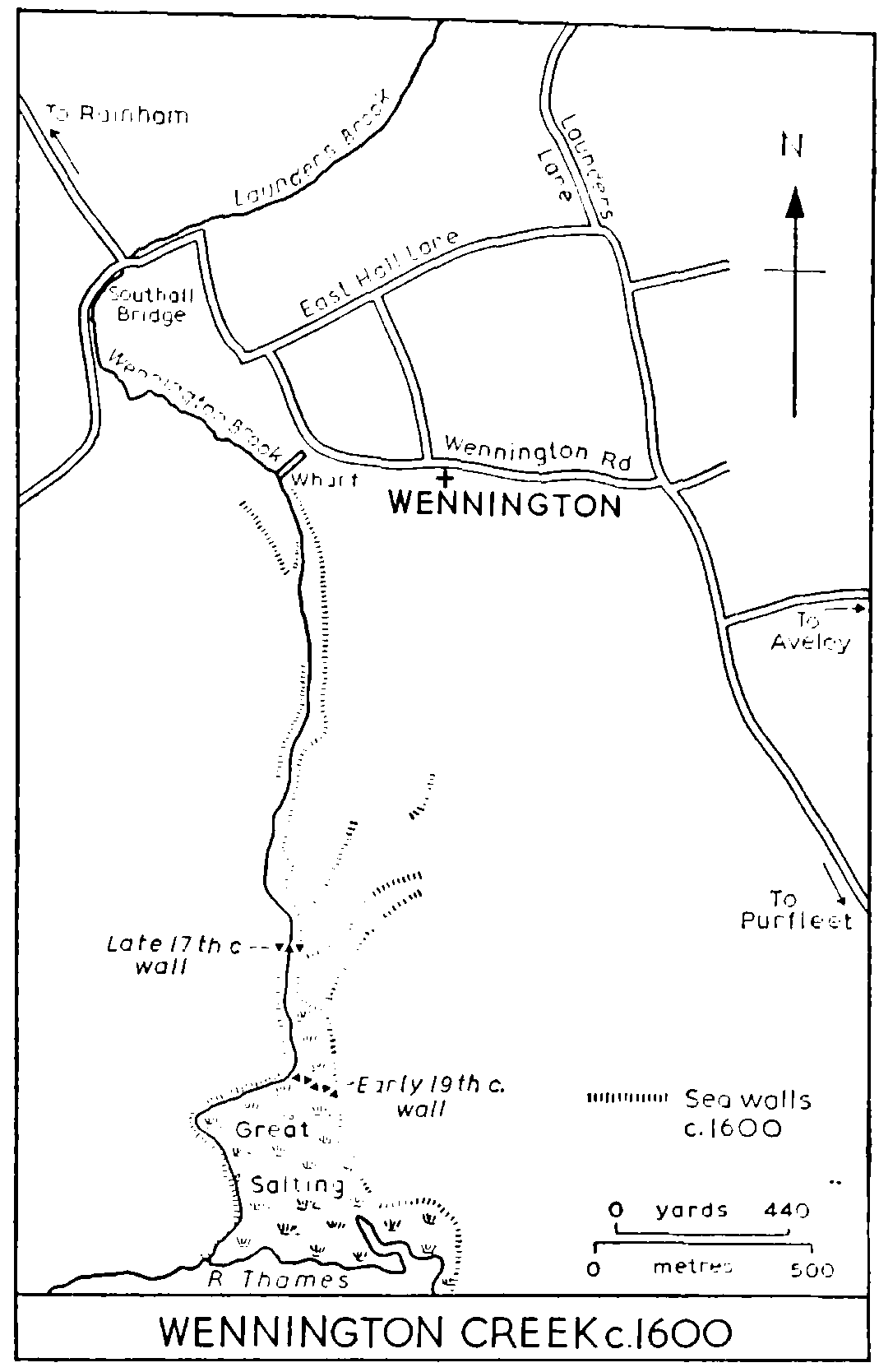
WENNINGTON CREEK c.1600
Mixed farming, including dairying, was being carried on in the earlier 15th century. When John Leventhorpe acquired the manor of Yonges about 1418 the stock comprised 150 ewes. (fn. 185) In the following year he began to buy cows at Braintree, Sawbridgeworth, and Bishop's Stortford (Herts.). and Chelmsford, and to enlarge the flock of sheep. Two rams were bought in 1419, and a bull in 1421. In 1420 78 lambs and 26 calves were sold to a London butcher. Cheese was also sold. By 1422 the dairy comprised 56 cows and 168 ewes, and was farmed out at £25 a year. In 1441 the cows' and ewes' milk was worth £20. The Leventhorpe dairy was apparently sold c. 1447, when most of the stock was sent to Shingle Hall, Sawbridgeworth, the family seat. John Leventhorpe's farm also produced wheat, beans, oats, rye, and barley, and sold the surplus in Barking, Dagenham and London. With only a small local population to draw on he was short of labour, and had to hire men by the day for all tasks, including carpenters from Dagenham, and harvesters from Writtle.
In the 17th century and later pasture predominated in Wennington's agriculture. In 1619 Noke manor farm contained 121 a. pasture out of a total of 146 a., and the whole of Wharf House farm, 65 a., was pasture apart from 8a. reeds. (fn. 186) In 1801 the area under grass was double that under crops. The main crops were barley, wheat, and turnips, with about 50 a. each, while there were smaller areas of oats, potatoes, peas, and beans. (fn. 187) In 1842 the parish had 729 a. pasture and 445 a. arable. (fn. 188) The four largest farms ranged in size from 94 a. up to 253 a. Several farmers in neighbouring parishes were leasing parcels of marshland in Wennington. By 1853 some of the arable was exhausted by overcropping and failure to use manure. (fn. 189) The marsh pasture, on the other hand, was in good heart. (fn. 190) A visitor in 1856 commented on the large herds of cattle there. (fn. 191) In 1953 pedigree Essex pigs were being raised. (fn. 192) Large-scale grazing was still being carried out in 1973.
By the mid 19th century Wennington was producing large quantities of vegetables, especially peas, for the London market. Vegetable growing must have been well established in the parish by 1841, when the population was swollen on census day by 160 Irish migrant workers. (fn. 193) Two firms played a leading part in developing market-gardening in the parish. Spear & Vellacott grew out of a business run by William Spear at East Hall Farm in the 1880s; by 1922 the firm had been enlarged to include also Coldharbour and Willows farms. (fn. 194) In the 1960s it began to cut the production of vegetables in favour of barley for feeding beef cattle. (fn. 195) Samuel Gunary & Sons, who also farmed at South Hall, Rainham, were at Wennington Hall from c. 1914 to c. 1969. (fn. 196) In 1933 market crops in Wennington included seakale, rhubarb, and asparagus. (fn. 197) Asparagus was still being intensively grown in 1973. (fn. 198)
Whatever trade the creek and wharf brought through Wennington in earlier centuries had ceased by 1652, when the inhabitants claimed that its blockage prevented the transport of goods to London. (fn. 199) There was little trade in the village. An alehouse which existed in 1630 (fn. 200) may have been the Anchor, which was named in 1754, and was licensed until 1770. (fn. 201) The licence ceased when the building was sold in 1771. (fn. 202) The Lennard Arms is reserved for treatment under Aveley. A coffee-house was built c. 1882 by John Kidd & Co. (fn. 203) It still survived in 1973.
In 1865 the Fresh Meat Preserving Co. built a factory in the grounds of Landthorpe House. (fn. 204) The business failed and in 1866 the factory and house were bought by James Ingram & Son, india-rubber manufacturers. They, too, failed and the factory was sold in 1881 to John Kidd & Co., chemical manufacturers. In 1885 Kidd leased the factory to the Camden Marine Steam Laundry, who built a large addition, but in 1891 the factory was burnt down. The derelict buildings, which were used for a time as a mat and rag factory, and later, c. 1914, for fish-skin drying, were demolished soon after 1966. (fn. 205)
In 1906 William Cunis Ltd. established a lighterage and dredging business at Coldharbour Point. (fn. 206) From 1929 the company carried gravel and ballast to London, returning with refuse to fill worked-out gravel-pits. It later undertook land reclamation, building up the marshland with refuse. Since 1956 the company has provided warehousing facilities on the built-up marsh.
Gravel was being extracted in Wennington in 1933 by the Wennington Sand and Ballast Co. Ltd. (fn. 207) An extensive tract of land at Willows farm, from which gravel had been extracted by Walker's Sand and Ballast Co., was being restored by the company in 1972 for return to agricultural use. (fn. 208) In 1973 Purfleet Timber Storage Ltd, had a depot near the Noak Café, where there was also a scrap-yard.
LOCAL GOVERNMENT.
No manor court rolls or books are known to have survived. (fn. 209) The lord of the manor was said in 1577 to be responsible for repairing the stocks, (fn. 210) but the parish repaired them in 1736 and rebuilt them in 1770. (fn. 211)
Most of the earlier parish records were stolen some time before 1837, and only some loose papers and bills survive for the pre-1836 period. (fn. 212) Two vestry books, 1762–1831, which existed in 1900, have also disappeared, but extracts from them were made by the then rector, Nicholas Brady. (fn. 213)
The oldest surviving vestry book dates from 1832. There were then four vestry meetings a year usually held in the church, with three or four parishioners attending. From c. 1769 to c. 1837, when there was no resident rector, the chair seems usually to have been taken by successive owners of the manor of Leventhorpes, Thomas Mansfard (d. 1822) and his grand-nephew of the same name. The elder Thomas served as churchwarden c. 1769–1822, and the younger from 1825 to 1843.
Wennington was accused in 1579 of having no parish officers. (fn. 214) There were two churchwardens in 1569, (fn. 215) but only one in 1593 (fn. 216) and later, until 1822. Two were chosen thereafter. A parish overseer was mentioned in 1734. One was being chosen in 1762, but by 1809 the practice was to choose two, of whom one, termed the acting overseer, was legally regarded as executing the office. As the second overseer named in 1809 was the constable, that officer may have acted also as assistant overseer. The constable, mentioned in 1700, was elected annually but, like all the other parish officers, was usually re-elected several years running. Matthew Turner, also parish clerk, was constable from 1788 to 1834. He had a painted and gilded staff of office. The parish continued to appoint a constable until 1874. A parish clerk was mentioned in 1419. (fn. 217) He was being paid £2 a year in 1685, and later was usually tenant of one of the parish cottages. The parish had one surveyor of the highways in 1735. The office was usually held with another. After c. 1830 two surveyors were chosen.
The cost of supporting the poor was met by two small charities, the rent of the parish cottages, and occasional rates. In the years 1754–7 two rates of 6d. each, producing a total of £46, sufficed to meet the overseer's spending for three years. By 1762 the poundage was usually 1s., levied from one to five times a year as necessary. Poor-relief costs averaged £31 a year in the three years 1783–5, and £83 in the years 1801 to 1817. (fn. 218) Between 1829 and 1835 the annual average was about £164. A constable's rate of 3d., producing £10 13s. 6d., was levied in 1731. Surveyor's expenses in excess of the sums paid to compound for statute duty were met by special rates, which were levied with increasing frequency after 1800.
In this isolated parish the casual relief of travellers rarely figures in the accounts, but the vestry not infrequently had to recover and bury the bodies of those drowned in the Thames or on the saltings. The number of parishioners in need can never have been large. Five householders were excused payment of hearth tax in 1670. (fn. 219) One weekly pension of 5s. was paid in 1729; there were two regular pensioners in 1754 and five in 1812. The homeless or helpless poor, including children, were boarded out in the village, sometimes with the constable, or in poorhouses in larger parishes nearby, such as West Thurrock, Aveley, and South Ockendon. The poor were nursed when sick, given medicines, inoculated, and attended by the apothecary, doctor, and midwife. In 1764 the parish paid for a family with smallpox to be nursed in Rochford pest-house, and for the survivors to convalesce in the 'airing house'. In the late 1820s an idiot girl was boarded at Bethnal Green asylum, the parish paying extra for hair-cutting, laundry, medicines, and clothing. The overseer's bills include payments for rent, coal, bedding and clothing; for provisions for a wife while her husband was in prison; for a child's writing books and a spinning-wheel; for apprenticeship indentures; for marriage fees, licence, and ring; and for burial.
The parish had two brick, tarred timber, and thatched cottages, (fn. 220) referred to as the parish or poorhouses, or clerk's house. (fn. 221) Both were let, one usually to the parish clerk, and the rents applied to parish purposes. The poor were sometimes housed or boarded in them. One of the cottages stood on an acre of land called Merston Set on the west side of Launders Lane. The land was let to the churchwardens in 1569 by Edward Barrett at a nominal rent for so long as it was used for the benefit of the poor and the repair of the church. In 1872 Merston Set was exchanged with Sir T. Barrett-Lennard for a piece of land west and south of the churchyard, on part of which the board school was built. Merston Set was obliterated in 1924 by the building of New Road. (fn. 222) The other cottage, built before 1683 on the waste in Church Lane, was a copyhold of Wennington manor. (fn. 223) It was later divided into two cottages, one of which was used as the parish school 1866–76. The building, which was standing in 1950, (fn. 224) had been demolished by 1973.
Wennington became part of Romford poor-law union in 1836.
CHURCH.
Wennington church was said to have been given to Westminster Abbey before the Conquest by Ætsere the swarthy and his wife Ælfgyth. (fn. 225) The church certainly existed, in the abbey's possession, by the time of Richard de Belmeis, bishop of London (1108–27). (fn. 226) Gilbert Marsh tried unsuccessfully to claim the advowson in 1222. (fn. 227) The abbey held the advowson until 1541. (fn. 228) In 1308 and 1385, when the abbacy was vacant, the king presented, (fn. 229) and in 1469 and 1491 the bishop of London presented by lapse. (fn. 230) In 1541 the advowson was granted to the newly created see of Westminster. (fn. 231) When the see was suppressed in 1550 it was granted to the bishop of London. (fn. 232) Queen Mary confirmed the grant in 1554, (fn. 233) but the abbey, after its restoration by Mary, presented William Talbot, who was instituted in January 1559. (fn. 234) The advowson was subsequently held by the bishop of London until 1852. Presentations for one turn were made by Thomas Cole in 1587 and Mark Danvers in 1588. (fn. 235) In 1852 the advowson was transferred to the bishop of Peterborough, (fn. 236) then in 1867 to the Crown. (fn. 237) Since 1958 it has been held by the Martyrs Memorial Trust. (fn. 238)
It was stated in 1254 that the church of Wennington, worth 10 marks, was appropriated to Westminster Abbey, and that there was no vicar. (fn. 239) Those facts would fit a donative curacy, but the institution of a rector was recorded in 1222, (fn. 240) and regularly from the early 14th century. The rectory was valued at £8 in 1291 and at the same figure in 1535. (fn. 241) By 1637 there were 4 a. glebe. (fn. 242) That may have originated as a toft granted to the rector in 1352 by Sir Thomas Charnels. (fn. 243) It lies opposite the church on the north side of the road. (fn. 244) The tithes, which were said to be worth £100 in 1650, (fn. 245) were commuted in 1842 for £420. (fn. 246) There seems to have been no rectory house since c. 1600 or earlier. (fn. 247) Since 1954 the living has been held in plurality, with Rainham. (fn. 248)
From the 17th century to the later 19th century most of the rectors were absentee pluralists. (fn. 249) Though some of them became eminent (fn. 250) they probably had little personal influence on the parish. Two rectors, William Ashton, 1583–7, and William Danvers, 1588–1616, were deprived of the living. (fn. 251) Ashton refused to wear the surplice. (fn. 252) Danvers was in prison in 1616, for what reason is not known. (fn. 253) He seems to have been a local trouble-maker. (fn. 254) Henry Bust, 1616–25, seems to have served the cure himself (fn. 255) and probably installed the fine oak pulpit and font cover mentioned below. His successor, John Aylmer, 1626–42, was usually absent, (fn. 256) but John Elborough, 1642–52, was described in 1650 as an able minister 'diligently preaching there'. (fn. 257) In the 18th and earlier 19th centuries the parish was normally served by a curate, often the vicar or curate of a neighbouring parish, such as Aveley or Rainham. (fn. 258) In the late 18th century there was usually one service on each or alternative Sundays. (fn. 259) William Hughes, 1865–74, was the first rector to serve the cure himself for over a century. His successor, Nicholas Brady, 1874–1907, who lived at Rainham Hall, restored public baptism, established an evening service, introduced choral celebration, and restored the church. (fn. 260) He took the lead in the social life of Wennington and compiled careful notes on the history of the parish. (fn. 261) The Revd. Alfred Norton, 1927–37, lived in the parish at a house called the Priory, which he built in 1929. (fn. 262)
The church of ST. MARY AND ST. PETER stands in Wennington Road, on rising ground above the marshes. (fn. 263) It is a restored medieval church of rubble with limestone dressings, comprising nave, chancel, aisles, embattled west tower, north porch, and south organ chamber. The oldest part of the church is a 12th-century round-arched doorway, reset in the vestry. (fn. 264) Masoned blocks of limestone, exposed in the foundations of the nave when the floor was renewed in 1960, were attributed to the Norman period, or even earlier. (fn. 265) The chancel, nave, and south aisle were apparently rebuilt in the early 13th century. In the early 14th century the north aisle was added. Later in the same century the west tower was built and a new roof was put on to the chancel. In the late 15th or early 16th century the chancel arch and the nave roof were rebuilt, and new furniture was added. The furnishings were further improved in the 17th century. Before 1720, (fn. 266) and probably c. 1600, the south aisle was demolished, the two-bay arcade was walled up, two Elizabethan-style windows were inserted, and a south doorway, later blocked. (fn. 267) Extensive repairs were carried out in the early 18th century. (fn. 268) By 1874 the church was shabby and neglected. (fn. 269) Through the efforts of the rector, Nicholas Brady, and under the architectural direction of the Revd. Ernest Geldart, it was restored and enlarged in 1885–6 to accommodate the increasing population. (fn. 270) The south aisle was rebuilt on its ancient foundations, with an organ chamber added. New windows were inserted in the chancel. A west gallery of unknown date was removed, and the base of the tower was converted into a vestry. (fn. 271) The cost of over £1,000 was met by subscription and from a fund raised earlier to build a rectory. (fn. 272) In 1900 the old porch was replaced by a new one of stone, also designed by Geldart. (fn. 273)
The fittings of the church include an early-13th-century oak chest. (fn. 274) The octagonal Purbeck marble font, also of the 13th century, has an early-17th-century carved oak cover. (fn. 275) There is a 13th-century piscina in the chancel and a 14th-century one in the north aisle. An oak bench of the 15th or early 16th century survives, and there are known to have been others. The oak staircase in the two upper stages of the tower is probably of the 15th century. The hexagonal carved oak pulpit dates from the early 17th century. (fn. 276) A wrought-iron hour-glass stand of the 17th century is attached to the north-east respond beside it. (fn. 277)
In 1552 there were three small bells. (fn. 278) The present bell-frame is of the 17th century, and there is one bell dated 1662 by Anthony Bartlet. (fn. 279) Two other bells of the same make and date still existed in 1856, (fn. 280) but only one bell was in use in 1872, (fn. 281) and by 1900 only one survived. (fn. 282)
The church plate includes a silver-plated paten dated 1790, with the initials T. M. (Thomas Mansfard), and a silver-plated cup given in 1875 by Nicholas Brady. (fn. 283) A silver cup and cover recorded in 1685 no longer survive.
A brass indent on the floor of the south aisle commemorates Thomas atte Noke, who died c. 1325. (fn. 284) Under the altar is the matrix of another brass, probably that to Margery (d. c. 1380), wife of Sir John Gildesborough, lord of the manor of Wennington. (fn. 285) In the north aisle is an alabaster tablet to Henry Bust, rector (d. 1625).
NONCONFORMITY.
The Wesleyan Methodist John Valton taught and preached at Noke House in 1769. (fn. 286) Henry Cooke Bourne (d. 1855), an Independent preacher who lived at Great Coldharbour Farm, was deacon of the Aveley Independent chapel. (fn. 287) John Dupray Bourne (d. 1879), of Wennington House, registered it for Independent worship in 1861. (fn. 288)
EDUCATION.
In the 18th century the vestry sometimes paid for poor children to be taught, (fn. 289) but in 1808 the curate reported that the parish was too small to support a school. (fn. 290) A Church Sunday school was opened about 1834. It was maintained by subscriptions, and in 1839 was attended by 27 children, who received free schooling and clothing. (fn. 291) In 1862 it was amalgamated with a small private dayschool kept by Emily Turnpenny. (fn. 292) She was appointed mistress at £16 a year, paid by the parish vestry. The school was moved in 1866 from a private house to the parish cottage in Church Lane. After compulsory church-rates were abolished in 1868 the cost of the school, about £30 a year, was met by subscription and children's pence. In 1870 there were 41 children in one small room. (fn. 293) A school board was formed in 1875, (fn. 294) and a new school and teacher's house, designed by Habershon & Pite, was opened in 1877 on a site, beside the churchyard, acquired by the parish in exchange for Merston Set. (fn. 295) Miss Turnpenny, who was uncertificated, then retired. The board school, which had places, for 63 children, was overcrowded by 1906, and the county council therefore reorganized it for mixed juniors and infants. It was closed in 1966, when 42 children were transferred to Rainham. The old building was converted into three dwellings.
CHARITIES FOR THE POOR.
William Heard, by his will proved 1593, gave a rent of 10s., charged on his lands in Rainham, to provide doles of 2s. each to 5 poor persons on Easter Day. (fn. 296) John Heard, heir of William, seems to have transferred the rentcharge to his house in Wennington called Old Lentrops, later the Anchor. (fn. 297) In 1837 the rentcharge was still being paid by the owner of Wennington House, which stood on the site of the Anchor. (fn. 298) It was then stated that another rent-charge of 10s. was due to the parish from the Angel in Rainham. That was presumably Barrett's gift, mentioned in 1719, to buy smocks for poor widows. (fn. 299) Its origin and purpose had been forgotten by 1837. The rent charge had not been paid since 1829. Before that the parish had customarily distributed the income from both rent-charges in doles to poor families. Neither of the charges is known to have been paid after 1837. (fn. 300)
The Helen Mary Norton charity was founded in 1937. (fn. 301) The Revd. Alfred Norton, rector of Wennington, gave £100 stock in trust to provide relief for the sick and needy in the parish. In 1976 the income was being used to provide Christmas parcels. (fn. 302)
Merston Set, let to the parish in 1569, partly for the benefit of the poor, is treated above. (fn. 303)