A History of the County of Worcester: Volume 4. Originally published by Victoria County History, London, 1924.
This free content was digitised by double rekeying. All rights reserved.
'Parishes: Abberton', in A History of the County of Worcester: Volume 4, ed. William Page, J W Willis-Bund (London, 1924), British History Online https://www.british-history.ac.uk/vch/worcs/vol4/pp4-7 [accessed 2 May 2025].
'Parishes: Abberton', in A History of the County of Worcester: Volume 4. Edited by William Page, J W Willis-Bund (London, 1924), British History Online, accessed May 2, 2025, https://www.british-history.ac.uk/vch/worcs/vol4/pp4-7.
"Parishes: Abberton". A History of the County of Worcester: Volume 4. Ed. William Page, J W Willis-Bund (London, 1924), British History Online. Web. 2 May 2025. https://www.british-history.ac.uk/vch/worcs/vol4/pp4-7.
In this section
ABBERTON
Eadbrihtinctune (x cent.); Edbritone, Edbretintune (xi cent.); Edbrighton, Edburinton, Eadbriston (xiii cent.); Aburton (xvi cent.).
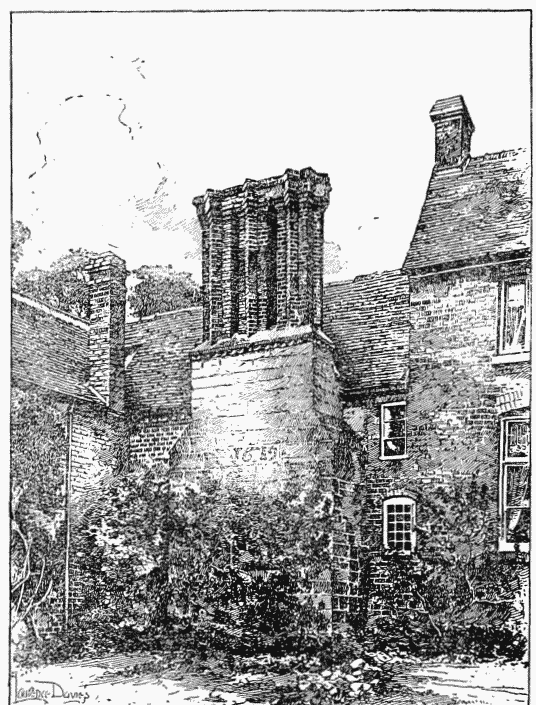
Old Chimney Stack, Abberton Hall
Abberton lies to the south of the main road from Worcester to Alcester, a branch from which runs through the parish from north-east to south-west. The village, which is very small, is 5 miles north of Fladbury station on the Oxford and Worcester section of the Great Western railway. To the east of the church are the remains of a moat. Abberton Hall, the seat of the lord of the manor, Mr. Alline Bushell, stands high in a fine park, with extensive views over the Bredon Hills and Vale of Evesham. It was originally an early 17th-century timber-framed building, but is now cased with brickwork and stands on a stone base, At one side is a fine old chimney stack, dated 1619, the lower part being of stone with shafts of brick set diagonally upon it. None of the internal fittings of the house are original, but the stables are of old black and white construction.
The village stands at about 200 ft. above the ordnance datum, and from it the land slopes away to the north and south, the southern boundary of the parish being formed by the Whitsun Brook. (fn. 1) The parish has an area of 999 acres, of which in 1905, 443 were arable land and 525 permanent grass. (fn. 2) The soil is sand and clay, the subsoil Lower Lias and Keuper Marl. The principal crops grown are wheat, beans, barley, turnips and fruit. Limestone and coal are supposed to exist, and there are springs similar to those at Epsom and Cheltenham. In the south of the parish is an old clay pit. There was a vineyard here in 1554. (fn. 3)
The inclosure of the parish took place in 1776, but not by Act of Parliament. (fn. 4)
Among ancient place-names have been found: a cottage called Calley, 1462 (fn. 5); Tytington Hill, 1527 (fn. 6); Caldwell Land, Tuddington's Lees and Abbot's Hill, 1544. (fn. 7)
MANOR
Four manses at Abberton were among the possessions said to have been confirmed to the abbey of Pershore by King Edgar in 972. (fn. 8) At the date of the Domesday Survey two berewicks, Edbritone and Edbretintune, both probably identifiable with the modern Abberton, belonged to the abbey of Pershore's manor of Pershore. (fn. 9) The manor of Abberton was described as 3 carucates of land, worth 3 marks yearly, in 1291. (fn. 10) It was held by the abbey of Pershore until the Dissolution, when it passed to the Crown. (fn. 11)
The manor was granted on 16 January 1544 to William and Francis Sheldon. (fn. 12) Ralph Sheldon was then lessee of Abberton, which he also held in 1540, (fn. 13) and it appears that he had been preceded here, as in his Beoley property, by his brother William, who died childless in 1517, and who is entered in the Visitation of 1569 as William Sheldon of Abberton. (fn. 14) John Sheldon, father of William and Ralph, was also seated at Abberton. (fn. 15) William and Francis Sheldon, grantees of the manor in 1544, were sons of this Ralph. (fn. 16) The manor was settled on Francis Sheldon and Mary his wife, with remainder to their children, William, Thomas, Francis and Lucy. (fn. 17) The William Sheldon to whom the grant of 1544 was made died on 24 December 1570, when William son of Francis was of full age and residing at Abberton. (fn. 18) This William was succeeded in 1608 by his son Francis, (fn. 19) a grant of the benefit of whose recusancy had been made to Henry Mynours in the previous year. (fn. 20) Francis Sheldon and his wife Elizabeth were holding the manor in 1625 (fn. 21) and 1632. (fn. 22) Francis Sheldon, who was dealing with the manor in 1699, (fn. 23) died in the following year, his son and successor Francis dying in 1711. (fn. 24) Francis Sheldon, probably son of the latter, was holding the manor in 1720. (fn. 25) In 1733 an Act was passed for discharging the estate at Abberton of Francis Sheldon, a lunatic, from the trusts of a former Act of Parliament, made for the payment of his debts, and for vesting other of his estates in trustees for the same purpose. (fn. 26) The manor was held by Thomas Sheldon in 1776 (fn. 27) and by Thomas and his wife Margaret in 1798, (fn. 28) when it was conveyed by them to John Hardcastle. Thomas died in 1804, and in 1821 the manor was in the hands of Samuel Lesingham and Lucy his wife. (fn. 29) Samuel Lesingham, who was probably a connexion of the Sheldon family, by the name of Samuel Sheldon heretofore Samuel Lesingham, with Lucy his wife, conveyed the manor in 1829 to William Laslett. (fn. 30) Abberton then followed the same descent as Kington (fn. 31) to Mrs. Baker Carr. It was put up for auction on 7 September 1905, but was withdrawn. (fn. 32) It passed in 1907 into the hands of Mr. Alline Bushell, (fn. 33) who now holds it.
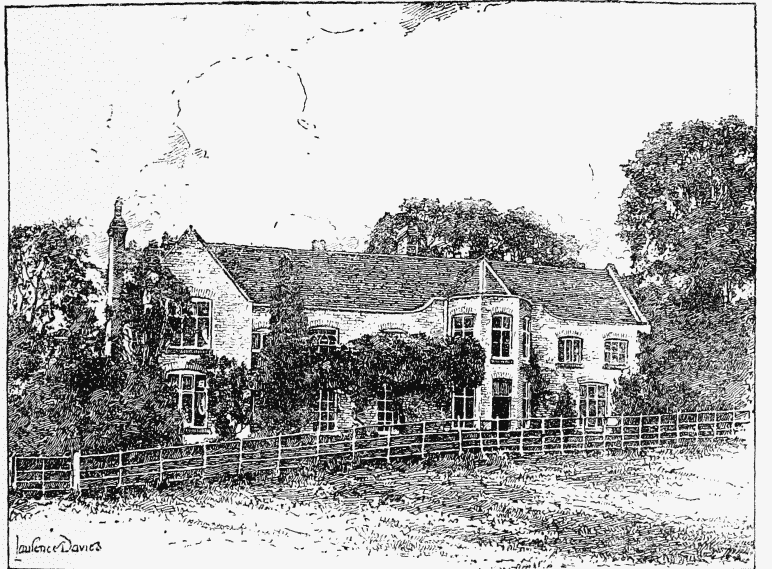
Abberton Hall
Accounts of reeves, bailiffs and collectors for the manor from 1399 to 1483–4, (fn. 34) and Court Rolls for 1421, (fn. 35) 1462–3, (fn. 36) 1524–5 (fn. 37) and 1533–4 are preserved. (fn. 38)
There was a mill here held by the abbey of Pershore in 1291. (fn. 39) In 1699 (fn. 40) and 1720 (fn. 41) two water-mills were held with the manor, and in 1798 (fn. 42) one water corn-mill. The present Abberton Mill is on Whitsun Brook in the south of the parish.
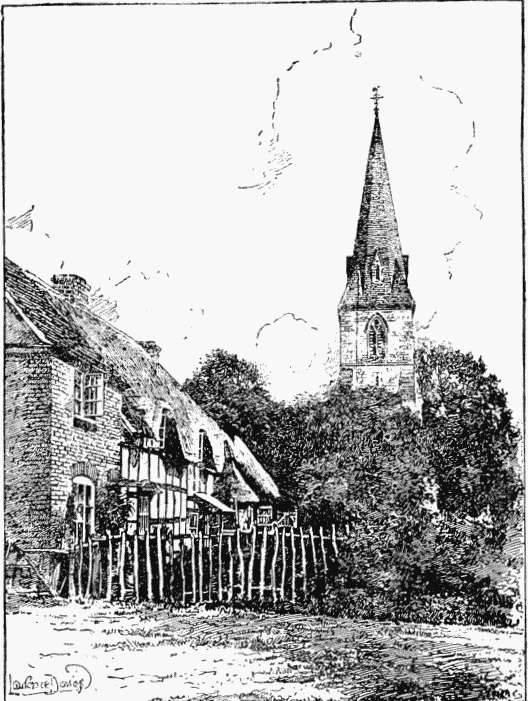
Old Cottages and Church Tower, Abberton
CHURCH
The church of St. Eadburgawas entirely rebuilt in 1881–2 on the site of the old church, at the sole cost of the late William Laslett of Abberton Hall. It is a structure in the style of the early 14th century, consisting of a chancel with north vestry, nave with a timber south porch and a west tower. It is built of brick faced with stone and has a timber chancel arch and three-light traceried east and west windows. In the north wall of the nave is a window of two trefoiled lights with a quatrefoil in the head, which is partly of 14th-century work re-used; the other nave windows are of one light and modern. The west tower has a moulded arch to the nave and is surmounted by a stone broach spire; it contains two small bells, one inscribed, the other dated 1686.
Under the tower are a number of slabs of the Sheldon family, including Samuel Sheldon, 1659, and Mercy, 1729, son and daughter of Francis Sheldon; Susanna wife of Francis Sheldon, 1719, with the arms Sheldon impaling Dormer; Francis Sheldon, 1700, with the arms Sheldon impaling Savage and several others.
The font has a hemispherical 12th-century bowl with small upright cheveron ornament round the rim and a cheveron band lower down.
The plate consists of a cup and cover paten, both with the London mark for 1571, and a large paten of the 18th century, without date mark, but bearing the Sheldon arms —a fesse between three sheldrakes.
The registers before 1812 are as follows: (i) all entries 1661 to 1729; (ii) mixed entries 1730 to 1812; (iii) marriages 1759 to 1812.
ADVOWSON
The advowson of Abberton was in the hands of the Abbot of Pershore in 1283, (fn. 43) and was held by the abbey until its suppression, (fn. 44) when the rectory was returned as worth £6 yearly. (fn. 45) The advowson was granted with the manor in 1544 to William and Francis Sheldon, (fn. 46) but when the manor was settled on Francis and his heirs the advowson was excepted and remained with William and his descendants, the Sheldons of Beoley. (fn. 47) It followed the descent of Beoley (fn. 48) until about 1736. It was then held by William Sheldon of Beoley, (fn. 49) but in 1772 Thomas Sheldon, then lord of the manor of Abberton, presented to the church, (fn. 50) and the advowson has since descended with the manor. (fn. 51) The rector resides at Flyford Flavell, of which parish he is also rector.
CHARITIES
The parish is in possession of about 2 a., situate in Flyford Flavell, let at £1 15s. a year, which is applied towards the expenses of the church.
In 1804 Thomas Sheldon, by his will proved in the P.C.C. 19 September, devised a rent-charge of £5, payable out of the Abberton Hall estate, to be distributed yearly to the poor during the month of December.
In 1814 Thomas Sims, by his will proved 2 November, bequeathed £50, the interest to be given away to the labouring poor in beef on St. Thomas's Day. The legacy, less duty, was invested in Government stock, which was paid off in 1824, and the proceeds became vested in a deceased trustee. Owing to the costs incurred in the recovery of the principal sum, the trust fund amounts to £22 only, which is on deposit in the Post Office Savings Bank.
The interest, together with the annuity of £5 above mentioned, is distributed in doles of money.