A History of the County of Worcester: Volume 4. Originally published by Victoria County History, London, 1924.
This free content was digitised by double rekeying. All rights reserved.
'Parishes: Broadway', in A History of the County of Worcester: Volume 4, ed. William Page, J W Willis-Bund (London, 1924), British History Online https://www.british-history.ac.uk/vch/worcs/vol4/pp33-43 [accessed 30 April 2025].
'Parishes: Broadway', in A History of the County of Worcester: Volume 4. Edited by William Page, J W Willis-Bund (London, 1924), British History Online, accessed April 30, 2025, https://www.british-history.ac.uk/vch/worcs/vol4/pp33-43.
"Parishes: Broadway". A History of the County of Worcester: Volume 4. Ed. William Page, J W Willis-Bund (London, 1924), British History Online. Web. 30 April 2025. https://www.british-history.ac.uk/vch/worcs/vol4/pp33-43.
In this section
BROADWAY
Bradanuuege (x cent.); Bradeweia (xi cent.); Bradeweye (xiii cent.).
The parish of Broadway, which comprises 4,990 acres, lies at the extreme south-eastern corner of the county and is almost entirely surrounded by Gloucestershire. The village consists principally of one wide street called Broadway Street, part of the high road from Evesham to Stow-on-the-Wold, climbing the western slope of the North Cotswolds, but it also continues along the road following the foot of the hills southward. All the cottages and houses are built and roofed with stone from the quarries on the top of Broadway Hill.
At the cast end of the village, on the south side of the road, is the house known as Court Farm, the residence of Mr. Antonio F. de Novarro, which consists of two independent houses joined together by a modern building forming a central hall of considerable size, and having on its northern side a connecting passage between the two portions of the house. The eastern building incorporates part of the hall of a late 14thcentury house, one of the braced-collar trusses of which still stands intact. Only a short length of this hall, into which a floor has been inserted, remains, the remainder of the house having been completely rebuilt in the early 17th century. The floor here inserted is supported by richly moulded beams of the same date as the truss and probably re-used, the mouldings of which are stopped at their junction with the wall beams by well-carved angels holding scrolls, and at their central intersection by a large boss, the lower part of which has perished. The fragment of the hall is only visible externally on the south or garden front, and the window lighting the ground floor here is a Jacobean insertion. In the room on the ground floor to the east of the hall is a fine chimneypiece in situ with a four-centred head to the fireplace opening and panelled jambs and overmantel. On the north side of the house is a good oak central newelstair with flat twisted balusters fencing the landing. The western block was an early 17th-century L-shaped house of the same type and still retains some interesting stone fireplaces and other characteristic detail of the period. In the modern connecting hall is a very fine oak chimneypiece, probably of Italian workmanship, the panels of which are carved with delicately modelled arabesques; this was brought from an old house in Hereford.
Some distance to the west of Court Farm, facing the Willersey road, is the house now called the 'Gables,' an L-shaped two-storied building of stone, dating from the early 17th century. The upper floor is lighted by a row of gabled dormers, from which the house takes its name, each containing a three-light mullioned window. On the opposite side of the village street, a little to the west of the Willersey road, is a small 14th-century house, the plan of which, though the interior was entirely rearranged in the early 17th century, remains to a certain extent undisturbed. The hall, which is now divided by an inserted floor, has a timber roof divided into four bays by bracedcollar principals, and is entered by doorways with moulded jambs and two-centred heads at the east end of each side wall. At the west end of the hall is the solar block, which is now used as a storehouse and is in a poor state of repair. The arrangement of the kitchen, buttery and pantry at the opposite end of the hall cannot now be traced.
Near the middle of the village, on the south side of the street, is the house somewhat incongruously named the 'Tudor House.' It is of four stories, the two upper floors partly in the roof, and presents a picturesque triple-gabled front to the street. The windows are all mullioned and the centre of the elevation is emphasized by a bay window to the ground and first floors, on the parapet of which are two shields bearing the dates 1659 and 1660 respectively, commemorating, doubtless, the commencement and complection of the building. The interior has been very largely altered and modernized. On the opposite side of the road, near the green at the west end of the village, is the 'Lygon Arms,' formerly the 'White Hart,' a fine stone building dating probably in part from the 16th century, but much altered and enlarged early in the following century, to which date belong the front towards the street and most of the original detail which survives internally. The house is four stories in height, two, as in the case of 'Tudor House,' being partly contained in the roof. It has tall gables, and consists of a central block with projecting wings at either end. The windows, which have been in many cases renewed, are mullioned and have moulded labels. The entrance doorway, which bears the date 1620, has a depressed four-centred head, and is flanked by Ionic pilasters of the baluster type supporting an entablature with strapwork ornament upon the frieze. Immediately to the west of the entrance passage is a large room, formerly the kitchen, with a good open fireplace at the east end. At the north-east of this room is a newel-stair, now approached from the passage which has been taken out of the room on the north. On the first floor of the east wing is the room known as the Cromwell room, which has a fine stone fireplace and enriched plaster frieze and ceiling, all probably work of the early 17th century. Over the kitchen is an oak-panelled room of the same period, where Charles I is said to have met Sheldon of Broadway Court in May 1645. (fn. 1)
Overlooking the rough triangular green, where markets and fairs were formerly held, is the 14thcentury house known as the Abbot's Grange. The remaining portion of the original building consists of a hall placed with its greatest length from north to south, and having an oratory or small chapel projecting at the south-east, and a solar with its undercroft at the southern end. From the solar a small wing, also of two stories, projects on the south, but of the buildings to the north of the hall, containing the kitchen and offices, nothing is now left. In spite of the many alterations and additions to which it has been subjected, without, however, much disturbance to the original portions, the house presents an interesting and extremely valuable example of the domestic architecture of the 14th century. A floor appears to have been inserted in the hall in the early 17th century, while the wing to the south of the solar seems to have been remodelled at the same period, new fireplaces being inserted and the room on the first floor panelled with oak. In recent years, while in the occupation of the late F. D. Millet, the wellknown artist, who perished in the sinking of the Titanic in 1912, the building was used as a studio, and considerable restorations were undertaken, including the construction of the present stone stairs to the solar and oratory. An addition was also made on the north side, and further alterations were made in 1913 with the object of transforming the building into a modern residence.
The hall, which measures internally about 25 ft. 8 in. by 19 ft. 9 in., was entered at the screen, or northern, end by doorways in each side wall. That on the east has a restored two-centred external head chamfered continuosly with the jambs, and a flat three-centred rear arch; the doorway opposite has been much disturbed, but the springing of a twocentred external head moulded with a filleted roll remains on the north. Of the three doorways in the north wall, the eastern pair, which must have communicated with the buttery and pantry, have ogee heads on the hall side, moulded in each case with a sunk quarter-round continued upon the jambs, and three-centred rear arches. On the north side of the wall, immediately to the east of the eastern doorway, are traces of a circular stair, which may have led to a gallery over the screens. The doorway at the west end of the wall has a flat three-centred head similarly moulded, but the jambs and head are considerably skewed. The northern of the two windows in the east wall, which has been renewed, is of two trefoiled lights with a transom. The southern window is placed diagonally across the angle made by the oratory projection with the hall. The window is entirely original, and is of two trefoiled ogee lights, divided by a transom, with pierced spandrels and a square external head, the projection being covered by a tabled stone roof. A plain square-headed doorway at the southern end of the wall opens into a room below the oratory. Over this is a small circular opening, which has had cusped running tracery, now cut away. It commands a view of the altar and of the oratory from the floor of the hall, and evidently served the purpose of a squint. An ogee-headed doorway at the east end of the south wall leads to the modern stairs to the solar and oratory and to the room below the solar. A fireplace is now being formed in the wall to the west of this doorway. The two windows in the west wall have had their tracery renewed, though the jambs are original; the southern is of two trefoiled ogee lights, divided by a transom, with pierced spandrels and a square containing head, while the northern window is like that opposite, save that the mullion is hollowchamfered and the spandrels are pierced and foliated. The roof is supported by a central braced-collar truss supporting heavy moulded purlins, and the common rafters above the level of the purlins are trussed throughout the length of the roof by subsidiary braced collars. The central truss has wall-posts sunk into the face of the wall and stopping about 5 ft. from the floor; the inner ogee mould of the braces is continued upon them, and appears to have been originally continued in stone down to the floor and to have been subsequently hacked away.
The room under the oratory is lighted by small square lights on the east and south, both probably original, and by a square-headed two-light window with a flat three-centred rear arch on the north, the mullion and external jambs of which are modern. The north-east corner of the undercroft of the solar is occupied by the modern stairs above mentioned. Traces of steps were found at the south-east angle of the hall, and suggested the present reconstruction. In the west wall of the undercroft is a low square-headed window of four lights with hollow-chamfered mullions, probably of original 14th-century date. At the southwest is a small light with a two-centred head originally trefoiled, and to the east of it a large fireplace with a flat chamfered head. Adjoining the fireplace is a square-headed doorway, continuously chamfered, leading into the south wing, and at the extreme east of this wall is a second square-headed doorway, very narrow, also leading into the south wing. The masonry has been much disturbed here, as the doorway was blocked up in the 17th century by the building of a large chimney stack with an open fireplace immediately in front of it on the ground floor of the south wing, which is now being rebuilt. In the north wall is a plain niche or recess, and in the east wall a modern square-headed window of two lights. The oratory is entered from the south-west by a plain doorway with a cambered head, the jambs of which are placed askew as if to suit the upper winders of the stairs, an additional clue to their original arrangement. The east window, a fine and elaborate piece of work, is of two trefoiled lights with quatrefoil tracery in a two-centred head. The ribbed rear arch is of the same form, and the internal sill is placed a little distance below the bottom of the lights. The stone of which it is formed is modern, but its position suggests that the original sill was used as an altar-stone. In the north wall is a trefoiled light with a segmental rear arch, and in the south wall an ogee-headed light, also trefoiled, while on the west is the circular opening looking into the hall described above. The rafters of the roof are trussed by collars with arched braces and the wall-plates are moulded.
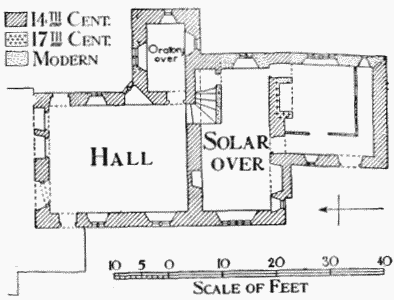
Plan of the Abbot's Grange, Broadway
The solar is lighted from the west by a fine original window of two trefoiled ogee lights, divided by a transom, with quatrefoil tracery above in a two-centred head with an external label. The rear arch is ribbed and the jambs and mullion are elaborately moulded, though internally they have been much injured by the insertion of a floor, now removed, at the level of the transom, above which the lights are blocked to about the height of 9 in. In the north wall is a squint looking into the hall, and in the east wall a transomed window of two trefoiled lights with a ribbed rear arch, the lights being blocked above the transom as in the case of the west window. There is a broken fireplace opening at the west end of the south wall, and at the opposite end of the same wall, communicating with the south wing, is a doorway with a two-centred head, moulded with a swelled chamfer continued upon the jambs. The roof, which, like the other detail here, is of original 14th-century date, has a central braced-collar truss and the rafters are stiffened by curved wind-braces. The south wing was entirely remodelled internally in the 17th century, when the fireplaces and chimney stack were inserted. It is now undergoing further alteration, the east wall having been rebuilt. The ground floor, which was apparently made into one room in the 17th century, has had passages taken out of it on the south and west, and the large fireplace in the north wall has been curtailed on the east to reopen communication with the undercroft of the solar. The plain doorway and window in the west wall may be of original date. The room on the first floor has a good moulded stone fireplace of the early 17th century, and the walls have oak panelling of the same date. In the south wall are two square-headed lights, the easternmost blocked; above the latter is a plain corbel from which a bell may have hung, the porter's lodge being probably in this part of the building. Externally the roofs are covered with stone slates and the walling generally is of sandstone rubble, while the gables have plain copings with gablet finials. The chimney stack of the solar block, which is of original 14thcentury date, is corbelled out at the first-floor level, and weathered back to a comparatively narrow square shaft above the gutter level, while in the angle formed by the projecting oratory with the solar block is a large grotesque spout.
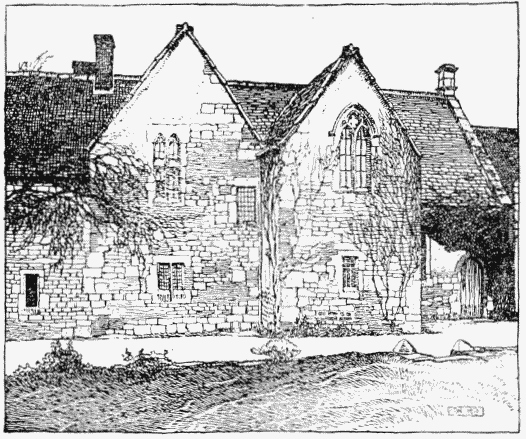
The Abbot's Grange, Broadway: East Front
Middle Hill, the residence of Mrs. Edgar Flower, stands on high ground in a park about 2 miles southeast of the village, and commands charming views over the Cotswolds and as far as the Malvern Hills. It is a late 18th-century rectangular plastered house of two stories and an attic, with slate roofs and dormer windows, and has a modern addition in the Jacobean style on the east. The rooms are decorated in the Adam manner and have some carved oak fireplaces. The walls of a small room in the modern addition are covered with oak panelling of about 1600, brought from elsewhere.
Kite's Nest, in the valley about a quarter of a mile west of Middle Hill, is a rectangular stone house of two stories and an attic, with stone-slate roofs. The southern portion dates from about 1666, and, being on lower ground than the north, has an additional lower story; it is lighted by a large number of original mullioned and transomed windows, some of which are now blocked. On the south front are two pointed gables connected by a small semicircular gable which incloses a weatherworn sundial; at the corners of the plain parapet are small openwork finials of stone. The northern portion of the house is probably earlier, but most of its original details, including the stone-mullioned windows and the doorway on the north front, have been renewed; the studded oak door, however, with its iron hinges is original. Internally there is a central stair hall with a fine wide oak staircase of the 17th century having square newels, turned pendants and twisted balusters. In the open fireplace of the kitchen is an old iron fireback with a nude figure in relief. The house, which is a charming example of its period, is in good condition and preserves many of its original features; the windows retain much of their original green leaded glass and several well-designed iron fastenings, while four plain lead gargoyles, dated 1666, project from the parapet on the south front.
The Court House, the residence of Mr. Henry S. J. Ayshford Sanford, on the west side of the road immediately to the north of the old church, consists of the old gate-house to Broadway Court, with modern additions on the west. The gate-house portion is a stone building of the late 16th or early 17th century, of two stories and an attic, with a stone-slate roof and stone-mullioned windows. The plan consists of a gateway with semicircular archways on the east and west, and the porter's lodge to the south of and above it; the lodge retains its original four-centred doorways and fireplace and stone newel stairs. Above a square label over the east archway are the quartered arms of Sheldon, Sheldon quartering Ruding and Willington, and below the label are the crests of Savage, Sheldon, and Daston. The shield of Daston quartering Dumbleton, which is built into the modern west front, was found near the site of the old house, and fragments of low-relief carving of the late 16th or early 17th century are built into the garden wall which faces the road; these are embellished with foliated and heraldic ornament, and are probably from the porch or portico of the old house. Broadway Court itself has entirely disappeared, but its site is said to have been some distance to the east of this gate-house. West End Farm, to the south-west of the village, is a 17thcentury L-shaped house of stone with an 18thcentury west front.
Spring Hill was the residence of the late Major Vicesimus Knox, J.P., and Farncombe is the residence of Mr. William Skidmere Barrett. Sir Arthur William Blomfield, the architect, had a country house at Broadway, where he died in 1899. (fn. 2) His widow Lady Blomfield still resides at Springfield Cottage. The late Edwin A. Abbey, R.A., and the late Viscount Lifford also lived here.
The old church of St. Eadburga is used as a mortuary chapel and services are held there on Sunday afternoons in the summer, another church dedicated in honour of St. Michael and All Angels having been built nearer the village in 1839. This new church was built on the site of a chapel erected in 1608, (fn. 3) for the convenience of the parishioners in bad weather, the parish church being such a distance from the village. The chapel, of which Prattinton gives a full description, (fn. 4) was a small stone building with a bell-turret. The roof was of wood, unceiled, and the pulpit painted blue and gold.
An old workhouse was in existence at Broadway in 1820. (fn. 5) There is a public elementary school and a Roman Catholic school, built in 1851, attached to St. Saviour's Monastery, built here in 1850 by the Passionist Fathers. (fn. 6) A small chapel, priest's house and school had been built about 1828, and were bought by the Passionist Fathers and converted into the present monastery. (fn. 7) There are also Congregational, Wesleyan and Methodist chapels in the village, the first having been founded in 1808 (fn. 8) and the Wesleyan chapel about 1811. (fn. 9)
In June 1644 Charles I passed twice over Broadway Hill on his way from Oxford to Worcester and back. (fn. 10) On the second occasion he passed the night at Mr. Savage's house at Broadway. (fn. 11) Again in May of the next year he 'went down by Broadway to Evesham.' (fn. 12)
The highest point in the parish is the top of Broadway Hill (1,026 ft. above the ordnance datum), whence it is said that thirteen counties are visible. The place is marked by a tower called The Beacon, built in 1797 by Lord Coventry. This tower was used from 1822 to 1862 by Sir Thomas Phillipps for his private printing press, and many of his publications were issued from here. In 1862, however, the press was moved to Cheltenham.
The main road to London used to pass by the church of St. Eadburga by way of Pie Corner, Coneygree Lane and the Seven Wells, but probably there was always an alternative road through Broadway village and over the hill. The present road over the hill was constructed at the time of the inclosure in 1771, and the Fish Inn was built at the top. (fn. 13) A slight alteration was made in the course of the road in 1820 to improve the descent. (fn. 14)
The soil, which is loam with a subsoil of clay and limestone, is very fertile, producing crops of wheat, barley and beans and a considerable amount of fruit. The permanent grass in the parish is very nearly twice the extent of the arable land, and the woods and plantations amount to about 300 acres. (fn. 15) In 1585 two great fish-ponds are mentioned, probably 'les pooles' which belonged to the Broadway Court estate in 1620. (fn. 16) Agriculture is the principal industry, but glove-making was carried on to some extent in the middle of the 19th century. (fn. 17)
A 'quarre broche' close to Middle Hill is mentioned in 1540, (fn. 18) and a pit called Bayles or Baylye's Pitte, (fn. 19) referred to in 1585 and 1635, was probably also a quarry. In 1770, when the parish was inclosed, (fn. 20) Sir Edward Winnington, lord of the manor, had the exclusive right of opening and working clay-pits and hone quarries on the hills. (fn. 21)
The following place-names have been found: Colhulledone, Alburnwell, Umbaresput (fn. 22) (xiv cent.); Worthemernys (fn. 23) (xv cent.); Lamborne Hay, the Seven Wells, the Doore Conynger, Bitteling Hunger, the Dorton (fn. 24) (xvi cent.).
BOROUGH
In 1196 and the two following years the monks of Pershore paid 10 marks for a weekly market on Wednesdays at Broadway. (fn. 25) In 1251 they obtained a grant of a weekly market on Tuesdays and a fair lasting three days at the feast of the Nativity of St. John Baptist. (fn. 26) This grant probably synchronized with the foundation of a borough at Broadway. Little is known of it in the 13th and early 14th centuries, when it must have been at the height of its prosperity. (fn. 27) A claim made in 1397 by Joan Berton that a burgage which she held had been freed by the burgesses of the borough from the payment of heriot, in support of which she produced a charter of the portmote, (fn. 28) seems to show that Broadway had at one time possessed a well-developed governing body, of which the burgages were held and to which the burgage rents were paid. (fn. 29)
The court known in 1379, when the existing rolls begin, (fn. 30) as the view of frankpledge with little court (parva curia) was probably originally the court of the borough, or portmote. The division of the court into two sessions was usual in boroughs of this type, pleas relating to debt being taken in the little court. In 1379 the portmote was rapidly coming to be looked upon merely as a tithing of the manor, and only in isolated instances was a separate session held for it after the view of frankpledge had been taken. (fn. 31) The courts were held by the steward of the abbot, probably at the hall (aula) of Broadway, mentioned in 1437 as the place where John son of John Streche did homage. (fn. 32) Ordinances made in the court were usually said to be made by the steward at the request of or with the consent of the tenants.
The chief officers of the borough were the two bailiffs of the portmote, sometimes called portreeves or port-bailiffs, and two ale-tasters, assisted by a jury of twelve. Two oversecrs of flesh (cadaveratores) are mentioned in the earlier rolls, but do not occur after the early 15th century. From about 1500 the portbailiffs served the office of the ale-tasters. A constable is mentioned on the later rolls, but he was probably never an officer of the borough, as no mention of the office is found until after the portmote had become definitely a part of the manor. The election of these officers is entered regularly on the rolls. They had probably originally been elected in the portmote court, but when the rolls begin they appear as purely manorial officers, making their presentations in the same way as the tithingmen and ale-tasters of Upend and Westend. (fn. 33) By the time of Henry VI the fusion of the portmote into the manor was complete, but the borough was still represented by its own bailiff and twelve jurors, apart from the twelve who appeared for the foreign of the manor. (fn. 34)
The market at Broadway had fallen into disuse before the 17th century, (fn. 35) but a pleasure fair was still held in the 18th century (fn. 36) and still survives as a 'wake,' which is held on the Wednesday after Whit Sunday. Since the Great Western railway brought the line to Broadway in 1904–5 a cattle market has been started near the mill-stream and a vegetable market close to the station.
There is no evidence to show the number of burgages in the town. They seem to have been fairly numerous and each was held at a rent of 12d. called port rent, (fn. 37) suit at the lord's court at Broadway every three weeks, heriot and mortuary. That the rent and heriot had formerly been paid to the burgesses seems clear from the suit mentioned above, but from the time of the earliest Court Rolls it was paid to the Abbot of Pershore by the hand of the port-bailiff. By the 16th century the burgesses had evidently lost the privilege of holding their burgages at a fixed rent of 1s., for in 1510 a case occurs where one messuage consisting of three burgages was granted to a tenant at a rent of 20s. besides the port rent of 3s. (fn. 38) Burgage tenements changed hands frequently in the 14th century and still existed in the 16th, though mention of them does not then occur so often in the Court Rolls. No rents from burgage tenements are mentioned in the valuation of the manor taken in 1535.
The boundaries of the borough are not known. The crosses called the White Cross (fn. 39) and Newmans Cross (fn. 40) may have been boundary crosses. Stonehill, near which stood the chapel of St. James, which existed in the 14th century, was within the borough boundary. (fn. 41) Street-names which occur in the Court Rolls are Green Street, (fn. 42) le Bury Street, (fn. 43) Saltstret, (fn. 44) le Portstret, (fn. 45) Staunton's Lane, (fn. 46) and Warnerslane. (fn. 47) Wennebrugg or Winnebrugg (fn. 48) is frequently mentioned.
MANORS
In the 10th century the manor of BROADWAY was the property of the monastic church of St. Mary and Eadburga of Pershore, to whom 20 manses of land there are said to have been confirmed by Edgar in 972, (fn. 49) and it remained part of the possessions of the abbey until its dissolution in 1539–40. (fn. 50) In 1086 the manor consisted of 30 hides paying geld. Of this land 2½ hides had been held under King Edward by 'a free man,' and this was claimed, when the survey was taken, by Urse, who said that he had it in exchange from the abbot for 'a manor belonging to the demesne.' (fn. 51) In the 13th century the abbots held 5 carucates at Broadway, (fn. 52) and seem to have farmed the manor as part of their demesne lands, (fn. 53) employing a bailiff to collect the rents. In 1251 Henry III granted the abbot free warren in this manor. (fn. 54) A quarrel occurred between the abbot and his tenants in 1533, and one of the complainants was Christopher Westerdale, bailiff of Broadway, who accused the abbot, John Stonywell, Bishop of Polizzi, of having impoverished him with suits, taken from him a parcel of ground pertaining to his office called the Play-hay, refused to pay him the money due for butter and cheese, &c., supplied to the monastery and finally dismissed him from the bailiwick. The abbot in his reply stated that Westerdale had not done the service due for his office for five years, and, while he protested that he believed that all debts to the bailiff had been paid, he brought a counter-accusation against him, suggesting that silver and jewels were missing from the monastery, and that it was more than probable that Westerdale and his wife Elizabeth knew where they were. The quarrel, in which Ralph Sheldon, one of the abbot's most important tenants, seems to have been the leading spirit, included many other inhabitants of Broadway, and amongst their grievances they accused the abbot of disregarding their right of common. (fn. 55) Two years later, on the eve of the Dissolution, Abbot John Stonywell granted to Anthony Daston a lease for sixty-three years of extensive fields and closes in Broadway Manor, and of the manor-house with its parlour and a chamber adjoining the kitchen, the gate-house with the granaries, two little houses within the gate-house, two stables, a bake-house, a house for the shepherd 'sett or buylded nere unto the parysshe churche,' a sheep-house by the churchyard and another near the Wheat Furlong. (fn. 56)
After the Dissolution this lease to Daston was disputed in 1540 by Philip Hoby, one of the gentlemen of the king's household. He claimed that the late abbot had given another lease about 1534 to a certain Walter Walshe for a term of eighty years, to begin at the end of Daston's tenure, which, he asserted, had then nearly expired. Walshe was now dead and his interest had passed to Philip Hoby, who had married his widow, (fn. 57) but Daston refused to allow him to enter into the property. A long and detailed inquiry followed, and the principal inhabitants of the neighbourhood, including Ralph Sheldon, were called as witnesses. The late abbot sent his attorney, excusing himself from coming because he had 'such infirmities of age that can scharsley keepe my lyfe without any walkyng or rydyng out of my house.' He denied the validity of Walshe's lease, which, he said, had been made by the prior and a few of the monks and not with the consent of the whole community. (fn. 58) Judgement must have been given against Hoby, as no more is heard of him and Anthony Daston was still in possession in 1558. (fn. 59)
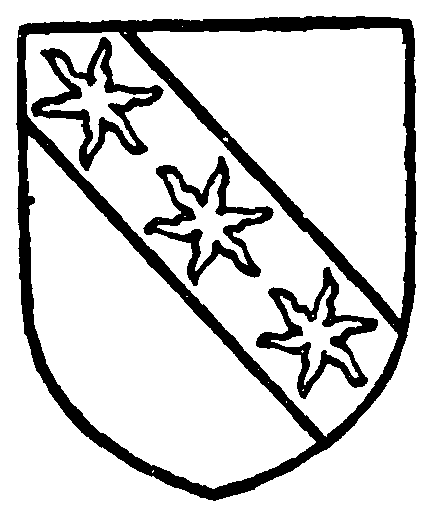
Daston. Gules a bend or with three stars sable thereon.
The farm of the rest of the manor, including fisheries, fowling, warren and woods, was held by Ralph Sheldon under a lease from the abbot dated 5 September 1538 for a term of eighty years. (fn. 60) In 1558, however, William Babington acquired from Queen Mary the fee simple of the whole manor at a twenty years' purchase. (fn. 61) Sir William Babington, grandson of the purchaser of the manor, (fn. 62) sold it in 1576 to Ralph Sheldon, the former owner of a lease of part of the property, and to William Childe of Pensax, (fn. 63) who was the husband of Sir William's daughter Elizabeth. (fn. 64) William Childe appears to have held the manor jointly for his life with Ralph Sheldon, (fn. 65) and in 1595 he united with him in a settlement of the property on Sheldon's nephew William, (fn. 66) but after this date there is no further mention of him or his heirs in connexion with Broadway.
Ralph Sheldon survived his only son Thomas, who died in 1593, leaving two daughters. (fn. 67) In 1576 Ralph Sheldon and William Childe granted a capital messuage and land at Broadway to Anthony, Ralph's brother. (fn. 68) Anthony died in 1584, when his son William succeeded to his estate. (fn. 69) In 1595, two years after his son Thomas's death, Ralph Sheldon settled the whole manor on this William. (fn. 70) During his possession of the estate Ralph sold various messuages and lands. (fn. 71) Most of these conveyances occurred in 1577, when he sold a house and land to Nicholas Blaby, the husband of his sister Jane. (fn. 72) Nicholas was succeeded in 1593 by his grandson Ralph son of John Blaby. (fn. 73) William Sheldon held the manor and a capital messuage in the Westend of Broadway until his death in 1626, when his son, another William, inherited. (fn. 74) In 1678 the manor was still held by the Sheldons, William Sheldon then conveying it to John Barcroft, (fn. 75) in trust, to be sold for the benefit of his children after his death, which occurred in 1680. (fn. 76)
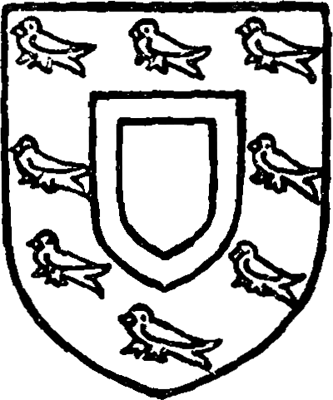
Winnington, baronet. Argent a voided scutcheon in an orle of martlets sable.
It had probably passed before the end of the century to Sir Francis Winnington, who dealt with land at Broadway in 1699 (fn. 77) and whose son Francis held the manor in 1727. (fn. 78) It has since followed the descent of Stanford on Teme (fn. 79) (q.v.), Sir Francis Salwey Winnington, bart., being the present owner.
There were two mills in the manor of Broadway in 1291. (fn. 80) In 1528 the mill called Broadway Mill was rented by William Hannow, (fn. 81) and a fulling-mill is mentioned in 1454. (fn. 82) In 1575 there were two water-mills belonging to the manor, (fn. 83) and these belonged in 1640 and 1687 to the Savages, owners of the Middle Hill estate. (fn. 84) A silk-mill was established by Mr. Mann in 1810, but was closed about 1864. The disused buildings still stand near West End Farm.
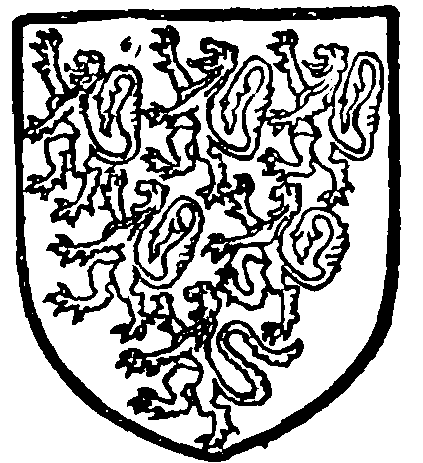
Savage. Argent six lions sable.
BROADWAY FARM and MIDDLE HILL. In 1573–4 William Babington sold a messuage, probably Broadway Court, with a dove-house, two gardens and 2,960 acres of land in Broadway called by Habington 'Bradeway's greate farme,' (fn. 85) to Anne, the widow of Anthony Daston. (fn. 86) Anne, who was the daughter of William Sheldon, had formerly married Francis Savage, by whom she had several children, (fn. 87) and she settled her Broadway property, which included Middle Hill and Spring Hill, (fn. 88) on two of her younger sons by her first husband, Walter and Anthony Savage. (fn. 89) Anthony died in 1587, before his mother, who lived until 1619, and his son John conveyed his right to Walter, (fn. 90) who inhabited Broadway Court. (fn. 91) Walter died in 1622, (fn. 92) his son Richard having predeceased him in 1614. (fn. 93) The next heir, Richard's son Walter, obtained livery of the estate in 1631. (fn. 94) He had in 1627–8 made a conveyance of tithes to Lord Coventry, (fn. 95) lord keeper of the Great Seal, and it is believed that Spring Hill was sold about this time to Lord Coventry. (fn. 96) In the middle of the 19th century the mansion at Spring Hill belonged to the Lygons, (fn. 97) and was the residence of General the Hon. Edward Pyndar Lygon at his death in 1860. It was sold and became the property of the late Major Vicesimus Knox. (fn. 98)
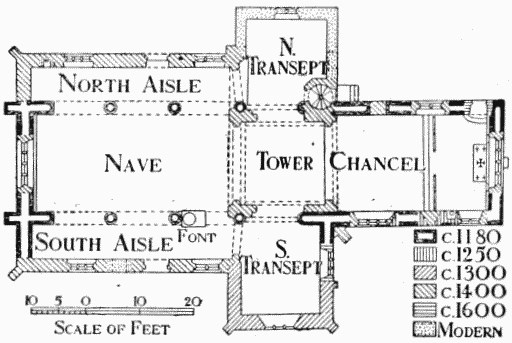
Plan of Broadway Church
The Middle Hill estate including Broadway Court was amongst the lands held by Richard Savage's son Walter at his death in 1640, (fn. 99) and probably remained in his family until the death without issue of his greatgrandson Walter in 1718, (fn. 100) though there is no further record of it until 1724, when lands at Middle Hill were acquired by William Taylor, recorder of Evesham, who built the first mansion there. (fn. 101) At his death in 1741 he left the property to his friend Robert Surman, who was succeeded by his daughter Thomazine, the wife of the Hon. John Boscawen. Her son, W. A. Boscawen, sold the estate about 1772 to Mr. Jukes of New Combe, Saintbury (co. Glouc.), from whom it was purchased in 1777 by George Savage, a descendant of Walter Savage. The house at Middle Hill was enlarged and altered by Mr. Savage, who pulled down Broadway Court for the purpose, (fn. 102) and he lived there until his death in 1793. His four sisters were his co-heirs, and shortly after they sold Middle Hill to Thomas Phillipps of Manchester. Mr. Phillipps died 1 November 1818, leaving his lands to his son Thomas Phillipps, (fn. 103) the well-known collector of MSS., who on 27 July 1821 was created a baronet. Sir Thomas Phillipps's collection was a famous one, containing MSS. of all languages, French romances, a Greek manuscript of Dioscorides, and the Welsh MSS. of Aneurin's Godadin, besides a great quantity of charters and chronicles. His eldest daughter Henrietta, on whom the estate was entailed, married James Orchard Halliwell, the Shakespearian scholar, without her father's consent. Sir Thomas Phillipps never forgave his daughter nor saw her again, and he bequeathed all the unentailed property to some people of the name of Phillipps of whom he heard by chance, and to whom he refers as 'my distant cousins.' On the death of Sir Thomas Phillipps in 1872 Henrietta succeeded to the estate, and her husband, owing to her mental infirmity, the result of an accident, took over the management of his wife's Worcestershire property and assumed by Letters Patent the surname of Phillipps. (fn. 104) In 1876 Mr. Edgar Flower purchased the estate from Mr. Halliwell Phillipps, his widow, Mrs. Edgar Flower, holding it at the present day.
CHURCHES
The church of ST. EADBURGA consists of a chancel 27ft. 5 in. by 17 ft. 9 in., central tower 15 ft. 8 in. by 15 ft. 3 in., north transept 14 ft. 10 in. by 16 ft. 10 in., south transept 14 ft. 7 in. by 18 ft., nave 35 ft. 5 in. by 18 ft., north aisle 37 ft. by 6 ft. 2 in. and south aisle 37 ft. by 6 ft. 4 in. These measurements are all internal.
The church dates from the latter part of the 12th century and consisted then of the present chancel and nave (the east bay of which is now occupied by the central tower) and north and south aisles; but of the aisles the only original part is the west wall of the south aisle, the other external walls having been rebuilt at subsequent periods, partly on the old foundations, and partly extended to form transepts. During the 13th century some windows, since blocked, were inserted in the chancel, while the south transept was added about 1300; probably the north transept, since rebuilt, dated from the same period. About 1400 the central tower was built within the eastern bay of the nave, and the aisle walls were rebuilt with the exception already mentioned; windows were at the same time inserted in the chancel and nave, the west gable of which was also rebuilt. The church was extensively repaired in 1866, when the galleries which had been erected in the nave were taken down and the north transept was rebuilt. The walls are of red sandstone ashlar and rubble, plastered internally, and the roofs are covered with stone slates.
The chancel is covered by a low-pitched plastered ceiling and is lighted from the east by a window of four cinquefoiled lights with perpendicular tracery under a two-centred head. At the north-east is a threecentred doorway of about 1600, and near the west end of the same wall is a blocked round-headed doorway, probably of the 12th century, while between them is a window of two cinquefoiled lights with tracery under a square head. On the south are two square-headed windows with tracery; the eastern is of two trefoiled lights, and the other, which is more elaborately treated, is of three cinquefoiled lights. All these chancel windows are of about 1400. The external jambs of the larger of the south windows have been cut away, probably for casement frames. Between the south windows are the remains of two 13th-century single lights with trefoiled heads, one of which is blocked, and of the other only the east jamb remains, the rest having been taken away for the three-light window. At the south-east is a large piscina with a trefoiled head of about 1250. In the centre of the cast wall is a pilaster buttress, probably of the 12th century, now weathered off below the east window.
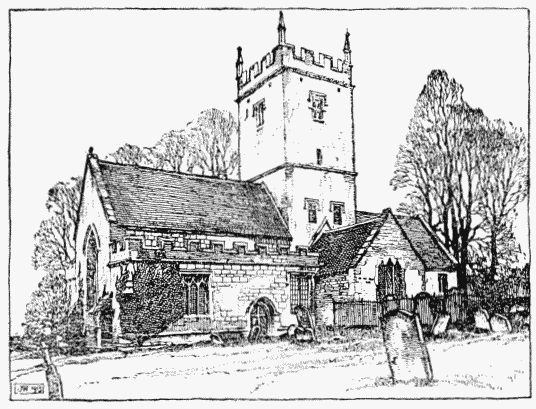
Broadway Church from the South-west
The lower stage of the central tower, now occupied as the western extension of the quire, has acutely pointed arches of two chamfered orders, those on the north and south being narrower and having their inner orders corbelled off at the springing line. These latter arches replace those of the original east bay of the nave arcades, the responds of which remain, crowned by 15th-century capitals. The west piers of the tower are built against the eastern columns of the arcades; abutment is provided on the ground stage on the east by a diagonal buttress and the stair turret, which terminates below the bellchamber, and on the west by flying buttresses which span the openings between the transepts and aisles. Above are two stages divided externally by a string-course, the ringing chamber lighted by squareheaded trefoiled lights on the north and south, while the bell-chamber has on each side a window of two trefoiled lights under a square head. The walls are crowned by an embattled parapet with a small square pinnacle at each corner. The stairturret at the north-east is entered through an original doorway in the north transept and a modern external doorway. Immediately west of the eastern tower arch, on either side, is a plain chamfered corbel course, which evidently supported a former rood-loft entered by a doorway from the turret staircase, now blocked.
The north transept has a modern pointed window in the north wall of two trefoiled lights, while built into the wall above it externally is a mediaeval headstop. The south transept remains substantially in its original state, but that the open roof is principally of modern timbers, and in the east wall is a three-light window under a square head, an insertion of the late 16th or early 17th century. In the south wall is a large original window of about 1300, of three trefoiled ogee-headed lights, the lower portions of which have been blocked for a height of about 2 ft. The diagonal buttresses at the southern angles of the wall are original.
The 12th-century nave arcades now consist of three bays only; the arches are slightly pointed and of two orders, recessed only on the nave faces. All the columns, with their capitals and bases, are circular and stood originally on square plinths, but except in the case of the responds the plinths were rounded off in 1866. The capitals on the north are alternately scalloped and moulded, while those on the south are all scalloped. The lower part of the west wall is original, and is supported by two original low buttresses; it has a moulded plinth carried round the buttresses and along the west wall of the south aisle. The wall was rebuilt above the window sill about 1400, leaving a 6-in. offset on the inside, and the west window, of four trefoiled lights with perpendicular tracery under a two-centred head, is of this latter period. The wall is considerably cracked externally and greatly needs repair.
The north and south aisles are very similar and each has two windows with a doorway between. The north and south doorways are of the early 15th century and have two-centred heads with continuously moulded jambs. All the windows are of the early 15th century, and were originally of three cinquefoiled lights with tracery under a square head, but the east window of the north aisle has modern tracery and the corresponding window of the south aisle has now only a central mullion dividing the window into two squareheaded lights. In the north wall of the north aisle is a fireplace, probably of the latter part of the 18th century, and to the west of the south doorway is a blocked opening which led to the nave galleries. Both aisles have embattled parapets and diagonal buttresses on the west. The nave has an open-timber trussed rafter roof of about 1400, with hollow moulded wall-plates enriched by flower ornament, and still retains traces of original paint. The lean-to roofs of the aisles are modern.
The carved oak altar and the altar rails are of the 17th century. The font has a plain circular bowl shaped like an inverted truncated cone, dating probably from the 12th century. It stands on a base with modern supports and its upper edge is somewhat broken away in places. Near it is a 15th-century oak pulpit of octagonal form, 2 ft. across inside and standing on a modern base with some 15th-century tracery used in the front. The sill and rail are each cut from a single block and are joined by the uprights, which inclose traceried panels. On the rail is painted an inscription, probably of the 17th century, 'Proverb 29 where the word of God is not preached the people perish. 'This pulpit was brought from the chapel which stood on the site of the modern church, and was probably replaced here in the 17th century by the carved oak pulpit of that period which now stands in the north transept with its canopy lying on the top. Between the north aisle and transept is a 17th-century oak screen, considerably damaged and refitted in its present position with an old bench rail on the top. In the lower panels are groups of three small holes triangularly disposed. Under the tower are quire stalls constructed of 15th-century benches with traceried fronts, while the tracery from other benches is re-used in the screenwork on either side and some of the rails in the stalls on the north of the chancel. There is a dado of 17th-century oak panelling on the east wall of the chancel, and some 18th-century oak panelling on the north and south walls.
There are traces of wall painting on the south wall of the south transept and on the upper part of the east wall of the chancel. The central part of the north door is old, but the tracery in front and the mounting behind are modern. In the north transept is an old oak bier, probably of the 18th century. At the north-east of the nave is a moulded oak almsbox shaped like a circular newel, dating probably from the late 17th or early 18th century.
Some early 15th-century glass remains in the heads of the east and north windows of the chancel, and in the westernmost of the two south windows, as well as in the heads of the west window of the nave and of the westernmost windows in both aisles. The head of the east window is filled with old quarries and lower down in the south light is a shield of the Salters' Company. There are also several fragments of heraldic glass in the west window of the nave, which in 1779 is said to have contained the arms of Sheldon, Brace, Sambach, Pynk, Treton, Savage, Wheeler and others.
On the north wall of the chancel is a hatchment bearing the arms Azure powdered with fleurs de lis or a lion argent, with the motto 'Resurgam,' and over the western tower arch is a panel with the arms of Charles I dated 1641. In a recess on the north side of the altar is a palimpsest brass figure of Anthony Daston, who died in 1572, with a shield above of Daston quartering Dumbleton, a fesse wavy between six billets, and a long inscription below. The reverse side is embellished with heraldic and foliated ornament. In a recess on the south side is a brass inscription to Cecilia Newport, who died in 1766, wife of John Newport of Hanley Court, whose first husband was Walter Savage of Broadway Court. On the chancel floor is a brass inscription to John Treavis, who died 27 May 1641. On the south wall of the chancel is a stone monument to Walter Savage, who died in 1640; the inscription, which is now rather indistinct, is flanked by Corinthian columns supporting an entablature and moulded cornice, and above is, shield of Savage impaling Wheeler. There is also a mural tablet to Mary Phillipps, wife of William Phillipps of Broadway, who died in 1794. On the east wall of the south transept is an elaborate marble monument to William Taylor of Middle Hill, second son of Francis Taylor of South Littleton, who died 17 April 1741; on the pediment is his shield: Sable a lion passant argent. A small stone of the late 16th century, found in the churchyard and built into the west wall of this transept, bears the inscription 'as thou art so was I, as I am so shalt thou be.' In the floors of the chancel and south transept are several slabs which have been relaid; some of them have incised Calvary crosses. A slab in the chancel is dated 1585 and another has a Latin inscription to Mary wife of John Vicaridg, who died 23 July 1611.
The tower contains a ring of six bells: the treble and fifth are by Matthew Bagley, 1778; the second is by Thomas Mears, 1812; the third is by Henry Farmer of Gloucester, 1603 and bears the initials 'W.M.A. B.H.'; the fourth is also by Henry Farmer, 1609; the tenor was recast by John Rudhall at Gloucester in 1828.
The communion plate consists of a cup and cover paten and almsdish, all of 1729, the cup inscribed 'Broadway in Worcester Shire 1731,' with the Passion nails and sacred monogram; the almsdish also bears the nails and sacred monogram.
The registers previous to 1812 are as follows: (i) baptisms 1541 to 1704, marriages 1539 to 1703, burials 1539 to 1704; (ii) baptisms and burials 1703 to 1812, marriages 1703 to 1753; (iii) marriages 1754 to 1771; (iv) marriages 1773 to 1812.
The church of ST. MICHAEL AND ALL ANGELS, erected in 1839–40, is a building of considerable size designed in the late 13th-century style and built of sandstone with slate roofs. It consists of chancel with north and south vestries, nave, north and south aisles and west tower. There are galleries round the aisles and at the west end of the nave. There is a repaired oak chair of the 17th century in the chancel, and in the clergy vestry is an oak chest inscribed 'C. W.L. M.R. W. 1674.' In the tower is a small bell inscribed 'Pro Rege et Populo 1608.'
ADVOWSON
There was a priest at Broadway in 1086, (fn. 105) and the advowson belonged to the Abbot and convent of Pershore from the earliest times of which records are obtainable. (fn. 106) Licence to appropriate the church of Broadway was granted in 1384 to the abbot, (fn. 107) and, though the patent was afterwards cancelled, the appropriation seems to have taken place, being confirmed by the pope in 1395. (fn. 108) The ordination of the vicarage was confirmed in 1390 by the Bishop of Worcester. (fn. 109) The advowson and rectory remained in the possession of the Abbots of Pershore until the Dissolution. (fn. 110)
In 1558 Philip and Mary granted the advowson of Broadway with many others in the diocese to the Bishop of Worcester, (fn. 111) but in the same year, when the manor was bought by William Babington, the right of presentation was included with it. (fn. 112) In 1575 Sir William Babington sold it with the manor to Ralph Sheldon, (fn. 113) and he, twenty years later, conveyed it to Walter Savage, (fn. 114) with whose descendants (fn. 115) it remained until the death of George Savage in 1793. (fn. 116) John Mills and Margaret his wife, one of the sisters and co-heirs of George Savage, (fn. 117) dealt with the advowson in 1793, (fn. 118) and in 1827 Thomas Bennett Round and Samuel Morris and his wife Ann conveyed it to George Agg. (fn. 119). In 1829, however, the right of presentation belonged to Miss Elizabeth Mills (fn. 120) and in 1836 to a Mr. Bird. (fn. 121) Since about 1842 the advowson has been in the hands of the Peache trustees.
At the dissolution of the abbey of Pershore the rectory of Broadway passed to the Crown. In 1583 certain of the tithes were granted in fee farm to Theophilus and Robert Adams, (fn. 122) and in 1589–90 Walter Savage received a grant of all tithes of sheaves and corn in the manor. (fn. 123) Other tithes at Broadway were granted in 1598–9 to Henry Best. (fn. 124) Certain tithes seem also to have belonged to the Sheldons. (fn. 125) The Savages retained their part of the tithes until 1627, when Walter Savage sold them to Sir Thomas Coventry. (fn. 126) These tithes remained in the possession of Sir Thomas's family until 1771, when under the Inclosure Act land was assigned in lieu of them. (fn. 127)
Licence was granted in 1339 to Henry de Broadway to have a chaplain to celebrate in the oratory of his house at Broadway. (fn. 128)
CHARITIES
Educational Charities.—Hodges' School, founded in 1686 by will of Thomas Hodges, is regulated by a scheme of the Board of Education, 21 January 1908. The trust property consists of a house and a farm of about 75 a., producing £70 a year, and £ 986 19s 1d consols, producing £ 24 13s. 4d. in annual dividends. The net income is applicable in exhibitions and in providing facilities for day or evening instruction in agriculture, horticulture and rural economy.
In 1855 Miss Elizabeth Wylie, by her will proved in the P.C.C., bequeathed £400 towards the salary of the schoolmaster of National or Sunday schools. In 1857 £ 259 13s., part of the principal, was expended in school buildings and the balance invested in £142 2s. 7d. consols, the annual dividends of which, amounting to £3 11s., are applied for the benefit of the Church of England school.
Ecclesiastical Charities.— The parish has been in possession from time immemorial of a messuage known as the Church House, (fn. 129) now let at £16 a year. By an order of the Charity Commissioners, 1896, a moiety of the income was made applicable for the repair of the church and the other moiety for the poor.
Richard Hodges, as appeared from a deed poll 27 August 1674, gave a piece of land for the reparation of the parish church. The land, however, apparently cannot now be identified.
Eleemosynary Charities.—It appeared also from the deed poll above referred to that certain lands were given for the poor by Anthony Dickens and William Combe. The lands in question were sold in 1866 and the proceeds expended on certain works connected with the covering in of a stream.
The parish was for many years in possession of a house supposed to have been given in 1729 by William Daves for apprenticing. The house was pulled down in 1869 and an extra schoolroom built upon the site. The official trustees hold a sum of £56 10s. 1d. consols, representing accumulations of income, producing £1 8s. yearly.
In 1814 John Knowles, by a codicil to his will, bequeathed £200 for the benefit of old and infirm poor of Broadway and Burford (Salop). Owing to insufficiency of assets a sum of £50 only was received. This was invested in £55 consols, producing £1 7s. 4d. yearly.
In 1841 Thomas Fewson Eagles, by his will, bequeathed £200 consols, the annual dividends, amounting to £5, to be applied in the upkeep of the tomb of the testator's daughter and the surplus given to the poor.
In 1864 Miss Rebecca Coombe, by deed, gave £100 consols, the dividends of £2 10s. to be distributed among sick, aged and deserving poor members of the Established Church.
In 1878 Miss Ann Bedford, by her will proved at Worcester 24 January, bequeathed a sum of money, now represented by £313 16s. 5d. consols, the annual dividends, amounting to £7 16s. 8d. (subject to the upkeep of the Russell family vault at Broadway and the monument in the new church), to be applied in the distribution of articles in kind.
The Lady Hilda McNiell memorial charity, founded in 1905 by deed of trust, is endowed with £215 10s. 7d. India 3 per cent. stock, raised by public subscription for the purpose of placing on record the bravery and devotion of Lady Hilda McNiell, who lost her life whilst endeavouring to save a boy from drowning. The annual dividends, amounting to £6 9s. 4d., are applied in the distribution of coals.
The several sums of stock are held by the official trustees.