
A History of the County of Worcester: Volume 4. Originally published by Victoria County History, London, 1924.
This free content was digitised by double rekeying. All rights reserved.
'Parishes: Broughton Hackett', in A History of the County of Worcester: Volume 4, (London, 1924) pp. 43-45. British History Online https://www.british-history.ac.uk/vch/worcs/vol4/pp43-45 [accessed 12 April 2024]
In this section
BROUGHTON HACKETT
Broctune (x and xi cent.); Broctone Inardi, Brocheton (xii cent.); Brocton Haket (xiii cent.); Brouton or Broghton Haket (xiv cent.); Haggetts Broughton (xvi cent.).
This small parish, not 3 miles in circumference, lies on the road from Worcester to Alcester. The village includes several timber-framed cottages, some black and white and others with brick filling; attached to Manor House Farm is a square timber-framed pigeonhouse of the 17th century. The houses are scattered along heavily-wooded lanes to the north of the main road.
The parish lies in the valleys of the Bow Brook, which bounds it on the east, and of one of its tributaries, which forms the northern boundary. The highest ground is near the church, but even there does not reach 200 ft. The parish has an area of 386 acres, of which the greater part is pasture land. The soil is rich and lies on a subsoil of Lower Lias. A valuable bluish limestone is found here. An Inclosure Act was passed in 1807, (fn. 1) the award being dated 17 September 1808. (fn. 2)
Ancient place-names include Foxoll's Gate, the Hyde, (fn. 3) Harnell and Sperte (fn. 4) (xvi cent.).
MANOR
Three manses in BROUGHTON were among the property restored to the abbey of Pershore by the doubtful charter of King Edgar in 972, (fn. 5) but by the date of the Domesday Survey Broughton was again lost to the abbey, having been granted by Edward the Confessor with Pershore to Westminster Abbey. In 1086 3 hides at Broughton formed part of the abbey's great manor of Pershore, (fn. 6) and the abbot retained the overlordship until the 15th century, (fn. 7) the owners of Broughton Hackett owing suit at the abbot's court at Binholme.
Urse was tenant under the abbey in 1086, the estate having been previously held by Bricsmar. Urse's interest passed with the rest of his estates to the Beauchamps and followed the descent of Elmley Castle (fn. 8) until the 15th century. (fn. 9) In the 16th century Broughton Hackett attended the view of frankpledge (fn. 10) at Naunton Beauchamp. In 1570 it was not known of whom the manor was held. (fn. 11)
Aiulf was holding Broughton of Urse in 1086, (fn. 12) and in the 12th-century survey of Pershore Hundred the Beauchamps' under-tenant was probably Isnard or Inard of Hampton Lovett, the place being then called Broughton Inardi. (fn. 13) Apparently Isnard did not hold the whole of Broughton, and the descent of his estate will be found below.
An entry in the Pipe Roll of 1196 that Maud, Margaret, Eufemia, Juliana, Eddusa, Agnes and Alice, sisters of Ranulf Armiger, received seisin of half a hide of land at 'Brocton' (fn. 14) may refer to an estate at Broughton Hackett. It is, however, not very probable, as in 1194 Walter Hacket and John de Brauton and Richard son of Guy had a suit as to half a knight's fee in Broughton. (fn. 15) In 1240–1 Walter Hacket granted half a knight's fee in Broughton to Robert de Pendock. (fn. 16) In 1274—5 John de Northwick mortgaged his lands in Broughton Hackett and the advowson of the church to Eustace de la Hache and Thomas de Naunton, (fn. 17) and the latter presented to the church in 1274. (fn. 18) Eustace de la Hache seems to have had some estate in the manor in 1276, as he then paid 7s. to the Subsidy Roll. (fn. 19) By 1292 the manor had apparently passed into the hands of Sir Philip Burnell, who then presented to the church. (fn. 20) It had probably been acquired by him from the Beauchamps, for Walter Beauchamp was returned in 1297–8 as a former holder of the manor, (fn. 21) and in 1315 Maud Beauchamp, possibly the widow of a former Beauchamp owner, was holding the manor. (fn. 22) This estate then became annexed to the Burnells' manor of Upton Snodsbury, (fn. 23) which had also been formerly held by the Beauchamps. It was sold by Sir Hugh Burnell in 1417 to Joan Lady Bergavenny, (fn. 24) and was probably, like Upton Snodsbury (q.v.), claimed by her heirs, the Earls of Ormond, but finally reverted to the Lovels, (fn. 25) the heirs of Sir Hugh Burnell, and followed the descent of Upton Snodsbury until 1528, when it is mentioned for the last time in deeds. (fn. 26) From Habington's account, however, it evidently still continued to pass with Upton, which was granted in 1590 to William Walshe, (fn. 27) and sold by his nephew William to Lord Coventry in 1632. (fn. 28) Nash wrote that in his day the manor was in dispute between Lord Coventry and Sir John Pakington. (fn. 29) The Earl of Coventry is still a landowner at Broughton Hackett.
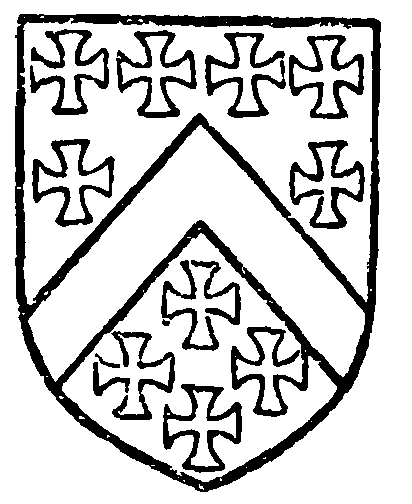
Berkeley of Spetchley. Gules a cheveron between ten crosses formy argent.
The estate at Broughton held by Isnard Parler of William Beauchamp in the 12th century evidently became annexed to Isnard's manor of Hampton Lovett (fn. 30) (q.v.), following the descent of that manor to the Lovetts, (fn. 31) and reverting, on the failure of that line, to the Cornwalls, (fn. 32) heirs of Brian de Brompton, to whom Isnard Parler had bequeathed the estate. It was sold in 1544 with Hampton Lovett by George Cornwall to John Pakington as land at Haggett's Broughton. (fn. 33) In 1571 the estate is called the manor of Haggett's Broughton, (fn. 34) and it evidently followed the descent of Hampton Lovett until 1808–9, when Sir John Pakington sold it to Samuel Brampton. (fn. 35) On 18 January 1816 the manor was advertised for sale as the property of Samuel Brampton, a bankrupt. (fn. 36) In 1828 the Broughton Hackett estate was purchased of Joseph Ellis Viner by Robert Berkeley, (fn. 37) whose grandson Robert Valentine Berkeley of Spetchley Park is now lord of the manor of Broughton Hackett.
CHURCH
The church of ST. LEONARD is a small building consisting of chancel and nave without structural division, measuring internally 45 ft. 9 in. by 17 ft. 3 in., and a south porch.
There is little indication of the date of the building, but the nave is probably of the 14th century, while the chancel is perhaps of the 15th, there being a break in the building of the north wall. The south wall and porch are modern.
The chancel has a modern three-light east window of 15th-century character and only the lower part of the wall itself is ancient. The roof has a flat plaster ceiling. The nave has a modern square-headed twolight window in both the north and south walls and a modern south door. The blocked north door is narrow and has an oak lintel, and the west window is of the 14th century, with two trefoiled lights and a quatrefoil over. The roof is four-centred and ceiled in plaster, with two modern beams at the west end supporting a square weather-boarded bell-turret with a pyramidal roof containing two bells probably cast at Warwick about 1350, inscribed respectively 'Ave Maria gracia' and 'Ihesus Nazarenvs Rex Ivdeorum.' Below the west window is a blocked opening. The octagonal font is modern, but the communion table with twisted legs dates from the late 17th century. There are also an old parish chest with five padlocks and staples, and a table of benefactions dated 1725. In the sacrarium are slabs to Thomas Moule, M.A., rector, 1647, and Mabel Moule, to Abigail Sanders, 1683, and to Susanna Sanders, 1674.
The plate consists of a small Elizabethan cup and cover paten of 1571, with maker's mark 'HW.' There are also an almsdish and a pewter flagon.
There is only one early book of registers, containing all entries 1761 to 1812.
ADVOWSON
The first reference to the church occurs in 1274, when the advowson was mortgaged with the manor by John de Northwick to Eustace de la Hache and Thomas de Naunton, (fn. 38) the presentation being made in the same year by Thomas. (fn. 39) The advowson was evidently held with that manor of Broughton Hackett which belonged to the Burnells, and followed the same descent, the presentations in the 15th century being made by the executors, and later by the heirs, of Joan Lady Bergavenny, and afterwards by the owners of the Lovels' interest in the manor, (fn. 40) reflecting the confusion which clearly existed as to the ownership of the two manors of Upton Snodsbury and Broughton Hackett. The advowson was still held with the manor in 1547, when Sir Anthony Kingston presented, (fn. 41) but George Winter presented in 1576 by grant of Dorothy wife of Sir John Bourne. (fn. 42) In 1590 the advowson was in the hands of the sovereign, (fn. 43) and has ever since so remained. (fn. 44)
CHARITIES
In 1613, as appeared from the church table, Thomas Gould and John Cross, then churchwardens, by deed conveyed a tenement, known by the name of the Church House, and certain lands to the use of the parish for the repairing of the church and bridges and the highways, and also for the relief of the poor. The trust estate now consists of about 2¼ acres of land let in allotments, two cottages and a tenement, the whole producing about £11 a year. The net income is applied in repairs of the church.
The other charities recorded on the same tablenamely, the charities of William Yardley, will 1715, and of Thomas Cross, for the poor, and the charity of the Rev. William Hurt, a former rector, for a schoolmaster in Crowle—have been lost through the insolvency of the holders of the principal sums.