A History of the County of Worcester: Volume 4. Originally published by Victoria County History, London, 1924.
This free content was digitised by double rekeying. All rights reserved.
'Parishes: Great Comberton', in A History of the County of Worcester: Volume 4, ed. William Page, J W Willis-Bund (London, 1924), British History Online https://www.british-history.ac.uk/vch/worcs/vol4/pp57-60 [accessed 1 May 2025].
'Parishes: Great Comberton', in A History of the County of Worcester: Volume 4. Edited by William Page, J W Willis-Bund (London, 1924), British History Online, accessed May 1, 2025, https://www.british-history.ac.uk/vch/worcs/vol4/pp57-60.
"Parishes: Great Comberton". A History of the County of Worcester: Volume 4. Ed. William Page, J W Willis-Bund (London, 1924), British History Online. Web. 1 May 2025. https://www.british-history.ac.uk/vch/worcs/vol4/pp57-60.
In this section
GREAT COMBERTON
Cumbrincgtune (x cent.); Cumbrintune (xi cent.); Cumbrittone, Magna Cumbrintone, Major Cumberton (xiii cent.).
Great Comberton is a small parish two and a half miles south of Pershore. It lies partly on the northern slope of Bredon Hill and partly at its foot, on the left bank of the Avon, which, with one of its tributaries, forms the greater part of the western boundary, the southern being identical with that of the county. The Mary Brook, another tributary of the Avon, forms its northern boundary, at the eastern end of which is Mary Brook Bridge. On its southern boundary the parish reaches a height of about 90c ft., the ground sloping steeply west and north to about 50 ft. above the ordnance datum.
The village lies near the bank of the River Avon, on which there is here a quay. It is small and well timbered and includes a considerable number of 'black and white' cottages. One of these near the modern rectory is of some size, with a thatched roof and a gabled wing at the west end; it is thought to have formerly been the rectory. St. Michael's Church is in the south of the village, with the rectory to the north-west. North of the rectory is the school, built in 1892, together with a schoolhouse, on a site given by the lord of the manor. About a quarter of a mile south of the quay are the Waterfall and Comberton Aits, which, with the towing-path bordered by trees, form a picturesque group.
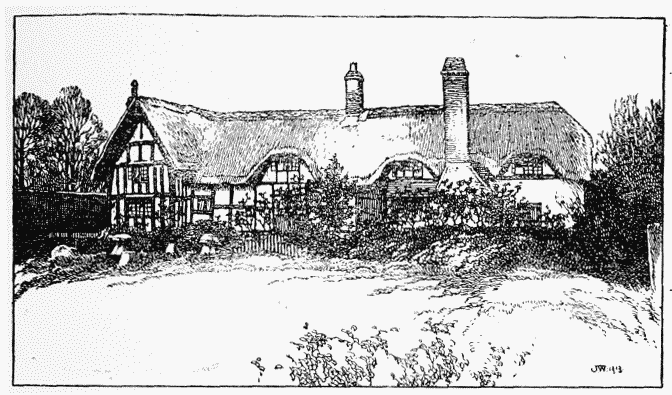
Cottage at Great Comberton, probably the former Rectory
The parish has an area of 965 acres, of which 308 acres are arable land, 593 acres permanent grass and 2 acres woods and plantations. (fn. 1) The soil is marl, the subsoil Lower Lias; the chief crops are wheat, barley, beans and market produce. In the extreme south of the parish is a quarry, doubtless that alluded to in the Account Rolls of the priory of Worcester of 1376–7 as supplying stone for the building of the dormitory. (fn. 2) Various fossils are embedded in it.
An Inclosure Act was passed in 1818, (fn. 3) and the award is dated 22 March 1820. (fn. 4)
MANORS
Ten manses at COMBERTON formed part of the original possessions of the abbey of Pershore, to which they are said to have been restored by King Edgar in 972. (fn. 5) Two estates at Comberton were, however, held by St. Peter of Westminster at the date of the Domesday Survey (fn. 6) as part of their great manor of Pershore, with which they had probably been granted by Edward the Confessor to the abbey. One of these estates was held under the abbey by Gilbert Fitz Turold. I: consisted of 9 hides which had formerly been held by Eadric, a free man, (fn. 7) and seems to have included both Little Comberton and part of Great Comberton. Part of this land may have passed to Robert le Despencer, (fn. 8) for Henry II confirmed to the abbey of Westminster land at Comberton which Robert le Despencer had given them. (fn. 9) The abbey was apparently still holding this estate in demesne in 1210–12. (fn. 10)
From this time until the 15th century there is nothing to prove that the Abbots of Westminster still continued to hold this estate; but as annuities were granted from the manor by the abbot in 1463 and 1465, (fn. 11) it was probably still held in demesne at that time. From about 1465 this manor seems to have been leased to the Earl of Warwick at a fee farm of £4 10s. 2½d., (fn. 12) and the rent was paid by the representatives of the earl until the accounts cease in the reign of Henry VII. At the Dissolution the abbey still held this rent, (fn. 13) which was granted in 1542 to the Dean and Chapter of Westminster. (fn. 14) Before 1556 the manor must have returned into the hands of the dean, for when the late possessions of the abbey were restored to the newly-founded abbey by Queen Mary, the manor of Comberton (fn. 15) was granted to it. (fn. 16) The manor was restored to the dean and chapter on the accession of Queen Elizabeth, (fn. 17) and remained in their possession until 1650, when it was sold by the Parliamentary Trustees to Sir Cheney Culpeper. (fn. 18) The dean and chapter recovered possession at the Restoration, and in 1690 the 'reputed manor of Comberton' formed part of the dean and chapter's manor of Binholme in Pershore. (fn. 19)
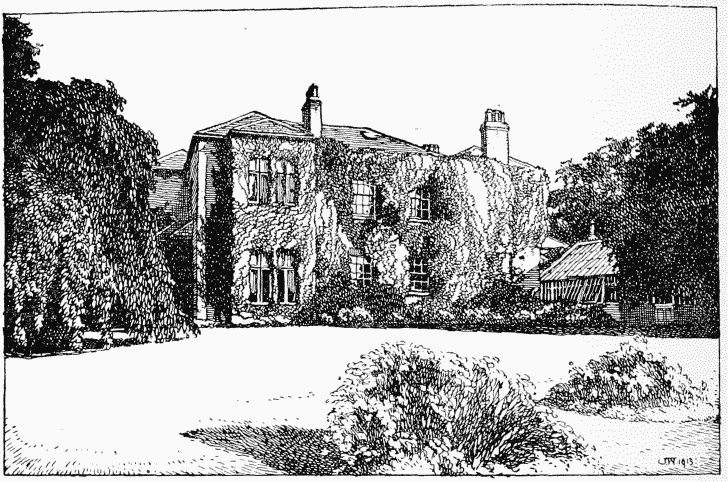
The Rectory, Great Comberton
In 1086 Urse held at Comberton an estate known from the end of the 16th century as WEST GREEN. It consisted of 2 hides held of the Abbot of Westminster's great manor of Pershore, and it had formerly been held by Azur. (fn. 20) Another estate which had belonged to Azur at Comberton, (fn. 21) consisting of a hide and a half, was in Urse's possession in 1086. It was held by Azur at the death of King Edward of the monks of Pershore, as of their manor of Pershore, at an annual rent of 20s., and was to revert to the church's demesne after the death of Azur and his wife. Azur's wife died and he became an outlaw before 1086. (fn. 22) The two estates were held separately by Urse's descendant, William Beauchamp, at the beginning of the 12th century, under the same overlords as Urse had held them. (fn. 23) After this time there is no further mention of the overlordship of Pershore Abbey, and the Beauchamps owed service for the manor to the Abbot of Westminster's manor of Binholme in Pershore in the 15th century. (fn. 24)
The Beauchamps' two estates appear to have been united under the name of the manor of Great Comberton, and about the middle of the 13th century William Beauchamp added to it by purchasing an estate at Great Comberton of William son of William Sevecourt. (fn. 25) William Beauchamp, his son William, and grandson Guy acquired land and rent in Comberton from many of their tenants during the latter half of the 13th century, (fn. 26) and the manor followed the descent of Elmley Castle (fn. 27) until the death of Richard Earl of Warwick in 1439. (fn. 28) At Richard's death it did not pass with the earldom to his son Henry, but to Elizabeth wife of George Lord Latimer, one of his daughters by his first wife. (fn. 29) It then followed the descent of Stoulton (fn. 30) until the death of John fourth Lord Latimer in 1577, when it fell to the share of his second daughter Dorothy (fn. 31) wife of Sir Thomas Cecil, afterwards Lord Burghley and Earl of Exeter, to whom it was confirmed in 1580 by Richard Nevill, cousin and heir male of John Lord Latimer. (fn. 32) From them it was in 1581 purchased by John Hanford, (fn. 33) who died at Wollashull in 1617 seised of this manor, (fn. 34) which has ever since been held by the Hanfords of Wollashull (q.v.), Major R. T. Hanford being now lord of the manor. (fn. 35)
Another manor in Great Comberton, later known as VAMPAGES, and held of the manor of West Green, may perhaps be identified with an estate at Great Comberton held in the 13th century by the Ledenes. Alfred Ledene was in possession of an estate in Comberton about 1195, (fn. 36) and Henry Ledene granted land in Great Comberton to Abbot Roger (1234–50) and the convent of Pershore. (fn. 37) Walter Ledene and Agnes his wife were holding land in Comberton in 1277. (fn. 38) Richard Ledene and Richard son of William Ledene contributed to the subsidy about 1280. (fn. 39) In 1300 Maud Beauchamp, Countess of Warwick, died seised of tenements in the manor, with which she was enfeoffed jointly with her late husband, Earl William, by Richard Ledene, who formerly held the tenements of the earl. (fn. 40) This may have been the estate called Wadyngs held in 1315 by Roger Golafre of Maud's son Guy Earl of Warwick, (fn. 41) though Ledenes still contributed to the subsidy in 1327. (fn. 42) The Golafres' estate at Great Comberton afterwards passed to William Wollashull, from whom it descended with Wollashull to the Vampages and their heirs the Hanfords of Wollashull (fn. 43) (q.v.). The Hanfords subsequently acquired the manor of West Green, as has been seen above, and the two manors descended together, Vampages retaining its separate identity until 1771 or later. (fn. 44)
A mill belonging to Comberton recorded in the Domesday Survey (fn. 45) is mentioned down to the 14th century. (fn. 46)
Two fisheries were held with the manor in 1298. (fn. 47) In 1579 Sir Thomas Cecil and Dorothy his wife conveyed to John Pope a free fishing in the Avon, with appurtenances in Great Comberton, Birlingham and Pensham. (fn. 48)
CHURCH
The church of ST. MICHAEL consists of a chancel 23 ft. 6 in. by 14 ft. 6 in., with vestry and organ chamber, nave 29 ft. 3 in. by 21 ft. 3 in. and west tower 11 ft. by 8 ft. 6 in. The total length is 65 ft. 6 in., all the measurements being internal.
Some of the rubble masonry of the nave may perhaps be of early date, but the church appears to have been almost entirely rebuilt in the 14th century, beginning at the east end. Apart from some small alterations in the 15th century, it remained untouched till modern times, when the vestry and organ chamber were added and the east wall and chancel arch rebuilt.
The east window is modern and of three lights, and in the north wall are two 14th-century windows, both of two lights, the first having a pointed and traceried head and the second a square head and ogee lights. Between them is a priest's door, apparently of the early 15th century, with a moulded external label and large stops carved with crowned heads. Both this and the second window now open into the modern vestry. In the south wall is a twolight 14th-century window, similar to the first on the north, and at the west end a modern arch opening into the organ chamber. The pointed chancel arch and roof are modern, and in the east wall to the south of the altar is a 14th-century piscina with a trefoil ogee head, bowl and shelf.
The nave is lighted by two 14th-century windows in each wall; the eastern pair are of three trefoiled lights under a pointed head filled with trefoils. The western pair are similar, but of two lights only; the mullions and tracery are all restored, but the openings are original. (fn. 49) The tower arch is of rough construction, and is apparently in an unfinished state; it is the full height of the nave roof and is pointed, with broad roughly chamfered jambs. These are finished on the inside of the tower by chamfered imposts, from which spring arches supporting the side walls. They open into deep recesses formed by continuing the side walls of the nave to the west face of the tower. The northern has an irregular-shaped roof, plastered on the soffit, and in the south wall of the southern is a pointed window of two plain lights. The west window is pointed and of two lights with a quatrefoil in the head, and below it is an early 15th-century pointed west doorway with an external label and head stops of a man and woman. Within it is a small lobby with stone walls and an inner pointed doorway with chamfered jambs having voluted stop-chamfers.
The tower is three stages high and finished with an embattled parapet having crocketed pinnacles at the angles and large grotesque gargoyles at the angles of the parapet string. The ground stage is supported by two western buttresses stopping at the level of the second stage, which is lit by loops to the north and south. The bell-chamber has a two-light squareheaded window in each face with trefoiled ogee-headed lights of late 14th-century date. On the south face is a small sundial. There are six bells, the first, second, fourth and fifth by Matthew Bagley, 1687 (probably cast at Evesham); the third and sixth by Taylor of Loughborough, 1869 (the tenor being then added as a new bell). The nave roof is a good example of 14th-century work; it is of wagon form, all the rafters being trussed and having moulded plates, purlins and ridge-piece.
The early 15th-century font, under the tower, has an octagonal bowl, each face having a quatrefoil panel and a blank shield, a moulded necking and base. The communion table is Jacobean with turned legs, and there are two chairs of similar date, one with a carved head at the back being particularly good. The quire-stalls are largely made up of Jacobean panelling, and the benches in the nave are probably of the 16th century; they are quite plain, but unusually massive, even the book boards being some 2 in. thick.
The plate is modern, and consists of a cup, paten and flagon and a stand paten.
The registers before 1812 are as follows: (i) all entries 1540 to 1704; (ii) all entries 1721 to 1812, marriages to 1755 only; (iii) marriages 1755 to 1812.
ADVOWSON
The first mention of the church occurs in 1268, when Ankaret Beauchamp held it. (fn. 50) She appears to have been holding the Beauchamps' manor also at that time, and the advowson continued to be held with this manor until the end of the 17th century, (fn. 51) after which date they were held separately. The last owner of the manor who made a presentation was Compton Hanford in 1684. (fn. 52) In 1721 a presentation was made by Sir Thomas Foley, in 1766 by Stephen Lightfoot, in 1799 by Charles Sandby, clerk, and in 1808 by Anne Middleton, widow. (fn. 53) The advowson remained with the Middletons until about 1829. It had passed before 1836 to the Rev. Charles Hubert Parker, who had become rector in 1826 and was patron until his death in 1883. The advowson then passed to the Jobling family, and is now held by Mrs. Jobling. (fn. 54)
At the suppression of the chantries there was a rent of 8d. from an acre of land for the finding of one lamp. (fn. 55)
In the 13th century the bodies of all those who died in Great Comberton holding land were buried at Pershore; those who held no land were buried in the churchyard of Little Comberton. (fn. 56)
CHARITIES
Alderman Gibbs's charity consists of an annuity of 30s. paid out of an estate in the parish in respect of a gift of £20 by the said alderman of London, as mentioned in a deed, 1 January 1709. The distribution is made in bread on St. Thomas's Day.
In 1751 Joseph Wright, by his will, bequeathed his residuary personal estate to the poor. A piece of land called Guilding's Meadow, situated in the parish of Birlingham, containing by estimation 3 acres, was purchased therewith, and by deed, 22 July 1753, conveyed to trustees for the maintenance of the poor. The land is let at £5 a year, which is distributed in coal.
The church lands consist of a field containing 6 acres allotted on the inclosure in lieu of the original property; it is let at £4 a year.
The official trustees also hold a sum of £254 9s. consols, arising from the sale in 1880 of cottages in Church Street. The income is applied towards church expenses.
The official trustees also hold a sum of £207 14s. 8d. India 3 per cent. stock, representing a legacy by the will of Miss Martha Phipps, proved 3 September 1897. The annual dividends, amounting to £6 4s. 8d., are applicable towards the repair of the organ of the parish church.