
A History of the County of Worcester: Volume 4. Originally published by Victoria County History, London, 1924.
This free content was digitised by double rekeying. All rights reserved.
'Parishes: Longdon', in A History of the County of Worcester: Volume 4, (London, 1924) pp. 111-118. British History Online https://www.british-history.ac.uk/vch/worcs/vol4/pp111-118 [accessed 25 April 2024]
In this section
LONGDON
Longandune, Langandune (xi cent.); Longedun, Langedune (xii cent.); Langdon (xiii cent.).
Longdon has an area of 3,941 acres, of which about three-fourths is pasture. (fn. 1) Wheat, barley and beans are the chief crops grown. The soil is marl and sandy loam and the subsoil Keuper Marls. Longdon Marsh, the western part of the parish, is low-lying; to the north and east the land rises to 100 ft. and more above the ordnance datum. The marsh is a large flat, and is said to be the last remains of the great tidal estuary of the Severn above Gloucester. It was formerly about 10,000 acres in extent; the question of draining it was agitated nearly two centuries ago. In 1763 Brindley, the celebrated engineer, made a survey, and another was made in 1788 by a Mr. Hall, but nothing came of it. Between 1861 and 1866 drainage operations were carried on under the Land Drainage Act, but the machinery entirely broke down in 1866. In 1868 operations had ceased. (fn. 2) The marsh was inclosed in 1872, (fn. 3) and later drained.
On the south the parish is bounded by the high road from Ledbury to Tewkesbury, which is also the county boundary. At Long Green it is crossed by another high road running north from Gloucester to Upton upon Severn. On the latter road are Buckberry (formerly the manor of Bugbury) and Chambers Court, the residence of Colonel Ellis C. Fletcher Holland, R.A. East of Buckberry is Aggberrow Wood, while part of Pull Court Park is in this parish. To the west of Buckberry is Hill Court, now a farmhouse. At Robertsend Farm near Hill Court is a square timber framed dovecote, restored by Mr. Dowdeswell about fifty years ago. Near Chambers Court is a pound.
The parish is drained by a winding brook which flows north through Longdon Marsh, and, turning east near the village, empties itself into the Severn beyond Pull Court. North of the village the brook is crossed by Yard Bridge, which was rebuilt in 1855, and for purposes of drainage placed on a different site from the older bridge, (fn. 4) perhaps the bridge of Longdon near the marshes (fn. 5) mentioned in 1241, (fn. 6) 1329–30 (fn. 7) and again in 1554. (fn. 8) Some distance past the bridge is Eastington Hall, a picturesque brick and timber gabled house of two stories, erected probably by William Bridges c. 1500. It is now used as a farm-house. The front, which is very irregular in outline and about 76ft. in length, faces almost due north and the plan follows the usual arrangement of central hall and end wings, the latter running back a considerable distance and forming the east and west sides of a quadrangle open on the south. The roofs are covered with red tiles and the chimneys are of brick, but the principal elevations are almost entirely of timber and plaster on a low stone base, the front elevation being well broken up by the large ivy-covered hall chimney, flanked on one side by a smaller timber gable and on the other by a two-storied porch with hipped roof (fn. 9) in the angle formed by the eastern wing and flush with it. The smaller gable stands in front both of the chimney and the west wing, the whole producing a very diversified and pleasing effect, though no curved timbers are introduced. The house was put into habitable repair and received some additions (fn. 10) about 1870, and has again recently been restored, but externally it has undergone little structural change since the time of its erection and is an exceedingly good example of the domestic work of the early Tudor period. In the east wing, with which the porch is incorporated as an architectural whole, the first floor and gable both slightly overhang, and the barge-boards are elaborately carved with a natural vine-leaf pattern. Below the barge-boards are carved pendants, between which and the first floor oriel window are thrown arched struts flush with the sill of the gable above. (fn. 11) 'The spandrels of these arches are filled with Tudor roses and oak leaves, those on the sides of the window near its base are also filled with the same ornaments and one of them with the figures of a man and a dragon, the latter engaged in trying to swallow the former. The lower gable has modern barge-boards, but the rest of it is old and the spandrels of its brackets are filled with exquisitely carved leaves and varieties of Tudor roses.' (fn. 12) The porch has a four-centred outer and inner doorway, the spandrels of which are all elaborately carved, (fn. 13) and the brackets supporting the moulded sill-piece of the east wing are also richly ornamented. The whole of the detail is very good, the ornament being well concentrated and set off by the simple vertical lines of the oak framing. The west wing is entirely covered with ivy at its north end, but the timber framing with its vertical lines and unbroken sill-piece is continued along the side elevation, terminating in a projecting gable, and broken by a good chimney with diaper work in the upper part and detached shafts united at the top. Internally the house has undergone a good deal of change and a corner of the hall has been partitioned off and added to the parlour under the smaller gable. (fn. 14) The screen and passage remain at the east end of the hall, but the screen has been spoiled with match-boarding and carried up to the roof with plaster filling. (fn. 15) Two original doorways from the screen to the kitchen and offices in the west wing remain, but the doorway at the south end of the passage has been blocked up. The ceiling of the hall is crossed by massive moulded beams, and the fireplace is on the north side, the windows facing south on to the quadrangle. No interesting detail, however, is to be found inside the house. Externally the picturesque appearance of the building seen from the north is further emphasized by the detached outbuildings which stand on either side and form a kind of forecourt. They are of brick and timber, with red tiled roofs and may be later in date than the house itself. A circular stone pigeon-house with red tiled roof stands to the north-east of the house.
Longdon village stands on the Gloucester high road. It contains the church and vicarage, Churchend Farm, Manor Farm and the Moat House, the latter being partly surrounded by a moat. (fn. 16) Many of the women were formerly employed as glove sewers. (fn. 17) In the 17th century the people of Longdon held May games and sports on summer Sundays. (fn. 18) They appear to have been stopped because of the riotous conduct of the players.
The common lands in Longdon parish were inclosed by a general Inclosure Act of 1836, the award being made in 1845. (fn. 19)
The following place-names occur: Wildresmareys, (fn. 20) Gilberdeshimming, (fn. 21) Baxteres Ruding, (fn. 22) Tranerestret, Bukebaristret, (fn. 23) Akeberg (Aggberrow), (fn. 24) La Hurste, La Stonyendinge, La Ruhehelde, Calfrecrofte, Lunelesruding, Est Feldeshale (fn. 25) (xiii cent.); Gippeplace, Horsull, (fn. 26) Le Pulle, Hokheye, (fn. 27) Longdonsbrigg (fn. 28) (xiv cent.); Bastrudyng, Asshefeld, Le Merche (fn. 29) (xv cent.); Ibbylcroft, Pollebroke (fn. 30) (xvi cent.); Marshfurlong (fn. 31) (xvii cent.); The Lynch, Pyecroft, (fn. 32) Brookefield, Monmedow (fn. 33) (xviii cent.).
MANORS
Thirty manses in LONGDON were confirmed to the abbey of Pershore by a charter said to have been given by King Edgar in 972. (fn. 34) The abbey was despoiled of many of its lands by Delfer, whose heir, Earl Odda, in the time of Edward the Confessor, held the manor of Longdon. (fn. 35) Odda died in 1056, leaving no heir, and in 1086 Longdon formed part of the manor of Pershore and belonged to the abbey of Westminster, (fn. 36) having probably been given with Pershore to the abbey by Edward (fn. 37); it was a large estate of 30 hides, 11 of which were held in demesne. (fn. 38) Eighteen hides had been held in King Edward's time by nine freemen 'who used to mow in the meadows of their lord for a day, and do such service as was commanded.' Their names were Elric, Reinbald, Elward, Brictric, Alfric, Godric cloch, Godric, Alwi and Alwi blac. (fn. 39)
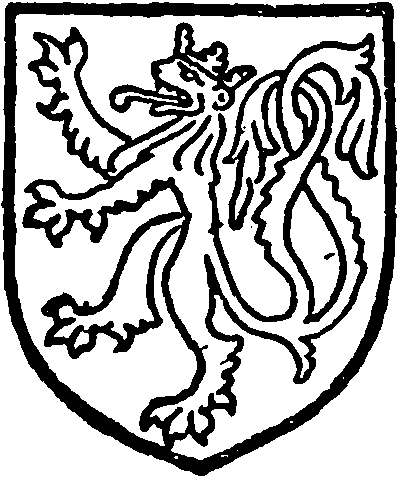
Folliott. Argent a lion purpure crowned or with a forked tail.
At a very early date, probably before 1166, (fn. 40) the Abbot of Westminster granted the manor of Longdon at fee farm (fn. 41) to the Folliotts, William Folliott in 1166 holding a knight's fee in Worcestershire and Gloucestershire under the abbot. (fn. 42) He had a charter from Henry II granting to him and his heirs in hereditary fee all his assarts in Worcestershire, whatever he and his father occupied 'after justice was done with regard to the moneyers of Marlborough.' (fn. 43) In 1175–6 William Folliott of Worcestershire paid 10 marks surety money to the Treasury. (fn. 44) He was the son of Sir Richard Folliott of Bickmarsh in Warwickshire (fn. 45) and married first Audrey daughter of Peter de Saltmarsh, and secondly Cecily widow of William de Staunton. (fn. 46) He was alive in 1189– 90. (fn. 47) His heir Reynold Folliott (fn. 48) died before 1208, in which year Robert Folliott gave 50 marks and a palfrey for the lands of his brother Reynold. (fn. 49) Robert married Emma daughter of William and Cecily de Staunton, (fn. 50) and confirmed to her (fn. 51) a grant made by his father of all his new assarts in Longdon. (fn. 52) Robert was apparently succeeded early in the 13th century by his son Reynold, who confirmed the manor of Longdon to his mother Emma as dower. (fn. 53) Reynold Folliott was parson of the church of Longdon, (fn. 54) and died without issue, when this inheritance passed to his four aunts, Agnes, Avice, Amphyllis and Akyna, sisters of Robert Folliott. (fn. 55) Agnes may have predeceased Reynold, as her grandson Philip, son of William de Colevill, dealt with her share. (fn. 56) In 1235 Philip, Avice and Amphyllis took steps to convey their shares of the manor of Longdon to the Abbot of Gloucester, but this was forbidden by the king, as it would do injury to the abbey of Westminster. (fn. 57) In the same year Philip and Avice granted their two shares to the Abbot of Westminster, the chief messuage being in the gift of Philip. (fn. 58) In 1238–9 Philip's grant was confirmed by Philip de Colevill, possibly his son. (fn. 59) Another account states that Edward I granted Longdon Manor to Westminster Abbey for endowing the anniversary of Eleanor the late queen. (fn. 60) Amphyllis married William de Saltmarsh, (fn. 61) and the fourth sister Akyna married into the Muchgros family. (fn. 62) In 1241 Richard de Muchgros and William de Saltmarsh, husband (fn. 63) or son (fn. 64) of Amphyllis, each held the reversion of quarter of the manor of Longdon after the death of Agnes and Emma, widows of Reynold and Robert Folliott respectively, who held as dower. (fn. 65) In 1291 the Abbot of Westminster was seised of 4 carucates of land in Longdon and its members. (fn. 66) His successors continued to hold half the manor (fn. 67) till the Dissolution, when their holding in Longdon was valued at £19 9s. 3d. (fn. 68) It was given by Henry VIII in 1542 to the Dean and Chapter of Westminster. (fn. 69) In 1556 Queen Mary granted it to the restored monastery. (fn. 70) It was regranted to the dean and chapter in 1560, (fn. 71) and their successors are lords of the manor at the present time. (fn. 72)
The Saltmarsh share of the manor was held by Peter son of William de Saltmarsh (fn. 73) on his death shortly before 1316. (fn. 74) His son John (fn. 75) left a daughter and heir Joan. (fn. 76) She married Henry Grendour, and after her death in 1395 (fn. 77) the Grendour lands in Longdon appear to have been sold to the Abbot of Westminster in 1397. (fn. 78) 'The manor of Longdon Grendour' had certainly passed to the abbey by 1463–4 (fn. 79) and henceforward descended with the abbey lands.
The part of the manor which passed to the Muchgros family became known in the 15th century as the manor of MUGHGROS (Mochgros, xvi cent.). Richard de Muchgros, the owner in 1241, (fn. 80) left two sons John and Nicholas, who in 1277–8 dealt with lands in Longdon. (fn. 81) They both held land in Longdon in 1276. (fn. 82) In 1310 an inquiry was held into the waste committed by Joan widow of John de Muchgros on the inheritance of his son James in Longdon. (fn. 83) James was alive in 1327 (fn. 84) and in 1339 had been succeeded by his son John. (fn. 85) There is no further mention of the Muchgros family in connexion with this parish, but in 1476–7 the manor of Muchgros in Longdon was conveyed with Hill Court (see below) to Sir Richard Croft. (fn. 86) In the 16th century Muchgros was in the hands of the Toney family, (fn. 87) Robert Toney in 1555 granting the manor of 'Mouchegreues' in Longdon to his son Henry. (fn. 88) Robert died in 1556–7, (fn. 89) and in 1577 Muchgros Manor was conveyed by Henry Toney and Agnes his wife to John Bridges and Thomas Wrenford. (fn. 90) It was held about the middle of the 17th century by William Parsons, (fn. 91) said to be a Muchgros descendant. (fn. 92) Nash suggests that Muchgros was probably the name of the estate of Mr. Parker, 'now called which he sold a few years ago to Mr. Thomas Wrenford and which is still known by the name of Parson's Land.' (fn. 93) In 1757 Edward Bartlett held 'Parson's' in Longdon Hill End. (fn. 94)
The family of Wrenford was associated with Longdon in early times; mention is made of John de Wrenford and Margery his mother in the reign of Henry III, (fn. 95) and in 1321 William son of William Wrenford was released from doing suit at the court of Longdon. (fn. 96) William Wrenford occurs in 1375–6 and in 1402 (fn. 97) and Edmund Wrenford was bailiff there in 1496–7. (fn. 98) In 1550 John Wrenford settled the manor of WRENFORD on his son William, (fn. 99) who was bailiff of the abbey in 1558–62, (fn. 100) and died in 1570 seised of a messuage in Longdon. He left a son and heir Thomas, (fn. 101) against whom in 1572 Joyce widow of William Wrenford and wife of John Nott presented a claim. (fn. 102) In 1576 Thomas held the manors of Wrenford, (fn. 103) and in 1606–7 Thomas Wrenford and Dorothy his wife, with others, conveyed the manors of Farend (fn. 104) and Wrenford Place to Richard Bartlett. (fn. 105) John Wrenford of Longdon is mentioned in 1599, 1602 and 1625, (fn. 106) and in 1630–2 he was fined for not taking knighthood. (fn. 107) A Thomas Wrenford seems to have been living here in the 18th century. (fn. 108) A tombstone in the church records the death in 1714 of Nicholas Wrenford, at the age of seventy-six. (fn. 109) There are many other records of the family among the documents of the dean and chapter, but there is no further mention of this manor after 1606–7.
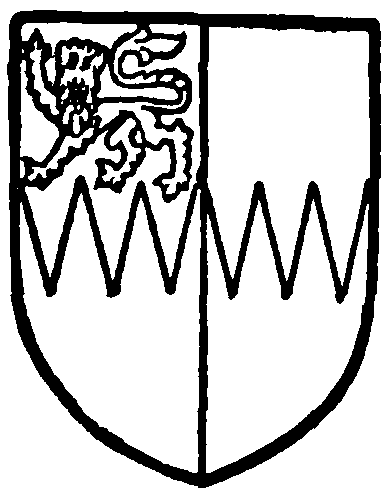
Croft. Quarterly fessewise indented azure and argent with a leopard or in the quarter.
In 1339 Robert de Longdon had licence for an oratory in his manor of 'Hulle' or Longdon, (fn. 110) afterwards HILL COURT. In 1451 John son of Robert de Longdon gave to Sir Thomas Winslow and his wife Agnes (possibly Agnes de Muchgros) (fn. 111) the manor of Hill Court in the vill of Longdon. (fn. 112) Sir Thomas Winslow left three daughters Agnes, Elizabeth and Jane, and the manor seems to have passed to Elizabeth, who married a Seymour, (fn. 113) for in 1476–7 Ralph Seymour and Isabel his wife sold Hill Court to Sir Richard Croft. (fn. 114) This led to a suit between the Crofts and the heirs of Sir Thomas Winslow, viz., Thomas Giffard, Simon Seymour, Margery wife of Maurice Fillol and Iseult wife of Robert Irissh. (fn. 115) The Crofts appear to have kept their interest, (fn. 116) for in 1560 Richard Croft and his son Thomas conveyed the manor to John Harley and Robert Mason. (fn. 117) The manor of Hill Court was held in 1561 by Sir James Croft, who with Thomas Croft conveyed it in 1562 to John Wetherston. (fn. 118) This was confirmed in 1582 by Sir James's son Edward. (fn. 119) On John's death in 1596 it passed to his son Thomas, but he died without issue in the following year, when the estate passed to his two sisters, Alice who married first William Messenger, and secondly Richard Nanfan, and Isabel wife of Nicholas Phelps. The manor was divided between them in 1599, Isabel widow of Thomas Wetherston having given up her rights in 1598 in consideration of £470. (fn. 120) In 1612 Richard Nanfan and Alice and John Messenger and Mary his wife sold their moiety to Nicholas and Isabel Phelps, (fn. 121) who conveyed the whole in 1617 to Henry Smyth, clerk. (fn. 122) It was apparently sold by Edward Dineley to John Coulding in 1638. (fn. 123) In 1668 the manor of Hill Court was sold by Edward Coulding and his wife Dame Katherine to Richard Dowdeswell, who was to hold it for life with remainder to his son William. (fn. 124) In the same year Richard Dowdeswell gave his estate in this manor to his son William, (fn. 125) in whose family it has since remained, (fn. 126) being now in the possession of the Rev. E. R. Dowdeswell of Pull Court.
Towards the end of the 12th century William Folliott gave to Adam de Longdon the fee which Alured, Adam's ancestor, had held in Longdon, namely, the land of BUCKBERRY (Buccebur, xii cent.; Bugbury, xiii-xvi cent.) and the land of Okhaye (Ocheia). (fn. 127) All this land Adam granted to his brother Michael. (fn. 128) About 1219–21 Robert Folliott granted to his wife Emma de Longdon (or Staunton) his lands of Buckberry and Okhaye. (fn. 129) She gave to the priory of Little Malvern all her lands in the vill of Longdon. (fn. 130) Thus the priory came to hold the manor of Buckberry, which in 1291 consisted of 2 carucates of land and a mill. (fn. 131) It, with another estate at Longdon sometimes called a manor, formerly belonging to the priory, was granted in 1537, after the Dissolution, to Richard Bartlett (fn. 132) of Castlemorton. He settled it in 1555 on his nephew Richard, (fn. 133) who died in 1581, (fn. 134) and in 1598 his son Henry Bartlett (fn. 135) and others conveyed the manor of Buckberry to Thomas Wrenford, (fn. 136) who in turn conveyed it to Richard Bartlett in 1607. (fn. 137) It had passed before 1653 to Thomas Lord Coventry, (fn. 138) and then followed the descent of Croome D'Abitot until 1831 or later, (fn. 139) when it was sold to Mr. Dowdeswell. (fn. 140)
CHAMBERS COURT
The so-called manor of CHAMBERS COURT probably formed part of the estate held by Urse in the manor of Longdon in 1086. (fn. 141) It was known as Longdon Osmundi in the 12th century, and was then held by William Beauchamp, Urse's descendant. (fn. 142) It may perhaps be identified with the half fee held in 1315 by Robert son of Edmund de Sudley of Guy Earl of Warwick. (fn. 143) In another inquisition of about the same date this name is given as Robert son of Edmund de Solveys. (fn. 144) In 1321 Edmund son of Edmund Solley (Solneye) was in possession of a manor at Longdon, (fn. 145) and later Robert Solley (fn. 146) was the Earl of Warwick's tenant at 'Longdon Walteri Barwyn (or Bruin).' (fn. 147) In 1346 Robert atte Chamber (or de la Chambre) held of the Earl of Warwick half a fee in Longdon which his ancestor Robert had held, (fn. 148) and about 1401 Richard Payne held the estate as successor to Robert Solley. (fn. 149) In 1428 this estate was said to be held by the heir of Robert atte Chamber. (fn. 150) In 1556 the manor of Chambers Court was conveyed by Robert Dawes, or Erles, who may have inherited it from his father Thomas in 1553, to William Wrenford and others. (fn. 151) In 1601 it was conveyed by James and Mary Gilbert to Thomas and Robert Tuston, (fn. 152) but James Gilbert held land at Chambers Court in 1635. (fn. 153) Chambers Court afterwards belonged to the family of Turberville, (fn. 154) and was purchased in 1779 of George Turberville of Twyning near Tewkesbury by John Stone. His grandson, Captain W. H. Stone, sold the estate in 1913 to a syndicate, and the property has since been divided. (fn. 155)
Another manor called Longdon, held in the 16th century by the Wye family, (fn. 156) was sold in 1596 by Elizabeth Wye to John Throckmorton. (fn. 157)
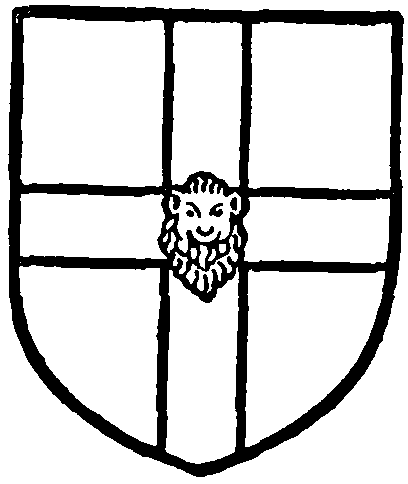
Bridges. Argent a cross sable charged with a leopard's head or.
The manor of EASTINGTON (Estinton, xiiixvi cent.; Estington, Essington, xvii-xviii cent.) gave its name to its early holders, of whom William Eastington in 1220 owed half a mark to the Treasury for having a writ of pone against William Bracy for a knight's fee in Eastington. (fn. 158) In 1248–9 William Eastington dealt with lands here. (fn. 159) The Eastingtons continued here for many years. William Eastington, the last of the line, (fn. 160) was lord of the manor late in the 15th century. His daughter and heir Alice married William Brugge or Bridges, who died in 1523. (fn. 161) Alice dealt with the manor in 1527, (fn. 162) and left it at her death in 1538–9 (fn. 163) to her younger son Giles. (fn. 164) His son John Bridges was living at Eastington in 1601 (fn. 165); he sold the manor in 1633 to John Nanfan and Edward Reed. (fn. 166) It was held by Edward Earl of Dorset in 1641, and settled by him in 1642 in tail on his second son Edward Sackville on his marriage with Bridget Wray. (fn. 167) Edward Sackville died without issue in 1646, and his elder brother Richard Earl of Dorset sold this manor in 1661–4 to Nicholas Lechmere of Hanley Castle. (fn. 168) It passed with Ryall in Ripple (fn. 169) to Susan wife of John Glasse, widow of Nicholas Lechmere, (fn. 170) who conveyed it in 1817 to her son Edmund Lechmere Charlton. (fn. 171) Mr. Berkeley, a tenant, bought this estate from the Lechmeres. (fn. 172) It was purchased in 1842 from Anna, George and John Berkeley by Mr. Edward Gresley Stone, whose son Captain W. H. Stone sold it in 1913 to a syndicate, and the property has since been divided. (fn. 173)
In 1277–8 there were two mills on the estate held by the Muchgros family in Longdon and Castlemorton. (fn. 174) There was a mill at Buckberry in 1291, (fn. 175) and a mill in Longdon is mentioned in 1418. (fn. 176) A corn-mill is now standing at Eastington.
CHURCH
The church of ST. MARY THE VIRGIN consists of an apsidal chancel 22 ft. by 18 ft. with vestry on the north side, nave 56 ft. 6 in. by 21 ft. 9 in., south porch, and west tower and spire 14 ft. 9 in. square, all these measurements being internal.
The tower is surmounted by a short octagonal stone spire, and is of late 14th-century date, but with this exception the whole of the church was rebuilt in brick about 1786, the south side being stuccoed, and a small low semicircular projection at the east end serving as chancel and sanctuary. (fn. 177) The church remained unaltered down to about 1868, when, on the appointment of a new vicar, plans were prepared for rebuilding the nave and chancel, but were abandoned on account of expense. The 18th-century nave was, therefore, retained and a new chancel and vestry added. A certain amount of restoration was at the same time effected, the tower arch being opened out, the west entrance done away with, and a new south doorway and porch erected. A proposal to case the nave walls with stone has not been carried out. (fn. 178)
The chancel is in the style of the 12th century and is lighted by six round-headed windows. The nave is divided into three bays, the middle one projecting externally 9 in. on both north and south. The pulpit originally stood against the north wall in the middle bay, and opposite, in the south wall, is a large window of 'Venetian' type; the other windows are plain round-headed openings. Internally the middle bay is emphasized by engaged Ionic columns supporting a cornice which goes all round the nave. There is a flat plaster ceiling with a small circular dome in the middle in the roof space.
The tower is of two principal stages exterually divided by a double string inclosing a band of plain masonry. It has a moulded plinth and diagonal buttresses of two stages on the west side. The spire, which has ribbed angles and trefoiled spire light near its base on all eight sides, rises from a plain parapet with four octagonal angle turrets, each terminating in a miniature embattled parapet and spirelet. The belfry windows are tall, plain, narrow openings of two lights with transoms at mid-height and forked mullions. There is a clock dial on the south side. The north and south sides are blank in the lower stage except for a small square-headed opening high up in the wall. The west window is of two lights with forked mullion and double-chamfered jambs. The masonry below is new, but the doorway removed in 1868 may have been an insertion of a comparatively late date. There is a projecting vice in the north-east angle. The tower arch is of three chamfered orders dying into the wall and is 8 ft. in width.
The font consists of a modern bowl, standing on a pedestal of 12th-century date, composed of four short shafts with scalloped capitals and moulded bases. The upper part of the Saxon font at Deerhurst was in Longdon Church from 1845 to 1870. It was restored to Deerhurst in the latter year, when the lower part of the font was recovered. An 18th-century wooden font has been transformed into a bookstand, (fn. 179) on which are kept a copy of Jewell's works published by John Norton in 1611 and a black-letter Bible.
Nash records in the north aisle of the old church 'a tombstone inlaid with brass whereon is engraved a man armed except his head and praying; at his feet a lion, by him his wife; under the man are eleven sons, and under the woman five daughters.' (fn. 180) The tomb, which was that of William Bridges and Alice his wife, has disappeared, but the two brass figures remain. They are attached to the east wall of the nave north of the chancel arch and are each 3 ft. in length. The brasses of the children are lost and only one of the shields mentioned by Nash remains. (fn. 181) Below is a fragment of an inscription in Gothic characters: '. . . . Esquire of the mano . ... xix day of Aprell yn the yere of ower lord God a thousand five hundred xi . . . .' (fn. 182) Nash also notes some coloured glass and the brass of a priest inscribed, 'Hic jacet dominus Henricus Grafton vicarius hujus ecclesiae, cujus animae propitietur deus,' but these have disappeared. (fn. 183)
The pulpit is of wood of 18th-century date and has an inlaid star panel on one side. In the vestry is a chest with three locks and the initials and date, IB. HM. 1672.
There is a ring of six bells cast in 1835 by T. Mears. There is also a 'little bell' cast by Abraham Rudhall of Gloucester, 1712. (fn. 184) The clock dates from 1887.
The plate consists of a large cup and cover paten, without hall marks, but inscribed, 'd.d. J. Pynnocke, 1627,' (fn. 185) and a cup, two patens, and a flagon of 1791 inscribed, 'The gifts of T. Parker, Silver Street, Worcester.' There is also an old pewter flagon. (fn. 186)
The registers before 1812 are as follows: (i) baptisms, burials and marriages 1538 to 1641; (ii) 1601 to 1656; (iii) baptisms and burials 1642 to 1737, marriages 1653 to 1736; (iv) baptisms and burials 1737 to 1796, marriages 1737 to 1754; (v) marriages 1754 to 1812; (vi) baptisms and burials 1796 to 1812.
ADVOWSON
A priest is mentioned in Longdon in 1086. (fn. 187) The advowson of the church belonged to the capital manor of Longdon, being given in dower by Reynold Folliott to his mother during the reign of Henry III. (fn. 188) In 1250 the advowson was claimed by the Prior of Little Malvern as the gift of Amphyllis, Avice and Agnes Folliott and of Richard de Muchgros, but judgement was given in favour of the Abbot of Westminster, Richard de Muchgros and William de Saltmarsh, then owners of the manor. (fn. 189) The advowson seems to have belonged to the abbot's moiety of the manor, (fn. 190) and after that time until the Dissolution the presentations were made by him and his successors. (fn. 191)
In 1330 the Bishop of Worcester had a papal mandate to appropriate the church of Longdon to the abbey of Westminster at the request of the king, because the abbey had been greatly injured by a fire which had broken out in the adjoining palace of Westminster. (fn. 192) This the bishop refused to do until the abbot released to him jurisdiction over the priory of Great Malvern. (fn. 193) In 1333 the mandate was renewed, (fn. 194) and the church was appropriated to the abbey. (fn. 195) A vicarage was ordained in the same year, (fn. 196) the abbot agreeing to pay an annual pension of 40s. out of the church to the cathedral of Worcester. (fn. 197)
In 1541 the advowson was granted to Thomas Bishop of Westminster, (fn. 198) but on the suppression of that bishopric in 1550 (fn. 199) the advowson was given to Nicholas Bishop of London (fn. 200) and confirmed to Edward Bishop of London in 1554. (fn. 201) It had passed to the Dean and Chapter of Westminster before 1571 (fn. 202) and has remained with them until the present day. (fn. 203)
The rectory had been granted with the manor to the Dean and Chapter of Westminster in 1542 (fn. 204) and was confirmed to them in 1604. (fn. 205) In 1650 the Parliamentary Trustees sold Longdon rectory to Matthew Batson and Thomas Jolland, (fn. 206) who sold it in 1651 to Talbot Badger. (fn. 207) In 1767 it was conveyed by Charles Dowdeswell to Hester Saunders. (fn. 208)
In 1553 John and William Dodington granted to John Bartlett the tithes of grain, sheaves and hay in Eastington End and Hill End in Longdon lately belonging to Great Malvern Priory, (fn. 209) these tithes having been granted to them in the same year. (fn. 210) Richard son of John Bartlett in 1594 sold them to Thomas Wrenford, who was farmer of the rectory early in the 17th century. (fn. 211) In 1637 the rectory of Longdon with all tithes was leased to — Coulding (fn. 212) and in 1660 to Thomas Crofts. (fn. 213)
In the time of Robert Folliott regulations were laid down for the services in the church of Longdon. Two chaplains, one deacon and a sub-deacon were to be always resident at the church, one of the chaplains to be perpetual vicar. (fn. 214) Half a mark, which the monks of Little Malvern were to pay to the mother church of Longdon from the chapel of Eldersfield, was to be used for seven tapers to burn at the mass of the Blessed Virgin and at the mass of the Holy Cross. (fn. 215) These regulations were revised in 1333. One priest was to celebrate mass daily in the church with a deacon and a sub-deacon, while provision was made for two priests to serve the annexed chapels of Castlemorton and Chaceley. The abbot and convent were bound to provide books and ornaments, to repair the chancel and provide a house for the vicar. (fn. 216)
CHARITIES
In 1606 Henry Toney by his will gave an annuity of 20s. out of his land at Guller's End for the poor.
In 1626 John Pinnock by his will charged a meadow called Hurste in Longdon with 20s. to be distributed amongst the poor on St. Thomas's Day.
Giles Godwin, by will 1629–30, devised land in the parishes of Berrow and Pendock containing 23 a. 3 r. and 3 a. 2 r. in Longdon for the poor and school. The property produces about £30 yearly. By an order of the Charity Commissioners, 1905, a yearly sum of £6 13s. 4d. was made applicable for the benefit of the poor and the residue of the income for educational purposes.
The charity of the Rev. Henry Smith consisted of about 6 a. purchased in 1630 with £100 bequeathed by donor's will for the poor, now let at £7 3s yearly.
The income from the above charities (excluding the Educational Foundation of Giles Godwin) is distributed to about seventy recipients, usually in coal.
William Lyes—as stated on the church table— gave £100 stock, now represented by £100 consols with the official trustees; the annual dividends of £2 10s. are applied in the payment of 15s. for a sermon on Lady Day, 10s. for the care of the founder's burial place, and the remainder, subject to the repair of the founder's tomb and chandelier, for the poor in bread.
The church land consists of a cottage and garden and about 15 a. of land. The property is let at £34, which is applicable for the repair of the church.