A History of the County of Worcester: Volume 4. Originally published by Victoria County History, London, 1924.
This free content was digitised by double rekeying. All rights reserved.
'Parishes: Great Malvern with Newland', in A History of the County of Worcester: Volume 4, ed. William Page, J W Willis-Bund (London, 1924), British History Online https://www.british-history.ac.uk/vch/worcs/vol4/pp123-134 [accessed 30 April 2025].
'Parishes: Great Malvern with Newland', in A History of the County of Worcester: Volume 4. Edited by William Page, J W Willis-Bund (London, 1924), British History Online, accessed April 30, 2025, https://www.british-history.ac.uk/vch/worcs/vol4/pp123-134.
"Parishes: Great Malvern with Newland". A History of the County of Worcester: Volume 4. Ed. William Page, J W Willis-Bund (London, 1924), British History Online. Web. 30 April 2025. https://www.british-history.ac.uk/vch/worcs/vol4/pp123-134.
In this section
GREAT MALVERN with NEWLAND
Malferna (xi cent.); Malverne (xii cent.); Much Malvern (xvi-xvii cent.).
The parish of Great Malvern formerly included the hamlet of Guarlford and the chapelry of Newland, and stretched from the River Severn on the east to the Malvern Hills on the west. Guarlford was formed into a separate civil parish in 1894. (fn. 1) Great Malvern proper has an area of 1,801 acres, Guarlford has 2,759 acres, and Newland 800 acres. (fn. 2) The greater part of this land, except in the town, is pasture. (fn. 3) The valley is on the Keuper Marls. (fn. 4)
The town of Great Malvern is situated in beautiful woodland scenery at the foot of the Worcestershire Beacon and the North Hill, the two highest peaks at the northern end of the Malvern range; the former reaches a height of 1,395 ft. and the latter 1,307 ft. above the ordnance datum. Between them is the Sugar Loaf Hill (1,214 ft.). From the top of the hills can be seen a beautiful panorama of the Severn valley with the hills of Herefordshire and Wales beyond, parts of thirteen counties, the Bristol Channel, and the cathedrals of Worcester, Gloucester and Hereford.
The magnificent priory church, dedicated to SS. Mary and Michael, (fn. 5) 'the stateliest parish church in England,' (fn. 6) occupies a central position in the town. The original parish church, built some time before 1269, (fn. 7) was dedicated to the honour of St. Thomas the Martyr (fn. 8) and stood at the north-west corner of the present churchyard; it measured 90 ft. by 36 ft. and had one small chapel to the south. (fn. 9) Before the Dissolution it fell into decay and efforts were made to repair it. About 1521 there is an entry in the accounts of the Prior of Worcester 'to ye sexten of Moche Malv'ne to ye byldyng of ye Parish church there 5s.' (fn. 10) Early in the same century a free tenant named Thomas Pope gave land for the repair of the parish church. (fn. 11) The priory church 'so far exceeded it in beauty and in every respect that the inhabitants determined to purchase it for their own use.' (fn. 12) About 1541 they bought the church, tower, and chancel with aisles and chapels for £20 from the Crown, and it has ever since been the parish church. (fn. 13) St. Thomas's Church was then destroyed, its goods removed and its font taken to the chapel at Newland, (fn. 14) where it is still preserved. (fn. 15) The church-house of Malvern is mentioned in 1607. (fn. 16)
A short distance east of the church is the ancient Swan Pool. 'New Pool,' mentioned in 1545, is a mile to the south. (fn. 17) Malvern College is a large modern Tudor building with a gate-house tower in the centre and a handsome Gothic chapel with a richly carved reredos. The Abbey Hotel, a modern dwelling, marks the site of the ancient priory. The market cross now stands on a wall below Belle Vue Terrace. It has a square base and octagonal shaft surmounted by a stone ball. There is a large hydropathic establishment in the Abbey Road. Near the church are the Assembly Rooms and Pleasure Gardens, covering an area of about 6 acres. To the north of them are North Malvern and Newtown, the most northerly districts of the town. At the former is Holy Trinity Church, to which a district was assigned in 1869. (fn. 18) The present Benedictine priory of Our Lady and St. Edmund, founded in 1905, (fn. 19) is in College Road near the church. The church is built in the 15th-century Gothic style and has several side chapels and some elaborate fittings. A little to the west on the wooded slope of the hill is the famous St. Anne's Well, (fn. 20) now covered by a modern well-house. Near the well is a villa named Bello Sguardo, (fn. 21) built about 1840 on the site of an old cottage known as the Hermitage. The cottage when pulled down contained carvings of an ecclesiastical nature, and various bones and parts of coffins were dug up in its orchard. (fn. 22) From its position (fn. 23) it has been suggested that this may have been the site of a chapel dedicated to St. Michael, which was destroyed shortly after the Dissolution. (fn. 24) Leland mentions a chapel near the priory dedicated not to St. Michael but to St. John Baptist, (fn. 25) and assigns to it the scene of the martyrdom of the legendary founder of the priory, St. Werstan. (fn. 26)
The Worcester, Malvern and Hereford branch of the Great Western railway has a station in the middle of the town. Near Malvern College it forms a junction with the Ashchurch, Tewkesbury and Malvern branch.
In front of the town a rich plain, partly covered with orchards, slopes gently down to the Severn. On this plain is the parish of Christ Church, which was formed into an ecclesiastical parish in 1872. (fn. 27) On the Chase estate in this parish is the cemetery, which was opened in 1861, and contains a monument to Jenny Lind, who was buried here in 1887. North of the cemetery is Pickersleigh, (fn. 28) where there is a 15thcentury half-timbered farm-house. South of the Chase estate is the district of Poolbrook, and between it and Malvern Wells is Malvern Common with golf links and a club-house opened in 1883.
Near Malvern Wells is the Wyche, a deep cutting between the hills. Here is a chapel of ease to the priory church. Other churches in the parish are St. Joseph's Roman Catholic Chapel, built in 1876, consisting of a nave and chancel with a bell-turret between them and a presbytery adjoining, and the Brethren's Meeting House, both at North Malvern, Emmanuel Chapel (Countess of Huntingdon's Connexion), built in 1874, the Baptist Church in Abbey Road, built in 1886, (fn. 29) Holly Mount Congregational Church, in the middle of the town, built in 1876, a Primitive Methodist chapel, built in 1875, a Wesleyan chapel in Lansdowne Crescent, built in 1865, and a Friends' Meeting House in Church Street.
To the east of the Chase estate are Sherrard's Green, Hall Green and Barnard's Green. At Sherrard's Green is Moat Court, which still has the remains of a surrounding moat. By the road side is an ancient pollard oak known as the 'Devil's Oak.' (fn. 30) A little south of Barnard's Green are corn-mills, and to the west is Mill Farm. Sherrard's Green, Hall Green and Barnard's Green, about equidistant from Great Malvern and Guarlford, probably mark the site of Baldenhall, a lost manor, which was formerly about a mile in length, lying between Great Malvern and Guarlford, but which seems to have disappeared before the end of the 16th century. (fn. 31) Baldenhall as the name of a district occurs, however, in a church list of seatholders in 1722, (fn. 32) the form Baldwin's Green appearing in 1770. (fn. 33)
The village of Guarlford contains Guarlford Court, once the home of the Wheeler family, and the church of St. Mary. There was formerly a ferry over the Severn at the Rhydd. (fn. 34) Near the river are Rhydd Green and Dripshill House. (fn. 35)
Two miles north-east from Great Malvern, on the high road from Malvern to Worcester, lies Newland. It is quite separated from Malvern, being about a mile north of Madresfield, with the parish of Leigh on its western boundary. The population in 1901 was 221. (fn. 36) The site of the ancient chapel of St. Leonard, Newland, (fn. 37) is a little to the south of the present church, which is also dedicated to St. Leonard. The church-house of Newland is mentioned in 1608. (fn. 38) Burials formerly took place at Malvern, (fn. 39) but a burial ground was consecrated here when the new church was built. (fn. 40) At the south-east corner of Newland Green, close to Newland Grange and the site of the old chapel, stands an old half-timbered thatched cottage, which has always been called the 'old Vicarage' and belongs to the benefice. (fn. 41) It was undoubtedly the Priest's House when Newland was served by Malvern Priory, and may be identical with the church-house mentioned above. The Beauchamp Almshouses (fn. 42) form three sides of a quadrangle, one side being filled by the church and warden's lodge, which are connected by a cloister.
Newland Green to the north of the village is a large triangular open space, the remains of what was once a large common. It is described in 1814 as a wide common with some picturesque old cottages on its borders. (fn. 43) North of the Green is Newland Court and a farm still known as Monkfields.
The earliest poetical allusion to the Malvern Hills occurs in the Vision of Pierce Plowman (1362), 'And on a Maye mornynge on Malverne hylles.' (fn. 44) William Langland, the reputed writer, was possibly educated at the priory of Great Malvern. (fn. 45)
Historically Malvern is chiefly noteworthy for its great forest known as Malvern Chase, (fn. 46) which pertained to the lordship of Hanley Castle (q.v.), and for its Benedictine priory. Tradition says that Henry VII with his queen and two sons visited the priory, the king being housed in the rooms over the priory gateway, and that at his command the north window in the north transept of the priory church was made. (fn. 47)
For many years after the Dissolution Malvern was a small and unimportant village. In 1562–3 it contained 105 families, while Newland had 13. (fn. 48) By the 17th century the Malvern waters were beginning to be known for their curative properties:
'A little more Ile of their curing tell,
How they helpe sore Eyes with a new found well: (fn. 49) Great speech of Malvorne hills was late reported, Unto which Spring, people in troupes resorted.' (fn. 50)
By 1688 the waters were well known as a cure for cancer and sores of all kinds, (fn. 51) and Dr. Wall added to their reputation by his Experiments and Observations on the Malvern Waters, published in 1754. (fn. 52) In 1819 Malvern had begun to take its place as a summer resort. It then contained sixty houses, mostly let to visitors. (fn. 53) From that time to the present the population has shown a steady increase, the census of 1841 showing a population of 2,768, of whom 150 were visitors. (fn. 54) Malvern Wells was long the part where visitors chiefly stayed, Malvern itself being little more than a row of houses. (fn. 55) Queen Victoria spent some time here in 1830, and Queen Adelaide also visited the place, while Byron, Southey and Bulwer Lytton all contributed to the fame of the hills. (fn. 56) But it was the invention of hydropathy which accounted for the sudden growth of Malvern. It was introduced from Graefenberg in 1842 by Dr. Wilson and Dr. Gully, (fn. 57) and by 1844 the system was fully established. (fn. 58) In 1845 Dr. Wilson's large hospital for water treatment was built. (fn. 59) Among Dr. Gully's patients were Gladstone, Macaulay, Carlyle, Tennyson and others. (fn. 60) Charles Dickens spent some time here in the early 'fifties and his father died here. (fn. 61) By 1851 there were three resident hydropathic doctors, (fn. 62) the population having risen to 3,771. (fn. 63) In that year an Act was passed constituting Malvern a town with a board of commissioners for improvements. (fn. 64) In 1858 another Act gave further powers to the commissioners, and the Local Government Act was adopted in 1867. (fn. 65) These were confirmed and amended by subsequent Acts. (fn. 66) For more than twenty years hydropathy flourished in Malvern, bringing constant expansion to the place; in 1871 there was a population of 7,605. (fn. 67) With the death of Dr. Wilson in 1867 and the retirement of Dr. Gully, hydropathy in its original form practically ceased. (fn. 68) Malvern is still a growing town, however, and one of the best known inland watering places, famous for its beautiful scenery and sheltered position, and for the purity of its water.
About 1833 a 15th-century kiln was discovered 200 yards from the east end of the priory church, on land formerly belonging to the priory. (fn. 69) A second kiln was uncovered in 1902. (fn. 70) Here the encaustic tiles, of which many examples are to be seen in this church, are supposed to have been made. (fn. 71)
Malvern was visited by the plague in 1535 (fn. 72) and again in 1637. (fn. 73)
In 1884 an Act was passed to prevent encroachment on the Malvern Hills. (fn. 74)
The following place-names occur: Akberewe (fn. 75) (xiii cent.); Redmores, Nymyng, (fn. 76) Reddenhyll, Haryett, Cleytlond, Flytefeld, Gnastall, Youklesowe, Dryppshill, Yerlesmore, Rydley, (fn. 77) Rydgrene, The Lode House, Goryshale, Shyrrolde, Mulwarde Lode, Lynckegrene, Shelvescrofte, Oselake, (fn. 78) Menysfeld, Calverneleasowe, Wolselake, (fn. 79) Thassert (fn. 80) (xvi cent.); Flyfords, Colsties (fn. 81) (xvi cent.).
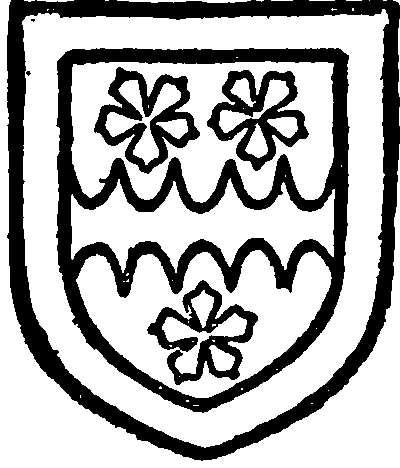
Foley. Argent a fesse engrailed between three cinqfoils and a border sable.
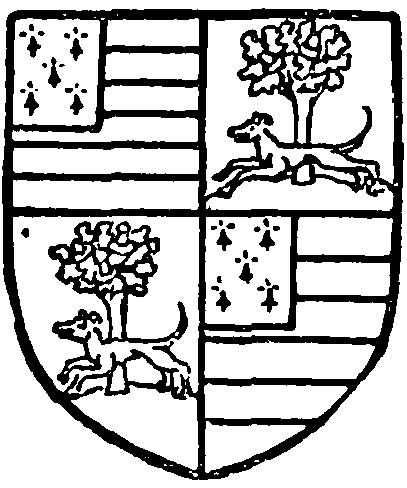
Grey, baronet. Barry argent and azure with a quarter ermine, for Grey, quartered with Argent an oak tree on a mount vert with a running greyhound gules, for Lambert.
MANORS
The manor of GREAT MALVERN is not entered in the Domesday Survey. A monastery is said to have been founded here in the reign of Edward the Confessor. (fn. 82) The site of the priory was confirmed to the monks by Edward the Confessor, William I and Henry I, the latter in 1127–8 granting quittance for assarts made in the forest with land in Baldenhall. (fn. 83) His charter was confirmed by Edward II (fn. 84) in 1320–1 and by Edward III in 1376. (fn. 85) In 1276 the prior was returned as owner of Great Malvern, (fn. 86) the extent of which was estimated in 1291 at 4 carucates of land. (fn. 87) At the dissolution of the priory the clear annual value of the manor of Great Malvern was £67 9s. 8½d. (fn. 88) It was held by the Crown till 1547, (fn. 89) when it was leased for twenty-one years by Edward VI to Thomas Fisher. (fn. 90) In 1554 Queen Mary granted the manor in reversion to John Lord Lumley, (fn. 91) and this grant was confirmed by Queen Elizabeth in 1585. (fn. 92) In the same year Lord Lumley had licence to alienate it to Henry Bromley of Holt, (fn. 93) and the sale was effected in 1586. (fn. 94) Great Malvern Manor descended with Holt (fn. 95) to the Foley family. On the death of Thomas first Lord Foley in 1777, (fn. 96) Great Malvern was inherited by his second son Edward, (fn. 97) who died in 1808. (fn. 98) His son Edward Thomas Foley, who was lord of the manor in 1813, (fn. 99) died without issue in 1846. (fn. 100) His widow, Lady Emily Foley, held the manor till her death in 1900. It had been settled on Edward Thomas Foley's sister Anna Maria, who married Henry John Lambert, but both she and her son predeceased Lady Foley, and the manor passed to her grandson Sir Henry Foley Lambert, bart. (fn. 101)
He changed his name to Grey by royal licence in 1905, and is the present owner of the manor.
Edward the Confessor gave to the priory of Great Malvern a virgate of land in BALDENHALL (fn. 102) (Baldehalle, xi cent.; Baldenhale, xii cent.) of the fee of Hanley, and this gift was confirmed by his successors. (fn. 103) Baldenhall is mentioned in the Domesday Survey;'a villein at Baldenhall renders to the manor of Hanley 2 ounces of silver pennies.' (fn. 104) The wood of Baldenhall was one of the smaller woods of the Chase. (fn. 105) The Confessor's gift was, no doubt, the virgate of land of the fee of Hanley mentioned as a possession of the priory about 1210. (fn. 106) Baldenhall was confirmed to the priory in 1217 by Pope Honorius III. (fn. 107) At this time it seems to have been more important than Malvern, which in 1276 appears as part of the vill of Baldenhall belonging to the priory. (fn. 108) A court for the manor of Malvern was held at Baldenhall in 1526, (fn. 109) but by the middle of the 16th century Baldenhall seems to have become merged in Great Malvern Manor. In the time of Edward VI it was stated that 'the manor of Baldenhale should be between the manors of Great Malvern and Guarlford,' but it no longer existed, the name being retained in Baldenhall Grove, in which both tenants of Great Malvern and Guarlford claimed common. (fn. 110)
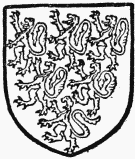
Savage. Argent six lions sable.
In 1541 Henry VIII leased for twenty-one years to Richard Berde the SITE of the PRIORY of Malvern with the grange of NETHER COURT. (fn. 111) In 1544 Berde transferred his lease to William Pinnock, (fn. 112) to whom the king granted the lands in fee in the same year. (fn. 113) In 1545 Pinnock sold his lands to John Knottesford, (fn. 114) to whom, in 1552, Edward VI gave the custody of the site of the monastery. (fn. 115) He died in 1589, (fn. 116) having settled this property in 1580 (fn. 117) on his eldest daughter and co-heiress (fn. 118) Anne and her husband William Savage of Elmley Castle, and in 1588 in tailmale successively on their sons John, Giles and George. (fn. 119) This property descended with Elmley Castle (fn. 120) till about 1774, when Thomas Byrche Savage is said to have sold the priory demesne to James Oliver of Worcester, the site of the priory having been sold a few years earlier. (fn. 121)
Three carucates of land at GUARLFORD (Garleford, xiii-xvii cent.) belonged to the priory in 1291 (fn. 122) and were held by successive priors till the Dissolution, when the grange of Guarlford, in the occupation of Richard Cave, was valued at £9 1s. a year. (fn. 123) In 1541 the manor of Guarlford was granted for life to Richard Berde, (fn. 124) and in 1545 the reversion was granted to William Pinnock, (fn. 125) who sold it in the following year to Francis Wheeler and Ellen his wife. (fn. 126) In 1562 they conveyed the manor to Robert Harbord, (fn. 127) probably in settlement on Francis, for he was still seised on his death in 1584 (fn. 128); he was succeeded by his son Richard, who had livery of the manor in the following year. (fn. 129) Richard died in 1609, leaving as heir his grandson Rowland Wheeler (son of Richard Wheeler and Anne his wife), having in 1608 made a provision for his daughters Helen wife of Samuel Romney, Margaret wife of William Bennett, Lettice wife of William Parsons, and Elizabeth, who afterwards married John Hollward. (fn. 130) Rowland died in 1611, leaving an infant daughter Frances, (fn. 131) during whose minority the four sisters appear to have held the manor jointly. (fn. 132) They were in possession in 1624, but in 1640 John Baker and Frances his wife, probably Rowland's daughter, conveyed the manor to Henry Browne, Thomas Surman and John Orrett. (fn. 133) No further references to this estate have been found.
The manor of MOAT COURT (Mote Court, le Motte, xvi-xvii cent.), a possession of the late priory of Great Malvern, (fn. 134) was leased in 1541 to Richard Berde, (fn. 135) and in 1545 the reversion was granted to John Broxholme and John Bellowe. (fn. 136) It seems to have been shortly afterwards granted to William Moore, who died in 1565 seised of the manor of Moat Court (fn. 137); he was succeeded by his son Richard, who had livery of it in 1571. (fn. 138) He settled it in 1604 on Frances wife of his son Richard. (fn. 139) The elder Richard died in 1610, (fn. 140) and in 1612 his son had livery of a third part of the manor. (fn. 141)
The manor of NEWLAND (fn. 142) (Nova Terra, xii cent.) was given to the priory of Malvern by Gilbert, (fn. 143) Abbot of Westminster (fn. 144) (ob. 1117). (fn. 145) This gift was confirmed by Henry I: 'I grant and confirm Newland (Nova Terra) also, with Woodsfield (Windeff) and Limberga situated between Powick and Baldenhall, as Walter of Gloucester and others of my barons on my behalf, and Gilbert abbot of Westminster and the convent there by Hugh and Warner his monks on his behalf, gave to the brothers of the priory.' (fn. 146) The grant was confirmed by Pope Honorius III in 1217. (fn. 147) In 1291 the prior held 2 carucates of land at Newland. (fn. 148) At the Dissolution the priory lands here, including the grange, were valued at £8 14s. 11d. (fn. 149) In 1563 the manor and capital messuage of Newland, in the occupation of John Moore and his wife Alice, (fn. 150) were granted to Humphrey Shelton and Edmund Hunt. (fn. 151) They may have been 'fishing grantees,' for about 1568 Newland was granted to the Walweyn family. (fn. 152) John Walweyn, probably the original grantee, died apparently before 1587, in which year his son Robert dealt with the manor, (fn. 153) probably in settlement on his wife Penelope Lygon. Robert settled it in 1607 on his second wife Elizabeth. (fn. 154) He was alive in 1608, (fn. 155) but was succeeded by his son John before 1619. (fn. 156) John died a lunatic about 1624, leaving as heir his daughter Elizabeth, aged seven. (fn. 157) She afterwards married Walter White of Wiltshire, (fn. 158) and it was no doubt their descendant Priscilla White who with Richard Salwey and Elizabeth his wife conveyed the manor of Newland in 1707 to Thomas Prime and William Allington (fn. 159); in 1809 it was in the possession of Elizabeth Mary Booth and Marianne Ford. (fn. 160) Early in the 19th century Newland was purchased by Earl Beauchamp, and has since followed the descent of Brace's Leigh in Leigh parish. (fn. 161)
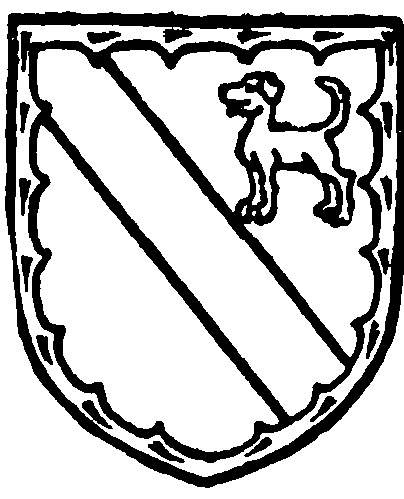
Walwkyn Gules a bend and an engrailed border ermine with a talbot or in the chief.
In 1291 there were two mills on the priory demesne. (fn. 162) A horse-mill and a water-mill (fn. 163) were there at the Dissolution (fn. 164) and passed with the demesne lands to John Knottesford, who in 1585 settled one mill on William and Anne Savage. (fn. 165) In 1588 they had licence to convey a water-mill to William Rydgeley and Richard Daston. (fn. 166) Two mills were sold with the manor to Henry Bromley in 1585. (fn. 167) The mill-house of Guarlford is mentioned in 1624. (fn. 168) There were two water corn-mills in Malvern in 1714, (fn. 169) and corn-mills still exist near Barnard's Green.
CHURCHES
The church of ST. MARY AND ST. MICHAEL, formerly the conventual church of the Benedictine priory, is a cruciform building consisting of a quire and presbytery, central span 58 ft. 9 in. by 27 ft., with north aisle 17 ft. 9 in. wide, south aisle or St. Anne's chapel 55 ft. 9 in. by 18 ft. 3 in., central tower about 27 ft. square, north transept 39 ft. by 28 ft. 3 in., nave 82 ft. by 27 ft., with north aisle 19 ft. wide, south aisle 9 ft. 6 in. wide and north porch. The destroyed portions include the Lady chapel at the east end 46 ft. by 23 ft. with transeptal chapels and a crypt under 39 ft. 9 in. by 21 ft. and the south transept. The total length of the church before the destruction of the Lady chapel was about 219 ft. 6 in. All the measurements are internal.
The church, which, with the gateway, is all that now remains of the priory, is described by Camden (fn. 170) as being entire (except for the Lady chapel at the east end and one on the north side) with beautiful painted windows miserably defaced. By 1788 it had become so ruinous that it was not safe, and plans were suggested for its repair. (fn. 171) In 1809 a brief was granted to collect money for this purpose (fn. 172); it was partly restored in 1812 and again in 1816, 1834 and 1841, chiefly through the efforts of Dr. Card, the vicar, appointed in 1815. The tower was restored in 1852. About 1861 a thorough restoration was carried through at a cost of £10,000 (fn. 173) and minor restorations have been made subsequently.
The earliest parts of the structure are the nave arcades with the south aisle and the piers of the central tower, all dating from the late 11th or early 12th century. Some remains of the Norman apsidal east end have come to light. The remains of the crypt beneath the Lady chapel appear to date from the close of the 12th century, and an eastern chapel must have been amongst the earliest additions. The Lady chapel was rebuilt and lengthened probably late in the 14th century. The whole church underwent complete transformation in the 15th century, being begun by Prior John about 1440. The presbytery was first rebuilt and finished probably in 1460, when the Bishop of Worcester consecrated seven altars in the priory church (fn. 174); it was followed by the transepts, central tower and nave, the latter being completed about 1480. At some uncertain period the south transept was destroyed and a wall built across level with the nave aisle. The church was extensively restored under Sir Gilbert Scott and in 1894 the north porch was taken down and rebuilt.
The eastern arm of the church is three bays long with moulded piers and responds and pointed arches, all of the 15th century. The inner faces of the piers have each three attached shafts carried up to support the two-centred arches over the clearstory windows. The space beneath these arches is panelled in six divisions, the two side ones blank and the four in the centre pierced to form clearstory windows with transoms and segmental pointed heads; below their sills the panels have traceried cinquefoiled heads. The east window is pointed and traceried and has eight lights with a massive central mullion. The flat timber roof is panelled in six bays from east to west, and three across. The corbels which support the moulded wall-posts are formed by the springing stones of an intended vault. Each panel is subdivided with modern carved bosses. The wall spaces over the clearstory arches are filled with blind tracery in wood in the form of three-light traceried windows and the spandrels above the east window are similarly treated. Below the east window and of the same width is a broad and low three-centred arch, now strengthened by a modern arch below it and formerly opening into the Lady chapel. Under it the mullions of the east window are carried down to form a stone screen, each division being subdivided and having trefoiled heads and a transom. The latter is broken in the centre on either side of an ogee-headed door, the moulded jambs of which unite at the head to support the central mullion of the window above. The screen is now glazed and the doorway is used as an entrance. Just to the east of the easternmost pair of piers is the stone reredos pierced by two roundheaded doors, one on either side of the altar, leading to the sacristy. The latter is not roofed and is inclosed on the east by a plain wall segmental on plan and pierced by four trefoiled lights, skewed to view the lights of the various side altars. The wall is finished with a modern cornice and with the reredos is ornamented only with glazed wall tiles. The north aisle is covered with a simple stone vault with plainly chamfered diagonal and transverse ribs and carved bosses at the intersections. The east window is of three lights with tracery and is set in an altar recess, forming a shallow three-sided apse internally roofed with a panelled arch three panels wide and cusped. On the north of the altar is a moulded bracket and on the south a pillar piscina with a panelled stem and an ogee trefoiled head. In the north wall each of the three bays has a panelled surface of six panels, the four middle ones pierced to form windows with traceried heads. Below the sills is a row of trefoilheaded panels. The vault springs from groups of five attached shafts with moulded capitals and a continuous base. The main arcade on this side is of two plain chamfered orders. The south aisle or St. Anne's chapel is similar in general character to the north. The east window has modern tracery and is set in a rectangular altar recess covered by a panelled arch, the arch moulds being carried halfway down the jambs on to moulded capitals, and in the north jamb is a door with a four-centred head formerly leading by a stair to the Lady chapel crypt but now blocked and used as a seat. Flanking the east window, which is not quite central, are carved grotesque corbels or image brackets. On the south respond is a pillar piscina with a panelled stem. The vault is similar to that in the north aisle and in the south wall are three windows similar to those on the north and having a row of quatrefoil-headed panels below the sills, twelve to each bay. In the west wall is a pointed arch opening into the former transept. It is of two chamfered orders and apparently of rather earlier date than the rest of the rebuilding. Externally the eastern arms and aisles have plain embattled parapets, carried also across the base of the main gable. The buttresses of the aisles are two stages high and those to the main roof are capped by crocketed pinnacles. Over each clearstory window is a large much weathered gargoyle. The north aisle was formerly gabled, but has now a pent roof.
The central tower of three stages was built in the 15th century on the 12th-century piers. The east and west arches of the crossing are similar, two-centred and moulded; the responds have each five small attached shafts, three in the centre and one at each edge, with small moulded capitals and springing from a moulded string at the level of the capitals of the nave arcade. Within the west arch is a deep panelled band making the arch on this side considerably wider. The north and south arches are lower and narrower, but the jambs and arch moulds are similar, all being of the 15th century. The face of the wall on either side of them is the early 12th-century masonry. The walls above them within the crossing are elaborately panelled with blind tracery in the form of a window of four main and eight subsidiary lights. The crossing is covered with a rich lierne vault with numerous subsidiary ribs and a circular bell-way in the centre; at every intersection is a carved boss mostly of foliage, but four bearing repainted shields. The external faces of the two upper stages are elaborately panelled and have panelled diagonal buttresses. The bellchamber has a pair of two-light windows in each face with pointed heads and ogee crocketed labels terminating in carved finials. The tower is finished with a pierced embattled parapet with square pierced pinnacles at the angles surmounted by pierced spirelets and finials.
The north transept is much lower than either the chancel or nave and has a wide arch on the east of two chamfered orders, perhaps of late 14th-century date, but having moulded capitals and bases inserted when the north quire aisle was built. Above it and the corresponding arch to the nave aisle are coupled clearstory windows, each of two lights with square traceried heads. In the north wall is a large six-light transomed window with a depressed four-centred head and below it are two recesses with similar heads inclosed in square-headed recesses. In the west wall there is a three-light traceried and transomed window and to the south of it a blocked doorway with a fourcentred head and having a shield of the Beauchamp arms above it outside. The flat wooden roof of the north transept is modern; against the north wall of the tower are the marks of the original steeppitched roof. The exterior of the transept is finished with a panelled and embattled parapet continued across the gable and diagonal three-stage buttresses also panelled, gabled and capped with pinnacles. In the centre of the north wall the plinth is carried up over a square-headed blocked door three parts buried, and in the east wall are traces of a four-centred door head; it is probable that they led to a charnel beneath the transept. The south transept has been destroyed except for the start of the side walls. Visible externally in the east wall is the jamb of a 15th-century window and further north the respond of a 12thcentury arch opening into the former transeptal chapel. The arch opening into the south nave aisle is of the same date and is semicircular with cheveron ornament on the west face and springs from enriched abaci chamfered on the under side.
The nave is of six bays, but possibly the original intention was to extend it further to the west. The arcades are uniform and of early 12th-century date with short cylindrical columns having moulded capitals and bases standing on square chamfered plinths except to the two eastern piers. The arches are of three plain square orders and the 12th-century masonry of small uncoursed rubble rises only some 3 ft. above the arch crowns; above the eastern pair it is destroyed to the arch. Above the second pier on the south are two filled mortises, perhaps marking the position of the rood screen. The capital of the east respond on the north is partly scalloped, but the work was not completed. In the second and fifth piers on the same side are shallow trefoil-headed niches cut in the masonry. Above the arcades the walls are blank to the base of the clearstory windows, which are of three transomed 15th-century lights with the mullions carried up and traceried two-centred heads. It was apparently intended to vault the nave, as the wall is set back to receive it above the window heads and also on the west face of the tower. The 15th-century west window is in three main divisions, each of three lights with a two-centred arch, tracery and transom. The side lights and all below the transom are blank panels and across the lower part of the window externally ran a gallery, now destroyed, with three diminutive openings to the nave, each of two trefoiled lights. The 15th-century nave roof is flat with moulded wall-posts and curved brackets resting on moulded stone corbels; the eastern spandrels are traceried, and at the intersections of the ribs are curved bosses like those in the eastern arm. Externally the walls are finished with a pierced embattled parapet carried across the western gable with a niche in the centre containing a modern figure. Over the buttresses are crocketed pinnacles.
The north aisle has a moulded and pointed 15thcentury arch opening into the transept and having moulded capitals to the inner member of the jambs. In the north wall are five uniform windows, all of the same date, with modern tracery of three lights. In the last bay is the north door with moulded jambs, side shafts and a four-centred head, opening into the porch. The aisle is finished externally with a panelled and embattled parapet largely restored and buttresses with cusped gablets. The south aisle preserves the original width of the Norman aisle and much of its masonry. In the east bay is the 12th-century processional door from the cloister with a moulded round arch and two engaged shafts to each jamb. The capitals and bases are of rough cushion form without abaci and appear to have been tampered with. Above the door is a blocked round-headed window of the same date. The Norman wall remains standing for the first five bays and is pierced by three modern windows. In the last bay are two 15th-century doorways with four-centred heads, the westernmost being blocked. One of these was evidently the western processional door, and the second was possibly the night stair from the dorter. From the last pier on this side a 15th-century four-centred arch is sprung across the aisle.
The north porch, reconstructed on the old lines in 1894, has a four-centred moulded outer arch with quatrefoil panels and shields in the spandrels. The room above the porch is lighted by two two-light windows with traceried square heads which form part of a line of similar panels carried across the front; the rest of the wall face is also panelled, but most of the facing is modern. Between the windows is an original niche with a head of rich tabernacle work with a cornice and cresting of Tudor flower. The parapet is panelled and embattled with square crocketed pinnacles at the angles. The roof of the porch is stone vaulted and mostly modern, but most of the carved foliage and grotesque bosses are original. The room above is approached by a modern staircase in the thickness of the west aisle wall. It contains several interesting late mediaeval deeds connected with the church and some massive early 15th-century wood tracery from the old guest hall, retaining traces of gilding and colour.
The Lady chapel was probably destroyed at the Dissolution, but the start of the side walls remains and the plan has been recovered by excavation. It was of the late 14th century with diagonal eastern buttresses and a pair of small transeptal chapels similar to those still standing in the Lady chapel at Gloucester. At the west end are remains of a panelled arch against the east wall of the church, and a stone bench and part of the floor remain against the screen already described. The crypt under the chapel was of less length, four bays long and roofed with a stone vault in two spans. Two of the moulded corbels supporting it at the west end remain visible and have scalloped capitals and semi-octagonal abaci. The core of the vault remains for the first half bay and the ribs have a double chamfer.
The most noticeable feature of the church is the remarkable quantity of fine 15th-century stained glass. Much of it was moved and disordered in the restorations of the last century. Between 1910 and 1919 the whole was releaded and partly rearranged. The great east window contains remains of the original Passion scenes, and many figures and fragments brought from other windows. In the tracery are the Annunciation and Coronation of the Virgin with saints and apostles. The lower lights have figures of benefactors, one pair bearing the arms, Argent three cartwheels sable. The first clearstory window on the north contains the Annunciation, the Presentation, the Angel's Message to Joachim, Joachim and St. Anne meeting at the Golden Gate, and the Birth of the Virgin. In the second window are St. Dunstan, St. Edmund of Canterbury, a bishop, the Virgin and Child, St. Blaize, St. Oswald, St. Wulfstan and St. Anne. The third window tells the story of the foundation. In the upper lights are (1) the site revealed to St. Werstan; (2) the building of the church; (3) St. Edward the king giving a charter to 'William Edward,' a monk (?); (4) the martyrdom of Werstan and the torture of his disciples. In the lower lights (5) Osbernus Poncius granting a charter to 'Magister Aldewyn'; (6) William Earl of Gloucester and Bernard Earl of Hereford; (7) St. Wulfstan granting a charter to Aldewyn; (8) William the Conqueror. In the tracery are the arms of Edward the Confessor and Westminster Abbey (azure two keys in saltire or and argent, impaling azure on a chief indented gules a mitre and crozier or). The first window in the south clearstory contains figures of angels with passion symbols, saints, amongst them St. Andrew and St. Peter, and various fragments; all the lights have tabernacle work. In the second window are various saints, including St. James the Great, St. Katherine, an abbot, a large angel, a crucifixion, and in the tracery three angels, one bearing a quartered shield, of which only the second and third quarters, Or a cross gules, survive. The third window also contains saints and angels described as Virtues, Seraphim, Powers and Dominations. In the tracery are angels, two bearing shields, one of Berkeley, the other of France and England quarterly with a label and a scutcheon quarterly, Mortimer and De Burgh. The windows of the north aisle contain fragments only, tabernacle work and among other coats of arms: Gules a fesse or with two molets argent in the chief; impaling Quarterly fessewise indented azure and argent. The windows in the south aisle are mostly in good preservation. The first on the south contains eleven subjects, the first six representing the Creation, followed by the Fall and Expulsion from Eden; below each subject is an explanatory inscription. The second window has twelve subjects, the first eight giving the story of Noah, followed by four of the story of Abraham, which is completed in the next window. The third window also contains Esau receiving the blessing, Joseph put in the pit, Joseph and his brethren, Moses and Pharaoh's daughter, manna in the wilderness, the Golden Calf, the drinking of the water, and some fragmentary subjects. Among the coats of arms in the traceries are Party gules and argent a bend sinister sable with (three) molets argent thereon; Or a cheveron ermine between three bulls' heads sable; Party gules and azure three lions argent; and shields with the Passion symbols. The large north window in the transept was glazed in 1502. It contained in the upper part a coronation of the Virgin (restored) inclosed in a blue nebuly vesica with trees at the base and figures of patriarchs and angels at the sides. The side lights contain an Ascension and Descent into Hell. In the tracery are five female saints and six angels with Passion instruments. The lower part of the window has representations of Christ among the doctors, the Visitation, the Marriage at Cana, the Nativity, and kneeling figures of Henry VII, Arthur Prince of Wales, Sir Reynold Bray and Sir Thomas Lovell. In the west window in this transept are figures of St. Paul, St. John and St. John Baptist. Below are fragments, including a Last Supper, and at the bottom, small kneeling figures of the donors (about 1480) and in the tracery are two coats of arms, Vair, and Vairy or and azure. The west window of the nave contains figures of St. Laurence, St. George, St. Christopher, the Virgin and Child, St. James and St. John with their mother, SS. Katherine, Leger, Alphege, Edmund, Martin, Nicholas, and other saints, Cherubim and Principalities. In the tracery are four female saints, Joachim, St. Anne teaching the Virgin, and fragments. One of the windows of the north nave aisle has ten scenes from the Gospel history, and two from the life of the Virgin. The traceries of this aisle contain numerous fragments. In the nave clearstory are many modern coats of arms (early 19th century).
The monuments include a recumbent figure of a knight in mail on the north side of the presbytery in high relief of about 1200; the figure has a short pick, long surcoat and oval-shaped shield. On the south side of the presbytery is an alabaster altar tomb with recumbent effigies to John Knottesford, 1589, and Jane his wife, daughter of Sir Richard Knightley. The male effigy is in armour picked out in red and the lady wears a large ruff and heavy necklaces. At the east end of the tomb is a shield of Knutsford impaling Argent two pales gules (evidently intended for Knightley, perhaps repainted), and at the sides are figures of two daughters, each with a coat of arms. To the east of the tomb kneels the life-size alabaster figure of another daughter, Anne, with an elaborate head-dress and a prayer desk in front. In the sacristy are numerous heraldic floor slabs of the Lygon family; they include those of Mary wife of William Lygon of Madresfield, 1668; of Penelope (Lygon) wife of Robert Walweyn of Newland; of William Lygon, sen., 1720; of William Lygon, jun., 1716; of Richard Lygon, 1687, and of Frances (Skinner) wife of Robert Gower, 1668. The Knottesford monument rests on the roof of a 15th-century chantry chapel opening from the south aisle. It has two four-centred arches on this side with a band of traceried panelling above. Against the inner or north wall are two tomb recesses with elaborately cusped four-centred arches; the bases have pointed oval cusped panels with a blank shield in each. The chapel has a richly panelled fanvaulted roof in two bays and contains a collection of architectural objects including a recut slab with inscription to Walcher Lotharingus, prior 1125, another to William de Wykewane, fragments of coupled columns and bases, bosses, &c.
Preserved in the presbytery and aisles are a large quantity of very fine slip tiles; the position of many of these is remarkable, as they appear to occupy their original position as wall decoration, while others are equally noticeable as bearing dates. The upper part of the quire screen on the north has tiles in series of five with tabernacle work and the date 'Anno r. ţ. h. vi, xxxvi,' the second bears a shield of the Passion, the third a crowned monogram, the fourth the royal arms, and the fifth or lowest a pelican vulning herself in a tree. The plinth of the screen has another series forming a diaper with the royal arms and those of the Confessor alternately. Other tiles on this side bear the arms of Clare, England, the Bohun swan, the fesse and molets of Power and Power impaling a cross engrailed. On the curved wall at the back of the sacristy is a dado three tiles high, the top ones all dated 'Anno d. mcccliii'; below are the shields of Clare and Beauchamp alternately. Further south are the coats of Mortimer with the scutcheon ermine, Bohun, England, the Confessor, Beauchamp of Powick, Despencer, and Newburgh Earl of Warwick. On the face of the reredos are similar tiles dated 1453 and bearing the same arms with the addition of a bend between six birds' heads razed and a cheveron and a quarter ermine. Several worn tiles remain on the sacristy floor.
Two rows of quire stalls remain on each side of the quire; they have lost their canopies, but retain a fine series of carved misericordes; ten may represent months of the year. The six western on each side are of the 15th century with carved elbow rests, and the following subjects are amongst those represented on the misericordes: sowing corn, a man pulling off a woman's boot, two monsters with human heads, wings and birds' claws, gathering acorns, a bulldog, a cockatrice, a gardener, reaper, four rats hanging a cat, and a labourer, all on the north side. On the south side: blowing out the devil, sick man and physician, mermaid, two monsters, a wyvern, angel with instrument, man with an ox, and other subjects. The parclose screens in the west bays of the quire are of the 15th century and delicately executed; the fourteen panels on each side have traceried heads and the cornice is enriched with carved vine leaves and fruit. The font has a circular bowl, probably of the 13th century, and modern stem.
There are nine bells and a sanctus: the treble, fifth and tenor by Taylor of Loughborough, 1887; the eighth is inscribed, 'An (i.e., Ann) Saveg, John Saveg I.H. E.H. 1611'; the seventh, 'I.H. E.H. 1611'; the sixth is mediaeval, inscribed, 'Virginis egregie vocor campana marie' in Lombardic letters; the fourth, 'Richard Leeth and Edmund Gifford, churchwardens 1707'; the third by Abraham Rudhall, 'God save the queen and church A.R. 1706'; the second also by Abraham Rudhall, 'Prosperity to all our benefactors A.R. 1707'; sanctus, uninscribed. The sixth bell was cast at Gloucester about 1350 and does not form part of the ring. At the west end of the nave are preserved six clappers from the old bells.
The plate is all modern.
The registers before 1812 are as follows: (i) all entries 1556 to 1617; (ii) all entries 1617 to 1701; (iii) all entries 1709 to 1803; (iv) baptisms 1801 to 1812; (v) burials 1801 to 1812.
The monastic buildings lay to the south of the church, but have been entirely demolished. The gate-house is a 15th-century building standing to the west of the church. The front is a modern rebuilding, panelled and embattled, with a wide four-centred archway in the centre with a small projecting oriel window above it. The rear elevation has an arch of similar form with original jambs and restored head and above it a carved angel; the upper part on this side is of red brick and the square-headed windows are considerably restored. Just within the gate on the site of Knutsford Lodge stood a fine timber-framed building, probably the guest-house, but vulgarly called the refectory. It was lighted by two ranges of windows with traceried heads and had an open roof with wind-braces and traceried filling above the collar.
A short distance to the south of the church is a large well, now covered by a low domed structure, probably of the 18th century, and rather further away is the artificially embanked fish-pond.
In the churchyard, to the north of the church, is a stone cross with a modern head and steps of 1896. The shaft is an octagonal monolith with a shallow trefoil-headed niche on the west face, and the base is octagonal to square with broach stops. It was formerly surmounted by a square late 17th-century sundial with bronze gnomons, now set on a modern base a short distance away.
The church of ST. MARY THE VIRGIN, Guarlford, was built as a district chapel in 1844 and consists of chancel, nave and west porch. A vestry on the south side of the chancel, with organ chamber adjoining, opening into the nave, was added in 1877 at the cost of the late Earl Beauchamp. The building is of stone in a plain 13th-century style with high-pitched slated roof. The carved oak pulpit is in memory of the Rev. John Bateman Wathen, who was rector for forty-eight years.
The plate consists of a chalice, salver paten, flagon and almsdish, all of 1844. (fn. 175) There is also a plated almsdish and one of brass.
The ecclesiastical parish of Guarlford was formed from Great Malvern and Madresfield in 1866. (fn. 176) The living was declared a rectory in 1867, (fn. 177) and is in the gift of Earl Beauchamp.
The old church of ST. LEONARD at Newland was an interesting timber and plaster building, rectangular in plan, measuring internally about 55 ft. by 14 ft., (fn. 178) with north porch (fn. 179) and a square bellturret at the west end surmounted by a short broach spire. The building belonged probably to the 15th century, though locally an earlier date is claimed for it. (fn. 180)
The structure, which was of a severely simple type as regards the timber framing, consisted of five bays, two of which composed the chancel, whose length was about 16 ft. 6 in. The chancel had a boarded and panelled ceiling, but the rest of the building was open to the roof, which externally ran the length of the building with unbroken ridge. An undated drawing of the interior shows it to have been filled with high straight-backed pews and to have had a 'three-decker' pulpit on the south side. These were probably introduced in the 18th or early years of the 19th century, when a curved plaster ceiling seems also to have been erected over the nave. When the trustees of the Beauchamp charity purchased the advowson of Newland they were required to repair or rebuild the parish church at the expense of the charity. They accordingly pulled down the old building in 1864 and erected a new church on a different site, adjoining the almshouses. The site of the altar of the old church is now marked by a stone cross erected in 1866, and the graveyard is still used.
The new church of ST. LEONARD is a stone building in the style of the 14th century, consisting of chancel, nave and north porch, with an aisle on the south side of the chancel (from which it is separated by an arcade of four arches) and an octagonal bellturret on a square base, terminating in a short crocketed spire to the south of the aisle. The aisle is under a separate gabled roof and is partly appropriated to the organ. The church is attached to the east end of the almshouses and is also connected with the warden's lodge by a cloister leading from the aisle. The cloister was an addition in 1876. A portion of the timber framing of the old church has been erected between the chancel and the warden's lodge, opening from the cloister, and is used as a mortuary chapel. The timbers are filled in with modern brickwork and rest on a brick base, and all the windows are new. This re-erected portion of the old building measures internally 20 ft. 10 in. by 14 ft. 10 in., and consists of two bays and a portion of a third. It represents, therefore, less than half of the original structure. The boarded ceiling of the old chancel was re-erected in the sacristy of the new building.
The font is from the old church and is a plain cylindrical bowl of 12th-century date with a band of star ornament round the top. As already stated, it originally belonged to the church of St. Thomas in Great Malvern, and was brought to Newland when the church of the priory became the parish church of Malvern.
There are two bells: one is of pre-Reformation date and bears the inscription in Lombardic letters 'Scii Thessiliay,' (fn. 181) the other is a modern bell cast in 1864 by G. Mears & Co. of London.
The plate is all modern and consists of a jewelled chalice of foreign make, a jewelled ciborium, and paten silver gilt, the last inscribed as the gift of James Skinner, priest, 1877. There are also two chalices and patens of 1863, of modern mediaeval pattern, one set silver and the other silver gilt, a large silver flagon of 1857, a paten of 1863, inscribed on the back, 'Presented to the church of Newland as a small thankoffering by Henry Carter, A.D. 1863,' and a silver pyx and censer.
The registers before 1812 are as follows: (i) baptisms 1596 to 1740, burials 1732 to 1741, marriages 1562 to 1641; (ii) baptisms 1742 to 1807, burials 1758 to 1804, marriages 1742 to 1751; (iii) marriages 1754 to 1812; (iv) baptisms 1808 to 1812.
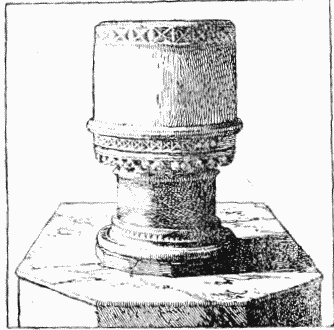
The Font, Newland Church
CHRIST CHURCH, erected in memory of the Rev. George Fisk, vicar of Great Malvern, 1874, consists of a chancel with south chapel and vestry, aisled nave, south porch and west tower with a lofty broach spire of stone. The building is Gothic in the style of the 14th century. The living is a vicarage in the gift of the Bishop of Worcester.
HOLY TRINITY, North Malvern, built in 1842, consists of a chancel, vestry and organ chamber, an aisled nave and a small tower on the north of the chancel. The style is 13th-century Gothic, and the walls are of rubble with ashlar dressings. The octagonal tower is surmounted by a shingled timber spire. The living is a vicarage in the gift of Sir Henry Foley Grey, bart.
ST. ANDREW, Poolbrook, built in 1885, consists of an aisleless nave and chancel with a south porch and apsidal north vestry. It is built of stone and brick in the style of the 13th century and has a carved oak altar and reredos. The font has a hemispherical bowl and a stone stem inscribed ' . . . BER 1724.'
ALL SAINTS, The Wyche, built in 1903, is of Malvern Hill stone in 13th-century style and consists of nave with semicircular apse. It serves as a chapel of case to the priory church.
ADVOWSON
The earliest mention of the church of St. Thomas at Malvern occurs in 1269, when the Prior and convent of Great Malvern presented Ranulph de Piddle to the vicarage. (fn. 182) The church had evidently before this date been appropriated to the monastery, (fn. 183) but the actual date of appropriation is not known. The advowson has always (fn. 184) descended with the manor. (fn. 185)
The rectory of Great Malvern was divided into Prior's and Almoner's Tithes. The former—i.e., the great tithes of corn, grain and hay—were kept in the hands of the prior for the hospitality of the house (fn. 186) till leased by Prior Durham (xvi cent.) to his nephews or great-nephews William and John Moore. (fn. 187) In 1541 the rectory with tithes was leased to Richard Berde (fn. 188) and passed with the site of the priory to John Knottesford and the Savage family, though still farmed by the Moores. (fn. 189) In 1614 the great tithes were granted to Francis Morrice and Michael Cole, (fn. 190) in 1719 they were sold by Richard Brookbank and Elizabeth his wife to Joseph Bayliss and William Brookbank, (fn. 191) and in 1780 by John Wilson to Thomas Brockhurst. (fn. 192) These tithes apparently afterwards passed to the Lygons, for in 1867 Earl Beauchamp endowed the new parish of Guarlford with the great tithes of Malvern. (fn. 193)
The Almoner's Tithes, issuing from land in Baldenhall, were leased by Prior Durham to Richard Sandy (fn. 194); they afterwards passed to John Walweyn. (fn. 195) The small tithes of Malvern were paid to the prior to maintain a priest in the chapel of St. Leonard. Afterwards they went to the vicar of Great Malvern. (fn. 196) Probably they were the tithes granted in 1589 to Richard Branthwayte and Roger Bromley. (fn. 197)
The chapel of St. Michael, called Holme Chapel, (fn. 198) may have been the 'old chapel late of the priory of Great Malvern' sold in 1541 to John Lawrence. (fn. 199) In 1544–5 St. Michael's chapel, lying under 'le Malvern Hyll,' was granted in fee to Richard, Roger and Robert Taverner. (fn. 200) It was granted in 1545 to William Sheldon and John Draper, (fn. 201) and was destroyed shortly after the Dissolution. (fn. 202)
Before the Dissolution there was a chapel at Great Malvern dedicated to St. Leonard. The manor of Guarlford was situated in its parish, (fn. 203) and it was, no doubt, the chapel of Baldenhall mentioned in a deed of 1368. (fn. 204) Divine service, attended by the households of Guarlford Court and Hall Green House, was held by a monk from the priory, sometimes apparently the sacristan, who received £4 a year issuing from the small tithes of Malvern. (fn. 205) This chapel is mentioned among the priory possessions at the Dissolution. (fn. 206) There was a font in the chapel and christenings and marriages took place there. (fn. 207) Francis Wheeler (d. 1584) was married there. (fn. 208) Services were held by Sir John Betterton under Queen Mary, in whose reign (fn. 209) (or about 1558–68) (fn. 210) the chapel was destroyed by Gowen Nicholls, farmer of the churchyard. (fn. 211) The churchyard became the property of the lord of Great Malvern Manor. (fn. 212)
The tithes of this chapel appear to have been separate from those of Great Malvern, with which they were leased to Richard Berde in 1541. (fn. 213) They were granted in 1589 to Richard Branthwayte and Roger Bromley. (fn. 214) In 1596 they were sold by John Colman and others to Richard Wheeler, (fn. 215) and in 1606 by John Colman to Thomas Jones. (fn. 216) About 1606 they were claimed by both William Savage and John Colman, (fn. 217) and in 1654 all the tithes of Baldenhall and Great Malvern were sold by William Triggs and Rebecca his wife to Gervase Elwes. (fn. 218)
The chapel of St. Leonard at Newland was confirmed to the priory in 1217. (fn. 219) It was taxed with the church of Great Malvern in 1428. (fn. 220) Until the Dissolution a monk from the priory held Sunday services alternately at this chapel and at Woodsfield in Powick. (fn. 221) It was returned at the Dissolution as a chapel subject to the church of Malvern (fn. 222); the stipendiary curate of Newland is mentioned in 1540 among the monks of Great Malvern. (fn. 223) This chapel was granted in 1554 to Lord Lumley with the advowson of Malvern, (fn. 224) to which it remained a chapel (fn. 225) until the new church at Newland was built. The parish being without a burial ground, the Beauchamp Charity Trustees assigned for a burial ground the site of the old church and a portion of the ground vested in them. They also bought the advowson of the new church. (fn. 226)
In 1578 the rectory of Newland was granted to Edward Earl of Lincoln and Christopher Gow. (fn. 227) They are said to have granted it to Thomas Smith and William Hagon in the same year, (fn. 228) and they in 1579 to Anthony Rotsey, whose son John sold it in 1589 to Edward Street (fn. 229); he sold it early in the 17th century to John Street. (fn. 230) In 1610 the rectory, church and cemetery (fn. 231) of Newland were granted to William Lloyd and Anthony Gooch. (fn. 232) They were probably fishing grantees, for in 1619 the rectory was conveyed by John Street and Bridget his wife to John Dickins. (fn. 233) It was sold by William Hall and Elizabeth his wife and Thomas Read and Mary his wife in 1699 to Francis Saunders, (fn. 234) who with Rachel his wife sold it in 1723 to Caleb Randolph. (fn. 235)
CHARITIES
The following charities are administered by the vicar and churchwardens and Poor Law Guardians of Great Malvern, the rector of Guarlford and the vicars of North Malvern and Christ Church, Great Malvern, namely:—
1. The charities of Daniel Chapman and others for the repairs of the church and poor—recorded on the church table. The trust estates consist of a house and garden at Sherrard's Green, Guarlford, 2 a. 3 r. 10 p. known as Barton's Tillage, Pickersleigh, and 4 a. 1 r. 10 p. known as Shervast; also of £840 2½ per cent. annuities arising from the sale in 1899 of Church Leys and Poor Leys, and £160 consols arising from the sale in 1908 of Stephen's Close, Barnard's Green.
2. Charity of James Bevan for the poor, founded by will (date not stated), consisting of 2 a. 1 r. 29 p. in the parish of Powick known as Daw's Nest, and £47 15s. 9d. consols representing a compromise for determining a lease for lives.
3. Charities of Mrs. Anna Bull and others, comprised in deed, 1 August 1709, now consisting of 3 a. 2 r. 6 p. known as Morley Meadow.
4. Charity of George Dowdeswell for the poor— recorded on church table—trust fund, £109 17s. 9d. consols.
5. Countess of Harcourt's charity, for keeping in repair the roof of the church, trust fund, £227 12s. consols.
6. Charity of Rev. John Webb, a former vicar, will 1724, consisting of an annuity of £1 charged on land known as Painton Meadow, Porter's Hill, Pickersleigh, for the benefit of poor children, and of an annuity of £1 charged on land called Herbert's Croft, Malvern, for ornaments for the parish church. By a codicil to the said will the reversion of the lands so charged after the expiration of 160 years from the death of the testator's wife was vested in the successive vicars of Malvern for their own use and benefit.
7. Charity of Richard Wheeler—recorded on the church table—being an annuity of 10s. for the church and 10s. for the poor, charged on land called Launtridge, Hanley Castle.
8. Charity of Joseph Lloyd, who died in 1787, for the poor, trust fund, £172 0s. 10d. consols.
The several sums of stock are held by the official trustees, producing in yearly dividends £38 18s. 4d. In 1911 the gross income from realty amounted to £52 8s., the net income of which, together with the said dividends, was applied in the payment of £13 9s. 6d. for the relief of the poor, £10 15s. 5d. in teaching poor children, and the balance in the repairs, &c., of the parish church.
Other charities recorded on the church table appear to have been lost sight of.
In 1868 James Hayes, by his will proved at London 1 April, bequeathed £102 19s. 6d. consols, the annual income to be applied in pursuance of a scheme 24 November 1905.
In 1888 Miss Ann Lucretia Andrews, by her will, bequeathed £100 consols, the dividends to be applied in doles of money to the poor of the Hill District.
In 1892 Miss Mary Ann Pitt, by her will proved at London 22 April, bequeathed £50, the income to be applied in the distribution of half-crowns to an equal number of poor men and women over sixty years of age and regular communicants of the Church of England. The legacy with accumulations is represented by £66 1s. 8d. consols.
In 1893 Charles Rogers Coxwell, by his will proved at London 20 October, bequeathed £500, the income to be applied at Christmas amongst deserving poor; the legacy was invested in £491 17s. 11d. consols.
In 1894 Colonel Henry Pear, by deed, gave £50 for the use of the local branch of the Society for the Prevention of Cruelty to Animals with certain provisions in case of its discontinuance. The legacy was invested in £50 1s. consols.
In 1911 Miss Emilia Lucy Gordon, by her will proved 28 September, bequeathed £200 consols, the dividends to be applied towards the coal and blanket fund, to be distributed at Christmas to deserving poor in the ecclesiastical parish attached to the Priory Church.
The sums of stock belonging to the six preceding charities are held by the official trustees, producing together £25 5s. in annual dividends, which are allocated proportionately to the respective charities.
The official trustees also hold a sum of £48 8s. 9d. Metropolitan Consolidated 3½ per cent. stock arising from the sale of the Congregational chapel at Barnard's Green. The annual dividends, amounting to £1 14s., are applicable towards the support of a congregation of Protestant Dissenters near Malvern or in the county of Worcester.
Educational Charities.—The Lyttelton Grammar School was founded in 1871 as a middle-class secondary school.
In 1883 Mr. Edward Roger Cooper Hay, by deed, gave £160 Midland Railway 2½ per cent. stock, the annual dividends, amounting to £4, to be applied towards the education at the Lyttelton Grammar School of a boy chosen from Mill Lane, Wyche or St. Ann's National schools, under the title of the Southlea charity.
The stock is held by the official trustees, who also hold a sum of £140 0s. 5d. New Zealand 4 per cent. stock, the annual dividends, amounting to £5 12s., to be applied towards the education at the same school of a scholar chosen from the National schools within the rural deanery of Powick, in pursuance of a deed of trust, 25 July, 1891, known as the Blanshard Scholarship.
Great Malvern, Christ Church.—In 1911 Miss Emilia Lucy Gordon, by her will proved 28 September, bequeathed £200 consols, the annual dividends of £5 to be applied towards the coal and blanket fund, to be distributed at Christmas to deserving poor.
North Malvern, Holy Trinity.—In 1909 Miss Frances Margaret More, by her will proved 25 March, bequeathed £500, the income to be applied in the distribution of coals at Christmas to deserving poor, to the number of forty or less. The legacy is represented by £596 3s. 6d. consols, producing £14 18s. yearly.
In 1911 Miss Emilia Lucy Gordon, by her will proved 28 September, bequeathed £200 consols, the annual dividends of £5 to be applied towards the coal and blanket fund, to be distributed at Christmas to deserving poor.
The sums of stock are held by the official trustees.
Newland.—Caleb Randall, as appeared from the church table, devised a small plot of meadow land containing about an acre, known by the name of the Poor's Land, the yearly rent to be given to the poor. The land is let at £2 10s. a year.
In 1766 Thomas Dalby, as appeared from the same table, left 10s. to the poor, charged upon Grange Farm, Newland, belonging to Earl Beauchamp. This sum is duly paid and applied.
The Beauchamp charity for the church, almshouses and choir school was founded by John Earl Beauchamp, who, by his will dated 22 February 1853, left £60,000 for the erection of almshouses for twelve or more poor men or women who should have been employed in agriculture. The almshouses and a warden's lodge were erected in 1862–3 on land given by the Hon. Charles Grantham Scott, the nephew of the founder. In 1902 a sum of £55,072 6s. 5d. consols, arising from the original endowment and from sales of land, and held by the official trustees, was sold out and reinvested in other authorized securities producing a yearly income of £1,566. A further sum of £109 2s. 8d. consols is also held by the official trustees, producing £2 14s. 4d. yearly.
The charity is regulated by a scheme of the High Court of Chancery, 26 March 1859, as amended by further schemes of the said Court, 1863 and 1864, and by a scheme of the Charity Commissioners, 27 April 1875.
In 1909 the sum of £409 5s. was expended on the pensioners, who received from 7s. 6d. to 10s. a week, £452 7s. on the stipends account, £14 on an out-pension, £37 16s. 6d. for coal for the pensioners, £30 4s. on the nursing account, and £217 11s. on the choir school.
Additional almshouses, known as the Lygon almshouses, were in 1889 erected on land adjoining the Beauchamp almshouses.
The Hostel of St. Barnabas, founded by the Rev. George Cosby White, by deeds 5 December 1900 and 23 May 1908, is endowed with a sum of £595 Great Western Railway 5 per cent. stock and £1,022 19s. 4d. Dominion of Canada 3 per cent. stock, held by the official trustees, producing a yearly income of £60 8s. 10d.
The trust is for the benefit of clergymen obliged by failing health or length of years to resign their benefices.