A History of the County of Worcester: Volume 4. Originally published by Victoria County History, London, 1924.
This free content was digitised by double rekeying. All rights reserved.
'Parishes: Powick', in A History of the County of Worcester: Volume 4, ed. William Page, J W Willis-Bund (London, 1924), British History Online https://www.british-history.ac.uk/vch/worcs/vol4/pp184-192 [accessed 30 April 2025].
'Parishes: Powick', in A History of the County of Worcester: Volume 4. Edited by William Page, J W Willis-Bund (London, 1924), British History Online, accessed April 30, 2025, https://www.british-history.ac.uk/vch/worcs/vol4/pp184-192.
"Parishes: Powick". A History of the County of Worcester: Volume 4. Ed. William Page, J W Willis-Bund (London, 1924), British History Online. Web. 30 April 2025. https://www.british-history.ac.uk/vch/worcs/vol4/pp184-192.
In this section
POWICK with CLEVELODE and WOODSFIELD
Poincguuic (x cent.); Poiwic, Poiwicha (xi cent.); Poywyk (xii-xiv cent.); Powyke (xix cent.).
Powick, which includes the hamlets of Clevelode, Callow End, Bowling Green, Pixham, Woodsfield, Collett's Green and Bastonford, is a large parish about 2 miles south-west of Worcester. It has an area of 5,250 acres, of which 3,020 acres are grassland. (fn. 1) The soil is loam and clay with a subsoil of Keuper Marls and Alluvium; the chief crops are wheat, barley and hops. On the east and north respectively the parish is watered by the Severn and by the Teme, which here forms a junction with the Severn. In the river region the land is very low and liable to floods. On the right bank of the Terne is a large tract of open field meadow-land known as Powick Hams. The land rises slightly towards the village, which is pleasantly situated on a slope overlooking the river valleys and the city of Worcester. The highest level in the parish (200 ft. above the ordnance datum) is attained at the Old Hills, near Callow End, on the southern boundary. Powick village, about half a mile south of the Teme, stands at the junction of the main roads from Great Malvern and Upton upon Severn to Worcester. The church of St. Peter is on high ground in the south-east of the village, and close by is the Manor Farm, with the vicarage and the old rectory to the west. There is a pound on the Upton road.
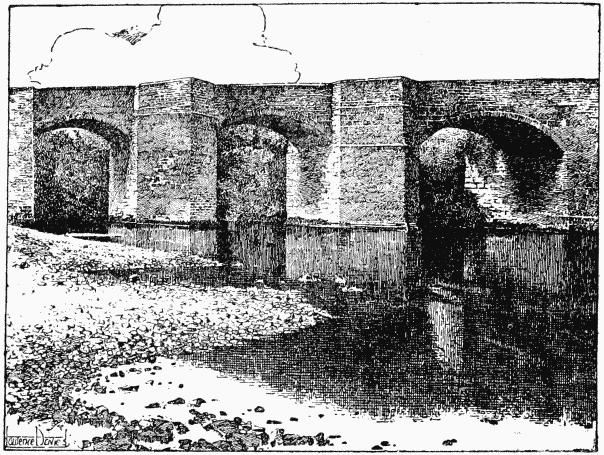
Powick Old Bridge
From the village a road runs in a north-easterly direction to Worcester, crossing the Teme into the parish of St. John in Bedwardine at Powick Bridge, an iron bridge built in 1837. The ancient bridge, which lies a little to the west, was built before 1447, when an indulgence of forty days was granted to all assisting in its repair. (fn. 2) The bridge was much decayed in the years 1598, 1604 and 1633, the lords of the manors of Powick and Wick Episcopi being liable for its repair, (fn. 3) as the lord of Powick still is for his part. (fn. 4) The upper part has been rebuilt in brick.
South of the village along the Upton road, at Stanbrook, is St. Mary's Benedictine Abbey, a nunnery removed here in 1838 from Salford Priors in Warwickshire; attached to the abbey are a burial ground and a beautiful chapel built in 1871. There is a second Roman Catholic chapel in the abbey grounds. A little east of Stanbrook is Pole Elm, where there is an Independent chapel, and close by, on the right bank of the Severn, stands Beauchamp Court, formerly the seat of the Beauchamps of Powick. It is now only a farm-house. There is a pound on the high road here.
At Callow End are the church of St. James and the house known as Prior's Court. (fn. 5) The latter stands on rising ground above the Severn, close to Pixham Ferry, and is an interesting rectangular timber and plaster building built around a small courtyard, the entrance to which is by a through passage, 6 ft. in width, on the north side. The building is perhaps of c. 1500, but there is little architectural detail, the timber framing being entirely constructional, and a restoration in 1898–9, while recovering many ancient features, has at the same time given to the house, at any rate externally; a certain air of newness. The building, though small, is nevertheless of more than usual interest by reason of its plan, which suggests a house of much larger size compressed or shrunk to its present dimensions. Most of the ground floor rooms open directly from the quadrangle, which measures only 16 ft. by 12 ft. 6 in., the greater length being from north to south. The hall is situated in the south-west corner of the building, with the offices in the west wing. A one-story brick wing, containing the kitchen, which bears the date 1789 and the name of John Gorle, has been built out at the northwest corner running west, and there is a small brick addition two stories in height at the south-east corner facing south, of perhaps rather earlier date. The principal rooms are on the east and south sides of the courtyard, the hall and drawing room extending across the house on the south side, with a passage-way 4 ft. wide between, entered from the court. This no doubt represents the old screens, and it would therefore appear that the kitchen and offices originally occupied the east wing, the disposition of the rooms being at some subsequent time reversed, perhaps when the 18th-century one-story wing was added. The position of the staircase, which leads from the southeast corner of the hall, and the cellars under the east wing, access to which is by a stone staircase direct from the courtyard, support this reading of the original plan. Externally the building measures 47 ft. by 45 ft., the lesser fronts facing north and south, and has three gables to the north and two to the east. The south elevation is more irregular, being broken up by a large chimney. The timber framing rests on a low brick base, and the chimneys are of brick from the ground with diagonal shafts. The roofs are covered with red tiles, but the gables are without barge-boards and have brick filling between the timbers. The whole of the middle bay on the north side and the lower part of the walls facing the courtyard have also brick filling, but the spaces between the timbers are elsewhere plastered. In front of the entrance is a small porch with a gable on each face supported by turned wooden posts, and the courtyard is flagged. On the north side of the court the first floor overhangs and the roof is gabled. On the drawing room chimney outside is a stone with the initials A.G. (probably for A. Gorle), most likely indicating a rebuilding or restoration in the 18th century.
The hall is 23 ft. 8 in. long inside the screens by 20 ft. wide and 8 ft. 6 in. in height. The floor is tiled and the walls panelled in oak. The staircase is 5 ft. in width and has turned balusters of Jacobean type. The drawing room, or old kitchen, is about 20 ft. square and has a wide open fireplace on the south side with stone jambs supporting a massive timber beam, above which the wall is panelled. The walls generally in this and other rooms show the bare timber framing. On the first floor a narrow corridor runs round the courtyard on the east and north sides, the south side being occupied by the landing. The building seems to have been remodelled or repaired in the late 17th or early 18th century, to which period some of the interior wood work belongs. The entrance door has two circular panels and a Y knocker. All the old furniture, once a notable feature of the house, has been dispersed. In the grounds to the north-east is an old cock-pit, now turned into a rose garden.
To the west of the village of Powick, following the Leigh road, are the districts of King's End, Dawshill and Collett's Green. On the Malvern Road, about 3½ miles from Worcester, is the City and County Lunatic Asylum, a large building dating from 1852, with a chapel attached. Through the west of the parish runs the Great Western railway, which has a station, Bransford Road, in Powick. The south-east and south-west of the parish are occupied respectively by Pixham and Woodsfield. Pixham stands on the Severn bank, and there is a horse ferry over the river here. There are brick works by the river, where in 1906 extensive remains of early pottery were found. Woodsfield is on the northwestern edge of Madresfield Park on the Malvern road. It is drained by Madresfield Brook, which flows into the Severn near Clevelode.
The population of Powick, other than its 1,100 patients in the asylum, is chiefly agricultural; a few of the women were formerly engaged in glove sewing. (fn. 6)
Powick was the birthplace of John Wall (1708–76), a famous physician who practised in Worcester and did much to encourage the china manufacture of that city. He also wrote a treatise on the Malvern Waters, which greatly contributed to their fame. (fn. 7)
There was formerly a tithe barn in this parish which was pulled down before 1585. (fn. 8)
The first and second battles of Worcester, which respectively opened and closed the Civil War, took place at Powick Bridge. A fierce skirmish in which the Parliamentarians were utterly routed occurred on 23 September 1642 at Wick in the parish of St. John in Bedwardine. Colonel Edwin Sandys was wounded and taken prisoner, dying of his wounds soon after, and Major Douglas was slain. The rebels were pursued to the bridge and fled in terror to Pershore, many being slain and drowned, while Rupert marched with his small force to Tenbury. This skirmish is also known as the battle of Wick Field. (fn. 9) The second engagement took place on 3 September 1651. Two piers of Powick Bridge which gave access to Worcester were destroyed by the Royalists, (fn. 10) and the two parties met in the morning of the 3rd. The Parliamentary army tried to carry Powick Bridge, but failed after several attacks. Ultimately the Scots had to abandon it, as Cromwell got between them and Worcester. As a result the Scots were utterly routed and driven out of Worcester. (fn. 11)
The following place-names occur: Wykeholme, (fn. 12) Wolvermede alias Wolverholme, (fn. 13) Moyses Ground, (fn. 14) The Prior's Leyes, Frythwoode, (fn. 15) Ashrudge, Slynch Croft, Prestlande, Brasewyck, Cowlecrofte, Skyncrofte, Bostansforde (now Bastonford), Daybrooke, Eymoore, Denyscrofte, Slowecroftsbridge, Kyngeende, (fn. 16) Slawters Court, (fn. 17) Pickamite alias Pittamite. (fn. 18)
MANORS
Seven manses of land in POWICK' were confirmed to Pershore Abbey by King Edgar's charter, 972. (fn. 19) Powick was given with many other Pershore lands by Edward the Confessor to Westminster Abbey. Before the Conquest it was held by eight radmanni, Æthelward, Edward, Brictmer, Saulf, Ælfwine, Godric, Æfwig and Ketelbert, who mowed for one day a year in the meadows of their lord and did all the service that they were bidden. In 1086 the estate was gelded at 3 hides and was held of the abbot (fn. 20) by Urse the Sheriff, (fn. 21) Gilbert Fitz Turold, (fn. 22) Walter Poer (Ponther), (fn. 23) and a Frenchman Artur (fn. 24) respectively. The manor of Powick was given by Herbert Abbot of Westminster (1121–40) to the priory of Great Malvern, at a fee-farm rent of £24 a year, (fn. 25) Henry I confirming the grant. (fn. 26) The estate was confirmed to the priory by Pope Honorius III in 1217. (fn. 27) The priors continued to pay a rent of £24 13s. 4d. to the Abbots of Westminster as overlords till the Dissolution. The manor was leased for twenty-one years to Richard Berde in 1541, (fn. 28) and in 1545 the reversion was granted to Edward Lord Clinton and Ursula his wife. (fn. 29) They sold it with Hanley Castle to the king in 1547. (fn. 30) It remained in the Crown till 1590, when it was bought by Henry Bromley of Holt. (fn. 31) It descended with Holt (fn. 32) till 1649, (fn. 33) when it was sold by Henry Bromley and his wife Beatrice to Thomas Lord Coventry, (fn. 34) since which date it has descended with Croome D'Abitot, (fn. 35) the Earl of Coventry being the present owner. (fn. 36)
The manor of BEAUCHAMP COURT (Poiwica Willelmi de Bello Campo, Poiwica Inardi, xii cent.; Holythorne Green, xvii cent.) in 1086 was part of the estate of Urse, who was by far the largest and most important of the abbot's tenants in Powick, his holding being valued at £9 5s. (fn. 37) One version of the Domesday Survey, after entering the whole of Powick as 3 hides, reckons Urse's holding here as 5 hides. (fn. 38) Urse's grandson William Beauchamp in the time of Stephen held two estates in Powick, called 'Poiwica Willelmi de Bello Campo' and 'Poiwica Inardi, each consisting of a hide. (fn. 39) His descendants continued to hold as overlords here in right of their honour of Elmley Castle, the manor being held of that honour till the 16th century. (fn. 40) The Beauchamps of Elmley probably held the manor in demesne until about 1269, when on the death of William Beauchamp it passed to his third son Walter. In 1269 3 carucates of land in Powick and Bransford were settled on Walter and his wife Alice de Toeni. (fn. 41) In 1276 Walter paid 10s. for his lands in Powick. (fn. 42) Walter, who was mentioned in his father's will in 1268 as a Crusader, (fn. 43) was a steward of the royal household and in 1300 had a grant of free warren in his demesne lands of Powick. (fn. 44) He also had a chantry in the court of his manor here. (fn. 45) He died in 1303, (fn. 46) succeeded in turn by his three sons Walter (of Alcester), who died in 1328– 9, (fn. 47) William, who with his wife Joan in 1334 settled the manors of Powick and Bransford on themselves and their heirs, (fn. 48) and Giles. Giles was succeeded in 1361 (fn. 49) by his son Sir John, who in 1381 was exempted for life from being put on assizes, juries, &c., and from being made justice, mayor, sheriff, escheator, &c., against his will. (fn. 50) He was a commissioner of the peace for the county of Gloucester in 1383 (fn. 51) and in 1386 was keeper of Gloucester Castle. (fn. 52) He was succeeded before May 1389 (fn. 53) by a son William, (fn. 54) who with his wife Catherine dealt with this manor in 1394. (fn. 55) William was made constable of Gloucester Castle in 1392–3, (fn. 56) Sheriff of Worcestershire in 1401 (fn. 57) and of Gloucestershire in 1413. (fn. 58) He and his wife had licence to have a portable altar in 1415. (fn. 59) He died before December 1422, (fn. 60) and in 1431 his widow held a knight's fee in Powick. (fn. 61) William's heir was his son Sir Walter Beauchamp, (fn. 62) who before 1444 had been succeeded by his brother John. (fn. 63) The latter became constable of Gloucester Castle in 1446. (fn. 64) In 1447 he was created Lord Beauchamp of Powick, (fn. 65) and became treasurer of the Exchequer in 1450. (fn. 66) He was followed in 1475 (fn. 67) by his son Richard, who died in 1503, having assigned the manor of Powick to be held for the payment of his debts. (fn. 68) His heirs were his grandsons Edward Willoughby and Richard Rede and his daughter Anne widow of Richard Lygon. The co-heirs had livery of this manor in 1513 (fn. 69) Edward Willoughby died about 1518 seised of a third of the manor of Powick, (fn. 70) of which his daughters had livery in 1526. (fn. 71) Eventually the whole estate passed to the Lygons as heirs of Anne, Lord Beauchamp's second daughter. (fn. 72) Her son Richard Lygon held it on his death in 1556, (fn. 73) and the manor has since descended with Madresfield. (fn. 74) (q.v.).
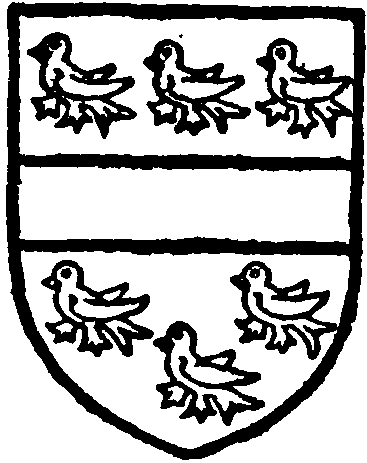
Beauchamp of Powick. Gules a fesse between six martletas or.
In 1275 it was presented that William, father of Walter Beauchamp of Powick, had withdrawn the suit of his men of Powick and Bransford from the sheriff's tourn and transferred it to his manor of Powick. (fn. 75)
The manor of CLEVELODE (fn. 76) (Cliuelad, Clyvelode, Clueveloude, xiii cent.; Clyvelode, Cleavelode, xiv-xvii cent.) was doubtless the estate in Powick which Godric held in the time of Edward the Confessor and which was held by Walter Poer (Ponther) in 1086. (fn. 77) It was held under the Abbots of Westminster till the 15th century. (fn. 78)
Hugh Poer in 1166 held three knights' fees in Worcestershire and Gloucestershire of the Abbot of Westminster. (fn. 79) John Poer between 1204 and 1234 gave land in Powick to the abbey of Pershore, Roger Poer confirming the gift. (fn. 80) William Poer in 1274 was presented for making a warren in Clevelode and other places, but he showed his warrant. (fn. 81) He or his son William (fn. 82) paid a subsidy of 10s. on his lands here in 1276 (fn. 83) and was living in 1295. (fn. 84) In 1322–3 Isabel widow of John Washbourne (fn. 85) gave to Richard le Porter land in Clevelode and Eastham and the advowson of Clevelode chapel, with remainder to his son Richard and his wife Joan. (fn. 86) Richard le Porter in 1346 paid 4s. for a tenth of a fee in Clevelode which Reynold le Porter had formerly held. (fn. 87) Before 1361 (fn. 88) Clevelode passed to the Berkeleys of Beverstone (co. Gloucs.), for in that year John Berkeley, son of Thomas Lord Berkeley by his second wife Catherine, (fn. 89) presented to the chapel. (fn. 90) In 1372 Margery, wife of Thomas Rawlins, daughter and co-heir of Richard le Porter, confirmed Clevelode to John Berkeley. (fn. 91) Catherine Lady Berkeley died in 1386 seised of lands in Clevelode and the advowson of the chapel. (fn. 92) She was succeeded by Sir John, who held a fee in Clevelode in 1388–9 (fn. 93); he was seised of the manor on his death in 1428. (fn. 94) His son and heir Maurice was succeeded in 1460 (fn. 95) by a son Maurice, who died in 1473–4. (fn. 96) His son Sir William Berkeley (fn. 97) probably sold Clevelode in 1527 to Richard Bartlett. (fn. 98) Richard settled it in 1555 on his nephew Thomas, (fn. 99) who sold it in 1580 to Richard Lygon of Madresfield, (fn. 100) with which manor Clevelode has since descended. (fn. 101)
The manor of PIXHAM (Picresham, xi cent.; Pykerham, Pykeresham, xiii cent.) was apparently included in Powick in 1086. (fn. 102) According to one account it was valued at 23s. and belonged to Urse. (fn. 103) The names of Richard and Simon de Pixham occur as landholders in Powick in 1276, (fn. 104) but the manor is not mentioned till the Dissolution, when with 'Powick Messor' it was in the hands of the Prior and convent of Great Malvern. (fn. 105) It was leased with the capital manor to Richard Berde in 1541, (fn. 106) and in 1546 was granted in reversion to Thomas Wymbish and his wife Elizabeth Lady Talboys, (fn. 107) who in the same year had licence to alienate it to Lord Clinton. (fn. 108) He sold Pixham to the Crown in 1547. (fn. 109) Queen Elizabeth granted it in 1560 to William Garrard and William Chester, (fn. 110) but it was surrendered and the grant cancelled in 1562. (fn. 111) It was bought from the Crown in 1599 by William Lygon of Madresfield (fn. 112) (q.v.), with which manor it has since descended. (fn. 113)
The manor of WOODSFIELD (Wyndeff, xii cent.; Wrdsfelda, Wortefeld, xiii-xiv cent.; Woodfeld, Worfield, xvi cent.) was granted by Gilbert Abbot of Westminster (ob. 1117) to the Prior and convent of Great Malvern (fn. 114) and confirmed to them by Henry I. (fn. 115) In 1276 Woodsfield was assessed under the vill of Baldenhall as a possession of the priory, (fn. 116) and in 1291 it comprised 2 carucates of land. (fn. 117) At the Dissolution the manor was valued at £4 5s. 8½d. a year. (fn. 118) It was leased in 1541 to Richard Berde, (fn. 119) and in 1575 was granted in reversion to John Dudley and John Ascough. (fn. 120) Before 1598 it had passed to Robert Walweyn and Joyce Walweyn, widow, (fn. 121) and has apparently since descended with the manor of Newland in Great Malvern. (fn. 122)
Another so-called manor known as PRIOR'S COURT or the RECTORY MANOR, (fn. 123) and possibly to be identified with POWICK MESSOR, (fn. 124) was surrendered by the Earl of Lincoln to the Crown in 1576. (fn. 125) This manor had been leased by Thomas Dereham, Prior of Great Malvern (c. 1533–8), (fn. 126) to William Staple and Joan his wife and their sons. Richard Cupper bought their lease about 1573 and kept a court (fn. 127) here from 1577 to his death about 1586. He conveyed the manor to Richard son of John Cupper. (fn. 128) Another deed, however, states that John Cupper purchased the rectory and manor of Powick from John Wellesburne and others, (fn. 129) and that they passed to his eldest son Thomas with contingent remainder to his younger sons Vincent and Richard. Richard granted his interest to the Crown about 1585. (fn. 130) It may after this time have passed with the rectory (see below), and is now in the possession of the Earl of Coventry. (fn. 131) The manor of the rectory was said in the 16th century to be greater than the manor of Powick. (fn. 132)
Two mills at Powick are mentioned in the Domesday Survey, one for the use of the hall and the other on the holding of Gilbert Fitz Turold. (fn. 133) They were probably granted with the manor to the priory of Great Malvern, for in 1291 the prior held two mills in Powick at fee farm of the Abbot of Westminster. (fn. 134) In 1626 a survey of the manor of Powick was made, (fn. 135) and it was found that there had been a windmill (fn. 136) built on the demesne lands of Powick, but it had been removed by one of the Cuppers and set up on copyhold land pertaining to the manor of Powick, which copyhold was granted to Richard Cupper. There was also a water corn-mill on the manor of Powick, but it was in decay in 1626.
CHURCHES
The church of ST. PETER consists of chancel 37 ft. by 20 ft., north and south transepts each 26 ft. by 19 ft. 6 in., nave 75 ft. 6 in. by 21 ft. 6 in., with north and south aisles, and west tower 14 ft. square, all these measurements being internal. The north aisle is 11 ft. wide and the south aisle 10 ft., the width across nave and aisles being 47 ft.
The oldest parts of the building are the walls of the transepts, which, though refaced in places and with later windows inserted, are substantially of 12thcentury date. The chancel belongs to the 13th century, the walls of the aisles to the 14th century, while the nave arcade is of c. 1380–1400, and the tower of the early part of the 15th century. The existing 12th-century work, which includes two windows in the north and one in the south transept, together with the respond of an arch between the south transept and the aisle, points to the existence of a large Norman church with transepts, centre tower and an aisled nave. The evidence of the south aisle is conclusive, but the respond is of c. 1190 and suggests that the aisle was added to a building of earlier date. The exact plan of the Norman building and whether it comprised a north aisle must remain, however, conjectural. There is some reason to believe from the evidence of the east walls of the transepts that the early 12th-century church was a simple version of the plan of Worcester Cathedral with transept apses and an apsidal chancel. The impropriators probably rebuilt and lengthened the chancel in the 13th century, and an east window was inserted above the altar in the north transept c. 1250. In the 14th century, perhaps c. 1320, but possibly later, the aisles were rebuilt, most likely with a view to the entire reconstruction of the nave, but the old arcades seem to have been left standing till c. 1380–1400, to which date the present arcading may be ascribed. The transepts were also reconstructed in the latter part of the 14th century and new windows were inserted in the chancel at the time that the aisles were rebuilt. The tower followed the rebuilding of the arcades and is of early 15th-century date. The building was restored about 1845, when the north and south doorways were blocked up, a south porch removed, an entrance made through the tower at the west end and the interior repaired and refitted with open seats. There was a further restoration in 1896–7.
The greater part of the walling is of pink sandstone roughly coursed, but the tower is faced with yellow ashlar. The aisles are under leaded lean-to roofs, but all the rest of the roofing is covered with modern red tiles overhanging at the eaves. There is no clearstory and the ridge of the transept roofs is the same height as that of the nave. The chancel roof is slightly lower and the aisle roofs are also without parapets. Apart, therefore, from the tower, which is of good proportions, the general external appearance of the building is not architecturally interesting. On the tower are still the bullet marks of the fighting on the advance of the Parliamentary troops on 3 September 1651.
The chancel has an original east window of three lancet lights with external labels and rounded string at the sill level. The openings are chamfered on the outside, but internally have moulded heads springing from banded shafts with carved capitals and moulded bases. There is a moulded string at the sill level, formerly, no doubt, running all round the chancel inside, but now only remaining along the east and part of the north wall, at the east end of which two original lancets remain. They have external labels carried along the wall as a string-course about twothirds of its length, and the sill moulding is also carried along the north wall, dropping on the west side of the doorway. It probably went all round the chancel, but was removed on the south side when the later windows were inserted. The buttresses are of two stages finishing below the eaves, and there is a chamfered plinth. The north doorway is original 13th-century work and has a plain chamfered head and jambs with moulded label. On the south side the chancel is lighted by three 14th-century windows, each of two trefoiled lights, with quatrefoil in the head, but without labels. They are unequally spaced, the two westernmost being near together. The south doorway, which is built up and has a flat four-centred head, is probably later in date. There is another 14th-century two-light window at the west end of the north wall. The south wall seems to have been a good deal rebuilt subsequent to the 13th century, and no traces of ancient ritual arrangements remain. The roof, which was restored in 1896, is of four bays with three old king-post principals, but the rafters are modern. The chancel arch appears to have been rebuilt and is of two chamfered orders, the inner springing from moulded corbels and the outer carried down to the ground on each side. The axis of the chancel is swung round considerably to the north of that of the nave.
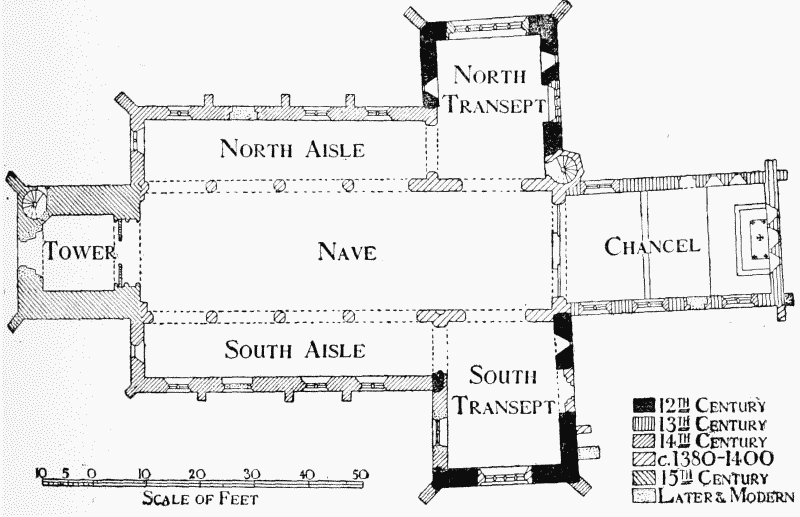
Plan of Powick Church
If the 12th-century church had a central tower it was entirely removed in later times, either in the 14th century or when the nave arcade was reconstructed. The arches opening to the transepts from the nave, though springing at a lower level and less in height than those further west, are of the same character, as also are the arches between the transepts and aisles. Both transepts have diagonal buttresses of two stages at the angles, but the end wall of the south transept is entirely hidden by ivy. The three 12th-century windows occur in the east and west walls of the north and in the east wall of the south transept, and are all of the usual type, high up in the wall, with semicircular heads in one stone and wide internal splays. Below the south transept window is a fragment of a flat chamfered string-course, but no other 12th-century feature remains on the outside. In the east wall, however, inside is a shallow recess about 8 ft. wide with segmental arch, the jambs of which to a height of 5 ft. 8 in. are of 12th-century date. If these jambs are in their original position, they suggest the existence of an apse, but they may have been constructed with stones from the old building at a later date. It is not easy, however, to account for this feature if introduced in the 14th century or later, and it is therefore reasonable to suppose the transepts had apses on the east side, all traces of that on the north having disappeared. The spaces between the jambs are now built up with masonry pierced by a late 14th-century doorway, the filling being recessed behind the face of the transept wall. The 13th-century window in the east wall of the north transept is of three trefoiled lights with a large triangular sexfoil opening above, but there is no containing arch or label. The north window is of five cinquefoiled lights with perpendicular tracery, apparently a restoration of a 15th-century insertion. In the south-east corner of the transept a doorway led by a circular stone staircase to the rood loft, but no trace of the opening to the loft remains. In the end wall of the south transept is a window of four cinquefoiled lights with a straight-sided four-centred head and in the west side a two-light window with forked mullion. There is also a similar two-light window high up in the east wall above the recess. The east wall appears to have been a good deal tampered with, two buttresses being added near its south end, the reason for which is not clear. The roof of the north transept is old with framed rafters and a moulded wall-plate, but has been newly boarded. The south transept is now used as an organ chamber and vestry, and both transepts are separated from the nave and aisles by modern oak screens. There are no traces of mediaeval ritual arrangements.
The nave arcade consists of five pointed arches of two chamfered orders without hood moulds springing from octagonal piers with moulded capitals and square bases. The piers have a double wave moulding, rather delicate in outline, on each of the four longer sides, and the responds are of similar section. The eastern arch of both arcades, as before mentioned, springs from responds at a lower level, being separately treated from the rest, the transverse arches to the aisles abutting on long masonry piers. The aisles are each lighted from their side walls by three windows of two trefoiled lights with a quatrefoil in the head, and there is a similar window at the west end of the north aisle. The corresponding window on the south consists of a single trefoiled light. The south doorway is of 14th-century date and has a double wave moulding to the jambs and head and moulded label. The line of the former porch roof shows above the opening. The north doorway has a plain four-centred head. The nave roof consists of framed rafters and was restored in 1896–7, the old timber being used. The walls internally are of bare stone with red pointing.
The tower is of three stages with diagonal buttresses its full height and terminates in an embattled parapet and angle pinnacles. The belfry windows are of three trefoiled lights with perpendicular tracery and hood moulds, and there is a pointed single-light window to the middle stage on each side. The west window is of four cinquefoiled lights and perpendicular tracery, but the mullions and tracery, like the doorway below, are modern. There is a vice in the north-west corner, but the original internal doorway has been built up and a new one inserted outside. There is a clock with a dial facing west. The tower is open to the nave by a lofty arch of a single chamfered order carried down the jambs to the ground. The soffit is plain, but the face of the jambs has sunk stone panelling with traceried heads. Below the arch is a modern Gothic stone screen of the same date as the west doorway.
The font is of 14th-century date and consists of an octagonal stone basin with panelled sides containing quatrefoils within circles and stands on a panelled and moulded stem and base. The nave contains a large number of 15th-century traceried oak bench ends, but the seating was carried out during the restoration of 1845. The pulpit is modern. The flooring of the nave and transept and other parts of the church contains a considerable number of inscribed blue grave slabs, some with coats of arms, and below the pulpit is one of mediaeval date with an incised calvary cross.
In the north transept are two 17th-century mural monuments, one to William Cookes (d. 1672), son of Sir William Cookes, bart., and the other to Daniel Tyas (d. 1673) and Elizabeth his wife, both with shields of arms, the latter erected in 1678 with a long Latin inscription. There is also a monument in the north transept, with reclining marble figure, by T. Scheemaeckers, to Mary wife of William Russell and daughter of Joseph Cocks, who died in 1786, and a number of 18th-century mural tablets, one in the chancel to Richard Case (d. 1774) and Anne his wife (d. 1765). (fn. 137) In the vestry is a fine oak table 9 ft. 6 in. long, with massive turned legs, apparently of late 16th-century date, and in the chancel two 17th-century oak chairs with hinged backs.
There is a ring of six bells, originally cast by Abraham Rudhall of Gloucester in 1705. The tenor was recast by Mears of London in 1833. In 1910 the second, third and fifth were also recast and all the bells rehung. The old inscriptions were retained in the new bells. (fn. 138)
The plate consists of cup and cover paten without date letter, the former inscribed, 'This Cupe belongeth to the Parish of Powick in Worcest' Sheare 1674,' and the latter ' Powick 1674,' a large paten inscribed, 'This plate belongeth to the Parish of Powick in Worcestr Sheare 1674,' (fn. 139); a flagon of 1862 presented by Mr. G. E. Martin of St. Cloud in 1878, and a chalice of 1891 given by Mr. J. W. WillisBund in 1894.
The registers before 1812 are as follows: (i) baptisms and burials 1662 to 1730, marriages 1664 to 1730; (ii) all entries 1731 to 1770; (iii) all entries 1771 to 1812; (iv) marriages 1754 to 1812.
In the churchyard is a gravestone to John Titmarsh of Haseley in Warwickshire, who died in 1765, aged 102 years. (fn. 140) A lych-gate was erected in 1912 to the memory of Arent de Peyster Chance, who died in 1906.
The church of ST. JAMES, Callow End, was built in 1888 by the sixth Earl Beauchamp. It is a plain brick building and serves as a chapel of ease to Powick Church.
ADVOWSON
There was a priest at Powick in 1086. (fn. 141) Urse the sheriff gave the tithes of Powick to the priory of Great Malvern, (fn. 142) the church being confirmed to the priory by Pope Honorius III in 1217. (fn. 143) In 1314 the church was appropriated to the priory and a vicarage was ordained. (fn. 144) At the Dissolution the vicarage was valued at £10 14s. 5d. (fn. 145) The advowson and rectory were granted with the manor to Lord Clinton, (fn. 146) who alienated them to the Crown in 1547. (fn. 147) He as Earl of Lincoln made another conveyance of the rectory and advowson to Queen Elizabeth in 1576. (fn. 148) In 1600 the advowson was conveyed by John Hayes and Elizabeth his wife and Thomas Cupper to Sir Henry Bromley, (fn. 149) and it has since descended with the manor of Powick. (fn. 150)
The rectory, having passed to the Crown in 1547, (fn. 151) was granted by Queen Elizabeth in 1578 to the Earl of Lincoln and Christopher Gough. (fn. 152) In 1600 John Hayes and Elizabeth his wife and Thomas Cupper conveyed the rectory to Sir Henry Bromley, (fn. 153) and it afterwards passed, probably with the manor, to the Earl of Coventry. (fn. 154) The tithes were held by the corporation of Worcester in 1703, (fn. 155) and are still in their possession.
The rectory had been leased by the last Prior of Great Malvern to one Thomas Rocke; his daughter married William Pinnock, who about 1559 was farmer of the rectory by virtue of this lease. (fn. 156) Pinnock's widow married Richard Smith, the next farmer, who leased the rectory to Michael Lygon. After Michael's death Richard Cupper bought the fee farm of the rectory from Henry and Robert Townsend, two of Lygon's trustees. (fn. 157) Richard Cupper in 1585 granted his interest in the rectory with the Rectory Manor to the Crown. (fn. 158)
The advowson of the chapel of St. Michael (fn. 159) at Clevelode was held by the lords of that manor. (fn. 160) The first mention of the chapel occurs in 1322–3. (fn. 161) It was annexed to the chantry of Over in Gloucestershire. (fn. 162) In 1595 the chapel was united with the church of Madresfield, because of their nearness and the smallness and poverty of the hamlets. (fn. 163) Though decayed, the chapel was standing in 1607–8 (fn. 164); it had completely disappeared by the middle of the same century. (fn. 165)
The chapel of Woodsfield, dedicated to St. Mary Magdalen (fn. 166) and built before 1250–1, (fn. 167) was in the patronage of the Prior and convent of Malvern, (fn. 168) to whom in that year Thomas, parson of Powick, granted his right to 12d. a year from the chapel. (fn. 169) Until the Dissolution the prior provided a monk to read service on alternate Sundays at this chapel and at Newland. (fn. 170) The rectory and chapel of Woodsfield were granted in 1545 to Lord Clinton, (fn. 171) and surrendered by him as Earl of Lincoln to the Crown in 1576. (fn. 172) They were granted in 1575 to John Dudley and John Ascough, (fn. 173) and thenceforward descended with Woodsfield Manor. (fn. 174) The chapel, though much decayed, was in existence about 1624. (fn. 175) It was in ruins in 1754, and has now completely disappeared. (fn. 176) Its site, near Woodsfield Grange, is still known as Chapel Field.
A chantry dedicated in honour of our Lady was in existence at Powick early in the 16th century. (fn. 177) In 1560 all lands in Powick and St. John in Bedwardine, formerly belonging to the chantry of St. Mary in Powick, were granted to Richard Okeham and Richard Byttenson. (fn. 178) These lands were held by the Moores early in the 17th century. (fn. 179)
CHARITIES
The following charities are regulated by a scheme of the Charity Commissioners, 25 November 1897, under the title of the United Charities, namely:
(1) The charities of John Greenway, will, 1631, and fourteen others, commonly known as the Charity Lands; trust funds, £2,103 16s. 7d. consols, representing proceeds of sales of land and accumulations of income;
(2) The charities of John Chettle, will, 1730, John Purser, Thomas Tolley, and Michael Farr; trust fund, £58 12s. 6d. consols, representing redemption of rent-charges;
(3) Charity of Phineas Jackson, will, 1680, consisting of 10 acres at Stoke Lacy (co. Hereford), let at £20 a year;
(4) Charity of John Worfield, will, 1642, being a rent-charge of £8 issuing out of an estate called Knutsford, belonging to the Earl of Coventry;
(5) Charity of Samuel Beard, will, 1747, being a rent-charge of 10s. issuing out of land called Weat Lessow, belonging to Earl Beauchamp;
(6) Charities of Elizabeth Poole, will, 1776, Rev. Thomas Cooke, will, 1786, and of Mrs. Worfield and Mrs. Mary Brinton, mentioned on the church table; trust fund, £125 5s. 1d. consols;
(7) Charity of John Benjamin Morgan, will, proved at London, 13 June 1851; trust fund, £103 4s. 6d. consols;
(8) Charity of Henry Herbert, will, proved at Worcester, 20 August 1859; trust fund, £32 1s. consols.
The several sums of stock, amounting together to £2,422 19s. 8d. consols, are held by the official trustees, producing £60 10s. 8d. yearly, making with the realty a total gross income of about £90 a year.
The scheme provides that two-thirds of the net income of Phineas Jackson's charity shall be paid to the vicar and churchwardens and applied by them for the benefit of poor children of the parish, and, subject thereto, the income of the said charities shall be applied by the body of trustees by the said scheme constituted, in accordance with the subsisting trusts, for the benefit of the poor of the parish.
In 1910 £12 11s. was expended in bread, £27 18s. 6d. in money, £24 16s. 10d. in coats and gowns to sixteen men and twenty women, £8 to four old men, and £1 to twenty widows, and the remainder of the income in repairs and cost of management.
The Strawson charity, founded in 1877 by deed, is endowed with a sum of £542 10s. India 3½ per cent. stock with the official trustees. The annual dividends, amounting to £19, are applicable for the benefit of necessitous patients discharged as recovered from the County and City of Worcester Pauper Lunatic Asylum.