A History of the County of Worcester: Volume 4. Originally published by Victoria County History, London, 1924.
This free content was digitised by double rekeying. All rights reserved.
'Parishes: Acton Beauchamp', in A History of the County of Worcester: Volume 4, ed. William Page, J W Willis-Bund (London, 1924), British History Online https://www.british-history.ac.uk/vch/worcs/vol4/pp224-227 [accessed 30 April 2025].
'Parishes: Acton Beauchamp', in A History of the County of Worcester: Volume 4. Edited by William Page, J W Willis-Bund (London, 1924), British History Online, accessed April 30, 2025, https://www.british-history.ac.uk/vch/worcs/vol4/pp224-227.
"Parishes: Acton Beauchamp". A History of the County of Worcester: Volume 4. Ed. William Page, J W Willis-Bund (London, 1924), British History Online. Web. 30 April 2025. https://www.british-history.ac.uk/vch/worcs/vol4/pp224-227.
In this section
ACTON BEAUCHAMP
Hactone, Aactune, Actun (viii cent.); Actune, Acton, ultra Tamedam, Hactona (xiii cent.); Acton Beauchamp (xiv cent.).
Acton Beauchamp, formerly in Worcestershire, was transferred to Herefordshire in 1897. (fn. 1) The River Leadon and its tributaries bound it on the south and east, and it is also watered by a tributary of Leigh Brook, on which stands Acton corn-mill. (fn. 2)
The parish lies on high ground. Between the church and Acton Green a height of 600 ft. is reached, and on the eastern boundary the land falls to 300 ft. The area is 1,544 acres. The soil is loam and the subsoil Old Red Sandstone, interstratified with cornstone at Pippin's Hill in the north. The chief crops are wheat, barley and hops. In the west and south are quarries of building stone which contain numerous fossil fishes. (fn. 3)
The village, which is at Acton Green, about 1½ miles east of the church, at the crossing of the Bromyard and Worcester roads, consists of some halftimber 17th-century cottages, a square 18th-century stone house two stories in height, with a plastered front, on the south side of the road, and some modern brick cottages. There is an early 19th-century brick toll-house at the cross-roads, which is now ruinous.
Near Redmarley Farm, where there was formerly an ancient farm-house, there is a curious periodical spring known as the Roaring Water, issuing from a cavity called Hunger Hole. Near it formerly grew a holy thorn said to have been a scion of that of Glastonbury, which put forth flowers at night on Christmas Eve. This attracted so many sightseers that in the early 19th century the farmer cut it down, and tradition has it that his sacrilegious act was followed by the burning of his farm after his leg and arm had been broken in an accident. (fn. 4)
Names mentioned among the Anglo-Saxon boundaries of Acton Beauchamp given by Heming are Horsebrook, Hawbridge, Bylyngbrook, Leagesgate, Bickerafold, Scottaweth, Gislanford, Saltersway, Clacgwyllan. (fn. 5)
MANOR
The manor of ACTON was one of the properties involved in the great dispute between the churches of Worcester and Evesham before the Conquest, and its early history has therefore to be extracted from details of this quarrel. Both monasteries are suspected of altering or forging charters in support of their claims, and a full discussion of the merits of the case as regards Acton has already been given. (fn. 6)
According to the Domesday Survey Acton had belonged to the church of St. Mary of Evesham in the reign of Edward the Confessor, and Urse received it afterwards from the abbot in exchange for some other land. (fn. 7) In 1086, however, Urse held it of Odo, Bishop of Bayeux, and the manor was still held of the fee of the Bishop of Bayeux in the 12th century, (fn. 8) but in 1298 and 1316 it was said to be held of the Abbot of Evesham. (fn. 9)
This manor, with Urse's other possessions, passed to the Beauchamps of Elmley, and seems to have followed the descent of Elmley Castle (fn. 10) until about the middle of the 13th century, (fn. 11) when it was held by James Beauchamp, a younger son of Walter Beauchamp of Elmley. (fn. 12) It is uncertain whether the manor was given to James by his father, or whether like Sheriffs Lench (fn. 13) he had received it from his brother William. By an undated charter William granted to him view of frankpledge and freedom from suit at shire and hundred in this manor, (fn. 14) and at about the same time James obtained from Maud, widow of Robert D'Abitot of Acton, from her son John and from John le Cur all the land which they held in Acton. (fn. 15) James was in possession of the manor about 1280, (fn. 16) and, probably on account of the failure of his issue, it afterwards reverted to the elder branch of the family, being held by William Earl of Warwick at the time of his death in 1298. (fn. 17)
In 1345 Thomas Earl of Warwick, grandson of William above named, (fn. 18) conveyed Acton Beauchamp among other manors to trustees for providing portions for his daughters. (fn. 19) He must shortly afterwards have given it to Giles Beauchamp of Powick, for Giles died in 1361 holding it of Thomas Earl of Warwick. (fn. 20) Acton Beauchamp then followed the descent of Beauchamp Court in Powick to the Lygons, (fn. 21) and was sold in 1602 by William Lygon to Rowland Berkeley (fn. 22) of Spetchley. Rowland's son William, who succeeded him in 1611, (fn. 23) purchased Cotheridge Manor in 1616, and Acton Beauchamp then descended with Cotheridge (q.v.) until about 1805, (fn. 24) when the Rev. Henry Rowland Berkeley sold it to Mr. Heming. (fn. 25) In 1822 Richard Heming held the manor with the mansion-house of Sivington, (fn. 26) and the manor was purchased of his trustees in 1858 by William Hanbury Sparrow of Penn, co. Staffs. (fn. 27) From him it passed in 1867 to William Mander Sparrow, who died in 1881 without issue. He was succeeded by his nephew Mr. William Arthur Brown, son of Louisa daughter of William Hanbury Sparrow and wife of George Gwynn Brown of Mitton Grange, Stourport. Mr. W. A. Brown, who took the name of Sparrow on succeeding to the estates of his mother's family, (fn. 28) sold the property in 1912. Mr. George Holloway of Sivington Farm is now lord of the manor. (fn. 29)
CHURCH
The church of ST. GILES consists of a chancel measuring internally 20 ft. 2 in. by 14 ft. 9 in., nave 34 ft. 4 in. by 19 ft. 8 in., and a west tower about 11 ft. square.
The plain chancel arch and the east wall of the nave, which measures about 3 ft. 4 in. in thickness, are the only surviving fragments in situ of a 12thcentury church. The rest of the building, the walls of which are only 2 ft. I in. thick, appears to have been rebuilt at a comparatively modern period, the south doorway, which dates from c. 1200, being reset.
Both chancel and nave are lighted by large plain round-headed lights; the south window of the nave may have some mediaeval stones in its jambs, but with this exception the windows are modern, or at least subsequent to the 17th century. The south doorway is of two round-arched orders externally. The outer order is roll-moulded and springs from jamb shafts with moulded bases of the water-holding type. The capital of the eastern shaft has boldly executed human heads carved upon it, while that of the western shaft is merely scalloped. The inner order is continuously moulded with a plain deep chamfer, and the arch stones have been numbered for resetting. In the walling on either side of the doorway, at the level of the springing of the arch, are large pockets, as if there had originally been a timber porch. A small gallery occupies the west end of the nave. The tower is undivided externally, and is crowned by a pyramidal slated roof with wide caves. In the south wall of the ground stage is a plain doorway with the head formed out of a stone sculptured with scroll foliage, perhaps an early 12th-century coffin-lid. The bell-chamber is lighted by small pointed windows with brick rear arches, and the intermediate stages by small round-headed lights, the jambs of which appear to contain some reset stones from the former church. The walls throughout are of sandstone rubble plastered in places, and are crowned by a rough cornice of brick. Both chancel and nave have elliptical barrel ceilings.
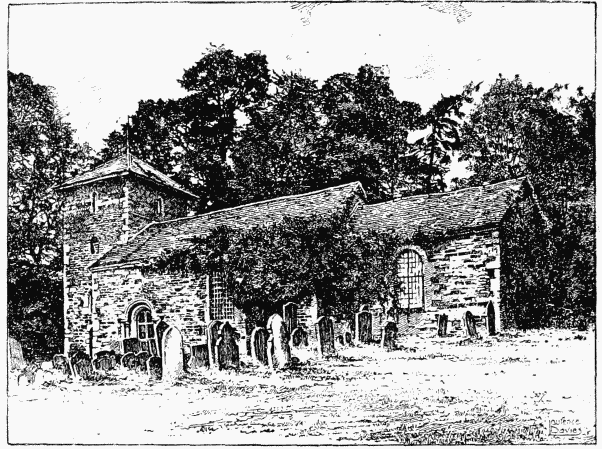
Acton Beauchamp Church From The South-East
The font has an octagonal bowl and stem, and is probably of the 15th century. In the chancel are two chairs of the last half of the 17th century. Some Jacobean panelling remains in the jambs of the doorway to the gallery. The 18th-century box pews still survive, and on the gallery front is fixed a small barrel organ made about eighty or ninety years ago by Benjamin Dobson of London. On the south wall of the nave is a mural tablet commemorating Thomas Heming, who died in 1777, Mary his wife, 1776, and other members of his family. On the north wall is a mural monument to Henry Brace, 1773, his wife Ann, 1767, their son Henry, 1773, and others of the same family. There are also several 18th-century floor slabs in the chancel and nave.
There are three bells; the treble and second, cast at Worcester, date from the 15th century, and the maker's mark is a cross saltire with a fleur de lis in each corner. The treble is inscribed in crowned Gothic capitals, 'Sancte Gabriel ora pro nobis,' and the second, 'Sancte Petre ora pro nobis.' The tenor has 'Fear God Honour the King,' with the mark of Abel Rudhall and the date 1748.
The plate consists of a silver cup and cover paten of about 1670, with the marks obliterated.
The registers before 1812 are as follows: (i) baptisms 1577 to 1699, burials 1577 to 1700, marriages 1577 to 1695; (ii) baptisms and burials 1700 to 1803, marriages 1700 to 1761; (iii) marriages 1725 to 1812.
ADVOWSON
The advowson of Acton Beauchamp belonged to the lords of the manor from the time when it is first mentioned in 1315 until the beginning of the 19th century. (fn. 30) It was apparently retained by the Rev. Henry Rowland Berkeley when the manor was sold, for he presented in 1807. (fn. 31) A manuscript note of 1822 states that the advowson was sold by Mr. Berkeley to 'the present incumbent.' (fn. 32) At that date, however, the incumbent was the Rev. H. Berry, the patron being H. Wrighte. (fn. 33) In 1829 the advowson belonged to Miss M. A. Bourne, (fn. 34) who afterwards became Mrs. Cowpland, and it remained in her family until 1914, when it was sold by the representatives of the late Rev. William Epworth Cowpland to Mrs. S. A. Richings, the present patron. (fn. 35)
There do not appear to be any endowed charities subsisting in this parish.