
A History of the County of Worcester: Volume 4. Originally published by Victoria County History, London, 1924.
This free content was digitised by double rekeying. All rights reserved.
'Parishes: Edvin Loach', in A History of the County of Worcester: Volume 4, (London, 1924) pp. 272-275. British History Online https://www.british-history.ac.uk/vch/worcs/vol4/pp272-275 [accessed 24 April 2024]
In this section
EDVIN LOACH
Edevent (xi cent.); Yeddefen, Yedefenne Loges (xiii cent.); Yedefont Loges, Zeddenfenlogges, Yedefenlonges (xiv cent.); Yedfenloges (xv cent.); Edvinloche, Edvyn Loche, Edwin Loch (xvi cent.).
This very small parish, lying 3 miles north of Bromyard station on the Worcester and Leominster section of the Great Western railway and 15 miles west of Worcester, was formerly a detached portion of the county, surrounded on all sides by Herefordshire. Under the Acts of 1832 and 1844 (fn. 1) Edvin Loach was made part of Worcestershire, but in 1842 it was placed in Herefordshire for purposes of the land tax. (fn. 2) In 1893 it was transferred to Herefordshire, (fn. 3) though for Parliamentary purposes it still remains in Worcestershire.
The village is near the southern boundary of the parish. The old church is no longer used for divine service, being replaced by a new church close by. Habington wrote of' the little church without arms or monuments which adjoineth here so near an old fortification as they both seem to possess jointly antiquity and poverty.' (fn. 4) Nash's suggestion that the manor-house was formerly here seems probable. (fn. 5) It is the highest point (600 ft.) in the parish, the rest of which is about 500 ft. above the ordnance datum.
Prattinton, writing before 1829, (fn. 6) records that in a field near the church the late Mr. Richard Jones began building a brick house which remained unfinished at his death, and had since been allowed to go to decay, that this was said to have been built or the site of an old moated stone house called Camp House, and that bones and skulls were found in digging the foundations. Camp House, adjoining the churchyard, was advertised for sale in 1820. (fn. 7) Prattinton also concluded from the 'very parkish appearance' of the hill on which the church stands, and from what seemed to be the remains of an entrenchment at its summit, that it was on this spot that the fortification mentioned by Habington had formerly stood.
On the road to the south-east of the church there is a two-storied half-timber and brick cottage of the 17th century. Steeple Farm, further south on the same road, is a 16th-century two-storied house of half-timber and brick with an 18th-century stone addition on the north making the plan H-shaped. The old part of the house retains its original timbering with diagonal panels in the front gable. The upper story projects beyond the lower face on all sides, except on that which joins the 18th-century work, and is supported by moulded beams and brackets.
The parish has an area of 533 acres, which is chiefly permanent grass, (fn. 8) and is watered by the River Frome and its tributaries. The soil is clay, the subsoil Old Red Sandstone, producing crops of corn.
In 1884 Combe's Wood was transferred for civil purposes from Edvin Loach to Collington. (fn. 9)
MANORS
The manor of EDVIN LOACH was held by Osbern Fitz Richard in 1086, and Ulfac had held it in the reign of King Edward. (fn. 10) The overlordship belonged to the lords of Richard's Castle, following the descent of Wychbold in Dodderhill, of which manor it appears to have been held, until 1434. (fn. 11) In 1535, 1558 and 1561 it was said to be held of the barony of Beauchamp. (fn. 12)
In 1086 Herbert held the manor of Osbern Fitz Richard. (fn. 13) In 1211–12 John de Loges held half a knight's fee in Edvin Loach. (fn. 14) He had been succeeded before the middle of the 13th century by William de Loges, (fn. 15) who paid half a mark to the subsidy about 1280 for his land here. (fn. 16) William gave to his daughter Maud de Loges a rent of 5s. from land in Piry (Piro), near Kyre Wyard, (fn. 17) and in 1300 Miles Pichard (fn. 18) was sued for having disseised Maud of her estate. (fn. 19) In 1287 and again in 1308 the heirs of William de Loges were said to be holding the manor, (fn. 20) but the actual owner of the manor is not known until 1346, when Hugh de Hawkesley held it. (fn. 21) In 1393 a messuage and a carucate of land in Edvin Loach was settled on Roger Mortimer of Tedstone Wafer, Hugh de Hawkesley, clerk, acting as trustee. (fn. 22) Roger Mortimer died in 1402, (fn. 23) and the manor then followed the descent of Kyre Wyard (q.v.) until 1520, when Kyre Wyard was sold. Edvin Loach was retained by Lord de la Warr, and sold by his son Sir Thomas in 1528 to Sir Humphrey Coningsby. (fn. 24) It then descended with North Piddle (q.v.) in the Coningsby family, being sold to Sampson Wise in 1657–8. (fn. 25)
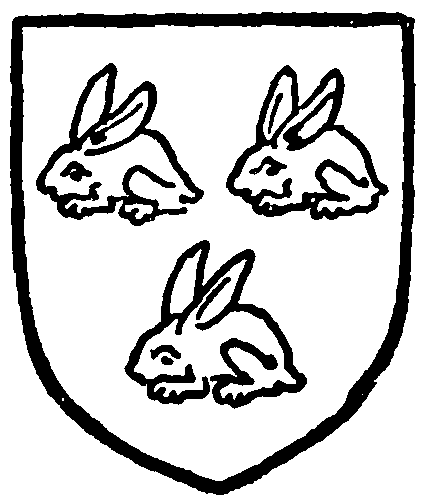
Coningsby, Earl Coningsby. Gules three sitting conies argent.
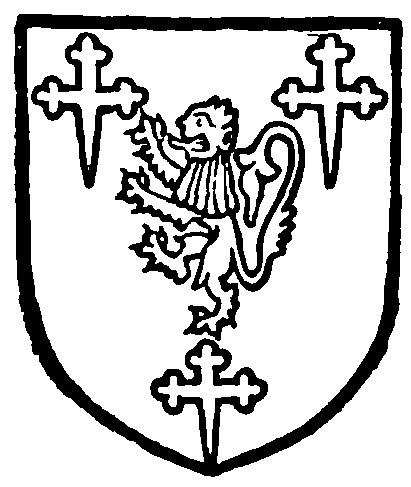
Capell, Earl of Essex. Gules a lion between three crosslets fitchy or.
There are no deeds relating to the manor from this time to 1782, but it probably passed with Orleton and other manors of the Coningsbys to Ferdinando Gorges of Eye, and by the marriage of his daughter Barbara with Thomas Coningsby (fn. 26) was recovered by the Coningsby family. Thomas was created Lord Coningsby in 1692 and Earl of Coningsby in 1719, and died in 1729. (fn. 27) This manor probably descended with the earldom to the children of his second wife, (fn. 28) Margaret, who died without surviving issue in 1761, (fn. 29) and Frances wife of Sir Charles Hanbury-Williams. Frances daughter of the latter married William Capell fourth Earl of Essex, but died in her mother's lifetime. (fn. 30) On the death of Lady Hanbury-Williams in 1781 her grandson George Capell Viscount Malden succeeded, and assumed the name Capell Coningsby. (fn. 31) He was in possession of the manor in 1782, (fn. 32) and succeeded his father as twenty-fifth Earl of Essex in 1799. (fn. 33) He must have sold the manor shortly after to William Higginson of Saltmarshe (co. Heref.), who presented to the church in 1811. (fn. 34) William Higginson devised all his property to his great-nephew Edmund Barneby, who took the name Higginson in 1825 (fn. 35) and died childless in 1871, (fn. 36) when the estates passed to his nephew William Barneby. William was succeeded in 1895 by his son William Theodore Barneby, (fn. 37) the present owner of the manor.
A second manor at Edvin Loach (fn. 38) may perhaps be identified with the land which Miles Pichard held there about 1280. (fn. 39) He sold the estate between 1300 and 1304 to Edmund Mortimer (fn. 40) of Wigmore, and it followed the descent of Bromsgrove (fn. 41) until 1431, when it was held by John Holand Earl of Huntingdon, who had married Anne widow of Edmund Earl of March. (fn. 42) It probably passed to the Crown with the other estates of the earldom of March on the accession of Edward IV, but it is not again mentioned until 1556, when Thomas Baskerville leased the site to James Jones. (fn. 43) The estate then descended with Stoke Bliss to Thomas son of John Baskerville, (fn. 44) who in 1621 conveyed it as certain messuages in Edvin Loach to Thomas Collins and William Fox. (fn. 45) This manor evidently passed with Netherwood and land in Stoke Bliss in 1621 from Thomas Baskerville to Edward Reed, (fn. 46) for he conveyed it in 1648 to James Pecock. (fn. 47) Its further descent has not been traced.
CHURCH
The old church of ST. MARY THE VIRGIN, now a roofless ivy-covered ruin, stands in the churchyard to the east of the present church. It consists of a continuous nave and chancel about 39 ft. long, narrowing in width from 17 ft. 9 in. at the east end to 16 ft. 6 in. at the west end, and a west tower about 8 ft. 3 in. by 6 ft. 3 in. These measurements are all internal.
The building is particularly interesting on account of the early character of its masonry, but in the absence of any detail it is impossible to assign to it a definite date. The nave is of Saxon workmanship, probably of the early 11th century, but the tower, which also appears to be of pre-Conquest date, is a later addition. The east wall was rebuilt at the end of the 12th century, and although a straight joint occurs at its meeting with both the north and south walls of the chancel, they also have both been rebuilt, and are probably contemporary with the east wall. The upper part of the north wall of the nave is probably of the same date. The walls are built of narrow blocks of sandstone rubble and tufa, while the dressings are generally of squared tufa. The whole of the lower part of the north wall of the nave is of 'herring-bone' work, and this kind of masonry has also been introduced into the south wall. Internally the building was plastered with a thin coat of hard plaster, much of which is still to be seen.
The original church appears to have been lighted by narrow lights, having widely splayed inner jambs, set high up in the wall. Most of the walling above the level of the sills of these windows has, however, been demolished, and the lower part of the window immediately to the east of the south doorway alone survives to show their type. The lower parts of the jambs of a window at the east end of the north wall of the nave, and of another at the east end of the south wall of the chancel, besides the east jamb of a window to the west of the latter, also remain, though much broken and of a later date. In the east wall is a small pointed 13th-century window having external rebates for shutters. The doorway into the building is in the south wall of the nave and appears to be contemporary with the earliest remaining work. The jambs are square, with an internal rebate for the door, and are built in narrow courses of sandstone. Over the head of the opening is a deep tufa lintel with a semicircular relieving arch of worked voussoirs of the same material above. The tympanum and semicircular rear arch are also of tufa.
The tower stands on a base and was originally of two stages with small external offsets at each stage. The walls are now broken above the second offset. It appears to have been always open to the nave for its entire height, there being no trace of any arch to carry an east wall. Lighting the bottom story is a squareheaded window in which is set an oak frame for two lights. This window is probably an insertion of the 17th century, though above it is a small original narrow light; both have internal oak lintels. In the south wall are two square-headed windows. There are buttresses against the north wall, at the east end of the chancel, and at the junction of the walls of the chancel and nave. These were evidently added in the 13th century.
In the nave is a fragment of the bowl of a 12thcentury font enriched with a cheveron ornament. This was recovered from the old church at Tedstone Wafer, which is now disused. There are also several memorial slabs, but the earliest of these seems to be of the 17th century, though the inscriptions on many are now quite indecipherable. One is to Beatrix Jones, wife of Thomas Jones; she died 7 May 1673. Another is to Thomas Freeman, who died in 1682.
Pieces of the old wooden weathercock are still to be seen stacked up in a corner of the tower.
The new church of ST. MARY, immediately to the west of the old church, was built in the early part of the 19th century by Mr. E. Higginson. It consists of a continuous nave and apsidal chancel, vestry, south porch, and west tower with a broached stone spire. It is built of uncoursed sandstone rubble in the late 13thcentury style, and has open timber tiled roofs. In the vestry are an old oak table and an oak chest probably of the 18th century. Three bells, two from the old church of Edvin Loach and one from the old church of Tedstone Wafer, are now placed at the west end of the nave. The smallest bell bears the inscription 'John Rogarse 1629. SB,' the 6 being reversed; the bell from Tedstone Wafer is inscribed 'Thomas Houldin CW 1674,' while the other is without inscription.
The plate consists of a silver cup and paten of 1571, a modern chalice, paten, and flagon, and a pewter flagon.
The registers begin in 1570.
ADVOWSON
The church of Edvin Loach seems originally to have been a chapel of Clifton upon Teme, for in 1286 a pension of 3s. was paid from the church of Edvin Loach to that of Clifton upon Teme. (fn. 48) The advowson belonged to the lords of Richard's Castle and followed the descent of Wychbold in Dodderhill until 1419, when Eleanor Lucy was patron. (fn. 49) Its descent after this time is obscure. The bishop presented in 1476 by a lapse, (fn. 50) and in 1567 Sir James Croft conveyed the advowson to Thomas Baskerville, (fn. 51) who was already in possession of an estate here. Thomas Baskerville was described in 1576 as the 'true patron of the rectory of Colyton (Collington, co. Heref.) with the chapel of Edven Loche,' (fn. 52) but in 1617 Sir Thomas Coningsby was in possession of the advowson, (fn. 53) which has since followed the descent of the manor. (fn. 54)
In 1625 the livings of Edvin Loach and Tedstone Wafer were united, (fn. 55) and so remain at the present day.
The custody of a cottage and one-quarter of a virgate of land in Edvin Loach which John Clehungre formerly held, given to find a lamp in the church there without licence, was committed to Richard Ruyhale, jun., for sixteen years in 1377. (fn. 56)
CHARITIES
It is stated in the Parliamentary returns of 1786 that a sum of £7 had been left to the poor by a donor unknown in respect of which 7s. a year was formerly paid.
Giles's Acre consisted of about an acre of land and a cottage near the church. There are no documents extant relating to the property, which has been occupied from time to time by the parish clerk, or the rents thereof paid to him.