A History of the County of Worcester: Volume 4. Originally published by Victoria County History, London, 1924.
This free content was digitised by double rekeying. All rights reserved.
'Parishes: Ribbesford with the borough of Bewdley', in A History of the County of Worcester: Volume 4, ed. William Page, J W Willis-Bund (London, 1924), British History Online https://www.british-history.ac.uk/vch/worcs/vol4/pp297-317 [accessed 30 April 2025].
'Parishes: Ribbesford with the borough of Bewdley', in A History of the County of Worcester: Volume 4. Edited by William Page, J W Willis-Bund (London, 1924), British History Online, accessed April 30, 2025, https://www.british-history.ac.uk/vch/worcs/vol4/pp297-317.
"Parishes: Ribbesford with the borough of Bewdley". A History of the County of Worcester: Volume 4. Ed. William Page, J W Willis-Bund (London, 1924), British History Online. Web. 30 April 2025. https://www.british-history.ac.uk/vch/worcs/vol4/pp297-317.
In this section
RIBBESFORD with the BOROUGH of BEWDLEY
Ribbedford, Ribeford (xi cent.); Rybbesford (xii cent.).
The parish of Ribbesford covers a triangular piece of land bounded on the east by the River Severn and on the south-west by Gladder Brook; it contains, including the borough of Bewdley, nearly 3,713 acres, of which 455 are arable, 1,560 under permanent grass and 1,224 woodland. (fn. 1) The church of St. Leonard, Ribbesford, stands in a beautifully kept little churchyard not far from the river, and a narrow avenue of lime trees leads from it in the direction of Bewdley. A door in the churchyard wall opens into the garden of Ribbesford House. (fn. 2) The house itself was described in 1627 as 'pleassant for the somer, but not healthful for the winter' (fn. 3); it stands, fronting the Severn, immediately below the steeply rising ground of Ribbesford Wood. Sir Henry Herbert was advised by a friend not to buy the estate, as so great a part of it was coppice that it could not 'strengthen a lord with any multitude of tenants.' (fn. 4) There is still much woodland in the parish. The present house is said to stand on the site of that in which the Ribbesfords lived in the time of Henry II; there was formerly a moat round it, which can still be traced, though it was filled up about 1790, when much of the old house was pulled down. (fn. 5) The remaining portion, which is of brick and dates mainly from the first half of the 16th century, was considerably altered in the 17th century, and is now completely disguised externally by an early 19th-century facing of stucco with added details in an 'Elizabethan' manner. The principal block, which faces north-east and is three stories in height with an attic, contains a large entrance hall on the ground floor with the drawing room on the east and the dining room on the west. As originally arranged the space occupied by the dining room was probably devoted to the pantry and buttery. The hall is entered at the north-west through a three-storied entrance porch, which forms one of the principal features of the northern elevation. The ceiling is supported by richly moulded beams of the original date of the house, but the fireplace on the south and all other detail here is modern. On the southern side of the hall are two octagonal turrets rising above the eaves of the roof and crowned by leaded cupolas. These are joined on the ground floor by a corridor at the back of the hall, entered from the outside by a doorway placed centrally between the two turrets, in the western of which are the principal stairs, which date from the early 19th-century reconstruction. An 18th-century painting of the southern front of the house in the possession of the present owner shows that in their original state these turrets were circular and were then crowned by conical roofs. To the west of the principal block, and roofed continuously with it, is the kitchen wing. The kitchen, which is placed at the extreme west, was originally open to the roof, but a floor has been inserted at the level of the tiebeams, and a partition now divides the lower portion into two rooms. This wing, according to the 18thcentury view above referred to, appears to have been refaced about 1700 on the south side, but it is now stuccoed over. The original staircase was probably between the kitchen and the present dining room, but the interior here has been greatly altered, though some Jacobean panelling remains. (fn. 6) ' A long, low two-storied office wing projects northwards at right angles to the kitchen wing; the elevation towards the east has been stuccoed, but some of the original brickwork, with traces of blue brick diapering, can be seen on the west side. On the south side of the Home Farm, which stands to the south-east of the church, is a T-shaped range of buildings, which probably once formed the stables of Ribbesford House. The walls are of red sandstone with dressings of a lighter colour, and the end walls have gables with shaped kneelcrs and moulded copings. A tablet in the south wall carved with the Herbert shield, Party palewise three lions rampant, suggests that the building was erected in the first half of the 17th century, soon after the estate passed into the possession of the Herberts. The house is now the residence of Mrs. Lees-Milne.
The soil in Ribbesford is light and fertile, the subsoil is coal (fn. 7) and Old Red Sandstone, and a small part of the Kidderminster Bunter Pebble beds lies in the bend of the river near Winterdyne. The chief crops are cereals and fruit, especially cherries.
Peter Prattinton, the antiquary, son of William Prattinton of Bewdley, was buried at Ribbesford in 1840. His collections for a history of Worcestershire are preserved at the Society of Antiquaries.
Dr. Arthur Foley Winnington-Ingram, the present Bishop of London, was born at Ribbesford in 1858.
The following place-names occur in local records: La Oke or Houke Wood (xiii (fn. 8) and xiv (fn. 9) cent.); Postel Pool, Edissh field, 'the brook called Gladder,' Howbache, Doggehed, Birchen Valley and Wallbrook Gate (fn. 10) (xiv (fn. 11) cent.); Porters, (fn. 12) Barne Grove, (fn. 13) Royalles, (fn. 14) Spilsberyslynge, Kynettes Moore, Longe Trentall, Castle Hill and Stagborow Hill (fn. 15) (xvi cent.).
BOROUGH OF BEWDLEY
The borough of Bewdley (Beaulieu, xiii cent.; Beaudle, Buedeley, xiv cent.; Beauly, Bewdley, (xv cent.) lies to the north of Ribbesford parish, on the borders of Wyre Forest, and is divided by Dowles Brook from Shropshire, in which county it was included in the 15th century. In the 14th century it was usually described as being in Worcestershire, and this uncertainty to which of the two counties it belonged made it a harbour for fugitives and criminals, (fn. 16) 'for if any were indicted in Worcester they said their town and franchise was in Shropshire and vice versa.' (fn. 17) For this reason Bishop Roland Lee, President of the Council and missionary of order in the Marches, and his worthy second in command Sir Thomas Englefield were extremely anxious that it should 'be declared by Act of Parliament in what shire Beaudeley stands,' and urged that 'it were better made part of Worcester, as their parish church is clearly in that shire.' (fn. 18) This reform was at last carried out in 1544, (fn. 19) after nearly ten years' agitation and frequent reminders to the central government accompanied by apt illustrations of the working of the adulterine sanctuary, such as the pleasant tale of Sir Thomas Tye, priest, who 'preached sedition which was thought to sound much to treason, but the justices being here in the shire ground could not proceed.' (fn. 20) Neither Lee nor Englefield lived to see the passing of the Act for which they had laboured, but they used their authority for the repression of disorder with such energy that in 1539 Leland, who visited the town, was under the impression that it had already ceased to be a sanctuary. (fn. 21)
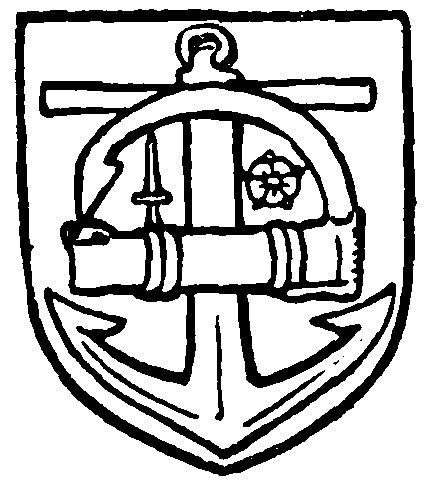
Borough of Bewdley. Argent an anchor upright surmounted by a fetterlock azure with a sword proper on the dexter side and a rose gules on the sinister within the fetterlock.
The borough is bounded on the north and east by Dowles Brook and the River Severn, on the south by Ribbesford parish and on the west by Wyre Forest. The boundaries of the ancient manor are given in a survey of 1612, which has been printed in Burton's History of Bewdley (fn. 22); they coincide with the present municipal boundary.
'The Towneselfe of Beaudeley is sett on the side of an Hill, soe comely that a man cannot wish to see a better' (fn. 23); and as long ago as 1539 it was acknowledged, by one visitor at least, that the best view of the town was to be had from Summer Hill in Wribbenhall 'at the rising of the sunne,' when 'the whole Towne glittereth.' (fn. 24) Since that time the riverside has been a good deal altered, as the houses at the corner of the old bridge were destroyed to make room for the present one, which Telford placed higher up the river, in a line with Load Street (fn. 25) No one who has seen this beautiful bridge can regret that the goodly fair one of five arches admired by Leland and Habington was swept away by the flood of 1795. It had, indeed, long passed its best days before its destruction. In 1644 the whole of the second arch from the town had been broken down by the Royalists, (fn. 26) and a timber one was afterwards substituted, (fn. 27) while two of the other arches were patched with timber in places. There can be little wonder that it was unable to resist the heavy snowfall and sudden thaw which destroyed it. It was not replaced by Telford's bridge till the summer of 1798, which was so dry that the great engineer was 'enabled ... to raise Bewdley bridge as if by enchantment,' (fn. 28) finishing it entirely in one season. It is a fine sandstone structure with three segmental arches and a balustraded parapet. On the Wribbenhall side the original tollhouse, an octagonal building of stone, remains. The approaches on either side have stone arched retaining walls crowned by cast-iron balustrading.
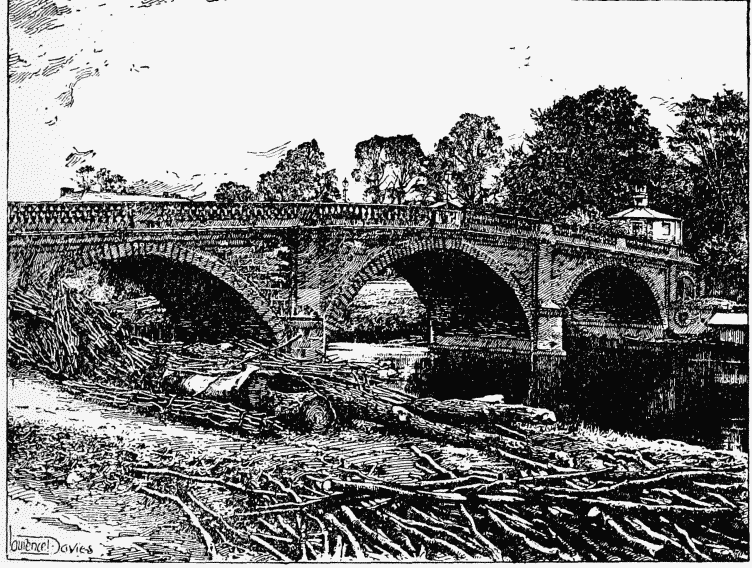
Bewdley Bridge
The principal portion of the town of Bewdley lies about a parallelogram of streets formed by Load Street on the north-west, High Street on the southwest, Severn Side on the north-east and Lax Lane on the south-east. At the top of Load Street, which is a fine wide thorough fare, stands the church upon an island site. Though Georgian work, early and late, is the predominating characteristic of Load Street, some examples of the early 17th century still survive. On the south side of the church, at the top of the street, is a half-timber house with two gables having carved barge-boards and elaborate console brackets, and bearing the date 1632 with the initials W.B. The ground story has been faced with brick and the front generally has been considerably repaired. The house now occupied by the post office is a half-timber house of about the same period, much modernized. Of the Georgian work, the finest is a brick house to the south-east of the church, four stories in height, with a pedimented centre slightly broken forward; the central window of the first floor is framed by Corinthian pilasters supporting an entablature and broken pediment, while the window of the second floor above it has rusticated dressings. The plastered front of the George Inn, on the opposite side of the road, is also of the 18th century, though the fabric itself is largely of half-timber and of earlier date. On the west side of the High Street, a little distance to the south of its junction with Load Street, is a fine half-timber house, now divided into two; it is of two stories with a triple-gabled attic floor above, and each floor projects on carved consoles, the windows of the first floor having projecting stills, similarly supported, and ovolo-moulded mullions and transoms of oak. Over the northern doorway is carved 'T 1610 B.' In this half of the house is an original stair with moulded handrails and ball-crowned newels. In the middle room on the first floor is an original chimneypiece with fluted Ionic pilasters. Both these features are in very poor condition, though the front of the house is in fair repair. Modern bay windows of brick have been added to the ground floor.
Facing the river on the Severn Side is an early 17th-century half-timber house with carved consoles supporting the sill of the gabled upper story. All the openings and the barge-boards to the gables are modern. The River House is a pleasant red brick building of the early 18th century, three stories in height, with an attic above a crowning modillion cornice, a hood over the doorway, and a pedimented central window to the first floor. In Welsh Gate, which leads out of the High Street at the north-west of the town in the direction of Cleobury Mortimer, is a picturesque group of brick and half-timber cottages of the 17th and 18th centuries, standing on a high bank with a rubble retaining wall. Of the almshouses in the town, the only buildings of any interest are those of the Cooke charity. They form a two stories block, with a plastered front, tiled roof, and square brick chimney shafts. On a tablet in the front wall is a long inscription to the effect that they were built with money bequeathed by Thomas Cooke, son of 'Mr. Richard Cooke, late of Bewdley, who departed this life the 22 of January 1693, aged about nineteen.' The buildings were restored in 1860 at the cost of the Rev. Joseph Crane. Neither Bourlton's almshouses in Park Lane, nor Sayer's almshouses in Lower Park, are of any architectural interest. The old grammar school at the back of the High Street, on the west side, is an L-shaped half-timber house, probably of the first half of the 17th century, now turned into cottages.
The oldest Nonconformist community in Bewdley is that of the Baptists, which was founded in 1646 by John Tombes, curate of St. Anne's, who, though retaining his office in the church, made no secret of his objections to infant baptism. (fn. 29) He disputed with Richard Baxter on this subject at Bewdley, and their followers, according to Wood, became 'like two armies . . . and the civil magistrate had much ado to quietthem. (fn. 30) In 1650 Tombes removed to Leominster, and within a few months of his departure Henry Oasland, a native of Rock, was appointed to St. Anne's (fn. 31) He held office until the Act of Uniformity was passed in 1662, when he declared himself a Presbyterian (fn. 32) and probably formed with his followers the conventicle which Thomas Wylde intended to surprise in 1663, (fn. 33) His house was licensed for Presbyterian worship in 1672, (fn. 34) and about 1680 the chapel is said to have been built. (fn. 35) In 1883 the Unitarians met here, (fn. 36) but it now belongs to the Wesleyan Methodists.
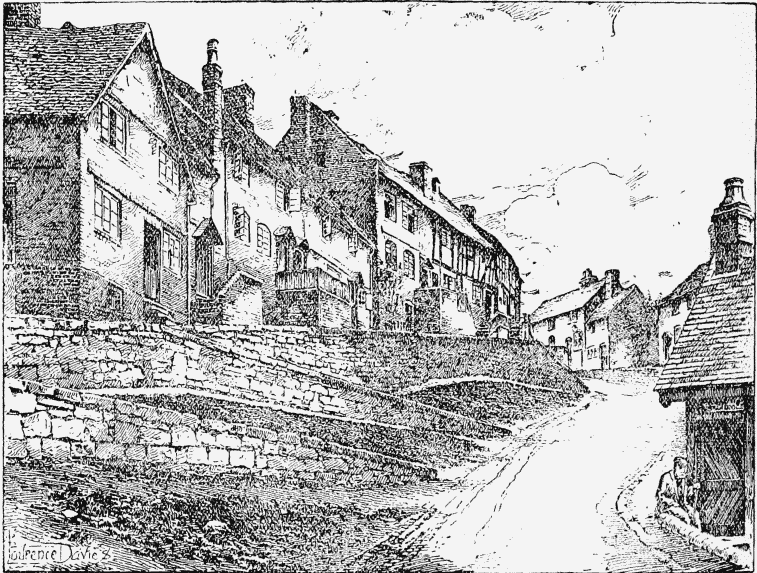
Welsh Gate, Bewdley
John Wesley visited Bewdley several times between 1774 and 1786 and preached in the open air, generally without opposition. (fn. 37) The Wesleyan chapel, which stands behind the houses on the west side of the High Street, was opened for divine service in 1795 by Dr. Cook, a clergyman of the Church of England. (fn. 38) It is an interesting little building of red brick with a moulded stone cornice, and is oblong on plan, with an apse at either end. It is lighted by semicircular-headed windows with moulded stucco architraves, and the pews, which do not appear to have been altered since they were first made, are set out on a curve to command a good view of the pulpit, the sounding-board of which is supported by two fluted Doric pilasters. The gallery at the end opposite to the pulpit is approached by an external flight of stairs.
The Society of Friends met in the Cotterells' house on Severn Side in 1689. When they desired that it might be registered as their meeting-place at the next general sessions. (fn. 39) The site on which their meeting-house now stands was bought for the society in 1691, and the house itself was probably built shortly afterwards. (fn. 40)
The site of Tickenhill Palace, which stood on high ground to the south-west of the town, is occupied by an early 18th-century house of some size, with modern additions, now used as a school. The cellars may contain some remains of the original building. On the brow of a hill to the south of the town, overlooking the Severn, is Winterdyne, the residence of Mrs. Napier George Sturt, a square stuccoed house of the last half of the 18th century, three stories in height, with a basement containing the offices. The elevations are restrained and dignified, the west or entrance front having semicircular bay windows at either end flanking a small portico which forms a porch to the main entrance. The principal rooms are on the east front, overlooking the valley of the Severn, the drawing room, which is lighted by a large semicircular bay window, being in the centre, with the dining room and the library on either side. The windows of the upper floors are plain and well-proportioned, and the walls are crowned by a modillion cornice of slight projection, above which is a hipped slate roof of low pitch. Internally there is much good plaster work. A curving approach, lined with cellars and out-houses, and artfully concealed by plantations, leads to the stables on the north side of the house. The grounds, which slope steeply down to the river, are beautifully laid out with winding paths and terraced walks on the face of the hill, which is in parts almost precipitous.
Wyre Court, situated about a mile west of Bewdley on the south side of the Tenbury road, is a rectangular half-timber building of mediaeval date, to which has been added a large modern house. The old part, which is constructed of heavy timbers and is of early date, was much repaired about 1600. On the lintel of one of the north windows is carved in relief the date 1165, with a crown and the initials L.W.; this is evidently quite modern. The later part of the house contains some 17th-century oak panelling.
According to tradition the earliest settlement at Bewdley was situated on Wyre Hill, about half a mile from the Severn. This is to some extent borne out by the number of original burgages in that quarter, which is still detached from the rest of the town and stands at the crest of the hill on the old main road from Cleobury Mortimer to Kidderminster. It is difficult to see why the town should have begun to grow up at this point, which was partly in the forest even at the end of the 16th century, (fn. 41) and not along the natural highway of the river, unless, indeed, it was from the beginning the 'club sanctuary' that vexed the orderly soul of Bishop Roland Lee.
The early history of Bewdley is very obscure. There is no tale of a lord's oppressive insistence on his rights or of an eager community facing fearful odds in the struggle to grasp more power than custom allowed, and almost the only evidence of the growth of the place up to the middle of the 15th century is the gradual increase of free tenants recorded in the inquisitions. (fn. 42) Though the town stands on a main road there was probably not much traffic here earlier than the 14th century, for as late as 1313 there seems to have been no passage over the Severn except by the Lax ford, (fn. 43) though doubtless those who had business at Wribbenhall or Kidderminster might cross in coracles such as those still in use for this purpose in 1900. The ferry over the river is first mentioned in 1336, at which date it was worth only 10s. yearly, (fn. 44) but its value increased greatly during the next half-century, and in 1381, after the first grant of a market to the town, the profits amounted to £2, (fn. 45) a sum which had been more than doubled by 1424. (fn. 46)
This suggests that Bewdley owed a good deal of its prosperity to the grant of a market and fairs made by Edward III to Philippa Countess of March in 1376. (fn. 47) There is no indication in the grant of specially local products to be bought on these occasions, but it appears that the timber, leather and carrying trades were of some importance in Bewdley at an early period.
It is said to have been the good service rendered by the men of Bewdley on the Yorkist side at Tewkesbury which won them their first charter in 1472 from Edward IV. (fn. 48) This deed, which is still kept at Bewdley in an old box ornamented with roses, granted 'to the Burgesses and inhabitants of Bewdley that the said town with its precincts may be a free Borough for ever. . . . And that the Burgesses of the said town and their successors should be incorporated by the name of the Burgesses of the Town of Beaudeley and the precincts thereof.' (fn. 49)
The 15th-century inquisitions, which give such detailed extents of the manor till 1433, do not contain reference to any burgage, and apparently the first mention of this tenure occurs in the Ministers' Accounts of 1472, after the grant of the charter. (fn. 50) Probably the growth of the town during the greater part of this period was very rapid, as Richard Duke of York, who succeeded to the manor in 1433, is traditionally credited with having done much to foster the prosperity of Bewdley, though there is evidence that it also suffered in his cause. (fn. 51) With the triumph of Edward IV, however, it entered on a period of unbroken prosperity, and additional privileges were granted by Henry VII and Henry VIII. (fn. 52)
In 1606 the town received a new charter from James I, under the style of the bailiff and burgesses of the borough of Bewdley. (fn. 53) The ruling body was to consist of a bailiff and twelve capital burgesses, and the former, who had hitherto been appointed by the Crown, was to be elected by the burgesses yearly. The capital burgesses, the first twelve of whom were appointed by the king, were to be elected for life, as vacancies occurred, by the bailiff and capital burgesses, while the common burgesses were to be appointed for life by the bailiff and capital burgesses without any limitation as to number. The common burgesses might be either resident or non-resident and were in practice usually non-resident. They have never been very numerous, and in 1835 there were twenty-six. The capital burgesses were to be chosen from the common burgesses. The provision that any burgess retained by or serving with any nobleman or gentleman was immediately to be removed from office was inserted in the charter.
The common burgesses had no voice in municipal affairs except the election of the bailiff. The officers of the corporation, the steward, recorder, deputy recorder, (fn. 54) and serjeants-at-mace (fn. 55) and two constables (fn. 56) were all elected by the bailiff and capital burgesses, the constables being elected yearly and the other officers during pleasure. The bridge wardens, who seem to have been officials of some importance, are not mentioned in any of the charters or in the Report of 1835; they had presumably always been capital burgesses. Their accounts begin in 1569, (fn. 57) and they are mentioned by Symonds as officials of the corporation. (fn. 58)
In 1684 the charter of James I was surrendered to Charles II, (fn. 59) who had promised a new one with the additional privileges that the corporation might levy toll from all boats passing under the bridge, and that they should have power to keep all strange traders from coming into the town. (fn. 60) The new charter was not, however, granted till 1685, after Charles's death. (fn. 61) By it the borough was to have fourteen capital burgesses instead of the twelve granted by the charter of James I, the commission of the peace was considerably enlarged, and a common clerk was added to the officers under the former charter; this charter remained in force for little more than twenty years, when it was declared void on account of an informality in the terms of the surrender. (fn. 62) By this time only one of the burgesses who had acted under the charter of James I, Samuel Slade, was still living, and, as seven burgesses at least were necessary to a legal act by that charter, he alone could do nothing. (fn. 63) Queen Anne therefore granted a new charter in 1708, (fn. 64) restoring and confirming the charter of James I and nominating men to fill its offices. The charter of James II, however, still had its champions, and consequently for two years 'Bewdley had two Corporations and two Bailiffs who fulminated against each other like rival Popes.' (fn. 65) The climax was reached when Salwey Winnington was elected M.P. under one charter and Henry Herbert under the other. (fn. 66) The case then came before the House of Commons, and the Whigs being in the majority it was decided by 211 to 132 that Herbert was the rightful member, and Slade, who had been nominated bailiff in 1708, the rightful bailiff. (fn. 67) At the next election the Tories came into power, and the Commons passed a resolution ' That the charter dated 20 April 1708 attempted to be imposed on the Borough of Bewdley ... is void, illegal and destructive to the constitution of Parliament.' (fn. 68) Steps were taken to annul the charter, and it only escaped repeal by the death of Queen Anne, whose obit (1 August) was long observed by the corporation as a day of thanksgiving for its preservation. (fn. 69) The charter has not since been disputed, and except in so far as it has been modified by the Municipal Reform Act of 1835, which changed the title of the chief magistrate to mayor and added four aldermen to the twelve councillors, (fn. 70) is still the governing charter of the borough.
Under the charter of King James I the borough acquired the right to return a member to Parliament. It has been asserted that the town sent members to Parliament at an early date, and the charter of Henry VIII recites that this right had been discontinued, (fn. 71) but no early returns of members for Bewdley have been found. The right of voting for the return of a member was vested in the bailiff, capital and common burgesses. By the Reform Act of 1832 the Parliamentary borough of Bewdley was enlarged to include the hamlets of Wribbenhall, Hoarstone, Blackstone, Netherton, and Lower Mitton with Lickhill, (fn. 72) and in 1885 it was merged in the county representation. (fn. 73)
By the charter of James I the burgesses gained the right to have a court of record held fortnightly or oftener before the bailiff and recorder or their deputies for all pleas save those affecting life and limb, and a court of pie-powder for the regulation of the fairs and markets, with the ordinary jurisdiction of a court leet. (fn. 74) This brought the corporation into conflict with Sir Edward Blount, who held a lease of the manor and therefore claimed the right of holding a court leet, and a suit between them dragged on from 1606 to 1615, (fn. 75) when the matter seems to have been arranged by Blount's making a lease of his rights to the town. (fn. 76) The charter constituted the bailiff clerk of the market and escheator and coroner in the borough. The court leet had fallen into disuse before 1835, (fn. 77) and the court of pie-powder also seems to have been obsolete at that time. In the court of record actions were dealt with to the amount of £100, but in 1835 the holding of the court was formal only, no actions having been brought in it for a period of seventeen years. Under the charter of James I the bailiff, recorder and ex-bailiff were justices of the peace. (fn. 78) Their jurisdiction was not exclusive, but in practice the county magistrates did not interfere with the concerns of the borough. Petty sessions are now held on alternate Mondays.
In 1376 Philippa Countess of March obtained from Edward III a grant of a weekly market on Wednesdays and two three-day fairs yearly at the feasts of St. Leonard (6 November) and the Translation of St. Thomas (7 July), (fn. 79) and in 1446 Richard Duke of York was granted another Wednesday market and a yearly fair on St. Agatha's Day (5 February) by Henry VI. (fn. 80) No market or fair was granted by the charter of Edward IV, but in 1507 Henry VII granted to the bailiff and burgesses a market on Saturdays and three fairs yearly, on the feasts of St. George the Martyr (23 April), St. Andrew (30 November), and St. Anne the mother of our Lady (26 July). (fn. 81) Probably the last two superseded the earlier November and July fairs—unless, indeed, these had already fallen into disuse—for there is no further mention of those which had been granted to Philippa.
The charter of 1606 confirmed to the burgesses a market on Saturday and the three fairs granted by the charter of Henry VII 'as in the same borough is used and accustomed,' (fn. 82) from which it would appear that those were the only markets and fairs then in existence. In 1612, however, the jury present at the survey of Bewdley stated that 'here are four fairs by the year and two markets weekly granted by charter.' (fn. 83) The burgesses were therefore at that time evidently in possession of the market and fair granted to Richard Duke of York as well as those conferred by their own charter.
The Wednesday market had fallen into disuse by 1792, and so had St. Agatha's fair, but the winter fair lasted a day longer, being held on Old St. Andrew's Day (10 December) and the day following, and the other fairs and the Saturday market were still in existence, (fn. 84) though the July fair seems to have ceased before 1810. (fn. 85) The present market day is Saturday, and the principal fair is still held on St. George's Day, but is fast falling into disuse.
The bailiff and burgesses seem to have had some difficulty in securing their right to the toll (fn. 86) of the market which had been granted by the charter of James I, for in 1614 Mr. Chelmicke was sent to London to sue for the tolls on behalf of the corporation. (fn. 87) His suit was probably successful, but the commercial powers of the burgesses do not seem to have been used for the good of the community, as successive bailiffs were indicted for using false measures. (fn. 88)
In 1835 the market tolls were valued at £42 a year and the rents of stalls in the butchers' shambles at about £30 13s., (fn. 89) but in 1888 the tolls amounted to between £15 and £20 only. (fn. 90)
The corporation was empowered by the charter of James I to hold lands to the value of £20 yearly. (fn. 91) This property consisted chiefly of land and houses in Bewdley, the rents of which amounted in 1835 to £108 6s. How much of it had belonged to the corporation before 1606 is not clear, but the mention of the bridge wardens' lands in 1472 seems to show that some had been held under the charter of Edward IV. Under this charter the bailiff and burgesses acquired the right to have a common seal. This was confirmed by subsequent charters. The seal used in 1682, now lost, bore an anchor in pale surmounted by a fetterlock, within the fetterlock on the dexter side of the anchor a sword erect, on the sinister side of the anchor a rose. Legend, 'Sigillum : Libertatis: Burgi: de: Beaudeley.' A similar seal was used in 1883, but the modern spelling, Bewdley, was used. (fn. 92)
The corporation now possesses two early 17thcentury seals and a small embossing stamp bearing the arms as above, circumscribed 'Sigillum. Officiall. de Bewdley.' The seal now in use is an embossing stamp copied from one of the 17th-century seals. The arms of the town consist of the old common seal upon a field argent. (fn. 93)
By their charter the burgesses were permitted to have silver or gilt maces bearing the arms of England for their ornament. Two large silver maces were bought for the corporation of Bewdley by Lord Herbert in 1708. (fn. 94) These maces, which are 22½ in. in length, bear the royal arms and badges and the initials A. R., and are still in use. (fn. 95)
The first bridge between Wribbenhall and Bewdley was probably begun about 1447, when John Carpenter, Bishop of Worcester, granted an indulgence of forty days to all who contributed to the work. (fn. 96) It was at least partly built of stone, and must have been destroyed about 1459, when the town was taken by the Lancastrians, for the stones were then granted to her old enemy Worcester for the repair of walls, gates and bridge there. (fn. 97) The men of Bewdley, however, undeterred by this disaster, seem to have set to work at once to build a new bridge of the timber fortunately so easy to obtain, (fn. 98) and though both this and the ferry were put under the care of a Lancastrian warden in May 1460, (fn. 99) it was not long before the Earl of March enjoyed his own again and the king's too. The timber bridge lasted until 1483, when a third bridge was built, towards the expenses of which King Richard III gave 20 marks. (fn. 100) As there is no further record of bridge-building in Bewdley till 1795, when an Act was passed for rebuilding the bridge, (fn. 101) it may perhaps be assumed that this was the stone bridge which was still standing at the end of the 18th century, a curious patchwork of much damage and many repairs. (fn. 102)
There are two sketches of this bridge preserved in the council chamber of Bewdley Town Hall. It was of five arches, and on the third pier from Bewdley stood a timbered gate-house with strong gates on the Wribbenhall side. The north end of this gate-house served as a dwelling for the toll-gatherer, and the other, called the Bridge House, was used as a corporation prison. (fn. 103) Two other gates are mentioned in the Ministers' Accounts of 1472 : Welsh Gate, which was pulled down about 1822, and Welsh Pool Gate, the site of which is uncertain. Doglane Gate (which was still standing in 1831) and Tinker's Gate are not mentioned till later, (fn. 104) but it is quite likely that they were in existence at this time, for the town was apparently of much the same proportions as it is now. There seems, indeed, to be no reference to Park Lane till 1595, but Dog Lane, High Street, Over Street and Laxlane are all mentioned in 1472 (fn. 105) and 'le Wodstret' occurs a little later. (fn. 106) All these are familiar names to the inhabitants at the present time, with the exception of the Over or Upper Street (superior vicus). Fortunately, however, there is no difficulty in identifying it; the description in the Ministers' Accounts of 'a tenement in le Overstrete at the corner of laxlane' (fn. 107) and another 'near St. Anne's chapel,' (fn. 108) shows clearly enough that it was the present High Street. The name of High Street was given at that time to the double row of buildings which on the authority of tradition is still regarded as the Old Town. Several tenements in the High Street are said in the 15th-century accounts to be bounded by Win Brook, (fn. 109) and in 1526 a burgage is definitely described as standing 'on Werehill . . . and stretching from the High Street to Wynbroke.' (fn. 110) In 1472 the market-place was here, (fn. 111) probably on the traditional site now occupied by the inn called the Old Town Hall. This house was perhaps one of the 'two newly built shops by the Cross in the marketplace in High Street' mentioned in the 15th century. (fn. 112) It had originally 'an upper story projecting into the road and supported by two strong posts,' and under the shelter of this covering the market is said to have been held. (fn. 113) The overhanging part was taken down in the time of Dr. Prattinton, who was much interested in the tradition as to its use, and hoped that the title-deeds would have thrown some light on the subject. It was, however, merely described as 'one tenement forming three dwellinghouses bounded on the north side by the turnpike road and on the south by Bewdley Park,' and he was obliged to content himself with the meagre note that 'Mrs. Bradley remembered old people saying that it was the principal Inn and the Sign the Shoulder of Mutton.' (fn. 114) It is possible that it had already been used as an inn for some years before the beginning of the 18th century, when it was bought by John Prattinton, the great-grandfather of the antiquary, (fn. 115) as the market had apparently been moved to Load Street before 1539. (fn. 116)
The new market, which was described by Leland as 'a fair lardge thing and well-builded,' (fn. 117) included the barley-market, shambles and butter-cross, (fn. 118) and formed a long range of timber buildings filling up the middle of Load Street. Probably the market was moved here in order to be nearer the river-side. In earlier times even the bargemen seem to have preferred to live on the hill. There is no mention in the 15th century of burgages on Severn Side; 'a parcel of waste next the Bridge Gate' and 'a croft called Comberscroft near Dog Lane, going down to the Severn,' (fn. 119) are the only records of what in Leland's time was one of the 'memorable streets of the town.' Towards the end of the 18th century the marketplace was pulled down and a new one built.
Situated as the town is at the edge of a great forest of oaks and overlooking a fine river, the timber, leather and carrying trades were the natural occupations of the inhabitants, and it was doubtless due to the growth of the carrying trade during the 14th century that a second settlement began to spring up at a little distance from the old town and nearer to the river. As early as 1308 there are signs that the trade was becoming of sufficient importance to rouse the jealousy of other river-side towns and lead to fierce disputes, and even fighting, over the right of free passage to Bristol and the claim of Worcester to exact tolls for the repair of her bridge. (fn. 120) In 1308 both Ralph the son of Cecily de Bewdley and Adam de la Halle complained that the ships which they had freighted with brushwood and other goods for Bristol had been seized at Worcester by William Roculf and others of the same town, who had not only robbed them of their cargoes, but imprisoned their persons. (fn. 121) There is no evidence of any corporate action on the part of the Bewdley townsmen at this period, but in 1411 we are told that some of them, 'having great boats called Trowes, had confederated themselves together for their singular profit, and would let no one pass through with their goods and chattels unless they would hire the said boats .. . at outrageous charges.' (fn. 122) They were further accused of having lain in wait near Bewdley with great force and arms for a float laden with timber and fuel for Gloucester, whose citizens had resisted their extortions, and 'forced the owners to cut her in pieces on the river so that the cargo was lost, or otherwise they would have cut off their heads.' (fn. 123)
An Act of 1430 recites that the Severn is common to all the king's liege-people to carry all manner of merchandise to and fro as well in trowes and boats as in floats or drags. (fn. 124) This did not, however, put an end to the disputes between the river-side towns, for the bailiffs of Worcester continued to levy a toll on every boat that passed under their bridge. (fn. 125) An inquiry into the matter, which was held in 1504, seems to have established the right of the Worcester bailiffs to exact dues from those who tied at their quays, (fn. 126) but the Bewdley men subsequently complained that they were compelled to 'cum out of the Kynge's hye streym with their merchandize and to pay the seyd summes of money and also to make sale of their merchaundize contrary to their myndes' because the citizens of Worcester set upon them with stones and arrows if they showed signs of passing the quay. (fn. 127)
By the beginning of the 16th century a great part of the carrying trade on the Severn belonged to Bewdley, and several Bristol merchants had established dépôts for their goods here. (fn. 128) Large store-houses were built and commerce is said to have been carried on with inland towns as far as Manchester and Sheffield by means of pack-horses, while there was an extensive trade in malt with Ludlow and Tenbury. (fn. 129) This, however, is said to have been diminished by the making of a new road from Worcester to Tenbury, (fn. 130) and the greater part of the carrying trade afterwards passed to Stourport owing to the refusal of the Bewdley townsmen to allow the Worcestershire and Staffordshire Canal to join the Severn here as had at first been planned. (fn. 131) As late as 1832 it was stated that the town could 'hardly be said to be in a state of decay, although the changes in the internal navigation of the country have deprived it of its former commercial importance.' (fn. 132)
The frequent royal visits and keeping of the King's Hall during the 16th century must have given increased employment to the inhabitants, especially, perhaps, the innkeepers, for the horses belonging to the royal household seem to have been boarded out at the inns (fn. 133); an order of 1528 regulated the charge for such horses at 1½d. a day and night each for hay and litter, while 'all others repairing to the town' should be charged 2d. (fn. 134) Probably the innkeepers also made some profits from the actors, who, drawn here no doubt by the presence of the court, frequently gave performances; the Queen's Players are mentioned in 1572, the Earl of Leicester's next year, and 'my Lord President's' in 1593, besides unnamed companies. (fn. 135) Other popular amusements are indicated by the allusions in the bridge wardens' accounts to the bull-ring (fn. 136) and the lottery. (fn. 137) The latter of these was, however, removed by the king's order in 1620 'that it should contynue no longer within the Marches of Wales to the ympoverishment of his subjectes there,' (fn. 138) and the proceeds seem to have been 'imployed to such charitable uses in the Towne as should be thought fitt by the bayleife and burgisses at the oversight of Mr. Hamonds,' the rector of Ribbesford. (fn. 139)
It was not only variety of entertainments and an increased demand for many goods that Bewdley owed to the palace on Tickenhill. The presence of the Council in the Marches, and above all the abolition of the unauthorized sanctuary of Bewdley, in response to repeated and urgent appeals from Roland Lee and Sir Thomas Englefield, (fn. 140) did much to secure merchants against the robbery and disorder which must have been a serious hindrance to trade before 1536, and accordingly the 16th century was marked by a great increase in commercial prosperity, as is shown by the number of strangers who sought the freedom of the town. (fn. 141)
During this period, as far as can be judged from somewhat scanty information, the inhabitants of Bewdley began to be employed in cap-making, (fn. 142) an industry which, as Fuller tells us, set no less than fifteen callings to work, (fn. 143) and certainly became the most important trade in the town during the first half of the 17th century, when it is said to have given employment to nearly a thousand people. (fn. 144) Its prosperity was, however, short-lived; in 1677 capmaking is described as being 'in a very low condition, like in a few years to fall to the ground,' and, though it revived for a little while at the end of the 18th century, it had died out completely before 1883. (fn. 145)
At one time there was some manufacture of saltpetre here, and references may be found to it in the State Papers of the 17th century, (fn. 146) notably in 1626, when William Earl of Northampton, President of the Council, wrote to Mr. Secretary Conway suggesting that it might be made into powder on the spot, as this 'would be a great ease to the county and a ready way to procure a supply of powder.' (fn. 147)
Cloth-making was pursued in this town as well as in other places in Worcestershire during the 16th and 17th centuries. (fn. 148) Weavers of sacking and bombazine used to live on Wyre Hill, and the latter material was still made here about 1860, but the trade had ceased before 1883. (fn. 149)
There are, however, still three local trades of old standing in Bewdley. The manufacture of horn goods was active here in the 18th century, (fn. 150) and is said to be of considerable antiquity. Drinking horns, powder flasks and combs are still produced, and this is now the chief special manufacture of the town. Brass-founding was introduced here in 1697 by Christopher Bancks of Wigan, whose works were carried on by successive members of the family till about the middle of the 19th century, when they were bought by Messrs. William Stokes and John Smith. The making of Maslin pans, kettles, and other brass and pewter ware is still pursued.
The third of the existing trades and the oldest established has already been mentioned—leatherwork, which the town owed to the nearness of Wyre Forest, where oak bark was easily obtained for tanning. This, though it may never have given employment to so many at once, cannot be regarded as a less important industry than capping, for it has left a far greater mark on the history of the place. Even had it died out completely, Tanner's Hill and Bark Hill would still recall its ancient prosperity, which is also shown by the number of town worthies in some way connected with the trade. Among those not actually engaged in tanning, but belonging to families established in the business, there may be mentioned John Inett, Precentor of Lincoln and author of a History of the English Church, (fn. 151) and Richard Willis (the son of William Willis, tanner, and Susanna Inett), who was afterwards sub-preceptor to the Duke of Gloucester and successively Bishop of Gloucester, Salisbury and Winchester. (fn. 152)
It is possible that in 1308 the leather industry was one of the causes of ill-feeling between this town and Worcester, for one of the leaders of the attacks on Ralph son of Cecily and Simon de la Halle is described as a 'tanner.' Worcester indeed was almost as much engaged in the trade as Bewdley, and had her own companies of barkers, corvesers and saddlers, (fn. 153) who no doubt proved themselves formidable rivals. In the 15th century the Bewdley corvesers also seem to have formed some kind of gild, which is said to have founded the chantry of our Lady in the chapel. (fn. 154) Habington tells us that there was a window here representing the Virgin and Child between Saints Crispin and Crispinian; underneath were the names 'Glowceter corveser, Ricardus Taylor corveser, Johannes Hawll corveser.' (fn. 155) In another window John Wiglond was described as one of the founders of the chapel, and a third mentioned William Monnox, who was perhaps a tanner like others of his family. (fn. 156) In the 16th century John and Richard Monnox were said to be owners of a tan-house in Bewdley, which was claimed between 1558 and 1579 by John's son and namesake as his inheritance, (fn. 157) and some years later another William Monnox, tanner, made a more enduring memorial of himself than painted glass.
This William, who died in 1591, left by his will the money for the maintenance of the Free School, (fn. 158) among the benefactors of which occur several other names well known in the tanning trade, such as Richard Clare, John Crump, John Sheriffe, and John Crane. Gregory, John and Thomas Ballard gave the land whereon the old school was built. (fn. 159)
MANORS
RIBBESFORD seems to have belonged in early times to the priory of St. Mary at Worcester, and is mentioned among the lands lost at the time of the Danish invasion. (fn. 160) It was, however, recovered, (fn. 161) and was given by Wulstan Archbishop of York and Bishop of Worcester between 1012 and 1023 to his sister for life on her marriage with Wulfric. (fn. 162)
After the Conquest the church of Worcester was again dispossessed of Ribbesford by Turstin the Fleming, (fn. 163) who 'not long afterwards justly lost all his own possessions, as well as those he had unjustly kept from God.' (fn. 164) Turstin was probably concerned in the rebellion of the Earl of Hereford, of whom he held land in the neighbouring parish of Cleobury (co. Salop); his property in Ribbesford was in the possession of the Crown at the time of the Domesday Survey. (fn. 165)
There are two manors of Ribbesford mentioned in 1086; both were berewicks of Kidderminster and belonged to the Crown. (fn. 166) After this date, however, there is no mention of more than one manor; possibly both were granted together to the Mortimers of Wigmore, of whom the manor of Ribbesford was subsequently held (fn. 167) by a family which took the name of the place. There is no record of this grant, but Walter de Ribbesford seems to have been in possession by the middle of the 12th century; he was present at the inquisition concerning Oswaldslow Hundred which was taken in the time of John of Pageham, Bishop of Worcester. (fn. 168)
Simon de Ribbesford, Roger Mortimer's steward, held the manor in 1176. (fn. 169) It may have been this Simon who in 1201 had seisin of the lands of Walter de Portes, whose heir he had married. (fn. 170) He was succeeded by Tristram, who died before 1232, in which year Lettice, his widow, brought a suit against Ralph Mortimer for the third part of a virgate of land in Gloucestershire. (fn. 171) Tristram's heir was probably the Henry de Ribbesford who held the manor in 1235. (fn. 172) He was followed by another Simon, who made an agreement with his lord, Roger Mortimer, by which he gave up the right to hunt in the wood called 'La Oke,' and to pursue deer in Wyre Forest without special leave from Roger, 'save if his hounds chase deer from his woods into Wyre Forest and follow it, the trespass—if it can be so called—is to be determined by friends.' (fn. 173) Simon de Ribbesford was one of the commissioners appointed in pursuance of the ordinance made in the Parliament at Oxford in 1258 to inquire touching grievances in the county of Worcester, and to bring the result to Westminster for delivery to the council. (fn. 174)
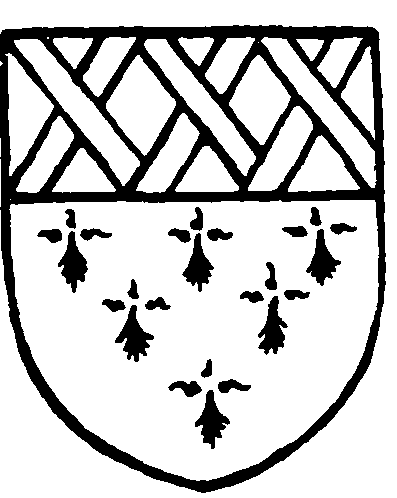
Ribbesford. Ermine a chief gules fretty or.
Henry de Ribbesford, possibly Simon's son, was keeper of the forest of Cannock in 1278 (fn. 175); he afterwards became a justice of the King's Bench and was knighted before 1288. (fn. 176) In 1286 he was appointed to make inquiry touching those who had narrowed and heightened their weirs on the Severn between Gloucester and Shrewsbury, so that vessels could not pass through as they were wont, and to pull down the said weirs where necessary. (fn. 177) Sir Henry seems to have been succeeded before June 1305 by Henry, probably his son, (fn. 178) who was knighted at Westminster with the Prince of Wales at the following Whitsuntide. (fn. 179) In 1316 he went to Ireland with Roger Mortimer of Wigmore, (fn. 180) whose side he afterwards took against the king (fn. 181) in spite of a quarrel in 1320 about the hunting in Wyre Forest. (fn. 182) In 1322 he received a commission to select suitable men in the county of Worcester, arm them and bring them to Newcastle by the Eve of St. James 'to serve the King,' (fn. 183) and accordingly raised 300 men who were presumably, like himself, 'of the quarrel of Thomas of Lancaster.' (fn. 184) When Mortimer came into power Ribbesford reaped the reward of his service; the demand by the Exchequer for his fine as a Lancastrian was ordered to be cancelled, (fn. 185) and in May 1328 he received a grant of a weekly market on Wednesdays and a yearly fair of three days at Rock, with free warren in his demesne lands of Rock and Ribbesford. (fn. 186)
In 1329 Sir Henry settled Ribbesford on his son Robert and the heirs of his body, with contingent remainders successively to his other sons John the elder, Walter, John the younger and Thomas. (fn. 187) Walter had succeeded to the estate before 1351, in which year he quarrelled with his neighbour Sir William Coningsby, to whose house in Rock he is said to have come armed 'with a very great number of evil-doers,' to make an attack on the men whom Coningsby had assembled to go on the king's service to Calais. (fn. 188) This attack, according to Coningsby's account, was so successful that fear of death prevented him from having the use of his goods. (fn. 189) Walter's relations with his neighbours seem to have been somewhat unquiet, for in 1360 he sued Sir William Devereux for carrying off Constance his wife and divers of his goods and chattels. (fn. 190) The sheriff returned that the said Sir William was 'not to be found,' but Walter seems to have succeeded in recovering his wife, for she was holding dower in his lands in Ribbesford (fn. 191) after his death five years later. (fn. 192) Their sons Walter and Roger both died in childhood, and in 1379 the manor was the subject of a lawsuit between John Darras and his aunts, Burga and Elizabeth le Forcer, and John de Resunden. (fn. 193) John Darras was the son of Joan, one of the three granddaughters and heirs of Avice le Forcer, the sister of Sir Henry de Ribbesford; he and his aunts Burga and Elizabeth claimed as the heirs of Roger the younger son of Walter de Ribbesford. (fn. 194) John de Resunden claimed in right of his wife Iseult, the granddaughter of Walter's half-sister Julian, upon whom they asserted he had settled the manor. (fn. 195) Judgement was given in favour of John Darras and Burga and Elizabeth le Forcer, (fn. 196) but the manor passed shortly afterwards into the possession of Thomas Earl of Warwick. (fn. 197) After his attainder it was granted in 1397 to the Earl of Salisbury, (fn. 198) but at the accession of Henry IV two years later the attainder was reversed and Ribbesford was restored to Warwick, who died seised of it in 1401. (fn. 199) In 1423 it was settled by Richard Earl of Warwick on his wife Isabel le Despencer for life with reversion to his heirs. (fn. 200) On the death of his granddaughter Anne it passed to Margaret his daughter by his second wife Elizabeth Lady Lisle. (fn. 201) Margaret married the famous Sir John Talbot, afterwards (1442) Earl of Shrewsbury. (fn. 202) Her only son John was killed with his father at the battle of Chastillon, (fn. 203) and in 1470 Thomas his son and heir perished in a skirmish with the Berkeleys, from whom he claimed certain lands in right of his grandmother. (fn. 204) The manor was then divided between his sisters, Margaret who had married Sir George Vere, and Elizabeth the wife of Edward Grey, afterwards Lord Lisle (fn. 205); it was, however, reunited in 1473, when Margaret died childless, leaving her moiety to her sister. (fn. 206) Elizabeth was succeeded by her son John (fn. 207); he married Muriel daughter of Thomas Duke of Norfolk, (fn. 208) who held the manor in dower after his death in 1504. (fn. 209) She died in 1512 and was succeeded in Ribbesford by Elizabeth, only daughter and heir of John Grey, (fn. 210) who died a minor in 1519, leaving her property to her aunt of the same name. (fn. 211) This Elizabeth, the widow of Edmund Dudley, afterwards married Sir Arthur Plantagenet (created Viscount Lisle in 1523) (fn. 212) who sold the manor before 1533 to Sir Robert Acton. (fn. 213) Sir Robert Acton was succeeded in 1558 by his son Sir Henry, (fn. 214) whose son and heir, another Robert, followed him in 1563. (fn. 215) It is said that 'he had a faire estate, but was unthryfty' (fn. 216) : he seems to have got into pecuniary difficulties, and in 1605 was accused of coining money. (fn. 217) Stephen le Sieur begged for a lease of his lands and grant of his goods, (fn. 218) but Acton received a pardon. (fn. 219) He sold Ribbesford in the autumn of the following year to John Churchill, (fn. 220) who died seised of it in 1607. (fn. 221) It was subsequently conveyed by Ellis Churchill, his executor, and John Churchill, his son, to Sir Robert Cooke and other trustees, (fn. 222) who sold it in 1621 to Sir Henry Mildmay. (fn. 223) Mildmay granted it to the Crown, (fn. 224) and Charles I gave it in 1627 to Edward Herbert, afterwards Lord Herbert of Chirbury, and his brother George. Sir Henry Herbert obtained full possession of the estate from his brothers in the same year. (fn. 225) Sir Henry Herbert was made Master of the Revels by Charles I. (fn. 226) He was member of Parliament for Bewdley in 1640, but was disabled from sitting by resolution of the Commons in 1642 because he put into execution the king's commission of array. (fn. 227) He took the Royalist side in the Civil War, and suffered severely for his delinquency under the Commonwealth. (fn. 228) After the Restoration he was again returned as member of Parliament for Bewdley, and held the seat till his death in 1673. (fn. 229)
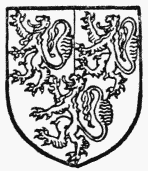
Herbert of Chirbury. Party azure and gules three lions argent.
Sir Henry was succeeded by his son of the same name, (fn. 230) created Lord Herbert of Chirbury in 1694 on the failure of the elder branch. His son and heir, a third Henry, died childless in 1738, (fn. 231) and the property passed under his and his father's wills to his cousin Charles Morley (fn. 232) with remainder to Charles's son Henry. Henry Morley assumed the name Herbert, (fn. 233) and died in 1781, when the estate was inherited by his sister Magdalene. She died in 1782 leaving it to her kinsman George Paulet, afterwards Marquess of Winchester. (fn. 234) It was sold by him in 1787 to Francis Ingram, (fn. 235) who bequeathed it in 1797 to his brother Thomas Ingram with remainder to the son of his sister Mary, Sir Edward Winnington, bart., and his younger sons. (fn. 236) Sir Edward's second son Edward assumed the name WinningtonIngram, (fn. 237) and the manor remained in the possession of his family until 1904, when it was sold to the late J. H. Lees-Milne, whose son, Mr. Alec M. LeesMilne, is now lord of the manor. (fn. 238)
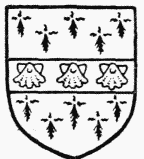
Ingram. Ermine a fesse gules with three scallops or thereon.
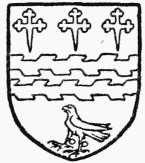
Lees. Argent two ragged bars between three crosslets fitchy in the chief and a falcon in the foot all gules.
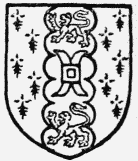
Milne.Erminois a pale sable invected and charged with a mill rind between two lions passant argent.
The manor of BEWDLEY does not appear to be mentioned under this name before the end of the 13th century, and was therefore probably included at an earlier date in one of the berewicks of Kidderminster, which here extended over both banks of the Severn. Considering the position of the town of Bewdley, and the fact that while two manors of Ribbesford are mentioned in the Domesday Survey only one occurs afterwards, it seems probable that Bewdley may be identified with the second manor. On the other hand, it has been contended that the berewick of Wribbenhall included the site of Bewdley on the opposite side of the river, (fn. 239) and this theory is supported by the statement in 1303 that the manor of Bewdley was burdened to the use of the priory of Worcester with a rent of 20s., (fn. 240) which sum, according to the priory register, had been paid in 1203 by Roger Mortimer for a holding in Wribbenhall (Wurlenli) (fn. 241) which the monks had had of the gift of a certain Turstin, confirmed to them by Ralph Mortimer the elder. (fn. 242) The Wribbenhall here mentioned is clearly not the present one, in which the Mortimers had no interest, and it has been suggested that the grantor may be identified with Turstin the Fleming of Wigmore, (fn. 243) mentioned above, who may have granted them Wribbenhall as compensation for Ribbesford. The Domesday Survey contains no reference to the monks' claim, merely recording that both Ribbesford and Wribbenhall were in the king's hands. (fn. 244) The priory, however, continued to regard themselves as overlords of the manor, (fn. 245) and stated in 1240 that Roger Mortimer had taken it from them at fee farm, (fn. 246) and that both he and his successor Hugh had done fealty to the prior. (fn. 247) The Mortimers, on the other hand, declared that the manor was a member of Wigmore and held of the king by barony, though they acknowledged a yearly rent to St. Mary of Worcester. (fn. 248) It seems doubtful whether the convent received their rent with much regularity. In 1337 it is said to have been paid by the Mortimers until the death of Margaret widow of Edmund Mortimer in 1334–5 (fn. 249); but though it was allotted to the cellarer for buying timber (fn. 250) it does not occur in any of the existing cellarer's accounts between 1277 and 1352, (fn. 251) nor does there appear to be any mention of it later than 1337. After this date the manor is returned as held of the king in chief as part of the honour of Wigmore. (fn. 252)
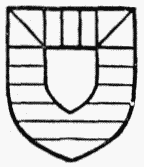
Mortimer. Barry or and azure a chief or with two pales between as many gyrons azure therein and a scutcheon argent over all.
Roger Mortimer, who appears to have been the first tenant of this estate under the priors, (fn. 253) resigned all his possessions to his son Hugh in 1214, (fn. 254) being then ill of the infirmity of which he died in the following year. (fn. 255) Hugh, who was a staunch supporter of King John, (fn. 256) was succeeded in 1227 by his brother Ralph. (fn. 257) Roger son of Ralph (fn. 258) was followed in 1282 by his son Edmund, (fn. 259) on whose death in 1304 Bewdley was assigned to his widow Margaret. (fn. 260) She held it until her death in 1334–5, (fn. 261) when it passed to her great-grandson Roger son of Edmund Mortimer. He became Earl of March in 1354 on the reversal of the attainder of his grandfather Roger and died in 1360. (fn. 262) His widow Philippa held Bewdley until her death in 1382, (fn. 263) and it was afterwards assigned in dower to Eleanor widow of her son Roger and to Anne widow of her grandson Edmund. (fn. 264) Anne held it till her death in 1433, when she was succeeded by her husband's nephew Richard Duke of York. (fn. 265) He was staying at Bewdley in the autumn of 1443, (fn. 266) and is traditionally associated with the progress made by the town about this time; possibly he contributed to the building of the first bridge. He was attainted in 1459, (fn. 267) and early in the following year Edward Prince of Wales received a grant from the issues of Bewdley Manor 'to support his charges in recovering his lordships and manors in Wales, now in the hands of the rebels.' (fn. 268) The rebels, however, shortly afterwards recovered Bewdley under the leadership of the young Earl of March, who was proclaimed king as Edward IV in 1461.
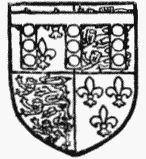
The Dukes of York bore the royal arms with the difference of a label argent charged with roundels gules.
In 1511 Catherine Countess of Devon and Anne Lady Haward, sisters of Elizabeth of York and coheirs of Edward IV, quitclaimed their right in the manor to Henry VIII, (fn. 269) and after this date it remained Crown property until 1870. Except when it was occupied by members of the royal family (see below in Tickenhill) it was usually let to farm to some tenant for a term of years. (fn. 270) Edward VI granted it to Thomas Lord Seymour in 1547, (fn. 271) but it was forfeited on his attainder two years later, and was then leased to Sir George Blount, (fn. 272) who had obtained a lease of Ladymeadow and the herbage of the park from Henry VIII. (fn. 273) Sir George was still the tenant of the manor in 1566, (fn. 274) and was succeeded by Sir Edward Blount, who held it in 1601, (fn. 275) but in 1610 it was granted to Henry Prince of Wales, (fn. 276) and after his death to his brother. (fn. 277) In 1623 Prince Charles leased it for thirty-one years to Ralph Clare, (fn. 278) whose term had not quite expired in 1651, when the Parliamentary commissioners sold the manor to Richard Pryce of Aberbechan, co. Montgomery. (fn. 279)
After the Restoration the property was resumed by the Crown and settled first on the Queen Mother Henrietta Maria (fn. 280) and then on Queen Catherine of Braganza. (fn. 281) Their trustees granted leases to Samuel Gardiner, (fn. 282) in whose name the courts were held between 1670 and 1673, (fn. 283) and Sir Richard Powle, K.B., (fn. 284) and the interest of both these tenants was bought in 1674 by Sir Francis Winnington, who afterwards obtained a lease for ninety-nine years after the expiration of their term. (fn. 285) This grant continued the Winnington family in the tenancy until 1841, (fn. 286) after which the Earl of Dudley was lessee. (fn. 287) On the expiration of this last lease in 1870 the whole estate of 2,210 acres, including Tickenhill, Kateshill, Winterdyne, Park Lodge and Farm, Wharton's Farm, Bowcastle, Uncles and part of Wyre Forest, was sold to various purchasers. (fn. 288) The manorial rights were purchased by William Nichols Marcy, a local solicitor, clerk of the peace for Worcestershire. On his death in 1893 the manor came to Mr. Hemingway, who now holds it. (fn. 289)
About 1269 Roger Mortimer granted the custody of the manor of Bewdley and the chase of Wyre to John the chamberlain and his heirs. (fn. 290) The son and heir of this chamberlain was known as John de la More, (fn. 291) which suggests that he was the tenant of the manor afterwards known as Cheney's Moor in the neighbouring parish of Rock. He was succeeded before 1332 by his son and heir, another John de la More, who was 'prevented from the custody' of Wyre by Ralph de la Hull, 'pretending a grant from the King,' (fn. 292) and was probably not undisturbed in his custody of Bewdley, which Edward III granted in 1335–6 to John de Hothey during the minority of Roger Mortimer. (fn. 293) The right of John de la More was, however, recognized by Mortimer, who seems to have made him a fresh grant of the custody of Bewdley, (fn. 294) and he was succeeded by his only daughter Isabel. (fn. 295) She afterwards married Philip Wigmore, and their son John Wigmore was warden of Bewdley in 1366. (fn. 296) In November of that year he granted the custody to Hugh Cheney, (fn. 297) who settled it on Sir John Cheney of Beckford (co. Glouc.) and the heirs male of his body, with remainder to his own heirs. (fn. 298) William Cheney, the son and heir of Sir John, was holding the office in 1424. (fn. 299)
The so-called manor of TICKENHILL (Tykenhull, xiv cent.; Tiknyll, Tyknell, xv cent.) is first mentioned as distinct from that of Bewdley about the middle of the 15th century, (fn. 300) but it seems clear from the extents given in the earlier inquisitions that they were in reality the same. No evidence has been found that the courts were ever held separately or that there was more than one capital messuage, while the earliest manor-house seems to have stood on the site of the present one 'in a goodly Parke well wooded, on the very knappe of an Hill that the Towne standeth on.' (fn. 301) In spite of this the manor did not apparently take its name from the hill until almost the end of the 14th century, when it is indifferently described as 'Beaulieu manor' (fn. 302) and 'the manor of Tykenhull with the vill of Beaulieu.' (fn. 303)
In the earliest extent (1304) the house is described as ruined, (fn. 304) but in 1336 it was being repaired. (fn. 305) There seems to be no direct evidence of the building traditionally ascribed to Richard Duke of York, (fn. 306) though no doubt the house was put in order afresh when he came to stay there, but in the early years of his son's reign great alterations were made. A large hall, 100 ft. long, with chambers above and below, was built on the southern side of the existing house, (fn. 307) and the Ministers' Accounts of 1472 refer to the making of new doors and windows and the 'stone tiles' that were brought for the roof. (fn. 308) The expense of the carriage of 'greater stones' is also entered, but the house was built chiefly of timber, probably from the neighbouring forest, and plastered. (fn. 309)
It is possible that this enlargement was made in view of the proposed removal to the Marches of the Prince of Wales's Council, (fn. 310) which, with John Alcock, Bishop of Worcester, as president, was appointed in accordance with several precedents by Edward IV in 1473. (fn. 311) The plan of holding it in the Marches was continued by Henry VII, who probably appointed a council for his son Arthur about 1493, when the prince was made justice there, (fn. 312) and is said to have further enlarged Tickenhill and made it into a palace for this purpose. (fn. 313) Prince Arthur was married by proxy to Catherine of Aragon in the chapel within the manor in 1499, (fn. 314) and continued to live chiefly here and at Ludlow until his death in 1502. (fn. 315) His body rested at Bewdley on the way from Ludlow to Worcester; a contemporary manuscript describes 'the foulist could windy and rayney day' on which the journey took place and the diffculty of bringing the coffin along the heavy roads, 'in some places fayne to take oxen to drawe the chare so ill was the way.' (fn. 316)
After his death the house was probably deserted for some time, as it needed very thorough repairs when the king appointed a household there for the Lady Mary in 1525; accounts show that workmen were employed on it for eighteen weeks, the amount spent being £354 5s. 5½d. (fn. 317) There may, however, have been fresh additions to the house, as the princess's household seems to have been arranged on an elaborate scale. She was sent to the Marches in September 1525, and her chapel furniture was brought down from London, together with damask velvet and cloth out of the Wardrobe for her attendants. (fn. 318) Soon after the conclusion of her father's divorce case Mary's establishment in the Marches was reduced; there is a letter from her council to Wolsey, in 1528, asking that sixty-nine of the poorest of those discharged might be bestowed among various religious houses in the neighbouring counties. (fn. 319) Shortly afterwards the princess herself was sent for by the king, (fn. 320) but the council, which had before this date become definitely a council for the Marches, continued to sit at Bewdley during the summer months, though it was usually at Ludlow for the winter. (fn. 321) Its presence near the Welsh border was indeed absolutely necessary, to judge from the grim accounts of disorder and maintenance given between 1535 and 1542 in the letters of Roland Lee, Bishop of Coventry and Lichfield, and perhaps the greatest, if not the most famous, of all the presidents in the Marches. (fn. 322)
By the reign of Elizabeth Tickenhill House was again in need of repair, and £59 14s. 4d. was spent on it in 1582. (fn. 323) This was during the presidency of Sir Henry Sydney, and it is interesting to notice that he was the first to bring a supply of water to the house, (fn. 324) though it had so long been a royal residence. Admiral Lord Seymour of Sudeley had planned a conduit and brought to Bewdley for this purpose a great quantity of lead, which in Sydney's time was still 'left there to be daily stolen.' (fn. 325) The lord president, however, obtained a treasury warrant to use the lead for the making of 'a conduyt with a howse of lyme and stone for a hedd to the same, and pypes for conveying of the water . . . and a fayre lardge founteyne made with Lyme stone and ledd at the Howse, her Majesty's Armes with divers other Armes sett therupon.' (fn. 326)
During the early part of the 17th century Tickenhill was the property of the Princes of Wales, (fn. 327) but it was occupied in 1608 by Ralph Clare, the lessee of the park, who is said to have 'forgotten himself in refusing to receive the lord president and the council without reserving some rooms to himself.' (fn. 328) He was commanded to admit them immediately, though the king does not seem to have been quite sure of his ground, being 'far from his learned counsel and having not many of his privy councillors in attendance.' (fn. 329)
James I was himself at Bewdley in the autumn of 1615, and it was there that he heard the news of Sir Thomas Overbury's death, but this was apparently his only visit. (fn. 330) Charles Prince of Wales let the house in 1623 to Ralph Clare, and after this date it is said to have been seldom frequented by the council of the Marches. (fn. 331) Ralph, however, still expected all repairs to be done at the king's charges, with the result that by 1641 the place seems to have been almost a ruin. (fn. 332) Sir Thomas Lyttelton, Royalist Governor of Bewdley, lived at Tickenhill in 1644, (fn. 333) and was carried off from here by 'Tinker' Fox. Charles I spent several days there in June 1644, (fn. 334) but when he came to Bewdley, after his defeat at Naseby in 1645, he slept at the 'Angel' in Load Street, because Tickenhill was not fit for his reception. (fn. 335) Five years later the scanty furniture which still remained in the rooms was all sold to Mr. Hales of Bewdley for £27 19s. 6d., (fn. 336) and the house was valued only at the worth of the materials and site. (fn. 337) Probably it was partially rebuilt after the Restoration, but does not appear to have been any longer a seat of the Court of the Marches, and in 1688 the court itself was abolished. (fn. 338) The gate-house and a good deal of the old house were still standing in 1712, being then occupied as three houses, (fn. 339) but about 1738 most of it was pulled down by Mr. Ingram, who had married Anne daughter of Sir Francis Winnington, the lessee of the manor. (fn. 340) In 1873 the house and grounds were bought from the Crown by Mr. Joseph Tangye. (fn. 341)
PARKS
The extent of Bewdley Manor seems to have varied a good deal during the 13th and 14th centuries, and probably the boundary between it and Cleobury Mortimer was somewhat undefined. In 1301 only one park is mentioned at Bewdley, together with a chase at Wyre and a free warren at Cleobury, (fn. 342) but the extent of Bewdley in 1304 includes a coney warren, which does not again occur, and two parks. (fn. 343) These were distinguished as the Park and the Great Park of Bewdley in 1336, at which time 'a certain great wood' was also said to belong to the manor, (fn. 344) and in 1381 the Chase of Wyre seems to have been added. (fn. 345) This, however, had been included in Cleobury Mortimer by 1424, (fn. 346) together with the great wood and one of the parks, and only one park at Bewdley is afterwards mentioned.
In early times Bewdley or Tickenhill Park seems usually to have followed the descent of the manor, though in 1382 it was granted by the king to Richard de Hampton during the minority of Edmund Mortimer. (fn. 347) But after the manor came into the hands of the king the park often seems to have been leased separately. The keepership was held with the bailiwick of Bewdley by Sir William Compton during the first years of the reign of Henry VIII, (fn. 348) and on his death in 1528 was granted to William Thynne. (fn. 349) In 1531 George Blount was made 'Rider of Wyere Forest and of all the King's parks therein,' (fn. 350) and the office seems to have continued in his family till the end of the century. (fn. 351) James I granted the keeping of the park to Sir Robert Stuart, (fn. 352) but revoked his gift in 1606 on the ground that the keeper had assigned his office to certain townsmen, whereby great waste had been committed in the king's woods. (fn. 353) Stuart was succeeded by Sir Edward Blount, who was at once involved in a dispute with the corporation, which lasted until 1615 (fn. 354); with the best will in the world he seems to have been quite unable to prevent the townsmen from taking timber when and where they would. (fn. 355) Before 1608 a lease of the park was granted to Ralph Clare, (fn. 356) and after this date it followed the descent of Tickenhill till 1872, when it was sold in lots to several purchasers. (fn. 357)
Swanmote courts for the forest of Wyre used to be held at Bewdley Park End, (fn. 358) the name of which is still preserved in that of a coppice forming part of the municipal boundary. In 1616 an attempt was made to revive these courts for keeping up the forest laws, and prohibitions were issued against the shredding of trees and undue building of cottages, (fn. 359) but nevertheless the wood was still felled, and certain bold inhabitants of Bewdley, being caught 'carrying away black poles . . . by William Fidoe . . . said they would never cease cutting wood whilst there was any standing.' (fn. 360) The difficulty of prevention was increased by the fact that 'many of the magistrates of the town that should right the King against such apparent wrong do trade in things wrought out of such black poles and wood,' (fn. 361) and accordingly such misdemeanours had to be brought within the jurisdiction of the Council of the Marches in 1623. (fn. 362)
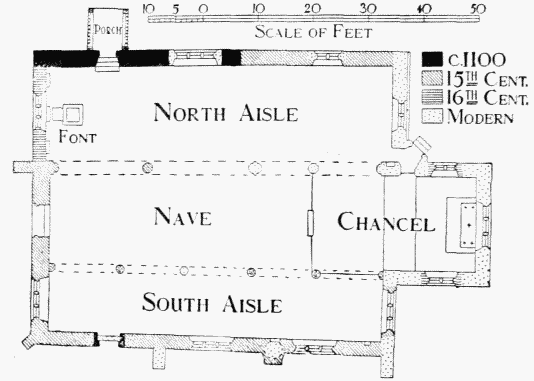
Plan of Ribbesford Church
The mill within the Park is mentioned in the extent of Bewdley Manor in 1336, (fn. 363) and seems to have stood on the site of the now disused Snuff Mill. In 1381 it was said to be often useless because the stream dried up, so that it was worth no more than 6s. 8d. yearly. (fn. 364)
About 1595 Sir John Hibbotts or Hubaud gave the town two mills for the poor. (fn. 365) There are at the present time two corn-mills on Dowles Brook known as the Town Mill and Knowles Mill.
A free fishery by the island called the Neyte is mentioned in all the early extents of the manor, but in 1651 this island is said to have been much wasted and decayed by the water of the Severn, and therefore of little value, (fn. 366) and it has now entirely disappeared.
CHURCHES
The church of ST. LEONARD, Ribbesford, consists of a chancel 29 ft. 4 in. by 17 ft., nave 48 ft. by 16 ft. 6 in., north aisle (the east end of which is screened off for a vestry) 63 ft. 3 in. by 17 ft. 6 in., south aisle (including south chapel) 60 ft. 6 in. by 11 ft., north porch and timber west bellcote. These measurements are all internal. The church is built of sandstone ashlar and is roofed with tiles.
The present north aisle probably covers the area of a small church built here about 1100, the only parts of which now left are the western half of the north wall, the south doorway reset in the south wall of the south aisle, and some carved fragments re-used in the modern masonry. Later in the 12th century a south chapel was probably built, for the two eastern bays of the north arcade, destroyed in 1877, are said to have been Norman, and some of the 12th-century carved stones built into the modern blockings are said to be fragments of them. During the first half of the 15th century the present nave, and probably a chancel, were added and the eastern portion of the north wall of the original nave was rebuilt. The south aisle was added later in the century. In the following century some windows were inserted and the west wall of the north aisle was rebuilt. The timber north porch dates from 1633. The church was struck by lightning on 13 June 1877, and the damage done necessitated the thorough restoration of the fabric and the rebuilding of the chancel, the east walls of the aisles, and the two east bays of the north arcade. The walls of both aisles were also raised 2 ft., the south porch was removed, and the south doorway blocked.
The chancel has a modern east window of three cinquefoiled lights with geometrical tracery. In each side wall is a 16th-century window of two cinquefoiled lights with a square head. Their external lintels are formed out of 12th-century stones, that of the north window being enriched by foliated carving, while the lintel of the south window has star and strap ornament; the internal jambs and sill of the latter are carried down to form sedilia. To the west of the window on the north side is a modern doorway. There is no chancel arch, and the chancel extends west so as to include the easternmost bays of the north and south arcades. The bay so included on the north has a modern stone arch, while that on the south is the east bay of an oak arcade of five bays extending to the west wall of the nave. This arcade consists of octagonal posts with capitals, from which spring curved struts, reaching to the large plate which carries the rafters of the roof, and meeting so as to form two-centred arches. It probably dates from about 1450. The second pillar from the west is modern, and the lower parts of all have been cut and placed upon modern stone bases. The capitals are octagonal and the struts forming the arches are chamfered. The portion of the north arcade within the nave is of three bays; the easternmost bay is modern, and was rebuilt with the adjoining bay on the north side of the chancel in 1877. The other two bays are of the 15th century, and have four-centred arches of two sunk chamfered orders and an octagonal pillar and west respond. The two eastern pillars and all the bases are modern. At the west end is a 15th-century doorway with a modern depressed head, and above it is a three-light window with a restored square head and mullions. The posts at the west end of the nave supporting the bellcote, and the framework of the bellcote itself, appear to be modern.
The north aisle has a modern two-light east window; the lower part of the east wall is 3 ft. thick, and is probably of the 12th century. In the north wall, near the east end, is a two-light window with modern tracery, and further west is a modern three-light window. Beyond this is a doorway of about 1100, which has a semicircular head moulded with an edge roll, and engaged jamb shafts with carved capitals and abaci. In the tympanum is a carved figure subject representing a knight with bow and arrow transfixing a fishlike monster; below the bow, between these figures, is a greyhound with its back to the monster. This subject, within a star border, is well executed and in a good state of preservation. The capitals are carved with strap ornament and figure subjects in low relief, and there are similarly carved panels on the jambs beside them; the abaci are carved with zigzag and chequered ornament. The shafts stop abruptly on plain chamfered plinths, that on the east side being modern. On this wall, opposite the two western pillars, are two 15th-century moulded corbels for the support of the aisle roof; they have canopied niches below them and mark the original height of the aisle wall. In the west wall is a repaired three-light window with uncusped lights under a four-centred head, probably of the 16th century. The north porch is timber framed and has open balustraded sides, and a cambered and moulded beam over the entrance, on which is carved the date 1633 with the initials T.H. and H.W. A similar beam on the inside has been cut away that the doorway may be seen to better advantage; its previous existence doubtless accounts in no small measure for the excellent preservation of the tympanum. The porch, which has been repaired and probably reconstructed, is covered with a tiled roof, and the gable is plastered above the outside beam.
The south aisle has a reset east window of three lights under a four-centred head; the central light is cinquefoiled and the side lights are trefoiled. There are three windows of similar design in the south wall, one of which is above the south doorway, and one in the west wall; all of these are original, but repaired. In the south wall, near the east end, is a four-centred piscina recess without a bowl, and between the two easternmost windows is a blocked rood-stair doorway with a four-centred head, and above it a similar doorway, now obscured by a modern monument; built into the blocking of the lower one is a piece of 12th-century cheveron moulding. The stairway projects on the outside as a buttress upon which is a sundial. The south doorway, now blocked, is similar in character to the north doorway, but has a modern lintel. The capitals are carved with rudimentary leaf ornament and mythical animals in low relief, very finely executed. There are fragments of 12th-century mouldings built into the blocking on the inside of the wall, some circular pieces of which, enriched with wicker-work ornament, are said to have belonged to a stone altar now lying below the floor under the east window of the north aisle.
The nave, chancel and aisles all have modern opentimber trussed roofs. The font and pulpit are modern. Pieces of 15th-century oak tracery, doubtless the remains of the rood-screen, have been re-used in the panels of the present chancel screen and the pulpit. These fragments are enriched with heads, lilies, and human figures with shields, all well executed; the screen has also a band of carved open-work leaf ornament. The lectern is made up of pieces of oak ornamented with 17th-century carving in low relief. At the west end of the north aisle is a small 17th-century oak table with turned legs, and in the chancel is preserved a chair of about 1650. At the west end of the north aisle is a fragment of sculptured stonework, probably from a tomb.
In the west window of the south aisle are some panels of 15th-century painted glass. Those in the heads of the lights have a central shield and an edge border of crowns; the shield in the south light is Argent three chanfrons sable, that in the north light is Gyronny of twelve pieces argent and gules, and the central one is Gules a fesse argent with a crescent argent in chief. Below this in the central light are four panels. The top one is a long panel of the 15th century, which was found some years ago in the churchyard; it occupies the full width of the light and represents St. George and the dragon within a border of crowns. Two small lozenge-shaped panels below are composed of fragments of glass of the same date, including some black lettering in the lower one, and between them is a shield of France and England.
There are three monumental slabs, now placed upright against the west wall of the north aisle; the north one, a flat slab having in relief a calvary cross with fleur de lis arms, is probably of late 12th-century date; the central one, with a foliated calvary cross and a long shield with a gobony border placed over it, is of the 13th century, much defaced and broken. The upper part of the cross is missing and a piece, since repaired, has been broken out of the centre of the slab. There is a marginal inscription in fine Gothic characters, only part of which, '. . . pri: . . . bon: henri' is decipherable; the upper surface of this slab is slightly raised towards the central line. The southern slab is also of the 13th century, and has a foliated cross and moulded edges; it is in good condition, but slightly decayed at the foot. Above these stones are mural monuments to Thomas Millward, who died in 1780, John Boraston (rector), who died in 1688, and two other tablets of the 18th century, while in the north corner is a slate slab to John Willetts, who died in 1726. On the north wall are mural monuments to Christopher Bancks, who died in 1788, Charles Wright, who died in 1796, and his wife, 1788, and to William Prattinton, who died in 1789, his son Peter, (fn. 367) M.B. of Christ Church, Oxford, 1840, and other members of the Prattinton family. On the west wall of the nave is a monument to Richard Clare, who died in 1708, with a shield of arms Or three cheverons gules. On the south wall of the south aisle are a tablet to John Tiles, who died in 1626, and a monument with flanking columns, broken pediment, and central shield, to John Soley, who died in 1604, 'Margare' his wife, 1639, and some members of their family; the shield is Vert a cheveron party or and gules between three soles proper with a molet for difference; crest, a sole on a crescent. Placed in the blocked doorway to the rood-loft is a fragment of a monumental slab, probably of the 15th century. On the west wall of the south aisle are tablets to William Hopkins, who died in 1647, and his wife, 1656.
There is a ring of three bells in the bellcote: the treble is by Abel Rudhall, 1756; the second is a bell of early form, probably of the 12th century; it has a conical waist, a flat, slightly oval lip, a lower diameter averaging 1 ft. 83/8 in. and a height of 1 ft. 6 in. to the feet of the cannons. This bell is in excellent condition, and has been in continuous use. The tenor is by John Rudhall, 1798.
The plate consists of a silver chalice of 1636, inscribed with a quotation from St. Paul's Epistle to the Corinthians in Latin round the body, and at the bottom 'Donum Henrici Herberti eq' Eccles' de Ribsford anno Dom' 1636 mens' mart' ante festum Paschae,' a cover paten of 1636 with modern lining, a paten of 1759, the gift of Ann Willets, and a flagon of 1638, given by Henry Herbert in 1639.
The registers before 1812 are as follows: (i) (including the parish of Bewdley) all entries 1574 to 1653; (ii) 'births' 1653 to 1660, baptisms 1661 to 1694, marriages 1653 to 1694, burials 1653 to 1678; (iii) all entries 1695 to 1723, also births in parallel columns with the baptisms from 1706; in this book is a copy of a deed of gift to charity by Thomas Cooke, dated 1693; (iv) all entries 1724 to 1747; (v) baptisms and burials 1748 to 1764, marriages 1748 to 1765; (vi) and (vii) in one book containing all entries 1765 to 1798 and 1799 to 1812.
The church of ST. ANNE at Bewdley consists of a chancel measuring internally 22 ft. by 30 ft. 6 in., nave 65 ft. 10 in. by 21 ft. 10 in., north and south aisles 9 ft. 6 in. wide, and north-west tower 12 ft. 1 in. by 13 ft. 5 in.
The square tower was erected in 1695–6, as recorded by an inscription in the ringing chamber, and the body of the church, which is designed in the Renaissance manner of the period, replaced a somewhat earlier structure in 1748. The whole building is of sandstone ashlar plastered internally. Thechancel has a 'Venetian' east window flanked by Roman Ionic fluted pilasters, wide semicircular-headed windows on the north and south, and a flat plaster decorated ceiling. The nave is divided into five bays by Roman Doric columns reaching to the plaster ceiling, which is segmental over the nave and flat over the aisles, the aisle windows being similar to those in the side walls of the chancel. Externally the walls have a moulded plinth, flat pilasters between the windows, a moulded cornice, and a balustraded parapet which passes horizontally across the east end, the chancel roof being hipped. The nave and aisles are included under one roof, which, like that of the chancel, is tiled. The tower is of four stages, separated by plain flat string-courses, and is surmounted by a deep moulded cornice and a balustraded parapet with a vase at each corner. The belfry has on each face a wide fourcentred louvred window with a clock face below. The panelled oak pulpit, which is square with truncated angles and has a deep cornice, the oak galleries at the north, west, and south of the nave and aisles, and the pews, cut down to their present height at a later period, are all of the 18th century. The font is modern.
There is a ring of eight bells, all by Thomas Rudhall, 1780; there is also a small bell hung in the east window of the belfry, stamped with the arms of Bewdley, but without inscription.
The plate consists of a cup of 1637 bearing the inscription 'Margaret Whitcoate of Bewdley 1636' and a quotation in Latin from St. Paul's Epistle to the Corinthians; a paten of the same date to fit the cup; two large patens of 1759; a flagon of 1637, which has at the bottom the inscription 'Donum Henrici Herberti Ecclesiae de Ribsford Anno Do. 1637 Ante Festum Paschae'; and a modern chalice.
The registers are included with Ribbesford.
The church of HOLY TRINITY in the Far Forest was consecrated in 1844. (fn. 368) The building is of stone and is designed in the style of the 13th century. It consists of a chancel, nave, transepts, and small west turret containing one bell. The parish was taken out of Rock, Ribbesford and Stottesdon in 1845, (fn. 369) and the living, a vicarage, is alternately in the gift of the rectors of the first two parishes.
ADVOWSONS
The advowson of Ribbesford followed throughout the descent of the manor, (fn. 370) though the king presented for one turn in 1638 (fn. 371) and Henry Arthur Earl of Powis was patron in 1765. (fn. 372) In 1291 the church was not worth £4 yearly, and was therefore untaxed, (fn. 373) but in 1535 it was valued at £23 14s. 2d. together with the chapel at Bewdley. (fn. 374)
The town of Bewdley, probably owing to its origin as a forest settlement, was extra-parochial until by a private Act of Parliament made in the reign of Henry VI it was put within the parish of Ribbesford. (fn. 375) The first chapel, which Leland describes as a timber building in the heart of the town, was probably built before 1472. (fn. 376)
One of the chantry priests, who was chosen by the men of the town, (fn. 377) served the cure of Bewdley at a stipend of £8. (fn. 378) When the chantries were suppressed this stipend was granted by the Crown to the chaplain of Bewdley and paid by the king's receiver. (fn. 379) The bailiff and burgesses augmented the stipend to £40, and, as they also repaired the chancel (fn. 380) and paid all other expenses, it became the custom for them to present a chaplain. (fn. 381) In 1720, however, the rector of Ribbesford laid claim to the advowson and the corporation acknowledged his right under their common seal. (fn. 382) The rector of Ribbesford is still the patron, but the chapel became a parish church in 1853. (fn. 383) The inhabitants of Bewdley petitioned in 1655 that their chapel might be made parochial, but, as there was no suitable land from which a church-yard could be formed, their petition was not granted. (fn. 384)
The old chapel remained standing till 1745, when it was decided to pull it down and build a new one of stone. (fn. 385) At this time the dedication was said to be to St. Andrew, (fn. 386) but no evidence of this has been found. The chapel was certainly dedicated to St. Anne in 1520, (fn. 387) and probably as early as 1472. (fn. 388)
A bridge chapel at Bewdley is mentioned in 1650, when 1,000 tiles were ordered from Worcester for repairing it. (fn. 389) According to tradition this was the oldest chapel in the town, though, as the bridge was not built till 1447, it cannot have been much older than the first chapel of St. Anne. It was a small timber building on the north side of the old bridge and was pulled down to make room for Telford's bridge in 1798. (fn. 390) This chapel was also dedicated to St. Anne, if one may judge from the fact that its site used to be known as St. Anne's Corner. (fn. 391)
The chantry of St. Anne in the chapel of Bewdley is traditionally said to have been founded by John Washbourne, who left 'one tenement to the same chantry' to celebrate his anniversary. (fn. 392) It stood on the north side of the chancel, and next to it was another chantry chapel dedicated to the Holy Trinity. This seems to have been connected with a gild of some kind. (fn. 393) The 'Warden of the Guylde of Holly Trinytie' is mentioned in a conveyance of the manor of Dowles in 1544, (fn. 394) and part of the property there was long known as Trinity Ground, but there is apparently no record of the work of the gild or the object for which it had been founded. On the south side of the chancel was the chantry chapel of our Lady, which is said to have been founded by the Gild of Corvesers. (fn. 395) Property belonging to all three chantries was granted in 1549 to Richard Hall and Edward Barber, (fn. 396) and at the same date a burgage called the Crown at Bewdley, belonging to St. Anne's chantry, was granted to Thomas Watson and William Adys. (fn. 397)
CHARITIES
Mary Crane, Elizabeth Crane and the Rev. Joseph Crane by their wills, proved in the P.C.C. on 16 May 1855, 24 December 1855, and 18 October 1860, respectively, bequeathed a legacy of £50 each, the interest to be distributed on St. Thomas's Day among poor persons in the parish. The legacies, less duty, were invested in three sums of £48 16s. 8d. consols, producing together £3 13s. yearly.
The sums of stock are held by the official trustees, who also hold a sum of £27 16s. 3d. consols, producing 13s. 8d. yearly, in trust for Bancks's Sunday School Foundation for prizes for scholars, and £22 consols in trust for Bancks's charity for the poor for providing two yearly sums of 5s. each for two old people at Christmas and a yearly sum of 1s. for a Bible from time to time for such people.
In 1879 William Essington Essington, by will proved at London 12 February, bequeathed £102 3s. 5d. consols, the annual dividends, amounting to £2 11s., to be applied for the benefit of the poor of the parish of St. Anne.
In 1884 Thomas Draper, by his will proved at Worcester 14 January, bequeathed £105 13s. 7d. consols, the annual dividends, amounting to £2 12s. 8d., to be distributed at Christmas among the poor of the lordship of Ribbesford. The two sums of stock are held by the official trustees.
In 1840 Ellen Vobe, by will proved in the P.C.C. 5 August, left a sum of money, now represented by £510 4s. 1d. consols with the official trustees, the annual dividends, amounting to £12 15s., to be distributed among twelve poor single women who have attained the age of fifty years, to be selected from Ribbesford, Bewdley and Dowles.
Bewdley Educational Charities.—The Free Grammar School (fn. 398) and its endowments are regulated by a scheme of 1914 by which the school is carried on as a cookery and woodwork centre of the Worcestershire County Council.
In 1819 the Rev. Thomas Wigan by his will, proved in the P.C.C., bequeathed to the rector of Ribbesford and to the master of the grammar school a collection of books to be used as a public library.
In 1661 Richard Viccaris, otherwise Vickriss, conveyed to trustees a farm-house and 10 acres, or thereabouts, at Oldbury, in the parish of Thornbury, Gloucestershire, called the Shepherdine estate, upon trust to pay £5 a year to the master of the grammar school, £3 to poor women in childbed, and the residue to the preacher serving at the chapel in Bewdley (now St. Anne's Church).
The land is let at £26 a year, and the official trustees hold a sum of £36 5s. 11d. consols, arising from sale of timber.
Almshouse Charities.—Sayers's almshouses, otherwise the Lower Park almshouses, and subsidiary endowments are regulated by a scheme of the Charity Commissioners, 13 June 1893. The almshouses were founded by will of Samuel Sayers, proved in the P.C.C. 27 January 1625, for six poor men. The endowments consist of a rent-charge of £30 issuing out of land and tenements at Nettlestead, Suffolk; two fields at Astley Wood, containing 11 acres, or thereabouts, let at £18 a year, the gift of John Sheriffe; £91 0s. 6d. consols derived under the will of Miss Ellen Vobe, proved in the P.C.C. 1840; and £112 4s. consols, the gift of Mary Watkins, 1842. The sums of stock are held by the official trustees, producing together £5 1s. 4d. yearly.
Bourlton's almshouses, otherwise Park Lane almshouses, founded in 1645 by Humphrey Bourlton for poor old decayed men, their wives and children, are endowed with 6 acres at Hawthorne Bush let at £18 a year, a rent-charge of £4 10s. charged upon an estate at Wribbenhall, and £860 consols, representing a legacy of £100 by will of Ellen Vobe, and a gift of £280 10s. 4d. consols by Mary Watkins and accumulations of income. The stock is held by the official trustees, producing £21 10s. yearly.
Cooke's almshouses, situate in the High Street, founded by will of Thomas Cooke, dated in 1693, confirmed by deed 20 September 1705, are endowed with an annuity of £21 5s. charged upon Newhouse Farm, situate in Neen Sollers, county Salop, £92 3s. 9d. consols by will of Ellen Vobe, £280 10s. 1d. consols by gift of Mary Watkins, and £109 9s. 6d. consols by will of James Tart. The sums of stock are held by the official trustees, producing £12 0s. 8d. yearly. The almshouses are occupied by eight poor women.
Hibbotts's and Gilding's Charity for Poor.—In an ancient table of benefactions, which was preserved in the grammar school, it was stated that Sir John Hibbotts, kt., bequeathed (prior to 1595) two cornmills situate on Dowles Brook, the rents to be paid for ever to the poor of the town of Bewdley.
In 1651 Francis Gilding, as appears in the Parliamentary Returns of 1786, left land for the poor.
These charities are administered together under the provisions of schemes of the Charity Commissioners, 1873 and 1882. The official trustees hold a sum of £506 6s. 7d. consols, arising from the sale of the Town Mill (Hibbotts's charity), and a sum of £803 0s. 2d. consols arising from the sale in 1884 of property in Dog Lane and Dowles Road (Gilding's charity), producing together £32 14s. 8d. yearly.
Sir Henry Herbert, kt., by his will (date not stated) devised an annuity of £13 issuing out of certain property in Upper Street (now High Street) to be applied in the distribution of bread among the poor. By an order of the Charity Commissioners, 19 November 1895, the annuity was vested in the official trustee of charity lands.
In 1714 John Hammond by will directed a sum of £150 to be laid out in land, the net rents thereof to be distributed among twelve poor housekeepers of the borough in Christmas week and on Monday in Easter week in equal portions. The charity was the subject of proceedings in Chancery, and the legacy was laid out in the purchase of certain meadow lands in the parish of Whitbourne in the county of Hereford, containing about 6 acres, which by a deed dated 23 January 1770 were conveyed to trustees upon the trusts and with such powers as were mentioned in the said will and a decree of the Court of Chancery, pronounced 13 December 1717. The land is let at £8 a year, and the official trustees hold a sum of £22 13s. 6d. consols, arising from the investment of accumulations of income.
In 1754 William Crump by his will bequeathed £200 secured by a turnpike bond, now represented by £188 1s. 3d. consols, the annual dividends to be distributed on 16 October in bread among twenty poor widows residing in Bewdley.
In 1808 John Hurst by his will left £10, the interest to be applied in the distribution of bread at Christmas; trust fund now £9 17s. 9d. consols.
In 1819 Wilson Aylesbury Roberts by a codicil to his will bequeathed £200 secured by a turnpike bond, now represented by £188 13s. 7d. consols, the income to be distributed on St. Thomas's Day among ten poor widows.
In 1830 Miss Caroline Aylesbury Roberts by her will bequeathed £216 13s. 4d. secured by a turnpike bond, now represented by £219 4s. 9d. consols, the income to distributed on St. Thomas's Day among ten poor women.
In 1855 Elizabeth Crane, and in 1860 the Rev. Joseph Crane, by their wills proved in the P.C.C., left legacies of £50 each, the interest thereof respectively to be distributed on St. Thomas's Day among poor belonging to the Bewdley chapel district. The legacies are represented by two sums of £48 16s. 8d. consols.
In 1884 Thomas Draper, by his will proved at Worcester, bequeathed £100 consols, the dividends to be distributed at Christmas among the most deserving poor of the borough.
The sums of stock belonging to the six preceding distributive charities are held by the official trustees, producing together £20 1s. yearly, the dividends being duly apportioned among the respective charities.
In 1871 Miss Mary Blackford by her will bequeathed her residuary personal estate to form a fund, to be known as the Bewdley Coal, Blanket and Clothing Fund. The trust fund consists of £2,200 consols, with the official trustees, the annual dividends of which, amounting to £55, are applied in pursuance of the trusts declared by deed of 19 June 1875 confirming the bequest.
Nonconformist Charities.—The Wesleyan Methodist chapel, school and trust property, comprised in deeds of 1811 and 1879, was by an order of the Charity Commissioners, 13 September 1892, vested in the trustees thereby appointed upon the trusts of the Skircoat model deed, 1832.
The Independent or Presbyterian meeting-house is possessed of a sum of £817 2s. 2d. consols, derived under the will of James Clarke, 1765, for the benefit of the minister of the chapel and for the poor; also of £512 14s. 8d. consols, John Reynold's charity, comprised in deed, 1836. The sums of stock are held by the official trustees, producing together £33 4s. 8d. yearly.
The Particular Baptist chapels in Bewdley and Kidderminster were endowed by the Rev. George Brookes by deed, 2 October 1840 (enrolled), and by will, proved with a codicil in the P.C.C. 2 April 1844, with six houses in York Street, four houses in Bromsgrove Street, and two houses in Brussels Street, all in Kidderminster, of a gross rental value of £117 a year; and £2,126 3s. 5d. consols, which is held by the official trustees, producing £53 3s. annually. The sum of £20 is paid to the minister of the Baptist chapel, Church Street, Kidderminster, (fn. 399) and the remainder of the net income is applied for the benefit of the Baptist chapel, Bewdley.
By an order of the Charity Commissioners of 18 July 1905 new trustees were appointed, and the legal estate in the lands and hereditaments was vested in the official trustee of charity lands.
Bewdley, Far Forest.—In 1879 William Essington Essington by will, proved at London, 12 February, bequeathed £100, the interest to be applied halfyearly for the benefit of the poor of Far Forest. The legacy was invested in £102 3s. 5d. consols, producing £2 11s. yearly.
The same testator bequeathed £100 for educational purposes in Far Forest, of which part was expended in reflooring the school and the balance in the purchase of £64 16s. 3d. consols, producing £1 12s. 4d. yearly.
The sums of stock are held by the official trustees, who also hold a sum of £151 3s. 4d. consols, the annual dividends of which, amounting to £3 15s. 4d., are under a scheme of 29 August 1902 applicable in the repair of the church of Holy Trinity and its contents.
The same trustees also hold £100 18s. 1d. consols arising under the will of Mrs. Ann Weaver, dated in 1850, producing £2 10s. 4d. yearly, which is applicable for the benefit of the school in connexion with the district church.