A History of the County of Worcester: Volume 4. Originally published by Victoria County History, London, 1924.
This free content was digitised by double rekeying. All rights reserved.
'Parishes: Shrawley', in A History of the County of Worcester: Volume 4, ed. William Page, J W Willis-Bund (London, 1924), British History Online https://www.british-history.ac.uk/vch/worcs/vol4/pp337-341 [accessed 30 April 2025].
'Parishes: Shrawley', in A History of the County of Worcester: Volume 4. Edited by William Page, J W Willis-Bund (London, 1924), British History Online, accessed April 30, 2025, https://www.british-history.ac.uk/vch/worcs/vol4/pp337-341.
"Parishes: Shrawley". A History of the County of Worcester: Volume 4. Ed. William Page, J W Willis-Bund (London, 1924), British History Online. Web. 30 April 2025. https://www.british-history.ac.uk/vch/worcs/vol4/pp337-341.
In this section
SHRAWLEY
Escreueleia, Scravelega, Scraveley (xii cent.); Shreveleye, Schreweleye, Srauele (xiii cent.); Sharuele, Schrauell, Shraule, Schrauleye (xiv cent.); Shraveley (xv cent.).
Shrawley is almost surrounded by the Severn and its tributaries, being bounded on the east by the Severn, on the south by Shrawley Brook, and on the north by Dick Brook. The school was built in 1860 and enlarged in 1894 and 1911. It stands on the Worcester road, about a quarter of a mile north of the church, which is situated on the north side of a by-road leading westwards to Great Witley from the main road. Near it stands the pound.
The principal settlement is situated on the Worcester road about three-quarters of a mile to the north of the church, where it is joined by a by-road from the west. Here are several half-timber cottages and houses, mainly of the early 17th century. Standing back from the road on the east side, nearly opposite the fork, is a half-timber house of 1600, two stories in height, now turned into two cottages, with a stable at the western end. A large open fireplace inside has been filled up and an entrance made at the side of it; the chimney stacks are surmounted by good brick shafts of the diagonal type. A little to the south of the fork a lane branches off on the west side of the main road and again joins it near the school. Along this lane are several half-timber houses, one of which, near the post office, has timbering of an early type, with 17th-century and modern brick chimney stacks. The rectory, which is reached by a by-road branching off from this lane near its northern end, is a two-storied brick house of the early 18th century with a small central courtyard containing a well, and an original oak staircase. To the east of the rectory is the old glebe barn, which dates from the 17th century. It is constructed of brick on a sandstone base, and has a tiled roof; the walls are pierced by several tiers of short loop-holes.
Shrawley Court is about a quarter of a mile northeast of the church, and is now a farm-house. Immediately below it are several artificial mounds known as the Court Hills or Oliver's Mound, which seem to have been raised for military purposes, possibly to command a ford over the Severn. The Worcester Road is carried over Shrawley Brook by Doleham Bridge.
Shrawley Wood is a large piece of woodland in the north of the parish between the Worcester road and the Severn. It is between 400 and 500 acres in extent, and is very luxuriant. The indigenous smallleaved lime tree forms its underwood and it abounds with lily of the valley. A rare grass—the wood fescue grass—grows in it, and a great number of fungi. It was reserved from the sale of the manor by William Sheldon in 1558, (fn. 1) and followed the descent of the advowson. Wood House, the property of the lord of the manor, is entirely modern, and is the residence of Mr. James Hugh Allan.
The surface of the parish is undulating, at a height of about 200 ft., but in the east the land falls to the level of the Severn. Sharpley Pool is a large piece of water on the north-western boundary, partly in Astley. There are several other large ponds, (fn. 2) and a small heronry in Shrawley Wood.
The parish has an area of 1,941 acres, of which 406 are arable land, 982 permanent grass, and 438 woods and plantations. (fn. 3) The soil is of a stiff loamy nature, the subsoil chiefly Keuper Sandstone, with a little Keuper Marl in the south. The chief crops are wheat, barley and beans, and a considerable quantity of fruit is grown.
Among place names have been found: Fygysbrugge (xv cent.), (fn. 4) Netherparke, Courtehey (fn. 5) (xvi cent.), Esgars, Rudding Meadow, or Over Rudding (xvii cent.). (fn. 6)
MANOR
The first mention of SHRAWLEY appears to be an entry in the Evesham Chartulary, assigned to the latter half of the 12th century, that William Beauchamp of Elmley held I hide there. (fn. 7) In 1210–12 William Beauchamp held a fee in Shrawley of Ralph de Toeni. (fn. 8) Ralph's interest passed with the overlordship of Elmley Lovett to the Beauchamps, (fn. 9) and thus lapsed. The Beauchamps, afterwards Earls of Warwick, continued as overlords (fn. 10) until about 1337, when Thomas Earl of Warwick acquired the manor in fee through his marriage with Catherine Mortimer. (fn. 11)
The first recorded under-tenants of the Beauchamps were the Poers. Roger Poer held a fee in Shrawley of William Beauchamp early in the 13th century, (fn. 12) and was dealing with land in Shrawley in 1234–5. (fn. 13) In 1248–9 Hugh Poer granted 2 carucates in Shrawley to William Poer, (fn. 14) who claimed free warren in the manor in 1274–5. (fn. 15) He died without male issue, (fn. 16) and the manor was granted by his daughter Alina, one of his co-heirs, to Edmund Mortimer and Margaret his wife, (fn. 17) who were jointly seised at the time of Edmund's death in 1304. (fn. 18) Margaret granted the manor in 1314 with Eckington to Alina Poer for life, with reversion to John son of Edmund Mortimer and his issue, and contingent remainder to Margaret and her heirs. (fn. 19) Margaret Mortimer was holding the manor in 1316, (fn. 20) and it probably passed to her great-grandson, Roger Earl of March. Roger's eldest daughter Catherine married Thomas Earl of Warwick in 1337, and apparently brought the manor to him, for in 1344 it was settled by him on himself and Catherine, with remainder in tail-male successively to his sons Guy, Thomas and Reynburn and to the heirs male of John his brother. (fn. 21) From this time the manor (fn. 22) followed the same descent as Elmley Castle, (fn. 23) passing with it to Henry VII in 1487. It was granted to Catherine Parr for life in 1544. (fn. 24)
In February 1545 a lease of the manor for twentyone years was granted to William Sheldon of Weston (co. Warwick), (fn. 25) to whom on 5 August of the same year the reversion of the manor was granted in fee by Henry VIII. (fn. 26) William Sheldon, then of Beoley, sold the manor in 1558 to William Gower of Redmarley to hold of himself and his heirs at a yearly rent of £9. (fn. 27) William Gower settled the manor in 1573 jointly on his two elder daughters, Anne, wife of George Rotherham of Farley in Luton (co. Bedford), and Ursula wife of William Adams of Cleaton (co. Salop.), (fn. 28) and died seised of it in 1595. (fn. 29) His daughter Anne was at that date wife of Edward Hugford or Hungerford, and Ursula of George Nash. They had livery of the manor on 23 February 1602. (fn. 30) Ursula died on 23 September 1602 at Bridge (co. Hereford), and was succeeded in her moiety of the manor by her son John Adams. (fn. 31) On his death in 1616 his daughter Anne, wife of Francis Adams, succeeded, (fn. 32) and she and her husband conveyed the manor in 1628 to Charles Adams and John Corbett. (fn. 33) They were holding it in 1637–8, (fn. 34) but were evidently trustees for Francis Adams, who conveyed the manor in 1663 jointly with William Crumpton and Sarah his wife to Thomas Stephens. (fn. 35) Thomas was probably acting for his father-in-law, Thomas Childe, who bought the other half of the manor about this time, and whose son William joined with him in conveying the whole to Allan Cliffe in 1681. (fn. 36)
The other moiety passed at the death of Anne Hugford in 1619 to Thomas Rotherham, her son by her first husband. (fn. 37) Thomas Rotherham, who died in 1620 at Worcester seised of this moiety, then called the lower (inferior) manor of Shrawley, was succeeded by his brother Edmund. (fn. 38) Edmund was succeeded before 1649 by his son George Rotherham, (fn. 39) who in that year sold his moiety to Dame Anna Maria Jenkinson and her son Robert Jenkinson, (fn. 40) to whom in the same year Mary, widow of Edmund Rotherham, conveyed the third of the manor which she held as jointure. (fn. 41) The Jenkinsons seem to have been acting for Thomas Childe of Northwick, (fn. 42) and joined with his son and successor William in 1681 in selling the manor to Allan Cliffe. (fn. 43)
By his will, dated 1687, Allan Cliffe appointed as his executor his nephew Allan Cliffe, son of his brother Humphrey. (fn. 44) Allan had succeeded by 1699, (fn. 45) and in 1700 sold the manor to Thomas Vernon of the Middle Temple, lord of the manor of Hanbury. (fn. 46) Since that date Shrawley has descended with Hanbury, (fn. 47) and now belongs to Sir Harry Foley Vernon.
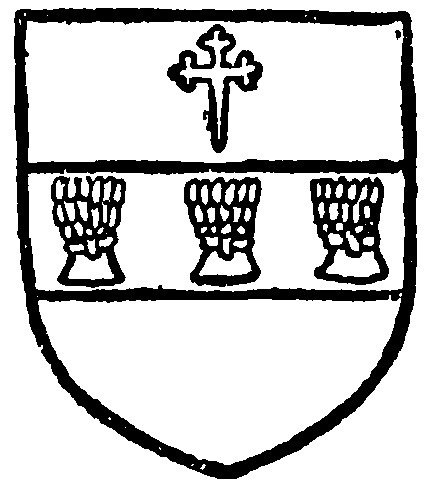
Vernon of Hanbury. Or a fesse azure with three sheaves or thereon and a crosslet fitchy gules in the chief.
A third of a mill at Shrawley was claimed in dower from Roger Poer by Alice, widow of Henry the Miller, in 1234–5. (fn. 48) Reference occurs to a water-mill called Hedemylle in 1398–9 (fn. 49) and in 15th and 16th-century court rolls. (fn. 50) There is also a reference in 1488 to a mill called Dolemylle and to a fulling-mill. (fn. 51) Dolemylle may have been in the neighbourhood of Doleham on Shrawley Brook, but there are no mills existing in the parish at the present day.
CHURCH
The church of ST. MARY consists of a chancel 27 ft. 6 in. by 16 ft. 11 in., north vestry, nave 52 ft. 6 in. by 21 ft. 9 in., south porch 11 ft. 6 in. by 10 ft., and west tower 9 ft. 11 in. square. These dimensions are all internal.
The chancel dates from about the year 1100, but the nave, which is not on the same axis, appears to have been built at a somewhat later date, while the south doorway of the nave is an insertion of about 1170. Windows were added to the nave and its north walls buttressed during the four following centuries, while in the 15th century the church was reroofed and an embattled parapet built on the nave walls. The south porch was built in the latter part of the 15th century, and the west tower about 1550. In recent years the fabric has been restored, the east end of the chancel rebuilt, and a brick vestry added on the north side of the chancel.
The church and tower are built of red sandstone ashlar, and the porch, which is also of sandstone, and is built of very large stones, has its east and west sides filled in with 17th-century brickwork above an ashlar plinth. All the walls are faced externally, while internally the chancel walls are faced and the nave walls plastered. The chancel and nave roofs are of slate, that of the porch being tiled.
The modern east wall of the chancel is pierced by twin round-headed lights with a circular window above. In the north wall are three narrow roundheaded lights of about 1100 having splayed jambs, rear arches, and sills; the central light piercing the pilaster buttress forms a picturesque feature of the external elevation. Below the sills externally is a cable moulded string-course, broken round the buttresses. The wall below the windows is thickened by a high internal plinth. Below the easternmost window is a plain aumbry with a segmental head, probably of the 14th century, and under the westernmost window is a modern doorway to the vestry. On the south side are three original windows similar in all respects to those on the north, the moulded external string being enriched with cable and cheveron moulding. Below the westernmost window is an original doorway with a plain segmental head, moulded label with billet enrichment, plain jambs, and moulded abaci. The semicircular chancel arch is modern.
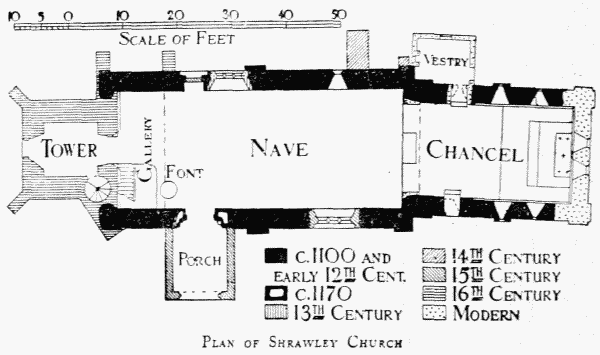
Plan of Shrawley Church
At the north-east of the nave is an original early 12th-century single light with a semicircular head, and further west a three-light window under a twocentred head with tracery, the inner jambs and rear arch of which are probably of the late 13th century, but the external stonework is modern. Beyond this window is a 12th-century blocked doorway with a semicircular head of two orders, one of which is moulded with a large edge-roll, while the other is square; the outer order is supported by shafts with scalloped capitals, chamfered abaci, and moulded bases. The north wall is strengthened by five buttresses; the central one is an original pilaster buttress, while the two eastern buttresses are of the 14th century, one of them a massive block of masonry 6 ft. 10 in. deep by 4 ft. wide. The buttresses to the west of the doorway are of the 16th century. A string-course with cheveron moulding passes round the north-east corner, and is stopped on the large buttress. There are two windows on the south side of the nave. The easternmost is a three-light window of the late 15th century, the four-centred head of which has been rebuilt at a later date and tilted up so as to present a horse-shoe appearance, the mullions being continued to the head without cusps; the other window, which is near the west end of the wall and is partly blocked by the porch roof, is an original round-headed light widened at a later date, probably in the 18th century, by the removal of the inner order. The south doorway, below and a little to the east of this, has a roundheaded arch of three moulded orders and a hollowchamfered label; the outer and inner orders have plain edge-rolls continued down the jambs, the head of the inner order being segmental with a plain plastered tympanum above. The middle order is enriched by zigzag ornament, and is supported on the west by a jamb shaft with a leaf capital, chamfered abacus, and moulded base, and on the east by a similar capital and abacus, but the shaft is corbelled off a little below the capital, the space below being occupied by a 15thcentury stoup, the sides of which are panelled and project as three sides of an octagon. The stonework of the bowl and foot of the stoup is somewhat broken and worn away, and modern plaster flower ornaments have been placed in the hollow chamfer of the label over the doorway. There are two original pilaster buttresses on this wall, one at the east end and the other in the centre. At the east end, stopped by the later south-east window, is a string-course with a cheveron moulding similar to that on the north wall. Internally there are pieces of a hollow-chamfered 12thcentury string-course which probably went all round the nave walls at the level of the window-sills and over the door arches. The south porch has a wide archway of two orders with a depressed four-centred head; there is a horizontal stone string-course over the arch, and the gable above is plastered.
The tower is of three internal stages, but is only divided externally by one string-course. There are diagonal buttresses at the western angles, which stop below the belfry stage, and the walls are crowned by a plain parapet with crocketed pinnacles at the angles; the stair-turret is at the south-east, and being continued across the angle made by the nave with the tower forms a deep buttress. The ground stage of the tower has a semicircular-headed doorway with ogee moulded jambs, opening into the nave, and a pointed chamfered doorway on the west with a round-headed window of two lights above it. On the south side of the intermediate stage is a flat-headed opening with a wood door, and each face of the bell-chamber has a twolight round-headed window.
The chancel and nave haveopen-timber trussed roofs of the 15th century with moulded principals, spandrels, purlins, and wall-plates; the nave roof is strengthened by four modern beams. The font has a white sandstone circular bowl and short circular shaft of the early 12th century, and a red sandstone octagonal base of a later date. The upper part of the bowl is enriched by a scalloped band and the lower edge with a hollow moulding. The oak pulpit dates from the late 16th or early 17th century; it has panelled sides with incised foliated and geometrical designs, and a bookboard supported by curved brackets; the stand has been altered at a subsequent date. At the west end of the nave, supported by a cross-beam, is an 18th-century gallery with a front having turned balusters divided into three bays by two panelled posts. The nave is fitted with 18th-century oak pews, which are complete, except that the inner parts of some under the gallery have been cut away to form a vestry; they are in good condition, and apparently have never been painted. There is some 17th-century oak panelling at the east end of the nave, and also along the west wall.
In the churchyard to the south of the church is the square moulded base of a churchyard cross, which probably dates from the 14th century. It stands upon three steps, and has large moulded stops at the angles, the upper part being octagonal. On the top is a sundial made by Samuel Thorpe of Abberley in 1819, with this inscription, 'Ab Hoc Momento pendet Aeternitas.' Also in the churchyard, near the northeast corner of the chancel, is a mediaeval gravestone with a central ridge and plain inclined sides; it is broken across the middle and the lower part is entirely gone.
The tower contains a ring of six bells: the treble, second, third, and fourth are by Thomas Rudhall, 1772, and the fifth and tenor by Abraham Rudhall, 1705. There is also a small bell with no inscription.
The plate consists of an early 19th-century cup without date marks; a paten with feet of 1820; a flagon of 1819, given by Thomas Shrawley Vernon, 1820; and an electro-plated paten.
The registers previous to 1812 are as follows: (i) all entries 1537 to 1653; (ii) 1653 to 1718; (iii) 1719 to 1758; (iv) baptisms and burials 1759 to 1812, marriages 1755 to 1812.
ADVOWSON
The early history of the advowson is obscure. The church is mentioned in 1291, (fn. 52) and in 1304 the advowson belonged to Edmund Mortimer, lord of the manor, (fn. 53) to whom it had probably passed with the manor from the Poers. It descended with the manor until 1558, (fn. 54) when William Sheldon of Beoley reserved it from the sale to William Gower. (fn. 55) It was sold to William Childe in 1579–80 by Ralph son of William Sheldon, (fn. 56) and was held by the Childes of Pensax and Northwick, (fn. 57) until William Childe sold it with the manor to Allan Cliffe in 1681. (fn. 58) Since that date it has been held with the manor. (fn. 59)
Habington states that 'on the south-east of the churchyard is an owld decayed chap . . . nothinge ealse theare to bee seene.' (fn. 60)
The yearly value of a tenement given for the maintenance of obits was returned by the commissioners of Edward VI as 6s. 8d., whereof 12d. was given to the poor. (fn. 61) In 1637 the tenement was granted to Thomas Dalmahay and others for thirty-one years. (fn. 62)
CHARITIES
Thomas Vernon by a codicil to his will, dated in 1711, directed that a sum of £1,000 should be set apart for the benefit of the poor of the parishes of Hanbury (fn. 63) and Shrawley for buying gowns for poor old men and women and coal and other fuel for the winter.
The share of this parish was laid out in the purchase of an estate called Dean's Green in the parish of North Claines containing 83 acres, which is let at £134 a year.
The official trustees also hold a sum of £392 9s. 5d. consols, arising from accumulations of income and sale of timber.
The charity is regulated by a scheme of the High Court of Justice, 20 July 1883, whereby the trustees are authorized to pay a yearly sum not exceeding £60 to the managers of the National school. In 1911 a sum of £32 10s. was expended for educational purposes, and a sum of £32 was applied in the distribution of coal and clothing and in donations to charitable institutions.
Robert Marshall alias Millard—as appeared from the church table— gave £5 for the poor of this parish. It also appeared from the same table that the Rev. Edward Burlton, rector in 1664, gave £40 for the schooling of five poor children till they could read well in the Bible. No payments are now made in respect of either of these charities.
In 1856 Jane Bourne, by will proved in the P.C.C. 11 October, bequeathed a legacy now represented by £313 14s. 6d. consols, with the official trustees, the annual dividends amounting to £7 16s. 8d. to be applied for the benefit of aged and infirm poor on St. Thomas's Day.
The distribution is made in coal and gifts of money.