A History of the County of Worcester: Volume 4. Originally published by Victoria County History, London, 1924.
This free content was digitised by double rekeying. All rights reserved.
'The city of Worcester: Introduction and borough', in A History of the County of Worcester: Volume 4, ed. William Page, J W Willis-Bund (London, 1924), British History Online https://www.british-history.ac.uk/vch/worcs/vol4/pp376-390 [accessed 30 April 2025].
'The city of Worcester: Introduction and borough', in A History of the County of Worcester: Volume 4. Edited by William Page, J W Willis-Bund (London, 1924), British History Online, accessed April 30, 2025, https://www.british-history.ac.uk/vch/worcs/vol4/pp376-390.
"The city of Worcester: Introduction and borough". A History of the County of Worcester: Volume 4. Ed. William Page, J W Willis-Bund (London, 1924), British History Online. Web. 30 April 2025. https://www.british-history.ac.uk/vch/worcs/vol4/pp376-390.
In this section
THE CITY OF WORCESTER
Uueogorna (vii cent.); Weogorna ceastre (ix cent.); Wirccester (xi and xii cent.); Wigornia (xii to xvii cent.).
Upon emerging from the high lands which terminate about Bewdley and Stourport the Severn flows southwards through an undulating plain to meet the Avon at Tewkesbury. For more than a thousand years that plain has been dominated by the city of Worcester. The only ancient borough of the middle Severn district, its market was the appointed place of resort from all the surrounding country, its industries attracted more permanent settlers within its walls, its bridge gave accese in peace or war from the Midlands to Herefordshire and the Welsh border. Urban development at Worcester has always followed the lines proper to one of the ancient shire towns of England.

City of Worcester. Quarterly sable and gules a castle with three towers argent.
Local contours at Worcester, as elsewhere, determined the growth of the town, though their scale is small and their nature disguised by the long-continued occupation of the site. The road from London, before entering the city, descends a steep hill into the valley now occupied by the Worcester and Birmingham Canal, then rises up Sidbury and College Street to the level of High Street, the nucleus of the town. Continuing northward through Foregate Street and the tithing of Whistones, it descends slightly to the Bever Burn, from which the suburb of Barbourne derives its name, and then divides into branches which make respectively for Stourport and Droitwich. To the left of this line runs the Severn, at a level considerably below that of the town; between the river and the inhabited area along the Barbourne Road lies the Pitchcroft, a large common where the races are now held, occupying in regard to Worcester a position somewhat similar to that of the Roodee, outside the walls of Chester. Eastwards of the city the ground rises rapidly into hills, avoided by the mediaeval roads. A long strip of level ground, running north and south, raised above the Severn, and consequently exempt from its floods and commanding a ford across the river at the intersection of ancient tracks, (fn. 1) gave occasion for the rise of Worcester.
It had already attracted settlers during the period of the Roman government. Vague as are the traces of the Roman occupation from time to time revealed upon the site of Worcester, they are sufficient to prove permanent habitation. The coins which have been discovered there range in point of date from the 1st century to the 4th, (fn. 2) and sufficient fragments of Roman work remained at the date of the English conquest to obtain from the new settlers recognition of the site as a 'chester.' Recent scholarship has seen in the first element of the modern name a trace of Celtic origin, and has derived the early English Weogornaceaster from the British wegro ='grass.' (fn. 3) The existence of a Roman settlement at Worcester is not to be doubted; but there is no discernible continuity between it and the town of later times.
BOROUGH
Upon this site, in the later 7th century, there was built a church in honour of St. Peter, within which, soon after its foundation, was placed the seat of the bishop of the Hwiccas. In the last decade of that century Æthelred, King of the Mercians, gave lands to Oftfor the bishop and to the church of St. Peter, which is placed 'in Uueogorna civitate,' (fn. 4) and his charter affords the earliest documentary evidence of the existence of the town of Worcester. His example was widely followed by his successors, and, if their charters tell little of the history of the town, they at least attest its continued life from the age of the conversion until its fortification in the time of the Danish wars. The frequent reference which is made to Worcester in early times contrasts strongly with the utter obscurity which overhangs the remaining Severn boroughs of Shrewsbury and Gloucester.
Such evidence naturally places the church of Worcester in the foreground of the picture. When in 814 King Coenwulf of Mercia remitted to Bishop Denebeorht the feorm of twelve men which justly belongs to the city of Worcester 'and to the other monasteries which are under his authority,' (fn. 5) the city and the episcopal estate there were clearly regarded as equivalent. Yet it would be an error to regard the town as the creation of the church or to assume that the whole body of the citizens were the men of the bishop. Gloucester is apparently a town which developed round a religious house founded upon a vacant Roman settlement; at Worcester evidence coming from the 9th century shows the bishop merely as the greatest person in the borough, endowed with high privileges, but by no means the lord of the whole civic community. (fn. 6) Around the inhabited area at Worcester there lay wide fields, and an incidental reference in an early charter shows that to the west of the Severn there lay an extensive tract of land still regarded as appurtenant to the city as late as the beginning of the 9th century. In 816 Bishop Denebeorht bought from Coenwulf of Mercia immunities for his estates in various parts of the modern shire. Among these estates there is mentioned the land of thirty manentes 'in Weogorena leage,' of which the boundaries started from Moseley, ran along the Laughern and ended at the Teme. (fn. 7) Now it would be idle to consider how far this 'Weogorena leah' extended beyond the limits of the bishop's land, but the early dependence of this strip of territory upon the adjacent civitas is itself of sufficient importance. It may imply that the villages and hamlets within this area are of comparatively late formation; it certainly shows us an ancient borough standing in some form of superior relationship to lands far outside the boundaries of its own immediate fields. Also the fact that a great part of this district had passed at an early date into the hands of the bishop may remind us of the more famous expanse of episcopal territory which lay outside the walls of Winchester.
With the Danish wars of the 9th century begins the second phase in the history of Worcester. At some unknown date between 872 and 899 the city was fortified by Æthelred, Earl of the Mercians, and Æthelflæd his wife, with the assent of King Alfred and of the Mercian witan. The work was undertaken at the request of Bishop Werfrith 'for the protection of all the people,' and the bishop's friendship with the earl and his wife obtained for the church of Worcester a grant of privileges within the borough, recorded in a document which has happily been preserved. In return for psalms and masses, Æthelred and Æthelflæd granted to the bishop half the fines levied 'about the market-place and the streets' in respect of land-fee, fighting, stealing, buying or selling contrary to market rules, payments towards the maintenance of the borough wall. Without the market-place, the bishop should be held worthy of his land, and his rights, as the earl's predecessors ordained. (fn. 8)
This document is of the highest value, as well for general as for local history. It is one of the very earliest records which imply the existence of a borough court, and it enumerates the more important matters which were likely to fall within the province of this assembly. It reveals the early market of Worcester, it suggests with some force that the duty of maintaining the borough wall was laid at this date upon the townsmen rather than upon the men of the shire. It tells of an early bishop's quarter within the borough distinct from the market-place and the streets where jurisdiction was the king's. It has often been quoted, and rightly, for its evidence is unique. (fn. 9)
It is highly probable that in this fortification of Worcester there were laid down the lines of defence followed by the mediaeval wall of the city. Worcester has lost its walls, but the destruction was only accomplished in the 18th century; the circuit was virtually complete in 1610, and its course can be traced even at the present time. The outer face of the wall was strengthened with occasional bastions and protected by a wide ditch full of water; its memory is preserved in the name of Watercourse Alley, near Lowesmere, and a fragment of ancient wall, composed of large square blocks of red sandstone, is still visible both near St. Martin's Gate and also at the Butts, upon the exact line of the city defences. The outline described by the wall, as displayed in early maps, is irregular; the plan of Worcester has none of the rectangular symmetry which distinguishes that of Wallingford and Wareham. The line of the wall, which is still traceable for nearly the entire length, with long stretches of some height between the Butts and the back of New Street, starts from the river against the site of St. Clement's Church, and from thence proceeds eastwards to the Foregate. Sansome Street continues the line of the town ditch, the 'Port ditch' of the 14th century. Behind the ditch ran the wall along Watercourse Alley, trending in a south-easterly direction to St. Martin's Gate, the point of entrance for the mediaeval road from the east. It had a hornwork of defence, and was the last among the ancient gates of the city to survive the demolition of the 18th century. Between St. Martin's Gate and Sidbury Gate, commanding the London road, a long stretch of wall running north and south parted the city from the Blockhouse Fields, to which access was given, midway between the two gates, by Friar Gate, (fn. 10) connected by a narrow lane with Friar Street. Across Sidbury Street the line of the wall was continued to include St. Peter's Church; but at this point it turned at a right angle and ran north-westwards across Frog Lane, where it was pierced by another gate, to the castle precincts. Here it described another angle and ran north to the point marked by the 14th-century gateway known as the Edgar Tower, turning thence to the river along the southern boundary of College Green. The wall was continued along the river front of the city, where various fragments survived until the 19th century, and was entered from the Severn by the Water Gate against the priory ferry. In the 16th century the wall was entered through six gates. (fn. 11)
Doharty's map shows St. Martin's Gate, the chief entrance from the east, to have had a pointed arch between two octagonal bastions, and covered by three parallel gabled roofs. Sidbury Gate was the chief entrance from the south, protected by the formidable earthwork called Fort Royal, the remains of which still exist, and was similar to St. Martin's Gate except that the flanking bastions were circular; the foundations of the northern were uncovered in 1907.
Except in the south-eastern quarter of the city, where the course of the wall runs irregularly round the outer bailey of the castle, this line is very likely to represent the direction of the 9th-century works. It is evident that such an outline was determined by the distribution of existing streets and houses, and there is no reason to doubt that the protected area, now, as always, the kernel of the town, substantially represents the inhabited Worcester of King Alfred's day. It is less easy to speak with confidence about the nature of the original defences. Bedford never attained to any fortification stronger than a rampart and ditch, and the certainty that, with the rarest exceptions, earth and timber were alone employed in the fortresses of the early Norman period always raises an initial presumption against the use of stone in pre-Conquest defensive works. Yet Edward the Elder inclosed the burh of Towcester with a stone wall. (fn. 12) Athelstan surrounded Exeter with defences of hewn stone. (fn. 13) At Worcester Earl Æthelred's work is contemporaneously described as a wall, and there is a significant absence of later references to any rebuilding in stone of the city fortifications. (fn. 14) It may well be that the earliest walls of Worcester, in material as well as outline, come from the closing years of the 9th century.
During the reign of Harthacnut Worcester for a time became the storm-centre (fn. 15) of the English resistance to the heavy taxes of the Danish king. Two of his huscarls in May 1041, while collecting the geld, were attacked and driven into the tower of the priory and there slain. After six months' preparation a royal array, led by Godwin, Siward and other earls, reached the county. But the citizens in the long interval had formed a camp of refuge in the island of Bevere and now stoutly resisted. The avenging force sacked and burnt the city; but after this a settlement was effected, and the men of Worcester returned to build again their ruined homes.
It is during the period between the reign of Alfred and the Norman Conquest that Worcester, in common with most English boroughs, first appears as a minting place. (fn. 16) A solitary moneyer, by name Alfwold, first appears in the reign of Æthelred II, two moneyers only struck the extant Worcester coins of Cnut; under Edward the Confessor the number was suddenly increased to seven. Among these early citizens of Worcester two only, the Arncetel and Wicing, who worked respectively for Cnut and Edward the Confessor, bear names of Scandinavian origin—we might have expected a stronger alien element to appear in a city which for a time was the centre of a Danish earldom. It is, however, to be observed that no complete list has yet been attempted of old English civic moneyers. Local histories, for example, will at times record the names of minters who have escaped the British Museum catalogue. Under Æthelred II, for example, an unrecorded Æthelmær struck Worcester pennies. (fn. 17) His name is old English, but further investigation might well reveal that he had Scandinavian companions. But the seven moneyers who appear at Worcester during the Confessor's reign form but a small group in comparison with names which are recorded on the coins of Lincoln or Winchester, and the conclusion cannot be avoided that in 1066 Worcester held as yet but a secondary place among the trading centres of England.
It is impossible to speak more exactly, for the Domesday Survey gives no complete information respecting either the houses in the city or the number of its burgesses. In accordance with rule, the scribes have prefaced the description of the county with a column nominally relating to the affairs of the borough, but their interest in this case was confined to the local sources of the royal revenue and the legal customs which prevailed in the shire. (fn. 18) It is only incidentally, in the body of the county survey, that we read of Worcester houses or burgesses, and for the most part they appear as appurtenant to rural manors. The large holding of the Bishop of Worcester within the borough is revealed casually in this way, for his 90 houses in Worcester are only entered as an appurtenance of his manor of Northwick. (fn. 19) Of these, 45 remained in demesne, rendering nothing except work in the bishop's 'court,' 24 were held of the bishop by Urse d'Abitot, 8 by Osbern Fitz Richard, 11 by Walter Ponther; one was held by Robert le Despencer. That these details only account for 89 houses is characteristic of the arithmetic of Domesday. In addition to this group of tenements, which we may presume to have lain in the southern half of the city, Urse d'Abitot held under the bishop 25 houses 'in the market of Worcester,' and we are reminded of the 9th-century market within which Earl Æthelred and his wife granted profits of jurisdiction to Bishop Werfrith. Nothing hinders the belief that these houses lay about the later market-place round the Cross, just within the Foregate.
Among the Worcestershire landowners who possessed an interest in the county town the king claims the first place. There belonged to him one house worth 10d. as an appendage of his great manor of Kidderminster, two houses belonging to Feckenham, which rendered nothing, three houses annexed to Martley producing 12d., and one house appurtenant to Holloway whose occupant furnished two ploughshares. (fn. 20) An incidental reference to the rent of the houses in the city as a 'custom' received by Edward the Confessor (fn. 21) implies that there was much other property in Worcester, not recorded in connexion with estates in the shire, from which the king derived revenue. The number of these houses is not told us: an entry concluding the description of the fief of Evesham Abbey is more explicit in recording that that foundation possessed twenty-eight messuages within the city, of which five were waste, while the remainder rendered 20s. (fn. 22) In borough as in county it is certain that the ecclesiastical interest was strong, but lay lords also possessed their holdings within the town. Earl Roger of Shrewsbury possessed one house in Worcester worth 12d., attributed to his manor of Halesowen (fn. 23); Ralf de Toeni had two burgesses belonging to Astley and rendering 2s. (fn. 24); perhaps the burgess entered in the survey of Abbots Morton as rendering 10s. to Robert of Stafford (fn. 25) had his habitation in Worcester. In the entry relating to the manor of Pedmore two masuræ in Worcester are recorded, worth 2s. to William the son of Ansculf. (fn. 26) William the son of Corbucion and Urse d'Abitot each possessed a burgess in Worcester rendering 2s., appurtenant to their respective manors of Witton in Droitwich and Upton Warren (fn. 27); two burgesses in the county town who rendered 12d. belonged to the manor of Chaddesley Corbett held of the king by Eadgifu (fn. 28); one house in Worcester worth 16d. was appended to the lost manor of 'Osmerlie' (fn. 29) on the fief of Urse d'Abitot. (fn. 30) In these cases, at least, there can be no doubt of the connexion between the country manor and the county town.
Now if the details which have been collected here had been set forth in their due place at the head of the county survey, the description of Worcester would strikingly have resembled the picture which is given in Domesday of such a town as Leicester or Wallingford. It is only the absence of complete detail which has prevented Worcester from appearing as a typical borough of the composite kind, in which the burgage tenements are distributed among the several landowners of the shire, and are held by them as appurtenances of their estates in the county at large. It is of more interest to note that Worcester forms one of a group of boroughs, including Winchester, Southampton, Wilton, Cricklade, Hereford and Warwick, in which this connexion between town and county can be traced beyond the Conquest. Two haws 'within the port' were annexed to the 2 hides in Tappenhall which Bishop Lyfing leased to his faithful Earncytel in 1038. (fn. 31) Little attention has thus far been paid to such cases as these, but they have a very definite bearing on the question, which any history of Worcester must face, as to the nature of the relationship between the country manor and its burghal appurtenances. The doctrine that the landowners of the shire were bound by law to maintain in the county town houses whose occupants should be responsible for the repair of the borough wall finds little support in the Worcester evidence. It will hardly be argued that the burgesses whose rents swelled the bishop's receipts from his manor of Northwick were kept in the borough for the discharge of military responsibilities. The few facts which we possess imply that the maintenance of the Worcester walls was discharged by the citizens whom it protected; the inclusion of borough houses in leases of rural estates reads like a mark of favour rather than the expression of a legal responsibility. (fn. 32) We shall do better to accept in the case of Worcester the more recent theory which suggests that the annexation of town houses to country estates was intended to give to the rural community a means of access to the borough market. (fn. 33) The men of Worcester could still turn out to war, if need arose, in the 11th century. The whole body of the citizens joined the bishop's retainers and the garrison of the castle in repelling the rebels of 1088, (fn. 34) but the Worcester of Domesday nevertheless appears as essentially a community of traders, the town houses are a source of profit to rural lords, and the mobilisation of the burghers in a moment of danger should not incline us to subject them to military duties more stringent than lay upon the freemen outside their walls.
Little evidence will be expected respecting the internal topography of Worcester at this early date, but a document coming from the year 904 may fittingly be cited in connexion with the houses and messuages recorded in Domesday. (fn. 35) In that year Bishop Werfrith leased to his benefactors Earl Æthelred and his wife a haga within the walls of Worcester. The boundaries of this tenement are set forth in the lease: 'From the water by the north wall eastwards twenty-eight rods long, and then southwards twenty-four rods broad, and again then westwards to the Severn nineteen rods long.' Whatever may have been the length of the Worcester rod, it is clear that within this irregular outline there was room for the building of future houses: its dimensions agree with other evidence which shows us the soil of ancient boroughs divided into plots of considerable area. Across the Severn, level with the haga, there lay appurtenant meadow land included in the lease, which also conveyed 60 acres of arable to the south of the Barbourne and an equal amount to the north. The distribution of these acres suggests that the Worcester arable at this date was cultivated according to the two-field system. (fn. 36) Although the term is not employed, we may fairly infer that the bishop is here conveying a hide of land for the use of the dwellers within the haga, and we thus obtain reference to the agricultural element in the life of the early borough. The reference is welcome, for the borough fields are ignored alike by Domesday and by earlier records.
The revenue which an 11th-century king received annually from Worcester was derived from various sources. (fn. 37) Most important of these was the payment later known as the farm of the city. In the Confessor's day Worcester had rendered under this head £10 to the king and £8 to Earl Edwin, but of this sum the bishop received the third penny, which amounted to £6. (fn. 38) His position in this respect was anomalous, for the third part of the burghal render normally belonged to the earl; it is very likely that the bishop's claim was founded ultimately upon the grant to his predecessor by Æthelred and Æthelflæd of half the 'right' within Worcester which belonged to their lordship. The farm of £18 was exclusive of the unspecified sum received by the king from the rent of the houses in the borough, and exclusive also of a payment of £1 made by each moneyer during his visit to London when the dies were changed upon the issue of a new coinage. Even so it was a small sum; Gloucester had rendered £36 yearly to King Edward. Ninety years later, in contributing to the aid of 1156, Worcester and Gloucester were alike assessed at £15 as against Oxford and Exeter, which rendered £20, Hereford, which paid £10. (fn. 39) Worcester was clearly enough a borough of the second rank, but its wealth and population should not be underestimated. If we allow one burgess to each recorded house or messuage, and make no estimate of those unnumbered tenements from which the king derived his rent, we shall assign to Worcester the respectable number of 131 householders. This is no great population for an ancient borough, but there were shire towns of high importance in the Conqueror's day whose recorded inhabitants were fewer. The Nottingham of 1086 contained but 120 burgesses.
In common with most boroughs of its kind, Worcester suffered an increase of its farm during the Conqueror's reign. In 1086 the sheriff was rendering account of £23 15s. by tale from the city, of which the bishop received £8 as his third part. It may fairly be argued that the true firma of Worcester stood at the neater sum of £24, but was affected at the moment of the Survey by some temporary circumstance of which we know nothing. Until the reign of Henry III the farm remained stationary at £24. Among the constituent elements of this render the profits of the market, tolls, and the proceeds of the borough court must have accounted for the greater part. The farm of Worcester, like that of Huntingdon, did not include the king's burgage rents, its danegeld was, as usual, the subject of a distinct assessment. Already in 1086 it is possible that the burgesses were dealing directly with the sheriff in the matter of their farm; if, like the men of Hereford or Wallingford, they performed any personal services to the king, we read nothing of them.
Towards the danegeld the borough of Worcester was assessed in 1086 at 15 hides. (fn. 40) Unlike most county towns, Worcester was included for fiscal purposes in a rural hundred; it paid its geld in the hundred of Fishborough, (fn. 41) as the borough of Northampton at one time gelded in the hundred of Spelho, Huntingdon, in that of Hurstingstone. The Worcester case is the most remarkable of the three, for the hundred of Fishborough was remote from the borough; it lay along the Avon valley in the southeastern corner of the county. Worcester was surrounded by its bishop's triple hundred of Oswaldslow; Fishborough Hundred belonged to the abbey of Evesham, which possessed 65 hides within its limits. Worcestershire is the classical example of a county arranged symmetrically in hundreds of a hundred hides; at some unknown date it was felt desirable that the assessment of Fishborough Hundred should be raised to the normal standard, and this was accomplished by the heroic measure of adding 20 hides situated in the distant north-western hundred of Doddingtree and completing the hundred hides with the 15 hides laid on the borough of Worcester. The fiscal autonomy of the borough was violated for the sake of administrative symmetry, but the independence of the borough court was not affected. (fn. 42)
The 12th century was a calamitous time for the city of Worcester. It was burned four times within eighty years. On 19 June 1113 the town, cathedral and castle were destroyed in an accidental fire. (fn. 43) The second conflagration is recorded by a northern writer who remarks upon the frequency of these disasters; he tells us that in November 1131 the town of Worcester, 'as often happened,' was burned down. (fn. 44) The town suffered severely during the anarchy of Stephen's reign. Held for the king at the beginning of the wars by Count Waleran of Meulan, Worcester lay in dangerous proximity to the central stronghold of the empress at Gloucester, it commanded the nearest bridge by which the king, operating from Oxford against the rebels of the west, could cross the Severn. On 7 November 1139 the city was taken by the garrison of Gloucester. An attack had been anticipated, but no commander of rank was in the town, and the enemy, after a repulse before an outwork which protected the approaches from the south, broke in through the northern quarter. A part of the city was burned, the whole was sacked, and many of the citizens were carried off for ransom, but no attempt was made to hold the place for the empress, and within a week it was reoccupied for the king by the Count of Meulan. (fn. 45) In 1189 another fire destroyed nearly the whole town. (fn. 46)
An event more important in the history of the borough than this accidental disaster marks the first year of Richard I. In 1189 Worcester received its first royal charter. (fn. 47) By this document, which still rests in the archives of the corporation, the king granted to the burgesses of Worcester that they should hold the 'vill' of him at a rent of £24, to be paid yearly at the Exchequer. The men of Worcester obtained no remission of their ancient render to the king; the vital privilege conveyed by the charter is expressed in the last clause, which is repeated emphatically at the end of the original document. The citizens were thenceforward to make their account solely and directly with the officers of the Exchequer; the intervention of the sheriff in the matter of the city firma was abolished. It is at least possible that the men of Worcester had been delayed in attaining this elementary liberty—the first ambition of a rising town—by the fact that the shrievalty of the county descended hereditarily in its most powerful baronial family; the accession of a new king, willing to sell privileges that he might equip a crusading army, gave an opportunity the like of which had not occurred before. The charter was executed at Westminster on 12 November, a day on which the king was much occupied with the dispatch of writs to various parts of his dominions; record has been preserved of grants made on that occasion to the Bishop of Agen, the hospital of St. Mary Magdalen at Rouen, and the archbishop of that see. (fn. 48) It is significant that among the witnesses to the last document there occurs a certain Philip of Worcester; we may conjecture that his business at court was connected with the grant of privileges to the town from which he derived his name. We may also see in his absence from the witnesses to the Worcester charter itself the deliberate omission of an interested party.
From John, Worcester obtained no charter—a remarkable circumstance in view of the number and variety of burghal privileges granted by this king, apparently of set policy. At the beginning of his reign the citizens gave him 60 marks that they might hold their city at fee farm, (fn. 49) and in his later years he took tallages of unprecedented severity from the town. In 1199 it thus rendered 30 marks; in 1203, 40; in 1210, 500; in 1214, £100. Before this time 80 marks had been the greatest sum imposed by these arbitrary levies; this amount was paid by way of tallage in 1195. To all appearance it was immaterial whether the sheriff or the burgesses rendered accounts of these exactions; in 1203 and 1210 the sheriff answered for the tallage; in 1195 and 1199 the town or city; in 1214 the burgesses. (fn. 50)
It is to Henry III that Worcester owes its first detailed grant of chartered liberties. (fn. 51) In 1227, on 17 March, the king issued a charter, still preserved by the corporation, though ignored by most historians of Worcester, in which the essential privileges enjoyed by the borough in the later middle ages are explicitly conveyed. The charter opens by asserting that the royal constables, in whom we must recognize the hereditary castellans of Worcester, had been accustomed to exact from the town, apparently yearly, a tun of beer, rendering therefrom to the king only 2½d This demand was remitted to the town for the future, but its firma was simultaneously raised from £24 in assayed money to £30 by tale, to be paid at the Exchequer in two equal portions at Easter and Michaelmas respectively. For the future the feefarm rent of Worcester was fixed at £30. (fn. 52) In the second place, it was granted that no sheriff for the future should intervene in any plea belonging to the city, saving pleas of the Crown, which ought to be attached by the citizens pending the arrival of the king's justices. The third clause of the charter is of greater interest; by it the king granted that the citizens should have a merchant gild, with a hanse and all proper liberties, and that no one outside the gild should make any merchandise within the city or its suburb without the citizens' consent. It is evident, from the wording of the charter, that the Worcester gild merchant was a new creation, but its legitimation in the present document carries back its history to a point thirty-seven years earlier than the year 1264, from which its first appearance is commonly dated. Already in 1249 a Worcester charter is witnessed by Richard de la Gyldhall. (fn. 53) In the fourth clause of the charter it is declared that the villein of anyone who dwells in the city for a year and a day, in the gild and hanse. and at scot and lot with the burgesses, shall be free thenceforward. The scrf's freedom is made conditional upon his membership of the gild merchant. Franchises and immunities occupy the final clause of the document; the men of Worcester are to possess sake and soke, toll and theam, and infangenethef, and shall be quit of toll, lestage, passage, pontage, stallage, levy, danegeld. and gaiwite, in all the king's dominions, saving the liberty of the city of London. The charter was re-affirmed in 1264, (fn. 54) a date which has generally been taken as marking the first conferment of these liberties, but in the meantime the third in order among the earliest charters of the town had completed the exclusion of the sheriff from its precincts.
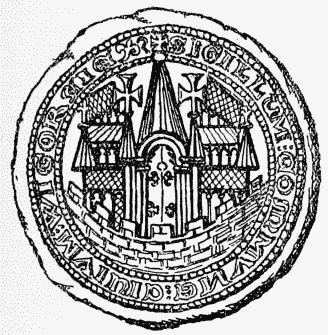
12th-century Seal of the Citizens of Worcester
By a charter (fn. 55) dated from Brill on 3 February 1257 the king granted to the men of Worcester, 'for the bettering of our city of Worcester,'the franchise known as the return of writs. Henceforward no sheriff should interfere in any matter of summons or distraint within the city, except through the defect of the citizens or bailiffs. This privilege was incorporated in the charter of 1264, and with the other liberties of the city was confirmed by each successive king from Edward I to Edward IV, (fn. 56) and by Henry VII, Henry VIII, and Edward VI. (fn. 57)
Worcester had been late in obtaining its grant of chartered privileges from the king, and the future development of its constitution was slow. The city was incorporated under the style of bailiffs, aldermen, chamberlains and citizens by charter of Philip and Mary in 1555 (fn. 58); its mayoralty was created by James I in 1621. (fn. 59) Until this date the chief officers of the city were the two bailiffs, who first appear in the 13th century, probably, as in other towns, representing predecessors whose function it was to collect the fee-farm rents due to the king. No complete list of the reeves or bailiffs of Worcester has been, or with our present knowledge could be, compiled; the early court rolls of the borough have been lost, and the attestation of the bailiffs of the town to private charters conveying land within its boundaries was not an invariable custom. The first reeve whose name has been preserved is the Ordric who, with the title 'prepositus,' occurs in a charter of the year 1089. (fn. 60) Among early bailiffs may be mentioned Roger de Oxford and John Credan, who appear in 1241; John de Estleye and John Comyn; William Sebrond and John Pergamenar, who witness other charters of the 13th century; William Colle and John Lovi, who appear in 1307; William Roculf the younger and William de Hodynton, appearing in 1319; William le Carter and Ralf de Tolwardyn; Robert de Sevenhampton and Peter de Radston, bailiffs in 1324 and 1326 respectively. (fn. 61) It is probable that already the custom prevailed by which the senior or high bailiff vacated office each year.
The late continuance of early forms of government at Worcester has this advantage, that the independence of the municipal government and the organization of the gild merchant becomes the more evident. Already in 1294 (fn. 62) the gildhall had become the court of justice for the borough in which the bailiffs sat to hear pleas, but in the 15th century the existence of a tollbooth or town hall is recorded. In a charter of 1241, (fn. 63) fourteen years after the foundation of the gild, the borough court appears as the proper authority to take cognizance of transfers of property within the city. In that year Ralf de Wickhamford granted to John de Kinebulton, rector of Pirton, a rent of 60s. from tenements in Worcester. His charter was witnessed by the bailiffs of Worcester, and on the morrow of the Holy Trinity was read 'in full hundred of the said city.' The use of this phrase at so late a period as the middle of the 13th century is very remarkable; it points back to a time when the city constituted a hundred of itself, with a court held co-ordinate with the assembly of Oswaldslow or Doddingtree. It also demonstrates the continuity between the old English borough court of Worcester and the judicial body which is found there in the later middle ages.
An alien element in the city life of this period was supplied by the Jews. Worcester, like most important boroughs, contained a Jewry as early as the 12th century. In 1184 Bonefei, a Jew of Worcester, owed one mark of gold for a respite to the king's court of an amercement for a novel disseisin, (fn. 64), and a little later in the next reign we hear of Leo the Jew, a usurer, with whom the abbot of Pershore had dealt, being imprisoned for a forcible entry into the hospital of Worcester, doubtless in the attempt to make good some legal claim. (fn. 65) The Worcester Jewry was probably never very large, since Jews were likely to avoid a city where life was cheap on account of the Welsh, (fn. 66) but it was sufficiently important (fn. 67) in the 13th century to possess a chirographer's chest, (fn. 68) and an assembly of Jewish notables met at Worcester (fn. 69) in 1241 to arrange for a tallage or assessment. In 1263 the Worcester Jewry was sacked (fn. 70) by a baronial force under Robert Earl Ferrers and Henry de Montfort. Jews, however, continued to live in Worcester till 1275, when their deportation (fn. 71) to Hereford was ordered.
Despite the Great Pestilence which marks its middle course, the 14th century was a prosperous time for the city of Worcester. It received augmented privileges from Edward III (fn. 72) and Richard II. (fn. 73) In 1377 it was ordained that no citizen should be required to come before the king's justices outside the walls of the city; in 1396 the chattels of felons and outlaws were granted for the use of the citizens, and the bailiffs were empowered to hold all pleas of lands and tenements and to discharge the office of justice of the peace, without the intervention of the county justices, in regard to all matters save felony. The woollen industry, upon which rested the prosperity of Worcester in the 16th century, was growing; in 1353 the city petitioned to be raised to the rank of a staple town, though its petition was refused. (fn. 74) In 1397 Worcester, with such flourishing towns as Leicester, Northampton, Yarmouth, and Nottingham, paid £66 13s. 4d. by way of loan to the king. (fn. 75)
The importance of Worcester as a distributing centre for the western Midlands depended largely upon its bridge. At the beginning of the 14th century there was no other bridge across the Severn between Gloucester and Bridgnorth; the conflux of travellers was felt to lay a grievous burden upon Worcester Priory. (fn. 76) A bridge already spanned the Severn at Worcester in the 11th century; it had just been repaired when the citizens crossed it to meet the rebels of 1088, (fn. 77) and the building of the original structure may possibly be referred to preConquest times. Early in the 14th century a new bridge was built, by which the river was crossed until 1780; to Leland, visiting Worcester upon his itinerary, the bridge appeared 'a royal peace of worke, highe and stronge.' (fn. 78) Its renovation was a charge laid upon the city; there is no trace of any custom by which the landowners of the county contributed to the maintenance of Worcester Bridge. The water bailiff, an officer of the city, appointed yearly, was charged with the care of the bridge (fn. 79); money was occasionally left in early wills for the purpose of its repair. In 1323 Bishop Cobham advocated its rebuilding as an act of piety, (fn. 80) and in 1328 a pontage grant for three years was obtained by the men of Worcester. (fn. 81)
The ancient bridge was across the river at the bottom of Newport (formerly Eyport) Street. It consisted of six arches resting on piers with starlings, and upon the middle pier was a gate-house like that still remaining at Monmouth. The bridge was pulled down in 1781, and the piers were found 'so strong as to be capable of bearing any weight and were with the utmost difficulty demolished; the openings were covered with double arches each consisting of three ribs and the interstices filled up with small stones and grout which by time was become one solid mass.' (fn. 82) The new bridge, said to have been necessary because the old one was insecure, is placed lower down the river at the foot of Bridge Street, which was widened to give it a suitable approach. It was designed by John Gwynn, a local architect, and consists of five semicircular arches crowned by a balustered parapet, and at the south end are a pair of circular domed lodges surrounded by Doric peristyles. It was opened to the public on 17 September 1781, and with the approaches cost £29, 843. (fn. 83) It has since been widened.
The names of the chief streets of the city are recorded in local grants of land, (fn. 84) and show that, as elsewhere, the men who followed particular trades grouped themselves in distinct quarters of the town. Such names are Glovers Street, Needler Street, Baxter Street, Corvyser Street, the quarter of the cordwainers, within which a shop was conveyed in the 13th century, Huckster Street, now Little Fish Street. The Sudbury Street of the 14th century is the modern Sidbury, Lich Street in the city has preserved its mediaeval name, 'Wodestapestret' is no longer known, Sansome Street represents the mediaeval Portditch, Mealcheapen Street retains its ancient name. The High Street and its continuation, the Foregate, continually recur; upon the tract of land before the city gate denoted, as at Shrewsbury, by the latter name, a suburb had already arisen by the 13th century. The grant in 1396 of a shop with a solar or upper chamber in High Street illustrates the nature of the buildings of the mediaeval town. (fn. 85) In the western suburb, across the Severn, Cripplegate, leading from the bridge to the Bull Ring in the township of St. Johns, and Hulton Street, apparently the modern Hylton Road, are the most prominent names.
As in the names of streets, so in the names of citizens, reference is continually made to prevailing trades and crafts. Richard le Mercer, William le Goldsmith, Gervase le Seller, David Pistor are typical examples; Simon and Richard le Belzeter, who appear in 1274 and 1319, were Worcester bellfounders. (fn. 86) Adam de Stratford, skinner, of Worcester, appears in a document of approximately 1230. (fn. 87) Very rarely there occur surnames which derive from personal names of the old-English period. In the last resort, Aldrich de Ledbury, Richard son of Gladwyne, Wulstan de Shrewsbury, William son of William son of Roculf descend respectively from an old English Ealdric, Gladwine, Wulstan and Hrocwulf. (fn. 88) But probably the greater number of the personal names current in mediaeval Worcester relate to the places from which their bearers came. They are of interest as indicating a mobile population in the district around; Shrewsbury, Winch combe, Hereford furnished citizens to Worcester in the 14th century, but the number of places in the shire from which Worcester burgesses derived their names is much less than the corresponding number to be obtained in the case of Leicester or Nottingham. We may suspect that there was less freedom of migration in the Severn country than existed in the north and east. Already in the 13th century settlers from Worcester were established in other, and distant, towns. Walter, Henry and William, of Worcester, appear in documents of this age as burgesses of Leicester. (fn. 89)
Worcester in the 14th century was already the centre of an important system of roads. The direct line from London to mid-Wales ran through Oxford, Chipping Norton and Evesham to the Severn at Worcester; the road to Evesham is mentioned in early city charters. A mile from the Cross a road branched off to Alcester and Warwick, which is likewise recorded in the 14th century. From Sidbury Gate ran the road to Gloucester and the lower Severn valley; the northern portion of this line is represented by the highway which leads to Kempsey, recorded in 1427. (fn. 90) From the western extremity of the old bridge the road to Hereford followed a devious course through the parish of St. John in Bedwardine, and the recorded journeys of King Stephen from Worcester to Ludlow show that a line corresponding to the modern road through Martley and Tenbury was already open in the 12th century. The series of road maps, which begins with Ogilby's Britannia in 1675, shows Worcester at the converging point of many lines of communication. The alternative roads from Evesham, through Pershore or by Fladbury, the roads from Gloucester, Leominster and Ludlow, the north-eastern road to Droitwich and Bromsgrove, are severally described, and as they approach the town of Worcester are marked as running through inclosed country. It is evident that the existence of a large and constant market for agricultural produce in the city had led to a modification of the local agrarian system. In Speed's map of 1610 suburban dwellings are shown clustering along the roads to Droitwich, Hereford, and London.
The significance of the city of Worcester as a meeting point of mediaeval roads is made much plainer by a study of the very valuable map of approximately 1350 preserved in the Bodleian Library. Upon this map a road is laid down north-westwards from Worcester to Kidderminster, Bridgnorth and Shrewsbury, each of these three towns representing a twelve-mile stage. To the north a road is marked as far as Bromsgrove, there dividing into two branches, of which one led direct to Coventry, the other forming part of a great cross-route over England by Birmingham and Lichfield to Derby, Chesterfield, and Doncaster. Southwards is defined a road to Tewkesbury and Gloucester. (fn. 91) It is impossible to enter here into a discussion of the exact meaning of the figures which are marked upon the map, and obviously do not approach at all closely to the measured miles of the present day, but it may be remarked that they appear to represent the 'computed miles' which occur in the road-books of the 17th and 18th centuries. If, however, the roads which are known from the direct evidence of the Bodleian map are added to those roads to Hereford, Oxford, and Warwick, with which incidental information acquaints us, there can be no question of the reasons why the city of Worcester maintained its prosperity through the middle ages.
The first recorded perambulation of the city boundaries was made on 12 April 1498. (fn. 92) With one very important exception, to be hereafter noted, the limits ascertained at that time remained the boundary of the city until its extension in 1835, and they evidently represent the area included within the liberties of the mediaeval borough. It is not possible at the present time to identify the oaks, stiles and gates marked in the 15th-century perambulation, but the boundaries are marked on extant maps, and the greater part of their course can still be followed. The perambulation started from the High Cross, which stood in front of the gildhall, (fn. 93) passed thence to the Grass Cross, on the site of the present Cross, (fn. 94) and where was apparently the mediaeval hay market, and so directly to the old bridge across the Severn. Beyond the river the line appears to have coincided with the modern city boundary as far as the present Bromwich Lane; its immediately subsequent course cannot be followed in detail, but the 18th-century boundary cut through the suburb of St. John, passing across the Bull Ring and along Henwick Road. It is certain that St. John's Church and the greater part of the township lay outside the borough until the 19th century. From the Henwick Road the line turned almost directly to the Severn, recrossed the river, passed over Pitchcroft and along Salt Lane, now named Castle Street, to the junction of Foregate Street with the tithing of Whistones. Continuing eastwards, the line described a great curve around the borough fields, crossing the roads to Droitwich and Alcester and reaching the London Road at the exact point of its junction with the road to Gloucester. For a short distance the latter road formed the city boundary, which ultimately struck off directly to the river and ran along the river bank to the castle ditch, leaving the castle precincts outside the borough. From the point at which the line recrossed the Severn, to the east end of the castle liberties, there is no doubt that the boundaries of 1498 were preserved until the last century; the final stage of the early perambulation is more obscure. It is, however, certain that the line ran along the castle ditch, then along a section of the priory wall, and ultimately to St. Mary's steps at the west end of Edgar Street. From this point the boundary is taken directly to the High Street and so to the High Cross. We may reasonably suppose that the perambulation followed the course of the cathedral precincts, as they existed in the 15th century, defined by Edgar Street, Sidbury and Lich Street.
Now these boundaries display this very remarkable feature, that they definitely leave a large part of the kernel of the town outside the borough. It is not strange that the priory and its adjacent area should thus be excluded; the cathedral precincts were only incorporated in the borough in 1835. But it is in every way a noteworthy fact that the borough boundaries are deliberately drawn so as to omit the populous district to the north of the priory which is roughly inclosed by the Severn, Broad Street and High Street. Enigmatical in some respects the boundaries may be, but no identification of doubtful landmarks is likely to bring this area within the limits of the borough. The reason for this curious fact can only be surmised, but it is a fair inference that the omitted area represents the portion of the town traditionally regarded as belonging to the church of Worcester. We cannot, indeed, believe that at the close of the 15th century the whole section of the town west of High Street and south of Broad Street lay outside the sphere of the borough court; when details respecting the manorial rights of Worcester Priory become known they were being exercised over tenements indiscriminately scattered in any quarter of the city. But it is not impossible that even at this late date memory may have been preserved of that early bishop's quarter within the city, the existence of which has already been inferred. Unless we are to assume that the boundaries have been described with an inadvertence wholly unlikely in the record of a solemn perambulation, we can only account for the facts by supposing that they represent a division of the inhabited area at Worcester, already obsolete in the 15th century, but received as a matter of tradition by the men of that date.
We are on surer ground in dealing with the boundaries of the cathedral precincts. As defined in 1640, they comprised an area bounded by the Severn, the northern wall of the castle yard, Castle Lane, Edgar Street, Sidbury, Lich Street and the southern wall of the bishop's palace. Within these limits lay the sanctuary of Worcester. It is evident that they represent the area of the cathedral monastery. The position of this area relative to the town of Worcester is very remarkable, for it interrupts the course of the north and south road upon which the city stands. The modern road which connects High Street with Sidbury disguises this irregularity, but it is very plain in the map of the city given by Green. It looks as if the cathedral precincts had encroached upon and diverted a more ancient road. But the archaeological evidence does not alone justify our assigning so high antiquity to the Foregate-Sidbury line. Future discoveries may throw light upon this question. (fn. 95)
Between the inter-mural area and the city boundary there were arable fields, but the agricultural basis of city life is less evident in Worcester records than in those of other towns. If we consider a typical series of Worcester deeds, such as those relating to the hospital of St. Wulstan which are preserved in the Bodleian Library, (fn. 96) we read much less of selions and fields than of houses and cottages. The exceptions are just enough to remind us of the agricultural background of the city. In 1333, for example, Agnes daughter of William de la Grene of Bromley quitclaimed to William le Carter, citizen of Worcester, all her right in certain arable land behind the close of the Friars Minor. (fn. 97) There were meadows near Diglis and at Pitchcroft, but we know nothing of any land-holding patriciate of burgesses such as appears in other towns of the rank of Worcester. At the same time, a measure at least of the ancient common rights of the burgesses survived all changes. In 1835 it was reported that the freemen enjoyed 'a limited right of common over about twenty acres of land.' (fn. 98) It is probable that the paucity of evidence as to mediaeval burgess holdings of arable is due to the early acquisition by the cathedral priory of a large holding around the city. (fn. 99)
The condition of the city of Worcester in the 15th century and the nature of its government are made known to us in some detail by the elaborate set of ordinances issued 'by the kynges comaundement and by hole assent of the citesens inhabitantes in the citye of Worcester at their yeld marchaunt holden the Sonday in the feste of the Exaltacion of the holy crosse' in the sixth year of Edward IV. (fn. 100) These ordinances relate to most aspects of civic life; they represent, at least, in great part a codification of existing customs, and they were reissued with some additions in 1496–7. Provision was made for their future recitation upon every law day falling next after Michaelmas; their execution was entrusted to the bailiffs of the city, who were to take action upon the information of the chamberlains, warned to advise the bailiffs if so directed 'by ii credible persones of the seid citie.'
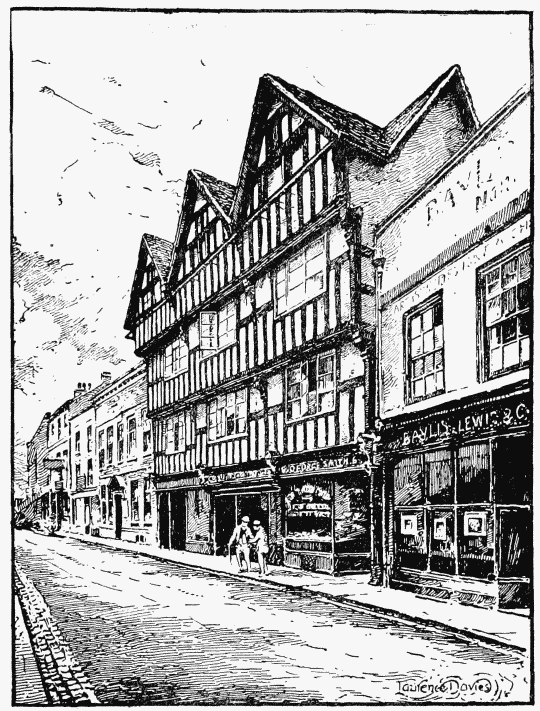
Worcester City: Old Timbered House
The ordinances, which are expressed in eighty-two distinct clauses, begin with regulations for the custody of the money and records belonging to the city. The first act was to ordain 'a stronge comyn cofur with vi keyes to kepe yn ther tresour.' The keys were severally to be held by the high bailiff, by one of the aldermen, by the two chamberlains, and by two 'thrifty comyners, trewe, sufficiant, and feithfulle men.' The chamberlains were to receive and account for the rents and other profits of the city, leases and conveyances were to be enrolled, acts of this and of former gilds were to be engrossed, one copy to be in the charge of successive low bailiffs, another to be held by the two chamberlains jointly, to whom was given the title 'conservitors or kepers of the articles of this said yelde, to that entent that they make levey of summes forfett by the same, to the use and profit of the seyd comynalte, dewly to be declared uppon ther accomptes amonge ther other receytes, and so to be delyvered to the comyn cofur.' Among these early clauses there occurs one of the few references to the agricultural background of urban life at Worcester, for it was ordained 'that the comyns may have knowlech from yere to yere how the comyn grounde ys occupied, and by whom, and yf that yt be not rented the comyns to seise it into hur handes to that ende that they may be remembered of their right, and to have profit and avayle thereof.'
Regulations of trade follow; that those who broke the assize of bread should not compound for their offence with the bailiffs, but should 'have the punysshement of every defaute accordynge to the statute and to the lawe,' that there should be no forestalling nor regrating of corn, that the price of ale should be assessed at every law-day, that there should be a public ale-measure, that no stranger to the borough should buy barley or malt until the resident brewers and maltsters had been served. An interesting clause (No. xiv) provides that a married woman should be sued 'as a woman soole marchaunt,' and that an action for debt should be brought against her without naming her husband in the plea. A series of scattered ordinances provide sanitary regulations, provision for bringing water to a citizen's house in case of fire, provision for the repair of the city walls, of the quay slips and of the pavement in the streets. Public order was the care of the bailiffs, to be assisted if need arose by every citizen, under penalty of 20s. A fine of 40d. was laid on anyone making an affray within the city; if the affray extended to the shedding of blood the guilty person should lose his weapon and pay 6s. 8d. 'Provided alwey that it shalle be lefulle to eny inhabitaunt to correct his servant or apprentice accordynge to the lawe.' It was a citizen's privilege not to be put in the common prison, but in one of the rooms underneath the gild hall, 'witout he be commytted to prison for felony or mans deth or an heynos trespas, or els the summe of dett of x li.'
The ordinances are mindful of the cloth industry, upon which the prosperity of the town already depended. We read of city weights for wool, and of custom to be paid on wool bought in the city, in the gild hall. The seventeenth ordinance relates to the payment of journeymen in the wool industry. Wages were thenceforward to be paid in gold or silver, but not 'in mercery, vitelle, or by other meanes.' It is evident that payment in kind was a practice highly resented by the Worcester artisans; the considerable fine of 20s. was ordained for a return to the system. Evasion of this rule by the employment of hands outside the city was foreseen; it was decreed that no one should 'put out eny wolle in hurting of the seid cite or in hynderynge of the pour comynalte of the same, wher they be persones ynogh and people to the same, to dye, carde or spynne, weve, or cloth-walke withyn the seid cyte, to every maner person or persons forein, but it be to men or women dwellynge wtyn the seid cite or subbarbes of the same.'The cloth industry in Worcester should give employment for Worcester artisans alone.
Other clauses connect the life of the borough with the political conditions of the time. The twentythird clause proclaims 'that pease and reste may be hadd and contynued betwene gentellz of the shyre and the cite at alle dayes.' The thirty-third, with reference to proclamations against liveries, forbids anyone to give or receive any livery contrary to the statute. No craftsman or artisan should 'be of clothyng wt eny other persone . . . . upon peyne of grevous and streyte inprisonement of hys body, and to make fyne and rannson at the kynges wille.' No man should receive malefactors, no outlawed citizen should hold office in the city. Provision was made for the open election of members of Parliament in the gild hall, 'of suche as hev dwellynge wtin the ffraunches and by the moste voice.' Members must be 'of good name and fame, not outlawed, not acombred in accyons as nygh as men may knowe, for worshipp of the seid cite'; they must possess freehold of at least the annual value of 40s. When returned to Parliament they must be 'att it to the end of the parliament' and receive their wages within three months of their coming home. The constable was to levy these wages, defaulting payers were to be fined 6s. 8d. to the common treasure.
Little is said in these ordinances of the craft gilds of Worcester; their history can be pieced together from incidental passages elsewhere, and that of the clothiers' and tilers' gilds has been already fully discussed. (fn. 101)
The cordwainers and shoemakers of Worcester had probably formed a gild as early as 1316, when they rendered yearly two pairs of leggings to the Earl of Warwick. (fn. 102) The cordwainers were incorporated by Henry VII in 1504, and their gild was governed by a master, two wardens and three assistants. (fn. 103) Their book of ordinances, 1558, silver seal and cup were in existence in 1857. They met in the Trinity Hall. (fn. 104) Joiners and carpenters were incorporated under a charter of 1690 with a master, two wardens and eight assistants. (fn. 105) The Bakers' Company was formed before 1496. (fn. 106) Their acts and ordinances for that year and 1563 still exist. (fn. 107) They were governed by two wardens, the youngest master of the craft being beadle. They met four times a year at the Grey Friars. Noake gives the date of incorporation of several other trades: glovers and pursers 1497, mercers, grocers, &c, 1545, tailors and drapers 1551, ironmongers 1598, butchers 1604, barbers and tallowchandlers 1677, bricklayers 1713, coopers 1726, and masons 1739. (fn. 108)
The craft gilds only come into the ordinances where their activities touch the general life of the town. Such was the case with the pageants of the crafts, which apparently had fallen into some decay before this time. We learn that there were five pageants to be held yearly; it was ordained that they should not be to seek 'when the shuld go to do worshippe to God and to the cite,' and that they should be better kept than they had been. One other clause relates to the crafts. A stranger to Worcester, wishing to exercise his craft there as a master, must make the customary payments to the wardens of the craft; a journeyman coming to the city, after dwelling there for a fortnight, must pay his dues to the wardens. But the enforcement of these regulations was left to the bailiffs of the city and the keepers of the articles of the gild. The gild merchant at Worcester dominated the city.
The government of Worcester is incidentally revealed in the course of these ordinances. Essentially, it consisted of the two bailiffs, a high and a low chamber of the common council. Its structure had become oligarchic by the 15th century. Each year the high bailiff retired, to be replaced by the low bailiff of the previous year. The choice of the new low bailiff rested with a body chosen for this purpose by the existing bailiffs and aldermen. The high chamber of the council consisted of twenty-four members, and vacancies in this body, which is sometimes called the Great Cloth, were filled by co-option. A fine of 13s. 4d. was laid upon any man so appointed who should decline to serve. The lower chamber was composed of forty-eight members, also maintained by co-option from among 'the most sadde and sufficiant of the comyns wtyn the cite.' The refusal of service was visited in this case by a fine of only 3s. 4d. In financial matters the lower chamber played an important part; no gift 'of the comyns good' might be made without their consent. If necessity arose for a tax or loan, it was to be assessed by a committee of twelve members, six chosen from the twenty-four and six from the forty-eight. Provision was made for the secrecy of council meetings, and for the due promulgation of the articles of the present gild, and such as should be made on future occasions. At every gild the existing body of ordinances and those proposed for adoption 'shullen at the laste be ii redde aforn the comyn counselle of the seid cite for ther willes assent and agrement to be hadd in the same.' After the third reading the ordinances should be read before 'alle the citezens of the seid cite that wollen appere to the same.' It does not, however, appear that the assent of the 'commons' of the city was essential to the acceptance of these by-laws. The government of the city rested with the bailiffs, the twenty-four and the forty-eight, and so remained until the charter of 2 October 1621, by which James I created the city a county of itself, and ordained its government by a mayor, recorder, and six aldermen. It is interesting to note that when the charter came down to Worcester it 'was read openly in the Guildhall of the said citie, first in Latin by Mr. William Wyatt, then towne clorke, and after, in Englishe, by Mr. Robert Barkeley, recorder, who expounded the special branches of the said charter to the cittizens then present, being a great multitude of all sorts of people.' (fn. 109)
The Ordinances of 1467 are not an example of ordered legislation; the recension made under Henry VII is much better arranged. A few articles of miscellaneous import may be described here. It was decreed that a citizen acting contrary to the ordinances should be boycotted by his fellows—' that none other citezen wtyn the seid cite demenaunt wthym bye ner sille chaffare un peyne of lesynge of his liberte and ffraunches for evermore.' The jurisdiction of the city court was jealously guarded—one citizen might not implead another in an external court until the city court had first been invoked. The 'foreign burgess,' important in the early phase of the borough history, was not regarded with favour in the 15th century. No more foreign burgesses should thenceforward be made, but all should be put on oath to dwell within the city. Existing burgesses dwelling outside should bear the same charges as those within 'except certeyn persones that for ther gret worshippe and offices of attendaunce be exemted.' Six names follow, among which are Thomas Lyttelton, Thomas Throckmorton, and William Lygon. Freedom of the city could be obtained in various ways. An apprentice must serve his seven years before applying for his freedom; his indentures brought in a fee of 4d. to the commonalty, and one penny, a charge for enrolling, to the town clerk. The son of a burgess might, it seems, proceed to this freedom upon payment of the accustomed charges; for him, as for an apprentice who had served his term, forty pence 'of old tyme accustomed' to the bailiffs and nine pence to the two aldermen' and other officers.' The smallness of these fees suggests that their origin is ancient. A stranger wishing to become a burgess must pay 13s. 4d. 'to the comyn cofre of the cite.' A concise clause ordains 'that no Burges be made in secrete wise, but openly, before sufficiaunt recorde.'
Regulations illustrating social life appear from time to time. No butcher must occupy a cook's craft. No one must sell ale without a sign at his door. Tennis must not be played in the gild hall. Labourers wishing to be hired within the city must stand daily at the Grass Cross, in winter at 6 a.m., in summer at 5. No fishmonger must buy fish of any stranger 'tylle the comyns be served yf they wylle bye of yt.' Two fishmongers must be chosen by the aldermen to see that the fish brought to the quay 'be able and sete for mannys body.' Tench and pike were eaten in Worcester at this time. No one must allow his pigs to go at large in the city to the annoyance and grievance of his neighbour. Horses must not stand in the market-place upon market day. For the prevention of fire neither wooden chimneys nor thatched roofs should be allowed thenceforward: by Midsummer Day next coming the wooden chimneys should be replaced by brick or stone and the thatched roofs by tiles. This particular ordinance may perhaps explain why tilers were encouraged to settle in Worcester just at this time. Tilers, it is said, might make their own bargains; the formation of a close body of tilers was discountenanced. 'And that the Tyler of the cite sett no parliament among them to make eny of them to be as a maister and alle other tylers to be as his seruant, but that every tyler be ffree to come and go to worche wt every man and citezen, frely, as they may accorde.' But every tiler should set his proper mark upon his tiles. (fn. 110)
The men who passed these ordinances might be an oligarchy; but they certainly had a wider conception of their duties than, so far as we can tell, had been current in earlier times. Worcester is not unique in this respect; other towns show the same tendency in the 15th century. The town government was no longer solely occupied with the maintenance of trade monopoly; at Worcester the gild merchant had virtually absorbed the earlier organization of the borough. It could therefore divert its attention towards securing some of the amenities of city life; streets paved, if only by individual effort, a river not charged with refuse, a decent measure of sanitary precaution. That the 'commons' of the city were much interested in the details of its government we have no evidence. The tendency towards burghal oligarchy is characteristic of the century; if the Worcester ordinances are in any way exceptional it is in their recognition of the commons as a body to be informed if not consulted. The city was prosperous, its industries varied and flourishing, its bridge still a frequent resort of travellers. Its government was justified in insisting upon its 'worship.' It is fortunate that we possess so illuminating an account of the condition of so powerful a city at the close of the Middle Ages.
The prosperity of Worcester in the middle of the 16th century is attested by the evidence of Leland. 'The welthe of the towne of Worcestar standithe most by draping, and noe towne of England, at this present tyme, maketh so many cloathes yearly as this towne doth.' (fn. 111) If Leland's description of Worcester is read in connexion with Speed's map published in 1610, and with the map given in Valentine Green's History of Worcester in 1796, the conclusion is very definitely produced that already by 1540 the inhabited area of the city had reached limits which were not greatly exceeded before the early part of the 19th century. Worcester in Leland's day was 'reasonably well waulyd'; in 1796 long stretches of the walls were down, but the space once fortified still included by far the greater part of the houses of the town. The suburbs of 1797 are already recorded in 1610 and by Leland. There had been building in the north beyond the Foregate; the houses in Green's map extend beyond St. Oswald's Chapel, which to Leland marked the very end of the Foregate suburb. The suburb without St. Martin's Gate was little extended beyond the lines suggested by Speed's map; it may be presumed that the 'low morishe ground' to which Leland refers prevented expansion in this quarter. There is no evidence that houses had spread further along the London road in 1796 than in 1610, nor that 'the fayre suburb without Sudbyry gate' which Leland saw was anything other than the house-fringed road which Speed drew. In Green's map the group of houses where the west end of the mediaeval bridge had been was still separated from the village of St. John in Bedwardine by a road running between hedgerows. Neither the map of Speed nor that of Green suggests any expansion of Leland's 'fayre suburbe beyond the bridge on Severn' of which the inhabitants resorted to St. Clement's Church cis pontem.
The Worcester evidence, in fact, suggests that such building as was required by the growth of population meant rather the addition of more houses within the ancient inhabited area than expansion towards the open country. The copious details which have been preserved concerning mediaeval Cambridge teach us that the core of the town was sparsely planted with houses, that we must make allowance for orchards, crofts and gardens. (fn. 112) The Worcester evidence is vague, but does not contradict the suggestion that in the 17th century there was still room for building near the centre of the city. No other suggestion, indeed, is possible if we interpret Speed's map strictly. He shows us buildings closely lining the streets of the city, streets for the most part which exist to-day, but between the lines of houses come wide open spaces within which, if we may believe him, no houses had arisen. He is sometimes at pains to assert the vacuity of these spaces by drawing trees within them: he draws a large area between Broad Street and the city wall completely void of habitation. Without asserting that the 'description' of Worcester expresses the result of a minute survey of the city we may certainly believe that the Worcester of 1610, and therefore of 1540, was loosely compacted, still occupying, conveniently enough, its mediaeval area. By the time of Green's map these empty spaces were full of houses and lanes. The skeleton of the city only remained unchanged; in 1796, as in 1610, and by Leland, it could be said that 'the fairest and most celebrate strete of the towne is from the Bysshopp's palace-gates to Fore-gate alonge by northe.'
How far the population of Worcester had really grown in these centuries must of course remain quite uncertain. Three different estimates are recorded by Green. In 1563 the families in the several parishes excluding the cathedral precincts amounted to 1,025. In the siege of 1646 the inhabitants within the city were 7, 176. In 1779 Mr. G. Young, 'an accurate and ingenious surveyor,' published a plan of the city which estimated the houses in the city and suburbs at 2,449 and the inhabitants at 13,104. (fn. 113) There is no real basis of comparison here, for only a speculative estimate will give the average number of persons in an Elizabethan family; and if, as is probable, the computation of 1646 omits the suburban population, it is apparently leaving out not less than a fifth of the inhabitants of Worcester. Also a time of siege is not one at which an estimate of population will be likely to give results which represent the normal condition of a town.
The charter of 2 October 1621 is a long and elaborate document in which the whole government of the city is reviewed and recast. It begins by declaring that the city 'ever hereafter is, shall be and remain, a free city of itself, and that the said city of Worcester precinct, circuit and going about and jurisdiction thereof shall extend and reach out . . . . unto seven wards of the same city.' The city was declared a county of itself and incorporated by the name of the Mayor, Aldermen and Citizens of the City of Worcester, with a common seal. The government of the city was entrusted to the mayor, 'six lawfull and discreet citizens' as aldermen, a sheriff and two chamberlains, a body of twenty-four, including the mayor and aldermen, and a body of forty-eight, including the two chamberlains. To this body was assigned 'one Counsell House within the guildhall of the said city.' It was further appointed that each year on the Monday next after St. Bartholomew's Day the mayor, aldermen, twenty-four and fortyeight should elect one of the twenty-four, willing to accept office, as mayor, six of the twenty-four as aldermen and one of the twenty-four or forty-eight as sheriff, he not having previously served that office nor been mayor nor bailiff. (fn. 114) The two chamberlains were to be elected by the same authority from among the forty-eight; the recorder, who must be learned in the law, should be chosen by the same body. Provision was also made for the election of a common clerk, auditors, coroners, escheator, sword-bearer and sergeants-at-mace. (fn. 115) These officers, as also the recorder, should hold their office at the will of the mayor, aldermen, twenty-four and forty-eight, and, with the exception of the recorder and common clerk, were subjected to loss of franchises, fine and imprisonment if they refused to bear office after their election. Entrance into the common council of the forty-eight was obtained by co-option.
The legal powers of the city authorities were further defined. Upon each Monday a court of record was to be held in the gild hall by the mayor, recorder and aldermen, or any three of them, to which such jurisdiction was given in matters of debt, trespass and pleas of land as had formerly belonged to the court held before the bailiffs, aldermen and chamberlains of the city. Power was given to execute the law merchant; the mayor, recorder and aldermen were declared justices of peace within the city; the sheriff was empowered to hold a court, called the county court of the city, each month; the corporation was allowed to purchase real property up to the yearly value of £100; tolls, rights of fair and market, chattels of felons and fugitives, wastes and commons were confirmed as they had been held in times past. The only exception to the authority of the corporation was contained in the last clause of the charter by which it was ruled that nothing in the charter should be construed to the loss or prejudice of the bishop or of the Dean and Chapter of Worcester. All privileges enjoyed by the cathedral body before the granting of the charter were declared inviolate, 'the liberty of bearing the sword before the mayor of the said city according to the tenor of these presents excepted.'
Substantially, this is still the constitution of the city. It was modified for a time in the first year of James II. On 18 February 1685 a charter was granted to the city which made certain changes of detail. The recorder, it was there ordained, should be a nobleman who should appoint a barrister of five years' standing to be his deputy. The number of the forty-eight was to be reduced to thirty-two; no further election was to be made into this body until seventeen of its members were dead or removed. But the crucial change was made by a clause which exposed the corporation to the direct influence of the Crown. The king was declared to possess the power of removing by order in council the mayor, recorder, sheriff, town clerk, or any of the aldermen, chamberlains or common council. The charter of 1685 has place in the movement which at this time was remodelling the constitutions of many towns to admit the exercise of royal intervention. in their affairs. As was usually the case, the new charter ceased to govern the town after the Revolution of 1688.
Worcester was a close corporation; discontent with the governing body led there, as in other boroughs, to riots in 1831. The freemen were still in 1834 as in the reign of Edward IV the basis of the constitution, and they formed comparatively a small proportion of the total population of the city. Freedom was attained by birth, servitude, purchase and gift. The government of Worcester had clearly ceased to be representative; its various organs were still doing efficient work. (fn. 116) The jurisdiction of the city in both civil and criminal cases was very far from obsolete. In criminal cases it claimed exclusive cognizance of offences not affecting life and limb; in civil matters it covered all actions without limitation as to amount. Financially, the city was in a fairly satisfactory position. It was burdened with a debt of £3,500; its average yearly revenue and expenditure were both estimated at £2,000. Its accounts were kept by a vice-chamberlain; local feeling, we learn, was opposed to the provision in the Act of 1835 which made the consent of the Treasury necessary before any of the corporation property could be sold or leased. (fn. 117)
Under the Act of 1835 (fn. 118) the government of the city became vested in a mayor, twelve aldermen and thirty-six councillors. The mayor was to be a justice of the peace and the city had a separate commission of the peace. It also acquired under this Act a separate court of quarter sessions.
Worcester returned two members to Parliament from earliest times, (fn. 119) this right being confirmed to them by the charter of 1555, until 1885, when under the Redistribution of Seats Act it lost one member. (fn. 120)
In the 13th century the city was divided into seven wards: St. Clement's, All Saints', St. Nicholas', St. Martin's, St. Peter's, St. Andrew's, and 'Alta Warda.' (fn. 121) The wards remained unaltered by the charter of James I, but under the Act of 1835 their number was reduced to six. (fn. 122) In 1885 the boundaries of the city were extended (fn. 123) to include parts of Claines, Hallow, St. John in Bedwardine, St. Peter's and St. Martin's which had been included in the city for Parliamentary purposes since 1868, (fn. 124) and six new wards were formed: St. John's, St. Nicholas', All Saints', St. Peter's, Claines, and St. Martin's.
In 1218 the Bishop of Worcester obtained a grant of a yearly fair at Worcester for four days at the feast of St. Barnabas the Apostle. (fn. 125) A fair 'de draperia' was held on the Nativity of the Virgin Mary, and in 1223 the bailiffs were ordered not to allow it to be held anywhere but in the accustomed place. (fn. 126) Under the charter of 1555 the citizens obtained a court of pie-powder (fn. 127) and three markets weekly, on Monday, Wednesday and Saturday, and four fairs, a four-days' fair beginning on the fifth day before Palm Sunday, a two-day's fair on the Friday and Saturday before the close of Easter called Low Sunday, a two-days' fair at the feast of the Assumption, and a two-days' fair at the feast of the Nativity of the Virgin. (fn. 128) Habington reports that the last two fairs were declining in his time, as they came during harvest. The other fairs were held on the Monday after Passion Sunday and on Saturday after Easter Day, and the markets on Wednesday and Saturday, the latter being 'so greate a mercate as scarce any mercats in England equallethe itt.' (fn. 129) Early in the 18th century the market days were Wednesday, Thursday and Saturday, and the fairs were held on Monday after Palm Sunday, 15 August and 8 September. (fn. 130) Before 1792, however, the Thursday markets had been changed to Friday, and there were five fairs held on Saturday before Palm Sunday, Saturday in Easter week, 15 August, 19 September, and the first Monday in December. (fn. 131)
In 1869 it was ordained that the fairs of Worcester were to be held on the first and third Monday in every month from January to August and in October and November, on the first Monday in December and on 19 September, while the Christmas fair was to be held on 16 December, or, if that day fell on Saturday or Sunday, on the Monday following. (fn. 132) The Monday fairs were in reality the former cattle markets. Besides the cattle market or fair a general market is still held on Wednesdays and Saturdays in the market-place. (fn. 133)
In the 16th century the principal fair was held alternately at the Grass Cross and St. Helen's, and the locality of the market was frequently changed. Leland says that the markets were held, one a little within St. Martin's Gate and the other a little within Foregate. (fn. 134) The salt market was held at the well of All Hallows, the cattle market in Broad Street, later at Dolday and Angel Lane. (fn. 135) Early in the 19th century the markets were held in front of the gild hall, but when that was restored an Act of Parliament was obtained for removing the market to a newly-erected market-house, while a cattle market was to be made for the sale of cattle, horses and sheep. (fn. 136)
The hop market held in 1796 on Wednesday, Friday and Saturday, and now on Saturday, the only authorized hop market in England except that of London, is not under the control of the corporation. It is administered by the Hop Market Guardians, a body constituted in 1731 as guardians of the poor, (fn. 137) and was held in the old Worcester workhouse. (fn. 138) Two representatives on the Board of Guardians were elected by each of the ancient parishes of Worcester and about twelve by the corporation. (fn. 139)
The industries of Worcester have been described in detail in the second volume of this history. Cloth-making was the first and greatest, but Worcester did not long hold that pre-eminence in the cloth industry which Leland assigns to the city. The struggle against cloth-makers who practised their craft in the county had ended to the disadvantage of the city clothiers. With cloth-making were combined the allied industries of fulling and dyeing. There are mediaeval references to the craft of glove-making, which developed greatly during the 17th and 18th centuries and is now one of the distinctive industries of the city. The same must be said of the manufacture of china, of which the beginnings in Worcester date from the middle of the 18th century. Mediaeval references exist to prove that Worcester contained workers in leather, tilers, and bell-founders. The necessities of 17th-century trade called forth a copious issue of token currency, and some pieces were struck, as at Nottingham, by the governing body of the town. At the present time Worcester is one of those towns in which a population, originally attracted by the demands of a market centre, has been augmented very materially by the planting of distinct industries. Accidental circumstances have contributed very largely to this, and Worcester in this respect has followed in the 19th century a development shared by many of the ancient shire towns of England.
The insignia of the corporation consists of two swords, four maces, a mayor's chain and badge, two other badges, the common seal and other seals. The sword of state is silver-gilt with the royal arms of William III and those of the city. The mourning sword is of 16th-century date. The four maces are of silver, hall-marked 1760–1. The common seal is of late 12th-century date with the legend: 'sigillum: commune: civium: wigornie.' The ancient seal of the bailiffs, now lost, was contemporary with the common seal. The arms of the city are Quarterly sable and gules a castle argent with three towers. (fn. 140)
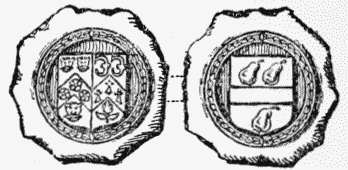
Seal of the Clothiers' Company of Worcester