
A History of the County of Worcester: Volume 4. Originally published by Victoria County History, London, 1924.
This free content was digitised by double rekeying. All rights reserved.
'The city of Worcester: Cathedral and priory', in A History of the County of Worcester: Volume 4, (London, 1924) pp. 394-408. British History Online https://www.british-history.ac.uk/vch/worcs/vol4/pp394-408 [accessed 19 April 2024]
CATHEDRAL AND PRIORY
Oswald was appointed to the bishopric of Worcester in 961, and he built a new church, hallowed in honour of our Lady, with monastic buildings. (fn. 1) Oswald's church was burnt by the Danes in a general sack of the city in 1041, (fn. 2) but the walls were little injured, as will be shown below. No foundations of this building have ever been found, and the only remains of it are the capitals and bases of the wall arcade on the north side of the parlour, which are old material used up in the later work.
Bishop Wulstan began to build a new church in 1084. (fn. 3) In 1089 the monks entered the new quire, (fn. 4) and before 1092 the church, probably only the eastern part, had been hallowed by the founder. (fn. 5) A new shrine was made for St. Oswald at a cost of 72 marks of silver. (fn. 6) Ultimately the remains of the old church of St. Oswald were pulled down. (fn. 7) Wulstan's church, besides the crypt, was completed as far as and including the crossing and possibly two bays of the nave to include the quire. The parlour was also of the same date, and the great dorter of the monks with the south side of the cloister, if not actually of Wulstan's work, must be very little later.
The damage to the church in the fire of 1113 seems to have been confined to the roofs, of which the lead was melted, the planks converted into charcoal, and beams as large as whole trees fell to the pavement, but in the midst of this the tomb of Wulstan remained uninjured. (fn. 8) The repairs and new works following this fire may with certainty be identified by having green and white stone used in alternate bands. The presbytery would be quickly mended, so as not to interfere with the services, and the transepts were repaired and the angle turrets added. The nave was continued up to the west end, as shown by the vaulting shafts at the seventh pair of pillars and the jambs of the north doorway. The chapter-house is also of the same date. The next building to be undertaken was the frater, of which the subvault remains with the cloister entry, which shows the work to be of about 1140.
The west end of the church seems to have been built on bad foundations, if not on made ground, and in consequence, as shown by the northern of the remaining vaulting piers of the old church, had settled considerably, if not actually fallen. To this reason must be ascribed the complete rebuilding of the two western bays with their aisles and the passage to the infirmary. This work could hardly have been finished when a further catastrophe occurred, for in 1175 the new tower fell. (fn. 9) This must have been a collapse of the upper works of the central tower, owing to the failure of the south-west pier. Both transepts were damaged, and the repairs in consequence included inserting vaulting shafts, rebuilding most of the south gable and the side walls, including the triforium, of the south transept. The subvault of the reredorter is of about the date of these repairs.
Another fire occurred in 1202, which included the church with all its adjuncts and a great part of the city. (fn. 10) Nothing whatever shows in the present buildings of this conflagration or the consequent repairs, though it is almost certain, on account of the important dedication sixteen years later, that some considerable works were necessary.
In 1218 the cathedral church was dedicated in honour of our Lady, St. Peter, and the confessors Oswald and Wulstan, that is to say, the high altar in honour of St. Mary and St. Oswald and the lower altar in honour of St. Peter and St. Wulstan, by Bishop Silvester in the presence of the young king, ten bishops, seventeen abbots and many nobles. The same day the bones of St. Wulstan were placed in a new shrine. (fn. 11) Two years later a great storm of wind on the feast of St. Andrew cast down two of the lesser towers of Worcester (fn. 12); these, if of the cathedral at all, were certainly not at the west end, but might possibly have flanked the apse.
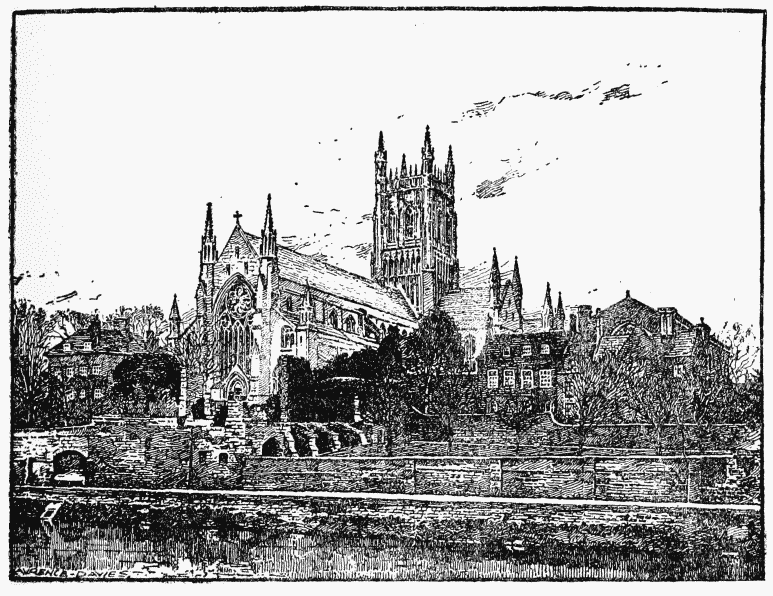
Worcester Cathedral from the South-west
As the fame of St. Wulstan increased, the repaired church of 1218 appears to have been inconvenient for the numbers of pilgrims which had to be dealt with, for in 1224 Bishop William of Blois laid the foundation of the new east front. (fn. 13) This building was begun far eastward of the old front, and was completed up to the earlier work, as shown by the straight joints in the presbytery and aisles. The old presbytery was then taken down and the new building completed up to the crossing; but curiously no record occurs of the finish or hallowing of this noble work. In consequence of the new building being on the site of the monks' cemetery many graves were disturbed, and to accommodate the bones the bishop made a bone-hole and founded a chapel above. (fn. 14)
In August of 1225 the prior, William of Tynemouth, began to build himself a house, which was finished in December of the same year, (fn. 15) from which it would seem to have been constructed with timber. In 1280 Nicholas, Bishop of Winchester, who held the see of Worcester from 1266 to 1268, left 60 marks towards rebuilding the central tower. (fn. 16) 'On the second Ides of July, 1302, the greater part of our dorter fell, which fall had threatened for some time and showed our negligence.' (fn. 17) This is the last entry in the annals relating to the buildings.
It is stated that Wulstan de Braunsford, while prior, built the great hall commonly called the Guesten Hall, 1320. (fn. 18) Upon the same authority Bishop Cobham is accredited with vaulting the north aisle of the nave beneath which he was buried in 1327. (fn. 19) Both of these works, however, are distinctly later. The north aisle of the nave was finished and the building of main wall of the nave above was stopped by the Black Death in 1349. Another interesting stoppage of the same date occurs in the great gate, the lower part of which is of early 14th-century work, but the upper story seems later and was probably part of the work following the licence to crenellate in February 1368–9. (fn. 20) The rebuilding of the frater was begun by the same hand which built the north aisle, and the alleys of the cloister were finished before 1372.
The central tower, which took seventeen years to build, was finished in 1374, (fn. 21) but whether this was the direct successor of that which fell in 1175 there is no evidence to show. In 1375 the new vault and windows were put over the chapel of St. Mary Magdalene, (fn. 22) which appears to have been the north transept, as no other part of the church was so treated at that date. The new dorter was begun the same year. (fn. 23) The year following (1376) the vaulting under the new tower and over the quire was made; also the vaulting and windows over St. Thomas's altar, which was in the south transept. (fn. 24) In 1377 the vaulting of the nave was made, the new dorter was finished, as well as the treasury and library. (fn. 25) The next year the water-gate above the Severn was built, the new stalls put in the quire, and the quire, with the chapels of St. Mary Magdalene and St. Thomas, was paved. (fn. 26) During the next year a screen was made between the quire and presbytery, also the bishop's stall, and screens were put to the altars of St. Edmund, the archbishop, and the Holy Cross. The great window was inserted in the west gable. (fn. 27) In 1381 a screen was made round the chapel of our Lady near the red door, also a new pulpitumwas added in front of the quire. (fn. 28) In 1386 the north porch was finished; this work completed the structure of the church, (fn. 29) to which no addition has since been made.
In the 15th century new windows were inserted in the Lady chapel and presbytery, and in 1502 Prince Arthur's chantry was built.
At the Suppression the monastery was turned into a college. (fn. 30) To the dean was allotted the prior's house, to the first prebend the sacrist's, the second the tumbary, the third the sub-prior's, the fourth the hosteler's, the fifth the infirmarer's, the sixth the pittancer's and part of the cellarer's, the seventh the kitchener's, the eighth and ninth the master of the chapels, the tenth the almoner's and part of the prior's. (fn. 31) The sites of these houses are known, as well as their respective appropriations, and will be referred to later.
In 1551 the quire stalls and bishop's seat were taken down, and five years later new stalls were set up in the position of those now existing, with a 'goodly loft to read the gospel' under the eastern arch of the crossing. (fn. 32) At this time the floor of the old quire under the tower was removed, and a flight of steps extending from end to end of the transepts was placed immediately in front of their eastern wall. (fn. 33) In 1614 'the goodly loft' was altered or replaced by a new one, to contain a large organ, which had the parapet decorated with the arms of those who contributed towards the work. (fn. 34)
During the Civil War great damage was done to the buildings by the removal of lead and timber from the roof, which in the case of the belfry-tower and dorter caused the ultimate ruin of the buildings themselves. The value of the lead and timber removed was estimated at £8,204, and included the lead and timber from the belfry, lead off the roof of the east cross and lead and timber of the pinnacle, the lead and timber from Mr. Boughton's house (that at the west end of the frater), lead from the dean's hall, lead and timber from the dorter, the gate-house, and the queen's chamber, 2,140 yards of water-pipes, the whole of the conduit-houses and the lead cisterns. (fn. 35)
In the time of Bishop Hough (1717–43) the dean and chapter spent several thousands in repairs and new casing the outside of the walls; they also 'rebuilt four neat pinnacles on the top of the tower and greatly beautified the church with several ornaments.' (fn. 36) These repairs included the tall pinnacles so conspicuous in old views of the church, and which are said to have been removed about 1832. (fn. 37) Great flying buttresses were erected round the east end of the church between 1764 and 1789. (fn. 38) The west window was made in 1789 and one at the east end in 1792. (fn. 39) The tower had the decayed faces dressed off about this time, thus destroying the whole of the external features. (fn. 40) A new organ gallery was put up in 1812 and had the old misericordes re-used as ornaments on its face (fn. 41); also a screen was added at the back of the altar, made out of those across the eastern transepts. (fn. 42) ' Finally in 1857 the 'complete restoration' of the church was begun under the direction of Mr. Perkins, a Worcester architect, who carried on the work until 1864, when Mr. G. G. Scott was employed. The church was reopened in 1874 after an expenditure of £114,296. Between that date and 1885 £5,362 was spent. (fn. 43) Externally the whole has been made new, new windows put at the east and west ends and at the north and south ends of the main transept; all the 15th-century tracery was taken from the windows of the eastern part of the church, while internally the quire screen has gone, the fine 16th-century stalls are no more, and the monuments have been shuffled about to no purpose. The cloister has been furnished with new windows of a misleading character, the chapter-house has been recased as well as the frater, and the guest hall was demolished in 1862. (fn. 44)
The precinct contains about 12 acres, and is roughly in the form of a rectangle with its west side on the Severn bank. The chief entrance was on the east side, but there was another gateway on the north to the cemetery and another on the west to a ferry across the river. The buildings occupy the greater portion of the area, the church being in the middle. On the south side of the church is the cloister, having on the east side the chapter-house, on the south the frater, and on the west the dorter. The infirmary was at the west end of the church, the kitchen south of the frater, and the prior's lodging with the guesthouse eastward of the chapter-house. On the north side of the church was the belfry, opposite the eastern transept, and the charnel opposite the north porch.
The original southern boundary of the precinct appears to have run direct east from the south side of the water-gate to a point 50 ft. south of the great gate. Outside this on the south was the castle of which the northern half was given to the convent in 1217, and this additional area was thrown into the precinct. Along the north and east sides of the precinct, outside the wall next Lich Street and Friar Street, are, and apparently always have been, tenements and shops.
The great gate-house, commonly called Edgar Tower, was built in the 14th century, and not a vestige of its predecessor remains. It is of two stories, of which the ground floor consists of an outer porch and an inner gate-hall, having rooms on either side and octagonal turrets at each angle. The east face has a wide pointed arch with a series of niches over the apex, on either side of which is a two-light window, and there are other large niches between the windows and the angle turrets. The west side is similar, but has no side niches. The porch and gate-hall are both vaulted and divided from each other by the usual pair of doors for horse and foot traffic respectively. On the south side is the porter's lodge, and the corresponding projection on the north contains a narrow room vaulted in two bays. The vice to gain the upper floor is in the north-west turret, and is vaulted at the top. The upper floor is arranged in four chambers of like size to the lower divisions, and was doubtless used for the housing of guests. The almonry adjoined the gate on the north and the almoner's lodging was appropriated at the Suppression to the tenth prebend.
Within the gate was the great court of the monastery, having the main group of buildings on the north side. The south side, now covered with houses, would be occupied by the stables, bakehouse, brew-house, malthouse, granaries, and other necessary buildings.
From the great gate the precinct wall is traceable to the south-west angle on the river bank, and thence some yards northward to the watergate. This gate was built in 1378, and has two stout side walls and is vaulted in two bays; the upper part is now a cottage, but probably follows the lines of the original building. Northward of this gate the wall has been rebuilt for some yards, but continues again further north to the north-west angle of the precinct, where it turns east and runs up to and includes the north side of the charnel chapel. The rest of the wall has been destroyed, but in the middle of its northern side is a timber-built archway, with a chamber above, which was the entrance to the lay folks' cemetery, precisely similar to the like structure remaining at Evesham.
The present church consists of a Lady chapel with aisles, an eastern transept, presbytery with aisles and a southern chapel, a main transept with a great tower over the crossing, a nave with aisles, a north porch and a chapel on the north side. Under the presbytery and aisles is a crypt entered by steps from the south transept.
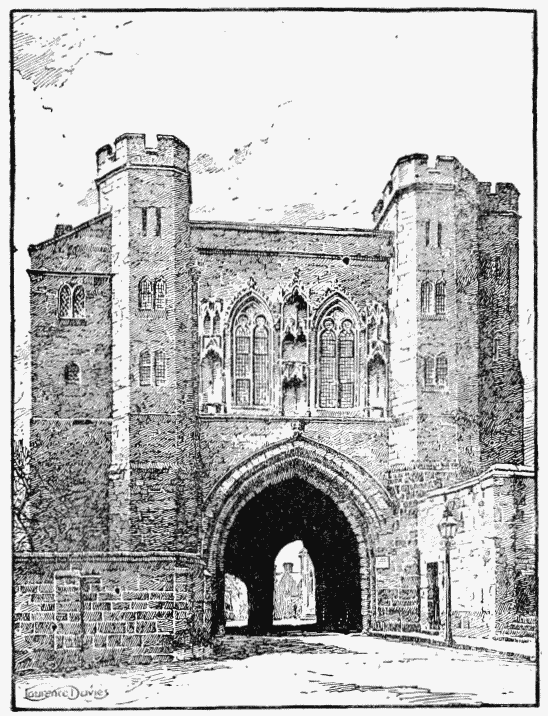
Worcester City: The Edgar Tower
The crypt extended under the whole of the eastern part of Wulstan's church, and as it remains almost entire shows the plan of the superstructure. This consisted of a presbytery of three bays with aisles and an apse of seven divisions round which the aisle was taken as an ambulatory. There was apparently a chapel to the east beneath the present high altar platform and a chapel on either side in the form of towers, of which remains of the foundation of the southern one were found in 1860. (fn. 45) On either side of the presbytery next the transept was a chapel of two bays with apsidal ends.
The crypt in the main span is formed of three rows of eight monolithic columns with cushion capitals carrying vaulting with only rubble cross ribs. The aisles are similar, but with one row of columns down the middle of each, and the side chapels were of the same design. In the 13th century the east end of the southern chapel was squared, but in the floor were the foundations of an apse, which seems to have been a half octagon with a flat side to the east. This chapel has recently been filled up with the organ works; in like manner its companion is filled with earth.
The Norman presbytery has left a few traces in the superstructure. In the south aisle, adjoining the tower pier, is one of the original columns of the respond of the main arcade with a cushion capital which is at a slightly higher level than the nave arcade. On both sides of the main span against the tower are remains of Norman work which show that the triforium consisted of a large round arch filling the whole bay and that the clearstory passage above was at the same level as that of the nave. Under the aisle roofs on both sides are the responds with a chamfered impost and the springers of the triforium arches.
The whole of the church eastward of the main crossing, with the above exceptions, is of the work begun in 1224 by Bishop William of Blois, which internally is one of the most beautiful 13th-century buildings remaining, and Purbeck marble is used throughout for bases, columns and string-courses. Externally the whole work is quite modern save for a few yards of plain walling beneath the windows on the north side of the Lady chapel and eastern transept. The main roof together with the eastern transept is at one level from the east end to the tower, and 'the lead pinnacle' destroyed in the Civil War may have been at the intersection. The east end is entirely modern. The main walls are divided into three stages by string-courses considerably higher than those of the Norman period and continuous from end to end. The bays of the Lady chapel are well-proportioned. The main arches are of three deeply-moulded members resting on moulded piers having eight marble columns to each and richly carved capitals. The triforium has a pair of arches in each bay, each containing a pair of smaller arches with a carved figure in the spandrels; there is a wall passage behind having a wall arcade at the back in which no marble is used. The clearstory has a group of three arches in each bay, of which the middle is kept much higher than the sides, resting on marble columns, and there is a wall passage behind. The vault is original and has large bosses richly carved at the intersection of the diagonal ribs.
The aisles have a wall arcade of trefoiled arches with sculptured spandrels without marble, and the windows have triple arches internally resting on marble columns with carved capitals. The easternmost bay, having no side aisles, differs from the rest by having two tall lancets one above the other and wall panelling, like the aisles, carried beneath. The eastern transept is treated similarly to the last, but has a group of three lancets in two tiers at the ends and in the free bays; the panelling is also carried round the walls. In the south arm the spandrels of the south and west sides are original.
The floor of the presbytery, owing to the crypt beneath, is 3½ ft. above the Lady chapel, and this with the wider spacing of the bays renders the western half of the building not nearly so pleasing as the eastern, though the design is similar. The three western arches on each side, built after the destruction of the Norman presbytery, have a leaf pattern ornament on the outer members and the mouldings differ slightly from the others. The aisles of the presbytery have no wall arcade, and except the third on the north side the windows differ from those of the Lady chapel. The first on the north and both on the south have a large rear arch containing the whole of the window. In the second and fourth on the north the rear arches are feathered and could originally, as now, have only had two lancets.
Most of the original lancets were removed in the 15th century and replaced by three-light windows in the aisles and clearstory of the Lady chapel, four-light windows in the aisles of the presbytery, save in the two narrow windows, which had three lights and tracery with mullions inserted in the lancets of the eastern transept. This work was repaired in the 18th century and removed altogether in the 19th.
The chapel on the south of the presbytery is separated from the aisle by arches and pillars of similar character to the main arcades. It has triple rear arches to the south windows and a wide rear arch to the east window. At the west end is an early 12th-century arch, of which the jambs are of Wulstan's work, with large cushion capitals, carved in later days, but the arch is of the repairs after the fire of 1113. (fn. 46) The chapel was converted into vestries apparently in the 14th century, when all three arches towards the church were walled up and a doorway inserted in the south-west angle which leads by steps to the treasury.
The Norman church had a corresponding chapel on the north side, but it was done away with in Bishop Blois' scheme, and in the 15th century another building was erected on its site to house the sacrist, with a doorway from the church inserted in the presbytery aisle. Just over this doorway is a small corbelled bay window with cusped heads and panelled base, through which the sacrist commanded a view of the presbytery with the high altar and the two shrines. The sacrist's lodging was appropriated to the first prebendary, when rooms were added over the north aisle of the presbytery. The house was pulled down about 1717 and a new house built for his use at the corner of College Green opposite the Deanery, (fn. 47) but the raised aisle remained till 1860.
The main transept is the same size as first set out by Wulstan, and still retains in each arm some of the original work. Both arms were repaired after the fire of 1113, again after the fall of the tower in 1175, and the upper parts were once more rebuilt when the vaulting was added in 1375–6.
The north gable has a tall modern window within a containing arch of 13th-century work, on the east side of which the original rubble walling remains to a considerable height, and in the angle is the vaulting shaft added after the fall of the tower in 1175. The east side has an arch into the original chapel similar to that into the south chapel already described, but it has been much renewed. To the south of the arch is the middle of the added vaulting shafts consisting of a triplet of columns placed in front of a flat pilaster with rounded angles. The arch into the aisle was inserted in 1375, at which time the upper works were rebuilt and the vaulting added. The triforium stage consists of a series of narrow cusped panels with a transom above which is a continuous quatrefoiled band. Above this is the clearstory with pointed rear arches and a wall passage; the actual windows are repairs of the 18th-century restoration of the original tracery. In the north-east angle is a vice in a circular turret which projects boldly into the transept and is built in bands of green and white stone for some feet, above which it is carried up in the work of 1175. Southward are the jambs of an inserted window of the same date, on either side of which the original rubble remains to some height and is not bonded in any way with the turret. The middle vaulting shaft is similar to its companion on the east, and the arch into the nave aisle with the triforium and clearstory is of the date of the vaulting.
The crossing contains in at least three of its piers the cores of the work following the fire of 1113. No sign remains of the work after the fall of the tower in 1175, as each pillar is cased with the work of 1357–74. Each arch is alike, springing from small capitals, at the level of the string-course under the Norman clearstory passage, and having piers unbroken by band or stringcourse, consisting of bowtels and hollows. The tower above has externally been entirely made new owing to the peeling of about 1785, but internally the original work remains. This consists, above the crossing arches, of three stages, of which the two lower were intended when built to have been open to the church. The bottom stage consists on each face of five pointed arches divided by a stout mullion and transom and has a wall passage. The next stage is similar but twice as high and has six arches with two transoms in front of a wall passage. The top stage seems to have been always intended for bells. In each angle of the tower were vices, of which that in the south-east angle is the only one now used. Though intended to have been a lantern, the tower was vaulted at the level of the main vaults in 1376. Externally between the belfry windows are niches containing figures, three on each face, which, though all new, take the places of the original figures illustrated by Wild. The tower was originally intended to have been surmounted by a stone spire, for which the springing stones of the squinches still remain above the belfry windows.
In the tower is a ring of twelve bells, with hour bell and three quarter bells put up by Taylor of Loughborough in 1868. The twelve bells of the ring are each inscribed with the name of an apostle, and the tenor weighs 2½ tons. The three quarter or half-tone bells bear the names of St. Paul, St. Mark and St. Luke. The hour bell weighs 4½ tons and the diameter is 6 ft. 4½ in. It is inscribed 'Surge qui dormis et exsurge a mortuis et illuminabit te Christus; In Usum Ecclesiae Cathedralis Christi Et Beatea Mariae Virginis In Civitate Bt Comitatu Vigorniensi,' and bears the arms of the see, the dean and chapter, and the city.
In 1220 the great bell was made by W. de Bradwe, the sacrist, and consecrated by Bishop Blois' in honorem S. Salvatoris et genetricis ejus' and 'Hauteclere' in honour of St. John the Evangelist. (fn. 48) In 1374 John Lyndsey, the sacrist, took the small bell of the three hanging in the 'clochium' and placed it in the new tower as a clock bell, (fn. 49) and he seems to have provided a new bell for that removed. (fn. 50) In 1558 the four bells then in the 'clochium' were broken up and carried away.
Of the eight bells existing previously to 1868 in the great tower, one (the second) was stolen, another (the fifth) is said to have gone to Dewsbury, and a third (the treble) to Holy Trinity on Shrub Hill; the tenor was sold. The other four bells were acquired by Mr. Tyssen-Amherst (afterwards Lord Amherst of Hackney) and placed by him in Didlington Church, Norfolk. Of these, the third is a very ancient bell, uninscribed; the fourth is inscribed 'IN HONOR[em] SCI WVLSTANI EPI,' and was cast by William Burford of London; the sixth, 'HOC OPVS IMPLETO IESV VIRTVTE FAVTETO,' by Stephen Norton of Kent. These two, as the latter inscription suggests, were placed in the new tower in 1374. The seventh bell, inscribed 'Missi De Celis Habeo Nomen Gabrielis' is by John Danyell of London (c. 1460), and has a remarkably fine initial cross. (fn. 51)
The south transept, like that on the north, contains some of Wulstan's work in the lower parts. The repairs after the 1113 fire show in the circular turret, which is precisely similar to that on the north, the mending of the arch to the eastern chapel, and in the east facing of the wall over the arch to the presbytery aisle with the north jamb of the triforium above. After the fall of the tower, vaulting piers were also added to this transept, and a considerable amount more of the same work remains. The south wall has in the lowest stage two round-arched windows with jamb shafts and cheveron-ornamented arches, above which is a modern three-light window, but the rear arch seems to be of the end of the 13th century. The east wall has in the south bay the arch to the chapel already described, also remains of the triforium, consisting of one large semicircular arch ornamented with large dog-teeth and subdivided with smaller arches having cheveron ornament. The northern bay has a 14th-century arch to the presbytery aisle with remains of a triforium arch similar to that in the south bay in the roof space above. The triforium and clearstory have been remodelled to match the north transept and the vaulting has an additional lierne rib. The west wall has in the south bay remains of the 1175 triforium, which on this side was formed of a series of trefoiled arches on detached columns with a wall passage behind. It is cut through by a tall window of four lights, having two continuous stages beneath the clearstory. The northern bay has the arch to the nave aisle, with triforium and clearstory above to match the east side.
The nave is of nine bays. At the seventh pair of pillars is a vaulting shaft on either side built with the green and white stones, showing that the western part of the nave was not completed until after the fire of 1113. The west end and the two western bays apparently follow the lines of the earlier Norman nave. The main arches are slightly pointed and of four members carried on nook shafts, having capitals of freely treated Norman patterns. The triforium in each bay has two pointed arches, each containing three round arches with cheveron ornament and scalloped capitals containing smaller round-headed openings at a lower level. The spandrels of the outer arches and over the inner openings have carved bosses. The clearstory has in each bay a large roundheaded arch flanked by two small pointed openings in front of a wall passage. The window follows the line of the middle opening, but is now filled with tracery. The main span was from the first intended to be vaulted, as shown by the vaulting shafts which rise from the ground in triplets in front of a pilaster with rounded angles which was continued as a wall rib. The wall passage at the clearstory and triforium levels was in both cases continued across the west end. The bases and jambs of the west doorway are original, though the rest of the doorway, the window above and the great flanking buttresses are all modern.
The south aisle of the two western bays retains its original vaulting, carried on shafts arranged like those for the main span, and in each bay is a wide roundheaded window recess which shows the original treatment of the windows on the north side. The north side has vaulting of the same character as the rest of the aisle, and windows were inserted at the same date. Over this side the walls are carried up and finished by a continuous table course, the space above the aisle being lighted by large circular windows in each bay.
The remodelling of the nave was begun in the 14th century; the work was started at the east end of the north side and continued westward. In the aisle and main arcade the whole seven bays up to the late Norman work were so treated, but the triforium and clearstory were built for only five bays. The two remaining bays of the triforium and clearstory are of a slightly different design, which marks the pause caused in the work by the Black Death. The whole of the south wall and aisle are of subsequent work, but carry on the same scheme. The arcade is quite different from that on the north, but the triforium is the same as that of the sixth and seventh bays; the clearstory is also different, and was probably finished just before the vaulting was put on in 1377. Of the north bays the arcade is of three members carried on clustered pillars having boldly carved capitals, and, to the first three, rough deep bases, but to the rest the bases are moulded. The triforium has two arches in each bay containing two smaller arches, in the spandrels of which are seated figures, and there is a wall passage behind. The vaulting shafts rise from the ground and are finished with deeply carved capitals at the string-course over the triforium. At first it was intended to have only cross and diagonal ribs, but an intermediate rib was afterwards determined upon, which on this north side is carried by a small arch just above the springing. The clearstory has a wide opening flanked by a smaller one on either side, having labels with carved heads; it has a wall passage behind and the windows are of three lights.
The north aisle has large triple vaulting shafts matching those on the main piers and has a continuous string-course. Above this are the windows, having shafted jambs with carved capitals to the rear arch, but the tracery throughout is modern. Projecting from the second bay is the Jesus chapel, which has over it a dwelling-place for a priest, with a fireplace, and is gained from the turret in the north transept by a wall passage. The chapel has been recently inclosed by a stone screen surmounted by a rood and fitted with an altar having a wooden reredos.
The south side of the nave has the pillars formed of hollows and bowtels, also carried round the arch, and with small capitals to the latter only. The triforium is divided, as on the north, but the capitals are diminutive and occur only to the front moulding. The clearstory has three openings but no label moulding, and the arches are nearly straight-sided following the line of the wall rib of the vault. After the new nave was built the tower seems to have shown signs of weakness, as on either side the triforium and clearstory are underbuilt by two series of flying buttresses across the arches. (fn. 52)
The south aisle matches the north save that the windows are kept high up to escape the cloister roof. Under the windows, except in the first and seventh bays, are round-headed recesses, of the same date as the wall itself, of which the two eastern are filled with contemporary monuments, having arched recesses with side pinnacles and a pediment above. The vaulting of the aisle has cross and diagonal ribs and an intermediate lierne. In the first and seventh bays are doorways to the cloister. The eastern is of the 13th century reset in the later wall, and is of two members with a jamb shaft having moulded capitals in each jamb. The western doorway is of two moulded orders with a four-centred arch.
Projecting from the fifth bay on the north side is the porch finished by Bishop Wakefield in 1386. It is of two bays of lierne vaulting with richly carved capitals resting on detached marble columns and has a seat on either side. The entrance to the church is a mutilation of the original 12th-century doorway, over which is a triangular window with flowing tracery. Externally the whole porch is new, and has in front over the great arch a row of niches with figures of the apostles. Above the porch is a parvise fitted up as a caretaker's lodge and gained by a vice in the south-west corner.
At this point the monastic arrangements of the church may be considered. In Norman times the high altar was in the apse with the shrine of St. Oswald on the north side and the tomb of St. Wulstan on the south, between which, but one bay westward, was buried King John. The quire was placed beneath the crossing and apparently one bay of the nave, westward of which was the pulpitumoccupying a whole bay and having a small altar on either side of the quire door. At the third pair of pillars was the nave altar in front of the rood screen. This arrangement of quire and pulpitumremained until the Suppression, but considerable alterations were made in the 13th century, after the completion of the presbytery. The old high altar seems to have been kept as a quire altar with the shrines of St. Oswald and St. Wulstan on either side, and King John's tomb was moved eastward behind this altar. The new high altar was placed under the eastern crossing, and had in 1502 the chantry of Prince Arthur built on its south side. It is obvious from the size of the 13th-century presbytery that it was intended to have brought the quire into it, eastward of the main crossing, but for some reason the scheme was abandoned. Each arm of the eastern transept had an altar, the steps of which remained until about 1860, and were separated from the aisles by 15th-century screens removed in 1812. (fn. 53) There was an altar at the east end of the Lady chapel and one at the end of either aisle.
In each main transept was an altar, St. Mary Magdalene's in the north and St. Thomas's in the south. The altars on either side of the quire door were apparently hallowed in honour of the Holy Cross and St. Edmund the Archbishop respectively. The nave altar was hallowed in honour of St. Peter and St. Wulstan, if it can with certainty be identified with the lower altar of the consecration of 1218.
A number of the monuments have been subjected to the usual restoration displacement, but fortunately the principal mediaeval monuments remain in position.
Opposite the altar of our Lady are two 13thcentury bishops in mass vestments supposed to have been the builders of the eastern part of the church, William of Blois and Walter Cantilupe. Under the altar screen is a 15th-century bishop. Along the Lady chapel aisles are placed effigies, on the north side (1) a 14th-century bishop in mass vestments, which appears to be Bishop Cobham, removed from the third bay of the north aisle of the nave, (2) a fine 13th-century effigy of a lady on a pedestal with open leafwork round the edges, moved in 1636 from the chapel of the chancel where it stood on the north side towards the west, (fn. 54) (3) a cross-legged knight sheathing his sword and having a pointed shield; on the south side are two 14th-century ladies. The monuments under the easternmost arches of Dean Edes (1604) on the south and Bishop Thornborough (1641) on the north have been shifted for no reason to similar positions in the eighth bay of the nave. Under the second pair of arches are monuments to Lord Lyttelton (1876) on the north and the Earl of Dudley (1885) on the south. In the north-east transept is a monument by Chantrey to Lady Digby (1820). At the south end of this transept next the presbytery are two monuments; the eastern is a 14th-century arched recess ornamented with large ball flowers and holds the effigy of a bishop much mutilated, the western is a late 14thcentury moulded recess having an Elizabethan pedestal inserted, upon which lies a fine 15th-century effigy of a bishop in mass vestments. These two monuments were left in 1860 with their original whitewash to show what the church was like before it was restored.
In the midst of the presbytery opposite the high altar is the tomb of King John. It consists of a late 15th-century pedestal, having three divisions on either side and one at each end ornamented with quatrefoils containing shields. The effigy of the king is in Purbeck marble, of a date closely following his death; the head, upon which is a modern metal crown, lies upon a pillow supported by small figures of the Bishops Oswald and Wulstan and the feet rest upon a lion. The whole effigy has been recently gilded and the shields painted by error with the arms of France modern and England. The monument was opened in 1797 and found to contain the bones of the king in a stone coffin, (fn. 55) upon which the slab of the effigy fitted as a lid.
On the south side of the high altar is the chantry of Prince Arthur, having open traceried sides of five unevenly spaced bays with a solid bay at each end. The bays are separated by stout mullions, having niches containing mourners, and terminating with tall pinnacles above an open panelled parapet. The chapel is covered by a nearly flat ceiling, having in the middle the arms of England with a label of three points supported by antelopes and the plume of feathers beneath. The reredos has five mutilated figures in niches, of which the middle one seems to be of the prince with angels bearing him to heaven; the figures on either side are kings, the outermost figure on the north is St. James the Less, and that on the south St. George. Between the outer niches on each side are two little niches, having St. Katharine on the north with a bishop above, and St. Margaret on the south, also with a bishop over. The width of the altar was 4½ ft. and its height 2 ft. 10 in. The monument of the prince stands in the middle of the chantry chapel, and is of Purbeck marble, having the arms of the king's son painted on shields in three quatrefoils on each side and one at each end. Around the edge is a painted inscription:—
'Here lyeth buried prince Arthur the fyrst begotten sonne of the righte renowned Kinge Henry the Seventhe whiche noble Prince departed oute of this transitory life att the Castle of Ludlowe in the seaventeenth yeare of hys fathers reign and in the yeare of our Lorde God on thowsand fyve hundred and two.'
The entrance doorway from the altar platform contains the original open tracery door with the ironwork. On the south side, owing to the level of the south-east transept being so much lower than the chantry, is another stage of panelling enriched with Tudor badges and inclosing two monumental recesses. These contain two late 13th-century effigies on carved pedestals, all in Purbeck marble. The western figure is of a bishop, supposed to be Godfrey Giffard, in mass vestments, under a fine pedimented canopy, which had shafts at the sides supported by crockets, and the pedestal has six quatrefoils with seated figures of the apostles. The eastern figure is of a lady closely related to the bishop, as the pedestal is similar and bears the remainder of the twelve apostles. Against the south wall of this transept is an early cross-legged effigy of a knight in mail, supposed to be a Harcourt. In the middle of the transept is a Purbeck marble altar tomb bearing an inscription to Sir Gryffith Ryce, 1500, but the brasses on the top are modern. Two or three interesting monuments (fn. 56) which originally stood in the transept have disappeared in recent years.
At the extreme west end of the north aisle of the presbytery is the monument of Bishop Maddox (1759), removed from the south transept.
In the north transept against the north wall is a monument to Bishop Fleetwood (1683) and another to Bishop Stillingfleet (1699), which stood side by side behind the high altar. Against the west wall is a large monument to Sir Thomas Street (1696), and under the restored Norman arch in the east wall is a monument by Roubiliac to Bishop Hough (1743).
In the middle of the south transept is a monument to Bishop Philpott (1892).
In the nave under the fourth arch on the north is a fine altar tomb, enriched with panelling and arms of the Beauchamps of Holt, bearing the effigies of a knight and a lady. In the corresponding position on the south side is an altar monument to Robert Wylde and his wife (1607) bearing their effigies. In the first recess in the south aisle is the effigy of a priest which has been mended; in the next recess is the effigy of Bishop Parry (1616), removed from the north-east transept, but the monument, which was a good one, was destroyed (fn. 57); in the fourth bay is an Elizabethan altar tomb without any inscription; in the next bay is an altar tomb with the legend 'Sir Thomas Lyttleton of Frankly 1481,' it has arms in panels and originally had a brass; and in the sixth bay is an altar tomb to Bishop Freke (1591), and the recess is lined with stone panelling of the same date. Westward of the cloister doorway is a monument to Bishop Gauden (1662), another of those originally at the back of the high altar, and in the western bay is a monument to Bishop Johnson (1774). In the first bay against the north wall is a curiously treated effigy of Bishop Bullingham (1576), only recently moved from its original position in the Jesus chapel. In the seventh bay is a recessed monument to John Moore, Ann his wife, and four children (1613), who are represented as kneeling figures in couples. In the eighth bay is a fine monument to Abigail, wife of Bishop Goldsborough of Gloucester (1613), moved from the north side of the high altar. There is also a monument to Isaac Walton's wife.
The church is particularly poor in any fittings. The misericordes of the quire, now thirty-seven in number, belong to the stalls erected in 1379, but have passed through many adventures; for some time they were thrown into the belfry, then used in the Elizabethan stalls, again removed and used as ornamentation to the quire screen of 1812, from which they were rescued on the destruction of that screen about 1860. The pulpit, now in the quire, was moved in 1748 from the seventh pillar on the north side of the nave, where it was erected after the Civil War for the City Sermons. (fn. 58) It is all of stone, circular on plan, has canopied niches with the emblems of the Evangelists over open books and arms of France, England, Scotland, Ireland, and the see. It had an elaborate sounding-board supported by a stone back bearing a carved panel depicting the new Jerusalem now retained in the sill of the west window near by. The font stood, in the 18th century, against the second pillar on the south, but was destroyed about 1748, when a new one of marble was placed in the midst of the Jesus chapel; this in turn has been discarded and a still newer one placed in the westernmost bay of the south aisle.
The plate consists of a large paten, apparently of early 17th-century date, two large flagons, two large cups with covers for patens, richly gilt and engraved with the arms of the see, bought in 1661, after the restoration, of one Mr. Alvey, who was paid £106 9s. for communion plate (fn. 59); two smaller cups and flagon of later date, two fine early 17th-century tups presented by Colonel Mylne Sandys in 1907. There are also seven pewter almsdishes, eight cruets and one ciborium.
The early registers consist of a single volume tontaining all entries 1693 to 1811. (fn. 60)
On the south side of the nave is the cloister, which is 4 ft. longer on the east than the other sides, around which are alleys of communication with the surrounding buildings. In the first place the alleys would be merely wooden pentices subjected to destruction at each of the great fires, but after that of 1202 the fronts, at any rate, would be built in stone or marble and gradually give way to the present alleys as built in the 14th century. This rebuilding seems to have begun with the west alley, followed by the east, then the north, and lastly the south was built. The windows to the garth were filled with glass bearing the arms of benefactors, but it was all destroyed in the Civil War. The present windows are quite modern and took the place of mean three-light openings of the 18th century. In the north, east and south alleys the windows have internally deep recesses, the soffits of which are decorated with flowing tracery, and in the pier between each two bays is a square loop, so that from the ends all the windows can be seen, but for what purpose is not clear, save in the north alley, where there would be carrels for the monks to study in, over which such supervision might be required. The vaulting is similar throughout, having cross, diagonal, and intermediate ribs with liernes in continuation on to the diagonals. The intersections have bosses, which in the west and east alleys are small and carved with leafwork, except the middle boss of the north-east bay, which bears a mutilated figure of our Lady between the two bishops Oswald and Wulstan. The bosses in the north alley are large angels holding shields, and in the middle bay is our Lady and Child surrounded by the emblems of the Evangelists and censing angels. The bosses of the south alley represent a Jesse tree leading up to the coronation of our Lady in the middle bay.
The west alley has vaulting shafts of nine sides representing the number of ribs, with bases but without capitals; the east alley has semi-octagonal shafts with bases and capitals; the north and south alleys have similar shafts next the garth, but the vaulting is carried on corbels in the main walls.
The transept towards the cloister is built with Wulstan's rubble walling; it had a pilaster buttress at the south-west angle, which has been cut away, and the old Norman stones re-used as facing in line with the wall.
Adjoining the transept is a passage to the monks' cemetery, which here, as at Durham, was doubtless used as the parlour. It is of Wulstan's work, with wall panelling of round arches grouped in two bays on either side. It has a barrel vault with cross barrels opposite the bays of the wall arcade. The parlour is entered from the cloister by a pointed archway having a large niche in each jamb and of the date of the cloister. There are two openings at the east end; the northern leads to what was the monks' cemetery, and the southern to the prior's lodging. In the south-west angle is a square-headed doorway to the triangular space formed by the chapter-house which now contains a staircase of comparatively modern construction. The treasury, built in 1377, occupies the space over the parlour, and was originally gained by steps through the doorway, already described, in 'St. John's chapel.' At the head of the stairs is a second door, inside which is a low vaulted lobby with a window to the east; a doorway on the west leads to a large high vaulted room over the eastern part of the parlour. This room, which may be called the hall of the treasury, has besides the entrance three other doorways. That in the south-west angle leads into the space occupied by the present stairs, off which is another door to a second vaulted room over the western part of the parlour. In the south-east corner of the hall is a pointed door to an irregular space covered by a wagon vault and lighted by a small window in the east end: in the north-east corner is a doorway to a semi-octagonal chamber, which was apparently a garderobe. In the midst of the north wall of the hall is a pointed doorway to a wall stair leading up to another story over the entrance lobby and garderobe; the northern part is vaulted in two bays and had a wide opening towards the treasury; a doorway at the south end leads to an irregular-shaped chamber vaulted into two bays.
In the cloister the two bays southward of the parlour door have deep recesses with square joggled heads made to hold wooden cupboards for books for the use of the monks in the cloister.
The chapter-house is to the south of the parlour, and is entered from the cloister by an arched doorway having two large niches in either jamb of the same date as the cloister alley. The chapter-house is circular on plan, and built with alternating bands of white and green stone of the work following the fire of 1113. Internally the circumference is divided into ten bays by half-round columns with cushion capitals, from which spring half-round vaulting ribs which converge upon a central round column with moulded capital. Each bay is of three stages; the lowest has a stone seat with hollowed recesses in a continuous range round the wall, the second stage is a wall arcade of seven round-headed arches resting on detached columns, above which are interlacing arches, and the top stage had originally a roundheaded window in each bay. The exterior of the chapter-house was cased early in the 15th century, and large buttresses added opposite the vaulting bays. The outside face of the wall was made straight between the buttresses, and in each free bay were inserted large four-light windows. Blank windows of similar pattern were put internally to the two northern bays.
The cloister wall from the chapter-house door to the south-east angle was rebuilt at the same time the alley was made. The southernmost bay, owing to the deflexion of the south side, has been rendered square by a wide vaulting shaft in the angle.
The frater occupies the whole of the south side of the cloister raised upon a sub-vault which has the cloister entry at the east end. The sub-vault and entry are of about 1140. The entry has a barrel vault and a round-headed doorway, of five moulded members resting on jamb shafts, at the south end. The sub-vault is now divided up into three parts, but originally was open from end to end and entered by a segmental-headed doorway from the cloister entry. It is roughly of six bays of unribbed vaulting resting on middle columns, of which the eastern one is square with a half-round respond, the next three are circular, and the fifth is like the first. Each bay on the south had a pair of small round-headed windows with deep splays, and between each externally are wide pilaster buttresses with bold splayed plinths, having a roll string-course carried round the heads of the windows as a label. There is another entrance to the sub-vault in the fifth bay with a lamp niche inside; and yet another entrance was in the west wall at its south end.
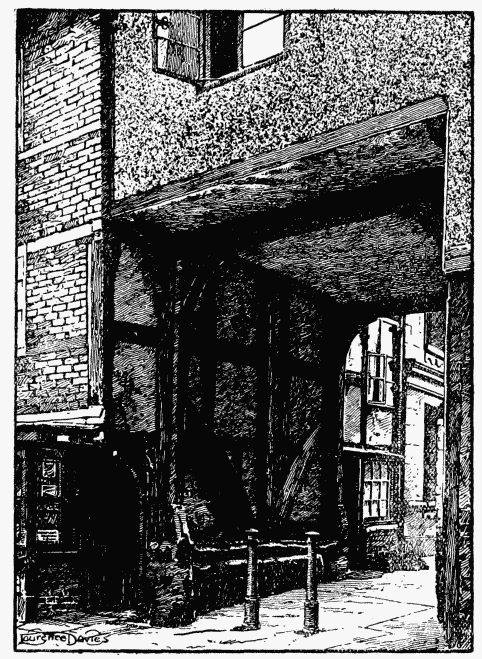
Worcester City: The Cemetery Gateway
The frater itself was rebuilt in the 14th century by the same hand that built the north aisle of the nave. It has a high dais at the east end over the cloister entry. In the east wall is a modern square window, but beneath it is a finely carved Majesty, which has been mutilated and all projecting points cut off in line with the wall. It consists of a seated figure of our Lord within a quatrefoil, in the surrounding spandrels of which are emblems of the Evangelists, and on either side are two niches with lofty canopies. The whole is supported upon a hollow moulded shelf enriched with leafwork and heads. Each side wall has five three-light windows with modern tracery. In the second window on the north was the pulpit; the middle light is filled up for a short distance with a canopied panel; the pulpit is gained by a staircase in the thickness of the wall from a small doorway near the dais. The west wall is carried on a great construction arch and has a modern window above. The entrance from the cloister is in the western bay, and is of two moulded members with an enriched label; the steps inside now go in a straight flight, but originally turned eastward over the thickened wall in the sub-vault. There is another doorway on the south side which led to the kitchen. The whole of the western bay is, and always seems to have been, filled by a gallery, forming the screens and containing the buttery; it may have been used for the dining room for the old monks, as at Durham. This gallery, the roof, and all the woodwork are modern, and the frater is used for the school hall of the king's scholars.
At the east end of the frater was the checker of the hosteler, which communicated with the east alley of the cloister by a small doorway in the second bay from the south. In connexion with this checker was the spital for poor guests, said to have measured 50 ft. by 20 ft. (fn. 61) The lodging of the hosteler was appropriated to the fourth prebend, and the house which occupied its site was pulled down in 1841. (fn. 62)
The hosteler having to attend to the guests, his checker was placed conveniently for that purpose. The guest-hall was therefore placed north and south, eastward of the chapter-house, and had a small gatehouse or entrance next the hosteler's checker. The hall was standing with its original roof in 1862, but was then pulled down with the exception of part of its east wall, and the roof was given to the new church of the Holy Trinity to cover its nave. It was of five bays, and entered by a porch at the south end of the west side. The side walls had in each bay two-light windows with flowing tracery, over which externally were wall arches similar to those at Penshurst. The windows in the two northern bays of the east wall are kept high up in order to clear the roof of a building to the east, into which is a small doorway from the hall. The hall roof was divided into eight bays by arched principals resting on carved wooden corbels and having three moulded purlins on each side with richly feathered wind-braces.
At the north end of the hall was a low building of which the south wall remains, containing two windows of two lights, and which seems to have been a chapel. Between this and the chapter-house was a two-storied building divided into two parts. The western part was of the 15th century divided into two bays by a buttress on the north side, and the upper floor was a large room with panelled ceiling lighted by a large window of two lights with a transom. The eastern part was a timber structure. (fn. 63) At the south end of the guest-hall were the kitchens, buttery and pantry, above which was a large room called the queen's chamber. (fn. 64)
Eastward of the guest-hall was the prior's lodging, which was appropriated to the use of the dean, whose house also included the guest-hall and the rooms to the north, and was destroyed in 1845. It was entered from College Green by a doorway to a lobby, corresponding with the porch of the guest-hall, to the east of which was a timber-built hall 55 ft. long by 20 ft. wide, having an open roof of the 14th century. (fn. 65) This hall had been divided into two stories, in monastic days, and originally joined up to the building running eastward from the northern end of the guest-hall, which seems to have been the prior's solar.
At the west end of the frater was the lodging of the sub-prior, conveniently placed adjacent to the dorter, and was allotted to the third prebend, but the present house retains no old features. Southward of this was the checker of the pittancer and cellarer, which were allotted to the sixth prebend, but the house was destroyed in 1845. (fn. 66) To the south of the frater and adjoining the last was the house of the seventh prebend, also destroyed in 1845; it occupied the site of the cook's checker and contained the walls of the kitchen. These were described as of 'a spacious octagonal apartment 34 ft. in diameter and in height 11 ft. (fn. 67) South-west of the kitchen, close against the water-gate, is the house of the prebend of the second stall, who had allotted him the tumbary. If this means the lodging of the shrine keeper it would appear that the site of the house has been altered, as this position is too far away from the church for that official. At Durham his chamber was in the dorter, and he does not seem to have had a checker.
The west wall of the cloister is full of interesting features; in the southern bay is a modern door to the house of the third prebend. The next two bays are occupied by the arched recesses to hold the lavatory, of which the basin has been renewed. Just to the north is the base of a 13th-century nook shaft, evidently of the earlier lavatory. In the fourth bay is a round-headed 13th-century doorway now blocked up. The next bay is filled with a wide square-headed doorway inserted at the end of the 15th century. In the sixth bay is a small late doorway with a two-light window to the north, all now built up; above are two square recesses, one of which may have been for a lamp and the other for a bell. In the seventh bay is a tall round-headed doorway of two members with nook shafts of early date, which has been filled in by a small late 15th-century doorway. In the next bay was a cupboard, and in the northernmost bay is a fine pointed archway of the same work as the western bays of the nave, having three members, of which the middle one is enriched with zigzags and carried by nook shafts. This archway is to a passage of the same date vaulted in four bays, which led originally to the infirmary. From the lavatory northward the cloister wall is built in alternating courses of narrow and deep stones with rough faces.
The great dorter of the monks ran westward from the cloister and was one of the first buildings erected after the eastern part of Wulstan's church. It was built on a sub-vault of eight bays in length and four in width. Of this building the whole of the western end remains, but recased, two bays of the south wall, three bays of the north wall forming the south side of the infirmary passage, and the east wall, which is the west wall of the cloister. These remains show that the sub-vault had pilasters for cross arches with small members in the angles for the vault which was unribbed. On the north side is a doorway from the infirmary passage, and in the north-east corner is a small doorway with steps in the thickness of the wall to the floor above. Over the sub-vault was the dorter itself, of which next to nothing remains; it was originally entered by steps through the early Norman doorway in the cloister, but in late days this was blocked up and the wide square-headed doorway took its place. Most of the dorter fell in 1302, after which it seems to have been patched up, for in 1375 a new dorter was begun and finished the following year. In the rebuilding, like the frater, the original spacing was not followed, and the new dorter had two roofs side by side carried on five stone columns, (fn. 68) but nothing of this conversion remains except a two-light window in the second bay of the sub-vault.
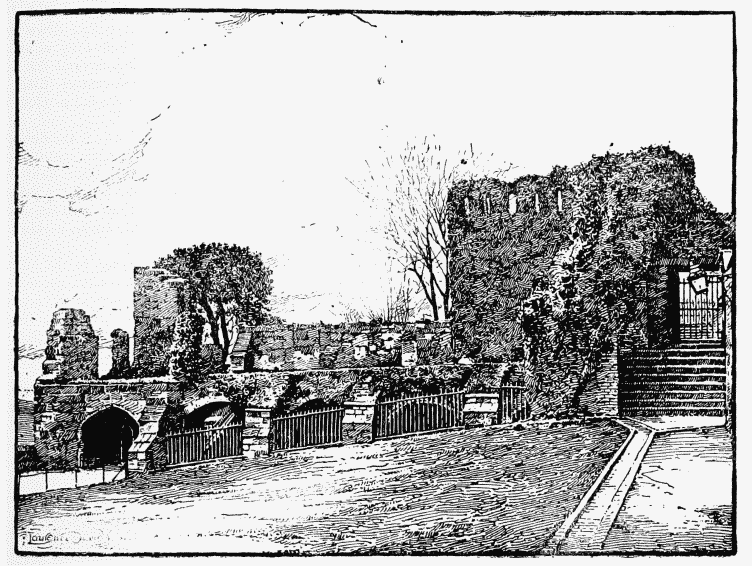
Worcester Priory: Ruins of the Reredorter
In continuation westward of the dorter, occupying the ground up to the Severn bank, is an interesting building of similar date to the west bays of the church, and of which the lowest story at 30 ft. below the dorter floor remains tolerably perfect. On plan it consists of two chambers side by side built against the earlier west wall of the dorter. The northern chamber is five bays in length and vaulted in two alleys carried by round columns down the middle. In the north wall in each bay is a pair of lancet windows within a deep recess. Above this chamber were two stories level with the sub-vault and dorter respectively, of which the upper was the reredorter of the convent and had the seats arranged against the south wall over the great drain. A small piece of this wall is standing, in which are four small loops with deep splays, and further south a fragment of the inner wall of the reredorter pit remains. In the opposite wall are said to have been stately windows whose arches were elaborately wrought, (fn. 69) but these would be in the second story.
The southern chamber is also vaulted, but in one span, and the south wall has deep recesses for windows. There is a small vaulted garderobe at the west end. At the second bay is a wide doorway to the northern chamber, eastward is a small chamber in the thickness of the wall, presumably a garderobe, and the remainder of the wall westward contains the pit of the reredorter. Over the southern chamber was one story only, which had a pentice roof against the reredorter and was the lodging of the master of the chapels. This was allotted to the prebend of the ninth stall, whose house was pulled down in 1843. (fn. 70) What was the use of the sub-vault of both divisions and the room under the reredorter is not clear, though they were probably in connexion with the infirmary.
Northward of the reredorter was the house of the eighth prebend, to whom originally had been appointed the lodging of the master of the chapels. The site of this house could not have been monastic, as it would have blocked up the rooms under the reredorter; therefore it is probable that the lodgings allotted to the eighth and ninth prebends were too small, and a new house was built on this site for the accommodation of the occupant of the eighth stall. This house was removed in 1845. (fn. 71)
Across the west front of the church was the infirmary with the lodging of the infirmarer, which latter was allotted to the fifth prebend, and the house occupying the site was destroyed in 1851. (fn. 72) The infirmary was reached from the cloister by the vaulted passage next the nave already described; the shavinghouse in the infirmary was built in 1379, and there was as usual a separate chapel, for in 1287 a camera next the infirmary chapel was removed for fear of fire and erected elsewhere. (fn. 73) From the site occupied by the infirmary it must have been very differently arranged from those at the great Benedictine houses of Christ Church, Canterbury, Peterborough, Ely or Gloucester.
At the west end of the infirmary passage is a pointed doorway to the vice in the south-west turret of the nave which leads to the floor over the south aisle. The two western bays were precisely similar to their companions on the north, but the remainder up to the transept were formed into the library in 1377 by raising the roof and outside wall. Each bay has two windows of two lights, except the easternmost, which has a three-light window. The library now contains three distinct collections: (1) the mediaeval MS. library of 277 volumes, dating from the 11th to the 16th century, in locked cupboards against the north wall; (2) the collection of printed books, numbering about 4,350 catalogued A to Z, on shelves against the north wall; (3) the muniments, consisting of volumes of manuscripts, historical or financial, charters and indentures, rolls and accounts of officers of the convent, &c., in cases. (fn. 74)
On the north side of the nave of the church was the charnel chapel, hallowed in honour of our Lady and St. Thomas of Canterbury, now represented above ground by the lower parts of either ends of the north wall, with buttresses forming part of the boundary of the deanery on either side of the front gate. 'The building was not demolished till the reign of King Charles I, when complaint was made of its abuse, being at that time converted into a hay-barn, which was redressed by an order for taking it down. The only vestiges of the chapel are part of the north and south walls, which now inclose the court before the house of William Bromley, esq., but the crypt or vault which is underneath this court, extending the whole space of it, is very entire; its length is 58 ft., its breadth 22 ft., and its height about 14 ft. It contains a vast quantity of bones, which seem to have been curiously assorted and piled up, but are now in some disorder. The entrance of it is on the south side, but is generally stopped up.' (fn. 75)
At the time of the restoration of the church the arched vaulting was partially destroyed in order to lower the approaches to the north porch of the cathedral. (fn. 76)
The college for four priests, of whom one was to be master, stood at the west end of the chapel, and was destroyed about 1677, when a new house was built on its site. (fn. 77)
As already stated, the sacrist's lodging stood on the north side of the presbytery, and in front of it was a lofty stone cross; 'at this place the sermons were wont to be delivered in the open air, on the south side of it near the church walls were seats for the accommodation of the principal citizens.' (fn. 78) It was destroyed in the time of the Civil War.
Northward of the eastern transept stood the belfry; it was octagonal on plan, 61 ft. in diameter, and had walls 10 ft. thick; it was 60 ft. high, or level with the parapet of the church. Upon this stood a wooden spire covered with lead, 150 ft. high and capped by a weathercock. There were originally five bells. (fn. 79) The lead and timber were removed during the Civil War and sold for £1,640, there being 60 fodders of lead at £20 and 800 tons of timber at 26s. The stonework was not pulled down immediately, and is shown on an old drawing of about 1670, but quite devoid of any architectural features, though it was probably of 12th-century date, as otherwise it would not have been erected so close to the church.
The present Deanery was, until 1842, the Bishop's Palace from the beginning of the 13th century and perhaps before. In 1224 Bishop Blois built the charnel between the cathedral church and the palace, and in 1271 Bishop Giffard obtained a licence from the king to crenellate or fortify his houses within his close of Worcester. (fn. 80)
The portion of ground belonging to the bishop is an irregular area, just under two acres, cut out of the north-west angle of the precincts of the priory. The palace had a strong gatehouse containing divers chambers opening from the street called Bishop Street (now Palace Yard) and was surrounded with strong walls. (fn. 81)
The present house contains much work of Bishop Giffard's time, especially in the cellars, but received its present outward form in the 18th century. Bishop Hough (1717–1743) is accredited with 'entirely rebuilding a good part of the Episcopal Palace of Worcester.' (fn. 82)
Bishop Johnson (1759–1774) 'made some valuable additions ... at an expense exceeding £5,000.' (fn. 83)
The house is placed close to the north boundary of the site and although considerable remains exist of the 13th-century building the arrangements are not easy to make out.
In the middle of the building is the bishop's hall, placed east and west over a subvault. The latter, which was probably used by the servants, is vaulted with four bays, lighted at either end by a two-light window and has a lancet and a fireplace in the north wall. It is entered through a large moulded doorway at the east end of the south wall, and there is a small doorway in the opposite wall which communicated by a vice with the hall above. There is also a small doorway in the west wall opening outwards. The main entrance to the subvault is covered by a vaulted porch having a wide outer doorway to the east flanked by two small loops which remain complete in the entrance hall of the present house.
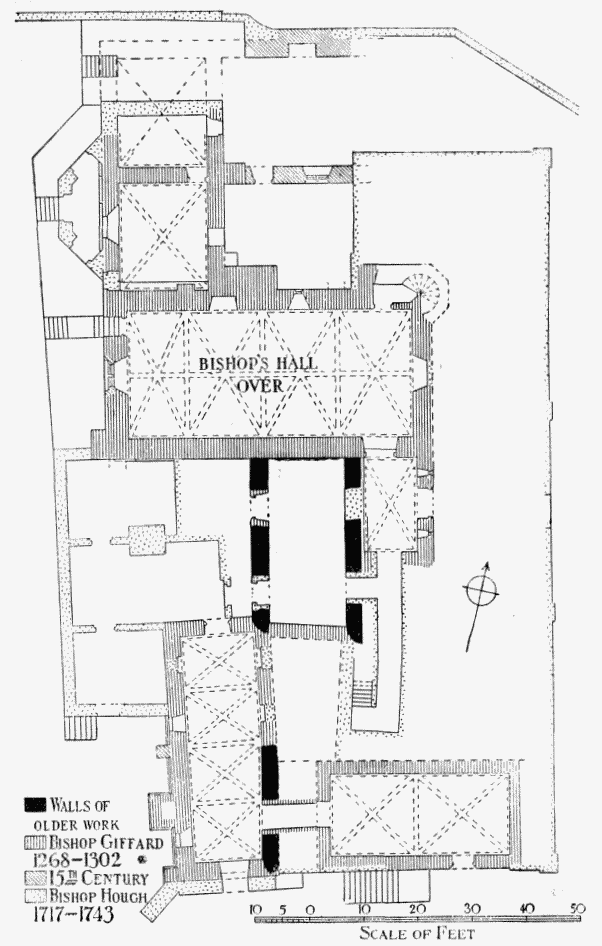
Worcester City: Plan of The Deanery, formerly The Bishop's Palace
The hall itself has been much modernized but retains its original entrance, exactly over that to the subvault. This was also covered by a porch but entered by a moulded doorway to the south which appears to have been originally gained by steps from the courtyard. The east end of the hall was divided off by screens and there was an original fireplace in the north wall, with a window to the right of it.
To the west of the porch is the chapel now placed north and south and entered directly from the hall. The southern part of this chapel was the eastern part of the original building and retains a trefoiled piscina in the south wall. In the west wall is a wide double chamfered arch, now blocked, which connected to the nave of the chapel which has been destroyed. The north end of the present chapel is contemporary, as shewn by the window in the west wall, and was probably the vestry.
Northward of the hall, at its west end, is an original wing of which the subvault remains to two-thirds its length. This is divided into two square chambers with semi-octagonal ribbed vaulting. The southern chamber was entered from the west through a small doorway and has in its south wall one of the original buttresses of the hall. The northern chamber is entered from the other by a small doorway at the east end of the dividing wall. The room or rooms over this subvault are entirely destroyed by the present dean's study but were doubtless the guest chambers of the palace. Eastward of the northern division are the remains of a large room added in the 15th century, in the south wall of which are a doorway and a two-light window and in the north a fireplace. This latter was in contact with the precinct wall of the palace.
Southward of the chapel are the subvaults of an L-shaped building. The western part runs southward from the nave of the chapel and is of four vaulted bays entered through a doorway at the north end. It has a doorway in the northernmost bay on the east and a window in the next bay, while on the west are lancets in the first, second and southernmost bays. At right angles to the south end of this subvault is another subvault of two bays vaulted like the rest and with a doorway in the south wall. The superstructure is much altered but there are two 14th-century windows of two lights in the east wall with a block for a garderobe between. These were probably the private rooms of the bishop and the kitchen was to the north of the southern block in connexion with the subvault under the hall through the porch.
The whole arrangement of the place is most unusual and is due apparently to altering existing buildings to suit the new scheme of Bishop Giffard.
The considerable space southward of the present house suggests that here, as at Wells and Lincoln, was a great hall and kitchen so necessary for the entertainment of the bishop's guests.