A History of the County of Surrey: Volume 3. Originally published by Victoria County History, London, 1911.
This free content was digitised by double rekeying. All rights reserved.
'Parishes: Peper Harow', in A History of the County of Surrey: Volume 3, ed. H E Malden (London, 1911), British History Online https://www.british-history.ac.uk/vch/surrey/vol3/pp49-52 [accessed 30 April 2025].
'Parishes: Peper Harow', in A History of the County of Surrey: Volume 3. Edited by H E Malden (London, 1911), British History Online, accessed April 30, 2025, https://www.british-history.ac.uk/vch/surrey/vol3/pp49-52.
"Parishes: Peper Harow". A History of the County of Surrey: Volume 3. Ed. H E Malden (London, 1911), British History Online. Web. 30 April 2025. https://www.british-history.ac.uk/vch/surrey/vol3/pp49-52.
In this section
PEPER HAROW
Pipereherge (xi cent.); Piperinges (xiii cent.); Pyperhaghe (xiv cent.).
Peper Harow is a small parish lying west of Godalming town. It measures about 4 miles from north to south, about 2 miles in breadth in the northern and under a mile in the southern part. The soil is exclusively the Lower Green Sand, except for alluvium in the valley of the Wey, which runs in a winding course across the parish from west to east. The southern part of the parish includes Ockley Common and Pudmoor, extensive heathlands connected with Thursley Common and Elstead Heath. In the northern part of it is Peper Harow Park, the seat of Viscount Midleton, extending to both sides of the Wey, and reaching on the southern bank into Witley parish. The area is 1,301 acres of land and 19 of water. The road from Farnham to Godalming crosses the parish from west to east. The population is under 200.
The charter of Edward of Wessex to the church of Winchester, c. 909, (fn. 1) gives the boundary of Elstead and of Peper Harow as it now exists in part: 'Aerest aet vii dican to Ottanforda, swa to Sumaeres forda, (now Somerset Bridge), őouan to Ocanlea (Ockley Common).'
The park and grounds at Peper Harow contain some fine timber, notably some cedars of Lebanon, which were put in as seedlings from pots in 1735. (fn. 2)
In the park are the remains of Oxenford Grange, a grange of Waverley Abbey. The fifth Viscount Midleton employed Mr. Pugin to build an imitation 13th-century farm here, and a gatehouse to the park in the same style in 1844, and in 1843 Mr. Pugin built an arch of similar design over the Bonfield Spring in the neighbourhood—a medicinal spring of local repute, said by Aubrey to be good for all eyesores and ulcers. This land of Oxenford is now counted in Witley parish. (fn. 3)
A conveyance to Sir Walter Covert in 1605 speaks of the land in the 'Parish and Field' of Peper Harow. But the end of 'the Field' is not known. There was no Inclosure Act.
MANOR
PEPER HAROW was held by Alward under Edward the Confessor, and after the Conquest came into the possession of Walter, Governor of Windsor Castle, son of Other, ancestor of the Windsors, (fn. 4) to whose honour of Windsor the overlordship of the manor belonged. (fn. 5) The actual tenant of Peper Harow in 1086 was a certain Girard, (fn. 6) one of whose successors, Osbert of Peper Harow, sold Peper Harow to Ralph de Broc. His son-in-law Stephen de Turnham received a confirmation of the sale from King John in 1205. (fn. 7) Stephen's daughter Clemency received Peper Harow as her portion on her marriage with her first husband Alan de Plugenhay; (fn. 8) she afterwards married Wandrith de Corcell, and her third husband, Henry Braybrok, who evidently survived her, sued Ralph son of Bernard and his wife Eleanor, daughter of Clemency by Wandrith de Corcell, (fn. 9) for Peper Harow as having been settled on him at his marriage with Clemency. (fn. 10) Clearly the suit was decided in favour of Ralph and Eleanor, (fn. 11) for William Braunch, husband of their daughter Joan, held a fee in 'Piperinges' of the honour of Windsor. (fn. 12) William and Joan settled a rent of 2 marks from the manor on Giffard, Abbot of Waverley, and his successors in 1246, (fn. 13) and Joan was still in possession of Peper Harow in 1279, when she claimed free warren there under a charter of Henry III, her right being disputed on the ground of the previous disafforestation of the whole county. (fn. 14) A fresh grant of free warren in Peper Harow was issued to Henry of Guildford in 1303, when he was lord of the manor. (fn. 15) Joan Braunch died before 21 December 1279, leaving a son and heir Nicholas, (fn. 16) who suffered a recovery to Henry of Guildford, marshal of the king's household 1297–8, and gave him a release. Henry died 1312 holding the manor, (fn. 17) and among the executors of his will was Hervey (or Henry) de Stanton, (fn. 18) who obtained a release of the manor from Henry de Stoughton. (fn. 19) Henry de Stoughton was assessed for feudal aid in Peper Harow in 1316. (fn. 20) He is said to have obtained it from Henry of Guildford 1312–13 and to have conveyed it to Henry de Stanton c. 1360–2, from whom it descended to Hervey de Stanton. (fn. 21) He held the manor for some time. (fn. 22) The Stoughtons recovered their estate, though by illegal means, for in 1343 Henry de Stoughton was fined for persuading Walter de St. Neot to come to Bagshot calling himself Master Hervey de Stanton, and in that name to make quitclaim of Peper Harrow to John son of Henry de Stoughton. (fn. 23) In the same year Sir Andrew Braunch, son of Nicholas, (fn. 24) purchased Henry Stoughton's rights in Peper Harow for £100. (fn. 25) He was succeeded by a young son and heir Thomas, who died in the wardship of the king in 1360, leaving, though he was only eleven years of age, a widow Mary, (fn. 26) to whom dower was assigned in the manor. (fn. 27) Stephen de Wydeslade, Andrew Braunch's nephew by his sister Eleanor, heir to Thomas, seems to have sold the manor, for in 1368 it appears in the possession of John Chapman and Geoffrey Edyth, evidently trustees, who conveyed it early in 1368 to Bernard Brocas, clerk, for life, with remainder to Sir Bernard Brocas of Beaurepaire and his wife Mary in tail. (fn. 28) The latter's son and heir, Sir Bernard, succeeded to Peper Harow at his father's death in 1395, (fn. 29) but forfeited it by his share in the conspiracy to restore Richard II. (fn. 30) His son William, however, was restored to his father's estates in the following year, (fn. 31) and died in 1456. (fn. 32) His son William, sheriff of Berkshire and Oxfordshire in 1459, held the manor, (fn. 33) as is recorded by his wife's inscription in Peper Harow Church. It had been seized by Edward IV and granted in 1477 to his servant John Smyth, (fn. 34) but it was clearly recovered by Brocas. His son John followed, and was succeeded by William Brocas, also of Beaurepaire.

Stoughton. Azure a cross engrailed ermine.
His two daughters and heirs, Anne and Edith, were aged respectively twelve and nine at their father's death in July 1506. (fn. 35) Edith, who was ultimately her sister's heir, married Ralph Pexsall, (fn. 36) during whose tenure the house and demesne lands, except the rights of fishing, were leased for ten years to John Moth of Sherborne. (fn. 37) Ralph's son, Mr. Richard Pexsall, afterwards knighted, was holding in the survey of the manor of Godalming in 1547. (fn. 38) He was once attacked at Peper Harow by a certain 'Bedon,' who with his friends had entered upon lands belonging to the Parsonage. (fn. 39) Sir Richard's daughter Anne having married Bernard Brocas of Horton, a descendant of Sir Bernard, the supporter of Richard II, most of the Pexsall lands were settled on her son Pexsall Brocas, (fn. 40) and among them a considerable portion of Peper Harow. In 1585 he sold ten-twelfths of the manor and the advowson to Henry Smythe, (fn. 41) the remaining two-twelfths of the manor being in possession of Pexsall's aunt Margery Cotton, and of Edward Savage, son of Sir John Savage, second husband of Eleanor widow of Sir Richard Pexsall. (fn. 42) The former conveyed her share to Henry Smythe in 1594, (fn. 43) while Edward Savage sold his to Sir Walter Covert, kt., (fn. 44) who in 1605 bought the other eleven parts from Henry Smythe. (fn. 45) Sir Walter died 22 January 1631–2, (fn. 46) the manor being settled on his widow Joan for life, with remainder to John Covert, son of Sir Walter Covert of Maidstone, who in June 1655 sold the reversion at Joan's death to the Hon. Denzil Holles of Damerham, afterwards Lord Holles, who died 1680. (fn. 47) The manor descended to his son, Francis, Lord Holles. (fn. 48) At the death of his son Denzil (who had no issue) in 1694, the manor reverted to John, Duke of Newcastle, male heir of the elder branch of the family. (fn. 49) He sold it in February 1699–1700 to Philip Frowde, (fn. 50) who in 1713 sold it to Alan Brodrick, afterwards Viscount Midleton.
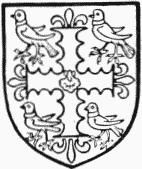
Pexsall. Argent a flowered cross engrailed sable between four birds azure having beaks and legs gules and collars argent with a scallop argent in the cross.

Brocas. Sable a leopard rampant or.
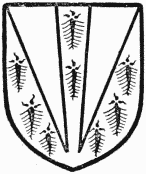
Holles, Lord Holles. Ermine two piles sable.
In 1725 Viscount Midleton was 'expected to reside shortly,' and was patron. (fn. 51) He died 1728. His son Alan, second viscount, died 1747. In his time his first cousin Vice-Admiral Thomas Brodrick was residing at Peper Harow. (fn. 52) George, the third viscount, son of Alan the second, died 1765. He was succeeded by his son George, created Baron Brodrick of Peper Harow in the peerage of the United Kingdom. He died 1836. His son George Alan was succeeded in 1848 by his cousin Charles, grandson of the third viscount, who died in 1863. The manor passed to his brother the Very Rev. William John Brodrick, who dying in 1870 was succeeded by his son William, the late Lord Lieutenant of Surrey. Viscount Midleton died in 1907, and was succeeded by his eldest son, the present viscount.
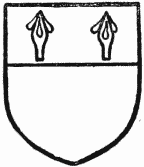
Brodrick, Viscount Midleton. Argent a chief vert and therein two spear-heads argent having drops of blood upon them.
There is mention in 1353 of a manor-house (fn. 53) at Peper Harow. It formed for a time the residence of William Brocas and his widow Joan, who was buried in the church in 1487. (fn. 54) The third viscount pulled down the old house, but at his death in 1765 the new house, which was being built from designs by Sir William Chambers, was not completed. It was finished by his son when he came of age ten years later, and afterwards added to, under the advice of Wyatt. It is a plain Italian building, in brick and stucco.
RIEHULL
RIEHULL (or Royal hodie) in Peper Harow was a very early grant to Waverley Abbey by Ralph the sheriff, confirmed by the pope in 1147. (fn. 55) It is presumably part of the land in Peper Harow of which the Earl of Southampton, the grantee of Waverley, died seised in 1542. In 1602 Henry Smith, who owned Peper Harow, (fn. 56) settled 'Ryalls' on his son William on his marriage. (fn. 57)
The property continued with the Smiths till about 1837, when it passed to Mr. Fielder King, son of George and Elizabeth King, under the will of — Smith, brother of the latter. The King family sold the property to Lord Midleton. (fn. 58)
Besides the liberty of warren claimed by Joan Braunch and granted to Henry of Guildford, the lords of Peper Harow had free fishery, which last was reserved by Ralph Brocas in granting a lease of the manor. He also claimed hospitality from his tenant when he came to the manor to hold his courts. There is mention in the survey of 1086 of a mill at Peper Harow; this had fallen into ruins before 1353. (fn. 59)
CHURCH
The church of ST. NICHOLAS is situated in the park. The churchyard, which is beautifully kept, is surrounded by trees. The ancient parts of the church are built of local sandstone rubble, with dressings of clunch, covered with rough plaster; the modern work is in local stone rubble with Caen stone dressings, except the tower, which is coursed stone. The roofs are tiled.
The church consists of a nave about 35 ft. by 20 ft., and a chancel 18 ft. long by 20 ft. wide. These represent the extent of the mediaeval building. To them in 1826 a western tower was added, replacing the wooden bell-turret with shingled spire shown in Cracklow's view. A north aisle was added to the nave and a mortuary chapel opening out of it to the chancel by the then Viscount Midleton in 1847, from the designs of the late A. W. Pugin, while in 1877 the nave was reroofed and reseated, and a new porch added on the south side, to replace one built in 1826. There is a vestry on the north of the aisle. These successive works have considerably changed the ancient aspect of the building; but even so they have stopped short of what was proposed to be done, judging by the plate published in Brayley's Surrey.
The nave is entered through the south porch by an ancient round-headed doorway of two plain orders, with a hood-mould and impost simply chamfered. The only other ancient features in this wall are the external south-east quoins of chalk and a single-light window low down in the wall close adjoining, with an ogee trefoiled head, evidently inserted to light the south nave altar, and dating from about 1330; it is set in a recess going down to the floor on the inside. The two windows to the westward are quite modern. In the south wall of the chancel, near to its western end, is a low side window renewed in modern stone. All the other windows and external features in the chancel, chapel, north aisle, and tower are modern.
In the interior the most striking features are the much-restored chancel arch and its flanking recesses— that to the south pierced with a squint—dating from the middle of the 12th century. But though parts of the works are old, particularly in the recesses, the whole has been so much renewed, with the addition of carved shafts and elaborate mouldings, that it possesses little interest for archaeologists. The arcade to the new aisle, also a very elaborate piece of work, has been built to accord with the chancel arch, the materials used being chalk and Caen stone, with shafts of Irish marble from Lord Midleton's estates in that country.
Within the chancel practically all is new, including the sedilia in the south wall, but the piscina is said to be a copy of that formerly in existence. The chancel and chapel windows, which are entirely modern, are designed in the style of the early part of the 14th century, and there are also some image niches and other features in the new work with much carving about them. The roofs, fittings, and glass are also modern.
The chancel roof is panelled and covered with sacred emblems. That of the chapel has quatrefoiled bosses, with painting and gilding in the panels. The reredos, of Caen stone, has five canopied compartments, the middle one containing a cross supported by angels, and the other four cherubim standing on their wheels.
Besides the monuments to Lord Midleton's family in the chapel there are some brasses of ancient date, one on the north wall of the chancel to Joan Adderley, bearing date 1487. It is fixed in a slab of Sussex marble, and represents her in widow's dress kneeling at a prayer-desk before a representation of the Blessed Trinity with labels inscribed, 'Ihu Mercy—Lady helpe' and the inscription in black letter:—
Ex vestra caritate orate pro anima Johane Adderley quondam uxoris Johanis Adderley quondam Majoris Civitatis London', et nuper uxoris Willelmi Brokes, armigeri, Patroni istius ecclesie, que quidem Johana obiit xviij die Novembris ao Domini mcccclxxxvij; cujus anime propicietur Deus. Amen.
In front of the altar rails is another slab bearing a brass cross which formerly marked the actual place of her burial.
Among the church plate is a paten of 1717 and a chalice and paten of peculiar design and uncertain date, made at Danzig, Germany.
There are three bells, all of 17th-century date.
The registers of baptisms begin in 1697, of burials in 1698, of marriages in 1699. There is a note at the beginning that the old registers were destroyed when the rectory house was burnt 'in Dr. Mead's time.' He was rector 1661 to 1687.
ADVOWSON
The church is not mentioned in the Domesday Survey of Peper Harow, but it was assessed at £5 in 1291. (fn. 60) The advowson was an appurtenance of the manor, with which it has descended till the present day.
CHARITIES
The charities are a rent-change on an estate at Shelley in Essex, for the use of poor persons, amounting to 30s., left by Nicholas Wallis, rector in 1606; and Smith's Charity for the relief of aged and infirm persons of good character, apprenticing children, portioning maids, &c., payable out of the Warbleton estate, Sussex, and amounting to about £3 a year or under.