
A History of the County of Surrey: Volume 3. Originally published by Victoria County History, London, 1911.
This free content was digitised by double rekeying. All rights reserved.
'Parishes: Witley', in A History of the County of Surrey: Volume 3, (London, 1911) pp. 61-69. British History Online https://www.british-history.ac.uk/vch/surrey/vol3/pp61-69 [accessed 26 April 2024]
In this section
WITLEY
Witlei (xi cent.); Whitle or Witle (xiii cent. onwards).
Witley is bounded on the west by Thursley, formerly a chapelry of the parish. It is rather over 6 miles from north to south, and 2 miles from east to west, tapering somewhat towards the south. It contains 7,210 acres of land, and 40 of water. The soil of most of the parish is the Lower Green Sand; the south-eastern part is on the Atherfield and Wealden Clays. On the west side of the parish Witley Common is an extensive waste of heather, connected with Thursley Common and the waste land running thence up to Hindhead, all included in the manor of Witley. The escarpment of the Green Sand to the south is abrupt, affording fine views southward and eastward, and the central parts of the parish are 300 ft. above the sea. The parish was divided into four tithings. Milford to the north, containing the hamlets of Milford and Mousehill, and now a separate ecclesiastical parish, Ley or Lea in the centre, containing the hamlet of Wheeler Street; Stoatley; and Birtley, which includes Witley Street and all the parish to the south. Witley Park was in the last.
The parish is intersected from north to south by the London and Portsmouth road, and in the same direction by the London and South Western Railway to Portsmouth. Milford station is in Witley, but Witley station is in Godalming parish.
Pinewood is the seat of Viscount Knutsford; Rake of Archdeacon Potter; Lea Park was the home of the late Mr. Whitaker Wright. At the sale of this property in 1905, the manorial rights over part of the waste of Witley, including Thursley and part of Hindhead, were acquired by trustees for the Commons Preservation Society. The principal landowners are Mr. Webb, Mrs. Francis E. Eastwood of Enton, Mr. E. A. Chandler, the Earl of Derby, and the various purchasers of the Lea estate.
The soil of Witley Common contains a considerable percentage of ferruginous sand. There were ironworks in the parish on Witley and Thursley Heaths, but the more important part of them was probably in the Thursley chapelry, now a separate parish. But iron was found also in Witley Park, in the clay. These ironworks seem to have been among the last which were kept open in Surrey. (fn. 1) They were working in 1767.
The social troubles of the year 1549 led to riots in Witley among other places, dignified by an old inhabitant as 'the general rebellion in these parts,' when the pale of Witley Park was demolished. The rebellion was largely against inclosing of lands. (fn. 2)
Witley Park was in the hollow, east of Hindhead and south of the road called Park Lane. The whole property is still called Witley Park. (fn. 3)
The ancient cottages near the church are very picturesque. The White Hart Inn may be of 16th-century date, though it has been restored externally. In Milford and in Brook there are also old cottages. Near Stroud are the remains of a moat, where possibly the lodge of Witley or Ashurst Park once stood. Leman Lane, an old road on the eastern boundary of Lea Park, possibly is a very old right of way, retaining its characteristic name, and nature, of the muddy way.
The Witley Institute was built by Mr. John Foster in 1883. It contains a good reference library of 240 volumes, and a lending library of over 700 volumes.
On Witley Common is a moated barrow of considerable size, apparently undisturbed. (fn. 4) Other barrows are said to have existed, and to have been opened, but no record is known of their contents.
Neolithic implements and flakes are fairly common. An Anglo-Saxon gold ring of curious make has been found at Witley. (fn. 5)
The ecclesiastical parish of Milford was separated from Witley in 1844. The village is about a mile and a half south of Godalming. The parish is traversed by the London and Portsmouth road and by the Portsmouth line of the London and South Western Railway, which has a station there.
Milford House, the seat of Mr. R. W. Webb, J.P., is a substantial brick house of the style of Queen Anne's reign. It was built by Thomas Smith, who succeeded to the property in 1705. His daughter Mary married Philip Carteret Webb, from whom Mr. R. W. Webb is descended.
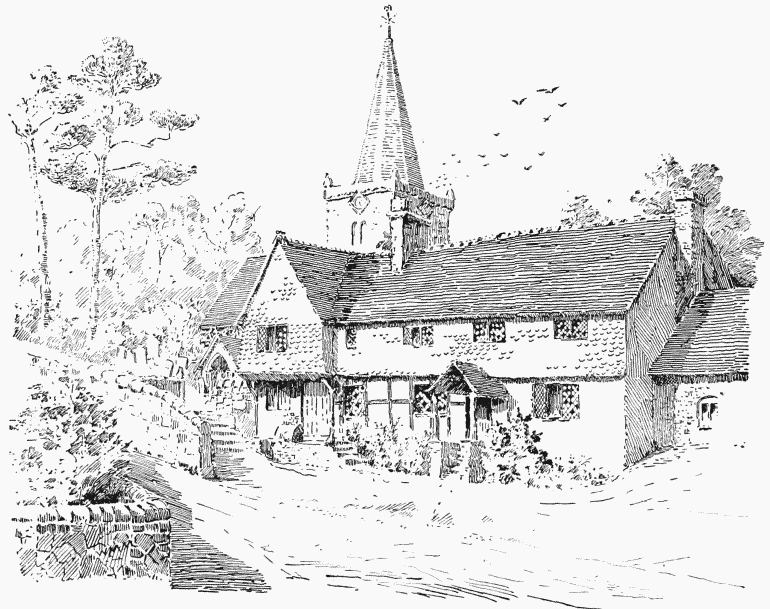
Witley: Cottages South-east of the Church
In and around the hamlet of Milford are a number of old houses and cottages. One, a farm-house, with a fine old yew tree in front, has a large roof of steep pitch over the centre, which covered the hall, and a gabled wing of slight projection at either end, in which both the upper story and the gable-end overhung. Its timber-framed construction is now hidden by plaster, and the barge boards of the gables are plain. The arms of Paine quartered with an unknown coat are in a window. The window-frames appear to be 17th-century insertions in some cases, but one at least of the chimneys is original. The general date of this house may be about 1500.
At Mousehill, to the west of Milford, is a fine old brick manor-house of 17th-century date, with a large chimney at either end having crow-stepped set-offs, and there is some curious panelled work in brick, the window heads with shouldered-arches under a stringcourse being very unusual.
At Milford is a small Congregational Chapel opened in 1902.
MANORS
WITLEY MANOR was a possession of Earl Godwin, and after the Conquest was among the lands of Gilbert son of Richer (Richerius) de Aquila, (fn. 6) whose grandfather Engenulf de Aquila had accompanied William the Conqueror and fell at the battle of Hastings. (fn. 7) Gilbert's son Richer demanded his father's lands in England; these were at first refused him, but were temporarily restored upon his invoking French aid. For his complicity in the rebellion of William Clito his whole honour of Aquila escheated to the Crown, and was only fully regranted in 1154. (fn. 8) He died in 1176 and was succeeded by a son of the same name. (fn. 9) The latter's son Gilbert went away into Normandy shortly before 1200, at which date the sheriff accounted for his lands at Witley. (fn. 10) The custody of this manor was given first to Stephen de Turnham, and afterwards, in 1204–5, to William, Earl de Warenne, Gilbert's brother-in-law, (fn. 11) who obtained the grant on behalf of his sister. (fn. 12) The lands had probably been restored to Gilbert before 6 April 1226, when he had licence to cross to Normandy, (fn. 13) but they were again taken into the king's hands in September of the same year, (fn. 14) perhaps as a pledge for his loyalty to Henry III, for they were restored in the following spring on payment of a fine. (fn. 15) Gilbert de Aquila was dead before January 1231–2, (fn. 16) and his lands escheated to the king, (fn. 17) probably owing to his or his heir's adherence to French interests, (fn. 18) for in 1232 Henry III granted his barony to Peter de Rivaulx, the Poitevin favourite, promising that, if he should restore it to Gilbert's heirs by a peace or of his own free will, Peter should not be dispossessed without compensation. (fn. 19) Peter de Rivaulx, however, seems to have lost the lands at the time of his deprivation in 1234, for in December of that year the king granted them with a similar promise to Gilbert Marshal, Earl of Pembroke. (fn. 20) He exchanged them almost immediately with the king's brother Richard, (fn. 21) but temporarily only, for he surrendered them to the Crown in June 1240. (fn. 22) In the year following Henry granted the honour of Aquila to Peter of Savoy, uncle of Queen Eleanor, (fn. 23) and entailed it on his heirs in 1246. (fn. 24) It was doubtless the general dislike of foreigners which caused the ill-feeling that arose between Peter of Savoy and his tenants at Witley. They roused his anger by neglecting the homage due to him, and he in revenge increased their rents. (fn. 25) On the baronial victory in 1264, Peter of Savoy having fled from the country, Witley was granted to the custody of Gilbert de Clare, Earl of Gloucester. (fn. 26) But after Evesham, Peter's lands were restored, and on his death in 1268 Queen Eleanor received Witley in accordance with a settlement made by Peter her uncle. (fn. 27) The king and queen granted the manor to their son Edward, who surrendered it to his mother for her life. (fn. 28)
She granted the tenants a release from the oppressive exactions of her predecessor on condition that they should cause a yearly service to be held in Witley Church for the souls of her husband and of Peter of Savoy. (fn. 29) In 1275 she gave the manor for life to her steward Guy Ferre, (fn. 30) who surrendered it to the Crown c. 1279. (fn. 31) In 1283 Queen Eleanor was again in possession, for she then had a grant of a weekly market on Fridays at her manor of Witley, (fn. 32) and her charter to Guy Ferre was confirmed in 1289. (fn. 33) She died in 1291.
Edward I visited Witley in June 1294, (fn. 34) and in 1299 assigned the honour of Aquila, and possibly Witley also, but there is no definite proof that Witley was parcel of the honour, in dower to Queen Margaret, (fn. 35) who was in actual possession of Witley in 1313, (fn. 36) and possibly earlier, for Guy de Ferre the former tenant for life had died before 1303. (fn. 37) Witley seems to have been assigned with the honour to the next queen, Isabella, who was in possession in 1329. (fn. 38) Queen Isabella surrendered it with her other lands in 1330, (fn. 39) and it formed part of Philippa of Hainault's dower in January 1330–1. (fn. 40) During the latter's life Andrew Tyndale held the manor in lease, and after her death, in 1369, the lease was renewed for twenty years. (fn. 41) He died c. 1377, (fn. 42) and the manor was thereupon granted by Richard II to his nurse Mundina Danos for life, the grant being afterwards extended to her and her husband Walter Rauf, the king's tailor, in survivorship. (fn. 43) They seem to have renewed the exactions of Peter of Savoy, whereupon the tenants of the manor raised a subscription among themselves and brought a plea against Mundina and her husband, (fn. 44) and though they were not at the time successful they were able in the next reign to obtain an exemplification of the Domesday entry relating to Witley, (fn. 45) and a confirmation of Queen Eleanor's charter. (fn. 46) Walter Rauf died 12 June 1421, (fn. 47) but Mundina survived him, at any rate till 1423, when she had confirmation of the former grants of Witley. (fn. 48) The reversion of Witley Manor was given to John Feriby, king's clerk, for life, in 1422; (fn. 49) Henry VI also granted a life-interest in the manor to Sir Bryan Stapilton, kt., with remainder after his death to James Fiennes, afterwards Lord Say, (fn. 50) who was in possession of it in 1450, when he was executed by Cade's mob. (fn. 51) His lands fell to the king, who bestowed Witley on his brother Jasper Tudor, Earl of Pembroke, in 1453. (fn. 52) On the accession of Edward IV, the Earl of Pembroke was attainted and forfeited his lands to the king, (fn. 53) who granted Witley to the Earl of Kent in tail male, (fn. 54) and at the earl's death without heirs male in January 1462–3 to George, Duke of Clarence, (fn. 55) his ill-fated brother. (fn. 56) On the duke's execution Witley was again seized by the Crown, the stewardship of the manor being granted in 1478 to Sir George Brown, kt., for life. (fn. 57) Jasper Tudor's attainder was reversed in 1485; probably he regained Witley. At his death in 1495 Henry VII was his heir. Again in 1511 the stewardship of the manor was given to William Fitz William and William Cope, and in 1527 to Sir William Fitz William and Sir Anthony Browne. (fn. 58) The demesne lands were held in 1547–9 by Thomas Jones, (fn. 59) son of Thomas, Server of the Chamber to Henry VIII (buried in the church), the manorial rights being reserved to the Crown. (fn. 60)
In 1551 the manorial rights and the park were given in exchange for other lands to Edward Fiennes, Lord Clinton and Say, (fn. 61) who almost immediately conveyed them to Sir Richard Sackville, Chancellor of the Court of Augmentations. (fn. 62) The latter conferred the stewardship on William More of Loseley. (fn. 63) Queen Mary evidently resumed the manor. (fn. 64) In 1599 Queen Elizabeth sold the whole manor and park together with courts leet and baron to trustees for Elizabeth Egerton, widow of Sir John Wolley and sister of Sir George More, (fn. 65) her favourite maid of honour. Her son Sir Francis Wolley sold it in 1605 to Sir George More his uncle, (fn. 66) who in 1613 sold the park to his brother-in-law Sir Edward More, (fn. 67) and the manor to Henry Bell of Rake. (fn. 68) It was settled on his great-nephew Anthony Smith the younger. (fn. 69) It descended in the Smith family till it passed by the marriage of Philip Carteret Webb in 1763 with Mary Smith (fn. 70) to his family. Mr. Robert William Webb of Milford House sold the manor to Mr. Whitaker Wright of Lea Park. Since his death part of the waste has been acquired by trustees, to preserve the open ground for public enjoyment, (fn. 71) and other parts separately sold. Mr. G. H. Pinckard of Combe Court bought the quit-rents of the manor.
PARK
The lords of Witley seem to have had a park there early in the 13th century, (fn. 72) but it is not specially mentioned in the grants of the manor till after April 1247, when Peter of Savoy obtained free warren in his demesne lands of Witley. (fn. 73) In 1303 the profits of the park amounted to 33s. 5d., (fn. 74) and ten years later Queen Margaret sent five oaks from her park at Witley for making shingles to cover the king's great hall at Westminster. (fn. 75) Early in the following year Queen Margaret made complaints against certain persons who had broken several of her parks, including Witley, (fn. 76) and a similar petition was made by Queen Isabella in 1329. (fn. 77) In the grant to Mundina Danos in 1378 vert and venison in the park were reserved to the king, while the grantee undertook to pay the parker his wages of 2d. a day. (fn. 78) Amongst the charges brought against the tenants of the manor by Mundina Danos and her husband was that of breaking into their warren, (fn. 79) while they claimed free warren in the lands of bond-tenants as well as in their demesne lands. (fn. 80) Frequent appointments to the office of keeper occur in the Patent Rolls, sometimes in conjunction with that of Ashurst Park. In 1514 Thomas Jones (Johns) and his son Robert had a grant of the office of keeper in survivorship. (fn. 81) Sir William Fitz William and Sir Anthony Browne were made masters of the hunt at Witley when they obtained the stewardship of the manor, (fn. 82) but in the survey of Witley Manor dated 1547 Thomas Jones was said to be custodian of the park, which was 6 miles in circuit. (fn. 83) It was not always included in the leases of the demesne lands, but in May 1596 was granted in farm to Elizabeth Wolley, Francis her son, and George More her brother, (fn. 84) and finally sold to Elizabeth Wolley with the manor, with which it descended till 1613. Sir George More then sold to his brother-in-law, Sir Edward, grounds called Witley Park, which he had previously held on lease. (fn. 85) In 1656 Edward More, grandson of Sir Edward, sold it to Thomas Russell (fn. 86); it was probably already broken up into farms. Russell was possibly trustee for Simon Bennett, whose daughter Frances carried a moiety of the park in marriage to James fourth Earl of Salisbury. Her sister Grace died in 1730 without issue, and her moiety also passed to James, the sixth Earl. His son the first Marquess of Salisbury sold it to William Smith of Godalming in 1791. (fn. 87) William Smith bequeathed the estate to his brother, Richard Smith of Burgate, whose niece Mary, widow of George Chandler, inherited it in 1838, and held it with remainder to her son Allen. (fn. 88) Mr. Allen Chandler sold it to the Earl of Derby, in 1876.
In the 15th century the lords of Witley Manor had both court baron and view of frankpledge together with the chattels of fugitives and outlaws; (fn. 89) they also had a right to heriot and relief from certain of their tenants, (fn. 90) and claimed a custom called 'grasaves,' or 'Grayside,' which was valued at 5s. 4d. yearly. (fn. 91) From time to time their tenants claimed various privileges, asserting that Witley was ancient demesne. On this ground in 1380, and again in 1401, they were exempted from paying the expenses of knights to Parliament. (fn. 92) On the other hand, in the suit brought against Peter of Savoy by the men of Witley, the jurors allowed the exactions of Peter of Savoy, but denied that Witley was ancient demesne of the Crown. (fn. 93) In 1389 the tenants, with a few exceptions, (fn. 94) were said to be villeins and bond-tenants, and were bound to act as reeve of the lord's manor, and to perform certain other services. (fn. 95)
They obtained a recognition of their position as tenants in ancient demesne in the proceedings in 1401, including right of exemption from juries. (fn. 96) This privilege, with the exemption from contribution to expenses of knights of the shire, was confirmed 20 June 1574. (fn. 97)
Free fishery was recounted among the appurtenances of the manor in 1443. (fn. 98)
WYTLEY CHESBERIES alias WYTLEY CHEASBURIES
WYTLEY CHESBERIES alias WYTLEY CHEASBURIES is a small reputed manor. It is near Wheeler Street. In 1310 William de Chussebury de Muleford was husband of Dionisia, co-heiress of Stephen de Asshurst. (fn. 99) They levied a fine of land in Witley, Godalming, &c. The name Chesbury appears in subsidies in 1332 and 1381. In 1566 there was an inquiry in the Catteshull court as to whether Henry Chittie, tenant of Chesberies, was or was not subject to the court's jurisdiction. (fn. 100) In 1575 Henry Chittie alias Bocher parted with the manor of Chesberies to Laurence Stoughton, parson of Witley. (fn. 101) In 1580 Laurence sold to George Weller. (fn. 102) In 1605 Weller parted with the manor of Chesberies to Thomas Compton, (fn. 103) doubtless the owner of Taylors, Godalming. (fn. 104) It afterwards went to the Duncombes. In 1726 John Duncombe sold to John Marche, yeoman. It descended to Richard Marche, and through the Winkworth and Sparkes families from him to Mrs. Eastwood, who lately sold it to Mr. Heatley.
OXENFORD GRANGE
OXENFORD GRANGE, within Peper Harrow Park, but in the parish of Witley, was a part of the manor of Witley until Richer de Aquila granted it to the abbey of Waverley early in the 12th century. (fn. 105) His gift is mentioned in the bull of Pope Eugenius III, dated 1147, confirming to the abbey all its property, (fn. 106) and the grange of Oxenford with land at Rihella was included in the lands confirmed to the abbey by Richard I. (fn. 107) Richer's grandson, Gilbert de Aquila, in confirming his grandfather's gift, mentioned the right of the abbot to inclose so much of Witley Park as belonged to Oxenford. (fn. 108) In the 'Taxatio' of 1291 Oxenford was rated at £1, (fn. 109) and the abbot seems to have objected to paying the tenth for it, (fn. 110) but his claim to exemption was disallowed. (fn. 111) The grange remained among the possessions of the abbey till the Dissolution, at which time it was valued at £4 13s. 4d. (fn. 112)
It was included in the grant of the site of Waverley to Sir William Fitz William, (fn. 113) with which it descended to Anthony, first Viscount Montague, (fn. 114) who died seised of a messuage called Oxenford, 9 October 1592. (fn. 115)
His son by his second wife, Sir Henry Browne, sold to Sir George More of Loseley in 1609. (fn. 116) Sir George, his son Sir Robert, and their respective wives, levied a fine to John Hone in 1613, (fn. 117) and Bartholomew Hone his son, of Oxenford, and others conveyed to John Chesterton of St. Giles in the Fields in 1619. (fn. 118) After his death in February 1624–5, it was held by his wife Anne for life, who survived her two sons, Walter, who died in 1638, (fn. 119) and John. (fn. 120)
The reversion became divided among the three sisters of John and their representatives, namely, Mary wife of Henry Fox, Jane wife of John Smith of Riehull, and Martha wife of Antony Covert. On 8 February 1667 Antony Covert and his son conveyed their third to John Platt of Westbrook and his heirs, (fn. 121) and in 1676 his son Sir John Platt, and John Smith son of John and Jane, conveyed two-thirds to Denzil, Lord Holles, (fn. 122) from whom it passed as Peper Harow (q.v.). This portion included the grange itself.
Chesterton Fox, son of Henry Fox and Mary, was possessed of the other third in 1680, (fn. 123) and in 1705 it was sold by Mary Horish and Anne Fox, daughters of Chesterton Fox, to Edmund Stillwell of Thursley. (fn. 124) His descendants sold to Viscount Midleton c. 1822.
The remains of the Grange are now included in Peper Harow Park. They consist of only part of a cottage, the rest having been pulled down in 1775 when the present mansion-house at Peper Harow was approaching completion. The fifth Viscount Midleton employed Mr. Pugin to build an imitation 13th-century farm here. The land of Oxenford is counted now in Witley parish. It was apparently, when in the hands of Waverley, extra-parochial, and is tithefree. In 1802 and 1803 the inhabitants successfully resisted an inclusion for rateable purposes in Witley. (fn. 125)
MOUSEHILL
MOUSEHILL (Mushulle, xiv cent.; Moussulle, xv cent.) is a hamlet of Milford. The family of Court were the chief landowners there in the 14th century. In 1335–6 Cecily widow of Richard le Court leased land at Mousehill to Thomas atte Dene and Robert son of John le Court. (fn. 126) Robert Court is said to have held court baron for the manor of Mousehill early in the reign of Henry V. (fn. 127)
Robert Court conveyed all his lands in Witley to his son Thomas Court in 1426. (fn. 128) Thomas is said to have had a daughter Julia who married John Hedger. His granddaughter Marion married Richard Shudd. (fn. 129) From the Courts the estate became known as Court Thorn in Mousehill. (fn. 130) In 1548 the manor of Court was held by Richard Shudd, (fn. 131) son of Richard and Marion, who was succeeded by John Shudd. He conveyed in 1611 to his son Richard. In 1614 Richard bequeathed Court Thorn in Mousehill to his brother Thomas, together with Court Hall in Mousehill, which he had purchased from John Fludder, (fn. 132) subject to the condition that Thomas granted his right in other property to a third brother John. This arrangement was carried out in 1615, (fn. 133) John Stillwell (vide infra) being an executor. Thomas Shudd entered upon his bequest in 1614. He died in 1649 (fn. 134) holding Court Hall and Mousehill, and his son Thomas was in possession of them c. 1618, and died in 1699. (fn. 135) They passed, through the marriage of his sister Joan to John Stillwell of Lower House in Thursley, to the Stillwell family. (fn. 136)
The 'manor of Court Thorn or Mousehill' remained in the possession of John Stillwell's descendants till about 1822, when it was purchased by Viscount Midleton. (fn. 137) A court baron existed as late as 1701.
RAKE
RAKE in Milford is an Elizabethan house near the watercourse which runs from Witley to Milford. The owner of the estate had a mill near his house, the whole being described c. 1548 as a tenement and 26 acres of land and a fulling-mill. (fn. 138) Robert Mellersh, who was then the owner, was succeeded by his widow Joan, after whom their son John held Rake. (fn. 139) He was involved in a suit with the tenant of Witley. Thomas Jones, concerning the damage caused to the demesne lands of Witley by the overflow of water from the pond at Rake, and a right of way claimed by Mellersh through the lands of Witley Manor. (fn. 140) In 1592 he sold a messuage and mill in Witley to Henry Bell. There seems no doubt that this sale referred to Rake, (fn. 141) for Henry Bell was possessed of 'Rake farm' at his death. (fn. 142) It passed to his nephew Antony Smith, who settled it upon his great-nephew Antony Smith Meale; it descended to the latter's granddaughter Anne, the wife (1748) of Thomas Woods of Godalming, whose grandson Thomas Woods sold the house and mill in 1836 to Thomas Durrant. He died in 1879; the property was sold to the trustees of the Busbridge estate, and the late owner was the Hon. Violet Monckton, but it has been sold again recently to Archdeacon Potter. (fn. 143)
Rake House, built by Henry Bell in 1602, is one of the best examples of the half-timber manor-house remaining in Surrey. (fn. 144) Its timber framework, filled with bricks laid herring-bone fashion, the many original windows, and a large and finely proportioned chimney-stack rising from the ground on the west side are noteworthy features. The plan is important, as typical of the smaller gentleman's house of the beginning of the 17th century. It is L shaped, with the staircase carried up in a gabled excrescence built in the inner angle of the L (a feature occurring in a house of similar plan at Shottermill). The hall or kitchen occupies roughly the middle of the long stroke of the L, having the great open fireplace at one end and a screen along one side. Two kitchen offices filled the top of the L, and two parlours, separated by a large chimney-block, the short stroke. The annexe containing the staircase served also as an entrance porch, and there was a second doorway opposite to it in the rear of the hall. The parlour filling the outer angle of the L is approached by a third outer door, which opens into the lobby formed by the thickness of the chimney between the two parlours; and in the other parlour is an oak mantelpiece, very delicately carved with arabesque and foliage patterns, caryatides, and arches, bearing the date 1602 and the initials H. B.
ROAKE or ROKELAND
ROAKE or ROKELAND was held in 1548 by Walter son of John Roke, (fn. 145) who was doubtless a descendant of Richard atte Roke, one of the tenants who protested against the exactions of Mundina Danos in 1389. (fn. 146) Walter's granddaughters, Alice Clarke and Jane Payne, inherited Rokeland, which ultimately passed to Thomas Clarke, (fn. 147) who sold 'the manor of Rokeland' and a house called Rokehouse to Thomas Carrill in 1585. (fn. 148) Six years later the Carrills alienated Rokeland to John Westbrook, (fn. 149) whose descendants held it for nearly a century. (fn. 150) In 1674 Richard and William Westbrook sold it to Thomas Smith of Witley, (fn. 151) with which manor it has since descended.
CHURCHES
The church of ALL SAINTS stands upon a gentle slope on one side of the village. The churchyard is beautiful and has some fine trees; and the cottages at the south-eastern angle, with the church stile, combine to make a most picturesque and oft-painted group, the square tower and slender spire of the church appearing behind. There are many 17th and 18th-century gravestones in the churchyard.
The church is built of local sandstone rubble, with dressings of the same or Bargate stone; brick and Bath stone have been partly used for modern additions. Horsham slabs still remain upon the roofs, together with ordinary tiles, and the spire is covered with oak shingles.
The church consists of nave, 44 ft. 6 in. by 18 ft. 6 in. with north and south transepts (the south, which is ancient, being 13 ft. 9 in. by 15 ft. 6 in.), central tower (about 14 ft. square) and spire, chancel, 26 ft. 6 in. long, by 15 ft. 2 in., and north chapel known as the Witley Manor Chapel, originally 27 ft. by 15 ft. The nave is the oldest part of the building, and probably the plan and main structure of this date from the last quarter of the 11th century. The central tower, transepts, and chancel belong to the next period, 1190, while the north chapel was added and other alterations made in the first half of the 14th century. There is a porch on the south of the nave, patched work of 19th-century date, and another giving access to the north transept of more recent date. This transept has been thrown out on an enlarged scale, and a short aisle and vestry built in 1890 on the north of the nave. Before these extensions the insertion of 'churchwarden' windows, &c., in the early part of the 19th century, and a severe 'restoration' in 1844 had robbed the church of some of its interest.
Externally, the most ancient feature is the south doorway within the porch, which preserves its jambs and their plain heavy nook-shafts, with cushion capitals, of date c. 1080. Part of the abacus is plain except for a small moulding, but the rest, of a slightly later date, has been carved with another moulding and the star-pattern. (fn. 152) The original semicircular arch has been replaced by a rude pointed one, apparently of early 19th-century date. The substance of the nave walls, which are unusually lofty for a church of this size, is of the latter part of the 11th century, but no windows of this period are now visible, they having been replaced by large two-light openings of 'churchwarden' character. The west window and the doorway below are apparently of 15th-century date. On the gable of the south porch, which is a modern antique, is an ancient oak barge-board, perhaps as old as the latter part of the 14th century, but belonging originally to a demolished house in the village.
The south window of the south transept is a 'churchwarden' insertion, but in the west and east walls are small narrow lancets, dating from about 1190. The eastern is set with a pointed-arched recess on the inside, indicating the position of the chapel altar. This transept retains its original roof of somewhat acute pitch.
Above the crossing rises the tower, of solid dignified square form, in two stages, without buttresses. It is built like the rest of the church of local rubble, with Bargate stone quoins and other dressings. At the south-east angle is a circular stair-turret of modern date, and in the lower stage are lancet windows with pointed heads. A string-course of half-round section separates the stages, and upon this stand, in each face, two round-headed openings divided by a broad mullion: these are chamfered and rebated. The tower is crowned by a coped parapet resting upon a corbel, and at the angles are small obelisks or pinnacles, evidently 17th-century additions; the corbels of the parapet being variously moulded and coeval with the tower.
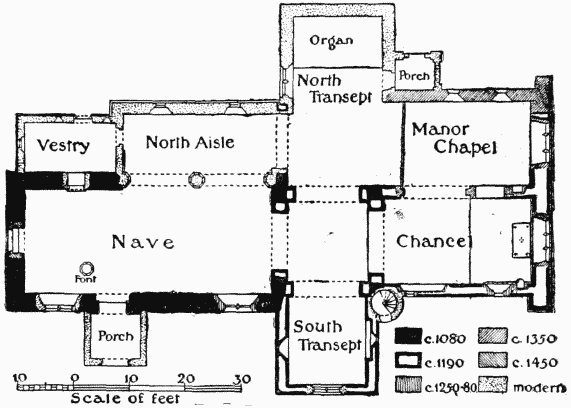
Witley Church: Ground Plan
The shingled spire is of 14th or 15th-century date. Altogether this tower is one of the most interesting studies in early masonry in Surrey. Within it rests upon plain pointed arches, worked in clunch, and having steeply chamfered imposts and narrow chamfers to the piers.
In the south wall of the chancel, at its western end, is a trefoiled lancet, which old photographs show to have been a low side window: its sill has been lately raised. Further east is a wide lancet with pointed head, and at the angle a good example of a late 12th-century buttress with a string-course of semi-octagon shape, which also appears beneath the east window. The latter, which has replaced the original early lancets, is an interesting design in flowing tracery of three lights, worked in clunch. (fn. 153) The gable has a moulded barge-board. The east window of the Witley Manor Chapel, also of three lights, is a restoration on the old lines of a reticulated pattern tracery. The windows in the north wall are also new, but perhaps restorations, and the north transept, porch, aisle, and vestry are modern.
Coming to the interior, we find few features of antiquity in the nave, which has a new oak-panelled roof and seating. The internal opening of the south doorway has been enlarged and otherwise altered. The character of the tower arches and the south transept has been noted above. In the chancel are handsome modern alabaster sedilia and other fittings, but the curious piscina with thirteen foliations to the drain and the aumbry above it are of about 1350. The face of the latter is sloped back, so as to keep the door automatically closed; adjacent to this are the remains of the earlier semi-octagonal string found also on the outside.
The arches between the two chancels appear to have been pierced at a later date than that of either chancel, and originally there was probably a wall between the two with a door in it. The western arch is wide, of two plain chamfered orders, and the other quite narrow, of 15th-century date, with a plain tomb standing in it which was used as an Easter sepulchre. Eastward of this, on the chapel side under a pointed arch and credence shelf, is a piscina in Sussex marble, bearing curious ornamentation of wavy lines. This bowl was probably transferred here from the main chancel when the later piscina there was made and the chapel built.
The original oak roof (c. 1190) remains over the south transept. It is of braced collar-beam construction, with fine massive timbers. The corresponding north transept roof was preserved when the walls supporting it were removed to extend the area, and a noteworthy detail of this is the billet ornament upon the wall plates, a feature rarely found in woodwork. (fn. 154)
The handsome screen between this transept and the north chapel is of the 15th century. On the south wall of the nave, high up, is a painting of 12th-century date in two tiers. It measures about 16 ft. in length, by about 9 ft. in height, but is obviously a fragment of a scheme which probably covered the entire nave; the colours used are red, pink, yellow, and white, and the whole composition and treatment recall the early Lewes school as represented in Hardham, Clayton, and other Sussex churches. The subjects are uncertain, but the upper tier seems to contain scenes connected with the Nativity, and the lower legendary incidents in the lives of saints. One nimbed figure in the lower tier bears a T-headed staff. In the background is some architecture of arcaded towers and domed roofs with scale-shaped tiles. On the east wall of the south transept and elsewhere are further slight remains of colour decoration, chiefly in red.
Some good 15th-century heraldic glass (among which are the arms of France and England quarterly, and France impaling France and England) remains in the windows of the Witley Manor Chapel, but it has been shifted and releaded within the last century, and not all of it is ancient. One fragment on which was depicted the hawthorn bush and crown, with the initials H. E. in black letter beneath it, formerly marked the connexion of the manor with Henry VII. It and the remaining old glass are conjectured to have been placed in the windows by Sir Reginald Bray (temp. Henry VII). The font dates from about 1250. Its octagonal bowl, which has been renewed or recut, rests upon a central drum and eight small shafts with moulded bases, standing upon a circular plinth.
Some ancient seats belonging to the first half of the 14th century, which may have originally stood in the nave, have been placed in the same chapel. The sanctuary is bordered with a dado of modern marble.
A fragmentary inscription in black letter, cut in a piece of stone let into the north wall of the chancel, bears the date 1468, and records the fact that the manor of Witley was held by the ill-fated Duke of Clarence, brother of Edward IV. It reads:—'Georgii Ducis Clarence et Dñs (sic) de Wytle, ac fratris Edwardi quarti, regis Anglie et Franc . . .' This accounts, probably, for the heraldic glass in the windows.
The Easter sepulchre contains a brass to Thomas Jones, Jane his wife, and their six children, 'which Thom's was one of the Servers of the Chamber to our Souverayne lorde Kinge Henry VIII.'
A brass in the north wall of the manorial chapel bears the date 1634, and commemorates Henry Bell, 'Clarke Controwler of the Household to our late Soveraigne Lord King James of Blessed Memorie.'
There are also tablets in the chancel and north chapel to the wife of a 17th-century vicar of Witley (in which her virtues are likened to those of Sarah, Rebecca, Rachel, and Ruth); and to Anthony Smith, 'Pentioner' to Charles I and II, with a curious Latin couplet containing allusions to his gift of a bell to the church, and his benefactions to the poor of Witley.
An ancient almsbox of enamelled iron, with 14th or 15th-century tracery on the front, stands by the south door. Although an undoubted antiquity, it has been presented to the church in recent years.
The registers date from 1558.
There are eight bells in the tower, the treble and third by Bryan Eldridge, 1648; the second bears Richard Eldridge's initials and the legend, 'Our Lord our hope, 1604.' The fourth is by William Eldridge, 1670.
Among the church plate are chalices of the years 1638 and 1639, the second being an ancient piece imported from Yorkshire, the gift of Mr. John Harrison Foster, of Witley. There is also a paten of the date 1717, and an old pewter tankard of a poor type.
The church of St. John the Evangelist, Milford, was built in 1844. It is of Bargate stone, which is found in the neighbourhood, in 14th-century style, with a bell turret. The north aisle was added in 1894.
The church of All Saints, Grayswood, was built in 1900–1 and consecrated in 1902.
ADVOWSONS
A church is mentioned in the Domesday Survey of Witley. (fn. 155)
The advowson of Witley Church was appurtenant to the manor until Gilbert Marshal, Earl of Pembroke, gave it to the Abbey of St. Mary de Gloria, Anagni, to which Pope Gregory IX granted an indult to enter in possession in September 1238, a vicar's portion being reserved. (fn. 156) This appropriation does not seem to have been carried into effect, and the advowson itself was evidently restored to the lords of the manor before 1289, (fn. 157) when it was included in the confirmatory grant to Guy Ferre. (fn. 158)
In 1321 Queen Isabella presented a rector to Witley Church. (fn. 159) In 1342 Edward III gave the advowson to Dartford Priory, (fn. 160) to which the church was appropriated c. 1368, (fn. 161) but the prioress, doubting the validity of the former appropriation and 'being in no small need,' obtained a fresh licence from the pope in October 1395. (fn. 162) In 1544, after the suppression of the priory, the king sold the rectory and advowson of Witley as a manor to Thomas Jones, 'his servant,' (fn. 163) who sold them in 1571 to Thomas Smith, controller of the queen's household. (fn. 164) In 1642 a Thomas Smith his grandson presented to the vicarage, and left the manor in his will for sale. (fn. 165) In 1670 George Smith his son (fn. 166) presented. From him the rectory manor descended in moieties to Susan Smith and Sarah wife of Michael Purefoy. (fn. 167) Susan Smith either inherited or purchased the second moiety, for she was possessed of the whole rectory and advowson in 1715, (fn. 168) and alienated them to the use of William Myers. (fn. 169) He died in 1739. His son William Myers made a settlement of Witley rectory on his marriage in 1743. (fn. 170) In 1775 William Myers his son sold the rectory, advowson, and great tithes of Witley (but not of Thursley) to John Leech, Ph.D., of Alton and John Chandler of Witley. (fn. 171) The former took the rectory, manor-house, and part of the land, the latter the advowson of Witley and Thursley, the vicarage house, and other lands.
This Mr. Chandler's grandson was patron and vicar in 1837. The present patron is Mr. E. A. Chandler. The rectory manor passed ultimately to Mr. John Leech, of Lea, M.P. for West Surrey, son of Dr. Leech, who died in 1847. His widow Mary married William Wight, and died 1878. The manor was then sold to W. H. Stone, whence it probably passed with Lea, where Dr. Leech and Mr. Stone had lived, to Whitaker Wright, and was seemingly lost sight of as a manor.
There were manorial rights attached to the rectory as well as court leet. (fn. 172) With regard to the latter, the parson of Witley claimed view of frankpledge and assize of bread and ale in 1279, but the king recovered seisin of them through his default. (fn. 173) Apparently, however, the rectors had regained view of frankpledge before the Dissolution, and the rector had both court baron and court leet late in the 17th century. (fn. 174)
Milford was formed into a separate ecclesiastical parish in 1844. The vicar of Witley is patron of the living. (fn. 175)
Grayswood was formed into a separate ecclesiastical parish from Chiddingfold, Haslemere, Thursley, and Witley in 1900. The Bishop of Winchester is patron (fn. 176) of the living, which is a vicarage.