A History of the County of Surrey: Volume 3. Originally published by Victoria County History, London, 1911.
This free content was digitised by double rekeying. All rights reserved.
'Parishes: Alfold', in A History of the County of Surrey: Volume 3, ed. H E Malden (London, 1911), British History Online https://www.british-history.ac.uk/vch/surrey/vol3/pp77-80 [accessed 30 April 2025].
'Parishes: Alfold', in A History of the County of Surrey: Volume 3. Edited by H E Malden (London, 1911), British History Online, accessed April 30, 2025, https://www.british-history.ac.uk/vch/surrey/vol3/pp77-80.
"Parishes: Alfold". A History of the County of Surrey: Volume 3. Ed. H E Malden (London, 1911), British History Online. Web. 30 April 2025. https://www.british-history.ac.uk/vch/surrey/vol3/pp77-80.
In this section
ALFOLD
Alfaude (xiii cent.); Aldfold, Awfold (xvii cent.).
Alfold is a rural parish on the borders of Surrey and Sussex, bounded on the north by Hascombe and Cranleigh, on the east by Cranleigh, on the south by Rudgwick, Wisborough Green, and Kirdford (all in Sussex), on the west by Dunsfold. It measures roughly 2¼ miles north to south, a little over a mile east to west. It now contains 2,974 acres. The parish formerly extended into Sussex, and inclosed an outlying piece of Albury. In 1880 the Albury part was added to Alfold, (fn. 1) and in 1884 the Sussex portion was transferred to parishes in the county. (fn. 2) About 150 acres, with ten to fifteen inhabitants only, were added to Sussex, and about 50 acres taken from Albury. The soil is Wealden clay, and grows nothing much except forest trees and oats. There are no wastes in the parish, and the roadside grass is not above 20 acres in all. A great part of the parish is wooded, and it was all formerly in the Wealden Forest; 917 acres are tithe-free, as 'woodland in the Weald of Surrey and Sussex.' (fn. 3)
In Sydney Wood were glass-houses, of which the only relic is the name Glass House Fields. A glasshouse is marked in Speed's map. Aubrey (17th century) saw the graves of French glass-makers in the churchyard, but the industry was extinct in his time, so the French were not refugees after the Revocation of the Edict of Nantes, as stated by Brayley. Charcoal was extensively burnt in the parish for gunpowder works in Dunsfold, Cranleigh, and Sussex.
A road from Guildford to Arundel, made in 1809, (fn. 4) traverses the village. Before this time there was no made road in the parish, and fifty years ago there was no other. The disused Wey and Arun Canai passes through the parish.
Alfold Park, which belonged to the manor of Shalford, contained 300 acres. It had ceased to be a park when Speed's map was made, and was not mentioned among twenty-one Surrey parks of the compass of a mile in the proceedings under the Act for the Increase of Horses. (fn. 5) It is unknown when it was disparked. The house is, though partly modernized, a good specimen of an old timbered house, formerly with a hall with a louvre over, the chimney being a Tudor addition. There are the remains of a moat round it. The house is now known as Alfold Park Farm. There are also the remains of a moat at Wildwood Farm. The parish was rich in timbered farms and cottages, some of them being now altered, some pulled down.
A Baptist chapel was erected in 1883, and an elementary school in 1876. Sydney Manor is the residence of Mr. George Wyatt, Sachel Court of Mr. Thomas Wharrie.
In the lane leading up to the church, and close to the churchyard gate, the village stocks are still preserved; a shed-roof has lately been erected over them.
Besides the ancient tile-hung cottages grouped round this lane, a notable example of the half-timber house, originally built by a substantial yeoman in the early years of the 16th century, remains in Alfold House at the entrance to the village. This was originally constructed entirely from the foundation of timber framework, filled with wattle and daub. In plan it was of [capital letter L]-shape with hall (about 23 ft. by 19 ft.) between offices and living rooms. In late years it has been a good deal injured by the insertion of modern windows in place of the ancient mullioned openings filled with lead lights, but it still retains its arched doorway and a projecting gable, carried on a moulded bressummer and brackets and having a foliated barge-board. (fn. 6)
MANORS
WILDWOOD
WILDWOOD, (fn. 7) now represented by Great and Little Wildwood Farms and Wildwood Copse and Moat, was formerly possessed by the lords of Albury and Stoke D'Abernon, the D'Abernons and their successors. (fn. 8) In the 13th century the D'Abernon family had land in Alfold, (fn. 9) and in a deed of 1313 John D'Abernon's wood called 'le Wylwode' is mentioned. This was probably the wood of 40 acres of oaks, possibly the 'Wealden' Wood named in the inquisition on the Albury Manor. (fn. 10) In 1391 Elizabeth Grey, lady of Stoke D'Abernon, widow of Sir William Croyser, granted the soil and wood of Wildwood except the moat, grange, and manorial rights (fn. 11) to John, Duke of Lancaster, and others. (fn. 12) The descent of Wildwood followed that of Albury till 1626, when Sir Edward Randyll alienated it to Elizabeth Onslow, widow, and Sir Richard Onslow, (fn. 13) from whom it seems to have passed to the Duncombes of Weston. (fn. 14) With Weston it descended to Nathaniel Sturt, who is said to have sold it in 1736 to either Richard or Francis Dorrington, from whom it was purchased by Henry Page. He bequeathed it to his cousin Richard Skeet of Effingham, whose son Richard succeeded him as owner. (fn. 15)
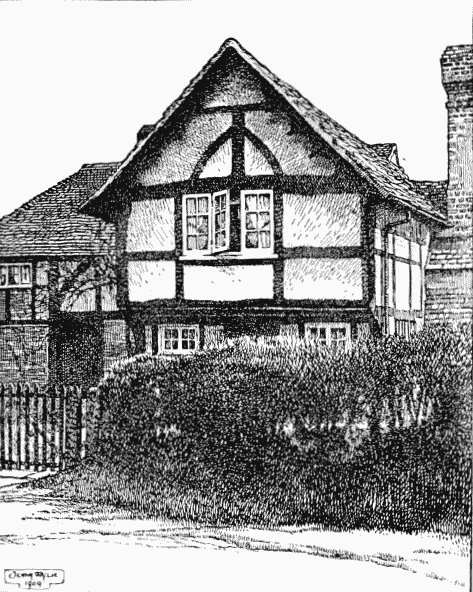
Alfold: Old House
MARKWICK and MONKENHOOK
MARKWICK and MONKENHOOK were among the possessions of Waverley Abbey, (fn. 16) but Markwick only was assessed as the property of the abbey in 1534–5. (fn. 17) The 'manors of Markwick and Monken hook' were included within the grant of the site of the abbey to Sir William Fitz William, at whose death they appear under the name of the manor of Alfold, (fn. 18) and descended to Anthony, second Viscount Montagu, (fn. 19) who alienated the estate circa 1623, (fn. 20) evidently to agents in a sale to Simon Carrill of Tangley, for it appears afterwards in the possession of the three daughters of John Carrill, (fn. 21) and descended with that part of his estate which was assigned to Henry Ludlow and his wife Margaret. (fn. 22) Giles son of Thomas Strangways sold them in 1784 to Thomas Boehm, the owner in 1808. (fn. 23) The Earl of Onslow is now lord of the manor.
It was said in the 17th century that the lord of Markwick had both court baron and court leet, while the lord of Monkenhook had court baron. (fn. 24) The courts were held at Rickhurst and Hook Street.
The reputed manor of SYDNEY alias HEDGECOURT or RICKHURST lies partly in Dunsfold. The family of Sydney can be traced in the surrounding parishes from the 14th century, while John at Sydney witnessed a deed concerning lands in Alfold in 1313. (fn. 25) In 1413 the lord of the manor of Shalford Bradestan is said to have granted Rickhurst and other land in Alfold to William Sydney and his wife Agnes. (fn. 26)
In 1595–6 Richard Ireland died possessed of a house called 'Sydneys,' which was held of the lord of Pollingfold. (fn. 27) He left a sister and heir Elizabeth, a minor at the time of his death, and it was probably from her that it passed ultimately to the Dorrington family, who held it during the 17th and following centuries. (fn. 28) Sydney Wood was purchased by Sir John Frederick, lord of Hascombe, with which manor it descended till the 19th century. (fn. 29) It was in 1903 the property of Mr. George Wyatt, but has since been bought by Messrs. J. E. Sparkes and H. Mellersh.
CHURCH
The church of ST. NICHOLAS stands upon a knoll of rising ground in the centre of the village, flanked by a cluster of charming old tile-hung cottages. The churchyard is prettily surrounded by trees, and contains several larches and one or two yews of some antiquity. (fn. 30) Dotted about among the graves are a number of cypresses and other evergreens, and in early spring the grass is thick with crocuses and daffodils. The churchyard has been extended considerably beyond its ancient boundaries.
The building in itself and with its surroundings is delightfully picturesque, especially as viewed from the south-east.
Bargate stone rubble, plastered outside and in, has been employed for the walls, with dressings of the same stone; but internally the hard chalk, or clunch, also quarried locally, has been used in the south arcade, the chancel arch, and the 15th-century features of the chancel. The chancel roof and the roofs over the aisles and porches are still 'healed' with Horsham slabs; the bell-turret and its spire are covered with oak shingles, and the porches are of oak.
In plan the church consists of a nave, 36 ft. 4 in. by 21 ft. 2 in., north and south aisles, about 7 ft. 5 in. wide (the south aisle is slightly longer than the nave); chancel, 17 ft. 5 in. wide by 16 ft. 5 in. long; north and south porches, and a vestry lately erected on the north of the chancel. The simple outlines of nave and chancel give the plan of the primitive church, erected perhaps about 1100, of which the only visible relic besides plain walling is the remarkable font.
The south aisle was added about 1190, the old walls being pierced with three plain, square-edged, obtusely pointed arches, unrelieved by moulding, chamfer, or label, and springing from columns and responds circular in plan, on square plinths, and having capitals of an early circular form, simply moulded. (fn. 31) The western respond only has a circular moulded base with angle-spurs. The church must have remained with one aisle till about 1290, when that on the north was thrown out. Its three arches were discovered blocked up in the north wall of the nave at the restoration of 1845; they were then opened and the aisle rebuilt on its old foundations. The arches, in rough Bargate stone, are moulded in three orders (a hollow between two wave-mouldings), and these spring direct from octagonal piers, without capitals, which have chamfered plinths instead of bases. (fn. 32) The chancel arch is of somewhat similar design, but in a firestone, or clunch, and springing from plain square piers. The mouldings indicate a slightly later date—c. 1320—to which period may be referred the south aisle windows, with ogee and reticulated tracery, and the outline at least of the east window of the chancel. The windows of the north aisle appear to be entirely modern, and are copies of those on the other side, but its doorway (c. 1290) has been replaced from the old north wall and retains the original oak door with very elaborate diagonallybraced framework on the back, a massive oak lockcase, and some good wrought-iron hinges and straps, partly ancient. The south door, less elaborate, is perhaps of the same date.
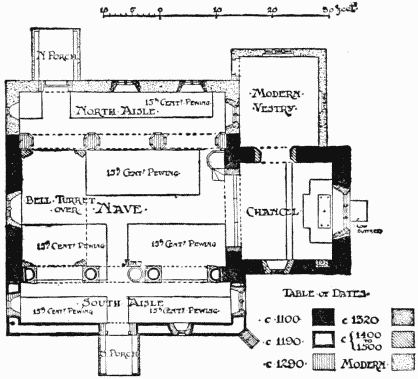
Plan of Alfold Church
The two-light window and piscina in the south wall of the chancel, and the splayed opening with four-centred arch in the wall opposite, are of 15th-century date, the piscina being a restoration. (fn. 33) The splayed opening now communicates with a modern vestry, but it is probable that it was originally an arch over a tomb or Easter sepulchre in the thickness of the wall, and the splays repeated on the outer face suggest that there was at one time a small chapel or vestry abutting upon the north wall of the chancel into which this arch opened. There is a small buttress at the south-east angle of the south aisle and a low one beneath the east window of the chancel, both perhaps dating from about 1320. Parts of the picturesque oak porches may belong to the same early date, but they have been much restored and are largely of new material. That on the south side appears in Cracklow's view very much as at present.
The timber bell-tower, standing on huge oak posts worked into a series of hollow mouldings, rises from the floor of the nave at its western end and occupies the western bay of the arcades, its width across the nave (20 ft. 6 in.) being considerably greater than from west to east (11 ft. 6 in.). It is spanned both ways by arched braces, those on the sides being much lower and forming complete four-centred arches. The framework of the bell-chamber above and of the spire is ancient, and the whole forms a most interesting piece of mediaeval carpentry, the date of which may be placed at about 1500. (fn. 34) The bell-cage is coeval.
The present west window of the nave, a disproportionately large one of five lights, replaces a simple two-light opening, having been inserted, together with its glass, quite lately as a memorial.
All the roofs of nave, south aisle, and chancel are of massive oak timbers, the spaces between the rafters being plastered. Such roofs are difficult to date precisely, but these may well be as old as the beginning of the 14th century.
The chancel screen is a restoration, incorporating parts of one of 15th-century date, and great part of the oak seating is of the same period, the bench-ends being of a plain square shape, with a moulded capping. The pulpit is an interesting example of Jacobean date, retaining its sound-board, suspended by a scrolled iron rod.
No ancient paintings are now visible, but in the works of 1845, on removing the whitewash, traces of a Crucifixion were found over the east window of the chancel, and a diaper of flower pots with lilies and roses on the north side of the nave. These were unfortunately covered up again, and in recent years the chancel walls have been elaborately painted with diaper patterns and figures. All the glass now in the church is modern.
The altar is raised on three steps above the chancel, the latter, however, being on the same level as the nave.
Few churches in Surrey have such an interesting font. It is in Bargate stone, tub-shaped, with a broad shallow base of recessed section round which winds a cable-moulding, the upper part of the bowl having an arcade of eight circular-headed arches on square piers with small square imposts—incised in a very shallow fashion. Within each arch is a Maltese cross on a long stem. A similar ornament was added to the ancient font in St. Martha's Chapel (q.v.) in 1849 by Mr. Woodyer. The date of the font is about 1100, and its design in the matter of the arcade and crosses is remarkably like that of the early font in Yapton Church, Sussex.
The most ancient monument within or without the church is to a yeoman family, the Didelsfolds, dating from 1670. The monument of Francis Dorrington is of 1693. In the churchyard is a slab said to cover the grave of the last of the glass manufacturers. A few incised marks may be found on the pillars of the south arcade and on one of the splays of the opening in the north wall of the chancel. The parish chest is of 1687.
The registers of burials date from 1658, of baptisms from 1661, and among other items of interest contain several certificates for touching for the king's evil.
Besides three pieces of 1819, 1820, and 1821, there are a silver chalice and paten-cover of 1570, and a pewter tankard-shaped flagon dated 1664. A curious pewter almsdish and a pewter plate have been lost between 1839 and 1876.
Of the three bells the treble and tenor are by Bryan Eldridge, of 1631 and 1625, and the second is by William Eldridge, 1714.
ADVOWSON
The advowson belonged to the lords of Shalford Manor, and is mentioned in the grant of that manor to John son of Geoffrey. (fn. 35) Richard son of John inherited the advowson, which formed a part of his widow's dower, and at her death descended to the successive Earls of Ormond, lords of Shiere Vachery, (fn. 36) till early in the 16th century, when Edmund Bray presented to Alfold. (fn. 37) Either he or his descendants seem to have sold it, and it afterwards continually changed hands. In 1681 Elizabeth Holt, and in 1694 Christopher Coles, presented, and in 1711 it was in the gift of Jacob Whitehead. William Elliott presented in 1801, and the Rev. William Elliott in 1817. The present patron is Sir Henry Harben of Warnham.