A History of the County of Surrey: Volume 3. Originally published by Victoria County History, London, 1911.
This free content was digitised by double rekeying. All rights reserved.
'Parishes: Wonersh', in A History of the County of Surrey: Volume 3, ed. H E Malden (London, 1911), British History Online https://www.british-history.ac.uk/vch/surrey/vol3/pp121-127 [accessed 30 April 2025].
'Parishes: Wonersh', in A History of the County of Surrey: Volume 3. Edited by H E Malden (London, 1911), British History Online, accessed April 30, 2025, https://www.british-history.ac.uk/vch/surrey/vol3/pp121-127.
"Parishes: Wonersh". A History of the County of Surrey: Volume 3. Ed. H E Malden (London, 1911), British History Online. Web. 30 April 2025. https://www.british-history.ac.uk/vch/surrey/vol3/pp121-127.
In this section
WONERSH
Wonherche (xiv cent.); Ognersh and Ignersh (xvi and xvii cents.).
Wonersh is a village about 3½ miles south by east of Guildford. The parish is bounded on the north by Shalford and St. Martha's, on the east by Albury, on the south by Cranleigh, on the west by Bramley and the ecclesiastical parish of Graffham, formed from Bramley and an outlying part of Dunsfold. It measures rather over 5 miles from north-west to south-east, and at the widest part a little over 2 miles from east to west; it tapers towards the south. The northern part of the parish is upon the Greensand, with an outcrop of Atherfield Clay at its base. The southern part reaches on to the Wealden Clay. About the village itself, however, the soil is sand and gravel washed down by a tributary of the Wey, which, rising in Cranleigh parish, traverses Wonersh and falls into the Wey in Shalford. The road from Guildford to Cranleigh and Horsham traverses the parish, and the disused Wey and Arun Canal also. The London, Brighton and South Coast line from Guildford to Horsham cuts the southern part of it. Bramley station on this line is close to the village of Wonersh, though in Bramley parish. The two villages are curiously close to each other. The parish is agricultural, and there is a good deal of waste land. Part of the heathcovered high ground of Blackheath is included in Wonersh, also part of Shalford Common, Shamley Green, once spelt Shamble Lea, and part of Smithwood Common in the south end of it. Along the road to Guildford is a great extent of roadside waste.
Wonersh was one of the flourishing seats of the clothing trade in West Surrey. The special manufacture was blue cloth, dyed, no doubt, with woad, licence to grow which was asked in the neighbourhood in the 16th century. (fn. 1) Her Majesty objected to the too free growth of woad as prejudicial to her customs. (fn. 2) The blue cloth of Wonersh commanded a sale in the Canary Islands, among other places. Aubrey (fn. 3) tells the story of how the market was lost by the dishonesty of the makers in stretching their webs. But the clothing trade was dwindling in the whole neighbourhood in the 17th century, (fn. 4) and Wonersh only shared in the general decay.
Prehistoric remains are rather abundant. Numerous palaeolithic flints have been found in the drift gravel near the stream, neolithic implements and flakes are abundant, especially on Blackheath and near Chinthurst Hill. In 1900 a small round barrow was opened on Blackheath. It had contained a cinerary urn, broken to pieces when found, in which were burnt bones. The urn had been inclosed by flat slabs of ironstone. In the barrow were two neolithic flints, a round disc, and an axe-head or hammer of rude make. (fn. 5)
There is a Congregational chapel in Wonersh. St. John's Seminary, built as a place of education for Roman Catholic clergy for the diocese of Southwark, was opened in 1891. It stands near the road to Cranleigh between Wonersh and Shamley Green. It is built in the Italian Renaissance style, and will accommodate over one hundred students as well as the teaching staff.
On Blackheath is a Franciscan monastery with accommodation for students, built in 1892; this is a handsome building with a chapel of stone in the Renaissance style.
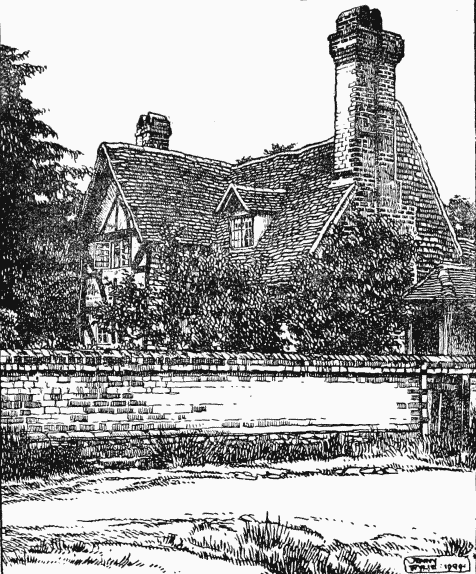
Wonersh: The Post-office, Shamley Green
The churchyard is closed to interments. The cemetery, between the village and Blackheath, was given by Mrs. Sudbury of Wonersh Park in 1900. Burials previously took place in the new churchyard at Shamley Green.
There is a Liberal club in the village.
Among the many interesting old cottages and houses in the village are two or three with very perfect half-timber fronts, having projecting upper stories showing the ends of the floor-joists, with boldly-curved brackets, or jutty-pieces, at intervals, ogee-curved braces, and in one case a recessed centre flanked by projecting wings, of which one has been removed recently. Several good chimneys of various patterns are noteworthy. On the eastern side of the village is a good example of early 18th-century architecture with hipped roof and sash windows.
Shamley Green, an outlying hamlet, contains a most interesting collection of old houses and cottages, some of which have evidently seen better days. The post-office (fn. 6) presents a charming study in roof-lines, and has a fine pair of chimneys and a timber-framed gable of very sharp pitch, filled in with brick. This gable possesses a good foliated barge-board of early character, very like one in the rear of West Horsley Place and another at Alfold. At the top of the Green is another good timber house with a projecting gable with a moulded bressummer on brackets and a barge-board of tracery work in the form of small quatrefoils pierced through the solid board. There is a good chimney, rising from the ground, with moulded brick bases to the shafts of the flues. More interesting still is a house with a half-timber front, a good projecting window, and a fine chimney. On the left side of the front is a wing of rubble and brick with tile-hung gable; the centre braces and a gable on the right are framed in squares, with braces cut into ogee curves. (fn. 7) The gable is framed on a bressummer, and has a bold projection on spurs or brackets, the soffit being coved in plaster with moulded wooden ribs. The curved braces occur in the gable-end also, and the gable is framed with a rich barge-board of pierced quatrefoils set in moulded circles, resembling that in the before-mentioned example. In the apex of both gables is a clever arrangement for concealing the junction of the two sides of the barge-board. The story beneath this gable rests upon an elaborately moulded joist-board or bressummer. The ground story has been built out in brickwork. This house may date from about 1500. (fn. 8)
Wonersh Park is a beautifully-timbered park through which runs a small stream. It formerly belonged to Richard Gwynn, who died in 1701, aged seventytwo. (fn. 9) His heiress was Susan Clifton, whose daughter and heiress Trehane married in 1710 Sir William Chapple, serjeant-at-law in 1723, who became a judge of the King's Bench in 1737 and died in 1745. He probably rebuilt the house. Sir William's eldest son, William, is said (fn. 10) to have been unmarried. In the Wonersh Registers his marriage is entered, but is erased with such success that though his name and parentage are legible that of the lady is entirely gone, and the details of the probable mésalliance are consequently lost. All Sir William's sons died without issue, except one, whose two daughters predeceased him. His surviving daughter Grace therefore became his heiress, and married in 1741 Fletcher Norton of Grantley in Yorkshire, who was Solicitor-General in 1761, Attorney - General in 1763, Speaker of the House of Commons 1770, being then M.P. for Guildford, and was created Lord Grantley in 1782. His family held Wonersh Park till 1884, when it was sold to Mr. Sudbury, husband of Mrs. Sudbury, the present owner. The house contains some pictures of note, and is a good example of early 17th-century architecture, inclosing the remains of a much older house. On the floor above the state rooms is a long gallery, and the staircase is so placed as to suggest its being part of the original plan. The western wing contains a fine suite of reception-rooms. Sir Fletcher Norton added a library and billiard-room of noble proportions, and further additions in the shape of an eastern wing were made about 1836.
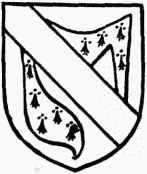
Norton, Lord Grantley. Azure a sleeve ermine with a bend gules over all.
The 'Grantley Arms' public-house is a fine old timbered house, with curiously arched wooden heads to the gable windows. It may be of 15th-century date in part. Plunks, another early house, has a double-gabled front, dating from the end of the 15th or the beginning of the 16th century. There is a quatrefoil barge-board here also, and doubtless good half-timber work is behind the present plaster face. The joist-board, of good section, is also a noticeable feature. The rear of the house is of more ordinary character, but a picturesque medley of roofs, gables, and chimneys.
Other old cottages and houses lie scattered around the lanes and hamlets in Wonersh parish, including good cottages at Blackheath; a long timber farmhouse at Halldish, or Aveldersh; Northcote Farm, Hull Hatch, an old timber-framed house, and Reel Hall.
The schools (National) at Norley Common were built in 1840 and enlarged in 1884. The infant school at Lawns Mead was opened in 1890, that at Blackheath in 1892.
The ecclesiastical parish of Shamley Green was separated from Wonersh in 1881. A Congregational chapel was built there in 1870.
Wood Hill, in the same parish district, is the residence of Captain Sparkes, R.N., C.M.G., J.P., one of the principal landowners in the whole parish. Longacre is the residence of Sir Charles Crosthwaite, K.C.S.I.; Willinghurst of Captain Ramsden, D.L., J.P.
The original Wonersh Schools, built in 1840, are in this part of the parish.
MANORS
Wonersh is not named in Domesday. All the subsequent manors were included in the manors of Bramley and Shalford.
TANGLEY or GREAT TANGLEY
TANGLEY or GREAT TANGLEY (Tangeley, xiii cent.) was originally parcel of the manor of Bramley. (fn. 11) In 1238–9 Walter of Tangley and his wife Maud were dealing with land in Worplesdon. (fn. 12) In the same years Ernald son of Richard of Tangley was proved to be nephew and heir of John of Burningfold. (fn. 13) This Ernald' held a messuage and a virgate of land in Bramley of William Brokere and his wife Edith. (fn. 14) About 1315–16 Sir Robert Fitz Pain held 'a tenement called Tangelee' by lease from Roland Vaux, who held it for life by right of his wife, then deceased. (fn. 15) Tangley then came into the possession of the Burley family. John Burley and his wife Agatha were dealing with land in Wonersh, and the service of Richard Tigenor, William Loxley, and others in 1367–8. (fn. 16) In 1542 another John Burley and his wife Katherine were seised of Tangley. (fn. 17) In 1545 John Burley entailed the reversion of it, after the death of himself and his wife Sybil, on Richard Carrill of Bramley. (fn. 18) John son of Richard Carrill inherited the manor after the death of Sybil, who survived her husband. (fn. 19) Thenceforward its descent is identical with that of the Carrills' manor of Bramley till 1677, when, at the partition of John Carrill's estates, it was assigned to his daughter Lettice, wife of John Ramsden. (fn. 20) In 1693–4 they sold it to John and Leonard Child. (fn. 21) In 1759 John's greatgrandson Charles Searle sold the manor to Sir Fletcher Norton, (fn. 22) with whose estates it has since descended. (fn. 23)

Burley. Sable a chief argent three tilting spears palewise counter-coloured.
In 1808 court leet and court baron are mentioned as appurtenant to the manor. (fn. 24)
The manor-house, where Hester wife of John Carrill lived during her widowhood, (fn. 25) is very ancient. It lies in the northern part of the parish, and has been made the subject of innumerable paintings, and has also been well described and illustrated. (fn. 26) The moat by which the present house is surrounded would appear to have been intended for purposes of defence as well as to drain away the water from the house, which lies somewhat low. Remains of stone buildings have been discovered. Within late years the house has twice been enlarged, having been rescued by its late owner, Mr. Wickham Flower, from the somewhat neglected state into which it had sunk as a mere farm-house, and surrounded by flower-gardens and covered walks. The south front, built in 1582 by John Carrill, can challenge comparison with any ancient house of its class in Surrey. This is not, however, the earliest part of the house: although subdivided into three floors in 1582, the hall, of the middle of the 15th century, with its original open roof, remains. It was of four unequally spaced bays, and the framed principals of the roof can be seen in the bedrooms. They consist of heavily-cambered tie-beams, 1 ft. 8 in. deep in the centre by 10 in., having under them a four-centred arch of solid timber, 4 in. thick, serving as braces to the massive story-posts, 10 in. by 9 in., on which the beams rest. A short king-post, with an arched brace 3 in. thick from each face, rises from the centre of the beam to support the collar and leon beams. The width of this hall was 20 ft., and its length, including the musicians' gallery, which was built out as an upper floor over the entry or vestibule, 29 ft. This hall, as was commonly the case, must have had a central hearth, the smoke from the wood fires finding its way out at the upper windows, or through a louvred turret in the roof. The original front door still remains. Doubtless there were various outbuildings and offices, beside double-storied wings with parlours and sleeping apartments, which have been either removed to make way for the later additions, or so masked as to be indistinguishable from them. The new front of 1582 was built on in advance of the old hall. It is of two stories, and its elevation consists of two gables of unequal size with a smaller gable between, below which is the porch entered by a wide doorway, having a fourcentred arch. The most interesting features of this front are the barge-boards with moulded hip-knobs, or pendants, at the apex; the overhanging upper stories; the mullioned and transomed oriels and other windows, some on carved brackets; and the 'square and circle' patterns of the timber framework. The latter is in some cases enriched with shallow carving of fleursde-lys—a very rare feature in half-timber treatment. Many other details worth notice might be cited, such as a doorway in the garden wall, chimneys (one with a crow-stepped base), panelling, doors, and internal fittings. It is now the property of Colonel Kennard.
LITTLE TANGLEY
LITTLE TANGLEY was assigned to Elizabeth Ludlow at the partition of John Carrill's estates. (fn. 27) After her daughter Elizabeth's death it was sold to William Hammond of Bramley. (fn. 28) It is now the residence of Mr. Cowley Lambert, F.R.G.S.
The reputed manor of CHINTHURST (Chilthurst xvi cent.) formed, together with a moiety of Loseley, the dower assigned to Thomasine widow of William Sidney by his son William in 1452. (fn. 29) It had then lately been held by John Hover. It passed with Loseley to Sir Christopher More in 1532, and descended to his son (fn. 30) William More of Loseley, who exchanged it in 1557 for Polsted Manor in Compton with John Wight and his wife Agnes. (fn. 31) John Wight, a descendant of this John (see Artington), sold the manor to John Sparkes of Gosden in 1791. (fn. 32) The manor was then held successively by his son and grandson, both being his namesakes. (fn. 33) It is now the seat of Mr. W. V. Cooper.
HALLDISH
HALLDISH is a small farm in Shamley Green. In the 14th century indulgence was granted to Bartholomew of 'Haveldersh' and his wife Joan, who were buried in Wonersh churchyard. (fn. 34) In the 17th century it was in the possession of the Duncombe family, and descended with Weston in Albury to Nathaniel Sturt and his wife Anne. (fn. 35) Their grandson, the Rev. George Chatfield, was owner in 1808. (fn. 36) It was purchased before 1841 by Henry Drummond of Albury, (fn. 37) and belongs to the Duke of Northumberland his grandson.
Green Place, the present residence of Mrs. Leighton, was reported in the 17th century to have been ' sometime a fair and large house now ruinated,' and formerly the property of Baron Roos. (fn. 38) It was the property of the Elyots, afterwards of Busbridge, in the 15th century. (fn. 39) Thomas and Henry Elyot have brasses in Wonersh Church.
LOSTERFORD
LOSTERFORD in Wonersh is called a manor in the 16th century. In 1547 John Scarlet died seised (inter alia) of the manor of Losterford, held of the Countess of Southampton (Fitz William) as of the manor of Shalford Bradestan. (fn. 40) He left a son John aged seven years and upwards. In 1576 Thomas Paston bought a moiety of the manor of Losterford and Wykes of John Scarlet. (fn. 41)
In 1579 William Tycknor bought the manor of Losterforde alias Lastarforde of Nicholas and Thomas Parson, no doubt the same as Paston above. (fn. 42) Losterford House is now the residence of Colonel Cust.
ROWLEYS
ROWLEYS, another reputed manor, was bought by Robert Harding, goldsmith, in 1508, of Humphrey Sydney. Robert's son William had a daughter Catherine (see Bramley), who married Richard Onslow, in whose family Rowleys descended, (fn. 43) till in 1806 the Earl of Onslow sold it to Richard Sparkes, (fn. 44) who was succeeded by his son John Sparkes. (fn. 45)
CHURCHES
The church of ST. JOHN THE BAPTIST is approached by a short lane from the village street, through iron gates in the lofty inclosing wall of Wonersh Park, its churchyard adjoining the park. The churchyard is surrounded by noble old trees and is beautifully kept.
The old parts of the church are built of ironstone rubble, conglomerate, chalk rag, Bargate rubble and other materials, with hard chalk or clunch for the dressings and a good deal of what seems to be Caen stone in the inside of the chancel and north chapel. The roofs are tiled. The nave and south aisle (thrown into one area and under one roof) and the transeptal chapel on the south were largely rebuilt in 1793 by the then Lord Grantley—it is said from plans by his butler—in red brick and in the plainest sort of meeting-house style.
In the alterations of 1793, the end of the chancel was cut off so as to make it coterminous with the transeptal chapels, a small alcove being built out to contain the altar. In the recent restoration (1901–2) some of the worst of these mutilations were undone, the chancel being extended to what was probably its original length, and the north chapel or chancel aisle, which had also been reduced in length, prolonged eastward on the old foundations.
The present dimensions therefore are:—nave 39 ft. 6 in. by 20 ft., or, with the space that originally formed an aisle on the south, 30 ft. 6 in. in width; chancel, 32 ft. 5 in. by 20 ft. 3in.; north chapel, 21 ft. 5 in. by 14 ft. 5 in.; tower, on the north of the nave, opening into it and into the chapel, 13 ft. 9 in. by 13 ft. 5 in.; and south chapel (now used as organ-chamber and vestry), 21 ft. 3 in. by 18 ft.
The tower, somewhat unusually placed on the north side of the nave at its eastern end, (fn. 46) and with its western wall askew, is in three stages, the topmost, which is embattled and contains the bells, being an addition of 1751, and taking the place of a shingled spire. The upper stage is of brick and rubble, with broad brick string-courses and wide, round-headed, louvred openings. A peculiarity of the lower stages is that there are no dressed stone quoins to the angles, which are formed of thin layers of ironstone rubble, the construction resembling that of the late 12th-century church at Wisley. As however, all the openings are later insertions, it is difficult to pronounce with certainty as to its date: but it seems to have been built up against a nave of pre-Conquest date, in which traces of round-headed windows finished in plaster were discovered in 1901. This nave was probably that of the chapel built in pre-Conquest times, or at any rate before the close of the 11th century. The early windows were not preserved at the restoration. Until the early years of the 13th century this tower was detached on three sides. It opens into the nave by a plain squareedged pointed arch, having chamfered abaci, and this may date from about 1180. Early in the 13th century the chancel was also rebuilt, on a much wider and larger plan. The fine lofty chancel arch, of unusually bold span, shows by its mouldings that it was executed about 1220, and there are the outlines of three blocked lancets in each of the side walls of the chancel, a piece of string-course on its north wall, and remains of a low side window or priest's door on the south, which agree with that date. At about the same time the lancet that lights the ground story of the tower was inserted, replacing perhaps a smaller and earlier opening.
Towards the close of the 13th century a chapel was thrown out on the south of the chancel, and as evidence of this the arch of communication between the two, with characteristically moulded capitals, remains. The piers and arch are of the same section, of two orders with narrow chamfers, and the capital is really no more than an impost moulding breaking their junction. Nothing but this arch remains of the chapel, which was rebuilt in brick in 1793.
In about 1400—perhaps slightly earlier—a corresponding chapel was made on the north side, opening to the chancel and tower by somewhat elaborately moulded arches, of two orders, with shafts having moulded capitals and bases. A good image-niche of this period, with ogee cinquefoiled head and carved brackets, remains high up in the south wall of this chapel, and hard by is a roughly formed squint having a piscina in its sill; while eastward of both on the chancel side is a door, low in the wall, with a flight of steps leading to what was perhaps a charnel behind the altar, paved with tiles of various dates. This is shown in an 18th-century engraving as having a low lean-to roof of stone, just above the ground, with two small lancet slits under gablets abutting against the east wall of the chapel. This curious and rare roofing was destroyed in 1793. Another curious doorway, also of this period, now blocked, is set beneath the lancet window in the north wall of the tower. It also is very low down in the wall and is planned to open outwards: the head is pointed within a square, with a shield and foliage in one spandrel: its presence here is hard to explain, but probably it was merely inserted in the 18th century, being brought from elsewhere in the church, as Cracklow's view shows a small porch, now no longer existing, against this wall of the tower. The door to the rood-loft, also of 15th-century date, is visible, its sill being at a height of some 8 ft. from the floor, in the south wall of the tower, close to the west face of the chancel arch; and on the opposite side, against the east wall of the nave, is some wrought clunch, which has formed the jamb of an opening at the corresponding level through the south wall of the nave. This wall, with its arcade to the aisle, was removed when the nave was gutted in 1793. A lancet to the west of the tower in the north wall appears to be modern, and the only ancient feature in this wall is a large embattled corbel, set at some height above the floor towards the western end. The soffit of the chancel arch retains a groove for a boarded tympanum, which originally formed a background for the rood and attendant images.
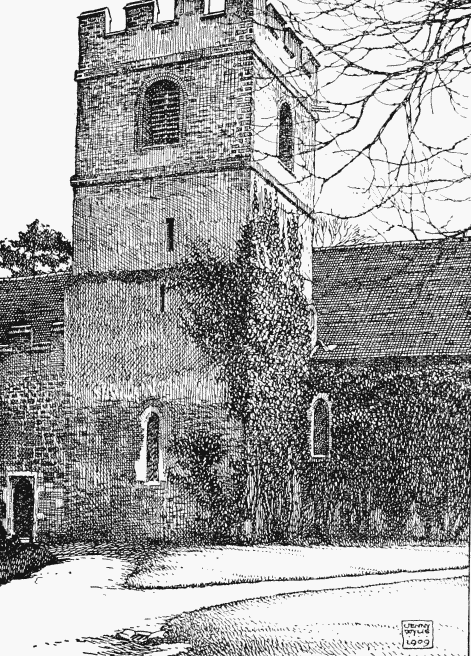
Wonersh Church from the North
The modern extensions of the chancel and north chapel are in excellent taste and in general conformity with the old work: they include a fine east window, piscina, and sedilia, new windows in the chancel and north chapel, and a door in the latter.
In 1793 the nave and the space formerly occupied by the aisle were re-roofed under one span, with great queen-post trusses, and the whole ceiled. The ceiling has now been removed, exposing the somewhat naked constructional timbers. The roofs of the chancel and north chapel are modern (except for a moulded beam, of 15th-century date, in the former, which, however, appears to have crowned a screen or rood gallery), and are elaborately ornamented with bosses, on which are carved sacred emblems, shields of arms, &c., the whole being coloured and gilt. The painted glass is all modern and exceptionally good, especially that in the east window of the north chapel, with figures of St. George and St. Alban. A few slight traces of mediaeval colour decoration remain, as on the voussoirs of the chancel arch. The altar-pace in the north chapel is paved with old tiles dating from the 13th to the 15th centuries. The chancel is paved in black and white marble, laid in squares and patterns, and the sanctuary is raised three steps above the nave. The chapel altar is brought forward to allow of the passage way behind it. Both the chancel and chapel altars have stone slabs, incised with the five crosses, on wooden framework, that of the high altar being handsomely carved in several woods. The chancel seats are elaborately carved in oak, with figures of saints as finials to the stall-ends, and the nave and tower are seated with benches in elm, very beautifully figured. There are one or two pieces of old oak beams lying in the 'crypt' passage behind the chapel altar, and within the arch to the south chapel is a good plain oak screen of 15th-century date, having moulded work, but no tracery. This has been copied in a modern screen in the opposite arch. There is a fine old Flemish chandelier hanging in the centre of the chancel, and in the north chapel is a pair of Georgian altarcandlesticks.
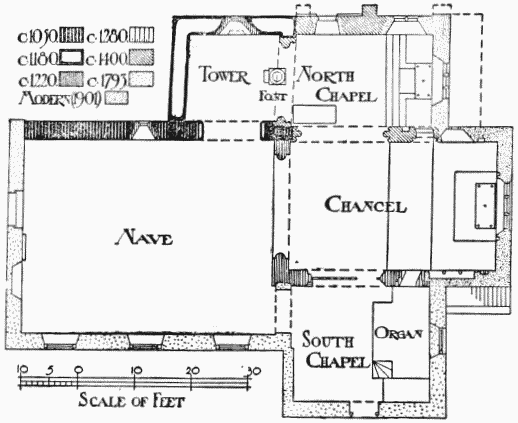
Plan of Wonersh Church
The font, of cup-shaped bowl, stem and base, is a restoration in sandstone, incorporating a curious band of ribbed work in a coarse grit-stone below the bowl, which, from its archaic character, may be of pre-Conquest date. This font was found buried beneath the floor at the restoration.
In the nave, aisle, and chapels are a few old slabs and ledgers, some with armorial panels. There is a large Purbeck marble altar-tomb in the north chapel, of 15th-century date, probably that of the founder of the chapel, but without name or inscription of any kind. Its sides are ornamented with quatrefoiled tracery panelling and shields, originally filled with coats-of-arms in latten, but these have all disappeared. An earthenware jar, now in the vestry, was found under the floor near this tomb. It is said that the person interred in the tomb was embalmed, as the cassia used in the embalming still exudes from the tomb in damp weather. In the south chapel, now the vestry, is another altar-tomb with a marble slab to the memory of Robert Gwynn, a 'Filezar of London,' with a fine heraldic panel and the date 1701. Built into the west wall of the nave are the fragments of a fine Elizabethan mural monument, with cornice pilasters and a foliaged scroll-work panel of good design: the inscription is missing. One of the grave-slabs, now missing, recorded the death of one of the Carills of Tangley, and the rhyming epitaph ended with the line, 'Caryll sings carols in the heavenly quire.'
On the floor of the chancel is a brass with figures of a civilian and wife and an imperfect inscription to 'Thomas Elyot de Wonersh' and his wife Alicia, dated 146—. Another, with figures of a civilian and lady and groups of twelve sons and eleven daughters, bearing date 1503, is to Henry Elyot and Johanna his wife. Within the chancel rails are two small brass inscriptions, to Elizabeth, one of the daughters of Thomas Blennerhayset, 1513; and to Elizabeth, daughter of Henry Bossevile: 'who died the 9 daye of February 1578, beinge 27 dayes olde."
Some of the tool marks on the 12th and 13th century arches are very well preserved, and on the arch between the tower and the nave is a dial, or incised circle.
The bells are modern.
Among the church plate are a silver cup and cover, with the usual band of arabesque foliage round the bowl of the latter, and the date 1569, with the corresponding hall-marks. Another silver paten bears the hall-marks of 1811, with the inscription— noteworthy for the date:— 'Ut dignius celebretur Eucharistia in Eccl. par. de Wonersh in Co[mitatu]. Surriensi, haec Patina Deo dicata est A.D. 1812. Gulmo H. Cole Vicario. J. Sparkes et E. Chitty Sacrorum Custodibus.'
The registers date from 1539.
Christ Church Shamley Green was built in 1864 as a chapel of ease to Wonersh. It is in the 13th-century style, of sandstone with a west turret and spire.
On Blackheath is a chapel of ease to the parish church. It is built of stone in Italian Gothic or Romanesque style.
ADVOWSONS
The church of Wonersh was formerly a chapel of Shalford, and as such was in the presentation of the king. (fn. 47) In 1304–5 Edward I granted it to the Hospital of St. Mary without Bishopsgate and called it a church in his charter. (fn. 48) The Prior of St. Mary held the advowson till the Dissolution, when it came into the hands of the Crown. (fn. 49) In 1590 Queen Elizabeth granted it with Shalford rectory to her secretary Sir John Wolley. (fn. 50) His son and heir Sir Francis Wolley died holding the advowson in 1609. (fn. 51) George Duncombe was dealing with it in 1650, Roger Duncombe in 1677, and George Duncombe in 1693. (fn. 52) In 1765 George Duncombe sold it to Sir Fletcher Norton, whose son, William Lord Grantley, held it in 1808. (fn. 53) It was acquired by Lord Ashcombe after the sale of the Grantley estates, and presented by him to Selwyn College, Cambridge.
Shamley Green was formed into a parish from Wonersh in 1881. (fn. 54) The living is in the gift of Lord Ashcombe.
CHARITIES
Smith's charity is distributed as in other Surrey parishes. Mr. John Austen of Shalford left money for poor relief in 1620. Mr. Henry Chennell of Wonersh left land, the produce to be devoted to putting six poor boys to school, in 1672. Mr. Gwynne of London gave land and bank stock, in 1698, to put four poor boys to school and to distribute bread to fifteen poor persons every Sunday after service.
The charities are now (1908) being amalgamated under a scheme by the Charity Commissioners.